Category: Weather

  • No, it’s not going to snow on Thanksgiving in Philly, but a taste of winter is coming

    No, it’s not going to snow on Thanksgiving in Philly, but a taste of winter is coming

    The snow rumors notwithstanding, the Philadelphia region and most of the rest of the Northeast can pretty well rule out a white Thanksgiving, nor will Black Friday turn white.

    However, the upper atmosphere evidently is in a state of upheaval with a potentially rare event unfolding, and forecasters say something resembling winter may arrive around here before the holiday weekend ends.

    The National Oceanic and Atmospheric Administration’s Climate Prediction Center has chances favoring below-normal temperatures and above-normal precipitation from Thanksgiving Day through Dec. 1.

    However, the meteorologists who have grappled with longer-range outlooks are cautioning against taking social media snow forecasting too seriously.

    “The observed snowfall is inversely proportional to the hype,” said Judah Cohen, research scientist with the Massachusetts Institute of Technology. He is among those who have noticed the snow mentions that have popped up on X accounts and popular websites.

    The next week should generally be uneventful save for rain Tuesday night possibly into getaway Wednesday, when highs are forecast to reach the 60s.

    Then a developing pattern change is predicted to import colder air into the Northeast. “I do believe it will get colder as the Thanksgiving week wears on,” said Bob Larson, senior meteorologist with AccuWeather Inc.

    A rare event may chill December

    What has the attention of Cohen and others in the meteorological world is the potential for a “major” stratospheric warming event in the upper atmosphere over the Arctic sometime in the next several days, a disruption that could allow significant cold air to pour into the United States.

    Major events have occurred on average about six times a decade, according to NOAA researchers; however, having one so early would be a rarity.

    If one occurred, it would be only the second time in records dating to the early 1950s that it has happened this early, said NOAA meteorologist Laura M. Ciasto.

    While computer models have been debating over just what is going to happen, Cohen, chief of seasonal forecasting for the Janus Research Group, said that such an early date has given him pause about forecasting it will happen.

    What causes a stratospheric warming event?

    On occasion, upward-moving waves from the troposphere, 5 to 9 miles over the Arctic, crash into the stratosphere, 10 to 30 miles up. That has the effect of compromising the polar vortex, the west-to-east winds that lock cold air in the places where the sun disappears for the winter, Ciasto said.

    When the winds slacken, the vortex can weaken and allow frigid air to spill southward. In some cases it might “stretch,” or split into pieces that deliver cold air to regions of the Northern Hemisphere.

    A major disruption would have longer-lasting impacts, Cohen said.

    The European forecast model has consistently predicted a major event, Ciasto said, while the U.S. model has not been as impressed.

    What is likely to happen if the warming event occurs?

    A major warming in January 2021, when temperatures in the stratosphere suddenly jumped 65 degrees Fahrenheit, resulted in quite a snowy February in the Philadelphia region.

    After a warming event, “there’s a greater chance that the jet stream will become more disrupted and dip down” over the continuous United States, Ciasto said, “bringing cold air with it.”

    As for timing, the effects may show up anywhere from two to several weeks after the event.

    In the meantime, she noted that “several other factors,” including patterns over the North Pacific, favor a chilling for the Northeast.

    Don’t be surprised to see snow appear in an actual forecast, but not necessarily on the ground.

  • What to expect for the Philadelphia Marathon weekend weather forecast

    What to expect for the Philadelphia Marathon weekend weather forecast

    Assuming the sports scientists have it right, the temperatures should be near the performance sweet spots for the runners participating in the Philadelphia Marathon Weekend races on both Saturday and Sunday morning.

    At showtimes, 6:55 a.m., just moments after daybreak, temperatures Saturday are expected to be in the upper 40s to near 50 degrees for the half-marathoners, and in the upper 30s to around 40 for Sunday’s main event.

    Light rain is expected through the early-morning hours Saturday, and forecasters have been on the fence about when it will shut off. Nick Guzzo, a meteorologist at the National Weather Service said Friday afternoon that rain was likely at the start of the race, but that probabilities would drop precipitously once the event was underway.

    AccuWeather Inc. and weather.com were posting about a 50-50 shot that the rain would continue through the morning. The hedging isn’t surprising; timing the onset and end of precipitation has been a longstanding forecast problem.

    Nor would it be surprising for those running the 13.1-mile race to experience conditions different from those logging 26.2 miles the following day, points out Kathleen Titus, the race director and runner who has been involved with the marathon for 20 years.

    This time of year is a busy one for frontal passages, this being a transition period when the atmosphere isn’t quite sure what season it wants to be. The temperature has reached 74 degrees on Nov. 22 (1883), and plunged to 14 (1880), and snowed 4.6 inches on Nov. 22-23, 1989.

    However, nothing momentous is expected this weekend.

    Like the rains, winds are forecast to be light, under 10 mph, from the north on Saturday, and northwest on Sunday, although runners allow that on the course, the wind can be way more capricious than the temperatures.

    Why runners like these temperatures

    Various studies have concluded that temperature is the most important weather variable in runner performance and that the ideal range for marathoning is 39 to 50 degrees Fahrenheit — give or take a few degrees.

    “Your body is always competing between a couple of different things,” said Philip Skiba, sports medicine specialist at Thomas Jefferson University Hospital, who helped train Eliud Kipchoge, the Kenyan who became the world’s first runner to complete a marathon in under two hours.

    During exercise, muscles demand blood to work, while for the body to stay cool, blood has to flow to the skin. If it’s too hot, more blood flows to the skin. When it’s cold, blood is diverted to heat the body’s core.

    With temperates in that 39-to-50 range, the blood flow can more easily serve both the muscles and skin. Said Titus, racers love that temperature range because, “It regulates your body. It just works.”

    Skiba said the temperature ranged from 51 to 55 degrees on the October 2019 day Kipchoge broke the two-hour barrier in a Vienna event that wasn’t held under record-eligible conditions.

    Had the temperatures been lower, Kipchoge could have shaved a few more seconds off his time, Skiba said.

    The wind also is a player in marathons

    While not as dominant as temperature, “wind resistance … is worth a few seconds per mile,” said Skiba, a former triathlete.

    “The more you stay out of the wind, you can save considerable energy,” he said.

    “It’s really important to learn how to draft,” that is, get behind a group running close to your pace and using them for wind-breakers, he said. (Not sure how the wind-breakers feel about that.)

    On the Philly course, the winds can be wild cards, especially on Kelly Drive, Titus said.

    One instant, the wind “hits in your face. Now it’s at my back!”

    Titus said she actually likes running uphill into the wind — and she is believed to be a member of a distinct minority — but agrees that “it is nice to have it at your back when you’re coming into the home stretch. Because it does give you a little boost.”

    The Philly Marathon is holding out hope for a record

    Titus said she is hoping for a record this year, unrelated to race times.

    She encourages people to overdress to stay warm before the running gets underway, and to be liberal about peeling off layers during the race.

    The shed garments are collected and given to the Salvation Army.

    “We’d love to break some record in the clothing donation,” she said.

  • A storm looms in what’s going to be another rough week for Jersey beaches

    A storm looms in what’s going to be another rough week for Jersey beaches

    New Jersey’s beaches, still recovering from major sand losses from an offshore hurricane and a nor’easter, evidently are in for another assault this week as October is about to make a dramatic exit.

    Gale-force gusts off the ocean could develop as early as Tuesday afternoon at the Shore, said Eric Hoeflich, a meteorologist at the National Weather Service office in Mount Holly, with brisk onshore winds persisting “maybe into Friday.”

    A potent storm is forecast to affect the entire region Wednesday night into Thursday, with heavy rains in the immediate Philadelphia area, where drought conditions have been intensifying.

    Also on Thursday, what is likely to become catastrophic Hurricane Melissa will be passing offshore, churning up the waves crashing on East Coast beaches.

    “The coast once again is going to take a pretty good battering,” said Dave Dombek, senior meteorologist with AccuWeather Inc.

    On the plus side, Hoeflich said, for the Shore, this week’s storm “doesn’t look as bad” as the beach-erasing nor’easter earlier this month. The path should be more inland, and the lunar influence on the tides would be less. Only minor flooding is expected, he said, subject to change.

    However, not only would the track mean region-wide heavy rain, but it would also increase the potential for severe thunderstorms Thursday. A front is due to chase the rains Friday, but it may generate gusts to 50 mph, the weather service says. Power outages are possible both days.

    The timetable for the winds and the storm in the Philly region

    The National Weather Service has posted a gale warning for Tuesday into Wednesday morning for the waters along the immediate coast for winds from the east that could gust past 50 mph.

    That would be more the result of high pressure to the north of the region. Winds circulate clockwise around centers of highs; thus, areas to the south of the center experience winds from the east.

    The breezes will be getting a second wind as a storm develops in the Southeast and tracks north. Meanwhile, a weakened Hurricane Melissa will be churning the ocean as it passes well off the U.S. coast on Thursday.

    The Philly region could use the rain

    The interagency U.S. drought monitor has the majority of the region in its “moderate drought” category.

    Rain for the last 30 days has been about a third of normal in the city and the neighboring Pennsylvania counties.

    South Jersey has fared only slightly better, but precipitation is well less than half of normal.

    What is the forecast for the trick-or-treaters?

    It is all but certain that Friday will be a dry day, with temperatures in the low and mid-50s. Wind gusts are forecast to die down sometime after 5 p.m., but hold onto those brooms, just in case.

  • Frost advisories are posted as Philly has its chilliest spell in six months

    Frost advisories are posted as Philly has its chilliest spell in six months

    Frost advisories are up for Friday morning for areas just outside Philadelphia on both sides of the Delaware River as the region is about to experience its chilliest spell in more than six months.

    While the urban hotplate areas of Philly and Delaware County were not included in the National Weather Service advisory zones, cooler areas of the city and Delco could see some patchy white.

    “It is certainly possible,” said Zachary Cooper, a meteorologist at the agency’s Mount Holly office.

    Conditions conducive to frost — relatively clear skies, temperatures in the 30s, and light winds — may whiten the pumpkins in the region through the weekend.

    As per standard procedure, the weather service will be issuing frost advisories until the end of the growing season, defined as the first time temperatures reach 32 degrees or lower in a given area.

    It won’t be freezing, just frosty

    Philly’s first freezing reading typically doesn’t occur until mid-November, but frost can form with temperatures above 32.

    The air temperatures are measured about six feet off the ground, but they can be several degrees lower on the ground and on cooler surfaces.

    When winds are calm, they keep the air from mixing, and that allows thin layers of colder air to develop at ground level.

    The winds won’t be completely calm Friday morning, but “they should be light enough for favorable” frost conditions, the weather service said.

    The dry spell in the Philly region continues

    Temperatures should be several degrees below normal into next week, with highs mostly in the 50s and lows 35 to 40 degrees, the weather service says.

    Notably absent from the extended outlook is precipitation. Officially, at Philadelphia International Airport, only 0.81 inches of rain have fallen this month. That’s less than a third of normal.

    Most of the region is in “moderate drought,” and remaining areas are “abnormally dry,” according to the U.S. Drought Monitor’s Thursday update.

    That could change the middle of next week, as computer models have been hinting at an active pattern.

    However, this should be a splendid weekend to get out and enjoy the burgeoning foliage show.

  • Winter weather is on the way: Tips to prevent frozen pipes, safely heat your home

    Winter weather is on the way: Tips to prevent frozen pipes, safely heat your home

    When it gets colder, it’s not only important to be mindful of your pets and your plants but also your home’s pipes and water heater.

    Yes, those inanimate objects need extra care, too.

    As temperatures drop across the region, the risk of your home’s pipes freezing increases. There are steps, however, that homeowners can take to help stop that from happening and help you avoid a hefty plumbing bill this winter.

    Here’s a list of plumber-approved tips on how to keep a pipe from freezing, spotting a frozen one, and what to do if it bursts.

    How to prevent your pipes from freezing

    “It comes down to three main things: draining outside faucets, keeping pipes warm, and checking for leaks,” said Vincent Thompson, owner of Thompson Plumbing and Heating. Thompson is a master plumber of more than 50 years and for two decades taught plumbing at Dobbins Vocational School in North Philadelphia.

    💧 Draining outside faucets

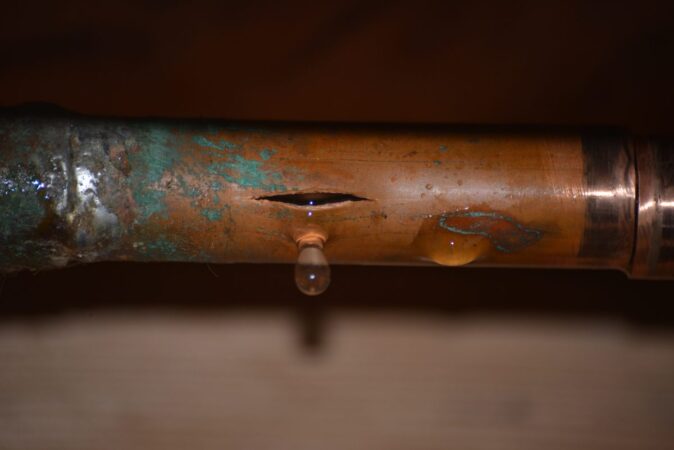
    Over the summer, we use outside faucets and hoses to water the plants, rinse of sidewalks, or simply cool down. When the temperature dips, water can freeze and build pressure, ultimately causing a burst pipe, a situation far too common, according to Thompson.

    He recommends disconnecting your hose (and storing it for the winter), shutting off the valve that feeds the faucet or spigot (usually found near the hot water heater), and letting the remaining water in the pipe drain out. You can leave the faucet or spigot slightly open, according to Thompson. Letting the faucet drip is also a good suggestion for inside fixtures.

    “If it’s empty, it’ll never freeze,” Thompson said. “But if there’s water, it can expand and explode. Then you’ll come out in the spring to use your hose and the water will be shooting out of the wall.”

    🌡️ Keep your pipes warm

    When the freezing weather descends upon us, we bundle up to stay warm. Pipes need that treatment too. Ideally, the lowest you want to keep your thermostat set at is 50 degrees, but heating is expensive. According to Thompson, the absolute lowest you can go is 40 degrees, because your pipes will start freezing at 39 degrees.

    Opening the cabinets underneath your bathroom sink can be a good way to keep pipes from getting too cold. And for the ones in extra-cold spots, using electrical heating tape or fitting them with foam and rubber sleeves is a good idea. Be sure to check for any leaks beforehand, because if water is accumulating, they won’t prevent a pipe from bursting and it will become an added step.

    🚽 Check for leaks

    “Every drop that goes down the drain will turn into an icicle and eventually can clog up the entire soil stack,” explained Thompson. Not addressing it can result in frozen pipes, flooding, and even water backing up through your toilet.

    After 50 years of handling these cases, he advises looking at your water meter because sometimes the leak might not be obvious. Make sure no water sources are open, and look at the blue or red triangle (depending on your meter). If it’s turning that can be a sign of a leak.

    If you suspect the culprit is your toilet, he recommends adding a couple of food dye drops into the tank. If the water in the bowl changes color, your suspicions are correct.

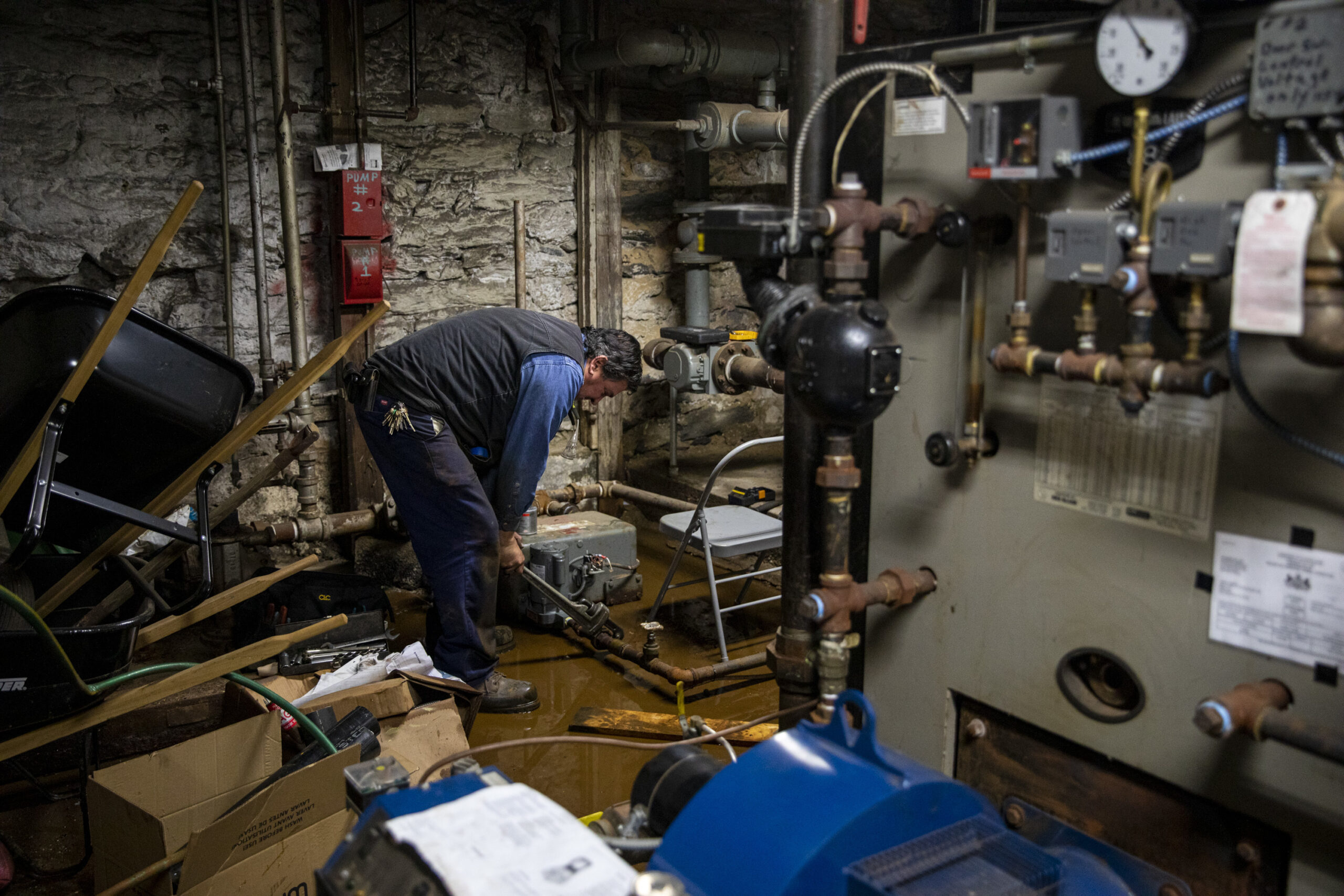
    Andrew Gadaleta, contractor, works on getting the heat fixed at Visitation BVM School in Philadelphia in December 2021 so that students could return to school. Thieves broke into the school Tuesday morning, ripping copper pipes from the walls that caused flooding. The water rendered the school unusable for a week.

    How to spot a frozen pipe

    Your house is filled with water pipes, and while it’s not hard to figure out when you’re dealing with a frozen pipe, it can be tricky to figure out where the frozen section is. If you turn on a faucet and nothing comes out, you’re going to have to do a little detective work.

    The first step should be to try all the other faucets in your house. If all the faucets in a room aren’t working, the freeze is likely in a split from the main pipe. If all the faucets on a floor aren’t working, the freeze is likely between where the first- and second-floor pipes separate. If all the faucets in your house aren’t working, then the freeze is probably near where the main pipe enters the house.

    The frozen section of the pipe, if exposed, will sometimes have condensation over it. You’ll also be able to tell that it’s colder just by touching it.

    How to thaw a frozen pipe

    Before thawing a frozen section of pipe, you should open the faucet to relieve the water pressure and allow the water to escape once it thaws. You should also begin the thawing process close to the faucet and work your way to the blockage. If melted water and ice get caught behind the blockage, the chance that the pipe will burst increases.

    One of the easiest ways to thaw a frozen pipe is with a hair dryer. You can also use hot towels or a heat lamp to warm up the pipe. Never use an open flame.

    What to do if a pipe bursts

    Don’t panic. The first thing you should do is shut off the main water line into your property. This will prevent your house from flooding. The main water valve is usually near your water meter. After you’ve done that, call your plumber. Locating and tagging the valve to your main water line ahead of time can help make the moment less stressful.