Category: Associated Press

  • Top auto regulator opens special probe after a Tesla slams into a Texas home, killing a woman

    Top auto regulator opens special probe after a Tesla slams into a Texas home, killing a woman

    NEW YORK — The top U.S. auto regulator opened an investigation Monday after a Tesla using an automated driving feature slammed into a Texas home at high speed and killed a 76-year-old woman standing inside.

    The National Highway Traffic Safety Administration said it’s opening a special investigation into the Tesla Model 3 crash on Friday near Houston, a significant probe because the car was using technology that Elon Musk considers key to the company’s future.

    The Tesla CEO is rolling out robotaxis using automated software in several U.S. cities this year and plans to invite Tesla owners to put their cars into the fleet using the same system across the country.

    The driver told the Harris County Sheriff’s Office that he was using the technology, according to a police report on the crash, but it’s not clear what role, if any, it played in the incident.

    Tesla did not respond to a request for comment but the head of the company’s artificial intelligence efforts suggested on social media later Monday that the self-driving feature was not to blame.

    “In this case, the driver manually overrode self-driving by pressing the accelerator all the way to 100% of the accel pedal in this residential area,” wrote Ashok Elluswamy on X, the platform that is now part of Musk’s rocket company, SpaceX. “They reached a speed of 73 mph during the crash, and had the accelerator pressed even after the crash.”

    The police report noted that the driver was not drunk and is cooperating. It identified the woman killed as Martha Avila.

    Video obtained by KHOU-TV shows the car traveling at top speed over the front lawn of a brick home in Katy, then ramming into a front room. The next shot shows the car encased in the home amid piles of crumbling plaster, split beams, and bits of furniture.

    The auto safety regulator, known as NHTSA, has launched several investigations into Tesla, including one late last year into 58 incidents in which Teslas reportedly violated traffic safety laws while using self-driving technology, leading to more than a dozen crashes and fires and nearly two dozen injuries.

    A few months earlier, the NHTSA opened an investigation into why Tesla apparently had not been reporting crashes promptly as required.

    As for special crash investigations, the NHTSA has opened 46 involving Teslas using self-driving or driver-assistance technology over the past decade, according to the agency’s records. In more than a dozen of those crashes, at least one person — a driver, passenger, or pedestrian — was killed.

    Tesla stock fell sharply early last year as car sales plunged amid a boycott of Musk after he waded into politics, leading President Donald Trump’s budget-cutting Department of Government Efficiency initiative and embracing European extremist candidates.

    Musk has since shifted the Tesla story to one less about car sales and more about AI and robotaxis, and done so successfully. The stock is up 16% in the past year. It closed down 5.8% Tuesday.

  • Supreme Court sides with Trump administration on immigration case dealing with green card holders

    Supreme Court sides with Trump administration on immigration case dealing with green card holders

    WASHINGTON — The Supreme Court sided with the Trump administration Tuesday in an immigration case dealing with the government’s power over green card holders accused of crimes.

    The 6-3 decision centers around an immigration officer’s 2012 decision to put lawful permanent resident Muk Choi Lau on immigration parole when he returned from a short trip to China because he had been accused of a counterfeiting crime.

    Lau argued that the officer overstepped their authority, and the decision wrongly allowed the Department of Homeland Security under then-President Barack Obama to swiftly begin deportation proceedings after he pleaded guilty to selling counterfeit clothes in New Jersey.

    The high court disagreed. “Border officers did not have the burden to establish by clear and convincing evidence that Lau had committed a crime involving moral turpitude,” Justice Clarence Thomas wrote in the opinion.

    Justice Ketanji Brown Jackson disagreed, writing that the decision to put Lau on immigration parole effectively sentenced him to “immigration limbo” before he’d been convicted of any crime, she wrote.

    “I worry that the Court has now handed the Government a massive blank check,” she wrote in a dissent joined by her two liberal colleagues.

    The liberal group Alliance for Justice echoed that concern, saying it could provide an expanded path for revoking green cards.

    But Advancing American Freedom, a group founded by former Vice President Mike Pence, applauded the decision, calling it an important case to allow the removal of people who “abuse the privilege of being granted lawful permanent resident status.”

    The decision comes as the high court considers a series of immigration-related issues against the backdrop of President Donald Trump’s sweeping immigration crackdown, though this case started before Trump took office.

    His administration argued that suspicion of a crime is enough to put a lawful permanent resident, also known as a green-card holder, on immigration parole. Federal attorneys urged the court to take an expansive view of executive authority over immigration.

    The court is also considering cases over Trump’s push to end birthright citizenship, potentially revive a restrictive asylum policy, and end temporary legal protections for migrants fleeing war and natural disasters in their homelands.

  • Ukraine says it hit a railway bridge to Crimea, seeking to isolate the Russian-held peninsula

    Ukraine says it hit a railway bridge to Crimea, seeking to isolate the Russian-held peninsula

    KYIV, Ukraine — Ukraine said Tuesday its forces struck a railway bridge, a power plant, and other key infrastructure targets in Crimea as Kyiv’s military seeks to isolate the vital Russian-held peninsula in the latest stage of the 4-year-old war.

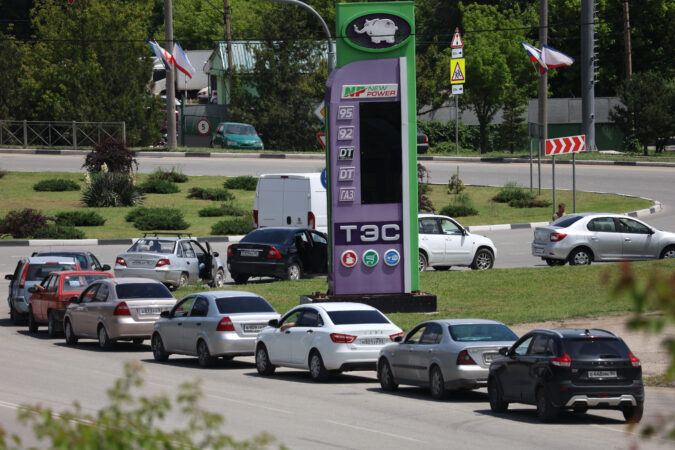
    The drone attacks added to the woes on the Black Sea peninsula, where Russian authorities have had to suspend gasoline sales to civilians as Ukraine has intensified its recent campaign to disrupt supply lines and the electrical grid at the height of the summer tourist season.

    The peninsula was seized by force and illegally annexed by Moscow in 2014. Ukraine’s increasing use of long-range strikes has highlighted its ability to inflict painful damage on Russia and put added pressure on the Kremlin while Moscow’s advances recently have ground to a near halt, Western analysts and officials say.

    Ukrainian Defense Minister Mykhailo Fedorov said last week that his forces are “isolating Crimea with drones.”

    “It looks like in the nearest time, Crimea will become an island. This could lead to some very unexpected consequences for Russians,” Fedorov said on a blogger’s YouTube channel.

    Russian President Vladimir Putin said Moscow had been warned that Ukraine aimed to disrupt energy supplies and Russia’s tourism industry. He didn’t say who gave the warning.

    Ukrainian drones “coming in a huge stream” seek to “destabilize” Russian society, Putin said.

    Russia’s ​Deputy Prime Minister ​Alexander Novak told Putin on Tuesday that officials were considering suspending diesel fuel exports to protect the country’s motorists, adding to ongoing bans on the export of jet fuel and gasoline, according to the Tass news agency. Novak also said scheduled maintenance at refineries had been postponed.

    Ukraine also has hit targets near to the Kremlin in Moscow and in St. Petersburg, Russia’s second-largest city, this month.

    Parts of Crimea are without power

    Ukraine’s Defense Ministry said drones struck an oil storage depot at the Kerch thermal power plant in eastern Crimea, an electrical substation in the west, and a liquefied natural gas distribution station in Simferopol, the peninsula’s second-biggest city.

    In addition, Ukraine’s Special Operations Forces said their units, working with what it said was the resistance movement in Crimea, destroyed a rail bridge over the North Crimean Canal near the village of Rozdolne.

    The military described the span as a key logistics route used to supply Russian forces in southern Ukraine and said drones began hitting the structure late Sunday to Monday, collapsing part of it. A second strike early Tuesday targeted railway repair equipment deployed at the bridge and its remaining sections, it said on Telegram.

    It was not possible to independently verify the Ukrainian claims, and Russian officials made no immediate comment.

    Parts of Crimea were without power Tuesday, the area’s energy supplier said. But it attributed the outages to “technical malfunctions” in local electrical grids and said it expected power to be restored within 24 hours.

    The diamond-shaped peninsula is important because of its naval bases and beaches, as well as its strategic location in the Black Sea. Russia has spent centuries fighting for it.

    Russian-appointed officials in Crimea have appeared reluctant to discuss attacks on the peninsula, but new security measures suggest deepening tension.

    Its Ministry of Sport on Tuesday canceled all sporting events, competitions, and training sessions for children through Sept. 1. It described the measures as “aimed solely at ensuring the safety of our children, athletes, and anyone who is involved with sport.”

    On Monday, Gov. Sergei Aksyonov said that for security reasons, all summer camps in the region had stopped accepting children and new bookings until Sept. 1.

    Successes against Russia boost Ukrainian morale

    On the front line in eastern Ukraine, where Russia’s war of attrition has made slow and costly advances since Moscow’s full-scale invasion in February 2022, Ukraine has deployed cutting-edge drone technology to keep the enemy pinned down.

    Meanwhile, its medium-range drones have also disrupted Russia’s supply lines to the front, and its long-range strikes have increasingly damaged Russian oil facilities that provide vital revenue for the Kremlin’s war effort.

    The Ukrainian Defense Ministry said Monday its forces have hit more than 800,000 enemy targets with drones since the beginning of the year and that 95% of drones used by the armed forces are domestically produced.

    The successes have boosted Ukrainian confidence, and President Volodymyr Zelensky says sustained foreign support is locked in to help stop Russia.

    Officials have shown renewed vigor in talking about the war.

    Ukraine’s U.N. Ambassador Andrii Melnyk said Monday that Kyiv remained ready for direct talks with Russia to achieve a “just and lasting peace” based on the U.N. Charter, but warned that Ukraine’s willingness to compromise was not open-ended.

    Melnyk said at a U.N. Security Council meeting that a ceasefire along the current front line already represented a major concession and urged Russia to withdraw from occupied Ukrainian territory.

    He also said recent Ukrainian strikes had altered the dynamics of the war, adding: “This is just the beginning.”

    Russia’s top diplomat says Moscow will defend Belarus

    Meanwhile, the Kremlin is ready to “ensure the security” of its neighbor and ally Belarus, Russian Foreign Minister Sergey Lavrov said Tuesday, days after Zelensky demanded that Belarus remove relay equipment on its territory that Kyiv said aided Russian drone attacks.

    The relay stations are used for signal transmissions to Russian drones attacking Ukraine, according to Zelensky.

    Lavrov told the Russian news agency Interfax that Kyiv was trying to drag Belarus into the conflict. Moscow, in fact, had used Belarus territory to launch its invasion of Ukraine.

  • 8 convicted in Texas immigration center shooting and protest are sentenced to decades in prison

    8 convicted in Texas immigration center shooting and protest are sentenced to decades in prison

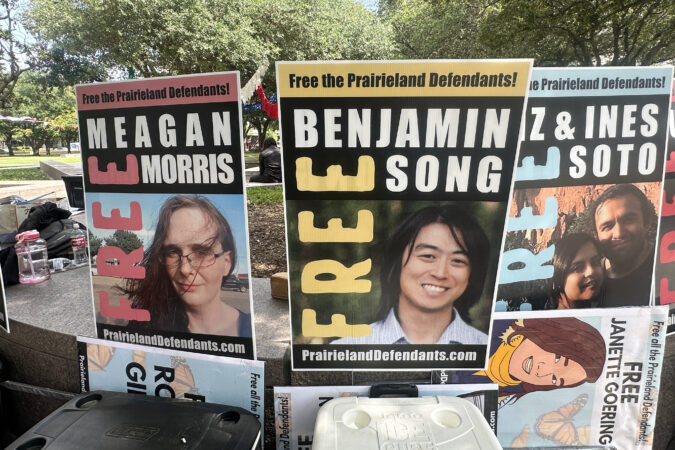
    FORT WORTH, Texas — Eight protesters accused by the Justice Department of having ties to antifa were sentenced Tuesday to decades in federal prison over a shooting outside a Texas immigration detention center that wounded a police officer and that prosecutors called an act of terrorism.

    One of the defendants, a former U.S. Marine Corps reservist convicted of opening fire during the July 4 demonstration outside the Prairieland Detention Center near Dallas, was sentenced to 100 years in prison, the maximum punishment.

    The lengthy sentences were condemned by family members and supporters in a news conference outside the federal courthouse in Fort Worth. Hope Song, whose son Benjamin Song received the heftiest sentence, disputed prosecutors’ claims that her son shot the officer and said he didn’t intend to hurt anyone.

    U.S. District Judge Reed O’Connor, one of two judges overseeing the proceedings, said what happened wasn’t a protest but “an assault on democracy.”

    “The need to deter this type of conduct is high,” O’Connor said.

    The seven other protesters received prison terms ranging from 30 to 70 years.

    Prosecutors said the eight are members of antifa, a decentralized anti-fascist organization and a target of the Trump administration. Antifa is not a single organization but rather an umbrella term for far-left militant groups that confront or resist neo-Nazis and white supremacists at demonstrations.

    President Donald Trump last fall signed an executive order designating antifa a domestic terrorist organization, even though there is no domestic equivalent to the State Department’s list of foreign terror organizations.

    The defendants deny any affiliation with antifa and maintain they attended the demonstration in support of detained immigrants.

    Prosecutor Frank Gatto urged the judge to impose stiff penalties.

    “People with that kind of extremist beliefs need extra time in prison,” Gatto said. “They believe violence is justified.”

    Phillip Hayes, Song’s attorney, said outside the courthouse that he takes issue with the idea that the protesters are extremists.

    “This is a bunch of kids and young adults who really have a really big heart and really wanted their voice to be heard,” Hayes said. “It was never intended that anybody get hurt. It was never intended that any shots would be fired.”

    Prosecutors said in court that Song had yelled “get to the rifles” and opened fire, striking a police officer who had just pulled up to the center.

    Hayes argued that Song’s shots were “suppressive fire” and that a ricochet bullet hit the officer after he arrived on the scene and “aggressively” pulled out his firearm. He said his client will appeal the 100-year sentence.

    “Song, aside from this day, has had an impeccable life. A former Marine. A good student,” Hayes said. “He had a lot of good qualities that were just ignored. The judge went ahead and gave as much as he could.”

    Other defendants and their family members pleaded for leniency in court.

    Autumn Hill said the gathering “seemed more like a party to me than anything else” and that she and others who participated ”didn’t expect or want any violence or destruction of property to occur.”

    Amber Lowrey told the judge that her sister, Savanna Batten, is a compassionate person with dreams of opening a bakery. She said Batten’s activism started with animal rights and evolved into anti-war and human rights advocacy.

    “She’s the best person I know,” Lowrey said.

    Hill and Batten both received 50-year sentences.

    Other defendants previously pleaded guilty to providing material support to terrorists rather than take their case to trial.

    Critics warn the case could have wide-reaching impact on protests given that organizations operating within the U.S. are supposed to be protected by First Amendment free-speech rights.

    Last week, federal prosecutors charged 15 people with impeding the Trump administration’s immigration crackdown in Minnesota. They claimed the demonstrators were members of antifa who conspired against the federal government to block arrests and deportations by setting up blockades around government buildings and throwing chunks of ice at federal vehicles, among other actions.

  • Giannis Antetokounmpo getting traded to Heat in blockbuster, AP source says

    Giannis Antetokounmpo getting traded to Heat in blockbuster, AP source says

    MIAMI — Giannis Antetokounmpo wants more championships. So do the Miami Heat.

    And the Heat finally have another superstar.

    Ending a marathon watch for the next great Miami get, the Heat landed Antetokounmpo — a two-time NBA MVP and 10-time All-Star — from the Milwaukee Bucks on Monday night in exchange for a massive haul of players and draft picks.

    The terms, according to a person who spoke to The Associated Press on condition of anonymity because the move has yet to receive the required league approval: Antetokounmpo and Bobby Portis are heading to Miami for Wisconsin native Tyler Herro, Jaime Jaquez Jr., Kel’el Ware and Kasparas Jakucionis. Milwaukee also gets at least four picks, including the No. 13 selection that will be made in Tuesday night’s NBA draft.

    Giannis Antetokounmpo was a two-time NBA MVP and 10-time All-Star with the Milwaukee Bucks.

    It ends a wild back-and-forth in the final days of the saga, with the Bucks considering offers from both Miami and Boston for Antetokounmpo — who led Milwaukee to the 2021 NBA title, was on the NBA’s 75th anniversary list of its greatest players ever, is a nine-time All-NBA selection and is coming off an injury-shortened season where he averaged 27.6 points per game.

    There has been no secret that this is what Miami has sought, because this is what Miami usually seeks. The Heat pulled off similar moves by landing Shaquille O’Neal in 2004 (helping lead to the 2006 NBA title) and by getting LeBron James and Chris Bosh to play alongside Dwyane Wade in 2010 (leading to four NBA Finals runs in four seasons together, along with the 2012 and 2013 NBA titles).

    Now, it’s Antetokounmpo’s turn. At 31, the Heat clearly believe he still has many good years left — and it’s generally presumed that by making this deal they’ll give the Greek superstar a massive extension later this year.

  • Alan Greenspan, former Federal Reserve chairman, dies at 100

    Alan Greenspan, former Federal Reserve chairman, dies at 100

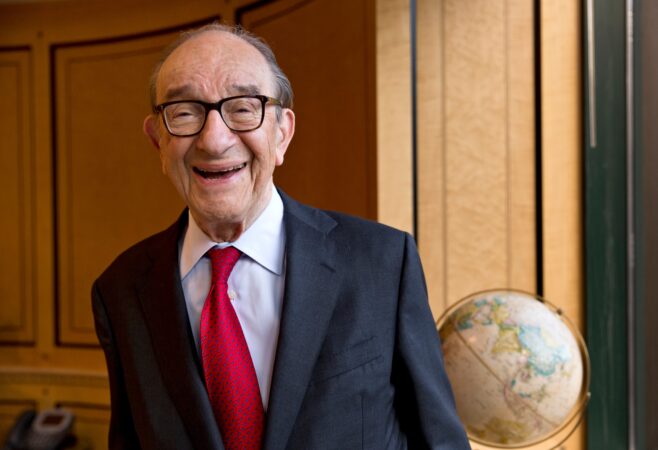
    WASHINGTON — Alan Greenspan, the jazz-playing U.S. Federal Reserve chair who was celebrated for engineering a decade of prosperity but later shared the blame for a devastating financial crisis, died Monday. He was 100.

    Mr. Greenspan died from complications of Parkinson’s disease, said his wife of 29 years, NBC News correspondent Andrea Mitchell.

    “To me he was my husband, who shaped my life from our very first date in 1984,” Mitchell wrote. ”He had ‘irrational exuberance’ for baseball, the Washington Commanders, tennis, golf, and music, especially jazz. He will be remembered for his brilliance and his kindness. Being his life partner was the joy of my life.”

    The Fed said Mr. Greenspan helped to cement trust in the Fed during a time of economic uncertainty.

    “Under his leadership, the Federal Reserve achieved a sustained era of price stability that supported economic growth and helped anchor the public’s confidence in the institution,” the central bank said in a statement Monday.

    Greenspan was hailed as “Maestro’’ — before crisis hit

    In 18½ years at the Fed, Mr. Greenspan presided over a breathtaking surge in stock prices and a 10-year economic boom that started in March 1991. He was celebrated as “Maestro’’ and “Oracle’’ — an economic virtuoso whose every utterance was dissected for clues on where interest rates and the economy were headed.

    The intense scrutiny of Mr. Greenspan’s intentions gave birth to new Fed folklore: the “Briefcase Indicator.” A stuffed briefcase carried into Fed meetings implied changes might be afoot because Mr. Greenspan carried with him charts and research to make his point.

    But his reputation began to suffer almost as soon as he left the Fed in 2006. American housing prices tumbled rapidly, causing huge losses for banks that had repackaged mortgage loans into a dizzying array of complex securities. The growing financial crisis pushed the U.S. economy into the Great Recession of 2007-2009 — the deepest downturn since the 1930s.

    Critics blamed the devastation on Mr. Greenspan’s easy money policies and his support for deregulated financial markets. Mr. Greenspan himself later acknowledged “I made a mistake’’ in assuming that banks could essentially regulate themselves.

    The authoritative voice on the U.S. economy

    For almost two decades, it seemed that Mr. Greenspan could do no wrong. Not only in the United States but across the world, he was regarded with a mixture of reverence and awe. Many openly dreaded the day when he would leave the Fed.

    Investors hung on his sometimes inscrutable observations. In the most well-known such remark, Mr. Greenspan sent financial markets reeling on Dec. 5, 1996, when he suggested with just two words — “irrational exuberance” — that stock prices were too high.

    Mindful of his power to move markets, Mr. Greenspan typically resorted to obfuscation. At times, he even joked about his habit of doing so. “I know you believe you understand what you think I said, but I am not sure you realize that what you heard is not what I meant,” Mr. Greenspan once told a befuddled congressional committee.

    Mr. Greenspan was one of the few Fed chairs that Kevin Warsh, chosen by Trump to lead the Fed, praised at his swearing-in last month. Warsh has said one of his goals is to dial back the Fed’s communications, particularly the guidance it gives financial markets, an approach closer to Mr. Greenspan’s than to Warsh’s immediate predecessors as chair.

    Yet for all his circumspect comments, Mr. Greenspan did make the Fed more transparent. He was the first chair to issue a statement explaining the Fed’s interest-rate decisions. Before Mr. Greenspan, investors had to divine the Fed’s intentions from market changes. Mr. Greenspan also began to release minutes and even full transcripts of meetings, though those changes were in response to pressure from Congress.

    A protégé is born

    Born in the Washington Heights neighborhood of Manhattan, the young Mr. Greenspan was a math whiz who was trotted out by his mother to show off for visitors.

    “I was a prop at parties,’’ he said in a 2007 interview with PBS NewsHour. A Julliard School dropout, he worked as a professional musician in his teens, playing clarinet and saxophone alongside the future jazz great Stan Getz. It was a humbling experience that persuaded the young Mr. Greenspan to seek another line of work.

    He pursued undergraduate and graduate study in economics at New York University, eventually earning a doctorate there. For most of three decades, he ran an economic consulting firm. During the 1950s, he became a disciple of the libertarian philosopher Ayn Rand, who stuck him with the nickname the “Undertaker’’ for his dark clothes and quiet bearing. When Mr. Greenspan was sworn in as President Gerald Ford’s chief economic adviser in 1974, Rand stood beside him.

    An early trial for a new Fed chair

    President Ronald Reagan tapped Mr. Greenspan to run the Fed in 1987. He was tested almost immediately. On Oct. 19, 1987, which came to be known as “Black Monday,” the stock market suffered the worst one-day percentage loss in American history just two months into his term. The Dow Jones Industrial Average plunged 22.6% for reasons that remain opaque to this day.

    Mr. Greenspan was credited for helping restore stability. He assured Wall Street that the Fed would supply as much money to the financial system as was needed to restore calm. Stocks recovered, and the American economy emerged unscathed by the market crash.

    During his tenure at the Fed, Mr. Greenspan drew praise for presiding over what was at the time the longest economic expansion in American history. (It was later surpassed by a 128-month expansion that ran from June 2009 through February 2020.) During Mr. Greenspan’s tenure at the Fed, the nation’s unemployment rate briefly dropped below 4% for the first time since 1970.

    And inflation, which had bedeviled the United States and much of the global economy during the 1970s, was remarkably dormant during Mr. Greenspan’s chairmanship, something many economists thought impossible for so long a period.

    During the long boom, Mr. Greenspan argued that improvements in technology had made the economy so efficient that it could run faster and at lower rates of unemployment, without unleashing inflation. As a consequence, the theory went, the Fed could keep interest rates low even when the economy was roaring.

    The economy soared in the late 1990s, expanding by 4% or more for four straight years, and Mr. Greenspan was credited with holding off on rate hikes and allowing the boom to run.

    Warsh has said that AI could reproduce the 1990s experience of high growth with low inflation, though economists are skeptical it will play out the same way.

    A passion for numbers and life

    As Fed chair, Mr. Greenspan relished poring over obscure economic data, from monthly boxcar loadings to steel production, all in a bid to assess where the economy was going. He would often phone economists at other government agencies to discuss details. He would rise early each morning for a two-hour soak in his bathtub, time that he used to review statistics and Fed staff memos.

    Improbably, Mr. Greenspan also made the gossip pages as an unlikely ladies’ man. He dated the television journalist Barbara Walters and later married Mitchell after a 12-year courtship. They had no children. Mitchell graduated from the University of Pennsylvania and worked for KWY radio and TV. She founded the Andrea Mitchell Center for the Study of Democracy in 2017.

    Mr. Greenspan dated Walters while working as an adviser to President Gerald Ford. According to a biography of Mr. Greenspan, The Man Who Knew by Sebastian Mallaby, when Ford read a newspaper item about the pair, he cut it out and sent it to his chief of staff, Dick Cheney, with a note that said, “I don’t believe it.”

    Faith in self-regulating markets is challenged

    All along, Mr. Greenspan held fast to the belief that financial markets could largely regulate themselves. With officials from President Bill Clinton’s White House, he helped block efforts by Brooksley Born, the nation’s top commodities regulator, to bring federal oversight in the late 1990s to the shadowy market in over-the-counter derivatives. The derivatives allowed speculators to make bets on everything from the price of oil to high-risk mortgages.

    Eventually, history would vindicate Born, not the Maestro.

    The low interest rates Mr. Greenspan had engineered helped swell housing prices into a dangerous bubble. And the financial deregulation he supported allowed banks and other financial firms to pile up huge risks, often hidden from government supervision. Bad derivatives bets helped sink insurance giant American International Group, which required a $180 billion taxpayer bailout. Vaunted investment firms Bear Stearns and Lehman Brothers failed and U.S. financial markets nearly collapsed.

    The Financial Crisis Inquiry Commission, which was assigned to investigate the debacle by Congress, concluded:

    “More than 30 years of deregulation and reliance on self-regulation by financial institutions, championed by former Federal Reserve chairman Alan Greenspan and others … had stripped away key safeguards, which could have helped avoid catastrophe.”

    Life after the Fed

    In the years after stepping down as Fed chairman in 2006 just shy of his 80th birthday, Mr. Greenspan kept busy doing what he loved to do most — following the economic data. He ran his own consulting firm, Greenspan Associates, through which he dispensed advice to Wall Street clients and collected handsome speaking fees.

    He kept up a busy schedule well into his 90s, writing his memoir and two other books on the economy, as well as opining on the latest economic developments on television news shows.

    He also signed onto opinion articles and statements defending the Federal Reserve’s political independence from President Donald Trump’s ongoing attacks. In January 2026 he signed a statement criticizing the Trump administration’s investigation of Fed Chair Jerome Powell. The statement, which was also signed by two other former Fed chairs and five former Treasury secretaries, called the investigation “an unprecedented attempt to use prosecutorial attacks to undermine” the Fed’s independence and warned it would have “highly negative consequences for inflation.”

    In his 2013 book The Map and the Territory, Mr. Greenspan defended himself against critics who assigned him significant blame for the 2008 financial meltdown. He argued that traditional economic forecasting was no match for the irrational risk-taking that can feed catastrophic price bubbles.

    “Bubbles go up very slowly as euphoria builds,” Mr. Greenspan said in a 2013 interview with the Associated Press. “Then fear hits, and it comes down very sharply. When I started to look at that, I was sort of intellectually shocked.”

  • Quarantine comes to an end for the last of the hantavirus ship passengers in Nebraska

    Quarantine comes to an end for the last of the hantavirus ship passengers in Nebraska

    OMAHA, Nebraska — The last eight American passengers who endured 42 days in a specialized hospital quarantine unit after exposure to an unusual hantavirus outbreak on a cruise ship that killed three people have left the Nebraska facility.

    U.S. Department of Health and Human Services officials on Monday confirmed the end of the quarantine.

    “Through close collaboration among federal, state, and local partners, HHS helped protect the American people, contain potential risks, and bring this response effort to a successful conclusion,” HHS spokesperson Emily Hilliard said in an email.

    More than 120 people were evacuated from the MV Hondius in Spain’s Canary Islands early last month — including the 18 Americans who wound up in the National Quarantine Unit in Omaha — though most were from other countries.

    In addition to those people evacuated by health officials in full protective suits, at least 30 other passengers had left the ship earlier before the outbreak was documented. That included seven Americans, who were allowed to monitor for any symptoms at home. When the ship eventually docked in the Netherlands, 25 crew members and two medical personnel were on board and had to quarantine.

    The World Health Organization didn’t immediately respond Monday to questions about the status of all the other people who had to quarantine around the globe. A total of 13 cases of the virus, including the three who died, were identified among people who were on the ship.

    Most Americans returned home but some were forced to quarantine

    One of the American passengers, Angela Perryman, had been held against her will and against the recommendation of a government medical expert. She said in an interview Monday passengers were told that the quarantine monitoring period ended Sunday at 2 p.m. She left on a flight that evening. Others were flying out Monday, she said.

    “We were locked in our rooms until 1:55. And at 2 o’clock, ‘OK, well, everybody walk out and go home,’” Perryman said, speaking from her Florida home.

    Some stayed the night elsewhere in Omaha, but Perryman pushed for a flight home that evening. The government paid for the flights, she said.

    Seven of the last remaining patients stayed there voluntarily, but Perryman was forced to stay as the result of a controversial quarantine order that was deemed unnecessary even by some health officials.

    Perryman and seven others spent six weeks at the National Quarantine Unit at the University of Nebraska Medical Center. That monitoring period was set because symptoms of hantavirus have taken as long as 42 days to appear in previous outbreaks. None were reported to have developed the illness.

    Ten others who were at the facility were allowed to leave earlier under an agreement that they would be closely monitored in their home states.

    Outbreak developed on a small cruise ship

    The passengers were on a Dutch cruise ship, the MV Hondius, traveling in the South Atlantic that became the setting of a hantavirus outbreak that killed three people, including a Dutch couple who health officials believe were the first exposed to the virus while visiting South America.

    Hantaviruses usually spread when people inhale contaminated residue of rodent droppings, but the hantavirus that caused the outbreak, called the Andes virus, may be able to spread between people in rare cases, health officials say.

    Some 25 Americans were on the ship, including about seven who disembarked in April and 18 who remained on board. Sixteen were evacuated to the Nebraska quarantine unit in Omaha on May 11, and two other Americans joined them a few days later.

    Passengers staying in Omaha enjoyed Nebraska hospitality

    During the passengers’ stay, local Omaha restaurants and food trucks delivered special meals for them to enjoy almost daily. And the nurses sometimes made Starbucks runs to deliver some of the passengers’ favorite drinks.

    The rooms they stayed in are like hotel rooms equipped with a desk, television, internet connection, and exercise equipment to help the passengers pass the time.

    One of the passengers, Jake Rosmarin, on Monday morning posted an “I’m finally coming home” video that showed him leaving his room at the quarantine center, hauling two suitcases and a backpack and turning out the lights as he walked out the door. Later Monday, he posted a video of the Omaha skyline shot out the window of his plane as he headed home to his fiance in Boston and his family.

    Rosmarin, who is a travel blogger, posted a tearful video Sunday thanking the staff of the quarantine unit, the Omaha community, and his family and friends who helped him get through quarantine.

    “I want to thank the Omaha, Nebraska, community for welcoming us with open arms and showing us complete kindness and generosity. And a big thanks to all of you who have helped me get through this because I really don’t know if it would have been as easy without the support from strangers,” he said while wearing a Nebraska Huskers sweatshirt that someone sent him.

    Florida wouldn’t agree to monitor passenger round the clock

    Perryman had a darker take. She was forced to stay after Florida officials refused a federal demand that the state provide round-the-clock surveillance on her if she were returned home. This happened even as they had started making travel arrangements for the passengers weeks ago, she said.

    “Nobody actually expected anybody to get sick at that point,” she said. “Everybody was well aware that we were all going home on commercial flights.”

    She called the six-week quarantine “a political stunt.”

  • Confirmed Ebola cases in Congo outbreak top 1,000 with 254 deaths, authorities say

    Confirmed Ebola cases in Congo outbreak top 1,000 with 254 deaths, authorities say

    BUNIA, Congo — Confirmed cases in the Ebola outbreak in eastern Congo have reached 1,003, including 254 deaths, officials said, as tracing those who had been in contact with patients remains a major challenge.

    A total of 100 people have recovered in the outbreak concentrated in the Ituri province since it was declared on May 15, Congo’s Ministry of Health said Sunday. At least 365 patients are in hospitals or in isolation, it said.

    The Ebola outbreak caused by the rare Bundibugyo virus, which has no vaccines or treatment, was the worst ever in its first month. Officials admit there could be far more cases they still don’t know about and that the peak of the outbreak is still ahead.

    Contact tracing remains a key issue for local authorities, who have only achieved a 55% coverage rate, the ministry said.

    “If you want to control an outbreak, especially Ebola outbreak, you must know the index case. We don’t have confidence on when this outbreak started,” the Africa Centers for Disease Control and Prevention Director-General Jean Kaseya told the Associated Press last week.

    Officials also are yet to identify the patient zero and trace more than 35,000 people who have come in contact with infected individuals as of last week, authorities said.

    That’s partly because eastern Congo is also battling ongoing violence from rebels. In Ituri, attacks by the Islamic State group-backed Allied Democratic Force have cut off access to many villages and forced people to flee their homes, including those sheltering in overcrowded camps and others constantly on the move.

    More than a month into the outbreak, officials believe the disease continues to outpace response efforts and no one knows its true scale.

    Displaced persons at risk

    At the Kigonze displacement camp in Bunia, the capital of Ituri province, camp officials said Friday that 10 people had died last week in unusual circumstances, raising the fear of a possible outbreak in the camp of over 20,000 displaced people.

    There had been no Ebola case confirmed at the site, camp officials said, but added that the death rate was unprecedented and called for investigation.

    The U.N. refugee agency has said at least 2 million people forcibly displaced from their homes, including over 320,000 refugees, live in areas at risk of Ebola in Congo.

    In a statement on Friday, the agency said it was “deeply concerned by the accelerating spread” of the virus and “the growing risks it poses to displaced communities across the region.”

    “If a disease or epidemic were to spread among the thousands of people living at this (Kigonze) site, it would be a real catastrophe given our already very precarious living conditions,” said Charité Banza, a civil society leader in Ituri.

  • Top Justice Department officials can remain part of prosecution of press gala attack, judge rules

    Top Justice Department officials can remain part of prosecution of press gala attack, judge rules

    WASHINGTON — A federal judge on Monday denied a request to disqualify top Justice Department officials from supervising the prosecution of the man charged with trying to kill President Donald Trump at the White House Correspondents’ Association dinner.

    Cole Tomas Allen had argued that involvement in his prosecution by Acting Attorney General Todd Blanche and District of Columbia U.S. Attorney Jeanine Pirro created a potential conflict of interest because they were among many administration officials present at the April dinner. Allen’s attorney also had raised concerns about the close friendship between Trump and Pirro, a former Fox News commentator.

    U.S. District Judge Trevor McFadden wrote in his ruling that neither their attendance at the dinner nor Pirro’s personal relationship with the president merited their disqualification. McFadden noted that Allen is not charged with attempting to harm Blanche and Pirro, and there is no evidence to suggest he even knew they would attend the dinner.

    “They are unlikely to be trial witnesses, nor do they meet the legal definition of victims,” wrote McFadden, who was nominated to the bench by Trump.

    Allen has been accused of trying to breach a security checkpoint armed with guns and knives. He has pleaded not guilty to various charges, including assaulting a federal official with a deadly weapon and attempted assassination of the president. He faces a maximum sentence of life in prison if convicted of the attempted assassination charge alone.

    Allen also is accused of firing a shotgun at a Secret Service agent during the attack, which disrupted and ultimately prompted an early end to one of the highest-profile annual events in the nation’s capital. The Secret Service officer who was shot once in a bullet-resistant vest fired his own weapon five times without hitting anyone. Allen, of Torrance, Calif., was injured but was not shot.

  • Trump-endorsed de la Espriella holds slim lead in Colombia’s election as rival challenges vote

    Trump-endorsed de la Espriella holds slim lead in Colombia’s election as rival challenges vote

    BOGOTA, Colombia — Conservative political outsider Abelardo de la Espriella held a narrow lead Monday with almost all votes counted in Colombia’s polarized presidential runoff, as the ruling party’s progressive candidate vowed to challenge the results.

    De la Espriella, a business owner and lawyer who earned U.S. President Donald Trump’s endorsement despite never having run for office, led with 49.7% of the votes over lawmaker Iván Cepeda, with 99.9% of results released by electoral authorities. Cepeda, ally of outgoing President Gustavo Petro, had 48.7%.

    Election officials have not formally announced a winner.

    A victory by de la Espriella is expected to usher in policies that will reverse Petro’s agenda, including a contentious plan to hold parallel peace negotiations with illegal armed groups. Cepeda, Petro’s protégé, had pledged to push forward that strategy and other social reforms if he won Sunday’s vote.

    The election was colored by people’s fears of renewed internal conflict.

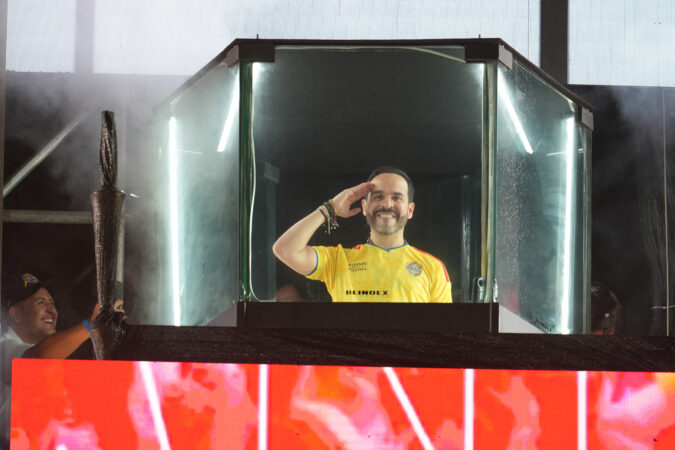
    “I will govern for all Colombians,” de la Espriella, nicknamed “The Tiger,” told thousands of supporters as he stood behind bulletproof glass in the northern city of Barranquilla on Sunday night. But his conciliatory tone changed as he spoke.

    “Pack your bags and prepare to become the opposition,” he added. “Make no mistake, Mr. Cepeda. You already know how fiercely the tiger roars.”

    Progressive candidate calls count “unofficial”

    Cepeda on Monday responded to de la Espriella’s remarks, warning him against threats, veiled or otherwise.

    “Let me be perfectly clear: We are half of this country in political terms, and we have a long history of resistance,” Cepeda said in the capital, Bogota. “We are very hardened. Don’t come threatening us. Neither your roars nor your screams frighten us.”

    He asked supporters to remain calm and maintain “exemplary behavior.” Hours earlier, people in the western city of Cali took to the streets, damaging a public bus, several surveillance cameras, and an ATM.

    The vote count showed that the municipality that includes Cali favored Cepeda with nearly 60%. Authorities there said four police officers were injured in the protest and two demonstrators were arrested.

    After the results became public Sunday, Cepeda characterized the count as “unofficial and non-binding” and announced that his team was challenging results from more than 30,000 voting stations. Petro also vowed to challenge the outcome.

    No recount has flipped the results of a presidential election in Colombian history.

    Sunday’s winner will begin a four-year term Aug. 7.

    The candidates pitched voters widely different strategies to protect the South American country from the nonstop violence, such as car bombs, kidnappings, disappearances, and forced displacements, that Colombians have lived with in previous decades.

    De la Espriella, 47, promised a heavy-handed approach to crime-fighting, including drug trafficking. He also said he plans to end Petro’s attempts to establish dialogue with multiple armed groups — an effort that has largely failed — and to build mega-prisons, emulating Salvadoran President Nayib Bukele’s aggressive policies. Those tactics have lowered homicide rates in the Central American country but have fueled accusations of human rights abuses.

    De la Espriella holds dual Colombian and U.S. citizenship. He’s a Trump supporter and a member of the Republican Party.

    “He Won, BIG!” Trump said on social media.

    ‘It’s always the same violence’

    Yolanda Hernández, who recycles trash for a living, voted for Petro in 2022 but cast her ballot for de la Espriella this time. While she acknowledged that Petro was unable to deliver on promises meant to help the poor because of congressional gridlock, she said Colombia cannot afford another four years under his vision for the country.

    “We want change in Colombia because it’s always the same violence, always the same thing,” Hernández, 49, said. “(Petro) said he was going to lower the cost of services, that he was going to lower the price of food, and everything is more expensive.”

    More than 426,000 voters chose a third, no-name option on the ballot meant to allow people to express dislike of both candidates. Another 29,000 voters cast blank ballots.

    Will Freeman, a fellow for Latin American Studies at the Council on Foreign Relations, said Sunday’s result shows the country “has not shifted overwhelmingly or decisively” against Petro’s project or for de la Espriella’s outsider “iron fist showmanship.”

    Freeman said the result also underscored Colombia’s regional divisions.

    “It’s regional, not just ideological, polarization; or rather, the two overlapping,” he said. “Ironically, de la Espriella’s iron-fist message performed best in the core of the country, not the periphery, which bears the brunt of Colombia’s violence.”

    Colombia’s illegal groups have more than 27,000 members.

    Last year, authorities recorded 14,780 homicides, the most since at least 2015, driven by clashes among illegal armed groups. Among those killed was conservative presidential hopeful Miguel Uribe.