Category: Associated Press

  • Penguins place Sidney Crosby on injured reserve after he got hurt at the Olympics

    Penguins place Sidney Crosby on injured reserve after he got hurt at the Olympics

    PITTSBURGH — The Pittsburgh Penguins will have to start their playoff push without Sidney Crosby.

    The club placed its longtime captain on injured reserve Wednesday. The move comes after Crosby suffered a lower-body injury during the Olympic hockey tournament at the Milan Cortina Games.

    The 38-year-old three-time Stanley Cup winner went down in the second period of Canada’s quarterfinal win over Czechia. The Canadians held out hope Crosby would be able to return, but he sat out a semifinal win over Finland and a loss to the United States in the gold medal game.

    Crosby, who is expected to miss at least four weeks, does not regret his decision to play in Milan.

    “It’s the Olympics and it’s an amazing experience just as an athlete, not just as a hockey player,” he said, later adding, “Obviously injuries are part of the game.”

    Crosby did not have an issue with the hit he absorbed from Czechia defenseman Radko Gudas.

    “He was trying to be physical and play hard as any defenseman would and it just went the wrong way as far as on my end of it,” he said.

    Crosby credited the medical staff in Italy with helping him have a shot at playing in the gold medal game. He believes he came “a lot closer” than he thought he would to suiting up for Team Canada in the final.

    Asked if he considered playing in a limited capacity, such as being relegated to strictly the power play, Crosby shook his head.

    “If you can’t go out there and do a job and be relied upon … then you can’t force it and that’s really what it came down to,” he said.

    The injury comes with the surprising Penguins in second place in the Metropolitan Division. Pittsburgh is looking to return to the postseason for the first time since 2022.

    Crosby has been his usually productive self this season. He leads the Penguins in goals (27), assists (32) and points (59) and is on pace to extend his NHL record of averaging at least a point a game to 21 years and counting.

    “Obviously, I want to be back out there as soon as possible,” he said. “Just have to figure out what that looks like and how that’s going to be and be at my best when I come back.”

    Pittsburgh opens the post-Olympic break at home against New Jersey on Thursday. The matchup with the Devils is the first of 13 games in a 24-day stretch for the Penguins.

    “All year we’ve had injuries [and] guys have stepped up,” he said. “To get to where we’re at at this point, it’s because of our team play.”

  • Larry Summers will resign from teaching at Harvard during review of Epstein ties, university says

    Larry Summers will resign from teaching at Harvard during review of Epstein ties, university says

    Former U.S. Treasury Secretary Larry Summers will resign from teaching at Harvard University amid a campus review of his ties to the late convicted sex offender Jeffrey Epstein, the university announced Wednesday.

    Summers, who has been on leave since November and whose name appeared hundreds of times in newly released Epstein files, will step down at the end of the school year, according to a statement from Harvard spokesperson Jason Newton.

    “Professor Summers has announced that he will retire from his academic and faculty appointments at Harvard at the end of this academic year and will remain on leave until that time,” Newton said.

    In a statement, Summers said it was a difficult decision and expressed gratitude to the students and colleagues he worked with over 50 years.

    “Free of formal responsibility, as President Emeritus and a retired professor, I look forward in time to engaging in research, analysis, and commentary on a range of global economic issues,” Summers said.

    The Justice Department’s latest release has rippled through academia, uncovering Epstein’s ties to numerous researchers who sought his funding and his friendship even after he became a convicted sex offender. Summers’ resignation follows that of Richard Axel, a Nobel laureate, who on Tuesday announced he would step down as co-director of Columbia University’s Zuckerman Mind Brain Behavior Institute.

    Summers served as treasury secretary under former President Bill Clinton and went on to lead Harvard as president for five years starting in 2001. Summers also has Philly-area roots. He grew up in Penn Valley and attended Lower Merion schools, graduating from Harriton High School in the early 1970s.

    A trove of files released by the government cast new light on Summers’ relationship with Epstein, which spanned years and included visits to one another at their homes in Massachusetts and New York. The two traded emails on topics ranging from politics and the economy to women and romance.

    Summers, who has been married for 20 years, consulted Epstein on a separate relationship with a woman he was tutoring in economics, according to emails from 2018 and 2019. Epstein described himself as Summers’ “wing man” and encouraged persistence. In a 2018 email, Summers said the woman was never his student but he had “known her father for 20 plus years as Chinese economic official.”

    “I have a very good life w Lisa kids etc.,” Summers said in a 2018 email, referencing his wife. “Easy to put at risk for something that might not materialize at all or if it does might prove transient.”

    In a 2016 email, Summers appeared to use a slur for Asian people while discussing an upcoming meeting between Epstein and an official from a Chinese university.

    Responding to previous revelations, Summers last year said he had “great regrets in my life” and that his association with Epstein was a “major error in judgment.”

    Harvard officials have publicly said little about Summers’ relationship. When Summers went on leave last year, the university said it was reviewing “individuals at Harvard” who were in the Epstein documents “to evaluate what actions may be warranted.”

    Epstein’s ties to Harvard were the focus of a 2020 campus report finding that the financier gave more than $9 million to the Ivy League school, mostly for a center founded by math and biology professor Martin Nowak. The report did not mention Summers’ relationship with Epstein. Nowak was later disciplined by Harvard.

    In December, Summers was dealt a lifetime ban from the American Economic Association, a nonprofit scholarly association dedicated to economic research, over his Epstein ties.

    At Columbia, Axel said in a statement Tuesday that he regretted his association with Epstein, calling it a “serious error in judgment.” He said he is also giving up his position as an investigator at the Howard Hughes Medical Institute but will continue to research and teach in his laboratory at the Zuckerman Institute in Manhattan.

    Axel was one of the 2004 winners of the Nobel Prize in physiology or medicine for discoveries related to the human olfactory system. His name appears more than 600 times in Justice Department files reviewed by the Associated Press, including in emails he exchanged with Epstein and on schedules noting their meetings, dinners and lunches.

    In a news article published in 2007, while Epstein was initially under investigation in Florida, the scientist praised Epstein’s intellect, telling New York magazine: “He has the ability to make connections that other minds can’t make. He is extremely smart and probing.”

    The resignations are the latest fallout from the Justice Department’s recent release of millions of pages of records pertaining to Epstein and his longtime confidant and former girlfriend Ghislaine Maxwell. Resignations have rippled across the academic, legal and business communities.

    In Britain, former Prince Andrew and ex-diplomat Peter Mandelson were arrested because of their connections to Epstein and Maxwell.

  • Daniela Petroff, AP’s longtime fashion and Vatican reporter, has died at 80

    Daniela Petroff, AP’s longtime fashion and Vatican reporter, has died at 80

    ROME — Daniela Petroff, who helped shape the Associated Press’ fashion and Vatican coverage for nearly four decades with style, authority and wit, has died in Rome. She was 80.

    Ms. Petroff died Tuesday at home, where she was recovering from a fall, said her husband, Victor Simpson, the retired AP Rome bureau chief.

    Ms. Petroff worked for the Chicago Tribune and Time magazine in Rome before moving onto the AP as a Vatican reporter and Milan fashion correspondent. She launched what became a mainstay of the AP’s culture report, covering the four weeks of menswear and womenswear each year.

    In 1985, the Simpsons endured an unfathomable tragedy: Their 11-year-old daughter, Natasha, was killed during the Dec. 27, 1985, terrorist attack at Rome’s airport that also wounded their son, Michael. When their youngest daughter, Debbie, was born two years later, Pope John Paul II called to congratulate Ms. Petroff.

    In announcing Ms. Petroff’s death, Simpson wrote that she had gone to sleep after lunch and decided not to wake up, “to finally embrace again her beloved Natasha.”

    Led AP’s Milan fashion coverage

    Fluent in Italian, German, French and English, Ms. Petroff spearheaded AP’s Milan fashion coverage just as Giorgio Armani was becoming an international figure, setting the pace for other reporters with informative, succinct, fact-based dispatches that stayed away from opinion and reviews.

    “She had a gift for putting the facts into kind of a very artful context,” said Lisa Anderson, who covered Milan fashion for the Chicago Tribune for nearly a decade starting in the mid-1980s. “She looked at that industry, which often takes itself too seriously, with a lot of amusement as well as respect, which is probably the right combination of qualities to approach fashion reporting.”

    Ms. Petroff’s last AP byline appeared in September, when her authoritative profile of Armani was published following the designer’s death.

    “Starting with an unlined jacket, a simple pair of pants and an urban palette, Armani put Italian ready-to-wear style on the international fashion map in the late 1970s, creating an instantly recognizable relaxed silhouette that has propelled the fashion house for half a century,” Ms. Petroff wrote.

    She covered the rise of Gianni Versace, Gucci in the Tom Ford era, Karl Lagerfeld at Fendi, and the Missoni fashion dynasty, and often put her fashion knowledge and smart wordsmithing to work on the Vatican beat.

    In one 2014 story about Pope Francis’ new batch of cardinals, she mused: “But with the ‘slum pope’ now calling the sartorial shots, fashionistas and Vaticanistas are wondering how his new cardinals — who hail from some of the poorest places on Earth, including Haiti, Burkina Faso and Ivory Coast — will dress themselves for their new role.”

    In between those assignments, Ms. Petroff covered some of the biggest cultural events in Italy, including the 2003 reopening of Venice’s La Fenice opera house after a devastating fire. “True to its namesake the phoenix, La Fenice has risen up from the ashes,” she wrote at the reopening.

    Early life in Paris, New York

    Born in 1945 in Mecklenburg, Germany, Ms. Petroff grew up first in Paris and then New York, where she attended the all-girl Convent of the Sacred Heart Catholic school. An only child, her parents and she moved to Rome for Ms. Petroff’s final two years of high school, which she completed at Marymount International School.

    After attending Manhattanville College in New York, Ms. Petroff returned to Rome and graduated from La Sapienza University with a degree in modern languages. In Rome, she soon met the new AP news editor, Victor Simpson. They were married in 1973.

    A childhood friend from New York, Gail Willett Bejarano, recalled ice-skating in Central Park, afterschool ice cream at Schraftt’s, and pushing the rules with the nuns at Sacred Heart. While Ms. Petroff was a top student, she was also part of the posse of girls who would go to ogle the boys at nearby Loyola, “hike your uniform up and put lipstick on, all forbidden,” Bejarano recalled.

    After retiring from AP in 2017, Ms. Petroff dedicated herself to her alma mater, Marymount, where she served as chair of the board.

    A private funeral is scheduled Thursday. A memorial service is planned for Monday at Marymount.

    In addition to Simpson, Ms. Petroff is survived by her son, Michael, and daughter, Debbie.

  • Fact check: A look at Trump’s false and misleading claims in his State of the Union speech

    Fact check: A look at Trump’s false and misleading claims in his State of the Union speech

    WASHINGTON — On inflation, immigration, tariffs, and matters of war and peace, President Donald Trump presented a frequently distorted account of the state of the nation Tuesday as he claimed a “turnaround for the ages” and myriad achievements that don’t pass scrutiny.

    Trump has spent the last year boasting of his accomplishments while mocking the record of his predecessor, Joe Biden. But much of this bluster has been based on misinformation, which he again fell back on during his State of the Union address.

    Here’s a closer look at the facts:

    The economy

    Claim: “When I last spoke in this chamber 12 months ago, I had just inherited a nation in crisis, with a stagnant economy.”

    The facts: Not quite. Voters were unhappy with high inflation in the 2024 election, but the U.S. economy was far from stagnant. The U.S. gross domestic product rose 2.8% in 2024 after adjusting for inflation. That’s a stronger pace of growth than the 2.2% achieved last year during the start of Trump’s second term.

    Trump: “Incomes are rising fast, the roaring economy is roaring like never before.”

    The facts: Not so. After-tax incomes, adjusted for inflation, rose just 0.9% in 2025, down from 2.2% in 2024, Biden’s last year in office. The annual gain in Trump’s first year is the smallest since 2022, when inflation soared and caused Americans’ inflation-adjusted income to drop.

    Wages and salaries are the largest component of incomes, and their growth has slowed as companies have sharply slowed hiring. Workers typically command smaller wage gains in such an environment.

    Investment

    Claim: “I secured commitments for more than $18 trillion pouring in from all over the globe.”

    The facts: Trump has presented no evidence that he’s secured this much domestic or foreign investment in the U.S. Based on statements from various companies, foreign countries, and the White House’s own website, that figure appears to be exaggerated, highly speculative, and far higher than the actual sum. The White House website offers a far lower number, $9.6 trillion, and that figure appears to include some investment commitments made during the Biden administration.

    A study published in January raised doubts about whether more than $5 trillion in investment commitments made last year by many of America’s biggest trading partners will actually materialize and questions how it would be spent if it did.

    Jobs

    Claim: “More Americans are working today than at any time in the history of our country.”

    The facts: Yes, but the number of Americans with jobs always rises as the population grows. The relevant figure is the proportion of Americans with jobs, which has fallen significantly in the last quarter-century, partly because the workforce is aging and more people are retired. The proportion of Americans with jobs peaked at 64.7% in April 2000, and was 59.8% in January.

    The unemployment rate is a low 4.3%, but was lower when Biden left office in January 2025, at 4%. During Biden’s presidency, the rate fell to a 50-year low of 3.4%.

    Foreign wars

    Claim: “My first 10 months I ended eight wars.”

    The facts: This statistic, which Trump frequently cites, is highly exaggerated.

    Although he has helped mediate relations among many nations, his impact isn’t as clear-cut as he makes it seem. In at least two instances of peace he claims credit for achieving, there were no wars to end: no fighting between Serbia and Kosovo, and friction rather than fighting between Egypt and Ethiopia over the Grand Ethiopian Renaissance Dam.

    The other wars Trump counts as those that he has solved were between Israel and Hamas, Israel and Iran, India and Pakistan, Rwanda and Congo, Armenia, and Azerbaijan, and Cambodia and Thailand. His influence varied in those conflicts.

    Tariffs

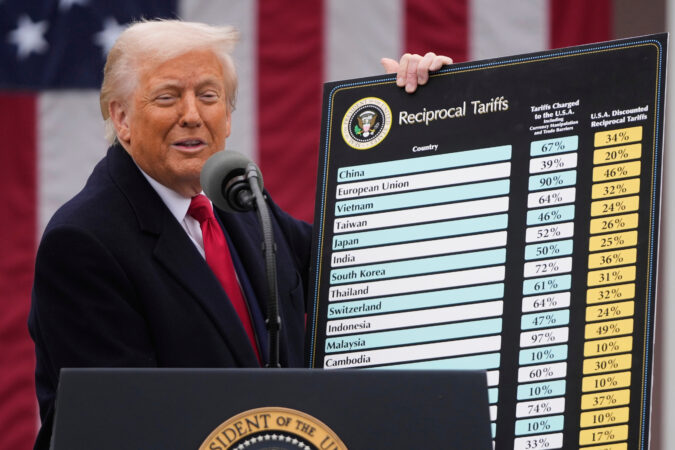
    Claim: Tariff revenues are “saving our country, the kind of money we’re taking in.”

    The facts: Though Trump has imposed massive tax hikes on imports, they’re not sizable enough to make a dent in the government’s annual budget deficits. Nor have the tariffs corresponded with manufacturing job gains.

    Before the Supreme Court struck down Trump’s tariffs based on an emergency declaration, the Congressional Budget Office estimated that his new taxes would raise $3 trillion over 10 years, or $300 billion annually.

    That’s not enough to cover the cost of his $4.7 trillion in tax cuts, including additional interest cuts, that favored companies and the wealthy. Nor is it enough to pay down an annual budget deficit that last year was $1.78 trillion.

    Claim: “Tariffs paid for by foreign countries will, like in the past, substantially replace the modern day system of income tax.’’

    The facts: Not likely. Under Trump, tariff revenues have swelled — to $195 billion in the budget year that ended Sept. 30 from $77 billion the year before. But the import taxes accounted for less than 4% of federal revenue. Income taxes and payroll taxes that finance Social Security and Medicare account for 84%.

    Medicine

    Claim: “I took prescription drugs, a very big part of healthcare, from the highest price in the entire world to the lowest. That’s a big achievement. The result is price differences of 300, 400, 500, 600% and more.”

    The facts: This is impossible. Although the Trump administration has taken steps to lower drug prices, cutting them by more than 100% would theoretically mean that people are being paid to take medications.

    Geoffrey Joyce, director of health policy at the University of Southern California’s Schaeffer Center, said in August that this claim is “total fiction” by the president. He agreed that it would amount to drug companies paying customers, rather than the other way around.

    Crime

    Claim: “Last year, the murder rate saw its single largest decline in recorded history. This is the biggest decline. Think of it in recorded history, the lowest number in over 125 years.”

    The facts: Trump takes credit for a significant decrease in violent crime during 2025, claiming the murder rate in the U.S. dropped to its lowest in 125 years. But this is misleading. Crime had already been trending down in recent years.

    A study released in January by the independent Council on Criminal Justice, which collected data from 35 U.S. cities on homicides, showed a 21% decrease in the homicide rate from 2024 to 2025.

    The report noted that when nationwide data for jurisdictions of all sizes is reported by the FBI later this year, there is a strong possibility that homicides in 2025 will drop to about 4 per 100,000 residents. That would be the lowest rate ever recorded in law enforcement or public health data going back to 1900.

    FBI reports for 2023 and 2024 show significant reductions in violent crimes.

    Crime surged during the coronavirus pandemic, with homicides increasing nearly 30% in 2020 over the previous year, the largest one-year jump since the FBI began keeping records. But violent crime dropped to near pre-pandemic levels around 2022 when Biden was president.

    Immigration

    Claim: “We will always allow people to come in legally, people that will love our country and will work hard to maintain our country.”

    The facts: Trump has actually taken steps to restrict who can emigrate to the U.S., often in the name of protecting national security.

    He suspended the refugee program on his first day in office and in October resumed the program but only in limited numbers for white South Africans.

    Trump has also placed restrictions on who can travel or emigrate to the U.S. from nearly 40 countries around the world. Many of those countries are in Africa.

    Taxes

    Claim: “With the great big beautiful bill, we gave you no tax on tips, no tax on overtime and no tax on Social Security.”

    The facts: Though the president frequently says his big tax cut bill means no tax on Social Security, that’s not true for everyone. Not all Social Security beneficiaries will be able to claim the deduction, which lasts until 2029.

    Those who won’t be able to do so include the lowest-income seniors who already don’t pay taxes on Social Security, those who choose to claim their benefits before they reach age 65 and those above a defined income threshold. The deductions also phase out as income increases.

    Elections

    Claim: “I’m asking you to approve the Save America Act to stop illegal aliens and other who are unpermitted persons from voting in our sacred American elections. The cheating is rampant in our elections.”

    The facts: He and his allies have never produced evidence of rampant election cheating. Experts say voter fraud is extremely rare, and very few noncitizens ever slip through the cracks.

    For example, a recent review in Michigan identified 15 people who appear to be noncitizens who voted in the 2024 general election, out of more than 5.7 million ballots cast in the state. Of those, 13 were referred to the attorney general for potential criminal charges. One involved a voter who has since died, and the final case remains under investigation.

    1776

    Claim: “The revolution that began in 1776 has not ended. It still continues because the flame of liberty and independence still burns in the heart of every American patriot.”

    The facts: To be clear, the American Revolution started the previous year, on April 19, 1775. The colonies declared independence in 1776. It ended Sept. 3, 1783.

  • Trump administration hits Iran with new sanctions as nuclear talks near

    Trump administration hits Iran with new sanctions as nuclear talks near

    WASHINGTON — The Trump administration on Wednesday imposed another tranche of sanctions on people and companies accused of enabling Iran’s ballistic missile program, drone production, and illicit oil sales as the U.S. presses Tehran to make a deal ahead of nuclear talks this week.

    The sanctions against 30 people, companies, and ships come as President Donald Trump has massed the largest U.S. buildup of warships and aircraft in the region in decades and has threatened to use military action in a bid to get Iran to constrain its nuclear program.

    The latest round of talks between U.S. officials, including envoy Steve Witkoff, and Iranian negotiators via mediator Oman are scheduled for Thursday in Geneva.

    The new sanctions imposed by the Treasury Department’s Office of Foreign Assets Control include a list of ships accused of being part of Iran’s “shadow fleet,” which refers to rusting oil tankers that smuggle oil for countries facing stiff sanctions.

    Also targeted are drone manufacturing firms, including Qods Aviation Industries, which has supplied drones “to all branches of the Iranian military and buyers in Africa and Latin America,” the Treasury Department said.

    Among other things, sanctions deny the people and firms access to any property or financial assets held in the U.S. and prevent American companies and citizens from doing business with them. However, they are largely symbolic because many of them do not hold funds with U.S. institutions.

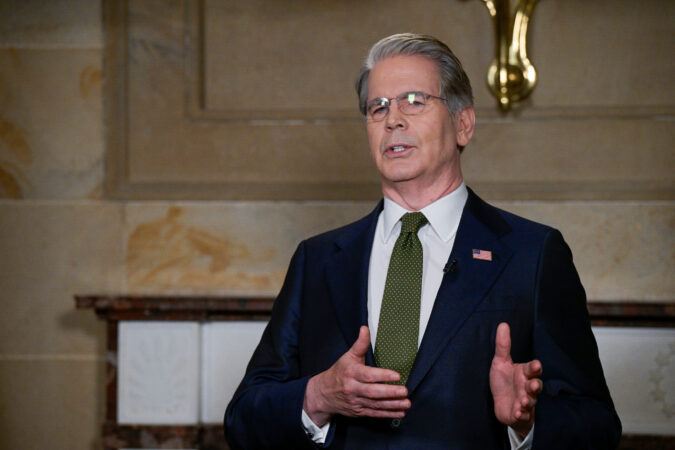
    “Treasury will continue to put maximum pressure on Iran to target the regime’s weapons capabilities and support for terrorism, which it has prioritized over the lives of the Iranian people,” Treasury Secretary Scott Bessent said in a statement.

    Trump and other top administration officials insist that Iran cannot be allowed to develop a nuclear weapon and ramped up pressure months after U.S. strikes in June on three Iranian nuclear sites.

    Iran long has maintained its nuclear program is peaceful. It had been enriching uranium up to 60% purity before the June attack — a short, technical step away from weapons-grade levels of 90%.

    “We wiped it out and they want to start all over again. And they’re at this moment again pursuing their sinister ambitions,” Trump said during his State of the Union speech Tuesday night. “We are in negotiations with them. They want to make a deal, but we haven’t heard those secret words: We will never have a nuclear weapon.”

  • States sue Trump administration over changes to childhood vaccine recommendations

    States sue Trump administration over changes to childhood vaccine recommendations

    SACRAMENTO, Calif. — More than a dozen states sued the Trump administration Tuesday over its rollback of vaccine recommendations for children, calling the move an illegal threat to public health.

    The states argue that the Centers for Disease Control and Prevention put children’s lives at risk when it announced last month that it would stop recommending all children get immunized against the flu, rotavirus, hepatitis A, hepatitis B, some forms of meningitis, and RSV. Under the new guidance, which was met with criticism from medical experts, protections against those diseases are recommended only for certain groups deemed high risk or when doctors recommend them in what’s called “shared decision-making.”

    The new vaccine recommendations ignore long-standing medical guidance and will make states have to spend more to protect against outbreaks, the states, including Arizona and California, said.

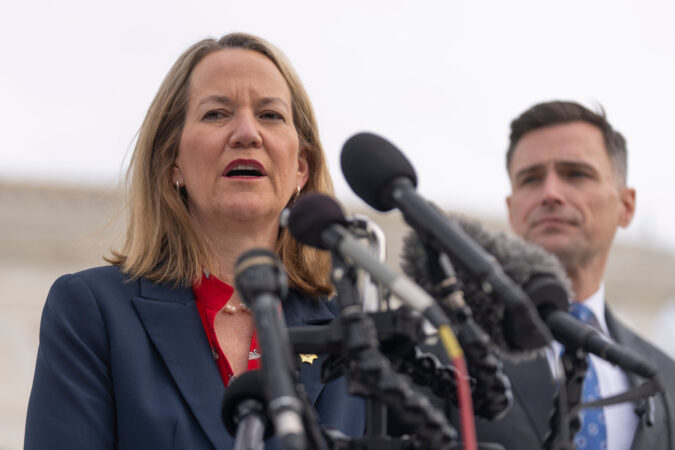
    “The health and safety of children across the country is not a political issue,” Arizona Attorney General Kris Mayes, a Democrat, said at a news conference. “It is not a culture war talking point.”

    Emily G. Hilliard, press secretary for the Department of Health and Human Services, blasted the complaint as a “publicity stunt dressed up as a lawsuit.”

    Pennsylvania, New Jersey, and Delaware all joined the Arizona-led lawsuit.

    “Every Pennsylvanian deserves accurate information to make their own healthcare decisions when consulting with their doctors — and science, not politics, will continue to guide our healthcare decisions here in the Commonwealth,” said Gov. Josh Shapiro, a Democrat who has repeatedly joined litigation against the Trump administration since last year.

    The lawsuit escalates an ongoing battle between Democratic-led states and Republican President Donald Trump’s administration over the federal government’s changes to public health policy under Health Secretary Robert F. Kennedy Jr. The Trump administration has laid off thousands of workers at federal public health agencies, cut funding for scientific research and altered government guidance on fluoride and other topics.

    Kennedy last year ousted every member of a vaccine advisory committee and replaced them with his own picks, which Tuesday’s complaint alleges was unlawful.

    The lawsuit comes months after the Democratic governors of California, Washington state, and Oregon launched an alliance to establish their own vaccine recommendations. The governors said the Trump administration was risking people’s health by politicizing the CDC.

    States, not the federal government, have the authority to require vaccinations for schoolchildren, though the CDC’s requirements typically influence state regulations.

  • Takeaways from Trump’s address: Sales mode on economy, heavy on patriotism, dark turn on Democrats

    Takeaways from Trump’s address: Sales mode on economy, heavy on patriotism, dark turn on Democrats

    WASHINGTON — President Donald Trump started in sales mode, using his State of the Union address to deliver an upbeat vision of the U.S. economy.

    But that portrayal collides with the sentiment of Americans who remain anxious about their finances and feel they haven’t benefited from Trump’s policies. He took the high road to honor the gold medal-winning U.S. men’s Olympic hockey team and a war hero before pivoting abruptly to a darker tone as he ridiculed Democrats.

    Here are takeaways from the speech.

    Trump’s ‘roaring’ economy is at odds with sour public sentiment

    Much of the nation is worried about the direction of the economy, but Trump says the good times are here, insisting repeatedly that rising costs are no longer a problem.

    “The roaring economy is roaring like never before,” he said. He cheered the lower cost of gasoline, mortgage rates, prescription drug prices, and the rising stock market: “Millions and millions of Americans are all gaining.”

    Such optimism, as so many Americans are feeling economic strains, risks painting Trump as out of touch. Just 39% of U.S. adults approved of Trump’s handling of the economy in February, according to AP-NORC polling.

    Still, the president focused much of the first hour of his speech on the economy, something Republicans had urged him to do as they head into the midterm elections.

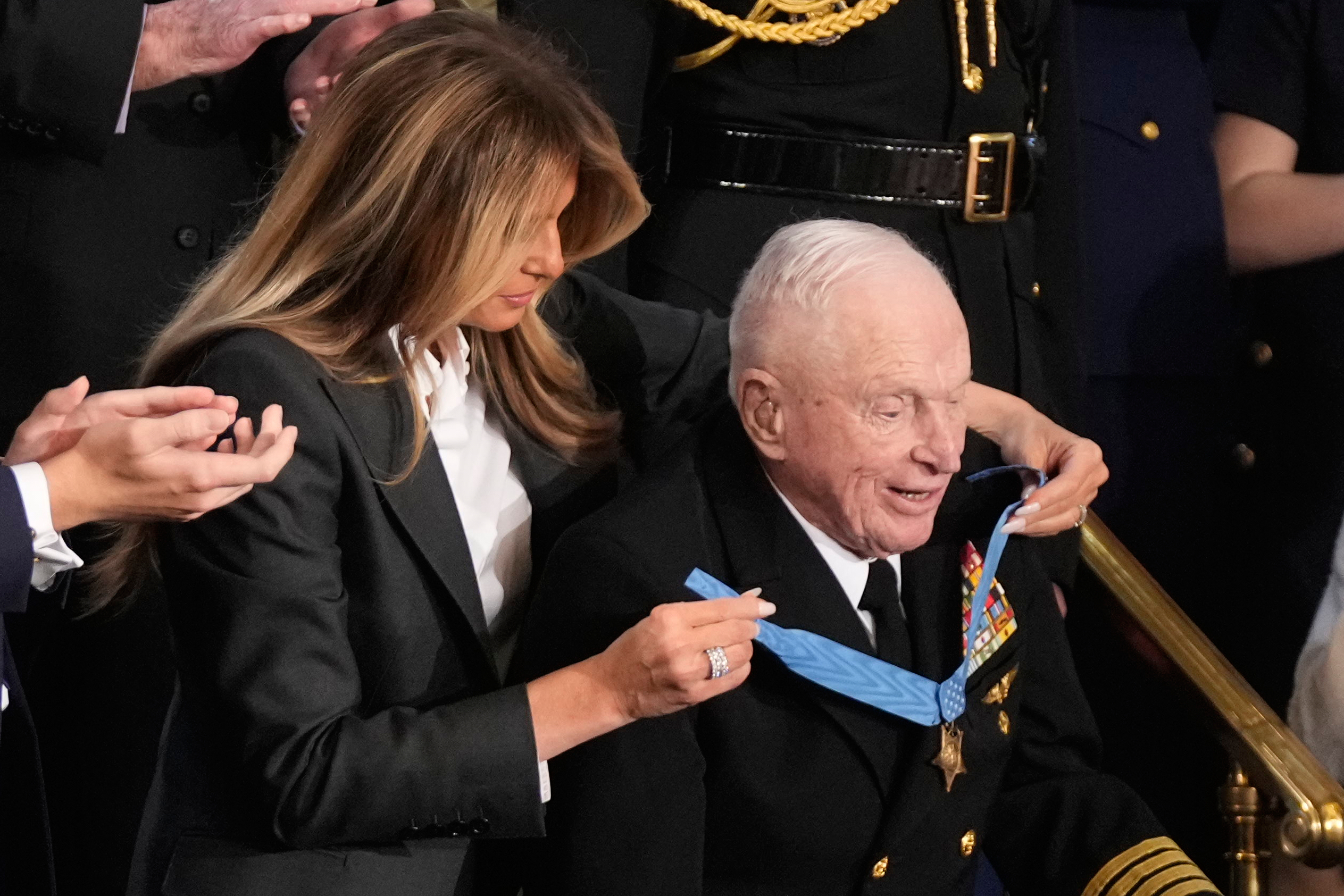
    First lady Melania Trump awards World War II Navy pilot Capt. Royce Williams the Congressional Medal of Honor as President Donald Trump delivers the State of the Union address to a joint session of Congress.

    Trump wraps himself in the flag

    For a president who always seems to be spoiling for a fight, Trump also tried to summon Americans’ innate patriotic impulses. In addition to the hockey team, he singled out war heroes and those who had taken brave stands in other countries, using the moment to bestow numerous presidential medals in an effort to give the address a more positive gloss.

    It underscored the president’s media savvy and understanding that even if a moment isn’t appreciated completely in real time, it can have an afterlife in the days following speech, especially on social media.

    Yet in one revealing moment, Trump lamented why he couldn’t give a congressional medal to himself.

    Taking aim at Democrats

    Tributes to the Olympic hockey team and a World War II veteran didn’t unify the room for long.

    The Republican president soon took aim at Democrats and blamed them for many of the nation’s ills.

    Trump said rising healthcare premiums are “caused by you,” suggested Democrats “are not protecting” Social Security and blamed them for the nation’s affordability crunch. “You caused that problem. You caused that problem,” Trump said as he glared at the Democratic side of the room.

    He seemed to get angrier as the speech progressed.

    “These people are crazy, I’m telling you, they’re crazy,” he said. “Democrats are destroying this country.”

    Trump’s MAGA base loves such aggression. It’s unclear, however, if the rest of the country feels the same.

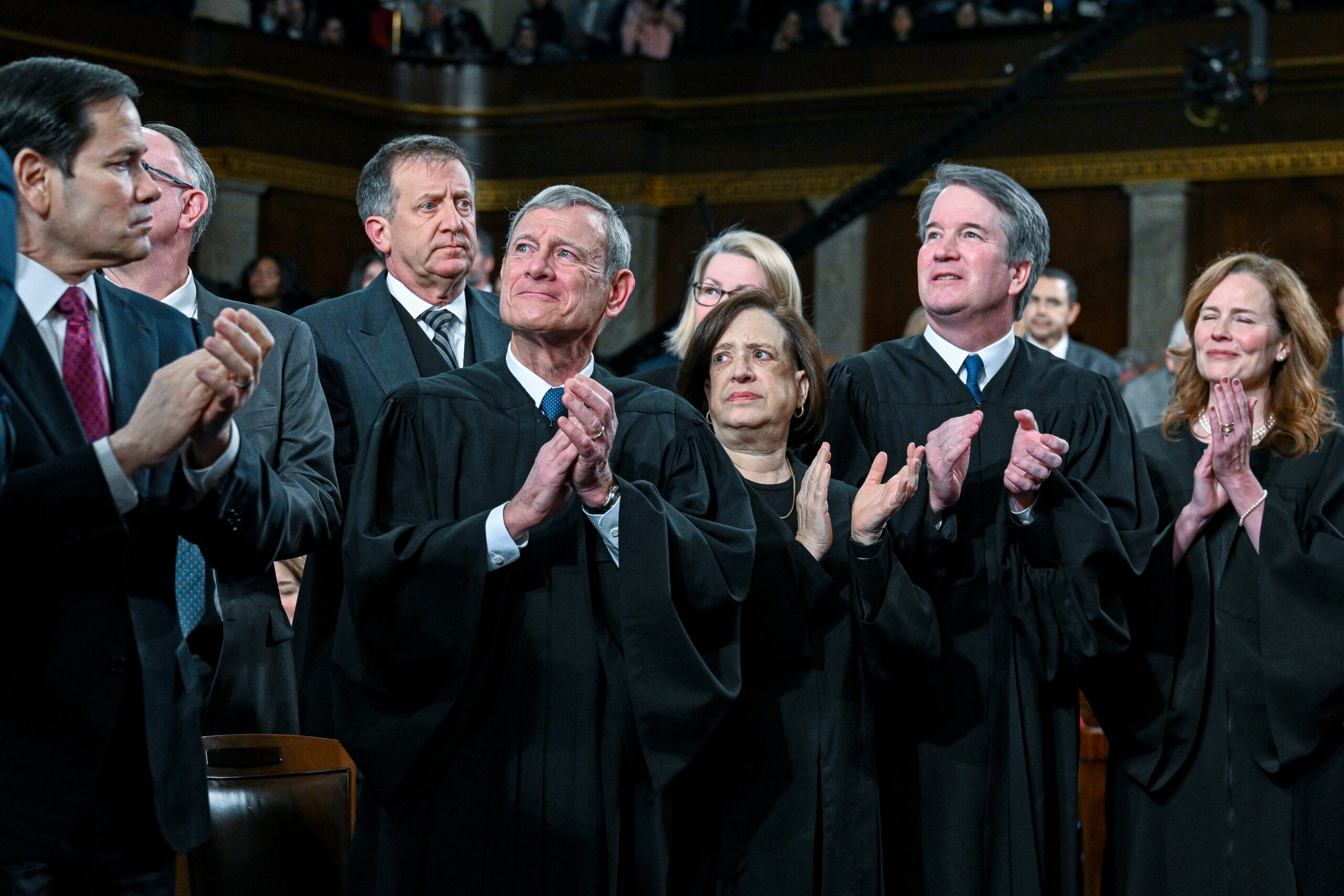
    Secretary of State Marco Rubio (from left), Chief Justice John Roberts, Justice Elena Kagan, Justice Brett Kavanaugh, and Justice Amy Coney Barrett applaud before President Donald Trump delivers the State of the Union address Tuesdy to a joint session of Congress in the House chamber at the U.S. Capitol.

    The Supreme Court’s ‘unfortunate’ decision

    By Trump’s standards, he held his tongue when it came to the Supreme Court.

    After the court struck down his tariff policy last week, Trump said the justices who voted against one of his signature issues were an “embarrassment to their families.” By Tuesday, he simply called the ruling “unfortunate.”

    Trump sought to treat the ruling with indifference, insisting that tariff revenues were “saving” the U.S., ignoring the fact that the levies haven’t made a significant dent in government debt. He said the tariffs were paid by foreign countries even as virtually every study concludes that costs have been paid by U.S. firms and consumers.

    At one point, he seemed to take the long view that history would ultimately vindicate him even if the Supreme Court would not.

    “As time goes by, I believe the tariffs paid by foreign countries will, like in the past, substantially replace the modern day system of income tax, taking a great burden off the people that I love,” he said.

    That is unlikely. The federal income tax is authorized by the 16th Amendment to the Constitution and the power to collect revenue is ultimately defined by Congress, not the president.

    Trump vows action on election ‘cheating’

    The president also used the speech to reprise his attack on the integrity of U.S. elections.

    “Cheating is rampant in our elections,” Trump said.

    Trump has made such claims for years, focused on his 2020 election loss, claims rejected by dozens of courts and his own attorney general at the time.

    But the timing of Tuesday’s prime-time claims, less than nine months before voters across America are scheduled to decide control of Congress, was noteworthy. So, too, was Trump’s suggestion that he would take action to address a problem that doesn’t appear to exist.

    “They want to cheat. They have cheated, and their policy is so bad that the only way they can get elected is to cheat,” Trump said of Democrats. “And we’re going to stop it. We have to stop it.”

    Trump is calling on Congress to pass a bill requiring voters to show a photo ID before casting ballots. But he also recently vowed to enact an executive order to address the issue, although the White House has not clarified what it might entail.

    No mention of Minneapolis

    Sometimes what’s not said is as notable as what is.

    Trump has highlighted immigration since the very first speech in which he announced his 2016 presidential campaign. And on Tuesday night, he revived much of the same language he’s used throughout the past decade, blasting “criminal aliens” and warning of “drug lords, murderers all over our country.”

    What he didn’t mention: the most aggressive immigration enforcement tactics that threatened to bring the U.S. to the brink earlier this year. He didn’t mention the deaths of two U.S. citizens in Minneapolis last month at the hands of federal agents.

    Indeed, it was Rep. Rashida Tlaib (D., Mich.), who shouted that “Alex wasn’t a criminal,” referring to Alex Pretti, one of the U.S. citizens killed in Minneapolis.

    During her Democratic rebuttal, Virginia Gov. Abigail Spanberger said law enforcement must work to build trust in communities and said Trump “every minute spent sowing fear is a minute not investigating murders.”

    Trump said nothing of his administration’s shift in tactics, including a drawdown of agents in the Twin Cities. And he made no acknowledgment of the broad concerns in the U.S. about Trump’s approach on immigration, as demonstrated by the 60% of U.S. adults who disapproved of his handling of the issue in February, according to AP-NORC polling.

    Drumbeat for war gets louder

    Trump has already built up the largest U.S. military presence in the Middle East in decades. And in his speech, he outlined a rationale for using those forces to launch a major military strike against Iran.

    The president said that Iran and its proxies have “spread nothing but terrorism, death and hate,” adding that its leaders killed at least 32,000 protesters in recent weeks, which is at the further end of estimates over the death toll. The U.S.-based Human Rights Activist News Agency has so far counted more than 7,000 dead and believes the death toll is far higher. Iran’s government offered its only death toll on Jan. 21, saying 3,117 people were killed.

    Trump also warned that the nation has developed missiles that can threaten Europe and is working on missiles “that will soon reach” the U.S.

    “My preference is to solve this problem through diplomacy. But one thing is certain, I will never allow the world’s number one sponsor of terror, which they are, by far to have a nuclear weapon. Can’t let that happen.”

    On brand, the speech was the longest SOTU ever

    The president, ever mindful of records that allow him to say he was the first, the best or had done the most, succeeded clearly on one thing: he beat his own record for the longest, clocking in at just under 1 hour, 48 minutes.

  • Trump used the longest-ever State of the Union to try to convince voters that the U.S. is ‘winning so much’

    Trump used the longest-ever State of the Union to try to convince voters that the U.S. is ‘winning so much’

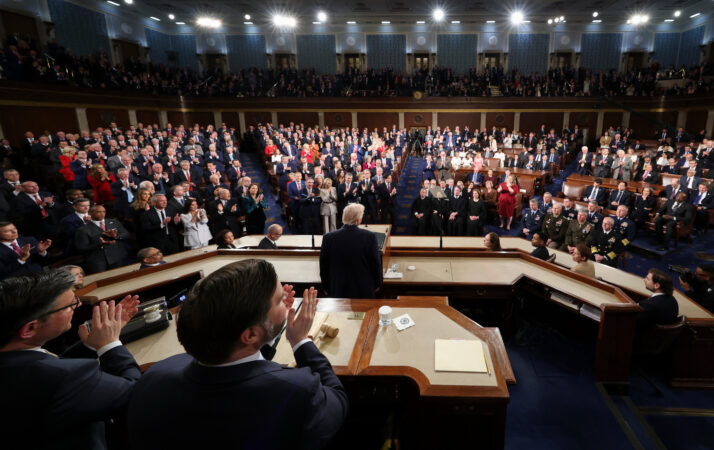
    WASHINGTON — President Donald Trump declared during a marathon State of the Union on Tuesday that “we’re winning so much” — insisting he’d sparked an economic boom at home and imposed a new world order abroad in hopes it can counter his sliding approval ratings.

    Trump’s main objective was convincing increasingly wary Americans that the economy is stronger than many believe, and that they should vote for more of the same by backing Republicans during November’s midterm elections. In all, Trump spoke for a record 108 minutes, breaking — by eight minutes — the previous time mark from his address before a joint session of Congress last year.

    The president largely avoided his usual bombast, only occasionally veering off-script — mostly to slam Democrats. As he did during such addresses in his first term, Trump relied on a series of surprise special guests to dramatically punctuate his message. They included U.S. military heroes and a former political prisoner released after U.S. forces toppled Venezuelan President Nicolás Maduro.

    Trump drew some of the loudest applause of the night when he invited the Olympic gold medal-winning U.S. men’s hockey team into the House chamber.

    “Our country is winning again. In fact, we’re winning so much that we really don’t know what to do about it. People are asking me, ‘Please, please, please, Mister President, we’re winning too much. We can’t take it anymore,’” Trump said before introducing the team.

    The hockey players, wearing their medals and “USA” sweaters, drew a bipartisan standing ovation. Trump pointed to the Democratic side of the chamber and quipped, “That’s the first time I ever I’ve ever seen them get up.”

    In a made-for-TV moment, the president announced he would be awarding the Presidential Medal of Freedom, America’s highest civilian honor, to the hockey team’s goaltender, Connor Hellebuyck. He also bestowed the Purple Heart on Andrew Wolfe — a National Guard member who was shot while deployed on the streets of the nation’s capital. Wolfe made his first public appearance since then during the speech.

    That scene recalled a similar surprise announcement in 2020, when Trump gave the Medal of Freedom to conservative radio host Rush Limbaugh during his State of the Union speech.

    Trump decries tariff decision as justices look on

    The president championed his immigration crackdowns and his push to preserve widespread tariffs that the Supreme Court just struck down. He drew applause only from Democrats while describing the high court’s decision, which he called “an unfortunate ruling.”

    Trump vowed to plow ahead, using “alternative” laws to impose the taxes on imports and telling lawmakers, “Congressional action will not be necessary.” Trump argued that the tariffs are paid by foreign countries, despite evidence that the costs are borne by American consumers and businesses. “It’s saving our country,” he said.

    The only Supreme Court justices attending were Chief Justice John Roberts, as well as Justices Brett Kavanaugh, Amy Coney Barrett and Elena Kagan. Trump greeted them personally before the speech, despite last week slamming Coney Barrett — who he appointed to the high court in his first term — for siding with the majority against his tariffs.

    Democrats also stood for Trump vowing to halt insider trading by members of Congress. But Rep. Mark Takano, a California Democrat, yelled, “How about you first!” Rep. Rashida Tlaib, a Michigan Democrat, called out, “You’re the most corrupt president!”

    When some heckling continued, Trump proclaimed, “You should be ashamed of yourselves.” Later, he pointed at Democrats and proclaimed, “These people are crazy.”

    Democratic Rep. Al Green was escorted from the chamber early in the speech, after he unfurled a sign of protest that read “Black People Aren’t Apes!” That was an apparent reference to a racist video the president posted that depicted former President Barack Obama and First Lady Michelle Obama as primates in a jungle. Green was also removed during Trump’s address last year.

    The president, meanwhile, was mostly optimistic and patriotic, but Trump struck a darker tone in large swaths of his speech to warn about the dangers posed by immigrants. He invited lawmakers from both parties to “protect American citizens, not illegal aliens” and championed proposals to limit mail-in ballots and tighten voter identification rules.

    Affordability gets relatively little time

    Trump didn’t dwell on efforts to lower the cost of living — despite polling showing that his handling of the economy and kitchen-table issues has increasingly become a liability. Such concerns about the high costs of living helped propel Democratic wins around the country on Election Day last November.

    There also are persistent fears that tariffs stoking higher prices could eventually hurt the economy and job creation. Economic growth slowed in the last three months of last year.

    It is potentially politically perilous ahead of November elections that could deliver congressional wins to Democrats, just as 2018’s blue wave created a strong check to his administration during his first term.

    On Tuesday, Trump blamed his predecessor, former President Joe Biden, along with Democratic lawmakers in the chamber, saying they were responsible for rising prices and health care costs, two issues his political opponents have repeatedly raised against him.

    “You caused that problem,” Trump said of affordability concerns. He added a moment later, “They knew their statements were a dirty, rotten lie.”

    Trump also said he’d press tech companies involved in artificial intelligence to pay higher electricity rates in areas where their data centers are located. Such data centers tend to use large volumes of electricity, potentially increasing the cost of power to other consumers in the area.

    Another notable off-script moment came as Trump was referencing prescription drug prices, saying, “So in my first year of the second term — should be my third term — but strange things happen,” prompting at least one chant in the chamber of “Four more years!”

    Virginia Gov. Abigail Spanberger, who delivered the Democratic response to Trump’s speech, slammed the president’s aggressive immigration policies, his widespread cuts to the federal government and his tariffs.

    “Even though the Supreme Court struck these tariffs down four days ago, the damage to us, the American people, has already been done. Meanwhile, the president is planning for new tariffs,” she said. “Another massive tax hike on you and your family.”

    A warning to Iran

    Trump’s address came as two U.S. aircraft carriers have been dispatched to the Middle East amid tensions with Iran. Trump said, “My preference is to solve this problem through diplomacy.”

    “But one thing is certain, I will never allow the world’s number one sponsor of terror — which they are, by far — to have a nuclear weapon,” he added.

    The president also recounted U.S. airstrikes last summer that pounded Tehran’s nuclear capabilities, and lauded the raid that ousted Maduro in Venezuela — as well as his administration’s brokering of a ceasefire in Israel’s war with Hamas in Gaza.

    “As president, I will make peace wherever I can,” Trump said. ”But I will never hesitate to confront threats to America, wherever we must.”

  • Sixers dominate Pacers, 135-114, in Joel Embiid’s return to the lineup

    Sixers dominate Pacers, 135-114, in Joel Embiid’s return to the lineup

    INDIANAPOLIS — Joel Embiid had 27 points in his return to the lineup after missing five games with right shin soreness and right knee injury management, Tyrese Maxey scored 32 points, and the 76ers beat the Indiana Pacers 135-114 on Tuesday night.

    Embiid scored 20 points in the first half, sinking 11 of 17 shots in 26 minutes. VJ Edgecombe chipped in with 23 points on 9-of-13 shooting for the 76ers, who shot 58%.

    Andrew Nembhard and Micah Potter each scored 23 for the Pacers. Quenton Jackson had 15 points and rookie Kam Jones added a career-high 13 points.

    Pacers leading scorer Pascal Siakam was out with a left wrist sprain. The Pacers also were without Aaron Nesmith, who missed his third consecutive game with right ankle sprain.

    Indiana shot 42% from the field and committed 16 turnovers. The Sixers held a 44-41 rebounding edge with Maxey leading the way with nine rebounds. Jarace Walker had 10 rebounds for the Pacers.

    The 76ers showed their dominance inside with a 82-52 edge in points in the paint.

    Sixers guard Tyrese Maxey (center) had a game-high 32 points against Indiana.

    The Pacers led 38-30 after the first quarter, but the 76ers answered with a 17-0 spurt to open the second quarter and take a 47-38 lead. Philadelphia shot 64% to take a 75-65 lead at halftime.

    Maxey scored 13 points in the third quarter as the 76ers took complete control, expanding the lead to 106-85 after three quarters.

    The Sixers led by 28 points in the fourth quarter before emptying the bench. They will return to Xfinity Mobile Arena next to face the Miami Heat on Thursday (7 p.m., NBCSP).

  • Hegseth warns Anthropic to let the military use the company’s AI tech as it sees fit, AP source says

    Hegseth warns Anthropic to let the military use the company’s AI tech as it sees fit, AP source says

    WASHINGTON — Defense Secretary Pete Hegseth gave Anthropic’s CEO a Friday deadline to open the company’s artificial intelligence technology for unrestricted military use or risk losing its government contract, according to a person familiar with their meeting Tuesday.

    Anthropic makes the chatbot Claude and is the last of its peers to not supply its technology to a new U.S. military internal network. CEO Dario Amodei repeatedly has made clear his ethical concerns about unchecked government use of AI, including the dangers of fully autonomous armed drones and of AI-assisted mass surveillance that could track dissent.

    Defense officials warned they could designate Anthropic a supply chain risk or use the Defense Production Act to essentially give the military more authority to use its products even if it doesn’t approve of how they are used, according to the person familiar with the meeting and a senior Pentagon official, who both were not authorized to comment publicly and spoke on condition of anonymity.

    The development, which was reported earlier by Axios, underscores the debate over AI’s role in national security and concerns about how the technology could be used in high-stakes situations involving lethal force, sensitive information, or government surveillance. It also comes as Hegseth has vowed to root out what he calls a “woke culture” in the armed forces.

    “A powerful AI looking across billions of conversations from millions of people could gauge public sentiment, detect pockets of disloyalty forming, and stamp them out before they grow,” Amodei wrote in an essay last month.

    The person familiar called the tone of the meeting cordial but said Amodei didn’t budge on two areas he has established as lines Anthropic won’t cross — fully autonomous military targeting operations and domestic surveillance of U.S. citizens.

    The Pentagon objects to Anthropic’s ethical restrictions because military operations need tools that don’t come with built-in limitations, the senior Pentagon official said. The official argued that the Pentagon has only issued lawful orders and stressed that using Anthropic’s tools legally would be the military’s responsibility.

    Anthropic will no longer be the only AI company approved for classified military networks

    The Pentagon announced last summer that it was awarding defense contracts to four AI companies — Anthropic, Google, OpenAI, and Elon Musk’s xAI. Each contract is worth up to $200 million.

    Anthropic was the first AI company to get approved for classified military networks, where it works with partners like Palantir. Musk’s xAI company, which operates the Grok chatbot, says Grok also is ready to be used in classified settings, according to the senior Pentagon official.

    The official noted that the other AI companies were “close” to that milestone. SpaceX, Musk’s space flight company that recently merged with xAI, didn’t immediately return a request for comment Tuesday.

    Hegseth said in a January speech at SpaceX in South Texas that he was shrugging off any AI models “that won’t allow you to fight wars.”

    Hegseth said his vision for military AI systems means that they operate “without ideological constraints that limit lawful military applications,” before adding that the Pentagon’s “AI will not be woke.”

    The defense secretary said that Grok would join the secure but unclassified Pentagon AI network, called GenAI.mil. The announcement came days after Grok — which is embedded into X, the social media network owned by Musk — drew global scrutiny for generating highly sexualized deepfake images of people without their consent.

    OpenAI announced in early February that it, too, would join GenAI.mil, enabling service members to use a custom version of ChatGPT for unclassified tasks.

    Anthropic calls itself more safety-minded

    Anthropic said in a statement after Tuesday’s meeting that it “continued good-faith conversations about our usage policy to ensure Anthropic can continue to support the government’s national security mission in line with what our models can reliably and responsibly do.”

    Anthropic has long pitched itself as the more responsible and safety-minded of the leading AI companies, ever since its founders quit OpenAI to form the startup in 2021.

    The uncertainty with the Pentagon is putting those intentions to the test, according to Owen Daniels, associate director of analysis and fellow at Georgetown University’s Center for Security and Emerging Technology.

    “Anthropic’s peers, including Meta, Google, and xAI, have been willing to comply with the department’s policy on using models for all lawful applications,” Daniels said. “So the company’s bargaining power here is limited, and it risks losing influence in the department’s push to adopt AI.”

    In the AI craze that followed the release of ChatGPT, Anthropic closely aligned with President Joe Biden’s Democratic administration in volunteering to subject its AI systems to third-party scrutiny to guard against national security risks.

    Amodei, the CEO, has warned of AI’s potentially catastrophic dangers while rejecting the label that he’s an AI “doomer.” He argued in the January essay that “we are considerably closer to real danger in 2026 than we were in 2023″ but that those risks should be managed in a “realistic, pragmatic manner.”

    Anthropic has been at odds with the Trump administration

    This would not be the first time Anthropic’s advocacy for stricter AI safeguards has put it at odds with President Donald Trump’s administration. Anthropic needled chipmaker Nvidia publicly, criticizing Trump’s proposals to loosen export controls to enable some AI computer chips to be sold in China. The AI company, however, remains a close partner with Nvidia.

    Trump’s Republican administration and Anthropic also have been on opposite sides of a lobbying push to regulate AI in U.S. states.

    Trump’s top AI adviser, David Sacks, accused Anthropic in October of “running a sophisticated regulatory capture strategy based on fear-mongering.”

    Sacks was responding on X to Anthropic cofounder Jack Clark, writing about his attempt to balance technological optimism with “appropriate fear” about the steady march toward more capable AI systems.

    Anthropic hired a number of ex-Biden officials soon after Trump’s return to the White House, but it’s also tried to signal a bipartisan approach. The company recently added Chris Liddell, a former White House official from Trump’s first term, to its board of directors.

    The Pentagon’s “breakneck” adoption of AI shows the need for greater AI oversight or regulation by Congress, particularly if AI is being used to surveil Americans, said Amos Toh, senior counsel at the Brennan Center’s Liberty and National Security Program at New York University.

    “The law is not keeping up with how quickly the technology is evolving,” Toh wrote in a post on Bluesky. “But that doesn’t mean DoD has a blank check.”