Category: Business Wires

  • U.S.-Russia talks on Ukraine were productive but work remains, Putin adviser says

    U.S.-Russia talks on Ukraine were productive but work remains, Putin adviser says

    Talks between Russia and the U.S. on ending the nearly four-year war in Ukraine were productive, but much work remains, Yuri Ushakov, a senior adviser to President Vladimir Putin, told reporters on Wednesday.

    Putin met President Donald Trump’s envoy Steve Witkoff and son-in-law Jared Kushner in the Kremlin in talks that began late Tuesday as part of a renewed push by the Trump administration to broker a peace deal. Both sides agreed not to disclose the substance of the talks.

    Ushakov called the five-hour conversation “rather useful, constructive, rather substantive,” but added that the framework of the U.S. peace proposal was discussed rather than “specific wording.”

    Putin’s aide also said that “so far, a compromise hasn’t been found” on the issue of territories, without which, he said, the Kremlin sees “no resolution to the crisis.”

    “Some of the American proposals seem more or less acceptable, but they need to be discussed. Some of the wording that was proposed to us doesn’t suit us. So, the work will continue,” Ushakov said.

    There were other points of disagreement, although Ushakov did not provide further details. “We could agree on some things, and the president confirmed this to his interlocutors. Other things provoked criticism, and the president also didn’t hide our critical and even negative attitude toward a number of proposals,” he said.

    Trump peace plan is center of effort to end the war

    The meeting came days after U.S. officials held talks with a Ukrainian team in Florida and which Secretary of State Marco Rubio described in cautiously optimistic terms.

    At the center of the effort is Trump’s peace plan that became public last month and raised concerns about being tilted heavily toward Moscow. The proposal granted some of the Kremlin’s core demands that Kyiv has rejected as nonstarters, such as Ukraine ceding the entire eastern region of the Donbas to Russia and renouncing its bid to join NATO. Negotiators have indicated the framework has changed, but it’s not clear how.

    On Tuesday, Putin accused Kyiv’s European allies of sabotaging U.S.-led efforts to end the war in Ukraine.

    “They don’t have a peace agenda, they’re on the side of the war,” Putin said of the Europeans.

    Putin‘s accusations appeared to be his latest attempt to sow dissension between Trump and European countries and set the stage for exempting Moscow from blame for any lack of progress.

    He accused Europe of amending peace proposals with “demands that are absolutely unacceptable to Russia,” thus “blocking the entire peace process” and blaming Moscow for it. He also reiterated his long-held position that Russia has no plans to attack Europe — a concern regularly voiced by some European countries.

    “But if Europe suddenly wants to wage a war with us and starts it, we are ready right away. There can be no doubt about that,” Putin said.

    Russia started the war in 2022 with its full-scale invasion of a sovereign European country, and European governments have since spent billions of dollars to support Ukraine financially and militarily, to wean themselves from energy dependence on Russia, and to strengthen their own militaries to deter Moscow from seizing more territory by force.

    They worry that if Russia gets what it wants in Ukraine, it will have free rein to threaten or disrupt other European countries, which already have faced incursions from Russian drones and fighter jets, and an alleged widespread Russian sabotage campaign.

    Trump’s peace plan relies on Europe to provide the bulk of the financing and security guarantees for a postwar Ukraine, even though no Europeans appear to have been consulted on the original plan. That’s why European governments have pushed to ensure that peace efforts address their concerns, too.

    Coinciding with Witkoff’s trip, Ukrainian President Volodymyr Zelensky went to Ireland, continuing his visits to European countries that have helped sustain his country’s fight against Russia’s invasion.

    High-stakes negotiations

    Zelensky said Tuesday he was expecting swift reports from the U.S. envoys in Moscow on whether talks could move forward, after Trump’s initial 28-point plan was whittled down to 20 items in Sunday’s talks between U.S. and Ukrainian officials in Florida.

    “The future and the next steps depend on these signals. Such steps will change throughout today, even hour by hour, I believe,” Zelensky said at a news conference in Dublin with Irish Prime Minister Micheál Martin.

    “If the signals show fair play with our partners, we then might meet very soon, meet with the American delegation,” he said.

    “There is a lot of dialogue, but we need results. Our people are dying every day,” Zelensky said. “I am ready … to meet with President Trump. It all depends on today’s talks.”

    Building on progress in Florida

    After months of frustration in trying to stop the fighting, Trump deployed officials to get traction for his peace proposals. The talks have followed parallel lines so far, with Rubio sitting down with Ukrainian officials.

    Zelensky said he met Tuesday with the Ukrainian delegation that returned from the negotiations with U.S. representatives in Florida. Rubio said those talks made progress, but added that “there’s more work to be done.”

    Zelensky said the Florida talks took as their cue a document that both sides drafted at an earlier meeting in Geneva. The Ukrainian leader said that document was now “finalized,” although he didn’t explain what that meant.

    Ukrainian diplomats are working to ensure that European partners are “substantially involved” in decision-making, Zelensky said on the Telegram messaging app, and warned about what he said were Russian disinformation campaigns aimed at steering the negotiations.

    European leaders want a say

    Zelensky met with political leaders and lawmakers in Dublin on his first official visit. Ireland is officially neutral and isn’t a member of NATO but has sent nonlethal military support to Ukraine. More than 100,000 Ukrainians have moved to Ireland since Russia launched its war on Feb. 24, 2022.

    Although this week’s consultations could move the process forward, few details have become public. It remains unclear how envoys are going to bridge the gap between the two sides on such basic differences as who keeps what territory. European officials say the road to peace will be long.

    European leaders want to make their voices heard after being largely sidelined by Washington. They are also working on future security guarantees for Ukraine.

    Zelensky was in Paris on Monday, and French President Emmanuel Macron said they spoke by phone with Witkoff. They also spoke to leaders of eight other European countries as well as top European Union officials and NATO Secretary-General Mark Rutte.

    Diplomats face a hard time trying to bridge Russian and Ukrainian differences and persuading them to strike compromises. The key obstacles — over whether Kyiv should cede land to Moscow and how to ensure Ukraine’s future security — appear unresolved.

    Zelensky under pressure

    Zelensky is under severe pressure in one of the darkest periods of the war for his country. As well as managing diplomatic pressure, he must find money to keep Ukraine afloat, address a corruption scandal that has reached the top echelons of his government, and keep Russia at bay on the battlefield.

    The Kremlin late Monday claimed that Russian forces have captured the key city of Pokrovsk in the Donetsk region of eastern Ukraine. Zelensky, however, said in Paris that fighting was still ongoing in Pokrovsk on Monday.

    Ukraine’s general staff on Tuesday also denied Russia’s claims to have captured Pokrovsk, saying it was a propaganda stunt. The Ukrainian army is readying additional logistic routes to deliver supplies to troops in the area, the Facebook post said.

  • Trump administration says it will withhold SNAP from Democrat-led states if they don’t provide data

    Trump administration says it will withhold SNAP from Democrat-led states if they don’t provide data

    WASHINGTON — President Donald Trump’s administration said Tuesday that it will move to withhold SNAP food aid from recipients in most Democratic-controlled states starting next week unless those states provide information about those receiving the assistance.

    Agriculture Secretary Brooke Rollins said at a cabinet meeting Tuesday that the action is looming because those states are refusing to provide data the department requested such as the names and immigration status of aid recipients. She said the cooperation is needed to root out fraud in the program. Democratic states have sued to block the requirement, saying they verify eligibility for SNAP beneficiaries and that they never share large swaths of sensitive data on the program with the federal government.

    Marissa Saldivar, a spokesperson for California Gov. Gavin Newsom, a Democrat, was skeptical about whether funding will really be taken away.

    “We no longer take the Trump Administration’s words at face value — we’ll see what they actually do in reality,” she said in a statement. “Cutting programs that feed American children is morally repugnant.”

    Twenty-two states and the District of Columbia previously sued over the request for information, which was initially made in February. A San Francisco-based federal judge has barred the administration, at least for now, from collecting the information from those states.

    The federal government last week sent the states a letter saying that it was time to comply, as other states have, but the parties all agreed to give the states until Dec. 8 to respond.

    Approximately 2 million Pennsylvanians receive SNAP benefits, or nearly one in six of the state’s residents.

    This fall, Gov. Josh Shapiro, a Democrat, joined 21 other states in his capacity as Pennsylvania’s governor in suing the USDA to prevent the department from withholding its SNAP payments. A federal judge in California in October ruled in favor of the Democratic-led states and temporarily blocked the USDA effort from going into effect.

    A spokesperson for Shapiro on Tuesday declined to comment.

    Administration says data is needed to spot fraud

    About 42 million lower-income Americans, or 1 in 8, rely on SNAP to help buy groceries. The average monthly benefit is about $190 per person, or a little over $6 a day.

    Rollins has cited information provided by states that have complied, saying it shows that 186,000 deceased people are receiving SNAP benefits and that 500,000 are getting benefits more than once.

    “We asked for all the states for the first time to turn over their data to the federal government to let the USDA partner with them to root out this fraud, to make sure that those who really need food stamps are getting them,” Rollins said, “but also to ensure that the American taxpayer is protected.”

    Her office has not released detailed data, including on how much in benefits obtained by error or fraud are being used.

    It’s also not clear which states have handed over the information. Rollins said 29 have complied and 21 have not. But 22 have sued to block the order.

    Additionally, Kansas, which was not part of the lawsuit, has not provided it. The USDA told the state in September that SNAP funds would be cut off. The state asked the agency to reverse the action. A spokesperson for Gov. Laura Kelly, a Democrat, said there had not yet been a reply as of Tuesday. North Carolina appears to be the only state with a Democratic governor that has handed over the information.

    Experts say that while there is certainly fraud in a $100 billion-a-year program, the far bigger problems are organized crime efforts to steal the benefit cards or get them in the name of made-up people — not wrongdoing by beneficiaries.

    Democratic officials question administration’s motives

    U.S. Rep. Jahana Hayes, a Connecticut Democrat who is a co-sponsor of legislation to undo recent SNAP changes, said Rollins is trying to make changes without transparency — or without a role for Congress — and that she is mischaracterizing the program.

    “Individuals who are just trying to buy food, those aren’t the ones who are gaming the system in the way that the administration is trying to portray,” Hayes said in an interview on Tuesday before Rollins announced her intention.

    Democratic officials responded to Rollins’ announcement by blasting the administration.

    “The Governor wishes President Trump would be a president for all Americans rather than taking out his political vendettas on the people who need these benefits the most,” said Claire Lancaster, a spokesperson for Minnesota Gov. Tim Walz, a Democrat. ”Whether it’s threatening highway funding or food assistance, the President is making malicious decisions that will raise prices and harm families.”

    In response to Rollins’ comments, New York Gov. Kathy Hochul tweeted, “Genuine question: Why is the Trump Administration so hellbent on people going hungry?”

    SNAP has been in the spotlight recently

    The program is not normally in the political spotlight, but it has been this year.

    As part of Trump’s big tax and policy bill earlier in the year, work requirements are expanding to include people between the ages of 55 and 64, homeless people and others.

    And amid the recent federal government shutdown, the administration planned not to fund the benefits for November. There was a back-and-forth in the courts about whether they could do so, but then the government reopened and benefits resumed before the final word.

    In the meantime, some states scrambled to fund benefits on their own and most increased or accelerated money for food banks.

    Staff writer Gillian McGoldrick contributed to this article.

  • Michael and Susan Dell donate $6.25 billion to encourage families to claim ‘Trump Accounts’

    Michael and Susan Dell donate $6.25 billion to encourage families to claim ‘Trump Accounts’

    NEW YORK — Billionaires Michael and Susan Dell pledged $6.25 billion Tuesday to provide 25 million American children 10 and under an incentive to claim the new investment accounts for children created as part of President Donald Trump’s tax and spending legislation.

    The historic gift has little precedent, with few single charitable commitments in the last 25 years exceeding $1 billion. Announced on GivingTuesday, the Dells believe it’s the largest single private commitment made to U.S. children.

    Its structure is also unusual. Essentially, it builds on the “Trump Accounts” program, where the U.S. Department of the Treasury will deposit $1,000 into investment accounts it sets up for American children born between Jan. 1, 2025, and Dec. 31, 2028. The Dells’ gift will use the “Trump Accounts” infrastructure to give $250 to each qualified child under 11.

    “We believe that if every child can see a future worth saving for, this program will build something far greater than an account. It will build hope and opportunity and prosperity for generations to come,” said Michael Dell, the founder and CEO of Dell Technologies whose estimated net worth is $148 billion, according to Forbes.

    Though the “Trump Accounts” became law as part of the president’s signature legislation in July, the Dells say the accounts will not launch until July 4, 2026. Michael Dell said they wanted to mark the 250th anniversary of U.S. independence.

    “We want these kids to know that not only do their families care, but their communities care, their government, their country cares about them,” Susan Dell told the Associated Press.

    Under the new law, “Trump Accounts” are available to any American child under 18 with a Social Security number. Account contributions must be invested in an index fund that tracks the overall stock market. When the children turn 18, they can withdraw the funds to put toward their education, to buy a home or to start a business.

    The Dells will put money into the accounts of children 10 and younger who live in zip codes with a median family income of $150,000 or less and who won’t get the $1,000 seed money from the Treasury. Because federal law allows outside donors to target gifts by geography, the Dells said using zip codes was “was the clearest way to ensure the contribution reaches the greatest number of children who would benefit most.”

    The Dells hope their gift will encourage families to claim the accounts and deposit more money into it, even small amounts, so it will grow over time along with the stock market.

    There is a political benefit for Trump and fellow Republicans. The accounts will become available in the midst of a midterm election, providing money to millions of voters — and a campaign talking point to GOP candidates — at a critical time politically. The $1,000 deposits are slated to end just after the 2028 presidential election.

    At the White House on Tuesday, Trump praised the Dells saying their gift was, “truly one of the most generous acts in the history of our country.”

    Trump said many companies and many of his friends would also be donating, adding “I’ll be doing it, too.”

    Brad Gerstner, a venture capitalist, who championed this legislation, said the accounts will give all children renewed hope in the American dream.

    “It’s hard to give effective dollars away at scale, particularly to the country’s neediest kids in a way that you have confidence that those dollars are going to compound with the upside of the U.S. economy,” said Gerstner, who is also the founder of Invest America Charitable Foundation, which is supporting the Treasury in launching the accounts.

    “Fundamentally, we need to include everybody in the upside of the American experiment. Otherwise, it won’t last. And so, at its core, we think it can re-energize people’s belief in free market, capitalist democracy,”″ Gerstner said of the accounts.

    About 58% of U.S. households held stocks or bonds in 2022, according to the U.S. Securities and Exchange Commission, though the wealthiest 1% owned almost half the value of stocks in that same year and the bottom 50% owned about 1% of stocks.

    In 2024, about 13% of children and young people in the U.S. lived in poverty, according to the Annie E. Casey Foundation, and experts link the high child poverty rates to the lack of social supports for new parents, like paid parental leave.

    While the funds in the Trump Accounts may help young adults whose families or employers can contribute to them over time, they won’t immediately help to diminish childhood poverty. Cuts to Medicaid, food stamps and childchildcare were also included in the spending package are likely to reduce the support children from low-income families receive.

    Ray Boshara, senior policy adviser with both the Aspen Institute and Washington University in St. Louis, said he is excited about the idea that the Trump Accounts will be able to receive contributions from the business, philanthropic and governmental sectors.

    “We would like to see this idea continue and get better over time, just like any big policy,’ said Boshara, who co-edited the book The Future of Building Wealth. “The ACA, Social Security — they start off fairly flawed, but get much better and more progressive and inclusive over time. And that’s how we think about Trump Accounts. It’s a down payment on a big idea that deserves to be improved and there’s bipartisan interest in improving them.”

    Through the Michael & Susan Dell Foundation, the Dell’s have reported giving $2.9 billion since 1999, with a large focus on education.

    Michael Dell said they had not initially envisioned committing so much to boost the child investment accounts, but Susan Dell said that changed over time.

    “We’re thrilled to be spearheading this in the philanthropy sector and are so excited because we know that more people are going to jump on board because really, we can’t think of a better idea and better way to help America’s children,” she said.

  • Why Cyber Monday could break spending records despite economic uncertainty

    Why Cyber Monday could break spending records despite economic uncertainty

    NEW YORK — After four days of deal-fueled spending sprees that kicked off on Thanksgiving, shoppers shifted their focus on Cyber Monday, which is again expected to be the biggest sales day of the year for online retailers.

    Walmart was promoting up to 50% off on fashion on its website among some of the deals, while online juggernaut Amazon was hoping to ply customers with discounts of up to 55%.

    It’s no secret that buying things online is now a staple of many people’s everyday routines. And year after year, those purchases mount during the gift-giving holiday rush. Experts expect consumers to drive record Cyber Monday spending this year, despite wider economic uncertainty.

    Adobe Analytics estimated that U.S. shoppers will spend $14.2 billion online Monday, or 6.3% more than in 2024. Spending was expected to peak between the hours of 8 and 10 p.m. local time, when Adobe expected $16 million to pass through online shopping carts every minute nationwide.

    U.S. consumers already spent $11.8 billion online for Black Friday, $6.4 billion on Thanksgiving Day, and another $11.8 billion over the weekend — exceeding Adobe’s forecasts. Purchases made across Cyber Week — the five major shopping days between Thanksgiving and Cyber Monday — provides a strong indication of how much shoppers are willing to spend for the holidays.

    “Cyber Week is off to a strong start,” Vivek Pandya, lead analyst at Adobe Digital Insights, said. “Discounts are set to remain elevated through Cyber Monday, which we expect will remain the biggest online shopping day of the season and year.”

    Pandya said he will be analyzing Adobe data capturing Cyber Monday sales to see if some of the spending momentum dissipated after a strong weekend.

    Deals on electronics and apparel were expected to peak Monday at 30% and 26% off average listed prices, per Adobe’s latest estimates. But other categories will still continue to see deep discounts — including toys, which Adobe expects to reach 27% off listed prices.

    Meanwhile, software company Salesforce — which tracks digital spending from a range of retailers, including grocers — estimated Cyber Monday’s online sales will total $13.4 billion in the U.S. and $53.7 billion globally.

    While the amount of money going into online shopping carts was expected to reach new heights Monday, rising retail prices also may contribute to any record sales figures that materialize. Consumers may be buying fewer total items. Experts say tighter budgets are causing many to shop with more precision than in years past — such as focusing on a few “big ticket” purchases, for example, and spreading out what they buy over days of promotions in hopes of getting the most bang for their buck.

    Businesses and households have watched anxiously for financial impacts from U.S. President Donald Trump’s tariffs on foreign imports. Workers in both the public and private sectors are also struggling with anxieties over job security amid both corporate layoffs and the aftereffects of the 43-day government shutdown.

    For the November-December holiday season overall, the National Retail Federation estimates that U.S. shoppers will spend more than $1 trillion for the first time this year. But the rate of growth is slowing — with an anticipated increase of 3.7% to 4.2% year over year, compared with 4.3% during last year’s holiday season.

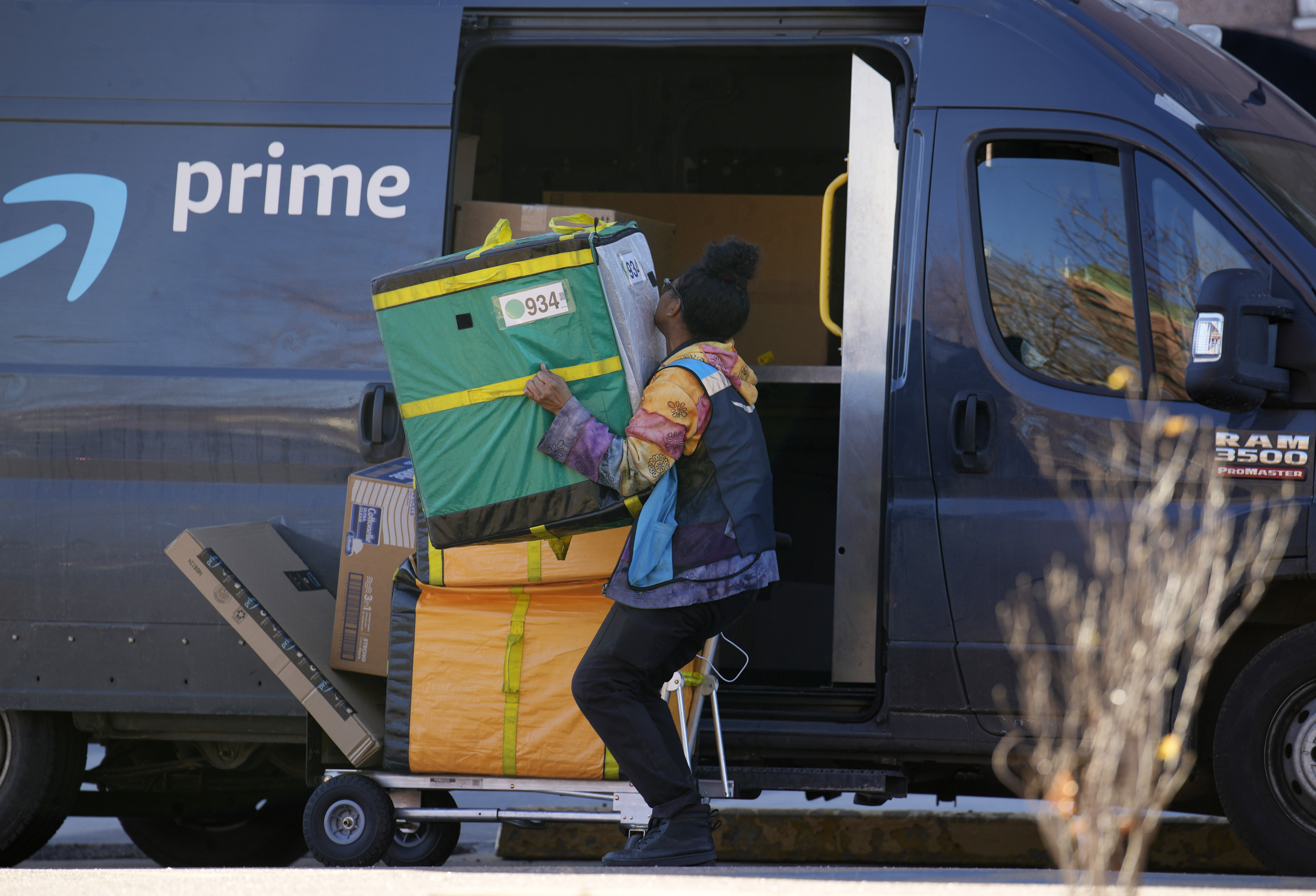
    An Amazon Prime delivery person lifts packages while making a stop on Nov. 28, 2023, in Denver.

    At the same time, credit card debt and delinquencies on other short-term loans have been rising. More and more shoppers are turning to “buy now, pay later” plans, which allow them to delay payments on holiday decor, gifts, and other items.

    Buy now, pay later loans are expected to drive $20.2 billion in online spending this holiday season, according to Adobe, up 11% from last year. The firm predicted that buy now, pay later loans would pass a new $1 billion milestone on Cyber Monday, the vast majority involving purchases made on mobile devices.

    Overall, mobile devices have become the dominant shopping platform consumers are turning to for the holidays. Adobe expects smartphones, wearable tech, and other handheld electronics to account for 58% of online spending this season.

    Five years ago, a majority of online purchases were made on desktops.

    Shopping services powered by artificial intelligence are also expected to play a role in what consumers choose to buy. For Black Friday, Salesforce estimated that AI assistants and digital agents contributed to $14.2 billion of the total $79 billion it said was spent online worldwide.

    Across the holiday season, “hot sellers” will include gaming consoles such as the Nintendo Switch 2 and toys-turned-fashion statements like Labubu Dolls, Adobe said. The analytics company anticipates the newest editions of popular consumer electronics — including the iPhone 17, Google Pixel 10, and Samsung Galaxy S25 — will also see high demand.

    To many, Cyber Monday is billed as the “last call” to take advantage of the deepest discounts in the days following Thanksgiving. But its reach has grown over the years.

    Cyber Monday is two decades old now, dating back to when the National Retail Federation first coined the term in 2005. Today, sales continue to bubble up throughout the week — riding on the hype that the industry has built to fuel consumer spending.

  • Starbucks to pay about $35M to NYC workers to settle claims it violated labor law

    Starbucks to pay about $35M to NYC workers to settle claims it violated labor law

    NEW YORK — Starbucks will pay about $35 million to more than 15,000 New York City workers to settle claims it denied them stable schedules and arbitrarily cut their hours, city officials announced Monday.

    The company will also pay $3.4 million in civil penalties under the agreement with the city’s Department of Consumer and Worker Protection. It also agrees to comply with the city’s Fair Workweek law going forward.

    A company spokesperson said Starbucks is committed to operating responsibly and in compliance with all applicable local laws and regulations in every market where it does business, but also noted the complexities of the city’s law.

    “This [law] is notoriously challenging to manage and this isn’t just a Starbucks issue, nearly every retailer in the city faces these roadblocks,” spokesperson Jaci Anderson said.

    Most of the affected employees who held hourly positions will receive $50 for each week worked from July 2021 through July 2024, the department said. Workers who experienced a violation after that may be eligible for compensation by filing a complaint with the department.

    The settlement also guarantees employees laid off during recent store closings in the city will get the chance for reinstatement at other company locations.

    The city began investigating in 2022 after receiving dozens of worker complaints against several Starbucks locations, and eventually expanded its investigation to the hundreds of stores in the city. The probe found most Starbucks employees never got regular schedules and the company routinely reduced employees’ hours by more than 15%, making it difficult for staffers to know their regular weekly earnings and plan other commitments, such as childcare, education, or other jobs.

    The company also routinely denied workers the chance to pick up extra shifts, leaving them involuntarily in part-time status, according to the city.

    The agreement with New York comes as Starbucks’ union continues a nationwide strike at dozens of locations that began last month, including at some Philadelphia stores. The number of affected stores and the strike’s impact remain in dispute by the two sides.

  • New York backs 3 new casinos, including at Mets stadium and a golf course Trump once ran

    New York backs 3 new casinos, including at Mets stadium and a golf course Trump once ran

    NEW YORK — New York City is poised to get its first Vegas-style casinos, including one next to the home stadium of baseball’s New York Mets and another that could see a windfall for President Donald Trump.

    They were among three casino proposals approved for lucrative gambling licenses on Monday by a key state panel. No casinos will end up coming to Manhattan, however, as several other competing proposals were already scrapped, including one in the heart of Times Square.

    The state Gaming Commission is expected to formally issue the licenses before the end of the year, as the gambling revenues are already factored into the state budget. Democratic Gov. Kathy Hochul said the casinos promise to unlock billions of dollars in funding for the state’s transit system and create jobs; however, opponents have repeatedly warned that easy access to casinos will lead to increased gambling addiction.

    Bally’s plan to spend $4 billion building a casino at the Ferry Point golf course in the Bronx could mean millions of dollars for Trump. When the company purchased the city-owned golf course’s operating rights from the Trump Organization in 2023, it promised to pony up another $115 million if it won a casino license. Spokespersons for the Trump Organization did not immediately respond to an email seeking comment.

    In nearby Queens, billionaire New York Mets owner Steve Cohen has proposed building an $8.1 billion Hard Rock casino on a parking lot of Citi Field. The complex would include a performance venue, a hotel, and retail and shopping space.

    Resorts World, meanwhile, has proposed investing more than $5 billion to expand an existing slots parlor into a full casino at the Aqueduct Race Track, which is also in Queens near John F. Kennedy International Airport. It too would add hotel, dining, and entertainment options.

    Vicki Been, chairperson of New York Gaming Facility Location Board, said the panel believed New York City was “plenty strong” enough to sustain the three planned casinos, despite their close proximity. The region’s dense and relatively affluent population, combined with high tourism, makes it one of the country’s most robust gaming markets, the board said, adding that nearby residents are expected to form the core of repeat visitors, bolstered by travelers from the U.S. and abroad.

    Using conservative assumptions, the board’s consultants estimated the casinos would bring $7 billion in gambling revenues for the state from 2027 to 2036, plus $1.5 billion in licensing fees and nearly $6 billion in related local taxes. The plans include public safety investments and upgrades to public transit and roadways.

    However, the board cautioned that the casinos have “ambitious” timelines for opening. The expansion at Aqueduct Race Track aims to open some facilities by March, while the Citi Field and golf course sites plan for a 2030 opening.

    Anti-casino protesters, meanwhile, chanted “Shame on you! Shame on you!” as they were escorted out of the meeting in midtown Manhattan.

    Jack Hu, one of the group’s organizers, said casino operators view older adults and workers as merely “cash cows to milk for money.” He said the proposals will have a disproportionately negative impact in the city’s Asian American communities, which are largely concentrated in Queens.

    “They bus our seniors to casinos, and they give them meal and gambling vouchers in the hopes that they’ll stay long enough to lose their entire Social Security check,” Hu said after the meeting.

    The commission is authorized to license up to three casinos in the New York City area after voters approved a referendum back in 2013 opening the door to casino gambling statewide.

    Since then, four full casinos with table games have opened in New York, but all of them are located upstate, miles away from Manhattan. The state also has nine gambling halls offering slot machines and other electronic gambling machines, but no live table games.

    The closely watched competition for a New York City license began with a crowded field, with some eight proposals in the running as recently as September.

    But four of the high-profile plans failed to get the stamp of approval from local advisory boards, automatically knocking them out of contention.

    Among the most notable was a Jay-Z-backed plan to build a Caesars Palace in Times Square, as well as two other resorts proposed in central Manhattan.

    Then in October, MGM abruptly pulled out of the license sweepstakes, saying the “competitive and economic assumptions underpinning” their plans had changed. The Las Vegas casino giant had planned a major expansion of the Empire City Casino, a slots parlor located at the Yonkers Raceway north of Manhattan.

  • Christmas tree retailers find lots to like at a Pennsylvania wholesale auction

    Christmas tree retailers find lots to like at a Pennsylvania wholesale auction

    MIFFLINBURG, Pa. — Christmas went on the auction block last week in Pennsylvania farm country, and there was no shortage of bidders.

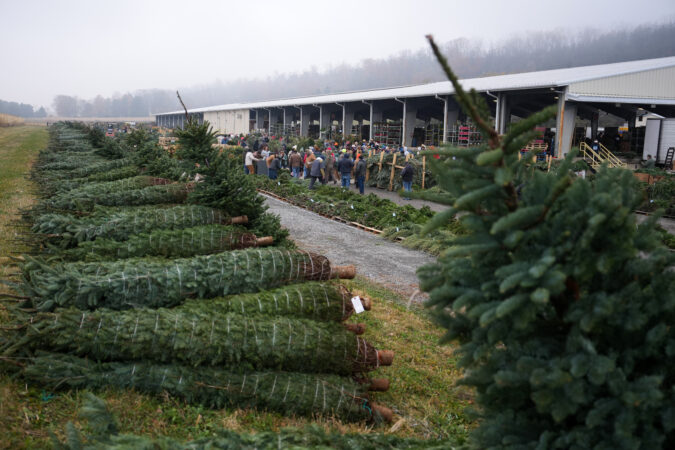
    About 50,000 Christmas trees and enough wreaths, crafts, and other seasonal items to fill an airplane hangar were bought and sold by lots and on consignment at the annual two-day event put on at Buffalo Valley Produce Auction in Mifflinburg.

    Buyers from across the Northeast and Mid-Atlantic were there to supply garden stores, corner lots, and other retail outlets for the coming rush of customers eager to bring home a tree — most commonly a Fraser fir — or to deck the halls with miles of greenery.

    Bundled-up buyers were out in chilly temperatures to hear auctioneers hawk boxes of ornaments, bunches of winterberry, cotton branches, icicle lights, grave blankets, red bows, and tree stands. It was nearly everything you would need for Christmas except the food and the presents.

    A worker transports holiday decorations at Buffalo Valley Produce Auction in Mifflinburg, Pa.

    Americans’ Christmas tree buying habits have been evolving for many years. These days homes are less likely than in years past to have a tree at all, and those that do have trees are more likely to opt for an artificial tree over the natural type, said Marsha Gray with the Howell, Michigan-based Real Christmas Tree Board, a national trade group of Christmas tree farmers.

    Cory Stephens was back for a second year at the auction after his customers raved about the holiday decor he purchased there last year for A.A. Co. Farm, Lawn & Garden, his store a three-hour drive away in Pasadena, Md. He spent nearly $5,000.

    “It’s incredible, it’s changed our whole world,” Stephens said. “If you know what you’re looking for, it’s very hard to beat the quality.”

    Ryan Marshall spent about $8,000 on various decorations for resale at Ward’s Berry Farm in Sharon, Mass. Among his purchases were three skids of wreaths at $29 per wreath — and he expected to double his money.

    “The quality’s good, and it’s a place that you can pick it out yourself,” he said.

    Gray said her group’s research shows the main reason people pick a real tree over an artificial tree “is the scent. They want the fresh scent of a real Christmas tree in their home.” Having children in the house also tends to correlate with picking a farm-grown tree, she said.

    An August survey by the Real Christmas Tree Board found that 84% of growers did not expect wholesale prices to increase this season.

    Buffalo Valley auction manager Neil Courtney said farm-grown tree prices seem to have stabilized, and he sees hope that the trend toward artificial trees can be reversed.

    “Long story short — we’ll be back on top of the game shortly,” Courtney said. “The live tree puts the real Christmas in your house.”

    A survey by a trade group, the National Christmas Tree Association, found that more than 21 million farm-grown Christmas trees were sold in 2023, with median price of $75. About a quarter of them were purchased at a “choose-and-cut” farm, one in five from a chain store, and most of the rest from nurseries, retail lots, nonprofit sales, and online.

  • Advocacy groups urge parents to avoid AI toys this holiday season

    Advocacy groups urge parents to avoid AI toys this holiday season

    They’re cute, even cuddly, and promise learning and companionship — but artificial-intelligence toys are not safe for kids, according to children’s and consumer advocacy groups urging parents not to buy them during the holiday season.

    These toys, marketed to kids as young as 2 years old, are generally powered by AI models that have already been shown to harm children and teenagers, such as OpenAI’s ChatGPT, according to an advisory published Thursday by the children’s advocacy group Fairplay and signed by more than 150 organizations and individual experts such as child psychiatrists and educators.

    “The serious harms that AI chatbots have inflicted on children are well-documented, including fostering obsessive use, having explicit sexual conversations, and encouraging unsafe behaviors, violence against others, and self-harm,” Fairplay said.

    AI toys, made by companies including Curio Interactive and Keyi Technologies, are often marketed as educational, but Fairplay says they can displace important creative and learning activities. They promise friendship but disrupt children’s relationships and resilience, the group said.

    “What’s different about young children is that their brains are being wired for the first time, and developmentally it is natural for them to be trustful, for them to seek relationships with kind and friendly characters,” said Rachel Franz, director of Fairplay’s Young Children Thrive Offline Program. Because of this, she added, the amount of trust young children are putting in these toys can exacerbate the harms seen with older children.

    Fairplay, a 25-year-old organization formerly known as the Campaign for a Commercial-Free Childhood, has been warning about AI toys for years. They just weren’t as advanced as they are today. A decade ago, during an emerging fad of internet-connected toys and AI speech recognition, the group helped lead a backlash against Mattel’s talking Hello Barbie doll that it said was recording and analyzing children’s conversations.

    This time, though AI toys are mostly sold online and are more popular in Asia than elsewhere, Franz said some have started to appear on store shelves in the U.S. and more could be on the way.

    “Everything has been released with no regulation and no research, so it gives us extra pause when all of a sudden we see more and more manufacturers, including Mattel, who recently partnered with OpenAI, potentially putting out these products,” Franz said.

    It’s the second big seasonal warning against AI toys since consumer advocates at U.S. PIRG last week called out the trend in its annual Trouble in Toyland report that typically looks at a range of product hazards, such as high-powered magnets and button-sized batteries that young children can swallow. This year, the organization tested four toys that use AI chatbots.

    “We found some of these toys will talk in-depth about sexually explicit topics, will offer advice on where a child can find matches or knives, act dismayed when you say you have to leave, and have limited or no parental controls,” the report said. One of the toys, a teddy bear made by Singapore-based FoloToy, was later withdrawn, its CEO told CNN this week.

    Dana Suskind, a pediatric surgeon and social scientist who studies early brain development, said young children don’t have the conceptual tools to understand what an AI companion is. While kids have always bonded with toys through imaginative play, when they do this they use their imagination to create both sides of a pretend conversation, “practicing creativity, language, and problem-solving,” she said.

    “An AI toy collapses that work. It answers instantly, smoothly, and often better than a human would. We don’t yet know the developmental consequences of outsourcing that imaginative labor to an artificial agent — but it’s very plausible that it undercuts the kind of creativity and executive function that traditional pretend play builds,” Suskind said.

    Beijing-based Keyi, maker of an AI “petbot” called Loona, didn’t return requests for comment this week, but other AI toymakers sought to highlight their child safety protections.

    California-based Curio Interactive makes stuffed toys, like Gabbo and rocket-shaped Grok, that have been promoted by the pop singer Grimes. The company said it has “meticulously designed” guardrails to protect children, and the company encourages parents to “monitor conversations, track insights, and choose the controls that work best for their family.”

    In response to the earlier PIRG findings, Curio said it is “actively working with our team to address any concerns, while continuously overseeing content and interactions to ensure a safe and enjoyable experience for children.”

    Another company, Miko, based in Mumbai, India, said it uses its own conversational AI model rather than relying on general large language model systems such as ChatGPT in order to make its product — an interactive AI robot — safe for children.

    “We are always expanding our internal testing, strengthening our filters, and introducing new capabilities that detect and block sensitive or unexpected topics,” said CEO Sneh Vaswani. “These new features complement our existing controls that allow parents and caregivers to identify specific topics they’d like to restrict from conversation. We will continue to invest in setting the highest standards for safe, secure and responsible AI integration for Miko products.”

    Miko’s products are sold by major retailers such as Walmart and Costco and have been promoted by the families of social media “kidfluencers” whose YouTube videos have millions of views. On its website, it markets its robots as “Artificial Intelligence. Genuine friendship.”

    Ritvik Sharma, the company’s senior vice president of growth, said Miko actually “encourages kids to interact more with their friends, to interact more with the peers, with the family members etc. It’s not made for them to feel attached to the device only.”

    Still, Suskind and children’s advocates say analog toys are a better bet for the holidays.

    “Kids need lots of real human interaction. Play should support that, not take its place. The biggest thing to consider isn’t only what the toy does; it’s what it replaces. A simple block set or a teddy bear that doesn’t talk back forces a child to invent stories, experiment, and work through problems. AI toys often do that thinking for them,” she said. “Here’s the brutal irony: When parents ask me how to prepare their child for an AI world, unlimited AI access is actually the worst preparation possible.”

  • U.S. employers added a surprisingly solid 119,000 jobs in September, the government said in a delayed report

    U.S. employers added a surprisingly solid 119,000 jobs in September, the government said in a delayed report

    WASHINGTON — U.S. employers added a surprisingly solid 119,000 jobs in September, the government said, issuing a key economic report that had been delayed for seven weeks by the federal government shutdown.

    The increase in payrolls was more than double the 50,000 economists had forecast.

    Yet there were some troubling details in the delayed report.

    Labor Department revisions showed that the economy lost 4,000 jobs in August instead of gaining 22,000 as originally reported. Altogether, revisions shaved 33,000 jobs off July and August payrolls. The economy had also shed jobs in June, the first time since the 2020 pandemic that the monthly jobs report has gone negative twice in one year.

    And more than 87% of the September job gains were concentrated in two industries: healthcare and social assistance and leisure and hospitality.

    “We’ve got these strong headline numbers, but when you look underneath that you’ll see that a lot of that is driven by healthcare,’’ said Cory Stahle, senior economist at the Indeed Hiring Lab. ”At the end of the day, the question is: Can you support an economic expansion on the back of one industry? Anybody would have a hard time arguing everybody should become a nurse.”

    The unemployment rate rose to 4.4% in September, highest since October 2021 and up from 4.3% in August, the Labor Department said Thursday. The jobless rate rose partly because 470,000 people entered the labor market — either working or looking for work — in September and not all of them found jobs right away.

    The data, though late, was welcomed by businesses, investors, policymakers and the Federal Reserve. During the 43-day shutdown, they’d been groping in the dark for clues about the health of the American job market because federal workers had been furloughed and couldn’t collect the data.

    The report comes at a time of considerable uncertainty about the economy. The job market has been strained by the lingering effects of high interest rates and uncertainty around Trump’s erratic campaign to slap taxes on imports from almost every country on earth. But economic growth at midyear was resilient.

    Healthcare and social assistance firms added more than 57,000 jobs in September, restaurants and bars 37,000, construction companies 19,000 and retailers almost 14,000. But factories shed 6,000 jobs — the fifth straight monthly drop. The federal government, targeted by Trump and billionaire Elon Musk’s DOGE cost cutters, lost 3,000 jobs, the eighth straight monthly decline..

    Average hourly wages rose just 0.2% from August and 3.8% from a year earlier, edging closer to the 3.5% year-over-year increase that the Federal Reserve’s inflation fighters like to see.

    The latest reading on jobs Thursday makes a rate cut by the Fed officials at their next meeting in December less likely. Many were already leaning against a cut next month, according to minutes of their October meeting released Wednesday. Steady hiring suggests the economy doesn’t need lower interest rates to expand.

    The September jobs report will be the last one the Fed will see before its Dec. 9-10 meeting. Officials are split between those who see stubbornly high inflation as the main challenge they need to address by keeping rates elevated, and those who are more concerned that hiring is sluggish and needs to be supported by rate reductions.

    Hiring has been strained this year by the lingering effects of high interest rates engineered to fight a 2021-2022 spike in inflation and uncertainty around Trump’s campaign to slap taxes on imports from almost every country on earth and on specific products — from copper to foreign films.

    Labor Department revisions in September showed that the economy created 911,000 fewer jobs than originally reported in the year that ended in March. That meant that employers added an average of just 71,000 new jobs a month over that period, not the 147,000 first reported. Since March, job creation has fallen farther — to an average 59,000 a month.

    With September numbers out, businesses, investors, policymakers and the Fed will have to wait awhile to get another good look at the numbers behind the American labor market.

    The Labor Department said Wednesday that it won’t release a full jobs report for October because it couldn’t calculate the unemployment rate during the government shutdown.

    Instead, it will release some of the October jobs data — including the number of jobs that employers created last month — along with the full November jobs report on Dec. 16, a couple of weeks late.

    The 2025 job market has been marked by an awkward pairing: relatively weak hiring but few layoffs, meaning that Americans who have work mostly enjoy job security – but those who don’t often struggle to find employment.

    Megan Fridenmaker, 28, lost her job last month as a writer for a podcast network in Indianapolis. She’s applied for at least 200 jobs and landed just one interview. “I am far from the only unemployed person in my friend group,’’ she said. “Where the job market’s at right now – people will apply for hundreds and hundreds (of jobs) before getting one interview.’’

    “Out of everything I’ve applied for, I get a response from maybe a quarter of them,’’ she said. “And the vast majority of the responses are the automated – ‘Thank you so much, but we’ve gone with another candidate.’ ‘Thank you so much, but we’ve already filled the position.’

    “The whole job-hunting experience has felt so cold and so distant and so removed from who we are as humans.”

  • Energy Department loans $1B to help finance the restart of nuclear reactor on Three Mile Island

    Energy Department loans $1B to help finance the restart of nuclear reactor on Three Mile Island

    HARRISBURG — The U.S. Department of Energy said Tuesday that it will loan $1 billion to help finance the restart of the nuclear power plant on Pennsylvania’s Three Mile Island that is under contract to supply power to data centers for tech giant Microsoft.

    The loan is in line with the priorities of President Donald Trump’s administration, including bolstering nuclear power and artificial intelligence.

    For Constellation Energy, which owns Three Mile Island’s lone functioning nuclear power reactor, the federal loan will lower its financing cost to get the mothballed plant up and running again. The 835-megawatt reactor can power the equivalent of approximately 800,000 homes, the Department of Energy said.

    The reactor had been out of operation for five years when Constellation Energy announced last year that it would spend $1.6 billion to restart it under a 20-year agreement with Microsoft to buy the power for its data centers.

    Constellation Energy renamed the functioning unit the Crane Clean Energy Center as it works to restore equipment, including the turbine, generator, main power transformer, and cooling and control systems. It hopes to bring the plant back online in 2027.

    The loan is being issued under an existing $250 billion energy infrastructure program initially authorized by Congress in 2022. Neither the department nor Constellation released terms of the loan.

    The plant, on an island in the Susquehanna River just outside Harrisburg, was the site of the nation’s worst commercial nuclear power accident, in 1979. The accident destroyed one reactor, Unit 2, and left the plant with one functioning reactor, Unit 1.

    In 2019, Constellation Energy’s then-parent company Exelon shut down the functioning reactor, saying it was losing money and Pennsylvania lawmakers had refused to subsidize it to keep it running.

    The plan to restart the reactor comes amid something of a renaissance for nuclear power, as policymakers are increasingly looking to it to shore up the nation’s power supply, help avoid the worst effects of climate change, and meet rising power demand driven by data centers.