Category: Nation World News Wires

  • NAACP asks judge to protect against ‘misuse’ of voter data seized by FBI in Georgia’s Fulton County

    NAACP asks judge to protect against ‘misuse’ of voter data seized by FBI in Georgia’s Fulton County

    ATLANTA — The NAACP and other organizations are asking a judge to protect personal voter information that was seized by the FBI from an elections warehouse just outside Atlanta.

    Georgia residents entrusted the state with their “sensitive personal information” when they registered to vote, and the Jan. 28 seizure of ballots and other election documents from the Fulton County elections hub “breached that guarantee, infringed constitutional protections of privacy, and interfered with the right to vote,” the organizations said in a motion filed late Sunday.

    The motion asks the judge to “order reasonable limits on the government’s use of the seized data” and to prohibit the government from using the data for purposes other than the criminal investigation cited in the search warrant affidavit. That includes prohibiting any efforts to use it for voter roll maintenance, election administration, or immigration enforcement.

    They also want the judge to order that the government disclose an inventory of all documents and records seized, the identity of anyone who has accessed the records outside of those involved in the criminal investigation, any copying of the records, and all efforts to secure the information.

    The Department of Justice did not immediately respond Monday to a request for comment on the motion.

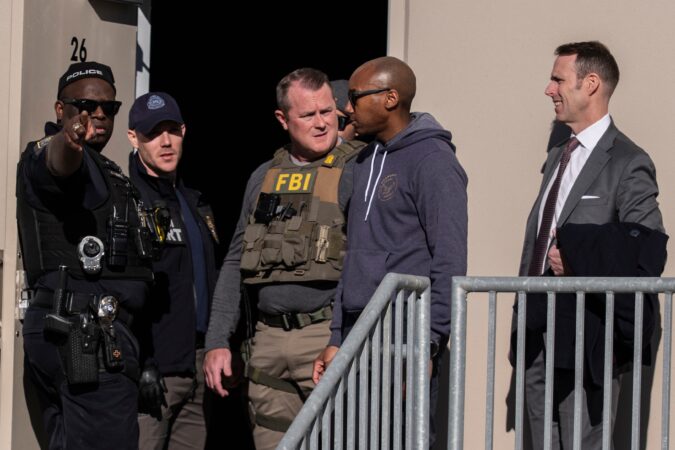
    FBI agents arrived at the elections hub just south of Atlanta with a search warrant seeking documents related to the 2020 election in Fulton County, including: all ballots, tabulator tapes from the scanners that tally the votes, electronic ballot images created when the ballots were counted and then recounted, and all voter rolls. The county has filed a motion seeking the return of the seized materials.

    President Donald Trump has fixated on Fulton, a Democratic stronghold and the most populous county in the state, asserting without evidence that widespread voter fraud there cost him victory in Georgia in 2020.

    An FBI agent’s affidavit presented to a magistrate judge to obtain the search warrant says the criminal investigation began with a referral from Kurt Olsen, who advised Trump as he tried to overturn his 2020 election loss and now serves as Trump’s director of election security and integrity with a mission to investigate Trump’s loss.

    The motion was filed by the Lawyers’ Committee for Civil Rights Under Law on behalf of the NAACP, Georgia and Atlanta NAACP organizations, and the Georgia Coalition for the Peoples Agenda. It notes that the seizure happened as the Justice Department has been seeking unredacted state voter registration rolls.

    The Justice Department has sued at least 23 states and the District of Columbia to try to get them to hand over detailed voter information. The agency has said it is seeking the data as part of an effort to ensure election security, but Democratic officials and other critics worry that federal officials want to use the sensitive data for other purposes. Federal courts in several states have rejected the Justice Department’s attempts to get the records.

    “These repeated efforts to access 2020 election records, including by the entity that now has custody of them, heightens concerns about the privacy and security of sensitive voter data and exacerbates the chill on voting rights,” the motion says.
  • Aliens are ‘real,’ Obama says, and Washington shrugs

    Aliens are ‘real,’ Obama says, and Washington shrugs

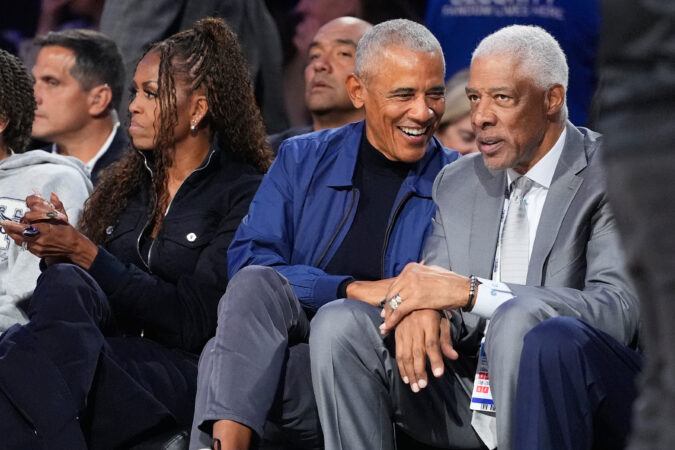
    Former President Barack Obama this weekend appeared to drop an otherworldly bombshell: Extraterrestrials exist.

    “They’re real, but I haven’t seen them,” Obama said in a podcast released Saturday. “There’s no underground facility, unless there’s this enormous conspiracy, and they hid it from the president of the United States.”

    The comments — coming in the 44th minute of a 47-minute interview with a popular liberal podcaster — sparked an outsize reaction on social media, including from UFO believers convinced the truth is out there and that government leaders have spent decades concealing it.

    It was also notable what didn’t happen, at least in official Washington. Political pundits didn’t discuss Obama’s comments on Sunday’s roster of talk shows. His foes didn’t rush to mock or condemn him; his allies didn’t jump to support him. Many mainstream media outlets initially ignored his comments on aliens while transcribing his other podcast remarks.

    In interviews, lawmakers and Capitol Hill staff members offered an explanation: The paranormal has become normal. They pointed to mounting political attention given to unidentified aerial phenomena, or UAPs — the term that has replaced UFOs — and polls that show a growing belief in extraterrestrials. Fifty-six percent of Americans believe that aliens exist, according to a November poll conducted by YouGov.

    Obama on Sunday night largely walked back his unearthly remarks, suggesting that he was offering a pithy response in the spirit of the podcast’s “lightning round” and that he was simply performing cosmic math.

    “Statistically, the universe is so vast that the odds are good there’s life out there,” Obama wrote on Instagram. “But the distances between solar systems are so great that the chances we’ve been visited by aliens is low, and I saw no evidence during my presidency that extraterrestrials have made contact with us. Really!”

    Not long ago, the former president’s 24-hour dalliance with E.T.s would have represented a political earthquake, liability, or both. When Dennis Kucinich, a former Democratic congressman from Ohio, affirmed at a 2007 presidential debate that he believed he had seen an unidentified flying object, Time magazine dubbed the comments one of the “screwups” of that political campaign cycle. Debate moderator Tim Russert then asked whether Obama, at the time a Democratic senator from Illinois, believed in extraterrestrial life, too.

    “I don’t know, and I don’t presume to know,” Obama responded, quickly pivoting from the question. “What I know is there is life here on Earth, and that we’re not attending to life here on Earth.”

    At the time, about a third of Americans believed in UFOs, according to an Associated Press/Ipsos poll released that month.

    But the political conversation has steadily shifted. Beginning in 2017, the New York Times and other media outlets have run reports on secret federal programs that have studied unusual, seemingly inexplicable phenomena. Government agencies have released videos of aircraft that appeared to defy the laws of physics.

    It’s a “legitimate question now,” former President Bill Clinton said in a 2022 appearance on The Late Late Show with James Corden.

    That curiosity is bipartisan. The GOP-led House Oversight Committee in 2024 held a hearing on “exposing the truth” about unidentified aerial phenomena, citing reports by naval aviators and government officials who claim to have witnessed or received reports of strange vehicles. Marco Rubio, the nation’s secretary of state and national security adviser, is among the now-dozens of officials and lawmakers who have demanded more information.

    “We have people with very high jobs in the U.S. Government that are either (a) liars; (b) crazy; or (c) telling the truth, and two of those three options are not good,” Rubio said in a Fox News interview in December, commenting on statements that he said he had heard while serving in the U.S. Senate. “I don’t know the answer.”

    Officials across multiple administrations have said they are unaware of proof of celestial beings.

    “I certainly wasn’t privy to any intelligence about alien life forms and believe me, I asked about it!” Sean Savett, the spokesperson for the White House National Security Council during the Biden administration, wrote in a text message on Sunday.

    Obama in 2021 said that he prioritized finding answers about extraterrestrial life as president, alluding to the conspiracy theories about Area 51 — a military base in Nevada that has been depicted in Hollywood productions as harboring alien technology and even alien beings.

    “When I came into office, I asked … ‘Is there the lab somewhere where we’re keeping the alien specimens and space ship?’ And, you know, they did a little bit of research and the answer was no,” Obama said in a 2021 appearance on The Late Late Show with James Corden.

    The current occupant of the Oval Office has been less publicly curious about interstellar matters. President Donald Trump told ABC News in 2019 that he had a “brief meeting” on UFOs during his first administration and that he didn’t particularly believe in aliens.

    While the White House press office did not respond to questions Sunday about Obama’s comments or whether Trump had updated his views, current staff members said they weren’t aware of Trump discussing the topic.

    “While POTUS often talks about things outside of my orbit, he’s never talked about things outside Earth’s orbit,” a White House official texted Sunday.

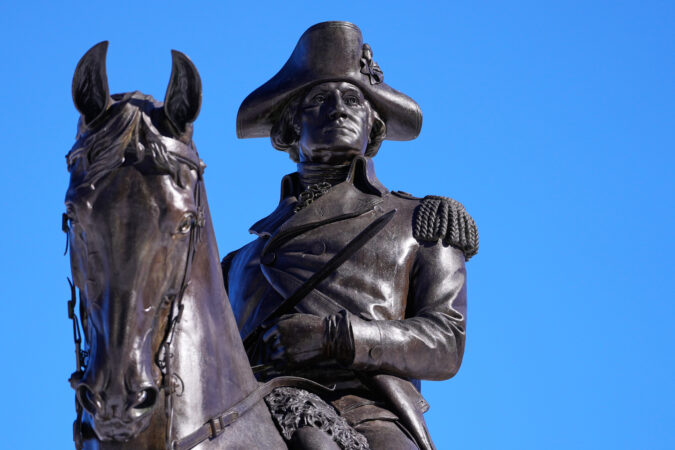
  • No, George Washington didn’t have wooden teeth. Yes, he led the Siege of Boston.

    No, George Washington didn’t have wooden teeth. Yes, he led the Siege of Boston.

    BOSTON — More than a decade before he became the country’s first president, George Washington was leading a critical campaign in the early days of the American Revolution. The Siege of Boston was his first campaign as commander-in-chief of the Continental Army and, in many ways, set the stage for his military and political successes — celebrated on Presidents Day.

    Following the Battles of Lexington and Concord, militias had pinned down the British in Boston in April 1775. The Continental Congress, recognizing the need for a more organized military effort, selected Washington to lead the newly formed army.

    The Siege of Boston and its significance

    On this day 250 years ago, Washington would have been nearing the end of an almost yearlong siege that bottled up as many as 11,000 British troops and hundreds more loyalists. The British were occupying Boston at the time, and the goal of the siege was to force them out.

    A critical decision made by Washington was sending Henry Knox, a young bookseller, to Fort Ticonderoga in New York to retrieve dozens of cannons. The cannons, transported hundreds of miles in the dead of winter, were eventually used to fire on British positions. That contributed to the decision by the British, facing dwindling supplies, to abandon the city by boat on March 17, 1776.

    Historians argue that the British abandoning their positions, celebrated in Boston as Evacuation Day, rid the city of loyalists at a critical time, denied the British access to an important port and gave patriots a huge morale boost.

    “The success of the Siege of Boston gave new life and momentum to the Revolution,” Chris Beagan, the site manager at Longfellow House in Cambridge, a National Historic Site that served as Washington’s headquarters during the American Revolution. “Had it failed, royal control of New England would have continued, and the Continental Army likely would have dissolved.”

    How the siege shaped Washington

    The siege was also a critical test for Washington. A surveyor and farmer, Washington had been out of the military for nearly 20 years after commanding troops for the British during the French and Indian War. His successful campaign ensured Washington remained the commander-in-chief for the remainder of the revolution.

    Doug Bradburn, president of George Washington’s Mount Vernon, said Washington took the first steps to creating a geographically diverse army that included militiamen from Massachusetts to Virginia and, by the end of the war, a fighting force with significant Black and Native American representation. It was the most integrated military until President Harry S. Truman’s desegregated the armed forces in 1948, he said.

    Washington, a slave owner who depended on hundreds of slaves on his Mount Vernon estate, was initially opposed to admitting formerly enslaved and free Black soldiers into the army. But short of men, Washington came to realize “there are free Blacks who want to enlist and he needs them to keep the British from breaking out” during the siege, Bradburn said.

    Ridding Boston of the British also turned Washington into one of the country’s most popular political figures.

    “He comes to embody the cause in a time before you have a nation, before you have a Declaration of Independence, before you’re really sure what is the goal of this struggle,” Bradburn said. “He becomes the face of the revolutionary movement.”

    Commanding the military for more than eight years also prepared Washington for the presidency, Pulitzer Prize-winning military historian Rick Atkinson said. “Perhaps most important, it gave him a sense that Americans could and should be a single people, rather than denizens of thirteen different entities.”

    Myths of Washington

    His rise to prominence also led to plenty of myths about Washington, many which persist to this day.

    One of the most popular is the cherry tree myth. It was invented by one of Washington’s first biographers, according to George Washington’s Mount Vernon, who created the story after his death. Supposedly, a 6-year-old Washington took an ax to a cherry tree and admitted as much when caught by his father, famously saying “I cannot tell a lie … I did cut it with my hatchet.”

    The second one is the wooden teeth myth. It was rumored that Washington had wooden dentures and scholars, well into the 20th century, were quoted as saying his false teeth were made from wood. Not true. He never wore wooden dentures, instead using those with ivory, gold and even human teeth.

    More than a statesman

    During his lifetime, Washington had myriad pursuits. He was known as an innovative farmer, according to the George Washington’s Mount Vernon, and an advocate for Western expansion, buying up to 50,000 acres of land in several Mid-Atlantic states. After returning to Mount Vernon, he built a whiskey distillery that became one of the largest in the country.

    His connection to slavery was complicated. He advocated for ending slavery, and his will called for freeing all the slaves he owned after the death of his wife, Martha Washington. But he didn’t own all the slaves at Mount Vernon so he couldn’t legally free all of them.

    Celebrating Presidents Day

    For fans of George Washington, Presidents Day is their Super Bowl. Originated to celebrate Washington’s birthday, which falls on Feb. 22, the holiday has become associated with good deals at the mall. Still, there are plenty of places celebrating all things Washington on this day.

    There will be a wreath-laying ceremony at Washington’s tomb at Mount Vernon, and there will be a Continental Army encampment. There will be a parade honoring Washington in Alexandria, Virginia, and, in Laredo, Texas, a monthlong celebration features a carnival, pageants, an air show and jalapeno festival.

  • Iran’s top diplomat met with the head of the U.N. nuclear watchdog ahead of a second round of U.S. talks

    Iran’s top diplomat met with the head of the U.N. nuclear watchdog ahead of a second round of U.S. talks

    GENEVA — Iran’s top diplomat met with the head of the U.N. nuclear watchdog agency on Monday, ahead of a second round of negotiations with the United States over Tehran’s nuclear program.

    Iranian Foreign Minister Abbas Araghchi met with Rafael Grossi, director-general of the International Atomic Energy Agency, and said he would also meet with Foreign Minister Badr al-Busaidi of Oman, which is hosting the U.S.-Iran talks in Geneva on Tuesday.

    “I am in Geneva with real ideas to achieve a fair and equitable deal,” Araghchi wrote on X. “What is not on the table: submission before threats.”

    As U.S. President Donald Trump ordered an additional aircraft carrier to the region, Iran on Monday launched a second naval drill in weeks, state TV reported. It said the drill would test Iran’s intelligence and operational capabilities in the Strait of Hormuz, the Persian Gulf and the Gulf of Oman.

    Iran’s drills take place against the U.S. military buildup

    Just before the talks, Iran announced its paramilitary Revolutionary Guard started the drill early Monday morning in the waterways that are crucial international trade routes through which 20% of the world’s oil passes.

    Separately, EOS Risk Group said sailors passing through the region received by radio a warning that the northern lane of the Strait of Hormuz, in Iranian territorial waters, likely would see a live-fire drill Tuesday. Iranian state TV did not mention the live fire drill.

    This is the second time in recent weeks sailors have received warning about an Iranian live fire drill. During the previous exercise, announced at the end of January, the U.S. military’s Central Command issued a strongly worded warning to Iran and the Revolutionary Guard. While acknowledging Iran’s “right to operate professionally in international airspace and waters,” it warned against interfering or threatening American warships or passing commercial vessels.

    On Feb. 4, tensions between the Iranian and U.S. navies rose further after a U.S. Navy fighter jet shot down an Iranian drone that was approaching the aircraft carrier USS Abraham Lincoln in the Arabian Sea. Iran also harassed a U.S.-flagged and U.S.-crewed merchant vessel that was sailing in the Strait of Hormuz, the U.S. military reported.

    Iran open to compromise in exchange for sanctions relief

    On Sunday, Iran’s Deputy Foreign Minister Majid Takht-Ravanchi signaled that Tehran could be open to compromise on the nuclear issue, but is looking for an easing of international sanctions led by the United States.

    “The ball is in America’s court. They have to prove they want to have a deal with us,” Takht-Ravanchi told the BBC. “If we see a sincerity on their part, I am sure that we will be on a road to have an agreement.”

    “We are ready to discuss this and other issues related to our program provided that they are also ready to talk about the sanctions,” he added.

    Oman hosted a first round of indirect talks between the U.S. and Iran on Feb. 6.

    Similar talks last year between the U.S. and Iran about Iran’s nuclear program broke down after Israel launched what became a 12-day war on Iran, that included the U.S. bombing Iranian nuclear sites.

    The U.S. is also hosting talks between envoys from Russia and Ukraine in Geneva on Tuesday and Wednesday, days ahead of the fourth anniversary of the all-out Russian invasion of its neighbor.

    U.S. keeps military pressure high

    Trump initially threatened to take military action over Iran’s bloody crackdown on nationwide protests last month, but then shifted to a pressure campaign in recent weeks to try to get Tehran to make a deal over its nuclear program.

    Secretary of State Marco Rubio, visiting Budapest, reiterated on Monday that the U.S. hopes to achieve a deal with Iran, despite the difficulties. “I’m not going to prejudge these talks,” Rubio said. “The president always prefers peaceful outcomes and negotiated outcomes to things.”

    Trump said Friday the USS Gerald R. Ford, the world’s largest aircraft carrier, was being sent from the Caribbean to the Mideast to join other military assets the U.S. has built up in the region. He also said a change in power in Iran “would be the best thing that could happen.”

    Iran has said if the U.S. attacks, it will respond with an attack of its own.

    The Trump administration has maintained that Iran can have no uranium enrichment under any deal. Tehran says it won’t agree to that.

    Iran has insisted its nuclear program is for peaceful purposes. However, its officials increasingly threaten to pursue a nuclear weapon. Before the June war, Iran had been enriching uranium up to 60% purity, a short, technical step away from weapons-grade levels.

    The direct meeting with Grossi is a significant step after Iran suspended all cooperation with the IAEA following the June war with Israel. The two also met briefly on the sidelines of the United Nations General Assembly in September. The IAEA said it has been unable to verify the status of Iran’s near weapons-grade uranium stockpile since the war. Iran has allowed IAEA some access to sites that were not damaged, but has not allowed inspectors to visit other sites.

    Iran’s stockpile of uranium enriched to 60% could allow Iran to build as many as 10 nuclear bombs, should it decide to weaponize its program, Grossi previously told The Associated Press. He added that it doesn’t mean that Iran has such a weapon.

    Israeli Prime Minister Benjamin Netanyahu rushed to Washington last week to urge Trump to ensure that any deal to include steps to neutralize Iran’s ballistic missile program and end its funding for proxy groups such as Hamas and Hezbollah.

  • Four smart moves to cut your 2025 tax bill under new rules

    Four smart moves to cut your 2025 tax bill under new rules

    The One Big Beautiful Bill Act made some long-awaited permanent changes to the tax code. It also introduced short-term tax breaks that come with strict limits and phaseouts, and many of them are only available through 2028 or 2029. Here are four ways to get the most out of the OBBBA’s temporary provisions as you file your 2025 taxes and plan ahead.

    Don’t dismiss itemizing your deductions

    The OBBBA temporarily boosts the state and local tax deduction cap, or SALT, from $10,000 to $40,000 (for married couples filing jointly and single filers). This higher cap applies from 2025 through 2029.

    Run the numbers: For 2025, the standard deduction is $31,500 for married couples and $15,750 for singles. If your total itemized deductions — including mortgage interest, charitable giving, and state and local taxes (up to the new $40,000 cap) — add up to more than your standard deduction, you should itemize.

    Watch your income: The new $40,000 SALT cap isn’t for everyone. It begins to phase out if your modified adjusted gross income is over $500,000 (for all filers). If your MAGI reaches $600,000, your SALT deduction reverts to the original $10,000 limit.

    Maximize the new targeted deductions — if you qualify

    The OBBBA introduced several temporary above-the-line deductions (available whether you itemize or not) to help middle-income workers. But they have very strict income and benefit limits.

    The qualified overtime pay deduction: Capped at $25,000 for married couples filing jointly and $12,500 for singles. Only the extra “half-time” portion of your time-and-a-half pay qualifies for the deduction. For a married couple, this benefit begins to disappear if your MAGI hits $300,000 and is entirely gone once your MAGI reaches $550,000.

    The qualified tips income deduction: Allows you to write off qualified tip income up to $25,000 per tax return, whether you file as married or single. The deduction is only available for tips that are formally reported on a Form W-2 or Form 1099. It phases out sharply for higher earners, starting at a MAGI of $300,000 for married couples and $150,000 for singles, and is fully eliminated at $550,000 and $400,000, respectively.

    The auto loan interest deduction: This temporary deduction allows you to write off up to $10,000 of interest paid on a loan for a new, personal-use vehicle with final assembly in the United States. (Leases are excluded.) It starts to phase out at $200,000 for married couples and $100,000 for singles and is completely gone by $250,000 and $150,000.

    Seniors, time your 2026 Roth conversions carefully

    If you are 65 or older, the OBBBA offers a new, temporary deduction for seniors of up to $12,000 for married couples ($6,000 per eligible spouse) and $6,000 for single filers. This is a welcome tax break, but it’s fragile.

    Beware the MAGI trap: This deduction begins to disappear for married couples with a MAGI over $150,000 and for singles over $75,000.

    Model Roth conversions for 2026: If you are a senior who is close to the $150,000 MAGI limit, a Roth conversion done in 2026 could push your income over the threshold, causing you to lose this entire $12,000 deduction. Work with your adviser to model any planned 2026 conversions.

    Optimize income to qualify for the best breaks

    Many of the OBBBA’s most valuable, temporary provisions are income-sensitive, particularly those new targeted deductions and the elevated SALT cap. Keep these rules in mind for 2025 filing and 2026 tax planning.

    If you are nearing any of the income phaseouts (like the $300,000 for tips/overtime, or the $500,000 for the elevated SALT cap), consider deferring income until 2026. This might include:

    • Postponing the sale of highly appreciated stock to avoid a large capital gain.
    • Delaying the exercise of nonqualified stock options.
    • Maximizing your 401(k) and health savings account contributions to reduce your current-year MAGI.
    • Holding off on large Roth conversions.

    A proactive approach to these expiring OBBBA provisions is essential for year-end. Don’t let the technical limitations and phaseouts catch you by surprise. With a little planning now, you can lock in significant tax savings.

    This article was provided to the Associated Press by Morningstar. For more personal finance content, go to https://www.morningstar.com/personal-finance.

    Sheryl Rowling, CPA, is an editorial director, financial adviser for Morningstar.

  • FBI: DNA recovered from glove found near Guthrie home that appears to match glove worn by suspect

    FBI: DNA recovered from glove found near Guthrie home that appears to match glove worn by suspect

    A glove containing DNA found about two miles from the house of “Today” show host Savannah Guthrie’s mother appears to match those worn by a masked person outside her front door in Tucson the night she vanished, the FBI said Sunday.

    The glove, discovered in a field beside a road, was sent for DNA testing. The FBI said in a statement that it received preliminary results Saturday and was awaiting official confirmation. The development comes as law enforcement gathers more potential evidence as the search for Guthrie’s mother heads into its third week. Authorities had previously said they had not identified a suspect.

    On Sunday night, Savannah Guthrie posted an Instagram video in which she issued an appeal to whoever abducted her mother or anyone who knows where she is being kept. “It is never too late to do the right thing,” Guthrie said. “And we are here. And we believe in the essential goodness of every human being, that it’s never too late.”

    Nancy Guthrie, 84, was last seen at her Arizona home on Jan. 31 and was reported missing the following day. Authorities say her blood was found on the front porch. Purported ransom notes were sent to news outlets, but two deadlines for paying have passed.

    The discovery was revealed days after investigators had released surveillance videos of the masked person outside Guthrie’s front door. A porch camera recorded video of a person with a backpack who was wearing a ski mask, long pants, jacket and gloves.

    On Thursday, the FBI called the person a suspect. It described him as a man about 5 feet, 9 inches tall with a medium build. The agency said he was carrying a 25-liter “Ozark Trail Hiker Pack” backpack.

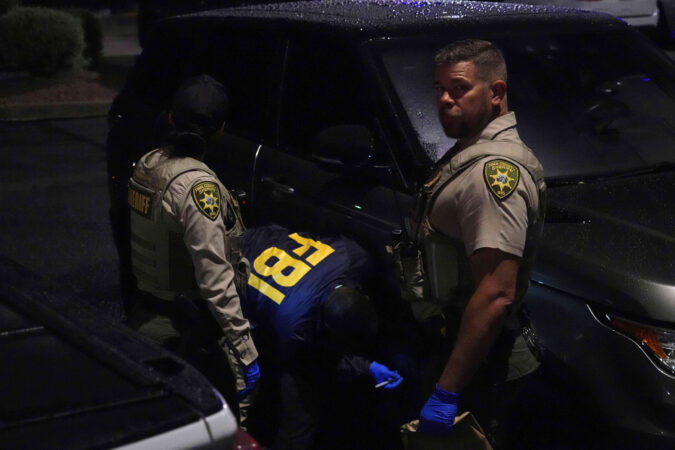
    Late Friday night, law enforcement agents sealed off a road about two miles (3.2 kilometers) from Guthrie’s home as part of their investigation. A series of sheriff’s and FBI vehicles, including forensics vehicles, passed through the roadblock.

    The investigators also tagged and towed a Range Rover SUV from a nearby restaurant parking lot late Friday. The sheriff’s department later said the activity was part of the Guthrie investigation but no arrests were made.

    On Tuesday, sheriff deputies detained a person for questioning during a traffic stop south of Tucson. Authorities didn’t say what led them to stop the man but confirmed he was released. The same day, deputies and FBI agents conducted a court-authorized search in Rio Rico, about an hour’s drive south of the city.

    Authorities have expressed concern about Nancy Guthrie’s health because she needs vital daily medicine. She is said to have a pacemaker and have dealt with high blood pressure and heart issues, according to sheriff’s dispatcher audio on broadcastify.com.

    Earlier in the investigation, authorities had said they had collected DNA from Nancy Guthrie’s property which doesn’t belong to Guthrie or those in close contact with her. Investigators were working to identify who it belongs to.

    The FBI also has said approximately 16 gloves were found in various spots near the house, most of which were searchers’ gloves that had been discarded.

  • Iran’s top diplomat to attend ‘indirect’ talks with U.S. in Geneva, state-run IRNA news agency says

    Iran’s top diplomat to attend ‘indirect’ talks with U.S. in Geneva, state-run IRNA news agency says

    DUBAI, United Arab Emirates — Iran’s top diplomat was traveling Sunday from Tehran to Geneva, where the second round of nuclear negotiations with the U.S. will take place, Iranian state media reported.

    Foreign Minister Abbas Araghchi and his delegation left for the Swiss city after the first round of indirect talks took place in Oman last week. Oman will mediate the talks in Geneva, the IRNA state-run news agency reported on its Telegram channel.

    Similar talks last year broke down after Israel launched what became a 12-day war on Iran that included the U.S. bombing Iranian nuclear sites.

    U.S. President Donald Trump has repeatedly threatened to use force to compel Iran to agree to constrain its nuclear program. Iran has said it would respond with an attack of its own. Trump has also threatened Iran over its deadly crackdown on recent nationwide protests.

    Gulf Arab countries have warned that any attack could spiral into another regional conflict.

    The Trump administration has maintained that Iran can have no uranium enrichment under any detail, which Tehran says it will not agree to.

    Iran continues to insist that its nuclear program is for peaceful purposes, but officials have increasingly threatened to pursue a nuclear weapon. Before the war in June, Iran has been enriching uranium up to 60% purity, just a short technical step away from weapons-grade levels.

    Araghchi is also expected to meet with his Swiss and Omani counterparts, as well as the director general of the U.N.’s atomic watchdog, the International Atomic Energy Agency.

    Earlier on Sunday, U.S. Secretary of State Marco Rubio said Washington remains interested in a diplomatic solution to ending its differences with Tehran, and that President Trump’s envoys Steve Witkoff and Jared Kushner were currently traveling for the new round of talks.

    Trump said Friday the USS Gerald R. Ford, the world’s largest aircraft carrier, was being sent from the Caribbean to the Mideast to join other military assets the U.S. has built up in the region. He also said a change in power in Iran “would be the best thing that could happen.”

    Rubio said recent military deployments in the Middle East were a protective measure aimed at shoring up the defenses of U.S. facilities and interests. Iran has threatened to attack U.S. bases in the region if Washington decides to strike. Tehran in June attacked the Al Udeid Air Base in Qatar, though no American or Qatari personnel were harmed.

    “No one’s been able to do a successful deal with Iran, but we’re going to try,” said Rubio at a news conference after meeting with Slovakian Prime Minister Robert Fico in Bratislava. “We are focused on negotiations.” Trump in recent weeks has suggested that his priority is for Iran to scale back its nuclear program, while Iran has said it wants talks to solely focus on the nuclear program.

    But Israeli Prime Minister Benjamin Netanyahu, who last week met with Trump in Washington, has been pressing for a deal that would neutralize Iran’s ballistic missile program and end its funding for proxy groups such as Hamas in the Gaza Strip and Hezbollah in Lebanon.

    The Israeli prime minister said in a speech Sunday that any deal between the U.S. and Iran must make sure that “all enriched material has to leave Iran.”

    It remains unclear how much influence Netanyahu will have over Trump’s policy on Iran. Trump initially threatened to take military action over Iran’s bloody crackdown on nationwide protests last month, but then shifted to a pressure campaign in recent weeks to try to get Tehran to make a deal over its nuclear program.

  • At least 6,000 killed over 3 days during RSF attack on Sudan’s el-Fasher, UN says

    At least 6,000 killed over 3 days during RSF attack on Sudan’s el-Fasher, UN says

    CAIRO — More than 6,000 people were killed in over three days when a Sudanese paramilitary group unleashed “a wave of intense violence … shocking in its scale and brutality” in Sudan’s Darfur region in late October, according to the United Nations.

    The Rapid Support Forces’ offensive to capture the city of el-Fasher included widespread atrocities that amount to war crimes and possible crimes against humanity, the U.N. Human Rights Office said in a report released on Friday.

    “The wanton violations that were perpetrated by the RSF and allied Arab militia in the final offensive on el-Fasher underscore that persistent impunity fuels continued cycles of violence,” said U.N. High Commissioner for Human Rights Volker Türk.

    The RSF and their allied Arab militias, known as Janjaweed, overran el-Fasher, the Sudanese army’s only remaining stronghold in Darfur, on Oct. 26 and rampaged through the city and its surroundings after more than 18 months of siege.

    The 29-page U.N. report detailed a set of atrocities that ranged from mass killings and summary executions, sexual violence, abductions for ransom, torture, and ill-treatment to detention and disappearances. In many cases, the attacks were ethnicity-motivated, it said.

    The RSF did not respond to an e-mailed request for comment.

    The paramilitaries’ Gen. Mohammed Hamdan Dagalo has previously acknowledged abuses by his fighters, but disputed the scale of atrocities.

    ‘Like a scene out of a horror movie’

    The alleged atrocities in el-Fasher, the provincial capital of North Darfur, mirror a pattern of RSF conduct in its war against the Sudanese miliary. The war began in April 2023 when a power struggle between the two sides exploded into open fighting in the capital, Khartoum, and elsewhere across the country.

    The conflict created the world’s largest humanitarian crisis with parts of the country pushed into famine. It has also been marked by heinous atrocities which the International Criminal Court said it was investigating as war crimes and crimes against humanity. The RSF was also accused by the Biden administration of carrying out genocide in the ongoing war.

    The U.N. Human Rights Office said it documented the killing of at least 4,400 people inside el-Fasher between Oct. 25 and Oct. 27, while more than 1,600 others were killed as they were trying to flee the RSF rampage. The report said it drew its toll from interviews with 140 victims and witnesses, which were “are consistent with independent analysis of contemporaneous satellite imagery and video footage.”

    In one case, RSF fighters opened fire from heavy weapons on a crowd of 1,000 people sheltering in the Rashid dormitory in el-Fasher university on Oct. 26, killing around 500 people, the report said. One witness was quoted as saying that he saw bodies thrown into the air, “like a scene out of a horror movie,” according to the report.

    In another case, around 600 people, including 50 children, were executed on Oct. 26 while taking shelter in the university facilities, the report said.

    The report, however, warned that the actual scale of the death toll of the weeklong offensive in el-Fasher was “undoubtedly significantly higher.”

    The toll does not include at least 460 people who were killed by the RSF on Oct. 28 when they stormed the Saudi Maternity hospital, according to the World Health Organization.

    Around 300 people were also killed in RSF shelling and drone attacks between Oct. 23 and Oct. 24 in the Abu Shouk camp for displaced people, 1.5 miles northwest of el-Fasher, the U.N. Human Rights Office’ report said.

    Woman and girls sexually assaulted

    Sexual violence, including rape and gang rape, was apparently widespread during the el-Fasher offensive, with RSF fighters and their allied militias targeting women and girls from the African Zaghawa non-Arab tribes over allegations of having links to or supporting the miliary, the report said.

    Türk, who visited Sudan last month, said survivors of sexual violence recounted testimonies that showed how the practice “was systematically used as a weapon of war.”

    The paramilitaries also abducted many people while attempting to flee the city, before releasing them after payment of ramson. Thousands have been held in at least 10 detention centers — including the city’s Children Hospital, which was turned into a detention facility — run by the RSF in el-Fasher, the report said.

    Several thousands of people remain missing and unaccounted for, the report said.

    The pattern of the RSF offensive on el-Fasher was a mirror of other attacks by the paramilitaries and their allies on the Zamzam camp for displaced people, 9 miles south of the city, and on West Darfur’s city of Geneina and the nearby town of Ardamata in 2023, the U.N. Human Rights Office said.

    Türk said there were “reasonable grounds” that RSF and their allied Arab militias committed war crimes, and that their acts also amount to crimes against humanity.

    He called for holding those responsible — including commanders — accountable, warning that “persistent impunity fuels continued cycles of violence.”

  • Cuba postpones its annual cigar fair as a U.S. oil siege causes severe fuel shortages and blackouts

    Cuba postpones its annual cigar fair as a U.S. oil siege causes severe fuel shortages and blackouts

    HAVANA, Cuba — Cuba’s annual cigar fair, which was set to be held the last week of February, has been postponed, organizers said Saturday, as the island faces blackouts and severe fuel shortages brought about by a U.S oil embargo.

    In a statement, the cigar fair’s organizer, Habanos S.A., said it decided to postpone the iconic event to “preserve its high standard of quality.”

    Habanos S.A., a joint venture between the state-owned company Cubatabaco and international firm Altadis, holds the global monopoly on Cuban cigar sales.

    Every year, the company hosts the annual Habanos Festival, a key event for cigar aficionados and distributors worldwide, where attendees tour tobacco plantations, participate in auctions, and witness the latest in craftsmanship.

    The statement by Habanos S.A. did not set a new date for the 26th edition of the cigar fair.

    Last year, the event closed with an auction in which $18 million was paid for a batch of highly coveted, hand-rolled cigars. The company last year also reported record sales of $827 million.

    Several cultural events, including a book fair, have been postponed in Cuba this month as the island grapples with the most severe fuel shortages and power blackouts in years.

    In late January, U.S. President Donald Trump threatened to impose tariffs on any country that sold oil to Cuba, as Washington puts more pressure on the island’s communist leadership to implement political and economic reforms.

    Cuba imports about 60% of its energy supply, and had long relied on Venezuela and Mexico for much of its oil.

    But shipments from Venezuela were canceled in January following the removal of that nation’s then-president Nicolas Maduro in a U.S. military raid, a move that also resulted in greater U.S. oversight over Venezuela’s oil industry.

    Shipments from Mexico stopped in mid-February following Trump’s tariff threat.

    Earlier this week, three Canadian airlines canceled flights to Cuba after the island’s government announced there would be no jet fuel for planes seeking to refuel at Cuba’s airports. Other airlines have maintained their flights to the island but will be refueling their planes with stopovers in the Dominican Republic.

    The fuel shortages have also hurt tourism on the island, with some agencies canceling trips as the government shuts down some hotels, and relocates tourists in a bid to save electricity.

    Tabacuba, a state-run tobacco company, lamented the postponement of this year’s cigar fair in a statement, saying it had come about due to “the complex economic situation that the nation is facing, as a result of the intensification of the economic, commercial and financial blockade” imposed by the United States.

  • Zelensky says questions remain for allies over security guarantees for Ukraine

    Zelensky says questions remain for allies over security guarantees for Ukraine

    KYIV, Ukraine — Ukraine’s President Volodymyr Zelensky thanked his international allies for their support but suggested there was still questions remaining over the future security guarantees for his country.

    Speaking at the Munich Security Conference in Germany, Zelensky repeatedly thanked American and European allies for helping Ukraine by providing air defense systems that protect infrastructure like power plants and “save lives.”

    Previous U.S.-led efforts to find consensus on ending the war, most recently two rounds of talks in Abu Dhabi, the capital of the United Arab Emirates, have failed to resolve difficult issues, such as the future of Ukraine’s Donbas industrial heartland that is largely occupied by Russian forces.

    Later with reporters, Zelensky questioned how the concept of a free-trade zone — proposed by the U.S. — would work in the Donbas region, which Russia insists Kyiv must give up in order to get peace.

    He also said the Americans want peace as quickly as possible and that the U.S. team wants to sign all the agreements on Ukraine at the same time, whereas Ukraine wants guarantees over the country’s future security signed first.

    European nations, including the U.K. and France, have already said they will commit troops to Ukraine to guarantee its future security. The U.S. is also expected to be involved and discussions are currently ongoing about the nature of America’s support.

    Russian officials are opposed to any foreign troop presence in Ukraine, Zelensky suggested, because Russian President Vladimir Putin wants to have the opportunity to attack Ukraine again.

    Zelensky also said he was surprised that Moscow had replaced the head of its negotiating team before another round of U.S.-brokered talks and suggested the move was deliberately aimed at delaying negotiations.

    The talks take place against a backdrop of continued fighting along the roughly 750-mile front line, relentless Russian bombardment of civilian areas of Ukraine and the country’s power grid, and Kyiv’s almost daily long-range drone attacks on war-related assets on Russian soil.

    During negotiations, Russian officials have insisted Ukraine give up more territory in the east of the country to end the war. But Zelensky told the Associated Press that it was “a little bit crazy” to suggest Ukraine withdraw from its own territory or exchange it.

    Thousands of Ukrainians have been killed defending the country’s Donbas region, he said, pointing out that 200,000 people also live there and it would not be acceptable to effectively hand them over to Russia.

    Zelensky also questioned how the concept of a free economic zone would work.

    “Imagine,” he said, if foreign soldiers patrolled the zone and Putin provoked them and they left. In that case, he said, there could be a “big occupation” of Ukraine and a lot of losses.

    If Putin is given any opportunity for victory “we don’t know what he will do next,” Zelensky said.

    Such a model, Zelensky told the AP, would have “big risks” for Ukraine and for any country which committed to guaranteeing Ukraine’s security. But he said he was ready to discuss it as it could be important as a compromise in exchange for securing support to reconstruct Ukraine.

    During negotiations, Moscow has to accept monitoring of a ceasefire and return some 7,000 Ukrainian prisoners of war in exchange for more than 4,000 Russian prisoners held by Ukraine, Zelensky said.

    Earlier on Saturday, drone strikes killed one person in Ukraine and another in Russia, Ukrainian officials said, ahead of fresh talks next week in Geneva aimed at ending the war.

    An elderly woman died when a Russian drone hit a residential building in the Black Sea port city of Odesa, Ukraine’s State Emergency Service said.

    In Russia, a civilian was killed in a Ukrainian drone strike on a car in the border region of Bryansk, regional Gov. Alexander Bogomaz said.

    Russia-installed authorities said a Ukrainian airstrike on a village Saturday wounded 15 people in Ukraine’s partially occupied Luhansk region.

    The attacks came a day after a Ukrainian missile strike on the Russian border city of Belgorod killed two people and wounded five, according to regional Gov. Vyacheslav Gladkov.