GENEVA, Switzerland — Delegations from Moscow and Kyiv met in Geneva on Tuesday for another round of U.S.-brokered peace talks, a week before the fourth anniversary of Russia’s full-scale invasion of its neighbor.
However, expectations for any breakthroughs in the scheduled two days of talks in Switzerland were low, with neither side apparently ready to budge from its positions on key territorial issues and future security guarantees, despite the United States setting a June deadline for a settlement.
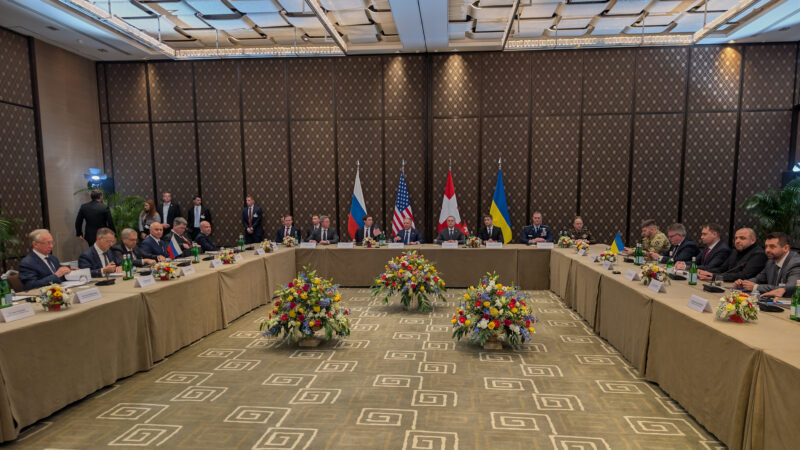
The head of the Ukrainian delegation, Rustem Umerov, posted photos on social media of the three delegations at a horseshoe-shaped table, with the Ukrainian and Russian officials sitting across from each other. President Donald Trump’s envoy, Steve Witkoff, and son-in-law Jared Kushner sat at the head of the table in front of U.S., Russian, Ukrainian, and Swiss flags.
“The agenda includes security and humanitarian issues,” Umerov said, adding that Ukrainians will work “without excessive expectations.”
Tough talks expected
Discussions on the future of Russian-occupied Ukrainian territory are expected to be particularly tough, according to a person familiar with the talks who spoke to the Associated Press on condition of anonymity because the person was not authorized to talk to reporters.
Russa is still insisting that Ukraine cede control of its eastern Donbas region.
Also in Geneva will be American, Russian, and Ukrainian military chiefs, who will discuss how ceasefire monitoring might work after any peace deal, and what’s needed to implement it, the person said.
During previous talks in Abu Dhabi, the capital of the United Arab Emirates, military leaders looked at how a demilitarized zone could be arranged and how everyone’s militaries could talk to one another, the person added.
Kremlin spokesperson Dmitry Peskov cautioned against expecting developments on the first day of talks as they were set to continue on Wednesday. Moscow has provided few details of previous talks.
Trump describes the talks as ‘big’
Ukraine’s short-handed army is locked in a war of attrition with Russia’s bigger forces along the roughly 750-mile front line. Ukrainian civilians are enduring Russian aerial barrages that repeatedly knock out power and destroy homes.
The future of the almost 20% of Ukrainian land that Russia occupies or still covets is a central question in the talks, as are Kyiv’s demands for postwar security guarantees with a U.S. backstop to deter Moscow from invading again.
Trump described the Geneva meeting as “big talks.”
“Ukraine better come to the table fast,” he told reporters late Monday as he flew back to Washington from his home in Florida.
It wasn’t immediately clear what Trump was referring to in his comment about Ukraine, which has committed to and taken part in negotiations in the hope of ending Russia’s devastating onslaught.
Complex talks as the war presses on
The Russian delegation is headed by Russian President Vladimir Putin’s adviser Vladimir Medinsky, who headed Moscow’s team of negotiators in the first direct peace talks with Ukraine in Istanbul in March 2022 and has forcefully pushed Putin’s war goals. Medinsky has written several history books that claim to expose Western plots against Russia and berate Ukraine.
The commander of the U.S. military — and NATO forces — in Europe, Gen. Alexus Grynkewich, and Secretary of the U.S. Army Dan Driscoll will attend the meeting in Geneva on behalf of the U.S. military and meet with their Russian and Ukrainian counterparts, said Col. Martin O’Donnell, a spokesman for the U.S. commander.
Overnight, Russia used almost 400 long-range drones and 29 missiles of various types to strike 12 regions of Ukraine, injuring nine people, including children, according to the Ukrainian President Volodymyr Zelensky.
Zelensky said tens of thousands of residents were left without heating and running water in the southern port city of Odesa. He said Moscow should be “held accountable” for the relentless attacks, which he said undermine the U.S. push for peace.
“The more this evil comes from Russia, the harder it will be for everyone to reach any agreements with them. Partners must understand this. First and foremost, this concerns the United States,” the Ukrainian leader said on social media late Monday.
“We agreed to all realistic proposals from the United States, starting with the proposal for an unconditional and long-term ceasefire,” Zelensky noted.
The talks in Geneva took place as U.S. officials also held indirect talks with Iran in the Swiss city.
Meanwhile, Ukraine’s Security Service, or SBU, used long-range drones to strike an oil terminal in southern Russia and a major chemical plant deep inside the country, a Ukrainian security official who spoke on condition of anonymity because he was not authorized to speak publicly told the AP.
Drones targeted the Tamanneftegaz oil terminal, one of the biggest ports of its type on the Black Sea, in Russia’s Krasnodar region for the second time this month, starting a fire, the official said.
Drones also hit the Metafrax Chemicals plan, which manufactures chemical components used in explosives and other military materials, in Russia’s Perm region, more than 1,000 miles from the Ukrainian border, according to the official.
WASHINGTON — The Justice Department has issued new subpoenas in a Florida-based investigation into perceived adversaries of President Donald Trump and the U.S. government response to Russian interference in the 2016 presidential election, according to multiple people familiar with the matter.
An initial wave of subpoenas in November asked recipients for documents related to the preparation of a U.S. intelligence community assessment that detailed a sweeping, multiprong effort by Moscow to help Trump defeat Democratic nominee Hillary Clinton in the 2016 election.
Though the first subpoenas requested documents from the months surrounding the January 2017 publication of the Obama administration intelligence assessment, the latest subpoenas seek any records from the years since then, said the people, who spoke on condition of anonymity to the Associated Press to discuss a nonpublic demand from investigators.
The Justice Department declined to comment Tuesday.
The subpoenas reflect continued investigative activity in one of several criminal inquiries the Justice Department has undertaken into Trump’s political opponents. An array of former intelligence and law enforcement officials have received subpoenas in the investigation. Lawyers for former CIA Director John Brennan, who helped oversee the drafting of the assessment and who has been called “crooked as hell” by Trump, have said they have been informed he is a target but have not been told of any “legally justifiable basis for undertaking this investigation.”
The intelligence community assessment, published in the final days of the Obama administration, found that Russia had developed a “clear preference” for Trump in the 2016 election and that Russian President Vladimir Putin had ordered an influence campaign with goals of undermining confidence in American democracy and harming Clinton’s chance for victory.
That conclusion, and a related investigation into whether the 2016 Trump campaign colluded with Russia to sway the outcome of the election, have long been among the Republican president’s chief grievances and he has vowed retribution against the government officials involved in the inquiries. Former FBI Director James Comey was indicted by the Trump administration Justice Department last year on false statement and obstruction charges, but the case was later dismissed.
Multiple government reports, including bipartisan congressional reviews and a criminal investigation by former special counsel Robert Mueller, have found that Russia interfered in Trump’s favor through a hack-and-leak operation of Democratic emails as well as a covert social media campaign aimed at sowing discord and swaying American public opinion. Mueller’s report found that the Trump campaign actively welcomed the Russian help, but it did not establish that Russian operatives and Trump or his associates conspired to tip the election in his favor.
The Trump administration has freshly scrutinized the intelligence community assessment in part because a classified version of it incorporated in its annex a summary of the “Steele dossier,” a compilation of Democratic-funded opposition research that was assembled by former British spy Christopher Steele and was later turned over to the FBI. That research into Trump’s potential links to Russia included uncorroborated rumors and salacious gossip, and Trump has long held up its weaknesses in an effort to discredit the entire Russia investigation.
A declassified CIA tradecraft review ordered by current Director John Ratcliffe and released last July faults Brennan’s oversight of the assessment.
The review does not challenge the conclusion of Russian election interference but chides Brennan for the fact that the classified version referenced the Steele dossier.
Brennan testified to Congress, and also wrote in his memoir, that he was opposed to citing the dossier in the intelligence assessment since neither its substance nor sources had been validated, and he has said the dossier did not inform the judgments of the assessment. He maintains the FBI pushed for its inclusion.
The new CIA review seeks to cast Brennan’s views in a different light, asserting that he “showed a preference for narrative consistency over analytical soundness” and brushed aside concerns over the dossier because he believed it conformed “with existing theories.” It quotes him, without context, as having stated in writing that “my bottom line is that I believe that the information warrants inclusion in the report.”
In a letter last December addressed to the chief judge of the Southern District of Florida, where the investigation is based, Brennan’s lawyers challenged the underpinnings of the investigation, questioning what basis prosecutors had for opening the inquiry in Florida and saying they had received no clarity from prosecutors about what potential crimes were even being investigated.
“While it is mystifying how the prosecutors could possibly believe there is any legally justifiable basis for undertaking this investigation, they have done nothing to explain that mystery,” the lawyers said.
CHICAGO — The Rev. Jesse L. Jackson, a protégé of the Rev. Martin Luther King Jr. and two-time presidential candidate who led the Civil Rights Movement for decades after the revered leader’s assassination, died Tuesday. He was 84.
As a young organizer in Chicago, Rev. Jackson was called to meet with King at the Lorraine Motel in Memphis shortly before King was killed, and he publicly positioned himself thereafter as King’s successor.
Santita Jackson confirmed that her father, who had a rare neurological disorder, died at home in Chicago, surrounded by family.
Rev. Jackson led a lifetime of crusades in the United States and abroad, advocating for the poor and underrepresented on issues, including voting rights, job opportunities, education, and healthcare. He scored diplomatic victories with world leaders, and through his Rainbow/PUSH Coalition, he channeled cries for Black pride and self-determination into corporate boardrooms, pressuring executives to make America a more open and equitable society.
And when he declared, “I am Somebody,” in a poem he often repeated, he sought to reach people of all colors. “I may be poor, but I am Somebody; I may be young; but I am Somebody; I may be on welfare, but I am Somebody,” Rev. Jackson intoned.
It was a message he took literally and personally, having risen from obscurity in the segregated South to become America’s best-known civil rights activist since King.
“Our father was a servant leader — not only to our family, but to the oppressed, the voiceless, and the overlooked around the world,” the Jackson family said in a statement posted online. “We shared him with the world, and in return, the world became part of our extended family.”
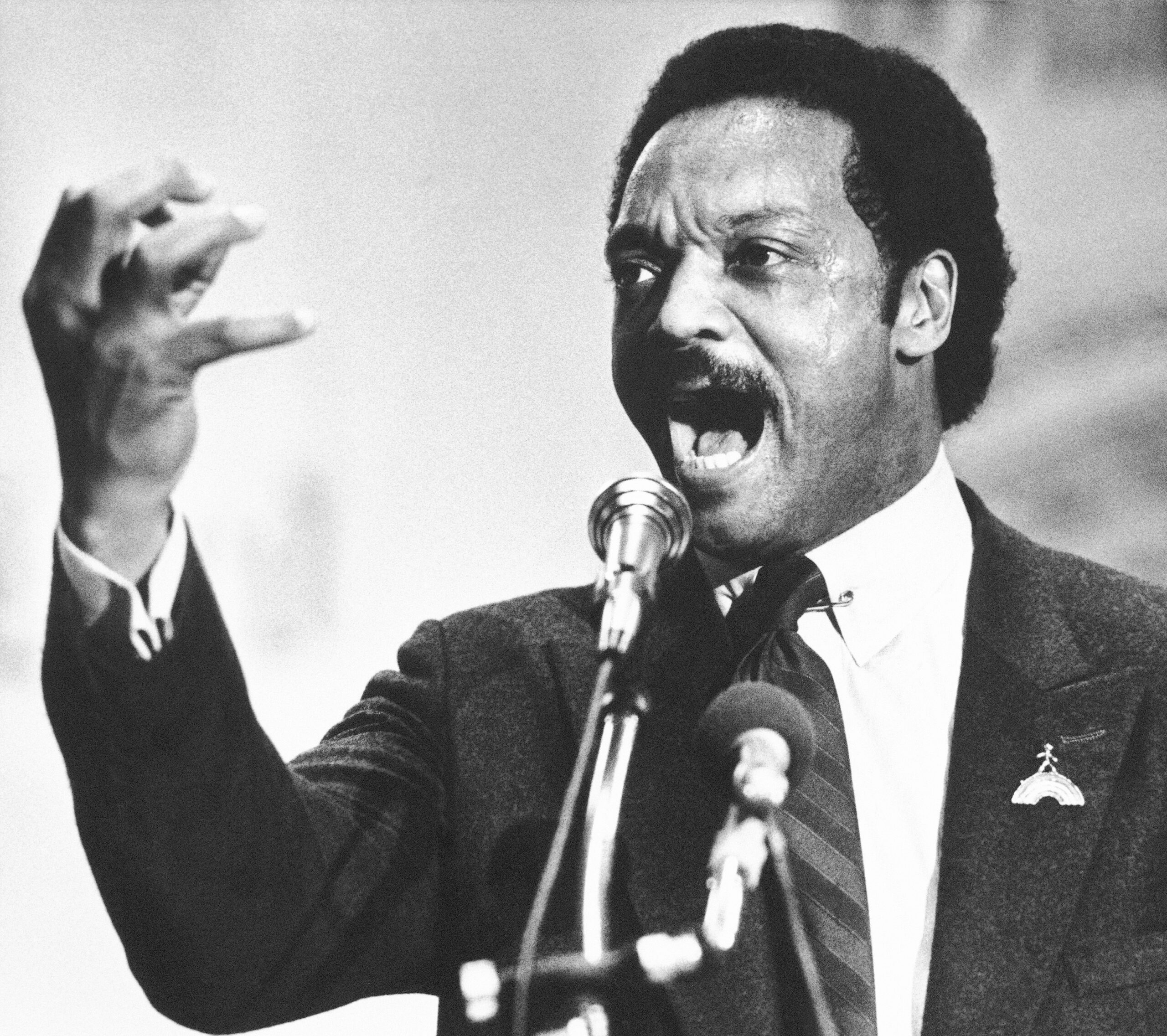
Democratic presidential primary candidate Jesse Jackson speaks to a group of his supporters at a rally held at a Baptist Church in Dayton, Ohio, on April 14, 1984.
Fellow civil rights activist the Rev. Al Sharpton said his mentor “was not simply a civil rights leader; he was a movement unto himself.”
“He taught me that protest must have purpose, that faith must have feet, and that justice is not seasonal, it is daily work,” Sharpton wrote in a statement, adding that Rev. Jackson taught “trying is as important as triumph. That you do not wait for the dream to come true; you work to make it real.”
“Even if we win,” he told marchers in Minneapolis before the officer whose knee kept George Floyd from breathing was convicted of murder, “it’s relief, not victory. They’re still killing our people. Stop the violence, save the children. Keep hope alive.”
Rev. Jackson’s voice, infused with the stirring cadences and powerful insistence of the Black church, demanded attention. On the campaign trail and elsewhere, he used rhyming and slogans such as “Hope not dope” and “If my mind can conceive it and my heart can believe it, then I can achieve it,” to deliver his messages.
Rev. Jackson had his share of critics, both within and outside of the Black community. Some considered him a grandstander, too eager to seek the spotlight. Looking back on his life and legacy, Rev. Jackson told the Associated Press in 2011 that he felt blessed to be able to continue the service of other leaders before him and to lay a foundation for those to come.
“A part of our life’s work was to tear down walls and build bridges, and in a half century of work, we’ve basically torn down walls,” Rev. Jackson said. “Sometimes when you tear down walls, you’re scarred by falling debris, but your mission is to open up holes so others behind you can run through.”
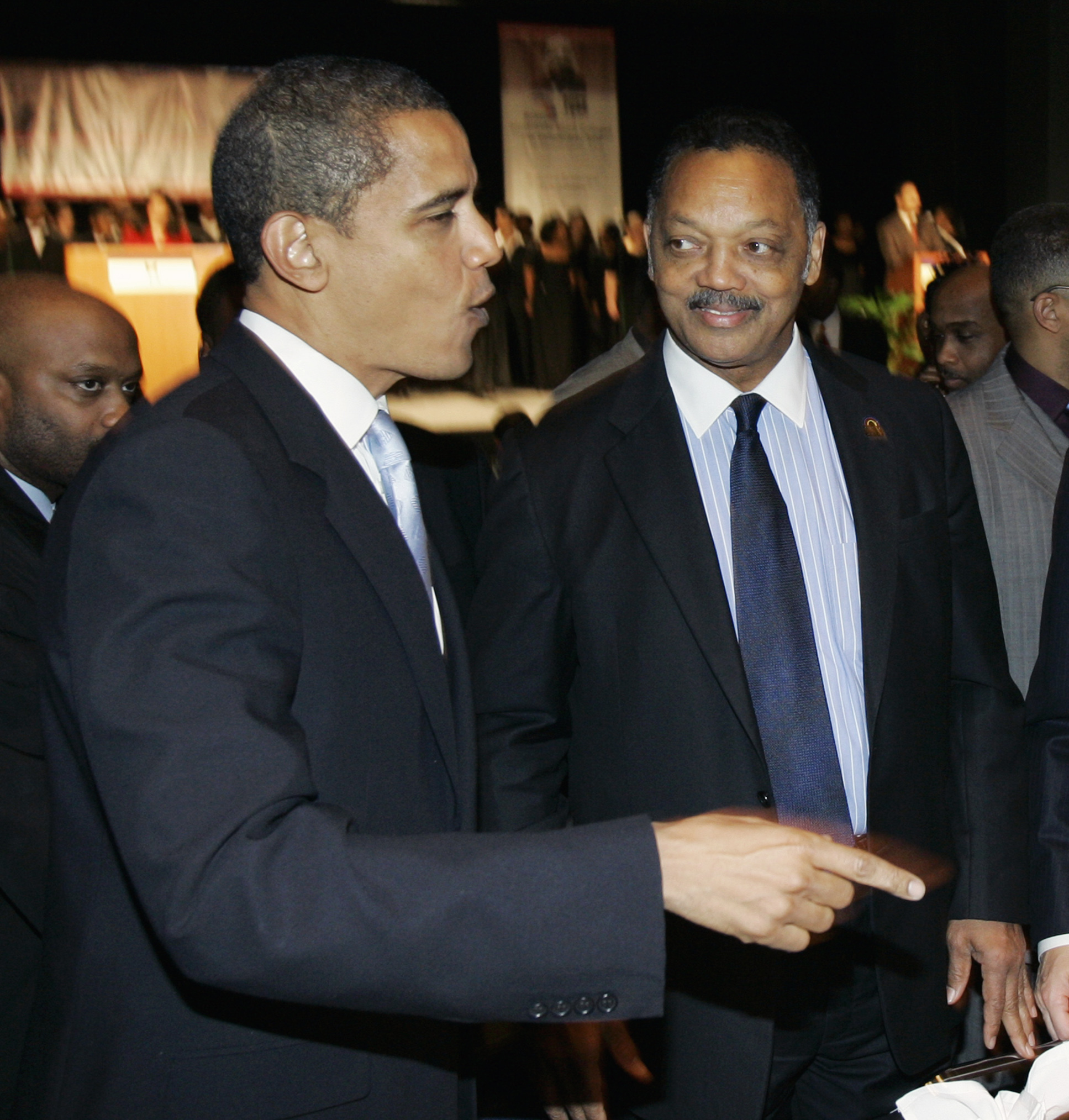
Barack Obama, then a senator. from Illinois, and the Rev. Jesse Jackson are seen at the Rev. Dr. Martin Luther King Jr. Scholarship Awards Breakfast in Chicago on Jan. 15, 2007.
In his final months, as he received 24-hour care, he lost his ability to speak, communicating with family and visitors by holding their hands and squeezing.
“I get very emotional knowing that these speeches belong to the ages now,” his son, Jesse Jackson Jr., told the AP in October.
A student athlete drawn to the Civil Rights Movement
Jesse Louis Jackson was born Oct. 8, 1941, in Greenville, S.C., the son of high school student Helen Burns and Noah Louis Robinson, a married man who lived next door. Jackson was later adopted by Charles Henry Jackson, who married his mother.
Rev. Jackson was a star quarterback on the football team at Sterling High School in Greenville, and he accepted a football scholarship from the University of Illinois. But after reportedly being told that Black people couldn’t play quarterback, he transferred to North Carolina A&T in Greensboro, where he became the first-string quarterback, an honor student in sociology and economics, and student body president.
Arriving on the historically Black campus in 1960 just months after students there launched sit-ins at a whites-only lunch counter, Rev. Jackson immersed himself in the blossoming Civil Rights Movement.
By 1965, he joined the voting rights march King led from Selma to Montgomery, Alabama. King dispatched him to Chicago to launch Operation Breadbasket, a Southern Christian Leadership Conference effort to pressure companies to hire Black workers.
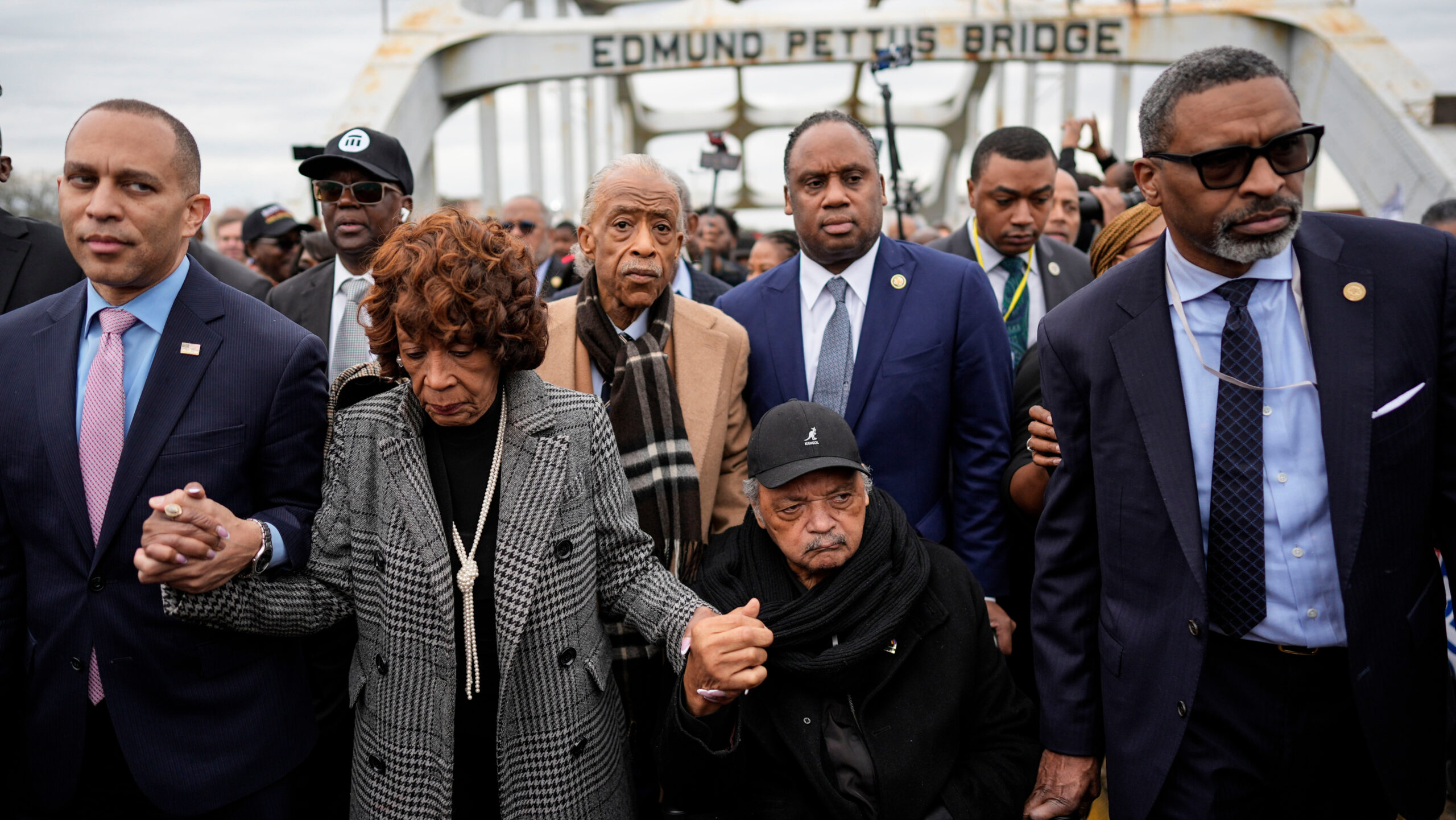
U.S. Rep. Hakeem Jeffries (D., N.Y.), U.S. Rep. Maxine Waters (D., Calif.), the Rev. Al Sharpton, Rev. Jesse Jackson and NAACP President Derrick Johnson walk across the Edmund Pettus bridge in Selma, Ala., on March 9, 2025, during the 60th anniversary of the march to ensure that African Americans could exercise their constitutional right to vote.
Rev. Jackson called his time with King “a phenomenal four years of work.”
Rev. Jackson was with King on April 4, 1968, when the civil rights leader was slain. Rev. Jackson’s account of the assassination was that King died in his arms.
Sharpton said he “always wondered how much trauma that must have been” for Rev. Jackson to witness King’s death. “He never would talk about it too much, but it drove him,” Sharpton said Tuesday. “He said, ‘We’ve got to keep Dr. King’s legacy alive.’”
With his flair for the dramatic, Rev. Jackson wore a turtleneck he said was soaked with King’s blood for two days, including at a King memorial service held by the Chicago City Council, where he said: “I come here with a heavy heart because on my chest is the stain of blood from Dr. King’s head.”
However, several King aides, including speechwriter Alfred Duckett, questioned whether Rev. Jackson could have gotten King’s blood on his clothing. There are no images of Rev. Jackson in pictures taken shortly after the assassination.
In 1971, Rev. Jackson broke with the Southern Christian Leadership Conference to form Operation PUSH, originally named People United to Save Humanity. The organization based on Chicago’s South Side declared a sweeping mission, from diversifying workforces to registering voters in communities of color nationwide. Using lawsuits and threats of boycotts, Rev. Jackson pressured top corporations to spend millions and publicly commit to hiring more diverse employees.
The constant campaigns often left his wife, Jacqueline Lavinia Brown, the college sweetheart he married in 1963, taking the lead in raising their five children: Santita Jackson, Yusef DuBois Jackson, Jacqueline Lavinia Jackson Jr., and two future members of Congress, U.S. Rep. Jonathan Luther Jackson and Jesse L. Jackson Jr., who resigned in 2012 but is seeking reelection in the 2026 midterms.
The elder Jackson, who was ordained as a Baptist minister in 1968 and earned his master’s of divinity degree in 2000, also acknowledged fathering a child, Ashley Jackson, with one of his employees at Rainbow/PUSH, Karen L. Stanford. He said he understood what it means to be born out of wedlock and supported her emotionally and financially.
On Tuesday, Harold Hall joined other mourners who stopped by the family home to pay their respects.
Hall, who once lived in the same Chicago neighborhood as Rev. Jackson, left a bouquet of flowers outside Rev. Jackson’s door and recalled that he helped local street organizations in the late 1960s and early 1970s.
Rev. Jackson “would come out and shoot ball and try to change the minds of many of our young folk,” urging them to stay out of trouble, Hall told reporters. “And in many instances, it happened. It worked.”
Presidential aspirations fall short but help ‘keep hope alive’
Despite once telling a Black audience he would not run for president “because white people are incapable of appreciating me,” Rev. Jackson ran twice and did better than any Black politician had before President Barack Obama, winning 13 primaries and caucuses for the Democratic nomination in 1988, four years after his first failed attempt.
His successes left supporters chanting another Rev. Jackson slogan, “Keep hope alive.”
“I was able to run for the presidency twice and redefine what was possible; it raised the lid for women and other people of color,” he told the AP. “Part of my job was to sow seeds of the possibilities.”
U.S. Rep. John Lewis said during a 1988 C-SPAN interview that Rev. Jackson’s two runs for the Democratic nomination “opened some doors that some minority person will be able to walk through and become president.”
Obama acknowledged Rev. Jackson’s efforts, saying he led some of the most significant movements for change in human history.
Michelle Obama “got her first glimpse of political organizing at the Jacksons’ kitchen table when she was a teenager,” Obama wrote on X. “And in his two historic runs for president, he laid the foundation for my own campaign to the highest office in the world.”
Rev. Jackson “was relentless in his belief that we are all children of God, deserving of dignity and respect,” the post read.
Rev. Jackson also pushed for cultural change, joining calls by NAACP members and other movement leaders in the late 1980s to identify Black people in the United States as African Americans.
“To be called African Americans has cultural integrity — it puts us in our proper historical context,” Rev. Jackson said at the time. “Every ethnic group in this country has a reference to some base, some historical cultural base. African Americans have hit that level of cultural maturity.”
Rev. Jackson’s words sometimes got him in trouble.
In 1984, he apologized for what he thought were private comments to a reporter in which he called New York City “Hymietown,” a derogatory reference to its large Jewish population. And in 2008, he made headlines when he complained that Obama was “talking down to Black people” in comments captured by a microphone he didn’t know was on during a break in a television taping.
Still, when Rev. Jackson joined the jubilant crowd in Chicago’s Grant Park to greet Obama that election night, he had tears streaming down his face.
“I wish for a moment that Dr. King or [slain civil rights leader] Medgar Evers … could’ve just been there for 30 seconds to see the fruits of their labor,” he told the AP years later. “I became overwhelmed. It was the joy and the journey.”
Exerting influence on events at home and abroad
Rev. Jackson also had influence abroad, meeting world leaders and scoring diplomatic victories, including the release of Navy Lt. Robert Goodman from Syria in 1984, as well as the 1990 release of more than 700 foreign women and children held after Iraq’s invasion of Kuwait. In 1999, he won the freedom of three Americans imprisoned by Yugoslav President Slobodan Milosevic.
In 2000, President Bill Clinton awarded Rev. Jackson the Presidential Medal of Freedom, the country’s highest civilian honor.
“Citizens have the right to do something or do nothing,” Rev. Jackson said, before heading to Syria. “We choose to do something.”
In 2021, Rev. Jackson joined the parents of Ahmaud Arbery inside the Georgia courtroom where three white men were convicted of killing the young Black jogger. In 2022, he hand-delivered a letter to the U.S. Attorney’s Office in Chicago, calling for federal charges against former Chicago Police Officer Jason Van Dyke in the 2014 killing of Black teenager Laquan McDonald.
Rev. Jackson, who stepped down as president of Rainbow/PUSH in July 2023, disclosed in 2017 that he had sought treatment for Parkinson’s, but he continued to make public appearances even as the disease made it more difficult for listeners to understand him. Last year, doctors confirmed a diagnosis of progressive supranuclear palsy, a life-threatening neurological disorder. He was admitted to a hospital in November for nearly two weeks.
During the coronavirus pandemic, he and his wife survived being hospitalized with COVID-19. Rev. Jackson was vaccinated early, urging Black people in particular to get protected, given their higher risks for bad outcomes.
“It’s America’s unfinished business — we’re free, but not equal,” Rev. Jackson told the AP. “There’s a reality check that has been brought by the coronavirus, that exposes the weakness and the opportunity.”
Investigators working on the disappearance of “Today” show host Savannah Guthrie’s mother are consulting with Walmart management to develop leads because a backpack the suspect was wearing is sold exclusively at the stores, the Pima County, Arizona, sheriff said Monday.
Nancy Guthrie, 84, was last seen at her Arizona home on Jan. 31 and was reported missing the following day. Authorities say her blood was found on the front porch. Purported ransom notes were sent to news outlets, but two deadlines for paying have passed.
The Federal Bureau of Investigation released surveillance videos of a masked person wearing a handgun holster outside Guthrie’s front door in Tucson the night she vanished. A porch camera recorded video of a person with a backpack who was wearing a ski mask, long pants, a jacket and gloves.
Pima County Sheriff Chris Nanos said in a text message to The Associated Press on Monday that the 25-liter “Ozark Trail Hiker Pack” backpack was the only clothing item that has been “definitively identified.”
“This backpack is exclusive to Walmart and we are working with Walmart management to develop further leads,” Nanos said.
The suspect’s clothing “may have been purchased from Walmart but is not exclusively available at Walmart,” the Pima County Sheriff’s Department said in a statement Monday. “This remains a possibility only.”
Investigators on Sunday announced that a glove discovered near the Guthrie home has been sent for DNA testing. The FBI said that it received preliminary results Saturday and was awaiting official confirmation. The development comes as law enforcement gathers more potential evidence and as the search for Guthrie’s mother heads into its third week. Authorities previously said they had not identified a suspect.
The FBI said the suspect in the surveillance footage is a man about 5 feet, 9 inches tall with a medium build.
Nanos said on Monday that members of Guthrie’s family, including siblings and spouses, are not suspects.
“The family has been nothing but cooperative and gracious and are victims in this case,” Nanos said in a statement.
Authorities have expressed concern about Nancy Guthrie’s health because she needs vital daily medicine. She is said to have a pacemaker and have dealt with high blood pressure and heart issues, according to sheriff’s dispatcher audio on broadcastify.com.
PAWTUCKET, R.I. — Three people, including the suspect, were fatally shot during a Rhode Island youth hockey game Monday, authorities said.
Pawtucket Police Chief Tina Goncalves told reporters that three other victims were hospitalized in critical condition. The shooter died from an apparent self-inflicted gun wound, she said.
While police were not involved in the shooter’s death, authorities were still investigating, she said.
“It appears that this was a targeted event, that it may be a family dispute,” she said.
Goncalves did not provide details about the suspect or the ages of those who were killed, though she said it appeared that both victims were adults.
She said investigators were trying to piece together what happened and speak with witnesses of the shooting inside Dennis M. Lynch Arena in Pawtucket, a few miles outside Providence. They also were reviewing video taken from the hockey game. Unverified footage circulating on social media shows players diving for cover and fans fleeing their seats after popping sounds are heard.
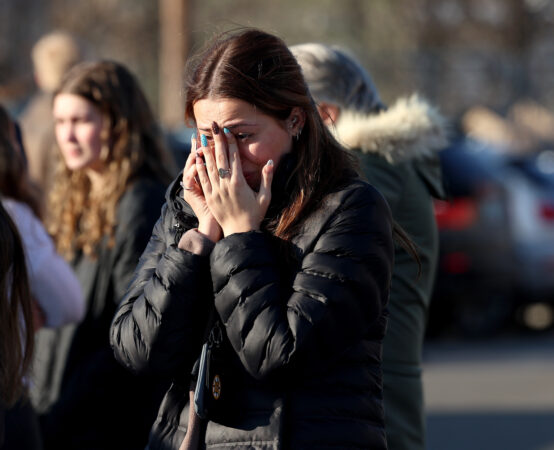
Outside the arena, tearful families and high school hockey players still in uniform could be seen hugging before they boarded a bus to leave the area. Roads surrounding the arena were shut down as a heavy police presence remained and helicopters flew overhead.
Monday’s shooting comes nearly two months after Rhode Island was rocked by a separate gun violence tragedy at Brown University, where a gunman killed two students and wounded nine others. That shooter went on to also fatally shoot a Massachusetts Institute of Technology professor. Authorities later found Claudio Neves Valente, 48, dead from a self-inflicted gunshot wound at a New Hampshire storage facility.
“The fortunate thing is that the two incidents are not related, but it is very tragic,” said Pawtucket Mayor Don Grebien. “These are high school kids. They were doing an event, they were playing with their families watching, a fun time, and it turned into this.”
Pawtucket is nestled just north of Providence and right under the Massachusetts state border. A city of just under 80,000, Pawtucket had up until recently been known as the home to Hasbro’s headquarters.
RAMALLAH, West Bank — Israeli prosecutors said Monday that they plan to charge a settler in the killing of a Palestinian activist during a confrontation that was caught on video, opening a rare prosecution of violence by Jewish settlers in the occupied West Bank.
Attacks from settlers and home demolitions by authorities have spiked dramatically over the past two years, but the death in July of Awdah Hathaleen has drawn particular attention due to his involvement in the 2025 Oscar-winning film No Other Land, which chronicled Palestinian villagers’ fight to stay on their land. The case also stands out because the confrontation between Palestinians and Yinon Levi, an internationally sanctioned settler, was captured on video from multiple vantage points.
An Israeli judge released Levi from custody six months ago, citing a lack of evidence that he fired the shots that killed Hathaleen.
Israel’s State Attorney General’s office confirmed in a statement Monday that it had initiated proceedings to indict Levi. It did not specify the charges.
Eitan Peleg, an attorney for Hathaleen’s family, said the office had informed them it planned to indict Levi for reckless homicide, triggering a process that allows Levi to contest charges before they’re formally filed.
“Enforcement of the law in cases like this involving Palestinians in the West Bank is very rare, so this is unique,” Peleg told the Associated Press on Monday.
Israel’s military referred questions on the indictment to police, who have not yet responded. Both bodies enforce laws in the area.
More than 3.4 million Palestinians and 700,000 Israelis live in the occupied West Bank and east Jerusalem, territories captured by Israel in 1967 and sought by Palestinians for a future state. The international community overwhelmingly considers Israeli settlement construction in these areas to be illegal and an obstacle to peace.
Palestinians and rights groups say authorities routinely fail to prosecute settlers or hold them accountable for violence. Under National Security Minister Itamar Ben-Gvir, investigations into settler attacks have plummeted, according to the Israeli rights group Yesh Din.
Khalil Hathaleen, Awdah’s brother, said the family was glad some measure of justice was being pursued but felt the charge of “reckless homicide” was insufficient.
“It was an intentional killing in broad daylight, with prior intent and premeditation,” he said.
Levi’s attorney, Avichai Hajbi, declined Monday to comment on the coming indictment, which he said he hadn’t received. After the shooting, he told the Associated Press that Levi acted in self-defense, without elaborating. Levi did not answer phone calls Monday.
Parts of confrontation were filmed
Video released last year by B’Tselem, an Israeli human rights group, showed Levi firing a gun toward the person filming. At the moment that B’Tselem says Hathaleen collapsed, the visuals are jostled but moans of pain can be heard. The group said it obtained the video from the family of Hathaleen, who said he filmed it.
Additional footage obtained by the AP last year showed Levi waving a pistol during the standoff in Umm al-Khair with a group of Palestinians over an excavator that had rolled down from a nearby settlement and damaged Palestinian property earlier in the day.
Alaa Hathaleen, a cousin who filmed the encounter, told AP at the time that he had approached Levi to tell him the group was unarmed and to stop the bulldozing.
In the video, one Palestinian insults Levi and another challenges him to shoot. Levi shoves someone just out of the frame, demands to know who threw stones, and later fires a shot, seemingly away from the crowd. He then fires again and yells toward the crowd to get away from the excavator.
The footage did not show where bullets struck, though other relatives said they saw Awdah Hathaleen fall immediately after shots were fired.
Levi was detained before being released to house arrest. That condition was eventually lifted, too.
Levi was among the Israeli settlers sanctioned by the United States and other Western countries over allegations of violence toward Palestinians in 2024. U.S. President Donald Trump lifted the U.S. sanctions after taking office the following year.
Attacks spike as spotlight grows
Activists and crew members on the film No Other Land have said settler attacks have intensified on the village portrayed since the movie won the Oscar.
Hamdan Ballal, one of the film’s directors, said his family home in Umm al-Khair was subject to another attack on Sunday. Four relatives were arrested during the confrontation, he said.
Ballal said a soldier, who came to their home accompanied by another soldier and a settler-herder, grabbed his brother by the neck and tried to choke him. Neither the army nor the police responded to requests for comment on the incident.
“The year after I won the Oscar, the assaults increased significantly. On a daily basis, settlers come and destroy the fields, destroy the trees, destroy the crops around the house,” he said.
Israeli proof-of-ownership rules spark anger
As prosecutors move to indict Levi and violence persists across the West Bank, Israel is moving ahead with measures to deepen its control over land in the occupied territory.
On Sunday, it announced it would resume a land registration process across the West Bank to require anyone with a claim to land to submit documents proving ownership. Rights groups say the process could strip Palestinians of land they’ve lived on and farmed for generations and transfer vast swaths of land to Israeli state control.
Israel’s Foreign Ministry said the steps countered Palestinian Authority land registration efforts in areas where Israel maintains civil and military control.
The measures follow years of accusations by Palestinians that actions by settlers and the military — campaigns of violence, harassment and demolitions — have pushed them from their land.
The decisions have drawn widespread condemnation as violations of international law, including from countries involved in the ceasefire process in the Gaza Strip and Trump’s Board of Peace.
Saudi Arabia’s Foreign Ministry in a statement on Monday said the measures were part of Israel’s effort to impose a “new legal and administrative reality” that undermines prospects for peace and stability. Egypt’s Foreign Ministry called the move a “flagrant violation” of international law, warning it would escalate tensions in the Palestinian territories and across the region.
U.N. Secretary-General António Guterres condemned Israel’s decision, calling it not only destabilizing but unlawful according to the International Court of Justice, the U.N.’s highest tribunal, his spokesperson Stéphane Dujarric said.
YAOUNDE, Cameroon — A new group of third-country nationals was deported by the United States to Cameroon on Monday, lawyers told the Associated Press, days after it came to light that the Trump administration sent nine people to the Central African nation last month as part of its secretive program to remove immigrants to countries they have no ties with.
Lawyer Alma David of the U.S.-based Novo Legal Group said that a group of migrants who were not Cameroonian citizens arrived on a deportation flight that landed in the capital, Yaounde, on Monday.
David and Cameroon-based lawyer Joseph Awah Fru said they believed there were eight third-country nationals on the plane but had not spoken to them yet. The two lawyers said they are giving legal advice to some of the nine migrants — five women and four men — from other African countries who were deported from the U.S. to Cameroon last month.
The lawyers also expected to offer counsel to the new group of deportees, they said.
“For now, my focus is handling their shock,” Fru said.
A White House official, who was not authorized to comment publicly about the matter and spoke on condition of anonymity, acknowledged the second deportation flight to Cameroon but gave no details.
The New York Times first reported Saturday on the group of nine sent secretly to Cameroon last month. Two of them have since been repatriated to their home countries, David said.
Most of the deportees had protection orders
Eight of those nine previously deported migrants had protection orders granted by a U.S. immigration judge that prevented them from being deported to their home countries for fear of persecution or torture, David said, some of them because of their sexual orientation and others because of political activity.
Deporting them to a third country like Cameroon, from where they could ultimately be sent home, was effectively a legal “loophole,” David said.
“That is why the United States did not send them directly to their countries,” Fru said. “Because there is cause for concern that they might be harmed, that their lives are threatened.”
David said none of the nine sent to Cameroon last month, which included migrants from Zimbabwe, Morocco, and Ghana, had criminal records apart from driving-related offenses. She had no details yet on the eight who arrived on Monday.
African nations are being paid millions
Cameroon, where 93-year-old President Paul Biya has ruled since 1982, is the latest of at least seven African nations to receive deported third-country nationals in a deal with the U.S. Others that have struck deals with the Trump administration include South Sudan, Rwanda, Uganda, Eswatini, Ghana, and Equatorial Guinea.
Some of them have received millions of dollars in payments to take deported migrants, according to documents released by the U.S. State Department. Details of some of the other agreements, including the one with Cameroon, have not been released by the Trump administration.
The Trump administration has spent at least $40 million to deport roughly 300 migrants to countries other than their own in Africa, Central America, and elsewhere, according to a report compiled by the Democratic staff of the Senate Foreign Relations Committee and released last week.
According to internal administration documents reviewed by the AP, there are 47 third-country agreements at various stages of negotiation. Of those, 15 have been concluded and 10 are at or near conclusion.
Immigration policies are a ‘top priority’
The U.S. State Department said Monday in a statement to the AP on the Cameroon deportations that it had “no comment on the details of our diplomatic communications with other governments.”
“Implementing the Trump Administration’s immigration policies is a top priority for the Department of State,” it said, adding, “we remain unwavering in our commitment to end illegal and mass immigration and bolster America’s border security.”
Cameroon’s Foreign Ministry didn’t respond to a request for comment.
The U.S. Department of Homeland Security confirmed there had been deportations to Cameroon in January but didn’t give specific information on third-country migrants. It did not comment on the second plane.
“We are applying the law as written. If a judge finds an illegal alien has no right to be in this country, we are going to remove them. Period,” the department said. “These third-country agreements, which ensure due process under the U.S. Constitution, are essential to the safety of our homeland and the American people.”
The Trump administration has used third-country deportation deals as a deterrent to force migrants who are in the U.S. illegally to leave on their own, saying they could end up “in any number of third countries” if deported.
It has also defended the practice as part of a crackdown to remove what it refers to as dangerous criminals and gang members.
Activists and lawyers say the U.S. should know that sending migrants to third countries with poor human rights records risks them being denied due process and exposed to abuse.
Last year, the U.S. deported five nationals from Vietnam, Jamaica, Cuba, Yemen, and Laos to the southern African nation of Eswatini. The deportees had all been convicted of serious criminal offenses, including murder, attempted murder, and rape. They had all served their criminal sentences in the U.S.
Four of them have been held at a maximum-security prison in Eswatini for more than six months without charges and have not been allowed to meet in person with a lawyer. Their detentions are the subject of two legal challenges in Eswatini.
Eswatini, which is ruled by a king as Africa’s last absolute monarchy, will be paid $5.1 million to take up to 160 third-country deportees, according to details of the deal released by the State Department. The Eswatini king, Mswati III, has long been accused of clamping down on pro-democracy protests in a country where political parties are banned while using public money to fund his lavish lifestyle.
BEIJING — British and Canadian citizens can enter China without a visa starting Tuesday, bringing to 79 the number of countries granted visa-free access in a bid to boost tourism and business.
China has expanded eligibility for the program significantly in the last two years. Visitors can stay for up to 30 days for business, tourism, and exchange programs and to visit family and friends.
Most Europeans qualify for visa-free entry, along with some from select countries in other regions including Latin America, Southeast Asia, and the Middle East.
Citizens of a few other countries, including the United States and Indonesia, can enter for 10 days if they are in transit — meaning they have a ticket departing for a different country than they arrived from.
Business executives and tourists have welcomed the change, as the China visa application process can be a relatively cumbersome one.
The U.K. and Canada are being added following visits to China last month by their prime ministers, Keir Starmer and Mark Carney. Both are relatively new leaders who are trying to revamp ties with Beijing after a downturn in recent years.
For most countries, the visa-free access expires at the end of this year, but it has been extended in the past.
ABUJA, Nigeria — About 100 U.S. troops plus equipment have arrived in Nigeria to help train soldiers in the West African country as the government fights against Islamic militants and other armed groups, the Nigerian military announced Monday.
The arrival followed a request by the Nigerian government to the U.S government for help with training, technical support, and intelligence-sharing, the military said in a statement.
The deployment follows an easing of tensions that flared between the U.S. and Nigeria when U.S. President Donald Trump said the country wasn’t protecting Christians from an alleged genocide. The Nigerian government has rejected the accusation, and analysts say it simplifies a very complicated situation in which people are often targeted regardless of their faith.
Maj. Gen. Samaila Uba, spokesperson for Nigeria’s Defense Headquarters, previously has said that the U.S. troops won’t engage in combat or have a direct operational role, and that Nigerian forces will have complete command authority.
In December, U.S. forces launched airstrikes on Islamic State group-affiliated militants in northwestern Nigeria. Last month, following discussions with Nigerian authorities in Abuja, the head of U.S. Africa Command confirmed a small team of U.S. military officers were in Nigeria, focused on intelligence support.
Nigeria is facing a protracted fight with dozens of local armed groups increasingly battling for turf, including Islamic sects like the homegrown Boko Haram and its breakaway faction Islamic State West Africa Province. There is also the IS-linked Lakurawa, as well as other “bandit” groups that specialize in kidnapping for ransom and illegal mining.
Recently, the crisis has worsened to include other militants from the neighboring Sahel region, including the Jama’at Nusrat al-Islam wal-Muslimin, which claimed its first attack on Nigerian soil last year. Several thousand people in Nigeria have been killed, according to data from the United Nations. Analysts say not enough is being done by the government to protect its citizens.
While Christians have been among those targeted, analysts and residents say the majority of victims of the armed groups are Muslims in Nigeria’s Muslim-dominated north, where most attacks occur.
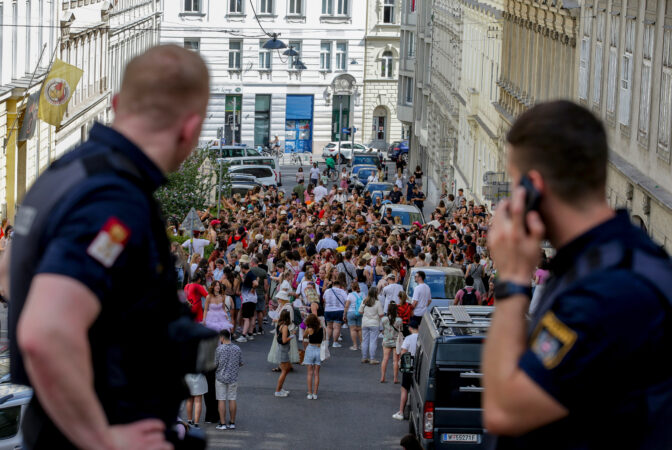
VIENNA — Austrian public prosecutors filed terrorism-related charges Monday against a 21-year-old defendant who they say planned to carry out an attack on one of superstar singer Taylor Swift’s concerts in Vienna in August 2024.
Vienna public prosecutors said in a statement that the unnamed defendant had declared allegiance to the Islamic State group by sharing propaganda material and videos via various messaging services.
Vienna prosecutors also accuse the defendant of having “obtained instructions on the internet for the construction of a shrapnel bomb based on the explosive triacetone triperoxide” typically used by IS, and of having produced a small amount of the explosive.
Prosecutors also say that the defendant had made “several attempts” to buy weapons illegally outside the country and to bring them to Austria.
Vienna public prosecutors plan to proceed with a criminal case against the unnamed suspect in Wiener Neustadt, a town near the Austrian capital.
The spokesperson for the Vienna public prosecutors office confirmed to the Associated Press that the defendant is in custody. Austrian media identified the suspect as Beran A. and said he was arrested in August 2024.
The U.S. provided intelligence that fed into the decision to cancel the concerts.
“The United States has an enduring focus on our counterterrorism mission. We work closely with partners all over the world to monitor and disrupt threats. And so as part of that work, the United States did share information with Austrian partners to enable the disruption of a threat to Taylor Swift’s concerts there in Vienna,” then-White House national security spokesperson John Kirby said in August 2024.