PAWTUCKET, R.I. — The person who opened fire Monday during a youth hockey game at a Rhode Island ice rink was specifically targeting family members, killing an ex-wife and son as many fans dived for cover while a handful rushed the shooter to stop the attack, authorities said.
Pawtucket Chief of Police Tina Goncalves said the shooter’s ex-wife Rhonda Dorgan and adult son Aidan Dorgan were killed and three others were injured: Rhonda Dorgan’s parents, Linda and Gerald Dorgan, and a family friend Thomas Geruso, all of whom remained in critical condition Tuesday afternoon, Goncalves said
Police identified the shooter as 56-year-old Robert Dorgan, who died from an apparent self-inflicted gunshot wound. Dorgan also went by the names Roberta Esposito and Roberta Dorgano, authorities said.
Goncalves said there was “no indication” there would be violence at the ice rink in Pawtucket on Monday afternoon, adding that Dorgan had been to many hockey games to watch family members play before without incident.
Gender identity apparently was a contributing factor to Dorgan’s wife filing for divorce in 2020 after nearly 30 years of marriage.
Court filings show Rhonda Dorgan initially wrote “gender reassignment surgery, narcissistic + personality disorder traits” as reasons for filing but crossed that out and wrote “irreconcilable differences which have caused the irremediable breakdown of the marriage.”
Court documents show that two shared the same last name even prior to getting married. Authorities have not provided additional details about the same name.
Under the name Roberta Dorgano, Dorgan posted on X that Rhonda Dorgan “hates the person who stole her husband” while posting about the couple’s marital troubles in 2018. A year later Dorgan wrote on social media: “Transwoman, 6 kids: wife – not thrilled,” and encouraged people to not let being transgender stop them from creating a family.
A day before the shooting, Dorgan responded on X to anti-transgender posts by actor Kevin Sorbo and Infowars conspiracy theorist Alex Jones by saying that constant criticism of transgender people is “why we Go BERSERK.”
Brutal attack ended when fans rushed to stop shooter
Goncalves on Tuesday credited several “good Samaritans” who intervened and quickly stopped the attack
At least three bystanders were able to contain Dorgan in the middle of the stands as the crowd fled and ran around them, but said Dorgan was still able to reach for a second firearm and died of a self-inflicted gunshot, Goncalves said.
The hockey game was livestreamed by LiveBarn, a streaming platform for youth sporting events, whose videos have been shared on social media showing players on the ice as popping sounds are heard. Chaos quickly unfolds as players on benches dive for cover, those on the ice frantically skate toward exits and fans flee their seats.
LiveBarn’s social media account has been issuing warnings to those who shared the video that they do not have permission to do so.
Michael Steven, who recorded video after the shooting, recalled crying parents trying to locate their children outside the arena and young people being taken out on stretchers.
“It happens far too often in our nation,” Steven told reporters.
Members of the community held a vigil at Slatersville Congregational Church in North Smithfield in the evening Tuesday.
“It’s absolutely mind-boggling that this could happen to people we know and love and support through everything,” said Amy Goulet, whose son is a hockey player in the community.
Shooter known for bad temper, coworker says
Dorgan was an employee of General Dynamics Bath Iron Works, a ship building facility in Bath, Maine, that contracts with the U.S. Navy, David Hench, a spokesperson for the shipyard, said Tuesday. Coworkers said Dorgan often used the first name Roberta at work.
A colleague, Destiny Mackenzie, recalled that Dorgan used the women’s bathroom and said the two of them would often talk about family. Mackenzie said Dorgan’s ex-wife never came up in conversation but a hockey-playing son was a frequent topic.
“What was supposed to be some seniors’ only chance at playoff games is now ruined,” she wrote in a message to The Associated Press. “Images that these kids and family’s now have to live with. That’s who I send my condolences to is those families.”
Mackenzie said Dorgan had a bad temper that sometimes led to screaming matches with colleagues.
Another coworker said Dorgan appeared to be split on the issue of transgender acceptance, one second being proud of transitioning and the next, embarrassed. That coworker, who spoke on condition of anonymity for fear of workplace reprisals, said they knew Dorgan owned guns but was unsure how many.
Dorgan briefly served in the Marine Corps, enlisting on April 26, 1988, according to military records provided by the service. Less than three months later, on July 13, Dorgan was separated from the service with the lowest military rank.
Maj. Jacoby Getty, a Marine Corps spokesman, told The Associated Press that the rapid discharge indicated Dorgan’s character “was incongruent with Marine Corps’ expectations and standards.”
Getty declined to provide more detail.
Monday’s shooting came nearly two months after the state was rocked by a shooting at Brown University that killed two students and wounded nine others, as well as left a Massachusetts Institute of Technology professor dead. Authorities later found Claudio Neves Valente, 48, dead from a self-inflicted gunshot wound at a New Hampshire storage facility.
“Our state is grieving again,” Rhode Island Gov. Dan McKee said in a statement. “As governor, a parent, and a former coach, my heart breaks for the victims, families, students, and everyone impacted by the devastating shooting at Lynch Arena in Pawtucket.”
GENEVA, Switzerland — Iran announced the temporary closure of the Strait of Hormuz on Tuesday for live fire drills in a rare show of force as its negotiators held another round of indirect talks with the United States over the Islamic Republic’s disputed nuclear program.
It was the first time Iran has announced the closure of the key international waterway, through which 20% of the world’s oil passes, since the U.S. began threatening Iran and rushing military assets to the region. It was not immediately clear if the strait had been closed, but such a rare and perhaps unprecedented move could further escalate tensions that threaten to ignite another war in the Middle East.
As the talks began, Iran’s state media announced that Iranian forces had fired live missiles toward the strait and would close it for several hours for “safety and maritime concerns.”
Supreme Leader Ayatollah Ali Khamenei meanwhile warned that “the strongest army in the world might sometimes receive such a slap that it cannot get back on its feet.”
Iranian diplomat sees ‘new window’ in talks
Iran’s foreign minister later adopted a different tone, expressing optimism about the talks and saying “a new window has opened” for reaching an agreement.
“We are hopeful that negotiations will lead to a sustainable and negotiated solution which can serve the interests of relevant parties and the broader region,” Abbas Araghchi told a U.N. disarmament conference after leading the Iranian delegation at the talks held in Geneva.
He added that Iran “remains fully prepared to defend itself against any threat or act of aggression,” and that the consequences of any attack on Iran would not be confined to its borders.
He made no specific mention of the military drills or the closure of the Strait of Hormuz.
President Donald Trump, who scrapped an earlier nuclear agreement with Iran during his first term, has repeatedly threatened to use force to compel Iran to agree to constrain its nuclear program. Iran has said it would respond with an attack of its own. Trump has also threatened Iran over the killing of protesters.
Vance says talks went well ‘in some ways’
Trump’s envoys, Steve Witkoff and Jared Kushner, led the U.S. delegation at the latest indirect talks, held inside the residence of the Omani envoy to Geneva. Oman, a longtime regional mediator, had hosted an earlier round on Feb. 6.
There was progress in the talks but many details remained to be discussed, according to a U.S. official who was not authorized to comment publicly and spoke on condition of anonymity. The Iranian delegation said they would present more detailed proposals in the next two weeks to narrow gaps, the official said.
“In some ways, it went well,” Vice President JD Vance said in an interview with Fox News Channel after he spoke with Witkoff and Kushner. “But in other ways, it was very clear that the president has set some red lines that the Iranians are not yet willing to actually acknowledge and work through.”
Araghchi, who led the Iranian side, also said he met with Director-General Rafael Grossi of the International Atomic Energy Agency on Monday in Geneva. The Iranian minister said they discussed the agency’s role in helping to achieve an agreement.
A live fire drill
Iran said its Revolutionary Guard started a drill early Monday in the Strait of Hormuz, the Persian Gulf, and the Gulf of Oman, which are crucial international shipping routes. It was the second time in recent weeks that Iran has held a live fire drill in the Strait of Hormuz.
Iran often carries out military drills in the strait that can impede maritime traffic, but the announced closure went a step further. Danny Citrinowicz, an Iran expert at Israel’s Institute for National Security Studies, said Iran last closed the strait during the war with Iraq in the 1980s, when it mined the waterway.
He said the latest announcement was a clear message to the international community that any strike on Iran would have global impact.
Khamenei meanwhile stepped up his warnings to the U.S. over its buildup of military forces in the region.
“Of course a warship is a dangerous apparatus, but more dangerous than the warship is the weapon that can sink the warship,” Khamenei said, according to Iranian state TV.
He also warned the U.S. that “forcing the result of talks in advance is a wrong and foolish job.”
U.S. increases military presence
Last week, Trump said the USS Gerald R. Ford, the world’s largest aircraft carrier, was being sent to the Mideast. It will join the USS Abraham Lincoln and its accompanying guided-missile destroyers, which have been in the region for three weeks.
U.S. forces shot down an Iranian drone that approached the Lincoln on the same day last week that Iran tried to stop a U.S.-flagged ship in the Strait of Hormuz.
Gulf Arab nations have warned any attack could spiral into another regional conflict in a Mideast still reeling from the Israel-Hamas war.
The Trump administration is seeking a deal to limit Iran’s nuclear program and ensure it does not develop nuclear weapons. Iran says it is not pursuing weapons and has so far resisted demands that it halt uranium enrichment on its soil or hand over its stockpile of highly enriched uranium.
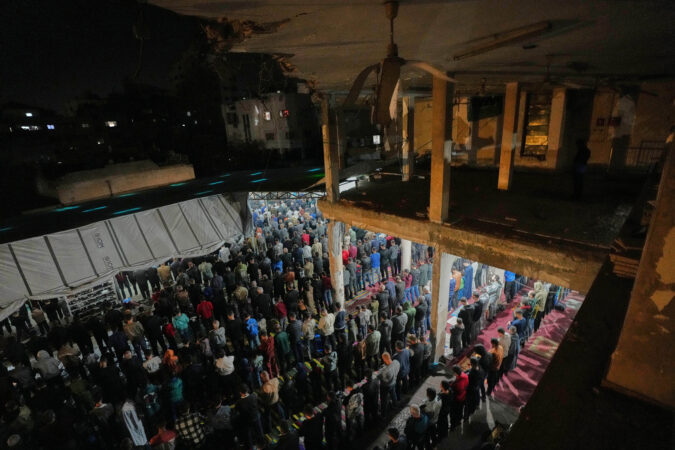
GAZA CITY, Gaza Strip — Palestinians in Gaza are preparing to welcome the Muslim holy month of Ramadan under a fragile ceasefire deal, but many say the challenges of their daily lives and the losses of the Israel-Hamas war are dampening the typically festive spirit.
“There is no joy after we lost our family and loved ones,” said Gaza City resident Fedaa Ayyad. “Even if we try to cope with the situation, we can’t truly feel it in our hearts. … I am one of those who cannot feel the atmosphere of Ramadan.”
In Gaza, the first day of the holy month is Wednesday. During Ramadan, observant Muslims fast daily from dawn to sunset. In normal circumstances, the month often brings families and friends together to break their fast in joyous gatherings. For Muslims, it’s a time for increased worship, religious reflection, and charity.
Circumstances in Gaza are far from normal. Israel’s military offensive has killed more than 72,000 Palestinians, according to Gaza’s Health Ministry, and caused widespread destruction and displaced most of the territory’s residents. Israel launched the offensive after Hamas-led militants killed some 1,200 people, mostly civilians, and took another 251 hostage in their attack on Oct. 7, 2023.
As Gaza residents visited markets this week, some lamented that economic woes cast a pall on the month.
“There is no cash among the people. There is no work. It’s true that it is Ramadan, but Ramadan requires money,” said Gaza City resident Waleed Zaqzouq. He said merchants should consider people’s financial hardships.
Before the war, “people lived a dignified life,” he said. “The situation has completely changed in the war, meaning people have been devastated and worn down.”
Israeli forces have carried out repeated airstrikes and frequently fire on Palestinians near military-held zones, killing more than 600 Palestinians, according to Gaza health officials. The ministry, which is part of the Hamas-led government, maintains detailed casualty records that are seen as generally reliable by U.N. agencies and independent experts. But it does not distinguish between civilians and militants.
Militants have carried out shooting attacks on Israeli troops, and Israel says its strikes are in response to that and other violations. Four Israeli soldiers have been killed.
Gaza’s winter has highlighted the grim conditions of the displaced residents and the many needs of the enclave and its people. Severe cold has caused child deaths in Gaza, and torrential rain has flooded displacement camps and collapsed already badly damaged buildings.
“There is much that has changed from this Ramadan to Ramadan before the war,” said Raed Koheel, who lives in Gaza City. “In the past, the atmosphere was more delightful. The streets were lit up with decorations. All streets had decorations. Our children were happy.”
Still, amid the hardships, some in the Gaza Strip have worked to bring a taste of Ramadan’s festivities.
Surrounded by ruins and crumbled buildings in Khan Younis, calligrapher and artist Hani Dahman dipped his brush in paint and wrote “Welcome, Ramadan” in Arabic as children watched.
“We are here in Khan Younis camp, trying to bring happiness to the hearts of children, women, men and entire families,” Dahman said. “We are … sending a message to the world that we are people who seek life.”
Strands of Ramadan decorations were hung among the ruins. Mohammed Taniri watched the decorations take shape.
“When they provide such beautiful, simple decorations, it brings joy to the children,” he said. “Despite all the hardships, they are trying to create a beautiful atmosphere.”
A Pennsylvania man who spent 43 years in prison before his murder conviction was overturned — only to be taken straight into immigration custody — was denied bail Tuesday while he fights deportation.
Subramanyam Vedam, 64, will remain in custody while he appeals a 1999 deportation order. The Board of Immigration Appeals agreed this month to hear his appeal based on what it called exceptional circumstances.
Vedam’s lawyer argued Tuesday that he would have likely been spared deportation and become a citizen if not for the murder case, given immigration laws in place at the time. Vedam would have left prison on a drug charge by 1992, lawyer Ava Benach said.
“It was delivery of LSD on a very small scale. This is not importing tons of cocaine,” Benach said Tuesday. “He is not a danger to the community. We are talking about offenses that occurred over 40 years ago.”
In August, a Pennsylvania judge threw out Vedam’s murder conviction in the 1980 death of a college friend, based on ballistics evidence that prosecutors hadn’t disclosed during his two trials. Supporters listening in remotely to the bail hearing included a Centre County prosecutor and the mayor of State College, where Vedam’s late father was a renowned professor at Pennsylvania State University, Benach said.
Immigration Judge Tamar Wilson, sitting in Elizabeth, N.J., said she believes detention to be mandatory given the felony drug conviction. Alternatively, she agreed with Department of Homeland Security officials who said he remains a safety risk.
“The fact he’s been a ‘model prisoner’ does not suggest that out in the general public he’s going to be safe,” Wilson said.
It’s not yet clear whether Wilson or another judge will hear the merits of the deportation case. No hearings have yet been scheduled.
“Subu is nothing if not resilient, and we’re resolved to emulate the example he sets for us by focusing on the next step in his fight for freedom. We continue to believe his immigration case is strong and look forward to the day we can be together again,” said his sister, Saraswathi Vedam, calling him by a family nickname.
She planned to bring him home when he was released from state prison on Oct. 3, only to see him taken into federal immigration custody. Vedam had come to the U.S. legally from India when he was 9 months old, when his parents returned to State College.
“He was someone who’s suffered a profound injustice,” Benach told the Associated Press last year. “Those 43 years aren’t a blank slate. He lived a remarkable experience in prison.”
Vedam is being held at an 1,800-bed U.S. Immigration and Customs Enforcement facility in central Pennsylvania.
“Criminal illegal aliens are not welcome in the U.S,” a Department of Homeland Security spokesperson said of the case last year.
NEW ORLEANS — People leaned out of wrought iron balconies, hollering the iconic phrase “Throw me something, Mister” as a massive Mardi Gras parade rolled down New Orleans’ historic St. Charles Avenue on Tuesday.
Mardi Gras, also known as Fat Tuesday, marks the climax and end of the weekslong Carnival season and a final chance for indulgence, feasting, and revelry before the Christian Lent period of sacrifice and reflection. The joyous goodbye to Carnival always falls the day before Ash Wednesday.
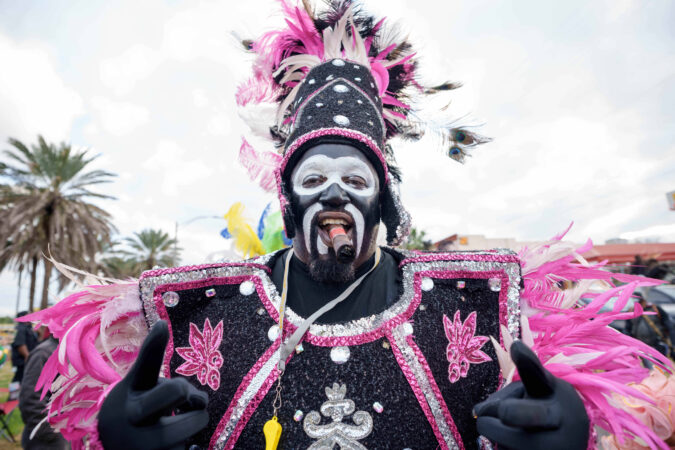
In Louisiana’s most populous city, which is world-famous for its Mardi Gras bash, people donned green, gold, and purple outfits, with some opting for an abundance of sequins and others showing off homemade costumes.
The revelers began lining the streets as the sun rose. They set up chairs, coolers, grills, and ladders — offering a higher vantage point.
As marching bands and floats filled with women wearing massive feathered headdresses passed by, the music echoing through the city streets, people danced and cheered. Others sipped drinks, with many opting for adult concoctions on the day of celebration rather than the usual morning coffee.
Each parade has its signature “throws” — trinkets that include plastic beads, candy, doubloons, stuffed animals, cups, and toys. Hand-decorated coconuts are the coveted item from Zulu, a massive parade named after the largest ethnic group in South Africa.
As a man, dressed like a crawfish — including red fabric claws for hands — caught one of the coconuts, he waved it around, the gold glitter on the husk glistening in the sun.
Sue Mennino was dressed in a white Egyptian-inspired costume, complete with a gold headpiece and translucent cape. Her face was embellished with glitter and electric blue eyeshadow.
“The world will be here tomorrow, but today is a day off and a time to party,” Mennino said.
The party isn’t solely confined to the parade route. Throughout the French Quarter, people celebrated in the streets, on balconies and on the front porches of shotgun-style homes.
One impromptu parade was led by a man playing a washboard instrument and dressed as a blue alligator — his papier-mâché tail dragging along the street, unintentionally sweeping up stray beads with it. A brass band played “The Saints” as people danced.
In Jackson Square, the costumed masses included a man painted from head to toe as a zebra, a group cosplaying as Hungry Hungry Hippos from the tabletop game and a diver wearing an antique brass and copper helmet.
“The people are the best part,” said Martha Archer, who was dressed as Madame Leota, the disembodied medium whose head appears within a crystal ball in the Haunted Mansion attraction at Disney amusement parks.
Archer’s face was painted blue and her outfit was a makeshift table that came up to her neck — giving the appearance that she was indeed a floating head.
“Everybody is just so happy,” she explained.
The good times will roll not just in New Orleans but across the state, from exclusive balls to the Cajun French tradition of the Courir de Mardi Gras, or Fat Tuesday Run — a rural event in Central Louisiana featuring costumed participants performing, begging for ingredients and chasing live chickens to be cooked in a communal gumbo.
Parades are also held in other Gulf Coast cities such as Mobile, Ala., and Pensacola, Fla., and there are other world-renowned celebrations in Brazil and Europe.
One of the quirkiest is an international Pancake Day competition pitting the women of Liberal, Kan., against the women of Olney, England. Pancakes are used because they were thought to be a good way for Christians to consume the fat they were supposed to give up during the 40 days before Easter.
Contestants must carry a pancake in a frying pan and flip the pancake at the beginning and end of the 415-yard race.
ATLANTA — Georgia high school students on Tuesday testified in court about the horrors of being shot during their algebra class, and recounted through tears seeing a classmate in a pool of blood, then seeing blood on their own bodies and fearing they might die.
Various students took the stand at the trial of Colin Gray, the father of Colt Gray, who investigators said had carefully planned the Sept. 4, 2024, shooting at the school northeast of Atlanta that left two teachers and two students dead and several others wounded.
This is one of several cases around the nation where prosecutors are trying to hold parents responsible after their children are accused in fatal shootings.
A ninth-grade girl saw a hole in her wrist and began screaming moments after the gunfire began in her Algebra I class, she testified Tuesday.
“I was also worried that I was going to die and how that would affect my parents because my dad has a heart problem,” she said.
As paramedics carried her out of the school building, she saw Colt Gray on the floor with his hands behind his back and screamed obscenities at him as she passed by him.
“I remember yelling at him that we were kids, because we were kids,” she said. The faces of she and others who testified were not shown during a video livestream of the testimony because of their young ages.
Other students said the trauma was not limited to their physical wounds, as they spoke of being depressed, anxious and slow to trust people even now, more than a year later.
“Just seeing what I saw that day, it just sticks with me … and not being able to trust certain people, trust people,” said one girl who sustained a gunshot wound to her left shoulder.
Many of the students said they were still in counseling to deal with nightmares, fears of loud noises and anxiety at school and at home. “Even to go on a walk around my neighborhood, anxiety would fill my head, and I feel like somebody driving past me would shoot me,” a female student testified.
Colt Gray, who was 14 years old at the time of the shooting, faces 55 counts, including murder in the deaths of four people and 25 counts of aggravated assault. His father Colin Gray faces 29 counts, including two counts of second-degree murder and two counts of involuntary manslaughter.
Colin Gray should be held responsible for providing the weapon despite warnings about alleged threats his son made, a prosecutor said as the father’s trial began Monday.
“This case is about this defendant and his actions in allowing a child that he has custody over access to a firearm and ammunition after being warned that child was going to harm others,” Barrow County District Attorney Brad Smith said in his opening statement.
Prosecutors argue that amounts to cruelty to children, and second-degree murder is defined in Georgia law as causing the death of a child by committing the crime of cruelty to children.
But Brian Hobbs, an attorney for Colin Gray, said the shooting’s planning and timing “were hidden by Colt Gray from his father.”
“That’s the difference between tragedy and criminal liability,” he said. “You cannot hold someone criminally responsible for failing to predict what was intentionally hidden from them.”
With a semiautomatic rifle in his book bag, the barrel sticking out and wrapped in poster board, Colt Gray boarded the school bus, investigators said. He left his second-period class and emerged from a bathroom with the gun and then shot people in a classroom and hallways, they said.
Smith told the jury that in September 2021, Colt Gray used a school computer to search the phrase, “how to kill your dad.” School resource officers were then sent to the home, but it was determined to be a “misunderstanding,” Smith said.
Sixteen months before the shooting, in May 2023, law enforcement acted on a tip from the FBI after a shooting threat was made online concerning an elementary school. The threat was traced to a computer at Gray’s home, Smith said.
Colin Gray was told about the threat and was asked whether his son had access to guns. Gray replied that he and his son “take this school shooting stuff very seriously,” according to Smith. Colt Gray denied that he made the threat and said that his online account had been hacked, Smith said.
That Christmas, Colin Gray gave his son the gun as a gift and continued to buy accessories after that, including “a lot of ammunition,” Smith said.
Colin Gray knew his son was obsessed with school shooters, even having a shrine in his bedroom to Nikolas Cruz, the shooter in the 2018 massacre at Marjory Stoneman Douglas High School in Parkland, Fla., prosecutors have said. A Georgia Bureau of Investigation agent had testified that the teen’s parents had discussed their son’s fascination with school shooters but decided that it was in a joking context and not a serious issue.
Three weeks before the shooting, Gray received a chilling text from his son: “Whenever something happens, just know the blood is on your hands,” according to Smith.
Colin Gray was also aware his son’s mental health had deteriorated and had sought help from a counseling service weeks before the shooting, an investigator testified.
“We have had a very difficult past couple of years and he needs help. Anger, anxiety, quick to be volatile. I don’t know what to do,” Colin Gray wrote about his son.
But Smith said Colin Gray never followed through on concerns about getting his son admitted to an inpatient facility.
GENEVA, Switzerland — Delegations from Moscow and Kyiv met in Geneva on Tuesday for another round of U.S.-brokered peace talks, a week before the fourth anniversary of Russia’s full-scale invasion of its neighbor.
However, expectations for any breakthroughs in the scheduled two days of talks in Switzerland were low, with neither side apparently ready to budge from its positions on key territorial issues and future security guarantees, despite the United States setting a June deadline for a settlement.
The head of the Ukrainian delegation, Rustem Umerov, posted photos on social media of the three delegations at a horseshoe-shaped table, with the Ukrainian and Russian officials sitting across from each other. President Donald Trump’s envoy, Steve Witkoff, and son-in-law Jared Kushner sat at the head of the table in front of U.S., Russian, Ukrainian, and Swiss flags.
“The agenda includes security and humanitarian issues,” Umerov said, adding that Ukrainians will work “without excessive expectations.”
Tough talks expected
Discussions on the future of Russian-occupied Ukrainian territory are expected to be particularly tough, according to a person familiar with the talks who spoke to the Associated Press on condition of anonymity because the person was not authorized to talk to reporters.
Russa is still insisting that Ukraine cede control of its eastern Donbas region.
Also in Geneva will be American, Russian, and Ukrainian military chiefs, who will discuss how ceasefire monitoring might work after any peace deal, and what’s needed to implement it, the person said.
During previous talks in Abu Dhabi, the capital of the United Arab Emirates, military leaders looked at how a demilitarized zone could be arranged and how everyone’s militaries could talk to one another, the person added.
Kremlin spokesperson Dmitry Peskov cautioned against expecting developments on the first day of talks as they were set to continue on Wednesday. Moscow has provided few details of previous talks.
Trump describes the talks as ‘big’
Ukraine’s short-handed army is locked in a war of attrition with Russia’s bigger forces along the roughly 750-mile front line. Ukrainian civilians are enduring Russian aerial barrages that repeatedly knock out power and destroy homes.
The future of the almost 20% of Ukrainian land that Russia occupies or still covets is a central question in the talks, as are Kyiv’s demands for postwar security guarantees with a U.S. backstop to deter Moscow from invading again.
Trump described the Geneva meeting as “big talks.”
“Ukraine better come to the table fast,” he told reporters late Monday as he flew back to Washington from his home in Florida.
It wasn’t immediately clear what Trump was referring to in his comment about Ukraine, which has committed to and taken part in negotiations in the hope of ending Russia’s devastating onslaught.
Complex talks as the war presses on
The Russian delegation is headed by Russian President Vladimir Putin’s adviser Vladimir Medinsky, who headed Moscow’s team of negotiators in the first direct peace talks with Ukraine in Istanbul in March 2022 and has forcefully pushed Putin’s war goals. Medinsky has written several history books that claim to expose Western plots against Russia and berate Ukraine.
The commander of the U.S. military — and NATO forces — in Europe, Gen. Alexus Grynkewich, and Secretary of the U.S. Army Dan Driscoll will attend the meeting in Geneva on behalf of the U.S. military and meet with their Russian and Ukrainian counterparts, said Col. Martin O’Donnell, a spokesman for the U.S. commander.
Overnight, Russia used almost 400 long-range drones and 29 missiles of various types to strike 12 regions of Ukraine, injuring nine people, including children, according to the Ukrainian President Volodymyr Zelensky.
Zelensky said tens of thousands of residents were left without heating and running water in the southern port city of Odesa. He said Moscow should be “held accountable” for the relentless attacks, which he said undermine the U.S. push for peace.
“The more this evil comes from Russia, the harder it will be for everyone to reach any agreements with them. Partners must understand this. First and foremost, this concerns the United States,” the Ukrainian leader said on social media late Monday.
“We agreed to all realistic proposals from the United States, starting with the proposal for an unconditional and long-term ceasefire,” Zelensky noted.
The talks in Geneva took place as U.S. officials also held indirect talks with Iran in the Swiss city.
Meanwhile, Ukraine’s Security Service, or SBU, used long-range drones to strike an oil terminal in southern Russia and a major chemical plant deep inside the country, a Ukrainian security official who spoke on condition of anonymity because he was not authorized to speak publicly told the AP.
Drones targeted the Tamanneftegaz oil terminal, one of the biggest ports of its type on the Black Sea, in Russia’s Krasnodar region for the second time this month, starting a fire, the official said.
Drones also hit the Metafrax Chemicals plan, which manufactures chemical components used in explosives and other military materials, in Russia’s Perm region, more than 1,000 miles from the Ukrainian border, according to the official.
WASHINGTON — The Justice Department has issued new subpoenas in a Florida-based investigation into perceived adversaries of President Donald Trump and the U.S. government response to Russian interference in the 2016 presidential election, according to multiple people familiar with the matter.
An initial wave of subpoenas in November asked recipients for documents related to the preparation of a U.S. intelligence community assessment that detailed a sweeping, multiprong effort by Moscow to help Trump defeat Democratic nominee Hillary Clinton in the 2016 election.
Though the first subpoenas requested documents from the months surrounding the January 2017 publication of the Obama administration intelligence assessment, the latest subpoenas seek any records from the years since then, said the people, who spoke on condition of anonymity to the Associated Press to discuss a nonpublic demand from investigators.
The Justice Department declined to comment Tuesday.
The subpoenas reflect continued investigative activity in one of several criminal inquiries the Justice Department has undertaken into Trump’s political opponents. An array of former intelligence and law enforcement officials have received subpoenas in the investigation. Lawyers for former CIA Director John Brennan, who helped oversee the drafting of the assessment and who has been called “crooked as hell” by Trump, have said they have been informed he is a target but have not been told of any “legally justifiable basis for undertaking this investigation.”
The intelligence community assessment, published in the final days of the Obama administration, found that Russia had developed a “clear preference” for Trump in the 2016 election and that Russian President Vladimir Putin had ordered an influence campaign with goals of undermining confidence in American democracy and harming Clinton’s chance for victory.
That conclusion, and a related investigation into whether the 2016 Trump campaign colluded with Russia to sway the outcome of the election, have long been among the Republican president’s chief grievances and he has vowed retribution against the government officials involved in the inquiries. Former FBI Director James Comey was indicted by the Trump administration Justice Department last year on false statement and obstruction charges, but the case was later dismissed.
Multiple government reports, including bipartisan congressional reviews and a criminal investigation by former special counsel Robert Mueller, have found that Russia interfered in Trump’s favor through a hack-and-leak operation of Democratic emails as well as a covert social media campaign aimed at sowing discord and swaying American public opinion. Mueller’s report found that the Trump campaign actively welcomed the Russian help, but it did not establish that Russian operatives and Trump or his associates conspired to tip the election in his favor.
The Trump administration has freshly scrutinized the intelligence community assessment in part because a classified version of it incorporated in its annex a summary of the “Steele dossier,” a compilation of Democratic-funded opposition research that was assembled by former British spy Christopher Steele and was later turned over to the FBI. That research into Trump’s potential links to Russia included uncorroborated rumors and salacious gossip, and Trump has long held up its weaknesses in an effort to discredit the entire Russia investigation.
A declassified CIA tradecraft review ordered by current Director John Ratcliffe and released last July faults Brennan’s oversight of the assessment.
The review does not challenge the conclusion of Russian election interference but chides Brennan for the fact that the classified version referenced the Steele dossier.
Brennan testified to Congress, and also wrote in his memoir, that he was opposed to citing the dossier in the intelligence assessment since neither its substance nor sources had been validated, and he has said the dossier did not inform the judgments of the assessment. He maintains the FBI pushed for its inclusion.
The new CIA review seeks to cast Brennan’s views in a different light, asserting that he “showed a preference for narrative consistency over analytical soundness” and brushed aside concerns over the dossier because he believed it conformed “with existing theories.” It quotes him, without context, as having stated in writing that “my bottom line is that I believe that the information warrants inclusion in the report.”
In a letter last December addressed to the chief judge of the Southern District of Florida, where the investigation is based, Brennan’s lawyers challenged the underpinnings of the investigation, questioning what basis prosecutors had for opening the inquiry in Florida and saying they had received no clarity from prosecutors about what potential crimes were even being investigated.
“While it is mystifying how the prosecutors could possibly believe there is any legally justifiable basis for undertaking this investigation, they have done nothing to explain that mystery,” the lawyers said.
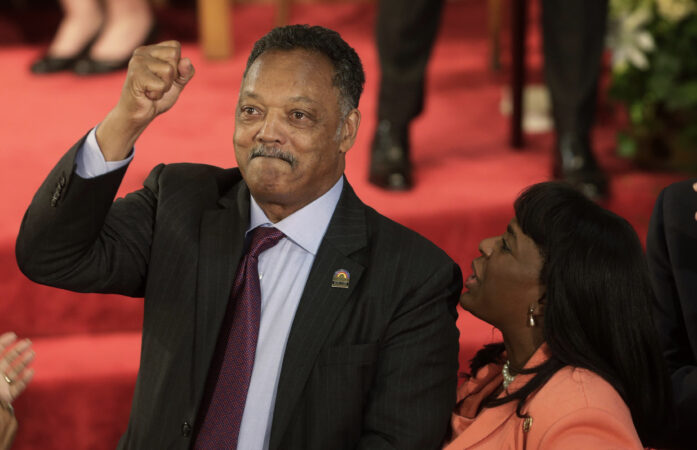
CHICAGO — The Rev. Jesse L. Jackson, a protégé of the Rev. Martin Luther King Jr. and two-time presidential candidate who led the Civil Rights Movement for decades after the revered leader’s assassination, died Tuesday. He was 84.
As a young organizer in Chicago, Rev. Jackson was called to meet with King at the Lorraine Motel in Memphis shortly before King was killed, and he publicly positioned himself thereafter as King’s successor.
Santita Jackson confirmed that her father, who had a rare neurological disorder, died at home in Chicago, surrounded by family.
Rev. Jackson led a lifetime of crusades in the United States and abroad, advocating for the poor and underrepresented on issues, including voting rights, job opportunities, education, and healthcare. He scored diplomatic victories with world leaders, and through his Rainbow/PUSH Coalition, he channeled cries for Black pride and self-determination into corporate boardrooms, pressuring executives to make America a more open and equitable society.
And when he declared, “I am Somebody,” in a poem he often repeated, he sought to reach people of all colors. “I may be poor, but I am Somebody; I may be young; but I am Somebody; I may be on welfare, but I am Somebody,” Rev. Jackson intoned.
It was a message he took literally and personally, having risen from obscurity in the segregated South to become America’s best-known civil rights activist since King.
“Our father was a servant leader — not only to our family, but to the oppressed, the voiceless, and the overlooked around the world,” the Jackson family said in a statement posted online. “We shared him with the world, and in return, the world became part of our extended family.”
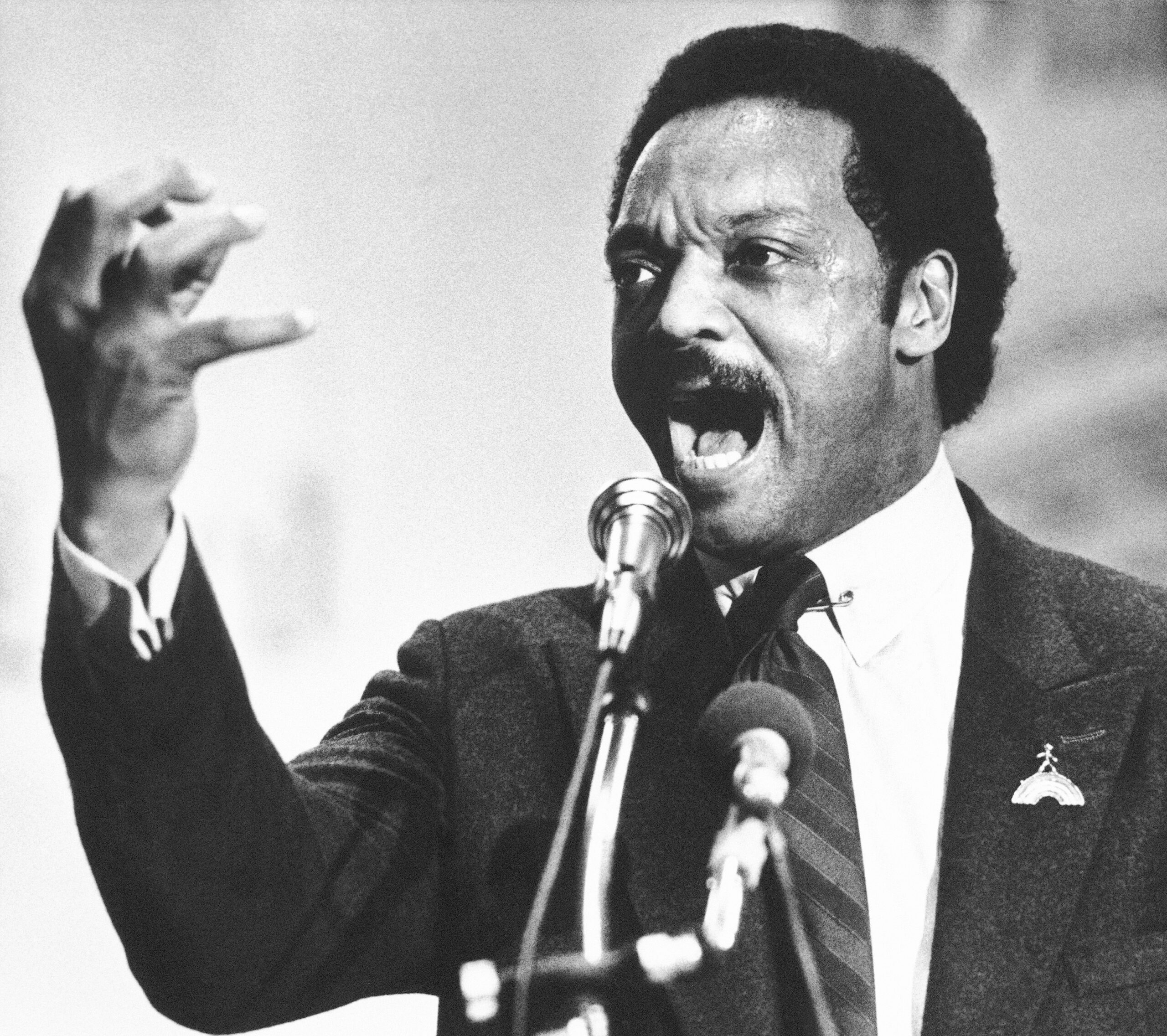
Democratic presidential primary candidate Jesse Jackson speaks to a group of his supporters at a rally held at a Baptist Church in Dayton, Ohio, on April 14, 1984.
Fellow civil rights activist the Rev. Al Sharpton said his mentor “was not simply a civil rights leader; he was a movement unto himself.”
“He taught me that protest must have purpose, that faith must have feet, and that justice is not seasonal, it is daily work,” Sharpton wrote in a statement, adding that Rev. Jackson taught “trying is as important as triumph. That you do not wait for the dream to come true; you work to make it real.”
“Even if we win,” he told marchers in Minneapolis before the officer whose knee kept George Floyd from breathing was convicted of murder, “it’s relief, not victory. They’re still killing our people. Stop the violence, save the children. Keep hope alive.”
Rev. Jackson’s voice, infused with the stirring cadences and powerful insistence of the Black church, demanded attention. On the campaign trail and elsewhere, he used rhyming and slogans such as “Hope not dope” and “If my mind can conceive it and my heart can believe it, then I can achieve it,” to deliver his messages.
Rev. Jackson had his share of critics, both within and outside of the Black community. Some considered him a grandstander, too eager to seek the spotlight. Looking back on his life and legacy, Rev. Jackson told the Associated Press in 2011 that he felt blessed to be able to continue the service of other leaders before him and to lay a foundation for those to come.
“A part of our life’s work was to tear down walls and build bridges, and in a half century of work, we’ve basically torn down walls,” Rev. Jackson said. “Sometimes when you tear down walls, you’re scarred by falling debris, but your mission is to open up holes so others behind you can run through.”
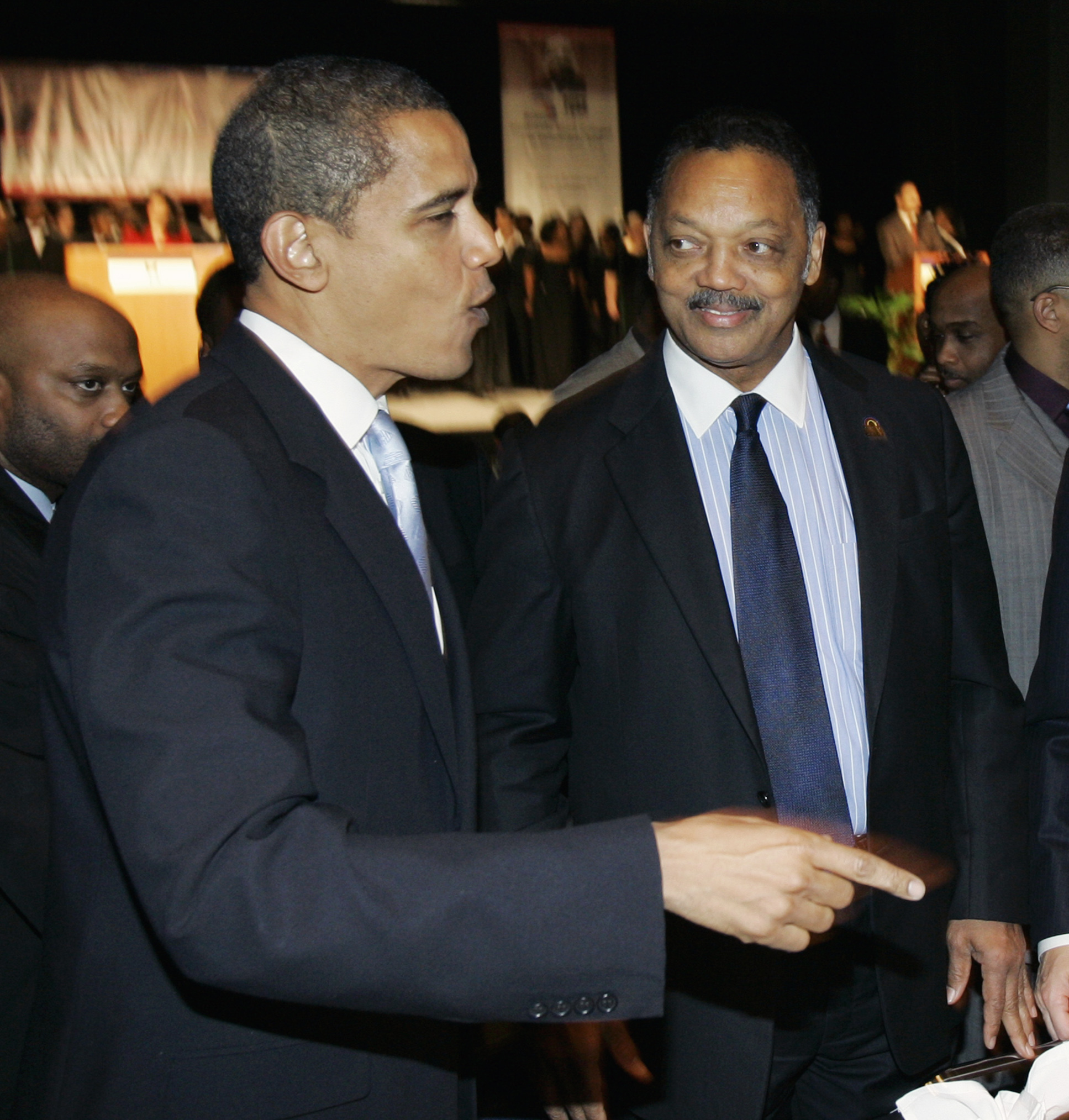
Barack Obama, then a senator. from Illinois, and the Rev. Jesse Jackson are seen at the Rev. Dr. Martin Luther King Jr. Scholarship Awards Breakfast in Chicago on Jan. 15, 2007.
In his final months, as he received 24-hour care, he lost his ability to speak, communicating with family and visitors by holding their hands and squeezing.
“I get very emotional knowing that these speeches belong to the ages now,” his son, Jesse Jackson Jr., told the AP in October.
A student athlete drawn to the Civil Rights Movement
Jesse Louis Jackson was born Oct. 8, 1941, in Greenville, S.C., the son of high school student Helen Burns and Noah Louis Robinson, a married man who lived next door. Jackson was later adopted by Charles Henry Jackson, who married his mother.
Rev. Jackson was a star quarterback on the football team at Sterling High School in Greenville, and he accepted a football scholarship from the University of Illinois. But after reportedly being told that Black people couldn’t play quarterback, he transferred to North Carolina A&T in Greensboro, where he became the first-string quarterback, an honor student in sociology and economics, and student body president.
Arriving on the historically Black campus in 1960 just months after students there launched sit-ins at a whites-only lunch counter, Rev. Jackson immersed himself in the blossoming Civil Rights Movement.
By 1965, he joined the voting rights march King led from Selma to Montgomery, Alabama. King dispatched him to Chicago to launch Operation Breadbasket, a Southern Christian Leadership Conference effort to pressure companies to hire Black workers.
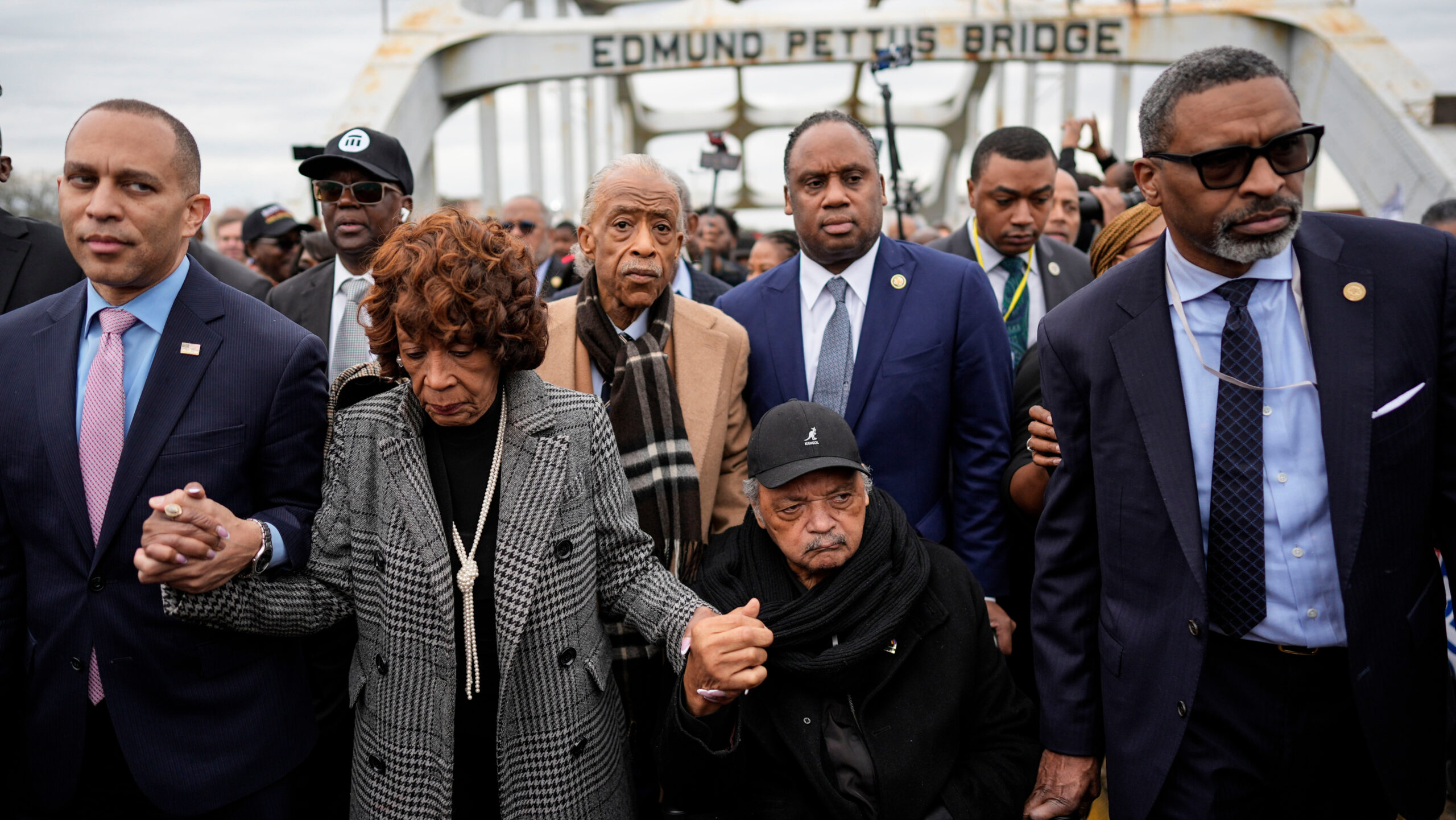
U.S. Rep. Hakeem Jeffries (D., N.Y.), U.S. Rep. Maxine Waters (D., Calif.), the Rev. Al Sharpton, Rev. Jesse Jackson and NAACP President Derrick Johnson walk across the Edmund Pettus bridge in Selma, Ala., on March 9, 2025, during the 60th anniversary of the march to ensure that African Americans could exercise their constitutional right to vote.
Rev. Jackson called his time with King “a phenomenal four years of work.”
Rev. Jackson was with King on April 4, 1968, when the civil rights leader was slain. Rev. Jackson’s account of the assassination was that King died in his arms.
Sharpton said he “always wondered how much trauma that must have been” for Rev. Jackson to witness King’s death. “He never would talk about it too much, but it drove him,” Sharpton said Tuesday. “He said, ‘We’ve got to keep Dr. King’s legacy alive.’”
With his flair for the dramatic, Rev. Jackson wore a turtleneck he said was soaked with King’s blood for two days, including at a King memorial service held by the Chicago City Council, where he said: “I come here with a heavy heart because on my chest is the stain of blood from Dr. King’s head.”
However, several King aides, including speechwriter Alfred Duckett, questioned whether Rev. Jackson could have gotten King’s blood on his clothing. There are no images of Rev. Jackson in pictures taken shortly after the assassination.
In 1971, Rev. Jackson broke with the Southern Christian Leadership Conference to form Operation PUSH, originally named People United to Save Humanity. The organization based on Chicago’s South Side declared a sweeping mission, from diversifying workforces to registering voters in communities of color nationwide. Using lawsuits and threats of boycotts, Rev. Jackson pressured top corporations to spend millions and publicly commit to hiring more diverse employees.
The constant campaigns often left his wife, Jacqueline Lavinia Brown, the college sweetheart he married in 1963, taking the lead in raising their five children: Santita Jackson, Yusef DuBois Jackson, Jacqueline Lavinia Jackson Jr., and two future members of Congress, U.S. Rep. Jonathan Luther Jackson and Jesse L. Jackson Jr., who resigned in 2012 but is seeking reelection in the 2026 midterms.
The elder Jackson, who was ordained as a Baptist minister in 1968 and earned his master’s of divinity degree in 2000, also acknowledged fathering a child, Ashley Jackson, with one of his employees at Rainbow/PUSH, Karen L. Stanford. He said he understood what it means to be born out of wedlock and supported her emotionally and financially.
On Tuesday, Harold Hall joined other mourners who stopped by the family home to pay their respects.
Hall, who once lived in the same Chicago neighborhood as Rev. Jackson, left a bouquet of flowers outside Rev. Jackson’s door and recalled that he helped local street organizations in the late 1960s and early 1970s.
Rev. Jackson “would come out and shoot ball and try to change the minds of many of our young folk,” urging them to stay out of trouble, Hall told reporters. “And in many instances, it happened. It worked.”
Presidential aspirations fall short but help ‘keep hope alive’
Despite once telling a Black audience he would not run for president “because white people are incapable of appreciating me,” Rev. Jackson ran twice and did better than any Black politician had before President Barack Obama, winning 13 primaries and caucuses for the Democratic nomination in 1988, four years after his first failed attempt.
His successes left supporters chanting another Rev. Jackson slogan, “Keep hope alive.”
“I was able to run for the presidency twice and redefine what was possible; it raised the lid for women and other people of color,” he told the AP. “Part of my job was to sow seeds of the possibilities.”
U.S. Rep. John Lewis said during a 1988 C-SPAN interview that Rev. Jackson’s two runs for the Democratic nomination “opened some doors that some minority person will be able to walk through and become president.”
Obama acknowledged Rev. Jackson’s efforts, saying he led some of the most significant movements for change in human history.
Michelle Obama “got her first glimpse of political organizing at the Jacksons’ kitchen table when she was a teenager,” Obama wrote on X. “And in his two historic runs for president, he laid the foundation for my own campaign to the highest office in the world.”
Rev. Jackson “was relentless in his belief that we are all children of God, deserving of dignity and respect,” the post read.
Rev. Jackson also pushed for cultural change, joining calls by NAACP members and other movement leaders in the late 1980s to identify Black people in the United States as African Americans.
“To be called African Americans has cultural integrity — it puts us in our proper historical context,” Rev. Jackson said at the time. “Every ethnic group in this country has a reference to some base, some historical cultural base. African Americans have hit that level of cultural maturity.”
Rev. Jackson’s words sometimes got him in trouble.
In 1984, he apologized for what he thought were private comments to a reporter in which he called New York City “Hymietown,” a derogatory reference to its large Jewish population. And in 2008, he made headlines when he complained that Obama was “talking down to Black people” in comments captured by a microphone he didn’t know was on during a break in a television taping.
Still, when Rev. Jackson joined the jubilant crowd in Chicago’s Grant Park to greet Obama that election night, he had tears streaming down his face.
“I wish for a moment that Dr. King or [slain civil rights leader] Medgar Evers … could’ve just been there for 30 seconds to see the fruits of their labor,” he told the AP years later. “I became overwhelmed. It was the joy and the journey.”
Exerting influence on events at home and abroad
Rev. Jackson also had influence abroad, meeting world leaders and scoring diplomatic victories, including the release of Navy Lt. Robert Goodman from Syria in 1984, as well as the 1990 release of more than 700 foreign women and children held after Iraq’s invasion of Kuwait. In 1999, he won the freedom of three Americans imprisoned by Yugoslav President Slobodan Milosevic.
In 2000, President Bill Clinton awarded Rev. Jackson the Presidential Medal of Freedom, the country’s highest civilian honor.
“Citizens have the right to do something or do nothing,” Rev. Jackson said, before heading to Syria. “We choose to do something.”
In 2021, Rev. Jackson joined the parents of Ahmaud Arbery inside the Georgia courtroom where three white men were convicted of killing the young Black jogger. In 2022, he hand-delivered a letter to the U.S. Attorney’s Office in Chicago, calling for federal charges against former Chicago Police Officer Jason Van Dyke in the 2014 killing of Black teenager Laquan McDonald.
Rev. Jackson, who stepped down as president of Rainbow/PUSH in July 2023, disclosed in 2017 that he had sought treatment for Parkinson’s, but he continued to make public appearances even as the disease made it more difficult for listeners to understand him. Last year, doctors confirmed a diagnosis of progressive supranuclear palsy, a life-threatening neurological disorder. He was admitted to a hospital in November for nearly two weeks.
During the coronavirus pandemic, he and his wife survived being hospitalized with COVID-19. Rev. Jackson was vaccinated early, urging Black people in particular to get protected, given their higher risks for bad outcomes.
“It’s America’s unfinished business — we’re free, but not equal,” Rev. Jackson told the AP. “There’s a reality check that has been brought by the coronavirus, that exposes the weakness and the opportunity.”
Investigators working on the disappearance of “Today” show host Savannah Guthrie’s mother are consulting with Walmart management to develop leads because a backpack the suspect was wearing is sold exclusively at the stores, the Pima County, Arizona, sheriff said Monday.
Nancy Guthrie, 84, was last seen at her Arizona home on Jan. 31 and was reported missing the following day. Authorities say her blood was found on the front porch. Purported ransom notes were sent to news outlets, but two deadlines for paying have passed.
The Federal Bureau of Investigation released surveillance videos of a masked person wearing a handgun holster outside Guthrie’s front door in Tucson the night she vanished. A porch camera recorded video of a person with a backpack who was wearing a ski mask, long pants, a jacket and gloves.
Pima County Sheriff Chris Nanos said in a text message to The Associated Press on Monday that the 25-liter “Ozark Trail Hiker Pack” backpack was the only clothing item that has been “definitively identified.”
“This backpack is exclusive to Walmart and we are working with Walmart management to develop further leads,” Nanos said.
The suspect’s clothing “may have been purchased from Walmart but is not exclusively available at Walmart,” the Pima County Sheriff’s Department said in a statement Monday. “This remains a possibility only.”
Investigators on Sunday announced that a glove discovered near the Guthrie home has been sent for DNA testing. The FBI said that it received preliminary results Saturday and was awaiting official confirmation. The development comes as law enforcement gathers more potential evidence and as the search for Guthrie’s mother heads into its third week. Authorities previously said they had not identified a suspect.
The FBI said the suspect in the surveillance footage is a man about 5 feet, 9 inches tall with a medium build.
Nanos said on Monday that members of Guthrie’s family, including siblings and spouses, are not suspects.
“The family has been nothing but cooperative and gracious and are victims in this case,” Nanos said in a statement.
Authorities have expressed concern about Nancy Guthrie’s health because she needs vital daily medicine. She is said to have a pacemaker and have dealt with high blood pressure and heart issues, according to sheriff’s dispatcher audio on broadcastify.com.