Category: New York Times

  • James Bradley, co-author of ‘Flags of Our Fathers,’ dies at 72

    James Bradley, co-author of ‘Flags of Our Fathers,’ dies at 72

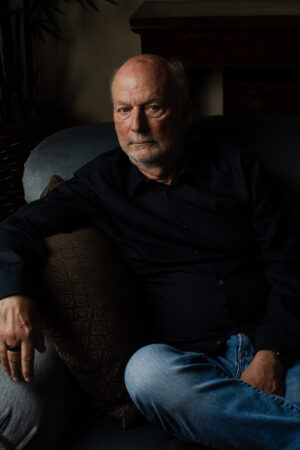
    James Bradley, who turned his curiosity about his father’s time in the Navy during the Battle of Iwo Jima — and the long-held but ultimately mistaken belief that he was in the iconic photograph of six servicemen raising the American flag on Mount Suribachi — into the bestselling book Flags of Our Fathers (2000), died on June 5. He was 72.

    His daughter Alison Cinnamond confirmed the death but declined to provide further details.

    Flags of Our Fathers, which Mr. Bradley wrote with Ron Powers, a Pulitzer Prize-winning journalist, spent 46 weeks on the New York Times bestseller list, climbing to No. 1, and was adapted into a 2006 film directed by Clint Eastwood. Ryan Phillippe played his father in the movie.

    Flags tells the stories of the six flag-raisers — John (Doc) Bradley and five Marines — through the brutal, five-week-long battle against Japanese forces on Iwo Jima, a tiny volcanic island.

    The battle claimed the lives of some 6,800 American service members, including three of the flag raisers. Bradley’s narrative followed the survivors — his father, Rene Gagnon, and Ira Hayes — on the national war bonds tour that they starred in upon their return to the United States and their sometimes difficult postwar lives.

    Doc Bradley, who became a funeral director in Antigo, Wisc., told his family little about his time in combat, or the fact that he had received the Navy Cross, the branch’s second highest award for valor, for treating and rescuing a wounded Marine while under mortar and machine-gun fire on Iwo Jima.

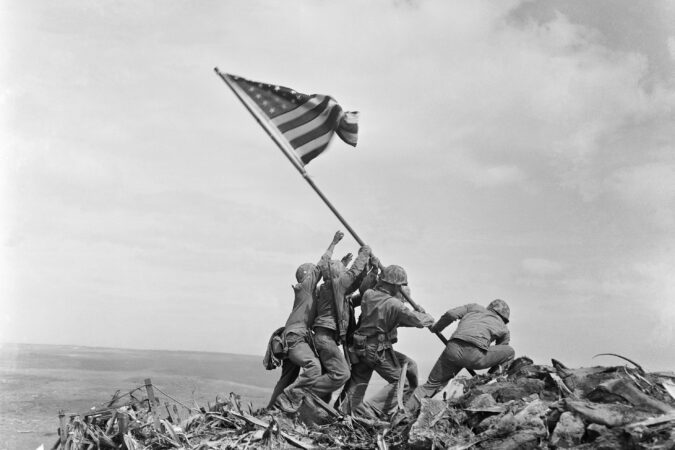
    But after his death in 1994, his family rummaged through boxes he had left behind. One of the items was a letter to his parents, postmarked Feb. 26, 1945, three days after the flag-raising photo was taken by Joe Rosenthal of the Associated Press. An image of the Pulitzer-winning photo appeared on the 3-cent stamp and on millions of war-bond drive posters. The picture also inspired the design of the Marine Corps War Memorial in Arlington, Va.

    In his letter, Doc Bradley wrote, “I had a little thing to do with the raising of the American flag and it was the happiest moment of my life.”

    The letter stunned his family.

    “If that was the happiest moment of his life,” James Bradley told the Times in 2000, “why had he never talked about it?”

    For nearly 70 years, there was little, if any, dispute that Doc Bradley was in Rosenthal’s brilliantly composed picture. The Marine Corps had, after all, named the six participants. James Bradley had no doubt of his father’s role, describing in Flags how he had dropped a handful of bandages before joining the other five men at the flagpole where he “gripped the pole in the cluster’s center.”

    But in 2014, an article in the Omaha World Herald described serious doubts raised by amateur historians that Doc Bradley was in the photograph. James Bradley was, at first, dubious.

    “Listen, I wrote a book based on facts, told to me by guys who had actually been there,” he told the newspaper. “That’s my research. That’s what I trust. At the end of the day, the truth is the truth. Everything is possible. But really?”

    He eventually took a deeper look at the paper’s findings and became convinced that his father had not been in Rosenthal’s picture but had been in a less dramatic one, with a smaller flag, taken earlier in the day on Feb. 23 by a Marine photographer, which the service branch confirmed.

    In 2016, a Marine Corps investigation — prompted by findings in a documentary, The Unknown Flag Raiser of Iwo Jima — concluded that Harold Schultz, a private first class, was the man in the image long identified as Doc Bradley.

    Cinnamond, James Bradley’s daughter, said in an interview that her father didn’t feel that the book was diminished by the finding, but that he wanted the Marine Corps to get its facts straight about who was actually in the photo.

    Indeed, it was not the only misidentification in the photo. In 1947, the Marine Corps said it had credited Henry Hansen for being in the photo when it had actually been Harlon Block. In 2019, the Marines determined that Gagnon, one of the Marines featured in Bradley’s book, had “contributed to the flag-raising,” but that Harold Keller was actually in the photo.

    James Joseph Bradley was born on Feb. 18, 1954, in Antigo. He was one of eight children of John and Elizabeth (Van Gorp) Bradley. James received a bachelor’s degree in East Asian history from the University of Wisconsin-Madison in 1977.

    Mr. Bradley was, at first, a traveling cookware salesperson, then built a career as a corporate events and video producer. Without training as a writer or researcher, he began writing Flags on his own, but his proposal was rejected by 27 publishers, one of whom told Mr. Bradley that “no one wants to read a book about old men weeping into the telephone.”

    One of his agents then brought Powers on as a collaborator; he had won the 1973 Pulitzer for criticism while writing for the Chicago Sun-Times. Bantam Books soon acquired the book.

    The book was one of several successful works during a decade that detailed the bravery of American soldiers during World War II, among them Stephen Ambrose’s D-Day: June 6, 1944 (1994); Tom Brokaw’s The Greatest Generation (1998); Steven Spielberg’s film Saving Private Ryan (1998); and the HBO miniseries Band of Brothers.

    In his review of Flags of Our Fathers in the Times, journalist Richard Bernstein called it “most affecting not because of its graphic portrayal of men at war, although its portrayal rivals Saving Private Ryan in its shocking, unvarnished immediacy.”

    Mr. Bradley continued to write about Asia in three subsequent nonfiction books. In Flyboys: A True Story of Courage (2003), he told the stories of nine American pilots, including the future President George H.W. Bush, who were shot down by the Japanese near the island of Chichijima during World War II. While Bush was rescued by an American submarine, the other eight were captured and executed by the Japanese.

    In The Imperial Cruise: A Secret History of Empire and War (2009), Mr. Bradley wrote critically about what he saw as President Theodore Roosevelt’s diplomatic mistakes in Asia.

    “Bradley explores the racist underpinnings of Roosevelt’s policies and paradoxical embrace of the Japanese as ‘honorary Aryans,’” Publishers Weekly wrote in its review, but added, “Bradley’s critique of Rooseveltian imperialism is compelling but unbalanced.”

    And in The China Mirage: The Hidden History of American Disaster in Asia (2015), Mr. Bradley described what he viewed as America’s long-running misunderstanding of China, dating to the early 1800s.

    He also wrote a novel, Precious Freedom (2025), set during the Vietnam War.

    Mr. Bradley’s three marriages ended in divorce. He is survived by two daughters, Cinnamond and Michelle Bradley, from his marriage to Eileen Heywood; two more children, Jack Bradley and Ava Bradley, from his marriage to Laura Shuler; two sisters, Kathleen and Barbara Bradley; five brothers, Steven, Mark, Patrick, Joseph and Thomas; and two grandchildren. He was also married to Shelley Tupper.

    In 1998, Mr. Bradley, his mother, and three of his brothers traveled to Iwo Jima at the invitation of Gen. Charles C. Krulak, the Marine Corps commandant. After climbing to the spot on Mount Suribachi where the celebrated Rosenthal photo was taken, Mr. Bradley asked that everyone, including the Marines in attendance, sing the only songs that Doc Bradley said he knew: “Home on the Range” and “I’ve Been Working on the Railroad.”

    “I knew, without looking up, that everyone standing on the mountaintop — Marines young and old, women and men; my family — was weeping,” Mr. Bradley wrote in Flags. “Tears were streaming down my own face. Behind me, I could hear the hoarse sobs coming from my brother Joe.”

    This article originally appeared in the New York Times.
  • Trump, claiming vandalism, says Reflecting Pool will be drained

    Trump, claiming vandalism, says Reflecting Pool will be drained

    WASHINGTON — President Donald Trump said on Saturday that “multiple individuals” had been arrested for vandalizing the Lincoln Memorial Reflecting Pool, and that problems with a more than $14 million renovation project had become so severe that the pool would have to be at least partly drained for “necessary repairs.”

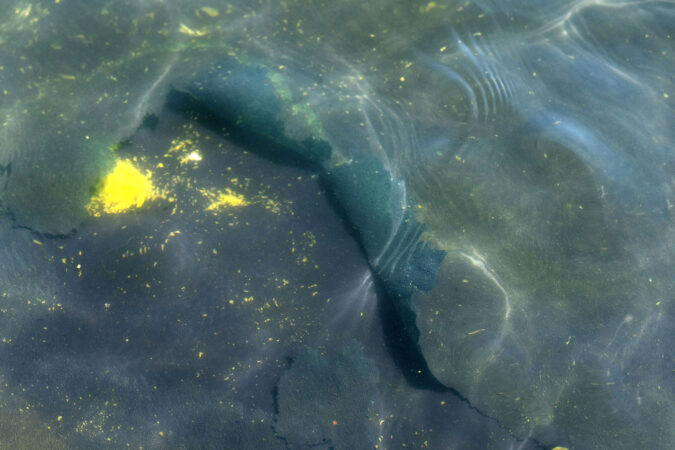
    The president’s announcement late Saturday, made on social media, was his starkest acknowledgment of the pool’s rapid deterioration in recent days. The water this week became covered by clouds of blooming algae, which were obscuring a floor that had just been painted a shade that Trump has called “American flag blue.” The paint then began to peel off, making it a tourist destination for unusual reasons.

    Among those accused of vandalism was David Carter Hearn, 67, a cyclist and three-time Olympian as a canoeist who says he stopped at the site Friday just to have a look, then reached down to touch a strip of peeling blue paint mixed with the algae.

    The U.S. Park Police arrested Hearn shortly after, accusing him of destroying government property, a crime that can carry up to a 10-year prison sentence. Hearn denies the charge.

    “I was just a curious, concerned citizen,” he said in an interview. “I guess I was there at the wrong place, wrong time.”

    The administration has not released the names of others accused of vandalizing the pool, a crime that Trump said Saturday could lead to “years in jail.” In a later post, he said without evidence that vandals had “poured corrosive and destructive chemicals into the Pool.”

    The project, one of many Trump is undertaking around the capital as the United States nears its 250th birthday, has faced intense scrutiny, including from engineers and other experts who warned that the hastily undertaken project was unlikely to undo the problems that have plagued the pool for decades. A construction company tied to Trump was awarded a no-bid contract and painted the bottom of the pool.

    Trump said Saturday that he had met with contractors earlier in the day to discuss the state of the pool.

    The Interior Department said this week that agency workers had “killed the algae” that had expanded with heat and humidity. But on Friday afternoon, the water was stained by clumps of algae where National Park Service staff members had scrubbed away bright green blooms along the bottom of the basin. The pool’s new coating was also missing large sections, including a gap roughly the size of a park bench. Underneath appeared to be the original concrete basin.

    Hearn, of Bethesda, Md., said that he was on a 50-mile bike ride before stopping at the pool, and that Park Police officers detained him for more than four hours Friday at a facility south of the National Mall without allowing a phone call. They also did not say more about why he had been arrested, he added. The White House and Park Police did not respond to requests for comment.

    Late Friday, Trump claimed on social media that the “inside surface that was just installed” had been damaged by vandals.

    Hearn said that he had “reached into the water to feel the characteristics” of a dislodged paint piece “still attached to the bottom.” He compared his actions to those of Jonathan Karl, an ABC News reporter who lifted a detached piece of paint at the pool Thursday in a video the news organization published.

    “I didn’t remove anything,” Hearn said. “I was bending and feeling this 2-millimeter-thick, rubbery flap.”

    Until his retirement 18 months ago, Hearn ran a company selling special materials for building canoes. That, he said, made him particularly interested in the materials contractors had used before the paint at the base of the pool began peeling.

    Hearn said that he had already received offers of pro bono representation following his arrest.

    “I’m getting a lot of support from my community,” he added.

    This article originally appeared in the New York Times.
  • A diocese tries to protect its 29-foot Jesus from Trump’s border wall

    A diocese tries to protect its 29-foot Jesus from Trump’s border wall

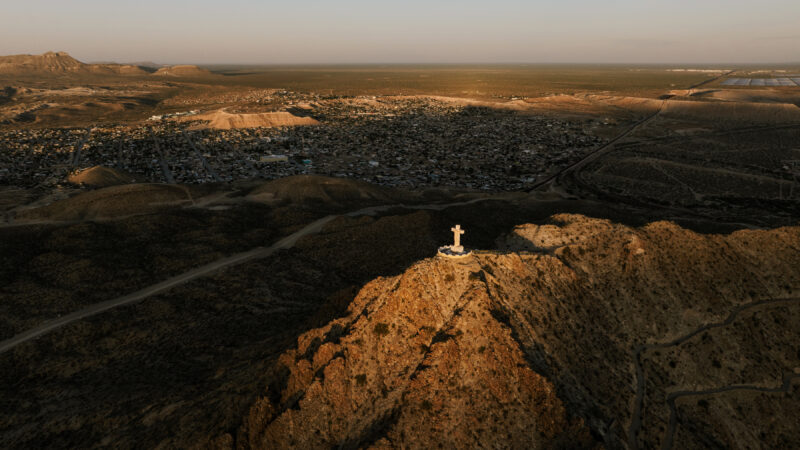
    LAS CRUCES, N.M. — At sunrise, when the day’s first golden glow washes over the 29-foot-tall limestone Jesus atop Mount Cristo Rey, Lourdes Castañon feels the presence of the divine. “The rays catch it,” he said, “and, oh man, I think I’m touching the face of God.”

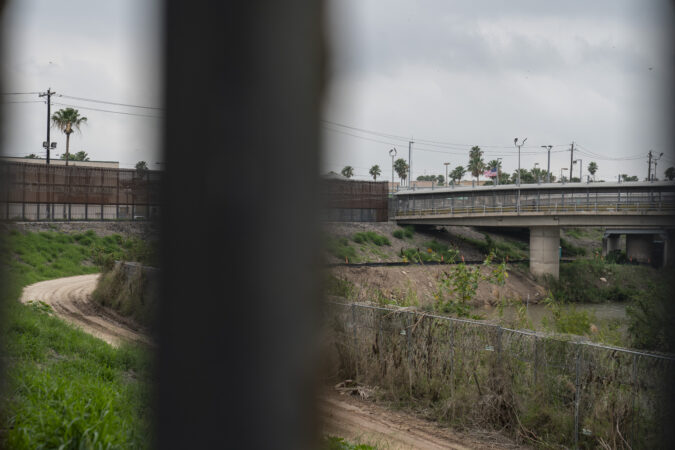
    Countless pilgrims from around the world journey to the sacred site just on New Mexico’s side of the southwestern border, but Castañon fears for its future. At the mountain’s base, President Donald Trump wants to build his border wall, and the small Catholic diocese that owns the land is trying to stop it.

    The Department of Homeland Security is attempting to use eminent domain to seize 14 acres of desert from the diocese, based in Las Cruces, N.M., so it can raise about 1.5 miles of new wall. The church claims a towering steel barrier would desecrate a holy landmark and violate the religious liberties of those who wish to worship there.

    “It will look like a scar on Mother Earth,” said Castañon, 74, a volunteer with the Mount Cristo Rey Restoration Committee, an independent group that works to keep the site clean and accessible.

    Homeland Security sued to wrest control of the land from the diocese last month, offering about $180,000 as compensation. The diocese, which had pleaded with the Trump administration to consider alternatives to a wall, countered in court, arguing that the lawsuit flouted the First Amendment and laws to further protect religious freedom.

    “The wall is a physical manifestation of this government’s attitude toward migrants,” the diocese said Friday in a legal brief that detailed its arguments and included testimony from local bishops and others. “Nothing could be less Catholic.”

    The ongoing federal case is the latest example of opposition to a border wall Trump wants to extend across the entire southern frontier. Since Trump’s first term, aggrieved landowners, environmentalists, and Native American tribes have fought the president’s barrier-building, tying up government lawyers in court.

    The Trump administration has claimed broad authority over wall construction, but opponents have secured a few tentative wins, including this year in Texas’ Big Bend National Park, where U.S. Customs and Border Protection had to change plans after a bipartisan outcry.

    Now, an administration that holds itself up as a defender of the devout is facing off with Catholics asserting their freedom of religion.

    “This is not a battle between the church and the government; it’s a battle between symbols,” said Deacon Jim Winder, the chancellor of the diocese. “One is a 29-foot statue of Christ the King, which is meant to symbolize unity and hope, and the other is a 30-foot iron monstrosity that symbolizes exclusion and division. Our symbol was there first. The wall is an in-your-face insult.”

    Customs and Border Protection has acknowledged Mount Cristo Rey’s significance, but the agency has argued that the site is also popular for drug smugglers and human traffickers. The mountain is the only stretch of land in the area not fortified with tall fencing — Cristo Rey was long considered a natural barrier — and the federal government now sees the gap as a security problem.

    Part of the new segment will be built on federal land and the rest “will have no adverse impact” on Mount Cristo Rey, the government has said, because it won’t block the trail leading up to the Christ sculpture. Construction will occur several hundred feet below the statue.

    “Anyone who spent 30 seconds examining a map of Mount Cristo Rey and the southern border would realize how ludicrous these claims are,” John B. Mennell, an agency spokesperson, said in a statement, referring to the church’s arguments.

    Mount Cristo Rey, known also as Sierra de Cristo Rey, near El Paso, Texas, and the suburbs of Mexico’s Ciudad Juárez, saw its first pilgrim in the early 1930s, after a local priest, Father Lourdes Costa, gazed out his window at the distant peak and envisioned a soaring crucifix at its summit.

    Costa made the challenging trek and shared his premonition with the Diocese of El Paso, which purchased the land from the state of New Mexico. In the nearly 90 years since the sculpture was completed, hundreds of thousands of faithful have traveled to the top, some on their knees and others barefoot, over rough ground studded with yucca and creosote.

    It also attracted those looking to cross into the United States illegally. As migrant apprehensions soared, members of the restoration committee, among the mountain’s most frequent visitors, noticed an uptick in vandalism and crime at the site.

    Not all of Mount Cristo Rey’s devotees oppose the wall. Ruben Escandon, whose parents and grandparents preceded him as Cristo Rey caretakers, worried that border-related safety concerns have held the site back from being considered one of the world’s premier Catholic attractions, like the statue of Christ the Redeemer in Rio de Janeiro.

    He is opposed to Trump’s immigration agenda, he said, but the surrounding segments of the border wall are funneling migrants onto his cherished mountain. The barrier needs to be completed, he said.

    “It has nothing to do with immigration policies; it has to do with keeping Mount Cristo Rey safe,” said Escandon, a former police officer who specializes in performing cross-border marriages. “Hopefully it will allow the traditional visitor to come without fear.”

    But environmental and migrant rights groups say the new wall would disrupt a fragile desert ecosystem and make an already dangerous journey over the border more deadly.

    The diocese said it respects the Trump administration’s authority to secure the area. When Border Patrol officials asked in recent years to carve a roadway through Cristo Rey property, the diocese agreed and charged the government nothing. The church has not objected to the agency’s use of sensors and cameras around the mountain.

    But a wall is too far, Winder said.

    Barrier construction elsewhere has threatened or destroyed other cultural sites, including a 1,000-year-old Native American etching that federal contractors mistakenly bulldozed in Arizona this year. And the blasting involved in building near Cristo Rey could damage the statue, he said.

    Lawyers for the Justice Department have been pushing to accelerate the case, filing motions to condemn the property and take possession of it in quick succession. “Time is of the essence,” they argued, because the government has already contracted with construction companies and could be fined if the project is delayed.

    “We’re just getting run over,” Winder said.

    A Justice Department spokesperson, Natalie Baldassarre, said “the taking is authorized by law” and that it “will not impact activity or use of the shrine.”

    Kathryn Brack Morrow, an attorney for the diocese, said the government’s urgency was not justified.

    “This is a self-inflicted emergency,” Morrow said. “The diocese has raised weighty religious liberty concerns that warrant deliberate consideration.”

    Contractors have already begun working at the base of Cristo Rey. On a recent morning, 15-year-old Fernanda Vazquez hiked up the winding trail with her family and looked down at the ribbon of dirt where the wall may soon be built.

    “It just breaks my heart,” she said. “It just doesn’t seem right.”

    This article originally appeared in the New York Times.
  • Can Trump sway another Latin American election? Here’s what to know.

    Can Trump sway another Latin American election? Here’s what to know.

    BOGOTÁ, Colombia — Colombians headed to the polls Sunday in the most polarized election in years, with voters choosing between the country’s governing leftist political movement and a President Donald Trump-endorsed right-wing outsider.

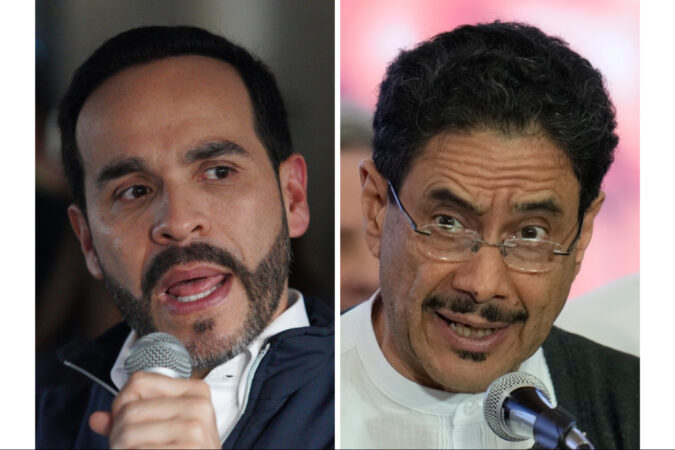
    The vote pits Sen. Iván Cepeda, a longtime human rights activist and ally of President Gustavo Petro, the country’s first leftist president, against Abelardo De La Espriella, a former criminal defense lawyer who vows a sweeping crackdown on guerrilla groups and drug-trafficking gangs.

    The high-stakes contest has drawn international attention following De La Espriella’s endorsement by Trump, who called Cepeda a “Radical Left Marxist.”

    The move marks the latest instance of Trump endorsing right-wing candidates in Latin American elections as the region increasingly shifts toward the right, driven in part by concerns over rising insecurity.

    Who are the candidates?

    Cepeda, 63, is a senator and well-known advocate for victims of Colombia’s decades-long armed conflict. He was also part of the negotiations that led to Colombia’s landmark 2016 peace deal with the Revolutionary Armed Forces of Colombia that was meant to help end that conflict.

    Running as the candidate of Petro’s party, he has pledged to preserve many of his policies, including anti-poverty programs, land redistribution efforts, and negotiations with armed groups.

    De La Espriella, 47, is a former high-profile criminal defense lawyer and businessperson with no previous political experience and who spent years living in Florida.

    Nicknamed “El Tigre,” or “the tiger,” he has campaigned as an antiestablishment outsider, though he has long been close to Colombia’s right-wing political power elites as a lawyer.

    Why has the vote spurred controversy in the U. S.?

    Some of De La Espriella’s campaign promises echo policies pursued by other Latin American right-wing leaders, such as Nayib Bukele of El Salvador and Javier Milei of Argentina. His platform includes building 10 megaprisons, shrinking the state, and collaborating with the United States to combat drug trafficking.

    He has also been known to legally pursue his opponents — including journalists. After he received Trump’s endorsement and the support of some Republican lawmakers, De La Espriella, a naturalized U.S. citizen, began warning that he would go after anyone who challenged him, with the assistance of the United States.

    Last week, Secretary of State Marco Rubio issued a memo saying that the presence of a progressive activist living in Arizona, Beto Coral, interfered with U.S. foreign policy after the activist criticized De La Espriella. Coral, 40, was detained by U.S. immigration authorities Tuesday, a move decried by Democrats in Congress and by rights groups.

    What are voters focused on?

    Along with complaints about Petro’s rocky four-year-term, voters cite concerns over crime and extortion and the growing power of armed groups in rural areas.

    Violence surged even during the campaign, which saw a presidential hopeful assassinated, two De La Espriella campaign workers killed, and Cepeda’s running mate briefly kidnapped.

    Critics say Petro’s flagship “Total Peace” strategy, which sought negotiated settlements with multiple armed groups, allowed those groups to grow stronger during ceasefires.

    Humanitarian organizations say violence has reached its highest level since the 2016 peace accord, but Colombia remains far safer than it was during the height of the conflict in the 1980s and 1990s.

    While De La Espriella says he will completely abandon peace talks and crush narcotrafficking groups within 90 days, Cepeda has said he will continue his own version of peace negotiations.

    The election is also seen as a referendum on Petro’s presidency. Supporters credit his government with expanding social programs, and increasing the political visibility of historically marginalized groups.

    But critics say his tenure has been marked not only by deteriorating security, but by a troubled state takeover of the health system and runaway spending that has left Colombia with a public debt that is at pandemic levels.

    Why the first round of voting was a surprise

    De La Espriella finished first in the opening round with 43.7% of the vote, compared with 40.9% for Cepeda.

    The result surprised many analysts. Despite complaints, Petro has maintained approval ratings above 50% and has created a broad coalition of movements that support the left. Cepeda enjoyed a comfortable lead in the polls into last month.

    Yet many voters instead turned to De La Espriella, a political newcomer who promised a clean break not only with the left, but with traditional parties and the “same ones as always.”

    Since the first round, most polls have shown De La Espriella holding the lead. However, analysts note that the right-wing candidate’s increasingly strident language has worried more middle-of-the-road Colombians, making it harder to predict whom undecided voters will support.

    After May’s first round, Petro claimed electoral fraud without evidence, raising concerns that he could refuse to accept the results of Sunday’s election or call for protests.

    When are results expected?

    Polls were open from 8 a.m. to 4 p.m. local time. Preliminary results were expected within hours of the polls closing.

    This article originally appeared in The New York Times.

  • When in New Jersey for the World Cup, do as the locals do. (Go to a mall.)

    When in New Jersey for the World Cup, do as the locals do. (Go to a mall.)

    EAST RUTHERFORD, N.J. — Benjamin Klevge, a soccer fan from Pamiers, France, had the front-facing camera open on his phone and a wide smile on his face. He crouched down, struggling to fit the Statue of Liberty into the frame.

    It wasn’t the actual Statue of Liberty, though. It was a 60-foot replica, encrusted with more than 1 million green jelly beans, towering above the entrance to a three-story candy store.

    And Klevge wasn’t in New York. He wasn’t even outdoors. He was roaming the gaping halls of the American Dream, a three-million-square-foot megamall in East Rutherford, N.J. He took more pictures in front of an indoor water park a few steps away as a Backstreet Boys song from the previous century played over the loudspeakers.

    “C’est magnifique,” he said, before switching to English. “It’s beautiful.”

    Fans who attended the opening match of this World Cup this month in Mexico City could wander a warren of neighborhood streets alive with music and the smell of grilled meat on their way to the iconic Estadio Azteca.

    Other citadels of soccer — whether Maracanã Stadium in Rio de Janeiro, which hosted the 1950 and 2014 finals, or Madrid’s Santiago Bernabéu, where the final was played in 1982 — are similarly embedded in dense, urban landscapes, helping to animate the heartbeats of their respective cities.

    Then there’s MetLife Stadium — or “New York New Jersey Stadium,” as World Cup officials have poetically rebranded it for the summer — which will host eight matches in this tournament, including the final.

    For fans accustomed to ballparks with more of the local flavor outside, it has become a punchline. They deride it as a remote island in a sea of asphalt, an inaccessible behemoth surrounded by swampland and a tangle of highway. And for the most part they’re right.

    But there’s another island out there.

    On Tuesday, before a match between France and Senegal, Klevge and thousands of others fans flooded the American Dream mall, which is connected to the stadium by an elevated footpath, and tried to make the best of an odd situation.

    Children from France kick play during a World Cup watch party at American Dream earlier this month.

    “Exit?” Klevge asked a reporter after taking his selfies and apologizing for his limited English. He tapped two fingers on his lips. “For smoking?”

    Erected in 2021, the American Dream is the second-largest shopping mall in the country. It has hundreds of stores, several dozen eateries and a host of attractions not commonly found indoors: a go-kart track, a water park, a ski slope and five roller coasters.

    This month, the air-conditioned cathedral to commerce represents the only public gathering space — besides the generic official “fan zones” immediately outside the stadium — accessible to the 82,500-capacity stadium by foot.

    “It’s kind of confusing. We’re just in a mall,” said Dawda Daye, 30, a Senegalese fan from Houston, who arrived there by taxi with his wife. “But it’s convenient, and everyone seems to be enjoying it and having fun.”

    Indeed, fans of both teams on Tuesday — just like the crowds supporting Brazil and Morocco over the weekend — seemed open to embracing the weirdness of the setting. The resulting rowdy energy was similar to the atmosphere at any major soccer match around the world — just entirely different.

    Three hours before kickoff, four men in French jerseys juggled a plush soccer ball, purchased moments earlier from an Ikea kiosk, outside a Verizon store.

    A Senegalese drum troupe rapped out a mesmerizing beat for a swaying group of soccer fans marching near the cash register of a Mrs. Field’s cookie stand.

    The sunlit space normally containing the mall’s NHL regulation-size ice rink had been converted into a sort of simulation of a beer garden, filled with picnic tables where scores of fans clapped and sang. Above them towered a screen roughly the size of the penalty area on a soccer field that displayed a video feed of the very same picnic zone they were in — meaning the fans were cheering real-time images of themselves cheering.

    “In the U.S., everything is bigger,” said Benoit Berthier, 39, a Frenchman working in Montreal, who was eating a pastry at a cafe a few steps away. “But what they did inside is good. If you have one thing you know how to do in America, it’s entertain.”

    In a food court connected to H Mart, the Korean American grocery chain, two men wearing the jersey of Rayan Cherki, a young French star, blew into vuvuzelas as they squeezed between groups munching on traditional Korean snacks.

    On the third floor — there are five levels to the American Dream — a trio of Frenchman puzzled over a digital map of the shopping center, tapping on the screen to find a place to eat.

    “This kind of mall is unusual for French people,” said Gérald Grégoire, 52, one of the fans. “What’s most surprising is the size of the parking lot.”

    Three friends kick a small soccer ball in the American Dream parking garage.

    During American football season, when the New York Jets and the New York Giants share MetLife Stadium, the parking lots there can hold close to 30,000 cars, a perfect setting for that quintessentially American sports tableau: tailgating.

    A handful of World Cup stadiums — like Lincoln Financial Field, where opposing fans played drinking games together before a match — are allowing tailgating this summer. MetLife is not one of them.

    “We heard there was no tailgating, so we said, ‘OK, we’re not going to the stadium, we’re going to the mall,’ ” said Carlos Orbe, 35, who was visiting from Tampa, Fla., with his fiancée, Julia Szenberg.

    Undeterred, the two grabbed a case of hard seltzers, took a cab to the American Dream and found some space between a row of parked cards in the mall’s indoor parking complex.

    They stood in a circle with a dozen or so other fans, sipping their drinks and periodically kicking a soccer ball that bounced their way. Asked about the people in the juggling circle, Szenberg, 36, who was born in Paris, shrugged.

    “We don’t know them,” she said. “But now they’re our family. This is the real American dream, happening in the mall parking garage.”

    This article originally appeared in The New York Times.

  • Trump, claiming vandalism, says reflecting pool will be drained

    Trump, claiming vandalism, says reflecting pool will be drained

    WASHINGTON — President Donald Trump said on Saturday that “multiple individuals” had been arrested for vandalizing the Lincoln Memorial Reflecting Pool, and that problems with a more than $14 million renovation project had become so severe that the pool would have to be at least partly drained for “necessary repairs.”

    The president’s announcement late Saturday, made on social media, was his starkest acknowledgment of the pool’s rapid deterioration in recent days. The water this week became covered by clouds of blooming algae, which were obscuring a floor that had just been painted a shade that Trump has called “American flag blue.” The paint then began to peel off, making it a tourist destination for unusual reasons.

    Among those accused of vandalism was David Carter Hearn, 67, a cyclist and three-time Olympian as a canoeist who says he stopped at the site Friday just to have a look, then reached down to touch a strip of peeling blue paint mixed with the algae.

    The U.S. Park Police arrested Hearn shortly after, accusing him of destroying government property, a crime that can carry up to a 10-year prison sentence. Hearn denies the charge.

    “I was just a curious, concerned citizen,” he said in an interview. “I guess I was there at the wrong place, wrong time.”

    The administration has not released the names of others accused of vandalizing the pool, a crime that Trump said Saturday could lead to “years in jail.” In a later post, he said without evidence that vandals had “poured corrosive and destructive chemicals into the Pool.”

    The project, one of many Trump is undertaking around the capital as the United States nears its 250th birthday, has faced intense scrutiny, including from engineers and other experts who warned that the hastily undertaken project was unlikely to undo the problems that have plagued the pool for decades. A construction company tied to Trump was awarded a no-bid contract and painted the bottom of the pool.

    Trump said Saturday that he had met with contractors earlier in the day to discuss the state of the pool.

    The Interior Department said this week that agency workers had “killed the algae” that had expanded with heat and humidity. But on Friday afternoon, the water was stained by clumps of algae where National Park Service staff members had scrubbed away bright green blooms along the bottom of the basin. The pool’s new coating was also missing large sections, including a gap roughly the size of a park bench. Underneath appeared to be the original concrete basin.

    Hearn, of Bethesda, Maryland, said that he was on a 50-mile bike ride before stopping at the pool, and that Park Police officers detained him for more than four hours Friday at a facility south of the National Mall without allowing a phone call. They also did not say more about why he had been arrested, he added. The White House and Park Police did not respond to requests for comment.

    Late Friday, Trump claimed on social media that the “inside surface that was just installed” had been damaged by vandals.

    Hearn said that he had “reached into the water to feel the characteristics” of a dislodged paint piece “still attached to the bottom.” He compared his actions to those of Jonathan Karl, an ABC News reporter who lifted a detached piece of paint at the pool Thursday in a video the news organization published.

    “I didn’t remove anything,” Hearn said. “I was bending and feeling this 2-millimeter-thick, rubbery flap.”

    Until his retirement 18 months ago, Hearn ran a company selling special materials for building canoes. That, he said, made him particularly interested in the materials contractors had used before the paint at the base of the pool began peeling.

    Hearn said that he had already received offers of pro bono representation following his arrest.

    “I’m getting a lot of support from my community,” he added.

    This article originally appeared in The New York Times.

  • No end in sight for U.S. military mission along border with Mexico

    No end in sight for U.S. military mission along border with Mexico

    WASHINGTON — For more than a year, the Pentagon has deployed about 9,000 active-duty troops along nearly 2,000 miles of the southwest border to confront migrants, smugglers, and drug cartels.

    The troops are still there — at a cost of tens of millions of dollars each week — even though the Trump administration months ago largely achieved its goal of slashing illegal crossings.

    The military patrols, working closely with Customs and Border Protection as well as the Mexican military, have pushed Mexican cartels and smugglers into more remote mountainous areas to evade detection.

    But threats to U.S. troops are on the rise, U.S. officials say.

    Some members of Congress have questioned whether the patrols are the best use of active-duty troops who would otherwise be training for deployments to Eastern Europe, the Middle East, or the Indo-Pacific. Lawmakers and independent analysts have voiced concerns that the border missions will distract from training, drain resources, and undermine readiness.

    The mission marked a milestone late last month when its third commander, Maj. Gen. Curtis D. Taylor of the Army’s 1st Armored Division, took control of one of the centerpieces of the Trump administration’s Western Hemisphere security policy.

    Challenges abound for the troops involved in the mission, which the military calls Ardent Vanguard.

    Cartel activity increased along the border in February after Mexican forces, aided by the CIA, killed a notorious Mexican cartel leader known as El Mencho. Soon after, U.S. service members discovered that their phones had been hacked, and they began receiving threatening messages, congressional officials said.

    “I’m very concerned about this operation and the safety of our Marines,” Rep. Sara Jacobs (D., Calif.), who sits on the Armed Services Committee, said at a hearing in March. “Our service members did not sign up for immigration enforcement, and this political stunt is putting their lives at risk.”

    While U.S. forces deployed to the southern border use several counterdrone systems, the general in charge of helping defend U.S. territory said that many troops lacked adequate technology for patrols.

    “It presents us a different challenge,” Gen. Gregory M. Guillot, head of the military’s Northern Command, said at a security conference in Tampa, Fla., last month. He noted the overall increase in anti-drone technology.

    Unlike the drone wars on the battlefields of Ukraine or Iran, there have been no drone attacks on either side of this border conflict and no U.S. casualties, military officials say.

    The mission to detect and interdict illegal activity across hundreds of miles of desert and mountainous frontier has also become a high-stakes proving ground for emerging technology, including counter-drone devices, remotely guided sea vessels, and advanced sensors.

    Guillot said at a change-of-command ceremony in Arizona last month that the military had for the first time conducted joint patrols with Mexican soldiers using encrypted radios and high-energy lasers to knock down potentially hostile cartel-operated drones.

    “My mission is to control the border,” Maj. Gen. David W. Gardner, commander of the 101st Airborne Division, said in a phone interview from Fort Huachuca, Ariz., before handing off the operation to Taylor. “We remain focused on the mission of sealing the border.”

    Asked about confronting the drones and other security threats posed by Mexican cartels, Gardner said that U.S. forces had disabled or knocked down drones that the cartels use to find new smuggling routes around the U.S. patrols.

    “The illicit actors are finding it more and more difficult to accomplish their objectives,” Gardner said.

    Sen. Jack Reed (D., R.I.), the top Democrat on the Armed Services Committee, expressed concern at a hearing last month that the border mission was siphoning money from important training missions. He said the Army faced a nearly $2 billion budget shortfall largely because the Department of Homeland Security had not reimbursed it for border-support missions.

    “I have received concerning reports about the potential for canceling training rotations, grounded flight hours, and reduced Guard and Reserve training resources,” Reed said, referring to the National Guard and Army Reserve. “These are real costs for real units.”

    But several commanders and some troops stationed along the border said in interviews — some of them recent — that serving in one of Trump’s highest-priority missions gave them purpose. They are using many of their skills — route planning, mission rehearsals, patrols, and surveillance flights — in the real world against criminal smuggling gangs and Mexican drug cartels, instead of just practicing at their home bases or in exercises, they said.

    There is no end in sight for the military mission on the border. The Pentagon said last May that the first four months of the operation cost $525 million. But the department declined to say what the total cost was now.

  • James Burrows, master of the TV sitcom, dies at 85

    James Burrows, master of the TV sitcom, dies at 85

    James Burrows, the genre-shaping master of the television situation comedy who was a creator of Cheers and directed more than 1,000 episodes of that show and other TV classics like The Mary Tyler Moore Show, The Bob Newhart Show, Taxi, Frasier, Friends, and The Big Bang Theory, died Friday. He was 85.

    His agent, Rick Rosen, confirmed the death but did not say where he died or specify a cause.

    Mr. Burrows earned a reputation as the “Steven Spielberg of sitcoms,” winning 11 Emmy Awards and receiving 47 nominations in a career that spanned five decades. In 1995, Bill Carter, writing in the New York Times, described him as “the man whose visual style and comedic instincts have helped create more comedy hits than anyone else in television.”

    With a unique flair for the multicamera sitcom, Mr. Burrows won audiences by focusing on the laughs.

    “When I direct a television show, I try to reach that sweet spot where the best script meets the best performance and the best chemistry between performers,” Mr. Burrows wrote in his 2022 autobiography, Directed by James Burrows, written with Eddy Friedfeld. “Hitting that exact moment, where these factors land in combination, results in the sweetest and most enduring laugh.”

    Whatever the setting, whether a New York taxi garage or a neighborhood bar in Boston, he sought to nurture his actors into ensembles. “I guess I have a gift for creating families,” he told the Times in 2023.

    Distinctly different from film directors, who control every aspect of a movie’s creative development, television directors often act as traffic cops on a set and toil in relative anonymity. They are part of a creative team led by a writer and executive producer, who also acts as the showrunner.

    Television directors don’t usually exert control ahead of the writers. But Mr. Burrows defied that tradition. He was so skilled that he became the most sought-after and highly paid sitcom director during the golden age of network comedies in the 1980s, ’90s, and early aughts.

    “I’m concerned about believability and the economy of the comedy, the shortest distance between the character and the laughter,” Mr. Burrows wrote in his autobiography. “When I direct an episode, I have lots of notes. I am apt to tell writers: ‘50 percent of what I say is gold and 50 percent is garbage. It’s your job to figure out which is which.’”

    He grew up immersed in the world of New York City theater as the son of Broadway playwright and director Abe Burrows, who helped create such hits as Guys and Dolls and How to Succeed in Business Without Really Trying.

    He even started his career approaching television episodes as if he was directing a stage play, and the ensemble casts, including such stars as Mary Tyler Moore, Bob Newhart, Judd Hirsch, Ted Danson, Jennifer Aniston, Sean Hayes, and Kelsey Grammer, loved working with him.

    “He is without a doubt the person any actor wants calling the shots when the cameras are rolling,” Grammer, who played psychiatrist Frasier Crane on Cheers and Frasier, said in a 2019 episode of Inside the Actors Studio.

    Because of his intuitive understanding of the timing and structure of a successful sitcom episode, Mr. Burrows was in constant demand, often working on more than one series at a time. He directed a staggering 75 pilot episodes that became series.

    “I try to break down those barriers between writer and actor and director, and make everybody feel like they’re all a part of the process, without incurring the wrath of a writer,” Mr. Burrows said in a 2023 interview on the public radio station KCRW.

    In 1994, for example, Mr. Burrows not only directed but also helped cast Friends. Before shooting the pilot, he gathered the group of mostly unknown young actors — Lisa Kudrow, Courteney Cox, Matt LeBlanc, David Schwimmer, Matthew Perry, and Aniston — and flew them on a private plane to Las Vegas for a dinner at Spago at Caesars Palace.

    He wanted to ensure that the cast members bonded. At dinner, he told them, “This is your last shot at anonymity. Once the show comes on the air, you guys will never be able to go anywhere without being hounded.”

    James Edward Burrows was born in Los Angeles on Dec. 30, 1940, to Abe and Ruth (Levinson) Burrows. When he was 5, the family moved to New York City, where he grew up. His mother was a homemaker and social activist who instilled a lifelong sense of social justice in James and her daughter, Laurie.

    His parents divorced when Mr. Burrows was 8, a trauma he said he carried into adulthood. His father’s success exposed him to theater luminaries. Having a famous father, however, was a mixed blessing.

    Mr. Burrows knew he would always be considered “Abe’s kid,” so to avoid his father’s long shadow, he decided he had no interest in a theater career. Nonetheless, he attended New York’s High School of Music and Art and eventually found himself unable to resist show business. Countless visits to his father’s productions and rehearsals left an indelible impression about how to work with actors and crews.

    Mr. Burrows graduated from Oberlin College in 1962 and the Yale School of Drama in 1965. There, he realized he couldn’t sing, dance, or write, but he became intrigued with the idea of directing.

    After graduating, he became an assistant stage manager for Breakfast at Tiffany’s, a short-lived 1966 musical that featured Moore. After working as a stage director at dinner theaters for the next few years, Burrows realized that television situation comedies — which in essence are short stage plays in front of a camera — might be a perfect outlet for his skills.

    In 1974, he wrote to Moore asking for a chance to work for her company, MTM, which produced her hit show. Her husband, Grant Tinker, invited Mr. Burrows to come to Los Angeles, where he was given his first shot at directing a sitcom. There, he met veteran TV director Jay Sandrich, who became a mentor.

    After The Mary Tyler Moore Show, he directed episodes of the spinoffs Rhoda and Phyllis and later The Bob Newhart Show, Laverne & Shirley, and Taxi. In 1982, he teamed up with writer-producer brothers Glen and Les Charles, whom he knew from Taxi, to create Cheers, which changed the trajectory of his career and eventually brought him vast wealth through syndication and residuals.

    Of the 275 episodes of the series over 11 seasons, Burrows directed all but 35. Its finale, in 1993, drew the second-largest audience for a series finale in television history. (Only the finale of M*A*S*H in 1983 drew more viewers.)

    In 1981, he married Linda Solomon, with whom he had three daughters, Kat, Ellie and Maggie. The couple divorced in 1993. Mr. Burrows married Debbie Easton in 1997; she survives him, along with his daughters; a stepdaughter, Paris; and seven grandchildren.

    Working into his 80s, Mr. Burrows maintained unabated enthusiasm for his craft.

    “The laughter behind me is so rewarding for my soul, I would almost do it for free,” he told the Times in 2023. “And it’s nice to be able to go back to what happened to me 50 years ago and still have this feeling of creativity. When pilot season comes this year, I hope there is a pilot that I like.”

    This article originally appeared in The New York Times.

  • Daveigh Chase, ‘Lilo & Stitch’ voice actor and ‘The Ring’ villain, dies at 35

    Daveigh Chase, ‘Lilo & Stitch’ voice actor and ‘The Ring’ villain, dies at 35

    Daveigh Chase, an actor known for voicing the character of Lilo in the hit animated film Lilo & Stitch and for her deeply unnerving turn as the child villain Samara in the horror movie The Ring, died on Tuesday in Los Angeles. She was 35.

    Her death, in a hospital, was confirmed by her father, John David Schwallier, who said the cause was complications of bacterial meningitis and a blood infection. Schwallier said his daughter had been homeless and living in Los Angeles with her boyfriend near the hospital where she died.

    Lilo & Stitch, released in 2002 when Ms. Chase was almost 12, told the story of an orphaned Hawaiian girl, Lilo, who brings home an impish blue space alien, Stitch, from the dog pound. Much wackiness ensues.

    The Disney film was a hit, grossing more than $274 million worldwide, according to Box Office Mojo (roughly $500 million when adjusting for inflation). And Ms. Chase, who had brought the plucky Lilo to life, won a Young Artist Academy Award for best performance in a voice-over role, age 10 or younger.

    Her breakout role, however, was in the live-action thriller The Ring, released in the United States roughly four months later, alongside Naomi Watts. Ms. Chase played Samara, a longhaired mystery girl who terrorized unsuspecting viewers of a certain VHS tape.

    The film, a remake of a Japanese film, Ringu, received mixed reviews, but the image of Samara crawling through a blurry television screen became seared in the cultural memory, and Ms. Chase won the award for best villain at the 2003 MTV Movie Awards.

    That year she returned to Lilo in the sequel Stitch! The Movie and in the Lilo & Stitch TV series, which ran from 2003-06.

    She then transitioned to her biggest TV role yet. In HBO’s Big Love — which chronicled the trials and tribulations of Mormon polygamists — she starred as Rhonda Volmer, a cunning 14-year-old bride in waiting, in 32 episodes between 2006 to 2011.

    Daveigh Elizabeth Schwallier was born July 24, 1990, in Las Vegas. Her father was a cook and helped to build motor homes. Her mother, Cathy Annette (Chase) Schwallier, went to nursing school but did not work a regular job.

    The family moved to Albany, Ore., where Ms. Chase would grow up, a few weeks after her birth. Ms. Chase was homeschooled, and at age 6 she won the Little Miss Oregon beauty pageant.

    She starred in a Campbell’s Soup commercial soon after, and then landed the voice-over role in Lilo & Stitch. She would go on to star as Samantha Darko, the younger sister of Jake Gyllenhaal’s Donnie, in Donnie Darko (2001) and in a little-noted sequel, S. Darko (2009). She also voiced Chihiro Ogino in Hayao Miyazaki’s 2001 animated classic, Spirited Away.

    After 2016, she largely stopped acting, and troubles with the law soon followed. In 2017, she was charged with riding in a stolen BMW, according to TMZ; in 2018, she was charged with possession of a controlled substance, according to the New York Post.

    Schwallier, 61, said in an interview Wednesday that Ms. Chase had struggled with drugs since the age of 13. He said that he hadn’t spoken with her since she was 19 and that she had a terrible falling-out with her mother around the same time. Her parents divorced 32 years ago.

    Schwallier had been in touch with Ms. Chase’s boyfriend, Roy Hernandez, and arrived at Los Angeles General Medical Center, where she was being treated, just before she died.

    “Him and her were destitute,” he said, describing the couple’s living conditions.

    In one of at least three GoFundMe pages set up to support Ms. Chase in recent days, Hernandez described her worsening condition: “The doctors say she may not survive, and when she leaves the hospital, we have nowhere to go. My hope is to raise enough money to find a place where we can be together and make her comfortable during her last days.”

    At the premiere of Lilo & Stitch in 2002, the Honolulu Star-Bulletin asked an 11-year-old Ms. Chase if she thought she could handle all the publicity that was sure to come her away after the movie’s release.

    “Well, it is just my voice,” she demurred. “But some people who worked for Disney have recognized me already. I don’t think people will really know who I am. I guess I’ll have to deal with it!”

    This article originally appeared in the New York Times.
  • Secret vetting and blocked promotions: Inside Hegseth’s war on diversity

    Secret vetting and blocked promotions: Inside Hegseth’s war on diversity

    WASHINGTON — The Navy’s top leadership believed that Rear Adm. Stephen D. Barnett was by far the best choice to lead the command that oversees the Navy’s bases at home and abroad.

    He had more experience than the other candidates and had successfully managed the aftermath of one of the Navy’s biggest messes, a fuel spill that contaminated an aquifer on a base in Hawaii, sickening thousands.

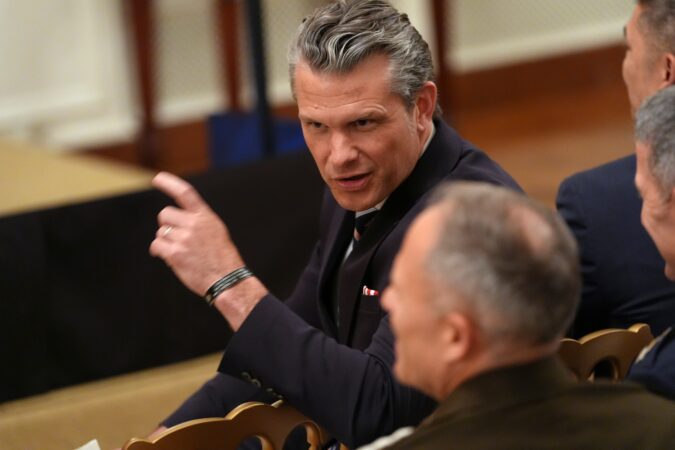
    The final decision this spring fell to Defense Secretary Pete Hegseth.

    To many in the Navy, Barnett’s promotion seemed like a foregone conclusion.

    The officer, however, had a big strike against him. Like other Black military leaders, he had been encouraged by his superiors to help the Navy recruit and retain minority officers, who remain significantly underrepresented in the force. His years-old remarks on the importance of diversity had been flagged in a secret vetting process designed to weed out senior leaders whom Hegseth and his team pegged as a problem.

    Instead of Barnett, Hegseth selected a white officer who was the Navy leadership’s third choice.

    So far this year, Hegseth has blocked the promotions of at least 40 senior officers to general and admiral ranks. About half of those are women or members of minority groups.

    This article, based on interviews with 15 current and former military and administration officials, is a look inside the process Hegseth and his team have used to halt the advancement of senior officers for reasons that have nothing to do with fighting wars or job performance.

    It tells the story of one Black officer — Barnett — whose blocked promotion shocked and angered senior Navy officials.

    The officials discussed sensitive personnel matters on the condition of anonymity. Barnett, who is expected to retire, declined a request for comment. A Pentagon spokesperson did not respond to a detailed list of questions.

    In books and speeches, Hegseth has maintained that the Pentagon’s push over the past decade to build a more diverse force had elevated women and minority officers to senior jobs that they had not earned.

    “When I think about my career in uniform, in almost every instance where there has been poor leadership or people in positions they’re not qualified for, it was based on either the reality or the perception of a ‘diversity hire,’” Hegseth, a former major in the Army National Guard, wrote in his 2024 book The War on Warriors.

    As defense secretary, he has promised to install a new promotion system that will be “ruthlessly meritocratic” and “focused squarely” on “warfighting ability.”

    In practice, though, his approach has made it harder for Black and female officers to get promoted to senior ranks, even when their records are exemplary.

    Such was the case with Barnett. In 2021, he was invited to speak at a Black History Month event at a naval base in Maryland.

    He talked about his career as a flight officer on Navy P-3 Orions, which track enemy submarines. “Just one generation before me, it was nearly unthinkable for a Black person to become a naval aviator,” he said.

    He reflected on his mentors, downplaying the importance of race. “What helped me was people who didn’t look like me,” he said.

    And he spoke about building a force that better represented the nation it serves.

    “As the country becomes more diverse, it makes sense for our military to become more diverse,” Barnett said. “Monolithic organizations cannot and will not survive.”

    At the time, the country was wrestling with the aftermath of the death of George Floyd, an unarmed Black man who was murdered by a white Minneapolis police officer nine months earlier. The Navy had just released a 142-page report with recommendations to remove barriers that had held back high-performing women and minority sailors.

    Five years later, Hegseth was leading the Pentagon. Now Barnett’s remarks were being cited as a reason to deny him a promotion that senior Navy officials said he deserved.

    “It’s Black over white”

    Hegseth has argued that the troops most likely to suffer discrimination in the military are white.

    He traced the problem to the protests and racial reckoning that followed Floyd’s murder. The Pentagon’s generals and admirals, he wrote in his 2024 book, started searching for evidence of institutional bias that did not exist. In the process, he argued, they destroyed the military’s meritocratic culture.

    “It’s Black over white. Female over male. Gay over straight,” Hegseth wrote.

    Internal Pentagon studies told a different story. Nearly a third of Black U.S. military troops reported experiencing racial discrimination, harassment, or both during a 12-month period, according to a survey conducted during President Donald Trump’s first term.

    In his book, Hegseth dismissed such data.

    As secretary of defense, he has fired or sidelined more than two dozen generals and admirals. Among those dismissed were Gen. Charles Q. Brown Jr., the second Black man to serve as chair of the Joint Chiefs of Staff, and Adm. Lisa Franchetti, the first woman to lead the Navy.

    Those ousters were all publicly announced. The extent of Hegseth’s vetoing of generals and admirals selected for promotion has remained secret until now.

    By law, one-star and two-star officers are chosen by promotion selection boards made up of senior military officers. The meetings are so confidential that board members are not permitted to tell others that they are part of the process.

    Last year, Hegseth and his top aides ordered the Army, Navy, Air Force, and Marine Corps to do online searches of the officers selected by the boards, to look for photos, videos, or news articles that might draw Hegseth’s ire, current and former defense officials said.

    The officials undertaking the reviews hoped that if they could show that the officers had been following previous Pentagon policies that Hegseth would allow their nominations to go forward to the White House and Congress for final approval.

    Inside the Pentagon, such material was referred to as “D-ROG,” short for derogatory material.

    Once the reviews led by each military service were complete, Hegseth’s staff conducted their own searches to make sure that the services had not missed or intentionally ignored anything.

    It was not clear whether Hegseth had the authority to pull names off the list. Congress had entrusted management of one-star and two-star promotion boards to the service secretaries, not the secretary of defense.

    The first test case was with an Army one-star promotion board. Last fall, Hegseth ordered Army Secretary Daniel P. Driscoll to remove two Black and two female officers from a 29-person promotion list. Driscoll, citing their decades-long records of exemplary service, repeatedly refused. The standoff lasted months.

    Finally, in March, Hegseth removed the officers’ names from the list and forwarded it to the White House.

    Around the same time, a senior aide to Hegseth accused the Navy, in a handwritten note, of promoting candidates that the defense secretary believed should have been blocked.

    Hegseth’s aides wanted the Navy to form a new promotion board that would choose a new list, Navy officials said.

    The Navy pushed back. Hegseth instead removed nine officers from the Navy’s original 31-person list.

    Soon, Hegseth was pulling officers from nearly every active duty and reserve officer promotion list. Officers who had spoken publicly about the importance of diversity in the ranks were removed from lists. So too were those who had strongly urged their troops to get the COVID vaccine.

    Hegseth has removed a total of 32 officers from Air Force and Navy one-star and two-star promotion lists, defense officials said. The only Black officer and the only female officer were removed from a Marine Corps promotion list. The two Marines’ promotions are in limbo.

    Much of the vetting process has remained shrouded in secrecy. In some instances, officers up for promotions were not told that they had been removed from the lists. Hegseth also has refused to give Congress the names of officers pulled from the lists, officials said. The Senate’s version of the 2027 defense bill would require Hegseth to provide “a written justification and notification” when removing an officer from a promotion list.

    Even the services often are not told why individual officers are vetoed.

    Military officials, though, said they have noticed patterns. Officers who had commanded aircraft carriers or amphibious assault ships have been especially vulnerable. The reason: Those ships have public affairs sailors on board who documented their skippers participating in events related to diversity or the COVID vaccine.

    Now those articles, videos, and photos, posted on the Navy websites, were being used against them, current and former Navy officials said.

    Among those targeted was Vice Adm. Sara Joyner, a three-star fighter pilot who military officials wanted to move to a higher-profile job in the Pentagon.

    Joyner had spoken at events designed to encourage and mentor female aviators and submariners. She also had appeared in a Navy recruiting ad describing her childhood and her trailblazing career as the first woman to command a carrier air wing.

    “One day, everyone will see that I’m not just a girl with a dream,” her character in the 2021 ad said. “I’m a sailor with one.”

    To Hegseth, the appearances and the ad were a big problem.

    Unlike with the one- and two-star ranks, there are no promotion boards for most three-star and four-star generals and admirals. Typically, the service secretaries and service chiefs identify their preferred candidate among two or three choices and present them to the chair of the Joint Chiefs of Staff, who can weigh in. Then the candidates are sent to the defense secretary, who picks a nominee from the shortlist.

    Joyner worked for Gen. Dan Caine, the chair of the Joint Chiefs of Staff, running a team that conducted classified war games and assessments of new weapon systems. Caine urged Hegseth to nominate her for the new position, current and former officials said. He also asked John Phelan, then the Navy secretary, to help persuade Hegseth to reconsider her promotion.

    Their interventions failed. Senior officers who are not promoted are usually expected to leave. The Times was unable to reach Joyner for comment. She retired last fall.

    A high-flying Navy career

    When Barnett joined the Navy in 1991, he never expected he would become an admiral. He didn’t come from a family with a deep history of military service and had not attended the U.S. Naval Academy.

    In 2023, he shared the story of his life and career in an interview with his hometown radio station in Columbia, Tenn.

    Barnett’s interest in the Navy was piqued by one of his fraternity brothers at Tennessee State University, a historically Black college. At the time, he was married with a child. The Navy offered a good salary, adventure, healthcare, and stability.

    “So, one day after thermodynamics class, I joined,” he told the radio host. “I kind of did it on a whim.”

    Barnett, who went by the call sign “Big Daddy,” recalled how much he enjoyed being part of a team. His P-3 surveillance plane had a crew of 11 sailors who flew sorties lasting as long as 10 hours. He rose through the ranks flying more than 250 missions in Iraq and serving in increasingly sensitive commands.

    Then, in 2021, the Navy’s Red Hill Bulk Fuel Facility leaked petroleum into an aquifer in Hawaii that tens of thousands of residents depended on for their drinking water.

    Adm. Samuel Paparo, who was serving as commander of the U.S. Pacific Fleet, asked Barnett to rush to Joint Base Pearl Harbor-Hickam in Hawaii to lead the cleanup.

    “I only need you there for 12 months,” he recalled Paparo telling him. Barnett remained for more than three years, working to decontaminate the aquifer and win back the trust of scared and angry residents.

    In a statement, Sen. Mazie Hirono (D., Hawaii) recalled him as “an important and trusted partner.”

    “He was proactive, communicative, and professional,” she said.

    Barnett’s work fixing Red Hill and experience overseeing three large regional commands made him the Navy’s top pick for a third star and the job running its bases.

    Before senior Navy officials recommended Barnett for the promotion, they searched the internet for anything in his public record that might offend Hegseth. Navy officials hoped that, if they put Barnett’s remarks in context, Hegseth might overlook them.

    Barnett had spoken at a few Black History Month events and talked in interviews about the legacy of service members, like Doris “Dorie” Miller, who became the first Black recipient of the Navy Cross for his heroics at Pearl Harbor. A photo of Miller hung in Barnett’s Hawaii office.

    In 2018, Barnett had appeared at a Navy-sponsored event during LGBTQ Pride month. “Together, we can make the world safer, freer, and more equal for everyone,” he said, according to an article posted on a Navy website.

    His statements were in line with Pentagon policy at the time, the Navy concluded.

    “If one were scrutinizing with extreme sensitivity, the only potential ‘signals’ are those of empathy and inclusivity,” according to an internal review obtained by the New York Times. “His digital footprint is remarkably disciplined and issue focused.”

    Phelan, the Navy’s senior civilian leader, and Adm. Daryl Caudle, its highest-ranking officer, picked Barnett to lead Navy Installations Command. Caine agreed.

    The final decision, though, did not fall to the Navy or the chair. It was made by Hegseth, who decided that Barnett should not advance.

    This article originally appeared in the New York Times.