Category: Wires

  • White House told CBS to run Trump interview unedited or get sued

    White House told CBS to run Trump interview unedited or get sued

    White House press secretary Karoline Leavitt told CBS News to air an interview with President Donald Trump in full or face a lawsuit, according to an audio recording of the exchange reviewed by the Washington Post.

    “He said, make sure you guys don’t cut the tape. Make sure the interview is out in full,” Leavitt told new CBS Evening News anchor Tony Dokoupil, relaying a message from the president ahead of the interview last week. “He said, if it’s not out in full, we’ll sue your ass off.”

    Dokoupil responded with levity: “He always says that!”

    The New York Times first reported on the exchange. The White House did not immediately respond to requests for comment.

    “The moment we booked this interview we made the independent decision to air it unedited and in its entirety,” a CBS spokesperson wrote in a statement.

    Before winning reelection in 2024, Trump sued CBS News for its editing of a 60 Minutes interview with Kamala Harris, then the vice president and Trump’s rival in the election. Trump’s lawsuit said the edited version was intended to “confuse, deceive, and mislead the public” and deliver the Nov. 5 election to Harris. CBS maintained that Harris’ answer was edited for time considerations only, a long-standing practice in television, just as space considerations come into play for other media outlets. In July, CBS settled the lawsuit out of court for $16 million.

    Later in the summer, CBS News’ parent company, Paramount, was purchased by Skydance, whose CEO, David Ellison, is the son of billionaire Trump ally and Oracle co-founder Larry Ellison. In October, the Paramount Skydance chief executive arranged the joint company’s purchase of the conservative opinion website the Free Press, run by former New York Times columnist Bari Weiss, and installed Weiss as editor in chief of CBS News, reporting directly to him.

    Weiss’s early tenure has been marked by layoffs and consternation among staffers about their new leader’s direction, story ideas, and deference to the government. In December, Weiss faced staff blowback at 60 Minutes for shelving a segment on the El Salvador prison CECOT because the production team was unable to secure an on-camera interview with an administration official.

    Dokoupil, who became the anchor of CBS’s storied evening news program earlier this month, has made a point of taking a different tack on the air, saying “People do not trust us like they used to.”

    Trump has expressed criticism of CBS News since it came under the new owners and Weiss’ editorship began. “THEY ARE NO BETTER THAN THE OLD OWNERSHIP, who just paid me millions of Dollars for FAKE REPORTING about your favorite President, ME!” Trump wrote on Truth Social in December. “Since they bought it, 60 Minutes has actually gotten WORSE!”

  • Republicans, Democrats try to contain Trump’s Greenland aggression

    Republicans, Democrats try to contain Trump’s Greenland aggression

    WASHINGTON — Republican lawmakers are scrambling to contain President Donald Trump’s threats of taking possession of Greenland, with some showing the most strident opposition to almost anything the Trump administration has done since taking office.

    They gave floor speeches on the importance of NATO last week. They introduced bills meant to prevent the U.S. from attacking Denmark. And several traveled to Copenhagen to meet with Danish counterparts.

    But it’s not clear that will be enough, as the president continues to insist that he will take control of the Arctic island. It’s raised fears of an end to NATO — a decades-old alliance that has been a pillar of American strength in Europe and around the globe — and raised questions on Capitol Hill and around the world about what Trump’s aggressive, go-it-alone foreign policy will mean for world order.

    “When the most powerful military nation on earth threatens your territory through its president over and over and over again, you start to take it seriously,” Sen. Chris Coons told the Associated Press.

    The Delaware Democrat organized the bipartisan trip to Denmark to “bring the temperature down a bit,” he said, as well as further talks about mutual military agreements in the Arctic. Republican Sens. Thom Tillis of North Carolina and Lisa Murkowski of Alaska accompanied a handful of Democrats on the trip. Also, Republican lawmakers joined in meetings in Washington last week with the Danish foreign minister and his Greenlandic counterpart where they discussed security agreements.

    Yet it’s clear Trump has other ideas. He said Saturday he will charge a 10% import tax starting in February on goods from eight European nations because of their opposition to his Greenland plans.

    Trump said on social media that because of modern weapons systems “the need to ACQUIRE is especially important.”

    The pushback to Trump’s Greenland plans

    Key Republicans have made clear they think that forcefully taking Greenland is out of the question. But so far, they’ve avoided directly rebuking Trump for his talk of possessing the island.

    Tillis on social media called Trump’s tariff plans “bad for America, bad for American businesses, and bad for America’s allies.”

    Senate Majority Leader John Thune (R., S.D.) told reporters Thursday, “There’s certainly not an appetite here for some of the options that have been talked about or considered.”

    In a floor speech, Thune’s predecessor as Republican leader, Sen. Mitch McConnell (R., Ky.), warned that an attempt to seize Greenland would “shatter the trust of allies” and tarnish Trump’s legacy with a disastrous foreign policy decision.

    Republican and Democratic lawmakers alike see an obvious path to bolstering American interests in Greenland while keeping the relationship with NATO ally Denmark intact.

    In a meeting with lawmakers Thursday, Danish Foreign Minister Lars Løkke Rasmussen and his Greenlandic counterpart Vivian Motzfeldt discussed how the countries could work together to develop critical mineral industries and military cooperation, Coons said. The diplomats also told the senators there is no evidence of Chinese or Russian activity in Greenland.

    Trump has made the argument that the U.S. should take Greenland before China or Russia do, prompting worry across Europe. Troops from several nations have been sent to Greenland in support of Denmark.

    Murkowski said on social media that “our NATO allies are being forced to divert attention and resources to Greenland, a dynamic that plays directly into Putin’s hands by threatening the stability of the strongest coalition of democracies the world has ever seen.”

    What can Congress do?

    Lawmakers are looking at a few options for taking a military attack on Greenland off the table. Still, the Trump administration has shown little if any willingness to get congressional approval before taking military action.

    Lawmakers, including Republicans like Murkowski, are pushing legislation that would prohibit Department of Defense funds from being used to attack or occupy territory that belongs to other NATO members without their consent.

    The Alaska senator also suggested Congress could act to nullify Trump’s tariffs. Murkowski and several other Republicans have already helped pass resolutions last year meant to undo tariffs around the globe, but those pieces of legislation did not gain traction in the House. They would have also required Trump’s signature or support from two-thirds of both chambers to override his veto.

    Democrats have also found some traction with war powers resolutions meant to force the president to get congressional approval before engaging in hostilities. Republicans last week narrowly defeated one such resolution that would prohibit Trump from attacking Venezuela again, and Democrats think there could potentially be more Republicans who would support one applying to Greenland.

    “What I’ve noticed is these war powers resolutions, they do put some pressure on Republicans,” said Sen. Tim Kaine, a Virginia Democrat who has forced votes on several similar resolutions. He said the tactic has also compelled the Trump administration to provide lawmakers with briefings and commitments to get congressional approval before deploying troops.

    Still, while dismissing the Venezuela war powers resolution on Wednesday, Republican leaders made the argument that the legislation should be ruled out of order because the Trump administration has said there are currently no U.S. troops on the ground in Venezuela.

    That argument may set a precedent for future war powers resolutions, giving Republicans a way to avoid voting against Trump’s wishes.

    “If you don’t have boots on the ground, it’s a moot point,” said Sen. Mike Rounds, a South Dakota Republican, about war powers resolutions in general. He also argued that the prospect of taking Greenland over the objections of Denmark is nothing “more than a hypothetical.”

    Other Republicans have expressed support for Trump’s insistence that the U.S. possess Greenland, though they have downplayed the idea that the U.S. would take it by force.

    That’s left the strongest objections on the Republican side of the aisle coming from a handful of lawmakers who are leaving Congress next year.

    Rep. Don Bacon, a Nebraska Republican, told the Omaha World Herald that an invasion of Greenland would lead to Trump’s impeachment — something he would “lean” towards supporting.

    Tillis, another retiring Republican, has directed his criticism at Trump advisers like White House deputy chief of staff Stephen Miller.

    “The fact that a small handful of ‘advisers’ are actively pushing for coercive action to seize territory of an ally is beyond stupid,” he said.

  • Melting ice may raise Greenland’s value. Trump’s fight may be just the start.

    Melting ice may raise Greenland’s value. Trump’s fight may be just the start.

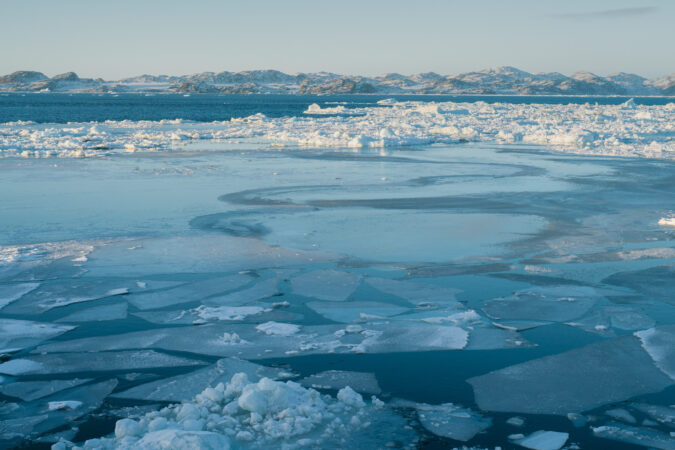
    The Arctic is warming around four times faster than the rest of the globe, exposing natural resources, opening up potential shipping routes and prompting an increase in activity among military powers. The changing landscape has created a region ripe for opportunity — and potential conflict — factors that may play a role in President Donald Trump’s sudden quest to obtain Greenland.

    Though he has called climate change a “hoax,” part of the value Trump has described in the Danish autonomous territory’s location is a result of the environmental shifts.

    “It’s partly the melting of sea ice making it more attractive for the economic development that he’d pursue in Greenland,” said Sherri Goodman, a distinguished fellow at the Atlantic Council and the former deputy undersecretary of defense for environmental security.

    Trump has said he wants the territory because of its strategic location and untapped natural resources, including diamonds, lithium, and copper.

    The president announced tariffs Saturday on countries that have sent troops to Greenland in recent days. Talks this week between the foreign ministers of Greenland and Denmark and U.S. officials ended in “fundamental disagreement,” according to Denmark’s top diplomat, Lars Lokke Rasmussen.

    The prospect of the United States using military force against the NATO ally, as Trump has floated, could end the decades-old defense pact. His bid for the territory is one of the most concrete examples of how climate change is influencing geopolitics. As the northernmost parts of our planet continue to warm, the effects could change the ways the international community operates.

    “The freeing of the Arctic from sea ice, at least seasonally, will create an entirely new theater for economic and security competition,” said Joseph Majkut, the director of the Energy Security and Climate Change Program at the Center for Strategic and International Studies. “And while we’ve known that is going to be the case for some time, it seems we’re at an inflection point.”

    Arctic sea ice typically peaks in March, as ice forms and spreads through the depth of winter, before beginning to melt to its lowest extent, usually in September. Over approximately the past five decades, changes in Arctic ice cover have revealed pathways for shipping and commerce, as parts of the region stay ice-free for longer. There’s the northern sea route along Russia’s coast, and the northwest passage along northern Canada. Analysts note icebreakers, or vessels with the capability to chomp through thinning ice, have begun passing through a “central route,” over the top of the Arctic.

    In October, a Chinese container ship used the northern sea route to shave about 20 days off its typical journey through the Suez Canal to Europe.

    If the region becomes ice-free in future summers, it could reshape global trade. That reality is mere decades away, though exact predictions depend on whom you ask and how quickly the planet warms.

    A 2021 study in Nature modeled future open-water periods based on different warming thresholds. It found that if the planet warms 2 degrees Celsius (3.6 degrees Fahrenheit) above the 1850-1900 average, that period lengthens by 63 days, while if the planet warms 3.5 degrees (6.3 degrees Fahrenheit) above the average, nearly the entire Arctic would have at least three months of open water each year.

    But it’s hard to predict the exact timeline of the rate of melting, and either way, continued escalations or jockeying won’t really depend on the pace of warming, Majkut said.

    They also may be underestimating the hazards of a melting Arctic, scientists warn. Regardless of when an ice-free summer comes, it will remain an extreme environment.

    “It’s going to be a long time before we’re arguing over beachfront property or protecting people from crocodiles up there,” Majkut said.

    Without sea ice, communities could lose crucial protection, said Zack Labe, a climate scientist who studies regional climate risks.

    “Typically, the ice would act as a buffer for high wind and waves,” he said, especially in the fall when the region experiences typhoons in the Pacific that bring huge swells. That ice protects people against erosion and flooding.

    The melting Arctic could produce unpredictable ocean conditions, like changes in the wind and the waves. And if there is an emergency, there are few accessible ports.

    “It could become more hazardous for ships to go into these areas rather than less,” said Labe.

    While Trump is pursuing Greenland, he hasn’t publicly acknowledged climate change’s role in what he perceives to be its value. A staunch climate change denier, the president has moved to cut funding to many climate initiatives including Arctic research.

    But to some, that could be bad geopolitical strategy.

    “Climate change is a significant national security risk,” said Goodman. “The openings of sea lanes, the changing ice conditions, are contributing to the intense geopolitical situations we’re experiencing.”

  • Pentagon readies 1,500 soldiers to possibly deploy to Minnesota, officials say

    Pentagon readies 1,500 soldiers to possibly deploy to Minnesota, officials say

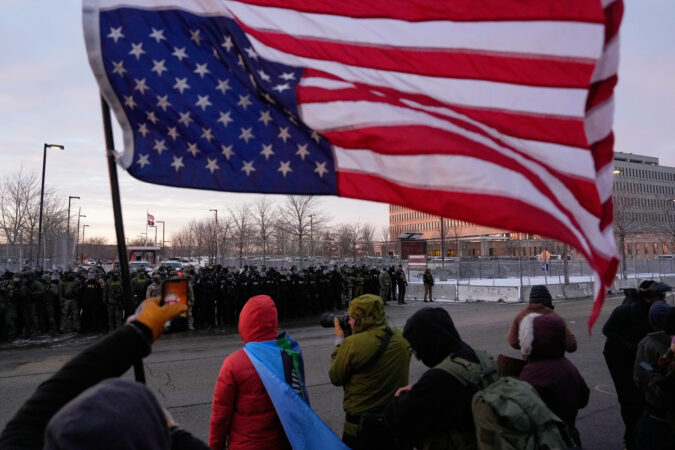
    The Pentagon has ordered about 1,500 active-duty soldiers to prepare for a possible deployment to Minnesota, defense officials told the Washington Post late Saturday, after President Donald Trump threatened to invoke the Insurrection Act in response to unrest there.

    The soldiers are assigned to two infantry battalions with the Army’s 11th Airborne Division, which is based in Alaska and specializes in cold-weather operations.

    The Army placed the units on prepare-to-deploy orders in case violence in Minnesota escalates, officials said, characterizing the move as “prudent planning.” It is not clear whether any of them will be sent to the state, the officials said, speaking like some others on the condition of anonymity to discuss sensitive military planning.

    The White House said in a statement that it’s typical for the Pentagon “to be prepared for any decision the President may or may not make.” Sean Parnell, a spokesperson for Defense Secretary Pete Hegseth, said in a statement Sunday that the Pentagon is “always prepared to execute the orders of the Commander-in-Chief if called upon.” Two officials said that the orders are unrelated to Trump’s recent rhetoric about the United States needing to take control of Greenland.

    The development was reported earlier by ABC News.

    Minneapolis Mayor Jacob Frey on Sunday called the federal government’s surge of immigration enforcement officials, and the possible deployment of active-duty soldiers, an attempt to “bait” protesters in the city.

    “We’re not going to give them an excuse to do the thing that clearly they’re trying to set up to do right now, which is these 1,500 troops,” Frey told CNN. “I never thought in a million years that we would be invaded by our own federal government.”

    The Insurrection Act, a federal law dating to 1807, permits the president to take control of a state’s National Guard forces or deploy active-duty troops domestically in response to a “rebellion.” Invoking the act would be an extraordinary move and mark the first time a commander in chief has done so since President George H.W. Bush called on the military during the Los Angeles riots of 1992 that killed dozens of people and caused widespread destruction.

    Typically, invoking the Insurrection Act is considered a last resort, when law enforcement personnel are unable to keep the peace during times of civil unrest.

    Trump threatened Thursday to invoke the law, saying on social media that unless officials in Minnesota could stop protesters from “attacking” agents with Immigration and Customs Enforcement, he would “institute the INSURRECTION ACT” and “quickly put an end to the travesty that is taking place in that once great State.”

    On Friday, Trump seemed to cool his rhetoric, saying there wasn’t a reason to invoke the law “right now.” He added, “If I needed it, I’d use it.”

    The Trump administration has turned up the pressure on Gov. Tim Walz and other Democratic leaders in Minnesota, with the Justice Department launching an investigation into whether Walz and Frey have impeded immigration enforcement. Walz, Frey, and other Democrats have said the move is an act of authoritarianism intended to silence critics of the administration’s actions.

    On Sunday, Frey said his office had not yet received a subpoena in the investigation, calling the probe “deeply concerning.”

    “This whole investigation would ultimately be the product of one of the most basic, foundational responsibilities that I have as mayor, which is to speak on behalf of my constituents,” he told ABC News.

    Walz and Frey have pleaded for protesters to remain peaceful. On Saturday, Walz also mobilized the Minnesota National Guard to support local authorities, but he has not deployed those troops.

    Minnesota has been a preoccupation of the Trump administration since at least December, when the Department of Homeland Security launched Operation Metro Surge, a multiweek immigration crackdown that has led to the arrest of hundreds of people and has been marked by clashes between federal agents and protesters.

    ICE agents have shot two people there this month, killing Renée Good, an American citizen, and wounding a Venezuelan migrant, Julio Cesar Sosa-Celis, after they attempted to detain him.

    Minnesota officials have sued the Trump administration over the operation, alleging the surge in law enforcement there is a politically motivated violation of the Constitution. Minnesota Attorney General Keith Ellison (D) said he is seeking a restraining order and called the operation a “federal invasion.”

    Other domestic military deployments ordered by Trump have been legally contested, with mixed results. In the most significant of those actions, Trump seized control of the California National Guard in June over the objections of Gov. Gavin Newsom, a Democratic political rival. About 4,000 Guard members were deployed to Los Angeles along with a battalion of about 700 active-duty infantry Marines after protests against ICE turned violent in a few instances.

    In December, Trump said he would end his efforts to keep National Guard troops deployed in Los Angeles, Chicago, and Portland, Ore., following a 6-3 ruling by the Supreme Court that found the administration failed to identify a legal way in which the military could “execute the laws in Illinois.” At issue in those jurisdictions was whether the deployments violated the Posse Comitatus Act, a federal law that prohibits U.S. troops from carrying out civilian law enforcement actions.

    Trump also has deployed more than 2,600 members of the National Guard to D.C., and administration officials recently extended that mission through the end of 2026. While that deployment remains legally contested, the president has more authority to deploy National Guard members there because it is a federal jurisdiction.

  • Europe warns of ‘dangerous downward spiral’ after Trump threatens tariffs over Greenland

    Europe warns of ‘dangerous downward spiral’ after Trump threatens tariffs over Greenland

    BERLIN — The eight European countries targeted by U.S. President Donald Trump for a 10% tariff for opposing American control of Greenland blasted the move Sunday, warning that his threats “undermine trans-Atlantic relations and risk a dangerous downward spiral.”

    The joint statement by some of America’s closest allies signaled a possible turning point in the recent tensions over sovereignty and security nearly 24 hours after Trump’s threat.

    It was also the most forceful rebuke of Trump from the European allies since he returned to the White House almost a year ago. In recent months, Europeans have mostly opted for diplomacy and flattery around him, even when seeking an end to the war in Ukraine. Sunday’s statement, as well as some European countries sending troops to Greenland for a Danish military training exercise, appeared to be a step away from that strategy.

    The unusually strong joint statement from Denmark, Norway, Sweden, France, Germany, the United Kingdom, the Netherlands, and Finland said troops sent to Greenland for operation Arctic Endurance pose “no threat to anyone.”

    Standing in solidarity with Denmark, Greenland

    Trump’s Saturday announcement sets up a potentially dangerous test of U.S. partnerships in Europe. He appeared to indicate that he was using the tariffs as leverage to force talks over the status of Greenland, a semiautonomous territory of NATO ally Denmark that he regards as critical to U.S. national security.

    “We stand in full solidarity with the Kingdom of Denmark and the people of Greenland,” the group said. “Building on the process begun last week, we stand ready to engage in a dialogue based on the principles of sovereignty and territorial integrity that we stand firmly behind. Tariff threats undermine trans-Atlantic relations and risk a dangerous downward spiral.”

    There are immediate questions about how the White House could try to implement the tariffs because the European Union is a single economic zone in terms of trading. It was unclear, too, how Trump could act under U.S. law, though he could cite emergency economic powers that are currently subject to a U.S. Supreme Court challenge.

    EU foreign policy chief Kaja Kallas said China and Russia will benefit from divisions between the U.S. and Europe. She added in a post on social media: “If Greenland’s security is at risk, we can address this inside NATO. Tariffs risk making Europe and the United States poorer and undermine our shared prosperity.”

    Europe has been trying to keep Trump on its side to ensure U.S. support for Ukraine, including Washington sharing intelligence with Kyiv and its involvement in security guarantees if a peace agreement is reached with Russia.

    Rasmus Søndergaard, a senior researcher at the Danish Institute for International Studies, called Trump’s announcement “unprecedented” because tariff threats normally stem from trade disagreements, not territorial disputes between allies.

    “That’s of course why we’re seeing the response from European countries saying ’enough is enough,’” he told the Associated Press. “I think there’s in part probably a strategic calculation, of course, from the governments in these countries that if you give in to Trump on this, what will be the next thing? And at some point you have to sort of push back.”

    Søndergaard also said Trump leveled the playing field for Europe with the tariff threat. Europeans cannot compete militarily, but the EU can wield an economic weapon through reciprocal tariffs.

    “The EU has the ability to really strike back with force if they want to, and it will hurt European economies,” he said. “It will hurt American economies. The challenge for Trump is he has midterms coming up and it’s not going to help him if the U.S. goes into more of an economic recession or more of an economic turmoil than is already the case.”

    Meanwhile, NATO Secretary General Mark Rutte wrote on social media Sunday that he’d spoken with Trump. Rutte has been criticized in recent days for largely sidestepping questions about Trump and Greenland and any NATO tensions over the island.

    “We will continue working on this, and I look forward to seeing him in Davos later this week,” Rutte said.

    Trump’s move was also panned domestically.

    U.S. Sen. Mark Kelly, a former U.S. Navy pilot and Arizona Democrat, said Trump’s threatened tariffs on U.S. allies would make Americans “pay more to try to get territory we don’t need.”

    “Troops from European countries are arriving in Greenland to defend the territory from us. Let that sink in,” Kelly wrote on social media. “The damage this President is doing to our reputation and our relationships is growing, making us less safe. If something doesn’t change we will be on our own with adversaries and enemies in every direction.”

    Former U.S. Vice President Mike Pence said he supports the United States ultimately owning Greenland, but not how Trump is trying to accomplish it.

    He said he had concerns whether Trump had the constitutional authority to impose unilateral tariffs on NATO allies, as well as about a threat of a military invasion. Trump’s current position threatens “to fracture that strong relationship, not just with Denmark, but with all of our NATO allies,” Pence said on CNN’s State of the Union.

    Populist allies of Trump criticize tariff threat

    Six of the countries targeted are part of the 27-member EU, which operates as a single economic zone in terms of trading. It was not immediately clear if Trump’s tariffs would impact the entire bloc. EU envoys scheduled emergency talks Sunday evening to determine a potential response.

    The tariff announcement also drew blowback from Trump’s populist allies in Europe.

    Italy’s right-wing premier, Giorgia Meloni, considered one of Trump’s closest allies on the continent, said she had spoken to him about the tariffs, which she described as “a mistake.”

    The deployment to Greenland of small numbers of troops by some European countries was misunderstood by Washington, Meloni said, adding it was not a move against the U.S. but aimed to provide security against “other actors” that she didn’t identify.

    Jordan Bardella, president of Marine Le Pen’s far-right National Rally party in France and a European Parliament lawmaker, posted that the EU should suspend last year’s tariff deal with the U.S., describing Trump’s threats as “commercial blackmail.”

    Trump also achieved the rare feat of uniting Britain’s main political parties — including the hard-right Reform UK party — all of whom criticized the tariff threat.

    “We don’t always agree with the U.S. government and in this case we certainly don’t. These tariffs will hurt us,” said Reform UK leader Nigel Farage, a longtime champion and ally of Trump. His social media post stopped short of criticizing Trump’s designs on Greenland.

    U.K. Prime Minister Keir Starmer, who leads the center-left Labour Party, said the tariffs announcement was “completely wrong” and his government would “be pursuing this directly with the U.S. administration.”
  • Kevin Stefanski hired as Falcons coach after being let go by Browns

    Kevin Stefanski hired as Falcons coach after being let go by Browns

    ATLANTA — The Atlanta Falcons have hired Kevin Stefanski to be their head coach.

    Stefanski, a two-time Associated Press NFL Coach of the Year with the Cleveland Browns, replaces Raheem Morris and will report to Falcons President Matt Ryan.

    “We’re thrilled to land a lead-by-example leader in Kevin Stefanski who brings a clear vision for his staff, our team and a closely aligned focus on building this team on fundamentals, toughness and active collaboration with every area of the football operation,” Ryan said in a statement. “Coach Stefanski is a team-first leader who puts a premium on accountability for everyone and a player-driven culture. His experience in Cleveland and Minnesota has given him a great understanding of the importance of working in sync with scouting, personnel and the rest of the football staff to maximize talent across the roster and in doing everything possible to put our players in the best position to succeed.”

    Stefanski was named AP Coach of the Year in 2020 after leading the Browns to the playoffs for the first time since 2002 and their first playoff win since 1994 with an 11-5 record. He won it again in 2023 when the Browns made the playoffs and finished 11-6. Stefanski was 45-56 in Cleveland.

    “I’m beyond thrilled to be charged with leading this iconic franchise,” Stefanski said. “I am grateful to Mr. (Arthur) Blank and Matt Ryan for trusting me to coach this football team and there are many talented players on our roster that I cannot wait to coach. We share a vision for this football team that I believe will make Falcons fans everywhere proud. We will get to work immediately putting together a first-class coaching staff and working hard to get to know all the great people that are so important to getting us all where we want to go.”

    Stefanski previously spent 14 years as an assistant in Minnesota under Brad Childress, Leslie Frazier and Mike Zimmer. He’s a former two-time All-Ivy League defensive back at the University of Pennsylvania from 2000-04.

  • Bo Nix breaks his right ankle late in Broncos’ playoff win, will have surgery

    Bo Nix breaks his right ankle late in Broncos’ playoff win, will have surgery

    DENVER — Bo Nix broke his right ankle late in overtime of the Denver Broncos’ divisional-round victory over Buffalo on Saturday and will have surgery that will sideline him for the rest of the playoffs.

    Coach Sean Payton delivered the stunning news about his second-year quarterback in the aftermath of Denver’s biggest win in a decade. Backup quarterback Jarrett Stidham will start the AFC championship game next weekend.

    “Stiddy’s ready,” Payton said after returning to the postgame lectern to discuss the injury following Denver’s 33-30 victory.

    Payton said Nix got hurt on a keeper where he lost 2 yards and was tackled by safety Cole Bishop. Nix was limping after the play, but there was no indication that he suffered such a serious injury.

    On the next play, Nix threw a deep pass to Marvin Mims Jr. that drew a 30-yard pass-interference flag and got the Broncos well into field-goal range. Nix then took a knee to center the ball for Wil Lutz’s game-ending 23-yard field goal.

    Payton said Nix will have surgery Tuesday in Birmingham, Alabama.

    “He’s such a strong, faith-based guy,” Payton said. “He’s sitting in the hallway with his family and coming over and we’re all talking to him. He knows that God’s got a plan for him and he said he had (a broken ankle) in high school and then he said he had one at Auburn.

    “And I said I didn’t realize that. I said if I had known that I wouldn’t have drafted you,” Payton cracked.

    The locker room had cleared out and reporters were waiting in an interview room for Nix when Payton returned and delivered the news.

    Nix, the 12th overall pick out of Oregon in the 2024 NFL draft, tied Russell Wilson’s NFL record with two dozen victories in his first two seasons. Saturday’s victory was his first in the playoffs. The Broncos lost last year at Buffalo but Nix led Denver to the AFC’s top seed this season.

    “He’s a tough cookie,” Payton said. “And this team all year has lost key players and will rise up for the next challenge.”

  • Pro- and anti-ICE demonstrators face off during Minneapolis immigration crackdown

    Pro- and anti-ICE demonstrators face off during Minneapolis immigration crackdown

    MINNEAPOLIS — Protesters for and against the Trump administration’s latest immigration crackdown clashed in Minneapolis on Saturday as the governor’s office announced that National Guard troops had been mobilized and stood ready to assist state law enforcement, though they were not yet deployed to city streets.

    There have been protests every day since the Department of Homeland Security ramped up immigration enforcement in the Twin Cities of Minneapolis and St. Paul by bringing in more than 2,000 federal officers.

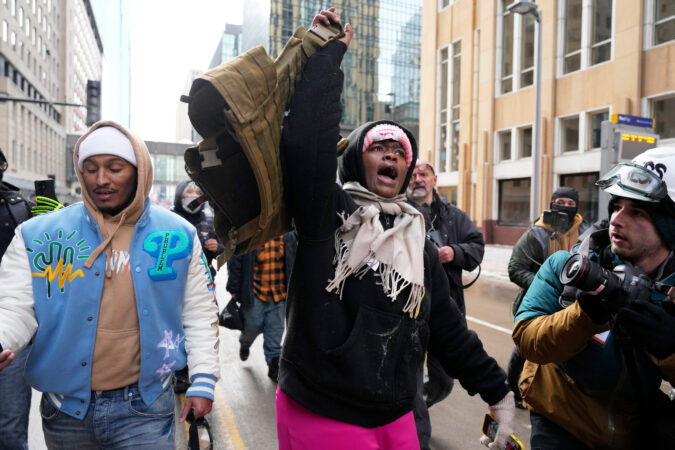
    A large group of protesters turned out in downtown Minneapolis and confronted a much smaller group of people attending an anti-Somali and pro-Immigration and Customs Enforcement rally. They chased the pro-ICE group away and forced at least one member to take off a shirt they deemed objectionable.

    Jake Lang, who organized the anti-Islam and pro-ICE demonstration, appeared to be injured as he left the scene, with bruises and scrapes on his head. He said via social media beforehand that he intended to “burn a Quran” on the steps of City Hall, but it was not clear if he carried out that plan.

    Lang was previously charged with assaulting an officer with a baseball bat, civil disorder and other crimes before receiving clemency as part of President Donald Trump’s sweeping act of clemency for Jan. 6 defendants last year. Lang recently announced that he is running for U.S. Senate in Florida.

    In Minneapolis, snowballs, and water balloons were also thrown before an armored police van and heavily equipped city police arrived.

    “We’re out here to show Nazis and ICE and DHS and MAGA you are not welcome in Minneapolis,” protester Luke Rimington said. “Stay out of our city, stay out of our state. Go home.”

    National Guard ‘staged and ready’

    The state guard said in a statement that it had been “mobilized” by Democratic Gov. Tim Walz to support the Minnesota State Patrol “to assist in providing traffic support to protect life, preserve property, and support the rights of all Minnesotans to assemble peacefully.”

    Maj. Andrea Tsuchiya, a spokesperson for the guard, said it was “staged and ready” but yet to be deployed.

    The announcement came more than a week after Walz, a frequent critic and target of Trump, told the guard to be ready to support law enforcement in the state.

    During the daily protests, demonstrators have railed against masked immigration officers pulling people from homes and cars and other aggressive tactics. The operation in the deeply liberal Twin Cities has claimed at least one life: Renee Good, a U.S. citizen and mother of three, was shot by an ICE officer during a Jan. 7 confrontation.

    On Friday a federal judge ruled that immigration officers cannot detain or tear gas peaceful protesters who are not obstructing authorities, including while observing officers during the Minnesota crackdown.

    Living in fear

    During a news conference Saturday, a man who fled civil war in Liberia as a child said he has been afraid to leave his Minneapolis home since being released from an immigration detention center following his arrest last weekend.

    Video of federal officers breaking down Garrison Gibson’s front door with a battering ram Jan. 11 become another rallying point for protesters who oppose the crackdown.

    Gibson, 38, was ordered to be deported, apparently because of a 2008 drug conviction that was later dismissed. He has remained in the country legally under what’s known as an order of supervision. After his recent arrest, a judge ruled that federal officials did not give him enough notice that his supervision status had been revoked.

    Then Gibson was taken back into custody for several hours Friday when he made a routine check-in with immigration officials. Gibson’s cousin Abena Abraham said Immigration and Customs Enforcement officials told her White House Deputy Chief of Staff Stephen Miller ordered the second arrest.

    The White House denied the account of the re-arrest and that Miller had anything to do with it.

    Gibson was flown to a Texas immigration detention facility but returned home following the judge’s ruling. His family used a dumbbell to keep their damaged front door closed amid subfreezing temperatures before spending $700 to fix it.

    “I don’t leave the house,” Gibson said at a news conference.

    DHS said an “activist judge” was again trying to stop the deportation of “criminal illegal aliens.”

    “We will continue to fight for the arrest, detention, and removal of aliens who have no right to be in this country,” Assistant Homeland Security Secretary Tricia McLaughlin said.

    Gibson said he has done everything he was supposed to do: “If I was a violent person, I would not have been out these past 17 years, checking in.”

  • Justice Dept. enters new territory with probe of Minnesota officials

    Justice Dept. enters new territory with probe of Minnesota officials

    President Donald Trump’s Justice Department crossed a new threshold with its criminal investigation of top Democratic elected officials in Minnesota, targeting vocal critics during a moment of crisis in which protesters and federal agents are clashing on icy city streets.

    The Twin Cities have been a tinderbox for more than a week since an Immigration and Customs Enforcement officer fatally shot a woman in her vehicle, with residents confronting ICE agents. Trump has raised the prospect of sending U.S. troops into the state, and the Justice Department escalated tensions Friday as it prepared to send subpoenas to Gov. Tim Walz and Minneapolis Mayor Jacob Frey, two of Minnesota’s highest-profile Democrats.

    The pair have loudly disparaged ICE’S presence in the state and the way Trump and his administration have defended the officer and sidelined state officials in an investigation into the shooting. The subpoenas the Justice Department is preparing to send suggest the agency is looking at whether Walz’s and Frey’s public statements about the administration’s actions amount to illegal interference with law enforcement.

    The administration has pursued numerous other Democrats and perceived adversaries, fulfilling Trump’s promises to prosecute his foes. However, the administration had not taken such forceful action against elected officeholders at a volatile moment when public safety was at issue — until now.

    To Trump’s allies, the latest investigation should serve as a warning to critics who they argue are inflaming matters with their rhetoric. Former Trump adviser Stephen K. Bannon said he believes Walz and Frey hit Trump’s “trip wire” with their heated comments and expects “intense prosecution.”

    “Walz and Frey should listen when the president says, ‘No games,’” he said.

    Trump’s critics warned in stark terms that he was crossing a dangerous line.

    “This is what totalitarianism looks like,” said Sen. Chris Murphy (D., Conn.). “Trump is now using the full, entire scope of the federal government in order to destroy and suppress dissent and compel loyalty.” Murphy said Minneapolis is a “test case” that will determine whether Trump tries the same approach elsewhere.

    The White House and Justice Department had no comment Friday on the probe of Walz and Frey, but Attorney General Pam Bondi posted on social media a “reminder to all those in Minnesota: No one is above the law.” Neither Walz nor Frey had been served with a subpoena by Friday evening, spokespeople for the officials said.

    Trump, who on Thursday threatened to invoke the Insurrection Act in Minnesota, which would enable him to deploy the military on U.S. soil, downplayed the prospect on Friday. “If I needed it, I’d use it. I don’t think there’s any reason right now to use it,” he told reporters.

    The Justice Department’s investigation of a governor and mayor is highly unusual. In the 1950s and 1960s, presidents used troops to enforce court desegregation orders in the face of defiance from some Southern governors. But the department did not press charges against them, said Steven Lawson, a history professor at Rutgers University.

    “The Justice Department’s Civil Rights Division did keep track of civil rights incidents in the South, but it did not prosecute or harass governors or mayors for their resistance,” he said by email.

    Trump’s administration is taking the opposite approach by going after those who have pilloried the president. Traditionally, the Justice Department has tried to insulate itself from the White House, but Trump has not shied away from getting involved in its investigations. In September, he took to social media to complain to Bondi that she wasn’t taking action against his political opponents.

    Many Minnesotans were angry when ICE sent thousands of agents to the state, and they launched widespread protests after an ICE officer fatally shot Renée Good. ICE’S presence and the demonstrations have put Minneapolis on edge, with residents blowing whistles and screaming at agents, and officers at times deploying tear gas. Demonstrations “remained peaceful until last night,” Minneapolis Police Chief Brian O’Hara said last weekend after 29 people were arrested and an officer was injured.

    Tensions rose again this week when an ICE officer shot a man in the leg.

    Soon after an investigation into Good’s shooting began, state officials said they were reluctantly withdrawing from it because the FBI was not sharing information with them. Separately, Minnesota Attorney General Keith Ellison sued federal officials this week to try to force ICE agents out of the state.

    Walz, the Democrats’ 2024 vice-presidential nominee, has been fiercely critical of ICE, as has Frey, who drew nationwide attention when he told ICE to “get the f— out of Minneapolis” following the shooting.

    Walz and Frey are being investigated under a law similar to one used against protesters whom federal officials have accused of impeding their work.

    “The administration is taking us back to the days of seditious libel, where people are prosecuted simply because they criticize the acts of government,” said Rep. Jamie Raskin (D., Md.), a former constitutional law professor who served on a congressional panel that investigated the Jan. 6, 2021, attack on the U.S. Capitol by a pro-Trump mob. “The Department of Justice has now been reduced to a completely political and partisan instrument of vendetta.”

    In a statement, Walz noted that Trump has gone after many others who have not done what he wants and said, “The only person not being investigated for the shooting of Renée Good is the federal agent who shot her.”

    Justice Department prosecutors pursued cases against former FBI director James B. Comey and New York Attorney General Letitia James, but judges dismissed the charges. The department has also conducted investigations of Sen. Adam Schiff (D., Calif.), who led Trump’s first impeachment as a member of the House, Federal Reserve Chair Jerome H. Powell, and several Democrats who told military members they could defy unlawful orders. He has also tussled with Democratic state officials such as California Gov. Gavin Newsom and Illinois Gov. JB Pritzker, and tried to withhold funds from them when they have fought his agenda.

    Frey wrote on the social media platform X that the investigation against him was “an obvious attempt to intimidate me for standing up for Minneapolis, local law enforcement, and residents against the chaos and danger this Administration has brought to our city.” He said he “will not be intimidated.”

    The administration’s pressure on Minneapolis ramped up further Friday when the Department of Housing and Urban Development said it was investigating the city over fair housing initiatives, probing for alleged violations of the Fair Housing Act and the Civil Rights Act.

    A Minneapolis spokesperson said the investigation “appears to be about politics, not affordable housing.”

  • Thousands march in Greenland to support Arctic island in the face of Trump’s threats to take it over

    Thousands march in Greenland to support Arctic island in the face of Trump’s threats to take it over

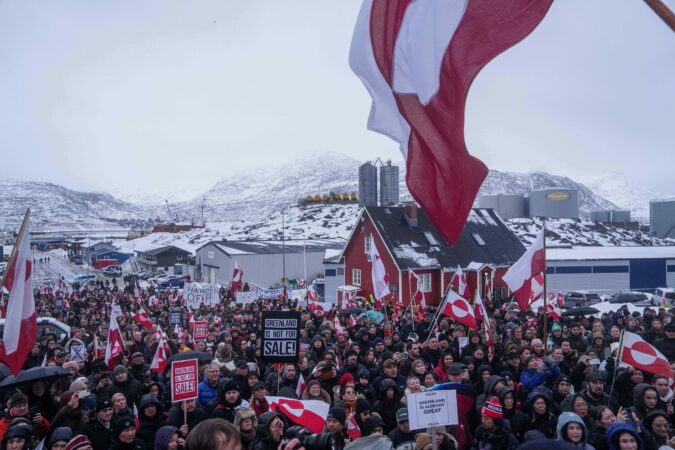
    NUUK, Greenland — Thousands of Greenlanders carefully marched across snow and ice to take a stand against U.S. President Donald Trump on Saturday. They held signs of protest, waved their national flag and chanted “Greenland is not for sale” in support of their own self-governance in the face of increasing threats of an American takeover.

    Just as they finished their trek from the small downtown of Greenland’s capital city Nuuk to the U.S. Consulate in rain and near-freezing temperatures, the news broke: Trump, from his golf course in sunny Florida, announced he will charge a 10% import tax starting in February on goods from eight European countries over their opposition to U.S. control of Greenland.

    “I thought this day couldn’t get any worse but it just did,” a stunned Malik Dollerup-Scheibel said after The Associated Press told him about Trump’s announcement. “It just shows he has no remorse for any kind of human being now.”

    Trump has long said he thinks the U.S. should own the strategically located and mineral-rich island, which is a self-governing territory of Greenland. Trump intensified his calls a day after the military operation to oust Venezuela’s Nicolás Maduro earlier this month.

    Dollerup-Scheibel, a 21-year-old Greenlander, and Greenland Prime Minister Jens-Frederik Nielsen were among what others described as the island’s biggest protest, drawing nearly a quarter of Nuuk’s population. Others held rallies and solidarity marches across the Danish realm, including in Copenhagen, as well as in the capital of the Inuit-governed territory of Nunavut in Canada’s far north.

    “This is important for the whole world,” Danish protester Elise Riechie said as she held Danish and Greenlandic flags in Copenhagen. “There are many small countries. None of them are for sale.”

    In Nuuk, Greenlanders of all ages listened to traditional songs as they walked to the consulate. Marie Pedersen, a 47-year-old Greenlander, said it was important to bring her children to the rally “to show them that they’re allowed to speak up.”

    “We want to keep our own country and our own culture, and our family safe,” she said.

    Her 9-year-old daughter, Alaska, crafted her own “Greenland is not for sale” sign. The girl said her teachers have addressed the controversy and taught them about NATO at school.

    “They tell us how to stand up if you’re being bullied by another country or something,” she said.

    Meanwhile, Tom Olsen, a police officer in Nuuk, said Saturday’s protest was the biggest he’s ever seen there.

    “I hope it can show him that we stand together in Europe,” he said. “We are not going down without a fight.”

    Tillie Martinussen, a former member of Greenland’s parliament, said she hopes the Trump administration will “abandon this crazy idea.”

    “They started out as sort of touting themselves as our friends and allies, that they wanted to make Greenland better for us than the Danes would,” she said as others chanted in the background. ”And now they’re just plain out threatening us.”

    She added that the push to preserve NATO and Greenland’s autonomy were more important than facing tariffs, though she added that she was not dismissing the potential economic impact.

    “This is a fight for freedom,” she said. “It’s for NATO, it’s for everything the Western Hemisphere has been fighting for since World War II.”

    But when the AP asked Louise Lennert Olsen what she would say to Trump, the 40-year-old Greenlandic nurse instead said she wanted to give a message to the American people.

    “I would really like them to support our wish to be Greenland as we are now,” she said as she marched through Nuuk. “I hope they will stand against their own president. Because I can’t believe they just stand and watch and do nothing.”