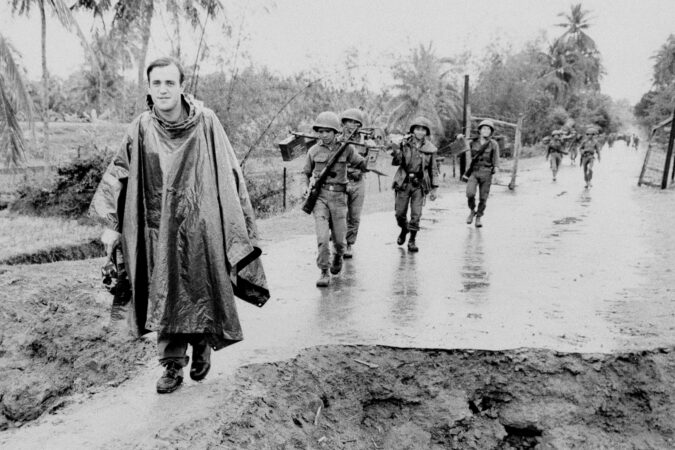
Peter Arnett was already an accomplished combat correspondent in 1966 when he embedded with an American infantry battalion tasked with routing out enemy snipers from a tunnel system near Saigon. Mr. Arnett was standing next to the unit commander when bullets tore through the map the officer was holding, hitting the colonel in the chest.
Medics ran up to bandage Lt. Col. George Eyster, a West Pointer who died the next day at a field hospital. Mr. Arnett wrote his obituary, which was among the scores of stories he filed from the humid jungle battlefields of Vietnam for more than a decade. He won the Pulitzer Prize for international reporting that year.
Mr. Arnett stayed in Vietnam beyond the very end. When Viet Cong guerrillas entered the Associated Press bureau during the 1975 fall of Saigon, his boss Nate Polowetzky told him to get out of there. Mr. Arnett refused. “He told me, in effect, to go screw myself,” Polowetzky said.
The New Zealand native would go on to cover more wars (15 to 20, he said), including the Gulf War. He was one of the few Western reporters in Baghdad in January 1991 when allied missiles started raining down, reporting live from the city for CNN. He interviewed Saddam Hussein in the second week of the war, and in 1997, Osama bin Laden.
When Mr. Arnett asked bin Laden about his plans, the 9/11 mastermind replied: “You’ll see them and hear about them in the media. God willing.”
Mr. Arnett died Wednesday at 91, in Newport Beach, Calif. The cause was prostate cancer, said his daughter, Elsa Arnett.
After arriving in Vietnam, Mr. Arnett was given lifesaving advice from one of his AP colleagues, Malcolm Browne: Lie prone under fire; look for cover and move toward it; do not get close to a radioman or medic because they are prime targets; and if you hear a shot, don’t get up to see where it came from because the second shot might get you.
Mr. Arnett, one of the most famous journalists of his era, wrote gripping battlefield stories that transported readers sitting in their living rooms to the scene of the news.
The stories that won him the Pulitzer included a dispatch about an Army captain who watched helplessly as a Viet Cong machine gunner kept pummeling the body of one of his men, rolling it over and over. In a story titled “Everyone Knew the Americans Were Coming,” Arnett wrote on a failed U.S. mission aimed at hunting down Viet Cong fighters who easily got away.
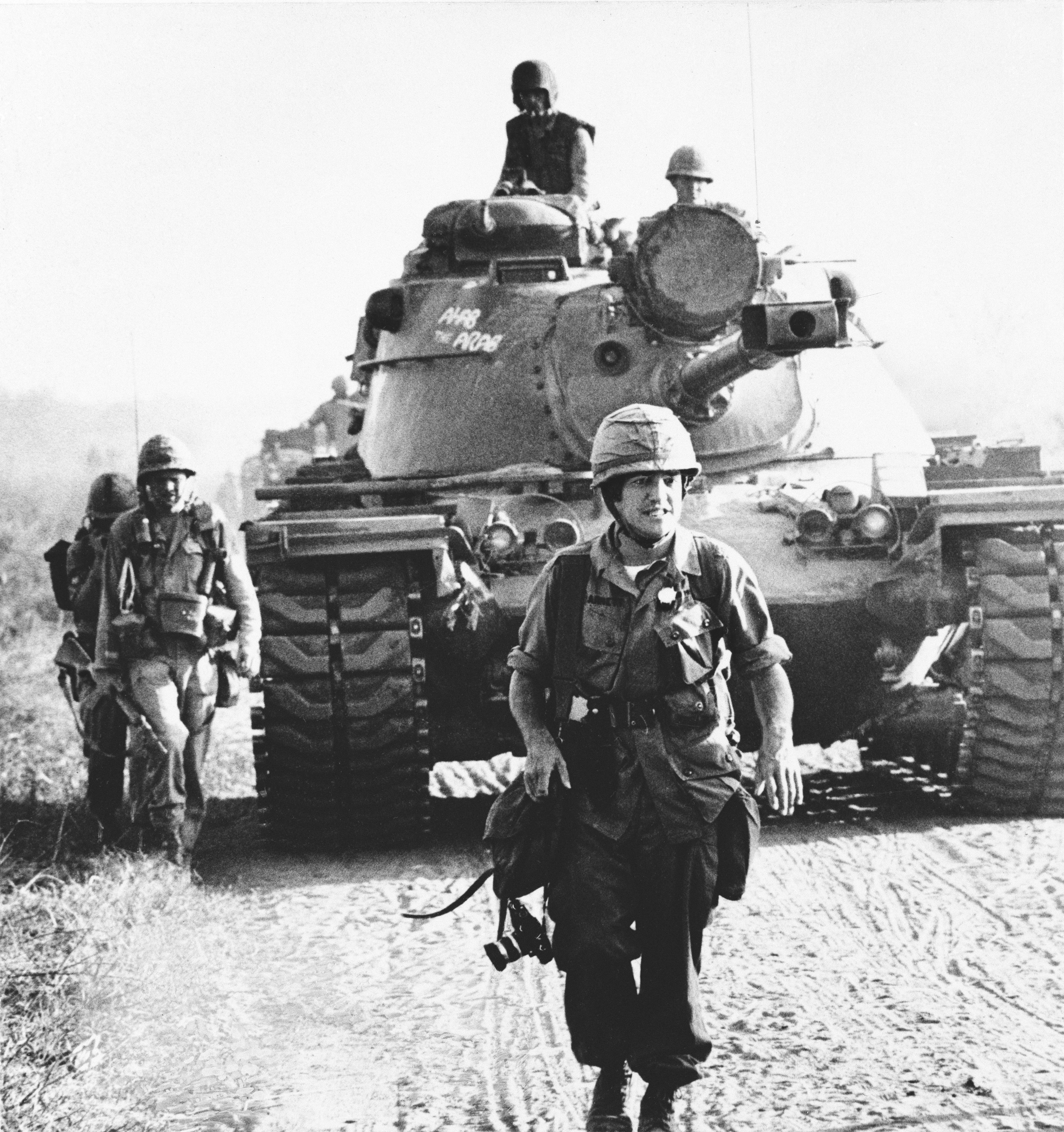
Peter Arnett walks in front of a U.S. tank in Vietnam in 1967.
Reporting on the Vietnam War forced Mr. Arnett to repress his human instincts. On one hot day at the Saigon market, Mr. Arnett watched a Buddhist monk squat on the pavement and douse himself in gasoline before flicking a lighter.
“I could have prevented that immolation by rushing at him and kicking the gasoline away,’” Mr. Arnett recalled. “As a human being I wanted to. As a reporter I couldn’t. … If I had stopped him, the [South Vietnamese] secret police who were watching from a distance would have immediately arrested him and carried him off to God knows where. If I had attempted to prevent them doing this, I would have propelled myself directly into Vietnamese politics. My role as a reporter would have been destroyed.”
Instead, Mr. Arnett photographed the burning monk and dashed back to his office to write his story.
But Mr. Arnett’s eagerness to report entangled him in controversy. In the Gulf War, as one of the few Western journalists reporting from behind enemy lines in Iraq, he was granted access by Hussein’s regime to what officials said was an industrial plant that produced milk powder and was the only source of infant formula in Baghdad. It had been hit by U.S. bombs.
Mr. Arnett reported on CNN what he saw and heard, and went to bed. The next day, he learned that he had reported on “one of the most controversial stories of my career.” U.S. officials disputed the claim that the factory made baby milk powder and instead alleged it was used for the production of biological weapons protected by the Iraqi military. White House officials called him a “conduit for Iraqi disinformation,” while Rep. Laurence Coughlin (R., Pa.) called him the “Joseph Goebbels of Saddam Hussein’s Hitler-like regime.”
Sen. Al Simpson (R., Wyo.) went so far as to accuse the brother of Mr. Arnett’s Vietnamese-born wife of being a Viet Cong operative. (Simpson later apologized, saying there was no evidence to prove that claim.)
Mr. Arnett kept reporting, showing the damaged buildings in the town of Al-Dour that Iraqi officials said had been hit by U.S. and allied bombs and had resulted in 24 civilian deaths.
“There was nothing in his tone that was judgmental, nothing that indicated sympathy for the Iraqis,” wrote Howard Rosenberg, the Los Angeles Times’s TV critic. “Without interpretation, he reported only what he said he saw, accompanied by the appropriate disclaimers regarding censorship.”
In 1999, Mr. Arnett left CNN after being involved in a story that alleged that the U.S. military had used deadly sarin nerve gas on deserting American soldiers during the Vietnam War. When a subsequent Pentagon investigation said there was no evidence of sarin gas ever having been shipped to Southeast Asia and disputed other key portions of the story, CNN retracted it.
Mr. Arnett faced further criticism in 2003, when he gave an interview to Iraqi state television.
“It is clear that within the United States there is growing challenge to President Bush about the conduct of the war and also opposition to the war. So our reports about civilian casualties here, about the resistance of the Iraqi forces … help those who oppose the war,” he said.
The remarks sparked backlash from the administration of President George W. Bush and lawmakers from both parties. His employer, NBC, initially defended him, saying the remarks were “analytical in nature,” but eventually fired him, saying it had been wrong for Mr. Arnett to “grant an interview to state-controlled Iraqi TV — especially at a time of war — and it was wrong for him to discuss his personal observations and opinions in that interview.”
Peter Gregg Arnett was born in Riverton, New Zealand, on Nov. 13, 1934.
He began his journalism career in his country of birth, writing for the Southland Times newspaper. Restless and bored, he left his home country seeking adventure. When he arrived in Southeast Asia, he decided to stay, enchanted by the “opium smugglers, revolutionaries and obscure little wars in obscure little kingdoms.”
He ended up reporting from Thailand and Indonesia before he arrived in Vietnam.
In Vietnam, he worked and competed with the other big-name journalists including David Halberstam and Marguerite Higgins.
He became a naturalized U.S. citizen in the mid-1980s while CNN’s Moscow bureau chief. Mr. Arnett thought it was important that he should be an American citizen because he was representing an American news organization, according to his family. Mr. Arnett said in a 2015 interview that his U.S. citizenship “solidified my credentials to challenge American policy.”
“I was perfectly happy to be a New Zealander, and it wasn’t an issue in my work. The Associated Press and CNN were more interested in the journalism than the nationality,” Mr. Arnett said. He added, however, that there were “a lot of comments during the Gulf War” about his foreign origins.
“But the point was, I was an American. If I hadn’t been, it would have been a way to further discredit my journalism.”
He met Nina Nguyen Thu-Nga, a South Vietnamese woman, while covering the war. He married her and they had two children, Andrew and Elsa, before divorcing in 1983. His frequent and extended travels abroad were to blame, according to Mr. Arnett’s family. They remarried in 2006 and stayed together until his death.
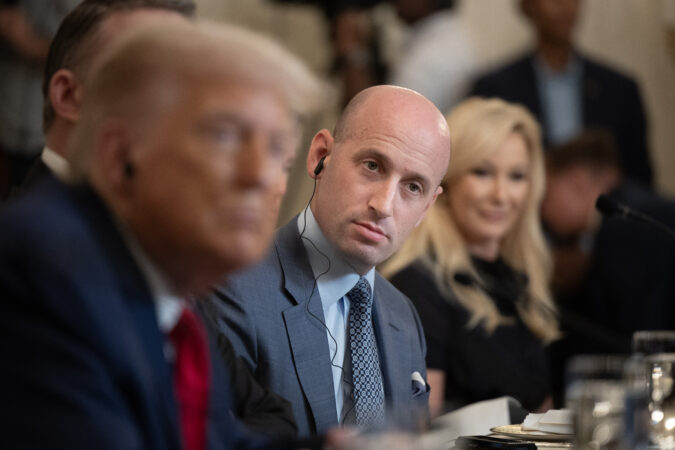
President Donald Trump’s homeland security adviser, Stephen Miller, and other senior officials were looking for a fight.
In the first months of the administration, Miller, the architect of Trump’s anti-immigration and border policies, and his team discussed starting a new war on drugs by striking cartels and alleged traffickers in Mexico, according to one current and two former U.S. officials.
Reducing the power of cartels, an idea that dated back to the first Trump administration, would ease the flow of migrants and narcotics, creating early political wins. But as the administration surged thousands of U.S. troops to the southern border, increased U.S. surveillance flights and boosted intelligence sharing with its neighbor, Mexican military operations across the border curbed cartel action, the people said. That left Miller and his team looking for another target.
“When you hope and wait for something to develop that doesn’t, you start looking at countries south of Mexico,” said the current official, who, like nine others interviewed for this story, spoke on the condition of anonymity because of the matter’s sensitivity.
The campaign that emerged in the Caribbean Sea and eastern Pacific Ocean is unprecedented in its use of lethal force by the U.S. military against alleged drug smuggling groups. These operations, which began Sept. 2, have evolved to embrace the Trump team’s long-running ambition to oust Venezuelan President Nicolás Maduro, whom the president has accused of overseeing “narco-terrorists” assaulting the United States.
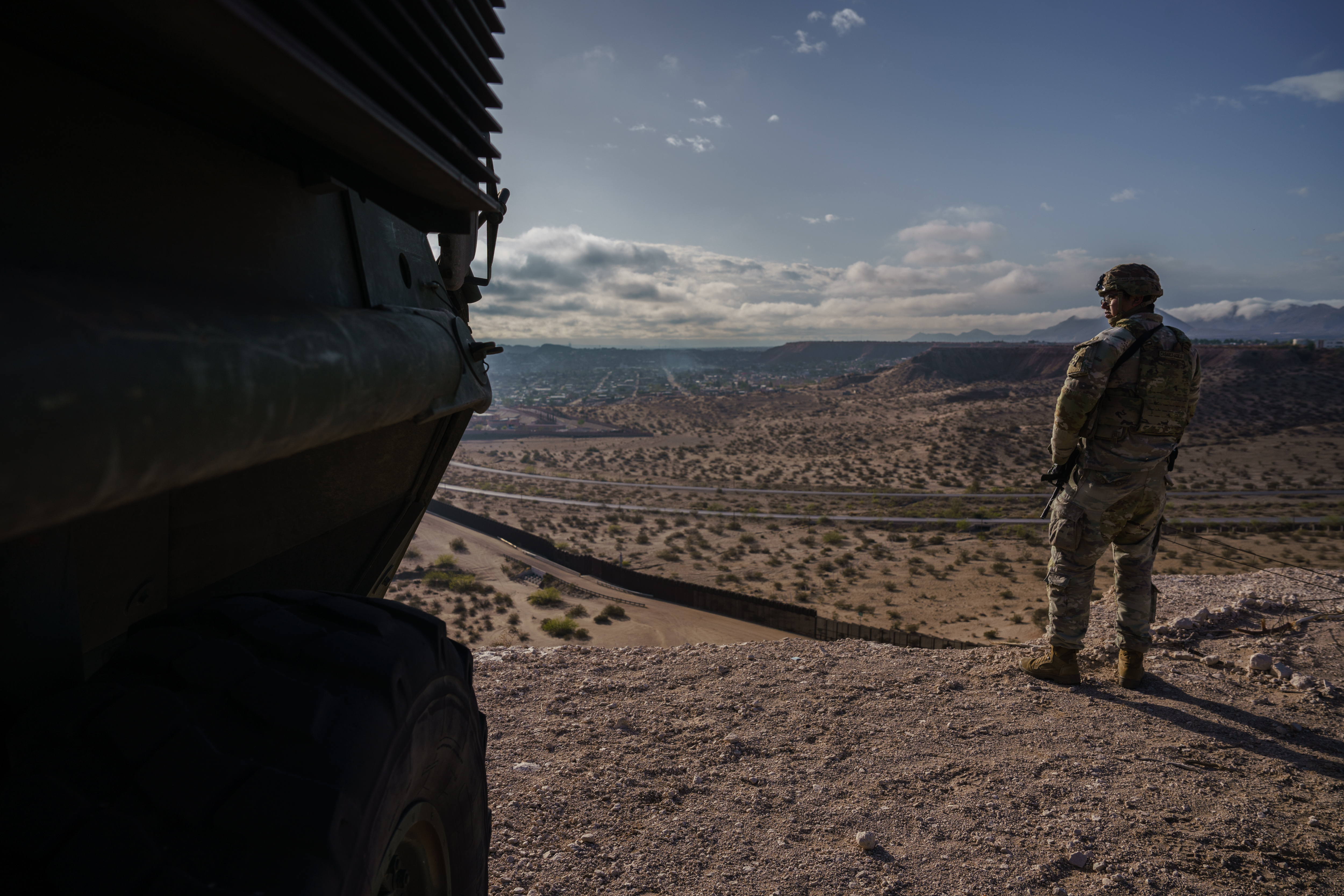
A U.S. soldier is deployed along the U.S.-Mexico border as part of the Joint Task Force Southern Border mission, in Sunland Park, N.M., on April 4.
Miller has been a driving force behind the administration’s counternarcotics campaign, pressing for results and fresh military options that could be turned into future operations, the current and former officials said.
“President Trump’s counternarcotics policies come from President Trump himself,” White House spokeswoman Anna Kelly said. “All senior administration officials work closely together to carry out the agenda President Trump was elected to implement, including eliminating the scourge of narco-terrorism that takes tens of thousands of American lives every year.”
Miller could not be reached for comment.
Miller steered the drafting of a July 25 classified directive signed by the president that authorized the military to undertake lethal force against two dozen foreign criminal groups, said a former U.S. official familiar with the campaign and its evolution. The administration has labeled these groups “designated terrorist organizations,” accusing them of using drugs as a weapon to kill Americans, using a moniker that many experts say has no basis in law.
“The president’s memo is the original sin of the whole operation,” the former official said.
That presidential directive provided the foundational authority for an “execute order” that Defense Secretary Pete Hegseth issued on Aug. 5 and that subsequently has been modified. The order, details of which were previously unreported, contains permissive targeting guidelines for lethal operations, current and former officials said. The presidential directive’s existence was first reported by the New York Times.
Together, these two documents guided a military campaign of lethal strikes against criminal organizations, grafting a wartime frame to what has been traditionally treated as a law enforcement problem. The execute order also contains targeting criteria lifted from the language of the counterterrorism campaign against al-Qaeda and the Islamic State, which some current and former officials say give the Pentagon an overly permissive license to kill.
The department will treat suspected drug smugglers “EXACTLY how we treated Al-Qaeda. We will continue to track them, map them, hunt them, and kill them,” Hegseth said on social media last month.
Pursuant to these orders, the Trump administration has launched strikes on at least 26 boats, killing at least 99 people in the Caribbean Sea and eastern Pacific Ocean. The Pentagon has not publicly identified those killed, and it is unclear whether it has collected the intelligence to do so.
“The administration appears to have authorized a campaign against civilians and alleged criminals that is now stretching the limits of international law so that it’s now totally unrecognizable,” said Todd Huntley, a former military lawyer who advised Special Operations forces for seven years at the height of the U.S. counterterrorism campaign and is director of the national security law program at Georgetown Law.
The White House’s early deliberations about the use of lethal force against cartels contemplated using covert action by theCIA. But as resistance emerged from lawyers and others over the ensuing months, Miller and his team turned increasingly toward the idea of using the military to pursue alleged traffickers.
Miller’s larger vision was to reduce the flow of drugs — and migrants — into the United States. He figured that attacking cartels would diminish their power and help stabilize Latin American countries, resulting in fewer people risking the trek to the United States, according to one of the former U.S. officials familiar with Miller’s deliberations.
As the summer progressed, the White House’s campaigns against narcotics and migration coalesced with a long-held desire of Secretary of State Marco Rubio to force Maduro from power. Rubio and the Justice Department in August doubled to $50 million the reward for information leading to the Venezuelan leader’s arrest, citing an indictment for corruption and drug trafficking during the first Trump administration.
Meanwhile, the White House found a willing partner in Hegseth, who had been knockedoff stride by several missteps and was eager to show he could deliver on a high-priority mission.
“Pete very much wanted to keep Stephen in his good graces and also the president,” said the former official familiar with Miller’s thinking. “And that was a motivation for him — getting behind this campaign in an aggressive way.”
The Defense Department declined to address questions about its operations to strike alleged traffickers and how the mission took shape. Elements of Miller’s leading role were reported earlier by the Guardian.
“This reporting is inaccurate and is built on a false premise that ignores reality,” Pentagon chief spokesman Sean Parnell said in a statement. The department’s focus, he said, “is, and will continue to be, protecting the Homeland from any threat.”
Widening the scope
The Aug. 5 execute order,or EXORD in Pentagon parlance, stated that the campaign’s goal is to stop the flow of drugs by sea to the United States, two people said.
Initially, the order contained a geographic boundary that designated target areas in international waters off the coast of Venezuela, but it was modified about two months later to include the eastern Pacific area, one current and one former U.S. official said.It specified that at least for the initial strikes, Joint Special Operations Command would be in charge of operations, the two people said.
A still frame from a video posted on social media by President Donald Trump shows a boat allegedly transporting illegal narcotics after a lethal strike on Sept. 2, through U.S. military imagery.
Over the late summer and into the fall, lawyers and policy personnel raised concerns about the legality of the lethal force campaign that was taking shape. Administration officials sought to reassure them by saying that a Justice Department Office of Legal Counsel memo was being drafted that determined that the lethal targeting of suspected drug runners was lawful under the president’s power to ascertain that the U.S. is in a formal state of war — in this case with alleged drug traffickers.
But the opinion was not signed until Sept. 5 — three days after the first boat strike — and some career lawyers were not permitted to read the draft OLC memo before the execute order was issued, said the former official familiar with the campaign’s evolution.
The OLC memo, signed by Assistant Attorney General T. Elliot Gaiser, asserts that alleged drug trafficking groups are a threat to the United States akin to a foreign nation attempting to invade, Sen. Mark Kelly (D., Ariz.), who was allowed to read it in his capacity as a member of the Senate Armed Services Committee, told the Post in an interview.
The execute order contains targeting instructions that do not require positive identification of any individual but rather “reasonable certainty” that adult males are members of, or affiliated with, a “designated terrorist organization,” or DTO, according to five current and former U.S. officials familiar with the criteria. To mitigate civilian harm, the order requires “near certainty” that no women, children or civilians are present, they said.
The administration is using the phrase “designated terrorist organizations” to refer to 24 alleged drug trafficking groups whose activities it contends are killing millions of Americans.
The term, said Rebecca Ingber, a professor at the Cardozo School of Law and a former State Department law-of-war expert, “is entirely manufactured as a source of targeting authority with no basis in law.”
The list of 24 such groups appears in an annex to Trump’s July directive and also in the EXORD, according to one current and one former official.
The assessment of “affiliation” is based on a number of factors, including the presence of drugs on board the vessel and its route, as well as intercepts of communications, the current and former officials said.
As a result, the campaign may be killing individuals who in some cases have a tenuous link to any organized drug-running operation, said one of the former U.S. officials, who has read the execute order.
“When you define DTO and affiliate so loosely and you’re attacking boats, [the guidelines are] basically meaningless,” the former official said.
If the United States were actually at war, the reasonable certainty standard would be “perfectly reasonable,” said Ryan Goodman, a former Pentagon special counsel who worked on counterterrorism targeting issues in the Obama administration.
“Not being in an armed conflict changes everything,” he said. “The idea that a government would kill people on the basis of ‘reasonable certainty’ that they’re a member of a drug cartel is beyond the pale. Any U.N. body would find that to be a gross violation of human rights.”
Identification and delegation
The targeting requirements, four former officials say, resemble the “signature strikes” of past global counterterrorism campaigns, in which the CIA and the military launched drone attacks in Afghanistan, Pakistan and Yemen on individuals or groups whose identities were unknown but who were targeted based on a pattern of behavior or other characteristics associated with terrorist activity.
The execute order, which sets the rules of engagement for the military, designates Hegseth as the “target engagement authority” — the official who can approve strike targets. It also stipulates that he can delegate that authority to others in individual missions.
“Now, the first couple of strikes … as any leader would want, you want to own that responsibility,” Hegseth said at a cabinet meeting this monthin response to questions about the first boat strike, details of which — including a subsequent missile strike to kill survivors — were first published bythe Post. “So I said I’m going to be the one to make the call after getting all the information and make sure it’s the right strike.”
Pentagon general counsel Earl Matthews — who had just been confirmed by the Senate on July 29 with a 50-47 vote — signed off on the Aug. 5 order, said a person familiar with the matter. Lawmakers have for weeks requested a copy of the order and related documents but have not received them. Matthews did not respond to a request for comment.
President Donald Trump signed a classified directive that authorized the military to undertake lethal force against two dozen foreign criminal groups.
Trump has asserted, without offering proof, that the U.S. troops know who they are targeting in every case. “We know everything about them. We know where they live. We know where the bad ones live,” he told reporters this month.
The military knew the identities of all 11 people killed in the first attack of the campaign on Sept. 2, Pentagon officials have said. But “they don’t know all of the individuals on many of the other boats” in subsequent strikes, Sen. Mark R. Warner (D., Va.), vice chairman of the Senate Intelligence Committee, told ABC News on Sunday.
Trump posted on Truth Social the day of the first strike that the U.S. military had killed 11 “positively identified” members of the Venezuelan organization Tren de Aragua. He called them “narco-terrorists” operating “under the control of” Maduro, who has been condemned by both the Trump and Biden administrations for illegally retaining power after losing last year’s presidential election.
This week, the commander overseeing that operation, Adm. Frank M. Bradley, told lawmakers that the military knew one of the 11 was a member of Tren de Aragua and the other 10 were affiliates, according to three U.S. officials.
The U.S. intelligence community this year assessed that Tren de Aragua, a transnational crime syndicate, was not directed by Venezuela’s government.
Two family members of men killed on Sept. 2 did not deny that the boat was smuggling marijuana and cocaine. But they said Trump’s allegation the men had worked for Tren de Aragua was inaccurate.
“I knew them all,” one of the family members told the Post in October, speaking on the condition of anonymity for fear of retribution. “None of them had anything to do with Tren de Aragua. They were fishermen who were looking for a better life” by smuggling contraband.
In some of the strikes, the targets who have been identified are not high-level operators or cartel bosses, lawmakers said. “It’s one thing to be a narco-terrorist and another thing to be a fisherman that’s getting paid a hundred bucks a couple times a year … to supplement his income” to ferry drugs, Warner told reporters at the Defense Writers Group last week.
Lifting language from the ‘war on terror’
The Aug. 5 execute order adopts the language of previous administrations in successive global counterterrorism campaigns after 2001, but the context is vastly different, current and former officials say.
The fight against ISIS in Iraq from 2014 on generally involved clearing terrain of fighters who often barricaded themselves in buildings in cities teeming with civilians, and U.S. troops were often firing in self-defense at militants shooting at them, former Special Operations personnel said.
In the drug boat campaign, the U.S. military is launching munitions from afar, more like the counterterrorism operations in Yemen and Somalia during the Obama and first Trump administrations.
Under President Barack Obama, outside areas of active hostility, the targeting guidelines required that lethal force be used only when capture was not feasible and only to prevent attacks against U.S. citizens or when targets posed a continuing imminent threat. They required “near certainty” that a target was a member of a terrorist organization.
“Generally you had people swearing allegiance” to a group like al-Qaeda as an indicator of membership, said the former U.S. official, who is familiar with the counterterrorism targeting criteria. “So you had the presence of weapons and good intelligence on planning you could point to, to link people to the group and say this person is a planner of attacks, this is the money guy, this is a recruiter, etc.”
The standard was changed to “reasonable certainty” under the first Trump administration. But for all practical purposes, said a former senior military officer involved in special operations and battle in the Middle East, the military was applying the “near certainty” standard in these areas. The standard was returned to near certainty under Biden.
“In places like Yemen, whether it was under Obama or Trump,” the retired officer said,“we knew who we were going after. We knew what their place in the network was. We knew what the effects of removing them would be on the network. I don’t see that in some of what [the U.S. is] doing right now.”
One major contextual difference in the current operations against seaborne narcotics is the lack of congressional authority. In the battles against al-Qaeda and associated forces, Congress explicitly authorized the campaigns, giving the president permission to use “all necessary and appropriate force” against those who attacked the United States on Sept. 11, 2001.
The execute order and subsequent targeting guidelines were grounded in the 2001 congressional authorization to use military force.
In 2013, during the Obama administration, the “near certainty” standard typically required confirmation via two sources of intelligence, said Huntley, the former military lawyer for Special Operations forces.
A combination of intelligence tools — signals intelligence, eavesdropping, human spies, and drone surveillance — would contribute to a “positive identification of the individual,” Huntley said. To get to “near certainty” that civilians were not present, the attack location was usually a remote area or a place known to be frequented by only members of the terrorist organization that Congress had specifically authorized as a viable target.
If U.S. officials know the identities of who they are striking, as Trump and Hegseth maintain, then they should release them, the former senior military officer said. “It would help build the case,” he said, that the military is acting to protect civilians according to the law of war.
‘Anybody … is subject to attack’
Though the administration’s charges against Maduro have merit, its claims that Venezuela is sending massive amounts of drugs to America do not, analysts and officials have said.The main domestic drug scourge is fentanyl, a synthetic opioid produced in Mexico, not Venezuela.
Many strikes taken have been in the Pacific, the main sea lane used by traffickers from Colombia and Ecuador. Drug running in the Caribbean focuses mainly on non-U.S. markets, such as Europe. The lethal strike on Sept. 2, for instance, targeted a boat carrying cocaine ultimately bound for Suriname, officials have said.
That absence of information has prompted speculation that the larger buildup of U.S. forces in the region is a preparation for an attack on Venezuela. Miller has indicated to colleagues that a strong reaction from Caracas could provide the reasoning to invoke the Alien Enemies Act to quickly deport hundreds of thousands of Venezuelan immigrants from the United States, the former official noted.
This month, Trump suggested that he wanted to go after Colombian targets. “I hear the country of Colombia is making cocaine,” he said. “They have cocaine manufacturing plants. And then they sell us their cocaine. … Anybody that’s doing that and selling it into our country is subject to attack.”
He also has stepped up the pressure on Venezuela, seizing an oil tanker last week off that country’s coast.
“He wants to keep on blowing boats up until Maduro cries uncle,” Trump’s chief of staff, Susan Wiles, told Vanity Fair in an article published this week. “And people way smarter than me on that say that he will.”
On Tuesday, Trump announced in a social media post a “total and complete blockade” of all sanctioned oil tankers entering or leaving Venezuela, further ratcheting up the pressure.
On Wednesday, Miller amplified Trump’s post, commenting: “American sweat, ingenuity and toil created the oil industry in Venezuela. Its tyrannical expropriation was the largest recorded theft of American wealth and property. These pillaged assets were then used to fund terrorism and flood our streets with killers, mercenaries and drugs.”
Trump, meanwhile, has been signaling that the campaign is widening.
“We knocked out 96 percent of the drugs coming in by water,” he told reporters Friday in the Oval Office. “And now we’re starting by land, and by land is a lot easier, and that’s going to start happening.”
WASHINGTON — U.S. inflation slowed unexpectedly last month, the government said in a report that was delayed and likely distorted by the government shutdown.
The Labor Department reported Thursday that its consumer price index rose 2.7% in November from a year earlier. Yet, year-over-year inflation remains well above the Federal Reserve’s 2% target, and Americans are complaining loudly about the high cost of living.
The report was delayed eight days by the federal government’s 43-day shutdown, which also prevented the Labor Department from compiling overall numbers for consumer prices and core inflation in October. Thursday’ report gave investors, businesses and policymakers their first look at CPI since the September numbers were released on Oct. 24.
Consumers prices had risen 3% in September from a year earlier, and forecasters had expected the November CPI to match that year-over-year increase.
Energy prices, driven up by sharply higher fuel oil prices, rose 4.2% in November. Excluding volatile food and energy prices, so-called core inflation rose 2.6%, compared with a 3% year-over-year gain in September and the lowest since March 2021.
U.S. inflation is still stubbornly high, partly because of President Donald Trump’s decision to impose double-digit taxes on imports from almost every country on earth along with targeted tariffs on specific products like steel, aluminum and autos.
The president’s tariffs have so far proved less inflationary than economists feared. But they do put upward pressure on prices and complicate matters at the Fed, which is trying to decide whether to keep cutting its benchmark interest rate to support a sputtering job market or whether to hold off until inflationary pressures ease. The central bank last week decided to reduce the rate for the third time this year, but Fed officials signaled that they expect just one cut in 2026.
Kay Haigh, global co-head of fixed income and liquidity solutions at Goldman Sachs Asset Management, warned that the November numbers were “noisy … The canceling of the October report makes month-on-month comparisons impossible, for example, while the truncated information-gathering process given the shutdown could have caused systematic biases in the data.
“The Fed will instead focus on the December CPI released in mid-January, just two weeks before its next meeting, as a more accurate bellwether for inflation.’’
The speech was a rehash of his recent messaging that has so far been unable to calm public anxiety about the cost of groceries, housing, utilities and other basic goods. Trump has promised an economic boom, yet inflation has stayed elevated and the job market has weakened sharply in the wake of his import taxes.
BALTIMORE — Dr. Oz, mouth full of quinoa, paused midbite.
He motioned a nearby videographer to a spot behind the tent where he and celebrity chef Geoffrey Zakarian sat tasting entries in a staff cooking competition. It was a better angle to capture dozens of employees watching them in the Centers for Medicare and Medicaid Services headquarters parking lot that August day.
The famous television doctor Mehmet Oz hasn’t left the stage. He has found a new one as he runs the federal agency that spends $1.5 trillion a year and oversees health insurance for almost half of all Americans. Instead of a New York City studio, Oz spends his time in drab government buildings. But Oz says his ability to reach people is why President Donald Trump wanted him for the job.
“He’ll say, ‘Oz, he was good on TV. It’s a good sign if you’re on TV because it means people can listen to you and you’re making sense to them,’” he said in his first wide-ranging interview as CMS administrator.
Oz’s ability to reach an audience is undisputed. But he now faces a test of whether showmanship and affability can win over public support as he guides major Medicaid changes, oversees soaring costs of Affordable Care Act plans, and contends with the nation’s chronic malady: paying exorbitant prices for mediocre results.
The issues Oz confronts are among the wonkiest in the federal government, with the lives of millions of Americans at stake. His ability to communicate and charm has earned him praise, even from critics skeptical of a man once summoned before senators for hawking “magic” weight loss from a coffee bean extract. Some of his predecessors under Democratic presidents, with whom he regularly consults, and many at the CMS and in the health industry say he has displayed policy expertise and been effective at boosting morale at his agency.
“I’ve been impressed,” said Andy Slavitt, who was CMS acting administrator under President Barack Obama. “He’s taken it very seriously.”
Oz’s name still provokes eye rolls among some health advocates and Democrats. “Nobody who’s serious in this country takes Dr. Oz seriously,” House Minority Leader Hakeem Jeffries (D-N.Y.) recently said.
Critics also say Oz brings with him concerns about his investments into companies that could be regulated by the agency he leads, such as those offering drug discounts, supplements, and AI health technology.
The renowned heart surgeon is better known for his pageantry during 13 seasons of “The Dr. Oz Show,” where he told viewers how to eat more protein or handle menopause. He’s the only administrator since CMS was established in 1977 with no experience in health policy or economics. His only foray into politics was a failed Pennsylvania Senate bid in 2022.
Oz acknowledges that his ascent from television star to the head of a highly technical government agency is surprising. “Of all people, what?” Oz said.
Oz’s central role in implementing cuts to public insurance programs and defending his polarizing boss, Health Secretary Robert F. Kennedy Jr., has drawn sharp criticism.
“Maybe he makes funny jokes and he’s a good hang,” said Sen. Chris Murphy (D-Conn.), a longtime member of the Senate Health, Education, Labor, and Pensions Committee. “That doesn’t mean that what he’s doing isn’t pure evil.”
Yet some policy experts said that compared to the tumultuous layoffs, leadership turmoil, and infighting at the Centers for Disease Control and Prevention, the Food and Drug Administration, and the National Institutes of Health, Oz’s agency appears less chaotic — at least so far.
“Out of all of those agency leaders, I think Oz is probably doing the best,” said a former Biden administration health official, who spoke on the condition of anonymity to speak candidly.
From surgeon to celebrity to CMS
Oz is used to career makeovers.
The pioneering cardiac surgeon launched his eponymous show in 2009. On it, he sometimes leaned into the sensational, undergoing a colonoscopy on-screen and entertaining unproven ideas, including that cellphones cause cancer and zodiac signs influence health traits.
But Oz centered the show on the notion that people should control their health through diet and exercise — a precursor to Kennedy’s Make America Healthy Again movement. He explored how poor gut health and chronic inflammation could cause disease, an idea affirmed in peer-reviewed studies. He urged viewers to stop eating processed foods and promoted bone broth and Greek yogurt.
“The MAHA movement was that on steroids,” he said.
In 2016, Trump went on Oz’s show during his presidential campaign to release a letter from his doctor attesting to his health. Six years later, Trump’s endorsement helped Oz win the Republican nomination to run for an open Senate seat in Pennsylvania, though he lost to Democrat John Fetterman.
Oz’s connection to Kennedy goes back even further to a 2010 clean water event in Utah where they skied together. He interviewed Kennedy in 2014 on his show about potential dangers from the vaccine preservative thimerosal, which scientists have deemed safe. During the segment, Oz told pregnant women to take a thimerosal-free nasal flu shot instead.
After Kennedy ended his independent presidential bid to endorse Trump last year, he and Oz threw Trump a fundraiser at Oz’s Pennsylvania home. Oz regularly hosted Kennedy at his Palm Beach, Fla., home as they awaited Senate confirmation.
As Oz tells it, health insurance is “a bit of an away game” for Kennedy. Shortly after the November election, Oz recalls Kennedy saying he was really excited about every part of running HHS — except for the highly technical health insurance programs under CMS’s purview.
‘That crazy guy from TV’
After Oz took the helm of CMS, some questioned whether he would be up for learning its soporific machinery — a job that requires drilling into such doze-inducing terminology as medical loss ratio and bundled payments.
“There was a fair amount of skepticism among people in the beginning, like, Dr. Oz, he’s that crazy guy from TV,” said CMS deputy administrator Kim Brandt, a Trump appointee who worked at the agency during his first term.
Oz, who has medical and business degrees from the University of Pennsylvania, said he has “always been a bit of a wonk” on health policy and enjoys thinking about how the health system works as a whole.
“He’ll sit and talk to you about something like surety bonds for 30 minutes,” said Brandt, whom Oz has dubbed “Kimba.”
He said he started compiling a health policy “bible” for himself as soon as he learned he would be nominated, calling past CMS leaders to learn how the agency works. He has talked many times to Slavitt and Chiquita Brooks-LaSure, who was CMS administrator under President Joe Biden.
And he surrounded himself with deeply experienced senior staff and worked to prevent infighting.
“Don’t waste time on battles that drain you of chi,” he said.
He has been steering the agency in its own wonky way toward Kennedy’s goals of reducing chronic illness, finalizing a Medicare payment rule in October aimed at nudging doctors away from surgeries and toward prevention.
Rep. Richard E. Neal (Massachusetts), the Democratic leader on a committee overseeing health agencies, said he viewed Oz as a moderating force after lawmakers on his panel met with the administrator over the summer.
“He didn’t come across as being radical,” Neal said. “Largely because he’s a real scientist, a real doctor.”
Oz is also by far the richest person in recent history to run CMS, with a net worth between $100 million and $300 million, according to a review of his financial disclosures and previous administrators’ backgrounds. His past financial ties — and the millions he has invested in health insurers, pharmaceutical companies, and other health firms — raise questions about how deeply he has profited from industries he now regulates.
He previously advised Eko Health, a company whose AI-enabled heart monitoring device CMS recently approved for funding amid a broader embrace of AI health technology. A CMS spokesperson didn’t explicitly answer whether Oz recused himself from the decision but said he “abided by all of his recusal obligations.”
Last year he co-founded ZorroRX with his son, Oliver, which aims to profit from a drug discount program overseen by a separate branch of HHS — but which could move to CMS under a pending restructuring plan.
Oz said he has divested all of his holdings in healthcare. “There’s not a single thing left in my portfolio which I have any involvement in,” he said.
But Oz also said he transferred his holdings in ZorroRX to a trust managed by Oliver, who is still involved in the company.
Oz also held millions of dollars of stock in iHerb, a wellness company that sells direct-to-consumer folinic acid supplements and other products. At a news conference on autism in September, Oz, along with Trump and Kennedy, praised leucovorin, a highly concentrated folinic acid medication requiring a prescription, as an effective treatment. HHS stressed in an X post that they are different products, after critics questioned on social media whether Oz stood to profit.
CMS spokesman Christopher Krepich said Oz complied with government ethics rules in divesting his ZorroRX and iHerb holdings, but Krepich did not answer whether he transferred his iHerb stock to his son or another relative.
Selling GOP policies
Establishing new Medicaid rules under Trump’s sweeping domestic policy law and selling them to the public poses one of Oz’s steepest challenges. The law, estimated to cut Medicaid spending by $911 billion over a decade, has alarmed Democrats and healthcare advocates, who say millions will be harmed by its work requirements, cuts to states’ funding. and new barriers to enrolling.
Oz emerged as one of the Trump administration’s top advocates for the changes, repeatedly dismissing projections by the nonpartisan Congressional Budget Office that 10 million more people will be uninsured under it.
He has been assuring states that tapping into better health technology will help limit coverage losses, touting plans for a CMS app for Medicaid beneficiaries to quickly report to states how many hours they worked, volunteered, or attended school in a given week to qualify for the insurance.
Oz rarely gives a speech without championing health technology, painting a picture of how it can improve care. He revealed in July that CMS would partner with Google and other tech companies in a “digital health ecosystem” to ease sharing of health information.
Slavitt, the CMS administrator under Obama, said in their conversations Oz tells him about leveling the playing field for “insurgent” smaller tech innovators to compete with “incumbent” healthcare giants such as Epic or UnitedHealthcare.
Oz has also played defense on another hot-button issue vexing Democrats: the expiration of pandemic-era enhanced subsidies for insurance plans sold through the Affordable Care Act, which sparked the longest government shutdown in history. Millions of Americans will have to pay hundreds or thousands more for monthly premiums after the extra subsidies expire Dec. 31.
Oz has stressed the subsidies were always meant to be temporary and noted they prompted more fraud in the marketplaces.
“It’s hard to disentangle Oz with the actions of the Trump administration broadly,” said Anthony Wright, executive director of Families USA, a consumer healthcare advocacy organization. “He is a main point person for many of the policy changes to make it harder to get on and stay on coverage.”
Oz has walked a fine line, supporting Trump and Kennedy but sometimes smoothing over controversial things they say.
Oz said it’s unfair to call Kennedy, the founder of an anti-vaccine group, “anti-vax” because he questions vaccine safety. He shares Kennedy’s view that the medical establishment has been too reticent to adjust to new evidence.
“That’s one of the hardest things to do in medicine: change your mind,” he said.
But as Kennedy built a career around vaccine skepticism, Oz hewed more closely to the experts. As Kennedy slammed the coronavirus shots, Oz told his viewers to get them. Unlike its sister agencies, CMS hasn’t pulled back on vaccines other than lifting a requirement that hospitals report COVID vaccinations among staff.
When Trump claimed an unproven link between Tylenol and autism, Oz adopted a more measured tone.
After the president repeatedly told pregnant women to avoid Tylenol, Oz told Newsmax that “of course” pregnant women should take Tylenol for a high fever if a doctor tells them to. On “TMZ Live,” he said Tylenol may be the “best option” for fighting lower-grade fevers during pregnancy.
Charming his audience
But Oz has a more basic goal than playing defense for his bosses. He said his chief aim is to improve outreach to people enrolled in Medicare and Medicaid.
“The most important accomplishment at CMS — if I can pull it off — is to talk to our customers,” Oz said.
He finds the Medicare enrollment booklets “dense” and wants to reach more seniors with an email newsletter instead. He made videos with Martha Stewart and Tony Robbins discussing aging. He pretended to call the Medicare hotline to enroll the day after his 65th birthday.
A team of photographers and videographers often tails him, ready if he has a spontaneous idea for a social media post.
Several hours after the cooking competition, Oz trekked to a roomy basement studio on the CMS campus to record videos promoting Medicare and marketplace enrollment.
Standing in front of a green screen, he launched into the first line as though introducing his show: “Medicare open enrollment is coming in hot.”
For a final video, he removed his jacket to demonstrate yoga moves for seniors.
Oz wants his staff to embrace this camera-ready strategy too. Medicare director Chris Klomp recounted running late at night when Oz called him to coach him on a media appearance.
“He believes in the ‘Fox & Friends’ model,” Klomp said, referring to the morning TV show that regularly features three hosts. “It shouldn’t just be the Oz show.”
Four CMS career staffers said he has been good for morale and more visible than past administrators, although some of them have misgivings about Kennedy and Trump.
He attended an employee Zumba class. Last spring, he was “mobbed” by staff during a lunchtime walk around the Baltimore campus, according to Dora Hughes, a career staffer who directs the CMS Center for Clinical Standards & Quality. Oz held a competition over the summer to see who could clock the most steps. He offered tips for “crushing cubicle cravings” during the holiday season as part of a regular agency update e-mailed to staff. “You don’t have to try every cookie on the cookie table,” he wrote.
As he browsed a farmers market in the CMS parking lot in August, a woman giggled as he donned her bright red glasses and posed with her for a photo. Born to Turkish immigrants, he spoke to another woman in Turkish.
Oz is “hard not to like,” said one CMS career employee who spoke on the condition of anonymity because they were not authorized to speak to reporters.
“Part of me thinks it’s a facade,” the employee said. “And part of me thinks it’s a little reassuring.”
WASHINGTON — President Donald Trump delivered a politically charged speech Wednesday carried live in prime time on network television, seeking to pin the blame for economic challenges on Democrats while announcing he is sending a $1,776 bonus check to U.S. troops for Christmas.
The remarks came as the nation is preparing to settle down to celebrate the holidays, yet Trump was focused more on divisions within the country than a sense of unity. His speech was a rehash of his recent messaging that has so far been unable to calm public anxiety about the cost of groceries, housing, utilities and other basic goods.
Trump has promised an economic boom, yet inflation has stayed elevated and the job market has weakened sharply in the wake of his import taxes. Trump suggested that his tariffs — which are partly responsible for boosting consumer prices — would fund a new “warrior dividend” for 1.45 million military members, a payment that could ease some of the financial strains for many households. The amount of $1,776 was a reference to next year’s 250th anniversary of the signing of the Declaration of Independence.
“The checks are already on the way,” he said of the expenditure, which would total roughly $2.6 billion.
Presidential addresses to the nation carried on network television are traditionally less partisan than rally speeches, but Trump gave a condensed version of his usual political remarks.
Flanked by two Christmas trees with a portrait of George Washington behind him in the White House’s Diplomatic Reception Room, Trump sought to pin any worries about the economy on his predecessor, Joe Biden.
“Eleven months ago, I inherited a mess, and I’m fixing it,” Trump said. “We’re poised for an economic boom, the likes of which the world has never seen.”
Trump seeking to stop the slump in his approval ratings
His holiday wishes came at a crucial time as he tries to rebuild his steadily eroding popularity. Public polling shows most U.S. adults are frustrated with his handling of the economy as inflation picked up after his tariffs raised prices and hiring slowed.
In 2026, Trump and his party face a referendum on their leadership as the nation heads into the midterm elections that will decide control of the House and the Senate.
The White House remarks were a chance for Trump to try to regain some momentum after Republican losses in this year’s elections raised questions about the durability of his coalition. He openly leaned into the politics despite television networks’ past reluctance to broadcast presidential addresses loaded with campaign-style rhetoric.
For example, in September 2022, networks declined to give the Biden White House a prime-time slot for a speech the then-president gave about democracy because it was viewed as too political.
Trump spoke at a rapid-fire clip with a tone that bordered at times on anger. He responded to the public frustration this year over the economy by making even bolder promises on growth next year, saying that mortgage rates would be coming down and that he “would announce some of the most aggressive housing reform plans in American history.”
Trump brought charts with him to make the case that the economy is on an upward trajectory. He made claims about incomes growing, inflation easing and investment dollars pouring into the country as foreign leaders, he claimed, have assured him that “we’re the hottest country anywhere in the world,” a statement he has frequently repeated at public events.
If the argument seemed familiar, that’s because it has echoes of the case that Biden made about the U.S. economy with little success. He, too, in the face of inflation pointed to the enviable rate of U.S. economic growth compared to other nations.
The public sees the economy differently from Trump
The hard math internalized by the public paints a more complicated picture of an economy that has some stability but few reasons to inspire much public confidence.
The stock market is up, gasoline prices are down and tech companies are placing large bets on the development of artificial intelligence.
But inflation that had been descending after spiking to a four-decade high in 2022 under Biden has reaccelerated after Trump announced his tariffs in April.
The consumer price index is increasing at an annual rate of 3%, up from 2.3% in April.
The affordability squeeze is also coming from a softening job market. Monthly job gains have averaged a paltry 17,000 since April’s “Liberation Day,” when Trump announced import taxes that he later suspended and then readjusted several months later.
The unemployment rate has climbed from 4% in January to 4.6%.
Trump said that investment commitments for new factories will boost manufacturing jobs and that consumer activity will improve dramatically as people receive increased tax refunds next year.
While emphasizing the economy, he also faces challenges on other policy fronts.
Trump sought to blame Democrats for the likely increase in health insurance premiums as the subsidies tied to the 2010 Affordable Care Act are expiring. Democratic lawmakers and some Republicans have sought to address that issue, but Trump has pushed back and suggested instead that payments should go directly to the buyers of health insurance instead of the companies. The president has yet to commit to a specific legislative fix.
After his speech ended and the video was no longer being broadcast, Trump turned to his gathered aides and asked them how his address to the nation went. The aides assured him it was great.
Trump then indicated that White House chief of staff Susie Wiles had told him he needed to address the nation. After some back and forth, he asked Wiles how he had done.
“I told you 20 minutes and you were 20 minutes on the dot,” Wiles said.
WASHINGTON — Ani Kilambi is joining the Nationals as their new general manager, a person with knowledge of the move told The Associated Press on Wednesday, making the 31-year-old who had been with the Phillies the latest young face to join president of baseball operations Paul Toboni in Washington.
The person spoke to the AP on condition of anonymity because Kilambi’s hiring had not been announced yet.
The news was first reported by ESPN.
Kilambi has been an assistant general manager for the Phillies, working with that club since 2021.
Before that, he was with the Tampa Bay Rays for more than five years.
Kilambi takes over a job that was held for more than a decade and a half by Mike Rizzo, who became the GM in Washington in 2009 and added the title of president of baseball operations in 2013. Rizzo was fired in July during the Nationals’ sixth consecutive losing season. Manager Dave Martinez also was fired then.
Rizzo and Martinez were in charge in 2019 when the Nationals won the World Series, but the team hasn’t had a winning year since. Washington went 66-96 in 2025, putting it 14th out of 15 clubs in the National League.
Mike DeBartolo took over as interim GM after Rizzo was let go and oversaw the selection of 17-year-old high school shortstop Eli Willits with the No. 1 pick in Major League Baseball’s amateur draft in July.
Toboni, 35, then was hired in late September to run the Nationals; he had been an assistant GM with the Boston Red Sox. He brought in manager Blake Butera, who at 33 became the youngest skipper in the majors since the 1970s.
There is plenty of work to be done to turn around the Nationals, who are in need of plenty of talent and depth as they try to replenish their major league roster and minor league supply of prospects.
Toboni’s first move in free agency came Monday, when Washington agreed to terms with left-handed pitcher Foster Griffin on a $5.5 million, one-year contract, pending the successful completion of a physical exam. Griffin played in Japan the past three seasons.
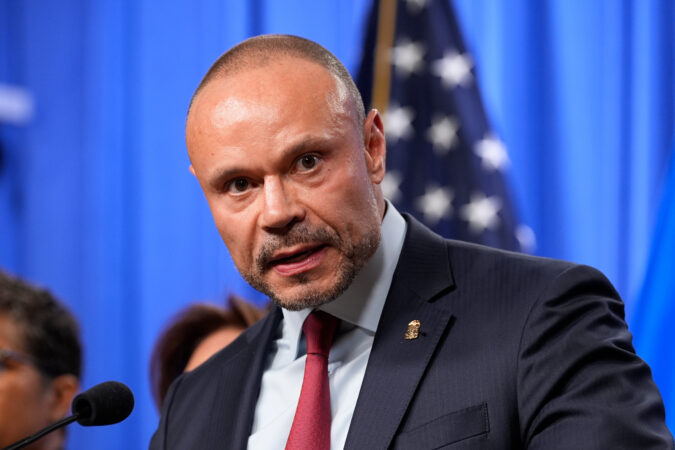
FBI Deputy Director Dan Bongino announced Wednesday that in January he will leave the powerful job in which he helped oversee a tumultuous period at the bureau with major shifts of resources and dramatic dismissals of experienced agents.
President Donald Trump commended Bongino on his tenure and suggested that he would be returning to his job as a conservative podcaster.
“Dan did a great job. I think he wants to go back to his show,” Trump told reporters Wednesday afternoon.
Bongino — the second most powerful person in the FBI — had left Washington for the year more than a week ago and said he would not be returning to the agency’s headquarters, according to the two people, who spoke on the condition of anonymity to discuss a personnel issue they were not authorized to talk about publicly. He had previously told colleagues that his last official day at the bureau will be in January, according to two people familiar with the matter.
“I want to thank President Trump, [Attorney General Pam Bondi] and [FBI Director Kash Patel] for the opportunity to serve with purpose,” Bongino wrote in a social media post announcing his departure. “Most importantly, I want to thank you, my fellow Americans, for the privilege to serve you. God bless America, and all those who defend Her.”
The departure after less than a year would mark the end of a tumultuous tenure for Bongino, who left a lucrative job as a podcaster to serve as second-in-command at the FBI when Trump became president. Bongino serves under FBI Director Kash Patel.
Patel and Bongino have shifted FBI resources to immigration enforcement, sinking morale at an agency that typically attracts law enforcement officials who are trained to work on more complex investigations. They have also pushed out seasoned veterans within the bureau with years of experience in national security and public corruption probes.
Multiple people familiar with his thinking said he has been unhappy at the FBI and has threatened to leave multiple times.
Three months into his job, Bongino expressed frustration with the demands of the deputy director position during a Fox News appearance.
“I gave up everything for this. My wife is struggling,” he said in the May interview. He continued, “I stare at these four walls all day in D.C., by myself, divorced from my wife — not divorced — but, I mean, separated, and it’s hard.”
When Trump named Bongino deputy director, the president transformed what was long a powerful career position that oversaw the day-to-day operations of the bureau into a political job with a more public presence.
Bongino, a Trump loyalist who had previously worked at the Secret Service, built his reputation within right-wing circles during the Biden administration. He did so in part by spreading conspiracy theories about the FBI and its workforce and criticizing law enforcement as politicized.
After Bongino began his job at the FBI and couldn’t prove the baseless theories he spread on his podcast, many of his right-wing supporters turned on him.
Bongino and Patel — also a conservative media personality — used their platforms, for example, to spread inaccuracies about the high-profile sex-trafficking investigation into Jeffrey Epstein, accusing the Biden administration without evidence of covering up key details of the case.
When the Justice Department declared during the summer that there was no rumored “client list” tied to Epstein and that the law enforcement agency would not be releasing any more investigatory files, many people directed their ire at Bongino and Patel and accused the Trump administration of lying to the American people.
In August, the Trump administration named then-Missouri Attorney General Andrew Bailey as the FBI’s co-deputy director, installing the Republican firebrand to serve alongside Bongino. Bailey was considered for a top Justice Department position at the beginning of the administration, but the president opted not to nominate him.
Since joining the bureau, Bailey has assumed a more behind-the scenes role than Bongino. Bailey is expected to remain in his slot as deputy director.
Patel and Bongino have pushed out senior FBI officials across the country, often with no stated reason or in response to far-right critics online who have called for the agents’ removals because of cases they may have been involved in. That has prompted multiple lawsuits against the FBI.
The lawsuits have portrayed Bongino and Patel as more concerned with their reputations online than with learning how the FBI operates.
LOS ANGELES — Nick Reiner made his first court appearance Wednesday in Los Angeles on two counts of first-degree murder in the killing of his parents, actor-director Rob Reiner and his wife Michele Singer Reiner, while the couple’s other two children made their first public statement on their crushing loss.
Nick Reiner, 32, did not enter a plea as he appeared from behind glass in a custody area in the large Los Angeles courtroom where newly charged defendants are arraigned. He was in shackles and wearing a blue, padded suicide prevention smock used in jail.
His arraignment was postponed until Jan. 7 at his attorney’s request. He spoke only to say “yes, your honor” to agree to the date. He is being held without bail.
Jake and Romy Reiner talk about their ‘unimaginable pain’
His older brother Jake Reiner and younger sister Romy Reiner released their statement through a family spokesperson.
“Words cannot even begin to describe the unimaginable pain we are experiencing every moment of the day,” they said. “The horrific and devastating loss of our parents, Rob and Michele Reiner, is something that no one should ever experience. They weren’t just our parents; they were our best friends.”
The brother and sister said they are “grateful for the outpouring of condolences, kindness, and support we have received not only from family and friends but people from all walks of life. We now ask for respect and privacy, for speculation to be tempered with compassion and humanity, and for our parents to be remembered for the incredible lives they lived and the love they gave.”
Medical Examiner says ‘sharp force injuries’ killed couple
Also Wednesday, the LA County Medical Examiner listed the primary cause of death for both Rob and Michele Reiner as “multiple sharp force injuries” as the office released its investigators’ initial findings.
The office said more investigation is needed before further details will be revealed, but the bodies can now be released to the family.
The cause of death was consistent with police describing the couple as having stab wounds.
Nick Reiner’s attorney urges caution
After the court hearing, Nick Reiner’s attorney, Alan Jackson, called the case “a devastating tragedy that has befallen the Reiner family.” He said the proceedings will be very complex and asked that the circumstances be met “not with a rush to judgment, not with jumping to conclusions.”
Jackson declined to answer shouted questions from dozens of reporters surrounding him and has not addressed the guilt or innocence of his client.
Nick Reiner was charged Tuesday with killing Rob Reiner, 78, and Michele Singer Reiner, 70.
They were killed sometime in the early morning hours of Sunday, the District Attorney’s Office said. They were found dead late in the afternoon in their home in the upscale Brentwood neighborhood on the west side of Los Angeles, authorities said.
Nick Reiner did not resist when he was arrested hours later in the Exposition Park area near the University of Southern California, about 14 miles from the crime scene, police said.
The two counts of first-degree murder come with special circumstances of multiple murders and an allegation that the defendant used a dangerous weapon, a knife. The additions could mean a greater sentence.
District Attorney Nathan Hochman said at a Tuesday news conference that his office has not yet decided whether to seek the death penalty.
Rob Reiner was the Emmy-winning star of the sitcom All in the Family who went on to direct films including Stand by Me, The Princess Bride, and When Harry Met Sally …, whose star Meg Ryan paid tribute to the Reiners on Wednesday.
“Thank you, Rob and Michelle, for the way you believe in true love, in fairy tales, and in laughter. Thank you for your faith in the best in people, and for your profound love of our country,” Ryan said in an Instagram post. “I have to believe that their story will not end with this impossible tragedy.”
Rob Reiner met Michele Singer Reiner during the shooting of the classic rom-com, and he said the meeting inspired him to change the film to have a happy ending.
Ryan’s co-star Billy Crystal, a close friend of Rob Reiner for decades, was part of a group that also included Albert Brooks, Martin Short, and Larry David that released a statement mourning and celebrating the couple Tuesday night.
“They were a special force together — dynamic, unselfish and inspiring,” the statement said. “We were their friends, and we will miss them forever.”
Rob Reiner has another daughter, Tracy Reiner, from his first marriage, to actor-director Penny Marshall.
The lawyers on the Reiner case
Nick Reiner’s attorney Jackson is a high-profile defense attorney and former LA County prosecutor who represented Harvey Weinstein at his Los Angeles trial and Karen Read at her intensely followed trials in Massachusetts. He was a central figure in the HBO documentary on the Read case.
On the other side will be Deputy District Attorney Habib Balian, whose recent cases included the Menendez brothers’ attempt at resentencing and the trial of Robert Durst.
Authorities have not said anything about a motive for the killings and would give few details when asked at the news conference.
WASHINGTON — The Senate gave final passage Wednesday to an annual military policy bill that will authorize $901 billion in defense programs while pressuring Defense Secretary Pete Hegseth to provide lawmakers with video of strikes on alleged drug boats in international water near Venezuela.
The annual National Defense Authorization Act, which raises troop pay by 3.8%, gained bipartisan backing as it moved through Congress. It passed the Senate on a 77-20 vote before lawmakers planned to leave Washington for a holiday break. Two Republicans — Sens. Rand Paul and Mike Lee — and 18 Democrats voted against the bill.
The White House has indicated that it is in line with President Donald Trump’s national security priorities. However, the legislation, which ran over 3,000 pages, revealed some points of friction between Congress and the Pentagon as the Trump administration reorients its focus away from security in Europe and toward Central and South America.
The bill pushes back on recent moves by the Pentagon. It demands more information on boat strikes in the Caribbean, requires that the U.S. keep its troop levels in Europe at current levels and sends some military aid to Ukraine.
But overall, the bill represents a compromise between the parties. It implements many of Trump’s executive orders and proposals on eliminating diversity and inclusion efforts in the military and grants emergency military powers at the U.S. border with Mexico. It also enhances congressional oversight of the Department of Defense, repeals several years-old war authorizations and seeks to overhaul how the Pentagon purchases weapons as the U.S. tries to outpace China in developing the next generation of military technology.
“We’re about to pass, and the president will enthusiastically sign, the most sweeping upgrades to DoD’s business practices in 60 years,” said Sen. Roger Wicker, the Republican chair of the Senate Armed Services Committee.
Still, the sprawling bill did face objections from both Democratic and Republican leadership on the Senate Commerce Committee and the head of the National Transportation Safety Board. That’s because the legislation could allow military aircraft to obtain a waiver to operate without broadcasting their precise location, as an Army helicopter had done before a midair collision with an airliner over Washington, D.C., in January that killed 67 people.
To address those concerns, the Senate advanced a bill to require all military and civilian aircraft to broadcast their locations. Republican Sen. Ted Cruz, the chair of the Senate Commerce Committee, said the tragedy might have been avoided had the Black Hawk been broadcasting its location before the crash.
That bill will now go to the House, and Cruz said he’s optimistic it could reach the president’s desk as soon as next month. The White House supports the bill and is committed to helping get it passed, said an official who spoke on condition of anonymity ahead of the formal public statement on the bill.
Boat strike videos
Republicans and Democrats agreed to language in the defense bill that threatened to withhold a quarter of Hegseth’s travel budget until he provided unedited video of the strikes, as well as the orders authorizing them, to the House and Senate Committees on Armed Services.
Hegseth was on Capitol Hill Tuesday ahead of the bill’s passage to brief lawmakers on the U.S. military campaign in international water near Venezuela. The briefing elicited contrasting responses from many lawmakers, with Republicans largely backing the campaign and Democrats expressing concern about it and saying they had not received enough information.
The committees are investigating a Sept. 2 strike — the first of the campaign — that killed two people who had survived an initial attack on their boat. The Navy admiral who ordered the “double-tap” strike, Adm. Frank “Mitch” Bradley, also appeared before the committees shortly before the vote Wednesday in a classified briefing that also included video of the strike in question.
Several Republican senators emerged from the meeting backing Hegseth and his decision not to release the video publicly, but other GOP lawmakers stayed silent on their opinion of the strike.
Democrats are calling for part of the video to be released publicly and for every member of Congress to have access to the full footage.
“The American people absolutely need to see this video,” said Sen. Richard Blumenthal, a Connecticut Democrat. “I think they would be shocked.”
Congressional oversight
Lawmakers have been caught by surprise by the Trump administration several times in the last year, including by a move to pause intelligence sharing with Ukraine and a decision to reduce U.S. troop presence in NATO countries in eastern Europe. The defense legislation requires that Congress be kept in the loop on decisions like that going forward, as well as when top military brass are removed.
The Pentagon is also required, under the legislation, to keep at least 76,000 troops and major equipment stationed in Europe unless NATO allies are consulted and there is a determination that such a withdrawal is in U.S. interests. Around 80,000 to 100,000 U.S. troops are usually present on European soil. A similar requirement also keeps the number of U.S. troops stationed in South Korea at 28,500.
Lawmakers are also pushing back on some Pentagon decisions by authorizing $400 million for each of the next two years to manufacture weapons to be sent to Ukraine.
Cuts to diversity and climate initiatives
Trump and Hegseth have made it a priority to purge the military of material and programs that address diversity, anti-racism or gender issues, and the defense bill would codify many of those changes. It will repeal diversity, equity and inclusion offices and trainings, including the position of chief diversity officer. Those cuts would save the Pentagon about $40 million, according to the Republican-controlled House Armed Services Committee.
The U.S. military has long found that climate change is a threat to how it provides national security because weather-related disasters can destroy military bases and equipment. But the bill makes $1.6 billion in cuts by eliminating climate-change related programs at the Pentagon.
Repeal of war authorizations and Syria sanctions
Congress is writing a closing chapter to the war in Iraq by repealing the authorization for the 2003 invasion. Now that Iraq is a strategic partner of the U.S., lawmakers in support of the provision say the repeal is crucial to prevent future abuses. The bill also repeals the 1991 authorization that sanctioned the U.S.-led Gulf War.
The rare, bipartisan moves to repeal the legal justifications for the conflicts signaled a potential appetite among lawmakers to reclaim some of Congress’ war powers.
DOVER AIR FORCE BASE, Del. — President Donald Trump paid his respects Wednesday to two Iowa National Guard members and a U.S. civilian interpreter who were killed in an attack in the Syrian desert, joining their grieving families as their remains were brought back to the country they served.
Trump met privately with the families at Dover Air Force Base in Delaware before he joined top military officials and other dignitaries on the tarmac for the dignified transfer, a solemn and largely silent ritual honoring U.S. service members killed in action.
The guardsmen killed in Syria on Saturday were Sgt. Edgar Brian Torres-Tovar, 25, of Des Moines, and Sgt. William Nathaniel Howard, 29, of Marshalltown, according to the U.S. Army. Both were members of the 1st Squadron, 113th Cavalry Regiment, and have been hailed as heroes by the Iowa National Guard. Their remains will be taken to Iowa.
Torres-Tovar’s and Howard’s families were at Dover for the return of their remains, alongside Iowa Gov. Kim Reynolds, members of Iowa’s congressional delegation and leaders of the Iowa National Guard.
Ayad Mansoor Sakat, of Macomb, Mich., a U.S. civilian working as an interpreter, was also killed. Three other Iowa National Guard members were injured in the attack. The Pentagon has not identified them.
They were among hundreds of U.S. troops deployed in eastern Syria as part of a coalition fighting the Islamic State group.
Returning to Joint Base Andrews after the transfer, Trump said it was a “beautiful event for three great people. And they’re now looking down and their parents and wives and all of the people that were there were, I mean, were devastated but great people, great people.”
The return of service member remains
Trump observed several dignified transfers at Dover in his first term and has said it was “the toughest thing I have to do” as president.
There is no formal role for a president at a dignified transfer other than to watch in silence, keeping all thoughts to himself for the moment. There is no speaking by any of the politicians and other dignitaries who attend, with the only words coming from the military officials who direct the highly choreographed transfers.
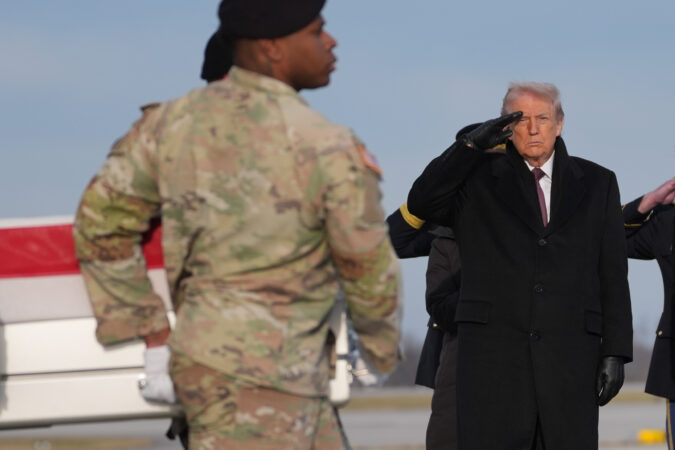
Trump, wearing an overcoat against the chill and brisk wind, joined the other attendees in a salute that was held as each of the American flag-draped transfer cases was carried from the belly of a hulking C-17 military cargo plane and loaded into a dark, unmarked van nearby.
He gazed straight ahead as each case passed in front of him, though he turned to look after the first one was placed inside the vehicle. The remains were taken to the on-base mortuary for processing before they are released to the families.
At the start of the transfer, Trump and Gen. Dan Caine, the chairman of the Joint Chiefs of Staff, joined several others from the military at the open rear of the cargo plane, where all but Trump bowed their heads. The president looked inside the plane. Trump then stood alongside Defense Secretary Pete Hegseth when the group joined the official party.
Before Trump joined the others, White House chief of staff Susie Wiles, who flew up with Trump, dabbed her eyes with a tissue.
Iowa National Guard members hailed as heroes
Howard’s stepfather, Jeffrey Bunn, has said Howard “loved what he was doing and would be the first in and last out.” He said Howard had wanted to be a soldier since he was a boy. Howard’s brother, a staff sergeant in the Iowa National Guard, was escorting him back to Iowa.
Torres-Tovar was remembered as a “very positive” family-oriented person who always put others first, according to fellow Guard members who were deployed with him and issued a statement to the local TV broadcast station WOI.
Dina Qiryaqoz, the daughter of the civilian interpreter, said Wednesday in a statement that her father worked for the U.S. Army during the invasion of Iraq from 2003 to 2007. Sakat is survived by his wife and four adult children.
The interpreter was from Bakhdida, Iraq, a small Catholic village southeast of Mosul, and the family immigrated to the U.S. in 2007 on a special visa, Qiryaqoz said. At the time of his death, Sakat was employed as an independent contractor for Virginia-based Valiant Integrated Services.
Sakat’s family was still struggling to believe that he is gone. “He was a devoted father and husband, a courageous interpreter and a man who believed deeply in the mission he served,” Qiryaqoz said.
Trump’s reaction to the attack in Syria
Trump has vowed retaliation, and the Pentagon’s chief spokesperson, Sean Parnell, has said the attack is under active investigation. The U.S. military said the gunman was killed in the attack.
Before this attack, the most recent instance of U.S. service members being killed in action was in January 2024, when three American troops died in a drone attack in Jordan.
Saturday’s deadly attack followed a rapprochement between the U.S. and Syria, bringing the former pariah state into a U.S.-led coalition fighting the Islamic State group.