Category: Wires

  • Venezuelan politics are a ‘blood sport.’ The U.S. is entering the ring.

    Venezuelan politics are a ‘blood sport.’ The U.S. is entering the ring.

    The day after U.S. special operations forces swept into Caracas, the new Venezuelan president assembled her cabinet members around a large wooden table at the Miraflores Palace. Behind Delcy Rodríguez were large pictures of the country’s fallen leaders: Hugo Chávez, dead of cancer in 2013, and Nicolás Maduro and his wife, Cilia Flores, now jailed in New York on drug-trafficking charges.

    Seated on either side of Rodríguez, at the head of the table, were the powers that remained. One was Vladimir Padrino López, the defense minister, dressed in military camouflage. The other was Diosdado Cabello, the interior minister. He wore a scowl and a hat that said, “To doubt is treason.”

    Both men hold far more power than their titles suggest, analysts say. Stalwarts of the Maduro regime — one U.S. investigators say is built on patronage and fueled by criminal proceeds — they control Venezuela’s expansive security state and much of its commercial activity.

    Since Maduro’s capture and arrest Saturday, public attention has focused on Rodríguez and whether she will accede to White House demands to open up Venezuela’s vast natural resources to American industry. But the newly installed president — alongside her brother Jorge, president of the Venezuelan National Assembly — represents only the political sphere.

    The country’s other power centers, according to scholars, Venezuelan researchers, and current and former U.S. officials, are commanded by Padrino López and Cabello — hard-line, old-school Chavistas who came of ideological age in the socialist movement and accrued significant power and wealth through continued loyalty to the cause.

    Using connections and intimidation, researchers say, the men have repeatedly helped Maduro survive periods of crisis and tighten his authoritarian grip. First in 2019, when much of the world united behind opposition leader Juan Guaidó’s bid to supplant Maduro. And then again in summer 2024, when electoral tallies made clear that Maduro had lost the presidential election.

    Now Padrino López and Cabello, both of whom are wanted by U.S. authorities on drug-trafficking allegations, will help to decide the future of Chavismo — and the nation. Their continued presence magnifies the complexity of the challenge faced by American negotiators as they seek to bypass war and regime change and find common ground with members of a besieged government riven by internal divisions.

    Venezuelan President Nicolás Maduro (left) listens to Defense Minister Vladimir Padrino López during a government-organized civic-military march on Nov. 25, 2025, in Caracas.

    “There are three centers of power,” said a former senior official with the U.S. State Department, who like others in this story spoke on the condition of anonymity to discuss sensitive matters. “And Delcy is going to find out pretty quickly that she can’t provide everything that the Americans want.”

    The Washington Post was unable to reach Padrino López and Cabello for comment. The communications office of the Venezuelan government did not respond to a request for comment.

    President Donald Trump has said the United States is “in charge” of Venezuela, while Secretary of State Marco Rubio has suggested a less direct role, saying the U.S. will use its ongoing oil blockade and other economic measures to make Caracas do its bidding.

    Venezuelan Interior Minister Diosdado Cabello attends the arrival of migrants deported from the United States at Simon Bolivar International Airport in Maiquetia, Venezuela, on Feb. 10, 2025.

    Analysts expressed concern that Washington doesn’t fully understand the factional, internecine political system it now seeks to control — a maze of overlapping loyalties, family ties and competing interests. Several pointed to Cabello — a feared figure who hosts a weekly talk show called Bringing the Hammer — as the wild card.

    One Venezuelan adviser close to Rodríguez’s government said he was central to maintaining unity. “In times of crisis, his role is not conciliatory, but rather one of maintaining order,” the adviser said. “Delcy governs; Diosdado ensures that power does not slip away.”

    But others worry about what he was capable of. At his disposal, according to researchers and U.S. officials, were not only the police and intelligence services, but also the “colectivos,” a pro-government militia embedded throughout society, whose members speed around the streets on motorcycles, armed and masked.

    “Cabello is a brutal, repressive figure in the regime, but he’s not stupid,” said Geoff Ramsey of the Atlantic Council. “He knows his survival depends on threatening to burn down the country, unless his interests are taken care of.”

    “Politics in Venezuela,” he added, “is a ruthless blood sport.”

    Power at all costs

    How the state built by Chávez went from a hierarchal system built around a single charismatic leader to a hotbed of competing factions is, to some degree, a story of Maduro’s own political failings.

    “Chávez was a leftist military man and very charismatic and happened to rule Venezuela during an oil boom, so he had a lot of resources to do a lot of things,” said David Smilde, a sociologist at Tulane University who researches Chavismo. “And with the exception of being a leftist, Maduro is none of those things — not charismatic, not a military man, and he has no oil boom.”

    After narrowly winning the presidential election to succeed Chávez in 2013, Maduro appeared to recognize what he lacked and set out to defend his hold on power not through political persuasion, but by restricting freedoms and empowering — and enriching — the armed forces.

    In February 2016, he put the mining sector in the hands of the military. A few months later, he gave it control over the distribution of basic goods. Another decree shortly afterward put the nation’s ports under its purview. Padrino López, who rose to defense minister in October 2014, became more powerful with each move, researchers said, pioneering new kickback schemes that kept the military loyal to him and indebted to the regime.

    “The military became its own branch of power,” said Carolina Jiménez Sandoval, the Venezuelan president of the Washington Office on Latin America. “I don’t think the United States understands the extent to which the military is ingrained into the politics and economy, both formally and informally.”

    The military also began to profit from illicit revenue streams, American authorities contend. In March 2020, federal prosecutors in the U.S. District Court of the Southern District of Florida filed charges against Padrino López and Cabello for using their roles to facilitate and abet Venezuelan drug trafficking and “flood” the United States with cocaine.

    The U.S. government announced significant bounties for both men — $15 million for Padrino López and $25 million for Cabello.

    Over time, Maduro came to be seen less as the ultimate authority in the country and more as an arbiter between competing powers that had little in common, said Roberto Deniz, a Venezuelan investigative journalist.

    “It’s not just an authoritarian regime,” he said. “It’s an authoritarian regime with a kleptocratic structure in which there are numerous heads, and each one acts as its own fiefdom.”

    “It doesn’t matter if the economy is good or bad, if human rights are respected or not,” he added. “The goal is to preserve power.”

    ‘The black sheep’

    Cabello, who describes himself online as a “revolutionary” and “radical Chavista,” is seen by observers as a particularly unpredictable figure. He participated in Chávez’s failed coup attempt in 1992 and spent the next two years in prison. After Chávez won the presidency through the ballot box, Cabello served as vice president, helping him stave off an attempted coup in 2002, and then as interior minister, a role where he developed deeper ties with the internal security and intelligence forces.

    At the time of Chávez’s cancer diagnosis, he was seen as the second most important revolutionary and a direct rival to Maduro, then the vice president, in the line of succession. After Chávez selected Maduro as his heir, he moved to sideline Cabello, only bringing him back into his cabinet shortly after his apparent electoral loss in 2024.

    “Cabello has been the black sheep in the ruling party,” Ramsey said. “But Maduro found it impossible to rule without his knack for repression and his proximity to the intelligence apparatus.”

    His family’s influence spans the nation. Alexis Rodríguez Cabello, a first cousin, is in charge of the Venezuelan intelligence service and posts frequent homages to Cabello on social media. His brother, José David Cabello, is in charge of the powerful customs and taxation ministry, granting him control over duties at borders and ports. His wife Marleny Contreras, a current member of the national assembly, has been the minister of both tourism and public works.

    The Post was unable to reach Cabello’s family members for comment.

    “Diosdado never stopped being a powerful actor, even when he seemed demoted,” Deniz said.

    And he has “ascended rapidly” since his formal return to government, added Rafael Uzcátegui, the former director of Provea, a prominent Caracas nongovernmental organization — “at the cost of Rodríguez.”

    Uzcátegui saw a narrow path forward for brokering an agreement between Venezuela’s rival power centers that would enable cooperation with U.S. officials and avert a wider conflict.

    “It’s much easier to negotiate with a malandro than a religious fanatic,” he said, using a word that most closely translates to “hustler.” “And the Diosdado Cabello and Padrino López factions are most motivated by material incentive.”

    But there have been worrying early signs, most notably from the informal militias that answer to Cabello.

    The colectivos have fanned out across Caracas. Ordinarily, they carry small arms to intimidate dissenters, but they have been seen with larger weapons in recent days, including assault rifles. They have set up checkpoints, forcing residents to turn over their phones and searching them for messages that could be seen as supportive of the U.S.

    Security forces also have arrested civilians and detained members of the media.

    “Diosdado Cabello could be the spoiler,” said the former senior U.S. diplomat. “It’s a pretty rough start for what is the same regime, but a different management.”

  • The data center rebellion is here, and it’s reshaping the political landscape

    The data center rebellion is here, and it’s reshaping the political landscape

    SAND SPRINGS, Okla. — One float stood out among the tinsel and holiday cheer at the annual Christmas parade here: an unsightly data center with blinding industrial lights and smoke pouring out of its roof, towering menacingly over a helpless gingerbread house.

    This city bordering Tulsa is a battleground, one of many across the country where companies seeking to build massive data centers to win the AI race with China are coming up against the reality of local politics.

    Sand Springs leaders were besieged with community anger after annexing an 827-acre agricultural property miles outside of town and launching into secret talks with a tech giant looking to use it for a sprawling data center. Hundreds of aggrieved voters showed up at community meetings. Swarms of protest signs are taking root along the rural roads.

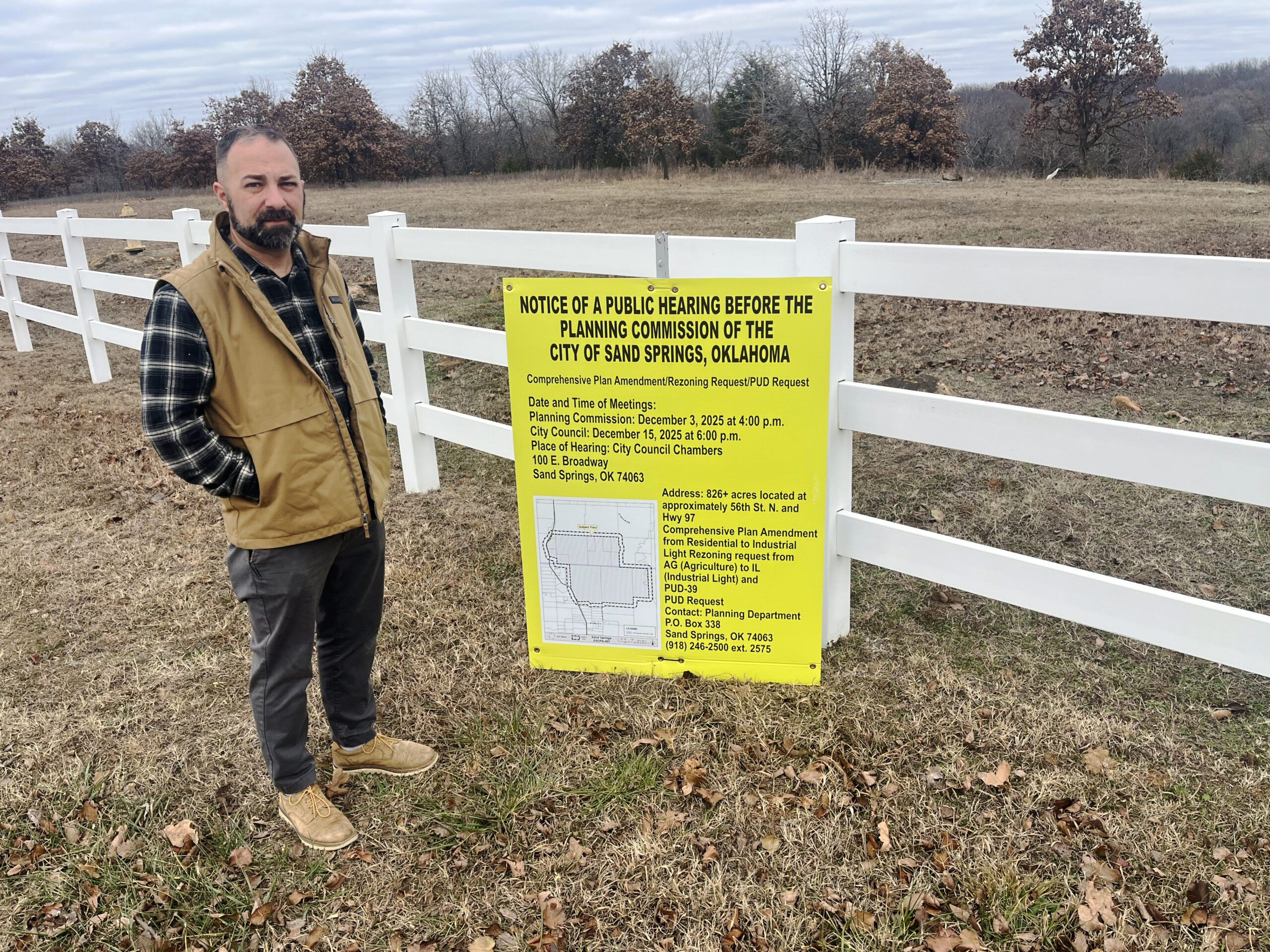
    “It feels like these data center companies have just put a big target on our backs,” said Kyle Schmidt, leader of the newly formed Protect Sand Springs Alliance. “We are all asking: Where are the people we elected who promised to protect us from these big corporations trying to steamroll us? The people who are supposed to be standing up and protecting us are standing down and caving.”

    Kyle Schmidt, president of the advocacy group Protect Sand Springs, at the property city officials have annexed near his home.

    From Archbald, Pa., to Page, Ariz., tech firms are seeking to plunk down data centers in locations that sometimes are not zoned for such heavy industrial uses, within communities that had not planned for them. These supersize data centers can use more energy than entire cities and drain local water supplies.

    Anger over the perceived trampling of communities by Silicon Valley has entered the national political conversation and could affect voters of all political persuasions in this year’s midterm elections.

    Many of the residents fighting the project in Sand Springs voted for Trump three times and also backed Gov. J. Kevin Stitt, a Republican who implores tech firms to build in his state.

    “We know Trump wants data centers and Kevin Stitt wants data centers, but these things don’t affect these people,” said Brian Ingram, a Trump voter living in the shadow of the planned project. “You know, this affects us.”

    Ingram was standing before a homemade sign he planted on his front lawn that said, “Jesus Was Born on Ag Land.”

    The grassroots blowback comes from deep red states as much as from left-wing groups such as the Democratic Socialists of America, which have helped draw hundreds of residents to hearings in Arizona, Indiana, and Maryland.

    Even Energy Secretary Chris Wright warned data center developers that they are losing control of the narrative. “In rural America right now, where data centers are being built, everyone’s already angry because their electricity prices have risen a lot,” he told energy executives assembled in Washington for the North American Gas Forum last month. “‘I don’t want them in my state’ is a common viewpoint.”

    Some industry groups argue that residents’ concerns are misplaced.

    “Fueled by misinformation, driven by radical environmental policies, communities are missing out on the jobs, security, and opportunities this technology is delivering,” said an email from Brian O. Walsh, executive director of the AI Infrastructure Coalition. The group says the projects lower electricity prices, a claim that is hotly disputed.

    The White House frames the data center boom as beneficial, saying in a statement that it will lead to big investments in infrastructure and boost manufacturing. But the administration is also aware some communities oppose them.

    “Communities know what’s best for them, and the Administration is clear that local infrastructure decisions remain with states and localities,” the statement said.

    Residents who attended a community meeting held near the land Sand Springs annexed were overwhelmingly against the proposed data center project.

    Many local politicians are yielding to community pressure and rejecting data centers. Between April and June, more projects were blocked or delayed than during the previous two years combined, according to Data Center Watch, a tracking project by the nonpartisan research firm 10a Labs. Some $98 billion in planned development was derailed in a single quarter.

    Last month, a group of Senate Democrats launched an investigation into the role data centers play in increasing electricity prices.

    Sen. Bernie Sanders (Ind., Vt.) last month called for a moratorium on data center construction, warning that the tech firms are draining scarce energy and water reserves and pushing the cost onto everyday Americans in pursuit of AI technologies that threaten to displace millions from the workforce.

    White House AI czar David Sacks replied on X: “He would block new data centers even if states want them & they generate their own power.”

    But advocates say residents’ concerns are legitimate.

    “This data center expansion affects so many issues,” said Mitch Jones, managing director of policy and litigation at Food and Water Watch. The group last month organized a letter signed by several national advocacy groups demanding a moratorium.

    “It takes up farmland in rural communities. It takes up dwindling water sources in communities that need cleaner drinking water. And it is driving up electricity prices for everyone,” he said. “It is drawing together people from disparate backgrounds who might not agree on other political issues. They are saying this is taking place without any forethought to communities and we must stop it.”

    The NAACP this month convened a two-day “Stop Dirty Data” conference in Washington that focused on the impacts of the AI build-out on minority and low-income communities. It included a bus tour of “Data Center Alley” in Northern Virginia, the world’s largest collection of data centers.

    Even Florida Gov. Ron DeSantis is championing an AI “bill of rights” to enshrine local governments’ power to stop data center construction and prohibit utilities from pushing AI infrastructure costs onto residents. The break between Rep. Marjorie Taylor Greene (R., Ga.) and President Donald Trump was driven in part by her vocal criticism of his AI build-out push.

    The industry has struggled to quell the concerns. In Chandler, Ariz., former Sen. Kyrsten Sinema, co-founder of the AI Infrastructure Coalition, implored city officials to get on board with a large proposed project or risk the federal government pushing it through without city input.

    The city council rejected the project unanimously.

    The vote followed the Tucson City Council’s unanimous rejection of a plan that would have required annexing land in the Sonoran Desert that until June had been zoned “rural homestead.” Some voters were outraged that local officials had signed a five-year nondisclosure agreement with Amazon, which did not come to light for two years. Frustration with the power company that would have provided the power has fueled a movement to drive it out in favor of a community-led nonprofit.

    Amazon did not respond to questions about the controversy, saying only, “We do not have any commitments or agreements in place to develop this project.” Amazon founder Jeff Bezos owns the Washington Post.

    “People are understandably asking how they will benefit,” said Chris Lehane, chief global affairs officer at OpenAI, which has won initial local approval for some of the country’s largest data center projects. He said companies need to listen to communities and make sure they are sharing in the economic gains. “You need to be on the ground, having these conversations. It is a journey.”

    In some places, large tech companies have signed contracts committing to pay for new power grid infrastructure required to bring a data center online, even when the companies are not the only ones that would benefit from it.

    It’s a journey that some local officials are willing to go on because the projects generate construction jobs and boost revenue for schools.

    “We’re trying to work through this,” said Mike Carter, the city manager in Sand Springs. “This would probably be one of our major employers. It would almost certainly become the dominant part of our tax base. … When you can surpass Walmart, which is right now the biggest taxpayer in our community, there is a big incentive to look at this.”

    He has tried to assure residents that they will have all their questions answered — including the name of the tech firm — before the city hearing this month, where officials will consider rezoning the sprawling property from agricultural to industrial. He said the city has signed other nondisclosure agreements during negotiations with large corporations, such as Olive Garden.

    The project developer, White Rose Partners, said none of the costs involved with providing electricity to the Sand Springs data center would fall on residential ratepayers. The firm says the data center would generate millions of dollars in revenue for local schools and services.

    It is cold comfort to many residents of the rural community, where the data center would industrialize a landscape now defined by the ranches that drew them there.

    “I don’t care how much chocolate icing you put on a dog turd, it don’t make it chocolate cake,” said Rick Plummer, who raises elite team-roping horses next to the proposed data center. “They are trying to fluff this data center thing up and say, ‘Man, eat this birthday cake.’ But it isn’t birthday cake.”

    On the other side of Tulsa, a steady stream of pickups pulled off the busy local road to sign petitions fighting a different data center proposed for the rural community of Coweta. One sign takes aim at the nondisclosure agreements, stating “NDAs BETRAY.” The petitions demand the firing of a city official who signed one.

    “We want to see this damn data center go away and go someplace else,” said Allen Prather, who was leading the petition drive dressed as Santa. “This town deserves a better centerpiece than a data center. They keep coming to smaller and smaller towns. Leave mine alone.”

    Sherri Crumpacker, a retired law enforcement officer who pulled over to sign, concurred. “I moved here from California to get away from BS like this,” she said.

  • No. 1 Indiana adds to CFP dominance with crushing 56-22 Peach Bowl semifinal win over No. 5 Oregon

    No. 1 Indiana adds to CFP dominance with crushing 56-22 Peach Bowl semifinal win over No. 5 Oregon

    ATLANTA — Undefeated Indiana’s already impressive march through the College Football Playoff gained momentum as its dominant defense created three first-half touchdowns with turnovers, Fernando Mendoza threw five scoring passes and the Hoosiers overwhelmed No. 5 Oregon 56-22 in the Peach Bowl semifinal on Friday night.

    No. 1 Indiana (15-0, No. 1 CFP) will face No. 10 Miami on Jan. 19 in the national championship game at Hard Rock Stadium in Miami Gardens. Miami beat Mississippi 31-27 in the Fiesta Bowl semifinal on Thursday night.

    Indiana will try to give the Big Ten its third straight national title, following Ohio State and Michigan the last two seasons. Few teams from any conference can compare with the Hoosiers’ season-long demonstration of balanced strong play.

    Led by Mendoza and the defense, Indiana is making a case to be considered among the top teams in history.

    Though Miami will be home for the national championship game, Mendoza, the Heisman Trophy winner and Miami native, will enjoy a homecoming following an almost perfect game against Oregon. Mendoza completed 17 of 20 passes and the five touchdowns, including two to Elijah Sarratt and a 36-yarder to Charlie Becker.

    Kaelon Black ran for two touchdowns to lead the Indiana running game.

    Oregon (13-2, No. 5 CFP) was doomed by the three first-half turnovers while also being short-handed by the absence of two of their top running backs.

    The Hoosiers led 35-7 at halftime as the Ducks were held to nine rushing yards on 17 carries. Noah Whittington, who leads Oregon with 829 rushing yards, was held out with an undisclosed injury after Jordon Davison, who had rushed for 667 yards and 15 touchdowns, already was listed as out with a collarbone injury.

    Backup running backs, including Jay Harris and Dierre Hill Jr, provided too little help for quarterback Dante Moore. Moore’s task against Indiana’s stifling defense would have been daunting even with all his weapons.

    Indiana’s defense didn’t wait long to make an impact. On Oregon’s first snap, cornerback D’Angelo Ponds intercepted Moore’s pass intended for Malik Benson and returned the pick 25 yards for a touchdown. Only 11 seconds into the game, the Hoosiers and their defense already had made a statement this would be a long night for Moore and the Oregon offense.

    Moore’s 19-yard scoring pass to tight end Jamari Johnson tied the game. The remainder of the half belonged to Indiana and its big-play defense.

    After Mendoza’s 8-yard touchdown pass to Omar Cooper Jr. gave the Hoosiers the lead for good at 14-7, Indiana’s defense forced a turnover when Moore fumbled and Indiana recovered at the Oregon 3, setting up Black’s scoring run.

    Moore lost a second fumble later in the second quarter when hit by Daniel Ndukwe and Mario Landino recovered at the Oregon 21. Mendoza’s first scoring pass to Sarratt gave the Hoosiers’ the 35-7 lead.

    Indiana extended its lead to 42-7 on Mendoza’s 13-yard scoring pass to E.J. Williams Jr.

    Oregon finally answered. A 70-yard run by Hill set up a 2-yard scoring run by Harris.

    Indiana’s special teams added a big play in the fourth quarter when Ndukwe’s blocked punt set up Mendoza’s second scoring pass to Sarratt.

    Following their undefeated regular season, the Hoosiers have only gained momentum in the CFP. Indiana overwhelmed Alabama 38-3 in the Rose Bowl quarterfinal as Mendoza passed for 192 yards and three touchdowns.

    Honorary captains

    Philadelphia Phillies slugger Kyle Schwarber was an honorary captain for Indiana and watched the game from the Hoosiers’ sideline. Former Oregon and Carolina Panthers running back Jonathan Stewart was the Ducks’ honorary captain.

    Season sweep

    Indiana completed a sweep of two games against Oregon this season. Defense played a lead role in each win. The Hoosiers took a 30-20 win at Oregon on Oct. 11 when Moore threw two interceptions and was sacked six times.

    Indiana also dominates the stands

    The game was a sellout and the red-clad Indiana fans were almost as dominant as the Hoosiers on the field. Indiana appeared to claim at least 80% of the 75,604 fans.

  • Tyrese Maxey’s 29 points leads Sixers past Magic despite both teams struggling on offense

    Tyrese Maxey’s 29 points leads Sixers past Magic despite both teams struggling on offense

    ORLANDO, Fla. — Tyrese Maxey had 29 points and three steals, Joel Embiid added 22 points and nine rebounds, and the Philadelphia 76ers beat the Orlando Magic 103-91 on Friday night in a game in which the teams combined to make 8 of 57 3-point shots.

    Paul George scored 12 of his 18 points in the second half and added nine rebounds for the 76ers, who won for the fifth time in six games. Philadelphia has won four straight on the road.

    Desmond Bane led Orlando with 23 points. Anthony Black added 21 points and Paolo Banchero finished with 14 points, 11 rebounds and seven assists.

    Philadelphia shot 4 for 28 (14.3%) from long range to Orlando’s 4 for 29 (13.8%).

    Maxey, the NBA’s third-leading scorer at 30.7 points per game, made only 3 of 12 shots in a 12-point first half and missed all four of his 3-point attempts. He finished 10 for 22 overall and 3 for 8 on threes.

    When Maxey hit his second 3-pointer of the game with 1:36 remaining in the third quarter, the 76ers were 3 for 22 from 3-point range and had a seven-point lead. His final 3-pointer came with 3:42 left and gave the 76ers their largest lead, 101-85.

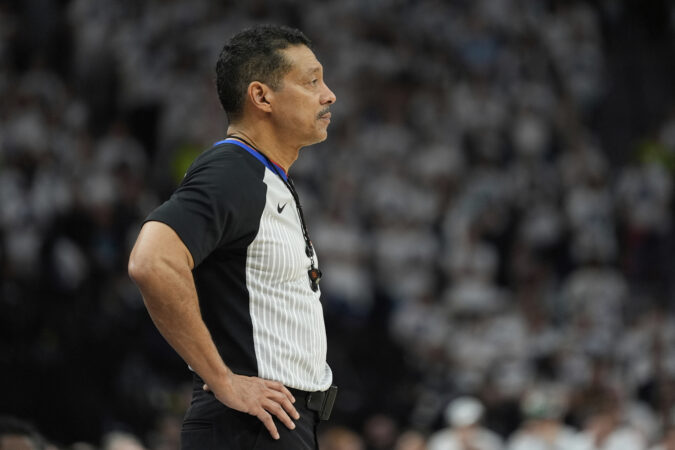
    Referee Bill Kennedy left the court in a wheelchair after suffering an apparent leg injury during the first quarter.

    The Magic played without Tristan da Silva (back spams) and Jalen Suggs, who missed a fourth straight game with a right knee contusion.

    Up next

    76ers: Play at Toronto on Sunday and Monday.

    Magic: Play at home against New Orleans on Sunday.

    ___

    AP NBA: https://www.apnews.com/nba

  • NBA official Bill Kennedy taken off court in wheelchair with injured leg in 76ers-Magic game

    NBA official Bill Kennedy taken off court in wheelchair with injured leg in 76ers-Magic game

    ORLANDO, Fla. — NBA official Bill Kennedy left the court in a wheelchair after suffering an apparent leg injury during the first quarter of the Sixers at Orlando Magic game on Friday night.

    Kennedy appeared to start limping as he was running down the court during a 76ers fastbreak with about 2 1/2 minutes remaining in the first quarter. He was seen hopping on the baseline as Paul George made a layup to cut Orlando’s lead to 22-20. He then called for assistance as the Magic called a timeout.

    His right leg was tended to for several minutes before he was wheeled off the court.

    Kennedy’s departure left officials James Williams and Michael Smith to work the rest of the game. The 76ers won the game 103-91.

    ___

    AP NBA: https://www.apnews.com/nba

  • Trae Young has a fresh start in Washington. His first order of business is getting healthy

    Trae Young has a fresh start in Washington. His first order of business is getting healthy

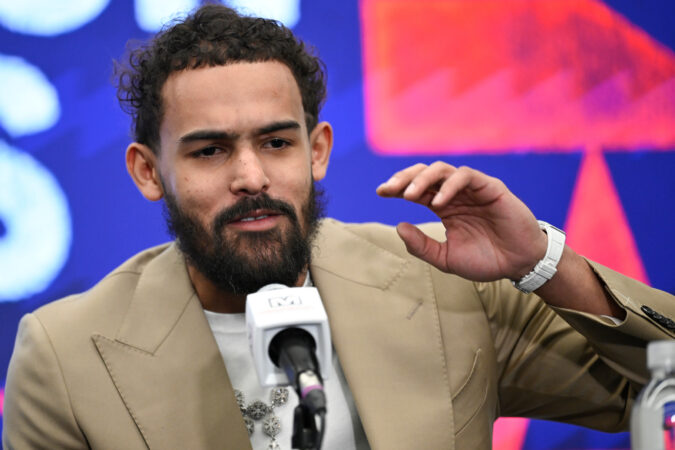
    WASHINGTON — Trae Young’s tan outfit nearly matched the color of Washington’s uniforms. And although he couldn’t take the court and help his new team, Wizards fans showed their appreciation.

    Young was introduced to the home crowd with a video during the first quarter of Friday night’s game against New Orleans. Earlier in the day, the trade that sent the high-scoring guard from Atlanta to Washington became official, and now Young can look forward to a fresh start after leaving the Hawks.

    “For me, DC is overlooked as far as a big market,” Young said. “In the NBA, I feel like this is a big market, and I just feel like I’m going to be able to come into an opportunity to be myself.”

    The first big question is when Young will play again. He missed Friday night’s game with knee and quadriceps issues and hasn’t appeared in a game since Dec. 27.

    Big market or not, the Wizards lost 64 games last season and 67 in 2023-24. They were 3-20 around mid-December but had won seven of their last 13 entering Friday night’s game. Washington has plenty of young players, and the development of second-year big man Alex Sarr has been encouraging, but the Wizards could use a true point guard to play alongside the likes of Bub Carrington, Bilal Coulibaly, Tre Johnson and Kyshawn George, all of whom are between 6-foot-4 and 6-foot-8 and under 23 years old.

    Enter the 27-year-old Young, who for his career has averaged 25.2 points per game and 9.8 assists. After the Wizards spent two seasons bottoming out, his arrival gives Washington fans a star they can pin their hopes on. General manager Will Dawkins suggested the move won’t alter the patience the team has shown with its less experienced players.

    “As an organization, we have a long-term plan, and we’re not going to do anything to deviate from that,” Dawkins said. “I think Trae fits into what we’re trying to do based on the development of a lot of the younger players.”

    Washington could lose its first-round pick this year if it falls outside the top eight, but aside from that, there was little obvious downside to bringing in a four-time All-Star like Young, especially since the Wizards gave up no draft choices in the trade. Washington sent guard CJ McCollum, who coincidentally has the same birthday as Young but is seven years older, to Atlanta along with reserve forward Corey Kispert.

    Young has a player option for about $49 million for next season.

    “When you have a four-time All-Star, All-NBA player available, who wants to come to DC and help make it what we want it to be, it was an easy partnership and an easy decision,” Dawkins said.

    Although he led the Hawks to the conference finals back in 2021, Atlanta hasn’t even made the playoffs the past two seasons, and the light return for Young indicates where his stock was when the deal was made.

    “On behalf of the Hawks franchise, I’d like to thank Trae for how he embraced the city of Atlanta and represented the Hawks during his time here, on the court and in the community.” Hawks GM Onsi Saleh said in a statement. ”Over more than seven seasons, including four All-Star appearances, he cemented himself as a fan favorite and one of the great players in our franchise’s history. We wish Trae and his family all the best.”

    Now Young will try to add to Washington’s recent history of dynamic point guards. After years with John Wall leading the way, the Wizards had Russell Westbrook for one remarkable season in which he averaged a triple-double and led Washington to its most recent playoff berth.

    But that was back in 2020-21, the same season the Hawks peaked with Young. He was in only his third season then.

    “It happened faster than I expected in my last place,” Young said, suggesting the Wizards could be capable of a similar rise.

  • Washington National Opera bows out of Kennedy Center

    Washington National Opera bows out of Kennedy Center

    WASHINGTON — The Washington National Opera announced Friday that it had decided to end its arrangement with the Kennedy Center in the nation’s capital, though it said it was hoping for an “amicable transition.”

    “To ensure fiscal prudence and fulfill its obligations for a balanced budget, the WNO will reduce its spring season and relocate performances to new venues,” the Opera said in a statement.

    It said the decision stemmed from the Center’s new business model, which “requires productions to be fully funded in advance — a requirement incompatible with opera operations.”

    Kennedy Center spokesperson Roma Daravi told The New York Times, “After careful consideration, we have made the difficult decision to part ways with the WNO due to a financially challenging relationship.”

    Artists ranging from Hamilton creator Lin-Manuel Miranda to rock star Peter Wolf have called off events at the Kennedy Center since President Donald Trump ousted the previous leadership early last year and arranged for himself to head the board of trustees. The board’s decision in December to rebrand the venue the Trump-Kennedy Center led to a new wave of cancellations.

    WNO’s announcement did not mention Trump.

  • Head of FBI’s New York field office to serve as co-deputy director after Bongino’s departure

    Head of FBI’s New York field office to serve as co-deputy director after Bongino’s departure

    WASHINGTON — The head of the FBI’s New York field office has been named co-deputy director of the bureau, replacing Dan Bongino following his recent departure, an FBI spokesperson said Friday.

    Christopher Raia, who helped lead the response to the deadly truck attack in New Orleans on New Year’s Day last year, was picked to run the New York office in April after having served as a top counterterrorism official at FBI headquarters. A former Coast Guard officer, Raia joined the FBI in 2003 and during the course of his two-decade career has investigated violent crime, drugs and gangs as well as overseen counterterrorism and national security investigations.

    As a career FBI agent, Raia is a more conventional selection for the FBI’s No. 2 job than was Bongino, a popular conservative podcaster who had previously served as a Secret Service agent but had never worked for the FBI until being selected by the Trump administration last year.

    Raia is expected to serve as co-deputy director alongside Andrew Bailey, the former Missouri attorney general who was named to the job last August. He is scheduled to start next week.

    He became the head of the New York field office after his predecessor, James Dennehy, who was reported to have resisted Justice Department efforts to scrutinize agents who participated in politically sensitive investigations, was forced to retire.

    Bongino announced last month that he was departing the bureau following a brief and tumultuous tenure. He officially ended his tenure last week.

    No immediate successor was named for Raia in New York.

  • Five Democratic-led states sue HHS over frozen welfare funding

    Five Democratic-led states sue HHS over frozen welfare funding

    Five Democratic-led states are suing the Trump administration for freezing their share of federal food, housing, and childcare assistance dollars, saying officials failed to justify the sweeping actions that could strip billions in aid from needy families.

    New York, along with California, Colorado, Illinois, and Minnesota, asked for a temporary restraining order that would allow them to continue receiving the funds, in a lawsuit filed Thursday evening with the United States District Court for the Southern District of New York.

    The states argued that the Administration for Children and Families, which is within the Department of Health and Human Services, provided no evidence of fraud and acted illegally by enacting sanctions within the three welfare programs without following processes laid out by law. The administration wrote to the states earlier this week that the freeze was necessary to prevent “potential” fraud but didn’t detail what it meant, according to letters viewed by the Washington Post.

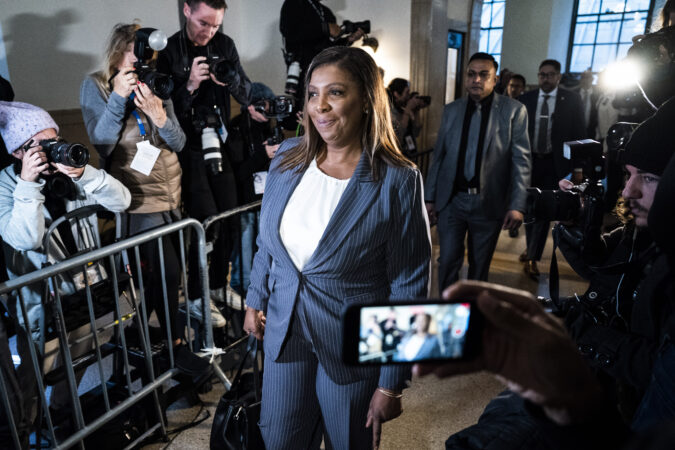
    “I will not allow this administration to play political games with the resources families need to help make ends meet,” New York Attorney General Letitia James (D) said in a statement.

    State officials and child advocates have said the funding freeze would wreak havoc on families relying on childcare aid and could cause ripple effects if parents are forced to quit their jobs to care for children or daycare centers shut down permanently.

    HHS General Counsel Mike Stuart wrote on X late Thursday that the agency “stands by its decision to take this action to defend American taxpayers.”

    “We identified serious concerns in these states that warranted immediate review and action,” he wrote. “These same officials were complicit in this perpetuation of this fraud and allowing it to happen.”

    Minnesota was already in the administration’s crosshairs amid investigations into billions of federal dollars authorities say were fraudulently claimed by individuals and groups purporting to help the state’s low-income population. HHS broadened its crackdown this week, saying nearly $2.4 billion in childcare grants have been frozen to the five states, as well as $7.35 billion in temporary grants for needy families and $869 million in social services funds. These programs help cover childcare, housing, food, and home utility costs for families with low incomes.

    Democratic leaders in those states blasted the move as politically motivated. Before the lawsuit was filed Thursday, New York Gov. Kathy Hochul (D) told reporters that the administration is “coming after Democratic governors, five of us, for no reason at all.”

    “I want them to know this, that you may think you’re punishing me as a Democrat, but this is a county program,” she said, referring to safety net programs in New York partly funded with federal dollars. “We are simply the pass-through. The money goes to providers selected by the counties. They run this.”

    Under the freeze, the states must submit justification and receipts before being able to collect funds from any of the programs. The administration wrote in letters to the states that the freeze wouldn’t be lifted until they put in place more verification measures to ensure the funds are being used properly for eligible recipients.

    A letter from HHS’s Administration for Children and Families to Colorado said the administration is committed to “rooting out fraud” and expressed concern that Colorado is providing “illegal aliens” government benefits.

    Fraud investigations into the three programs targeted by the administration are typically handled by states, former HHS officials said. New York’s Office of the Welfare Inspector General reported it secured nearly $600,000 in fraud-related restitution in 2024, for example.

    The administration froze childcare funding to nearly a dozen daycare facilities in Minnesota in late December after a viral video alleged they were collecting funds without caring for children — claims the state has rebutted. Federal prosecutors have charged 92 people with committing fraud in other, Medicaid-funded programs in the state.

    All five states involved in the lawsuit filed Thursday are among more than two dozen states that previously sued the Trump administration over withholding other federal funds including for education, disaster relief and public health, arguing the actions jeopardize critical services.

  • South Carolina measles outbreak grows by nearly 100, spreads to North Carolina and Ohio

    South Carolina measles outbreak grows by nearly 100, spreads to North Carolina and Ohio

    South Carolina’s measles outbreak exploded into one of the worst in the U.S., with state health officials confirming 99 new cases in the past three days.

    The outbreak centered in Spartanburg County grew to 310 cases over the holidays, and spawned cases in North Carolina and Ohio among families who traveled to the outbreak area in the northwestern part of the state.

    State health officials acknowledged the spike in cases had been expected following holiday travel and family gatherings during the school break. A growing number of public exposures and low vaccination rates in the area are driving the surge, they said. As of Friday, 200 people were in quarantine and nine in isolation, state health department data shows.

    “The number of those in quarantine does not reflect the number actually exposed,” said Dr. Linda Bell, who leads the state health department’s outbreak response. “An increasing number of public exposure sites are being identified with likely hundreds more people exposed who are not aware they should be in quarantine if they are not immune to measles.”

    Since the outbreak started in October, Bell has warned that the virus was spreading undetected in the area. Hundreds of school children have been quarantined from school, some more than once.

    South Carolina is one of two active hot spots for measles. The other outbreak is on the Arizona-Utah border, where 337 people have gotten measles since August.

    Last year was the nation’s worst year for measles spread since 1991, end-of-year data from the Centers for Disease Control and Prevention shows. The U.S. confirmed 2,144 cases across 44 states.

    And as the one-year anniversary of the Texas-New Mexico-Oklahoma outbreak approaches — which sickened at least 900 people and killed three — health experts say the vaccine-preventable virus is on the verge of making a lasting comeback in the U.S.

    At that point, the U.S. would lose its status of having eliminated local spread of the virus, as Canada did in November. International health experts say the same strain of measles is spreading across the Americas.