Category: Wires

  • Former Jets center Nick Mangold dies of kidney disease at age 41

    Former Jets center Nick Mangold dies of kidney disease at age 41

    Former New York Jets center Nick Mangold, one of the franchise’s most popular and decorated players, has died, the team announced Sunday. He was 41.

    The Jets said in a statement on social media that Mangold died Saturday night from complications of kidney disease.

    His death comes less than two weeks after the two-time All-Pro selection announced on social media that he had kidney disease and needed a transplant. He said he didn’t have any relatives who were able to donate, so he went public with the request for a donor with type O blood.

    “I always knew this day would come, but I thought I would have had more time,” he wrote in a message directed to the Jets and Ohio State communities.

    “While this has been a tough stretch, I’m staying positive and focused on the path ahead. I’m looking forward to better days and getting back to full strength soon. I’ll see you all at MetLife Stadium & The Shoe very soon.”

    New York Jets center Nick Mangold lines up against the New England Patriots on Dec. 27, 2015.

    Mangold said he was diagnosed with a genetic defect in 2006 that led to chronic kidney disease. He was on dialysis while waiting for a transplant.

    “Nick was more than a legendary center,” Jets owner Woody Johnson said in a statement. “He was the heartbeat of our offensive line for a decade and a beloved teammate whose leadership and toughness defined an era of Jets football. Off the field, Nick’s wit, warmth, and unwavering loyalty made him a cherished member of our extended Jets family.”

    Mangold was a first-round draft pick of the Jets in 2006 out of Ohio State and was selected to the Pro Bowl seven times. He was enshrined in the Jets’ ring of honor in 2022.

    He is survived by his wife, Jennifer, and their four children Matthew, Eloise, Thomas and Charlotte.

    Mangold was the anchor of New York’s offensive line his entire playing career, with all 11 seasons spent with the Jets. He started every game during his first five seasons and missed only four games in his first 10 years before an ankle injury limited his final season, 2016, to eight games.

    He was released by the team in 2017 and didn’t play that season. The following year, he signed a one-day contract with the Jets to officially retire as a member of the team.

    “Absolutely gutted,” former wide receiver David Nelson, who played with Mangold for two seasons, wrote on X. “One of the best guys I’ve ever met — true legend on and off the field.”

    Mangold’s No. 74 jersey remained a popular one for fans to wear at games, even nine years after playing his final NFL game.

    His long, blond hair and bushy beard made him instantly recognizable and his gritty, outstanding play on the field made him a fan favorite. He was active with charitable events and often dressed as Santa Claus for the team’s holiday celebrations for children.

    “Nick was the embodiment of consistency, strength, and leadership,” Jets vice chairman Christopher Johnson said in a statement. “For over a decade, he anchored our offensive line with unmatched skill and determination, earning the respect of teammates, opponents and fans alike. His contributions on the field were extraordinary — but it was his character, humility, and humor off the field that made him unforgettable.”

  • How China weaponized soybeans to squeeze U.S. farmers — and spite Trump

    How China weaponized soybeans to squeeze U.S. farmers — and spite Trump

    The start of the harvest in September is usually when China, the world’s biggest importer of soybeans, puts in a flurry of orders to the farms of Illinois, Iowa, Minnesota, and Indiana.

    This year, however, Chinese importers aren’t buying. In retaliation for President Donald Trump’s tariffs, Beijing has cut off Midwestern farmers from their largest and most lucrative overseas customer: China accounted for half — or $12.6 billion — of U.S. soybean exports last year.

    For the first time since November 2018, China imported no soybeans from the U.S. in September, data from China’s General Administration of Customs showed Monday.

    “We’re in uncharted territory in terms of a complete absence of Chinese buyers for the harvest that is currently coming in,” said Even Pay, director of agriculture research at Trivium China, a research firm based in Beijing.

    For Beijing, halting U.S. soybean imports has been an easy and relatively cost-free way to pile pressure on Trump ahead of a planned meeting with Chinese leader Xi Jinping in South Korea later this month.

    Trump, speaking to reporters on Air Force One last weekend, said he wanted China to return to its previous level of purchases and that he thought Beijing was ready to make a deal on soybeans.

    But while American farmers lobby Trump to get them back into China, there isn’t similar pressure within China for the government to allow purchases from U.S. suppliers. That “gives Beijing a great deal of negotiating leverage,” Pay said.

    On Tuesday, Trump took to social media to call China’s decision to not buy U.S. soybeans “an Economically Hostile Act” and said the U.S. was considering “terminating” buying cooking oil from China as retribution.

    But Beijing has shrugged off Trump’s threats. Analysts say it is ready to extend the purchasing freeze for the rest of the year.

    Here’s how China has turned its massive market for soy into a trade war weapon.

    Why does China buy so many soybeans?

    China consumes far more soybeans than any other country in the world, but it grows less than a fifth of what it needs — just enough to cover all the tofu and soy sauce used in Chinese cooking.

    It buys everything else from abroad — importing more than the rest of the world combined — and the U.S. has traditionally been one of its top suppliers.

    Those imported beans mostly feed huge numbers of pigs, chickens, and other livestock, as meat consumption by wealthier Chinese families has grown rapidly. Despite efforts to develop alternatives, soybeans accounted for 13% of animal feed in 2023.

    The remaining imported soybeans mostly become cooking oil: soybean oil’s mild taste and ability to withstand high heats make it perfect for stir-fries. Chinese producers favor U.S. or Brazilian imports over more expensive homegrown soybeans.

    For U.S. farmers, it’s hard to find a replacement for Chinese demand. “It’s just an enormous market,” said Phil Luck, director of the economics program at the Center for Strategic and International Studies (CSIS), a Washington-based think tank.

    How has China curbed reliance on American farmers?

    China has worked hard to curb its reliance on U.S. soy imports, especially after the trade conflict of Trump’s first term ended in 2020 when Beijing agreed to buy $200 billion in American products, including soybeans (although it bought far less than it promised.)

    Beijing has since pushed Chinese farms to consolidate and expand domestic output. It has launched trial programs for previously banned genetically modified crops. And it is aiming to lower the ratio of soybeans in animal feed to 10% by 2030, down from 18% in 2017.

    A Ministry of Agriculture report released in May said that these efforts meant import demand would steadily fall over the coming years.

    But thanks to limited farming land and ballooning demand, China is still a long way from its goals to meet half of its soybean needs with domestic crops and will rely on imports for years to come, analysts said.

    So who is supplying China instead?

    Chinese analysts are blunt about their country’s growing preference to buy from anywhere but the U.S.

    “From China’s perspective, the U.S. is an unpredictable supplier,” said Niu Haibin, director of the Center for Latin America Studies at Shanghai Institutes for International Studies.

    Tariffs mean U.S. soybeans no longer have a price advantage and China has already identified alternative suppliers to fill the gap. “The longer we rely on alternative sources, the dimmer the outlook for U.S. soybean exports to China becomes,” Niu said.

    Those suppliers include Argentina, Uruguay, and even Russia. But it is Brazil, the world’s largest soybean exporter, that has been the big winner from China’s U.S. embargo.

    China would typically alternate between hemispheres, buying from Brazil during its March to June harvest season and then from the U.S. for the remainder of each year.

    But this year, instead of switching to American farms, China kept placing orders from Brazil. It imported $4.7 billion in soybeans from the country in August and only $100 million worth from the U.S.

    That continued in September, when China bought 7.2 million tons of soybeans from the South American country — 93% its total exports, according to Anec, Brazil’s national association of grain exporters.

    China’s effort to secure Brazilian soybeans goes far beyond merely placing big orders.

    Chinese state-owned companies have taken stakes in the major Brazilian ports of Paranaguá, Açu, and Santos. COFCO, China’s largest agricultural importer, has the exclusive rights to run a major new terminal at Santos that opened in March and will expand the port’s throughput by 15 million tons per year when it reaches full capacity in 2026.

    And Beijing is still trying to lower barriers for Brazilian exporters to access its vast market. The two countries are working on plans to build a railway connecting Brazil to Peru’s Chancay port that could cut shipping times to Asia dramatically.

    What does this mean for U.S.-China trade talks?

    With plentiful supply from South America, China has been projecting confidence that it can cold-shoulder American farmers for as long as is necessary to reach a trade deal.

    Beijing once worried that U.S. wouldn’t sell China its soybeans, but it is now the U.S. that is anxious for China to buy, declared one widely shared article published on social media app WeChat last week.

    In response to Trump’s recent threat to retaliate by halting cooking oil trade — which Chinese analysts took to mean the U.S. stopping purchases of used oil that can be turned into biodiesel — the state-owned Global Times newspaper declared that “there is no shortage of buyers for China’s used cooking oil.”

    That defiant tone is helped by China’s sizable stockpiles. Its soybean imports hit a record in May and were up 5.3% year-on-year for January to September to reach 95 million tons, according to China’s customs agency.

    Beijing is in a position where it could hold out for months — possibly until new South American crops arrive in early 2026 — without needing to procure U.S. soybeans, said Pay, the Trivium analyst.

    Trump’s focus on soybean purchases has only strengthened Beijing’s belief that this is an easy way to squeeze the U.S. with minimal costs at home.

    In Beijing, “there’s definitely a sense that the U.S. is in chaos and there’s room for putting political pressure on targeted groups,” said Jack Zhang, director of the Trade War Lab at the University of Kansas.

    It also gives Xi something to offer Trump in exchange for what China really wants.

    “Part of the calculation,” Zhang said, “is that the U.S. will negotiate over these small but pressing concerns and relent on some of the larger structural stuff that China’s more worried about.” These include U.S. export controls on advanced computer chips.

    But even if a deal is struck this month, it may be too late for U.S. farmers to make up for orders already lost.

    “China’s in a pretty good position. We really want to resolve this. They don’t need to,” said Luck, the CSIS analyst. Even if China started placing orders the day after Xi and Trump meet, U.S. soybean farmers “still probably lost half of the season, so we’re on the clock here,” he said.

  • Trump’s crackdown on EVs hits home in the Battery Belt

    Trump’s crackdown on EVs hits home in the Battery Belt

    STANTON, Tenn. — Stanton, Tenn., population 450, welcomed a massive new neighbor a few years ago: a Ford electric-truck factory and a joint-venture battery plant slated to employ 6,000 workers.

    Ford’s 2022 groundbreaking triggered an influx of construction activity into the former cotton-and-soybean farmlands outside of Memphis. Hard-hatted workers filled local diners. Developers scrambled to build homes and fire stations

    Stanton is quieter these days. Ford over the past 18 months repeatedly delayed phases of the project. The EV truck plant is slated to begin initial production in 2027 and start sending deliveries the next year, a timeline delayed several times from the original plan of coming online in 2025.

    Ford said it “will be nimble in adjusting our product launch timing to meet market needs and customer demand while targeting improved profitability.”

    The Ford complex is part of the so-called Battery Belt, a swath of factories stretching across the U.S. heartland that spans from Georgia to Indiana. Roughly two dozen battery projects worth tens of billions in investment have been announced this decade, promising to inject tens of thousands of jobs in Republican-dominated states like Georgia and Kentucky.

    By last year, though, Americans’ waning enthusiasm for electric cars led automakers to delay or scrap some factory projects. Now, the additional fallout from U.S. President Donald Trump’s recent policy changes is descending on the Battery Belt.

    Ford CEO Jim Farley last week offered the prediction that electric-car sales could fall by around 50% following the Sept. 30 expiration of a $7,500 tax credit for buyers, echoing other gloomy forecasts for the EV market.

    The uncertain fate of these massive, high-tech factories and their employment has rattled the small rural communities that spent years hitching their economic futures to these projects.

    “That’s on everybody’s mind, quite frankly,” said Allan Sterbinsky, who retired as mayor of Stanton in December and advocated for the site for years before Ford came to town. Some residents worry that Ford will never follow through on the plant, the former mayor said. Others hope the company will repurpose the 3,600-acre site if demand doesn’t increase for EVs.

    A Ford spokesperson pointed to the automaker’s community work in Stanton, including grants to public safety organizations as part of a broader $9 million commitment to the area.

    A Reuters review of U.S. battery-investment plans shows those worries are justified. The industry appears headed toward a huge glut of factory capacity, if all those projects were to move ahead as planned.

    By 2030, the planned battery plants would provide the capacity to produce 13 million to 15 million EVs annually, according to figures provided to Reuters by research firm Benchmark Mineral Intelligence. But the industry now might only need about one-quarter of that factory space. S&P Global Mobility predicts only around 3 million EVs will be produced that year, and some would likely use batteries imported from other countries.

    Some of that excess roughly 10 million-EV worth of battery capacity would likely be used for hybrids and extended-range EVs as well as the booming energy storage industry, but there is still a sizable gulf, said Stephanie Brinley, S&P Global Mobility automotive analyst.

    The demise of the $7,500 tax credit — which had been in place for more than 15 years to persuade Americans to try green cars — is only the highest profile of several anti-EV measures put forth by the Trump administration. Combined, they further jeopardize battery projects and other electric-car-related investments, experts say. In the last few months, several automakers have canceled, delayed or downsized EV projects.

    Meanwhile, a pot of tens of billions of dollars available to companies that make EV batteries domestically has tighter restrictions that will likely reduce the amount of federal money that flows to the battery sites.

    “All of a sudden, much of what was originally going to benefit from these credits now no longer can to a large degree,” said Jennifer Stafeil, tax auto sector lead for KPMG.

    Trump has said he is not anti-EV, but prefers that consumers decide what cars to buy, without government influence. He also has criticized EV-friendly regulations implemented under former President Joe Biden, which Trump has said were costly and threatened American auto jobs.

    One of the nation’s largest EV projects, Hyundai Motor’s $12.6 billion assembly plant and joint-venture battery factory near Savannah, Ga., is moving ahead. Last month the project suffered a setback when federal law enforcement raided it. Hyundai has said the fallout would delay the battery plant by at least two to three months.

    In the three years since Hyundai announced the megasite, 21 suppliers have opened operations near the site.

    “Hyundai is committed to offering a diverse product lineup, including internal combustion, hybrid, plug-in hybrid, and EV models. We understand that every customer is unique, and we strive to meet a wide range of needs,” a company spokesperson said.

    The complex is gearing up to hire 8,500 employees by 2031, and is paying wages 25% above the county average, said Trip Tollison, president of the Savannah Economic Development Authority.

    Tollison acknowledged that some in the community worry about the uncertain future of the nascent EV industry that underpins all that development. He is hopeful Hyundai can flexibly shift to hybrid production if the EV market doesn’t take off.

    “That’s how you provide opportunities like this to lift people out of poverty,” he said.

  • Quentin Grimes’ clutch three lifts 76ers to victory over Charlotte in home opener

    Quentin Grimes’ clutch three lifts 76ers to victory over Charlotte in home opener

    Quentin Grimes’ clutch three-pointer with 14 seconds left led the Sixers to a 125-121 win over the Charlotte Hornets on Saturday night.

    It was the most clutch point in a 24-point night for Grimes. Tyrese Maxey scored 28 to lead the Sixers, who improved to 2-0. Joel Embiid, who scored 20 points and added two rebounds before departing due to minute restrictions. . VJ Edgecombe had 15 points coming off of a record-setting 34-point performance in the opener against Boston.

    LaMelo Ball led the Hornets with 27 points and Collin Sexton had 21.

    The Hornets lost Brandon Miller in the first half to left shoulder soreness. Miller grabbed his shoulder in pain and ran to the locker room after he was hurt on a play in the second quarter. He scored four points in nine minutes.

    The Hornets led by 10 points at the end of the third quarter and blew the lead even with Embiid out of the game in the final frame. Embiid is still on his minutes restriction as he returns from knee surgery. He used up his 20 allotted minutes by the end of the third quarter.

    Embiid scored four points on 1-of-9 shooting against Boston and did not play the final 9-plus minutes as Maxey and Edgecombe led them to victory. The 2023 NBA MVP and a two-time league scoring champion, Embiid was limited to 19 games last season because of a sprained left foot, a sinus fracture and arthroscopic surgery on his left knee.

    Against the Hornets, Embiid hit a trio of three-pointers and scored 16 points in the first half and showed — while his return to true All-Star form may take time — he’s still going to be the difference-maker for a Sixers team that has never been close to as good without him as they are with the 7-footer.

  • Spring-Ford alum Matt Zollers nearly lifts No. 15 Missouri to win against No. 10 Vanderbilt

    Spring-Ford alum Matt Zollers nearly lifts No. 15 Missouri to win against No. 10 Vanderbilt

    Missouri quarterback Beau Pribula dislocated his left ankle and will have an MRI exam Sunday, coach Eli Drinkwitz said Saturday after the No. 15-ranked Tigers’ 17-10 loss to No. 10 Vanderbilt.

    Following the injury, the Tigers turned to freshman Matt Zollers. Zollers entered the game having completed all six of his pass attempts for a total of just 40 yards and a touchdown. He also has a rushing touchdown this season.

    The former Spring-Ford standout gave Missouri a chance until time expired, throwing a 6-yard TD pass to Jude James, tying the game at 10-10 early in the fourth quarter. Zoller moved the Tigers down the field and connected with Kevin Coleman Jr. for a 36-yard pass as time expired, only to have the receiver ruled on review short of the goal line.

    Zollers would finish 14 of 23 for 138 yards passing.

    As for Pribula, the former Penn State quarterback, Drinkwitz said he didn’t have any broken bones but needed his ankle popped back into joint.

    “Don’t have a timetable for his return, but it could be a while,” Drinkwitz said.

    Missouri quarterback Beau Pribula is driven off the field after being injured during the second half of the Tigers’ game against Vanderbilt on Saturday.

    Pribula was hurt early in the third quarter, running out of the shotgun on fourth-and-goal at the Vanderbilt 2. Miles Capers and Bryan Longwell stopped Pribula after a 1-yard gain with 11 minutes, 15 seconds left in the third quarter. One defender landed on Pribula’s ankle as he was folded backward from defenders coming the other direction.

    The quarterback didn’t get up, and trainers quickly brought a bag out and placed an air cast over his left ankle. Then he was put on a cart and taken for further treatment.

    “He’s a guy that’s been such a playmaker for them, and outside of defending him was so much fun to watch on film,” Vanderbilt coach Clark Lea said. ”And so we just hope for the best prognosis, and speedy recovery.”

  • DOJ prepares to send election monitors to California, New Jersey following requests from state GOPs

    DOJ prepares to send election monitors to California, New Jersey following requests from state GOPs

    LOS ANGELES — The Department of Justice is preparing to send federal election observers to California and New Jersey next month, targeting two Democratic states holding off-year elections following requests from state Republican parties.

    The DOJ announced Friday that it is planning to monitor polling sites in Passaic County, New Jersey, and five counties in southern and central California: Los Angeles, Orange, Kern, Riverside, and Fresno. The goal, according to the DOJ, is “to ensure transparency, ballot security, and compliance with federal law.”

    “Transparency at the polls translates into faith in the electoral process, and this Department of Justice is committed to upholding the highest standards of election integrity,” Attorney General Pam Bondi said in a statement to the Associated Press.

    Election monitoring is a routine function of the Justice Department, but the focus on California and New Jersey comes as both states are set to hold closely watched elections with national consequences on Nov. 4. New Jersey has an open seat for governor that has attracted major spending by both parties and California is holding a special election aimed at redrawing the state’s congressional map to counter Republican gerrymandering efforts elsewhere ahead of the 2026 midterms.

    The DOJ’s efforts are also the latest salvo in the GOP’s preoccupation with election integrity after President Donald Trump spent years refusing to accept the results of the 2020 election and falsely railing against mail-in voting as rife with fraud. Democrats fear the new administration will attempt to gain an upper hand in next year’s midterms with similarly unfounded allegations of fraud.

    The announcement comes days after the Republican parties in both states wrote letters to the DOJ requesting their assistance. Some leading Democrats in the states blasted the decision.

    New Jersey Attorney General Matt Platkin called the move “highly inappropriate” and said the DOJ “has not even attempted to identify a legitimate basis for its actions.”

    Rusty Hicks, chair of the California Democratic Party, said in a statement that “No amount of election interference by the California Republican Party is going to silence the voices of California voters.”

    California’s House districts at stake

    The letter from the California GOP, sent Monday and obtained by the AP, asked Harmeet Dhillon, who leads the DOJ’s Civil Rights Division, to provide monitors to observe the election in the five counties.

    “In recent elections, we have received reports of irregularities in these counties that we fear will undermine either the willingness of voters to participate in the election or their confidence in the announced results of the election,” wrote GOP chairwoman Corrin Rankin.

    The state is set to vote Nov. 4 on a redistricting proposition that would dramatically redraw California’s congressional lines to add as many as five additional Democratic seats to its U.S. House delegation.

    Each of the counties named, they alleged, has experienced recent voting issues, such as sending incorrect or duplicate ballots to voters. They also take issue with how Los Angeles and Orange counties maintain their voter rolls.

    California is one of at least eight states the Justice Department has sued as part of a wide-ranging request for detailed voter roll information involving at least half the states. The department has not said why it wants the data.

    Brandon Richards, a spokesman for Gov. Gavin Newsom, said the DOJ has no standing to “interfere” with California’s election because the ballot contains only a state-specific initiative and has no federal races.

    “Deploying these federal forces appears to be an intimidation tactic meant for one thing: suppress the vote,” he said in an email.

    Orange County Registrar of Voters Bob Page said he welcomes anyone who wants to watch the county’s election operations and said it’s common to have local, state, federal and even international observers. He described Orange County’s elections as “accessible, accurate, fair, secure, and transparent.”

    Los Angeles County Clerk Dean Logan said election observers are standard practice across the country and that the county, with 5.8 million registered voters, is continuously updating and verifying its voter records.

    “Voters can have confidence their ballot is handled securely and counted accurately,” he said.

    Most Californians vote using mail ballots returned through the Postal Service, drop boxes or at local voting centers, which typically leaves polling places relatively quiet on Election Day. But in pursuit of accuracy and counting every vote, the nation’s most populous state has gained a reputation for tallies that can drag on for weeks — and sometimes longer.

    In 2024, it took until early December to declare Democrat Adam Gray the winner in his Central Valley district, the final congressional race to be decided in the nation last year.

    Passaic County the target in New Jersey

    California’s request echoed a similar letter sent by New Jersey Republicans asking the DOJ to dispatch election monitors to “oversee the receipt and processing of vote-by-mail ballots” and “monitor access to the Board of Elections around the clock” in suburban Passaic County ahead of the state’s governor’s race.

    The New Jersey Republican State Committee told Dhillon that federal intervention was necessary to ensure an accurate vote count in the heavily Latino county that was once a Democratic stronghold, but shifted to President Donald Trump’s column in last year’s presidential race.

    The county could be critical to GOP gubernatorial nominee Jack Ciattarelli’s hopes against Democrat Mikie Sherrill. But the letter cited previous voter fraud cases in the county and alleged a “long and sordid history” of vote-by-mail shenanigans.

    In 2020, a judge ordered a new election for a city council seat in Paterson — the largest city in Passaic County — after the apparent winner and others were charged with voter fraud.

    Platkin said the state is committed to ensuring its elections are fair and secure. With the DOJ’s announcement, he said the attorney general’s office is “considering all of our options to prevent any effort to intimidate voters or interfere with our elections.”

    Election observers are nothing new

    Local election offices and polling places around the country already have observers from both political parties to ensure rules are followed. The DOJ also has a long history of sending observers to jurisdictions that have histories of voting rights violations to ensure compliance with federal civil rights laws.

    Last year, when the Biden administration was still in power, some Republican-led states said they would not allow federal monitors to access voting locations on Election Day.

    Trump has for years railed against mail voting as part of his repeated false claims that former President Joe Biden’s victory in 2020 was rigged. He alleges it is riddled with fraud, even though numerous studies have found no evidence of widespread fraud in U.S. elections.

    Earlier this year, Trump pledged to ban vote-by-mail across the country, something he has no power to do under the U.S. Constitution.

    The DOJ’s effort will be overseen by Dhillon’s Civil Rights Division, which will deploy personnel in coordination with U.S. attorney’s offices and work closely with state and local officials, the department said

    The department also is soliciting further requests for monitoring in other jurisdictions.

    David Becker, a former DOJ attorney who has served as an election monitor and trained them, said the work is typically done by department lawyers who are prohibited from interfering at polling places.

    But Becker, now executive director of the Center for Election Integrity & Research, said local jurisdictions normally agree to the monitors’ presence.

    If the administration tried to send monitors without a clear legal rationale to a place where local officials didn’t want them, “That could result in chaos,” he said.

  • The fight between AI companies and the websites that hate them

    A lawsuit by online message board Reddit gives you a glimpse at the knockdown boxing match behind chatbot conversations.

    In one corner are artificial intelligence services that gobble information from across the internet to help you plan a vacation or create silly videos. In the other corner are companies that are sometimes unwilling or overwhelmed sources of that data.

    In its lawsuit, similar to ones against AI companies by news organizations, Hollywood studios, book authors, and others, Reddit alleges that the start-up Perplexity benefited from improperly using its website as AI fuel.

    The claims are an example of warnings from Reddit, Wikipedia, and others that say if the boxing match continues as is, AI services may kill the websites and other source material that we love.

    Dating back at least to the death of Napster a quarter-century ago, there have been constant fights over technology upstarts that remix media and information or deliver it in new ways. AI could be the most intractable fight of all.

    AI ‘bank robbers’ vs. Reddit

    The 20 years of our Reddit debates about the best Welsh restaurants and quiet air conditioners are gold for AI services. They typically need truckloads of online information like that to “train” their computers and serve up responses to your AI queries.

    Reddit knows how valuable it is and laid out ground rules for AI companies that wanted to profit from siphoning Reddit message boards in bulk: AI companies needed a paid contract with Reddit and to respect its guardrails.

    Some companies, including Google and ChatGPT parent company OpenAI, agreed to Reddit’s terms. For AI companies that didn’t agree, Reddit put up digital walls to block AI companies’ spiderlike software that crawls over websites to harvest their information.

    According to Reddit, Perplexity’s CEO promised Reddit’s top lawyer more than a year ago to respect Reddit’s digital walls. Perplexity, which makes what it calls an AI “answer” engine and an AI-specialized web browser, instead found another way to siphon Reddit pages, the company says.

    (The Washington Post has partnerships with Perplexity and OpenAI.)

    Reddit’s lawsuit, filed Wednesday in a New York federal court, said that Perplexity hired at least one data-siphoning middleman to grab many billions of pages of Reddit material indirectly, from Google search results.

    Those middlemen allegedly used technically sophisticated tactics to get around Google’s digital defenses against unwanted siphoning by bots. Reddit said that it obtained this information from a subpoena to Google in a different, secret lawsuit.

    Reddit’s lawsuit compared what Perplexity and the bot-for-hire middlemen did to “bank robbers” who know they can’t get into the bank vault and “break into the armored truck carrying the cash instead.”

    In a post on Reddit, Perplexity said that Reddit is after money. The lawsuit is a “sad example of what happens when public data becomes a big part of a public company’s business model,” Perplexity said.

    Google said that it has “strong technical measures to prevent this type of malicious abuse, because it undermines the choices websites make about who can access their content.”

    What this means for you

    Experts have said that the law generally protects technology companies that take copyrighted materials like news articles, books, and movies and put them to a new, creative use. Many AI companies say that their products meet that legal standard.

    Blake Reid, an associate professor at the University of Colorado Law School, said that Reddit’s case adds an extra wrinkle: The company doesn’t hold the copyright to Reddit posts. The people who created those posts do. Reid said that helps make the lawsuit’s outcome unpredictable.

    Regardless, AI keeps running into a paradox: To be useful, new forms of AI rely on ingesting vast swaths of the past, present, and future internet. But doing so can increase costs and divert users from websites, which imperils the internet we use.

    We’ve heard similar complaints before. Entertainment companies sued YouTube for giving you free access to their creations. Music companies have howled over TikTok letting you create dance videos to Taylor Swift tunes. News organizations have groused that Google and Facebook let you browse the news without buying newspapers or visiting news websites.

    The content companies have typically found ways to grudgingly live with, and even profit from, the technology upstarts. AI is different, said Toshit Panigrahi, CEO of TollBit, which helps websites get paid for AI data collection.

    AI services grab information at warp speed and at industrial scale from so many places, including news and entertainment sites, cruise operators, and furniture sellers. Panigrahi said that the old pattern — technology changes are good for us and the owners of digital creations — may no longer apply.

    “This is changing how the internet works fundamentally,” he said.

  • Think landing a job is hard? Try having ‘DEI’ on your resume

    Think landing a job is hard? Try having ‘DEI’ on your resume

    After seven rounds of grueling interviews, an offer for a recruiting job seemed within reach for David Daniels IV. Until a reference check that Daniels learned had involved wary discussions of his background in diversity, equity, and inclusion. The offer never came.

    Having DEI experience on a resume can feel like a scarlet letter in an already difficult job market, said Daniels, who lives in New York and held roles at companies including yoga wear retailer Lululemon Athletica Inc. “There’s this sense of, if you did DEI, we don’t want to hire you,” he said. For Daniels and others like him, working in diversity made them hot commodities in corporate America just a few years ago. Now it’s a liability. Conservatives have lambasted diversity work as exclusionary, while President Donald Trump’s ire against what he has termed “illegal DEI” has spurred a retrenchment in many companies. Fearing lawsuits and the loss of government contracts, businesses quickly pivoted, downsizing or dismantling their diversity groups.

    That left DEI professionals who lost their jobs stranded, competing for roles in a tight job market. Among the jobless population in the broader economy, about a quarter have been unemployed for a half-year or longer — the highest share since the mid-2010s, excluding the pandemic-era years. DEI specialists say they’re getting less interest from recruiters than they did several years ago and fewer interviews from companies. To bolster their chances, professionals have stripped the three letters from resumes and sought roles in adjacent departments such as in human resources, public affairs, and marketing. Others have weighed changing careers.

    One job hunter is Josue Mendez in New York, who used to work in the diversity group at Ogilvy, an advertising agency owned by WPP PLC. In June, weeks after his team won an industry award for a leadership program for its Black male employees, he was among those let go. Since then, Mendez spends his days scouring job listings and attending job fairs.

    A conversation with a recruiter was going well, he said, until Mendez mentioned his experience in diversity. “It suddenly went very cold,” Mendez recalled. “The second they see any previous work specifically in DEI, they want to stay away.” The call ended ahead of schedule. The recruiter later told Daniels he was out of the running for the job.

    A handful of large corporations remain publicly committed to workplace diversity. Delta Air Lines Inc., Southwest Airlines Co. and Coca-Cola Co. have kept the DEI label on their websites. And others are now emphasizing veterans and disabled employees.

    But there’s been a wave of reversals in the past year. Amazon.com Inc. halted some of its programs, McDonald’s Corp. stopped setting “representation goals” and Goldman Sachs Group Inc. ended a policy of only taking some companies public if they had diverse board members. Corporate fears around legal risks earlier this year overshadowed everything else, said Tynesia Boyea-Robinson, whose firm CapEQ advises companies on diversity and other social issues. “A lot of people basically looked to their legal counsel and asked: What is the way we can protect ourselves from being sued?” Job ads reflect the changed landscape. New postings for diversity roles have approximately halved this year to about 1,500 from 2019 levels, according to Revelio Labs, a firm that analyzes workforces. Postings had almost quadrupled to about 10,000 during the height of the DEI boom in 2022 compared with 2019.

    Since losing her position at a firm advising clients on their diversity efforts late last year, Victoria Person in New Orleans has been attending networking events held by the local Chamber of Commerce to help find clients for her new consulting business while she searches for a job. The moment Person mentions her 15-year career working in diversity, people give an uncomfortable laugh, change the subject or look over her shoulder to find someone else to talk to, she said. “I see and feel people reel back,” Person said. “There’s a lot of fear around this, people don’t want to be associated with it.” Still, in spite of the current malaise, Person said she hopes that diversity programs will reemerge stronger and more inclusive, serving all demographics rather than specific groups.

    Marie — who didn’t want her full named published because she fears online attacks from DEI critics — lost her role as a diversity manager, making $150,000, following Trump’s election win. Her job hunt initially yielded call backs and interviews. Now, responses have all but disappeared. Marie said she noticed some companies had posted the same diversity role multiple times over the course of months only to pull them later on. And in one interview, a chief diversity officer told her that the executive team wasn’t fully sold on workplace diversity, even though the company had posted a role. Given the scarcity of roles in diversity, Marie said she’s considering leaving the field. But returning to public education, her previous field, would mean risking cutting her income in half. In the meantime, she’s joined a group dedicated to professionals laid off from their diversity jobs. Its founder, Michael Streffery, who was let go from his job as director of DEI at Realtor.com earlier this year, says the group’s members have skills that are applicable to many other positions. “They’re systems thinkers, culture shapers, and crisis navigators,” he said.

    Before leaving his job earlier this year, Carlos Ayala experienced a slide. Once a chief diversity and inclusion officer at an energy company, his title was changed and his role downgraded. He stayed at the company for several months to help “de-risk” the department he once ran. That meant watering down or removing diversity policies to help reduce legal risks.

    Ayala quickly experienced firsthand the liability of having worked in DEI. He said he had applied for a role overseeing diversity efforts at a company that appeared, at least publicly, to be sticking with the strategy. Midway through his interviews, Ayala got an email from the recruiter who said the business was “reframing the role’’ and shifting it to a generalist human resources position. “I thought, God, that’s disappointing, they’ve been stringing me along,” said Ayala, whose based in the Chicago area. Weeks later, he’s still waiting to hear whether he got the job. Back in New York, Daniels is continuing his job search. He’s picked up some consulting work including a client in the United Kingdom, where the political backlash to diversity is less severe. He said he’s got more interviews after removing the DEI label from his online profile. In some interviews, Daniels said he’s repeatedly had to reassure hiring managers that he’s still comfortable working for a company even if it’s not focused on diversity. Despite the DEI retrenchment, Daniels is taking the long view. There’s an ebb and flow when it comes to social justice issues, he said. “America has always been this way.”

  • Amazon delivery contractors are bailing amid rising costs, meager profit

    Amazon delivery contractors are bailing amid rising costs, meager profit

    In 2022, Jake Clay started an Amazon delivery firm in Odessa, Texas, after hearing about the company’s program from a friend. He sank $75,000 into the business and earned more than $200,000 in the first year. An Air Force veteran, Clay, 50, felt like he’d joined an elite unit.

    The feeling didn’t last. Before long, rising insurance and other costs began eating into his profit. One of Clay’s drivers was badly bitten by a dog and went on workers’ compensation for a year, while his annual vehicle insurance rates soared fivefold to almost $500,000. Clay mulled laying off all his managers and running the business on his own, figuring he would clear about $75,000. In the end, he decided it wasn’t worth it. He quit last month.

    “I earned significantly less as I got more seasoned, which is the most upside-down business I’ve ever heard of,” Clay said. “Amazon wants a bunch of pawns and they keep a bunch of extra pawns on the bench to replace anyone who leaves.”

    Clay said he rejected an offer to sign an exit contract with Amazon that would have paid him $75,000, but ban him from speaking publicly about the program.

    Amazon.com Inc. launched its Delivery Service Partner program in 2018, offering aspiring entrepreneurs an opportunity to run their own businesses. The world’s biggest online retailer pledged to use its negotiating clout to help them lease vans and hire drivers. All they needed, the company said at the time, was can-do spirit and as little as $10,000 up front to earn as much as $300,000 (now $400,000) in yearly profit.

    Today, some who answered the call fear the best days are behind them. While many prospered during the pandemic-era e-commerce boom, they say their profits are dwindling owing to rising costs for insurance and vehicle maintenance even as Amazon tightens performance metrics that determine how much they earn. Like Clay, several delivery owners told Bloomberg that making money has become so hard they’re getting out — a wrenching decision with the economy slowing and unemployment rising.

    Amid the mounting discontent, Amazon recently announced a 20% hike to 12 cents for each package the firms deliver. It was the first such increase since the company launched the Delivery Service Partner program and an acknowledgment that inflation has driven up costs. But many contract delivery firms said the gesture was too little, too late. And because it doesn’t take effect until January, some saw it as a carrot to keep them working through the holidays when Amazon needs them most.

    Still, they recognize they have little leverage because Amazon can simply replace them. Last month, during the annual Ignite conference for delivery service partners, the company touted its “Road to Ownership” program, which is designed to persuade drivers to start their own delivery companies. Many owners saw the presentation as a reminder that there are plenty of people eager to step in. And a number of newbies attended the Las Vegas conference, looking for tips on how to run their businesses.

    Bloomberg interviewed 23 delivery partners who operate in 11 states around the U.S. Five said they quit the program because they were making less money each year, and several others are contemplating getting out. Four owners said they were happy with the program and that their income was growing. In online forums, delivery contractors have debated how to negotiate larger exit packages with Amazon and tried to establish how many have already quit. One chat room was set up specifically for contractors thinking of shuttering their firms and features more than 100 mostly anonymous members.

    Most of the delivery partners interviewed, including those who quit and one who liked the program, spoke on condition of anonymity because they feared repercussions from Amazon.

    “The anecdotes shared by a small number of DSPs don’t reflect the experience of the vast majority,” Amazon spokesperson Dannea DeLisser said in an emailed statement. “Interest in the program continues to grow as entrepreneurs recognize the opportunity to build their own businesses with Amazon’s support, and we’re proud of the thousands of DSPs that are doing well and making a positive impact in their communities.” Amazon has invested $16.7 billion in the program, which currently encompasses more than 4,400 firms — most of them in the U.S.

    Inflationary pressure

    Contract delivery firms have tangled with Amazon for years, often over what they consider unreasonable delivery targets that are monitored by artificial intelligence. Those concerns remain, but business owners trace their current woes to the inflationary environment and the company’s unwillingness to provide sufficient support at a time when Amazon is focused on cutting costs and boosting profits.

    Tension between the company and its delivery businesses flared earlier this year when the company passed along big bills to repair aging delivery vans. Some contractors said they were getting hit with repair bills of up to $20,000 per vehicle that they couldn’t afford to pay. The delivery firms used an app called Pave to estimate damages based on photos of the vehicle, but Amazon instituted a more rigorous inspection process this year that resulted in repair bills as much as 10 times higher than the app estimate.

    With delivery contractors balking, Amazon in September backpedaled and told them it would cover 20% of van repairs estimated in the Pave app going back to April and that it would send out revised invoices this month.

    The delivery firms are also grappling with the rising cost of insurance. Typically when they start out, insurance rates are reasonable. But the longer they are in business, the more chance there is for accidents, dog bites, and other issues, which in turn push up the costs of covering their operation.

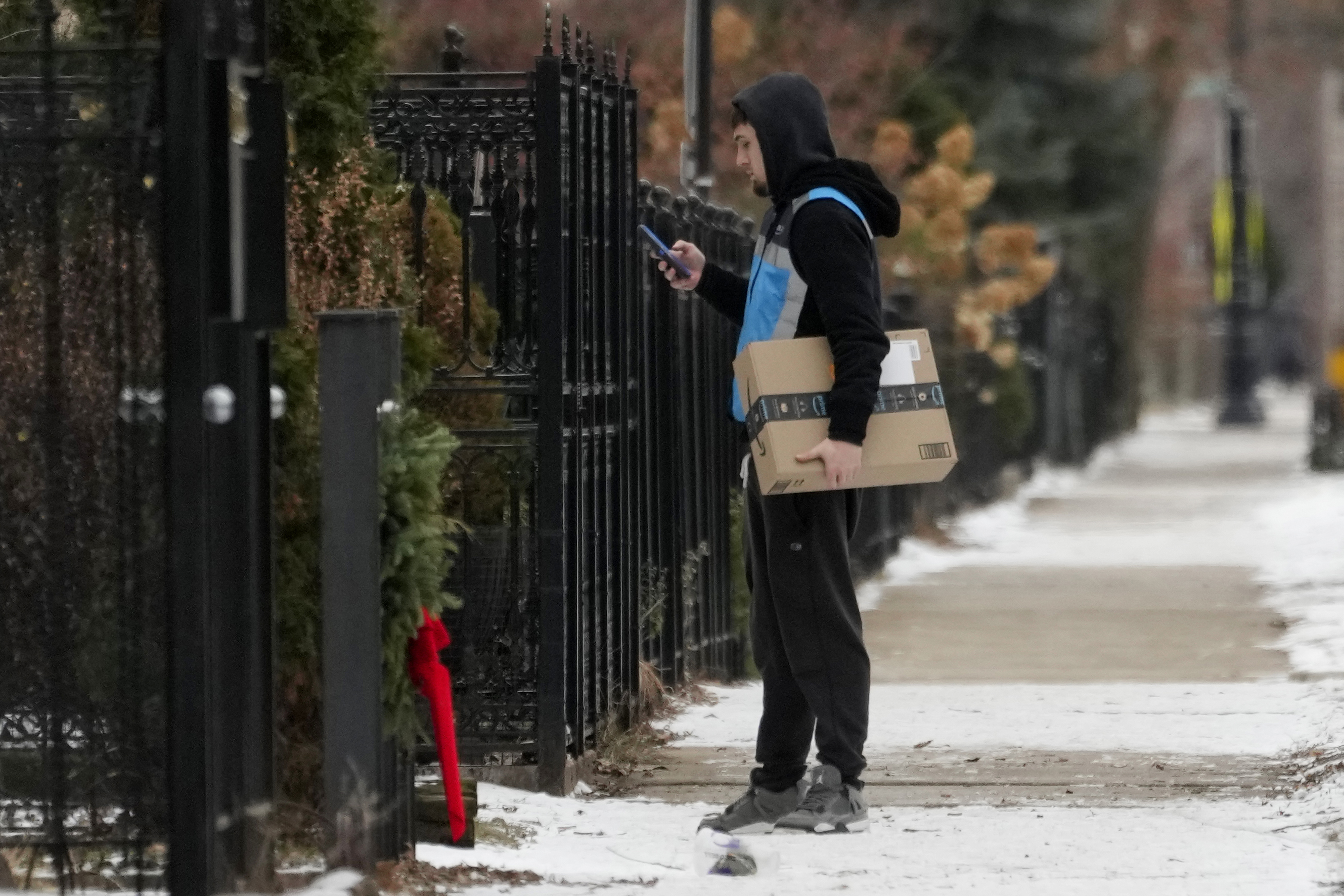
    A person checks an address before making an Amazon delivery in Chicago in January 2025.

    One owner who started an Amazon delivery business in 2019 blames skyrocketing premiums for slashing his annual profit from $400,000 to $150,000. He mostly employs young male drivers, whom insurers consider high-risk. His premiums soared after one driver was involved in a crash with serious injuries. When the case settled out of court for $1.4 million, the owner realized the risk wasn’t worth the reward.

    He went to the Amazon delivery station one Saturday evening to tell them he’d cease operating the next day, leaving the company scrambling to reassign thousands of packages to other firms. “They weren’t happy,” he said.

    Another delivery contractor who started when Amazon launched the program in 2018 said his yearly profits have been trending downward from about $200,000 to $160,000, which he expected to continue. His problems started when Amazon switched 10-hour delivery routes to begin later in the day at 11 a.m., meaning drivers made more deliveries in the dark when it’s harder to see street signs, addresses, and potential hazards like muddy puddles on dirt roads. That drove up his costs since he had to pay drivers overtime to complete routes and hire tow trucks to free vans stuck in mud. Amazon never increased his payments to reflect the increased costs associated with later deliveries.

    Amazon said it conducted a financial performance of 648 delivery contractors last year and found that about 80% of them generated annual profits of at least $100,000. The company said their profits, on average, increased each year. The average business has been operating for five years and fewer than 10% of them quit the program, according to Amazon.

    Some owners accept that running an Amazon delivery firm isn’t necessarily a long-term bet and prepare by diversifying. One delivery contractor in the Midwest started a plumbing franchise and encouraged his hardest-working delivery drivers to work there and learn a trade. Fred Vernon, 36, said starting an Amazon delivery business in 2019 in Houston has been life-changing. It’s hard work and he emphasizes driver safety to keep his insurance costs in line. Meanwhile, Vernon is using his proceeds to pay for law school.

    “We’re doing very well and I’m grateful for the opportunity to pursue other goals,” he said.

    Amazon delivery contractors quickly learn that bailing is no panacea. Unlike many small business owners, they have no hard assets to sell. They lease the vans, and the packages are stored in Amazon facilities. They could try to sell the business but it’s tied to a one-year contract with Amazon, which has veto power over any prospective buyer. So they can either quit with nothing or keep limping along with the knowledge that they could be replaced once the contract expires — perhaps with someone like Shannon Joseph.

    A former driver, Joseph launched her own delivery business in Austin in 2022. She says her experience hauling packages has helped build rapport with her 92 employees. Joseph has heard the complaints from other delivery firms, but is confident she’ll keep making money and growing by outperforming the pack.

    “I want to be one of the delivery partners who makes it for 10 years,” she said.

  • Pentagon accepts $130 million donation to help pay the military during the government shutdown

    Pentagon accepts $130 million donation to help pay the military during the government shutdown

    WASHINGTON — The Pentagon confirmed Friday that it has accepted an anonymous $130 million gift to help pay members of the military during the government shutdown, raising ethical questions after President Donald Trump had announced that a friend had offered the gift to defray any shortfalls.

    While large and unusual, the gift amounts to a small contribution toward the billions needed to cover service member paychecks. The Trump administration told Congress last week that it used $6.5 billion to make payroll. The next payday is coming within the week, and it is unclear if the administration will again move money around to ensure the military does not go without compensation.

    “That’s what I call a patriot,” Trump said during a White House event Thursday when he disclosed the payment from the donor.

    The president declined to name the person, whom he called “a friend of mine,” saying the man didn’t want the recognition.

    The Pentagon confirmed it had accepted the donation on Thursday “under its general gift acceptance authority.”

    “The donation was made on the condition that it be used to offset the cost of Service members’ salaries and benefits,” said Sean Parnell, chief spokesman for the Pentagon. “We are grateful for this donor’s assistance after Democrats opted to withhold pay from troops.”

    Congress is at a stalemate over the government shutdown, now on track to become one of the longest federal closures ever, in its 24th day. Neither Republicans, who have control of the House and Senate, nor Democrats, in the minority, are willing to budge in their broader standoff over health care funding.

    Payment for service members is a key concern among lawmakers of both parties as well as a point of political leverage. The Trump administration shifted $8 billion from military research and development funds to make payroll last week, ensuring that military compensation did not lapse.

    But it is unclear if the Trump administration will be willing — or able — to shift money again next week as tensions rise over the protracted shutdown.

    While the $130 million is a hefty sum, it would cover just a fraction of the billions needed for military paychecks. Trump said the donation was to cover any “shortfall.”

    What’s unclear, however, is the regulations around such a donation.

    “That’s crazy,” said Max Stier, president and CEO of the Partnership for Public Service, a nonpartisan organization focused on the federal government.

    “It’s treating the payment of our uniformed services as if someone’s picking up your bar tab.”

    He questioned the legality of the donation and called for more transparency around it.

    Pentagon policy says authorities “must consult with their appropriate Ethics Official before accepting such a gift valued in excess of $10,000 to determine whether the donor is involved in any claims, procurement actions, litigation, or other particular matters involving the Department that must be considered prior to gift acceptance.”