Category: Wires

  • Boy who appeared in Bad Bunny’s Super Bowl show is not the 5-year-old detained by ICE in Minneapolis

    Boy who appeared in Bad Bunny’s Super Bowl show is not the 5-year-old detained by ICE in Minneapolis

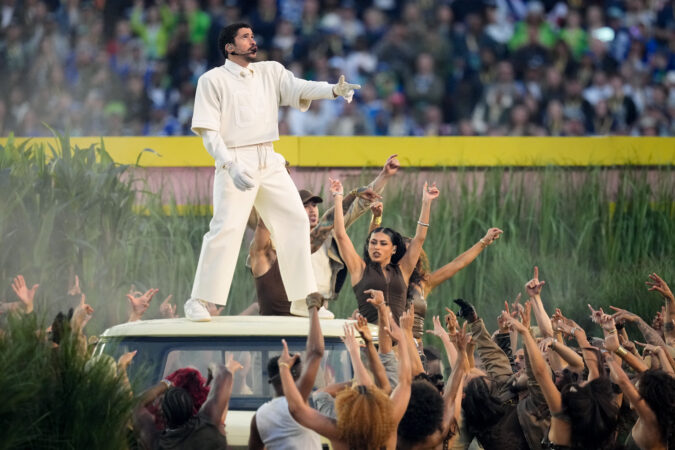
    Social media users incorrectly identified a small boy who was part of Bad Bunny’s Super Bowl halftime show on Sunday as Liam Conejo Ramos, the 5-year-old who, along with his father, was detained by immigration officials in Minnesota and held at an ICE facility in Texas.

    The boy was actually Lincoln Fox Ramadan, a child actor from Costa Mesa, Calif., who is also 5 years old, according to his Instagram profile.

    After Bad Bunny finished his song “NUEVAYoL,” cameras showed Lincoln watching Bad Bunny accepting his Grammy for album of the year last week. The artist then walks over and hands Lincoln what appears to be a Grammy.

    Here’s a closer look at the facts.

    Claim: Bad Bunny handed his Grammy to Liam Conejo Ramos during his Super Bowl halftime performance.

    The Facts: This is false. The boy was child actor Lincoln Fox Ramadan.

    “An emotional, unforgettable day being cast as the young Benito — a symbolic moment where the future hands the past a Grammy,” reads a Monday post on Lincoln’s Instagram profile. “A reminder that dreams come true and it’s never too early to dream big.”

    The post includes photos from Lincoln’s appearance during the halftime show and other moments from the day, as well as a childhood photo of Bad Bunny, whose real name is Benito Antonio Martínez Ocasio.

    In the caption, Lincoln also wrote that he’s “sending love to Liam Ramos” and that “we all deserve peace and love in America, a country built by and home to so many hard-working immigrants.”

    Another post from Lincoln’s Instagram, shared on Sunday, included a video of his cameo and was captioned, “I’ll remember this day forever! @badbunnypr — it was my truest honor.” His last post before the Super Bowl, on Jan. 31, was a photo of himself captioned, “I booked a cool gig! Can’t wait to share it with you guys.”

    Liam and his father, Adrian Conejo Arias, who is originally from Ecuador, were detained by immigration officers in a Minneapolis suburb on Jan. 20. They were taken to an ICE detention facility in Dilley, Texas, but returned to Minneapolis on Feb. 1 following a judge’s order.

    Images of immigration officers surrounding the young boy in a blue bunny hat and Spider-Man backpack drew outrage about the Trump administration’s immigration crackdown in Minneapolis.

    Lincoln, the child actor, is half Egyptian and half Argentinian, according to his Instagram and his acting profile. He previous work has included modeling for Walmart and Target.

    Bad Bunny has won six total Grammys, including three at the 2026 awards show. His album of the year win for the critically-acclaimed DeBÍ TiRAR MáS FOToS, is the first time a Spanish-language album has taken home the top prize.

    Representatives for Bad Bunny did not respond to a request for comment.

  • Masks emerge as symbol of Trump’s ICE crackdown and a flashpoint in Congress

    Masks emerge as symbol of Trump’s ICE crackdown and a flashpoint in Congress

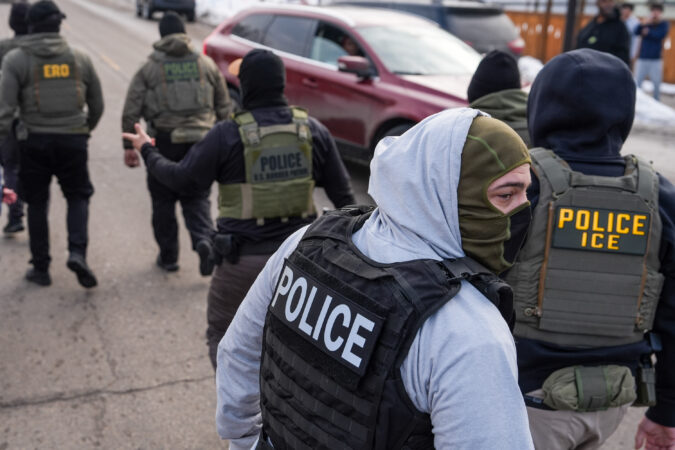
    WASHINGTON — Beyond the car windows being smashed, people tackled on city streets — or even a little child with a floppy bunny ears snowcap detained — the images of masked federal officers have become a flashpoint in the Trump administration’s immigration enforcement operations.

    Not in recent U.S. memory has an American policing operation so consistently masked its thousands of officers from the public, a development that the Department of Homeland Security believes is important to safeguard employees from online harassment. But experts warn masking serves another purpose, inciting fear in communities, and risks shattering norms, accountability, and trust between the police and its citizenry.

    Whether to ban the masks — or allow the masking to continue — has emerged as a central question in the debate in Congress over funding Homeland Security ahead of Friday’s midnight deadline, when it faces a partial agency shutdown.

    “Humans read each others’ faces — that’s how we communicate,” said Justin Smith, a former Colorado sheriff who is executive director and CEO of the National Sheriffs’ Association.

    “When you have a number of federal agents involved in these operations, and they can’t be identified, you can’t see their face, it just tends to make people uncomfortable,” he said. “That’s bringing up some questions.”

    Democrats demand ‘masks off’

    Masks on federal agents have been one constant throughout the first year of President Donald Trump’s mass deportation operation.

    What began as a jarring image last spring, when plain-clothes officers drawing up their masks surrounded and detained a Tufts University doctoral student near her Massachusetts home, has morphed into familiar scenes in Los Angeles, Chicago, and other cities. The shooting deaths of two American citizens at the hands of federal immigration officers during demonstrations against ICE raids in Minneapolis sparked widespread public protest and spurred lawmakers to respond.

    “Cameras on, masks off” has become a rallying cry among Democrats, who are also insisting the officers wear body cameras as a way to provide greater accountability and oversight of the operations.

    House Democratic Leader Hakeem Jeffries told reporters at the Capitol that unmasking the federal agents is a “hard red line” in the negotiations ahead.

    Immigration and Customs Enforcement says on its website that its officers “wear masks to prevent doxing, which can (and has) placed them and their families at risk. All ICE law enforcement officers carry badges and credentials and will identify themselves when required for public safety or legal necessity.”

    Fueled with funds from Trump’s big tax cuts bill, which poured some $170 billion into Homeland Security, ICE has grown to be among the largest law enforcement operations in the nation. Last year, it announced it had more than doubled its ranks, to 22,000, with rapid hiring — and $50,000 signing bonuses. Homeland Security did not respond to an emailed request for further comment.

    Most Republicans say the current political climate leaves the immigration officers, many of them new to the job, exposed if their faces and identities are made public.

    Sen. Thom Tillis (R., N.C.) said he just can’t agree with Democrats’ demand that officers unmask themselves.

    “You know, there’s a lot of vicious people out there, and they’ll take a picture of your face, and the next thing you know, your children or your wife or your husband are being threatened at home,” he said. “That’s just the reality of the world that we’re in.”

    ICE stands apart with masks

    It appears no other policing agency in the country regularly uses masking on a widespread basis. Instead, masks are used during special operations, particularly undercover work or at times during large crowd control or protest situations, and when there is inclement weather or individual health concerns.

    Experts said only perhaps during the Ku Klux Klan raids or in the Old West has masking been a more widely used tool.

    “It is without precedent in modern American history,” said the American Civil Liberties Union’s Naureen Shah in Washington.

    She said the idea of masked patrols on city streets seeking immigrants can leave people scared and confused about who they are encountering — which she suggested is part of the point.

    “I think it’s calculated to terrify people,” she said. “I don’t think anybody viscerally feels like, OK, this is something we want to become a permanent fixture in our streets.”

    Toward the end of the first Trump administration, Congress sought to clamp down after masked federal agents showed up in 2020 to quell protests in Portland, Ore., and other cities. A provision requiring agents to clearly identify themselves was tucked into a massive defense authorization bill that Trump assigned into law.

    Last year, California became the first state in the nation to ban most law enforcement officers, including federal immigration agents, from covering their faces. The Trump administration’s Justice Department sued, saying the state’s policies “create risk” for the agents.

    A federal judge on Monday blocked the part of the California law that would ban federal immigration agents from covering their faces, but they will still be required to wear clear identification showing their agency and badge number.

    Judge Christina Snyder said she issued the initial ruling because the mask ban as it was enacted did not also apply to state law enforcement authorities, discriminating against the federal government. The ruling could have national implications as states grapple with how to deal with federal agents enforcing the Trump administration’s immigration crackdown.

    It left open the possibility of future legislation banning federal agents from wearing masks if it applied to all law enforcement agencies, with Snyder writing “the Court finds that federal officers can perform their federal functions without wearing masks.” The ruling will go into effect Feb. 19.

    Police seek middle ground, advocates say unmasking not enough

    Smith, of the sheriffs’ association, said there’s no easy answer to the current masking debate.

    He suggested perhaps a middle ground could be reached — one that would allow officers to wear masks, but also require their badge or other identifying numbers to be prominently displayed.

    Advocates said while unmasking the federal agents would be an important step, other restraints on immigration enforcement operations may be even more so.

    They are pushing Congress to curb the ability of ICE officers to rely on administrative warrants in immigration operations, particularly to enter people’s homes, insisting such actions should be required to use judicial warrants, with sign-off from the courts.

    There is also an effort to end roving patrols — the ability of immigration officers to use a person’s race, language, or job location to question their legal status, sometimes called “Kavanaugh stops” after Supreme Court Justice Brett Kavanaugh’s concurring opinion to a Supreme Court decision last summer.

    Greg Chen, senior director of government affairs at the American Immigration Lawyers Association, said because Congress gave Homeland Security such robust funding in the tax cuts bill, “That’s why the policy reforms are so important right now to bring the agency in check.”

    Rep. Ayanna Pressley (D., Mass.), who recently returned from Minnesota, said the weight of the masked enforcement operation can be felt in ways that impact everyone — regardless of a person’s own immigration status.

    “It’s a very a heavy presence of surveillance and intimidation,” she said. “No one is exempt.”
  • Officials deny seeking quick end to asylum claims for the Minneapolis family of 5-year-old

    Officials deny seeking quick end to asylum claims for the Minneapolis family of 5-year-old

    MINNEAPOLIS — Federal authorities have denied attempting to expedite an end to asylum claims by the family of a 5-year-old boy who was detained with his father during the immigration crackdown that has shaken the Minneapolis area.

    Images of Liam Conejo Ramos wearing a bunny hat and Spider-Man backpack surrounded by immigration officers stirred outrage over the crackdown.

    Danielle Molliver, a lawyer for the boy and his father, told the New York Times that the government was attempting to speed up the deportation proceedings, calling the actions “extraordinary” and possibly “retaliatory.”

    The government denied that.

    “These are regular removal proceedings. They are not in expedited removal,” Department of Homeland Security official Tricia McLaughlin said in a statement, adding ”there is nothing retaliatory about enforcing the nation’s immigration laws.”

    Molliver told the Times that an immigration judge, during a closed Friday hearing, gave her additional time to argue the family’s case.

    The boy and his father, Adrian Conejo Arias, who originally is from Ecuador, were detained in a Minneapolis suburb on Jan. 20. They were taken to a detention facility in Dilley, Texas.

    They were released following a judge’s order and returned to Minnesota on Feb. 1.

    Neighbors and school officials have accused federal immigration officers of using the preschooler as “bait” by telling him to knock on the door to his house so that his mother would come outside. DHS has called that description of events an “abject lie.” It said the father fled on foot and left the boy in a running vehicle in their driveway.

    The government said the boy’s father entered the U.S. illegally from Ecuador in December 2024. The family’s lawyer said he has an asylum claim pending that allows him to stay in the U.S.

  • U.S. military boards sanctioned oil tanker in the Indian Ocean after pursuit from the Caribbean

    U.S. military boards sanctioned oil tanker in the Indian Ocean after pursuit from the Caribbean

    WASHINGTON — U.S. military forces boarded a sanctioned tanker in the Indian Ocean after tracking the ship from the Caribbean Sea as part of an oil quarantine meant to squeeze Venezuela, Defense Secretary Pete Hegseth said Monday.

    Venezuela had faced U.S. sanctions on its oil and relied on a shadow fleet of falsely flagged tankers to smuggle crude into global supply chains. Following the U.S. raid to apprehend then-President Nicolás Maduro in early January, several tankers fled the Venezuelan coast, including the ship that was boarded in the Indian Ocean overnight.

    Hegseth vowed to eventually capture all those ships, telling a group of shipyard workers in Maine on Monday that “the only guidance I gave to my military commanders is none of those are getting away.”

    “I don’t care if we got to go around the globe to get them; we’re going to get them,” he added.

    The Trump administration has seized seven tankers as part of its broader efforts to take control of the South American country’s oil. Unlike those previous actions, the Aquila II has not been formally seized and placed under U.S. control, a defense official said.

    Instead, the ship is being held while its ultimate fate is decided by the U.S., according to the official, who spoke on condition of anonymity to discuss ongoing decision-making.

    The Aquila II is a Panamanian-flagged tanker under U.S. sanctions related to the shipment of illicit Russian oil. Owned by a company with a listed address in Hong Kong, the ship’s tracking data shows it has spent much of the last year with its radio transponder turned off, a practice known as “running dark” commonly employed by smugglers to hide their location.

    It was one of at least 16 tankers that fled the Venezuelan coast last month, according to Samir Madani, co-founder of TankerTrackers.com, who said his organization used satellite imagery and surface-level photos to document the ship’s movements. According to data transmitted from the ship Monday, it is not currently laden with a cargo of crude oil.

    The Pentagon’s post on X said the military “conducted a right-of-visit, maritime interdiction” on the ship.

    “The Aquila II was operating in defiance of President Trump’s established quarantine of sanctioned vessels in the Caribbean,” the Pentagon said. “It ran, and we followed.”

    A Navy official, who spoke on condition of anonymity to discuss military operations, would not say what forces were used in the operation but confirmed the destroyers USS Pinckney and USS John Finn as well as the mobile base ship USS Miguel Keith were operating in the Indian Ocean.

    In videos the Pentagon posted to social media, uniformed forces can be seen boarding a Navy helicopter that takes off from a ship that matches the profile of the Miguel Keith. Video and photos of the tanker shot from inside a helicopter also show a Navy destroyer sailing alongside the ship.

    Since the U.S. ouster of Maduro in a surprise nighttime raid on Jan. 3, the Trump administration has set out to control the production, refining, and global distribution of Venezuela’s petroleum products. Officials in President Donald Trump’s Republican administration have made it clear they see seizing the tankers as a way to generate cash as they seek to rebuild Venezuela’s battered oil industry and restore its economy.

    Trump also has been trying to restrict the flow of oil to Cuba, which faces strict economic sanctions by the U.S. and relies heavily on oil shipments from allies like Mexico, Russia and Venezuela.

    Since the Venezuela operation, Trump has said that no more Venezuelan oil will go to Cuba and that the Cuban government is ready to fall. Trump also recently signed an executive order that would impose a tariff on any goods from countries that sell or provide oil to Cuba, primarily pressuring Mexico because it has acted as an oil lifeline for Cuba.

  • Venezuela’s top prosecutor orders the arrest of opposition leader’s ally, hours after his release

    Venezuela’s top prosecutor orders the arrest of opposition leader’s ally, hours after his release

    CARACAS, Venezuela — Venezuela’s top prosecutor said on Monday that his office had requested the arrest of one of the closest allies of opposition leader María Corina Machado, less than 12 hours after his release from a detention facility as part of a government move to free those facing politically motivated accusations.

    The attorney general’s statement did not say whether Juan Pablo Guanipa was rearrested, or give indication of his whereabouts. The government had released him along with several other prominent opposition members on Sunday following lengthy politically motivated detentions.

    Attorney General Tarek William Saab’s office posted on social media that it had “requested the competent court to revoke the precautionary measure granted to Juan Pablo Guanipa, due to his non-compliance with the conditions imposed by the aforementioned court.”

    It did not elaborate on what conditions Guanipa, a former governor for the opposition, violated during the hours he was free, but said authorities were seeking house arrest.

    Guanipa’s son, Ramón, told reporters Monday that authorities have not yet notified him of his father’s whereabouts and their decision to place him on house arrest. He said his father did not violate the two conditions of his release — monthly check-ins with a court and no travel outside Venezuela — and showed reporters the court document listing them.

    Abducted by ‘heavily armed men’

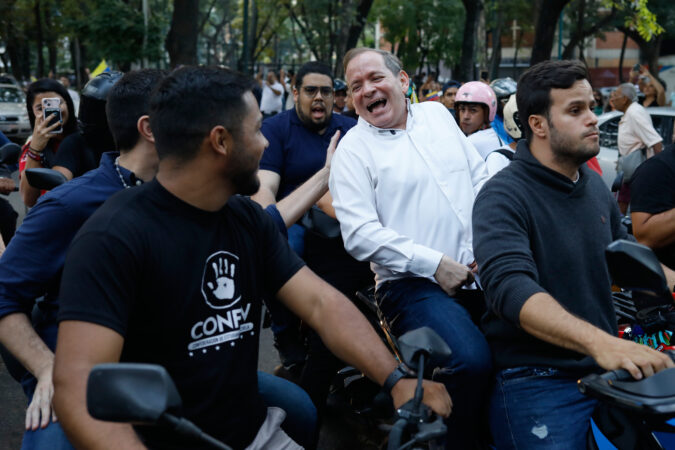
    Earlier on Monday, Machado announced Juan Pablo Guanipa had been “kidnapped” by “heavily armed men, dressed in civilian clothes” who “arrived in four vehicles and violently took him away” in a neighborhood in the capital, Caracas.

    The development marked the latest twist in the political turmoil in Venezuela in the wake of the U.S. military’s seizure on Jan. 3 of Nicolás Maduro and his wife, Cilia Flores, from a military base compound in Caracas in a stunning operation that landed them in New York to face federal drug trafficking charges.

    The government of Venezuela’s acting President Delcy Rodríguez has faced mounting pressure to free hundreds of people whose detentions months or years ago have been linked to their political activities. The releases also followed a visit to Venezuela of representatives of the U.N. High Commissioner for Human Rights.

    Rodríguez was sworn in as Venezuela’s acting president after Maduro’s Jan. 3 capture and her government began releasing prisoners days later.

    Some of those freed Sunday joined families waiting outside detention facilities for their loved ones. They chanted, “We are not afraid! We are not afraid!” and marched a short distance.

    “I am convinced that our country has completely changed,” Guanipa told reporters after his release. “I am convinced that it is now up to all of us to focus on building a free and democratic country.”

    Guanipa had spent more than eight months in custody at a facility in Caracas.

    “My father cannot be a criminal … simply for making statements,” Ramón Guanipa said. How much longer will speaking out be a crime in this country?”

    Venezuelan-based prisoners’ rights group Foro Penal confirmed the release of at least 30 people Sunday.

    Several members of Machado’s political organization were among the released Sunday, including attorney Perkins Rocha and local organizer María Oropeza, who had in 2024 livestreamed her arrest by military intelligence officers as they broke into her home with a crowbar.

    Alfredo Romero, president of Foro Penal, expressed serious concern over Juan Pablo Guanipa’s disappearance.

    “So far, we have no clear information about who took him,” he said on X. “We hope he will be released immediately.”

    Long detentions for political activities

    Guanipa was detained in late May and accused by Interior Minister Diosdado Cabello of participating in an alleged “terrorist group” that was plotting to boycott that month’s legislative election. Guanipa’s brother Tomás rejected the accusation, and said the arrest was meant to crack down on dissent.

    Rodríguez’s government announced Jan. 8 that it would free a significant number of those arrested — a central demand of the country’s opposition and human rights organizations with backing from the United States — but families and rights watchdogs have criticized authorities for the slow pace of the releases.

    The ruling party-controlled National Assembly last week began debating an amnesty bill that could lead to the release of hundreds. The opposition and nongovernmental organizations have reacted with cautious optimism as well as with suggestions and demands for more information on the contents of the proposal.

    National Assembly President Jorge Rodríguez on Friday posted a video on Instagram showing him outside a detention center in Caracas and saying that “everyone” would be released no later than next week, once the amnesty bill is approved.

    Rodríguez, the acting president, and Volker Türk, the U.N. High Commissioner for Human Rights, spoke by phone in late January. His spokesperson, Ravina Shamdasani, in a statement said he sent a team to the country and “offered our support to help Venezuela work on a roadmap for dialogue and reconciliation” in which human rights should be centered.

  • In new video, Savannah Guthrie says family is ‘at an hour of desperation’

    In new video, Savannah Guthrie says family is ‘at an hour of desperation’

    TUCSON, Ariz. — The FBI said Monday it is unaware of any continued communication between Savannah Guthrie’s family and suspected kidnappers more than a week after the Today show host’s mom went missing.

    The FBI has still not identified any suspects or persons of interest in the mysterious disappearance of 84-year-old Nancy Guthrie, said Connor Hagan, a spokesperson for the FBI.

    Savannah Guthrie said the family was “at an hour of desperation” in a video released Monday, just hours before a purported ransom deadline apparently set by her mom’s abductors.

    Savannah Guthrie didn’t mention the deadline in the video, saying her family continues to believe their 84-year-old mother is out there and hearing everyone’s prayers.

    “She was taken and we don’t know where and we need your help,” Guthrie said in the video posted on Instagram that urged people nationwide to be on the lookout. “No matter where you are, even if you’re far from Tucson, if you see anything, if you hear anything.”

    The mysterious disappearance and search has riveted the U.S. — from President Donald Trump, who spoke with Savannah Guthrie last week, to the online sleuths who’ve flooded social media with tips, theories, and rumors.

    The FBI is now asking for the public’s help on digital billboards up in several major cities in Texas, California, Arizona, and New Mexico. The FBI has offered a $50,000 reward for information.

    Multiple press outlets have received alleged ransom letters during the past week. At least one letter made monetary demands and set deadlines for receiving the money. The first deadline passed last Thursday but a second one was set for Monday evening.

    Law enforcement officials declined to affirm that the letters were credible but said all tips were being investigated seriously.

    Authorities say they have growing concerns about Nancy Guthrie’s health because she needs daily medication. She is said to have a pacemaker and has dealt with high blood pressure and heart issues, according to sheriff’s dispatcher audio on broadcastify.com.

    Investigators returned to Nancy Guthrie’s Arizona neighborhood several times over the weekend.

    Savannah Guthrie said over the weekend that the family was prepared to pay for her mother’s return.

    “We beg you now to return our mother to us so that we can celebrate with her,” she said in a video posted Saturday. “This is the only way we will have peace. This is very valuable to us, and we will pay.”

    Authorities believe Nancy Guthrie was taken against her will from her home just outside Tucson. She was last seen there on Jan. 31 and reported missing the next day after not attending church services. DNA tests showed blood on Guthrie’s front porch was a match to her and her doorbell camera was disconnected in the early hours of Sunday morning, Pima County Sheriff Chris Nanos has said.

    Outside the home on Monday, neighbors strolled by on their morning jogs and walks, while a county sheriff’s deputy remained stationed out front.

    Detectives and agents carried out follow-up work at multiple locations over the weekend as part of the investigation, the Pima County Sheriff’s Department said Sunday. “Investigators have not identified any suspects, persons of interest, or vehicles connected to this case,” the department said.

    Investigators on Saturday were inside daughter Annie Guthrie’s home, about 4 miles from Nancy Guthrie’s house. On Sunday, an investigator was seen using a pole to search an underground tank behind Nancy Guthrie’s home.

  • British PM Starmer vows to fight for his job after furor about former ambassador’s Epstein ties

    British PM Starmer vows to fight for his job after furor about former ambassador’s Epstein ties

    LONDON — British Prime Minister Keir Starmer vowed Monday to fight for his job as revelations about the relationship between the former U.K. ambassador to Washington and Jeffrey Epstein spiraled into a full-blown crisis for his 19-month-old government.

    The prime minister’s authority with his own Labour Party has been battered by fallout from the publication of files related to Epstein — a man he never met and whose sexual misconduct has not implicated Starmer.

    Some lawmakers in Starmer’s center-left Labour Party have called on him to resign for his judgment in appointing Peter Mandelson to the high-profile diplomatic post in 2024 despite Mandelson’s ties to the convicted sex offender. The leader of the Labour Party in Scotland, Anas Sarwar, joined those calls Monday, saying “there have been too many mistakes” and “the leadership in Downing Street has to change.”

    Starmer’s chief of staff and his communications director have also quit in quick succession. But Starmer insisted he will not step down.

    “Every fight I have ever been in, I’ve won,” he told Labour lawmakers at a meeting in Parliament.

    “I’m not prepared to walk away from my mandate and my responsibility to my country,” he added.

    After Sarwar spoke, senior colleagues — including those tipped as potential challengers — rallied to support Starmer. Deputy Prime Minister David Lammy wrote on X: “We should let nothing distract us from our mission to change Britain and we support the Prime Minister in doing that.”

    Foreign Secretary Yvette Cooper posted: “At this crucial time for the world, we need his leadership not just at home but on the global stage.” Former Deputy Prime Minister Angela Rayner, a potential successor, said Starmer “has my full support.”

    Supportive lawmakers said Starmer won over a restive crowd when he addressed scores of Labour members of Parliament Monday evening behind closed doors.

    “Of course, there were tough moments,” legislator Chris Curtis said. “But he really brought the room round.”

    Starmer has apologized

    Starmer fired Mandelson last September after emails were published showing that he maintained a friendship with Epstein after the financier’s 2008 conviction for sex offenses involving a minor. Critics say Starmer should have known better than to appoint Mandelson in the first place. The 72-year-old Labour politician is a contentious figure whose career has been tarnished with scandals over money or ethics.

    A new trove of Epstein files released by authorities in the United States last week revealed more details about the relationship and put new pressure on Starmer.

    Starmer apologized last week to Epstein’s victims and said he was sorry for “having believed Mandelson’s lies.”

    He promised to release documentation related to Mandelson’s appointment, which the government says will show that Mandelson misled officials about his ties to Epstein. But publication of the documents could be weeks away. They must be vetted on national security grounds and for potential conflicts with a police investigation.

    Police are investigating Mandelson for potential misconduct in public office over documents suggesting he passed sensitive government information to Epstein a decade and a half ago. The offense carries a maximum sentence of life in prison.

    Mandelson has not been arrested or charged, and he does not face any allegations of sexual misconduct.

    Chief of staff took the fall

    Starmer’s chief of staff, Morgan McSweeney, took the fall for the decision to give Mandelson the job by quitting on Sunday. He said he “advised the prime minister to make that appointment, and I take full responsibility for that advice.”

    McSweeney has been Starmer’s most important aide since he became Labour leader in 2020 and is considered a key architect of Labour’s landslide July 2024 election victory. But some in the party blame him for a series of missteps since then.

    Some Labour officials hope that his departure will buy the prime minister time to rebuild trust with the party and the country.

    Senior lawmaker Emily Thornberry said McSweeney had become a “divisive figure” and his departure brought the opportunity for a reset.

    She said Starmer is “a good leader in that he is strong and clear. I think that he needs to step up a bit more than he has.”

    Others say McSweeney’s departure leaves Starmer weak and isolated.

    Opposition calls to resign

    Opposition Conservative Party leader Kemi Badenoch said Starmer “has made bad decision after bad decision” and “his position now is untenable.”

    Since winning office, Starmer has struggled to deliver promised economic growth, repair tattered public services, and ease the cost of living. He pledged a return to honest government after 14 years of scandal-tarred Conservative rule, but has been beset by missteps and U-turns over welfare cuts and other unpopular policies.

    Labour consistently lags behind the hard-right Reform UK party in opinion polls, and its failure to improve had sparked talk of a leadership challenge, even before the Mandelson revelations.

    Under Britain’s parliamentary system, prime ministers can change without the need for a national election. If Starmer is challenged or resigns, it will trigger an election for the Labour leadership. The winner would become prime minister.

    The Conservatives went through three prime ministers between national elections in 2019 and 2024, including Liz Truss, who lasted just 49 days in office.

    Starmer was elected on a promise to end the political chaos that roiled the Conservatives’ final years in power.

    Labour lawmaker Clive Efford said Starmer’s critics should “be careful what you wish for.”

    “I don’t think people took to the changes in prime minister when the Tories were in power,” he told the BBC. “It didn’t do them any good.”

  • Ghislaine Maxwell declines to answer questions from a House committee, offers testimony for clemency

    Ghislaine Maxwell declines to answer questions from a House committee, offers testimony for clemency

    WASHINGTON — Ghislaine Maxwell, the former girlfriend of Jeffrey Epstein, declined to answer questions from House lawmakers in a deposition Monday, but indicated that if President Donald Trump ended her prison sentence, she was willing to testify that neither he nor former President Bill Clinton had done anything wrong in their connections with Epstein.

    The House Oversight Committee had wanted Maxwell to answer questions during a video call to the federal prison camp in Texas where she’s serving a 20-year sentence for sex trafficking, but she invoked her Fifth Amendment rights to avoid answering questions that would be self-incriminating. She’s come under new scrutiny as lawmakers try to investigate how Epstein, a well-connected financier, was able to sexually abuse underage girls for years.

    Amid a reckoning over Epstein’s abuse that has spilled into the highest levels of businesses and governments around the globe, lawmakers are searching for anyone who was connected to Epstein and may have facilitated his abuse. So far, the revelations have shown how both Trump and Clinton spent time with Epstein in the 1990s and early 2000s, but they have not been credibly accused of wrongdoing.

    During the closed-door deposition Monday, Maxwell’s attorney David Oscar Markus said in a statement to the committee that “Maxwell is prepared to speak fully and honestly if granted clemency by President Trump.”

    He added that both Trump and Clinton “are innocent of any wrongdoing,” but that ”Ms. Maxwell alone can explain why, and the public is entitled to that explanation.”

    Maxwell’s appeal hits pushback

    Democrats said that was a brazen effort by Maxwell to have Trump end her prison sentence.

    “It’s very clear she’s campaigning for clemency,” said Rep. Melanie Stansbury, a New Mexico Democrat.

    Another Democratic lawmaker, Rep. Suhas Subramanyam of Virginia, described Maxwell’s demeanor during the short video call as “robotic” and “unrepentant.”

    Asked Monday about Maxwell’s appeal, the White House pointed to previous remarks from the president that indicated the prospect of a pardon was not on his radar.

    And other Republicans push backed on the notion quickly after Maxwell made the appeal.

    “NO CLEMENCY. You comply or face punishment,” Republican Rep. Anna Paulina Luna of Florida wrote on social media. “You deserve JUSTICE for what you did you monster.”

    Maxwell has also been seeking to have her conviction overturned, arguing that she was wrongfully convicted. The Supreme Court rejected her appeal last year, but in December she requested that a federal judge in New York consider what her attorneys describe as “substantial new evidence” that her trial was spoiled by constitutional violations.

    Maxwell’s attorney cited that petition as he told lawmakers she would invoke her Fifth Amendment rights.

    Family members of the late Virginia Giuffre, one of the most outspoken victims of Epstein, also released a letter to Maxwell making it clear they did not consider her “a bystander” to Epstein’s abuse.

    “You were a central, deliberate actor in a system built to find children, isolate them, groom them, and deliver them to abuse,” Sky and Amanda Roberts wrote in the letter addressed to Maxwell.

    Maxwell was moved from a federal prison in Florida to a low-security prison camp in Texas last summer after she participated in two days of interviews with Deputy Attorney General Todd Blanche.

    The Republican chairperson of the committee, Rep. James Comer of Kentucky, had also subpoenaed her at the time, but her attorneys have consistently told the committee that she wouldn’t answer questions. However, Comer came under pressure to hold the deposition as he pressed for the committee to enforce subpoenas on Bill Clinton and former Secretary of State Hillary Clinton. After Comer threatened them with contempt of Congress charges, they both agreed to sit for depositions later this month.

    Comer has been haggling with the Clintons over whether that testimony should be held in a public hearing, but Comer reiterated Monday that he would insist on holding closed-door depositions and later releasing transcripts and video.

    Lawmakers review unredacted files

    Meanwhile, several lawmakers visited a Justice Department office in Washington Monday to look through unredacted versions of the files on Epstein that the department has released to comply with a law passed by Congress last year. As part of an arrangement with the Justice Department, lawmakers were given access to the over 3 million released files in a reading room with four computers. Lawmakers can only make handwritten notes, and their staff are not allowed in with them.

    Rep. Jamie Raskin, the top Democrat on the House Judiciary Committee, spent several hours in the reading room Monday morning. He told reporters as he returned to the Capitol that even if all the House members who triggered the vote on releasing the files “spent every waking hour over at the Department of Justice, it would still take us months to get through all of those documents.”

    Democrats on Raskin’s committee are looking ahead to a Wednesday hearing with Attorney General Pam Bondi, where they are expected to sharply question her on the publication of the Epstein files. The Justice Department failed to redact the personal information of many victims, including inadvertently releasing nude photos of them.

    “Over and over we begged them, please be careful, please be more careful,” said Jennifer Freeman, an attorney representing survivors. “The damage has already been done. It feels incompetent, it feels intimidating and it feels intentional.”

    Democrats also say the Justice Department redacted information that should have been made public, including information that could lead to scrutiny of Epstein’s associates.

    Rep. Thomas Massie, a Kentucky Republican who sponsored the legislation to force the release of the files, said that after reviewing the unredacted versions for several hours, he had found the names of six men “that are likely incriminated by their inclusion.” He called on the Justice Department to pursue accountability for the men, but said he could potentially name them in a House floor speech, where his actions would be constitutionally protected from lawsuits.

    Massie, along with California Democratic Rep. Ro Khanna, said they also came across a number of files that still had redactions. They said that was likely because the FBI had turned over redacted versions of the files to the Justice Department.

    Khanna said “it wasn’t just Epstein and Maxwell” who were involved in sexually abusing underage girls.

    Release of the files has set in motion multiple political crises around the world, including in the United Kingdom, where Prime Minister Keir Starmer is clinging to his job after it was revealed his former ambassador to the U.S. had maintained close ties to Epstein. But Democratic lawmakers bemoaned that so far U.S. political figures seem to be escaping unscathed.

    “I’m just afraid that the general worsening and degradation of American life has somehow conditioned people not to take this as seriously as we should be taking it,” Raskin said.

  • Seahawks ride their ‘Dark Side’ defense to a Super Bowl title, pounding the Patriots 29-13

    Seahawks ride their ‘Dark Side’ defense to a Super Bowl title, pounding the Patriots 29-13

    SANTA CLARA, Calif. — Defense won this championship.

    Devon Witherspoon, Derick Hall, Byron Murphy and the rest of Mike Macdonald’s ferocious unit pummeled Drake Maye, and the Seattle Seahawks beat the New England Patriots 29-13 on Sunday to win the franchise’s second Super Bowl.

    Sam Darnold threw a touchdown pass to AJ Barner, Kenneth Walker III ran for 135 yards and Jason Myers made all five of his field-goal tries.

    Uchenna Nwosu punctuated a punishing defensive performance by snagging Maye’s pass in the air after Witherspoon hit his arm and ran it back 45 yards for a pick-6.

    Seattle’s “Dark Side” defense helped Darnold become the first quarterback in the 2018 draft class to win a Super Bowl, ahead of Josh Allen, Baker Mayfield and Lamar Jackson.

    Labeled a bust, dumped by two teams and considered expendable by two others, Darnold proved his doubters wrong while helping the Seahawks go 17-3.

    After leading the NFL with 20 turnovers in the regular season, Darnold didn’t have any in three playoff games. He wasn’t particularly sharp against a solid Patriots defense but protected the ball and made enough plays, finishing 19 of 38 for 202 yards.

    The Seahawks sacked Maye six times, including two apiece by Hall and Murphy. Hall’s strip-sack late in the third quarter set up a short field and Darnold connected with Barner on 16-yard scoring toss to make it 19-0.

    Julian Love’s interception set up another field goal that made it 22-7 with 5:35 left.

    The Patriots (17-4) punted on the first eight drives, excluding a kneel-down to end the first half.

  • Trump plans to keep Democratic governors out of traditionally bipartisan meeting

    Trump plans to keep Democratic governors out of traditionally bipartisan meeting

    President Donald Trump plans to keep Democrats out of a traditionally bipartisan White House gathering of governors typically held as part of the National Governors Association’s annual Washington summit, the organization said.

    According to the governors’ offices, the president also revoked invitations sent to Maryland Gov. Wes Moore (D), the NGA’s vice chair; and Colorado Gov. Jared Polis (D) to attend a second White House event scheduled to occur around the summit: a dinner for governors.

    “This week, I learned that I was uninvited to this year’s National Governors Association dinner — a decades-long annual tradition meant to bring governors from both parties together to build bonds and celebrate a shared service to our citizens with the President of the United States,” Moore said in a statement Sunday. “… It’s hard not to see this decision as another example of blatant disrespect and a snub to the spirit of bipartisan federal-state partnership.”

    Moore told CNN’s State of the Union on Sunday that he was confused by the White House’s decision, saying that, just a few weeks ago, he led a bipartisan group of governors who met with the president as Trump signed a memorandum on bringing down energy costs.

    Moore also said on CNN that it was “not lost” on him that he is the only Black governor of a state.

    “I find that to be particularly painful, considering the fact that the president is trying to exclude me from an organization that not only my peers have asked me to help to lead, but then also a place where I know I belong in,” he said. “I’m never in a room because of someone’s benevolence nor kindness. I’m not in a room because of a social experiment. I’m in the room because I belong there and the room was incomplete until I got there.”

    Spokespeople for Polis, as well as representatives of the Democratic Governors Association, did not immediately respond to a request for comment.

    While Moore and Polis were excluded from the dinner with Trump, some Democrats remained invited to the gathering.

    The White House did not explain why Democratic governors were not invited to the meeting with Trump, and a spokesperson did not respond to a request to provide a list of Democrats who were invited to the dinner.

    Trump has frequently clashed with Moore and Polis, and his decision comes after months of conflict between the federal government and Democratic governors.

    Moore has condemned the president’s threat to deploy the National Guard to Baltimore and defund Maryland’s efforts to replace the fallen Key Bridge. Trump has also repeatedly claimed that Baltimore is “crime ridden” despite the fact that the city is experiencing its lowest homicide rate in 50 years.

    Polis and Trump have repeatedly feuded over Tina Peters, a former county clerk in Colorado who was convicted in state court on felony charges related to efforts to overturn the 2020 presidential election. Polis has defended the conviction and refused the White House’s request to transfer Peters to a federal prison. Because of this, in December, Trump in a Truth Social post called Polis a “scumbag” and said he should “rot in Hell.”

    The NGA’s Washington meetings are expected to take place Feb. 19 to 21. The organization said Friday that the White House meeting will no longer be part of the association’s official schedule.

    In a statement Friday, Brandon Tatum, the interim CEO of the NGA, said that the “bipartisan White House governors meeting is an important tradition, and we are disappointed in the administration’s decision to make it a partisan occasion this year.”

    “To disinvite individual governors to the White House sessions undermines an important opportunity for federal-state collaboration,” Tatum said. “At this moment in our nation’s history, it is critical that institutions continue to stand for unity, dignity and constructive engagement.”