Category: Wires

  • Why Trump’s algae problem is much bigger than the Reflecting Pool

    Why Trump’s algae problem is much bigger than the Reflecting Pool

    In his battle to clean the murky waters of the Lincoln Memorial Reflecting Pool, President Donald Trump has tried draining, painting, hydrogen peroxide, and what the Interior Department describes as “high-tech nanobubble ozone technology.” But he has seemingly overlooked two of the most important factors that experts say are driving unsightly — and sometimes dangerous — profusions of algae: pollution and climate change.

    Algae thrive in warm, still waters, causing populations to explode as global temperatures rise, said environmental engineer Steve Chapra, an emeritus professor at Tufts University.

    Meanwhile, rampant human development has increased the amount of fertilizer and sewage produced by farms and cities, and severe storms intensified by the warmer atmosphere are causing more of these pollutants to run off into local waterways — providing algae with the nutrients they need to grow.

    In a 2017 study, Chapra and his colleagues projected that climate change would cause a more than fivefold increase in the number of days when U.S. water bodies are affected by harmful algal blooms.

    Short-term measures like those Trump has pursued may temporarily reduce algae populations in some water bodies, Chapra said. But unless they grapple with warming and nutrient pollution, any efforts to address these blooms in the Reflecting Pool and elsewhere are doomed to fail in the long run.

    The consequences could be profound, because the problems presented by blooms go far beyond aesthetics, he added. They can disrupt aquatic food chains, deplete oxygen in water bodies and even produce deadly toxins.

    “It’s probably the biggest water quality problem in the world,” Chapra said. “The Reflecting Pool is the canary in the coal mine.”

    A spokesperson for the Interior Department did not respond to questions about whether the department had considered nutrient pollution or water temperature in planning the pool’s refurbishment. In an email, the agency reiterated that the National Park Service is using hydrogen peroxide and ozone nanobubbles, which break up algae by damaging their cells.

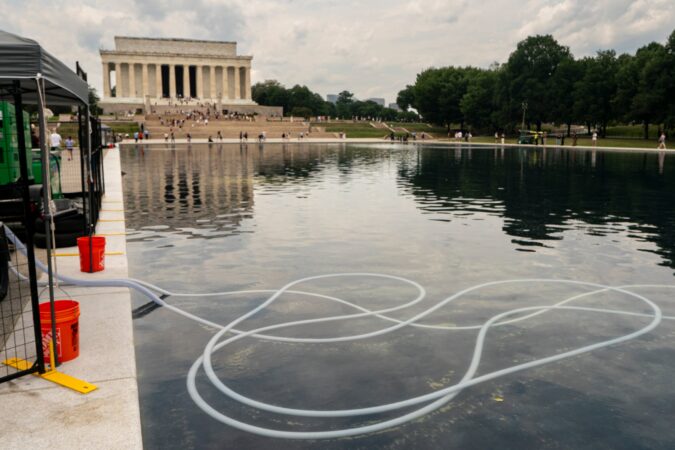
    The Reflecting Pool has been beset by algae blooms, as seen Monday.

    The root causes of blooms

    Algal blooms have long thrived in the Reflecting Pool, thanks to stagnant, shallow water enriched by pollution and warmed by sweltering D.C. summers.

    Since 2012, the pool has been filled from the Tidal Basin, which in turn is fed by the Potomac River. Both water bodies contain excessive amounts of nitrogen and phosphorous — the nutrients most loved by algae — and are designated as “impaired” by the Environmental Protection Agency, meaning they don’t meet basic water quality standards for swimming, fishing, and supporting aquatic life.

    Trump said his $14 million renovation this spring would clean the pool’s algae-clouded waters by sealing leaks and painting the bottom “American flag blue.”

    But the refurbishment didn’t address the pollution that is the root cause of algal growth, said Hans Paerl, an aquatic ecologist at University of North Carolina at Chapel Hill. The pool was refilled on June 4 using the same nutrient-rich Tidal Basin water as before.

    The spate of warm, sunny days that followed — June so far has been about 2 degrees Fahrenheit hotter than normal, according to the National Weather Service — provided ideal conditions for the photosynthetic creatures to multiply. Those high temperatures may have been exacerbated by the pool’s new dark blue coating, which absorbs more heat than its previous gray finish, Chapra said.

    Within days, satellite data showed that the Reflecting Pool contained more algae than at any recorded point in June for at least five years.

    The bloom that turned the pool green shortly after it was refilled was likely caused by a single-celled organism called cyanobacteria, Paerl said. Pictures of the pool showed a characteristic bright green scum coating the surface of the water.

    Cyanobacteria blooms are the most dangerous, Paerl said, because they produce toxic compounds that can cause rashes, vomiting, and neurological problems in people who touch or ingest them.

    After the Interior Department treated the pool with hydrogen peroxide, which breaks down cyanobacteria’s cell membrane and disrupts photosynthesis, the cyanobacteria bloom seemed to wane.

    But the water’s sickly green sheen remains. Aquatic ecologist Rosalina Christova, a George Mason University researcher who acquired a sample from the Reflecting Pool on June 15, found that the water had been colonized by a genus of multicellular green algae called Desmodesmus. In an email, she called the population “very dense.”

    The green algae are more resistant to the effects of hydrogen peroxide, and they were likely able to capitalize on the nutrients released from the disintegrating bodies of the slain cyanobacteria, Paerl said.

    “This created a niche for another player, so to speak,” he said. “Nutrients keep cycling through there and feed whatever blooms.”

    A growing global threat

    Though the administration’s concerns about algae in the Reflecting Pool are in part cosmetic, the proliferation of blooms in waterways across the planet pose a significant — and growing — threat, said Joaquim Goes, a biogeochemist at Columbia University.

    By studying satellite images of the ocean, he found that microalgae scums — caused by the same tiny organisms as those afflicting the Reflecting Pool — have expanded at a rate of 1% per year since 2003. The phenomenon has disrupted food chains and created oxygenless “dead zones” where fish can’t survive.

    “It is spreading like wildfire all over the world,” Goes said. “And there is no question that temperature is playing a role.”

    Blooms are also increasing in freshwater bodies that supply people’s drinking water, research shows.

    A 2022 EPA assessment found that 49% of U.S. lakes showed excess amounts of chlorophyll a, the photosynthetic compound that indicates presence of cyanobacteria and green algae. Detections of microcystins, a class of toxin produced by cyanobacteria, increased by almost 30 percentage points since the previous assessment was conducted five years earlier.

    Massive cyanobacteria blooms have poisoned important fisheries, such as in Lake Erie. They can imperil important ecosystems, like the Everglades below Florida’s Lake Okeechobee. They have been linked to the deaths of dogs, cattle and, in rare cases, humans.

    Even green algae, which do not produce toxins, can clog filtration systems and disrupt drinking water supplies. When they die, the decomposition of their bodies depletes oxygen in the surrounding water, killing other aquatic life.

    The National Office for Harmful Algal Blooms, funded by the National Oceanic and Atmospheric Administration, estimates that phenomenon causes an average $50 million in damage to the U.S. economy each year. Individual severe events can cause even greater harm: An unprecedented “red tide” cost roughly $2.7 billion in decreased tourism revenue when it forced the closure of beaches across southern Florida in 2018.

    Lasting solutions

    Theories about the persistence of the Reflecting Pool algae abound.

    The Interior Department has blamed residual organisms that remained in supply lines after the renovation. Some have speculated that the recent blooms are a product of liberal “sabotage.”

    The Trump administration has said it plans to drain the pool again to address algae growth and paint that is peeling from its bottom.

    But those measures are unlikely to prevent algae from reemerging, said environmental engineer Victor Bierman, a retired water quality consultant and former EPA scientist.

    As summer heat continues to ramp up, he worries the green algae could be replaced by cyanobacteria, which have no predators and readily outcompete other microbes at high temperatures.

    “You can get rid of an existing bloom, but if you don’t change the underlying conditions … you’re going to grow more algae,” Bierman said.

    Officials could stymie growth by increasing the flow of water through the pool, but that would disrupt the still surface needed for it to be reflective, he added. A better option would be installing an enhanced filtration system that removes nutrients from the Tidal Basin water before it is pumped into the pool.

    Ultimately, said Chapra, algae blooms will continue to plague the Reflecting Pool and countless other water bodies until people address the human-made problems of nutrient runoff and climate change.

    “If you don’t follow the science, then you think it’s magic or espionage, and it’s not,” Chapra said. “This is basic biology.”

  • Senate for first time approves a war powers resolution in a rebuke to Trump over Iran conflict

    Senate for first time approves a war powers resolution in a rebuke to Trump over Iran conflict

    WASHINGTON — The Senate for the first time approved a war powers resolution Tuesday seeking to block U.S. military action against Iran, as lawmakers warily watch President Donald Trump’s efforts to resolve a conflict that the administration launched on its own and now needs Congress to fund.

    It was the 10th time the Senate has tried to stop the war, and the outcome, on a vote of 50-48, was a stunning turnaround from past efforts. While the resolution is largely symbolic, and does not carry the full force of law, it reflects the growing concerns from a number of Republican lawmakers in both the House and Senate over both the war and the deal Trump struck with Iran to end it. The House approved the resolution earlier this month.

    Trump responded angrily Tuesday night on his Truth Social platform, calling the vote “poorly timed and meaningless” and saying it “provided aid and comfort” to Iran.

    Senate Democratic Leader Chuck Schumer of New York said, “Time after time, the vast majority of Senate Republicans sided with Trump and his war instead of the American people.”

    Schumer said Americans have paid the price for “Trump’s historic blunder in Iran. It’ll go down in the history books as one of the worst foreign policy forays America has ever made.”

    In the past, as many as four GOP senators have voted for the war powers resolutions, and they did so Tuesday — Republicans Lisa Murkowski of Alaska, Susan Collins of Maine, Rand Paul of Kentucky and Bill Cassidy of Louisiana. One Democrat, Sen. John Fetterman of Pennsylvania, voted against.

    Trump bashed the four Republicans as losers, saying, “These senators have made my job more difficult.”

    On this vote, the absence of two Republicans, including Sen. Mitch McConnell of Kentucky, who was admitted to the hospital recently for an undisclosed matter, left the GOP without a full majority to halt the effort. Sen. Dave McCormick, R-Pa., also missed the vote.

    The vote comes as the Pentagon is seeking $80 billion from Congress mostly for the Iran war as it backfills munitions and stockpiles.

    Trump to meet senators as Republicans balk at Iran deal

    Trump himself is headed to the Capitol on Wednesday to meet with GOP senators after Vice President JD Vance was overseas working to negotiate with Iran to end its nuclear ambitions — which had been among the stated rationales for the war.

    The president is not pleased with the Republicans who have been critical of the deal he struck with Iran, according to one GOP senator granted anonymity to discuss the private dynamics.

    The terms of the Iran deal are spelled out in a memorandum of understanding that Trump signed last week, starting a 60-day clock for the sides to reach a broader agreement over ending Iran’s nuclear program.

    But Republicans have particularly objected to the $300 billion fund to help Iran rebuild, which is far greater than the $1.7 billion then-President Barack Obama refunded the country under his administration’s 2015 Iran deal.

    “I believe President Trump is getting very poor advice on Iran,” Sen. Ted Cruz, R-Texas, said last week on his podcast after the deal was made public.

    Democrats have repeatedly forced Iran votes

    Over and again, Democrats have been forcing votes on the Iran war, almost since the U.S. and Israel launched missile strikes on Iran on Feb. 28.

    Nearly each week they’re in session, the Senate Democrats have put forward war powers resolutions, but they have failed to amass the majority needed for passage in the narrowly split chamber, where Trump’s Republican Party holds the majority. Trump would almost certainly veto any measure that passed.

    The House pushed its own version to passage earlier this month, with four Republicans joining all Democrats in approving the war powers resolution, over the objections of House Speaker Mike Johnson and the GOP leadership.

    While the House- and Senate-passed resolution does not go to the president for his signature, passage stands as a powerful, if symbolic, statement from Congress and a rebuke of the administration’s military actions.

    Sen. Tim Kaine, the Democrat from Virginia who has led his party’s efforts, said the pause in warfighting, as Trump’s team works to shore up a fragile ceasefire, provides the perfect time for Congress to step back and assess “what should the next chapter be.”

    Hegseth seeks $80 billion from Congress for the Iran war

    Defense Secretary Pete Hegseth is on Capitol Hill this week, seeking roughly $80 billion in supplemental funding to shore up defense supplies in the aftermath of the Iran war, which is drawing scrutiny when many Americans are reeling from high gas prices and costs of living.

    The Pentagon early on had estimated the war cost $11.3 billion during its first week, and senators said experts put the overall price tag of Operation Epic Fury higher, at some $100 billion.

    The Defense Department’s funding request is part of a broader beef-up of military money the White House wants as part of its budget request this year.

    House Democratic Leader Hakeem Jeffries said Tuesday, “We should not spend another dime of taxpayer dollars on Operation Epic Failure.”

    The Trump administration is seeking $1.5 trillion in defense funding this year — a nearly 50% increase — including $350 billion that it wants in a so-called budget reconciliation package. Johnson and GOP leaders are working to pass that package on their own, over the objections of Democrats, much the way they approved Trump’s big tax cuts bill last year.

    The 2025 tax cuts package also included a sizable increase for the military.

  • CBS News hired an independent watchdog. What’s he doing?

    CBS News hired an independent watchdog. What’s he doing?

    When news organizations around the world have faced criticism, they have historically turned to specialists: ombudsmen, in-house critics empowered to investigate their employers’ coverage and report their findings to the public.

    But when CBS News appointed one last year, under an agreement with the Federal Communications Commission, it took a different tack. It tapped Kenneth Weinstein to flag complaints privately to its executives, pitching him in the hiring announcement as “an independent, internal advocate for journalistic integrity and transparency.”

    As CBS News has been shaken by infighting between management and its star correspondents this year, Weinstein’s silence is being criticized by media experts. They say Paramount, the parent company of CBS News, has essentially hired a watchdog who doesn’t bark.

    In the nine months since he was hired, Weinstein has issued no public statements about CBS News’ coverage or its controversies. He has not issued any guidance or feedback in staffwide emails or memos, three employees said. He has told some employees that he is scheduled to work only one day per month, two people said, though one said he responded to queries outside his monthly workday.

    Most ombudsmen are much more public facing, said Jeffrey Dvorkin, a former NPR ombudsman who wrote the handbook for the Organization of News Ombuds and Standards Editors. That handbook says ombudsmen should report to the public, usually in a weekly column or mutually agreeable time slot.

    Part of “stewarding public trust,” as Weinstein promised to do in his hiring announcement, is addressing the public, Dvorkin said.

    “What’s the point then?” he said of CBS News’ decision not to require Weinstein to publish anything. “How is an ombudsman going to convey the public’s concerns, both internally and externally?”

    Paramount said in a statement that Weinstein had been doing his job.

    “He’s there to review concerns about CBS News’ reporting and coverage through a process that has been clear from the beginning,” the statement said. “Since September, he’s independently assessed the issues brought to him and, when appropriate, discussed them with CBS News and Paramount Skydance leadership.”

    After Weinstein flags potential problems to Paramount’s executives, they decide whether to raise them with CBS News.

    Since Weinstein was hired, Bari Weiss, the new editor-in-chief of the network, has been accused of injecting political bias into stories by three high-profile journalists for CBS’s 60 Minutes. She fired them all as part of a broader shake-up of the show. The remaining three correspondents said they would stay only because they didn’t want the show to die. (CBS News has denied the allegations of editorial meddling.)

    Many newsrooms have done away with their ombudsmen. Some, like the New York Times, which dropped the position in 2017, argued that they were anachronisms in an era of instant online criticism. Others have cited dwindling resources. In addition to the Times, the Washington Post, ESPN, and the Boston Globe did away with their in-house critics in the last quarter-century; NPR and PBS are among the last remaining U.S. news organizations that employ a full-time public editor.

    The FCC announced the creation of the CBS News ombudsman when it approved Skydance’s acquisition of Paramount in July. The agency’s chair, Brendan Carr, had been investigating a complaint about a 60 Minutes interview with Vice President Kamala Harris from the previous fall, but allowed the deal after the company agreed to employ, for two years, an ombudsman who would evaluate claims of bias. (President Donald Trump sued Paramount over the interview. Press freedom advocates said the controversy was baseless.)

    Carr said the move would “promote transparency and increased accountability.”

    In September, Paramount announced that it had found its pick: Weinstein, a veteran of the Hudson Institute, a right-leaning Washington think tank. Though he had no experience overseeing news coverage, Weinstein had served on the board of the U.S. Agency for Global Media, an independent federal agency that oversees U.S. government-supported civilian media such as Voice of America. There, he worked alongside Jeff Shell, who would become Paramount’s president.

    Though Weinstein does not respond to complaints publicly, he is easy to reach. CBS News set up a website where viewers can submit their concerns, anonymously or by name. One of the people said that many of the notes Weinstein received focused on the network’s coverage of the war in the Gaza Strip.

    At least one inquiry to Weinstein has been made public. Rep. Jamie Raskin (D., Md.) sent him a letter in December to ask for a full accounting of the network’s decision-making around a November interview with Trump.

    But Weinstein did not reply. Instead, Paramount’s general counsel sent a letter to Raskin explaining that the interview had been edited for length.

    In December, after a 60 Minutes correspondent, Sharyn Alfonsi, accused Weiss of meddling in one of her stories, media critics mused publicly about whether Weinstein would weigh in.

    “I wonder if the CBS News ombudsman will have anything to say about this,” Brian Stelter, CNN’s chief media analyst, wrote on social media. Eric Deggans, the Knight professor of journalism and media ethics at Washington & Lee University, posted: “Wonder if Weiss will ever say exactly why she pulled the story? Or if CBS News new ombudsman will somehow surface?”

    Carr, at least, does not seem concerned by the public silence from Weinstein.

    This month, after Weiss fired the three 60 Minutes correspondents, Carr was asked directly whether Weinstein would look into their complaints of editorial interference.

    Jake Tapper, an anchor on CNN, sat down with Carr and pointed out that the FCC had pushed for an ombudsman to evaluate claims of bias, and asked whether Weinstein should investigate.

    “I don’t think so,” Carr said.

    This article originally appeared in the New York Times.

  • NCAA panel approves new eligibility rules giving Division I athletes five years to play five seasons

    NCAA panel approves new eligibility rules giving Division I athletes five years to play five seasons

    Eager to lessen the chaos of the transfer portal era and court fights with players trying to extend their careers, the NCAA approved a new eligibility model for Division I athletes on Tuesday that will allow five seasons of competition over a five-year period that begins with their full-time enrollment or the academic year following their 19th birthday, whichever occurs first.

    The Division I Cabinet unanimously approved the change from the longstanding tenet of college sports that gave athletes five years to complete four seasons of competition with their eligibility clock starting at the time of enrollment, regardless of age.

    The move will all but eliminate waivers or redshirt years for extended eligibility except for religious missions, maternity leave or active-duty military service. No longer will extensions be considered for athletes who are injured.

    “While previous NCAA rules have served college sports well for a long time, we heard also loud and clear from NCAA members and student-athletes that eligibility rules should be easier to understand,” NCAA President Charlie Baker said.

    The NCAA believes the age-based model will make rules easier to administer and help make roster management more predictable for coaches.

    “I think this new rule is one of the most sensible things the NCAA has ever done, and it will absolutely eliminate the type of eligibility litigation that’s predominated lately,” said attorney Tom Mars, who represented Ole Miss quarterback Trinidad Chambliss in his successful quest for an additional year of eligibility in a case that went to the Mississippi Supreme Court.

    Mars added, “Let me put it in bottom-line language: There’s no way somebody could file an eligibility case based on a medical waiver now with the new rule. Can’t be done. You can file it, I guess, but it will be immediately dismissed.”

    The rules, which will become official when the Cabinet adjourns its meetings on Wednesday, are set to take effect this fall. Division I includes more than 350 schools, some 200,000 athletes and, with football and basketball leading the way, is by far the most lucrative of the three in the NCAA.

    The five-in-five language also is included in Senate legislation intended to address numerous concerns across college sports and comes after a wave of lawsuits from athletes seeking to extend their college careers and ability to earn money through revenue sharing and name, image and likeness deals. Still to be seen is whether the new rules will withstand legal scrutiny alongside the existing challenges.

    Heisman Trophy runner-up and Vanderbilt quarterback Diego Pavia remains the lead plaintiff in a lawsuit challenging an NCAA rule counting seasons spent at junior colleges against players’ Division I eligibility time. That case is slated for trial in February.

    “I wouldn’t say that the rule change itself will slow lawsuits down,” said Sam Ehrlich, a Boise State assistant professor of legal studies in business and management who tracks litigation against the NCAA.

    Ehrlich said athletes very well could continue to petition courts for extended eligibility based on antitrust arguments, but appellate courts recently have delivered wins for the NCAA by overturning preliminary injunctions in several cases.

    The new eligibility model will affect all athletes who enroll in 2027-28. Currently enrolled athletes with eligibility after the 2025-26 academic year, and those who are incoming freshmen this fall, can apply the age-based model or continue under previous eligibility rules. It would be advantageous this year for some incoming freshman hockey players to use the traditional model if they are coming from the junior ranks and are 20, as is common in the sport.

    For schools with current athletes who may be eligible for hardship waivers or extensions of eligibility under current rules, the D-I Cabinet indicated the deadline to submit requests to the NCAA is July 31. After that date, waivers would no longer be available.

    Ryan Downton, the attorney for Pavia in his case against the NCAA that won him a sixth year of eligibility last season, said he was happy to see athletes allowed five seasons of competition. But he said it was likely that high school class of 2022 athletes who are now cut off from further competition will go to court.

    “These athletes are still within their five-year eligibility window and spent their entire college careers competing against fifth- and sixth-year players due to the COVID waiver,” Downton wrote in an email to The Associated Press. “We hope the courts will correct the unfairness of the NCAA’s ruling and allow class of 2022 players to play their fifth season in 2026-27.”

    Ramogi Huma, executive director of the National College Players Association, wrote in a text to the AP that he had not seen the final language that was adopted but that the rule’s “general structure that has been discussed is within reason.”

    “But it’s important for athletes to have an opportunity to seek hardship waivers,” he wrote.

  • CDC’s chief blocked a COVID vaccine study. Now it’s in a top medical journal.

    CDC’s chief blocked a COVID vaccine study. Now it’s in a top medical journal.

    A COVID vaccine study that the CDC’s chief halted this spring over methodological concerns was published Tuesday in JAMA Network Open, a leading peer-reviewed medical journal.

    The analysis used the same methodology that CDC’s interim director had criticized when the paper was not allowed to be published in the weekly scientific report of the Centers for Disease Control and Prevention.

    The study, which had been slated for publication in March in the CDC’s Morbidity and Mortality Weekly Report, found that the COVID-19 vaccine reduced the risk of emergency department visits and hospitalizations among healthy adults by about half last winter. The findings were consistent with what researchers have found in past years, that the vaccine can help reduce the risk of severe illness in adults even after accounting for immunity from prior vaccination or infection.

    “Science was never the issue,” said Michelle Barron, one of the study’s authors and senior medical director of infection prevention and control for UCHealth, a nonprofit health system in Colorado. “Certainly it was within [the CDC’s] purview to keep it out, for whatever reason, but it was clearly not for scientific reasons that the study was withheld from publication in the MMWR.”

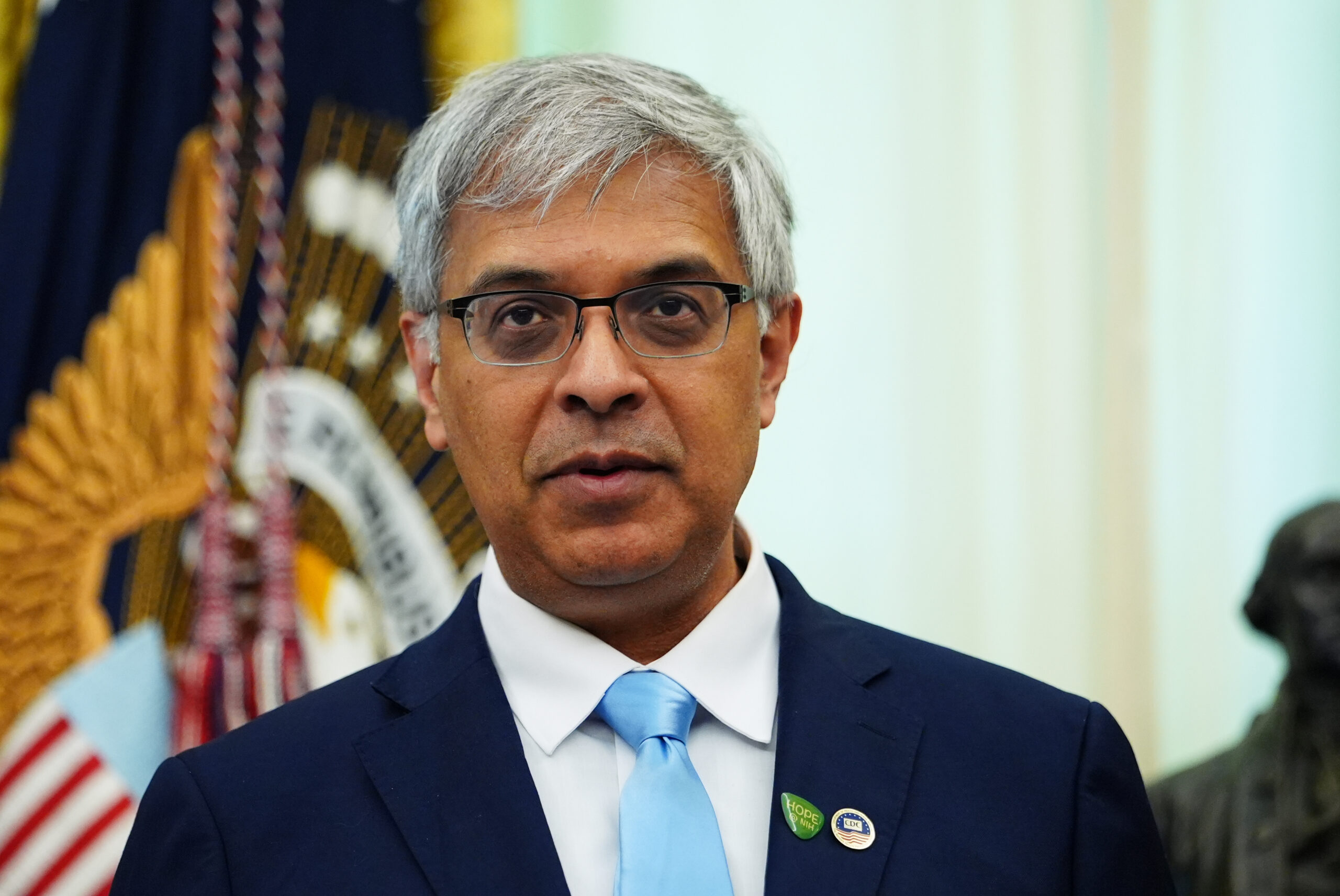
    Jay Bhattacharya questioned the study’s methodology. (AP Photo/Julia Demaree Nikhinson)

    Jay Bhattacharya, CDC’s interim director, delayed publication of the study before it was subsequently not published in the MMWR at all, The Washington Post previously reported. Bhattacharya had concerns about the methods used to calculate vaccine effectiveness, a Health and Human Services spokesman said at the time.

    Barron said she believed the study was not published because the findings did not support Health Secretary Robert F. Kennedy Jr.’s agenda that wants to limit the use of COVID vaccine specifically.

    Kennedy, the founder of a prominent anti-vaccine group, has been an outspoken critic of COVID shots, once referring to them as the “deadliest vaccine ever made.”

    A spokeswoman for the Health and Human Services Department did not directly address the author’s allegation Tuesday that the paper was withheld because it conflicted with the administration’s vaccine agenda. Spokeswoman Emily Hilliard said the CDC evaluates studies using rigorous scientific methods and reviews methodological concerns before publication.

    “The CDC does not make scientific determinations based on predetermined conclusions,” Hilliard wrote in an email. “We evaluate the weight of evidence using rigorous methods, communicate uncertainty and limitations, and subject our work to scientific scrutiny before publication.”

    A commentary accompanying Tuesday’s JAMA Network Open report said the methodology in question, known as test negative design, has limitations, like any study. But those shortcomings are well understood, actively studied, and outweighed by the method’s practicality for routine vaccine-effectiveness monitoring, wrote Natalie Dean, associate professor of biostatistics and epidemiology at Emory University’s Rollins School of Public Health.

    “This is not a controversial study design — this is [the] same design that has been churning out vaccine results for a long time,” Dean wrote in an email. “And from a highly experienced group — CDC plus a network of top vaccine researchers across the country. They are a well-oiled machine.”

    She added: “There was no scientific reason to reject this paper. It had undergone internal review, and it clearly meets the standards of peer-reviewed science. It makes my colleagues on edge to see political interference in the scientific process.”

    Dean said the methodology is being “unfairly maligned” and worried that efforts to discard it could weaken the nation’s vaccine surveillance system. “Then we’ll be flying blind with respect to influenza, COVID, and RSV vaccine monitoring,” she said.

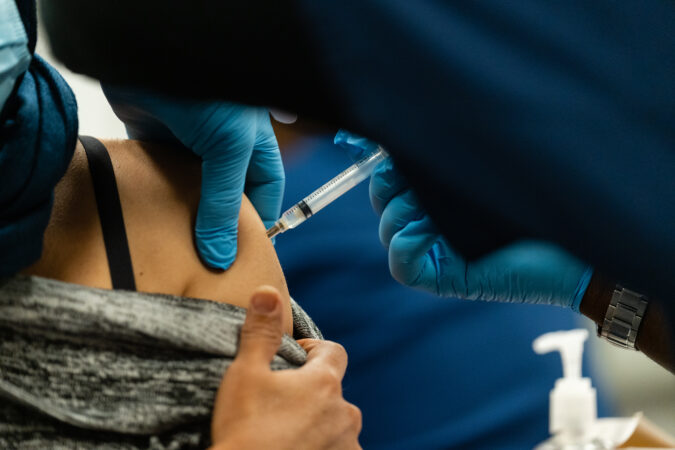
    Between September and December last year, healthy adults who received the COVID-19 vaccine reduced their likelihood of emergency department and urgent care visits by 50% and cut the likelihood of COVID-associated hospitalizations by 55%, compared with those not receiving a 2025-26 vaccine dose, the report found.

    Researchers analyzed data from a CDC-funded surveillance network to compare data on adults who sought medical care for COVID-like symptoms and compared outcomes between those who received the updated 2025-26 vaccine and those who had not.

  • Iranian singer sentenced to 74 lashes for performing without hijab

    Iranian singer sentenced to 74 lashes for performing without hijab

    An Iranian court has sentenced an outspoken female singer to 74 lashes for performing at a concert without wearing a hijab, according to a family member and state media news reports. The punishment indicated a possible tightening of religious rules for women under an Iranian political order reshaped by war.

    The singer, Parastoo Ahmadi, was sentenced last week at a closed trial in Qom province along with eight band and crew colleagues.

    A video of the 2024 performance, in which the singer’s hair, arms, and shoulders are uncovered, in defiance of Iranian law, went viral on YouTube.

    Ahmadi and her colleagues were also banned from performing or leaving the country for two years, said the family member who asked to remain anonymous, fearing reprisal for speaking to the media. Two of the nine individuals sentenced were not in Iran when the verdict was announced, the family member said.

    The sentencing came just days after Iran and the United States tentatively agreed to end a monthslong conflict that has killed thousands across the Middle East and sent shock waves throughout the global economy.

    The government’s crackdown on artistic expression and women’s dress has dampened hopes among some Iranians for a more moderate postwar order.

    “Besides being an inhumane and humiliating punishment, the 74-lash sentence against Parastoo Ahmadi simply for singing without compulsory hijab is a dangerous signal that the regime, emboldened by the peace deal with the U.S., may intensify its crackdown on women,” said Mahmood Amiry-Moghaddam, director of the Norway-based Iran Human Rights.

    The strikes against Iran by the United States and Israel that began in February killed several key figures, including Ayatollah Ali Khamenei, who oversaw the violent and repressive theocracy over nearly four decades.

    President Donald Trump justified the war, in part, by saying the United States intended to help Iranians overturn their leaders. “Iranian Patriots, KEEP PROTESTING — TAKE OVER YOUR INSTITUTIONS!!!” he wrote on social media in January.

    That month, Iranian authorities responded to widespread protests by killing thousands of people. Raha Bahreini, a lawyer and an Iran researcher at Amnesty International, called it a “state-orchestrated massacre.”

    Now, it is not clear that the war has left Iran in less restrictive hands than before. Khamenei’s son, Mojtaba Khamenei, has succeeded his father as supreme leader, and a group of hard-line senior members of the Revolutionary Guard has assumed an expansive role in running the country.

    In 2022, there were also hopes that change might come for Iranian women. Large protests erupted after the death of a young woman who was in the custody of the country’s morality police for violating the hijab law. The state responded by killing hundreds of people.

    During the “Women, Life, Freedom” movement that followed, more Iranians decided to flout the hijab rules, and violent crackdowns appeared to abate slightly, according to a U.N. report documenting the aftermath of the protests.

    It was in that context that the video of Ahmadi’s 2024 performance, in which she crooned a set of patriotic folk songs while wearing a simple black dress, went viral. The caption read: “I am Parastoo, a girl who wants to sing for the people I love. This is a right I could not ignore; singing for the land I love passionately.”

    Ahmadi and two of her collaborators were briefly detained after the video was posted.

    Now, with a postwar political order appearing to solidify in Iran, some in the country are looking at the sentencing of Ahmadi and her bandmates and wondering what it may mean for the future.

    “Will this country ever be fixed one day?” said Mariam, 30, a teacher in Mashhad who asked that her last name be withheld for fear of reprisals. “Where in the world is a woman’s singing punishable by lashes?”

    Iranian authorities have attempted to “project an image of normalcy” after the war, said Bahar Ghandehari, director of advocacy at the Center for Human Rights in Iran. But, she said, “cases like Parastoo’s expose the reality of the human rights situation in Iran: Women continue to face profound discrimination under the law, and defiance results in punishment and state violence.”

    It was unclear when the authorities planned to lash Ahmadi and the other defendants. Since the 2022 protests, there have been multiple documented cases of the authorities whipping women accused of violating hijab rules or speaking out against them.

    Court documents related to the trial have not been made public.

    This article originally appeared in the New York Times.

  • Trump dismisses Iran’s rejection of nuclear inspections

    Trump dismisses Iran’s rejection of nuclear inspections

    President Donald Trump accused Tehran of making “false statements” on Tuesday, after an Iranian official said his government had not agreed to allow international inspectors access to their country’s damaged nuclear facilities, despite U.S. claims.

    Trump claimed that Iran had already agreed to the inspections for an indefinite period of time and suggested it was one of many points of progress in recent days. “If they did not agree to this, there would be no further negotiations!” Trump posted on Truth Social.

    The clashing accounts suggested that there may still be considerable distance between the parties on the current terms of the negotiations. And it may be one of many still in dispute: Iranian officials also pushed back on other reported details regarding deliberations over Tehran’s ballistic missile program and how its government could use billions of dollars in unfrozen funds it expects to receive as a result of the peace talks.

    The dispute over inspections was sparked Monday, when Vice President JD Vance said Iran had agreed to grant the International Atomic Energy Agency access to its nuclear sites, telling reporters in Switzerland that it was a “major milestone for the American people, and the first step in permanently denuclearizing or permanently ending a nuclear weapons program in Iran.”

    Iran, however, rejected the claim the following day, with Foreign Ministry spokesperson Esmaeil Baqaei saying there was no plan for IAEA inspections of its nuclear facilities damaged by the war and that officials had not met with the director general of the nuclear watchdog.

    “There is simply no established procedure for this matter,” Baqaei said in comments reported by state media, adding that Iran would “adhere to the standard procedures, which are already well-defined and transparent.”

    U.S. officials, including Vance, have repeatedly said that Iran is being misleading in its account of the ongoing talks. Secretary of State Marco Rubio told reporters Tuesday that Iranian statements were driven by “domestic politics.”

    “We know what they agreed to do, and now they’ll either do it or they won’t,” Rubio said as he arrived in Abu Dhabi, United Arab Emirates, to see Arab Gulf allies. “If they do, the process moves forward, and if they don’t, the president will have some decisions to make.”

    Iran had been subject to regular inspections under the Nuclear Nonproliferation Treaty and agreed to more intensive monitoring under the Obama nuclear deal that Trump has frequently condemned. After Trump terminated that agreement in 2018, Iran blocked IAEA access to some sites, while some inspections continued.

    Since June 2025, Iran has prohibited the inspectors from visiting sites bombed by the U.S. and Israel.

    Ali Bahreini, Iran’s ambassador to the United Nations, told reporters in Geneva on Tuesday that discussion of Iranian nuclear activities is set for the next stage of talks. The ceasefire memorandum that Trump signed at the Palace of Versailles on June 17 gave the U.S. and Iran 60 days to resolve their hardest disputes, including over the fate of Iran’s uranium stockpile and the Strait of Hormuz.

    In a news conference Monday at the Bürgenstock resort in Switzerland, Vance said conversations with inspectors from the IAEA could happen as soon as that day.

    Baqaei’s contradictory comments Tuesday highlighted the difficulty of turning the fragile ceasefire into a more comprehensive peace agreement.

    Baqaei also said Iran would be free to use unfrozen assets or revenue from oil sales as it sees fit, after Vance said that such funds, if unfrozen, would be subject to oversight and could benefit American farmers. “The important point is that Iran’s previously blocked assets are now available and can be used freely by Iran in accordance with its own priorities,” Baqaei said, according to Iranian state media.

    The spokesperson also pushed back on reports that Pakistan’s prime minister, Shehbaz Sharif, had said that talks would involve discussion of Iran’s ballistic missile program. Baqaei said that the program was “not part of the negotiations” with the U.S., state media reported.

    Iranian President Masoud Pezeshkian traveled to Pakistan on Tuesday to meet with officials there who have been mediating the negotiations with the U.S. “The effectiveness of the talks depends on full commitment to the agreed obligations and their precise implementation,” he said in a post on X, in an apparent acknowledgment of the broad-brush nature of the 14-point memorandum of understanding.

    “Statements outside the agreed text do not help advance the negotiations,” he added.

    The ceasefire called for an end to Israeli attacks in Lebanon, which resumed over the weekend, again testing the fragile deal. Israeli Prime Minister Benjamin Netanyahu’s government has criticized the deal and is not formally a party to the agreement. The Washington Post previously reported that U.S. intelligence warned the Trump administration that Netanyahu would probably work to undermine it by continuing the attacks. On Sunday, Trump accused Iran-backed Hezbollah militants of “causing trouble” in Lebanon.

    Overnight, Netanyahu, Defense Minister Israel Katz, and Israel Defense Forces Chief of the General Staff Eyal Zamir issued a joint statement saying the IDF would “continue to act with determination in order to neutralize threats” and maintain what it calls a “security zone” in southern Lebanon.

    The Israeli and Lebanese governments are currently holding direct negotiations brokered by the U.S. in Washington. A State Department official, speaking on the condition of anonymity to brief the media, said Monday that the shared goal for all parties was the ending the “cycle of violence for good.”

    Though the Trump administration had initially rejected calls to formally include Lebanon in talks with Iran, Lebanese President Joseph Aoun said that he had held a call with Vance and Rubio on Tuesday in which they had agreed to set up a joint U.S.-Lebanese-Iranian cell to help “solidify” the ceasefire in Lebanon.

    Rubio told reporters in Abu Dhabi that while the Lebanon talks were separate from the Iranian talks, Tehran played a critical role in that conflict due to “their support and sponsorship of Hezbollah.”

  • Appeals court allows Trump to resume expedited deportations nationwide

    Appeals court allows Trump to resume expedited deportations nationwide

    WASHINGTON — A federal appeals court on Tuesday allowed the Trump administration to resume using a fast-track deportation process throughout the country that is typically reserved for people apprehended shortly after crossing the southern border.

    The decision revived a pillar of President Donald Trump’s mass deportation plans, after a lower court ruled last August that attempts to use the procedure to potentially remove millions of people without immigration hearings most likely violated their due process rights and risked wrongful detentions.

    In a 2-1 vote, a three-judge panel of the U.S. Court of Appeals for the District of Columbia found that it did not violate immigrants’ rights to use the policy to the maximum extent allowed by law. Judge Justin R. Walker, a Trump appointee, wrote the majority opinion, joined by Judge Neomi Rao, also a Trump appointee. Judge Robert L. Wilkins, an Obama appointee, wrote in a dissent that he would have let the lower court’s ruling stand.

    Writing for the majority, Walker wrote that Congress had delegated to the executive branch decisions about which migrants to designate for expedited deportations.

    “For many years, while some were designated, others were not,” he wrote. “But that changed in January 2025 when the executive expanded expedited removal to the maximum extent allowed by Congress,” he wrote.

    He added that the Homeland Security Department was not legally required to tell those arrested that they could avoid expedited removal if they could prove they had been in the country continuously for at least two years.

    “It is not a requirement that the government explain how the individual might prevail,” the opinion said.

    Immediately upon taking office in January, Trump empowered Immigration and Customs Enforcement to use the process, known as expedited removal, against an expanded population of immigrants lacking legal status.

    Expedited removal had been used narrowly for migrants lacking legal status who are detained near the southern border. It allows officials to deport people who have been in the country for less than two years without hearings in immigration courts.

    Trump’s expanded policy encouraged agents to detain and designate for rapid removal migrants questioned even deep in the country’s interior if they could not produce proof on the spot that they had been in the country beyond that two-year threshold.

    But judges have been deeply skeptical of the policy, noting that throwing out immigrants’ rights to challenge their removal in court could lead to abuse when carried out at scale.

    During a hearing last December, the three-judge appeals court panel focused on how immigration agents had used the policy in 2025 before it was blocked by a lower court. Judges pressed Drew Ensign, a lawyer for the government, for specifics.

    The three judges questioned why the government had waited until October 2025 to share with the court a policy memo circulated at ICE last February, which explained how and when expedited removal should be used.

    The guidance instructed agents that if someone apprehended by immigration agents professed to have been in the country longer than two years, they should be given “a brief but reasonable opportunity” to provide documentation to avoid being placed in expedited removal. Walker wrote in the opinion Tuesday that as long as migrants are provided that “reasonable opportunity,” the requirements of the law had been fulfilled.

    In his dissent, Wilkins wrote that the Department of Homeland Security had not disputed that in using the policy, it had deported a number of individuals who had been in the country longer than two years.

    “A procedure that can result in persons being deported pursuant to the expedited removal statute without even being asked how long they have been in the country might satisfy due process for persons encountered at the border, but it is woefully inadequate for persons encountered in the interior of the country,” he wrote.

    In a statement, James Percival, the general counsel of the Department of Homeland Security, celebrated the ruling. He wrote that the department had long “arbitrarily limited expedited removal,” though the law allows it to be used more broadly.

    He said the appeals court had “vindicated” the Trump administration’s practices.

    Anand Balakrishnan, a lawyer representing Make the Road New York, a nonprofit immigrant advocacy group that brought the lawsuit, argued during the hearing last year that such groups had been in the dark about how the procedure had been used. He said that the decision to give migrants lacking legal status an opportunity to state their case and avoid being placed into fast-track deportation was being made by individual agents with little oversight.

    “I don’t have any clue how this process is supposed to work in practice, particularly when the only check on it is that individual officer who is supposedly, in their discretion, providing them with time,” he said.

    Balakrishnan said the aggressive expansion of the policy effectively left everyone without full legal status vulnerable to being placed on a fast track for deportation, including those who had lived in the country for decades and had deep ties to their communities or to U.S. citizens.

    But Balakrishnan had faced skeptical questioning from Rao and Walker. At one point, Walker appeared to dismiss the case as an attempt to stall the deportation process nationally, rather than maintain what had for decades been a more circumscribed use of the expedited removal process.

    Walker observed that all of the people challenging the policy were in the country illegally.

    “So whether they get expedited removal or nonexpedited removal, the proper result is removal, right?” he said.

    “I don’t know whether the proper result is removal,” Balakrishnan said. “I mean, the proper result would be procedures to access the relief that Congress has afforded them.”

    This article originally appeared in the New York Times.

  • Vendors told to start dismantling Alligator Alcatraz detention center

    Vendors told to start dismantling Alligator Alcatraz detention center

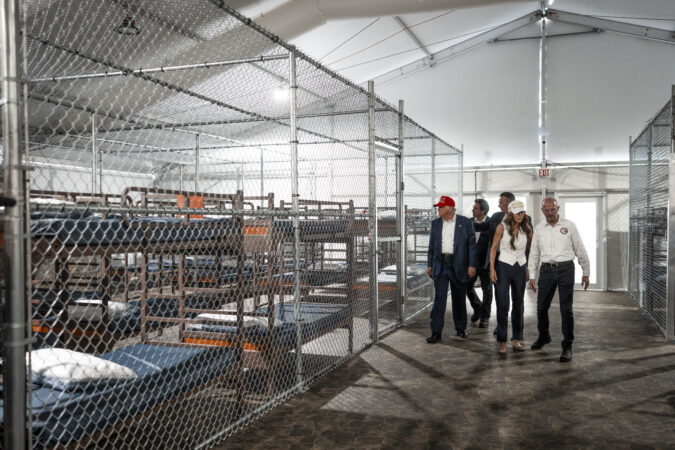
    Crews began dismantling a state-run immigration detention center in the Florida Everglades on Monday, signaling its closure even as state and federal officials continued to say little about the shutdown of a year-old facility that they once praised on a near-daily basis.

    State officials informed vendors in a call Monday morning that they could begin “demobilizing,” or taking down, the tents, fences, trailers, and other structures at the detention center, known as Alligator Alcatraz, according to three people familiar with the call. Vendors are supposed to make significant progress on the work by Wednesday, two of the people said.

    The directive came days after the Department of Homeland Security said that all detainees had been transferred out of the remote center, which opened a little less than a year ago to much fanfare from President Donald Trump and Gov. Ron DeSantis, his fellow Republican.

    “As we enter into hurricane season, ICE and the state of Florida have moved illegal aliens from the soft sided facility,” the department said in a statement last Tuesday, referring to the detention center. “For the safety of the illegal alien detainees, we transferred them to other facilities.”

    Last year, however, thousands of detainees spent the bulk of hurricane season at the center, which became the nation’s first state-run facility to hold federal immigration detainees. The tropical storm season runs from June 1 through Nov. 30.

    Immigration lawyers and activists took last week’s statement from DHS as the latest evidence that the facility would soon close.

    On Friday, Kevin Guthrie, Florida’s emergency management chief, whose agency operates the center, insisted that it remained open. “At this point in time, we have not been told to stand down, so we are still in a posture to receive detainees,” he told reporters, according to the Miami Herald.

    The Florida Division of Emergency Management did not respond to requests for comment Monday. Monday morning’s call between state officials and the detention center’s vendors was first reported by CBS Miami.

    The New York Times first reported last month that federal and state officials were considering closing the facility, which has cost Florida hundreds of millions of dollars to operate, by June.

    When asked about a closure since then, DeSantis has said that the Homeland Security Department is reassessing its detention needs now that Markwayne Mullin is in place as the agency’s new secretary. The agency plans to sell or give away most of the 11 warehouses it bought to detain immigrants, the Times reported last week.

    On Monday, DeSantis’ office referred questions about the center to the emergency management division. James Uthmeier, the Florida attorney general who was instrumental in opening the center, said Monday that he could not confirm if it was closing, though he knew that the number of detainees had been dropping.

    “Alligator Alcatraz actually stayed open longer than it was intentionally planned,” he said at a news conference in Tampa. “It was never expected to be a long-term thing.”

    To many who have closely followed the center over the past year, the inconsistent messaging about whether it is closing — and, if so, for what reason — has left the impression that Alligator Alcatraz, with its hefty price tag and ongoing reports of troubling conditions, has become too much of a political liability.

    “It’s been an expensive failure,” said Jeff Brandes, a Republican and former state senator who now runs the Florida Policy Project, a nonprofit, nonpartisan research organization. “Nobody would say this was a success.”

    The facility has cost state officials more than $1 million per day to operate, including for trucking in water and trucking out wastewater. The federal government had committed to pay the state more than $600 million to defray costs, but it has provided only a fraction of that amount so far.

    This year, Florida lawmakers imposed new rules on the emergency fund that the state has been using to cover the center’s operating costs. Those rules take effect July 1, the start of Florida’s new budget year.

    State officials hastily erected the detention center on a training airport about halfway between Miami and Naples, hailing it as the showcase of Florida’s cooperation with Trump’s immigration crackdown. They also erected an “Alligator Alcatraz” sign on a road leading to the facility, ignoring criticism that the moniker — and jokes they made about any escapees being intercepted by alligators — was cruel.

    Detainees, their relatives, and their lawyers have regularly denounced what they have described as unsanitary and inhumane conditions at the center, allegations that state officials deny. Environmental advocacy groups filed a lawsuit against the state and the federal government, arguing that the facility was illegally constructed in sensitive wetlands.

    Last week, after Homeland Security officials said that detainees had been moved out, a lawyer for the environmental groups vowed to continue the lawsuit over what he called the “secret Gulag in the Everglades.”

    “They hope that they can slink away in the middle of the night without explaining to anyone what they did, why they did it, or how they proposed to clean up the mess that they’ve made,” the lawyer, Paul J. Schwiep, said at a virtual news conference Wednesday. “And we don’t intend to let them get away with it.”

    This article originally appeared in the New York Times.

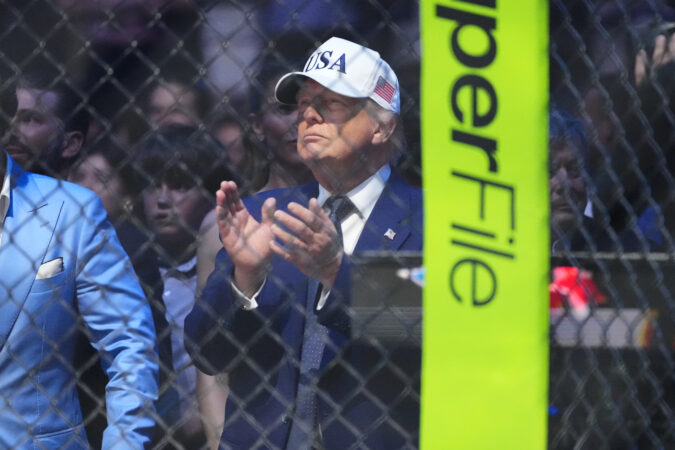
  • Trump supporter’s company pledges $1 million to fix White House lawn after UFC event

    Trump supporter’s company pledges $1 million to fix White House lawn after UFC event

    A private company run by a supporter of President Donald Trump has pledged to restore the grass on the South Lawn of the White House after it was destroyed by the Ultimate Fighting Championship event held there earlier this month.

    The White House announced last week that ScottsMiracle-Gro, an Ohio-based company, will commit $1 million to restore the South Lawn after the UFC event held on Trump’s 80th birthday left it heavily damaged. The company said it is donating “a combination of monetary and product support,” including re-sodding the South Lawn and then creating a “custom turf grass blend” with which to reseed it.

    It is unclear whether the commitment includes restoring the grass on the White House Ellipse, which was similarly damaged after the event. Aerial photos taken over the weekend by Reuters showed a large, circular expanse of dirt where the verdant Ellipse had been.

    The National Park Service, which typically handles White House lawn maintenance, directed inquiries Monday to the White House. Representatives for the White House said that ScottsMiracle-Gro had offered a private donation to the National Park Service to go toward lawn care, and that no taxpayer dollars would be used.

    But Citizens for Responsibility and Ethics in Washington, or CREW, a nonprofit government watchdog, said the arrangement raises ethics questions, particularly following the recent failed repairs at the Lincoln Memorial Reflecting Pool, which were done under a no-bid contract awarded to a Trump ally.

    “Major corporations generally don’t do things out of the goodness of their heart. It’s generally — they do things for the government because they want something from the government,” CREW vice president Jordan Libowitz told the Washington Post.

    Libowitz noted that ScottsMiracle-Gro markets and distributes the herbicide Roundup, whose active ingredient, glyphosate, has been the subject of lawsuits alleging that it causes cancer. In February, Trump signed an executive order calling glyphosate “crucial to the national security and defense” of the country, a move that angered part of his base. The Supreme Court is currently considering whether to block lawsuits that allege Roundup causes cancer.

    ScottsMiracle-Gro CEO James Hagedorn is a longtime Trump supporter who has advised the president on a different kind of grass: He lobbied for marijuana to be reclassified from a Schedule I drug — the most strictly regulated — to a Schedule III drug, and praised Trump when he signed an executive order late last year doing so.

    Tom Matthews, a ScottsMiracle-Gro spokesperson, said the company only markets the consumer brand of Roundup, which does not contain glyphosate, and pushed back on suggestions that there was a conflict of interest.

    “The special blend we’ve created for the White House is for the White House lawn regardless of who’s president,” he said, adding that it would also not be available to consumers. “We’re not commercializing it. We don’t have commercial business with the federal government and we don’t plan to.”

    Libowitz said it is not unusual for American presidents to boost American businesses, though usually they are not singled out in the way Trump has before — by including Palantir’s stock ticker, for example, in a social media post that touted the defense company.

    Last week, the official White House social media accounts announced ScottsMiracle-Gro’s donation in a post that seemed “just a little off” and like an ad, Libowitz added, particularly since the company was one of the sponsors of the UFC event.

    “It’s not just like ‘I support American businesses.’ It’s ‘I want you to put money behind the businesses supporting me,’ ” Libowitz said of Trump’s posts promoting private companies.

    “It seems to be this whole [UFC] event was an opportunity for different corporations to advertise in front of the president,” he added.

    Organizers of the UFC event had anticipated the grass would be destroyed when planning the event. Last year, UFC CEO Dana White told the Sports Business Journal that they were allocating $700,000 to replace the grass “because we’re going to f— up the South Lawn.”

    White and the UFC did not immediately return requests for comment Monday about whether the UFC would still be paying for any portion of the repairs to the South Lawn or to the Ellipse.

    As America approaches its 250th birthday, the grassless Ellipse and South Lawn — paired with the algae-filled Reflecting Pool and demolished East Wing of the White House — have drawn partisan criticism.

    “In the 250th year anniversary of USA the @WhiteHouse and surroundings looks so terrible … is so sad to see …” José Andrés, a chef and vocal Trump critic, wrote on X.

    According to ScottsMiracle-Gro, Trump personally selected a blend of tall fescues and Kentucky bluegrasses to restore the South Lawn.

    “The president knows a lot about grass. I think his history and past with golf courses,“ Nate Baxter, ScottsMiracle-Gro chief operating officer, told Fox Business.

    Grass experts said it would be more cost effective to reseed the lawn, rather than to lay down new sod and then reseed, but it would have taken several weeks for grass seed to germinate and establish itself.

    Matthews, the ScottsMiracle-Gro spokesperson, said the best time to grow grass from seed is the spring and fall because of the cooler nighttime temperatures.

    “To replenish the lawn in a quicker fashion, the sodding is the solution for it. … Then the overseeding will help thicken it and strengthen it and create stronger roots systems,” he said.

    The White House did not address questions about why they opted to resod and whether the new sod would be laid in time for July 4.

    “To replace it with sod, you’re talking a pretty significant financial expenditure or impact,” said Steve Mercogliana, director of operations at the Philadelphia-based Four Seasons Total Landscaping.

    Mercogliana, whose business went viral after it inexplicably hosted a 2020 news conference for Rudy Giuliani and other members of Trump’s legal team, said organizers could have also spared large swaths of grass by building a small platform to keep people off the lawn. He said he watched a little bit of the UFC fight “here and there,” but couldn’t help doing so through a landscapers’ lens.

    “I was curious. I looked at it and I thought, ‘Oh man, I wonder what that ground’s going to look like when all these people leave the premise? What’s the impact of that?’ And here we are,” he said.