Major League Baseball proposed limiting most free agent contracts to five years and 15% of a team’s salary cap and to eliminate deferred compensation, fleshing out details of a plan likely to spark a confrontation with the players’ association.
“There’s no question that we’re very far apart,” union head Bruce Meyer said during an online news conference.
During a bargaining session Thursday at the union’s office, MLB said it would accept the union’s proposal granting free agency a year early for players who have reached age 30 if the union accepted the league’s salary cap system. MLB also proposed boosting the minimum salary from $780,000 to $1 million for those with two years of big league service.
MLB also proposed increasing the pre-arbitration bonus pool from $50 million to $65 million next year and $75 million by 2032, the sixth season of MLB’s proposed seven-year deal.
Meyer said “the debate got a little more vigorous today.”
“The league has done us a favor because their proposals are in fact so obviously and extremely bad for players at all levels that it’s actually been a benefit for our unity,” Meyer said. “Anybody who’s banking on Major League Baseball players cracking, it’s never happened. It’s not going to happen. That’s why we’re the only ones who don’t have a salary cap.”
MLB also said it would agree to eliminate the qualifying offer for free agents that since its inception in 2012 has restricted the market for some players.
Bargaining started May 13 for a contract to replace the five-year deal that expires Dec. 1, and owners proposed a salary cap for the first time since the union fought off the system during a 7½-month strike in 1994-95. MLB is expected to impose a lockout in December, halting free agent signings and trades.
After the prior agreement expired in December 2021, intensive bargaining did not start until late February as the threat approached of losing regular-season games — along with revenue and salary. The sides reached an agreement on March 10, the 99th day of the lockout, preserving the 162-game schedule.
In the league’s cornerstone proposal, made last month, team spending would be capped next year at $245.3 million, using figures for luxury tax payrolls that include $20.1 million for benefits and the pre-arbitration bonus pool. It also would establish a payroll floor of $171.2 million, forcing several teams to spend more. The two-time World Series champion Los Angeles Dodgers, baseball’s biggest spenders, had a $415.2 million payroll on opening day this year — around $170 million over the proposed cap.
“The biggest issue baseball fans want solved to strengthen the game is fixing the payroll disparity that leaves too many fans without hope of their team competing for a World Series title,” MLB spokesman Glen Caplin said in a statement. “Every other major U.S. sport has tackled this problem, and every year more small market teams in those leagues have a chance to win. The salary cap and floor proposal levels the playing field.”
Meyer took issue with that.
“It’s appalling that the stewards of the game, the people whose job it is to grow the game primarily and promote the game have for whatever period of time now in the last couple of years been saying nothing but the game’s broken,” he said.
As part of the plan, MLB would establish a “cornerstone player” similar to the NBA’s Bird rule, which would allow a team to re-sign a player at 16% of the cap. A free agent switching clubs would be limited to a $36.8 million salary next year and a re-signing player to $39.2 million.
Salaries for free agents in additional seasons of a multiyear contract would be limited to 5% increases, as would salaries for younger players in multiyear deals that cover potential free-agent seasons.
Contracts would be capped by service time: at $500 million and 12 years for those yet to make major league debuts, $461 million and 11 seasons for those with 0-1 years of service, $421 million and 10 years for 1-2, $382 million and nine seasons for 2-3, $343 million and eight years for 3-4, $304 million and seven years for 4-5, and $265 million and six years for free-agent eligible players.
Agent Scott Boras claimed the then-record $252 million, 10-year contract he negotiated for Alex Rodriguez in December 2000 would not have been allowed.
“It’s like offering a few pieces of furniture if you agree to live in a house with a 4-foot ceiling,” he said, “an attempt to move player contract values back to the 1990s.”
Banning deferred compensation would eliminate a business practice used most prominently by the Dodgers, who owe just under $1.1 billion to 10 players from 2028-47. In addition, MLB would restrict bonus provisions in player contracts and mandate a standard award bonus package.
MLB said it would accept the union’s proposal to drop free-agent eligibility to five seasons of service from six for those turning 30 by the Nov. 1 of the offseason. MLB said 354 players on big league rosters as of Thursday would reach free agency a year earlier. MLB would start the change in the 2027-28 offseason.
As part of the minimum salary proposal, MLB said players with less than two years of service would have a $900,000 minimum and if earning a full year of service would get an additional $100,000 from the pre-arbitration bonus pool. Minor league minimums for players with major league contracts would increase from $63,600 to $73,400 for initial big league deals and $127,100 to $146,700 for additional contracts.
The union proposed to jointly lobby with MLB for the prohibition on prop bets; to allow player endorsement and sponsorship of legal betting entities, including sportsbooks and prediction markets; to have players under MLB betting investigations to be placed on administrative leave, similar to the domestic violence policy; and to allow players near the end of suspensions for betting to have unpaid 15-day minor league assignments, similar to the drug policy.
In addition, players asked for increases for in-season meal and tip allowances; housing benefits for players with major league contracts who are assigned to the minors; and increased moving expenses, including for assignments from one minor league affiliate to another.
Meyer expects at least one more bargaining session before the All-Star break.
YANKTON, S.D. — Charl Kleinhaus did not like the direction his country was taking.
A white South African, Kleinhaus said the laws meant to empower Black people after the demise of the racist apartheid system had hurt his mining business. Violence in the country — a scourge affecting everyone, regardless of race — had become too much.
So Kleinhaus considered his options.
Some of his fellow Afrikaners, the ethnic minority that ruled during apartheid, had moved to Germany, but the language barrier was not ideal. He thought about Australia, but decided that moving his family thousands of miles from home would be too hard.
Then, in February of last year, Kleinhaus received what he described as “a message from above.” President Donald Trump had suspended refugee admissions to the United States, but he made an exception for people like Kleinhaus: white Afrikaners who claim they are victims of racial persecution in South Africa.
“It’s now a reverse apartheid,” Kleinhaus said, summing up his grievances about his homeland. “That’s what we are fighting about now.”
In a matter of months, Kleinhaus secured refugee status and moved with his family to the United States, completing a process that can take years under normal circumstances. Now, after a year in the country, he has settled in South Dakota, where he has found part-time work at a car dealership, a farm, and a brickyard while planning his next business.
Kleinhaus is among more than 6,000 South Africans — the vast majority of them white — who have benefited from Trump’s decision to upend America’s refugee program, which for decades had made the United States a sanctuary for people fleeing disaster and persecution.
Charl Kleinhaus secured refugee status and moved with his family to the United States in a matter of months.
Under Trump, the program has effectively become a whites-only path to life in the United States, a culmination of the president’s long-standing antipathy toward immigrants and his embrace of the concept of “reverse racism” as a guiding principle in his administration.
The president has fought to limit immigration for more than a decade, imposing travel bans on mostly African and Muslim-majority nations and making it much more difficult for people from those nations to obtain green cards. He has railed against affirmative action, and in an interview with the New York Times earlier this year said he believed civil rights-era protections had resulted in white people being “very badly treated.”
But few of Trump’s efforts are as striking as his efforts to turn the refugee program on its head, leaving thousands of people across the world sitting in refugee camps with no chance of entry into the United States, even as he created a workaround for Afrikaners.
The Trump administration has argued that the overhaul of its refugee program is necessary to prioritize refugees who can better assimilate into the United States.
“President Trump has provided a lifeline for Afrikaners, who are being raped, maimed, killed, and driven off their property across South Africa,” Anna Kelly, a White House spokesperson, said in a statement. “While the South African government and many in the media have brushed off the horrific lived experiences of this community, the Trump administration continues to process applications for refugee status because the president has a humanitarian heart.”
But critics of the policy who are involved in refugee resettlement say the Trump administration’s priorities have made it impossible to help people who have nowhere else to turn.
“It’s the moral and legal inversion of what this work is about,” said Jason Marks, a senior refugee officer who resigned from the Department of Homeland Security last year when Trump announced the effort to fast-track Afrikaners to the United States. “They are rolling out the red carpet for this group with a clear racial and political agenda at the expense of everyone else.”
‘Too many people’
Kleinhaus acknowledges that moving to the United States from South Africa’s Mpumalanga province was not his “last option.” He left behind resources: a Jaguar sports car, a Range Rover, and what he estimates is property worth at least $300,000. He plans to sell them all to bring in extra money.
But he also says many of his white relatives and friends were no longer safe in South Africa.
White farmers — a population that Trump has spotlighted in public remarks — have indeed been killed in vicious acts of violence in a country that suffers from a high murder rate. But so have Black South Africans and others, and police data does not support the idea that white South Africans are more likely to be targeted than any other group.
Kleinhaus also said his profits were suffering because of racial equity laws.
“You’re not going to get a big contract from a mining company if you’re not Black,” he said. “There’s too many people. How do you divide a small cake between such a big population? Yeah, you cannot.”
He said he felt no guilt about bringing his children and grandson to America to pursue a new life, even as families fleeing conflict in Afghanistan, Sudan, and Ukraine remained walled off.
“You can’t take in those hard-core war people,” said Kleinhaus, whose news feed is full of social media videos and memes promoting the idea that white people are targeted in South Africa. “You can’t put them in a first-world country, you’ll be mad.”
After allowing refugees from around the globe to enter the country for decades, the United States was now trying to “have some type of balance,” he said.
Secretary of State Marco Rubio said this month that U.S. refugee policy must benefit Americans.
“Everything we do has to be geared by the national interest,” Rubio told lawmakers. He said, “It is in our national interest” to allow in people who can “quickly assimilate into society and be successful.”
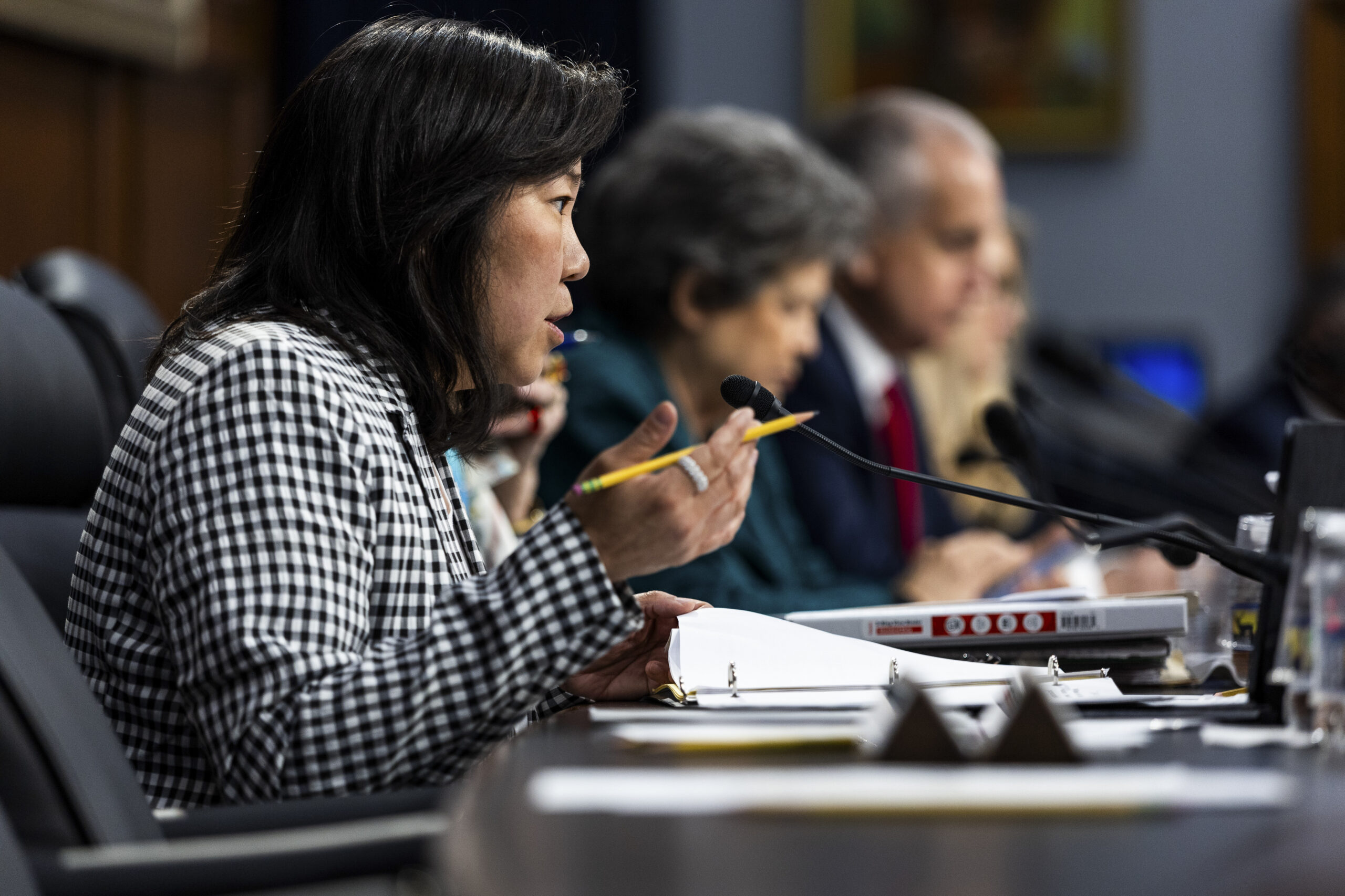
Rep. Grace Meng (D., N.Y.) questions Secretary of State Marco Rubio during a House Appropriations subcommittee hearing this month.
Rep. Grace Meng (D., N.Y.) asked why the administration thought other refugees could not assimilate, including Afghans who had helped U.S. soldiers during the war, cleared vetting, and were now stuck in limbo.
“They have assimilated and contribute and pay taxes,” Meng said of Afghan refugees who had moved to her district in Queens, New York. “I think it’s important for America to keep our promise as well,” she added.
Some of the Afrikaners, who are the descendants of Dutch and other European settlers, have not acclimated as smoothly as the administration expected.
During their initial months in the United States, refugees typically can receive some money for housing and food from resettlement organizations who receive federal funding. Those organizations can also help them find work.
But refugees are expected to eventually be self-sufficient. The process is often a difficult one.
Multiple Afrikaners reported delays in receiving financial support from their local resettlement agency, according to complaints obtained by the New York Times. (The names of many of the refugees were omitted from the documents.) One of the families complained about needing to complete Medicaid and Social Security applications on their own. That same family griped about needing to use public transportation, according to the documents.
Another South African relocated to Texas said he felt staffers from the local resettlement agency, which has a Muslim affiliation, had “discriminated” against him as a Christian. The staff members who picked up his parents from the airport were candid about their views of Trump’s changes to the refugee program.
“They told my mother they cannot wait for next election when Trump can leave office as they had a problem with his decision to give South Africans refugee status and how angry they are that only South African refugees are now allowed,” according to the correspondence.
The newly arrived South African also said his family was placed in an apartment that was “dirty, contained mold, and is located in an unsafe area in Fort Worth.”
The complaints by the Afrikaners about their level of assistance also came after the Trump administration made cuts to funding for resettlement agencies and benefits that in the past were made available to new refugees, including food stamps.
At least three Afrikaners made the return after being settled in states including Minnesota, Idaho, and Illinois, according to government documents. Some had sick relatives back home. One Afrikaner said the process had “occurred quickly” and “she had not thoroughly thought through the process.”
“I think some of them are finding that actually it’s not an easy life to be a refugee,” said Bryony Fox, a lecturer at South Africa’s Stellenbosch University, who researches forced displacement.
Claims of genocide
South African officials strongly dispute claims by Trump that Afrikaners are being targeted in a “genocide.”
During apartheid, which ended in 1994, the government denied Black South Africans the right to own prime agricultural land. That meant that almost all of the country’s large-scale commercial farmers were white, and that remains so to this day.
South Africa’s Commission for Employment Equity found that white people made up 61% of top management posts in 2024, while they are only 7.5% of the population. Black South Africans are also unemployed at far higher rates than their white peers, a disparity that has not improved over time.
To address the disparities, the African National Congress government has instituted racial equity laws that incentivize companies to have Black ownership and leadership. That Black Economic Empowerment initiative has prompted intense scrutiny from the Trump administration, as well as from Afrikaners fleeing to the United States who say it has harmed their businesses.
Kleinhaus said such policies make him as a white man feel targeted by the South African government. He said that he had struggled to keep thieves off his property and that his relatives had been the victims of violence, although he said getting into the specifics made him too emotional.
In his experience, white people are portrayed as “the problems in the economy” and “the privileged ones.”
“There’s no such thing as that,” Kleinhaus said. “Most whites have lost a lot.”
Fox said there was no denying the violence in South Africa.
“That is our biggest problem,” she said. “But it is not targeted. It is not systematic targeting.”
She said criminals had attacked farms because they “have resources that communities are seeking.”
Trump has echoed fringe claims about a white genocide in South Africa for years, going back to his first term. Last year, in a stunning confrontation in the Oval Office, Trump lectured the South African president, Cyril Ramaphosa, about his own country. Ramaphosa implored Trump to listen to “the voices of South Africans.”
The State Department does not break down its refugee data by race, but it has allowed in more than 6,600 refugees this fiscal year. All but three were from South Africa.
Trump’s aides have defended the program by saying that other racial minorities in majority-Black South Africa are welcome to apply for the refugee program.
South Africa also has minority populations of people of Indian descent, white people of British heritage, and mixed-race people — and a few individuals from those communities have been processed through Trump’s refugee program. But refugee resettlement officials say nearly all of those who have been accepted are white, and government documents confirm that the administration has prioritized resettling white Afrikaners.
Why white South Africans?
Long before Trump created the refugee program, many white South Africans traveled to the United States — from the Midwest to the Mississippi Delta — on temporary visas to work as seasonal farmers.
Since 2019, Kobus Van Den Berg has been traveling to and from the United States to plant soybeans and fertilize fields in North Dakota to save money for his family back home in South Africa. He agrees that crime is an issue in South Africa, but he pushed back on the notion that white South Africans are being singled out.
“They’ll attack anybody,” he said. “It doesn’t matter what color or race you are.”
He has watched as Afrikaners have come into the United States in recent months with refugee status and a pathway to citizenship, even as he has spent years navigating a complicated immigration system with the hopes of obtaining a green card.
“Why is it so easy for this other Afrikaner from South Africa to come over here?” Van Den Berg said. “The thing that blows everyone’s mind today is, why is it specifically white South Africans?”
Critics of the Trump administration say the answer lies not just in Trump’s long-standing embrace of the Afrikaners’ cause, or the administration’s desire for “assimilation,” but in his stance toward refugees more broadly.
Sharif Aly, the president of the International Refugee Assistance Project, said the policy shows an “indifference to the plight of nonwhite refugees.”
It is difficult to ascertain how rigorously the administration is vetting the South Africans. In the past, the process has been time-consuming, with agents demanding criminal records, medical records, and even social media posts.
The Trump administration has said it would deny immigration requests for those with antisemitic or “anti-American” posts on their social media accounts, but Kleinhaus was welcomed even though he had made antisemitic comments on social media. In April 2023, the X user @charlkleinhaus wrote in a now-deleted post that Jews were “untrustworthy” and “a dangerous group” and that “they are not Gods chosen.”
Kleinhaus said his grandmother was Jewish, he was not an antisemitic person and he had written the post in error while he was taking medication for a kidney stone. He also shared other posts that had been written by others.
During his processing, he said, he signed off on administration vetting of his social media accounts and no one brought up any problems.
‘Leaving everything behind’
Over breakfast at a local diner, the Fryn’ Pan Family Restaurant, Kleinhaus said he missed some aspects of his life in South Africa, including “the people, my workers, my friends, and family.”
But he also appreciates “these advantages that I’ve got here to do things I can do just as a white person” and not needing to worry about laws requiring him to sell a percentage of equity of his mining company to Black shareholders in South Africa “because they were here first or whatever the story can be.”
He said he was focused on working and contributing to the United States.
He said he did not complain when he, his son, daughter, and grandson were initially placed in one hotel room in Buffalo, N.Y. He soon identified a farmer in Yankton, S.D., who had hired seasonal workers from South Africa for years and was looking for more help.
Now, his daughter works at a flower shop in the small town of Yankton. His son works at another farm and his grandson has learned English quickly after knowing only Afrikaans.
And he has found part-time work at a car dealership and at a brickyard while he plans how to start his next business. He occasionally takes his grandson fishing in this area known for the Lewis and Clark trail on the weekends.
“I just want my kids to be successful,” he said.
Kleinhaus hopes he can convince other relatives to join him soon in America. He said he knows he cannot simply go back and visit, because that would undermine his claims of persecution.
“I’m leaving everything behind,” he said. “When you accept the refugee thing, it’s not a thing like, ‘I’ll be back in two weeks; I’m going on holiday.’ It’s nothing like that. You’re saying, ‘It’s done. I’m not going back.’”
NEW YORK — Carlos Mendoza was fired as manager of the underperforming New York Mets on Friday and replaced by Andy Green.
New York is 34-47 following a six-game losing streak, 15 games behind NL East-leading Atlanta and 9½ games back of the NL’s last wild-card berth.
The Phillies open a three-games series against the Mets at Citi Field on Friday night.
Mets owner Steve Cohen had high expectations for a team without a World Series title since 1986. New York opened the season with baseball’s highest payroll at $358 million and was projected to pay an additional $124 million in luxury tax.
“Our commitment to bringing our fans a championship-caliber team has not changed,” Cohen said in a statement. ”There is no sugarcoating it: This season has been a disappointment and our fans deserve better than what we’ve delivered.”
A former Yankees assistant coach, Mendoza replaced Buck Showalter after the 2023 season and led the Mets to a 206-199 record. While New York advanced to the NL Championship Series in 2024, the Mets failed to reach the playoffs last year and are among the sport’s biggest disappointments this season.
“Carlos has led the organization with passion and grace and is beloved by everyone who works with him on a daily basis,” president of baseball operations David Stearns said in a statement. “Carlos’ impact on our players, staff, and culture over the last three seasons has been transformative. Unfortunately, we know we are falling short and change is necessary to move forward.”
Green, a former major league infielder, joined the Mets in 2023 as senior vice president of baseball development. He managed San Diego to a 274-366 record from 2016-19.
The Florida Everglades immigration detention center known as “Alligator Alcatraz” has served its purpose, Gov. Ron DeSantis said Thursday, closing the makeshift facility heralded by the Trump administration and denounced as inhumane by civil rights groups.
DeSantis said the center, which opened in July 2025, was always meant to be only temporary until more permanent detention centers could be secured and federal officials now have that capacity.
“We stepped up because there was a gap, but my hope is that they’ll be able to handle that,” the Republican governor said at a news conference at the facility.
Officials announced a temporary closure of the facility earlier in June and sent all of the detainees to other facilities, saying hurricane season made it unsafe to keep them in the Everglades.
Immigration advocates said the center’s tents were never safe or humane for holding people. Detainees at the facility have talked about their difficulty accessing lawyers and described poor physical conditions, including worms in the food, toilets that didn’t flush, floors flooded with fecal waste, and mosquitoes and other insects everywhere.
They described large white tents with rows of and rows of bunk beds surrounded by chain-link cages. The air-conditioning could shut off abruptly in the sweltering Florida heat. Detainees could go days without showering or getting prescription medicine.
Advocates for immigrants said the closure of “Alligator Alcatraz” does nothing to stop the harm to people who spend months in custody as their families suffer. The Florida Immigrant Coalition said the only winners were corporations and contractors who profited millions of dollars as Republicans pushed an immigration emergency that does not exist.
The detention center of tents and trailers was built by DeSantis’ administration in a matter of days. The governor and President Donald Trump said the center was critical to Republican efforts to return people in the country illegally back to their home countries.
“There is no question this mission has made the state of Florida safer,” said DeSantis, noting that 21,000 people were deported through the facility.
Even with the closure of the facility, Florida continues to play a key role with other detention centers and an increased role in helping with immigration enforcement, White House border czar Tom Homan said at Thursday’s news conference.
“Gov. DeSantis did a good job, and he’s going to continue doing what he’s doing to help us make this country safe again,” Homan said. “This isn’t the end of relationship. This is a continuation.”
Lawyers for the immigrants at the facility said their clients suddenly started leaving for other facilities in South Florida, California, Arizona, Louisiana, and Texas earlier this month, disappearing for about a week before their attorneys and families were told where they were sent.
DeSantis said the Everglades airstrip the facility was built around will continue to be used.
Environmental groups sued over the detention center, saying Florida officials never got the proper permits or did required reviews on its impact.
The state and federal governments built the site with no oversight and closed it with no input, but they will still be held responsible even with the site is closed, said Paul J. Schwiep, an attorney for Friends of the Everglades and the Center for Biological Diversity.
“The administration believes it can quietly walk away and leave its mess for others to clean up. The law will not allow them to escape accountability. We will ask the courts to ensure that the environmental damage is fully addressed,” Schwiep said in a statement Thursday.
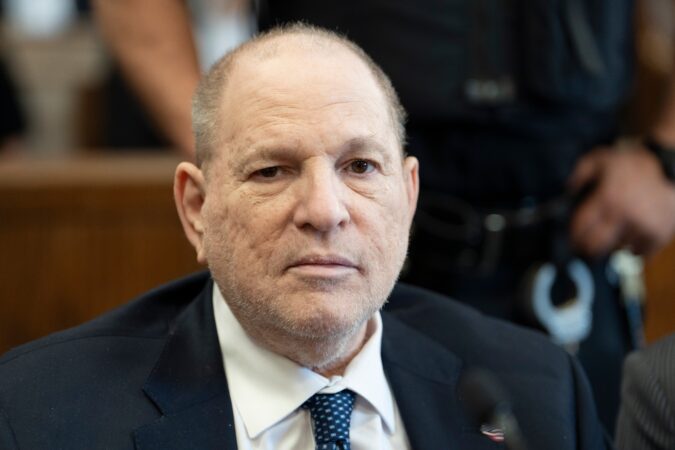
NEW YORK — Harvey Weinstein won’t face a fourth trial on a New York rape charge. Prosecutors dropped the #MeToo-era case on Thursday after his accuser said she could not bear to testify again.
Jessica Mann, a hairstylist and actor, spent days on the witness stand at all three trials, telling jurors that Weinstein raped her in a Manhattan hotel in 2013 and being questioned extensively about the complex relationship she had with him before and afterward. The Oscar-winning producer denied the charge and said everything that happened between him and Mann was consensual.
In a letter that prosecutor Nicole Blumberg quoted in court Thursday, Mann said she could “no longer endure going through this,” adding that the 8-year-old case has “put me through more harm than good.”
Blumberg told the court that prosecutors believe Mann and hail her “bravery, strength, courage and inspiration” to other survivors, but given her feelings about proceeding, “dismissal is appropriate.” With that, Judge Curtis Farber formally dismissed the case.
Weinstein left court with a neutral expression, returning to jail to await a September sentencing on a New York sexual assault conviction involving a different woman. Prosecutors are seeking a 20-year prison term.
Once Weinstein finishes whatever punishment he gets in New York, he’s due to serve 16 years in California, where he was convicted of raping a third woman, who’s an Italian actor. He is appealing both convictions.
Weinstein’s lawyers said he was relieved by the dismissal of the case surrounding Mann’s allegation.
“These charges should never have been brought to begin with,” lawyer Jacob Kaplan said outside court. “He is innocent.”
Mann has testified that she had a consensual, on-and-off relationship with Weinstein, who was married at the time.
But she told jurors she repeatedly tried to leave and said no to any sexual activity as he cornered her in a hotel room on March 18, 2013. They had planned to meet in the lobby for breakfast, but he had spontaneously taken a room.
She said he persevered, demanding that she undress and grabbing her arms, until she was afraid to keep protesting.
The latest trial, this spring, took a visible toll on Mann, 40. During five days of testimony, she was questioned for the first time about a diarylike, soul-baring note she wrote two days after the alleged rape, which the note did not mention. At one point during her testimony, Mann said she was struggling to focus, prompting court to wrap up early for the day.
In her letter to the court Thursday, she said she had suffered a concussion shortly before her testimony, had headaches and other symptoms on the stand and ultimately “disassociated.” It was a humiliating addition to an already crushing experience, she wrote.
“I have been fragmented, silenced, defamed and traumatized. I’ve paid the price of my reputation,” Mann wrote. Slamming the court, the media and Weinstein, she said her experience showed that “pursuing justice is better left a pipe dream.”
Weinstein was one of the movie industry’s most powerful figures, a producer of such tastemakers and hits as Shakespeare in Love, Pulp Fiction, and Chocolat.
The rape charge in this case was a low-level felony punishable by up to four years in prison — less time than Weinstein, 74, already has served.
Weinstein didn’t testify at any of the trials, though he complained during and after the 2025 New York retrial that it was unfair; the judge disagreed.
His lawyers have maintained that all his accusers had completely consensual sexual liaisons with a movie studio boss who could help them go places in show business. Weinstein himself has said he “acted wrongly, but I never assaulted anyone.”
The Associated Press does not identify people who say they have been sexually assaulted, unless they choose to be named, as Mann has done.
Apple on Thursday raised the prices of its Macs and iPads, citing the soaring costs of memory and storage chips as the artificial intelligence boom has created a frenzy for the components.
Apple increased prices on some laptop and tablet models $200 or more. A base model of the MacBook Pro, for example, now costs $1,999, up from $1,699. Apple’s entry-level laptop, the MacBook Neo, now costs $699, $100 higher than when it was unveiled in March.
The price of an iPad Air increased $150 to $749, while the price of an iPad Pro jumped $200 to $1,199.
The increases show that even Apple, with its sprawling supply chain, is not immune to a global shortage in memory and storage chips. AI chipmakers like Nvidia and Advanced Micro Devices have demanded more of the components for their own chips, which are then used in data centers for developing and running AI systems.
The surge in demand has led memory chip manufacturers like Micron to focus on producing for data centers, which tend to use more expensive chips than consumer electronics. As a result, those companies are making more money but shipping fewer consumer-grade chips, which have become more expensive.
Memory and storage chip prices have quadrupled over the past year, according to analyst estimates, and the cost of those components are expected to continue to rise.
Those costs are now being passed on to consumers. Microsoft also raised prices for its Surface laptops in April.
“We have never seen a component price increase this much, this quickly,” a spokesperson for Apple said in a statement. “We have now reached a point where we need to begin raising prices.”
Apple CEO Tim Cook said during an investor call in April that the company expected “significantly higher memory costs” for the quarter, which runs through June.
“Beyond the June quarter, we believe memory costs will drive an increasing impact on our business,” Cook said on the call.
The company also said it expected its profit margins to decline slightly for the quarter.
Apple on Thursday also raised the prices of its HomePod speaker and its Vision Pro mixed-reality headset.
The timing for the price increases was unusual. Apple typically raises prices when it releases new or refreshed products. In September, Apple released new iPhones and raised the prices for some models $100.
NEW YORK — David Clayton-Thomas, the lead singer of Blood, Sweat & Tears, whose husky, high-strung tenor on “Spinning Wheel,” “And When I Die,” and other hits helped make the so-called “brass rock” band among the most popular acts of the late 1960s, has died at age 84.
Spokesperson Eric Alper said that Mr. Clayton-Thomas died “peacefully” Wednesday at St. Michael’s Hospital in Toronto. Alper did not cite a specific cause.
Mr. Clayton-Thomas was a onetime street fighter and petty thief from Canada who briefly became a rock superstar, the front man of a nine-member group that sold millions of records and won two Grammys for Blood, Sweat & Tears, which beat out the Beatles’Abbey Road for best album of 1969. Calling out amid a jazzy parade of horns, keyboards, and percussion, Mr. Clayton-Thomas’ urgent shout was a signature voice of the era, preaching love on the Motown cover “You’ve Made Me So Very Happy,” a lasting legacy on Laura Nyro’s “And When I Die,” and a cool head on his own “Spinning Wheel.” Meanwhile, Blood, Sweat & Tears helped inspire a wave of horn-led bands, among them Chicago, the Electric Flag, and Ten Wheel Drive.
“A lot of the guys [in Blood, Sweat & Tears] would play a Broadway show matinee, then go up to Harlem and play Latin music or R&B and funk at night, or come down to the Village and play pure jazz the next night,” Mr. Clayton-Thomas told bestclassicbands.com in 2023. “I was just a blues player: give me three chords and I’ve got a song.”
At its peak, Blood, Sweat & Tears’ appeal was so broad it helped lead to the band’s downfall.
Hip enough to perform at the 1969 Woodstock festival, where they were among the highest paid acts, they also were known enough to the establishment to tour Eastern Europe the following year on behalf of the State Department. When Mr. Clayton-Thomas and other band members denounced the Communist regimes on the other side of the Cold War, Rolling Stone’s David Felton wrote that “the State Department got its money worth.” Yippies would turn up at a 1970 Blood, Sweat & Tears show at Madison Square Garden, carrying obscene banners outside and dumping manure by the front gate.
The band had practical reasons for going along with the government: Mr. Clayton-Thomas, who had allegedly wielded a gun at his girlfriend, had been denied a green card and faced deportation. But after topping the charts in 1970 with the album Blood, Sweat & Tears 3, their appeal soon faded. A burned out Mr. Clayton-Thomas left the group in 1972, and neither he nor the remaining musicians ever regained their old stature. Blood, Sweat & Tears would continue recording over the next few years, and even briefly reunited with Mr. Clayton-Thomas, who went on to release more than a dozen solo albums and tour on his own for decades.
Mr. Clayton-Thomas was inducted into the Canadian Music Hall of Fame in 1996. “Spinning Wheel,” covered by everyone from James Brown to TV star Barbara Eden, was voted into the Canadian Songwriters Hall of Fame a decade later.
Mr. Clayton-Thomas is survived by his daughters, Ashleigh Clayton-Thomas and Christine Graham.
Up from the streets
Born David Henry Thomsett in Surrey, England, and raised near Toronto and Ottawa, he was the son of a Canadian World War II veteran and of a pianist-entertainer who helped inspire her son’s interest in music. Thomsett was lucky to have the chance. He fought violently with his father, was living in the streets by his mid-teens and by age 20 was serving time in a reformatory for vagrancy, assault and other crimes.
An old guitar, left behind by a fellow inmate, changed his life. He taught himself to play and began spending extensive time in the early 1960s around Toronto’s Yonge Street music “strip,” where peers included the American rockabilly star Ronnie Hawkins, a mentor to Robbie Robertson and other future members of the Band and a guide for Thomsett early in his career.
Anxious to reinvent himself, he changed his last name to Clayton-Thomas while leading his own groups. In the mid-60s, he released such albums as Sings Like It Is and had a hit single with the anti-war rocker “Brainwashed.” He would also befriend a rising star, Joni Mitchell, whose childlike “Circle Game” helped inspire “Spinning Wheel,” and the venerable John Lee Hooker, who would indirectly contribute to Mr. Clayton-Thomas’ breakthrough in the U.S.
America beckons
Hooker had encouraged Mr. Clayton-Thomas to move to New York, where the American bluesman had an engagement at the Cafe Au Go Go in Greenwich Village. When Hooker unexpectedly departed for a tour of Europe, club owner Howard Solomon needed a replacement and recruited Mr. Clayton-Thomas.
“So I played him a couple songs on the guitar,” Mr. Clayton-Thomas told bestclassicbands.com. “He said, ‘Do you have a band?’ I said, ‘Sure,’ and went out into Greenwich Village looking for anybody carrying a guitar case or even looking like a musician, and we put together a little band and we opened there that night. We ended up staying there for several months.”
Around the same time, session man-producer Al Kooper was looking to a form jazz-rock group and was joined by such musicians as guitarist Steve Katz, drummer Bobby Colomby, and horn players Randy Brecker and Jerry Weiss. They called themselves Blood, Sweat & Tears, releasing the debut album Child Is Father to the Man early in 1968. Although praised by Rolling Stone publisher Jann Wenner as “a fine, exemplary group,” members were torn between those allied with Kooper and those who thought his vocals too weak to attract a substantial audience.
By the end of the year, Kooper and others had departed, and the band was seeking a new singer. After Judy Collins saw Mr. Clayton-Thomas perform, she recommended him to Colomby.
“I got home and just a couple of days later, Bobby Colomby called me up and said, ‘Hey, Kooper’s gone. We got four guys left out of the nine. And we still got a record contract with Columbia. Do you want to come down and try out for the band?”’ Mr. Clayton-Thomas told bestclassicbands.com. ”I said, ‘You’re damn right.’ I knew [bassist] Jim Fielder real well and I knew they were superb musicians. So I was on the next plane. We had a rehearsal that afternoon, an audition, and it was instant magic. We just knew right off the bat.”
Acting director of national intelligence Bill Pulte, installed Friday by President Donald Trump, has at Trump’s urging begun trimming his organization, which coordinates the nation’s 18 spy agencies.
This week Pulte fired a half-dozen political appointees and notified several dozen career officers on loan to the Office of the Director of National Intelligence that they were being sent back to their home agencies.
Pulte’s immediate predecessor, Tulsi Gabbard, had already culled hundreds of personnel, boasting that she had slashed the staff by 40%. Trump has long been distrustful of what he calls the “deep state” intelligence community, and the cuts by Pulte are the latest in a series of shocks that have roiled the ODNI.
Gabbard, who left office last week, had a stormy tenure, falling in and out of favor with Trump’s White House. Current and former officials criticized as ham-handed her release of files related to President John F. Kennedy’s assassination. She selectively declassified data on Russia’s interference in the 2016 U.S. election and other matters that supported Trump’s views.
In recent months, the ODNI has seen a number of high-level resignations and a roller coaster of leadership announcements by Trump.
The agency “is being so hollowed out that its new name might become DNR — do not resuscitate. It’s on life support already,” said Beth Sanner, a former ODNI deputy director who served as Trump’s intelligence briefer in his first administration.
While a number of current and former intelligence officials note that there are merits to shrinking the ODNI, the Trump administration, they say, has gone about it in a haphazard way that could undermine the intelligence coordination that Congress created the agency to do.
“Reasonable people can debate ODNI’s size and mission, but sacking dozens of seasoned officers in your first week isn’t reform — it’s performative firing to please a president who treats his own intelligence community as the enemy within,” said Julia Curlee, who served as a director for intelligence programs in Trump’s White House until last year and recently resigned from the CIA after 20 years as an analyst.
Pulte asked program heads for a rank-ordered list of personnel to guide decisions on who could be let go, according to former intelligence officials, who spoke on the condition of anonymity for fear of retribution.
One apparent casualty of the personnel moves that began under Gabbard is the National Intelligence Council, which was staffed primarily by career officers on loan from other agencies, such as the CIA. The NIC is considered the most authoritative intelligence analysis unit, producing in-depth reports on key topics for top government officials using information gathered by multiple spy agencies.
About 20 NIC personnel have been removed or have chosen to leave, including several senior officers who oversaw the production of analysis on Russia, China, and Europe.
The deputy director for mission integration, Will Ruger, who effectively led the council, was placed on administrative leave, according to three former intelligence officials.
It is unclear whether and to what extent the vacancies will be filled. When the principal deputy intelligence officer for Russia left last year, the position was kept open.
Trump told the Wall Street Journal this month that he’d like to see a “smaller” ODNI. “I think there are a lot of people in there that shouldn’t be there,” Trump said, noting that he was referring to holdovers from the Biden and Obama administrations.
Senate Intelligence Committee Chairman Tom Cotton said on the Senate floor Wednesday that “mass firings” were not taking place. He said Pulte told him that “a small handful of front-office personnel” were leaving, “which is not at all uncommon when a senior leader leaves an agency or one comes into an agency.” He added that “around 45 or 50 career officers” were returning to their home agencies.
“I think that’s a step in the right direction,” said Cotton, who has long called for shrinking the ODNI and last year proposed legislation that would cap its full-time staff at 650.
Some agency insiders have heard that there could be subsequent rounds of cuts and that keeping each round relatively small will help avoid congressional blowback, according to one former intelligence official.
Trump’s appointment of Pulte, who has no intelligence or national security experience, has alarmed Democratic lawmakers, as well as some Republicans. Some current and former intelligence officials fear he will use the post to further Trump’s agenda, including weaponizing intelligence against the president’s enemies.
As head of a federal mortgage regulation agency, Pulte has launched mortgage fraud probes of people Trump considers adversaries, including Sen. Adam Schiff (D., Calif.) and Federal Reserve Board member Lisa Cook.
Government reorganization efforts under Trump have been marked by chaos and missteps, such as when Elon Musk’s Department of Government Efficiency last year dismantled the U.S. Agency for International Development and conducted mass firings at the State Department and other agencies.
The Office of the Director of National Intelligence was created by Congress in the wake of the September 2001 terrorist attacks, after investigations found that the CIA, the FBI and other agencies had failed to share critical information about al-Qaeda plots.
The ODNI had a little more than 2,000 employees at the start of Trump’s second term. By the time Gabbard left last week, the number had shrunk to 1,300, according to congressional aides.
Morale was shaken last year when Gabbard dismissed the chair and vice chair of the NIC after it produced a report that found that the Venezuelan government was most likely not directing the activities of Tren de Aragua, a criminal gang that Trump has vilified. The finding contradicted his rationale for invoking the Alien Enemies Act and deporting alleged Venezuelan gang members without due process.
“Getting [the agency] smaller makes sense, but this isn’t the way to do it,” said John Sipher, a 28-year veteran CIA operations officer and former Moscow station chief, who has argued that the ODNI should be dismantled.
Sipher said the ODNI’s problem is that it suffers not just from bureaucratic bloat, but from political interference. “The office that was meant to safeguard intelligence from fragmentation has become another perch from which intelligence can be politicized and bent toward partisan narratives,” he wrote in the Bulwark.
This week’s cuts do not appear to have significantly affected the agency’s largest component, the National Counterterrorism Center, which was set up by Congress to be the government’s primary organization for analyzing international terrorism and which in its heyday had more than 1,000 personnel, according to former senior intelligence officials.
Trump has nominated Jay Clayton, U.S. attorney and former Securities and Exchange Commission chairman, to be the permanent director of national intelligence.
But last week, Trump abruptly froze Clayton’s nomination, prompting the Senate to postpone a confirmation hearing, in a fit of pique over lawmakers’ failure to pass unrelated election legislation.
Most of us have woken up with a headache, achy back, or a low-grade fever and rummaged through the medicine cabinet looking for an over-the-counter solution. And you’ve probably had more than one to choose from, including acetaminophen (the active ingredient in Tylenol) and ibuprofen (the active ingredient in Advil and Motrin). But which one is the right choice for your health issue?
While both medications can relieve pain and reduce fevers, the science suggests there are times when one may have an advantage over the other. We spoke to health experts and looked at current research to help you decide.
Acetaminophen capsules. (AP Photo/Chris Carlson)
If you have a headache
Both acetaminophen and ibuprofen can be used to treat headaches.
But the two medications have different mechanisms of action. Ibuprofen is a nonsteroidal anti-inflammatory drug (NSAID), a class that includes naproxen (Aleve) and aspirin. These medications block enzymes that produce prostaglandins, which are pain- and inflammation-causing compounds released by the body in response to injury.
So in addition to treating pain and fever, ibuprofen is a better choice for pain accompanied by inflammation and swelling.
Acetaminophen works better for pain that is not primarily caused by inflammation, such as headaches.
And because it generally has fewer cardiovascular, gastrointestinal, and kidney-related side effects and fewer drug interactions than ibuprofen, it may be a better option for some older people, those with certain cardiovascular or gastrointestinal conditions or those taking certain medications, said Gabriel Gavrilescu, chair of internal medicine and geriatrics at Cleveland Clinic in Florida.
Adults can take 650 mg of regular-strength acetaminophen every four to six hours as needed or 1,000 mg of extra-strength acetaminophen every six hours, not to exceed 4,000 mg per day. However, some experts recommend a maximum limit that’s lower. “For the elderly or people of lower weight, probably 2,000 to 3,000 milligrams would be a safer limit,” Gavrilescu said.
Acetaminophen is generally safe for most people if you stick with the recommended amounts. However, taking too much — more than 4,000 mg per day — can cause severe liver damage, even liver failure. It should not be combined with heavy alcohol use, and people taking medications that affect liver function should check with their doctor before using it.
If you have muscle aches
Because it helps reduce inflammation, ibuprofen may be more effective for muscle aches, toothaches, joint pain or acute injuries such as sprains and strains, said Amber Borucki, an anesthesiologist and pediatric pain medicine specialist at Stanford Medicine Children’s Health.
Adults can take 200 to 400 mg of ibuprofen — preferably with food — every four to six hours, not to exceed up to 1,200 mg per day.
To manage more severe or persistent pain, it can also be combined with acetaminophen for short-term use (typically less than a week), with each medication taken every 6 hours and staggering so that a dose of one or the other is taken every three hours, Borucki said.
And for acute pain — such as pain after surgery — the combination of acetaminophen and ibuprofen can provide more effective pain control than taking either one alone, research shows.
In some cases, healthcare providers may prescribe higher doses of ibuprofen. Both ibuprofen and acetaminophen can be used longer-term to manage chronic pain, with close monitoring by a provider. But in general, experts recommend using the lowest effective dose for the shortest duration possible.
If you have joint pain
Some studies have found that NSAIDs, including ibuprofen, may provide greater pain relief than acetaminophen for some people with osteoarthritis, the most common type of arthritis, which often occurs with aging and causes joint pain.
In cases of chronic inflammatory pain that requires ongoing treatment — such as osteoarthritis or rheumatoid arthritis, an autoimmune condition — a doctor may recommend a selective NSAID, which is a prescription medication such as celecoxib that selectively blocks the COX-2 enzyme involved in inflammation. This may reduce pain and inflammation while also potentially lowering the risk of gastrointestinal side effects, such as ulcers, compared with traditional NSAIDs, Borucki said. Selective NSAIDs carry other risks, however, including cardiovascular events and other potential complications for some people with certain medical conditions.
Gavrilescu said he also recommends topical NSAIDs such as diclofenac (which can be applied to the skin in a patch, gel, spray, or cream) for chronic joint pain because they may reduce the risk of systemic side effects compared with oral NSAIDs, and he often encourages people to address the underlying cause of persistent pain and discomfort with physical therapy or other nonmedicinal treatments.
If you have a cold or flu
Both acetaminophen and ibuprofen can help relieve symptoms related to a cold, COVID, flu, or any other respiratory infection. However, one medication may work better than the other, depending on your symptoms.
Ibuprofen is often preferred for sore throats to help reduce pain associated with throat swelling. For fevers and related body aches, on the other hand, either acetaminophen or ibuprofen can be taken alone or together, alternating them to help control fever and pain while reducing the need for high doses of either medication, Gavrilescu said.
Keep in mind that many other over-the-counter pain relievers, cold and flu medications, and even opioids also contain acetaminophen. When taking acetaminophen along with combination drugs intended to treat nasal congestion, cough, and fever, for instance, people may accidentally take more than the 4,000 mg daily limit without realizing it, increasing the risk of severe liver damage, said C. Michael White, a pharmacologist and pharmacist and chair of pharmacy practice at the University of Connecticut.
If you have cramps
Although either acetaminophen or ibuprofen can reduce pain from menstrual cramps, some research suggests that NSAIDs such as ibuprofen may provide slightly better pain relief because they reduce the production of prostaglandins, which trigger the uterine contractions that cause cramping.
If you have dental pain
Both medications can treat dental pain, but ibuprofen can help target inflammation or swelling associated with some dental issues.
Combining the two can be effective as well, particularly for more severe pain. A 2025 study found that a combination of acetaminophen and ibuprofen after dental surgery for impacted wisdom teeth provided better pain control than a prescription opioid combined with acetaminophen.
If you are pregnant
Ibuprofen is not recommended during pregnancy because NSAIDs have been linked to fetal complications, particularly later in pregnancy, Borucki said. Acetaminophen is generally considered the preferred first-line treatment for pain and fevers during pregnancy, according to the American College of Obstetricians and Gynecologists (ACOG).
Amid federal health concerns about Tylenol in pregnancy, the Food and Drug Administration announced last year that it was initiating the process for a label change “to reflect evidence suggesting that the use of acetaminophen by pregnant women may be associated with an increased risk of neurological conditions such as autism and ADHD in children.” The World Health Organization (WHO) stated, however, that there is no conclusive evidence confirming a possible link. And in separate statements, ACOG, the American Academy of Pediatrics, the American College of Medical Toxicology and the Society for Maternal-Fetal Medicine said acetaminophen remains appropriate for treating fever and pain during pregnancy when used as directed.
Avoiding the medication when it is needed to treat fever could lead to potential harm as “there is a significant risk with uncontrolled fever, both to the mother and to the fetus,” Gavrilescu said.
If you have certain health conditions or are taking certain medications
People who have liver disease, are heavy alcohol consumers, or taking certain medications that affect liver function should consult their doctor before taking acetaminophen. As we mentioned, exceeding the maximum daily dose of 4,000 mg can lead to severe liver damage, including liver failure.
In people with high blood pressure, a history of heart attack or stroke or heart failure, NSAIDs such as ibuprofen can increase the risk of serious cardiovascular events. NSAIDs can also raise the risk of gastrointestinal complications, including bleeding, especially in people with a history of stomach ulcers. And because they can reduce blood flow to the kidneys, people with kidney disease should consult a doctor before taking ibuprofen, White said.
Ibuprofen can interact with certain medications, as well. It can increase bleeding risk when taken with blood thinners such as warfarin, and it can interfere with some blood pressure medications, including angiotensin-converting enzyme (ACE) inhibitors, angiotensin receptor blockers (ARBs), beta blockers and diuretics, potentially making them less effective, White said.
Although both acetaminophen and ibuprofen “can be very helpful, use them judiciously. And when you’re able to come off of them, definitely wean yourself off of them,” Borucki said.
SAN FRANCISCO — A rural area of Northern California experienced its strongest earthquake since 1940 on Wednesday morning, causing some injuries but no immediate reports of major damage, officials said.
The epicenter of the quake, with a preliminary magnitude of 5.6, was about 7 miles northwest of the agricultural town of Willits, according to the U.S. Geological Survey. It was widely felt, including in the coastal city of Fort Bragg. The initial quake was centered inland about 50 miles east of Fort Bragg at 8:10 a.m. Pacific Time, and the USGS said it was about 5 miles deep.
The area in Mendocino County dotted with small, agricultural towns is 140 miles northeast of San Francisco.
Heather Rose, a Mendocino County spokesperson, said that hospitals had reported some injuries but that she had no details on their nature or extent. She said officials plan to meet later Wednesday when more information could be released.
Power outages are affecting more than 6,000 residents of six towns near the epicenter, the Mendocino County Executive Office said in a statement. The office encouraged people to stay off the highways and roads to allow work crews to inspect for damage and make repairs.
Brie Leon and her colleagues had just opened Club Calpella Restaurant when the building started shaking, rattling plates and liquor bottles.
“I had just turned the open sign on and went back into the kitchen, and that’s when it happened,” she said. “It almost felt like something hit the building.”
The restaurant is in Calpella, Calif., a town about 10 miles south of the epicenter and in a region of Mendocino County that has been struck by smaller quakes this year.
This was the biggest earthquake in nearly nine decades in the region, which is not on a major fault, said Lucy Jones, a veteran California seismologist.
“The area is not without earthquakes, but they’re usually smaller than this,” Jones said. She added that aftershocks are likely, but they’ll “probably stay on the low side.”
Three other quakes under a 2.7 magnitude struck near the epicenter within an hour.
Leon said the quake knocked frames off the walls and bottles off the shelves in the restaurant and the stockroom next door. She and other servers were cleaning up not long after to welcome customers for breakfast.
“It wasn’t a big, big quake, but things went everywhere,” she said.
Alan Harris and his family were at home in Kelseyville, about 40 miles southeast of the epicenter, when he received an earthquake alert on his cell phone. Soon after, the house began shaking.
“I yelled downstairs immediately to my wife and daughter to make sure they were hanging on,” Harris said. “It was scary. You could hear things crashing, mostly on the third floor of the house.”
A security camera inside Harris’ home shook vigorously as the quake struck. A few loud, crashing sounds can be heard on the video footage before Harris calls out: “Is everyone OK?”
It lasted only about 30 seconds. Framed photos fell off the walls and a computer monitor was knocked over, Harris said. Nothing appeared badly damaged, he added, noting he found no structural damage to the house.
Nearly 657,000 earthquake early warning alerts were sent by the MyShake App throughout Northern California, the California Governor’s Office of Emergency Services said. Cal OES had not received any reports of damage or injuries, but it was coordinating with authorities to evaluate impacts, the office said in a statement.
Hundreds of thousands more people received alerts through other public safety alert systems, but those numbers have not been finalized, said Robert de Groot, a scientist with the ShakeAlert operations team.
“The alert deliveries for this are going to be well over a million,” Groot said.