MINNEAPOLIS — For days, Luis Ramirez had an uneasy feeling about the men dressed as utility workers he’d seen outside his family’s Mexican restaurant in suburban Minneapolis.
They wore high-visibility vests and spotless white hard hats, he noticed, even while parked in their vehicle. His search for the Wisconsin-based electrician advertised on the car’s doors returned no results.
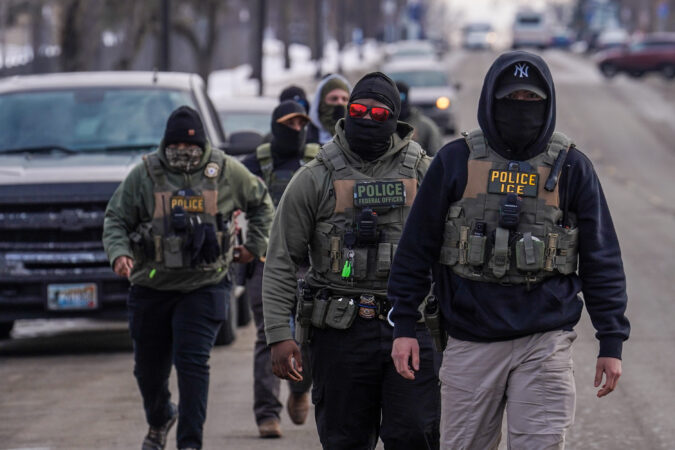
On Tuesday, when their Nissan returned to the lot outside his restaurant, Ramirez, 31, filmed his confrontation with the two men, who hide their faces as he approaches and appear to be wearing heavy tactical gear beneath their yellow vests.
“This is what our taxpayer money goes to: renting these vehicles with fake tags to come sit here and watch my business,” Ramirez shouts in the video.
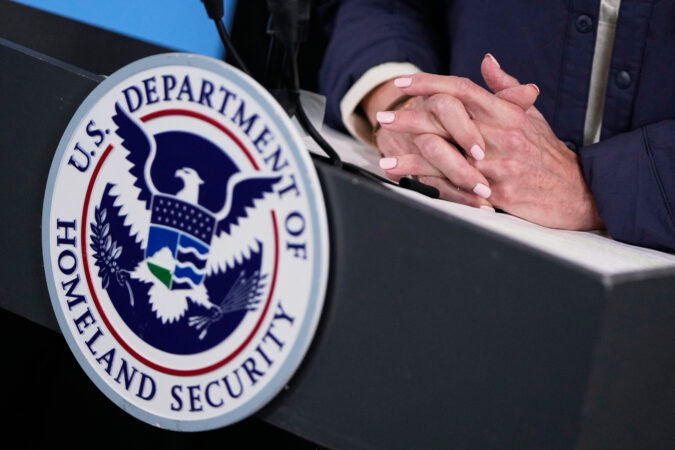
A spokesperson for the Department of Homeland Security and Immigration and Customs Enforcement did not respond to inquiries about whether the men were federal immigration officers. But encounters like Ramirez’s have become increasingly common.
As the sweeping immigration crackdown in Minnesota continues, legal observers and officials say they have received a growing number of reports of federal agents impersonating construction workers, delivery drivers, and in some cases anti-ICE activists.
“If you have people afraid that the electrical worker outside their house might be ICE, you’re inviting public distrust and confusion on a much more dangerous level,” said Naureen Shah, the director of immigration advocacy at the American Civil Liberties Union. “This is what you do if you’re trying to control a populace, not trying to do routine, professional law enforcement.”
A ‘more extreme degree’ of deception
In the past, immigration authorities have sometimes used disguises and other deceptions, which they call ruses, to gain entry into homes without a warrant.
The tactics became more common during President Donald Trump’s first term, attorneys said, prompting an ACLU lawsuit accusing immigration agents of violating the U.S. Constitution by posing as local law enforcement during home raids. A recent settlement restricted the practice in Los Angeles. But ICE deceptions remain legal elsewhere in the country.
Still, the undercover operations reported in Minnesota would appear to be a “more extreme degree than we’ve seen in the past,” said Shah, in part because they seem to be happening in plain sight.
Where past ruses were aimed at deceiving immigration targets, the current tactics may also be a response to the Minnesota’s sprawling networks of citizen observers that have sought to call attention to federal agents before they make arrests.
At the Bishop Henry Whipple Federal Building in Minneapolis, the city’s central hub of ICE activity, activists told the Associated Press they had seen agents leaving in vehicles with stuffed animals on their dashboards or Mexican flag decals on their bumpers. Pickups with lumber or tools in their beds were also frequently spotted.
In recent weeks, federal agents have repeatedly shown up to construction sites dressed as workers, according to Jose Alvillar, a lead organizer for the local immigrant rights group, Unidos MN.
“We’ve seen an increase in the cowboy tactics,” he said, though he noted the raids had not resulted in arrests. “Construction workers are good at identifying who is a real construction worker and who is dressing up as one.”
Using vintage plates
Since the start of the operation in Minnesota, local officials, including Democratic Gov. Tim Walz, have said ICE agents had been seen swapping license plates or using bogus ones, a violation of state law.
Candice Metrailer, an antiques dealer in south Minneapolis, believes she witnessed such an attempt firsthand.
On Jan. 13, she received a call from a man who identified himself as a collector, asking if her store sold license plates. She said it did. A few minutes later, two men in street clothes entered the shop and began looking through her collection of vintage plates.
“One of them says, ‘Hey, do you have any recent ones?’” Metrailer recalled. “Immediately, an alarm bell went off in my head.”
Metrailer stepped outside while the men continued browsing. A few doors down from the shop, she saw an idling Ford Explorer with blacked out windows. She memorized its license plate, then quickly plugged it into a crowdsourced database used by local activists to track vehicles linked to immigration enforcement.
The database shows an identical Ford with the same plates had been photographed leaving the Whipple building seven times and reported at the scene of an immigration arrest weeks earlier.
When one of the men approached the register holding a white Minnesota plate, Metrailer said she told him that the store had a new policy against selling the items.
Metrailer said she had reported the incident to Minnesota’s attorney general. A spokesperson for DHS did not respond to a request for comment.
A response to obstruction
Supporters of the immigration crackdown say the volunteer army of ICE-tracking activists in Minneapolis has forced federal agents to adopt new methods of avoiding detection.
“Of course agents are adapting their tactics so that they’re a step ahead,” said Scott Mechkowski, former deputy director of ICE enforcement and operations in New York City. “We’ve never seen this level of obstruction and interference.”
In nearly three decades in immigration enforcement, Mechkowski said he also hadn’t seen ICE agents disguising themselves as uniformed workers in the course of making arrests.
Earlier this summer, a spokesperson for DHS confirmed a man wearing a high-visibility construction vest was an ICE agent conducting surveillance. In Oregon, a natural gas company published guidance last month on how customers could identify their employees after reports of federal impersonators.
In the days since his encounter, Ramirez, the restaurant worker, said he has been on high alert for undercover agents. He recently stopped a locksmith who he feared might be a federal agent, before quickly realizing he was a local resident.
“Everybody is on edge about these guys, man,” Ramirez said. “It feels like they’re everywhere.”
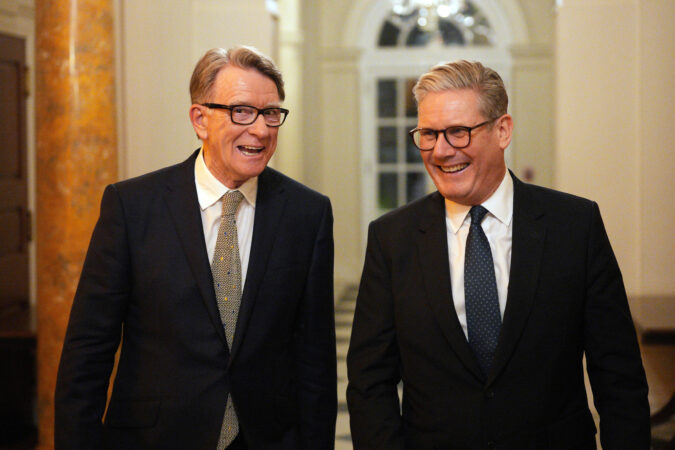
LONDON — British Prime Minister Keir Starmer ‘s chief of staff resigned Sunday over the furor surrounding the appointment of Peter Mandelson as the U.K. ambassador to the U.S. despite his ties to Jeffrey Epstein.
Morgan McSweeney said he took responsibility for advising Starmer to appoint Mandelson, 72, to Britain’s most important diplomatic post in 2024.
“The decision to appoint Peter Mandelson was wrong. He has damaged our party, our country and trust in politics itself,” McSweeney said in a statement. “When asked, I advised the Prime Minister to make that appointment and I take full responsibility for that advice.”
Starmer is facing a political storm and questions about his judgment after newly published documents, part of a huge trove of Epstein files made public in the United States, suggested that Mandelson sent market-sensitive information to the convicted sex offender when he was the U.K. government’s business secretary during the 2008 financial crisis.
Starmer’s government has promised to release its own emails and other documentation related to Mandelson’s appointment, which it says will show that Mandelson misled officials.
The prime minister apologized this week for “having believed Mandelson’s lies.”
He acknowledged that when Mandelson was chosen for the top diplomat job in 2024, the vetting process had revealed that Mandelson’s friendship with Epstein continued after the latter’s 2008 conviction. But Starmer maintained that “none of us knew the depth of the darkness” of that relationship at the time.
A number of lawmakers said Starmer is ultimately responsible for the scandal.
“Keir Starmer has to take responsibility for his own terrible decisions,” said Kemi Badenoch, leader of the opposition Conservative Party.
Mandelson, a former Cabinet minister, ambassador, and elder statesman of the governing Labour Party, has not been arrested or charged.
Metropolitan Police officers searched Mandelson’s London home and another property linked to him on Friday. Police said the investigation is complex and will require “a significant amount of further evidence gathering and analysis.”
The U.K. police investigation centers on potential misconduct in public office, and Mandelson is not accused of any sexual offenses.
Starmer had fired Mandelson in September from his ambassadorial job over earlier revelations about his Epstein ties. But critics say the emails recently published by the U.S. Justice Department have brought serious concerns about Starmer’s judgment to the fore. They argue that he should have known better than to appoint Mandelson in the first place.
The new revelations include documents suggesting Mandelson shared sensitive government information with Epstein after the 2008 global financial crisis. They also include records of payments totaling $75,000 in 2003 and 2004 from Epstein to accounts linked to Mandelson or his husband, Reinaldo Avila da Silva.
Aside from his association with Epstein, Mandelson previously had to resign twice from senior government posts because of scandals over money or ethics.
Starmer had faced growing pressure over the past week to fire McSweeney, who is regarded as a key adviser in Downing Street and seen as a close ally of Mandelson.
Starmer on Sunday credited McSweeney as a central figure in running Labour’s recent election campaign and the party’s 2004 landslide victory. His statement did not mention the Mandelson scandal.
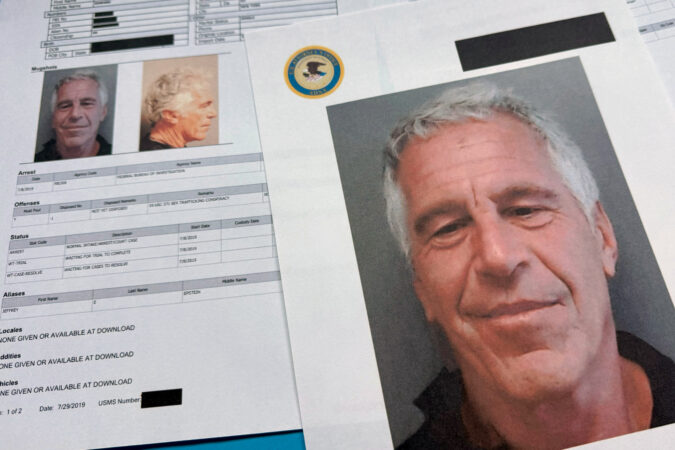
NEW YORK — The FBI pored over Jeffrey Epstein’s bank records and emails. It searched his homes. It spent years interviewing his victims and examining his connections to some of the world’s most influential people.
But while investigators collected ample proof that Epstein sexually abused underage girls, they found scant evidence the well-connected financier led a sex trafficking ring serving powerful men, an Associated Press review of internal Justice Department records shows.
Videos and photos seized from Epstein’s homes in New York, Florida, and the Virgin Islands didn’t depict victims being abused or implicate anyone else in his crimes, a prosecutor wrote in one 2025 memo.
An examination of Epstein’s financial records, including payments he made to entities linked to influential figures in academia, finance, and global diplomacy, found no connection to criminal activity, said another internal memo in 2019.
While one Epstein victim made highly public claims that he “lent her” to his rich friends, agents couldn’t confirm that and found no other victims telling a similar story, the records said.
Summarizing the investigation in an email last July, agents said “four or five” Epstein accusers claimed other men or women had sexually abused them. But, the agents said, there “was not enough evidence to federally charge these individuals, so the cases were referred to local law enforcement.”
The AP and other media organizations are still reviewing millions of pages of documents, many of them previously confidential, that the Justice Department released under the Epstein Files Transparency Act and it is possible those records contain evidence overlooked by investigators.
But the documents, which include police reports, FBI interview notes, and prosecutor emails, provide the clearest picture to date of the investigation — and why U.S. authorities ultimately decided to close it without additional charges.
Dozens of victims come forward
The Epstein investigation began in 2005, when the parents of a 14-year-old girl reported she had been molested at the millionaire’s home in Palm Beach, Fla.
Police would identify at least 35 girls with similar stories: Epstein was paying high school-age students $200 or $300 to give him sexualized massages.
After the FBI joined the probe, federal prosecutors drafted indictments to charge Epstein and some personal assistants who had arranged the girls’ visits and payments. But instead, then-Miami U.S. attorney Alexander Acosta struck a deal letting Epstein plead guilty to state charges of soliciting prostitution from an underage girl. Sentenced to 18 months in jail, Epstein was free by mid-2009.
In 2018, a series of Miami Herald stories about the plea deal prompted New York federal prosecutors to take a fresh look at the accusations.
A year later, prosecutors charged Epstein’s longtime confidant, Ghislaine Maxwell, saying she’d recruited several of his victims and sometimes joined the sexual abuse. Convicted in 2021, Maxwell is serving a 20-year prison term.
Prosecutors fail to find evidence backing most sensational claims
Prosecution memos, case summaries, and other documents made public in the department’s latest release of Epstein-related records show that FBI agents and federal prosecutors diligently pursued potential coconspirators. Even seemingly outlandish and incomprehensible claims, called in to tip lines, were examined.
Some allegations couldn’t be verified, investigators wrote.
In 2011 and again in 2019, investigators interviewed Virginia Roberts Giuffre, who in lawsuits and news interviews had accused Epstein of arranging for her to have sexual encounters with numerous men, including Britain’s former Prince Andrew.
Investigators said they confirmed that Giuffre had been sexually abused by Epstein. But other parts of her story were problematic.
Two other Epstein victims who Giuffre had claimed were also “lent out” to powerful men told investigators they had no such experience, prosecutors wrote in a 2019 internal memo.
“No other victim has described being expressly directed by either Maxwell or Epstein to engage in sexual activity with other men,” the memo said.
Giuffre acknowledged writing a partly fictionalized memoir of her time with Epstein containing descriptions of things that didn’t take place. She had also offered shifting accounts in interviews with investigators, they wrote, and had “engaged in a continuous stream of public interviews about her allegations, many of which have included sensationalized if not demonstrably inaccurate characterizations of her experiences.” Those inaccuracies included false accounts of her interactions with the FBI, they said.
Still, U.S. prosecutors attempted to arrange an interview with Andrew, now known as Andrew Mountbatten-Windsor. He refused to make himself available. Giuffre settled a lawsuit with Mountbatten-Windsor in which she had accused him of sexual misconduct.
In a memoir published after she killed herself last year, Giuffre wrote that prosecutors told her they didn’t include her in the case against Maxwell because they didn’t want her allegations to distract the jury. She insisted her accounts of being trafficked to elite men were true.
Prosecutors say photos, videos don’t implicate others
Investigators seized a multitude of videos and photos from Epstein’s electronic devices and homes in New York, Florida, and the U.S. Virgin Islands. They found CDs, hard copy photographs, and at least one videotape containing nude images of females, some of whom seemed as if they might be minors. One device contained 15 to 20 images depicting commercial child sex abuse material — pictures investigators said Epstein obtained on the internet.
No videos or photos showed Epstein victims being sexually abused, none showed any males with any of the nude females, and none contained evidence implicating anyone other than Epstein and Maxwell, then-Assistant U.S. Attorney Maurene Comey wrote in an email for FBI officials last year.
Had they existed, the government “would have pursued any leads they generated,” Comey wrote. “We did not, however, locate any such videos.”
Investigators who scoured Epstein’s bank records found payments to more than 25 women who appeared to be models — but no evidence that he was engaged in prostituting women to other men, prosecutors wrote.
Epstein’s close associates go uncharged
In 2019, prosecutors weighed the possibility of charging one of Epstein’s longtime assistants but decided against it.
Prosecutors concluded that while the assistant was involved in helping Epstein pay girls for sex and may have been aware that some were underage, she herself was a victim of his sexual abuse and manipulation.
Investigators examined Epstein’s relationship with the French modeling agent Jean-Luc Brunel, who once was involved in an agency with Epstein in the U.S., and who was accused in a separate case of sexually assaulting women in Europe. Brunel killed himself in jail while awaiting trial on a rape charge in France.
Prosecutors also weighed whether to charge one of Epstein’s girlfriends who had participated in sexual acts with some of his victims. Investigators interviewed the girlfriend, who was 18 to 20 years old at the time, “but it was determined there was not enough evidence,” according to a summary given to FBI Director Kash Patel last July.
Days before Epstein’s July 2019 arrest, the FBI strategized about sending agents to serve grand jury subpoenas on people close to Epstein, including his pilots and longtime business client, retail mogul Les Wexner.
Wexner’s lawyers told investigators that neither he nor his wife had knowledge of Epstein’s sexual misconduct. Epstein had managed Wexner’s finances, but the couple’s lawyers said they cut him off in 2007 after learning he’d stolen from them.
“There is limited evidence regarding his involvement,” an FBI agent wrote of Wexner in an Aug. 16, 2019, email.
In a statement to the AP, a legal representative for Wexner said prosecutors had informed him that he was “neither a coconspirator nor target in any respect,” and that Wexner had cooperated with investigators.
Prosecutors also examined accounts from women who said they’d given massages at Epstein’s home to guests who’d tried to make the encounters sexual. One woman accused private equity investor Leon Black of initiating sexual contact during a massage in 2011 or 2012, causing her to flee the room.
The Manhattan district attorney’s office subsequently investigated, but no charges were filed.
Black’s lawyer, Susan Estrich, said he had paid Epstein for estate planning and tax advice. She said in a statement that Black didn’t engage in misconduct and had no awareness of Epstein’s criminal activities. Lawsuits by two women who accused Black of sexual misconduct were dismissed or withdrawn. One is pending.
No client list
Attorney General Pam Bondi told Fox News in February 2025 that Epstein’s never-before-seen “client list” was “sitting on my desk right now.” A few months later, she claimed the FBI was reviewing “tens of thousands of videos” of Epstein “with children or child porn.”
But FBI agents wrote superiors saying the client list didn’t exist.
On Dec. 30, 2024, about three weeks before President Joe Biden left office, then-FBI Deputy Director Paul Abbate reached out through subordinates to ask “whether our investigation to date indicates the ‘client list,’ often referred to in the media, does or does not exist,” according to an email summarizing his query.
A day later, an FBI official replied that the case agent had confirmed no client list existed.
On Feb. 19, 2025, two days before Bondi’s Fox News appearance, an FBI supervisory special agent wrote: “While media coverage of the Jeffrey Epstein case references a ’client list,’ investigators did not locate such a list during the course of the investigation.”
SUVA, Fiji — The methamphetamine drop-offs to a squatter settlement here followed a routine.
Once a week, according to residents, a black Dodge truck with tinted windows pulled up to a tent on the edge of the community, a dense maze of tiny shacks connected by muddy paths, slick from the persistent summer rain. A man stepped out, swapped drugs for cash with his local contact, and drove off. Dealers repacked the white crystals into tiny zip-top bags, no bigger than a child’s pinkie, before doling them out for about $22 each.
The settlement does not have plumbing or formal electricity. Even food is scarce. But the drugs were everywhere, according to community workers and one former user who lives here, a 17-year-old boy. Given that almost all his friends were on meth, he said, getting addicted was “only a matter of time.”
For years, law enforcement partners and the United Nations had warned Fiji that international criminal syndicates were exploiting its geography as a South Pacific island, using it as a transshipment point for drugs originating in Southeast Asia and Latin America and destined for New Zealand, Australia, and North America.
Those drugs — principally methamphetamines — have seeped into Fiji itself, devastating families and scarring this small society. Community workers say they have seen users as young as 10.
Compounding the problem is how meth is used in Fiji: injected, rather than smoked, snorted or taken orally, according to interviews with current and former methamphetamine users and an assessment of drug use in Fiji’s capital, Suva, commissioned by the World Health Organization and U.N. Development Program (UNDP). Poor education around drugs and a deeply ingrained communal culture have meant that needles are routinely shared among users, who lack knowledge of or ignore safe sex practices — igniting an HIV public health crisis, health workers said in interviews.
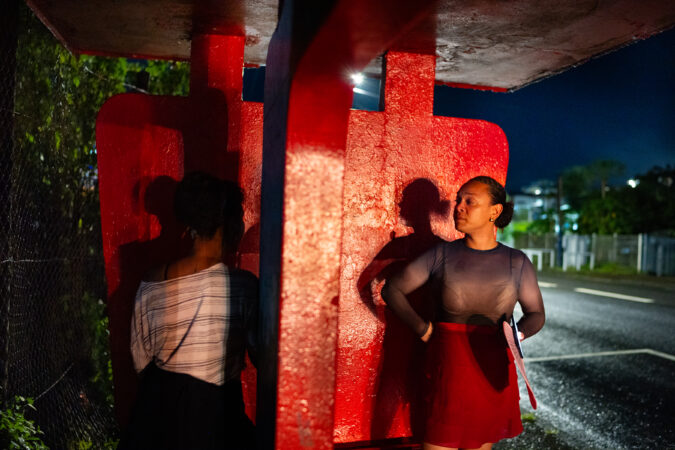
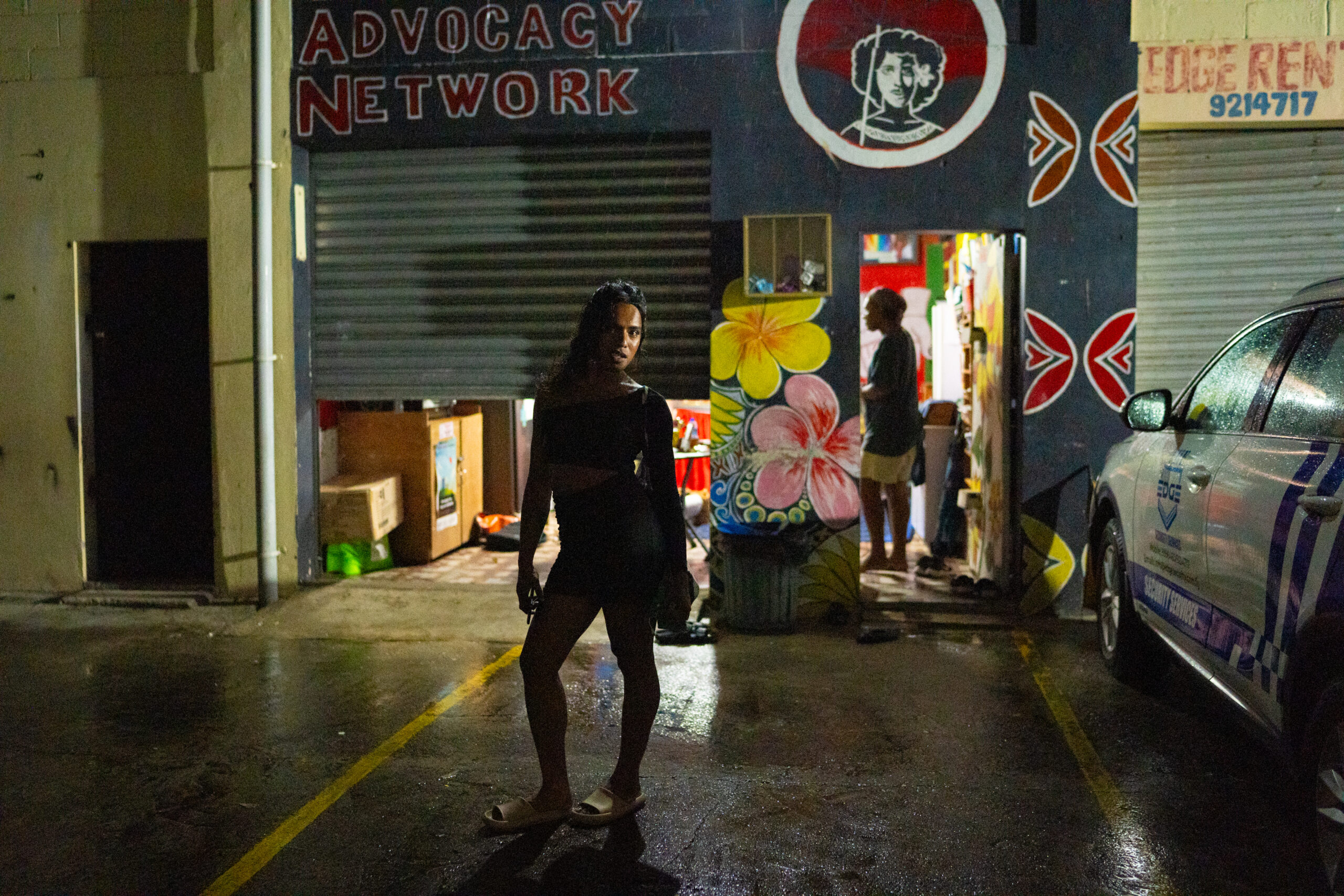
A sex worker waits outside the Survival Advocacy Network, a safe haven for the LGBTQ+ and sex worker community in Fiji that in recent years has also served injecting drug users and provides free HIV testing.
Fiji — a tourist destination known for its exclusive resorts, pristine waters, and white-sand beaches — now has one of the fastest-growing rates of HIV infection in the world, overburdening its donor-dependent public health system. More than 1,583 new HIV infections were recorded in 2024 in a country with a population of less than 1 million — the highest ever in Fiji’s history, and a 500% increase from 2018.
That number, according to preliminary assessments from the Joint U.N. Program on HIV/AIDS (UNAIDS) and Fiji’s Health Ministry, is expected to double again this year to more than 3,000. And public health officials believe the true number of those infected is closer to double that, as many exposed Fijians have not yet been tested, especially on more remote islands.
Conditions here “were a recipe for an explosive epidemic,” said Jason Mitchell, who leads the Fijian government’s HIV task force. “We have a long way to go … before we see the end of this.”
A majority of these new cases have been recorded among young people between ages 15 and 34, while a growing number of mothers are passing the infection on to their babies, according to local health statistics; half of the new infections are linked to drug use.
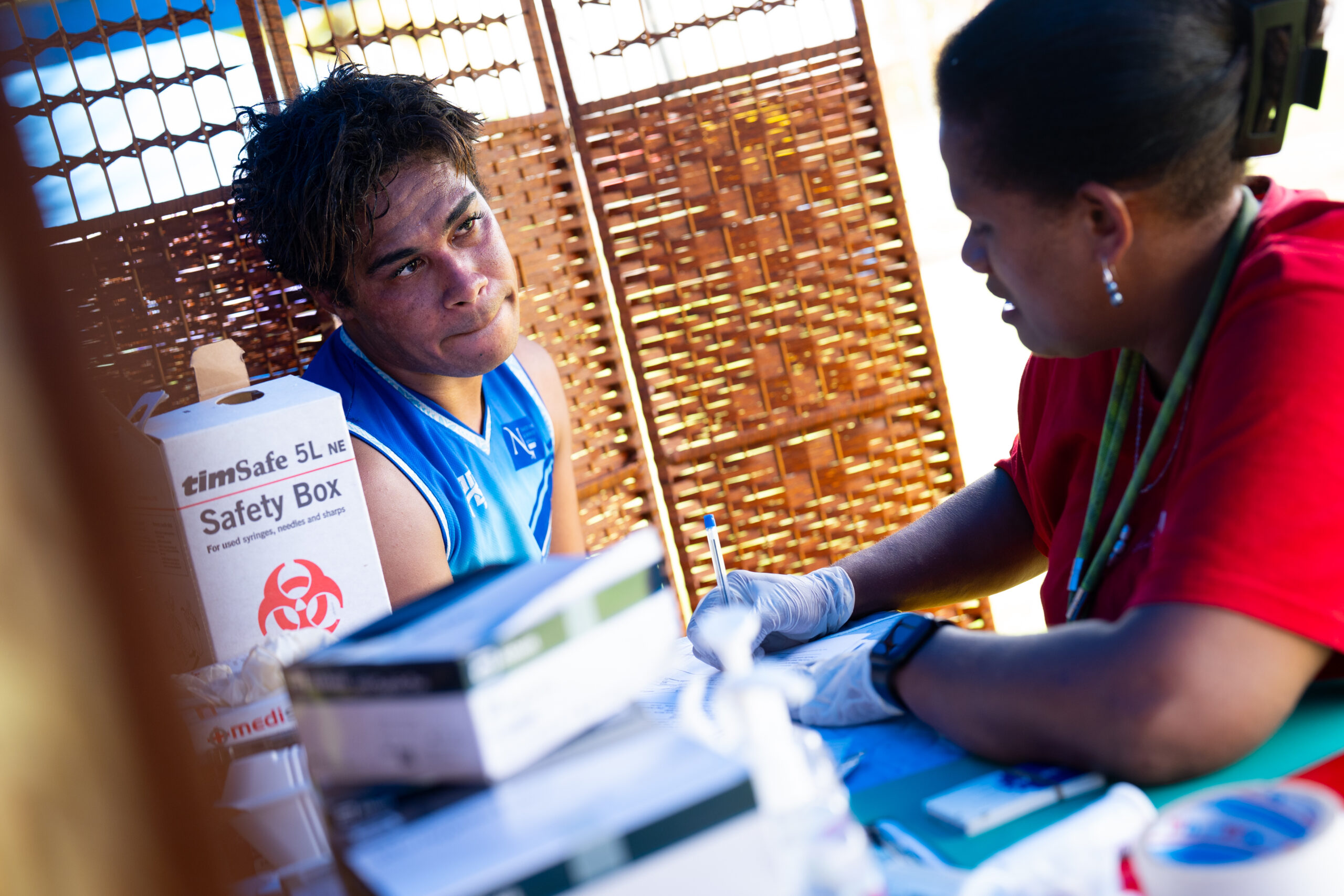
The Reproductive and Family Health Association of Fiji (RFHAF) gives free HIV tests at a sporting event. Isoa Fou, 26, wasn’t ashamed to be getting a test and feels concerned about what’s going on in the country.
Experts in both public health and transnational crime believe that Fiji is the starkest example of a phenomenon that is taking hold across the Pacific region: Rising HIV infections track drug shipment routes across islands that are smaller, more isolated and have significantly less testing for the virus, including in Tonga, Samoa, and the Solomon Islands.
Those islands “all have the early signs that Fiji had in 2019,” said Renata Ram, UNAIDS’ country director in Fiji. Ram raised alarm bells of an impending HIV crisis in a 2022 article, warning that risky behaviors commonplace in Fiji were spreading to other parts of the Pacific.
Law enforcement officials, customs agencies, U.N. officials and others who investigate drug syndicates believe that the groups operating in and around Fiji are working with each other, bringing together Chinese triads, Mexican cartels, Australian biker gangs, and other syndicates with connections as far away as Nigeria.
Criminal organizations are targeting our region “because they understand our enforcement limitations to monitor across vast maritime territories using traditional enforcement methods,” said the Oceania Customs Organization Secretariat, a 24-member association that helps coordinate customs and border enforcement for Pacific nations, in a response to questions from the Washington Post. “We’re witnessing unprecedented coordination between drug cartels, organized criminal groups and regional networks.”
That cooperation presents a huge challenge and has “thrown traditional narcotics work out the window,” according to one U.S. law enforcement official who, like others, spoke on the condition of anonymity to discuss counternarcotics operations. Criminal organizations from different countries, rather than violently seeking to secure turf, are working together in Fiji, law enforcement officials say, much like a diversified multinational corporation.
“Those guys are going to make deals along the chain, even though they technically would be looked at as adversaries,” the U.S. law enforcement official said, “because at the end of the day they are going to do what it takes to succeed.”
At the same time, international law enforcement agencies have been reticent to share intelligence with their Fijian counterparts, prosecutors said, because of allegations that drug syndicates have infiltrated the police and other agencies.
In December, leaked chats on Viber, a messaging app commonly used in Fiji, allegedly showed police officers texting with traffickers about moving drugs. Seven senior officers are now under investigation in connection with that case, according to Fiji’s Ministry of Policing. Between January 2023 and October of last year, before the Viber investigation, 27 police officers were charged with drug-related offenses, the ministry said.
John Rabuku, Fiji’s deputy director of public prosecutions, who last year secured convictions up to life in prison in connection with the Pacific’s largest-ever drug bust, acknowledged in an interview that these were only “middle-level people … involved in the logistics.” Even at trial, he said, prosecutors were unable to show the drugs came from a particular group. The syndicate had brought in 4.1 metric tons (about 4.5 U.S. tons) of methamphetamine worth over a billion dollars into Nadi, Fiji’s main tourist area, on a yacht in December 2023.
“No one would give us that information,” Rabuku said. “The offshore intelligence community … just didn’t want to tell us.”
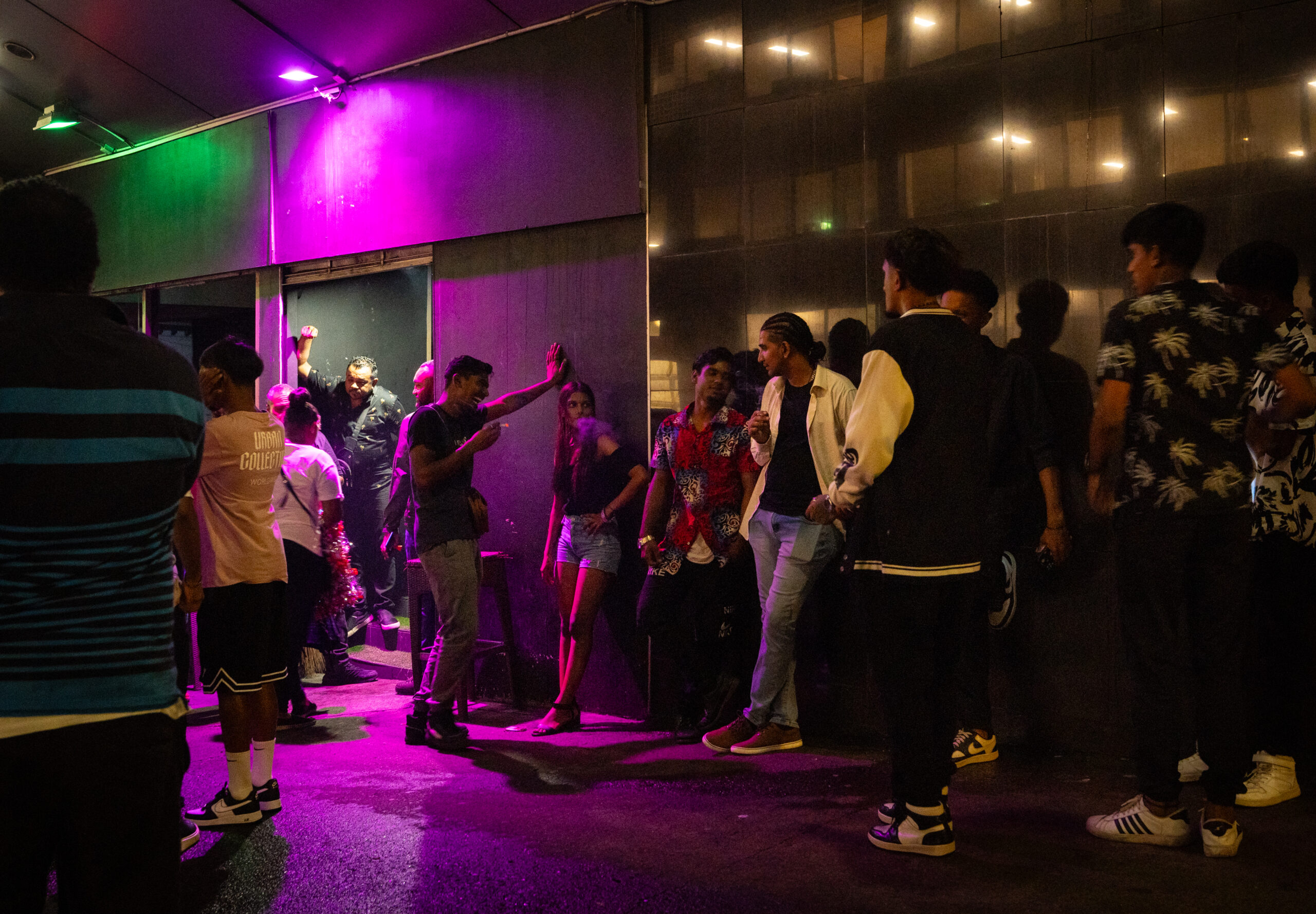
Guests wait outside a nightclub in Suva in December.
White money
Joseph was a singer in a reggae band, performing for tourists at beach bars, when a contact he knew approached him about selling marijuana. The 47-year-old, who spoke on the condition that only his first name be used because of security concerns and ongoing criminal cases against him, started dealing, mostly selling locally grown product to foreigners.
A few years before the COVID pandemic, he and others said, meth started hitting the streets, first as a party drug for tourists and wealthy Fijians. The drugs, according to the U.N. Office on Drugs and Crime (UNODC) and law enforcement officials, were from shipments transiting to Australia and New Zealand, where meth is growing in demand and exceptionally lucrative, selling for 18 times what it retails for in the United States, according to law enforcement officials and other experts on the drug trade.
When COVID-19 hit, putting a freeze on tourist arrivals and complicating the transport of drugs in and out of Fiji, traffickers started paying runners in the drug itself — “white money,” as it is called on the streets. Joseph and experts on organized crime said dealers started selling meth locally to turn their pay into cash.
“That payment in kind became the origin of the domestic market,” said Virginia Comolli, head of the Pacific program at the Geneva-based Global Initiative Against Transnational Organized Crime. There was so much that dealers “didn’t know how to price it,” she said, while users themselves had no idea how addictive the drug could be.
As supply exploded and prices fell, meth quickly spread among the urban poor, sex workers and other marginalized communities.
“It was the ‘in thing’ for us,” said Rochelle Naulunimagiti, a 37-year-old transgender sex worker and activist. “All the girls were on it.”
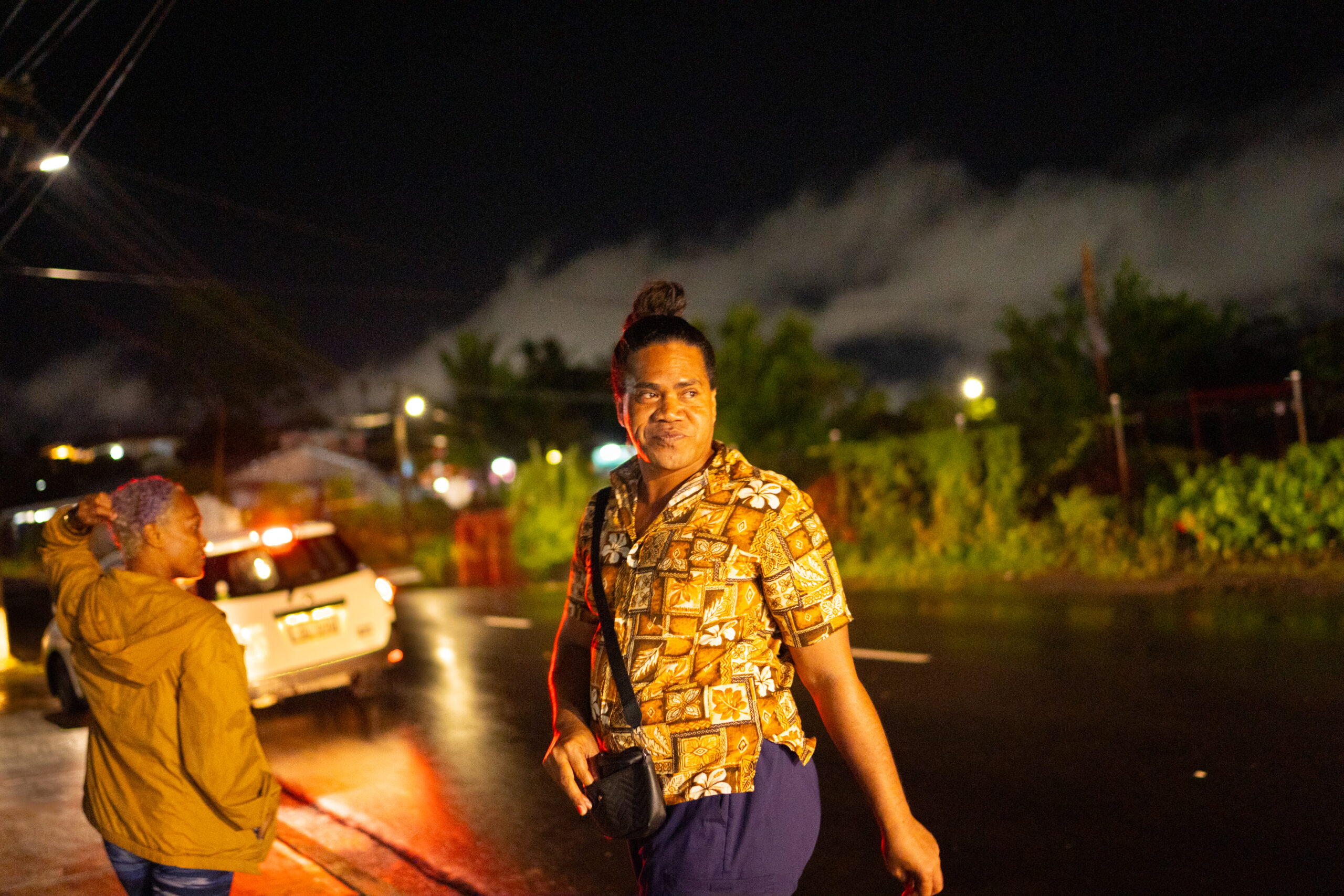
Rochelle Naulunimagiti, 37, a trans sex worker and community activist, shared a needle with a friend one night when she was desperate to get high, amid an especially tough period in her life. A few months later, she tested positive for HIV, a diagnosis that initially crippled her.
In Fiji, just as a single cigarette is often shared among a group of smokers and as the traditional psychoactive drink, kava, is passed around in a single cup, needles too were shared, community workers and users said.
Friends would sit and inject in a group, using shared bottle caps or other mixing paraphernalia to dissolve the crystals into an injectable liquid. Often, just one person — called the “doctor” — would be in charge of administering the drug, injecting the others, users and community workers said. In rare cases, addicts injected themselves with the blood of a person who was already high to get a residual hit. But the high was never as strong. On one evening, reporters from the Post observed a user injecting “raw,” as it is called here: using their own blood, instead of water, to dilute the crystals, and then injecting the mixture back into their veins.
Ben Morrison, who co-founded Inspire Pacific, which runs a camp for boys who are grappling with drugs and violence, said about 30% of those in the cohort are HIV-positive, most through needle-sharing.
For them, “HIV is like, what’s that? OK, I got a sickness, but look at my life. I don’t have a dad, I don’t have a home, I don’t eat on a daily basis,” Morrison said. “So what’s another diagnosis from a doctor to me?”
Sometimes, though, the risks were clear to users. Naulunimagiti knew better, she said. But one night in 2023, grappling with depression, she said she “really needed that feeling.” She took a needle from a friend and injected herself. Several months later, she tested positive for HIV.
“I was a leader in the community,” Naulunimagiti said through tears. “I thought, what would people think of me?”
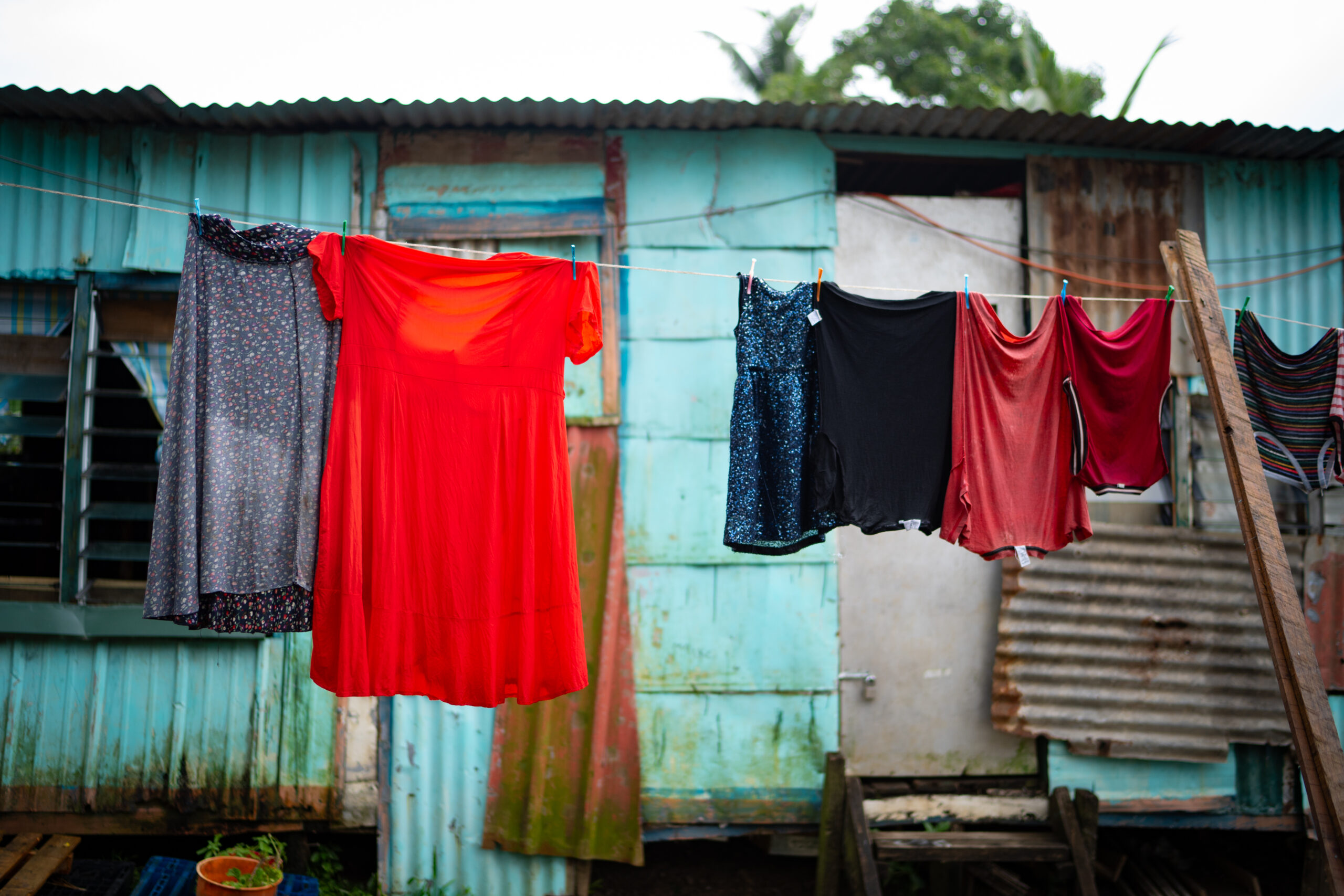
Laundry hangs on a line in an urban squatter community in Suva.
Culture of silence
Mark Shaheel Lal, a 24-year-old student, was walking through the streets of Suva one afternoon when a driver rolled down his window and shouted, “he has AIDS!” before speeding off. It wasn’t the first time, he said. Just a few months earlier, someone pointed at him and called out, “HIV.”
Just weeks before Fiji’s government officially announced there was an HIV outbreak in the country, Lal, a gay man who is not a drug user, came out as HIV-positive. In a nation where a culture of silence still exists around the diagnosis, Lal’s declaration made him a face of the epidemic, as well as a source of information for many HIV-positive Fijians. Through his Facebook page, Living Positive Fiji, Lal has counseled more than 100 newly diagnosed HIV patients over the past year, helping them navigate their diagnosis.
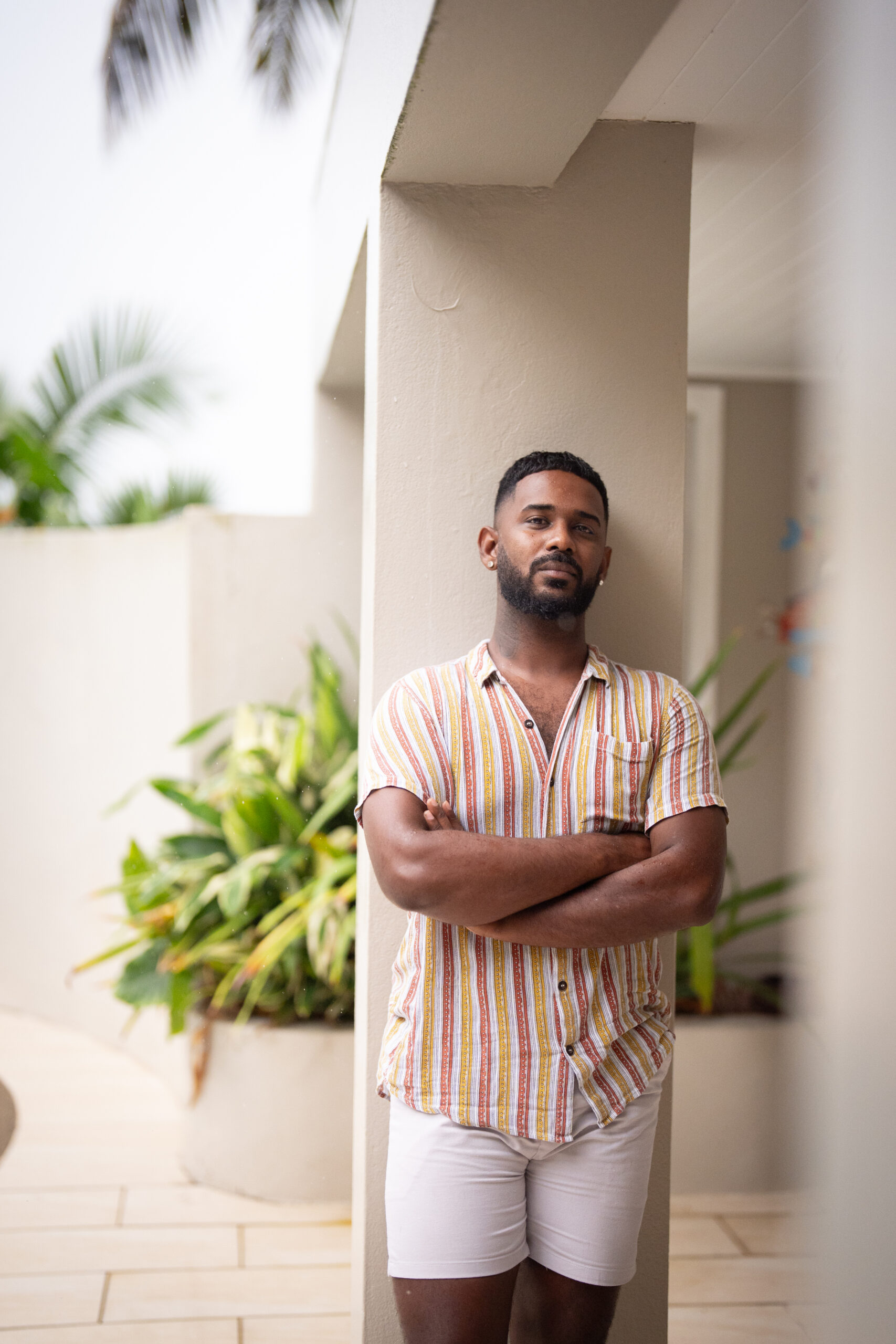
Mark Shaheel Lal, 24, came out as a HIV-positive in 2024, hoping to break the “culture of silence” around the diagnosis.
“I know how I felt when I got that note,” Lal said. “I thought my world was ending. It even came to a point where I thought I should take my own life because I was going to die anyway.”
Some who have reached out to him have been hesitant to get treatment, believing that since they are not showing any signs of sickness, the diagnosis must be incorrect. Advances in antiretroviral therapy mean HIV is no longer the death sentence it once was — but only if detected early and if someone is receiving treatment. Fiji’s public health officials are also pushing for Pre-Exposure Prophylaxis (PReP) medication for high-risk groups, which can prevent people from contracting HIV altogether.
Of the more than 120 people who died of HIV-related causes in Fiji in 2024, more than half found out their status the same year, according to data from the Health Ministry, long after their immune system had already been fatally compromised.
Lal holds his HIV medication pills.
Accessing critical medication has also not always been straightforward. At one point in late 2024, Lal and Naulunimagiti said, there were no antiretroviral pills in the country. There was also a shortage of specimen bottles for further testing, which Lal raised money for and then donated to the local reproductive health clinic.
In recent months, both Australia and New Zealand have pledged millions to Fiji’s effort to get the HIV epidemic under control. The Fijian government was separately in discussions with the U.S. Agency for International Development (USAID) for additional funding and the U.S. Centers for Disease Control and Prevention (CDC) for help investigating the origins of the epidemic and the specific strain of HIV the country was dealing with, according to people familiar with the conversations. Both discussions did not progress under the Trump administration, which took office soon after Fiji declared its epidemic. USAID had just reopened its regional mission in Fiji in late 2023 after more than a decade.
A spokesperson for the CDC, in response to questions from the Post, referred queries to the Department of Health and Human Services, which referred the Post on to the State Department. The U.S. Embassy in Suva did not respond to a request for comment.
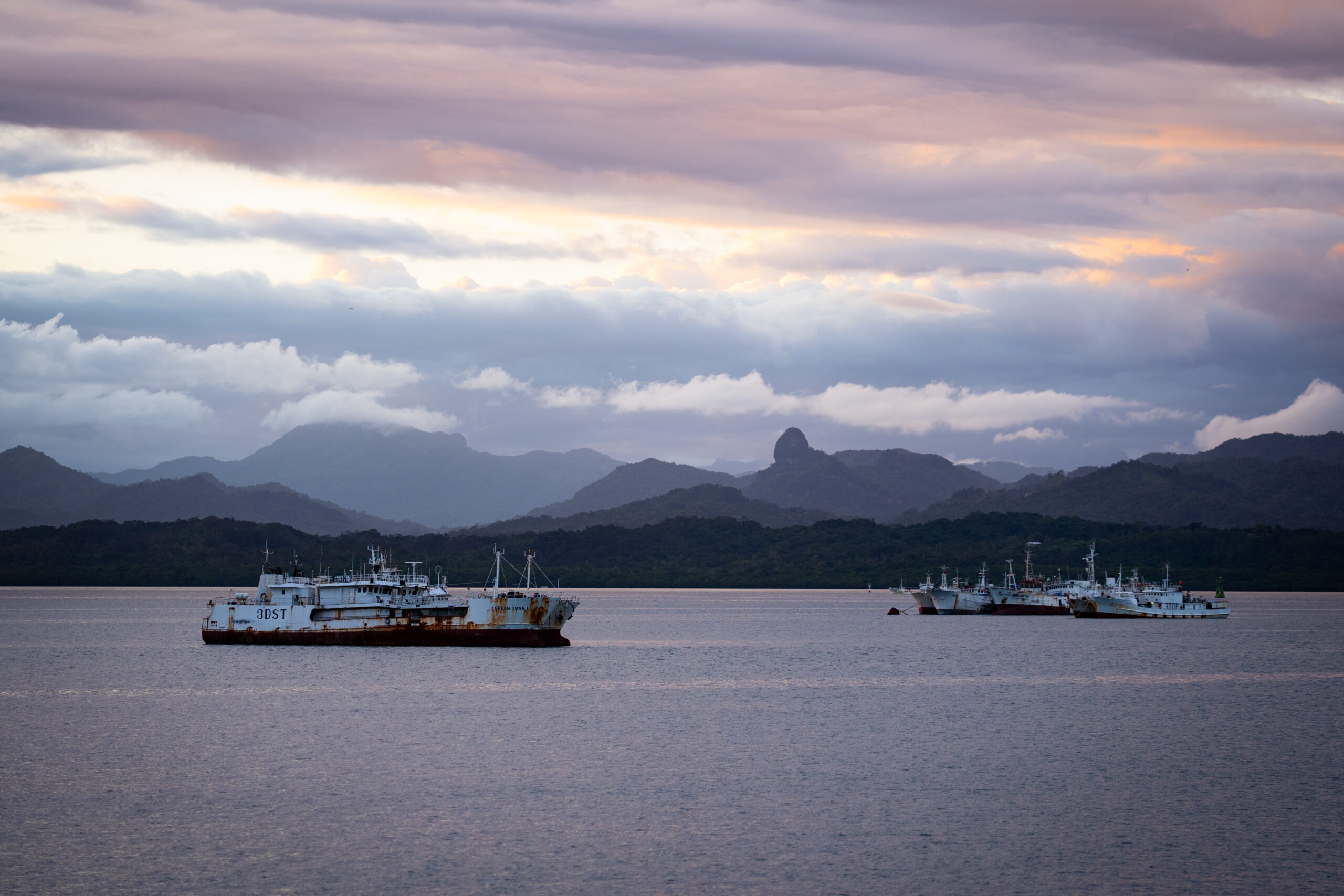
Ships in the waters off Fiji.
New year, new bust
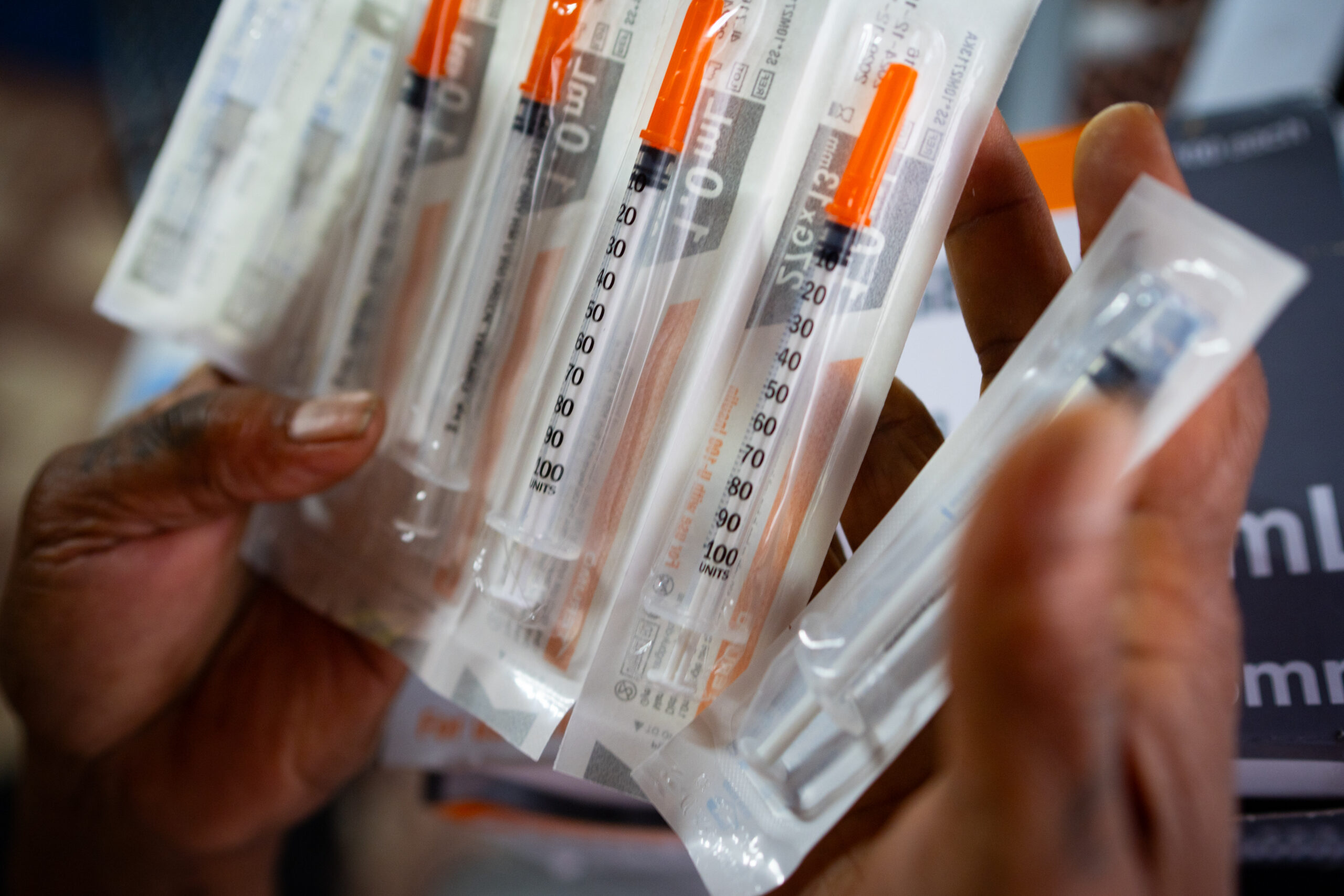
On a recent afternoon in Fiji, a community worker sitting in a taxi rolled down the window, stuck out their hand and brandished a handful of new syringes, still wrapped in sterile packaging, to a group of zombielike men, scar tissue marking their forearms, sitting outside an alcohol store.
It took them a minute to register that the syringes were free handouts. They rushed to the car, grabbed the syringes and asked for more.
Needles have now become almost as valuable as the drug itself, as awareness of safe injecting practices grows in the country. Providing needles remains illegal, however. Participants in the WHO- and UNDP-commissioned assessment on drug use said they “without exception … reported difficulties accessing sterile needles and syringes for injection,” particularly in pharmacies, which are reluctant to give them out without a prescription.
“Carrying the syringes sometimes feels just as risky as carrying weed or dope,” Joseph said.
Needles have become almost as valuable in Fiji as meth itself, as awareness of safe injecting practices grows in the country.
A needle and syringe program, where sterile needles are distributed free with no questions asked, is in the pipeline and likely to be implemented later this year after cabinet approval. The WHO, in its assessment, identified it as one of the highest priorities for Fiji.
Meanwhile, the drugs keep coming. On Jan. 16, Fijian police raided a vessel off a wharf in the northwest of the country and found more than 2 metric tons of cocaine, packed in over 100 sacks. Prosecutors have charged six — four Ecuadoran nationals and two locals — in connection with the trafficking case. The drugs, prosecutors said, came in through semisubmersible vessels known as “narco subs.” Also so far this year, two senior police officers, who have since been suspended, were charged with illegally importing and possessing meth.
“A culture of participation” in the drug trade has “seeped into our police force, our institutions and our society,” said Rabuku, the deputy public prosecutor, undeterred even by recent life sentences. As long as that does not change, he added, Fiji will “always remain a transit point for drugs.”
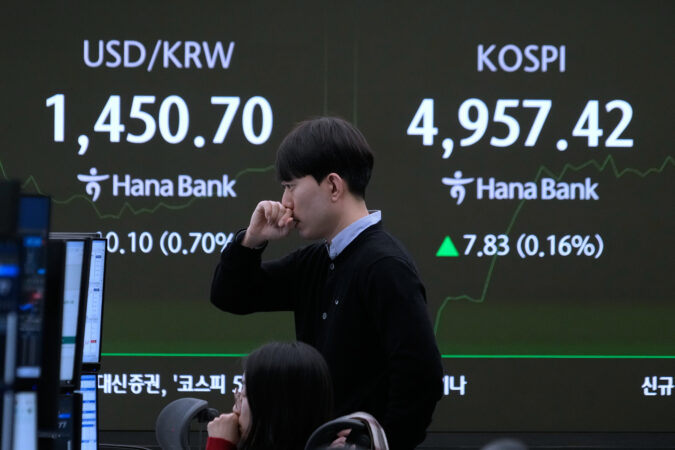
Fallout from the recent Greenland crisis clipped the U.S. dollar, aggravating a yearlong decline that has shaved more than 10% off the greenback’s value since President Donald Trump returned to the White House.
The dollar is under pressure on multiple fronts. After a long period of U.S. financial market outperformance, many foreign investors are rebalancing their portfolios to reduce excessive exposure to the United States and to capitalize on improving prospects elsewhere.Washington’s failure to address its mounting public debt, including crisis-level annual budget deficits at a time of low unemployment, isn’t helping.
But perhaps the key to the dollar’s drop is the ripple effect of the president’s erratic policymaking, including abrupt stops and starts with tariffs and military action against a lengthening list of countries. After more than a year of nonstop upheaval emanating from the White House, many foreign investment managers are exhausted.
“There is a visceral dislike of this kind of policy chaos,” said economist Robin Brooks, a senior fellow at the Brookings Institution. “I think the dollar will fall around 10% [more] this year.”
One sign of the dollar’s ebbing appeal has been a staggering surge in gold prices, up almost 80% over the past year.
At the end of January, the dollar rallied — and gold sank — on news that Trump had nominated Kevin Warsh, a former Federal Reserve governor, to be the next chairman of the nation’s central bank.
But the broader trend of dollar weakness remains in place, several economists and money managers said. The president has pushed repeatedly for the Fed to cut its benchmark 3.75% interest rate to levels far below what mainstream economists say is appropriate, which would be likely to further erode the dollar’s standing.
“We should have the lowest interest rate anywhere in the world. They should be two points and even three points lower,” the president said on Thursday during a Cabinet meeting.
The Fed’s policymaking committee left rates unchanged at their January meeting. But financial markets expect cuts to resume in June.
A weaker dollar will help U.S. exporters by making their products more affordable for foreign customers while boosting companies that earn profits abroad and convert them into dollars. A sagging greenback also should aid the president’s efforts to shrink the trade deficit and attract foreign capital to spur U.S. reindustrialization.
But by raising the cost of imported goods such as furniture, computers, cars, appliances, and clothing, a softer dollar could hamper the fight to cool inflation. That would be bad news for the president, already struggling to address voter concerns over the cost of living with the midterm congressional elections little more than nine months away.
The president and his aides have sent mixed signals about the trend. Recently, Trump brushed off currency concerns, telling reporters in Iowa that the dollar “was doing great.” After traders responded by driving it lower, Treasury Secretary Scott Bessent reaffirmed the traditional U.S. stance in favor of a “strong dollar.”
Doubts about Trump’s positionhave swirled since the 2024 election. A widely-read paper by Stephen Miran, a Trump economic adviser the president later named to a Fed position, argued for a weaker dollar to help rebalance the global trading system. With a nod to the president’s Florida resort, Miran christened the proposed arrangement “the Mar-a-Lago accord.”
No such agreement has emerged. But the dollar showed pronounced weakness on two occasions following major Trump initiatives.
After Trump’s announcement of historic global tariffs last April, U.S. stocks, bonds, and the dollar all sank in an unusual trifecta. While stocks and bonds recovered, the dollar remained depressed — the opposite of what typically happens when a nation imposes new import taxes.
Some analysts diagnosed a widespread “Sell America” trade sweeping financial markets. Bessent scoffed, and many analysts now acknowledge that assessment was overstated. The S&P 500 index hit an all-time high recently, which hardly supports the idea of a flight from U.S. assets.
If foreign investors did not abandon the dollar, they did become less confident in it, a change of sentiment that appeared throughincreased demand for hedges against their currency exposure.
For a foreign investor, changes in currency values are as important as movements in asset prices.
If the dollar falls while a foreigner holds U.S. stocks or bonds, their investment gains can be eroded or eliminated. Foreign investors can protect themselves against that risk by effectively selling dollars and buying their home currency, a practice called hedging.
When the dollar fell after Trump’s tariff announcements, unhedged investors suffered big losses and some began hedging to mitigate the damage. Those transactions served to encourage the dollar decline, according to a detailed June 2025 analysis by economists with the Bank for International Settlements.
“Global investors have changed their behavior. Even when they want exposure to the U.S. stock market, they now feel that they have to hedge the currency,” said Dario Perkins, an economist with TS Lombard in London.
Another headwind facing the dollar is the growing attractiveness of financial markets outside the U.S. For years, global investors poured funds into the U.S., drawn by available returns that were larger than in other markets.
That’s no longer true. The S&P 500’s 14% return over the past year was dwarfed by gains on exchanges in London, Tokyo, Hong Kong, and Toronto. Brazilian stocks are up 44% since this time last year.
The latest gauges of economic activity also show other economies stirring. Both the United Kingdom and Japan are growing at least as quickly as the U.S., according to January’s flash PMI surveys.
The uptick in activity is driving up the price of industrial metals. Zinc is up 30% since mid-2025 and iron ore is up 11%.
“There was this era of U.S. exceptionalism where the U.S. was significantly outperforming the rest of the world. And now we’re seeing more of a broad base. Global growth is picking up,” said Priya Misra, portfolio manager of JPMorgan’s core-plus bond fund.
Even after its recent decline, the dollar is about as strong, adjusted for inflation, as it was three years ago and remains at a level some analysts call “overvalued.” Many analysts expect a further decline this year. But there seems little reason to anticipate a full-fledged rout.
In a statement, Joseph Lavorgna, a counselor to the treasury secretary, described the dollar’s dip as unremarkable. The inflation-adjusted dollar “remains higher today than it was during President Trump’s first term, and it is overall at one of its highest levels in the last several decades,” he said.
Even as foreign investors edge away from the geopolitical chaos enveloping the dollar, it remains the global reserve currency. No viable alternative exists. Global central banks hold more than $7.4 trillion in U.S. currency, by far their largest single holding.
The U.S. also boasts the largest and most liquid financial markets. Its leading position in artificial intelligence makes it an essential destination, even for investors who are skeptical of Trump’s governing style.
“The U.S. economy is one of the strongest, most dynamic in the world. Investors should be careful about declaring the dollar is dead,” said Daniel Ivascyn, chief investment officer for Pimco in Newport Beach, Calif.
Foreign central banks also would be expected to push back against any rapid dollar plunge, according to economists at Bank of America. The flip side of a sinking dollar, by definition, is the appreciation of other currencies, a particular problem for exporting nations and a “recessionary shock” for the world outside the U.S., they said in a client note recently.
One wild card is the situation in Japan, where a long era of ultralow borrowing costs appears to have ended. That suggests the Japanese economy may have decisively emerged from its long-term funk. But rising interest rates threaten a popular strategy long used by global investors.
When Japanese interest rates hovered near zero, global investors could borrow yen cheaply and then invest it in U.S. and other markets, earning sizable returns via a strategy known as the “carry trade.”
Japanese investors hold nearly $5 trillion in overseas securities, with most of that amount in the U.S. With the gap narrowing between yields in Japan and those in other developed markets, some analysts expect Japanese investors to bring a portion of that money home.
Last week, Michael Burry, the famed investor known for “The Big Short,” posted several Japanese financial charts on X under the terse heading: “Repatriation pending.”
So far, there has been no sign of any Japanese exit, and some analysts think the concern is overblown.
“Japanese interest rates have been going up for some time now, and I’m not seeing any evidence that the Japanese are keeping their money at home,” said Marc Chandler, chief market strategist at Bannockburn Capital Markets in New York.
If that changes, it would only add to the downdrafts buffeting the dollar.
Washington Post publisher Will Lewis said Saturday that he’s stepping down, ending a troubled tenure three days after the newspaper said that it was laying off one-third of its staff.
Lewis announced his departure in a two-paragraph email to the newspaper’s staff, saying that after two years of transformation, “now is the right time for me to step aside.” The Post’s chief financial officer, Jeff D’Onofrio, was appointed temporary publisher.
Neither Lewis nor the newspaper’s billionaire owner, Jeff Bezos, participated in the meeting with staff members announcing the layoffs on Wednesday. While anticipated, the cutbacks were deeper than expected, resulting in the shutdown of the Post’s renowned sports section, the elimination of its photography staff, and sharp reductions in personnel responsible for coverage of metropolitan Washington and overseas.
They came on top of widespread talent defections in recent years at the newspaper, which lost tens of thousands of subscribers following Bezos’ order late in the 2024 presidential campaign pulling back from a planned endorsement of Kamala Harris, and a subsequent reorienting of its opinion section in a more conservative direction.
Martin Baron, the Post’s first editor under Bezos, condemned his former boss last week for attempting to curry favor with President Donald Trump and called what has happened at the newspaper “a case study in near-instant, self-inflicted brand destruction.”
The British-born Lewis was a former top executive at the Wall Street Journal before taking over at the Post in January 2024. His tenure has been rocky from the start, marked by layoffs and a failed reorganization plan that led to the departure of former top editor Sally Buzbee.
His initial choice to take over for Buzbee, Robert Winnett, withdrew from the job after ethical questions were raised about both he and Lewis’ actions while working in England. They include paying for information that produced major stories, actions that would be considered unethical in American journalism. The current executive editor, Matt Murray, took over shortly thereafter.
Lewis didn’t endear himself to Washington Post journalists with blunt talk about their work, at one point saying in a staff meeting that they needed to make changes because not enough people were reading their work.
This week’s layoffs have led to some calls for Bezos to either increase his investment in the Post or sell it to someone who will take a more active role. Lewis, in his note, praised Bezos: “The institution could not have had a better owner,” he said.
“During my tenure, difficult decisions have been taken in order to ensure the sustainable future of The Post so it can for many years ahead publish high-quality nonpartisan news to millions of customers each day,” Lewis said.
The Washington Post Guild, the union representing staff members, called Lewis’ exit long overdue.
“His legacy will be the attempted destruction of a great American journalism institution,” the Guild said in a statement. “But it’s not too late to save The Post. Jeff Bezos must immediately rescind these layoffs or sell the paper to someone willing to invest in its future.”
Bezos did not mention Lewis in a statement saying D’Onofrio and his team are positioned to lead the Post into “an exciting and thriving next chapter.”
“The Post has an essential journalistic mission and an extraordinary opportunity,” Bezos said. “Each and every day our readers give us a roadmap to success. The data tells us what is valuable and where to focus.”
D’Onofrio, who joined the paper last June after jobs at the digital ad management company Raptive, Google, Zagat, and Major League Baseball, said in a note to staff that “we are ending a hard week of change with more change.
“This is a challenging time across all media organizations, and The Post is unfortunately no exception,” he wrote. “I’ve had the privilege of helping chart the course of disrupters and cultural stalwarts alike. All faced economic headwinds in changing industry landscapes, and we rose to meet those moments. I have no doubt we will do just that, together.”
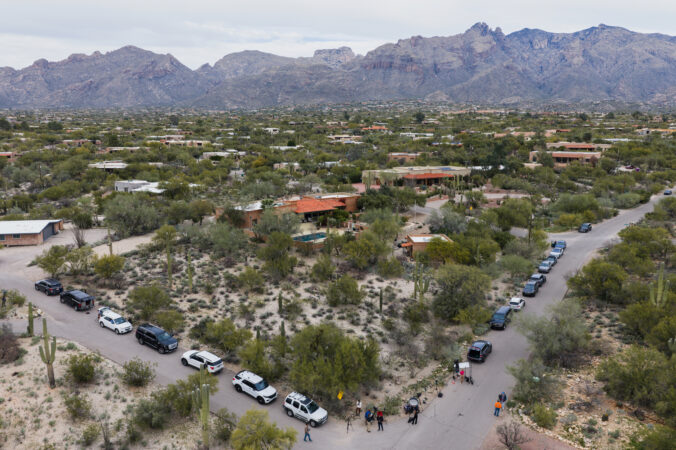
TUCSON, Ariz. — Savannah Guthrie told the potential kidnappers of her mother, Nancy Guthrie, on Saturday that the family is prepared to pay for her safe return.
“We received your message, and we understand. We beg you now to return our mother to us so that we can celebrate with her,” Guthrie said in the video, flanked by her siblings. “This is the only way we will have peace. This is very valuable to us, and we will pay.”
It was not immediately clear if Guthrie was referring to a new message from someone who might have kidnapped Nancy Guthrie. The Associated Press reached out to the Pima County Sheriff’s department seeking additional details.
The frantic search for the 84-year-old Nancy Guthrie has entered a seventh day. Authorities have not identified any suspects or ruled anyone out, Sheriff Chris Nanos said this week.
Authorities think she was taken against her will from her home just outside Tucson over the weekend. DNA tests showed blood on Guthrie’s front porch was a match to her, Nanos said.
President Donald Trump’s administration can continue to detain immigrants without bond, marking a major legal victory for the federal immigration agenda and countering a slew of recent lower court decisions across the country that argued the practice is illegal.
A panel of judges on the 5th Circuit Court of Appeals ruled on Friday evening that the Department of Homeland Security’s decision to deny bond hearings to immigrants arrested across the country is consistent with the constitution and federal immigration law.
Specifically, circuit judge Edith H. Jones wrote in the 2-1 majority opinion that the government correctly interpreted the Immigration and Nationality Act by asserting that “unadmitted aliens apprehended anywhere in the United States are ineligible for release on bond, regardless of how long they have resided inside the United States.”
Under past administrations, most noncitizens with no criminal record who were arrested away from the border had an opportunity to request a bond hearing while their cases wound through immigration court. Historically, bond was often granted to those without criminal convictions who were not flight risks, and mandatory detention was limited to recent border crossers.
“That prior Administrations decided to use less than their full enforcement authority under” the law “does not mean they lacked the authority to do more,” Jones wrote.
The plaintiffs in the two separate cases filed last year against the Trump administration were Mexican nationals who had both lived in the United States for over 10 years and weren’t flight risks, their attorneys argued. Neither man had a criminal record, and both were jailed for months last year before a lower Texas court granted them bond in October.
The Trump White House reversed that policy in favor of mandatory detention in July, reversing almost 30 years of precedent under both Democratic and Republican administrations.
Friday’s ruling also bucks a November district court decision in California, which granted detained immigrants with no criminal history the opportunity to request a bond hearing and had implications for noncitizens held in detention nationwide.
Circuit Judge Dana M. Douglas wrote the lone dissent in Friday’s decision.
The elected congress members who passed the Immigration and Nationality Act “would be surprised to learn it had also required the detention without bond of two million people,” Douglas wrote, adding that many of the people detained are “the spouses, mothers, fathers, and grandparents of American citizens.”
She went on to argue that the federal government was overriding the lawmaking process with DHS’ new immigration detention policy that denies detained immigrants bond.
“Because I would reject the government’s invitation to rubber stamp its proposed legislation by executive fiat, I dissent,” Douglas wrote.
Douglas’ opinion echoed widespread tensions between the Trump administration and federal judges around the country, who have increasingly accused the administration of flouting court orders.
U.S. Attorney General Pam Bondi celebrated the decision as “a significant blow against activist judges who have been undermining our efforts to make America safe again at every turn.”
“We will continue vindicating President Trump’s law and order agenda in courtrooms across the country,” Bondi wrote on the social media platform X.
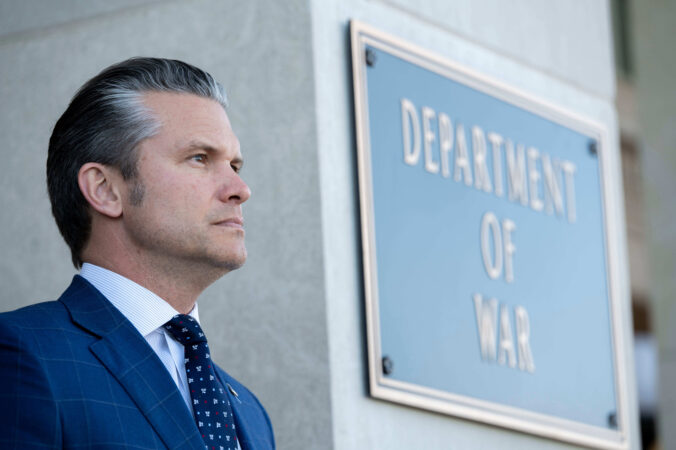
Defense Secretary Pete Hegseth said his department will cut academic ties with Harvard University, claiming it is no longer the right place to develop military personnel, in the latest flash point in the Trump administration’s long-running battle with the Ivy League institution.
“For too long, this department has sent our best and brightest officers to Harvard, hoping the university would better understand and appreciate our warrior class,” Hegseth said in a statement Friday. “Instead, too many of our officers came back looking too much like Harvard — heads full of globalist and radical ideologies that do not improve our fighting ranks.”
The Pentagon will end graduate-level professional military education, fellowships, and certificate programs at the school in the 2026-2027 school year, Hegseth said. Those who are currently attending courses would be able to finish them, he added.
The Pentagon would also review all graduate programs for active-duty service members at Ivy League and other civilian universities.
“The goal is to determine whether or not they actually deliver cost-effective strategic education for future senior leaders when compared to, say, public universities and our military graduate programs,” he said.
Hegseth’s announcement mentioned graduate programs and students but not Harvard College, the university’s undergraduate program. A department official declined to respond to a question Saturday about whether undergraduates in the Reserve Officers’ Training Corps would be affected, saying the department had nothing to add beyond the secretary’s video at this time. Harvard declined to comment on Hegseth’s remarks Saturday.
Harvard has a long history with the military, with people connected to the school serving in militias more than 100 years before the country’s founding. In 1776, students were sent home early, the campus was given over to the Continental Army, and 1,600 soldiers moved into the school’s five buildings. Later, more than 1,600 soldiers with ties to Harvard fought in the Civil War; the campus hosted the first Army ROTC in the country starting in 1916; and the U.S. Navy Reserve began training officers at Harvard during World War II.
Some Harvard students also protested the school’s military ties during the Vietnam War.
As of September 2025, Harvard had more than 100 cadets and midshipmen enrolled, as well as 78 veterans, according to the university. This summer, Harvard Kennedy School announced a fellowship providing a scholarship for at least 50 military veterans or public servants to attend a fully funded one-year master’s degree program.
Friday’s move is the latest rupture in the Trump administration’s relations with universities and Harvard in particular. President Donald Trump ran on a platform of making colleges and universities “sane,” alleging antisemitism in response to pro-Palestinian campus protests over the Israel-Gaza war. Since he took office, the government has used federal funding as leverage in an attempt to force changes on issues such as admissions,campus protests, and diversity, equity, and inclusion initiatives.
Tieswith Harvard have been particularly fraught, with the government threatening to withhold billions in federal grants and contracts, ordering sweeping changes and opening numerous investigations into the nation’s oldest university.
Harvard has rejected allegations of antisemitism and sued the Trump administration over the funding freezeand, separately, actions to block international students from enrolling at Harvard. In September, a judge ruled the Trump administration violated the Constitution by blocking more than $2 billion in research grants, and funding has now been restored, though the final outcome is far from clear. Both cases have been appealed by the Trump administration.
Last week, Trump said on social media that Harvard must pay $1 billion and that the administration wanted nothing more to do with the university, escalating tensions further.
Hegseth highlighted the military’s long-standing relationship with Harvard in his statement, saying “there are more recipients of our nation’s Medal of Honor who went to Harvard than any other civilian institution in the United States.” But he also accused Harvard of becoming “one of the red-hot centers of ‘hate America’ activism … all while charging enormous tuition. It’s not worth it.”
“We train warriors, not wokesters,” he said. “Harvard, good riddance.”
Hegseth went to Harvard himself, earning a master’s in public policy in 2013 from the Harvard Kennedy School. In a segment on Fox News in 2022, where he worked as co-host at the time, he repudiated the degree, scribbling “return to sender” on his diploma.
Since becoming defense secretary over a year ago, Hegseth has purged the military of DEI programs and “woke” student courses, and pushed out transgender service members. This week, the Pentagon warned Scouting America that it risks losing its partnership with the military unless it institutes “core value reforms” thathave not been made public.
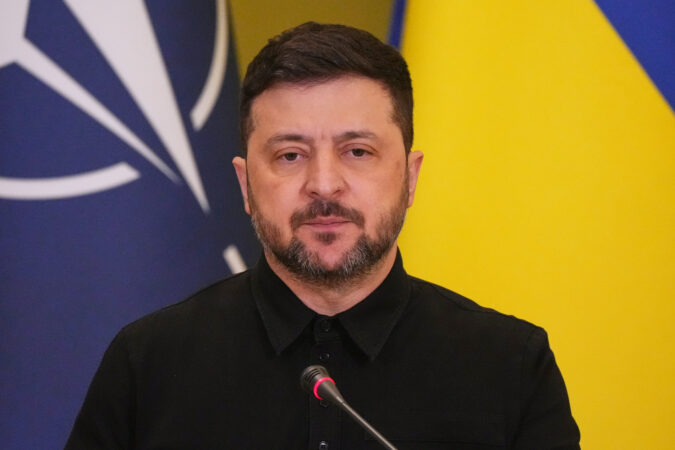
KYIV — Days after negotiations to halt Russia’s war in Ukraine ended inconclusively in Abu Dhabi, Ukrainian President Volodymyr Zelensky said that Russia and the United States were discussing bilateral economic agreements worth some $12 trillion, including deals that would affect Ukraine.
Zelensky said intelligence sources showed him documents that laid out a framework for U.S.-Russian economic cooperation that he called the “Dmitriev package” — named for Kirill Dmitriev, the head of Russia’s sovereign wealth fund and a close ally of Russian President Vladimir Putin who has been a central figure in negotiations over a potential ceasefire.
President Donald Trump previously has dangled the possibility of sanctions relief and renewed economic cooperation with Russia as inducements for Moscow to agree to halt the war. Putin, however, has insisted that Russia would achieve its objectives in Ukraine one way or another.
Dmitriev drafted a 28-point peace plan with Trump’s envoy to the talks, Steve Witkoff, and Trump’s son-in-law Jared Kushner — first revealed by Axios last November — which included sections for gradually lifting sanctions and creating long-term economic development projects between Russia and Ukraine.
However, Zelensky, backed by European leaders and some members of Congress, has insisted that the sanctions regime against Russia must instead be tightened, to starve the Russian war machine of revenue and Western technological components.
“We are not aware of all their bilateral economic or business agreements, but we are receiving some information on the matter,” Zelensky said during a briefing with journalists Friday, according to a transcript released Saturday.
“There are also various signals, both in the media and elsewhere, that some of these agreements could also involve issues related to Ukraine — for example, our sovereignty or Ukraine’s security,” Zelensky said. “We are making it clear that Ukraine will not support any such even potential agreements about us that are made without us.”
Zelensky’s concerns were made public as Moscow launched another major airstrike on Ukraine’s energy sector, plunging large portions of the country into darkness and cold Saturday. The attack also caused Ukraine’s nuclear power plants to reduce their power output as the “military activity affected electrical substations and disconnected some power lines,” the International Atomic Energy Agency wrote on X.
Dmitriev apparently presented the package while meeting with American officials in the U.S., but Zelensky did not say when.
Zelensky’s remarks come as talks to halt Russia’s war increasingly appear to be at an impasse, in particular over the question of who will control Ukraine’s eastern Donetsk region.
The U.S. has proposed creating a free economic zone in Donetsk, while Putin has demanded that Ukraine surrender the entire region, including areas Russia has failed to capture militarily even as it nears the fourth anniversary of its full-scale invasion.
Zelensky, according to the transcript, said that Washington had proposed bringing the war in Ukraine to an end “by June” and that he expected that “they will probably pressure the parties according to this timeline.”
The main concern for the Americans, Zelensky said, was the midterm congressional elections later this year.
“We understand that they will devote all of their time to domestic processes — elections, a shift in the attitudes of their society,” Zelensky said. “The elections are, for them, definitely more important. Let’s not be naive. They say they want to achieve everything by June, and they will do everything possible to ensure the war ends that way.”
Separately, U.S. and Ukrainian officials have discussed a goal of March for reaching a deal, with national elections and a referendum on the proposed peace agreement taking place in May, Reuters reported, citing unnamed sources.
“The Americans are in a hurry,” Reuters quoted one of its sources as saying, adding that U.S. negotiators had warned that Trump will shift his focus to the elections.
U.S., Ukrainian, and Russian officials have met in Abu Dhabi twice in recent weeks to try to forge an agreement, but there has been no breakthrough. Still, Ukrainian negotiators say that the tone and substance of the talks have markedly improved.
Zelensky said that Washington proposed that the parties meet in a week for the first time in the U.S. — “likely in Miami.”
“We have confirmed our participation,” he said.
Meanwhile, Russia’s strikes overnight Friday into Saturday marked a continuation of its relentless aerial onslaught against Ukraine’s power plants and electrical grid.
Ukraine’s air force said that Russia had launched 29 missiles and 408 attack drones at locations across the country — and that 13 missiles and 21 drones struck in 19 locations.
Russia’s Defense Ministry said in a statement Saturday that its armed forces had carried out a “massive strike using precision-guided sea and air-launched long-range weapons” at energy and transport facilities “used in the Ukrainian Armed Forces’ interests” and “defense industry enterprises.”
However, the barrage left large swaths of the civilian population without light and heat as temperatures remained well below freezing — a regular occurrence this winter as Russia has targeted the energy infrastructure supplying the entire country.
Ukraine’s state energy grid operator, Ukrenergo, in a post on social media said that the assault was the second major attack on the entire energy system since the beginning of the year and that “energy facilities in eight regions” were struck.
Power outages occurred across the country, Ukrenergo said.
Zelensky, posting on X, said that the bombardment “deliberately targeted … energy facilities on which depends the operation of Ukrainian nuclear power plants.”
“This puts at risk not only our security in Ukraine, but also the shared regional and European security,” he wrote. “We believe that partners in America, in Europe, and in other states who want peace must view this with a clear head and act accordingly.”