BARCELONA, Spain — Barcelona’s towering Sagrada Familia basilica reached its maximum height on Friday, though the magnum opus of Catalan architect Antoni Gaudí remains years away from completion.
A crane placed the upper arm of a cross atop the Tower of Jesus Christ, the church’s soaring central piece, which now stands 566 feet above the city.
With Friday’s addition, the Sagrada Familia inched closer to being done. The unfinished monument became the world’s tallest church last year after another part of its central tower was lifted into place.
The first stone of the Sagrada Familia was placed in 1882, but Gaudí never expected it to be completed in his lifetime. Only one of its multiple towers was finished when he died at the age of 73 in 1926, after being hit by a tram.
In recent decades, work has sped up as the basilica became a major international tourist attraction, with people enthralled by Gaudí’s radical aesthetic that combines Catholic symbolism and organic forms.
Inside, the Tower of Jesus Christ is still being worked on. Those who wish to actually see the cross will have to wait until the tower’s inauguration this summer, when the scaffolding surrounding it will be removed, according to the church.
Topping the central tower, which soars above the transept, has been a priority ahead of celebrations this June that will mark the centenary of Gaudí’s death.
As Gaudí had planned, the cross has four arms so its shape can be recognized from any direction, said Sagrada Familia’s rector, the Rev. Josep Turull. If Barcelona’s city government will allow it, the original plan also includes a light beam shining from each of the cross’ arms, symbolizing the church’s role as a spiritual lighthouse, he added.
Millions of tourists visit the Sagrada Familia every year, and entrance fees largely fund the ongoing construction.
This year, the Sagrada Familia will hold several events to celebrate the Catalan Modernist’s legacy, which includes other stunning buildings in Barcelona and elsewhere in Spain.
The Sagrada Familia became the world’s tallest church last October, when it rose above the spire of Germany’s Ulmer Münster, a Gothic Lutheran church built over more than 500 years, starting in 1377. That church tops out at 530 feet.
At Sagrada Familia, a prayer verse is included at the base of the cross installed Friday afternoon, said church rector Turull.
It reads: “You alone are the Holy One, you alone are the Lord, you alone are the Most High.”
The U.S. military is stationing a vast array of forces in the Middle East, including two aircraft carriers, fighter jets and refueling tankers, with President Donald Trump saying that Iran had 10 to 15 days at most to strike a deal over its nuclear program.
“We’re either going to get a deal, or it’s going to be unfortunate for them,” Trump told reporters Thursday aboard Air Force One. On a deadline, Trump said he thought 10 to 15 days was “pretty much” the “maximum” he would allow for negotiations to continue.
“I would think that would be enough time,” he said.
The deployment is unlike anything the U.S. has done since 2003, when it amassed forces before the invasion of Iraq. It dwarfs the military buildup that Trump ordered off the coast of Venezuela in the weeks before he ousted President Nicolas Maduro.
While the U.S. isn’t likely to deploy ground troops, the buildup suggests Trump is giving himself discretion to launch a sustained campaign lasting many days, in cooperation with Israel. While discussions have focused on a sustained campaign far more sweeping than the overnight strikes the U.S. launched against Iran’s nuclear program last June, the president is also weighing a limited early strike designed to drive Tehran to the negotiating table, the Wall Street Journal reported Thursday.
“Maybe we’re going to make a deal,” Trump said in a speech on Thursday morning. “You’re going to be finding out over the next probably 10 days.”
Heightened geopolitical worries over U.S.-Iran tensions sent stocks lower and extended a surge in oil, with Brent crude, the global benchmark, rising above $71 a barrel on Thursday.
The open question is whether Iran can possibly satisfy Trump’s demands and whether, by positioning so much military hardware to the region, Trump may feel compelled to use it rather than backing down.
Tracking site FlightRadar24’s data shows a surge of flight activity by U.S. military transport, aerial tankers, surveillance aircraft and drones to bases in Qatar, Jordan, Crete and Spain.
The aircraft, whose transponders make them visible over land to the tracking site, include KC-46 and KC-135 air-to-air refuelers and C-130J cargo planes used to move troops and heavy equipment.
It also includes E-3 Sentry jets equipped with airborne warning and control system radar, which provide “all-altitude and all-weather surveillance” of potential battle zones, as well as RQ-4 Global Hawk surveillance drones.
The weapons at Trump’s disposal are formidable. The USS Abraham Lincoln aircraft carrier is accompanied by three Arleigh Burke-class guided-missile destroyers, which can carry Tomahawk missiles. The carrier’s air wing includes F-35C fighter jets.
The USS Gerald R. Ford, the most expensive U.S. warship ever built, at $13 billion, is accompanied by guided missile destroyers, and its associated air wing includes F/A-18E and F/A-18F Super Hornets, E-2D airborne early warning aircraft, as well as MH-60S and MH-60R Seahawk helicopters and C-2A Greyhounds.
The two carriers provide “more options, and would enable us to conduct operations on a more sustained basis – if it comes to that,” said Michael Eisenstadt, director of military studies for the Washington Institute for Near East Policy. He said the buildup “signals to the Iranians the need to be more flexible in negotiations.”
Trump met with his son-in-law, Jared Kushner, and special envoy, Steve Witkoff, on Wednesday for an update on the negotiations with Iran. Officials met in the Situation Room on Wednesday to discuss possible action and were told to expect that all U.S. military forces deployed to the region would be in place by mid-March, according to a U.S. official.
A major strike against Iran – where leaders are anxious about regime stability following widespread unrest – risks entangling the U.S. in its third war of choice in the Middle East since 1991, against a more formidable adversary than the U.S. has faced in decades.
Trump’s use of the military in his second term has been characterized by short and successful engagements with minimal harm to American troops, including the bombing of Iranian nuclear targets in June, attacking alleged drug-trafficking boats and the raid that extracted Maduro in early January.
But if fresh strikes on Iran prompt a wider conflagration, the president could face considerable public pressure. Trump spoke against U.S. engagement in foreign wars on the campaign trail, but has gone on to bomb Iran, Tehran-backed Houthi militants in Yemen and militants in Syria.
“With Iran’s air defenses largely neutralized by previous U.S. and Israeli strikes, the U.S. strike fighters would operate largely with impunity over Iranian airspace,” said Bryan Clark, a defense analyst for the Hudson Institute and a former Navy strategy officer. “There is always the risk of downed pilots, but I think the bigger risk is to ships. The same cruise and ballistic missiles the Iranians gave to the Houthis could be turned against U.S. ships in the Persian Gulf, Arabian Sea and Red Sea.”
Thousands of U.S. servicemembers in the region are also within range of Iranian ballistic missiles, and regime officials have vowed to respond with full force to a U.S. strike.
Beyond attacks on U.S. military assets, Iran could try to close the Strait of Hormuz, the narrow waterway between Oman and Iran traversed by 25% of maritime oil traffic.
The U.S. strikes in June 2025 focused on three sites associated with Iran’s nuclear program, but a more ambitious effort to topple the regime in Tehran could involve attacks on sites associated with the Islamic Revolutionary Guard Corps and potentially senior leadership including Supreme Leader Ayatollah Ali Khamenei.
But Iran might be able to withstand such decapitation attempts.
“Israel already killed the top leaders of the IRGC in its opening strikes in the June war and Iran was able to reconstitute and respond within 24 hours,” said Jamal Abdi, president of the U.S.-based National Iranian American Council. “They’ve now planned for these possibilities in future wars and so now may be even more resilient if senior leaders are killed.”
White House press secretary Karoline Leavitt said Wednesday that Iran was expected to offer a response to the negotiations within “the next couple of weeks,” but did not preclude the possibility of military action before that. “The president will continue to watch how this plays out,” she said.
Sometimes it’s a fall that brings a broken hip and a loss of mobility. Or memory problems that bubble into danger. Or the death of the partner who was relied upon for care.
The need to move to a nursing home, assisted living facility, or another type of care setting often comes suddenly, setting off an abrupt, daunting search. It’s likely something no one ever wanted, but knowing what to look for and what to ask can make a big difference.
Here’s what to do when looking for a long-term care facility:
Start with government ratings
Regulation of assisted living facilities varies greatly from state to state, meaning there’s no centralized standards or source for information. If you’re looking for a nursing home, though, they are monitored by the federal government.
The Centers for Medicare and Medicaid Services maintains records on nursing homes, including data on who owns the facility, how robust its staffing is, and what types of violations it might have been fined for. It assigns homes a star rating, from one to five.
Sam Brooks, director of public policy for the National Consumer Voice for Quality Long-Term Care, says while the star rating “can be notoriously unreliable,” due to its reliance on self-reported data, it can still provide some clues about a home.
“One or two stars, expect it to be bad,” Brooks says.
Ratings can be a resource to rule out the worst options, but not necessarily to find the best. Still, Brooks suggests taking a closer look at four- and five-star facilities and to consider a home’s ownership, too. Nonprofit homes are often better staffed.
You could scour inspection reports and online reviews for clues, too, but eventually you’ll need to make a list of potential candidates and start making visits.
“The data,” Brooks says, “only goes so far.”
Look past the lobby
When visiting a home on your list, be careful not to be too swayed by decorative touches that might be designed to lure you in, like a lobby’s furniture, dangling chandeliers, or vases of flowers.
“When I tour a building, I listen first. Is it loud? Are call bells ringing nonstop?” says Mark Sanchez, CEO of United Hebrew, a nursing home in New Rochelle, N.Y.
After that, Sanchez says, switch your senses. Do you detect an odor? Do you see residents clustered around the nurses’ station, perhaps clamoring for help? Are staffers speaking respectfully to residents? Are they making eye contact? Are they rushed?
“Culture shows up in small moments,” Sanchez says, “and it matters.”
Seeking input from families of current residents can be insightful. Another resource may be your local long-term care ombudsman. Ombudsmen, funded by the federal Older Americans Act and present in every state, investigate long-term care residents’ complaints.
With all the available information on each home, it can be easy to feel like you’re drowning in data. So pay attention to how a place feels, too, and pair that with concrete facts.
When Jennifer Fink was making the “stressful, grief-inducing, hard, and scary” decision on what memory care community was right for her mother, she didn’t consult state databases or Google ratings. She went with her gut reaction and luckily, it was right.
“Trust your gut. Keep top of mind that the salesperson wants your loved one’s money,” says Fink, of Auburn, Calif. “If it’s giving you the ‘ick,’ then move on.”
Staffing matters most
More than any other single thing, experts on long-term care stress that a facility’s staffing is most important. That means both the quality of the care you witness workers giving residents during your visit and the average staffing levels shown in the reported data.
A home providing an average of three hours of nursing care to each resident each day may not look all that different on paper from one providing three-and-a-half hours. But those minutes matter dearly, meaning the difference between a person getting a shower, having help at mealtime, or being discovered if they’ve fallen.
During a visit, pay attention to how quickly call bells are answered and whether it seems like residents are engaged in activities. Ask staff how long they’ve worked there. A home that holds on to its workers for years may offer your loved one more continuity.
Evan Farr, an elder law attorney in Lorton, Va., who wrote The Nursing Home Survival Guide, says visiting a facility at night or on the weekend can be particularly revealing.
“These are the times when staffing is reduced and the true operation of the facility becomes apparent,” Farr says. “It is entirely possible to have a five-star rated facility that is woefully understaffed from 5 p.m. Friday until 8 a.m. Monday morning.”
Keep a long-range view
When faced with an urgent decision, it can be difficult to focus on anything beyond the factors in front of you. But it’s important to choose a home with a long-range view.
At the start, many long-term care residents are able to pay for the cost of their bill. But what happens if their money runs out? If it’s a nursing home that accepts Medicaid, how many beds are allocated to such residents? Would your loved one get that slot? If it’s an assisted living facility, do they even accept people on Medicaid?
Assisted living facilities often have complicated billing structures that require a bevy of questions to understand. Ask how costs may change as a person’s needs increase. Some places tack on separate charges for tasks like helping a person to the bathroom.
“Four-thousand dollars a month can become $8,000 overnight,” says Geoff Hoatson, founder of the elder law practice Family First Firm in Winter Park, Florida.
Another fact of long-term care that few understand is how often facilities seek to remove residents seen as undesirable, often due to a change in their financial circumstances or in their health. Dementia patients in particular — with challenging care needs and symptoms that can sometimes bring aggression — are targeted with orders to leave.
“Ask specifically what conditions would require transfer,” Hoatson says.
MILAN — Eileen Gu and all the other freestyle skiers wait for their scores by a large Powerade-branded cooler, then glide away without taking a drink.
Bottles of the blue sports drink are stacked in hockey penalty boxes. Even the tissues in figure skating’s drama-packed “Kiss and Cry” area are branded.
One way the Olympics generally stand out is by the absence of advertising on courses, rinks, and slopes. But increasingly at the Milan Cortina Games, sponsors are creeping into the action.
“We continue to open up those opportunities for partners,” International Olympic Committee marketing director Anne-Sophie Voumard said Wednesday, noting sponsor products can now “organically be present” more widely.
The change has seemingly accelerated since French luxury goods maker LVMH prominently placed its Louis Vuitton brand at the opening ceremony of the 2024 Paris Olympics.
“It seems like there’s been an increasing need and desire from the sponsors for the IOC to show greater value in the TOP [the Olympic partners] program,” Terrence Burns, who has worked for the Olympic body in marketing and consulted for sponsors and hosting bids, told the Associated Press.
There’s product placement on TV, even if it is still restrained compared to most American sports. Spectators inside the Olympic arenas hear shout-outs by the announcers and see logos on the big screen.
The IOC is looking to create extra value in its TOP program, which has been a financial success for the organization over four decades. There are 11 TOP sponsors in Milan, after peaking at 15 in Paris. Revenue in 2025 dropped a bit to $560 million in cash and services compared to $871 million in 2024.
Watching a hockey game in the arena is different
An Olympic hockey game looks clean and non-commercial on TV to NHL fans used to seeing sponsors on the boards. It’s a little different in the venue.
“This is the Corona Cero wave!” roars an announcer, attaching an alcohol-free beer brand to efforts to liven up fans at a quiet afternoon game with a wave around the arena.
An automaker gets a mention with the “Stellantis Freeze Cam” and an interview with a boxer during the intermission between periods is “thanks to Salomon,” a skiwear brand that signed a sponsor deal with the Milan Cortina organizing committee.
Burns thinks the logos in Olympic arenas are a morale booster for sponsors, but worth relatively little compared to the big campaigns they typically launch in the year before the Games.
“I think it’s a psychological ‘Attaboy’ to see your brand on a board somewhere in and around the Olympics,” Burns said. ”I get it, but show me how that helps you sell more things.”
A long-term trend ahead of the 2028 Los Angeles Olympics
The Olympic Charter, a kind of constitution for the Games, says any logo in an Olympic venue must be approved “on an exceptional basis,” but the IOC has gradually relaxed its restrictions.
“The Olympic world moves slow, and it should. It’s a 3,000-year-old brand, so they’ve got to be careful with it,” Burns said.
Barely a decade ago, the “clean venue” policy was so strict that IOC staff checked the hand dryers in arena bathrooms to make sure they had their manufacturer’s brand covered with tape.
For the Tokyo Olympics in 2021, restrictions on athletes promoting their personal sponsors on social media were relaxed after a legal challenge in Germany.
The Paris Olympics saw medals delivered to the podium in Louis Vuitton-branded boxes before athletes were handed a phone for “the Olympic Victory Selfie, presented by Samsung,” a new tradition that’s continued at the Milan Cortina Games.
Voumard, the IOC’s marketing director, acknowledged the need to “be mindful of the legacy of those [Olympic] Games and the uniqueness of the presentation.”
New opportunities
The Los Angeles Olympics will break new ground on sponsorship.
For the first time, the IOC has approved the selling of naming rights for venues in a pilot program. The volleyball venue in Anaheim will keep its Honda Center name, just like it does for NHL games, and Comcast is putting its brand on a temporary arena for squash.
Until now, stadiums named for sponsors have had to switch to generic names for the Olympics. The O2 Arena in London became the North Greenwich Arena for basketball and gymnastics in 2012, and a raft of French soccer stadiums got new names for 2024.
Burns predicts the IOC might come under pressure from Los Angeles organizers to take further sponsor-friendly steps, and might need to push back on some requests to protect the Olympic brand.
“It’s not unreasonable to think that LA would look to what happened in Paris with Louis Vuitton or even Samsung on a podium,” Burns said.
“It’s their fiduciary responsibility to try to make as much money as they can. So they’re going to be looking for any and all opportunities to generate incremental revenue from sponsors. That’s the IOC’s role as a franchisor to protect that.”
WASHINGTON — Tariffs paid by midsize U.S. businesses tripled over the course of the past year, new research tied to one of America’s leading banks showed on Thursday — more evidence that President Donald Trump‘s push to charge higher taxes on imports is causing economic disruption.
The additional taxes have meant that companies that employ a combined 48 million people in the U.S. — the kinds of businesses that Trump had promised to revive — have had to find ways to absorb the new expense, by passing it along to customers in the form of higher prices, employing fewer workers, or accepting lower profits.
“That’s a big change in their cost of doing business,” said Chi Mac, business research director of the JPMorganChase Institute, which published the analysis Thursday. “We also see some indications that they may be shifting away from transacting with China and maybe toward some other regions in Asia.”
The research does not say how the additional costs are flowing through the economy, but it indicates that tariffs are being paid by U.S. companies. The study is part of a growing body of economic analyses that counter the administration’s claims that foreigners pay the tariffs.
The JPMorganChase Institute report used payments data to look at businesses that might lack the pricing power of large multinational companies to offset tariffs, but may be small enough to quickly change supply chains to minimize exposure to the tax increases. The companies tended to have revenues between $10 million and $1 billion with fewer than 500 employees, a category known as “middle market.”
The analysis suggests that the Trump administration’s goal of becoming less directly reliant on Chinese manufacturers has been occurring. Payments to China by these companies were 20% below their October 2024 levels, but it’s unclear whether that means China is simply routing its goods through other countries or if supply chains have moved.
The authors of the analysis emphasized in an interview that companies are still adjusting to the tariffs and said they plan to continue studying the issue.
White House spokesperson Kush Desai called the analysis “pointless” and said it didn’t “change the fact that President Trump was right.” The study showed that U.S. companies are paying tariffs that the president had previously said would be paid by foreign entities.
Trump defended his tariffs during a trip to Georgia on Thursday while touring Coosa Steel, a company involved in steel processing and distribution. The president said he couldn’t believe the Supreme Court would soon decide on the legality of some of his tariffs, given his belief that the taxes were helping U.S. manufacturers.
“The tariffs are the greatest thing to happen to this country,” Trump said.
The president imposed a series of tariffs last year for the ostensible goal of reducing the U.S. trade imbalance with other countries, so that America was not longer importing more than it exports. But trade data published Thursday by the Census Bureau showed that the trade deficit climbed last year by $25.5 billion to $1.24 trillion. The president on Wednesday posted on social media that he expected there would be a trade surplus “during this year.”
The Trump administration has been adamant that the tariffs are a boon for the economy, businesses, and workers. Kevin Hassett, director of the White House National Economic Council, lashed out on Wednesday at research by the New York Federal Reserve showing that nearly 90% of the burden for Trump’s tariffs fell on U.S. companies and consumers.
“The paper is an embarrassment,” Hassett told CNBC. “It’s, I think, the worst paper I’ve ever seen in the history of the Federal Reserve system. The people associated with this paper should presumably be disciplined.”
Trump increased the average tariff rate to 13% from 2.6% last year, according to the New York Fed researchers. He declared that tariffs on some items such as steel, kitchen cabinets, and bathroom vanities were in the national security interest of the country. He also declared an economic emergency to bypass Congress and impose a baseline tax on goods from much of the world in April 2025 at an event he called “Liberation Day.”
The high rates provoked a financial market panic, prompting Trump to walk back his rates and then engage in talks with multiple countries that led to a set of new trade frameworks. The Supreme Court is expected to rule soon on whether Trump surpassed his legal authority by declaring an economic emergency.
Trump was elected in 2024 on his promise to tame inflation, but his tariffs have contributed to voter frustration over affordability. While inflation has not spiked during Trump’s term thus far, hiring slowed sharply, and a team of academic economists estimate that consumer prices were roughly 0.8 percentage points higher than they would otherwise be.
NEW YORK — Death and taxes may be inevitable. A big bill for your heirs is not.
The rich have made an art of avoiding taxes and making sure their wealth passes down effortlessly to the next generation. But the tricks they use to expedite payouts to heirs and avoid handing money to the government — can also work for people with far more modest estates.
“It’s a strategic game of chess played over decades,” says Mark Bosler, an estate planning attorney in Troy, Mich., and legal adviser to Real Estate Bees. “While the average person relies on a simple will, the well-to-do utilize a different playbook.”
Consider a trust
First, consider the facts: Despite widespread misconceptions, only estates of the very richest Americans are generally subject to taxes. At the federal level, estates of over $15 million typically trigger taxes. At the state level, 16 states and the District of Columbia do collect estate or inheritance taxes, according to the Tax Foundation, sometimes with lower exemptions than the IRS, but still at thresholds targeting millionaires.
While most people can pass on what they have without worrying about their heirs being caught in a web of taxes, it can require planning to escape a messy process that can hold up estates for years and cost families significantly in court fees and lawyer bills.
The solution at the center of many estate planners’ designs is a trust.
Though trusts conjure images of complex arrangements utilized by the uber-rich, they are relatively simple tools that can make sense for many people. They come with expense, often costing thousands of dollars in lawyer fees to set them up. But for a retired couple with a paid-off house, 401(k)s and a portfolio of investments, they can ease the passing of assets to heirs.
Among the reasons: Even if you aren’t leaving enough behind to trigger taxes, your estate can get tied up in probate court, which typically assesses fees based on an estate’s total value.
“You are leaving what might have gone to your children or other loved ones to attorneys and the courts,” says Renee Fry, CEO of Gentreo, an online estate planner based in Quincy, Massachusetts. “Anywhere from 3[%] to 8% of an estate might be lost.”
Trusts can allow an estate to sidestep court altogether and to shield it from public view by keeping details out of public records. Some people also use them to protect their savings if they someday need nursing home care and would prefer to qualify for a government-paid stay under Medicaid instead of paying themselves.
Pass on stocks virtually tax-free
Imagine being an investor in a stock like Nvidia that has soared in recent years. Now imagine being able to reap the profit of selling your shares without paying tax.
It’s possible with one caveat: You have to die.
That scenario, known in estate lingo as “step-up,” allows many rich families to grow their wealth while ensuring their heirs won’t be saddled with the bill.
It works like this: Say your savvy uncle bought 100 shares of Nvidia when it began trading in 1999 at $12 a share. Between splits and a soaring price, that $1,200 investment would be worth more than $9 million today. If he left it all to you, you could sell the shares owing little or no tax because gains are calculated from the day he died, not the day he bought it.
Benjamin Trujillo, a partner with the wealth advisory firm Moneta, based in St. Louis, Mo., says it all seems “like a magic trick.” And it’s completely legal.
“Wealth transfer looks like smoke and mirrors,” Trujillo says. “Assets like stocks can quietly grow for decades and, when they’re inherited, the tax bill often disappears.”
Lawmakers have sometimes proposed limits on the “step-up” rule, but at least for now, it remains, making it one of the biggest not-so-secret weapons in the arsenals of those looking to create generational wealth. If stocks aren’t your forte, “step-up” applies to other types of investments too, including artwork, real estate, and collectibles.
Keep up to date on beneficiaries
Ever get a prompt on one of your accounts asking you to name a beneficiary? It’s more than a confusing (or annoying) nudge from your brokerage. Estate planners say it is one of the simplest ways to ease the transfer of assets to loved ones after you die.
Regulations vary from place to place, but many banks and brokerages allow you to name a beneficiary to whom the funds will be transferred to upon your death.
“One of the easiest ways to transfer assets hassle-free,” says Allison Harrison, an attorney in Columbus, Ohio, who focuses on estate planning.
Beneficiary designations generally override wills, so it’s important to make sure yours are up to date to avoid the mess of having, say, an ex-spouse end up with everything you saved.
All of this requires planning, but experts say investing a little time in mapping out your estate is one of the moves that separates the rich from the less well-off.
STRAITS OF FLORIDA — At 2 a.m., oceanographer Ryan Smith was headed into his 12th hour of work with little sleep when trouble started.
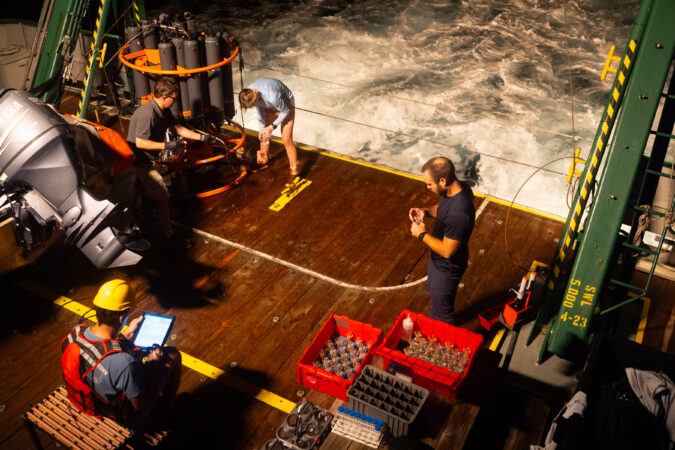
From the rear deck of the University of Miami’s research boat, he guided the vessel’s winch to lower a cage containing 14 long, gray tubes, collectively weighing about 1,000 pounds, hundreds of meters deep into the Atlantic Ocean, to record the temperature, salinity and density of the water. But after running smoothly for the first two-thirds of the trip, the sensors now suddenly stopped transmitting data.
There was no time for a hiccup. With urgency mounting, Smith signaled to bring the cage to the surface.
At sea, there is no helpline to call for a broken instrument at this hour (or any hour). If the team couldn’t fix it, they would need to make a 12-hour slog back to Miami through the fast-moving Florida Current — the precise subject they were trying to measure.
For 43 years, scientists have been studying the strength of the water flow between Florida and the Bahamas to learn what drives its changes over time. The information could help scientists answer a pressing question: Is the Florida Current, one of the world’s fastest ocean currents, slowing down? If so, it could indicate weakening of the larger circulation system in the Atlantic Ocean — what scientists call the Atlantic Meridional Overturning Circulation (AMOC) — which could be disastrous.
Even Hollywood has imagined the harm that could result from a collapse of this system of currents, which acts like a conveyor belt as it transports water, nutrients, and heat through the Atlantic.
While scientists doubt the scenario sketched out in the 2004 movie The Day After Tomorrow, in which the AMOC’s failure prompts a calamitous ice age across the Northern Hemisphere, researchers say rain patterns could change or fail in Southeast Asia and parts of Africa, disease may spread to new populations, and temperatures would probably drop across Western Europe. Iceland has even declared that the risk of such a collapse is a national security threat.
But climate scientists are at odds over how soon, or whether, the circulation system may weaken. Researchers largely agree that the AMOC may weaken over this century as the world warms, but they differ on whether the system is already slowing down.
Direct observations of the AMOC’s and the Florida Current’s flow, velocity, temperature and salinity could help clarify this. The Florida Current, which helps shuttle water north, is a key component in calculating the system’s strength.
Traveling between Miami and the Bahamas, a crew from the University of Miami and the National Oceanic and Atmospheric Administration homed in on the Florida Current, the world’s longest nearly continuously observed ocean current. Over 36 sleep-deprived hours, six researchers and seven crew members traversed the ocean, dove underwater, and collected gigabytes of measurements. These expeditions gather data that generations of scientists can use to better understand the state of our oceans — and humanity’s future.
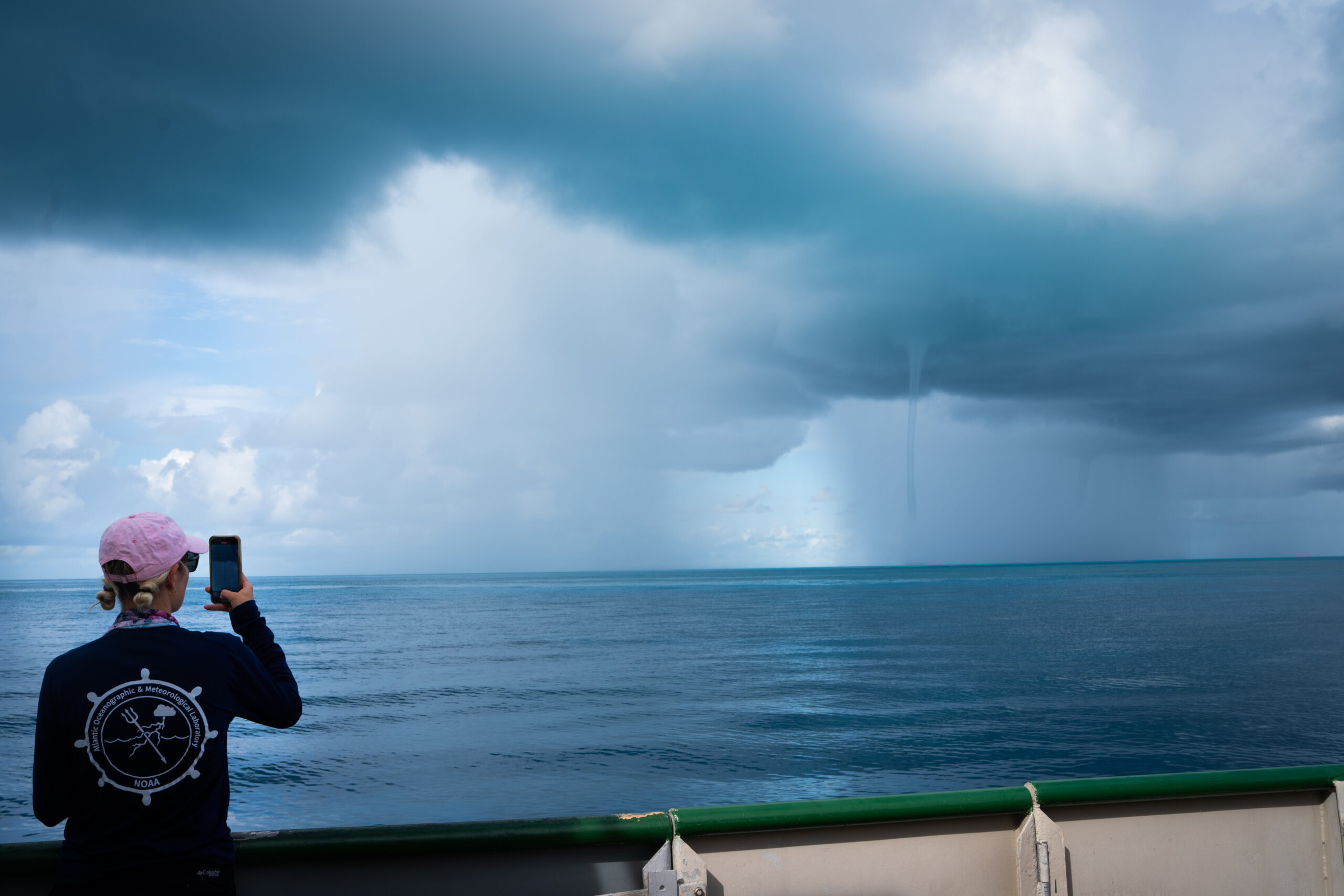
Tyler Christian, a marine scientist, takes a photo of a waterspout during a research trip to collect data on the Florida Current.
The AMOC debate
For more than four decades, scientists have almost continuously measured water flow across the Florida Current, largely with the help of a decommissioned AT&T telecommunications cable running from West Palm Beach to Grand Bahama Island.
The telephone line wasn’t intended for ocean research, but NOAA scientists noted that it picked up tiny voltages induced by seawater flowing across the Florida Straits, which changed depending on the current’s flow.Using direct measurements of the waterway from research cruises, scientists can convert the voltages into the volume of water carried each second through the strait.
In 2005, British oceanographer Harry Bryden tapped these cable measurements and the limited available ship measurements in a seminal paper that suggested a possible slowdown in the AMOC between 1957 and 2004. Using data across the Atlantic Basin today, scientists have found that the AMOC varies, daily and seasonally, yet it also appears to have experienced a slight weakening over the past two decades.
But is it on a long-term decline because of human-induced planetary warming? Debatable.
At about 4 a.m., oceanographer Denis Volkov, right, checks in on Jay Hooper, who helps the team with data management
The Florida Current is one of the main forces that make up the western boundary of the AMOC. The warm Florida waters feed into the mighty Gulf Stream, which merges with the warm North Atlantic Current headed toward Europe. As the current reaches the Arctic, air temperatures cool the water, which becomes denser. The water sinks and moves south toward the equator, where it is again warmed by the sun and returns north.
“The role of the AMOC in the climate is it carries a huge amount of heat from the equator towards the poles,” said Denis Volkov, who is a co-principal investigator of NOAA’s Western Boundary Time Series project along with Smith.
But scientists say a warming world is throwing off this balance. As Arctic ice melts, freshwater enters the North Atlantic — making the ocean water less dense, so it is less likely to sink. As a result, scientists propose thatit cannot power the ocean conveyor belt as well, so less salty, warm water is getting transported northward.
A major shift in the Atlantic Ocean’s circulation could create severe drought in some areas and damaging floods in others. Sea level could rise by a foot or more along the U.S. East Coast if it collapsed.
Scientists have typically used data that indirectly hints at the current’s movement — such as sea surface or air temperature — to reconstruct the oceans in models and track whether the overall system is weakening, but they have reached mixed conclusions.
For instance, a 2018 study plugged sea surface temperatures into computer models to show that the AMOC is weakening. Then, a paper released last January reported no evidence of weakening over the past 60 years after examining data on heat exchanges between the air and the ocean called air-sea fluxes.
The dive boat takes scientists to a site to collect data on the Florida Current.
Volkov and his colleagues are helping approach the puzzle with observations. In 2024, they reassessed the cable data from the Florida Current, adjustingfor changes from Earth’s geomagnetic field. First, they found that the current had remained stable over the past four decades. Then, they updated calculations of the AMOC in this region, which has been monitored for only 20 years or so, with the corrected data and found that the AMOC wasn’t weakening as much as previously calculated at this latitude.
“But there is a caveat that observational data is very short,” said Volkov. He said scientists would need another 20 years of AMOC observations to determine if the small decline is a robust feature and not part of natural variability.
And the AMOC can still weaken even if the Florida Current remains strong, he said, since it is the sum of currents across the basin. But long-term changes in the Florida Current can serve as an indicator of trouble for the rest of the system.
One snag, said Volkov: The serendipitous cable that provided data for more than 40 years malfunctioned in 2023 — perhaps broke. Until it’s fixed, researchers are ramping up their diving operations to recover data from underwater acoustic barometers on the ocean floor.
Volkov, left, and Smith watch as a sampling instrument drops into the water.
The expedition
When the research vessel departed from the university’s dock around 4 a.m. on Sept. 3, the sun and most of the science staff were down for the night. A few shipmates gazed at the illuminated cityscapes from the stern deck, next to the diesel engine’s deep rumble. After traversing rocking waves, the crew reached scenic Bahamian waters eight hours later.
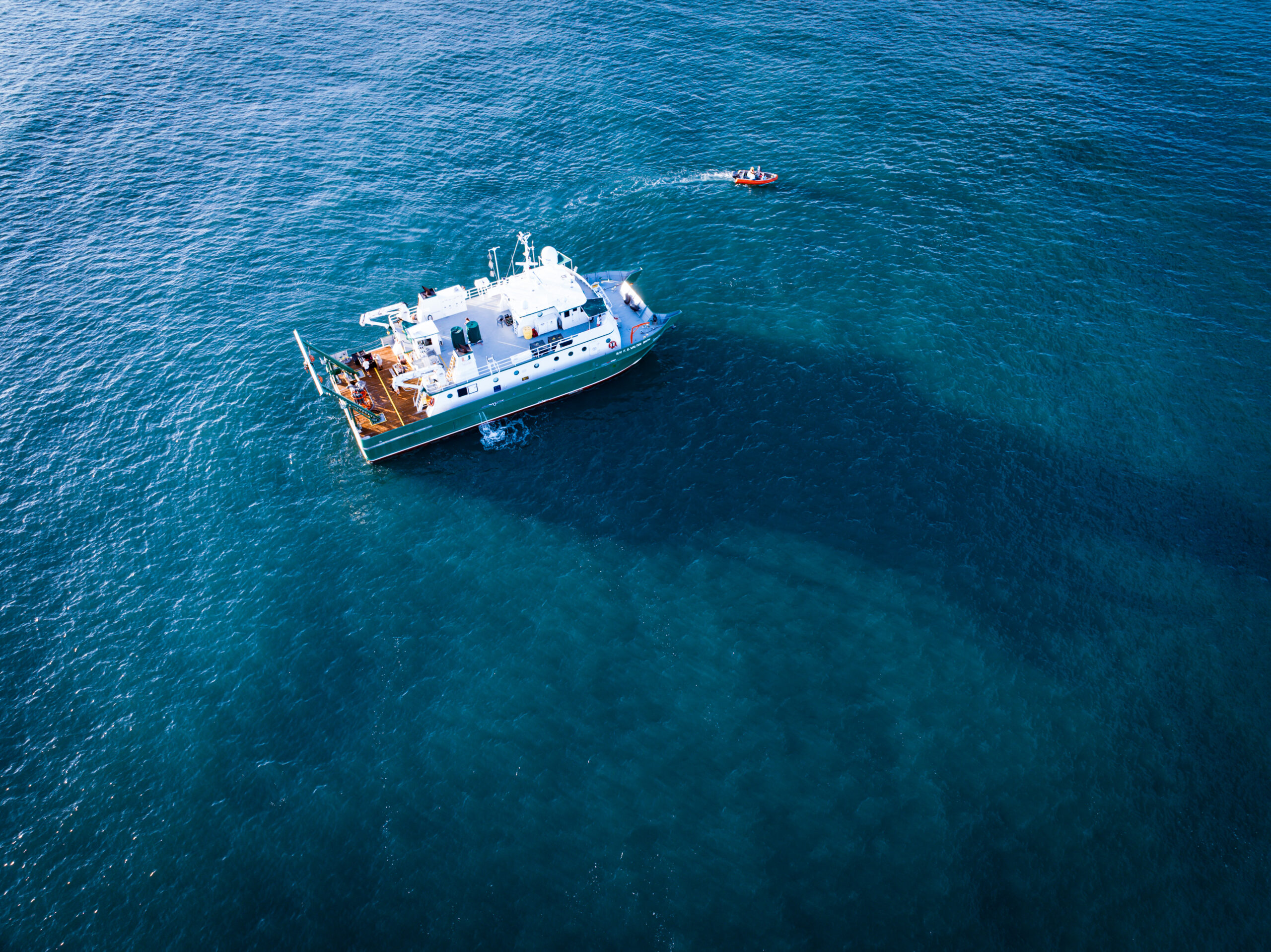
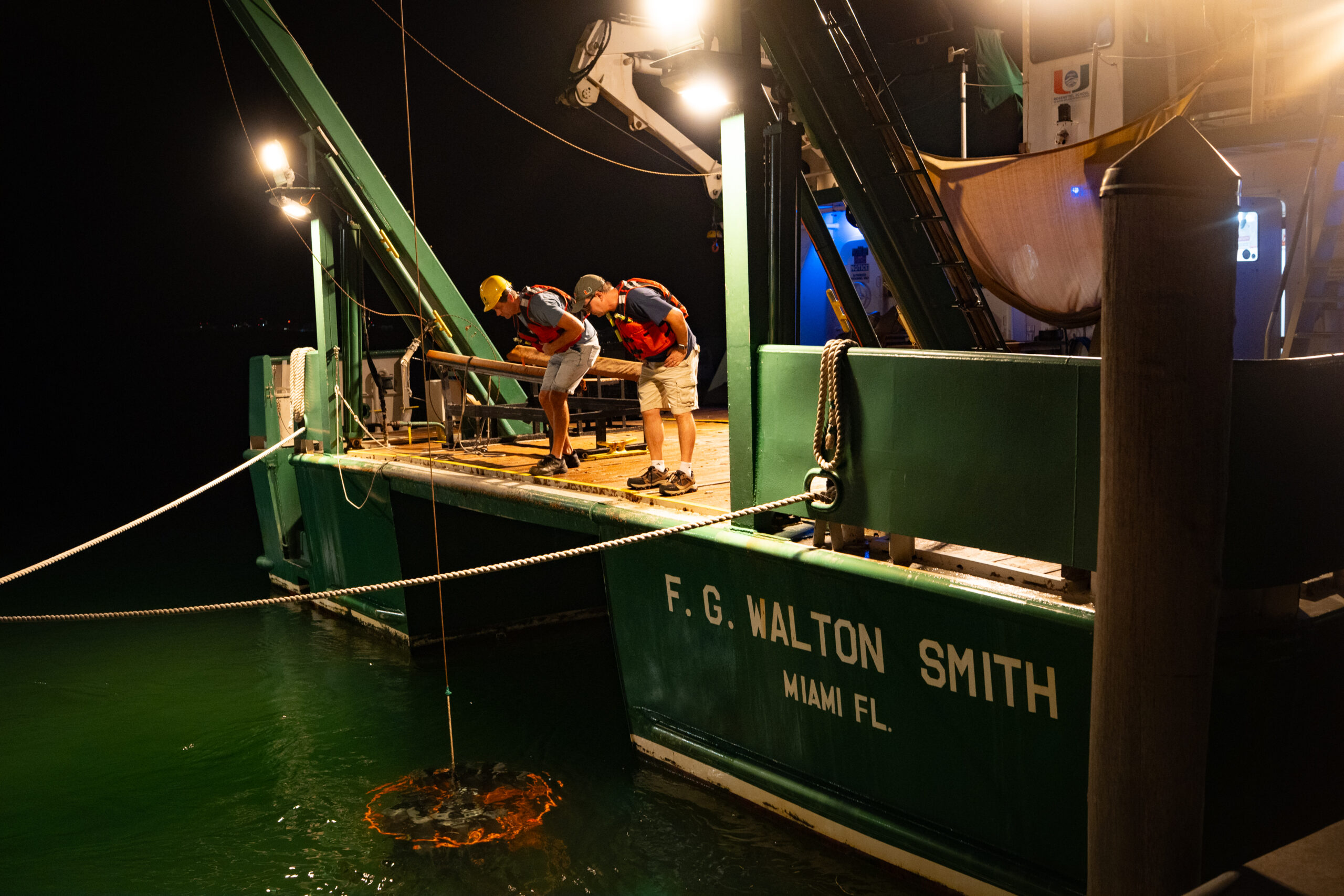
The green F.G. Walton Smith, 96 feet long, and its crewmake this overnight trip about six times a year, traveling 93 nautical miles diagonally from Miami toward the Little Bahama Bank. From there, they go west and collect data at nine sites from the boat and dive underwater at two others.
The team’s goal is to determine the amount of water flowing north through the Florida Current per second through a series of underwater instruments, from the boat and from satellites. They also collect temperature, salinity, density and velocity data; velocity and temperature, for example, can be combined to calculate the amount of heat transported across an area.
Chomiak, left, and Zach Barton, a technician and engineer, return from diving to the seafloor to place a data-collection instrument.
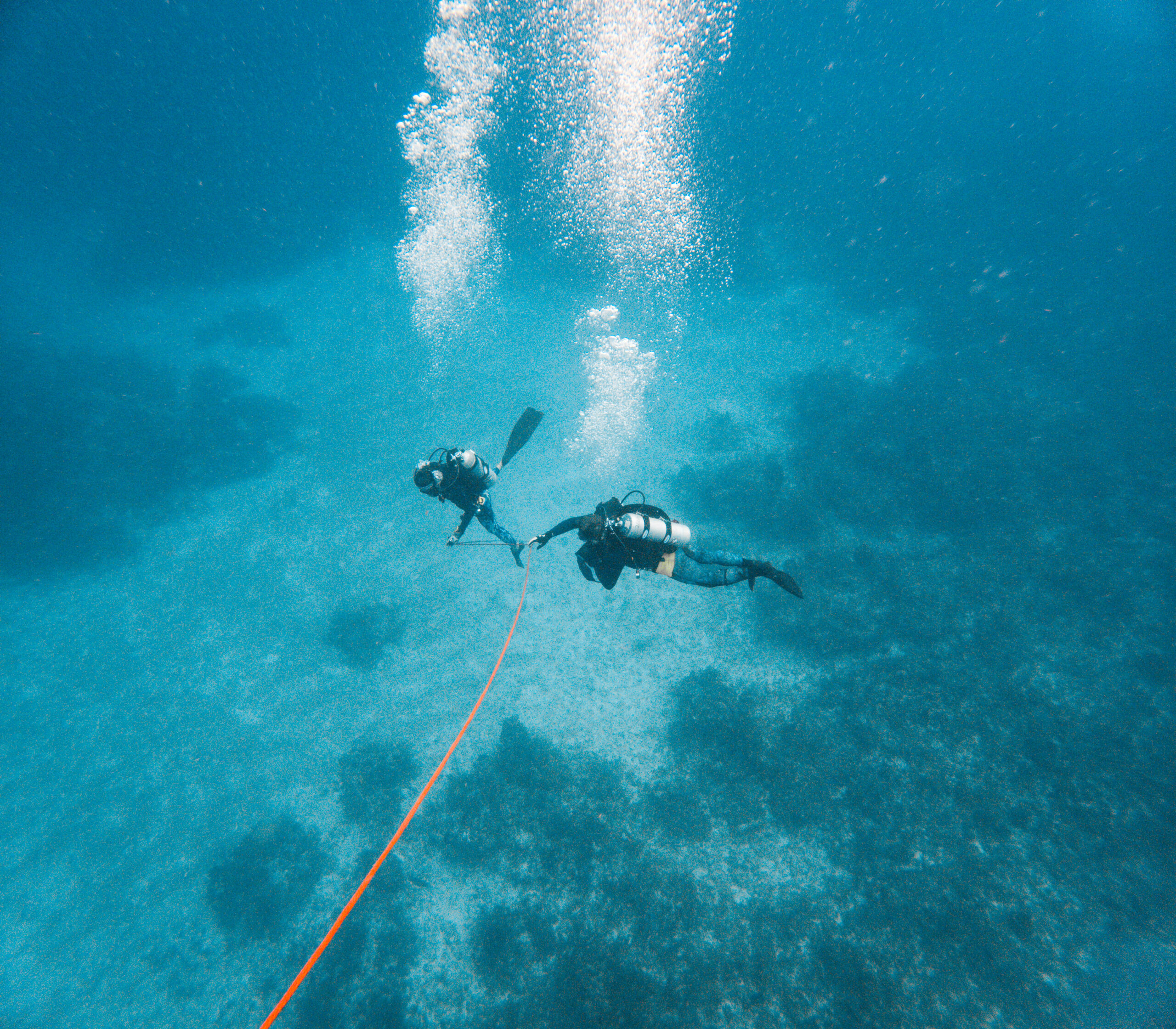
At the first dive site, a remora — a long, torpedo-shaped suckerfish — circled the two scuba divers less than a mile from the boat. The slender fish is known for a unique fin on its head that suctions itself to sharks, whales, and turtles to feed off their detritus. And for a quick moment, it latched onto Leah Chomiak’s head. And her thigh.
Chomiak focused on the barometer in front of her. Her bulky gloves made it harder to use a screwdriver 50 feet below the Bahamian surface. She and her fellow diver held onto the long tubes that had been recording data every five minutes for the previous two months, since the last time divers brought the instruments to the surface and downloaded the data.
“Now we decided to service them more frequently, because, at the moment, this is the only source of data for our Florida Current transport estimates,” Volkov said. The scientists can use the pressure data to help calculate the amount of water flowing through the area.
Next, the ship arrived at the first of nine hydrographic stations andlowered a cage of sensors known as a CTD-rosette sampler (CTD stands for conductivity, temperature and depth, although it measures many more properties). Researchers can use the temperature and salt concentrations of a particular mass of water to infer where it came from and how it reaches other parts of the world.
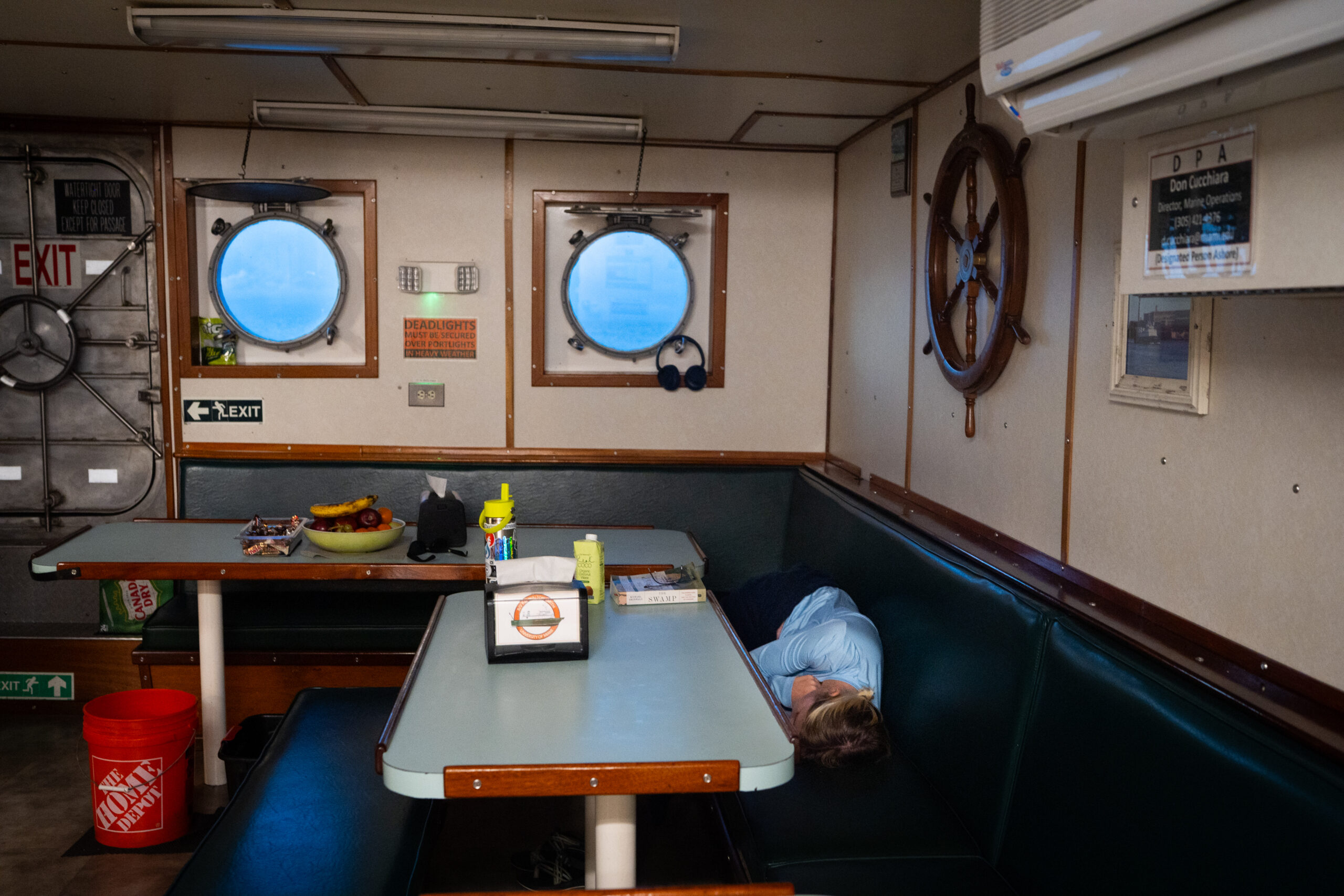
Christian takes a quick nap in the galley as the vessel travels back to Miami.
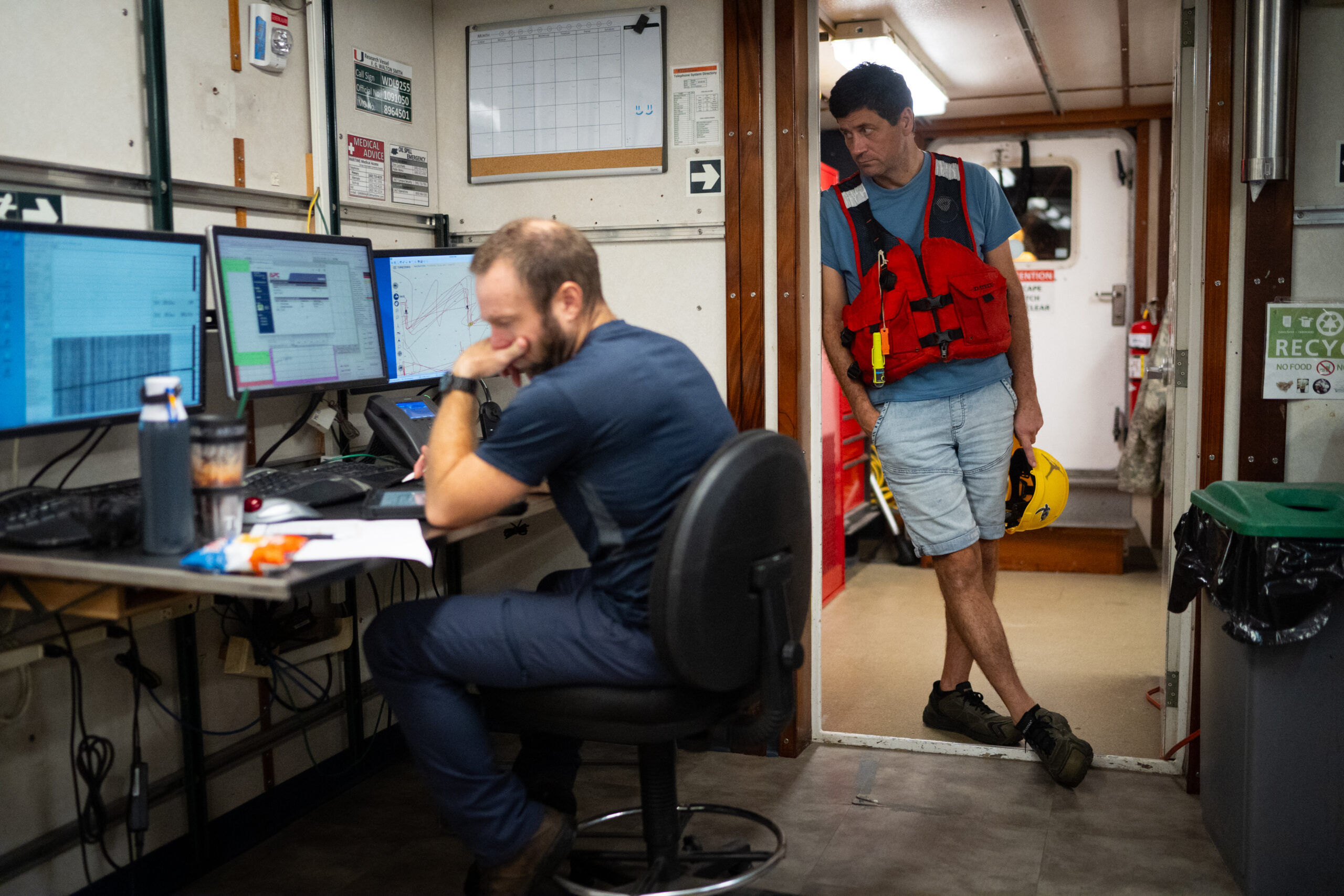
Jay Hooper, who has been on these trips for 10 years and helps with data management, sat at the ship’scomputer station.
“Ready whenever you are,” he said into his headset.
From the top deck, the captain lowered the rosette into the water, dropping 60 meters each minute. As the instruments approached the bottom at 486 meters, Hooper said to slow down.
Lines of various colors — representing salinity, temperature, and density — squiggled down on Hooper’s computer screen as the sensors dropped. Temperature decreased and density increased as the instruments descended. Seventeen minutes later, the rosette was brought back onto the boat.
After hours of gathering data, Hooper and Smith hit a snag at the seventh station. The rosette now wasn’t sending any information to the computer. Was it human error? Did the instrument break?
The two tried different solutions as the other scientists slept. Then they replaced the sensors’ cable, andas they lowered the rosette, data filled the computer screen.
The boat stopped for the last dive near the Florida coast to retrieve the second set of underwater acoustic barometers. But the water was so cloudy, thick and green that the divers couldn’t see their hands, so they decided they would try on the next trip.
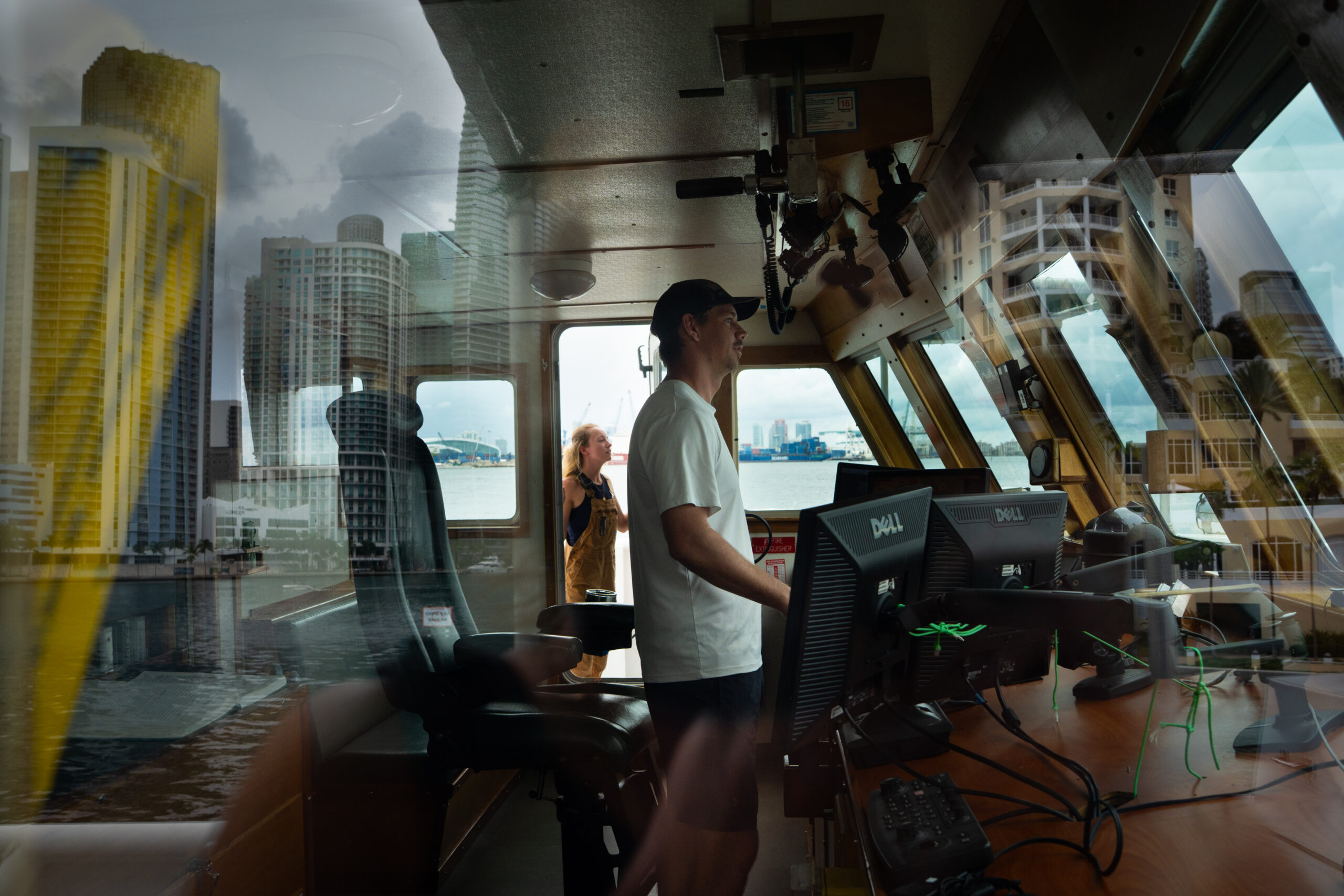
Captain John Cramer pilots the vessel back to the university.
For the next 12 hours, the boat fought against the Florida Current to take the crew home. Some aboard mustered up energy to sing “Happy Birthday” to one of the crew members.
The next morning, Smith and his colleagues processed the data to upload to NOAA’s Atlantic Oceanographic & Meteorological Laboratory website. There were no notes about a cable malfunction, encounters with remoras or sleep deprivation.
The Excel spreadsheet had a single note for each station it recorded: “Profile looks good; use these data.”
Jalen Johnson had 32 points and 10 rebounds and CJ McCollum added 23 points as the Atlanta Hawks beat the 76ers 117-107 on Thursday night in the teams’ first game after the All-Star break.
Dyson Daniels finished with 15 points, Nickeil Alexander-Walker scored 14, and Zaccharie Risacher and Jock Landale each had 10 as the Hawks snapped a three-game losing streak with their third win over the Sixers this season.
Tyrese Maxey scored 28 points and Rising Stars MVP VJ Edgecombe added 20 for the Sixers, who were without center Joel Embiid, who missed the game due to right shin soreness.
Kelly Oubre Jr. scored 17 points and Quentin Grimes scored 10 of his 14 points in the first half for Philly. Andre Drummond contributed 10 points and 14 rebounds as the Sixers lost their third in a row and for the fourth time in five games.
The Hawks built an 11-point lead with approximately six minutes remaining before the Sixers charged back and closed within 108-104 with less than three minutes left. Atlanta closed the game with a 9-3 run that included five points by Johnson, who shot 14-for-16 from the line.
The 76ers said Embiid experienced soreness in his shin while participating in a right knee injury management program over the break. After consulting with doctors, Embiid has received daily treatment, while progressing through on-court work and strength and conditioning.
Coach Nick Nurse said before the game against the Hawks that the plan is to get Embiid on the court on Friday and “see how he looks from there.” Nurse said he “don’t anticipate it being a long time.”
Embiid is averaging 26.6 points, 7.5 rebounds and 3.6 assists in 31 games this season.
The Sixers will face the Pelicans on Saturday in New Orleans (7 p.m., NBCSP).
Eric Dane, the celebrated actor best known for his roles on Grey’s Anatomy and Euphoria and who later in life became an advocate for ALS awareness, died Thursday. He was 53.
His representatives said Mr. Dane died from amyotrophic lateral sclerosis, known also as Lou Gehrig’s disease, less than a year after he announced his diagnosis.
“He spent his final days surrounded by dear friends, his devoted wife, and his two beautiful daughters, Billie and Georgia, who were the center of his world,” said a statement that requested privacy for his family. “Throughout his journey with ALS, Eric became a passionate advocate for awareness and research, determined to make a difference for others facing the same fight. He will be deeply missed, and lovingly remembered always. Eric adored his fans and is forever grateful for the outpouring of love and support he’s received.”
Mr. Dane developed a devoted fan base when his big break arrived in the mid-2000s: He was cast as Dr. Mark Sloan, aka McSteamy, on the ABC medical drama Grey’s Anatomy, a role he would play from 2006 until 2012 and reprise in 2021.
Although his character was killed off on the show after a plane crash, Mr. Dane’s character left an indelible mark on the still-running show: Seattle Grace Hospital became Grey Sloan Memorial Hospital.
In 2019, he did a complete 180 from the charming McSteamy and became the troubled Cal Jacobs in HBO’s provocative drama Euphoria, a role he continued in up until his death.
Mr. Dane also starred as Tom Chandler, the captain of a U.S. Navy destroyer at sea after a global catastrophe wiped out most of the world’s population, in the TNT drama TheLast Ship. In 2017, production was halted as Mr. Dane battled depression.
In April 2025, Mr. Dane announced he had been diagnosed with ALS, a progressive disease that attacks nerve cells controlling muscles throughout the body.
ALS gradually destroys the nerve cells and connections needed to walk, talk, speak, and breathe. Most patients die within three to five years of a diagnosis.
Mr. Dane became an advocate for ALS awareness, speaking a news conference in Washington on health insurance prior authorization. “Some of you may know me from TV shows, such as Grey’s Anatomy, which I play a doctor. But I am here today to speak briefly as a patient battling ALS,” he said in June 2025. In September of that year, the ALS Network named Mr. Dane the recipient of their advocate of the year award, recognizing his commitment to raising awareness and support for people living with ALS.
Mr. Dane was born on Nov. 9, 1972, and raised in Northern California. His father, who the actor said was a Navy veteran and an architect, died of a gunshot wound when Mr. Dane was 7. After high school, he moved to Los Angeles to pursue acting, landing guest roles on shows like Saved by the Bell, Married … With Children, Charmed, and X-Men: the Last Stand, and one season of the short-lived medical drama Gideon’s Crossing.
A memoir by Mr. Dane is scheduled to be published in late 2026. Book of Days: A Memoir in Moments will be released by Maria Shriver’s The Open Field, a Penguin Random House imprint. According to Open Field, Mr. Dane’s memoir covers key moments in his life, from his first day at work on Grey’sAnatomy to the births of his two daughters and learning that he had ALS.
“I want to capture the moments that shaped me — the beautiful days, the hard ones, the ones I never took for granted — so that if nothing else, people who read it will remember what it means to live with heart,” Mr. Dane said in a statement about the book. “If sharing this helps someone find meaning in their own days, then my story is worth telling.”
Mr. Dane is survived by his wife, actor Rebecca Gayheart, and their two teen daughters, Billie Beatrice and Georgia Geraldine. Gayheart and Mr. Dane wed in 2004 and separated in September 2017. Gayheart filed for divorce in 2018, but later filed to dismiss the petition. In a December essay for New York magazine’s The Cut reflecting on Mr. Dane’s diagnosis, Gayheart called their dynamic “a very complicated relationship, one that’s confusing for people.” She said they never got a divorce, but dated other people and lived separately.
“Our love may not be romantic, but it’s a familial love,” she said. “Eric knows that I am always going to want the best for him. That I’m going to do my best to do right by him. And I know he would do the same for me. So whatever I can do or however I can show up to make this journey better for him or easier for him, I want to do that.”
Their shared ritual was on display before Team USA’s 2-1 triumph Thursday — made possible through an outpouring of donations to a GoFundMe drive, with by far the biggest individual contribution — $10,000 — coming from NFL brother tandem Travis and Jason Kelce, who also grew up in Cleveland.
“As she comes in, she’s looking around,” her grandmother, Ernestine Gray, told the Associated Press earlier this week. “Then I say, ‘I won’t do anything to distract her.’ Then she did see me and I wave to her and then she waved back.”
Edwards, the first Black female hockey player to represent the United States at the Olympics, fielded a team of her own in Milan. The fundraiser enabled 10 family members and four friends to travel to Italy. Still others paid their own way.
After the semifinals game earlier this week, Edwards, a senior at Wisconsin, told the AP that her family’s presence in Milan “means everything to me.”
“They helped me get here and make this team and achieve my dream, so it means a lot,” she said.
Edwards had an assist for the first of the two goals that would win the game.
‘Queen of Cleveland’
The Kelce brothers grew up in the same town as Edwards. They have been fans of hers since 2023, when she became the first Black player to make the U.S. senior women’s national team, and shouted her out on their popular podcast, New Heights.
The top donation to the GoFundMe was $10,000, from someone remaining anonymous; Edwards has confirmed that it came from the Kelces. By Thursday, the Edwards family had raised more than $61,000.
What’s more, Travis Kelce reached out to provide advice to the “Queen of Cleveland,” a nickname her teammates gave her following a U.S.-Canada game played there in November. And Jason Kelce and his wife, Kylie, were in the stands Monday to cheer on the U.S. team during their 5-0 win over Sweden. Edwards, a forward-turned-defender, had an assist then, too.
Generosity from the Kelces and locals is another example of how the tight-knit town operates, her parents said, even though their daughter moved away at a young age. Edwards, considered the future face of women’s hockey, has also inspired the Black community in Ohio and beyond.
While diversity is reflected in many sports such as soccer, it hasn’t made a dent in winter sports and there are very few Black athletes in the Milan Cortina Olympic Games. Men’s and women’s hockey globally, including in the U.S., remains predominantly white.
“Just to hear all the people of color talking about, ‘I’ve never watched hockey before and I’m tuning in,’” said Edwards’ mother, Charone Gray-Edwards. “I would love to know what the ratings are. Because everybody at home, everybody is talking about it. All these people are trying to buy jerseys.”
For Gray-Edwards, some of the most meaningful moments have been seeing little boys come up to her daughter for an autograph.
“That means they’re not like, ‘Oh, this is a girl that plays hockey.’ They’re like, ‘This a good hockey player.’ So it doesn’t matter if she’s Black, a woman — she’s a good player,” Gray-Edwards said.
But Gray-Edwards’ most treasured memories likely won’t be about Thursday’s gold medal win — they will stem from watching her 91-year-old mother and her 22-year-old daughter together at the rink.
“You can just see them waving at each other. My mother’s like jumping and, oh, she just loves it,” Gray-Edwards said.
‘How would we afford it’
Hours before the puck dropped for Monday’s semifinal, the Edwards family was ready.
Gray-Edwards has strict rules about travel. She mandated that everyone meet in the hotel lobby 2½ hours before game time, dressed in their Team USA finest. They called a taxi van to fit the large group — including Edwards’ parents, grandmother, aunt, cousin, and older brother — and loaded up.
Her parents weren’t sure the entire family would be able to make the journey when she called them a month before the Olympics to say she’d been chosen for the team.
They could cover the costs for two people, but the full family roster — all of whom have supported her over the years — would have been far too expensive. And they hadn’t booked early flights or locked in cheaper hotel rates for fear of jinxing her.
“We had to start talking about how to get money,” Gray-Edwards said. “Who would go? How would we afford it?”
The family is accustomed to watching her from afar. When Edwards was 13, she left home to attend the Bishop Kearney Selects Academy in Rochester, N.Y., before moving on to the University of Wisconsin, where she is playing her senior season for the top-ranked Badgers.
The consensus is that Edwards will be selected in the top three of the Professional Women’s Hockey League draft in June, along with Wisconsin teammate Caroline Harvey and Minnesota’s Abbey Murphy.
Still, Edwards’ Olympic debut was something everyone wanted to see.
Her father, Robert Edwards, started the GoFundMe drive “Send Laila’s Family to the Olympics to Cheer Her On!” He set an ambitious goal of $50,000 so they wouldn’t have to choose between a ticket to one of her games and paying the electric bill back in Cleveland Heights, Ohio.
“There’s a lot of ups and downs in playing hockey at this high level and so she’s going to need somebody there,” her father said. “So I was like, ’Well, pride be damned: We’re going to do a fundraiser.’”