Category: Wires

  • Justice Dept. releases missing Epstein documents with Trump allegations

    Justice Dept. releases missing Epstein documents with Trump allegations

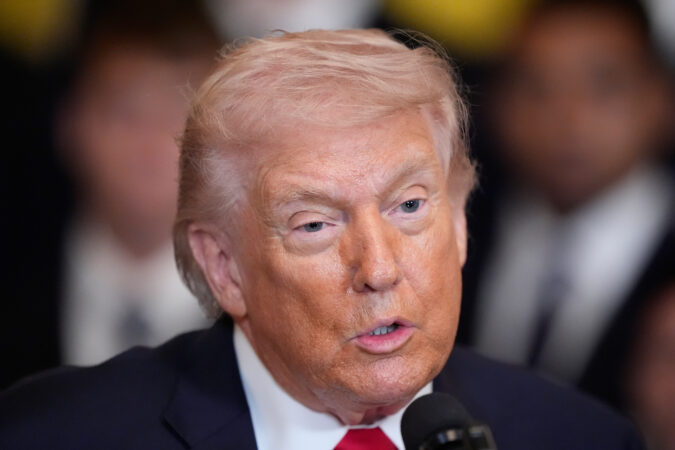
    The Justice Department on Thursday publicly posted additional records related to convicted sex offender Jeffrey Epstein, including some that include allegations against President Donald Trump, following sharp criticism of the agency’s handling of the issue.

    The agency said the files, which include details from FBI interviews with a woman who told authorities she had been sexually assaulted by Trump and Epstein, had not been previously released because they were incorrectly determined to be duplicates of other records. The Justice Department has posted millions of pages of Epstein-related records online, including investigative materials, following the passage of a law last year mandating their release.

    The woman, who was interviewed by the FBI in 2019, accused Trump of sexually assaulting her decades earlier when she was a minor. No evidence has emerged publicly to corroborate that accusation. The White House called the allegations against Trump “completely baseless accusations, backed by zero credible evidence.”

    The additional records were posted as Trump and his administration have struggled to combat controversies involving the release of files connected to Epstein, who died in federal custody in 2019 while facing charges of sex-trafficking and abusing girls.

    The Justice Department has faced particular criticism over its response to the Epstein Files Transparency Act, a measure passed by Congress last year that demanded the agency make public a wide array of records by mid-December. While the agency did release more than 100,000 pages by that point, it did not make public most of its files until weeks later, well after the deadline.

    Lawmakers have faulted the Justice Department for missing the deadline, failing to redact some information related to victims’ identities and redacting other information. Last month, after multiple media outlets reported that summaries of the woman’s account had not been included, the Justice Department said it was examining whether it wrongly withheld records containing allegations against Trump, who had been friends with Epstein for years before they had a falling out.

    On Thursday, the Justice Department said in a social media post that it had discovered that “15 documents were incorrectly coded as duplicative.” Among these records were notes from multiple FBI interviews with the woman, who spoke to authorities following Epstein’s arrest in 2019.

    According to the interview notes, the woman told investigators that she had been sexually assaulted by Epstein and Trump during separate incidents in the 1980s, when she was a minor. The Washington Post has been unable to corroborate these allegations or reach the woman.

    Though summary reports of three of her FBI interviews were not included in files previously released by the administration, the Justice Department had already posted a report on one of the interviews as well as a summary file referencing the woman’s allegations against Trump.

    Karoline Leavitt, the White House press secretary, pushed back against the allegations in a statement Friday.

    “The total baselessness of these accusations is also supported by the obvious fact that Joe Biden’s [Justice Department] knew about them for four years and did nothing with them — because they knew President Trump did absolutely nothing wrong,” Leavitt said. “As we have said countless times, President Trump has been totally exonerated by the release of the Epstein Files.”

    The Justice Department this week said it had “not deleted any files from the library,” and a spokeswoman called it “the most transparent Department of Justice in history.”

    In addition to the FBI interviews, the Justice Department said Thursday that federal officials in South Florida had separately concluded that five prosecution memos “initially marked as privileged could be released while still protecting the privileged materials.” Those were also released, the agency said.

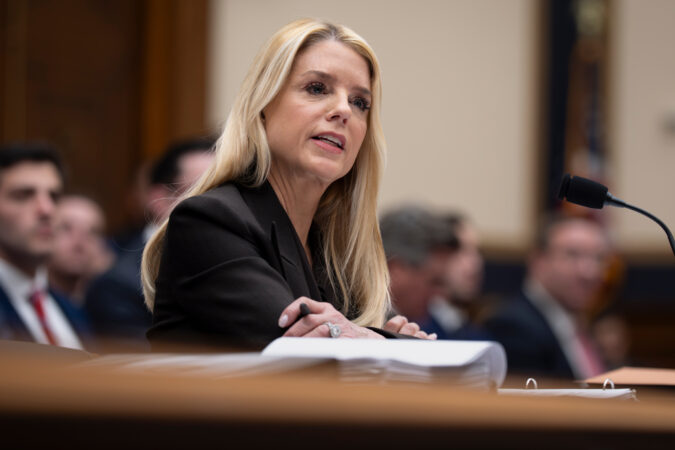
    The release of the FBI interviews and other documents came a day after the House Oversight and Government Reform Committee voted to subpoena Attorney General Pam Bondi, escalating tensions between Congress and the administration.

    Bondi, testifying last month before Congress, said the Justice Department “spent thousands of hours painstakingly reviewing millions of pages to comply with Congress’s law.”

    It was not clear how Bondi intends to respond to the subpoena, which compels her to appear before the committee for a closed-door deposition about the Justice Department’s release of the Epstein records.

  • Evidence suggests the deadly blast at an Iranian school was likely a U.S. airstrike

    Evidence suggests the deadly blast at an Iranian school was likely a U.S. airstrike

    JERUSALEM — Satellite images, expert analysis, a U.S. official and public information released by the U.S. and Israeli militaries suggest an explosion that killed scores of Iranian students at a school was likely caused by U.S. airstrikes that also hit an adjacent compound associated with the regime’s Revolutionary Guard.

    The Feb. 28 strike, which had the highest reported civilian death toll since the war began, has come under staunch criticism from the United Nations and human rights monitors. More than 165 people were killed, most of them of children, in the blast during school hours at Shajareh Tayyebeh Elementary School, according to Iranian state media.

    Satellite images taken Wednesday and reviewed by the the Associated Press show most of the school in the city of Minab, about 680 miles southeast of Tehran, reduced to rubble, a crescent shape punched into its roof. Experts say the tight pattern of the damage visible on the satellite photos is consistent with a targeted airstrike.

    Iran has blamed Israel and the United States for the blast. Neither country has accepted responsibility. Asked about the strike at the school at a Pentagon press briefing Wednesday, Defense Secretary Pete Hegseth said, “All I can say is that we’re investigating that. We, of course, never target civilian targets. But we’re taking a look and investigating that.”

    Several factors point to a U.S. strike.

    One is the launching of an assessment of the incident by the U.S. military. According to the Pentagon’s instructions on processes for mitigating civilian harm, an assessment is launched after a group of investigators make an initial determination that the U.S. military may bear culpability. A U.S. official told the AP that the strike was likely U.S. The official spoke anonymously because they were not authorized to comment publicly on the sensitive matter.

    Another is the location of the school — next to a base of the Revolutionary Guard in Hormozgan Province and close to a barracks for its naval brigade. The U.S. military has focused on naval targets and acknowledged strikes in the province, including one in the vicinity of the school.

    Israel, which has denied conducting the strike, has focused on areas of Iran closer to Israel and hasn’t reported conducting any strikes south of Isfahan, 500 miles away. The U.S. is operating warships in the Arabian Sea, including the USS Abraham Lincoln aircraft carrier, within range of the school.

    When asked by the AP about its findings, U.S. military Central Command spokesperson Capt. Tim Hawkins said, “It would be inappropriate to comment given the incident is under investigation.”

    White House press secretary Karoline Leavitt told reporters Friday that she had no updates on the investigation and did not directly answer a question about whether Trump was satisfied with the pace of the probe.

    “My assumption is that probably there were some activities recently there and they detected and tracked them, but … they weren’t aware or didn’t have an up-to-date database that a girls school was there and they bombed it,” said Farzin Nadimi, a senior fellow at the Washington Institute for Near East Policy who studies Iran’s military.

    Satellite images show damage

    The school is adjacent to a walled compound labeled on maps as the Seyyed Al-Shohada Cultural Complex of the Guard, which included a pharmacy, gym, and sports field.

    In addition to the school, satellite photos show that blasts struck at least five buildings in the Guard compound, leaving the area pocked with craters, charred holes in roofs, and piles of rubble. Historical satellite imagery shows the school building was not separated from the Guard compound until about a decade ago when a wall was built between them.

    Iranian online map applications show a living quarters for the Assef Brigades about 165 yards from the school, inside the Revolutionary Guard compound. The 16th Assef Coastal Missile Group is part of the Guard’s navy, Nadimi said. The 1st Naval District, which the Assef Brigades belong to, is responsible for the Strait of Hormuz, the narrow mouth of the Persian Gulf through which a fifth of all oil and natural gas traded passes. The strait has been a particular point of conflict in the war.

    In the aftermath of the strike, video from Iran’s state broadcaster verified by the AP using satellite imagery showed dozens of fresh graves dug at a nearby cemetery. Nadimi said it is likely the school taught daughters of Guard personnel.

    The strike has drawn wide condemnation from the secretary-general of the United Nations and international human rights groups. The criticism comes amid reports that airstrikes have also hit other schools in Iran.

    The London-based conflict monitoring organization Airwars is reviewing three other school strikes that caused casualties. In addition to those, in the last 48 hours the U.S.-based Human Rights Activists News Agency reported at least two more schools were struck.

    Targeting schools would be a clear violation of international laws governing armed conflict, said Elise Baker, a senior staff lawyer at the Atlantic Council, a Washington-based nonprofit think tank.

    “Strikes can only legally target military objectives and combatants, but the school was a civilian object and the students and teachers were civilians,” Baker said. “The school’s proximity to [Guard] facilities and the attendance of children of [Guard] members at the school does not change that conclusion: It was a civilian object.”

    Pattern of damage suggests targeted strike

    Three experts told the AP the satellite imagery and videos from the scene strongly suggested multiple munitions hit the compound. Complicating any assessment is the lack of images of bomb fragments from the blast. No independent agency has reached the site during the war to investigate, either.

    There are no craters or evidence of bombs hitting in the surrounding neighborhood, suggesting a great degree of accuracy, said Corey Scher, a researcher who uses satellite imagery and radar data to study landscape changes in armed conflict zones.

    “All the strikes are clustered within the walled-off compound,” Scher said. ”That’s one level of precision at the block level. And then most of the strikes are basically leading to direct hits on buildings. That’s another level of precision.”

    Scher said the school and the other buildings struck in the compound showed damage consistent with the use of air-to-surface munitions.

    “They didn’t explode in the air above the building,” he said. “It looks like the explosion happened at the time they hit the surface, whether it was the building or the ground.”

    Sean Moorhouse, a former British Army officer and explosive ordnance disposal expert, said the available satellite imagery was insufficient to determine exactly what type of munitions were used in the strike, but he said the visible damage was consistent with what would be expected with impacts from multiple 2,000-pound high-explosive warheads. He said the multiple precise impacts would undercut any suggestion that a malfunctioning Iranian missile hit the school.

    N.R. Jenzen-Jones, the director of Armament Research Services, said the school and Guard compound were targeted with “multiple simultaneous or near-simultaneous strikes.” He said in videos of the school taken immediately after the strike, smoke can be seen rising from the Guard compound. There were also impacts on multiple buildings visible in satellite images and media reports citing witnesses who said they heard multiple explosions.

    “If indeed it is confirmed that an American or Israeli strike hit the school, there are several potential points of failure in the targeting cycle,” Jenzen-Jones said. “We might be seeing an intelligence failure, likely rather early in the process, which misidentified the target or failed to update a targeting list following the building’s change in use.”

  • Florida Bar walks back statement on investigation into Halligan, now says there is none

    Florida Bar walks back statement on investigation into Halligan, now says there is none

    FORT LAUDERDALE, Fla. — The Florida Bar on Friday walked back what it said was an erroneous earlier statement its representatives had made indicating that it had an open investigation into Lindsey Halligan, a former top federal prosecutor in Virginia.

    A letter from a bar association representative to an advocacy group that had requested an inquiry into Halligan said that there was an “investigation pending” in response to the group’s complaint.

    Jennifer Krell Davis, a spokeswoman for the Florida Bar, also said Thursday that there was an “open file” but declined to comment further “as active Florida discipline cases are confidential.”

    On Friday, however, Davis issued a new statement saying, “The Florida Bar wrote a letter to the complainant erroneously stating that there is a pending Bar investigation of member Lindsay Halligan. There is no such pending Bar investigation of Lindsay Halligan.”

    She said the Florida Bar had received a complaint and was monitoring the “ongoing legal proceedings” but did not explain the discrepancy.

    Halligan, a former White House aide for President Donald Trump, pursued cases against the president’s opponents but ultimately left the job after her appointment was deemed unlawful.

    The Campaign for Accountability, a nonprofit watchdog that had sought the bar inquiry, published a letter on its website in which a representative of the Florida Bar confirmed that the organization had an investigation pending.

    A spokesperson for the Florida Bar had told the Associated Press on Thursday that there was an open file on Halligan but declined to comment further because disciplinary cases are confidential.

    On Friday, Michelle Kuppersmith, the executive director of CfA, said the Florida Bar had not directly told them that the Feb. 4 letter contained an erroneous mention of a pending investigation. She said it’s “hard to reconcile” the Bar’s latest statement.

    “If there is no longer an investigation into Halligan, the question is why not, given that three judges indicated she engaged in conduct that appears to violate ethics rules,” Kuppersmith said in a statement.

    Halligan did not immediately respond to several email requests for comment about the investigation.

    The complaint centers on Halligan’s brief but turbulent time as the acting U.S. attorney for the Eastern District of Virginia, historically one of the Justice Department’s most elite and prestigious prosecution offices.

    Halligan, who had served as one of Trump’s attorneys but had no prior experience as a federal prosecutor, was installed in September after the Trump administration effectively forced out her predecessor, Erik Siebert, amid pressure to bring charges against a pair of Trump’s political opponents: former FBI Director James Comey and New York Attorney General Letitia James.

    Halligan secured both indictments but ran into difficulty right away as lawyers for Comey raised questions about a series of what they said were irregularities in the grand jury presentation of the case, including legal and factual errors that tainted the process. A judge in November scolded Halligan for “fundamental misstatements of the law,” including what he said was her suggestion to the grand jury that Comey did not have a Fifth Amendment right to not testify in the case.

    A different judge subsequently dismissed both the Comey and James prosecutions after concluding that Halligan’s appointment by the Justice Department had been unlawful. Halligan left the position in January.

    The complaint rehashes that chronology and also suggests that Halligan may have violated rules of professional conduct by continuing to hold herself out in court filings as acting U.S. attorney for the district after a judge had ruled that she was serving in the position illegally.

    “In this way, Ms. Halligan appears to have issued false or misleading communications regarding herself and her services,” the complaint said.

  • Army unit’s moves trigger speculation as U.S. plots next steps in Iran war

    Army unit’s moves trigger speculation as U.S. plots next steps in Iran war

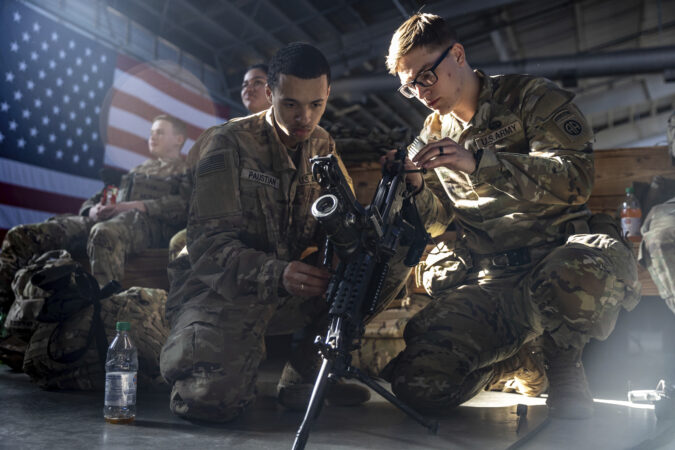
    The Army in recent days abruptly canceled a major training exercise for the headquarters element of an elite paratrooper unit, officials said, fueling speculation within the Defense Department that soldiers specializing in ground combat and a range of other missions may be sent to the Middle East as the conflict with Iran widens.

    The 82nd Airborne Division at Fort Bragg in North Carolina includes a brigade combat team of about 4,000 to 5,000 soldiers ready to deploy on 18 hours notice for missions as varied as seizing airfields and other critical infrastructure, reinforcing U.S. embassies, and enabling emergency evacuations. Its headquarters element is responsible for coordinating how those operations are planned and executed.

    No deployment orders had been issued as of Friday, officials said, speaking like some others on the condition of anonymity to discuss the situation. They noted that the Army is expected to announce soon a previously scheduled Middle East deployment for a helicopter unit with the 82nd, but that won’t happen until later in the spring.

    But the unexpected change of plans — the unit’s headquarters staff was told to stay put in North Carolina instead of joining the training event at Fort Polk in Louisiana — and the 82nd’s high-profile role in past conflicts has heightened expectations that the division’s Immediate Response Force could be called upon.

    “We’re all preparing for something — just in case,” said one official familiar with the issue.

    Army officials referred questions to the Pentagon, which issued a brief statement declining to provide details. “Due to operations security we do not discuss future or hypothetical movements,” the statement said.

    Officials with U.S. Central Command, which oversees operations in the Middle East, declined to comment.

    President Donald Trump has offered shifting explanations for his decision to start the conflict with Iran — and said publicly that U.S. ground troops “probably” would not be needed as part of the ongoing campaign. He and his top aides have repeatedly declined to rule out that possibility, however.

    The Immediate Response Force has been called upon in recent years to reinforce security at the U.S. Embassy in Baghdad just ahead of the military’s killing in 2020 of Qasem Soleimani, the Iranian Quds Force commander blamed for hundreds of deadly attacks on American personnel in the Middle East. It was central also to the evacuation of Afghanistan in 2021 and the show of U.S. force in Eastern Europe as Russia prepared to invade Ukraine in 2022.

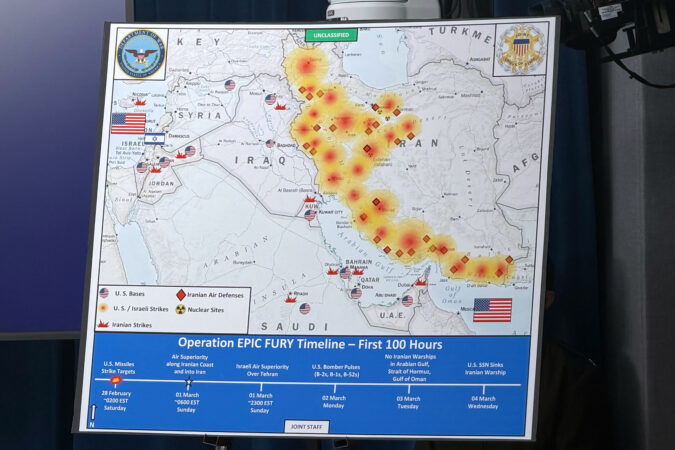
    Since hostilities began nearly a week ago, U.S. commanders have relied on airstrikes and naval strikes to target military sites and Tehran’s arsenal of missiles, attack drones and navy vessels. As many Iranian defenses have crumbled, U.S. forces increasingly are flying directly over Iran, dropping munitions with fighter jets, bombers and other aircraft.

    White House press secretary Karoline Leavitt told reporters Wednesday that sending American ground troops into Iran was “not part of the current plan, but I’m not going to remove an option for the president that is on the table.”

    At a Pentagon news briefing earlier in the day, Gen. Dan Caine, the chairman of the Joint Chiefs of Staff, declined to comment when asked about “U.S. boots on the ground,” saying that’s a “question for policymakers.”

    “I don’t make policy,” Caine added. “I execute policy.”

    As the Post reported last week, Caine had warned the White House that munitions shortfalls and a lack of broad military support from other U.S. allies would add considerable risk to any operation in Iran and to the personnel put in harm’s way. The Trump administration has sought to downplay those concerns.

    Caine appeared at Wednesday’s news conference alongside Defense Secretary Pete Hegseth, who earlier in the week also refused to rule out the possibility that ground combat troops could be sent into Iran.

    Adm. Charles “Brad” Cooper, who oversees the campaign as head of Central Command, said in a news conference Thursday in Tampa, Fla., that U.S. combat power in the region is still building as Iran’s declines. Fewer and fewer Iranian missiles and drones have been launched in the past few days, he said.

    By flying directly over Iran, Cooper said, U.S. forces are hitting its “center of gravity directly with overwhelming power and reach.” That includes, he said, B-2 bombers dropping 2,000-pound bombs on underground ballistic missile launchers.

    More than 50,000 U.S. troops are involved in the operation and six U.S. soldiers have been killed as Iran has mounted a ferocious counterattack targeting American positions and interests throughout the Middle East. Trump has said there will “likely be more” U.S. military fatalities before the campaign concludes, adding: “That’s the way it is.”

    The president and his top aides have been noncommittal on a timeline for ending the conflict. Trump has said it could last four to five weeks but “we have the capability to go far longer than that.”

    One prevailing concern, officials say, is the military’s limited stockpile of certain key weapons. The Pentagon is rapidly burning through its supply of precision arms and air-defense interceptors, people familiar with the matter have said. Senior Pentagon officials have denied there are any problems, noting that with Iranian defenses crumbling, U.S. forces are shifting heavily to strikes from manned aircraft with munitions that are plentiful.

    “We’ve got no shortages of munitions,” Hegseth said Thursday, speaking alongside Cooper. “Our stockpiles of defensive and offensive weapons allow us to sustain this campaign as long as we need to.”

    If the administration elects to send ground forces into Iran, one early target, analysts have said, could be Kharg Island. Located about 15 miles from the mainland in the Persian Gulf, the island is home to some of Tehran’s most significant oil infrastructure, with about 90% of the country’s oil exports moving through facilities there.

    A U.S. seizure of Kharg Island would give the Trump administration control of a centerpiece of the Iranian economy but leave U.S. troops vulnerable to attack.

    Michael Rubin, a senior fellow at the conservative American Enterprise Institute, called securing Kharg Island a “no-brainer” and said it appears that the Trump administration appears to be “coming around to the idea that Iran is a much greater problem set than perhaps they went in thinking.”

    While U.S. troops could take incoming fire if deployed there, Rubin said, capturing the island would give the United States significant strategic advantages, including potentially choking off Tehran’s ability to pay its military.

    Securing Iran’s most significant oil infrastructure also would follow a pattern for Trump, who has previously sought to secure oil wealth for the United States through the capture of Venezuelan President Nicolás Maduro in January and intervention in Syria during his first term in office.

    Still, deploying ground forces into Iran could pose significant political risk for the president, who is facing anti-war opposition from Democrats and a wing of his own Republican Party.

    A poll by CNN published Sunday found that 12% of respondents favor sending ground troops to Iran, while 60% oppose it and 28% are unsure.

  • U.S. national security offices, weakened by firings, confront Mideast war

    U.S. national security offices, weakened by firings, confront Mideast war

    Last week, FBI Director Kash Patel fired roughly a dozen agents and staff members who once had ties to an investigation of Donald Trump. Among them were agents who specialized in addressing threats from Iran and its proxies.

    Three days after the firings began, the United States was bombarding Iran.

    The fighting abroad poses a major test for a Justice Department and FBI reeling from mass firings, reassignments, and departures during Trump’s 14 months in office for his second term, according to current and former officials familiar with the matter, most of whom spoke on the condition of anonymity either out of concern about retaliation or to discuss continuing investigations.

    The FBI and Justice Department still have skilled leaders in many key national security positions, the people said, but they warned that the bench of expertise has significantly thinned over the past year, and the number of leaders with deep expertise in handling domestic threats has diminished.

    Thinner ranks, especially of experienced staff members, can matter in multiple ways, the current and former officials said.

    When the U.S. is engaged in conflict abroad, domestic law enforcement goes into high alert. FBI agents with national security experience sift through scores of possible threats, determining which are worth investigating further, which may be tied to terrorist groups — and which do not need to be followed up on.

    For serious threats, FBI agents often coordinate with Justice Department prosecutors to determine whether and how to execute warrants to surveil and arrest people before any possible violence occurs.

    Today, experienced agents and prosecutors are more scarce. At the FBI, the recent terminations came on top of scores of firings of agents and field-office leaders that Patel has ordered during his tenure, often without explanation.

    One former prosecutor, who spoke on the condition of anonymity to broadly discuss an investigation that has not been made public, said he worked last year with more than a half-dozen FBI agents to surveil a man who officials feared may have been planning a violent attack.

    FBI agents surveilled the man 24-7, the former prosecutor said. But Patel reassigned those agents to work on immigration, and the FBI’s capabilities to trail that suspect around-the-clock waned, the prosecutor said.

    As of October, roughly 25% of FBI agents had been assigned to immigration enforcement, stretching thin an already busy workforce.

    Each termination of an experienced agent also rids the bureau of years of source building, the current and former officials said.

    It’s impossible to know for sure what impact such departures have on the ability to track threats, they said. But, they said, each of the Iranian experts the FBI has lost probably had sources in and around Iranian American communities that they used to help monitor specific threats and people. Such source relationships, which are built on trust, cannot easily be transferred and are typically severed when agents leave.

    FBI spokesman Ben Williamson defended the bureau on social media. The recent firing of agents happened because “they acted unethically and violated the mission,” he said, adding that three agents with Iran expertise were ousted. The bureau did not answer questions about how the agents acted unethically or violated the FBI’s mission.

    “While we do not comment on personnel matters, the FBI maintains a robust counterintelligence operation, with personnel all over the country, who delivered record results in 2025 — including a 35% increase in counterintelligence arrests, six of the Ten Most Wanted Fugitives captured, and multiple foiled terrorism plots just in December alone,” Williamson said in a statement. “Our teams remain fully engaged across the country and prepared to mobilize any security assets needed to assist federal partners — as well as state and local law enforcement.”

    There’s no question, however, that the administration’s firings across the Justice Department and FBI have created big gaps in expertise across the law enforcement agency. The staffing losses have been widespread, hitting U.S. attorneys offices, FBI field offices and critical divisions at headquarters in Washington. The Justice Department has struggled to fill many of these slots with qualified people, the Washington Post has reported.

    The firings started on Day One of the Trump administration. Top Justice Department leaders pushed out Bruce Swartz, the deputy for international affairs in the criminal division, who had worked at the department for decades. Michael Nordwall, who headed the FBI’s criminal and cyber investigations division, and Robert Wells, whose portfolio included all of national security for the FBI, were also pushed out.

    At the time, The Post reported that Brian Driscoll — the acting FBI director while Patel was awaiting Senate confirmation — fought to keep Nordwall and Wells, saying their expertise was needed. Driscoll lost that fight. He subsequently was also pushed out by Patel.

    George Toscas — a veteran national security prosecutor who, in previous administrations, would have been overseeing the threats cases — was also ousted.

    Some of the removed leaders have been replaced with others who have years of experience in the department, the people interviewed said. In many cases, however, talented employees were promoted before they otherwise would have been, cutting short their training for senior positions. Others, they said, are unqualified for their jobs.

    Further stretching the national security leadership, Matthew Blue — the chief of the Justice Department’s counterterrorism section — is an Air Force veteran who has been serving in the D.C. National Guard since August. Trump deployed the D.C. National Guard to tackle “out of control” crime in the nation’s capital.

    One of Blue’s deputy chiefs, a longtime Justice Department prosecutor, has been serving as acting chief in his absence.

    Firings in other parts of the Justice Department can also have a ripple effect. Kyle Boynton — a former Civil Rights Division prosecutor and FBI agent who left the Justice Department in 2025 — noted that prosecutors who have reason to fear a person is planning a violent act can sometimes bring charges of an attempt to commit a hate crime before they carry out a violent attack. That can be a critical tool in preventing attacks, he said.

    As a prosecutor in the Civil Rights Division, Boynton said he would receive calls from FBI agents when they were tracking a threat against a synagogue, for example. He would help determine what search warrants or surveillance measures they could legally request. Boynton said he fears that few people remain in the division’s criminal section who have handled such investigations.

    The entire leadership of the criminal section of the Civil Rights Division has departed or been ousted in recent months, two people familiar with staffing in the division said.

    “It requires an enormous amount of manpower to track people before they commit a crime,” Boynton said. “What you are looking for is evidence of intent and evidence that they have taken substantial steps in furtherance of intent. That requires an enormous amount of attention and scrutiny by FBI agents and DOJ prosecutors.”

    Current and former Justice Department attorneys said they are frustrated that the Trump administration, including Patel and Attorney General Pam Bondi, did not appear to carefully consider the long-term ramifications of their staffing decisions.

    “We are now in a heightened-threat situation, not just in the Mideast but also here in the U.S. Iran, acting through its proxies, has long sought to carry out a terrorist attack or assassination inside the country,” said one longtime former senior National Security official.

    “The danger today is that we have lost so much of our capability to uncover and stop such an attack,” the official said. “We have let down our guard at the worst time.”

  • Gulf allies complain U.S. didn’t notify them of Iran attacks and ignored their warnings, sources say

    Gulf allies complain U.S. didn’t notify them of Iran attacks and ignored their warnings, sources say

    CAIRO — The Trump administration is confronting mounting discontent from allies in the Persian Gulf who have complained they were not given adequate time to prepare for the torrent of Iranian drones and missiles bombarding their countries in retaliation for strikes launched by the U.S. and Israel.

    Officials from two Gulf countries said their governments were disappointed in the way the U.S. has handled the war, particularly the initial attack on Iran on Feb. 28. They said their countries were not given advance notice of the U.S.-Israeli attack and complained the U.S. had ignored their warnings that the war would have devastating consequences for the entire region.

    One of the officials said that Gulf countries were frustrated and even angry that the U.S. military has not defended them enough. He said there is belief in the region that the operation has focused on defending Israel and American troops, while leaving Gulf countries to protect themselves, and said that his country’s stock of interceptors was “rapidly depleting.”

    Like others in this story, the Gulf officials spoke on the condition of anonymity because they were discussing a confidential diplomatic matter.

    The governments of Bahrain, Kuwait, Oman, Qatar, Saudi Arabia, and the United Arab Emirates did not respond to requests for comment.

    White House spokeswoman Anna Kelly said in response: “Iran’s retaliatory ballistic missile attacks have decreased by 90% because Operation Epic Fury is crushing their ability to shoot these weapons or produce more. President Trump is in close contact with all of our regional partners, and the terrorist Iranian regime’s attacks on its neighbors prove how imperative it was that President Trump eliminate this threat to our country and our allies.”

    The Pentagon did not respond.

    Official reactions by the Gulf Arab countries have been muted, but public figures with close ties to their governments have been openly critical of the U.S., suggesting that Israeli Prime Minister Benjamin Netanyahu dragged President Donald Trump into a needless war.

    “This is Netanyahu’s war,” Prince Turki al-Faisal, the former Saudi intelligence chief, told CNN on Wednesday. “He somehow convinced the president [Trump] to support his views.”

    Pentagon officials conceded this week in closed-door briefings with lawmakers they are struggling to stop waves of drones launched by Iran, leaving some U.S. targets in the Gulf region, including troops, vulnerable.

    The Gulf countries have emerged as valuable targets for Iran, well within the range of Iran’s short-range missiles and filled with targets, including American troops, high-profile business and tourist locations and energy facilities, disrupting the world’s flow of oil.

    Since the start of the war, Iran has fired at least 380 missiles and over 1,480 drones targeting the five Arab Gulf countries, according to an AP tally based on official statements. At least 13 people have been killed in those countries, according to local officials.

    In addition, six U.S. soldiers were killed in Kuwait on Sunday when an Iranian drone strike hit an operations center in a civilian port, more than 10 miles from the main Army base. The husband of one of the slain soldiers, who was part of a supply and logistics unit based in Iowa, said the operations center was a shipping container-style building and had no defenses.

    In briefings for members of Congress on Tuesday, U.S. Defense Secretary Pete Hegseth and Gen. Dan Caine, chairman of the Joint Chiefs of Staff, told lawmakers that the U.S. will not be able to intercept many of the incoming UAVs, especially the Shaheds, according to three people familiar with the briefings.

    In one of the briefings, Caine and Hegseth did not offer any details when pressed by lawmakers why the U.S. did not seem prepared for Iran to launch waves of drones at U.S. targets in the region, according to one of the people.

    That person, a U.S. official who is familiar with the U.S. security posture in Gulf region, said that the U.S. did not have widespread capabilities throughout the Gulf region to effectively counter waves of the one-way drones coming to places outside conventional targets or bases outside of Iraq and Syria.

    Drone attacks this week at the embassy in Saudi Arabia caused a limited fire at the embassy in Riyadh, and another drone attack the United Arab Emirates sparked a small fire outside the U.S. consulate in Dubai.

    The U.S. and its allies in the Middle East on Thursday even sought help from Ukraine, which has expertise in countering Iran’s Shahed drones, according to Ukrainian President Volodymyr Zelensky. When asked about Zelensky’s comments, Trump told Reuters on Thursday, “Certainly, I’ll take, you know, any assistance from any country.”

    Bader Mousa Al-Saif, a Kuwait-based analyst with Chatham House, said the U.S. appeared to have underestimated the risk to its Gulf Arab allies, believing American troops and Israel would be the primary targets of Iranian retaliation.

    “I don’t think they saw that there would be as much exposure to the Gulf,” he said, saying the lack of a plan to protect the Gulf countries “speaks to U.S. short-sightedness.”

    The frustration in some of the Gulf nations is driven in part by the relative success that Israel has had knocking down drones and missiles compared to some of their neighbors, according to a person familiar with the sensitive diplomatic matter who was not authorized to comment publicly.

    Their air defense systems are hardly as robust as Israel’s, but according to the person, U.S. officials have been somewhat perplexed that the Gulf countries are still not showing an appetite for delivering a counteroffensive by launching missiles at Iranian targets.

    Elliott Abrams, who served as a special representative for Iran and Venezuela at the end of Trump’s first term, said that U.S. national security officials and their Gulf allies were aware that Iran had the capability to carry out significant strikes.

    “And the neighbors knew it and were afraid of it. But it was never clear that Iran would actually do it, because they have a lot to lose,” Abrams said. “These attacks will leave long-term enmity, and if they keep up, the Gulf Arabs may start attacking Iran.”

    Michael Ratney, a former U.S. ambassador to Saudi Arabia, said that while the Gulf countries have an interest in seeing Iran weakened, they also have key concerns about the ongoing war — including the economic damage and instability it is causing and its open-ended nature.

    Ratney, who is now a senior adviser in the Middle East program of the Center for Strategic and International Studies, said: “What comes next? The countries of the Gulf will have to bear the brunt of whatever that is.”

  • Supply chain disruptions from the Iran war could raise prices for drugs, electronics, and more

    Supply chain disruptions from the Iran war could raise prices for drugs, electronics, and more

    NEW YORK — The Iran war has effectively halted oil tanker movement in the key Strait of Hormuz. But it’s also disrupting the wider global supply chain beyond oil, affecting everything from pharmaceuticals from India, semiconductors from Asia, and oil-derived products such as fertilizers that come from the Middle East.

    Cargo ships are stuck in the Gulf or making a much longer detour around the southern tip of Africa. Planes carrying air cargo out of the Middle East are grounded. And the longer the war drags on, the more likely that there will be shortages and price increases on a wide range of goods.

    “This is really causing some major impacts within the global supply chain,” said Patrick Penfield, professor of supply chain practice at Syracuse University. “As this conflict keeps progressing, you’ll start to see some shortages, you’ll see some major price increases.”

    Stalled at sea

    Clarksons Research, which tracks shipping data, estimates that about 3,200 ships, or about 4% of global ship tonnage, are idle inside the Persian Gulf, but that includes about 1,231 that likely only operate within the Gulf. About 500 ships, or 1% of global tonnage, are currently “waiting” outside the Gulf in ports off the coast of the United Arab Emirates and Oman, according to the firm.

    While those may seem like small percentages, they have a domino effect that will lead to congestion elsewhere, said Michael Goldman, general manager North America of CARU Containers.

    “The supply chain is kind of like a long train with many cars and each car represents, let’s say, a port in the world. Well, if one car gets derailed, it can very often have a domino effect to many other cars behind it or in front of it,” he said. “So although we only have a small number of ports affected by this military action, it can really have a big effect on the total supply chain.”

    On Tuesday, President Donald Trump pitched a plan aimed at getting oil and trade moving again through the Strait.

    Trump said on social media he ordered the U.S. International Development Finance Corp. to provide political risk insurance for tankers carrying oil and other goods through the Persian Gulf “at a very reasonable price.”

    Political risk insurance is a type of coverage intended to protect firms against financial losses caused by unstable political conditions, government actions, or violence. Marine insurers had been canceling or raising rates for insurance in the region.

    He said that, if necessary, the U.S. Navy would escort oil tankers through the Strait of Hormuz. The Navy has at least eight destroyers and three, smaller, littoral combat ships in the region. These ships have previously been used to escort merchant shipping in the region and in the Red Sea.

    Computer chips, pharmaceuticals, and other goods face delays

    A wide range of products are shipped through the Mideast region. Along with about 20% of the world’s oil that comes from the region, products made with natural gas such as petrochemical feedstock — used to make plastic and rubber — and nitrogen fertilizer come from the Middle East. Pharmaceuticals exported from India and semiconductors and batteries exported from Asia to the rest of the world are all shipped through the region and could face delays.

    Limited routes, higher costs

    In addition to constraints on the Strait of Hormuz, the instability has put a damper on transit in the Red Sea and the Suez Canal, which had just begun to see more transit after years of instability due to Houthi attacks on ships in the region. Shipping company Maersk had resumed transit in the Suez Canal and Red Sea but said Sunday that it was rerouting that traffic around the Cape of Good Hope in Africa, a move other companies have been making to avoid the volatile region.

    That journey adds 10 to 14 days to the trip and about $1 million extra in fuel per ship, Syracuse’ Penfield estimates.

    With higher fuel prices, longer routes, and higher risk in the region, shippers have begun adding fuel and “war risk” or “emergency conflict” surcharges to what they’re charging clients, leading to higher costs all around, he said.

    Air cargo under pressure

    Air cargo has also been constrained. Closed airspace and airports in countries including UAE, Qatar, Bahrain, Kuwait, Iraq, and Iran have stranded tens of thousands of people — and cargo.

    Each of the three major Middle Eastern airlines — Emirates, Qatar Airways, and Etihad Airways — operate fleets of cargo aircraft, and the airlines also transport goods in the belly of their passenger planes.

    The amount of goods that travels through the air typically accounts for less than 1% of all freight moving globally, but the products that do travel by air tend to be perishable or high-value goods like pharmaceuticals, electronics, and produce that together account for about 35% of the world trade value, Boeing estimated in its World Air Cargo Forecast.

    The longer these airports in the Middle East remain closed the greater the potential disruption to the economy if these sensitive shipments don’t arrive or have to be rerouted around the conflict. Even before the war in Iran began over the weekend, air freight and airlines were already contending with closed airspace over Ukraine and Russia.

    Flights through these Middle Eastern airport hubs are a key route for passengers and cargo from India. Henry Harteveldt, an airline industry analyst with Atmosphere Research Group, said it’s going to be hard to get to India now, and passengers may have to switch to different routes that fly west across Asia. Airlines may have to resort to longer flights, and in some case even add fuel stops on some routes.

    “Remember, there’s a lot of pharmaceutical products that are made in India and then exported to different countries around the world. If that’s disrupted, that has a huge, huge, huge impact,” Harteveldt said.

    Air cargo costs are expected to rise due to reduced capacity, increased demand, and surcharges.

    Maersk said in an operational update Tuesday that it expects air freight rates to rise due to capacity constraints.

    “Airlines are also introducing or reviewing the possibility of introducing war risk surcharges on shipments routed through or near the impacted regions,” Maersk said in a statement. “There may also be added costs linked to jet fuel which in turn can push up costs.”

    An industry that ‘runs on disruption’

    Despite the supply chain upheaval, however, Michael Goldman, general manager North America of CARU Containers, said the industry will adjust. Over the past few years it has faced other major disruptions like COVID supply shortages and other recent Mideast conflicts and has become more nimble.

    “The specific situation that’s happening is pretty unprecedented, so it’s very unique from that perspective,” he said. “[But] for the last few years the industry just kind of runs on disruption. So in terms of our industry having disruption, that is nothing new. That’s more of the same.”

  • Bernard LaFayette, Selma voting rights organizer, has died at 85

    Bernard LaFayette, Selma voting rights organizer, has died at 85

    NASHVILLE — Bernard LaFayette, the advance man who did the risky groundwork for the voter registration campaign in Selma, Ala., that culminated in the passage of the Voting Rights Act of 1965, has died.

    Bernard LaFayette, III, said his father died Thursday morning of a heart attack. He was 85.

    On March 7, 1965, the beating of future congressman John Lewis and voting rights marchers on Selma’s Edmund Pettus Bridge led the evening news, shocking the nation’s conscience and pushing Congress to act. But two years before “Bloody Sunday,” it was Mr. LaFayette who quietly set the stage for Selma and the advances in voting rights that would follow.

    Mr. LaFayette was one of a delegation of Nashville students who in 1960 had helped found the Student Nonviolent Coordinating Committee, which organized desegregation and voting rights campaigns across the South. SNCC crossed Selma off its map after some initial scouting determined “the white folks were too mean and the Black folks were too scared,” Mr. LaFayette said.

    But he insisted on trying anyway. Named director of the Alabama Voter Registration Campaign in 1963, Mr. LaFayette moved to the town and, with his former wife Colia Liddell, gradually built the leadership capacity of the local people, convincing them change was possible and creating momentum that could not be stopped. He described this work in a 2013 memoir, In Peace and Freedom: My Journey in Selma.

    The many dangers Mr. LaFayette faced included an assassination attempt on the same night Medgar Evers was murdered in Mississippi, in what the FBI said was a conspiracy to kill civil rights workers. Mr. LaFayette was beaten outside his home before his assailant pointed a gun at him. His calls for help brought out a neighbor with a rifle. Mr. LaFayette found himself standing between the two men, asking his neighbor not to shoot.

    Mr. LaFayette said he felt “an extraordinary sense of internal strength instead of fear” at that moment. Rather than fight back, he looked his attacker in the eyes. Nonviolence is a fight “to win that person over, a struggle of the human spirit,” he wrote.

    He also acknowledged that his neighbor’s gun may have been what saved his life.

    Mr. LaFayette was already working on a new project in Chicago by the time his work in Selma came to fruition in 1965. He had planned to join the Selma-to-Montgomery march on day two, so he missed Bloody Sunday when the march was stopped by tear gas and club-wielding state troopers before it even got out of Selma.

    “I felt helpless at a distance,” he wrote. “I was stricken with grief, concerned that so many people in my beloved community were hurt, possibly killed.”

    But he shifted quickly, rounding up people in Chicago and arranging transport to Alabama for a second attempt. They set off two weeks later on what had become a victory march: President Lyndon Johnson had introduced the Voting Rights Act to Congress.

    Inspired by his grandmother

    Mr. LaFayette grew up in Tampa, Fla., where he recalled trying to board a trolley with his grandmother when he was 7 years old. Black passengers had to pay at the front, then walk to the back to climb on. But the conductor began to pull away before they could board, and his grandmother fell. He was too little to help.

    “I felt like a sword cut me in half, and I vowed I would do something about this problem one day,” he wrote in his memoir.

    It was his grandmother who decided he was destined to become a preacher. She arranged for him to attend Nashville’s American Baptist Theological Seminary (now American Baptist College), where he roomed with Lewis, and both helped lead the nonviolent civil disobedience campaign that led to Nashville becoming the first major Southern city to desegregate its downtown accommodations.

    President Barack Obama spoke about the roommates in a eulogy after Lewis died in 2020, recalling how they integrated a Greyhound bus while riding home for Christmas break (Lewis to Troy, Ala., and LaFayette to Tampa, Fla.) just weeks after the Supreme Court banned segregation in interstate travel in 1960.

    The two sat up front and refused to move, angering the driver, who stormed off at every stop, all through the night.

    “Imagine the courage of these two people … to challenge an entire infrastructure of oppression,” Obama said. “Nobody was there to protect them. There were no camera crews to record events.”

    Mr. LaFayette has said they didn’t fully realize the impact of all this work at the time.

    “We lived through this, but this was our daily lives,” he told the Associated Press in a 2021 interview. “When you think about it, we weren’t trying to make history or trying to rewrite history. We were responding to the problems of the particular time.”

    Freedom Rides of 1961

    In 1961, Mr. LaFayette dropped out of college in the middle of final exams to join an official Freedom Ride, one of many that sought to force Southern authorities to comply with the court’s ruling. He was beaten in Montgomery, Ala., and arrested in Jackson, Miss., becoming one of more than 300 Freedom Riders sent to Parchman Prison.

    Mr. LaFayette later trained Black youth to become leaders in the Chicago Freedom Movement and helped organize tenant unions.

    “The tenant protections we have today are really a direct outcome of that work in Chicago,” said Mary Lou Finley, a professor emeritus at Antioch University Seattle who worked with Mr. LaFayette in Chicago in the 1960s.

    And when he learned that one of his secretaries had two children sickened by lead — a huge problem that was not well understood at the time — Mr. Lafayette organized high school students to screen toddlers for lead poisoning by collecting urine samples, and prodded Chicago to help develop the nation’s first mass screening for lead poisoning, Finley said.

    “Bernard has always worked quietly behind the scenes,” said Finley, who later collaborated with Mr. LaFayette on nonviolence training. “He has avoided the spotlight. In some ways, I think he felt like he could do more if he were doing it quietly.”

    Mr. LaFayette also worked alongside Andrew Young and the Southern Christian Leadership Conference to prepare for the Rev. Dr. Martin Luther King Jr.’s ill-fated Northern campaign. Several of King’s marches were attacked by white mobs, but Mr. LaFayette and Young challenged the notion that the Chicago movement was a failure.

    Young noted in a 2021 interview that in Chicago they were trying to organize a population 20 times larger than Birmingham’s, while pursuing a range of difficult issues, from neighborhood integration to the quality of schools and jobs. “In each one of those we made progress,” Young said.

    By 1968, Mr. LaFayette was the national coordinator of the King’s Poor People’s Campaign and was with King at the Lorraine Motel on the morning of his assassination. King’s last words to him were about the need to institutionalize and internationalize the nonviolence movement. Mr. LaFayette made this his life’s mission.

    After King died, Mr. LaFayette returned to American Baptist to complete his bachelor’s degree and then earned a master’s and doctorate from Harvard University. Mr. LaFayette later served as director of Peace and Justice in Latin America; chairperson of the Consortium on Peace Research, Education and Development; director of the Center for Nonviolence and Peace Studies at the University of Rhode Island; distinguished senior scholar-in-residence at the Candler School of Theology, Emory University, Atlanta; and minister of the Westminster Presbyterian Church in Tuskegee, Ala., among other positions.

    “Bernard did work in Latin America. He did nonviolence workshops in South Africa with the African National Congress. He went to Nigeria when the civil war was happening there,” Young said. “Bernard literally went everywhere he was invited as sort of a global prophet of nonviolence.”

    In his memoir, Mr. LaFayette wrote that the ever-present threat of death during those early years of organizing taught him that the value of life “lies not in longevity, but in what people do to give it significance.”

  • House narrowly rejects Iran war powers resolution in early test of Trump’s strategy

    House narrowly rejects Iran war powers resolution in early test of Trump’s strategy

    WASHINGTON — The House narrowly rejected a war powers resolution Thursday to halt President Donald Trump’s attacks on Iran, an early sign of unease in Congress over the rapidly widening conflict that is reordering U.S. priorities at home and abroad.

    It’s the second vote in as many days, after the Senate defeated a similar measure along party lines. Lawmakers are confronting the sudden reality of representing wary Americans in wartime and all that entails — with lives lost, dollars spent, and alliances tested by a president’s unilateral decision to go to war with Iran.

    While the tally in the House, 212-219, was expected to be tight, the outcome provided a clarifying snapshot of political support for, and opposition to, the U.S.-Israel military operation and Trump’s rationale for bypassing Congress, which alone has the power to declare war. At the Capitol, the conflict has quickly carried echoes of the long wars in Afghanistan and Iraq, and many Sept. 11-era veterans now serve in Congress.

    “Donald Trump is not a king, and if he believes the war with Iran is in our national interest, then he must come to Congress and make the case,” said Rep. Gregory Meeks, the top Democrat on the House Foreign Affairs Committee.

    The House also approved a separate measure affirming that Iran is the largest state sponsor of terrorism.

    Republicans largely back Trump, and most Democrats oppose the war

    Trump’s Republican Party, which narrowly controls the House and Senate, largely sees the conflict with Iran not as the start of a new war, but the end of a government that has long menaced the West. The operation has killed Iran’s Supreme Leader Ayatollah Ali Khamenei, which some view as an opportunity for regime change, though others warn of a chaotic power vacuum.

    Republican Rep. Brian Mast of Florida, chairman of the House Foreign Affairs Committee, publicly thanked Trump for taking action against Iran, saying the president is using his own constitutional authority to defend the U.S. against the “imminent threat” the country posed.

    Mast, an Army veteran who worked as a bomb disposal expert in Afghanistan, said the war powers resolution was effectively asking “that the president do nothing.”

    For Democrats, Trump’s attack on Iran, influenced by Israeli Prime Minister Benjamin Netanyahu, is a war of choice that is testing the balance of powers in the Constitution.

    “The framers weren’t fooling around,” said Rep. Jamie Raskin (D., Md.), arguing that the Constitution is clear that only Congress can decide matters of war. “It’s up to us.”

    While views in Congress are largely falling along party lines, there are crossover coalitions. The war powers resolution, if signed into law, would have immediately halted Trump’s ability to conduct the war unless Congress approved the military action. The president would likely veto it.

    Trump officials provide shifting rationale for war

    After launching a surprise attack against Iran on Saturday, Trump has scrambled to win support for a conflict that Americans of all political persuasions were already wary of entering. Trump administration officials spent hours behind closed doors on Capitol Hill this week trying to reassure lawmakers that they have the situation under control.

    Six U.S. military members were killed over the weekend in a drone strike in Kuwait, and Trump has said more Americans could die. Thousands of Americans abroad have scrambled for flights, many lighting up phone lines at congressional offices as they sought help trying to flee the Middle East.

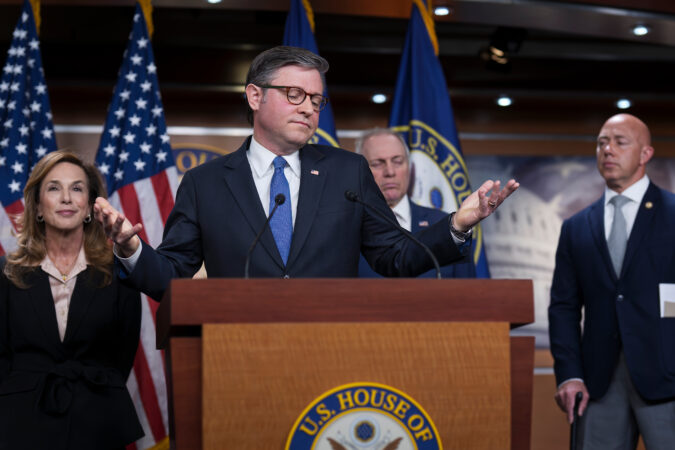
    Trump said Thursday he must be involved in choosing Iran’s new leader. Yet House Speaker Mike Johnson (R., La.) said this week that America has enough problems at home and is not about to be in the “nation-building business.”

    Defense Secretary Pete Hegseth said that the war could extend eight weeks, twice as long as the president first estimated. Trump has left open the possibility of sending U.S. troops into what has largely been a bombing campaign by air. More than 1,230 people in Iran have died.

    The administration said the goal is to destroy Iran’s ballistic missiles that it believes are shielding its nuclear program. It has also said Israel was ready to act, and American bases would face retaliation if the U.S. did not strike Iran first. On Wednesday, the U.S. said it torpedoed an Iranian warship near Sri Lanka.

    “This administration can’t even give us a straight answer of as to why we launched this preemptive war,” said Rep. Thomas Massie, the Republican from Kentucky, an outlier in his party.

    Massie and Rep. Ro Khanna (D., Calif.), who had teamed up to force the release the Jeffrey Epstein files, also pushed the war powers resolution to the floor, past objections from Johnson’s GOP leadership. Another Republican, Rep. Warren Davidson of Ohio, a former Army Ranger, was also expected to back the war powers resolution.

    Johnson has warned that it would be “dangerous” to limit the president’s authority while the U.S. military is already in conflict.

    “Congress must stand with the president to finally close, once and for all, this dark chapter of history,” Rep. Michael McCaul (R., Texas) said.

    Rep. Yassamin Ansari (D., Ariz.) said that as the daughter of Iranian immigrants who fled their homeland, she celebrates Khamenei’s death. But she warned that a democratic transition for the people of Iran never seems to a priority for Trump and his officials who briefed lawmakers.

    “War carries profound and deadly consequences for our troops, for the American people and for the entire world,” she said. “It’s the most serious decision that a nation can make and the American people deserve debate, transparency and accountability before that decision is made.”

    Other Democrats have proposed an alternative resolution that would allow the president to continue the war for 30 days before he must seek congressional approval. It is not expected yet for a vote.

    Senators sit in their desks for solemn vote

    In the Senate, Republican leaders have successfully, though narrowly, defeated a series of war powers resolutions pertaining to several other conflicts during Trump’s second term. This one, however, was different.

    Underscoring the gravity of the moment Wednesday, Democratic senators filled the chamber and sat at their desks as the voting got underway.

    Senate Democratic leader Chuck Schumer of New York said before the vote that every senator will pick a side. “Do you stand with the American people who are exhausted with forever wars in the Middle East or stand with Donald Trump and Pete Hegseth as they bumble us headfirst into another war?”

    Sen. John Barrasso, second in Senate Republican leadership, said “Democrats would rather obstruct Donald Trump than obliterate Iran’s national nuclear program.”

    The legislation failed on a 47-53 tally mostly along party lines, with Sen. Rand Paul (R., Ky.) in favor and Sen. John Fetterman (D., Pa.) against it.

  • Crews in Cuba rush to repair a damaged power plant to ease a blackout

    Crews in Cuba rush to repair a damaged power plant to ease a blackout

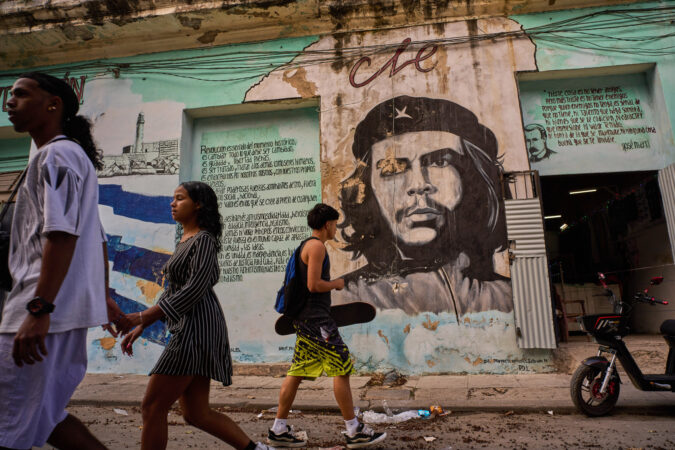
    HAVANA — Swaths of Cuba remained without power on Thursday nearly a day after a huge blackout hit the western part of the island in the latest outage blamed on a fragile electric grid and a lack of fuel.

    Crews worked overnight to repair a broken boiler at one of Cuba’s largest thermoelectric plants, but officials have warned that it could take three to four days for power to be fully restored.

    State media reported that nearly 660,000 customers in Havana, or 77%, had power, as well as 43 hospitals and 10 water supply stations. However, officials warned of low power generation and said some circuits that crews had reconnected were kicked offline again.

    Millions still remained without power, including Miguel Leyva, 65, who lives with his mother and brother, both of whom are ill.

    “I have no words to describe what I’m going through: the heat, the mosquitoes and no electricity. The food could spoil,” he said. “I’m aware of all the problems that exist, but listen, it’s been more than 24 hours now.”

    Cuba’s Ministry of Energy and Mines wrote on X that the electrical system is operating “in a limited capacity, prioritizing basic services, primarily health and water supply.”

    State media reported that two power plants are offline because of a lack of petroleum.

    Government officials said Wednesday afternoon that crews have located the crack in the boiler drum that led to the outage. They said it will take 12 hours to cool that area so crews can enter the furnace and start repairing it. Work already is underway to fix a pipe that also is damaged, officials added.

    Sonia Vázquez, 61, said the blackout didn’t stop her from selling coffee to passersby daily, saying she prepared it with gas at 5 a.m. under a rechargeable lamp.

    “I didn’t sleep last night. Too many mosquitoes,” said Vázquez, who lives with her grandson.

    Meanwhile, 57-year-old cafe owner José Ignacio Dorta, said that some of his frozen food has spoiled.

    “We’ve looked for ways to prevent further spoilage. We’re working on it. We hope nothing else will spoil,” he said.

    Cuba has long struggled with an aging electric grid and intermittent fuel supplies, but the crisis has deepened in recent months.

    Key oil shipments from Venezuela were halted after the United States attacked the South American country in early January. Then later that month, President Donald Trump warned that he would impose tariffs on any country that sells or supplies oil to Cuba.

    On Thursday, Trump suggested a deal may be imminent with Cuba but that he’s focusing on Iran in the meantime.

    Referring to a co-owner of Inter Miami being originally from Cuba, Trump said, “You’re gonna go back” and added, “That’s going to be a great day, right?”

    Without providing details, Trump said, “We’re going to celebrate that separately. I just want to wait a couple of weeks. I want him to wait a couple of weeks. But we’ll be together again soon, I suspect, celebrating what’s going on in Cuba.”

    He added of the island’s government, “They want to make a deal so badly. You have no idea.”

    Then, referring to Marco Rubio, the president said the secretary of state wants to work on Cuba but is cautious to do so during the war in Iran.

    “You’re next one’s going to be — we want to do that special — Cuba,” Trump said. “He’s waiting. But he says, “Let’s get this one finished first.’ We could do them all at the same time. But bad things happen. If you watch countries over the years, you do them all too fast, bad things happen.”

    Trump didn’t clarify his meaning, but the comments followed his from last week, when he raised that the prospect of a “friendly takeover” of Cuba might be possible without elaborating.

    Wednesday’s outage is the second one to hit western Cuba in three months.

    The outage in early December lasted nearly 12 hours. Officials said that a fault in a transmission line linking two power plants caused an overload and led to the collapse of the energy system’s western sector.

    Some of Cuba’s thermoelectric plants have been operating for more than three decades and receive little maintenance because of high costs. U.S. sanctions also have prevented the government from buying new equipment and specialized parts, officials say.