DUBAI, United Arab Emirates — Iranian authorities unveiled a new mural on a giant billboard in a central Tehran square on Sunday with a direct warning to the United States to not attempt a military strike on the country, as U.S. warships head to the region.
The image shows a bird’s-eye view of an aircraft carrier with damaged and exploding fighter planes on its flight deck. The deck is strewn with bodies and streaked with blood that trails into the water behind the ship to form a pattern reminiscent of the stripes of the American flag. A slogan is emblazoned across one corner: “If you sow the wind, you will reap the whirlwind.”
The unveiling of the mural in Enghelab Square comes as the USS Abraham Lincoln aircraft carrier and accompanying warships move toward the region. U.S. President Donald Trump has said the ships are being moved “just in case” he decides to take action.
“We have a massive fleet heading in that direction and maybe we won’t have to use it,” Trump said Thursday.
Enghelab Square is used for gatherings called by the state and authorities change its mural based on national occasions. On Saturday, the commander of Iran’s paramilitary Revolutionary Guard warned that his force is “more ready than ever, finger on the trigger.”
Tension between the U.S. and Iran has spiked in the wake of a brutal crackdown on nationwide protests that saw thousands of people killed and tens of thousands arrested. Trump had threatened military action if Iran continued to kill peaceful protesters or carried out mass executions of those detained.
There have been no further protests for days and Trump claimed recently that Tehran had halted the planned execution of about 800 arrested protesters — a claim Iran’s top prosecutor called “completely false.”
But Trump has indicated he is keeping his options open, saying on Thursday that any military action would make last June’s U.S. strikes on Iranian nuclear sites “look like peanuts.”
U.S. Central Command said on social media that its Air Force F-15E Strike Eagle now has a presence in the Middle East, noting the fighter jet “enhances combat readiness and promotes regional security and stability.”
Similarly, the U.K. Ministry of Defense said Thursday that it deployed its Typhoon fighter jets to Qatar “in a defensive capacity.”
The protests in Iran began on Dec. 28, sparked by the fall of the Iranian currency, the rial, and quickly spread across the country. They were met by a violent crackdown by Iran’s theocracy, which does not tolerate dissent.
The death toll reported by activists has continued to rise since the end of the demonstrations, as information trickles out despite a more than two-week internet blackout — the most comprehensive in Iran’s history.
The U.S.-based Human Rights Activists News Agency on Sunday put the death toll at 5,529, with the number expected to increase. It says more than 41,200 people have been arrested.
The group’s figures have been accurate in previous unrest and rely on a network of activists in Iran to verify deaths. That death toll exceeds that of any other round of protest or unrest there in decades, and recalls the chaos surrounding Iran’s 1979 Islamic Revolution. The Associated Press has not been able to independently verify the toll.
Iran’s government has put the death toll at a far lower 3,117, saying 2,427 were civilians and security forces, and labeled the rest “terrorists.” In the past, Iran’s theocracy has undercounted or not reported fatalities from unrest.
President Volodymyr Zelensky said Sunday that a U.S. security guarantees document for Ukraine is “100% ready” after two days of talks involving representatives from Ukraine, the U.S., and Russia.
Speaking to journalists in Vilnius during a visit to Lithuania, Zelensky said Ukraine is waiting for its partners to set a signing date, after which the document would go to the U.S. Congress and Ukrainian parliament for ratification.
Zelensky also emphasized Ukraine’s push for European Union membership by 2027, calling it an “economic security guarantee.”
The Ukrainian leader described the talks in Abu Dhabi, the capital of the United Arab Emirates, as likely the first trilateral format in “quite a long while” that included not only diplomats but military representatives from all three sides. The talks, which began on Friday and continued Saturday, were the latest aiming to end Russia’s nearly four-year full-scale invasion.
Zelensky acknowledged fundamental differences between Ukrainian and Russian positions, reaffirming territorial issues as a major sticking point.
“Our position regarding our territory — Ukraine’s territorial integrity — must be respected,” he said.
Russian President Vladimir Putin discussed a Ukraine settlement with U.S. President Donald Trump’s envoys Steve Witkoff and Jared Kushner during marathon talks late Thursday. The Kremlin insisted that to reach a peace deal, Kyiv must withdraw its troops from the areas in the east that Russia illegally annexed but has not fully captured.
Zelensky said the U.S. is trying to find a compromise, but that “all sides must be ready for compromise.”
Negotiators will return to the UAE on Feb. 1 for the next round of talks, according to a U.S. official. The recent talks covered a broad range of military and economic matters and included the possibility of a ceasefire before a deal, the official said. There was not yet an agreement on a final framework for oversight and operation of Ukraine’s Zaporizhzhia Nuclear Power Plant, which is occupied by Russia and is the largest in Europe.
PARIS — The captain of a tanker intercepted in the Mediterranean Sea by the French navy on suspicion of shipping oil in violation of sanctions against Russia was being held in custody on Sunday for questioning.
The ship’s Indian captain, 58, was handed to judicial authorities following the diversion of the oil tanker, Grinch, and its arrival at anchorage in the Gulf of Fos-sur-Mer, the Marseille prosecutor’s office said in a statement.
The investigation is being conducted by the Maritime Gendarmerie’s Investigation Unit in Toulon, jointly with the Marseille Ship Safety Centre, on charges of failure to fly a valid flag, according to the statement, which added that the crew, also of Indian nationality, was being kept on board.
“The purpose of the investigation is to verify the validity of the flag flown by the tanker and the documents required for its navigation,” the statement said.
The Grinch came from Murmansk in northwestern Russia and is suspected of being part of the sanctioned Russian “shadow fleet.” A video provided by the French military showed members of the navy boarding the ship from a helicopter earlier this week.
Russia is believed to be using a fleet of over 400 ships to evade sanctions over its war on Ukraine. France and other countries have vowed to crack down.
The fleet comprises aging vessels and tankers owned by nontransparent entities with addresses in nonsanctioning countries, and sailing under flags from such countries.
Some 12% of employed adults say they use AI daily in their job, according to a Gallup Workforce survey conducted this fall of more than 22,000 U.S. workers.
The survey found roughly one-quarter say they use AI at least frequently, which is defined as at least a few times a week, and nearly half say they use it at least a few times a year. That compares with 21% who were using AI at least occasionally in 2023, when Gallup began asking the question, and points to the impact of the widespread commercial boom that ChatGPT sparked for generative AI tools that can write emails and computer code, summarize long documents, create images, or help answer questions.
Home Depot store associate Gene Walinski is one of the employees embracing AI at work. The 70-year-old turns to an AI assistant on his personal phone roughly every hour on his shift so he can better answer questions about supplies that he is not “100% familiar with” at the store’s electrical department in New Smyrna Beach, Fla.
“I think my job would suffer if I couldn’t because there would be a lot of shrugged shoulders and ‘I don’t know’ and customers don’t want to hear that,” Walinski said.
AI at work for many in technology, finance, education
While frequent AI use is on the rise with many employees, AI adoption remains higher among those working in technology-related fields.
About 6 in 10 technology workers say they use AI frequently, and about 3 in 10 do so daily.
The share of Americans working in the technology sector who say they use AI daily or regularly has grown significantly since 2023, but there are indications that AI adoption could be starting to plateau after an explosive increase between 2024 and 2025.
In finance, another sector with high AI adoption, 28-year-old investment banker Andrea Tanzi said he uses AI tools every day to synthesize documents and data sets that would otherwise take him several hours to review.
Tanzi, who works for Bank of America in New York, said he also makes uses of the bank’s internal AI chatbot, Erica, to help with administrative tasks.
In addition, majorities of those working in professional services, at colleges or universities or in K-12 education, say they use AI at least a few times a year.
Joyce Hatzidakis, 60, a high school art teacher in Riverside, Calif., started experimenting with AI chatbots to help “clean up” her communications with parents.
“I can scribble out a note and not worry about what I say and then tell it what tone I want,” she said. “And then, when I reread it, if it’s not quite right, I can have it edited again. I’m definitely getting less parent complaints.”
Another Gallup Workforce survey from last year found that about 6 in 10 employees using AI are relying on chatbots or virtual assistance when they turn to AI tools. About 4 in 10 AI users at work reported using AI to consolidate information or data, to generate ideas, or to learn new things.
Hatzidakis started with ChatGPT and then switched to Google’s Gemini when the school district made that its official tool. She has even used it to help with recommendation letters because “there’s only so many ways to say a kid is really creative.”
Benefits and drawbacks of AI adoption
The AI industry and the U.S. government are heavily promoting AI adoption in workplaces and schools. More people and organizations will need to buy these tools in order to justify the huge amounts of investment into building and running energy-hungry AI computing systems. But not all economists agree on how much they will boost productivity or affect employment prospects.
“Most of the workers that are most highly exposed to AI, who are most likely to have it disrupt their workflows, for good or for bad, have these characteristics that make them pretty adaptable,” said Sam Manning, a fellow at the Centre for the Governance of AI and co-author of new papers on AI job effects for the Brookings Institution and the National Bureau of Economic Research.
Workers in those mostly computer-based jobs that involve a lot of AI usage “usually have higher levels of education, wider ranges of skill sets that can be applied to different jobs, and they also have higher savings, which is helpful for weathering an income shock if you lose your job,” Manning said.
On the other hand, Manning’s research has identified some 6.1 million workers in the United States who are both heavily exposed to AI and less equipped to adapt. Many are in administrative and clerical work, about 86% are women, and they are older and concentrated in smaller cities, such as university towns or state capitals, with fewer options to shift careers.
“If their skills are automated, they have less transferable skills to other jobs and they have a lower savings, if any savings,” Manning said. ”An income shock could be much more harmful or difficult to manage.”
Few workers are concerned about AI replacing them
A separate Gallup Workforce survey from 2025 found that even as AI use is increasing, few employees said it was “very” or “somewhat” likely that new technology, automation, robots, or AI will eliminate their job within the next five years. Half said it was “not at all likely,” but that has decreased from about 6 in 10 in 2023.
Not worried about losing his job is the Rev. Michael Bingham, pastor of the Faith Community Methodist Church in Jacksonville, Fla.
A chatbot fed him “gibberish” when he asked about the medieval theologian Anselm of Canterbury, and Bingham said he would never ask a “soulless” machine to help write his sermons, relying instead on “the power of God” to help guide him through ideas.
“You don’t want a machine, you want a human being, to hold your hand if you’re dying,” Bingham said. “And you want to know that your loved one was able to hold the hand of a loving human being who cared for them.”
Reported AI usage is less common in service-based sectors, such as retail, healthcare, or manufacturing.
Home Depot did not ask Walinski to use AI when he got a job at the store last year, after a decades-long career in the car business. But the home improvement giant also did not try to stop him and he is “not at all worried” that AI will replace him.
“The human interface part is really what a store like mine works on,” Walinski said. “It’s all about the people.”
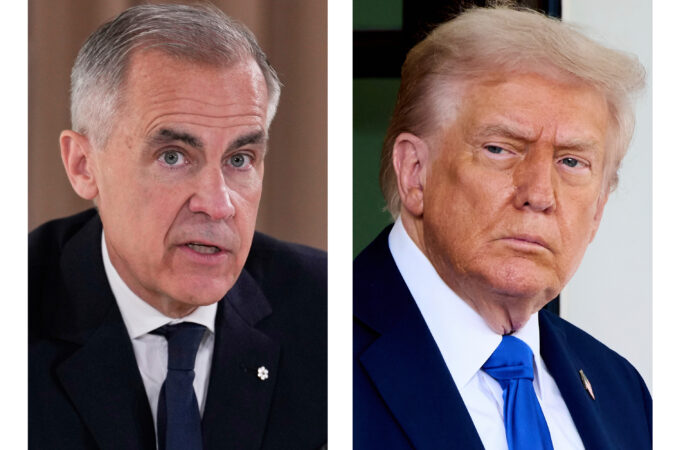
TORONTO — Canadian Prime Minister Mark Carney said Sunday his country has no intention of pursuing a free trade deal with China. He was responding to U.S. President Donald Trump’s threat to impose a 100% tariff on goods imported from Canada if America’s northern neighbor went ahead with a trade deal with Beijing.
Carney said his recent agreement with China merely cuts tariffs on a few sectors that were recently hit with the taxes.
Trump claims otherwise, posting, “China is successfully and completely taking over the once Great Country of Canada. So sad to see it happen. I only hope they leave Ice Hockey alone! President DJT”
The prime minister said under the free trade agreement with the U.S. and Mexico there are commitments not to pursue free trade agreements with nonmarket economies without prior notification.
“We have no intention of doing that with China or any other nonmarket economy,” Carney said. “What we have done with China is to rectify some issues that developed in the last couple of years.”
In 2024, Canada mirrored the United States by putting a 100% tariff on electric vehicles from Beijing and a 25% tariff on steel and aluminum. China had responded by imposing 100% import taxes on Canadian canola oil and meal and 25% on pork and seafood.
Breaking with the United States this month during a visit to China, Carney cut its 100% tariff on Chinese electric cars in return for lower tariffs on those Canadian products.
Carney has said there would be an initial annual cap of 49,000 vehicles on Chinese EV exports coming into Canada at a tariff rate of 6.1%, growing to about 70,000 over five years. He noted there was no cap before 2024. He also has said the initial cap on Chinese EV imports was about 3% of the 1.8 million vehicles sold in Canada annually and that, in exchange, China is expected to begin investing in the Canadian auto industry within three years.
Trump posted a video Sunday in which the chief executive of the Canadian Vehicle Manufacturers’ Association warns there will be no Canadian auto industry without U.S. access, while noting the Canadian market alone is too small to justify large scale manufacturing from China.
“A MUST WATCH. Canada is systematically destroying itself. The China deal is a disaster for them. Will go down as one of the worst deals, of any kind, in history. All their businesses are moving to the USA. I want to see Canada SURVIVE AND THRIVE! President DJT,” Trump posted on social media.
Trump’s post on Saturday said that if Carney “thinks he is going to make Canada a ‘Drop Off Port’ for China to send goods and products into the United States, he is sorely mistaken.”
“We can’t let Canada become an opening that the Chinese pour their cheap goods into the U.S,” U.S. Treasury Secretary Scott Bessent said on ABC’s This Week.
“We have a (United States–Mexico–Canada Agreement), but based off — based on that, which is going to be renegotiated this summer, and I’m not sure what Prime Minister Carney is doing here, other than trying to virtue-signal to his globalist friends at Davos.”
Carney has emerged as a leader of a movement for countries to find ways to link up and counter the U.S. under Trump. Speaking in Davos before Trump, Carney said, “Middle powers must act together because if you are not at the table, you are on the menu” and he warned about coercion by great powers — without mentioning Trump’s name. The prime minister received widespread praise and attention for his remarks, upstaging Trump at the World Economic Forum.
Trump’s push to acquire Greenland has come after he has repeatedly needled Canada over its sovereignty and suggested it also be absorbed into the United States as a 51st state. He posted an altered image on social media this week showing a map of the United States that included Canada, Venezuela, Greenland and Cuba as part of its territory.
MINNEAPOLIS — Alex Pretti, the man fatally shot by Border Patrol on Saturday, was a local intensive care nurse dedicated to caring for veterans, according to his family, friends, and co-workers.
“Alex was a kindhearted soul who cared deeply for his family and friends and also the American veterans whom he cared for as an ICU nurse at the Minneapolis VA hospital,” Pretti’s family said in a statement shared with the Washington Post. “Alex wanted to make a difference in this world.”
Pretti, 37, is the third person shot by federal immigration officials in recent weeks.
He was shot outside a popular doughnut shop about a mile and a half from his home by U.S. Border Patrol, according to law enforcement officials. The shooting followed a scuffle between Pretti and Border Patrol agents, andPretti was in possession of a 9mm handgun,according to the Department of Homeland Security.
Authorities believe Pretti was “a lawful gun owner with a permit to carry,” Minneapolis Police Chief Brian O’Hara said during a news conference.
Trump officials, including Secretary of Homeland Security Kristi L. Noem, called Pretti a “domestic terrorist.”
Pretti “came with weapons and ammunition to stop a law enforcement operation of federal law enforcement officers,” Noem said.
In the statement, Pretti’s family called the administration’s description of the shooting “sickening lies” and “reprehensible and disgusting.” The family said Pretti was trying to protect a woman who had been pushed down by immigration agents.
“Alex is clearly not holding a gun when attacked by [President Donald] Trump’s murdering and cowardly ICE thugs,” the statement said. “Please get the truth out about our son. He was a good man.”
The shooting sparked protests and clashes between demonstrators and authorities near the scene, which state investigators said they were barred from accessing Saturday by federal officials.
Pretti had another physical encounter with immigration officers recently, according to a colleague, Joshua Green, who recalled him coming to work with a bandage on his eye. Pretti said he got a small cut after being struck by an immigration agent, Green recalled.
Pretti cared about human rights, Green said, and mentioned protesting in the wake of the shooting of Renée Good, who was killed by an ICE officer in Minneapolis earlier this month.
Green said Pretti was not easily provoked or angry. “He was a very calm, collected person and always had a good demeanor,” he said. “He always had a smile. This is quite the shock.”
Aasma Shaukat said she hired Pretti for a research position at the Minneapolis VA Health Care System about a decade ago. “Alex was the sweetest, kindest, gentlest soul you ever met,” said Shaukat, now a physician and clinical researcher at the Manhattan VA Medical Center.
“He was very bright-eyed, bushy-tailed. He wanted to get into the healthcare field, work with patients and be a nurse,” she recalled. “He did wonderful. Did his work really well, was a team player.”
After finishing nursing school, Pretti returned to the Minneapolis VA as an intensive care nurse, she said.
“He wanted to serve the veterans, just had a high sense of duty and thought they were a vulnerable group in the country who needed our help,” she said.
Dimitri Drekonja, an infectious diseases physician at the Minneapolis VA Health Care System, said he was impressed when Pretti secured a job in the ICU fresh out of nursing school. “It is a testament to his abilities that he felt ready for it, that he was up for that challenge and wanted to help,” said Drekonja, who worked with Pretti.
Pretti always greeted him by name, Drekonja recalled, and stood out from other nurses for his distinctive beard. They both loved mountain biking and often rode the same trails, he said.
They never spoke about immigration operations or politics at work, Drekonja said.
“He was really someone that helped,” Drekonja said. “It’s just impossible to imagine a negative interaction with him. And the fact that he was killed on city streets — as an employee of the U.S. government, by the U.S. government — it’s blowing my mind.”
Pretti was a member of a local nurses’ union, and its sister union, AFGE Council 238, issued a statement that called his shooting “appalling.”
“The murder of our union brother Alex Pretti is an unconscionable act of violence and a betrayal of the values federal workers are sworn to uphold,” AFGE Council 238 President Justin Chen said in a statement.
Pretti was excited about his future, said Shaukat. “Being an ICU nurse is tough — it’s pretty intense. But he was looking forward to getting a place, a car,” Shaukat said.
The shooting “feels so wrong,” she said. “Knowing Alex, he was probably trying to protect or help or shield somebody from the agents. He had not a single mean bone in his body; always spoke about doing the right thing.”
His father, Michael Pretti, told the Associated Press that he had warned his son to be careful. “We had this discussion with him two weeks ago or so, you know, that go ahead and protest, but do not engage, do not do anything stupid, basically,” Michael Pretti said. “And he said he knows that. He knew that.”
Pretti attended the University of Minnesota’s College of Liberal Arts and graduated in 2011, a university spokesperson said.
Pretti lived in a quiet, tree-lined South Minneapolis neighborhood of single family homes and small apartment buildings, where neighbors gather in the street on lawn chairs with food during the warmer months.
Chris Gray, 41, a special education math teacher, lives in an apartment building near Pretti’s. Gray — who has been patrolling the streets as one of many local volunteers monitoring the federal immigration crackdown — said that while he did not know Pretti well, the shooting felt personal.
“It feels like [these killings] are just what happens now,” Gray said. “That could have been me or anyone. I’ve rarely felt that way, until today.”
A massive winter storm dumped sleet, freezing rain, and snow across much of the U.S. on Sunday, bringing subzero temperatures and paralyzing air and road traffic. Power lines were draped in ice, and hundreds of thousands of people in the Southeast were left without electricity.
The ice and snowfall were expected to continue into Monday in much of the country, followed by very low temperatures, which could cause “dangerous travel and infrastructure impacts” to linger for several days, the National Weather Service said.
Heavy snow was forecast from the Ohio Valley to the Northeast, while “catastrophic ice accumulation” threatened from the Lower Mississippi Valley to the Mid-Atlantic and Southeast.
“It is a unique storm in the sense that it is so widespread,” weather service meteorologist Allison Santorelli said in a phone interview. “It was affecting areas all the way from New Mexico, Texas, all the way into New England, so we’re talking like a 2,000-mile spread.”
President Donald Trump had approved emergency declarations for at least a dozen states by Saturday, with more expected to come. The Federal Emergency Management Agency prepositioned commodities, staff, and search and rescue teams in numerous states, Homeland Security Secretary Kristi Noem said.
New York Gov. Kathy Hochul said the state was bracing for the longest cold stretch and highest snow totals it has seen in years. Communities near the Canadian border have already seen record-breaking subzero temperatures, with Watertown registering minus 34 degrees Fahrenheit and Copenhagen minus 49 F, she said.
“An Arctic siege has taken over our state,” Hochul said. “It is brutal, it is bone chilling, and it is dangerous.”
Storm knocks out power and snarls flights
As of Sunday morning, about 213 million people were under some sort of winter weather warning, Santorelli said. The number of customers without power topped 900,000, according to poweroutage.us, and the number was rising.
Tennessee was hardest hit with nearly 325,000 customers out, and Texas, Louisiana, and Mississippi all had more than 100,000 customers in the dark. Tens of thousands of homes and businesses were without power in Kentucky, Georgia, Alabama, and West Virginia.
Some 11,000 flights had already been canceled Sunday and more than 13,000 have been delayed, according to the flight tracker flightaware.com. Airports in Philadelphia, Washington, Baltimore, North Carolina, New York, and New Jersey were hit especially hard.
At Philadelphia International Airport, inside displays registered scores of canceled flights and few vehicles could be seen arriving Sunday morning. At Reagan National in Washington, virtually all flights were canceled.
Bitter cold makes things worse
Even once the ice and snow stop falling, the danger will continue, Santorelli warned.
“Behind the storm it’s just going to get bitterly cold across basically the entirety of the eastern two-thirds of the nation, east of the Rockies,” she said. That means the ice and snow won’t melt as fast, which could hinder some efforts to restore power and other infrastructure.
Along the Gulf Coast, temperatures were balmy Sunday, hitting the high 60s and low 70s, but thermometers were expected to drop into the high 20s and low 30s there by Monday morning. The National Weather Service warned of damaging winds and a slight risk of severe storms and possibly even a brief tornado.
In New York City, Mayor Zohran Mamdani said at least five people died as temperatures plunged Saturday before the snows arrived in earnest.
“While it’s still too early to determine the causes of death, it is a reminder that every year New Yorkers succumb to the cold,” he wrote on X.
The Democrat also announced that Monday would be a remote learning day for students in the nation’s largest school system. Other officials across the affected areas also announced that school would be canceled or held remotely Monday.
Coping with the storm
In Corinth, Miss., where power outages were widespread, Caterpillar told employees at its remanufacturing site to stay home Monday and Tuesday.
“May God have mercy on Corinth, MS! … The sound of the trees snapping, exploding & falling through the night have been unnerving to say the least,” resident Kathy Ragan said on Facebook.
University of Georgia sophomore Eden England said there was a thin layer of ice on the ground of the campus in Athens and a mist fell as she walked with friends from the campus dining hall to her residence hall.
“It is definitely a little deserted but plenty of people chose to stay on campus,” England said.
Recovery could take a while
Nashville and the surrounding area saw ice accumulations of half an inch or more, with icicles hanging from power lines and overburdened tree limbs crashing to the ground.
In Oxford, Miss., police on Sunday morning used social media to tell residents to stay home as the danger of being outside was too great. Local utility crews were also pulled from their jobs during the overnight hours.
“Due to life-threatening conditions, Oxford Utilities has made the difficult decision to pull our crews off the road for the night,” the utility company posted on Facebook early Sunday. “Trees are actively snapping and falling around our linemen while they are in the bucket trucks.”
Tippah Electric Power in Mississippi said there was “catastrophic damage” and that it could be “weeks instead of days” to restore everyone.
The Tennessee Valley Authority provides power to some utilities across the region, and spokesperson Scott Brooks said the bulk power system remains stable but overnight icing had caused power interruptions in north Mississippi, north Alabama, southern middle Tennessee, and the Knoxville, Tenn., area.
Icy roads made travel dangerous in north Georgia, where the Cherokee County Sheriff’s office posted on Facebook, “You know it’s bad when Waffle House is closed!!!” along with a photo of a shuttered restaurant. Whether the chain’s restaurants are open — known as the Waffle House Index — has become an informal way to gauge the severity of weather disasters across the South.
Senate Democrats plan to block a sweeping government funding package after U.S. Border Patrol agents killed a man in Minneapolis on Saturday — increasing the likelihood of another shutdown at the end of the week.
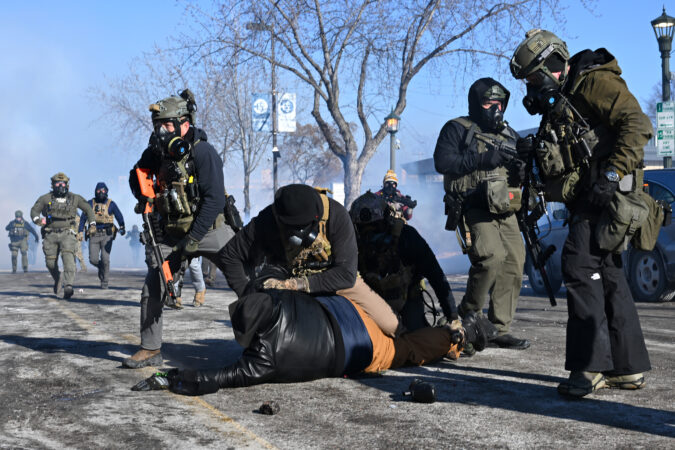
Federal law enforcement agents shot and killed a 37-year-old intensive care nurse, Alex Pretti, in Minneapolis on Saturday morning during an immigration enforcement surge in Minnesota. Federal officials alleged that Pretti approached officers with a handgun and resisted attempts to disarm him. Videos of the incident show federal agents swarming Pretti, wrestling him to the ground, and shooting him after he attempted to get up.
The shooting prompted protests and clashes between demonstrators and federal agents and drew furious recrimination from Democratic lawmakers who are expected to vote on bipartisan legislation this week that would fund most of the federal government. It is the third shooting by federal agents in Minneapolis this month: Officers also shot and killed Renée Good in her car and shot Julio Cesar Sosa-Celis in the leg as he attempted to evade arrest, according to federal officials.
Democrats said they could not vote for legislation to continue U.S. Immigration and Customs Enforcement’s funding without changes to how the agency operates.
“What’s happening in Minnesota is appalling — and unacceptable in any American city. Democrats sought common sense reforms in the Department of Homeland Security spending bill, but because of Republicans’ refusal to stand up to President Trump, the [Department of Homeland Security] bill is woefully inadequate to rein in the abuses of [Immigration and Customs Enforcement.] I will vote no,” Senate Minority Leader Charles E. Schumer (D., N.Y.) said in a statement. “Senate Democrats will not provide the votes to proceed to the appropriations bill if the DHS funding bill is included.”
The legislation set to come to the Senate floor this week includes six government funding bills spanning multiple agencies — including large agencies like the Departments of Defense and Health and Human Services — and makes up the majority of discretionary spending. It would appropriate $64.4 billion for Homeland Security, including $10 billion for ICE.
Existing government funding runs out at the end of the day on Friday, and most of the government would shut down if a funding bill is not approved in time. At least seven Senate Democrats would need to vote for the legislation for it to pass in the upper chamber, where 60 votes are needed to overcome the filibuster.
Lawmakers could try to split the Homeland Security bill from the legislation to fund the rest of the government, which has stronger bipartisan support. A spokesperson for Senate Appropriations Chair Susan Collins (R., Maine) said she is “exploring all options” to pass the remaining government funding bills in time.
ICE’s immigration enforcement raids in Minneapolis and other cities across the country have enraged Democrats in Congress and brought increased pressure from their voters to block funding for Homeland Security, even though most lawmakers have little appetite for another shutdown. The whole government closed in October for the longest period in U.S. history, as Congress deadlocked over demands from Democrats to extend enhanced healthcare subsidies that expired at the end of the year.
President Donald Trump and Homeland Security Secretary Kristi L. Noem have ramped up ICE operations across the country, arguing it is necessary to deport undocumented immigrants with criminal records. Agents have been recorded aggressively detaining individuals, including many U.S. citizens or undocumented immigrants without violent criminal records.
Some Democrats were already urging their colleagues not to vote for the funding package even before the Saturday shooting in Minneapolis. The House passed the Homeland Security funding measure last week, largely on party lines.
“I don’t think we will look sincere in our moral outrage about what’s happening in DHS if we vote to fund a budget that puts no constraints on their illegal, inhumane operations,” Sen. Chris Murphy (Conn.), the top Democrat on the Homeland Security appropriations subcommittee, said Thursday in an interview.
Sen. Tim Kaine (Va.), one of a handful of Senate Democrats who voted to end last year’s shutdown in November, said Friday that he would not vote for the Homeland Security bill “without significant amendment” due to concerns over ICE.
By Saturday, it was clear that Democrats wouldn’t support the Homeland Security funding unless it included additional accountability measures for ICE.
The top Democrat on the Senate Appropriations Committee, Sen. Patty Murray (Wash.), wrote on X on Saturday that she would no longer support the Homeland Security bill. Last week, she had advocated for the legislation, arguing that a funding extension or a shutdown would give the Trump administration more leeway over spending decisions at the agency.
“Federal agents cannot murder people in broad daylight and face zero consequences,” she wrote Saturday. “The DHS bill needs to be split off from the larger funding package before the Senate — Republicans must work with us to do that. I will continue fighting to rein in DHS and ICE.”
Another Democratic senator who voted to reopen the government last year, Catherine Cortez Masto (Nev.), said in a statement Saturday that the Trump administration is “putting undertrained, combative federal agents on the streets with no accountability” and “oppressing Americans.”
Some Republicans, too, raised concerns with ICE’s actions in Minnesota.
“The events in Minneapolis are incredibly disturbing,” Sen. Bill Cassidy (R., La.) said on X. “The credibility of ICE and DHS are at stake. There must be a full joint federal and state investigation. We can trust the American people with the truth.”
But others defended the federal operation. Sen. Bill Hagerty (R., Tenn.) argued that Schumer wants to shut down the government “because he puts illegal immigrants above law enforcement.”
“Instead of bowing to his socialist flank, what Schumer should be doing is telling [Gov. Tim Walz] to stop encouraging violence and let law enforcement do its job,” Hagerty wrote on X. “He must turn the rhetoric down and all the chaos is on his hands.”
MINNEAPOLIS — In dueling news conferences, federal and state officials offered starkly different messages Sunday about the immigration crackdown that has swept across Minneapolis and surrounding cities, with both claiming the moral high ground in the wake of another shooting death by federal agents.
“Which side do you want to be on?” Gov. Tim Walz asked the public. “The side of an all-powerful federal government that could kill, injure, menace, and kidnap its citizens off the streets, or on the side of a nurse at the VA hospital who died bearing witness to such government,” a reference to the shooting of Alex Pretti on Saturday in Minneapolis.
At the same time, in a federal office building about 20 miles away, Border Patrol Commander Gregory Bovino, the public face of the crackdown, again turned blame for the shooting to Pretti.
“When someone makes the choice to come into an active law enforcement scene, interfere, obstruct, delay, or assault law enforcement officer and — and they bring a weapon to do that. That is a choice that that individual made,” he told reporters.
The competing comments emerged as local leaders and Democrats across the country demanded federal immigration officers leave Minnesota after Pretti’s shooting, which set off clashes with protesters in a city already shaken by another shooting death weeks earlier.
Video contradicts administration statements
Video shot by bystanders and reviewed by the Associated Press appears to contradict statements by President Donald Trump’s administration, which said agents fired “defensively” against Pretti, a 37-year-old intensive care nurse, as he approached them.
Pretti can be seen with only a phone in his hand as he steps between an immigration agent and a woman on the street. No footage appears to show him with a weapon. During the scuffle, agents appear to disarm him after discovering that he was carrying a 9 mm semiautomatic handgun, and then the agents opened fire several times. Pretti was licensed to carry a concealed weapon.
In the hours after the shooting, Homeland Security Secretary Kristi Noem said Pretti attacked officers, and Bovino said he wanted to “massacre law enforcement.”
Bovino was more restrained Sunday, saying he would not speculate about the shooting and that he planned to wait for the investigation.
Relatives say they are heartbroken
Pretti’s family said they were “heartbroken but also very angry” at authorities. Relatives were furious at federal officials’ description of the shooting.
“The sickening lies told about our son by the administration are reprehensible and disgusting. Alex is clearly not holding a gun when attacked by Trump’s murdering and cowardly ICE thugs. He has his phone in his right hand, and his empty left hand is raised above his head while trying to protect the woman ICE just pushed down all while being pepper sprayed,” the family statement said. “Please get the truth out about our son.”
Pretti was shot just over a mile from where an ICE officer killed 37-year-old Renee Good on Jan. 7, sparking widespread protests.
A federal judge has already issued an order blocking the Trump administration from “destroying or altering evidence” related to the shooting, after state and county officials sued.
Minnesota Attorney General Keith Ellison said the lawsuit filed Saturday is meant to preserve evidence collected by federal officials that state authorities have not yet been able to inspect. A court hearing is scheduled for Monday in federal court in St. Paul.
“A full, impartial, and transparent investigation into his fatal shooting at the hands of DHS agents is nonnegotiable,” Ellison said in a statement.
Drew Evans, superintendent of the state’s Bureau of Criminal Apprehension, which investigates police shootings, told reporters Saturday that federal officers blocked his agency from the scene of the shooting even after it obtained a signed judicial warrant. On Sunday morning, bureau officers were working at the scene.
Assistant Homeland Security Secretary Tricia McLaughlin dismissed the lawsuit, saying claims that the federal government would destroy evidence are “a ridiculous attempt to divide the American people and distract from the fact that our law enforcement officers were attacked — and their lives were threatened.”
The Minnesota National Guard temporarily assisted local police at Walz’s direction, officials said, with troops sent to the shooting site and a federal building where officers have squared off daily with demonstrators.
But Minneapolis Police Chief Brian O’Hara said Sunday morning on CBS’ Face the Nation that “it’s back to just the Minneapolis police responding to calls.”
No evidence that Pretti brandished gun
O’Hara said he had seen no evidence that Pretti brandished the pistol, and that the crackdown was exhausting his department.
“This is taking an enormous toll, trying to manage all this chaos on top of having to be the police department for a major city. It’s too much,” he said.
Rep. Alexandria Ocasio-Cortez of New York was among several Democratic lawmakers demanding that federal immigration authorities leave Minnesota.
In a statement, former President Barack Obama called Pretti’s death a “heartbreaking tragedy” and warned that “many of our core values as a nation are increasingly under assault.”
He urged the White House to work with city and state officials.
“This has to stop,” Obama said.
Federal officials have repeatedly questioned why Pretti was armed during the confrontation. But gun rights groups noted that it’s legal to carry firearms during protests.
“Every peaceable Minnesotan has the right to keep and bear arms — including while attending protests, acting as observers, or exercising their First Amendment rights,” the Minnesota Gun Owners Caucus said in a statement. “These rights do not disappear when someone is lawfully armed.”
Minnesota businesses issue letter urging cooperation
“With yesterday’s tragic news, we are calling for an immediate deescalation of tensions and for state, local and federal officials to work together to find real solutions,” the open letter reads.
CEOs that signed the letter included 3M CEO William Brown, Best Buy CEO Corie Barry, General Mills CEO Jeff Harmening, Target incoming CEO Michael Fiddelke, UnitedHealth Group CEO Stephen Helmsley, and others.
Before the letter, most of the biggest Minnesota-based companies had not issued any public statements about the enforcement surge and unrest.
But the issue has become more difficult to avoid. Over the past two weeks protesters have targeted some businesses they see not taking a strong enough stand against federal law enforcement activity, including Minneapolis-based Target. Earlier in January a Minnesota hotel that wouldn’t allow federal immigration agents to stay there apologized and said the refusal violated its own policies after a furor online.
“In this difficult moment for our community, we call for peace and focused cooperation among local, state and federal leaders to achieve a swift and durable solution that enables families, businesses, our employees, and communities across Minnesota to resume our work to build a bright and prosperous future,” the letter reads.
WATER VALLEY, Miss. — A crowd turned out to hear a politician talk big about improving schools, but it wasn’t a Republican railing about transgender athletes or school vouchers or any of the issues the GOP has used to put Democrats into a defensive crouch.
On this night, the politician taking questions was a Democrat — former Chicago mayor and President Barack Obama’s chief of staff Rahm Emanuel — talking about reading. For the past several years, Republicans have dominated the education debate with a focus on culture war politics. Emanuel, who is exploring a 2028 presidential run, makes the case for returning to the education part of education: achievement and learning rather than book bans and gender identity.
That would benefit students and, he says, Democrats, who have not led a national conversation about student achievement since Obama was president. Instead, Republicans have been able to make up ground, capitalizing on anger about school closures during the pandemic and heated fights over transgender rights, race and other subjects.
Emanuel talks about school achievement with a frequency and urgency rarely heard from Democrats in recent years. And he says both parties have wasted time on education culture wars.
“This distracts us from the priorities of education,” he said in an interview. Questions around gender identity, he said, affect “less than 1 percent of the population and yet dominate 99 percent of the conversation. … You want to pick a pronoun? Great. Now can we focus on the other 35 kids that don’t know what a goddamn pronoun is?”
While a dozen or more Democratic presidential hopefuls scramble to carve out their identities in advance of the 2028 election, many of them better known than he is, Emanuel is betting that a renewed focus on education can fuel a Democratic victory — and more immediately, his own prospects.
As Chicago mayor, Emanuel successfully pushed several school reforms, including a longer school day, and saw graduation rates jump. But he had a contentious relationship with the teachers union and his tenure was marred by a seven-day strike. He also angered many Chicagoans by closing 50 schools. He says he has learned from his mistakes and hopes to take some of his successes national.
Emanuel traveled to Mississippi this month to examine and promote the state’s success in teaching reading. On fourth-grade tests, the state moved from 49th in the nation in 2013 to ninth in 2024 by focusing on what’s called the science of reading — instruction built on sound-it-out phonics. The state combined that withincreased funding, a heavy dose of teacher training and support, and a requirement that third graders pass a reading test to advance to fourth grade.
Emanuel argues that Washington should use federal dollars to incentivize other states to do the same. And he is proposing renewed federal standards and accountability, ideas that faded a decade ago.
At the town hall meeting in Water Valley, a tiny town in the north of the state, more than 125 people gathered. There were no questions about race, gender or culture wars, giving Emanuel space to drive home his central thesis.
“We’ve got a 30-year low in reading scores,” he said. “Has a single governor called for an emergency meeting of the governors association?”
Left unsaid was that he might run against some of those governors in a 2028 Democratic primary.
Emanuel brought a film crew with him, and within a day of leaving the state, he had posted video from the visit to his social media accounts.
Rahm Emanuel in 2023, when he served as U.S. ambassador to Japan.
An education evolution
Emanuel likes to hark back to anera when education reform was in vogue. A national movement centered on standards and accountability began in the states and culminated with the bipartisan passage of the No Child Left Behind Act in 2001. Schools were required to make progress on annual tests or face escalating consequences.
Eight years later, Obama continued pressing for accountability with the Race to the Top competition that awarded states with extra federal money for adopting favored policies such as Common Core standards and using student scores to measure teacher quality.
But by the end of Obama’s tenure, opposition had built to the high-stakes testing that the accountability system was built on. The Race to the Top program ended, and most of the requirements under the 2001 law were reversed. The bipartisan consensus collapsed, and soon the political parties gravitated to their partisan corners.
Democrats backed increased funding for public schools and racial equity initiatives. They adopted policies in support of transgender students. Today, most Democratic governors continue to focus on new funding — for prekindergarten, community schools, teacher pay, free meals, and other priorities.
Republicans promoted tax dollars for private school vouchers. During the pandemic, they blamed Democrats for keeping schools closed too long and for requiring measures like masks once school buildings reopened. Conservative parent groups that formed around pandemic issues soon used that momentum to build support for book bans and influence how educators address race and LGBTQ+ issues. GOP legislatures and conservative school boards passed laws and policies restricting how those topics could be dealt with in school.
Republicans began eating into Democrats’ commanding lead on education issues. In 2006, a Fox News poll found Democrats with a 17-percentage-point lead when asked whom they trust on education issues, though their advantage was not that big in other surveys. By 2022,Republicans had narrowed the gap significantly – som— polls found the parties virtually tied. (Several newerpolls have found that Democrats regained their advantage following President Donald Trump’s election.)
In the wake of the pandemic, scores on national math and reading exams slid to a 30-year low.
The Trump administration repeatedly cites this data in making the case for closing the Education Department and for backing school choice policies. Now, some Democrats are arguing that their party needs its own response to the slide.
“It is deeply frustrating to me as a Democrat that we completely ceded this issue,” said Lanae Erickson, senior vice president for social policy, education, and politics at Third Way, a centrist Democratic think tank. “We have absolutely no ideas on the table.”
In the 2024 presidential election, President Joe Biden and Vice President Kamala Harris, who took his place on the ticket, put forward only vague education goals. One day before the election, the Center for American Progress, a leading Democratic think tank, published a set of education recommendations. Even then, there was not muchabout student achievement.
Jared Bass, senior vice president for education at CAP, said the group is now working on a new set of proposals that will squarely address academics.
“There’s a real sense of humility within the party. We used to be the party that was trusted on education,” he said. “We need to get it right.”
Even with a hunger for action among Democrats, Emanuel’s ideas are likely to face pushback inside his party and beyond. Many progressives argue that racial inequity and racism are to blame for the low achievement rates of many students of color, and they may resist leaders who want to pivot away from those topics. Teachers unions, who are active in the Democratic Party, strongly oppose the accountability systems that rely on standardized testing that Emanuel hopes to bring back.
Randi Weingarten, president of the American Federation of Teachers and a longtime power in the Democratic Party, said she would oppose a return to accountability systems that too often, in her view, devolved into blaming teachers. Still, she agrees that Democrats need a new vision.
“Democrats are all too reactive and as a result they have lost ground on education,” she said. “It’s very frustrating.”
A new Race to the Top
Emanuel is betting that while other Democratic presidential candidates concentrate on standing up to Trump, voters will want a candidate more focused on their daily concerns.
On his trip to Mississippi, Emanuel toured an elementary school in Hattiesburg, crouching beside children’s desks to peek at their work and hearing from the principal about what has succeeded. And he met with Jim Barksdale, whose $100 million donation beginning 25 years ago set Mississippi on its path to a new reading program.
“When do we get to geek out?” he asked Barksdale as they took seats in his living room with a trio of people involved in education in Mississippi. He turned to the group and asked, simply, “How did you do it?”
After a long conversation about the reading program, Barksdale told Emanuel that a lot of people say they want to learn from Mississippi’s success. “They say, ‘I’m all for it. How’d you do this?’” he said. “And then they don’t do it because it costs money.”
“It also costs guts,” Emanuel replied.
Emanuel, long known as a partisan brawler, says he is ready to fight for this.
In an interview, Emanuel sketched the outlines of the federal program he would like to see. He suggested a new version of Obama’s Race to the Top that would incentivize states to adopt science of reading curriculums — what Mississippi uses — and other policy changes.
The program, he said, also could encourage high schools to offer more college courses, and he favors a policy he advanced in Chicago requiring all seniors to have a plan for college, trade school or the military to graduate from high school. He also wants to incentivize states to replicate Chicago’s promise of free community college for students who graduate from high school with a B average.
States would have to adopt these types of changes to get the new federal money, he said. He contrasted that approach with the unprecedented $130 billion in COVID funding that went to K-12 schools under the Biden administration, which Emanuel slammed as having too few requirements. For instance, the program was sold as a way to reopen schools, but districts were not required to reopen.
He argues that the No Child Left Behind system was too test-driven, but that the country “overcorrected.” The right answer, he said, lies somewhere in between.
As for the culture wars, he is trying to stay far away. He dismisses some of the racial equity efforts that swept through schools, mocking San Francisco’s effort to rename schools, including one named for Abraham Lincoln.
He also opposes allowing trans athletes to compete in girls’ and women’s sports, saying it’s not fair to other competitors. But he said he does not know whether he would, if elected president, pull federal funding from schools that resist, as Trump has done, and he said he is not interested in discussing the finer points of these policies. The entire debate, he said, has been a “dead-bang loser” — both politically and for the young people involved.
As Democrats begin to rethink their positions on education, they will need to weigh whether Emanuel’s prescriptions are the right ones and also whether he is the right messenger for them. For now, though, Emanuel is one of the fewpeople making this case.
At the town hall meeting, a questioner asked what he had done right and wrong as mayor, and Emanuel replied that he mishandled his relationship with the teachers union at first, specifically by unilaterally canceling a scheduled pay raise.
“It created a lot of animosity,” he said, describing his first term as “hand-to-hand combat.” He said he should have tried to work with the union president to find a solution together.
“You can’t drive reform if people don’t feel part of it,” he said. “That’s like 101, and I screwed it up — Mr. Smarty Pants over here. And I learned a lot.”