Category: Wires

  • Inside the toxic legacy of America’s multibillion-dollar carpet empire

    Inside the toxic legacy of America’s multibillion-dollar carpet empire

    DALTON, Ga. — Bob Shaw glared at the executives from the chemical giant 3M across the table from him. He held up a carpet sample and pointed at the logo for Scotchgard on the back.

    “That’s not a logo,” fumed Shaw, CEO of the world’s largest carpet company, one attendee later recalled. “That’s a target.”

    Weeks earlier, 3M Company announced it would reformulate its signature stain-resistance brand under pressure from the Environmental Protection Agency because of human health and environmental concerns.

    Mills like Shaw’s had been using Scotchgard in carpet production, releasing its chemical ingredients into the environment for decades. And on a massive scale: The shrewd CEO built Shaw Industries from a family firm in Dalton, Georgia, into a globally dominant carpet maker worth billions.

    “I got 15 million of these out in the marketplace,” Shaw told his 3M visitors. “What am I supposed to do about that?”

    A 3M executive replied that he didn’t know. Shaw threw the sample at him and left the room.

    The answer to Shaw’s Scotchgard question from that moment in 2000 would be the same as that of the broader industry. Carpet makers kept using closely related chemical alternatives for years, even after scientific studies and regulators warned of their accumulation in human blood and possible health effects. Customers expected stain resistance; nothing worked better than the family of chemicals known as PFAS.

    A lack of state and federal regulations allowed carpet companies and their suppliers to legally switch among different versions of these stain-and-soil resistant products. Meanwhile, the local public utility in Dalton responsible for ensuring safe drinking water coordinated with carpet executives in private meetings that would effectively shield their companies from oversight.

    Year after year, the chemicals traveled in water discarded during manufacturing from mills across northwest Georgia, eventually reaching a river system that provides drinking water to hundreds of thousands of people in Georgia and eastern Alabama.

    The pollution is so bad some researchers have identified the region as one of the nation’s PFAS hot spots. Today, the consequences can be found everywhere. PFAS, often called forever chemicals because they can take decades or more to break down, are in the water and the soil.

    They’re in the dust on floors where children crawl, the local fish and wildlife, and as ongoing research has shown, the people.

    Doctors have few answers for those like Dolly Baker who live downriver from Dalton’s carpet plants. She recently learned her blood has extraordinarily high PFAS levels.

    “I feel like, I don’t know, almost like there’s a blanket over me, smothering me that I can’t get out from under,” she said. “It’s just, you’re trapped.”

    An investigation by newsrooms including The Atlanta Journal-Constitution, The Associated Press and FRONTLINE (PBS) has revealed how the economic engine that sustained northwest Georgia contaminated the area and neighboring states, too. Downriver from Dalton, AL.com found cities in Alabama are struggling to remove PFAS from drinking water. And in South Carolina, The Post and Courier traced a local watchdog’s discovery of forever chemicals to a river by a Shaw factory.

    The full story of Georgia’s power structures prioritizing a prized industry over public health is only now emerging through dozens of interviews and thousands of pages of court records from lawsuits against the industry and its chemical suppliers. Those records, including testimony from key executives, emails and other internal documents, detail how carpet companies benefited from chemistry and regulatory inaction to keep using forever chemicals.

    All the while, the mills still hummed.

    Pointing fingers in a company town

    A sign welcomes Dalton’s visitors to the “Carpet Capital of the World.”

    Fleets of semitrucks stamped with company logos rumble out of behemoth warehouses. Textiles have employed generations here, propelling the city from 19th-century cotton mills into a manufacturing hub — and the region into a supplier of carpet to the globe.

    The durability that makes PFAS so good at protecting carpets from spilled tomato sauce and muddy boots lets them survive in the environment. It also makes them dangerous for humans. Because they bind to a protein in human blood and absorb into some organs, PFAS linger.

    The blood of nearly all Americans has some amount of the chemicals, which have been used in a variety of consumer products: nonstick cookware, waterproof sunscreen, dental floss, microwave popcorn bags.

    Few industries used them as much as carpet did in northwest Georgia. While huge amounts were needed for stain resistance on an industrial scale, minuscule amounts — the equivalent of less than a drop in an Olympic-sized swimming pool — can make drinking water a health risk. For certain PFAS, U.S. regulators now say no level is safe to drink.

    More than a year before the Scotchgard announcement in 2000, 3M informed Shaw Industries and its biggest competitor, Mohawk Industries Inc., that it was finding Scotchgard’s chemical in human blood and that it stayed in the environment, 3M records show.

    Carpet executives have long insisted they are not to blame. They point out that 3M and fellow chemical manufacturer DuPont assured them their products were safe, for decades hiding internal studies that were finding harm to the environment, animals and people.

    Shaw and Mohawk both said they relied on and complied with regulators and stopped using PFAS in U.S. carpet production in 2019.

    In an interview, a Shaw executive said the company acted in good faith as it worked hard to exit PFAS as quickly as suitable substitutes could be found.

    “Hindsight is 20/20,” said Kellie Ballew, Shaw’s vice president of environmental affairs. “I don’t think that we can call into question our intentions. I think Shaw had every good intention along the way.”

    Shaw in a follow-up statement said it complied with its wastewater permits and took guidance from chemical companies, some of which “instructed Shaw to put spills of product into the public sewer system.”

    Mohawk declined an interview request, instead referring to a 2024 filing in its lawsuit against chemical companies: “For decades, DuPont and 3M sold their carpet treatment products to Mohawk without disclosing the actual or potential presence of PFAS in their products.”

    Later, in response to detailed questions, Mohawk attorney Jason Rottner wrote that, “Any PFAS contamination issues in northwest Georgia are a problem of the chemical manufacturers’ making.”

    Now, uncertainty and feelings of betrayal are boiling across the region. Communities fear their drinking water is unsafe and local governments say the problem is too vast for them to fix alone.

    In Washington, Republicans and Democrats alike have been slow to act. Under President Joe Biden, the Environmental Protection Agency in 2024 established the first PFAS drinking water protections. The Trump administration has announced plans to roll back some and delay enforcement of others.

    The agency declined interview requests but in a statement said it is committed to combating PFAS contamination to protect human health and the environment, without causing undue burden to industry.

    Georgia’s regulatory system has done little to scrutinize PFAS and depends mostly on industry to self-report chemical spills, imposing modest penalties when companies do. The Georgia Environmental Protection Division, which declined an interview request, said it “relies on the expertise of” the EPA.

    Meanwhile, carpet makers still can’t seem to shake PFAS. Just last year, EPA concluded “PFAS have been and continue to be used” by the industry, based on wastewater testing. The agency did not name companies and said it’s unclear whether the chemicals were from current or prior use.

    The mess in northwest Georgia has led to a series of lawsuits over the past decade with hundreds of millions of dollars at stake.

    Buried in this avalanche of litigation, finger-pointing and politics are the people who live here. They have been forced to navigate a public health and economic crisis of a magnitude still not fully understood.

    “They ought to have to clean this land up,” Faye Jackson said, referring to carpet companies. A former industry worker, she raised her family in a house next to a polluted river and has elevated PFAS levels in her blood. “They ought to have to pay for it.”

    The creek ran blood red

    Lisa Martin watched the creek beside the Mohawk Industries mill run red with carpet dye.

    It was one of her first days as a planning manager at Mohawk in 2005, and she tried to hide her unease as the dye runoff turned the water into what looked like blood.

    The red she saw in Drowning Bear Creek had come from the nearby dyehouse, where carpets got their colors. There, machines whirred as workers sloshed around in rubber boots in ankle-deep dyewater, reminding Martin of fishermen. The acrid odor made her eyes tear up.

    A recent California transplant at the time, Martin recalled her initial culture shock.

    “At a gut level, you know it’s not right. And unfortunately, when you try to raise the flag and everybody’s like, ‘Well, that’s just the way it is,’” Martin said in an interview.

    “I became complacent.”

    Like Shaw, Mohawk is based in northwest Georgia and is among the largest carpet companies in the world. The industry supported the entire community, employing someone in what seems like every family. Martin realized carpet was in the region’s DNA.

    Martin said the chemical runoff was routine during her 20 years at Mohawk, which ended with her 2024 retirement. Sometimes, when the company dyed carpets blue, the water in the creek would be blue, too. One spill that turned the creek purple for a mile downstream killed thousands of fish, records show.

    Mohawk’s attorney called such spills “rare instances” that were promptly reported and said there is no evidence any spills directly discharged PFAS.

    In the dyehouse, what neither Martin nor the workers could detect were the colorless, odorless compounds also included in the wastewater: forever chemicals. Machines bathed the carpets in these soil-and-stain blockers, and what didn’t stick washed away.

    For decades, Mohawk’s and Shaw’s mills sent PFAS-polluted wastewater through sewer pipes to the local Dalton Utilities plants for treatment that did not remove the chemicals. Much of the tainted water ended up in the Conasauga River.

    Both Shaw and Mohawk said they operated in accordance with permits issued by Dalton Utilities. The utility said it takes direction from federal and state regulators, who have not prohibited PFAS in industrial wastewater.

    The Conasauga watershed is filled with lush green pastures, creeks and tributaries that help fuel the water-hungry industry. The river’s waters emerge out of Georgia’s Blue Ridge Mountains and eventually flow southwest, past Dalton, Calhoun and Rome, and then into Alabama.

    Residents downriver from the mills didn’t know about the chemicals running through their towns. But the industry’s top leaders did.

    PFAS is a catchall term for a group of thousands of related synthetic compounds also known as fluorochemicals. They have been fundamental to the carpet business since the 1970s, as market demand for stain resistance transformed the industry, and carpet makers began buying millions of pounds. In the mid-1980s, the introduction of DuPont’s Stainmaster, accompanied by a successful marketing blitz, further established these products as essential.

    Neither DuPont nor its related chemical companies that supplied PFAS provided comment for this story.

    The carpet industry used so much PFAS that Dalton’s mills became the largest combined emitters of the chemicals among 3M’s U.S. customers, according to a 1999 internal 3M study that looked at 38 industrial locations.

    Before 3M had pulled Scotchgard, leading to Bob Shaw’s showdown in the spring of 2000, both Shaw Industries and Mohawk had been privy to inside information that PFAS were accumulating in human blood. Bob Shaw did not respond to requests for comment.

    In late 1998 and early 1999, 3M held a series of meetings with carpet executives to disclose its blood-study research, according to 3M’s internal meeting notes from court records.

    “When we started finding the chemical in everybody’s blood, one of the biggest worries was Dalton, because we knew how sloppy they were,” Rich Purdy, a 3M toxicologist who alerted the EPA to his company’s hiding of PFAS’ dangers, said in an interview.

    Notes by a 3M employee from a January 1999 meeting said Mohawk executives did not express grave concerns about the revelations. “No real sense of Mohawk problem/responsibility,” 3M noted. “If it’s good enough for 3M, it’s good enough for Mohawk.” Mohawk’s attorney said of the meetings over two decades ago that 3M assured the company its chemicals were safe.

    At another meeting that January, Shaw executives were “concerned but quiet,” with one executive expressing he “felt plaintiffs’ attorneys would be involved immediately,” according to 3M’s notes. Shaw Industries maintains it learned of the concerns about Scotchgard at the same time everyone else did.

    In follow-up letters to top executives with Shaw and Mohawk later that month, 3M noted the company’s efforts were guided by the idea that reducing exposure “to a persistent chemical is the prudent and responsible thing to do” while emphasizing current evidence did not show human health effects.

    “We trust that you appreciate the delicate nature of this information and its potential for misuse,” the letters said. “We ask that you treat it accordingly.”

    3M then asked for access to Shaw and Mohawk mills to see if they were handling the chemicals safely, records show. Those internal reports, produced in 1999, would fault how carpet companies handled PFAS products, exposing workers and the environment, according to court records.

    The next year, 3M and EPA announced concerns about Scotchgard.

    The day of the announcement, the director of EPA’s Chemical Control Division sent an email to his colleagues and counterparts in other countries calling the key ingredient in Scotchgard an “unacceptable technology” and a “toxic chemical.” The email said the compound should be eliminated “to protect human health and the environment from potentially severe long-term consequences.”

    3M declined an interview request. In a statement, the company said it has stopped all PFAS manufacturing and has invested $1 billion in water treatment at its facilities. “3M has taken, and will continue to take, actions to address PFAS manufactured prior to the phase out,” the company said.

    In 2000, the year 3M announced it was pulling Scotchgard, Mohawk logged more than $3.4 billion in net sales. Shaw Industries reported $4.2 billion.

    EPA would not issue its first provisional health advisories for nearly another decade. Absent federal guidance, the carpet industry could legally continue to use these products.

    Despite accumulating health and environmental concerns, federal law at the time did not let EPA ban any chemical without “enormous evidence” of harm, said Betsy Southerland, a former director of the agency’s water protection division who spent over three decades there.

    “So we were really hamstrung at the time,” said Southerland, who has become a critic of EPA.

    At Mohawk, Lisa Martin was not an executive making decisions about PFAS, she said, but her time at the company weighs on her still.

    “Unfortunately, I later learned that there are more people that I worked with that were aware of it,” she said. “They were aware of it and didn’t do the things they should have done.”

    Years into her tenure, the athletic and inquisitive Martin began getting sick and feeling lethargic. Her doctor said she’d grown nodules on her thyroid, a gland that is a key part of the immune system and which studies have shown forever chemicals can harm.

    She had no family history of thyroid issues. It was a mystery to her.

    Cozy relationship

    Inside the Dalton headquarters of the Carpet and Rug Institute, industry executives and the local water utility conferred in 2004 about EPA’s growing scrutiny.

    For several months, EPA representatives had negotiated with Dalton Utilities and the carpet industry through the institute, its influential trade group, over gaining access to their facilities to test the water. Mohawk and Shaw were using DuPont’s Stainmaster and other products, which also contained forever chemicals akin to Scotchgard’s older formulation.

    Still, federal regulators worried these compounds were exhibiting similar harmful properties. Dalton Utilities and the carpet industry were uneasy about welcoming in government officials. Companies could not be guaranteed confidentiality and feared test results could lead to “inaccurate public perceptions and inappropriate media coverage,” records show.

    The public utility and the carpet industry chose to resist.

    Their close ties went back years. Carpet executives have long sat on Dalton Utilities’ board, appointed by the city’s mayor and city council. Fueled by the growth of the carpet industry, Dalton Utilities’ fortunes rose with the industry’s success.

    At the carpet institute’s 2004 annual meeting, officials with carpet and chemical companies convened to discuss the EPA’s increasingly aggressive posture. Shaw’s director of technical services, Carey Mitchell, addressed his colleagues. He was blunt. No company would allow testing.

    “Dalton Utilities has said not no, but hell no,” Mitchell said, according to notes made by a 3M attendee. Mitchell did not respond to requests for comment.

    In response to questions for this story, Dalton Utilities declined an interview request but said it and the carpet industry “have always operated independently of one another” and that the EPA testing request was informal.

    The carpet institute declined an interview request, sending a written statement instead.

    “The CRI’s conduct was and continues to be appropriate, lawful, and focused on our customers, communities, and the millions of people who rely on our products every day,” institute President Russ DeLozier said, adding: “Today’s carpet products reflect decades of progress, and The CRI members remain committed to moving forward responsibly.”

    The EPA stiff-arm was the latest run-in between Dalton Utilities and federal regulators.

    A public water utility’s obligation, above all else, is to ensure clean drinking water. Dalton’s utility had previously gone to criminal lengths to deceive regulators.

    In the early 1990s, Dalton Utilities’ staff traced a drop in oxygen levels in its wastewater treatment to stain-resistant chemicals from carpet mills, the utility’s top engineer at the time, Richard Belanger, said in an interview. While the utility didn’t know about PFAS then, something in these chemicals was impacting its ability to process the wastewater, he said. Rather than clamping down on industry, according to Belanger, his bosses ordered him to manipulate pollution figures the utility reported to government regulators.

    “I was told, OK, make this work,” Belanger, now retired, said.

    In June 1995, EPA investigators interviewed Belanger. He told them Dalton Utilities’ program to clean industrial pollutants was “a sham.” The treatment was so poor, the smell of carpet chemicals carried throughout the utility’s plant, and local creeks were often “purple and foamy,” according to investigators’ notes from the interview.

    Two months later, agents with the FBI and EPA raided Dalton Utilities’ offices.

    Federal prosecutors charged the utility with violating the Clean Water Act by falsifying wastewater reports, which concealed the full extent of the carpet industry’s pollution. The case did not address PFAS specifically, which was not yet a pollutant of concern for EPA. Dalton Utilities pleaded guilty in 1999 and was fined $1 million. Its CEO was removed.

    The utility was also put under federal monitoring in 2001 to ensure it was making key changes to protect the water supply and agreed to pay a $6 million penalty.

    The era of legal troubles with the federal government was pivotal, the utility said, adding it “has remained committed to avoiding the issues that led to those proceedings” and is transparent with regulators.

    Around the same time, emerging data showed the fluorochemicals used in carpets caused cancer in rats.

    The carpet institute’s then-president, Werner Braun, forwarded the rat study to several carpet and chemical executives in a 2002 email, calling the findings a “troubling issue,” records show. Braun, now in his 90s, was unable to comment for this story due to his health, his wife said.

    In preparing to respond to Braun, a 2002 email shows DuPont officials planned to explain that Stainmaster didn’t contain the type of PFAS that was then EPA’s focus. The next year, DuPont would tell carpet companies the opposite, acknowledging the chemical was indeed in Stainmaster. DuPont maintained in later legal proceedings it wasn’t aware until 2003 that Stainmaster contained the chemical.

    Despite its success in fending off EPA testing, the industry faced a mounting challenge, and the carpet institute focused on shoring up its influence and image.

    At a meeting in the spring of 2004 attended by top executives, the carpet institute decided to solicit donations from company employees for its political action committee “in an effort to submit friendships, gain access, and say thank you to legislators,” according to meeting notes.

    Later that year, PFAS made news in a high-profile legal case involving DuPont. The class-action lawsuit brought by residents in West Virginia claimed their water had been contaminated by a nearby chemical plant that used PFAS. Although DuPont said the settlement did not imply legal liability, it agreed to pay $70 million and to establish a health monitoring panel. Some two decades later, Braun was shown the rat study email during a legal deposition.

    “I wouldn’t necessarily call it a red flag but a flag, you know, that you might want to be aware of,” he said.

    Only years later did people downstream begin to learn the toll.

    The river brought the poison

    When Marie Jackson’s goats started dying about a year ago, nobody could explain why. Jackson saw it as just another sign something was wrong with her land.

    Marie and her mother, Faye Jackson, have lived on their 12 acres near Calhoun for decades. Today they keep mostly to themselves, inseparable, equal parts bickering and loving.

    Most days, Marie makes the short drive down a gravel road, Jackson Drive, to her mother’s house to check on her. She tends to Faye’s chickens, mows her grass and drives her to doctor’s appointments. Behind their homes is a rolling stretch of grassy pasture where their cattle graze — and the goats did as well, she said, until they all died.

    Past a curtain of trees on the far end of the pasture lies the Conasauga.

    Marie, 50, spent her childhood playing and swimming in the muddy river with rocks on the banks that made a good fishing spot. The Jacksons now know the water that sustains their homestead, about 15 miles downstream from Dalton, is contaminated.

    Tests of the river by the AJC found levels of what was once a key ingredient in Scotchgard at more than 30 times the proposed EPA limits for drinking water. Tests of Faye’s drinking water well by the AJC and the city of Calhoun found PFAS just under these federal health limits.

    Calhoun city officials used that health standard to guide a program designed to address contaminated wells. A 2024 legal settlement between the city and the Southern Environmental Law Center included a condition to test local water. As of August, 30% of private wells tested had levels above the health limit.

    Because Faye’s test was just below the cutoff, she does not qualify to receive a filtration system.

    Uncertainty about the chemicals continues to permeate every aspect of the Jacksons’ lives. They fear PFAS are behind their declining health. They fear their drinking water. They fear for the health of the cattle and chickens they raise; and for the health of those who may eat them.

    “I know they’ve got it in their systems,” Faye said.

    Even Marie’s memories are filled with second-guessing. Idyllic scenes of her childhood are now overshadowed by recollections of foam on the river and dead fish. She blames the mills.

    The Jacksons, like generations of northwest Georgians, relied on the carpet industry. Both of Marie’s parents worked in the mills: Faye with yarn machines and her dad in the dyehouse. Marie would end up working in carpet, too.

    Everyone suspected the work was dangerous. Faye said she’d get headaches from the strong chemical smells. The hours were long. But with the risk came a steady wage.

    “Around here, you have to understand the people, that’s all we know, right? That’s all we’ve ever been around,” Marie said, fidgeting with her plastic water bottle. “It’s like you don’t think. It’s routine. You go in, you know your job, you do your job, you go home.”

    Faye’s failing health eventually forced her to stop working. Today she drinks water she buys from the store.

    In 2022, Faye’s husband, Robert, died after struggling with several illnesses. She now wonders whether decades of PFAS exposure was to blame. And Marie has nodules growing on her thyroid.

    The Jacksons long suspected they had forever chemicals in their blood. With their consent, the AJC commissioned testing last fall and the mother and daughter finally learned the truth. Their PFAS levels were above the safety threshold outlined by the National Academies of Sciences, Engineering and Medicine.

    “They’ve poisoned us,” Faye said.

    Among the highest ever recorded

    In 2006, the carpet industry and Dalton Utilities faced a new dilemma.

    University of Georgia researchers were testing the Conasauga for PFAS, and early results seen by carpet companies showed high levels. Shaw Industries began conducting its own tests, which confirmed UGA’s results: PFAS coursed through the river.

    As Georgia’s scientists worked on their PFAS study, the majority of outside experts on an EPA advisory panel determined the PFAS associated with DuPont’s Stainmaster was ” likely to be carcinogenic.” In 2005, the year prior, EPA and DuPont settled a claim that the chemical company failed to report for decades what it knew about the risks. At $10.25 million, it was then the largest penalty ever obtained under a federal environmental law. DuPont did not admit liability.

    The university’s study, eventually published in 2008, made headlines. The UGA researchers reported PFAS levels in the Conasauga were “among the highest ever recorded in surface water” like a river or a lake. Not just in the United States, but worldwide.

    Journalists from a local newspaper also began asking questions about the study and the earlier decision by the utility and the industry to deny regulators access for testing.

    A Chattanooga Times Free Press reporter was “hot on the trail” of a story, wrote Denise Wood, at the time a Mohawk environmental executive and Dalton City Council member, in a February 2008 email to Dalton Utilities CEO Don Cope.

    One of the university researchers told the paper that UGA’s test results were “staggeringly high.” Cope did not respond to requests by the AJC and AP for an interview, and Wood declined to comment.

    At the carpet institute, officials rushed to create a crisis management team, internal records and emails show. The industry downplayed the UGA study and broader concerns about PFAS.

    “In our society today, it is absolutely known that you report the presence of some chemical and everybody gets all up and arms,” the institute’s head, Braun, told reporters.

    UGA’s study had an impact. The EPA returned in 2009. Unlike before, the agency now had provisional health advisory limits for certain PFAS compounds, offering regulators some enforcement authority.

    This new scrutiny would uncover a major source of pollution along the Conasauga.

    On the edge of Dalton, the Loopers Bend “land application system” occupies more than 9,600 acres on the river’s banks. The public utility had long hosted hunts for wildlife at the forested site, which is crisscrossed by a network of 19,000 sprinklers that sprayed PFAS-laden wastewater for decades.

    For years, the site’s design allowed runoff to leak into the river, according to EPA’s former water programs enforcement chief. The wastewater was so poorly filtered the ground felt like walking on “shag carpet” due to all the fibers, the EPA official, Scott Gordon, said in an interview. He noted gullies cut by wastewater led directly to creeks and the river.

    Because Dalton Utilities distributed the treated wastewater over land instead of discharging it into the river directly, it didn’t need a federal Clean Water Act permit. After EPA inspected and saw the conditions, the agency ordered the local utility to apply for one. The state, however, had approval power in Georgia and rejected the application, saying the permit wasn’t necessary.

    Today, Loopers Bend remains a significant source of PFAS in the Conasauga.

    The EPA worked with Dalton Utilities to upgrade the site starting in 1999, but it would be years before the agency would require testing of the Conasauga’s water.

    In 2009, testing reports submitted by Dalton Utilities to EPA confirmed what the UGA research had already shown: Forever chemicals had infiltrated the region. In addition to river and well water, deer and turkey taken from Loopers Bend had PFAS in their muscles and organs.

    Dalton Utilities said that levels of PFAS in its wastewater and the compost it provided to enrich soil for farmers and homeowners were not a health risk. PFAS were everywhere and a “societal problem,” and not one Dalton Utilities could solve, the utility’s lawyer wrote the EPA in 2010.

    Nonetheless, the utility agreed to restrict its compost distribution ​​and test wastewater from a quarter of its industrial customers annually.

    As later testing showed, the chemicals would persist for years.

    A health reckoning

    Why is the doctor calling? Dolly Baker wondered as she rinsed the hair of a client at her salon “Dolled Up” in Calhoun. Dr. Dana Barr’s number had popped up on her cellphone.

    Baker had taken part in a 2025 Emory University study of northwest Georgia, where she was one of 177 people who had their blood tested. Now one of the study’s lead scientists was on the phone.

    Barr, an analytical chemist with epidemiological experience, had been mailing study participants about the results. When she saw Baker’s test data, she dialed her phone.

    Baker, a lifelong Calhoun resident now in her 40s, had PFAS levels hundreds of times above the U.S. average.

    “I don’t want to alarm you, but we’re just trying to figure out what can be causing this,” Barr told her, Baker later recalled. “I suggest you talk to your doctor and let them know that there are certain cancers that can come into play later.”

    Baker was speechless.

    She walked back to her wash station and slowly started rinsing her client’s hair again, quietly processing what this all meant. How did she have such high levels? Her mind raced.

    What was she supposed to do about the forever chemicals in her body?

    “Unfortunately, there is no easy answer,” Baker said Barr told her.

    Emory tested Baker’s water and hair products, but the tests came back low. Almost a year after learning her blood test results, Baker is no closer to knowing why her levels are so high.

    She said she’s frustrated by the lack of action and leadership, especially after years of testing and community meetings to discuss the problem.

    “You know, people go in other countries to help them get clean water,” Baker said, “and do we have clean water?”

    Barr, who spent years at the U.S. Centers for Disease Control and Prevention studying environmental toxicants, realized there was too little data to grasp the problem in northwest Georgia. She helped launch Emory’s study to understand the extent of contamination in human blood.

    Three out of four residents tested by Emory had PFAS levels that warrant medical screening, according to clinical guidelines from the National Academy of Sciences.

    “People in Rome and in Calhoun tended to have higher levels of PFAS than most of the people in the U.S. population,” Barr said.

    Mohawk and Shaw say they stopped using older fluorochemicals around 2008. These were known by chemists as “long-chain” or C8 because each had eight or more carbon atoms on their molecular chains. Scotchgard, Stainmaster and Daikin’s Unidyne have since been reformulated without these C8 compounds.

    Chemical manufacturers made new “short-chain” or C6 versions with six carbon atoms. Daikin U.S. Corp. said in a statement it “is committed, as it always has been, to regulatory compliance, evolving PFAS science, and global standards.”

    Despite the chemical variations, short-chain PFAS had the stain-busting and water-repellant traits of the older chemicals. Scientists in the 2010s also expressed concerns that the newer formulations might carry similar environmental and health risks. Some began calling them “regrettable substitutes.”

    After saying it got out of PFAS completely in 2019, Shaw has struggled to remove the chemicals from its facilities. The company said the compounds have so many applications they appear elsewhere in the machines and processes it takes to produce carpet.

    “You can’t just say you stopped using them and you’re done,” said Ballew, Shaw’s vice president for environmental affairs.

    She said the company installed filters at some mills and sleuthed out PFAS sources from its supply chain to remove them. Shaw developed a testing technology and shared it with suppliers so they could do the same, offering it as an example of strong corporate citizenry from a company with roots in the region.

    “Shaw didn’t quit looking, and that’s what I’m really proud of,” Ballew said. “That’s the story. It’s not how long it took us to get here.”

    Worries, but few answers

    Down the road from Baker’s hair salon, Dr. Katherine Naymick operates a private medical practice. She’s practiced in Calhoun since moving there in 1996.

    Naymick’s office sits in a small strip mall off Calhoun’s main road — a tidy, white-walled office decorated with retro medical equipment. She’s been mystified that many of her young patients’ thyroid glands had just “quit on them.” Similarly, she said her patients also had higher rates of endocrine cancers than the national average.

    Doctors have few tools to address patient concerns, as the understanding of these chemicals’ links to health effects is still evolving. One resource is guidance the National Academy published in 2022 for physicians, which cites the “alarming” pervasiveness of PFAS contamination.

    That guidance recommended doctors offer blood testing to patients who live in high exposure areas. The panel also cautioned the results could raise questions about links to possible health effects that cannot be easily answered.

    People like Dolly Baker are at higher risk of kidney or other cancers, and thyroid problems, research shows.

    When Naymick started in Calhoun, chemical manufacturers knew about the potential dangers of forever chemicals, but the public did not. The doctor said she did her best to treat her patients while feeling powerless to understand why they were so sick.

    Then studies began to emerge in the 2000s showing high levels of forever chemicals in the Conasauga. In the 2010s, the first large health studies tied PFAS to issues with childhood development and the immune system.

    Naymick enrolled in environmental medicine training, which focuses on patients’ exposure to contaminants, among other factors. Through study, Naymick gained tools to investigate the area’s heavy industrial footprint she long suspected. She started looking for clues, including blood tests, that might help explain her patients’ problems. Soon she zeroed in on forever chemicals.

    In 2025, Dr. Barr’s group at Emory used Dr. Naymick’s clinic to draw blood. Naymick now thinks all her patients should get tested because of their high chance of exposure. But insurers rarely cover PFAS tests, and many of her clients can’t afford the hundreds of dollars they cost.

    As they wait, the full extent of the human toll in northwest Georgia remains unknown.

    The pollution continues

    This past June, more than a hundred people crammed into a barn in Chatsworth, about 10 miles east of Dalton.

    Law firms operating under the name PFAS Georgia had been testing properties across northwest Georgia.

    Nick Jackson, one of the attorneys, stood up to address the crowd, which was eager to hear about the contamination in their midst.

    “If you feel compelled to lift up your test results so that your neighbors could see, please feel free to do so at this time,” he said. At once, people raised signs displaying the levels found on their properties, many substantially above EPA health guidelines.

    PFAS Georgia has filed numerous lawsuits against chemical manufacturers and carpet makers since last June. Today the group represents dozens of residents and farmers in northwest Georgia who allege their properties are contaminated with PFAS from the carpet industry. The wave of litigation is the latest development in a legal saga that began a decade ago.

    In 2016, the eastern Alabama town of Gadsden filed the first of a series of municipal drinking water lawsuits against the carpet industry, accusing the mills upriver of contaminating its drinking water more than 100 miles away.

    Three years later, Rome filed its own lawsuit against the carpet industry, chemical companies and Dalton Utilities. The city’s water, drawn downriver from Dalton, had tested at over one-and-a-half times the EPA’s health advisories at the time. Rome estimated a new water treatment plant would cost $100 million, to be paid for by a series of steep rate increases.

    After several years of bitter litigation, Rome reached a series of settlements with carpet and chemical companies and the utility for roughly $280 million. None admitted liability.

    For many, the lack of state and federal PFAS regulations means the courts are their only chance for accountability.

    Georgia environmental officials have done little to regulate forever chemicals beyond drafting drinking water limits on two types of PFAS, deferring to their federal counterparts. The Trump administration’s EPA has said it intends to remove drinking water limits finalized by the Biden administration for some forever chemicals and is delaying limits on others until 2031.

    EPA said it is working on better PFAS detection methods. “EPA is actively working to support water systems who are working to reduce PFAS in drinking water,” an agency spokesperson said in a statement.

    In a statement, Georgia EPD pointed to testing it has done throughout the state. If PFAS is found above health advisory levels, the agency said it works to ensure safe drinking water is available.

    Last year, several northwest Georgia legislators proposed a state bill that would have shielded carpet companies from PFAS lawsuits. The lead sponsor, state Rep. Kasey Carpenter, R-Dalton, said legal action should target chemical makers, not carpet companies. The bill failed.

    Carpenter said he was not aware of the evidence showing the carpet industry knew of PFAS’ potential health risks and will consider it when he reintroduces the bill this year. He said, ultimately, he wants EPA to fix the contamination.

    “There needs to be some kind of federal deal where money’s dumped in for cleanup. That, to me, is a solution,” Carpenter said.

    The pollution continues. Dalton Utilities, in its own recent lawsuit against carpet and chemical companies, said PFAS applied long ago at the sprawling Loopers Bend land application system will continue to spread for the “foreseeable future.” The suit estimated PFAS contamination cleanup would likely exceed hundreds of millions of dollars.

    “The contamination that exists today is the result of the carpet industry’s use and application of PFAS and PFAS-containing products, purchased from chemical suppliers,” the utility said.

    Sludge spread by local municipalities to fertilize farms and yards over decades has pushed the crisis past the banks of the river and has heightened fears among some people over contamination in the local food supply.

    PFAS Georgia said it has collected more than 2,600 samples of dust, soil and water from hundreds of properties. The group said it has detected PFAS at levels exceeding EPA limits in over half of its water samples. No such limits exist for dust or soil, but the sampling has found the compounds at high levels in both, particularly in the dust inside people’s homes.

    “There’s nothing like northwest Georgia,” the group’s testing expert, Bob Bowcock, said. “I don’t know how we’re going to begin to tackle it.”

    Last year, Lisa Martin, the retired Mohawk manager, received her results from the Emory study. Her blood tested higher than most Americans for a type of PFAS used by the carpet industry.

    After she moved to Calhoun decades ago to work in carpet, Martin’s health declined. She has struggled with a suppressed immune system and long COVID. There were the nodules on her thyroid. She began to suspect PFAS.

    “What are the odds with my health that I’m going to live to old age?” said Martin, 64.

    Martin said she struggles with guilt from years of silence when she worked at Mohawk. Like many of her neighbors, she also wrestles with a sense of betrayal.

    “How many people have lost their health,” she asked, “because somebody made a decision not to do anything?”


  • When patients see the line between life and death, should we believe them?

    When patients see the line between life and death, should we believe them?

    After she dropped to her knees outside her home in Midlothian, Va., suffocating, after she was lifted into the ambulance and told herself, “I can’t die this way,” and after emergency workers at the hospital cut the clothes off her to assess her breathing, Miasha Gilliam-El, a 37-year-old nurse and mother of six, blacked out.

    What happened next has happened to thousands who’ve returned from the precipice of death with stories of strange visions and journeys that challenge what we know of science. Last year, a team of researchers from Belgium, the United States, and Denmark launched an ambitious effort to explain these experiences on a neurobiological level — work that is now being contested by a pair of researchers in Virginia.

    At stake are questions almost as old as humanity, concerning the possibility of an afterlife and the nature of scientific evidence — questions likely to take center stage at a conference of brain experts in Porto, Portugal, in April.

    “The next thing I knew, I was out of my body, above myself, looking at them work on me, doing chest compressions,” Gilliam-El said, recalling Feb. 27, 2012, the day she suffered a rare condition called peripartum cardiomyopathy. For reasons that aren’t fully understood, between the last month of pregnancy and five months after childbirth, a woman’s cardiac muscle weakens and enlarges, creating a risk of heart failure.

    Gilliam-El, who had given birth just three days earlier, recalled watching a doctor try to snake a tube down her throat to open an airway. She remembered staring at the machine showing the electrical activity in her heart and seeing herself flatline. Her breathing stopped.

    “And then it was kind of like I was transitioned to another place. I was kind of sucked back into a tunnel,” she said. “It is so peaceful in this tunnel. And I’m just walking and I’m holding someone’s hand. And all I’m hearing is the scripture, ‘Yea, though I walk through the valley of the shadow of death …’”

    While neuroscientists have discovered more and more about the inner workings of the brain in recent decades, a deep mystery still surrounds near-death experiences like Gilliam-El’s.

    Writing last year in the journal Nature Reviews Neurology, a research team led by Charlotte Martial, a neuroscientist at the University of Liège in Belgium, synthesized some 300 scientific papers focusing on commonalities across the following experiences: viewing one’s body from the outside, journeying through a tunnel toward a brilliant light, and experiencing a deep sense of peace. The authors linked these experiences to specific changes in the brain, creating a pioneering model called NEPTUNE (neurophysiological evolutionary psychological theory understanding near-death experience).

    Bruce Greyson and Marieta Pehlivanova, researchers at the University of Virginia School of Medicine, responded with a sweeping critique of the NEPTUNE model in the journal Psychology of Consciousness: Theory, Research, and Practice.

    While calling the model “an admirable strategy,” they wrote that aspects of such experiences cannot be explained solely by brain physiology, and they criticized the NEPTUNE authors for omitting evidence that did not support their ideas.

    Although this debate is taking place in the rarefied atmosphere of scientific journals and conferences, it is almost certainly one that has crossed the minds of most people.

    “This is not the digestive function of some lower life form we’re talking about here. These are implications that reach all of humanity,” said Jeffrey Long, a radiation oncologist and co-author of the 2011 book Evidence of the Afterlife: The Science of Near-Death Experiences.

    “Do we have some evidence?” he asked. “And how strong is that evidence that we have life after death, that our consciousness survives bodily death?” Long — who was not involved in either the NEPTUNE paper or the critique — said he has studied more than 4,000 near-death experiences.

    The NEPTUNE researchers cited several studies showing that about 10 to 23% of near-death experiences occur after a heart attack, 15% after a prolonged stay in intensive care and 3% after a traumatic brain injury. Others occur after electrocution, near drowning, and complications during childbirth.

    “For most of them, it’s a life-transforming experience,” Martial said. “Typically, they are less afraid to die [afterward].” They tend to develop greater interest in spirituality, she said, and can become more empathetic to others.

    To create the NEPTUNE model, scientists examined changes in gas concentrations in blood vessels in the brain: the decreased oxygen and increased carbon dioxide that occur just before and during a cardiac arrest.

    They cited studies suggesting that sensations resembling out-of-body experiences may be generated in the temporoparietal junction, a high-level hub for processing sensory information and helping distinguish the self from others. Studies indicate that applying electric stimulation to this area, located behind and just above the ear, could trigger an out-of-body experience, they wrote.

    Folded into their analysis were observations about brain chemistry, including the nerve cells and chemical messengers that regulate mood, sleep, and learning. Martial said the model is intended as a living document that can be revised as scientists learn more.

    But Greyson and Pehlivanova disputed key aspects of the model. They wrote that illusions triggered by electric stimulation are “nothing like the visions of deceased persons reported in [near-death experiences].” For example, one study reported inducing an illusion in which a patient felt the presence of a person behind them whom they could not see or hear.

    “This is not remotely comparable to the visions reported in many [near-death experiences] of identified deceased persons who are seen, heard, smelled, and touched,” wrote Greyson and Pehlivanova, who are, respectively, a professor emeritus of psychiatry and neurobehavioral sciences and a research assistant professor of psychiatry and neurobehavioral sciences.

    The two acknowledged that near-death experiences “are typically triggered by physiological events” but stressed that such events do not account fully for the experiences people have described. They faulted the NEPTUNE authors for dismissing evidence from patients’ near-death accounts and from hospital staff who have supported aspects of those accounts — for example, the number of people who were in the room during resuscitation.

    Scientists disagree on whether the stories patients tell constitute reliable scientific data.

    Near-death experiences have been described since antiquity, said Greyson. Researchers have been collecting and discussing accounts since at least 1892, when Swiss mountaineer and geologist Albert Heim discussed stories he’d collected since his own brush with death while climbing in the Alps.

    By their nature, these reports can be difficult to define and even harder to analyze with scientific rigor. In a 1983 paper, Greyson described a 16-item scale he developed for measuring accounts of near-death experiences and standardizing research into them.

    But the effort to impose rigor on the study of near-death experiences forces researchers into an uncomfortable zone that straddles the line between the scientific and the spiritual.

    “These stories are seductively powerful narratives that give hope to our deepest yearnings for consciousness beyond our death,” Kevin Nelson, an emeritus professor of neurology and retired chief of medical staff affairs at University of Kentucky HealthCare, wrote in an email. “I too have such hope, but with wax in my ears and science lashing me to the mast, I will not succumb to the siren’s song.” (Nelson was one of the authors of the NEPTUNE paper.)

    Greyson said the NEPTUNE researchers may dismiss the testimony of patients who have come close to dying “as not evidential, but the fact is that every scientific discovery begins with subjective observation that may eventually be corroborated by controlled experiment.”

    In addition to testing aspects of the NEPTUNE model, Greyson and Pehlivanova wrote that “it will also be important to remain open to other potential causes, whether currently unknown or not yet fully understood.”

    By necessity, most previous studies have involved researchers going back to patients after their near-death experiences to gather their accounts and medical records. But such retrospective studies are open to biases in how people remember such events after time has passed and how they have shared their accounts with others.

    However, Martial, the NEPTUNE researcher, said that she and three of her colleagues at the University Hospital of Liège are in the midst of a prospective study that involves tracking patients from the moment they are taken to the hospital’s resuscitation room. It will involve video footage recorded at the hospital as well as electroencephalograms that measure electrical activity in the brain.

    “When we die, this is a process — not just an event,” Martial said. “For example, during a cardiac arrest, we have a decrease of oxygen, which leads to a decrease of brain activity. But at some point, actually, we see an increase of electrical brain activity, and then we can observe a kind of flatline.”

    Gilliam-El, the nurse, remembered that her near-death experience ended when a powerful voice told her “Not yet,” and she felt herself return to her body. Everything looked blurry in the bright hospital room.

    She feared that if she told anyone what had happened, they wouldn’t believe her.

  • Olympics: Finland-Canada women’s hockey game postponed due to norovirus outbreak

    Olympics: Finland-Canada women’s hockey game postponed due to norovirus outbreak

    MILAN (AP) — Finland’s women’s hockey team’s preliminary round opener against Canada on Thursday has been postponed due to a stomach virus depleting Finland’s roster.

    The game was rescheduled to Feb. 12.

    The decision to postpone the game was announced shortly after Finland completed its early afternoon practice with just eight skaters and two goalies. The remaining 13 players were either in quarantine or isolation due to a norovirus that began affecting the team on Tuesday night.

    The postponement provides Finland two extra days to rest before playing the U.S. on Saturday. Had their game against Canada not been postponed, Finnish officials were considering the possibility of a forfeiture.

    “While all stakeholders recognize the disappointment of not playing the game as originally scheduled, this was a responsible and necessary decision that reflects the spirit of the Olympic Games and the integrity of the competition,” Olympic officials announced.

    “All stakeholders thank teams, partners, and fans for their cooperation and understanding, and look forward to the rescheduled game being played under safe and appropriate conditions.”

    Team Finland officials were already weighing the likelihood of not playing before the game was postponed.

    Coach Tero Lehterä said it could be unfair to ask his 10 healthy players to compete in a full game. Lehterä also said the team has to take into account the possibility of Canadian opponents being infected as well.

    “Most of them are getting better but not healthy enough to play. And there’s the chance that if we would play, it could influence Team Canada and their health as well,” Lehterä said following practice.

    “But I couldn’t risk my players if they were ill yesterday to play tonight because that would be wrong against the individual,” he added.

    Lehterä said the first sign of the illness became apparent on Tuesday night — and after the team held a full practice earlier in the day.

    The rescheduled game falls on the second of two consecutive off days during the women’s tournament, and a day before the quarterfinals open.

    The 53-year-old Lehterä is in his first year coaching the women’s team. He played for the Finland national team in the 1990s and previously coached men’s teams.

    Lehterä did his best to stay upbeat despite the situation. At one point, he joked the last time he competed in a game with 10 players was in a beer league outing.

    “It might become a strength. I got to think positive,” he said. “We might be stronger when we come out of this. You never know.”

    Lehterä then noted the potential of facing adversity was among his first messages to the team last summer.

    “Some things might happen, you never know what happens. And you only worry about the things that we can affect,” Lehterä said. “And this is not something we can do anything about it. We have no say whether we play or not. It’s not up to us. When we’re told to show up, we show up. Whether it’s five, six, seven, 15 or 20 [players].”

    Finland captain Jenni Hiirikoski, making her fifth Olympic appearance, said players were leaning on each other for support.

    “It’s not nice, definitely. But we try to focus one day at a time,” the 38-year-old defender said. “The big thing has been how we tolerate different things. I think we try to help each other, whatever it is, and how it goes. So it’s just stay calm and focused.”

    Finland, along with Czechia, entered the tournament as medal contenders behind the two global powers — the favored Americans and defending Olympic champion Canada.

    Finland is a four-time Olympic bronze medalist, with the last coming at the 2022 Beijing Games. And the team has won bronze at the past two world championships, beating Czechia both times.

    Though the 2022 Beijing Games were played amid the Coronavirus pandemic, no games were postponed during a competition that took place in front of few fans and with participants limited to a closed bubble.

    The closest a hockey game came to being postponed or forfeited happened during a preliminary round meeting between Canada and Russia. Team Canada refused to take the ice for pregame warmups and the game time was delayed because COVID test results of Russian players were not available.

    As a compromise, Canada agreed to begin the game after officials ruled all participants had to wear facemasks.

    AP Hockey writer Stephen Whyno contributed.

  • As cold-stunned invasive iguanas fall from trees, Floridians scoop them up for killing

    As cold-stunned invasive iguanas fall from trees, Floridians scoop them up for killing

    Ryan Izquierdo woke up on a recent morning groggy, cold and most of all ready — to go iguana hunting.

    Temperatures in Jupiter, Fla., where the 27-year-old social media star lives, had dipped well below 50 degrees, as a cold front swallowed much of the East Coast in snowfall and record-breaking low temperatures. As flurries fell on parts of the state, residents braced for the inevitable: Cold-stunned green iguanas — one of Floridians’ most reviled invasive pests — began to lose consciousness and fall out of trees.

    The dry, scaly deluge is a familiar forecast in those parts. These cold-blooded reptiles’ nervous systems shut down when temperatures dip into the 40s and below. They become paralyzed and fall from their leafy perches. This time, for some unlikely conservationists, as well as state officials, that meant killing season.

    In a first, officials capitalized on the paralyzed pests and told residents they could bring them in for disposal.

    “This is the first time we have organized a removal effort of invasive iguanas,” said Shannon Knowles, communications director for the Florida Fish and Wildlife Conservation Commission (FWC).

    “South Florida has not experienced this level of cold weather in many years,” she added. “So we used this opportunity to remove this invasive non-native species from the landscape.”

    The commission issued an executive order that allowed people without permits to gather and transport the iguanas to one of several offices to be humanely killed, “or, in some cases, transferred to permittees for live animal sales.”

    Typically people can themselves humanely or painlessly do away with green iguanas when they see them, but they’re not allowed to transport them. Knowles added that people lined up, cloth bags and bins brimming with the lizards, to drop them off Sunday and Monday. While she said the commission did not yet have an official estimate, Izquierdo was floored by what he saw.

    “It was a madhouse,” Izquierdo said of the FWC site near Fort Lauderdale where he deposited about 100 iguanas Monday. “There were iguanas that were pushing six to six-and-a-half feet long. They look like dragons, absolutely crazy.”

    Green iguanas are a scourge of South Florida. First documented in the 1960s, their population has since exploded to, by some estimates, more than 1 million. They’ve wreaked havoc on the region’s infrastructure, burrowing holes around homes, sidewalks and seawalls. They’ve chewed through some of the state’s most crucial native plants such as nickerbean, which helps sustain the endangered Miami Blue butterfly.

    Izquierdo has been catching iguanas since he was 10 years old. In his grandmother’s backyard, he found them to use as fishing bait for peacock bass.

    “I’ve always loved nature and the outdoors,” he said.

    Now, he makes a living out of it as a content creator, documenting his fishing excursions around the world. But as the dipping temperatures created a new opportunity last weekend, he decided to temporarily pivot to the quest he dubbed “a Florida man Easter egg hunt for dinosaurs.”

    He jumped into his pickup truck and began hunting.

    In warm temperatures, iguanas are almost impossible to nab. You need either a gun or a 15-foot-long pole with an invisible lasso attached to it, Izquierdo said.

    “If you want to do iguana management, this is a good time to do it because they’re very vulnerable to removal,” said Frank Mazzotti, a professor of wildlife ecology at the University of Florida.

    But in the cold, chase proved easy and bountiful. “This is the most I’ve ever found,” he said. “We were practically almost stepping on them.”

    Despite the fun and viral Instagram reels, he’s not immune to the difficult decisions that come with maintaining a balanced ecosystem.

    “They’re animals, so people do have a soft spot in their heart for them and so do I because they’re really cool, especially the little baby ones,” Izquierdo said. “But you have to look at the bigger picture of things.”

    He’s passionate about making the most of a dead green iguana. On Monday night, he and his friends baked an iguana pizza, (delicious, he said, they’re nicknamed “chicken of the trees”) and he plans to use the skin and some meat for fishing lures and bait.

    On Tuesday morning, as the temperatures in Florida finally began to creep up to milder levels, Izquierdo sat in his truck, filled with about a dozen stunned iguanas, knowing his hours of hunting were numbered.

    “As the temperature starts climbing back up, it’s going to get back to normal,” he said. Two motionless lizards, a male and a female, lay in his lap. “Yeah, these iguanas will be back about their business.”

  • Gavin Newsom sat by his mother during her assisted suicide, and came to terms with anger and grief

    Gavin Newsom sat by his mother during her assisted suicide, and came to terms with anger and grief

    It was the spring of 2002 when Gavin Newsom’s mother Tessa, dying of cancer, stunned him with a voicemail. If he wanted to see her again, she told him, it would need to be before the following Thursday, when she planned to end her life.

    Newsom, then a 34-year-old San Francisco supervisor, did not try to dissuade her, he recounted in an interview with the Washington Post. The fast-rising politician was wracked with guilt from being distant and busy as she dealt with the unbearable pain of the breast cancer spreading through her body.

    Newsom’s account of his mother’s death at the age of 55 by assisted suicide, and his feelings of grief and remorse toward a woman with whom he had a loving but complex relationship, is one of the most revealing and emotional passages in the California governor’s book, Young Man in a Hurry: A Memoir of Discovery, which will be published Feb. 24.

    Newsom, a potential Democratic candidate for president, has seldom spoken of the chapter in his family’s life, which is likely to generate controversy if he enters the race. Assisted suicide, at the time, was illegal in California and remains illegal in all but 12 states and the District of Columbia, according to the advocacy group Death with Dignity.

    When that Thursday in 2002 arrived, Newsom and his sister Hilary did as his mother asked and sat by her bedside in Pacific Heights, Newsom said in an interview this week. He wanted her suffering to end, he said, but it would be years before he could forgive her for asking him to be there.

    “I hated her for it — to be there for the last breath — for years,” he said in an interview in San Diego this week. “I want to say it was a beautiful experience. It was horrible.”

    Forty-five minutes before the “courageous doctor” arrived to administer the medicine that would end her life, Newsom and his sister gave their mother her regular dose of painkillers to keep her comfortable, he said.

    When the doctor arrived, Tessa Newsom lucidly answered his questions and told him she was sure of her decision, Gavin Newsom said. Her labored breathing and the gravity of the moment became too much for Newsom’s sister. She left the room. Newsom stayed.

    “Then I sat there with her for another 20 minutes after she was dead,” he said, his voice breaking briefly and his eyes welling as he told the story. “My head on her stomach, just crying, waiting for another breath.”

    Despite his painful memories, Newsom said that he believes assisted suicide should be legal nationally, that people should have “the freedom to make that decision themselves.” California legalized the practice in 2015 with the “End of Life Option Act.”

    Six years after voters approved the practice, and two years after he became governor in 2019, Newsom signed a second bill that reduced the waiting period for a drug-induced suicide from 15 days to 48 hours and eliminated a requirement for a formal written declaration of intent at the end of the process. Last year, Newsom signed a third bill that eliminated a sunset clause in the 2015 bill, making assisted suicide legal in California indefinitely.

    When the bill came up in the California legislature, Newsom heard objections not only from churches and religious groups, but also from “the old Irish Catholic side of my family.”

    They were “up in arms about that bill, and obviously, by extension, by what my mom did,” he recalled. But Newsom said his own experience with his mother strengthened his support for the bill.

    “I watched the physical deterioration, the mental deterioration, just the cries of pain,” he said this week. “She would have just suffered.”

    Last year in an interview on the Diary of a CEO podcast, Newsom said he had no regrets about his role — “If you want to come after me, come after me, she needed to do it,” he said.

    Tessa Newsom worked three jobs to support her two children after her husband left, Newsom wrote in the book. His father, William Newsom, an attorney who became a judge, was the best friend of the billionaire Gordon Getty — and had for a time helped manage the Getty Trust. Their father’s friendship with the Gettys, which began in high school, created what Newsom described as a “surreal” double life for the two Newsom children, who joined their father and the Gettys during summer vacations that involved private jets, resorts and limousines.

    Tessa Newsom, a quiet but dominant force who shaped his work ethic, he said, did not approve of Newsom’s political ambitions.

    She urged him to stay immersed in his business, the PlumpJack Group, a wine and hospitality company that he founded in 1992.

    “Get out before it’s too late,” Tessa Newsom told her son after he had become a San Francisco supervisor in 1997 and was considering a 2003 run for mayor of San Francisco, which had been his father’s dream.

    She never fully explained the admonition. But William Newsom had also harbored political ambitions for a time — running for San Francisco county supervisor and state senator. And the younger Newsom learned years later, through an oral history his father recorded, that his electoral failures and subsequent debt had led to the unraveling of his parents’ marriage, Newsom said in an interview with the Post and in his book.

    Newsom — a father of four who is married to Jen Siebel, a documentary filmmaker — said his mother’s warning still haunts him.

    “I think about it any time when things are really going down — that she was right,” he said with a laugh. And while many people don’t believe that Newsom is still wrestling with whether he will run for president, his mother’s warnings are part of the quandary, he said.

    “I don’t think people are taking me as literally as they should. We’ll see what happens,” he said of a potential presidential run. “Every day, I just try to get better, and be a better husband, be a better father. I’ve got to take care of them, and I can’t do what my father did.”

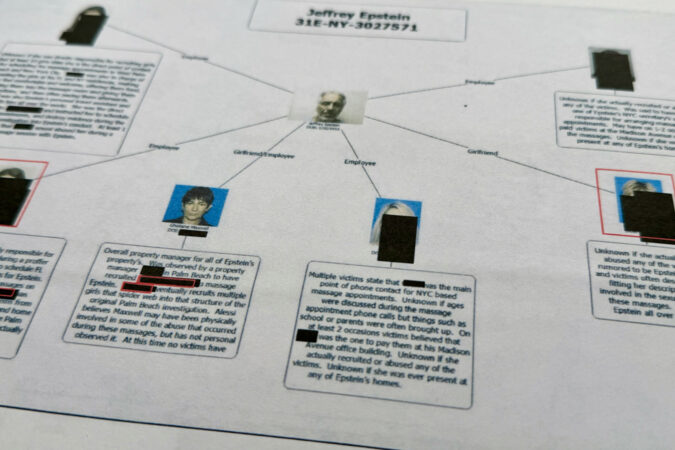
  • The latest Epstein files are rife with uncensored photos and victims’ names, despite redaction efforts

    The latest Epstein files are rife with uncensored photos and victims’ names, despite redaction efforts

    NEW YORK — Nude photos. The names and faces of sexual abuse victims. Bank account and Social Security numbers in full view.

    All of these things appeared in the mountain of documents released Friday by the U.S. Justice Department as part of its effort to comply with a law requiring it to open its investigative files on Jeffrey Epstein.

    That law was intended to preserve important privacy protections for Epstein’s victims. Their names were supposed to have been blacked out in documents. Their faces and bodies were supposed to be obscured in photos.

    Mistakes, though, have been rampant. A review by The Associated Press and other news organizations has found countless examples of sloppy, inconsistent or nonexistent redactions that have revealed sensitive private information.

    A photo of one girl who was underage when she was hired to give sexualized massages to Epstein in Florida appeared in a chart of his alleged victims. Police reports with the names of several of his victims, including some who have never stepped forward to identify themselves publicly, were released with no redactions at all.

    Despite the Justice Department’s efforts to fix the oversights, a selfie taken by a nude female in a bathroom and another by a topless female remained on the site, their ages unknown but their faces in full view, as of Wednesday evening.

    Some accusers and their lawyers called this week for the Justice Department to take down the site and appoint an independent monitor to prevent further errors.

    A judge scheduled a hearing for Wednesday in New York on the matter, then canceled it after one of the lawyers for victims cited progress in resolving the issues. But that lawyer, Brittany Henderson, said they were still weighing “all potential avenues of recourse” to address the “permanent and irreparable” harm caused to some women.

    “The failure here is not merely technical,” she said in a statement Wednesday. “It is a failure to safeguard human beings who were promised protection by our government. Until every document is properly redacted, that failure is ongoing.”

    Annie Farmer, who said she was 16 when she was sexually assaulted by Epstein and his confidant, Ghislaine Maxwell, said that while her name has previously been public, other details she’d rather be kept private, including her date of birth and phone number, were wrongly revealed in the documents.

    “At this point, I’m feeling really most of all angry about the way that this unfolded,” she told NBC News. “The fact that it’s been done in such a beyond careless way, where people have been endangered because of it, is really horrifying.”

    Trump administration defends its Epstein files redaction efforts

    The Justice Department has blamed technical or human errors on the problems and said it has taken down many of the problematic materials and is working to republish properly redacted versions.

    The task of reviewing and blacking out millions of pages of records took place in a compressed time frame. President Donald Trump signed the law requiring the disclosure of the documents on Nov. 19. That law gave the Justice Department just 30 days to release the files. It missed that deadline, in part because it said it needed more time to comply with privacy protections.

    Hundreds of lawyers were pulled from their regular duties, including overseeing criminal cases, to try and complete the document review — to the point where at least one judge in New York complained that it was holding up other matters.

    The database, which is posted on the Justice Department website, represents the largest release of files to date in the yearslong investigations into Epstein, who killed himself in a New York jail cell in 2019 while awaiting trial on federal sex trafficking charges.

    Epstein files rife with missed or incomplete redactions

    Associated Press reporters analyzing the documents have so far found multiple examples of names and other personal information of potential victims revealed.

    They have also found many cases of overzealous redactions.

    In one news clipping included in the file, the Justice Department apparently blacked out the name “Joseph” from a photo caption describing a Nativity scene at a California church. “A Nativity scene depicting Jesus, Mary and (REDACTED),” it said.

    In an email released in the files, a dog’s name appeared to have been redacted: “I spent an hour walking (REDACTED) and then another hour bathing her blow drying her and brushing her. I hope she smells better!!” the email said.

    The Justice Department has said staff tasked with preparing the files for release were instructed to limit redactions only to information related to victims and their families, though in many documents the names of many other people were blacked out, including lawyers and public figures.

    Images remain uncensored

    The Justice Department has said it intended to black out any portion of a photo showing nudity, and any photos of women that could potentially show a victim.

    In some photos reviewed by The AP, those redactions did obscure women’s faces, but left plenty of their bare skin exposed in a way that would likely embarrass the women anyway. Photos showed identifiable women trying on outfits in clothing store dressing rooms or lounging in bathing suits.

    One set of more than 100 images of a young woman were nearly all blacked out, save for the very last image, which revealed her entire face.

  • A self-collected test allowed me to finally get cervical cancer screening

    A self-collected test allowed me to finally get cervical cancer screening

    If you have a cervix you may have felt a surge of relief — joy, even — when the American Cancer Society (ACS) announced its updated guidelines for cervical cancer screening in December. I know I did.

    The organization now allows for a self-collection test for human papillomavirus, or HPV, a sexually transmitted infection that causes almost all cases of cervical cancer, as an alternative to a more traditional clinician-collected test. For some women — including me — this endorsement means that we can finally access this lifesaving screening.

    Over the last decade, there have been notable changes in how and when women are screened for cervical cancer. The go-to method used to be the Pap smear, which involves inserting a speculum so that a provider can collect cells from the cervix, the lowest end of the uterus that connects to the vagina. Eventually, in 2020, the ACS began recommending that all women at average risk of cervical cancer start screening at age 25 with a clinician-collected HPV test.

    For the patient, the experience was the same for a Pap or HPV test: Your provider would still have you lie on your back with your feet in stirrups, insert a speculum, and use a swab to collect a sample of cells from your cervix. As someone with vaginismus — a condition that causes my vaginal muscles to involuntarily contract — it would have been impossible for me to get these done.

    Then, in 2024, the Food and Drug Administration (FDA) approved self-collected HPV tests for use in healthcare facilities — meaning that women at average risk could opt to do a less-invasive self-swab of their vagina with their provider present. And in 2025, the FDA approved the first at-home tool, a wand made by Teal Health, to screen for cervical cancer, allowing women to collect the sample and mail it to a lab without even needing to visit their doctor. (If you have a personal history of cervical cancer or are at high risk, you may not be a candidate for self-collected testing).

    At 26, I was officially overdue for my first screen, so my doctor recommended I try the in-office self-collection test.

    What the self-collected HPV test was like

    Before self-collection became an option, I would lie on the exam table at my gynecologist’s office, put my legs in stirrups, and involuntarily clench at any touch. I was excited to try the self-collection test, but also skeptical that it would work for me.

    The self-swabs in the clinic looked manageable and controllable, something I could hold and insert myself. The handle was as narrow as a mascara wand, and the brush at the end was made of flexible plastic bristles that felt soft. Most importantly, it did not need to directly touch my cervix. It was less invasive, without the internal pressure that usually made my body tense. I inserted the swab about two inches into my vagina, rotated it for 30 seconds and then handed it to my doctor, who swirled it inside a vial with liquid solution.

    “That’s it?” I asked my doctor once she screwed the cap on the vial. “Is it for sure as accurate as a regular Pap smear?” Yes and yes, she assured me. I was in awe. There was a time earlier in life when my vaginismus made it feel impossible to even insert a tampon — I couldn’t believe I had completed an HPV test.

    My doctor mailed my sample to a lab, and I received the results in less than two weeks. My Pap smear came back normal with no signs of HPV. Even better, this meant I did not need to be tested again for another five years.

    Amy Banulis, an OB/GYN and associate medical director for Women’s and Maternal/Child Health at Kaiser Permanente in Virginia, said most women will be able to comfortably complete the self-collected test, even if they have vaginismus.

    “For those that still do have discomfort, there are relaxation techniques that can be utilized,” Banulis said. These could include progressive muscle relaxation, deep breathing, and imagery or visualization. If these tactics don’t make a difference, your OB/GYN can refer you to a pelvic floor physical therapist that may be able to help you with this, Banulis said.

    How effective it is compared to a traditional Pap

    The experience was so seamless that I actually worried something was wrong. What if I didn’t insert the swab high enough? I wondered when I got home. Would the results of the test still be reliable if, God forbid, I did not rotate it long enough? It almost felt too comfortable, so how effective was it really? Many women share the same concerns, but they don’t need to worry, said Jasmin Tiro, a professor of public health sciences at the University of Chicago.

    Many women who use the test say it’s easy to do and doesn’t hurt, Tiro said, adding: “It’s very hard to do it wrong.”

    It’s important to clarify that the self-collected HPV test is not the exact same test as a Pap smear or a clinician-collected HPV test, she said. The self-test collects vaginal cells, while the latter two tests use a sample of cervical cells. While a cervical sample can be tested for both HPV and abnormal cells (cancerous or precancerous), vaginal cells can only reveal if you have HPV, Tiro said.

    This means that a self-collected test may be only one part of the screening process, Tiro said. About 10% of women will screen positive for HPV, she said. If you get a positive HPV self-collected result, the next step may be a type of test or procedure that involves a pelvic exam to look for precancerous or cancerous cervical cells. That follow-up test is essential for the screening process to be effective, Tiro said.

    However, HPV does not always turn into cervical cancer; especially in people in their teens or early 20s, the virus often clears on its own without causing any health issues — which is why screening isn’t even recommended before 25. So depending on your age, your doctor may just want to retest you a few years later to see if you still have an HPV infection and determine then if that warrants further testing.

    My takeaway: We need to make screening more accessible

    I’m grateful for testing that is less invasive and painful, but I still find myself wondering why it took so long for us to arrive here. How many women would have been protected if our pain and concerns were not routinely diminished? In the past, I had doctors tell me, “Since you’ve had sex before, the speculum shouldn’t feel intimidating.” I became so used to people, including well-meaning physicians, questioning the validity of my pain. And I felt demoralized that I couldn’t even complete a test that was essential for detecting and preventing a disease that kills about 4,000 women in the U.S. each year.

    I also wonder what, if anything, can be done to ensure the new self-swab testing is accessible to all women who want or need it? When I asked Tiro, she told me that gathering more patient testimonials, developing patient-centered guidance for people who may still not want to complete the test, and devoting more research to the testing can all help. These are all things that physicians and researchers are actively working on.

    Personally, the self-collected HPV test has given me a sudden sense of agency, something I have rarely felt in a gynecologist’s office. My hope is that this alternative option can give other women greater control over their healthcare, too. Cervical cancer screening is an essential preventive care service. If you have trouble undergoing a Pap smear, ask for the alternative self-collection test. There is no shame, only power, in advocating for your health.

  • LaMonte McLemore, singer and founding member of The 5th Dimension, has died at 90

    LaMonte McLemore, singer and founding member of The 5th Dimension, has died at 90

    Singer LaMonte McLemore, a founding member of vocal group The 5th Dimension, whose smooth pop and soul sounds with a touch of psychedelia brought them big hits in the 1960s and ’70s, has died. He was 90.

    Mr. McLemore died Tuesday at his home in Las Vegas surrounded by family, his representative Jeremy Westby said in a statement. He died of natural causes after having a stroke.

    The 5th Dimension had broad crossover success and won six Grammy Awards including record of the year twice, for 1967’s “Up, Up and Away” and 1969’s “Aquarius/Let the Sunshine In.” Both were also top 10 pop hits, with the latter, a mashup of songs from the musical Hair, spending six weeks at No. 1.

    Mr. McLemore had a parallel career as a sports and celebrity photographer whose pictures appeared in magazines including Jet.

    Born in St. Louis, Mr. McLemore served in the Navy, where he worked as an aerial photographer. He played baseball in the Los Angeles Dodgers’ farm system and settled in Southern California, where he began making use of his warm bass voice and skill with a camera.

    He sang in a jazz ensemble, the Hi-Fi’s, with future 5th Dimension bandmate Marilyn McCoo. The group opened for Ray Charles in 1963 but broke up the following year.

    Mr. McLemore, McCoo, and two of his childhood friends from St. Louis, Billy Davis Jr., and Ronald Towson, later formed a singing group called the Versatiles. They also recruited Florence LaRue, a schoolteacher Mr. McLemore met through his photography, to join them. In 1965 they signed to singer Johnny Rivers’ new label, Soul City Records, and changed their name to The 5th Dimension to better represent the cultural moment.

    Their breakthrough hit came in 1967 with the Mamas & the Papas’ song “Go Where You Wanna Go.”

    That same year they released the Jimmy Webb-penned “Up, Up and Away,” which would go to No. 7 on the Billboard Hot 100 and win four Grammys: record of the year, best contemporary single, best performance by a vocal group and best contemporary group performance.

    In 1968 they had hits with a pair of Laura Nyro songs, “Stoned Soul Picnic” and “Sweet Blindness.”

    The peak of their commercial success came in 1969 with “Aquarius/Let the Sunshine In,” which along with its long run at No. 1 won Grammys for record of the year and best contemporary vocal performance by a group.

    That same year they played the Harlem Cultural Festival, which has become known as the “Black Woodstock.” The festival, and The 5th Dimension’s part in it, were chronicled in the 2021 documentary from Ahmir “Questlove” Thompson, Summer of Soul.

    The 5th Dimension also had a rare level of success with white audiences for a group whose members were all Black. The phenomenon came with criticism.

    “We were constantly being attacked because we weren’t, quote, unquote, ‘Black enough,’” McCoo said in Summer of Soul. “Sometimes we were called the Black group with the white sound, and we didn’t like that. We happened to be artists who are Black, and our voices sound the way they sound.”

    The group had hits into the 1970s including “One Less Bell to Answer,” “I Didn’t Get to Sleep at All,” and “If I Could Reach You.”

    They became regulars on TV variety shows and performed at the White House and on an international cultural tour organized by the State Department.

    The original lineup lasted until 1975, when McCoo and Davis left to make their own music.

    “All of us who knew and loved him will definitely miss his energy and wonderful sense of humor,” McCoo and Davis, who married in 1969, said in a statement.

    LaRue said in her own statement that Mr. McLemore’s “cheerfulness and laughter often brought strength and refreshment to me in difficult times. We were more like brother and sister than singing partners.”

    Mr. McLemore is survived by his wife of 30 years, Mieko McLemore, daughter Ciara, son Darin, sister Joan, and three grandchildren.

  • Russia and Ukraine envoys meet in Abu Dhabi for 2 days of U.S.-brokered talks

    Russia and Ukraine envoys meet in Abu Dhabi for 2 days of U.S.-brokered talks

    KYIV, Ukraine — Envoys from Moscow and Kyiv met in Abu Dhabi on Wednesday for another round of U.S.-brokered talks on ending the almost four-year war, as a Russian attack using cluster munitions killed seven people at a market in Ukraine.

    The delegations from Moscow and Kyiv were joined in the capital of the United Arab Emirates by U.S. special envoy Steve Witkoff and President Donald Trump’s son-in-law, Jared Kushner, according to Rustem Umerov, Ukraine’s National Security and Defense Council chief who attended the meeting.

    “The discussions were substantive and productive, focusing on concrete steps and practical solutions,” Umerov said on social media as the first of two days of talks wrapped up.

    Secretary of State Marco Rubio said that a breakthrough in the talks may not come for a while but the Trump administration has made great progress on negotiations over the past year.

    “That’s the good news,” Rubio told reporters Wednesday. “The bad news is that the items that remain are the most difficult ones. And meanwhile the war continues.”

    Kremlin spokesman Dmitry Peskov wouldn’t offer any details on the talks and said that Moscow wasn’t planning to comment on their results.

    He said that “the doors for a peaceful settlement are open,” but that Moscow will proceed with its military campaign until Kyiv meets its demands.

    Last month’s discussions in Abu Dhabi, part of a U.S. push to end the fighting, yielded some progress but no breakthrough on key issues, officials said.

    The current talks also coincide with the expiry of the last remaining nuclear arms pact between Russia and the United States on Thursday. Trump and Russian President Vladimir Putin could extend the terms of the treaty or renegotiate its conditions in an effort to prevent a new nuclear arms race.

    Energy networks targeted

    The Abu Dhabi talks were held as Ukrainians were outraged over major Russian attacks on their energy system, which have occurred each winter since Russia launched its all-out invasion of its neighbor on Feb. 24, 2022.

    A huge Russian bombardment overnight from Monday to Tuesday included hundreds of drones and a record 32 ballistic missiles, wounding at least 10 people. This came despite Ukraine’s understanding that Putin had told Trump that he would temporarily halt strikes on Ukraine’s power grid.

    Ukrainian civilians are struggling with one of the coldest winters in years, which saw temperatures dip to around minus-4 degrees Fahrenheit.

    About 60 foreign ambassadors took part in an organized visit Wednesday to a Kyiv thermal power plant that was almost completely destroyed by missiles and drones in the Monday night attack. The plant provided heating to about 500,000 people.

    Russia is hitting Ukraine’s energy facilities because its armed forces believe the targets are associated with Kyiv’s military effort, Peskov said.

    There has been a lack of clarity about how long Putin had promised to observe a pause on power grid attacks.

    Trump said Tuesday at the White House that Putin had agreed to halt strikes for a week, through Feb. 1, and that the Russian leader had kept his word. But Zelensky said Tuesday that “barely four days have passed of the week Russia was asked to hold off,” before Ukraine was hit with new attacks, suggesting that the Ukrainian leader wasn’t fully aware of the terms of the Trump-Putin agreement.

    Meanwhile, White House press secretary Karoline Leavitt said that Trump was “unfortunately unsurprised” by Moscow’s resumption of attacks.

    On Wednesday, more than 200 repair crews were at work in Kyiv to restore power, according to the Ukrainian Energy Ministry, which said that staff were exhausted and would be rotated. More than 1,100 apartment buildings in the capital were still without heating, Zelensky said.

    The Institute for the Study of War, a Washington think tank, said that the developments were part of Moscow’s negotiating strategy.

    “The Kremlin will likely attempt to portray its adherence to this short-term energy strikes moratorium as a significant concession to gain leverage in the upcoming peace talks, even though the Kremlin used these few days to stockpile missiles for a larger strike package,” it said late Tuesday.

    New attacks

    Russia used cluster munitions Wednesday in an attack on a busy market in eastern Ukraine that killed seven and wounded 15 others, officials said.

    The attack on the town of Druzhkivka darkened prospects for progress in the UAE, with Donetsk regional military administration chief Vadym Filashkin describing Russian talk of a ceasefire as “worthless.”

    Russia also launched 105 drones against Ukraine overnight, and air defenses shot down 88 of them, the Ukrainian air force said Wednesday. Strikes by 17 drones were recorded at 14 locations, as well as falling debris at five sites, it said.

    In the central Dnipropetrovsk region, a Russian strike on a residential area killed a 68-year-old woman and a 38-year-old man, regional military administration head Oleksandr Hancha said.

    The southern city of Odesa also came under a large-scale attack, regional military administration head Oleh Kiper said. About 20 residential buildings were damaged, with four people rescued from under the rubble, he said.

  • Still no suspect in the disappearance of ‘Today’ host Savannah Guthrie’s mother

    Still no suspect in the disappearance of ‘Today’ host Savannah Guthrie’s mother

    TUCSON, Ariz. — The search for Today show host Savannah Guthrie’s mother still had no suspect or person of interest Wednesday, authorities said, four days after she disappeared with signs of forced entry at her home in southern Arizona.

    Investigators believe Nancy Guthrie was taken against her will over the weekend and Pima County Sheriff Chris Nanos has said they don’t have credible information indicating Guthrie’s disappearance was targeted. Guthrie has limited mobility, and officials do not believe she left on her own. Nanos said she is of sound mind.

    “Detectives continue to speak with anyone who may have had contact with Mrs. Guthrie,” the sheriff’s department said in a statement on social media Wednesday. “Detectives are working closely with the Guthrie family.”

    Multiple media organizations reported receiving purported ransom notes Tuesday that they handed over to investigators. The sheriff’s department has said it’s taking the notes and other tips seriously but declined to comment further.

    The Pima County sheriff and the Tucson FBI chief urged the public to offer tips during a news conference Tuesday. Nanos has said Guthrie needs daily medication and could die without it. Asked whether officials were looking for her alive, he said, “We hope we are.”

    Authorities say Nancy Guthrie was last seen around 9:30 p.m. Saturday at her home in the Tucson area, where she lived alone, and she was reported missing midday Sunday. Someone at her church called a family member to say she was not there, leading family to search her home and then call 911.

    DNA samples have been gathered and submitted for analysis as part of the investigation. “We’ve gotten some back, but nothing to indicate any suspects,” Nanos said.

    There were signs of forced entry at Guthrie’s home, evidence of a nighttime kidnapping, and several personal items were still there, including Guthrie’s cell phone, wallet and car, according to a person familiar with the investigation, who was not authorized to publicly discuss details of the case and spoke to the Associated Press on condition of an anonymity. Investigators were reviewing surveillance video from nearby homes and information from area license plate cameras and analyzing local cell phone towers data.

    Guthrie’s upscale Catalina Foothills neighborhood is quiet and mostly dark at night, lit mainly by car headlights and homes spaced far apart. Long driveways, front gates and desert plants provide a buffer from the winding streets. Saguaro cacti tower above her home’s roofline, and wispy trees partially block the view of the front door. Decorative streetlamps and prickly pear cacti dot the grassy front yard.

    Jim Mason, longtime commander of a search and rescue posse for the Maricopa County Sheriff’s Office, said desert terrain can make looking for missing people difficult. Sometimes it’s hard to peer into areas that are dense with mesquite trees, cholla cactus and other brush, he said. His group is based 175 miles (280 kilometers) north of Tucson, and is not involved in the search for Guthrie.

    On the other side of the country, Victory Church in Albany, New York, said it’s offering a $25,000 reward for information that leads to finding Nancy Guthrie.

    “Me and my wife, we watch Savannah every single morning. We’ve heard of her faith. We’ve heard of her mom’s faith. And she’s got such a sweet spirit,” Pastor Charlie Muller said.

    For a third day Wednesday, Today opened with Nancy Guthrie’s disappearance, but Savannah Guthrie was not at the anchor’s desk. NBC Sports said Tuesday that Guthrie will not be covering the 2026 Milan-Cortina Winter Olympics “as she focuses on being with her family during this difficult time.”

    The Today host grew up in Tucson, graduated from the University of Arizona and previously worked as a reporter and anchor at Tucson television station KVOA. Her parents settled in Tucson in the 1970s when she was a young child. The youngest of three siblings, she credits her mom with holding their family together after her father died of a heart attack at 49, when Savannah was just 16.