Category: Wires

  • She battled bladder accidents for decades before doctors found the problem | Medical Mystery

    She battled bladder accidents for decades before doctors found the problem | Medical Mystery

    From as early as she can remember, Cindy O’Connor couldn’t control her bladder. She would suddenly feel the urge to pee and couldn’t make it to the bathroom before urine leaked out.

    In kindergarten, the Wisconsin resident wet her snow pants, which froze to a ledge as she sat outside of school. In seventh grade, a teacher who thought she was faking the need to go stopped her in the hallway, where, surrounded by classmates, she soaked her jeans. When playing outdoors with friends, she would run to a neighbor’s weeping willow and relieve herself under its wispy branches.

    Kids called her “pee-britches,” and her parents scolded her. To reduce the need to urinate, she stopped drinking water, only to develop cramps from constipation.

    As an adult, especially after the birth of her son, the problem got worse. She had to abruptly leave work meetings, stop the car frequently on road trips, and plan walks around available restrooms. Her regular doctors didn’t suggest any treatment for what they said was an overactive bladder, so she wore absorbent pads and figured she had to live with incontinence.

    Other doctors eventually prescribed medications and implanted two devices to try to resolve the issue, but the approaches didn’t help and had side effects. It wasn’t until O’Connor saw another specialist, who ordered a test other doctors hadn’t, that she was diagnosed with a rare condition that is typically caught at a much younger age.

    “I wish they would have figured it out years ago,” said O’Connor, now 65. “I wonder what things would have been like to have that normalcy.”

    Lifelong struggle

    O’Connor’s childhood memories are marked by urinary accidents.

    Her parents told her Santa wouldn’t leave gifts if he caught her up at night. Afraid to go to the bathroom, she often wet the bed on Christmas Eve. At the annual carnival in Belleville, the small town south of Madison where she grew up and still lives, she got stuck on a Ferris wheel and couldn’t hold her pee. After accidents at school, she would walk home during recess to change clothes.

    “I can’t tell you how many times I heard, ‘Why are you waiting until the last minute?’” O’Connor said.

    “‘I don’t,’” she would reply.

    When the trouble didn’t go away after her teens, she told doctors about it at visits for other complaints, but they didn’t focus on her incontinence. After her son was born when she was 21, she developed endometriosis, which is when tissue similar to the uterine lining grows outside of the uterus. She underwent a hysterectomy a few years later. Her abnormal bladder seemed like a secondary concern.

    As she raised her son, helped her husband, Mike, start an insurance business, and cared for her father before he died of lung cancer, O’Connor adapted to her uncontrolled peeing. On morning walks, she and Mike would go by the fire station, their church, a park, a laundromat, and a bar — all of which had bathrooms open early — so she could dash in when necessary.

    But the condition was more than a nuisance. After Mike struggled to pull the car over in time, they stopped taking lengthy road trips. Sometimes the urge to pee was so overwhelming that O’Connor’s whole body would tremble. Unless she calmed herself, an accident was inevitable.

    “It was like my bladder was spasming, my heart was racing, my ears were ringing, and my head was pounding,” she said. “Everything just goes haywire. If I stood up right away, I was done.”

    Unhelpful treatments

    In her late 40s, a change in health insurance led O’Connor to see a new gynecologist. The doctor treated her for incontinence with a medication called Detrol. It didn’t help and made O’Connor’s constipation worse.

    The gynecologist surgically placed a mesh sling under her urethra, which can ease some kinds of urinary incontinence. But O’Connor’s bladder was nicked during the procedure, requiring her to use a catheter for 12 days. The sling made it hard for her to urinate, so after three months the doctor cut the device to release its tension.

    O’Connor tried oxybutynin, another drug for overactive bladder, but it didn’t help and caused dry eyes and blurry vision. She went to another doctor — a gynecologist with training in urology — who prescribed a drug called Vesicare, which had a similar effect. Physical therapy, with Kegel exercises, wasn’t beneficial.

    The urogynecologist implanted a device that acts like a urinary “pacemaker,” using electrical pulses to stimulate nerves that communicate between the bladder and the brain.

    The device didn’t lessen O’Connor’s bladder symptoms. Instead, it activated another part of her body. “It made my toes curl,” she said.

    A new test

    In 2013, nearly four years after her first treatment, she saw another urogynecologist, Sarah McAchran, at UW Health in Madison. McAchran, a urologist with training in gynecology, found two things about O’Connor to be unusual. Her incontinence had persisted since childhood, and she hadn’t responded to numerous treatments. McAchran tried two additional drugs, which were also unsuccessful: Mirabegron, which gave O’Connor headaches, and Gelnique, a topical form of oxybutynin, from which she broke out in a rash.

    McAchran conducted urodynamic tests, in which catheters, electrodes, and fluids measure bladder capacity, pressure, and flow. O’Connor’s results were unusual. “She had a very early first sensation to void,” McAchran said. “Her contractions got progressively stronger and were all associated with leakage.”

    Using a flexible tube mounted with a camera, McAchran inspected O’Connor’s bladder and saw some trabeculations, or thickening of the wall, which suggests the bladder was contracting too much. “It can be a sign that the bladder has had to work harder than it should to try to get urine out,” McAchran said.

    Suspecting an underlying nervous system condition, McAchran ordered a spinal MRI. The scan revealed that the tip of O’Connor’s spinal cord was low and that a band of tissue between the tip and her tailbone appeared abnormal, indicating a condition called a tethered spinal cord. In the disorder, the spinal cord attaches to the spinal canal instead of flowing freely. Body movement causes the spinal cord to stretch too much, which can interfere with signals between the brain and the bladder.

    The condition can be caused by scar tissue from surgery but is often present at birth, when it is associated with spina bifida occulta, a mild version of a birth defect that can cause serious disabilities. O’Connor almost certainly was born with her tethered cord; many children who have it are diagnosed at a young age. But in a middle-aged woman, “you have to think about it to diagnose it,” McAchran said. “There’s so many other, more common … reasons for a woman to have incontinence that you would focus on those first.”

    When she heard the diagnosis, O’Connor was ecstatic. She finally had a response to the ridicule she had endured.

    “‘See, I told you that it’s not my fault; I don’t wait too long,’” O’Connor said she told those close to her. “Nobody would listen to me all those years. That was so frustrating.”

    Finding comfort

    Despite getting the diagnosis, a remedy did not come easily. When O’Connor was 53, a neurosurgeon cut the band of abnormal tissue connected to her spinal cord to release the cord, confirming during the procedure that the cord had been tethered. The operation, when performed at a young age, can prevent bladder and neurological problems.

    The surgery relieved O’Connor’s lower back pain, another symptom of her tethered cord, but it didn’t significantly improve her incontinence. That is because the procedure can’t reverse damage already done, said the neurosurgeon, Bermans Iskandar, of UW Health, who normally operates on children.

    “If you wait 50 years, there’s no way you’re going to bring back a bladder that has been damaged over the years,” Iskandar said. “The main reason for the surgery is to prevent additional problems in the future.”

    McAchran turned to Botox, injecting purified botulinum toxin through O’Connor’s urethra into her bladder to relax the muscle and reduce contractions. At first, the treatment decreased accidents, even though it made it harder for O’Connor to urinate and sometimes required her to use disposable catheters. But the benefit of the injections, given nine times over more than two years, diminished. “The spasms came back just as hard,” O’Connor said.

    The last option was surgery to increase the size of her bladder. It would require her to use a disposable catheter every time she went to the bathroom, regularly flush her urethra and bladder with saline solution, and urinate on schedule, every five or six hours, for the rest of her life. She worried about how she would do those things as she got older.

    But on a trip with Mike to Door County, Wisconsin’s version of Cape Cod, she had an accident at a restaurant. As their retirement years approached, she wanted to travel without worrying so much about her bladder.

    She decided to have the operation. In October 2018, during the five-hour procedure, McAchran and another surgeon used a piece of O’Connor’s bowel to more than double the size of her bladder, increasing its capacity to store urine more than threefold.

    Since then, O’Connor has had only one accident, when she exceeded her scheduled urination time while watching a parade in New Orleans. She has acclimated to using catheters in her daily routine. “It’s natural, it’s normal,” she said.

    For much of her life, she struggled with low self-esteem, sensing that people were laughing at her because of her condition. “It wasn’t a death sentence, but it sure wasn’t fun,” she said.

    Now, after retiring in September as office manager for Mike, she is embracing a more unencumbered life. She went with Mike to Europe two years ago, took a trip to Nashville last summer with her son and is regularly playing with her granddaughter, who is nearly 2. She and Mike plan to fly to California and drive back along Route 66.

    “Mike has always wanted to do that,” she said. “It is something that has never crossed my mind as possible until now.”

    David Wahlberg has been a medical reporter for 30 years, including at the Atlanta Journal-Constitution and the Wisconsin State Journal in Madison.


  • Emails outline potential cuts affecting thousands of FEMA disaster responders

    Emails outline potential cuts affecting thousands of FEMA disaster responders

    The Department of Homeland Security has drafted plans to drastically cut the Federal Emergency Management Agency workforce in 2026, according to documents obtained by the Washington Post that detail potential reductions to thousands of disaster response and recovery roles.

    The terminations are likely to come in waves, according to three people familiar with the plans who, like some others interviewed for this report, spoke on the condition of anonymity for fear of retribution. They said the cuts began on New Year’s Eve with the elimination of about 65 positions that were part of FEMA’s largest workforce, known as the Cadre of On-Call Response and Recovery (CORE) — staffers who are among the first on the ground after a disaster and often stick around for years to help communities recover.

    Independent journalist Marisa Kabas and CNN earlier reported a portion of the New Year’s Eve cuts.

    Emails sent to senior agency leadership in late December include detailed tables identifying roles that can be cut from the agency’s divisions. These tables include a 41% reduction in CORE disaster roles, amounting to more than 4,300 positions. They also list reductions in surge staffing, standby workers who are often the first on the ground when a disaster strikes, by 85%, or nearly 6,500 roles.

    In a statement, FEMA spokesperson Daniel Llargués said the agency has “not issued and is not implementing a percentage-based workforce reduction.”

    “The materials referenced from the leaked documentation stem from a routine, pre-decisional workforce planning exercise conducted in line with OMB and OPM guidance,” Llargués added. “The email outlining that exercise did not direct staffing cuts or establish reduction targets.”

    Homeland Security Secretary Kristi L. Noem has long wanted to cut back on CORE staffing, according to two former senior officials.

    Losing a large number of disaster-specific workers over a short period “would mean greater delays in processing and survivors not being dealt with as quickly as they had been before,” said Cameron Hamilton, who led FEMA as acting administrator in the early months of President Donald Trump’s second term.

    Internal agency emails and documents, as well as people familiar with the plans, suggest Noem is spearheading the drastic reductions, which may impede FEMA’s ability to fulfill its legal obligation to help the nation respond to disasters, according to three FEMA officials.

    Noem, who has exercised a tight grip over FEMA since taking over its parent department, has repeatedly expressed a desire to shrink or eliminate the agency. The Post reported that she previously made recommendations to cut agency staffing by about half.

    Although the documents call the staffing reduction an “exercise” and say “no staffing actions or personnel decisions are being directed or implemented as part of this request,” two officials familiar with the situation said the tables reflect Noem’s targets for the agency.

    An email describes the tables, which list total reduction counts and percentages for most of the agency’s divisions, as a “planning document.”

    Llargués said in FEMA’s statement that the “accompanying spreadsheet was an internal working tool used to collect planning inputs.”

    The emails show that there have been “deliberate” discussions regarding workforce reductions, said a person familiar with them, who added that the documents request “senior leadership to review and ensure that whatever staff is retained is absolutely necessary.”

    DHS has said publicly that it terminated 50 people in early January and that the cuts were “a routine staff adjustment of 50 staff out of 8000.”

    Two officials with knowledge of the process said that number is closer to 65. The officials had been told to expect that hundreds more people would lose their jobs by the end of January. CORE staffers whose jobs were supposed to be renewed this week still have not heard anything about their status, officials said.

    Llargués said the New Year’s Eve cuts were unrelated to the “planning exercise described in the leaked email.”

    The potential for additional cuts come less than a year after a wave of FEMA terminations, including of hundreds of probationary employees. FEMA officials are also awaiting a final draft of a report by a Trump-appointed review council on the agency’s future, which was supposed to be released last month. The Post previously reported that a version of that report recommended making FEMA leaner but also more independent — findings that countered recommendations from Noem, the council’s co-chair.

    Three FEMA officials raised concerns about the rapid and drastic dismantling of the agency workforce.

    Under the Post-Katrina Emergency Management Reform Act, the homeland security secretary is prohibited from taking actions that “substantially or significantly reduce the authorities, responsibilities, or functions” of FEMA.

    “It’s not just unprecedented — it directly contradicts the law,” said a veteran FEMA official who has also worked within DHS.

    Having the head of DHS determine the fate of disaster response roles “strips FEMA leadership of its statutory authority and puts control of the nation’s disaster workforce in the hands of a department that Congress explicitly told to step back after Katrina,” that person added.

    Emergency management historian Scott Robinson said cutting FEMA’s staffing at these levels “would [undo] an act of Congress without an act of Congress.”

    “The president is using a lot of administrative tools to try and do things we would have traditionally expected legislation to do,” Robinson said.

    There are about 17,500 CORE employees spread across the country — the majority of FEMA’s workforce of 22,316, an agency official said. Under the Stafford Act, FEMA hires these staffers for multiyear terms using the disaster relief fund.

    CORE teams partner directly with state and local officials to support ongoing response and recovery after a hurricane strikes or a fire tears through a town. They may move resources from warehouses to hard-hit communities; they process grants and conduct trainings. Some staffers were working on long-term projects related to Hurricanes Sandy, Maria, and Fiona. CORE teams also include lawyers, IT experts, and others who may help oversee nuclear plant operations or help in hazard reduction for earthquakes.

    For example, in a region that includes Texas, Louisiana and more than 60 tribal nations, about 80% of the FEMA staffers deployed in support roles are CORE employees, a former senior official said.

    Ongoing discussions to downsize FEMA also underscore how much autonomy the nation’s emergency management agency has lost since the start of Trump’s second term. FEMA has been without a congressionally appointed leader for nearly a year, cycling through temporary officials who have lacked disaster management experience, which is required by law to lead the agency. After David Richardson resigned in November, DHS tapped its chief of staff at the time, Karen Evans, to act as the agency’s interim administrator.

    An agency official familiar with the discussions said Evans has been part of conversations about the future of this disaster-specific workforce for the past few weeks, including about whether to extend positions for a month or two until the agency has had enough time to review the need for the roles. But the official said it seemed that Noem was making the final decision.

    As documents detailing workforce cuts made rounds within the agency over the past week, FEMA officials were stunned and pointed out that getting rid of nearly half of the nation’s disaster workforce would greatly harm communities in various stages of disaster recovery. States would need much more time to prepare and bolster their own disaster capabilities before the federal government significantly pulled back resources such as CORE employees.

    “The entire framework of a reduction should be built on stronger state partnerships, not knee-jerk reactions from the federal government,” Hamilton said.

    CORE appointments are typically renewed every two to four years. When the end of an employee’s contracted term approaches, their supervisors submit paperwork to renew those roles and send it up the chain. Most of the positions are usually reinstated, according to four current and former FEMA officials, in part because recovery work is long and complex.

    In mid-December, DHS took away FEMA’s authority to independently renew these positions, and it instituted a hiring process that requires Noem to review all CORE positions and help decide whether they should continue to exist, according to emails and a person familiar with a meeting where these new requirements were discussed.

    An email from Dec. 17 described how Noem — often referred to as “S1” in internal DHS and FEMA conversations and documents — created parameters for keeping the CORE employees.

    “To improve DHS review outcomes, each CORE term renewal justification must be written to fit what the S1 verification form is designed to capture,” it said.

    Noem overseeing hiring for disaster-specific employees “is completely outside the norm,” said the veteran FEMA official who also served within DHS. “CORE renewals have always been handled inside FEMA, as Congress intended under the Post-Katrina Emergency Management Reform Act.”

    The new system created year-end confusion as supervisors scrambled to send in detailed letters justifying a variety of positions.

    For example, in one region with 40 CORE employees whose jobs were to be renewed in January, supervisors sent lengthy justification notes for about 35 of those workers. That same day, they were told to trim the letters and send them again.

    They heard nothing in response, until they learned on Dec. 31 that they would lose nine employees “regardless of the recommendations of emergency management experts,” one official familiar with the situation said. The fate of the rest is unknown, a supervisor said. He said he was also told “there was no plan” to extend any other CORE employees whose jobs were supposed to be renewed this month.

    It is unclear whether FEMA or DHS took the justification memos into account.

    In the last weeks of December, the office was inundated with hundreds of these justification memos, including statistics and data meant to explain why specific roles were crucial to FEMA’s mission to help communities recover from disasters.

    Then, on New Year’s Eve, human resources staffers were told to inform people they had lost their jobs, according to a person familiar with the situation and memos obtained by the Post. Some CORE staffers learned they were fired on New Year’s Day while on vacation, and they were asked to send in their equipment by Jan. 2.

    Several agency officials who supervise CORE team members were shocked when they learned that numerous employees had suddenly lost their jobs, emails show.

    “This must be a mistake,” one supervisor wrote to FEMA’s HR services and other officials, explaining that they had approved their employee’s renewal and sent the paperwork through the proper channels.

    Another supervisor overseeing recovery work for Hurricane Helene expressed concern and confusion over losing a staffer, stating in a New Year’s Eve note to human resources that “based on the attached emails and form,” the worker’s “appointment should be renewed.”

    “I would like to resolve this ASAP, as this is a disappointing and confusing email to get right before a holiday,” the supervisor said.

    In response, a top human resources official said the situation was essentially out of their hands.

  • The best (and weirdest) tech we found at CES 2026

    The best (and weirdest) tech we found at CES 2026

    LAS VEGAS — This week, 2.5 million square feet of prime Las Vegas real estate is packed with visions of the future. Some of them are sensible and going on sale soon, others are way out there and still in development.

    That’s business as usual at CES, the massive tech confab once known as the Consumer Electronics Show that opens today. It’s a place where robots roam free, TVs tower over footsore onlookers, and artificial intelligence lurks around every corner.

    Here’s what has stood out from the crowd so far.

    Uber’s new robotaxi

    The ride-booking giant’s road to robotaxis has been a complicated one: An early Uber self-driving test vehicle killed a pedestrian in 2018. The company sold off its autonomous driving project in 2020 and has since partnered with its would-be rival Waymo in some parts of the country.

    Now, Uber is getting ready to roll its own self-driving cars onto city streets once again.

    The ride-hailing company didn’t build this thing from scratch. Autonomous driving company Nuro provided the cameras, sensors, and self-driving smarts, all of which are integrated into a Gravity model three-row electric SUV from Lucid Motors.

    Uber invested $300 million in Lucid last year and fleshed out the in-car experience for riders. You’ll be able to pick out playlists, adjust the cabin temperature, and make other customizations that are also already offered by Alphabet’s Waymo robotaxis.

    On Monday, Uber said that its Lucid vehicles are already being tested on public roads. It plans to make robotaxis available to Uber riders in the San Francisco Bay Area later this year.

    There’s no word yet on when these new self-driving Ubers will make it out of California, but at least it doesn’t seem like you’ll have to pay extra for one. When you hail a ride where these vehicles are active, the company says, you won’t have the option of selecting a robotaxi until you’ve already locked in a fare.

    A CES attendee sits on VOVO’s $4,990 Smart Toilet Neo.

    A toilet that can call for help

    VOVO’s $4,990 Smart Toilet Neo comes with now-standard niceties like a built-in bidet and automatic flushing. And VOVO claims its built-in urine analysis sensor can provide deeper insights into a user’s overall health, splashed across a screen meant to be installed nearby.

    Scanning one’s pee is par for the course at CES though: stand-alone liquid waste sensors have been floating around the show for years. The Smart Toilet Neo’s standout feature? When installed in a senior’s home, it can send messages to family members if no one has used it for more than eight hours, prompting loved ones to check in and make sure everyone is OK.

    Samsung’s 130-inch Micro RGB TV.

    A TV for the ‘size matters’ crowd

    Samsung’s 130-inch Micro RGB TV broke cover this week, and is so big that the svelte metal frame surrounding it looks barely up to the job.

    Long story short, Micro RGB TVs use gobs of incredibly small LEDs in red, green, or blue to light up the screen. That makes them better at delivering bright, accurate colors compared to a more standard LED TV.

    It’s unclear when Samsung plans to offer this monstrosity up to consumers, but when it does be sure to steel yourself before checking out the price tag. The company began selling a similar 115-inch model last year for an eye-watering $30,000.

    The Pinwheel Home phone.

    A retro landline phone for kids

    If you’re old enough to remember the pre-cellphone days, cast your mind back to all the time you spent tying up your parents’ phone line when you were young. A company called Pinwheel wants kids of the smartphone era to know what that feels like — without getting distracted by a screen.

    The $99 Pinwheel Home, slated for sale in the coming months, is a dead ringer for the corded phones you’d find affixed to kitchen walls in the 1980s. The company says it’s designed to help young ones hone their verbal and social skills by chatting with a handful of preset contacts.

    Calling other households with a Pinwheel Home costs parents nothing, but placing calls to regular phone numbers will set you back $9.99 a month. To sweeten the deal and help this throwback gadget further appeal to youngsters, the device will ship with a sheet of stickers.

    A portable, battery-powered food allergen detector

    For people allergic to gluten or dairy, even a simple meal out can feel like a minefield. Allergen Alert, spun out of a family-owned French biotech firm, wanted to help — by building a $200 portable allergen-sensing gadget they allege delivers lab-grade results.

    Here’s how it works: You unpack one of the company’s test pouches (available in packs of five to seven as part of a monthly subscription), and cram a bit of a suspect meal into a slender spoon. Pack all of that into the sensing device, which is about the size of a thick paperback, and you’ll get a result back in a few minutes.

    The catch? For now, the company only offers gluten test kits. It says that dairy-specific models will launch soon and that by 2028 the lineup will include tests for most major food allergens, including nuts and dairy.

    LEGO chief product and marketing officer and executive vice president Julia Goldin talks as a Wookiee stands behind her during a LEGO news conference ahead of the CES tech show Monday, Jan. 5, 2026, in Las Vegas.

    Star Wars and Lego announce a new partnership

    When Lucasfilm chief creative officer David Filoni brought out an array of X-Wing pilots, Chewbacca, R2D2, and C-3PO, he won the Star Wars fandom for Lego.

    Lego announced its Lego Smart Play platform on Monday, which introduces new smart bricks, tags, and special minifigs for your collection. The new bricks contain sensors that enable them to sense light and distance, and to provide an array of responses, essentially lights and sounds, when they are used in unison.

    Combine this with a newly announced partnership with the Star Wars franchise, and now you can create your own interactive space battles and light-saber duels.

    An LG Electronics home robot interacts with the audience during an LG news conference ahead of the CES tech show Monday, Jan. 5, 2026, in Las Vegas.

    LG reveals a new robot to help around the home

    File this one under intrigued, for now.

    The Korean tech giant LG gave the media a glimpse Monday of its humanoid robot that is designed to handle household chores such as folding laundry and fetching food. Although many companies have robots on display at CES, LG is one of the biggest tech companies to promise to put a service robot in homes.

    The Associated Press contributed to this article.

  • Fifth anniversary of the Jan. 6 attack brings fresh division to the Capitol

    Fifth anniversary of the Jan. 6 attack brings fresh division to the Capitol

    WASHINGTON — Five years ago outside the White House, outgoing President Donald Trump told a crowd of supporters to head to the Capitol — “and I’ll be there with you” — in protest as Congress was affirming the 2020 election victory for Democrat Joe Biden.

    A short time later, the world watched as the seat of U.S. power descended into chaos, and democracy hung in the balance.

    On the fifth anniversary of Jan. 6, 2021, there is no official event to memorialize what happened that day, when the mob made its way down Pennsylvania Avenue, battled police at the Capitol barricades and stormed inside, as lawmakers fled. The political parties refuse to agree to a shared history of the events, which were broadcast around the globe. And the official plaque honoring the police who defended the Capitol has never been hung.

    Instead, the day displayed the divisions that still define Washington, and the country, and the White House itself issued a glossy new report with its own revised history of what happened.

    Trump, during a lengthy morning speech to House Republicans convening away from the Capitol at the rebranded Kennedy Center now carrying his own name, shifted blame for Jan. 6 onto the rioters themselves.

    The president said he had intended only for his supporters to go “peacefully and patriotically” to confront Congress as it certified Biden’s win. He blamed the media for focusing on other parts of his speech that day.

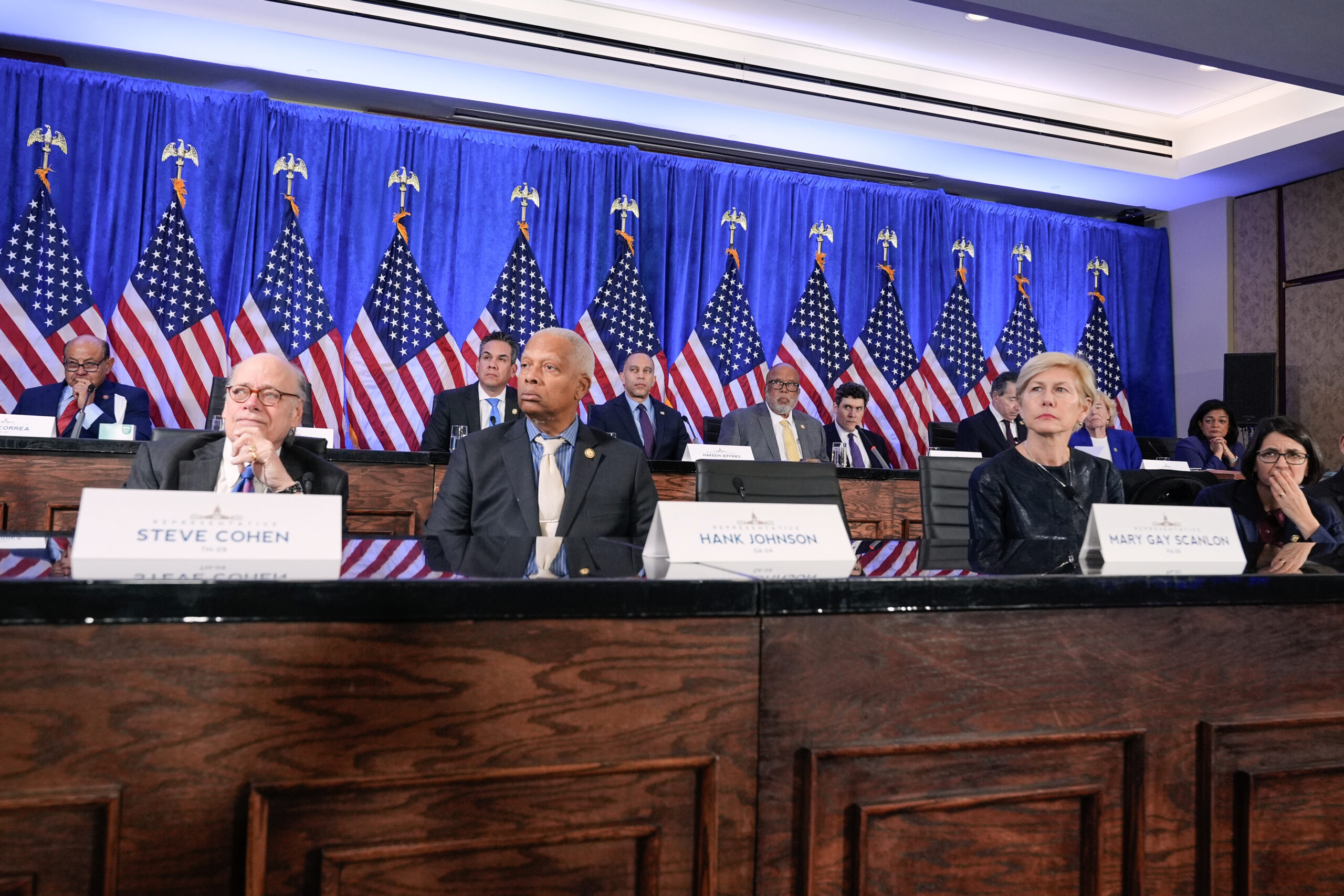
    Rep. Mary Gay Scanlon (second from right, front row), a Pennsylvania Democrat, was among members of Congress watching a video from the Jan. 6 attack during a hearing at the U.S. Capitol.

    At the same time, Democrats held their own morning meeting at the Capitol, reconvening members of the House committee that investigated the Jan. 6, 2021, attack for a panel discussion. Recalling the history of the day is important, they said, in order to prevent what Rep. Jamie Raskin (D., Md.) warned was the GOP’s “Orwellian project of forgetting.”

    And the former leader of the militant Proud Boys, Enrique Tarrio, summoned people for a midday march retracing the rioters’ steps from the White House to the Capitol, this time to honor Trump supporter Ashli Babbitt and others who died in the Jan. 6 siege and its aftermath. More than 100 people gathered, including Babbitt’s mother.

    Tarrio and others are putting pressure on the Trump administration to punish officials who investigated and prosecuted the Jan. 6 rioters. He was sentenced to 22 years in prison for seditious conspiracy for orchestrating the Jan. 6 attack, and he is among more than 1,500 defendants who saw their charges dropped when Trump issued a sweeping pardon on his return to the White House last year.

    “They should be fired and prosecuted,” Tarrio told the crowd before they arrived at the Capitol, confronted along the way by counterprotesters, and sang the national anthem.

    The White House in its new report highlighted the work the president has already done to free those charged and turned the blame on Democrats for certifying Biden’s election victory.

    Echoes of 5 years ago

    This milestone anniversary carried echoes of the differences that erupted that day.

    But it unfolds while attention is focused elsewhere, particularly after the U.S. military’s stunning capture of Venezuela’s president, Nicolás Maduro, and Trump’s plans to take over the country and prop up its vast oil industry, a striking new era of American expansionism.

    “These people in the administration, they want to lecture the world about democracy when they’re undermining the rule of law at home, as we all will be powerfully reminded,” House Democratic leader Hakeem Jeffries of New York said on the eve of the anniversary.

    House Speaker Mike Johnson of Louisiana, responding to requests for comment about the delay in hanging the plaque honoring the police at the Capitol, as required by law, said in a statement on the eve of the anniversary that the statute “is not implementable,” and proposed alternatives “also do not comply with the statute.”

    Democrats revive an old committee, Republicans lead a new one

    At the morning hearing at the Capitol, lawmakers heard from a range of witnesses and others — including former U.S. Capitol Police officer Winston Pingeon, who said as a kid he always dreamed of being a cop. But on that day, he thought he was going to die in the mayhem on the steps of the Capitol.

    “I implore America to not forget what happened,” he said, “I believe the vast majority of Americans have so much more in common than what separates us.”

    Also testifying was Pamela Hemphill, a rioter who refused Trump’s pardon, blamed the president for the violence and silenced the room as she apologized to the officer sitting alongside her at the witness table, stifling tears.

    “I can’t allow them not be recognized, to be lied about,” Hemphill said about the police who she said also saved her life as she fell and was trampled on by the mob. “Until I can see that plaque get up there, I’m not done.”

    Among those testifying were former Rep. Adam Kinzinger of Illinois, who along with former Rep. Liz Cheney of Wyoming were the two Republicans on the panel that investigated Trump’s efforts to overturn Biden’s win. Cheney, who lost her own reelection bid to a Trump-backed challenger, did not appear. Speaker Emerita Nancy Pelosi urged the country to turn away from a culture of lies and violence that she said sends the wrong message about democracy.

    Republican Rep. Barry Loudermilk of Georgia, who has been tapped by Johnson to lead a new committee to probe other theories about what happened on Jan. 6, rejected Tuesday’s session as a “partisan exercise” designed to hurt Trump and his allies.

    Many Republicans reject the narrative that Trump sparked the Jan. 6 attack, and Johnson, before he became the House speaker, had led challenges to the 2020 election. He was among some 130 GOP lawmakers voting that day to reject the presidential results from some states.

    Instead, they have focused on security lapses at the Capitol — from the time it took for the National Guard to arrive on the scene to the failure of the police canine units to discover the pipe bombs found that day outside Republican and Democratic party headquarters. The FBI arrested a Virginia man suspected of placing the pipe bombs, and he told investigators last month he believed someone needed to speak up for those who believed the 2020 election was stolen, authorities say.

    “The Capitol Complex is no more secure today than it was on Jan. 6,” Loudermilk said in a social media post. “My Select Subcommittee remains committed to transparency and accountability and ensuring the security failures that occurred on Jan. 6 and the partisan investigation that followed never happens again.”

    The aftermath of Jan. 6

    At least five people died in the Capitol siege and its aftermath, including Babbitt, who was shot and killed by police while trying to climb through the window of a door near the House chamber, and Capitol Police Officer Brian Sicknick died later after battling the mob. Several law enforcement personnel died later, some by suicide.

    The Justice Department indicted Trump on four counts in a conspiracy to defraud voters with his claims of a rigged election in the run-up to the Jan. 6 attack.

    Former Justice Department special counsel Jack Smith told lawmakers last month that the riot at the Capitol “does not happen” without Trump. He ended up abandoning the case once Trump was reelected president, adhering to department guidelines against prosecuting a sitting president.

    Trump, who never made it to the Capitol that day as he hunkered down at the White House, was impeached by the House on the sole charge of having incited the insurrection. The Senate acquitted him after top GOP senators said they believed the matter was best left to the courts.

    Ahead of the 2024 election, the Supreme Court ruled ex-presidents have broad immunity from prosecution.

  • Trump says U.S. to get 30 million to 50 million barrels of oil from Venezuela at market price

    Trump says U.S. to get 30 million to 50 million barrels of oil from Venezuela at market price

    CARACAS, Venezuela — President Donald Trump said Tuesday on his social media site that “Interim Authorities” in Venezuela would be providing 30 million to 50 million barrels of “High Quality” oil to the U.S. at its market price, an announcement that came after officials in Caracas announced that at least 24 Venezuelan security officers were killed in the dead-of-night U.S. military operation to capture Nicolás Maduro and spirit him to the United States to face drug charges.

    Trump posted on Truth Social that the oil “will be taken by storage ships, and brought directly to unloading docks in the United States.” He said the money would be controlled by him as president but it would be used to benefit the people of Venezuela and the United States.

    Separately, the White House is organizing an Oval Office meeting Friday with oil company executives regarding Venezuela, with representatives of Exxon, Chevron, and ConocoPhillips expected to attend, according to a person familiar with the matter who requested anonymity to discuss the plans.

    Earlier Tuesday, Venezuelan officials announced the death count in the Maduro raid as the country’s acting president, Delcy Rodríguez, pushed back on Trump, who earlier this week warned she’d face an outcome worse than Maduro’s if she does not “do what’s right” and overhaul Venezuela into a country that aligns with U.S. interests. Trump has said his administration will now “run” Venezuela policy and is pressing the country’s leaders to open its vast oil reserves to American energy companies.

    Rodriguez, delivering an address Tuesday before government agricultural and industrial sector officials, said, “Personally, to those who threaten me: My destiny is not determined by them, but by God.”

    Venezuela’s Attorney General Tarek William Saab said overall “dozens” of officers and civilians were killed in the weekend strike in Caracas and said prosecutors would investigate the deaths in what he described as a “war crime.” He didn’t specify if the estimate was specifically referring to Venezuelans.

    In addition to the Venezuelan security officials, Cuba’s government had previously confirmed that 32 Cuban military and police officers working in Venezuela were killed in the raid. The Cuban government says the personnel killed belonged to the Revolutionary Armed Forces and the Ministry of the Interior, the country’s two main security agencies.

    Seven U.S. service members were also injured in the raid, according to the Pentagon. Five have already returned to duty, while two are still recovering from their injuries. The injuries included gunshot wounds and shrapnel injuries, according to a U.S. official who was not authorized to comment on the matter publicly and spoke on the condition of anonymity.

    A video tribute to the slain Venezuelan security officials posted to the military’s Instagram account features faces of the fallen over black-and-white videos of soldiers, American aircraft flying over Caracas and armored vehicles destroyed by the blasts. Meanwhile, the streets of Caracas, deserted for days following Maduro’s capture, briefly filled with masses of people waving Venezuelan flags and bouncing to patriotic music at a state-organized display of support for the government.

    “Their spilled blood does not cry out for vengeance, but for justice and strength,” the military wrote in an Instagram post. “It reaffirms our unwavering oath not to rest until we rescue our legitimate President, completely dismantle the terrorist groups operating from abroad, and ensure that events such as these never again sully our sovereign soil.”

    Trump grumbles about how Democrats reacted to the raid

    Trump on Tuesday pushed back against Democratic criticism of this weekend’s military operation, noting that his Democratic predecessor Joe Biden had also called for the arrest of the Venezuelan leader on drug trafficking charges.

    Trump in remarks before a House Republican retreat in Washington grumbled that Democrats were not giving him credit for a successful military operation, even though there was bipartisan agreement that Maduro was not the rightful president of Venezuela.

    In 2020, Maduro was indicted in the United States, accused in a decades-long narco-terrorism and international cocaine trafficking conspiracy. White House officials have noted that Biden’s administration in his final days in office last year raised the award for information leading to Maduro’s arrest after he assumed a third term in office despite evidence suggesting that he lost Venezuela’s most recent election. The Trump administration doubled the award to $50 million in August.

    “You know, at some point, they should say, ‘You know, you did a great job. Thank you. Congratulations.’ Wouldn’t it be good?” Trump said. “I would say that if they did a good job, their philosophies are so different. But if they did a good job, I’d be happy for the country. They’ve been after this guy for years and years and years.”

    With oil trading at roughly $56 a barrel, the transaction Trump announced late Tuesday could be worth as much as $2.8 billion. The U.S. goes through an average of roughly 20 million barrels a day of oil and related products, so Venezuela’s transfer would be the equivalent of as much as two and a half days of supply, according to the U.S. Energy Information Administration.

    Despite Venezuela having the world’s largest proven crude oil reserves, it only produces on average about one million barrels day, significantly below the U.S. average daily production of 13.9 million barrels a day during October.

    What U.S. opinion polls show

    Americans are split about the capture of Maduro — with many still forming opinions — according to a poll conducted by The Washington Post and SSRS using text messages over the weekend. About 4 in 10 approved of the U.S. military being sent to capture Maduro, while roughly the same share were opposed. About 2 in 10 were unsure.

    Nearly half of Americans, 45%, were opposed to the U.S. taking control of Venezuela and choosing a new government for the country. About 9 in 10 Americans said the Venezuelan people should be the ones to decide the future leadership of their country.

    Maduro pleaded not guilty to federal drug trafficking charges in a U.S. courtroom on Monday. U.S. forces captured Maduro and his wife early Saturday in a raid on a compound where they were surrounded by Cuban guards.

    In the days since Maduro’s ouster, Trump and top administration officials have raised anxiety around the globe that the operation could mark the beginning of a more expansionist U.S. foreign policy in the Western Hemisphere. The president in recent days has renewed his calls for an American takeover of the Danish territory of Greenland for the sake of U.S. security interests and threatened military action on Colombia for facilitating the global sale of cocaine, while his top diplomat declared the communist government in Cuba is “in a lot of trouble.”

    Colombia responds to Trump

    Colombia’s Foreign Affairs Minister Rosa Villavicencio said Tuesday she’ll meet with the U.S. Embassy’s charge d’affaires in Bogota to present him with a formal complaint over the recent threats issued by the United States.

    On Sunday, Trump said he wasn’t ruling out an attack on Colombia and described its president, who’s been an outspoken critic of the U.S. pressure campaign on Venezuela, as a “sick man who likes making cocaine and selling it to the United States.”

    Villavicencio said she’s hoping to strengthen relations with the United States and improve cooperation in the fight against drug trafficking.

    “It is necessary for the Trump administration to know in more detail about all that we are doing in the fight against drug trafficking,” she said.

    Meanwhile, the leaders of France, Germany, Italy, Poland, Spain and the United Kingdom on Tuesday joined Danish Prime Minister Mette Frederiksen in defending Greenland’s sovereignty. The island is a self-governing territory of the kingdom of Denmark and thus part of the NATO military alliance.

    “Greenland belongs to its people,” the statement said. “It is for Denmark and Greenland, and them only, to decide on matters concerning Denmark and Greenland.”

  • AP source: John Harbaugh leaving the Baltimore Ravens after 18 seasons as coach

    AP source: John Harbaugh leaving the Baltimore Ravens after 18 seasons as coach

    OWINGS MILLS, Md. — John Harbaugh is leaving the Baltimore Ravens after 18 seasons as their coach, a person with knowledge of the decision told the Associated Press.

    The person spoke on condition of anonymity Tuesday because the Ravens haven’t announced the decision.

    The move comes after the Ravens were one of the league’s most disappointing teams this season, going 8-9 and missing the playoffs after entering Week 1 as one of the Super Bowl favorites. Baltimore’s season ended Sunday night when Tyler Loop missed a last-second field goal, allowing Pittsburgh to hold on for a 26-24 victory in the game that decided the AFC North title.

    Harbaugh went 193-124 including the postseason. He led the 2012 Ravens to a Super Bowl title and reached the AFC championship game on three other occasions. This season was only the sixth time Baltimore missed the postseason under Harbaugh. That’s the same number of times the Ravens won the AFC North with him at the helm.

    Baltimore Ravens head coach John Harbaugh talks with an official during a loss to the Steelers on Sunday.

    But most of Baltimore’s postseason success came in his first few seasons. The Ravens went to the AFC title game three times in his first five years as coach, culminating in their run to a Super Bowl title as a wild card, when Harbaugh beat his brother Jim’s San Francisco 49ers for the title.

    At that point, Harbaugh was 9-4 in the postseason, but after that he was just 4-7. After three straight seasons without a playoff berth, Lamar Jackson arrived in 2018 and led Baltimore to a division title. But Harbaugh’s lone trip to an AFC title game with Jackson was wasted two seasons ago when Baltimore lost at home to Kansas City.

    This season was a mess pretty much from the start, when Baltimore looked great for much of its opener at Buffalo before blowing a late lead. Indeed, squandering fourth-quarter advantages become a troubling trend for the Ravens in Harbaugh’s last few seasons, and after a hamstring injury sidelined Jackson, Baltimore stumbled to a 1-5 start in 2025.

    Harbaugh and the Ravens worked their way back into contention and eventually reached Sunday’s winner-take-all matchup as a favorite to beat the Steelers. But despite Derrick Henry’s early dominance on the ground and Jackson’s sensational fourth quarter, another season ended in excruciating fashion.

    AP Pro Football Writer Rob Maaddi contributed to this report.

  • Shooter who killed Brown students and MIT professor planned attack for months, says DOJ

    Shooter who killed Brown students and MIT professor planned attack for months, says DOJ

    BOSTON — The man identified by law enforcement as the shooter who killed two Brown University students and an MIT professor had been planning the attack for at least six semesters, according to information released Tuesday by the U.S. Department of Justice.

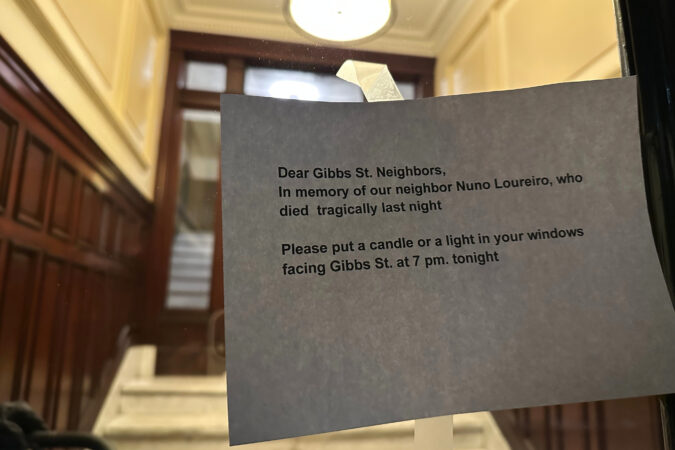
    Claudio Neves Valente, 48, a former Brown student and Portuguese national, was found dead in a New Hampshire storage facility after he killed two students and wounded nine others in an engineering building on Dec. 13. Two days later, he killed MIT professor Nuno F.G. Loureiro in his home in the Boston suburb of Brookline.

    Justice Department officials said Tuesday that during the search of the storage facility where Neves Valente’s body was found, the FBI recovered an electronic device containing a series of short videos made by Neves Valente after the shootings.

    In the recordings, the shooter admits in Portuguese that he had been “planning the Brown University shooting for a long time,” according to a press release. He did not provide a motive for targeting Brown or the MIT professor, with whom he attended school in Portugal decades ago.

    He said he felt he had nothing to apologize for. He also complained in the videos about injuring his eye in the shootings.

    “I’m not going to apologize because during my lifetime no one sincerely apologized to me,” he said.

    Neves Valente said his “only objective was to leave more or less” on his “own terms” and to ensure he “wouldn’t be the one who ended up suffering the most from all this.”

    “No, that cannot happen. So if you don’t like it, tough luck,” he said. Neves Valente called his execution of the murders “a little incompetent.”

    “But at least something was done,” he said.

    In the recording, he said he’d had the storage space where his body was found for about three years.

  • Fear grips Caracas as a new wave of repression is unleashed in Venezuela

    Fear grips Caracas as a new wave of repression is unleashed in Venezuela

    For a brief moment, some Venezuelans allowed themselves to celebrate.

    When they learned Saturday that strongman Nicolás Maduro had been seized by U.S. Special Forces, many group chats filled with messages of joy and relief. Some people cried. One family in Caracas opened a bottle of champagne they had bought months earlier and saved for a special occasion. After more than a decade of living under Maduro, there were cautious hopes for a different future.

    By Monday, however, those feelings had been replaced by more familiar ones: fear, dread, and uncertainty.

    Venezuela’s government has moved quickly to suppress any public expression of support for Maduro’s ouster, launching a nationwide crackdown that has included the detention of journalists, the arrest of civilians, and the deployment of armed gangs across the capital.

    “It feels like it did after the presidential elections in 2024,” said María, 55, who like others in this story spoke on the condition that they be identified by their first name, or on the condition of anonymity, for fear of reprisals. “We won, but we also lost,” she said, referring to the country’s last elections, in which Maduro claimed victory despite tallies showing the opposition had prevailed.

    The crackdown unfolded as Delcy Rodríguez, the country’s vice president, was sworn in as interim president Monday at the National Assembly. Senior military officials publicly pledged their loyalty to her — a signal that while the country had a new leader, the old power structure remained in place.

    At least 14 journalists and media workers were detained Monday — including 11 working for international outlets, according to the National Press Workers Union. Most, the union said, were held for several hours and later released, but several reported that military counterintelligence officers searched their phones. Many of the detentions took place near the National Assembly as Rodríguez took the oath of office in a ceremony overseen by her brother, Jorge Rodríguez, who heads the legislature.

    Authorities also moved against ordinary citizens — empowered by a “state of external commotion” decree that ordered Venezuela’s national, state, and municipal police forces to immediately search for and arrest anyone “involved in promoting or supporting the armed attack by the United States of America.” The decree, which entered into force Saturday but was published in full Monday, also suspended the right to protest and authorized broad restrictions on movement and assembly.

    In the western state of Mérida, two people in their 60s were arrested for shouting anti-government slogans and “celebrating the kidnapping of President Nicolás Maduro and First Lady Cilia Flores,” according to state police.

    Across Caracas, pro-government paramilitary groups known as “colectivos” — a hallmark of the informal security state built by former president Hugo Chávez and inherited by Maduro after his death — set up checkpoints, including along the Cota Mil highway that runs north of the city. Residents described being pulled over, questioned and forced to hand over their phones. Some said the armed men scrolled through their messages and social media, looking for anything that could be construed as support for the U.S. raid.

    “We’re texting each other routes to avoid,” said a Caracas resident. “You hear ‘don’t go there — they’re stopping cars with machine guns.’”

    In the wake of Maduro’s capture, President Donald Trump has said repeatedly that the United States is “running” Venezuela, though it is unclear what influence Washington is exerting on authorities in Caracas.

    Overseeing U.S. involvement in the country, Trump said, would fall to a small group of senior officials, including Secretary of State Marco Rubio, Defense Secretary Pete Hegseth, Deputy White House Chief of Staff Stephen Miller, — and himself. Venezuela, the president told NBC on Monday, was not in a position to hold elections.

    “We have to fix the country first,” he said. “We have to nurse the country back to health.”

    In a news conference Tuesday, Trump suggested that the Venezuelan government planned to shut down El Helicoide, a sprawling, spiral-shaped detention center in Caracas that has long been used to hold and torture dissidents, according to rights groups.

    Foro Penal, a local human rights group, has said more than 860 political prisoners remain in state custody.

    “Of course I have hope things could get better without Maduro,” a 30-year-old man in the capital told the Washington Post. “But from where I am, all I see is the same people who destroyed my country still in power. They’re still persecuting us. And we’re still afraid.”

    In an interview with Fox News’s Sean Hannity, opposition leader María Corina Machado — who left Venezuela in December to accept the Nobel Peace Prize in Norway — called the crackdown “really alarming” and urged the U.S. and the international community to monitor the situation. She described Rodríguez as “one of the main architects of torture, persecution [and] corruption.”

    Late Monday, as weary families bedded down, gunshots rang out near the Miraflores presidential palace. On social media, residents shared videos from their window of armed men in the streets; some speculated that a coup was underway.

    Hours later, the Communication and Information Ministry put out a statement saying police had fired warning shots after “drones flew over the area without authorization.”

    “The entire country is completely calm,” the statement said.

  • U.S. mandates more foreign travelers to pay $15,000 visa bond deposits

    U.S. mandates more foreign travelers to pay $15,000 visa bond deposits

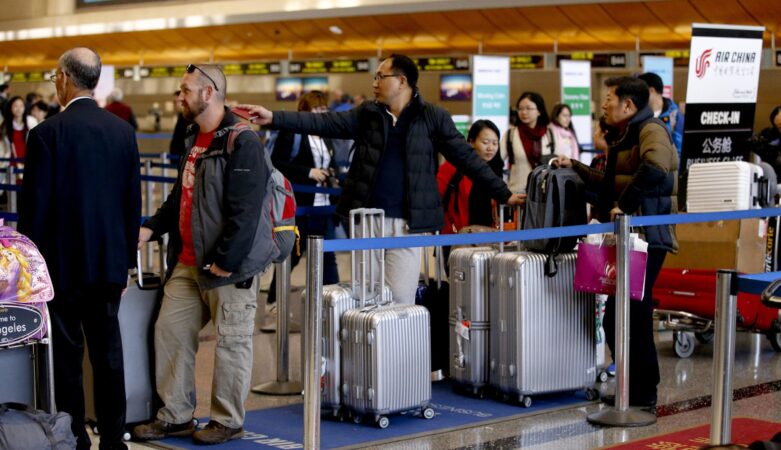
    Foreign travelers from seven additional countries are now required to pay up to $15,000 for a reimbursable bond when applying for a U.S. visitor visa, as the Trump administration continues to tighten entry requirements to the country.

    As of Jan. 1, Bhutan, Botswana, the Central African Republic, Guinea, Guinea-Bissau, Namibia, and Turkmenistan are required to pay the assurances as part of a State Department pilot program launched in August. Thirteen countries are now affected by the program, most of them in Africa.

    The bond deposits — which the department has said are aimed at deterring visitors from staying in the United States longer than they are allowed for business or tourism — range between $5,000 and $15,000, and do not guarantee that a visa will be issued. The payment will be refunded if visitors depart the U.S. within the time specified on their visas, according to the policy.

    Applicants whose visas are approved can only enter the U.S. from three designated airports: Boston Logan International Airport, New York’s John F. Kennedy International Airport, and Washington Dulles International Airport, the State Department notice said. The program is not applicable to those on student visas.

    Travelers from 42 countries that are part of the visa waiver program — who don’t need a visa to enter the U.S. — including much of Europe, Australia, Qatar, and Israel, are also exempt.

    The administration has said the program is aimed at countries with high visa overstay rates, citing a Department of Homeland Security report to Congress. However, some of the countries newly added to the list have low overstay numbers. The department suspects that two of the 137 visitors from the Central African Republic (or about 2%) overstayed their nonimmigrant business and tourist visas in fiscal year 2024, while about 4% from Namibia are suspected of overstaying.

    The pilot was launched in August with Malawi and Zambia. An estimated 234 visitors from Malawi (or 14%) overstayed their nonimmigrant visas in fiscal year 2023, as did 365 (11%) from Zambia. Four countries were added to the list in October.

    For couples or families, the potential up-front cost of $10,000 or $15,000 per person could be prohibitive. At the time of its launch, the State Department predicted the year-long pilot program would cost travelers around $20 million, based on 2,000 potential travelers paying an average bond of $10,000.

    The State Department had planned a six-month visa bond pilot in 2020, but did not implement it as global travel dwindled during the coronavirus pandemic.

  • Iran hospital raid fuels protest anger as crackdown kills 29

    Iran hospital raid fuels protest anger as crackdown kills 29

    Iran’s government ordered an investigation into clashes between protesters and riot police at a hospital in the country’s west as a video emerged online showing another hospital being hit with tear gas by security forces.

    Video posted to social media on Tuesday purportedly showed the courtyard of Sina Hospital submerged in tear gas smoke. The footage cannot be verified by Bloomberg but the hospital is near the capital’s Grand Bazaar, where a fresh bout of protests and clashes with police erupted on Tuesday, according to the Associated Press.

    Security forces fired tear gas at demonstrators in the sprawling market — where unrest began on Dec. 28 — who had shuttered their businesses and were staging a sit-in at the trading hub, the AP said, citing witnesses. Unverified social media footage also appeared to show police rushing crowds in the bazaar’s surrounding streets and in one of its main arteries.

    The U.S.-based Human Rights Activists News Agency said Monday that at least 29 people have been killed in provinces including Lorestan, Fars, and Kurdistan and more than 1,200 people arrested since a sharp currency decline triggered demonstrations in Tehran that later spread to other cities.

    On Sunday, videos emerged on social media appearing to show security forces storming the Imam Khomeini Hospital in the western city of Ilam and firing tear gas inside. The footage fueled even more public anger at the authorities, prompting President Masoud Pezeshkian to order the investigation. Officials haven’t yet responded to the incident at the hospital in Tehran.

    The protests have divided Iran’s leadership over how to respond. While Pezeshkian, a political moderate and a former heart surgeon, has described protesters’ demands as legitimate, judiciary chief Gholam-Hossein Mohseni Ejei has warned that “no leniency or tolerance” would be shown toward protesters and vowed swift trials, according to the official Mizan news agency.

    “Rioters can no longer claim to have been misled,” Ejei said, accusing the U.S. and Israel of openly backing the unrest. “There is now no room for any concessions toward rioters and instigators of unrest.”

    Supreme Leader Ayatollah Ali Khamenei, who has the final say on most state matters, said Saturday that “rioters must be put in their place.”

    The protests are the biggest to rock Iran since nationwide unrest in 2022 over the death of a young woman, Mahsa Amini, in police custody. But they don’t yet represent a threat to the Islamic Republic’s security, Eurasia Group analysts wrote in a report last week.

    The unrest comes amid deteriorating living conditions in Iran, where high inflation, rising costs and a weak currency have fueled growing public dissatisfaction.

    The government has announced measures to ease the frustration including a monthly cash subsidy of 10 million rials (roughly $7) for each member of every household. It also appointed a new central bank governor to stabilize the declining rial.

    The subsidy is part of a broader “livelihood plan” that’s aimed at offsetting the rising cost of basic goods like cooking oil, milk, sugar, and meat, government spokeswoman Fatemeh Mohajerani said on Monday.

    Iran’s currency has dropped by around 45% on the black market in the past year. It trades at roughly 1.5 million against the dollar, according to bombast, a website that tracks the currency.