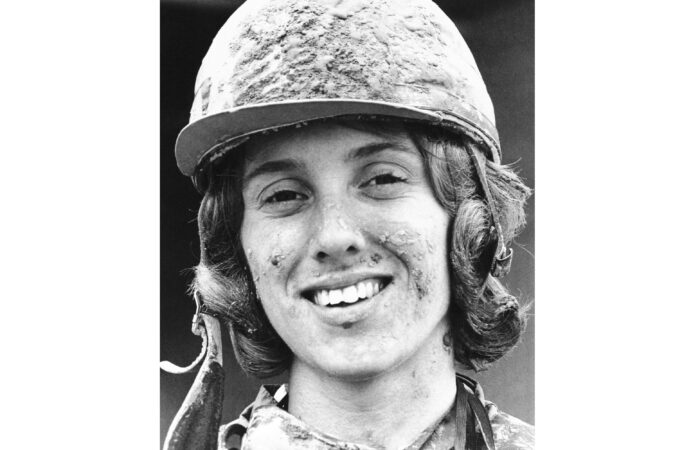
WASHINGTON — Diane Crump, who in 1969 became the first woman to ride professionally in a horse race and a year later became the first female jockey in the Kentucky Derby, has died. She was 77.
Ms. Crump was diagnosed in October with an aggressive form of brain cancer and died Thursday night in hospice care in Winchester, Va., her daughter, Della Payne, told the Associated Press.
Ms. Crump went on to win 228 races before riding her last race in 1998, a month shy of her 50th birthday and nearly 30 years after her trailblazing ride at Hialeah Park in Florida on Feb. 7, 1969.
Ms. Crump was among several women to fight successfully at the time to be granted a jockey license, but they still needed a trainer willing to put them in a race and then for the race to run. Others were thwarted when male jockeys boycotted or threatened to boycott if a woman was riding.
Photographs of Ms. Crump’s walk to the saddling area at Hialeah show her protected by security guards as a crowd pressed in on all sides. Six of the original 12 jockeys in the race had refused to ride, Mark Shrager wrote in his biography, Diane Crump: A Horse Racing Pioneer’s Life in the Saddle. Among them were future legends Angel Cordero Jr., Jorge Velasquez, and Ron Turcotte, who four years later would ride Secretariat to win the Triple Crown.
But other jockeys stepped up, and as the 12 horses made their way onto the track, the bugler skipped the traditional call to the post and instead played “Smile for Me, My Diane.” Ms. Crump, on a 50-1 longshot called Bridle ’n Bit, finished 10th, but the barrier had been broken. A month later, Bridle ’n Bit gave Ms. Crump her first victory at Gulfstream Park.
She again made history in 1970 by becoming the first woman to ride in the Kentucky Derby. She won the first race that day at Churchill Downs, but again her mount for the history-making race was outclassed. She finished 15th out of 17 on Fathom.
It would be 14 more years before another female jockey would ride in the Derby, with only four more to follow in the decades since.
The president of Churchill Downs Racetrack, Mike Anderson, said in a statement on Friday that Crump “will be forever respected and fondly remembered in horse racing lore.”
He noted that Ms. Crump, who had been riding since age 5 and galloping young Thoroughbreds since she was a teenager, “was an iconic trailblazer who admirably fulfilled her childhood dreams.”
Chris Goodlett, of the Kentucky Derby Museum, said “Diane Crump’s name stands for courage, grit, and progress.” He added: “Her determination in the face of overwhelming odds opened doors for generations of female jockeys and inspired countless others far beyond racing.”
After retiring from racing, Ms. Crump settled in Virginia and started a business helping people buy and sell horses.
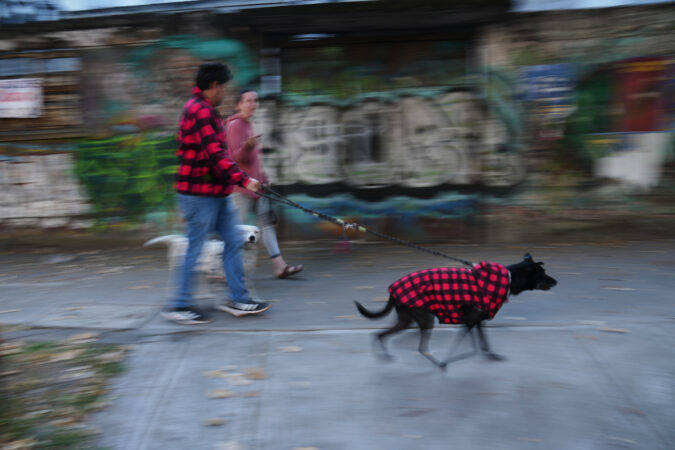
In later years, she took her therapy dogs, all Dachshunds, to visit patients in hospitals and other medical clinics. Some with chronic illnesses she visited regularly for years.
Payne said when her mother went into assisted living in November, she was already “quasi-famous” in the medical center because of how much time she had spent there, and a “steady stream” of doctors and nurses came to see her. One of the last people to visit her was the man who mowed her lawn.
Her daughter said Ms. Crump would never take “no” for an answer, whether it was becoming a jockey or helping someone in need.
“I wouldn’t say she was as competitive as she was stubborn,” Payne said. “If someone was counting on her, she could never let someone down.”
Late in life, Ms. Crump’s mottos were literally tattooed on her forearms: “Kindness” on the left, “Compassion” on the right.
Crump will be cremated and her ashes interred between her parents in Prospect Hill Cemetery in Front Royal, Va.
MEXICO CITY — A strong earthquake rattled southern and central Mexico on Friday, interrupting President Claudia Sheinbaum‘s first press briefing of the new year as seismic alarms sounded and leaving at least two people dead.
The earthquake had a magnitude of 6.5 and its epicenter was near the town of San Marcos in the southern state of Guerrero near the Pacific coast resort of Acapulco, according to Mexico‘s national seismological agency. There were more than 500 aftershocks.
The state’s civil defense agency reported various landslides around Acapulco and on other highways in the state.
Guerrero Gov. Evelyn Salgado said that a 50-year-old woman living in a small community near the epicenter died when her home collapsed. Authorities also said that a hospital in Chilpancingo, Guerrero’s capital, suffered major structural damage and various patients were evacuated.
Residents and tourists in Mexico City and Acapulco rushed into the streets when the shaking began. Mexico City Mayor Clara Brugada said that one person died after suffering an apparent medical emergency followed by a fall while evacuating a building.
The U.S. Geological Survey said the earthquake occurred at a depth of 21.7 miles, 2.5 miles north-northwest of Rancho Viejo, Guerrero, which is in the mountains about 57 miles northeast of Acapulco.
Sheinbaum resumed her press briefing a short time after the quake.
José Raymundo Díaz Taboada, a doctor and human rights defender who lives on one of the peaks ringing Acapulco, said he heard a strong rumble noise and all the neighborhood dogs began barking.
“In that moment the seismic alert went off on my cellphone,” he said, ”and then the shaking began to feel strong with a lot of noise.”
He said the shaking was lighter than in some previous quakes and he had prepared a backpack of essentials to be ready to leave as the aftershocks continued.
He said he had been unable to reach some friends who live along the Costa Chica southeast of Acapulco because communications were cut.
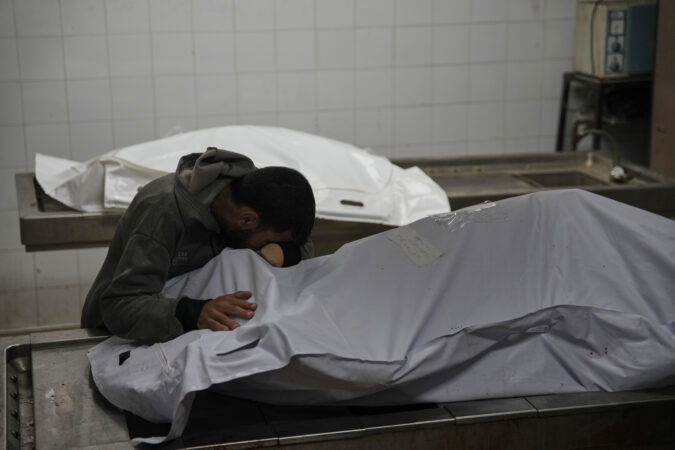
DEIR AL BALAH, Gaza Strip — A grandmother and her 5-year-old grandson burned to death in Gaza when their tent caught fire while cooking, as thousands of Palestinians endure colder weather in makeshift housing.
The nylon tent in Yarmouk caught fire Thursday night while a meal was being prepared, a neighbor said. A hospital official said that two Palestinian men were killed by Israeli gunfire on Friday in Gaza.
The shaky 12-week-old ceasefire between Israel and the Hamas militant group has largely ended large-scale Israeli bombardment of Gaza. But Palestinians are still being killed by Israeli forces, especially along the so-called Yellow Line that delineates areas under Israeli control.
Over the past few weeks, cold winter rains have repeatedly lashed the sprawling tent cities, causing flooding, turning Gaza’s dirt roads into mud and causing damaged buildings to collapse.
Aid groups say not enough shelter materials are getting into Gaza during the truce. Figures recently released by Israel’s military suggest it hasn’t met the ceasefire stipulation of allowing 600 trucks of aid into Gaza a day, though Israel disputes that finding.
Israel has said throughout the war that Hamas was siphoning off aid supplies, preventing the population in Gaza from receiving them. Last month, the World Food Program said that there have been “notable improvements” in food security in Gaza since the ceasefire.
Palestinians have long called for mobile homes and caravans to be allowed in to protect them against living in impractical and worn out tents.
Angelina Jolie greets Red Crecent workers during her visit Friday to the Rafah border crossing between Egypt and the Gaza Strip.
Actor visits Rafah crossing
Jolie met with members of the Red Crescent on the Egyptian side of the Rafah border crossing and then visited a hospital in the nearby city of Arish to speak with Palestinian patients on Friday, according to Egyptian officials.
Her visit sought to raise support for the displaced and humanitarian workers in the crises in Gaza as well as in Sudan, Jolie’s team said in a statement.
“What needs to happen is clear: the ceasefire must hold, and access must be sustained, safe and urgently scaled up so that aid, fuel and critical medical supplies can move quickly and consistently, at the volume required,” Jolie said about Gaza.
Reopening the crossing, which would allow Palestinians to leave Gaza — especially the ill and wounded who could get specialized care unavailable in the territory — has been contentious. Israel has said that it will only allow Palestinians to exit Gaza, not enter, until militants in Gaza return all the hostages they took in the attack on Oct. 7, 2023, which triggered the war. The remains of one hostage are still in Gaza.
Israel also says Palestinians wanting to leave Gaza will have to get Israeli and Egyptian security approval. Egypt, meanwhile, says it wants the crossing immediately opened in both directions, so Palestinians in Egypt can enter Gaza. That’s a position rooted in Egypt’s vehement opposition to Palestinian refugees permanently resettling in the country.
For more than two decades until 2022, Jolie was a special envoy to the U.N. refugee agency.
Gaza’s humanitarian situation
On Friday, the foreign ministers of Arab and Muslim countries, including Egypt, Qatar, and Saudi Arabia, expressed concern about Gaza’s humanitarian situation.
The situation has been “compounded by the continued lack of sufficient humanitarian access, acute shortages of essential life-saving supplies, and the slow pace of the entry of essential materials,” according to the joint statement.
The Palestinian death toll from the war is at least 71,271, according to Gaza’s Health Ministry, which doesn’t distinguish between militants and civilians in its count. The Israel-Hamas war began with the Hamas-led Oct. 7 attack in southern Israel that killed about 1,200 people and saw 251 taken hostage.
On Friday, two Palestinian men were killed in separate incidents by Israeli gunfire in the Khan Younis area of southern Gaza, a hospital official said. Israel’s military said troops operating in the southern Gaza Strip killed a person who “crossed the Yellow Line and approached the troops, posing an immediate threat to them.”
West Bank raids
Meanwhile, Israel continues operating in the occupied West Bank.
On Friday, the Palestinian Prisoners media office said that Israel carried out numerous raids across the territory, including the major cities of Ramallah and Hebron. Nearly 50 people were detained, following the arrest of at least 50 other Palestinians on Thursday, most of those in the Ramallah area.
Israel’s military said there were arrests made of people “involved in terrorist activity.” Last week, a Palestinian attacker rammed his car into a man and then stabbed a young woman in northern Israel, killing both of them, police said.
The Palestinian Prisoner’s Society says that Israel has arrested 7,000 Palestinians in the West Bank and Jerusalem this year, and 21,000 since the war began. The number arrested from Gaza isn’t made public by Israel.
Federal authorities said Friday they disrupted a plan by an 18-year-old, inspired by the Islamic State, to attack patrons at a grocery store and fast-food restaurants outside Charlotte.
Christian Sturdivant had drawn up detailed plans for what he described as a New Year’s Eve “martyrdom op” to target patrons with hammers and knives, officials said. He was charged with attempting to provide material support to a foreign terror organization after he discussed his intentions last month with two undercover law enforcement officers posing as Islamic extremists.
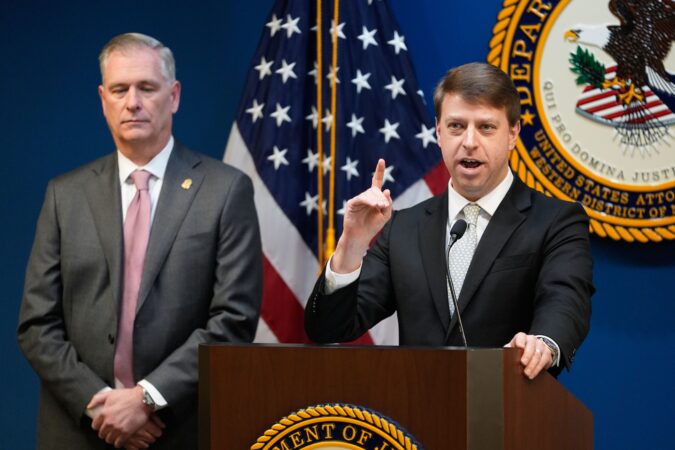
“It was a very well-planned, thoughtful attack,” Russ Ferguson, the U.S. attorney for the Western District of North Carolina, said at a news conference announcing the arrest. “He was preparing for jihad, and innocent people were going to die.”
Ferguson stressed that FBI agents had Sturdivant, a Burger King employee and grandson of a Christian minister, under surveillance for days leading up to his arrest Wednesday. At no point during that period did authorities believe he posed an immediate danger to public safety, Ferguson said.
Authorities also believed Sturdivant suffered from sufficiently serious psychiatric problems that they sought earlier in the week to have him involuntarily committed for care, Ferguson said. A North Carolina state judge’s denial of that request prompted the decision to charge him with a crime and arrest him instead, Ferguson said.
Sturdivant remains in federal custody late Friday pending a bail hearing next week. A defense attorney listed in public court filings did not immediately return calls for comment.
In recent weeks, the FBI has arrested a number of other individuals alleged to have been plotting terrorist attacks in Texas, California, and Louisiana. Many of those investigations, like the one that led to the charges against Sturdivant, involved undercover agents or officers offering encouragement and in some cases suggestions on carrying out those attacks.
Critics say those tactics run the risk of targeting vulnerable people for prosecution who may not have had the means or the immediate thought to carry out an attack on their own. The bureau has defended its methods, saying the tactic is one of the few that can help investigators prevent threats of terrorist violence before they result in deaths.
In Sturdivant’s case, authorities said he began communicating online three weeks ago with a person he believed to be a member of the Islamic State and repeatedly expressed his support for the extremist organization. That individual was actually an undercover New York Police Department employee.
“I will do jihad soon,” Sturdivant told him during a Dec. 13 exchange, according to an arrest affidavit filed in his case.
The officer encouraged Sturdivant to prove his commitment through an act of violence, the document states. The teen later repeated his intentions to attack a grocery store in Mint Hill, near the Burger King restaurant where he worked, in separate conversations with an undercover FBI agent also posing as an Islamic State sympathizer, officials said.
During a raid on Sturdivant’s family home Monday, authorities found two butcher knives and a hammer hidden under his bed — weapons officials said he intended to use to kill as many as 11 people.
They also discovered writings in a trash can in which they say Sturdivant laid out detailed plans for his assault, including the text message he intended to send his family during the attack and his plan to take his own life afterward by attacking responding police.
In one of the handwritten messages, titled “The Way of the Lion (The Martyr’s Notes),” Sturdivant said his goal was “pure destruction of America and the West,” according to the arrest affidavit.
Ferguson said Friday that while investigators believe Sturdivant had been planning his intended New Year’s Eve strike for a year, he was planning to undertake some form of attack “for far longer than that”
The arrest affidavit described another incident in 2022 when Sturdivant, dressed in black, had attempted to attack his neighbor with hammers, acting upon instructions he’d received online from an Islamic State member in Europe.
Sturdivant’s grandfather restrained him at the time, thwarting that attack. James C. Barnacle Jr., special agent in charge of the FBI’s Charlotte field office, said Friday that Sturdivant had received psychiatric care after that incident and that his grandfather had taken steps since then to keep household objects that could be used as weapons out of his grandson’s reach.
Barnacle said that before last month Sturdivant was not on the FBI’s radar, as the investigation into that previous incident had been closed years ago.
A solo hiker who authorities believe was killed by a mountain lion on a remote Colorado trail on New Year’s Day was not the first person to encounter one of the predators in the area in recent weeks.
Gary Messina said he was running along the same trail on a dark November morning when his headlamp caught the gleam of two eyes in the nearby brush. Messina used his phone to snap a quick photo before a mountain lion rushed him.
Messina said he threw the phone at the animal, kicked dirt and yelled as the lion kept trying to circle behind him. After a couple of harrowing minutes he broke a bat-sized stick off a downed log, hit the lion in the head with it, and it ran off, he said.
The woman whose body was found Thursday on the same Crosier Mountain trail had “wounds consistent with a mountain lion attack,” said Kara Van Hoose with Colorado Parks and Wildlife. An autopsy is scheduled for next week, said Rafael Moreno with the Larimer County Coroner’s Office.
Prior warnings and the hunt for a culprit
Wildlife officials late Thursday tracked down and killed two mountain lions in the area — one at the scene and another nearby. A necropsy will help determine if either or both of those animals attacked the woman and whether they had neurological diseases such as rabies or avian flu.
A search for a third mountain lion reported in the area was ongoing Friday, Van Hoose said. Nearby trails remained closed while the hunt continued. Van Hoose said circumstances would dictate whether that lion is also killed.
Based on the aggressiveness of the animal that attacked him on Nov. 11, Messina suspects it could be the same one that killed the woman on New Year’s Day.
“I had to fight it off because it was basically trying to maul me,” Messina told the Associated Press. “I was scared for my life and I wasn’t able to escape. I tried backing up and it would try to lunge at me.”
The 32-year-old man from nearby Glen Haven, Colorado, reported his encounter to wildlife officials days later who posted signs to warn people about the animal along trails in the Crosier Mountain area northeast of Estes Park, Van Hoose said. The signs were later removed, she said.
Mountain lions don’t often attack humans
Mountain lion sightings in that area east of Rocky Mountain National Park are common, Van Hoose said, because it offers good habitat for the animals: It’s remote with thick forests, rocky outcroppings and lots of elevation changes.
Yet attacks on humans by the animals are rare, and the last suspected fatal encounter in Colorado was in 1999, when a 3-year-old boy disappeared in the wilderness and his tattered clothes were found more than three years later. In 1997, a 10-year-old boy was killed by a lion and dragged away while hiking with family members in Rocky Mountain National Park.
Two hikers on Thursday saw the victim’s body on the trail at around noon from about 100 yards away, Van Hoose said. A mountain lion was nearby and they threw rocks to scare it away. One of the hikers, a physician, attended to the victim but did not find a pulse, Van Hoose said.
The victim will be publicly identified following the autopsy by the coroner, who is also expected to provide a cause of death.
Mountain lions — also known as cougars, pumas or catamounts — can weigh 130 pounds and grow to more than 6 feet long. They primarily eat deer.
Colorado has an estimated 3,800 to 4,400 of the animals, which are classified as a big game species in the state and can be hunted.
Back away slowly. Do not run
Thursday’s killing would be the fourth fatal mountain lion attack in North America over the past decade, and the 30th since 1868, according to information from the California-based Mountain Lion Foundation. Not all of those deaths have been confirmed as mountain lion attacks.
Most attacks occur during the day and when humans are active in lion territories, indicating the animals are not seeking out the victims, according to the advocacy group. About 15% of attacks are fatal.
“As more people live, work, and recreate in areas that overlap wildlife habitat, interactions can increase, not because mountain lions are becoming more aggressive, but because overlap is growing,” said Byron Weckworth, chief conservation officer for the foundation.
To reduce the risk travel in groups, keep children close and avoid dawn and dusk when lions are most active, Weckworth said. During an encounter, maintain eye contact with the lion, make yourself appear larger, and back away slowly; don’t run, he said.
Last year in Northern California, two brothers were stalked and attacked by a lion that they tried to fight off. One of the brothers was killed.
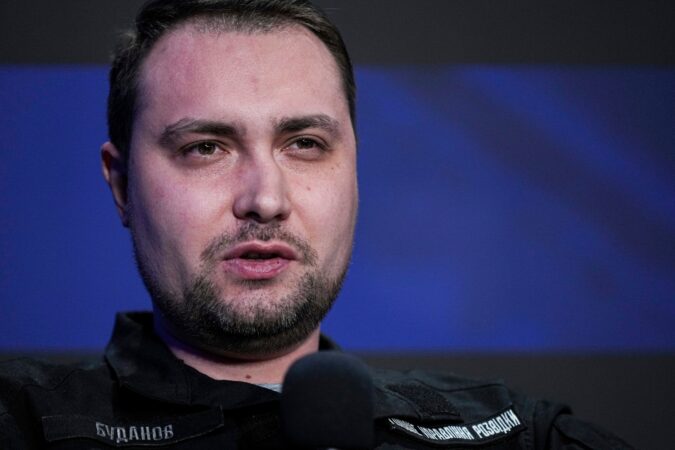
KYIV, Ukraine — President Volodymyr Zelensky on Friday appointed the head of Ukraine’s military intelligence as his new chief of staff, a move that comes as the U.S. leads a diplomatic push to end Russia’s nearly 4-year-old invasion.
Announcing the appointment of Gen. Kyrylo Budanov, Zelensky said Ukraine needs to focus on security issues, developing its defense and security forces, and peace talks — areas that are overseen by the office of the president.
Zelensky had dismissed his previous chief of staff, Andrii Yermak, after anti-corruption officials began investigating alleged graft in the energy sector.
The president framed Budanov’s appointment as part of a broader effort to sharpen the focus on security, defense development and diplomacy.
“Kyrylo has specialized experience in these areas and sufficient strength to achieve results,” Zelensky said.
Budanov, 39, said on Telegram his new position is “both an honor and a responsibility — at a historic time for Ukraine — to focus on the critically important issues of the state’s strategic security.”
In his evening address, Zelensky announced further changes to his team, saying he had proposed Mykhailo Fedorov, the current minister for digital transformation, as the new minister of defense.
Fedorov, 34, is credited with spearheading the introduction of drone technology in Ukraine’s army and introducing several successful e-government platforms in his current role.
He replaces Denys Shmyhal who took up the post last July in a major government shake-up. Zelensky thanked Shmyhal and said he would be taking up another role in government. He also credited the ministry for reaching a target production of more than 1,000 interceptor drones per day in December.
Earlier, Zelensky appointed Foreign Intelligence Service head Oleh Ivashchenko to replace Budanov as intelligence chief.
‘Prominent face of Kyiv’s intelligence effort’
Budanov is one of the country’s most recognizable and popular wartime figures. He has led Ukraine’s military intelligence agency, known by its acronym GUR, since 2020.
A career military intelligence officer, he rose through the defense establishment after Russia’s illegal annexation of Crimea in 2014. He also took part in special operations and intelligence missions linked to the fighting with Moscow-backed separatist forces in eastern Ukraine before the full-scale invasion of February 2022. He reportedly was wounded during one such operation.
Since the full-scale invasion, Budanov has become a prominent face of Kyiv’s intelligence effort, regularly appearing in interviews and briefings that mix strategic signaling with psychological pressure on Moscow. He has frequently warned of Russia’s long-term intentions toward Ukraine and the region, while portraying the war as an existential struggle for the country’s statehood.
Under Budanov, the GUR expanded its operational footprint, coordinating intelligence, sabotage and special operations aimed at degrading Russian military capabilities far beyond the front lines. Ukrainian officials have credited military intelligence with operations targeting Russian command structures, logistics hubs, energy infrastructure, and naval assets, including strikes deep inside Russian territory and occupied areas.
His appointment to lead the office of the president marks an unusual shift, placing an intelligence chief at the center of Ukraine’s political and diplomatic coordination.
Ihor Reiterovych, a Kyiv-based independent political expert, noted that Budanov had participated in the talks with the U.S. and “will fit much more naturally into the overall context” of the negotiations.
“Unlike Yermak, he has both experience in this field and has worked in a relevant position,” Reiterovych said, adding that the GUR also has had certain contacts with Russia on issues such as prisoner exchanges.
Russia reports a higher death toll from a strike
Russian authorities said Friday the death toll from what they called a Ukrainian drone strike on a cafe and hotel in a Russian-occupied village in Ukraine’s Kherson region rose to 28. Kyiv strongly denied attacking civilian targets.
Svetlana Petrenko, spokeswoman of Russia’s main criminal investigation agency, the Investigative Committee, said those killed in the village of Khorly, where at least 100 civilians were celebrating New Year’s Eve, included two minors, while 31 people were hospitalized.
A spokesman for Ukraine’s General Staff, Dmytro Lykhovii, denied attacking civilians. He told Ukraine’s public broadcaster Suspilne on Thursday that Ukrainian forces “adhere to the norms of international humanitarian law” and “carry out strikes exclusively against Russian military targets, facilities of the Russian fuel and energy sector, and other lawful targets.”
He noted that Russia has repeatedly used disinformation and false statements to disrupt the ongoing peace negotiations.
The Associated Press could not independently verify claims made about the attack.
Washington praises progress in negotiations
President Donald Trump’s special envoy Steve Witkoff said Wednesday that he, Secretary of State Marco Rubio, and Trump’s son-in-law and adviser Jared Kushner had a “productive call” with the national security advisers of Britain, France, Germany, and Ukraine “to discuss advancing the next steps in the European peace process.”
The U.S. efforts has faced a new obstacle earlier this week, when Moscow said it would toughen its negotiating stand after what it said was a long-range drone attack against a residence of Russian President Vladimir Putin in northwestern Russia early Monday.
Kyiv has denied attacking Putin’s residence, saying the Russian claim was a ruse to derail the negotiations.
In his New Year’s address, Zelensky said a peace deal was “90% ready” but warned that the remaining 10% — believed to include key sticking points such as territory — would “determine the fate of peace, the fate of Ukraine and Europe, how people will live.”
Overnight attacks
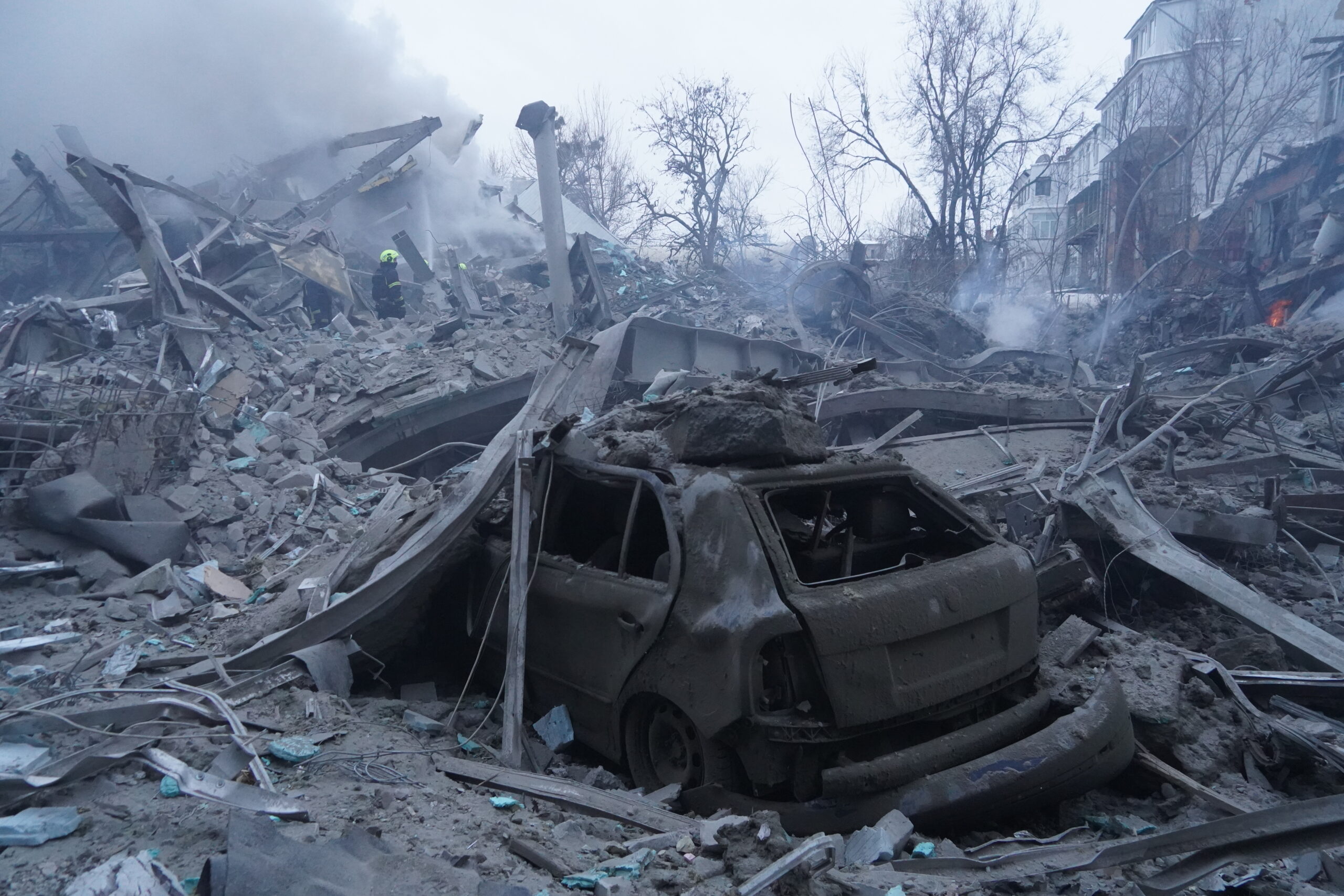
Elsewhere in Ukraine, Russia struck a residential area of Kharkiv with two missiles Friday, Zelensky wrote on his Telegram page, adding that Moscow’s forces “continue the killings, despite all the efforts of the world, and above all the United States, in the diplomatic process.”
At least 19 people in the eastern city were injured, including a 6-month-old, said regional administration head Oleh Syniehubov.
The Russian Defense Ministry denied launching any strikes with missiles or other airborne weapons on Kharkiv on Friday and suggested, without offering evidence, that the damage could have been caused by the detonation of ammunition at a weapons depot.
Earlier Friday, Russia conducted what local authorities called “one of the most massive” drone attacks at Zaporizhzhia. At least nine drones struck the city, damaging dozens of residential buildings and other civilian infrastructure but causing no casualties, according to Ivan Fedorov, head of the regional administration.
Overall, Russia fired 116 long-range drones at Ukraine, according to Ukraine’s air force, with 86 intercepted and 27 striking their targets.
The Russian ministry said its air defenses intercepted 64 Ukrainian drones overnight in multiple Russian regions.
The Russian city of Belgorod was hit by a Ukrainian missile, according to regional Gov. Vyacheslav Gladkov. Two women were hospitalized after the strike, which shattered windows and damaged an unspecified commercial facility and a number of cars in the region that borders Ukraine, he said.
Emergency services personnel work to extinguish a fire following a Russian missile attack in Kharkiv, Ukraine, on Friday.
CRANS-MONTANA, Switzerland — Investigators said Friday that they believe sparkling candles atop Champagne bottles ignited a fatal fire at a Swiss ski resort when they came too close to the ceiling of a bar crowded with New Year’s Eve revelers.
Authorities planned to look into whether sound-dampening material on the ceiling conformed with regulations and whether the candles, which give off a stream of upward-shooting sparks, were permitted for use in the bar.
Officials said they would also look at other safety measures on the premises, including fire extinguishers and escape routes. The attorney general for the Valais region warned of possible prosecutions if any criminal liability is found.
Arthur Brodard, 16, from the Swiss city of Lausanne, was among the missing. His mother, Laetitia, was in Crans-Montana on Friday and frantic to find him. She held out “a glimmer of hope” that he might be one of the six injured people who had yet to be identified.
“I’m looking everywhere. The body of my son is somewhere,” she told reporters. “I want to know, where is my child, and be by his side, wherever that may be — be it in the intensive care unit or the morgue.”
The injured included 71 Swiss nationals, 14 French, and 11 Italians, along with citizens of Serbia, Bosnia-Herzegovina, Luxembourg, Belgium, Portugal, and Poland, according to Frédéric Gisler, police commander of the Valais region. The nationalities of 14 people were unclear.
An evening of celebration turns tragic
Among the crowd was Axel Clavier, a 16-year-old from Paris, who said he felt as if he was suffocating inside the Swiss Alpine bar where moments before he had been ringing in the new year.
The teenager escaped the inferno by forcing a window open with a table. The dead included one of Clavier’s friends, and he told the Associated Press that two or three other friends were still missing hours after the disaster.
An impromptu memorial took shape near the bar, where mourners left candles and flowers. Hundreds of others prayed for the victims at the nearby Church of Montana-Station.
A French teenager on Friday brought a bouquet of tulips to the regional hospital in Sion for her best friend, a fellow 17-year-old girl who was badly burned and in intensive care. The two attend school together in Lausanne, said the girl, who was in distress and did not give her full name to the AP.
But when she arrived at the hospital, her friend had been heavily sedated for a dressing change and could not see visitors. It was the latest in hours of heartbreak for the teen, who had intended to join a dozen schoolmates at the bar but ultimately decided against it.
She said she has since learned that two of the 12 are in a Zurich hospital. She did not know if the others survived.
On Instagram, an account filled up with photos of people who were unaccounted for, and friends and relatives begged for tips about their whereabouts.
Valais regional government head Mathias Reynard told RTS radio Friday that officials have “numerous accounts of heroic actions, one could say, of very strong solidarity in the moment.”
He lauded the work of emergency officials on the day after the fire but added “in the first minutes it was citizens — and in large part young people — who saved lives with their courage.”
Servers arrived with burning sparklers
Clavier, the Parisian teenager, said he did not see the fire start, but saw servers arrive with Champagne bottles topped with the burning sparklers.
Two women told French broadcaster BFMTV they were inside when they saw a male bartender lifting a female bartender on his shoulders as she held a lit candle in a bottle. The flames spread, collapsing the wooden ceiling, they told the broadcaster.
One of the women described a crowd surge as people frantically tried to escape from the basement nightclub up a flight of stairs and through a narrow door.
Another witness speaking to BFMTV described people smashing windows to escape the blaze, some gravely injured, and panicked parents rushing to the scene in cars to see whether their children were trapped inside.
Gianni Campolo, a Swiss 19-year-old who was in Crans-Montana on vacation, raced to the bar to help first responders after receiving a call from a friend who escaped the inferno. He described people on the ground suffering from terrible burns.
“I have seen horror, and I don’t know what else would be worse than this,” Campolo told French television network TF1.
The severity of the burns made it difficult to identify bodies, requiring families to supply authorities with DNA samples. In some cases, wallets and any identification documents inside turned to ash in the flames.
Emanuele Galeppini, a promising 17-year-old Italian golfer who competed internationally, was officially listed as missing. His uncle Sebastiano Galeppini told Italian news agency ANSA that their family is awaiting the DNA checks, though the Italian Golf Federation on its website announced that he had died.
With high-altitude ski runs rising nearly 9,850 feet in the heart of the Valais region’s snowy peaks and pine forests, Crans-Montana is a major destination for international Alpine skiing competitions. It’s also home to the European Masters each August.
DIMONA, Israel — During the two years he was held captive in Gaza, Segev Kalfon had a recurring dream: slowly walking through a supermarket, browsing each aisle for his favorite foods, taking in the brightly colored packages and smells.
Since being released on Oct. 13, his dreams have flipped: Most nights when he closes his eyes, he is back on a dirty piece of foam mattress in the 22-square-foot room in a Hamas tunnel where he was kept with five other hostages, counting each tile and crack in the cement to distract himself from severe hunger and near-daily physical torture.
“I was in the lowest place a person can be before death, the lowest. I had no control over anything, when to eat, when to shower, how much I want to eat,” said Kalfon, 27. During the worst parts of captivity, he was so skinny he could count the individual vertebrae jutting from his spine.
Now that he’s back home in Dimona in southern Israel, Kalfon is trying to piece together a post-captivity life. He spends much of his time juggling appointments with an array of doctors and psychologists.
One of the strangest aspects of his release, Kalfon said, is that for two years, his entire life revolved around trying to please his captors, so they might share more food or spare a beating. Now that he’s out, “everyone is trying to please me,” he said.
From a family bakery to a Hamas tunnel
Before being taken hostage at the Nova music festival, Kalfon worked at his family’s bakery in the town of Arad and was studying finance and investments.
When rockets started flying at the start of the Hamas attack on Oct. 7, 2023, Kalfon said he and his closest friend tried to help others at the festival escape. Kalfon remembers pleading with a group of people who had taken cover in a yellow dumpster, telling them to come with him, that they were in a death trap. For two years, Kalfon wondered what happened to them. After his release, he learned they were all killed.
Hamas-led militants killed some 1,200 people and took about 250 hostages during their cross-border assault that day. Israel’s ensuing offensive has killed more than 71,000 Palestinians in Gaza, according to Gaza’s Health Ministry, which does not differentiate between civilians and combatants in its count. The ministry is part of the Hamas-run government and maintains detailed casualty records that are seen as generally reliable by U.N. agencies and independent experts.
While in captivity, every moment “felt like an eternity,” Kalfon said. The only thing that broke up the monotony was a meager portion of food and water once a day.
There were so many times he felt close to death: during frequent bombardment by the Israeli military, going through COVID and other illnesses with no medicine, enduring starvation and frequent physical torture. He said his captors used bicycle chains as whips and pummeled the hostages while wearing large rings to leave painful welts.
“We didn’t even have energy to yell out, because no one hears you,” he said. “You’re in a tunnel 30 meters underground; no one knows what’s going on.”
The worst part was the last three months of his captivity, Kalfon said, when he was kept in isolation and felt like he was losing his sanity.
In the darkest places, faith brings a ray of light
Both Kalfon and his family, advocating in Israel for his release, further turned to their Jewish faith to get through the dark times. Kalfon’s family filled their homes with additional Jewish books, ritual objects, and prayers from senior rabbis.
Kalfon and the other five hostages made a tradition of marking the start of Jewish holidays or the Sabbath by saying prayers over a bit of water and moldy pita.
The hostages used a square of precious toilet paper, where one roll had to last six people for two months, for the ritual skullcap that Jewish men traditionally wear during prayers.
A radio the captors had given to the hostages in hopes of converting them to Islam through recordings of the Quran sometimes allowed them to capture signals from Israeli news.
Once, when Kalfon was at his lowest and considering an escape attempt, which likely would have led to his death, he turned on the radio and heard his mother’s voice. He said it felt like a divine message to hold on for a little longer.
“I was living in the body of a dead person, living in a grave,” Kalfon said. “To get out of this grave, it’s nothing else if not a miracle.”
Kalfon was released along with 19 other living hostages as part of the U.S.-brokered ceasefire. He considers President Donald Trump a “messenger from God,” sure that no one else could have halted the fighting. His family has hung nearly a dozen American flags around the house in recognition of the U.S. contribution to his return.
‘War is starting with my soul’
Since his return, Kalfon is getting used to a new life, one where he is famous after his name and face were broadcast across Israel during the fight to release the hostages.
“Everyone wants to support me and say, ‘You’re such a hero,’” Kalfon said. “I don’t feel like a hero. Every person would want to survive.”
Kalfon knows he has a long journey to recovery after his years in captivity and a post-traumatic stress disorder diagnosis from before he was taken hostage.
“Although the war in Gaza is over, now my war is starting with my soul, to try to deal with thoughts that are very difficult,” he said.
He tries to keep his schedule busy to distract himself.
“But every night when I’m alone, it comes up,” Kalfon said. Even a small noise can startle him awake and thrust him into a terrifying flashback, so he barely sleeps.
For the immediate future, he wants to share his story more widely. He said he has been shocked by the rise in global antisemitism and anti-Israel fervor since he was captured and wants to make sure people hear his story, especially those who tore down posters of the hostages or accuse Israel of lying.
“I’m proof that it happened,” he said. “I felt it with my body. I saw it with my own eyes.”
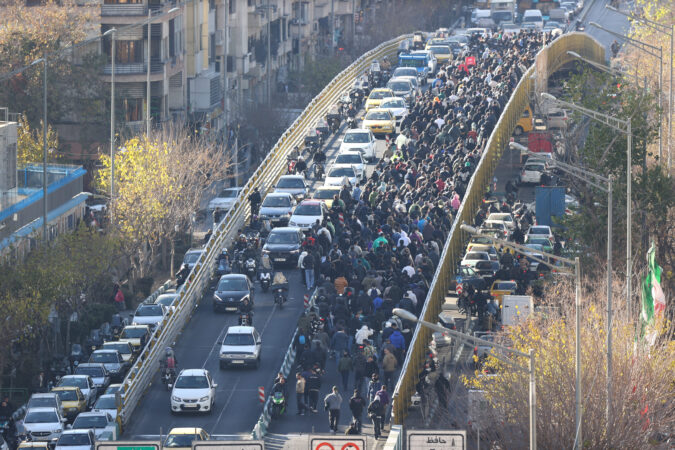
DUBAI, United Arab Emirates — President Donald Trump and top Iranian officials exchanged dueling threats Friday as widening protests swept across parts of the Islamic Republic, further escalating tensions between the countries after America bombed Iranian nuclear sites in June.
At least seven people have been killed so far in violence surrounding the demonstrations, which were sparked in part by the collapse of Iran’s rial currency but have increasingly seen crowds chanting anti-government slogans.
The protests, now in their sixth day, have become the biggest in Iran since 2022, when the death of 22-year-old Mahsa Amini in police custody triggered nationwide demonstrations. However, the demonstrations have yet to be countrywide and have not been as intense as those surrounding the death of Amini, who was detained over not wearing her hijab, or headscarf, to the liking of authorities.
Trump post sparks quick Iranian response
Trump initially wrote on his Truth Social platform, warning Iran that if it “violently kills peaceful protesters,” the United States “will come to their rescue.”
“We are locked and loaded and ready to go,” Trump wrote, without elaborating.
Shortly after, Ali Larijani, a former parliament speaker who serves as the secretary of Iran’s Supreme National Security Council, alleged on the social platform X that Israel and the U.S. were stoking the demonstrations. He offered no evidence to support the allegation, which Iranian officials have repeatedly made during years of protests sweeping the country.
“Trump should know that intervention by the U.S. in the domestic problem corresponds to chaos in the entire region and the destruction of the U.S. interests,” Larijani wrote on X, which the Iranian government blocks. “The people of the U.S. should know that Trump began the adventurism. They should take care of their own soldiers.”
Larijani’s remarks likely referenced America’s wide military footprint in the region. Iran in June attacked Al Udeid Air Base in Qatar after the U.S. strikes on three nuclear sites during Israel’s 12-day war on the Islamic Republic. No one was injured, though a missile did hit a radome there.
Iran’s Foreign Minister Abbas Araghchi wrote on X, formerly Twitter, that “the Great People of Iran will forcefully reject any interference in their internal affairs. Similarly, our Powerful Armed Forces are on standby and know exactly where to aim in the event of any infringement of Iranian sovereignty.”
Araghchi also said that Trump’s message likely was influenced by those who fear diplomacy between the two nations without elaborating.
Video circulated on social media late Friday showed protests continued in many cities across the country, including at least three points in the south and east of the capital Tehran. The Associated Press cannot independently verify the footage.
No major changes have been made to U.S. troop levels in the Middle East or their preparations following Trump’s Iran post, said a U.S. official, who spoke on condition of anonymity to discuss sensitive military plans.
Ali Shamkhani, an adviser to Supreme Leader Ayatollah Ali Khamenei who previously was the council’s secretary for years, separately warned that “any interventionist hand that gets too close to the security of Iran will be cut.”
“The people of Iran properly know the experience of ‘being rescued’ by Americans: from Iraq and Afghanistan to Gaza,” he added on X.
Iran’s hard-liner parliament speaker Mohammad Bagher Qalibaf also threatened that all American bases and forces would be “legitimate targets.”
Iran’s Foreign Ministry spokesperson Esmail Baghaei also responded, citing a list of Tehran’s longtime grievances against the U.S., including a CIA-backed coup in 1953, the downing of a passenger jet in 1988 and taking part in the June war.
The Iranian response came as the protests shake what has been a common refrain from officials in the theocracy — that the country broadly backed its government after the war.
Trump’s online message marked a direct sign of support for the demonstrators, something that other American presidents have avoided out of concern that activists would be accused of working with the West. During Iran’s 2009 Green Movement demonstrations, President Barack Obama held back from publicly backing the protests — something he said in 2022 “was a mistake.”
But such White House support still carries a risk.
“Though the grievances that fuel these and past protests are due to the Iranian government’s own policies, they are likely to use President Trump’s statement as proof that the unrest is driven by external actors,” said Naysan Rafati, an analyst at the International Crisis Group.
“But using that as a justification to crack down more violently risks inviting the very U.S. involvement Trump has hinted at,” he added.
Protests continue Friday
Demonstrators took to the streets Friday in Zahedan in Iran’s restive Sistan and Baluchestan province on the border with Pakistan. The burials of several demonstrators killed in the protests also took place, sparking marches.
Online video purported to show mourners chasing off security force members who attended the funeral of 21-year-old Amirhessam Khodayari. He was killed Wednesday in Kouhdasht, over 250 miles southwest of Tehran in Iran’s Lorestan province.
Video also showed Khodayari’s father denying his son served in the all-volunteer Basij force of Iran’s paramilitary Revolutionary Guard, as authorities claimed. The semiofficial Fars news agency later reported that there were now questions about the government’s claims that he served.
Iran’s civilian government under reformist President Masoud Pezeshkian has been trying to signal it wants to negotiate with protesters. However, Pezeshkian has acknowledged there is not much he can do as Iran’s rial has rapidly depreciated, with $1 now costing some 1.4 million rials. That sparked the initial protests.
The protests, taking root in economic issues, have heard demonstrators chant against Iran’s theocracy as well. Tehran has had little luck in propping up its economy in the months since the June war.
Iran recently said it was no longer enriching uranium at any site in the country, trying to signal to the West that it remains open to potential negotiations over its atomic program to ease sanctions. However, those talks have yet to happen as Trump and Israeli Prime Minister Benjamin Netanyahu have warned Tehran against reconstituting its atomic program.
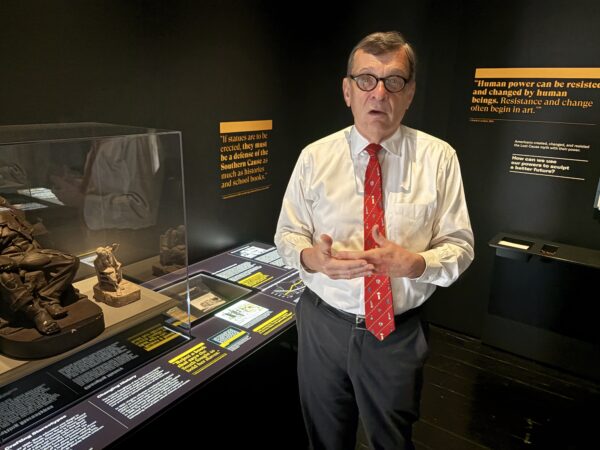
RICHMOND — In a cavernous gallery of the Valentine museum filled with marble busts and giant images of maps, Bill Martin gestured at a humble 1950s school history textbook in a display case.
“This is where it gets personal for me,” Martin said one day last August.
That book taught generations of young Virginia fourth graders — including Martin — that slavery was benign and enslaved people were happy. Now, as the director of a history museum, he had featured it in an exhibit that exploded the lies of the Southern “Lost Cause” mythology.
Martin has been one of the most beloved and influential figures in the movement to retell the story of Richmond — and, by extension, Virginia and the nation — in a more honest and clear-eyed fashion.
Over the weekend, Martin, 71, was struck by a vehicle and killed while crossing a street near the Valentine in downtown Richmond.
His sudden loss has brought an outpouring of grief and shock from a wide swath of the community, ranging from historians to activists to politicians.
“He stood in the gap for so many — helping to connect some of the very most complicated corners of the city through arts, culture, and history,” Sesha Joi Moon, co-leader of the JXN Project’s effort to commemorate a historic Black neighborhood, said in a written statement. Moon has been nominated as state director of diversity by Gov.-elect Abigail Spanberger.
“No one was more dedicated to fostering a deep understanding of Virginia’s complicated history than Bill Martin,” Sen. Tim Kaine (D., Va.) posted on X this week.
A bespectacled white man from rural Culpeper County with a soft Southern accent and a wit as sharp ashis penchant for neckties, William J. “Bill” Martin was an unlikely agent of reform in the former capital of the Confederacy.
He graduated from Virginia Tech and had worked at museums in Georgia and Florida before landing in Petersburg,Va., in 1987 to run that city’s museums and tourism effort. Martin joined the Valentine, which is dedicated to Richmond history, in 1994, just in time to see it nearly sink from depleted finances and low attendance.
Over time, Martin became known as the “dean” of Richmond’s many museums, a one-man welcoming committee for new directors and a clearinghouse for collaborative efforts.
He was a congenial force for change as the city wrestled with its complicated history. As recently as 2020, giant statues of Confederate leaders still loomed over busy intersections and enthusiasts waving the rebel battle flag regularly greeted traffic outside the national headquarters of the United Daughters of the Confederacy.
Martin led a long process to reorganize the Valentine, using community input to focus its collections and slowly homing in on a story he felt it was uniquely positioned to tell: the origins of the Lost Cause, the romanticized view of the South that took hold in the years after the Civil War. After all, one of the primary creators of the images that fueled the myth was sculptor Edward Valentine, first president of the museum that bears his family’s name and the artist behind some of the iconic statues of Confederate leaders.
When Martin’s changes to the museum’s messageprovoked hate mail and even death threats, he was known to invite his critics to lunch, as recounted last year by Richmond’s StyleWeekly magazine in naming him Richmonder of the Year for 2024. “You can’t do history and sit on the sidelines,” Martin told the magazine.
That philosophy was put into action in 2020 when Richmond’s streets erupted in racial justice protests over the killing of George Floyd by Minnesota police. One night in early June, Martin stayed alone at the Valentine in case there was rioting or vandalism. Police broke up demonstrations with chemical sprays and trapped protesters in a warren of downtown blocks, arresting them by the dozens.
As he described in an interview with the Post that year, Martin heard voices whispering outside a museum window and found several young protesters hiding in the bushes. He hustled them inside, helped wash the chemical spray out of their eyes with milk, and kept watch until it was safe for them to leave without being arrested. The next morning, he gathered rubber bullets and signs from the streets to display in the museum.
Only a few days later, protesters dragged down a statue of Confederate president Jefferson Davis from stately Monument Avenue. That touched off a series of events that saw city and state officials eventually remove almost all Confederate monuments from public spaces in the city.
Martin had quietly been angling to get Davis into the Valentine for several years, at least since the deadly Unite the Right rally in Charlottesville in 2017 began turning the tide of public opinion against the monuments. The Davis figure was an Edward Valentine creation — the former Confederate had posed for his likeness in the carriage house studio that now sits on the grounds of the museum.
While the rest of Richmond’s statues went into storage, the Davis — dented and spattered with paint — went on display at the Valentine. The museum convened community meetings to discuss how to remake the sculpture studio to better tell the story of what Valentine’s body of work had created.
On Aug. 19 of this year, reporters descended on the Valentine to see the Davis statue removed from the museum to be loaned to a gallery in Los Angeles. Martin was there, of course, and pulled a few reporters aside individually to show them something he considered more profound: the remade sculpture studio, located across a courtyard from the main gallery.
Where floor-to-ceiling shelves once held hundreds of pieces of Valentine’s work — studies of hands, heads, other body parts — now a black screen covered the far wall. A multimedia display would occasionally illuminate sculptures behind the screen, bringing them out of darkness to tell the story of how the South constructed a new narrative for itself after the Civil War.
Or, as Martin put it, “How does fiction become accepted truth?”
He emphasized that the answer to that question came not with lecturing or preaching but with facts. Around the room, quotes highlighted in orange signified primary sources — figures from the postwar era stating, clearly and in their own words, that they were devising a massive publicity campaign to burnish Southern honor.
“All that is left of the South is the ‘war of ideas,’ ” author Edward Pollard wrote in his 1866 book The Lost Cause, which was published in Richmond.
“If statues should be erected, they must be defensive of the Southern cause, as much as histories and school books,” sculptor Valentine wrote in a letter around 1900. He was a chief image maker of the movement, creating everything from the noble statue of Gen. Robert E. Lee that until recently represented Virginia in the U.S. Capitol to caricatures of happy, simpleminded Black people.
With an animated map, Martin demonstrated how grand monuments proliferated across Richmond — not in the immediate aftermath of the Civil War, but in the 20th century during the repression of Jim Crow, when the statues made the same intimidating point as the Ku Klux Klan Christmas parade that’s also depicted in the gallery. Similar tales played out across the South.
“Richmond is the only place” to tell that story, Martin said, “because you have every part of the history here.”
Martin spent more than 30 years investing in that belief. On Saturday, Dec. 27, he stopped by the Valentine to check in — as he often did on weekends, staffers said. He left around 2 p.m. and was just two blocks away, crossing Broad Street, when he was struck by a vehicle. Martin died the next day in a hospital.
Police have released little information about the incident, other than to say the driver remained at the scene and that the investigation is ongoing.
Martin’s leadership “helped shape the museum into the place it is today, and his impact will be felt for generations to come,” Meg Hughes, who will serve as acting director while the Valentine’s board seeks a replacement for Martin, said in a written statement to museum members. “We remain committed to serving our community and honoring the legacy that he leaves behind.”