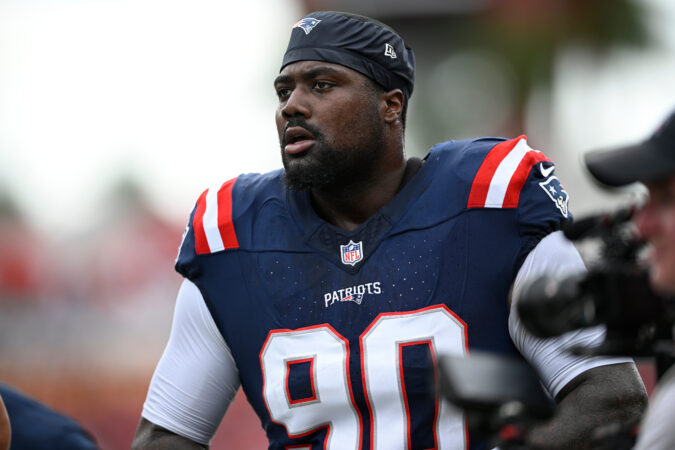
New England Patriots defensive lineman Christian J. Barmore is facing a domestic assault and battery charge after his girlfriend told police he threw her to the ground in August at his home outside Boston.
A criminal complaint issued Dec. 18 claims Barmore, 26, briefly took the woman’s phone, threw her to the ground, and grabbed her by the shirt inside the home in Mansfield, Mass.
Mansfield Police Sgt. John Armstrong said the woman called police on Aug. 25 to report what had occurred almost three weeks earlier. The woman told police she had stayed at the home periodically during their relationship of several years.
Barmore was a second-round draft pick in 2021 out of Alabama. He starred in high school at Lincoln before transferring to Neumann Goretti.
Barmore’s lawyer, David Meier, issued a statement Wednesday saying “the evidence will demonstrate that no criminal conduct took place.” Meier called it a personal matter and said he expected it to be “resolved in the near future and both parties will move forward together.”
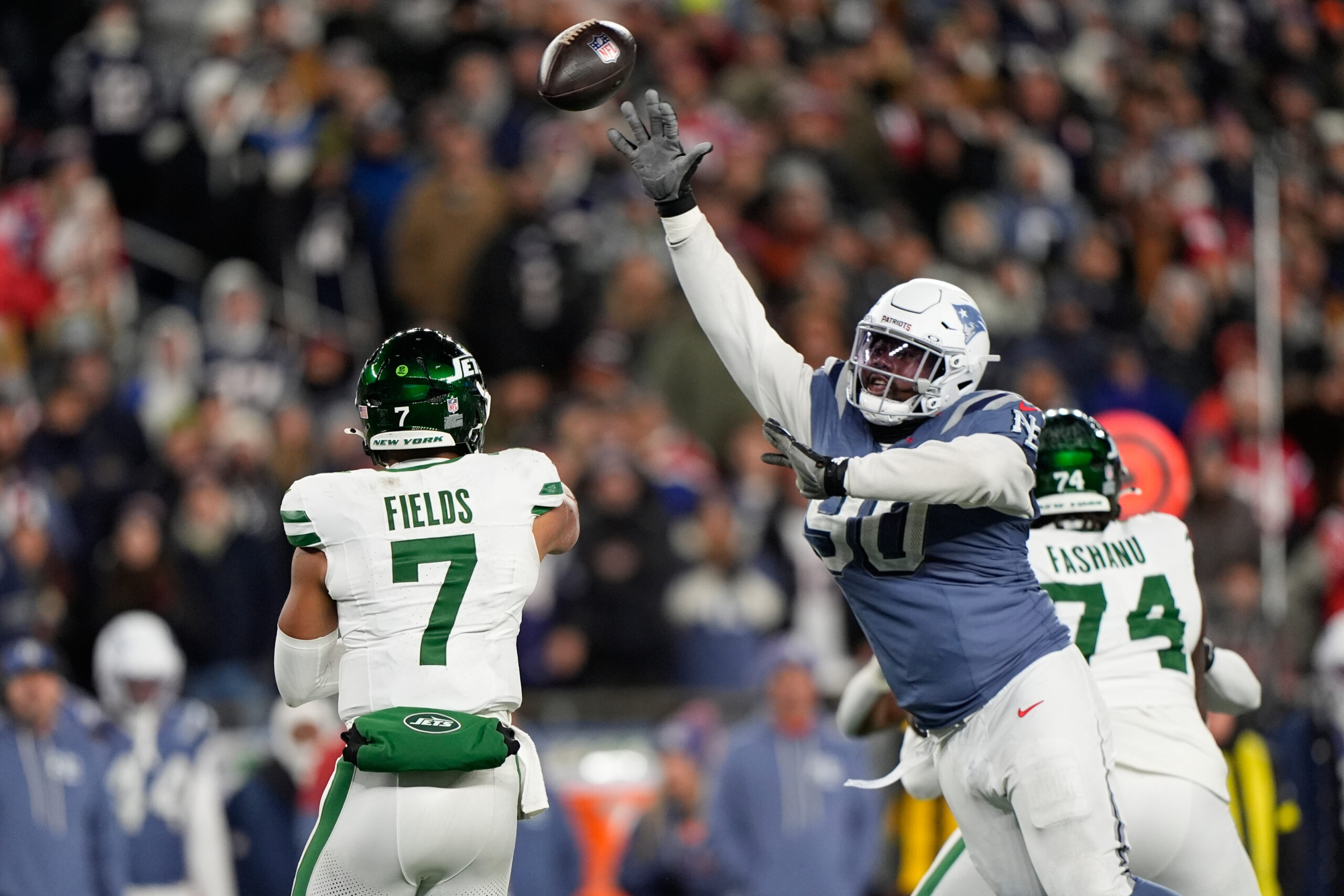
Jets quarterback Justin Fields throws a pass under pressure from New England’s Christian Barmore on Nov. 13.
The woman told police she took their daughter early the morning of Aug. 8 into Barmore’s bedroom, where Barmore was upset because the thermostat was 2 degrees warmer than he preferred. She said their daughter wanted to see him.
She claimed Barmore “picked up the child, placed her on the floor just outside the master bedroom, turned back into the room and slammed the door shut,” according to police.
As the woman packed her belongings to leave later in the day, Barmore took the phone from her hand and disconnected a call with the woman’s mother, according to the criminal complaint. When she headed for the front door to call for help, police said, Barmore allegedly “grabbed her before she could and threw her to the floor.”
Barmore grabbed her by the shirt but “eventually let go” and the woman got up, she told police. A car provided by the team picked up the woman and their daughter and drove them to Delaware. She provided police with a photo showing bruises she said occurred when she was thrown to the floor.
New England coach Mike Vrabel said that Barmore was away from the team with an illness Wednesday but that he hadn’t heard anything that would make him unavailable to play Sunday.
“We’ve made a statement and we’ve taken the allegations very seriously,” Vrabel said, referring to allegations against both Barmore and receiver Stefon Diggs. Diggs has been charged with felony strangulation or suffocation and misdemeanor assault and battery in a dispute with his former private chef.
“I don’t think we have to jump to any sort of conclusions right now. Let the process take its toll,” Vrabel said.
An arraignment was scheduled for early February. The charge is a misdemeanor.
The team’s public relations office e-mailed a statement saying it had been aware of the matter when it occurred and notified the league.
“The matter remains part of an ongoing legal process. We will respect that process, continue to monitor the situation closely, as we have over the past few months, and cooperate fully with the league,” the Patriots said.
It’s my annual tradition to take stock of big themes in technology, with a focus on positive developments for you in the past year. Here is the tally of the mostly good, but occasionally crummy, year in technology for 2025.
AI that’s useful and less creepy
I love the motto of Gabriel Weinberg, the CEO of web search and browser company DuckDuckGo: AI should be “useful, private, and optional.”
DuckDuckGo lets you access chatbots including ChatGPT but insists that the AI companies can’t access your data. (The Washington Post has a content partnership with ChatGPT owner OpenAI.)
You can turn off AI features in DuckDuckGo, too. I’m hoping that DuckDuckGo inspires more AI kill switches across the internet.
I’m declaring DuckDuckGo the best technology company of 2025. Even if you never use its products, DuckDuckGo shows that people and companies can challenge the Silicon Valley conventional wisdom that AI is inevitable, inescapable, and insatiable.
I’m also curious about the just announced encrypted chatbot from Moxie Marlinspike.
I haven’t tried it yet, but Marlinspike helped create the gold standard encryption that’s used by the Signal app, WhatsApp, Meta Messenger, and Google’s texting app for Android phones. If he can likewise establish a usable, private chatbot standard, that’s a boon for you.
And I never thought I’d say this, but I’m a convert to AI search technologies for questions and research that don’t work in standard web searches.
I asked ChatGPT recently for the Stephen King novel featuring a character that carves into the skin of another. (“It.”) I used Google’s AI Mode to poke into technology stock returns since the 2010s. It wasn’t perfect but it was useful to guide more intensive research.
Using AI search tools isn’t life changing. And AI still has the same problems. It risks draining precious resources, preying on vulnerable minds, wiping out jobs, or choking your favorite websites.
The worst technology of 2025 is a no brainer: AI “agents,” the chatbots or AI browsers that promised you could just tell AI what to do — order groceries or find the best mattress. Outside a handful of tasks such as software coding, agents are an overhyped mess.
It became glaring this year that many Americans mistrust, reject, or feel pessimistic about AI even as we use the technology more. That’s not a contradiction. It’s a warning sign.
The companies that make AI, and those of us who use it, must focus on judicious deployment of AI. We can insist that AI be useful, private, optional, and open about its shortcomings. And we must be clear-eyed about when AI is the wrong tool for the job.
A technology that beat inflation and got cheaper
Government inflation figures show that prices of wireless phone service have fallen this year. It shows that corporate warfare can actually help you.
Mobile phone carriers are increasingly fighting one another for customers. That has showered many people with steeply discounted new smartphones. There’s also a flourishing market for alternative mobile service providers that can save you loads of money.
The bad news: You can probably expect price increases in 2026 for laptops and some other electronics. Blame AI.
Gen Z protests and government workers showed technology’s empowering promise
In the United States, federal government workers who were stunned by the tumultuous start to the second Trump administration swarmed to Signal and Reddit to discuss what was happening, buck each other up, and share their experiences.
And in countries such as Nepal and Indonesia, young people disappointed in their political leaders used apps such as TikTok, Discord, and WhatsApp to spread memes, organize protests, and even appoint new political leaders.
These twin movements felt like an echo of the Arab Spring. Those early 2010s uprisings helped cement the idea that people could harness social media to unite against entrenched power.
As with the Arab Spring, 2025’s technology-aided movements might not bring lasting change. But they did remind us of technology’s promise to empower the little guys.
Saving the most important for last
The most important technology of 2025 is:
YouTube. It’s the place to understand where our culture, technology, and media are headed.
Google-owned YouTube remains America’s most popular social media service among adults and teens. It tops Facebook, TikTok, and Instagram by a country mile.
Americans also spend more time watching YouTube on TV than anything else. Netflix is a distant second, according to Nielsen.
YouTube has spawned news and entertainment empires that couldn’t have existed before, including MrBeast and Ms. Rachel. It’s also increasingly the home for big events such as football games and the Oscars. That combination has grabbed your time, advertisers’ dollars, and cultural influence away from traditional Hollywood and media gatekeepers.
That makes YouTube the most consequential technology in our lives and — with apologies to Netflix and the Ellison family — the most disruptive force in media and entertainment.
Runner-up: Smartphones. There will more attempts in 2026 at AI-dedicated smart glasses and other gadgets intended to displace the smartphone as the primary computer for billions of people. But it may be that the killer AI device is still the smartphone.
The naturalizations of the Kentucky-born movie star and his family were announced last weekend in the Journal Officiel, where French government decrees are published.
The government notice indicated that human rights lawyer Amal Clooney was naturalized under her maiden name, Amal Alamuddin. It also noted that George Clooney’s middle name is Timothy.
The couple purchased an estate in France in 2021. In an interview with Esquire in October, Clooney described their “farm in France” as their primary residence — a decision the 64-year-old actor and his 47-year-old wife made with their children in mind.
“I was worried about raising our kids in LA, in the culture of Hollywood,” he told the magazine. “I don’t want them to be walking around worried about paparazzi. I don’t want them being compared to somebody else’s famous kids.”
Growing up away from the spotlight in France, “they’re not on their iPads, you know?” he said. “They have dinner with grown-ups and have to take their dishes in. They have a much better life.”
Representatives for George Clooney did not respond to the Associated Press’ request for comment Monday. It wasn’t clear whether he retained his American citizenship. Amal Clooney was born in Lebanon and raised in the United Kingdom. The 8-year-old twins were born in London.
The French government’s Interior Ministry did not explain why the Clooneys were entitled to French citizenship but said in a statement to the AP that the couple “followed a rigorous procedure” with security checks and interviews required as part of the naturalization process.
Non-French residents of France have multiple possible routes to becoming naturalized, including if they are deemed to have abilities and talents that would enable them to render what the government describes as “important services to France.”
In recent media interviews when he was promoting Jay Kelly, Clooney said that he is trying to teach himself French using a language-learning app but that it remains “horrible, horrible.” He said that his wife and children speak the language perfectly.
“They speak French in front of me so that they can say terrible things about me to my face and I don’t know,” he joked, speaking to French broadcaster Canal+.
French media have reported that the Clooneys live part-time in their luxury 18th-century villa outside the town of Brignoles in southern France, where they can keep a lower profile and their children are protected from unauthorized photographs by French privacy laws.
Brignoles Mayor Didier Brémond told broadcaster BFMTV on Tuesday that the Clooneys are “a very simple and very accessible family” and noted that the actor shops in town and attended the opening of its cinema. Their decision to become French citizens testified to “his love for our country,” the mayor said.
“Here, he wants to live normally and that’s what he is trying to do,” he said.
Richard Smallwood, a gospel singer and recording artist nominated eight times for Grammy Awards, has died. He was 77.
Mr. Smallwood died Tuesday of complications of kidney failure at a rehabilitation and nursing center in Sandy Spring, Md., his representative Bill Carpenter announced.
Mr. Smallwood had health issues for many years, and music gave him the strength to endure, Carpenter said in an interview.
“Richard was so dedicated to music, and that was the thing that kept him alive all these years,” he said. “Making music that made people feel something is what made him want to keep breathing and keep moving and keep living.”
Mr. Smallwood’s songs were performed and recorded over the years by artists such as Whitney Houston, Stevie Wonder, Destiny’s Child, and Boyz II Men. Houston brought his music to film by performing “I Love the Lord” in the 1996 movie The Preacher’s Wife, according to Mr. Smallwood’s biography at the Gospel Music Hall of Fame.
Mr. Smallwood “opened up my whole world of gospel music,” singer and songwriter Chaka Khan wrote on Facebook after his death.
“His music didn’t just inspire me, it transformed me,” she said. “He is my favorite pianist, and his brilliance, spirit, and devotion to the music have shaped generations, including my own journey.”
Mr. Smallwood was born Nov. 30, 1948, in Atlanta and began to play piano by ear by the age of 5, according to biographic materials provided by Carpenter. By age 7, he was taking formal lessons. He had formed his own gospel group by the time he was 11.
He was primarily raised in Washington, D.C., by his mother, Mabel, and his stepfather, the Rev. Chester Lee “C.L.” Smallwood. His stepfather was the pastor of Union Temple Baptist Church in Washington.
Mr. Smallwood was a music pioneer in multiple ways at Howard University in Washington, where he graduated cum laude with a music degree. He was a member of Howard’s first gospel group, the Celestials. He was also a founding member of the university’s gospel choir, according to an obituary from Carpenter.
After college, Mr. Smallwood taught music at the University of Maryland and went on to form the Richard Smallwood Singers in 1977, bringing a contemporary sound to traditional gospel music. He later formed Vision, a large choir that fueled some of his biggest gospel hits, including “Total Praise.”
“Total Praise” became a modern-day hymn that touched people from all types of backgrounds and walks of life, Carpenter said by phone Wednesday.
“You can go into any kind of church — a Black church, a white church, a nondenominational church — and you might hear that song,” he said. “Somehow it found its footing throughout the whole Christian world. If he never wrote anything else, that would have put him in the modern hymn book.”
Wonder performed “Total Praise” at the funeral of the Rev. Dr. Martin Luther King Jr.’s son Dexter Scott King at Ebenezer Baptist Church in Atlanta on Feb. 10, 2024.
In recent years, mild dementia and other health issues prevented Mr. Smallwood from recording music, and members of his Vision choir helped care for him.
His legacy will live on “through every note and every soul he touched,” Khan said.
“I am truly looking forward to singing with you in heaven,” she said.
KYIV, Ukraine — Russian drones blasted apartment buildings and the power grid in the southern Ukraine city of Odesa in an overnight attack that injured six people, including a toddler and two other children, officials said Wednesday.
Russian President Vladimir Putin expressed confidence in his country’s eventual victory in the nearly four-year war against its neighbor.
Four apartment buildings were damaged in the Odesa bombardment, according to regional military administration head Oleh Kiper. The DTEK power provider said two of its energy facilities had significant damage. The company said 10 substations that distribute electricity in the region have been damaged in December.
Russia has escalated attacks on urban areas of Ukraine. As its invasion approaches a four-year milestone in February, it has also intensified targeting of energy infrastructure, seeking to deny Ukrainians heat and running water in the bitter winter months.
Between January and November, more than 2,300 Ukrainian civilians were killed and more than 11,000 were injured, the United Nations said earlier in December. That was 26% higher than in the same period in 2024 and 70% higher than in 2023, it said.
Renewed diplomatic push to stop the fighting
Trump’s special envoy Steve Witkoff said he, Secretary of State Marco Rubio, and Trump’s son-in-law and adviser Jared Kushner had a “productive call” with the national security advisers of Britain, France, Germany, and Ukraine “to discuss advancing the next steps in the European peace process.”
“We focused on how to move the discussions forward in a practical way on behalf of (Trump’s) peace process, including strengthening security guarantees and developing effective deconfliction mechanisms to help end the war and ensure it does not restart,” Witkoff said in a post on X.
He added that a main element of the conversation was the reconstruction of Ukraine and how to ensure its prosperity in the future.
Wednesday’s call comes after U.S. President Donald Trump hosted Ukrainian President Volodymyr Zelensky on Sunday and announced that a settlement is “closer than ever before.” European and Ukrainian officials plan to meet Saturday, lead Ukrainian negotiator Rustem Umerov reaffirmed, adding that U.S. representatives were expected to join remotely.
Zelensky also is due to hold talks next week with European leaders supporting his efforts to secure acceptable terms.
Putin is convinced of victory
Despite progress in peace negotiations, which he didn’t mention, Putin reaffirmed his belief in Russia’s eventual success in its invasion during his traditional New Year’s address.
He gave special praise to Russian troops deployed in Ukraine, describing them as heroes “fighting for your native land, truth, and justice.”
“We believe in you and our victory,” Putin said, as cited by Russian state news agency Tass.
The Russian Defense Ministry said 86 Ukrainian drones were shot down overnight over Russian regions, the Black Sea and the illegally annexed Crimea peninsula.
Russia claims Putin’s residence was attacked
Russia’s Defense Ministry released a video of a downed drone that it said was one of 91 Ukrainian drones involved in an alleged attack this week on a Putin residence in northwestern Russia, a claim Kyiv has denied as a “lie.”
The nighttime video showed a man in camouflage, a helmet and a Kevlar vest standing near a damaged drone lying in snow. The man, his face covered, talks about the drone. Neither the man nor the Defense Ministry provided any location or date.
The video and claims could not be independently verified.
Kyiv has denied the allegations of an attack on Putin’s lakeside country residence and called them a ruse to derail progress in peace negotiations.
Ukraine’s Center for Countering Disinformation said Wednesday the images could not be considered evidence of the attack as the origin of the damaged drone, as well as the time and location of the video itself, remained unknown.
“It took Russia more than two days to fabricate this ‘evidence’. The photographs of metal fragments laid out on the snow, published by the Russian Defense Ministry, do not prove anything in themselves,” the center said in a statement on its website.
“There is no video of air defense operations in the area of the residence, no recorded drone crashes in the claimed locations and no consistency even in its own figures, which have changed repeatedly.”
Maj. Gen. Alexander Romanenkov of the Russian air force claimed that the drones took off from Ukraine’s Sumy and Chernihiv regions. At a briefing where no questions were allowed, he presented a map showing the drone flight routes before they allegedly were downed by Russian air defenses over the Bryansk, Tver, Smolensk, and Novgorod regions.
The European Union’s foreign policy chief, Kaja Kallas, called the Russian allegations “a deliberate distraction” from peace talks.
Ukraine weapons fund receives billions of dollars
Zelensky said Romania and Croatia are the latest countries to join a fund that buys weapons for Ukraine from the United States.
The financial arrangement, known as the Prioritized Ukraine Requirements List, or PURL, pools contributions from NATO members, except the United States, to purchase U.S. weapons, munitions, and equipment.
Since it was established in August, 24 countries are now contributing to the fund, according to Zelensky. The fund has received $4.3 billion, with almost $1.5 billion coming in December, he said on social media.
Meanwhile, Ukraine’s Security Service carried out a drone strike on a major Russian fuel storage facility in the northwestern Yaroslavl region early Tuesday, according to a Ukrainian security official who was not authorized to speak publicly.
Long-range drones struck the Temp oil depot in the city of Rybinsk, part of Russia’s state fuel reserve system, the official told the Associated Press. Rybinsk is about 500 miles from the Ukrainian border.
U.S. Immigration and Customs Enforcement officials are planning to spend $100 million over a one-year period to recruit gun-rights supporters and military enthusiasts through online influencers and a geo-targeted advertising campaign, part of what the agency called a “wartime recruitment” strategy it said was critical to hiring thousands of new deportation officers nationwide, according to an internal document reviewed by the Washington Post.
The spending would help President Donald Trump’s mass-deportation agenda dominate media networks and recruitment channels, including through ads targeting people who have attended UFC fights, listened to patriotic podcasts, or shown an interest in guns and tactical gear, according to a 30-page document distributed among officials in this summer detailing ICE’s “surge hiring marketing strategy.”
The Department of Homeland Security has spoken publicly about its fast-tracked effort to significantly increase ICE’s workforce by hiring more than 10,000 new employees, a surge promoted on social media with calls for recruits willing to perform their “sacred duty” and “defend the homeland” by repelling “foreign invaders.” The agency currently employs more than 20,000 people, according to ICE’s website.
But the document, reported here for the first time, reveals new details about the vast scale of the recruitment effort and its unconventional strategy to “flood the market” with millions of dollars in spending for Snapchat ads, influencers and live streamers on Rumble, a video platform popular with conservatives. Under the strategy, ICE would also use an ad-industry technique known as “geofencing” to send ads to the phone web browsers and social media feeds of anyone who set foot near military bases, NASCAR races, college campuses, or gun and trade shows.
The document was also distributed among ICE officials in the days after the agency published a request for bids seeking contractors who could use “precise audience targeting, performance media management, and results-driven creative strategies” to “accelerate the achievement of [its] recruiting goals.” The language in the published bid closely mirrored language in the strategy document. That same month, DHS awarded two marketing firms nearly $40 million to support ICE’s public affairs office “recruitment campaign,” according to federal awards data.
It’s unclear how much of the spending and strategy have been carried out. But the plans outlined in the document have coincided with a rush of recruitment ads online seeking Americans who will “answer the call to serve.”
The rapid-recruitment approach is unlike anything ICE has ever pursued, said Sarah Saldaña, a director of ICE during the Obama administration, who recalled the agency filling its open positions through local police departments and sheriff’s offices with appeals to officers’ interests in federal public-safety work.
She said she worries that the speed with which ICE is racing to bring on new hires — coupled with the ad campaign’s framing of the jobs as part of a war — will raise the risk that the agency could attract untrained recruits eager for all-out combat.
The appeal to law enforcement should not be “the quicker we get out there and run over people, the better off this country will be,” she said. “That mentality you’re fostering tends to inculcate in people a certain aggressiveness that may not be necessary in 85 percent of what you do.”
ICE deferred comment toTricia McLaughlin, a DHS spokeswoman, who did not dispute a detailed list of claims and financial figures sent by the Post andsaid she was “thrilled to see the Washington Post highlight … [the] wildly successful ICE recruitment campaign, which isunder budget and ahead of schedule.”
The agency, she said, has received more than 220,000 job applications in five months and has issued more than 18,000 tentative job offers. More than 85% of the new hires had experience in law enforcement, she added.
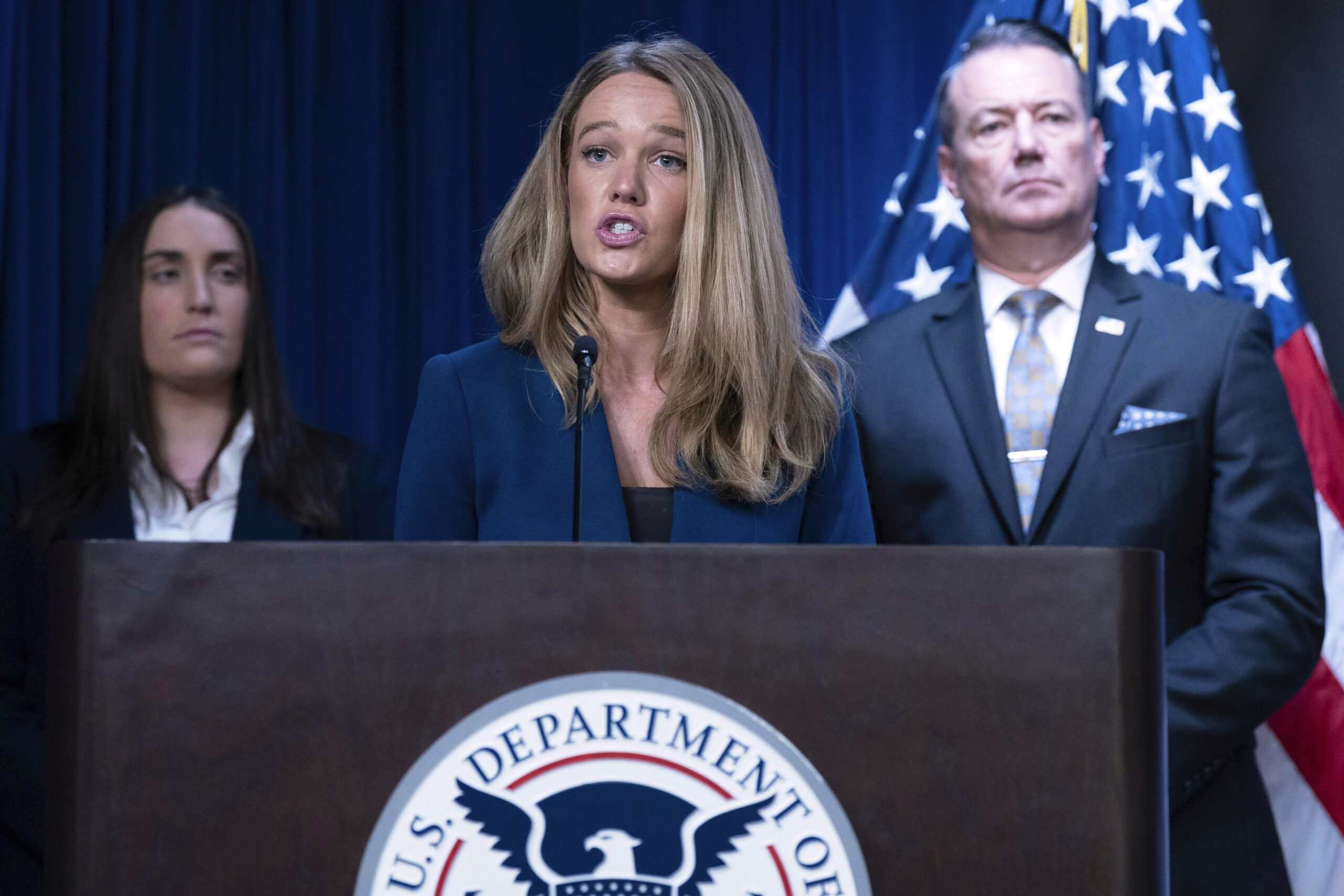
Tricia McLaughlin, spokeswoman for the Department of Homeland Security, is flanked by Madison Sheahan, second in command at ICE, and Todd Lyons, acting ICE director, at a May 21 news conference in Washington.
Congress this summer tripled ICE’s enforcement and deportation budget to about $30 billion by passing the One Big Beautiful Bill Act, helping to start a hiring spree that officials have said would be necessary to carry out the Trump administration’s promise of the biggest mass deportation in American history. Officials set a goal of 1 million deportations within the first year of Trump’s term.
To bolster its recruiting, the agency has removed its age limits for applicants and offered signing bonuses of up to $50,000. A job listing on a federal hiring board said the salaries for many deportation officers could range from $50,000 to $90,000 a year.
Recruitment ads have proliferated across TV, radio, print and podcasts directing viewers to an ICE hiring website that portrays immigration as an existential threat. “America has been invaded by criminals and predators,” reads the website, which includes an image of Uncle Sam. “We need YOU to get them out.”
On social media, administration accounts have mixed immigration raid footage with memes from action movies and video games to portray ICE’s mission as a fight against the “enemies … at the gates.” “Want to deport illegals with your absolute boys?” one post says. “Are you going to cowboy up or just lay there and bleed?” says another.
A U.S. Immigration and Customs Enforcement agent is seen in Park Ridge, Ill., on Sept. 19.
But to reach ICE’s “rapid hiring” goal of about 14,000 new Enforcement and Removal Operations officers, Homeland Security Investigations agents, ICE lawyers and support staff, the strategy document also calls for deploying more finely targeted digital advertising tools that can home in on viewers’ interests and lifestyles.
ICE recruitment ads, the plan said, would be shown to people with an interest in “military and veterans’ affairs,” “physical training,” or “conservative news and politics” and would target people whose lifestyles are “patriotic” or “conservative-leaning.”
The strategy said to target listeners of conservative radio shows, country music and podcasts related to patriotism, men’s interests and true crime, as well as any accounts that resemble users with an interest in “conservative thought leaders, gun rights organizations [and] tactical gear brands,” the document said.
To further attract recruits, the strategy called for spending at least $8 million on deals with online influencers whose followers are largely Gen Z and millennials and who were in the “military families,” “fitness,” and “tactical/lifestyle enthusiast communities.”
The document did not name specific influencers but said it would focus on “former agents, veterans and pro-ICE creators” who would be expected to host live streams, attend events and post short- and long-form videos and other content to Facebook, Instagram, Rumble, X and YouTube. Blogs, Substack newsletters, and Threads accounts would also be targeted for more “niche communities,” the document said.
The objective, it said, is to build trust through “authentic peer-to-peer messaging” and to “normalize and humanize careers at ICE through storytelling and lived experiences.” The document said it expected more than 5,000 applicants would come through the influencer program, costing ICE about $1,500 per application.
ICE has run ads on Google, LinkedIn, Instagram and Facebook, targeting the latter to military veterans and “entry-level job” seekers, according to the companies’ ad libraries, which share public data on the platforms’ ad campaigns. Millions more in advertising was slated for delivery to gaming consoles, connected TV devices and streaming services such as ESPN, Fox News and Paramount+, as well as across newspapers, billboards and box trucks, the strategy document said.
Listeners on Spotify have heard ICE ads calling on recruits to “fulfill your mission,” leading to hundreds of complaints on the music service’s message board. One NASCAR viewer who saw the ads on live streams said in a Reddit post that they changed the channel, and separately told the Post that they had “never felt such distaste for our government airing such ads.”
Natalia Banulescu-Bogdan, a deputy director at the Migration Policy Institute, a nonpartisan Washington think tank, said ICE’s ads harked back to World War I recruitment posters by using symbols like Uncle Sam.
The war rhetoric is in line with the Trump administration’s broader efforts to push mass deportations as critical to American security and immigration officials’ work as heroic, she said. But the ads also allow ICE to gloss over the “messy realities of immigration enforcement,” including “the public backlash, the legal pushback and the very real operational constraints.”
“We’ve never seen immigration agencies kind of strip down the policy debates to this level of raw imagery and symbolism,” she added.
The strategy document features on the cover ICE’s second-in-command, Madison Sheahan, who worked as an aide to DHS Secretary Kristi L. Noem when she was governor of South Dakota. In the photo, Sheahan, 28, wears a “police” vest and an ICE badge under the words “Defend the Homeland.”
The document called for spending “$100 million within one year” as part of an “aggressive” recruitment program that would “saturate digital and traditional media” and prioritize “speed, scale, and conversion at every level.”
Public ad-tracking figures from Google and Meta show ICE’s digital ad spending so far is a fraction of the strategy’s proposed budget for their platforms. McLaughlin, the DHS spokeswoman, did not respond to questions about how much money had been spent already or whether the strategy had changed.
Beyond demographic targeting, the strategy document also identified New York, Los Angeles, Minneapolis, Chicago, and Boston as “key locations” for finding recruits. The cities have been the targets of intense ICE sweeps and major anti-deportation protests over the last year.
The largest local recruitment target, seeking up to 1,000 removal officers, is slated for the New Orleans field office. The state of Louisiana has one of the country’s biggest immigrant detention populations, second only to Texas, and the New Orleans field office manages all nine detention facilities in the state.
ICE has hosted hiring events around the country, including at a Texas job fair earlier this year, during which a former mixed martial arts fighter told the Post he was eager to “work with these guys that are going to arrest you, slam your face on the pavement and send you home.”
But the strategy has also called for boosting recruitment at major gatherings and sporting events, including a booth at the NASCAR Cook Out Southern 500 in South Carolina in August; a “gym-based recruitment” event with “influencer-style content” at the UFC Fight Night in Las Vegas in November; and a planned sponsorship devoted to “patriotism, strength [and] grit” at the National Finals Rodeo this month in Las Vegas.
DHS did not say whether all the events proposed in the strategy were carried out, but their ads did accompany several of the events on TV. “ICE commercial during the UFC event tonight?! How gross,” one X user said in October. ICE also posted a bid in November seeking a firm to “identify suitable event locations” for “recruitment and outreach events.”
The recruitment ads run separately from other large-scale DHS campaigns that celebrate Trump’s immigration agenda and urge undocumented immigrants to leave the U.S. DHS has awarded more than $200 million in contracts this year to People Who Think and Safe America Media, two marketing firms linked to Republican political consultants, federal contracting records show. Representatives from the firms did not respond to requests for comment.
Those efforts, too, have relied on ad-targeting techniques more commonly used by corporate marketing campaigns. The ad library for Meta, which runs Facebook and Instagram, shows that DHS has spent more than $1 million on “self-deportation” ads in the last 90 days targeted to people interested in “Latin music,” “Spanish as a second language,” and “Mexican cuisine.”
On a message board for the music streaming service Pandora, some users were furious about the ads they called “fearmongering … propaganda.” One user, who said she is a U.S. citizen who likes listening to reggaeton, said she had been overwhelmed by DHS commercials “implying I am an undocumented immigrant and instructing me to ‘go home’” that played in “nearly every other ad slot I hear.”
ICE’s ads have drawn criticism from some Democrats, who have called them overly inflammatory. The Senate Judiciary Committee, led by Sen. Dick Durbin (D., Ill.), said in October that ICE’s “polarizing recruitment ads” would “only attract MAGA radicals.”
And some of the platforms on which the ads have run have expressed their own reservations. Earlier this month, a transit operator in Long Beach, Calif., removed ICE recruitment ads from its buses and apologized for the “uncertainty and fear” they may have caused, as was first reported by the Long Beach Watchdog, a local news source.
Americus Reed, a marketing professor at the University of Pennsylvania’s Wharton School, said the ICE strategy reminded him of the “Army of One” campaign that the military once used to build up recruits as mighty warfighters critical to safeguarding the American way of life.
“They’re aiming for that sweet spot of people who’ve got something to prove, who want to have that power, under the guise of patriotism,” he said.
The Kennedy Center adopted bylaws earlier this year that limited voting to presidentially appointed trustees, a move that preceded a unanimous decision this month by board members installed by President Donald Trump to add his name to the center.
The current bylaws, obtained by the Washington Post, were revised in May to specify that board members designated by Congress — known as ex officio members — could not vote or count toward a quorum. Legal experts say the move may conflict with the institution’s charter.
Trump took over the Kennedy Center in February, purging its board of members he had not appointed. The months that followed saw struggling ticket sales and programming changes that began to align the arts complex with the Trump administration’s broader cultural aims, culminating with the annual Kennedy Center Honors hosted by the president.
Days later, on Dec. 18, the board voted to add the president’s name to the institution, and within 24 hours it was on the website and the building itself: “The Donald J. Trump and The John F. Kennedy Memorial Center for the Performing Arts.”
Several artists have announced cancellations at the center as the unprecedented move drew public scrutiny and backlash. Democratic lawmakers and legal experts said it was illegal for the board to alter the name of the living memorial to Kennedy that Congress established. Democrats also claimed that one ex officio member, Rep. Joyce Beatty (D., Ohio), was muted when she attempted to speak out during the Dec. 18 vote.
Roma Daravi, the center’s vice president of public relations, told the Post that ex officio members have never voted.
“The bylaws were revised to reflect this longstanding precedent and everyone received the technical changes both before the meeting and after revisions,” Daravi wrote in an email to the Post. “Some members (including ex officio) attended in person, others by phone, and no concerns were voiced, no one objected, and the bylaws passed unanimously.”
The Kennedy Center lists 34 presidentially appointed board members, including Trump himself as chair, and 23 ex officio seats. The center’s president, Richard Grenell, is also an officer of the board.
The federal law that established the Kennedy Center designates specific government and federal positions — including the librarian of Congress; the mayor of Washington, D.C.; the secretary of the Smithsonian Institution; and the majority and minority leaders of the Senate — to serve as ex officio members.
The law identifies them as part of the board of trustees, which it directs to maintain and administer the facility as a living memorial. But it does not distinguish between voting and nonvoting members, which has been a point of ambiguity in the days following the vote to rename the Kennedy Center.
The center’s original bylaws didn’t distinguish voting powers, either. But its most recent tax filings list 59 “voting members” of its governing body — a total that includes both general and ex officio members.
A former Kennedy Center staffer with knowledge of board proceedings, who spoke on the condition of anonymity out of fear of retribution, told the Post that ex officio members were “always included in debate and discussion” during their tenure, but the person did not recall a time when those members’ votes were counted.
“Theoretically they could vote, but our practice was not to have them vote or count toward quorum,” the person said, noting they were not aware of the new leadership’s practices at the center.
For this report, the Post reached out to all ex officio members with questions about their voting authority and any known changes to it. Some told the Post or other outlets that they understood their current role to be nonvoting, though none addressed whether they were aware of any prior changes to that status.
“Like a lot of things, this seems to be in dispute,” said one person with knowledge of board proceedings, who spoke on the condition of anonymity because they were not authorized to speak on the matter.
Senate Majority Leader John Thune (R., S.D.) told a reporter Dec. 18: “I don’t have a vote. I don’t know enough about it.”
Sen. Sheldon Whitehouse (D., R.I.) told the Post that he became an ex officio member this year after he became the lead Democrat on the Senate Committee on Environment and Public Works — another ex officio seat designated by Congress — but was not invited to board meetings until his committee began investigating the Kennedy Center last month.
Whitehouse said the statute “makes no distinction between ex officio and presidentially appointed Trustees when it comes to members’ rights and responsibilities on the board, including voting,” and he accused the Trump-appointed board of attempting to “illegally change the bylaws to silence dissent.”
A spokesperson for the Smithsonian Institution said that Secretary Lonnie G. Bunch III does not vote or attend the meetings. It was unclear whether he had since assuming his role in 2019, but it is not uncommon for high officials serving on influential Washington boards to attend by proxy or not at all.
Copies of the Kennedy Center’s May and September board meeting minutes, obtained by the Post, showed that many ex officio members were absent or sent a staffer in their place.
Beatty, who sued the Kennedy Center’s board of trustees Dec. 22 to stop it from adding Trump’s name to the institution, declined to comment for this story. But her lawsuit argues the center’s statute makes her a “a full voting member.”
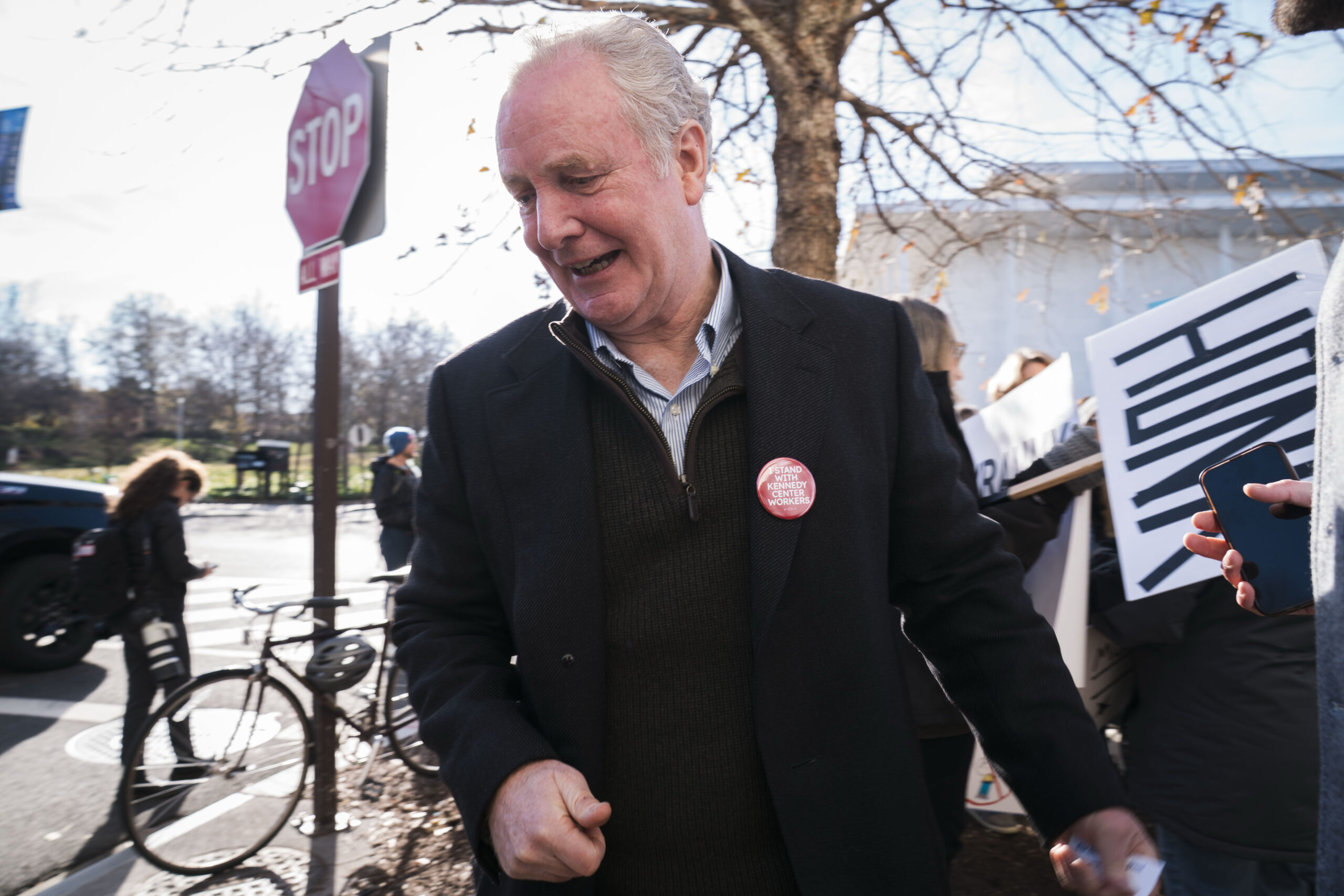
Sen. Chris Van Hollen (D., Md.) leaves a protest of the Kennedy Center name change in Washington on Dec. 20.
Sen. Chris Van Hollen (D., Md.), who is listed as an ex officio member on the Kennedy Center’s website, said he is no longer part of the board. “I was on the Kennedy Center board … in the last Congress,” he told the Post. “So their website is not caught up because I was told when Democrats lost control of the Senate and the Republicans became the majority that I fell off.” (The charter calls for three additional Senate members appointed by the president of the Senate and three House members appointed by the speaker to serve in ex officio seats.)
Many in high-ranking roles, including Secretary of State Marco Rubio, Health Secretary Robert F. Kennedy Jr. and Senate Minority Leader Charles E. Schumer (D., N.Y.), did not respond to requests for comment.
The offices of D.C. Mayor Muriel E. Bowser and the acting librarian of Congress, Robert Newlen, declined to comment.
Other changes from the May revision state that the general trustees “serve at the pleasure of the President.” (Previously, that language appeared in the bylaws and the federal statute only in reference to the Advisory Committee on the Arts, a separate body that makes recommendations to the board.)
They also added language about the ability of officers to make certain appointments, including stating that the chair may appoint the center’s president to act as chief executive.
The vote by the Kennedy Center’s board to add Trump’s name to the institution marked the most overt effort to date by the president and his allies to remold the storied performing arts center in his image.
In the days since his name was added to the building, several lawmakers have vowed to fight the change.
During a rally outside the Kennedy Center on Dec. 20, Van Hollen said he and his colleagues would work to “reverse” the move when Congress returns to session in January. “The day we get back, we can put an amendment on the … Interior appropriations bill to reverse this outrage,” he told the crowd.
Beatty’s lawsuit, filed in the U.S. District Court for the District of Columbia, claimed that the vote exceeded its statutory authority and requested that a judge declare it to be void.
“Because Congress named the center by statute, changing the Kennedy Center’s name requires an act of Congress,” the lawsuit says, adding that “Congress intended the Center to be a living memorial to President Kennedy — and a crown jewel of the arts for all Americans, irrespective of party.”
President Donald Trump, shown attending a showing of “Les Misérables” in June, has made himself a marquee element of the Kennedy Center.
Last week, Rep. April McClain Delaney (D., Md.) introduced legislation to remove Trump’s name.
Rep. Chellie Pingree of Maine, the top Democrat on the Appropriations subcommittee that oversees the Kennedy Center, along with more than 70 lawmakers in Congress, called for Trump to reverse the renaming effort and remove his name from the building immediately.
“No board vote nor social media post has the legal authority to change the name without an act of Congress,” the members wrote.
“We’ll be working to block this disgraceful renaming effort at every possible opportunity and restore the Kennedy Center’s rightful place as our nation’s cultural center without the burden of vanity projects or political influence,” they wrote.
Roger Colinvaux, a law professor at Catholic University, said his read of the statue establishing the center was “not quite as demonstrative” as Beatty’s, but “I’d argue that the statute does not differentiate among types of trustees in terms of powers and obligations, which would include voting.”
Colinvaux added that “basic governance principles” “do not allow for the ‘muting’ of members” of an entity’s governing body, which is a “deliberative body.”
Phil Hackney, a law professor at the University of Pittsburgh and a specialist in nonprofit tax-exempt organizations, said it’s worth noting “how ex officio trustees have traditionally operated” at both the Kennedy Center and the Smithsonian, of which the Kennedy Center is technically a bureau. He said that a court would also need to consider whether trustees are supposed to be able to remove ex officio members’ powers by amending bylaws.
That said, the statute says the trustees “have the usual powers,” and “it still strikes me, under what I see so far, that it is reasonable to believe that ex officio trustees might have the right to vote,” he said.
Ellen Aprill, senior scholar at UCLA School of Law, who has written about the Kennedy Center’s legal status, said even if the bylaws limit voting to general board members appointed by the president, “I believe there is a strong argument that such a bylaw provision violates the Kennedy Center’s charter.”
Aprill stressed that the charter includes a variety of public servants, and both majority and minority members of Congress in the Kennedy Center’s governance. “Clearly the intent of the charter provisions was to entrust Kennedy Center guidance to a broad group, not just those appointed by the president,” she said.
Still, the Kennedy Center’s relatively ambiguous legal status as a public-private entity “makes it difficult to predict how a judge faced with the issues in the case beyond standing would decide,” she said, noting the situation “is likely to give any judge a great deal of freedom in making any decision.”
Former Sen. Ben Nighthorse Campbellof Colorado, who overcame a hardscrabble childhood to become the first Native American chairman of the Senate Committee on Indian Affairs and a leader of the effort to build the National Museum of the American Indian in Washington, died Dec. 30. He was 92.
Mr. Campbell died surrounded by his family, his daughter, Shanan Campbell, told the Associated Press. A cause of death was not provided.
Mr. Campbell, a member of the Northern Cheyenne tribe, represented the western slope of Colorado for three terms in the U.S. House, starting in 1987, and served two terms in the Senate beginning in 1993.In each chamber, he was the only American Indian in office at the time.He immersed himself in public lands, water, and mining issues but made Indian causes the centerpiece of his legislative career.
In the button-down environs of Capitol Hill, Mr. Campbell stood out by arriving at work on a motorcycle, wearing a ponytail and a bolo tie with a handmade silver and turquoise clasp. His unusual resumé further set him apart from the many former lawyers in Congress.
In his youth, Mr. Campbell was a member of the first U.S. Olympic judo team. He became a Teamsters union truck driver, an Air Force military police officer, a trainer of champion quarter horses and a successful jewelry designer before entering public service, by his account, on a whim.
A fiscal conservative and social liberal, Mr. Campbell was elected first as a Democrat and made a high-profile switch to the Republican Party in 1995. He joined the Republicans, in part, he said, to protest Senate Democrats’ defeat of a GOP-backed proposed constitutional amendment to balance the budget.
He continued to support abortion rights and opposed attempts by some Republicans to cut spending for the federal school lunch program. The program sometimes accounted for “the only meal I got when I was a kid,” he said, recalling a childhood that also included years in an orphanage during the Depression.
Republicans had recently taken control of the Senate when Mr. Campbell joined their caucus, and they rewarded him with a seat on the Appropriations Committee, which controls government spending. In 1997, he was selected to chair the Indian Affairs Committee.
His involvement with the Smithsonian Institution’s National Museum of the American Indian dated to 1989, when he was a sponsor of legislation that authorized construction of a building on the National Mall and that required the Smithsonian to identify Indian remains and sacred objects in its vast collection and repatriate them to tribes requesting their return. The museum opened in 2004.
Unlike federal laws regarding water rights or tribal boundaries for Native Americans, the museum legislation “was about respecting their humanity,” said Kristen Carpenter, director of the American Indian Law Program at the University of Colorado.
John Echohawk, executive director of the Native American Rights Fund, a Colorado-based public interest law firm that has worked for decades to secure the return of Indian remains and sacred objects, said the legislation was a “key part of the process of educating” the publicabout Indian rights and sovereignty.
Fascination with judo
Benny Marshall Campbell was born in Placer County, Calif., northeast of Sacramento, on April 13, 1933.
His father, who dabbled in jewelry-making and ran a country store, tried to hide his Cheyenne Indian heritage in an era of rampant discrimination. “My father insisted we keep our Indian background a secret,” Mr. Campbell told his biographer, Herman J. Viola. “Don’t worry about it, we were told. Just keep your mouth shut. It doesn’t mean anything; don’t have anything to do with it.”
His mother, a Portuguese immigrant, suffered from tuberculosis and was in and out of healthcare facilities for much of his childhood. She struggled to look after Benny and his sister while their father,an alcoholic, spent long periods away on drinking sprees.
“It was all she could do, sick and weak herself, to take care of her little family,” Mr. Campbell recalled to Viola. Sometimes the only food in the house was a can of vegetables. “I remember one day, in fact, when my mother opened a can of peas and gave half of them to my sister and half to me,” he said. “All she kept for herself was the juice in the can.”
Mr. Campbell was 6 when his mother placed her children inan orphanage in Sacramento, an act that he said he never held against her, given the family’s struggles. They occasionally returned to her care when their father was home.
At roughlyage 12, Mr. Campbell began packing fruit at the many farms in the area. He worked alongside laborers of Japanese heritage and, in one heated moment, found himself ina fight with a young man Mr. Campbell assumedhe could easily knock to the ground.
Instead, to his shock, the man put him on the floor with a judo maneuver — and Mr. Campbell became a “convert” to the sport, he said. He joined a judo club established by Japanese residents in Placer County, and the sport became an obsession.
Heleft high school in 1950, during his junior year, to enlist in the Air Force at the start of the Korean War. He chose to be a military police officer,in part, because the training included judo lessons.
He completed his high school equivalency diploma in the Air Force and, after he left the service, used the GI Bill to enroll at San Jose State College (now university), partly because of its winning judo team. His biographer wrote that Mr. Campbell’s first marriage, which was annulled within months, and his second, to Elaine Morgan, ended, in part, because he “put judo first.”
After graduating in 1957 with degrees in physical education and fine arts, Mr. Campbell taught art and industrial arts at an elementary school near San Jose. When he learned in 1960 that judo would be introducedin the 1964 Tokyo Olympic Games, hequit his job, sold his house and car, and moved to Japan to enroll in a renowned judo program at Meiji University.
To support himself in Tokyo, he taught English and landed bit parts in Japanese movies. He won a gold medal at the 1963 Pan American Games in Sao Paulo, Brazil.
The next year, Mr. Campbell was part of a four-man U.S. Olympic team, but a knee injury forced him to drop out during the competition. Stunned and in pain, Mr. Campbell wept openly when he had to forfeit the match, according to his biographer.
Returning to California, hetook a job as a high school physical education teacher near Sacramento.
In 1966, he married Linda Price, and they had two children, Colin and Shanan. A complete list of survivors was not immediately available.
Entering politics
In the late 1960s, a period of protest and cultural resurgence among American Indians, Mr. Campbell joined thousands of Native American young people searching for their roots. He located relatives in the Northern Cheyenne tribe in Montana, became a member of the tribeand took the name Nighthorse.
Soon, Mr. Campbell moved his family to a ranch in Southwest Colorado and began raising champion show-ring quarter horses. He also made award-winning jewelry with Indian themes, using skills he learnedfrom his father, whotaught him how to carve wood and bone and shape metal from coins and tobacco tins.
With a thriving jewelry business, Mr. Campbell acquired a pilot’s license and purchased a single-engine plane to ease travel to jewelry shows and competitions around the country. One day in 1982, he found himself grounded by weather in Durango, Colo., and met up with a friend who was attending a Democratic Party gathering to nominate a candidate for the state House of Representatives.
Mr. Campbell, who had not been active in politics, volunteered when no one else agreed to run. He won election that November, with 54% of the vote, and served two terms before narrowly unseating one-term incumbent U.S. Rep. Mike Strang in 1986 in a congressional district that included the cities of Pueblo, Grand Junction, and Durango.
In the U.S. House, Mr. Campbell successfully co-sponsored legislation to rename the Custer Battlefield National Monument in Montana, which became the Little Bighorn Battlefield National Monument. The change, according to the National Park Service, was intended “to recognize indigenous perspectives” on the American Indian victory over Lt. Col. George A. Custer and his 7th Cavalry in June 1876. The legislation also authorized a prominent memorial to the warriors who died there.
In 1987, Mr. Campbell generated support to remove from theHouseInterior Committee hearing room a century-old painting, titled Death Whoop and depicting an Indian holding a bloody knife in one hand and a settler’s scalp in the other.
“It’s out of touch with the sensitivity of Indians,” Mr. Campbell told the Associated Press at the time. “It plays on the prejudice of man.”
After three terms in the House, Mr. Campbell ran in 1992 for an open Senate seat and won the general election with support from organized labor, energy interests, ranchers and Hispanic voters.
He did not seek reelection in 2004, citing poor health. He had been treated for prostate cancer the previous year.
Yet it was his vigor that most colleagues recalled.
On one occasion, he chased down a mugger who had accosted him. In 1995, when he was 62, he used his martial arts skills to help subdue a homeless man who had shoved 92-year-old Sen. Strom Thurmond (R., S.C.) and then attacked a Capitol Police officer.
Alluding to his colleague’s physical prowess, Sen. Mitch McConnell (R., Ky.) wryly observed when Mr. Campbell retired that “many senators became a little more inclined to vote for his amendments after that.”
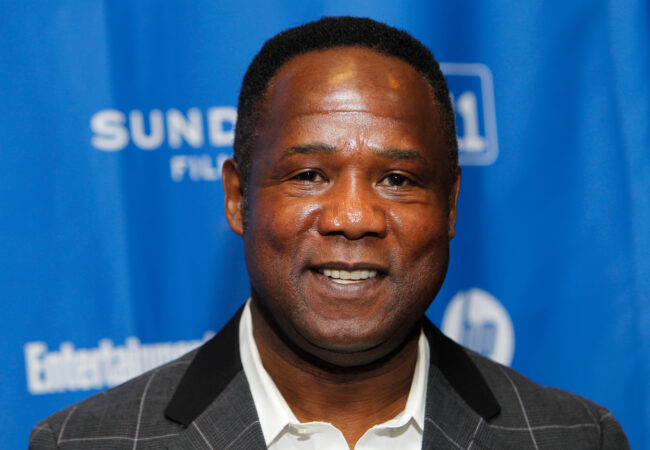
Isiah Whitlock Jr., an actor who made frequent memorable appearances on the HBO series The Wire and Veepand in five films with director Spike Lee, died Tuesday. He was 71.
Mr. Whitlock’s manager Brian Liebman told the Associated Press in an email that the actor died in New York after a short illness.
Mr. Whitlock played openly corrupt State Sen. Clay Davis on 25 episodes across the five seasons of The Wire.
Davis, a fan-favorite character, was known for his profane catchphrase — “sheee-it” — delivered by Mr. Whitlock in moments of triumph and blunt honesty. The actor first used the phrase in his first film with Lee, 2002’s The 25th Hour, when his detective character discovers a cache of drugs hidden in a couch.
“It’s a big, big, big loss,” Lee said in a phone call with the AP on Tuesday night. “I’m going to miss him for the rest of my life.”
Mr. Whitlock went on to appear in five other Lee films, including 2004’s She Hate Me, 2012’s Red Hook Summer, 2015’s Chi-Raq, 2018’s BlacKkKlansman, and 2020’s Da 5 Bloods.
“We vibed over all those years,” Lee said. “We clicked from the jump.”
Lee said he has especially sweet memories of the extended time he spent with Mr. Whitlock shooting Da 5 Bloods on location in Thailand, and he fondly remembered the last time he saw Mr. Whitlock — Lee and his daughter, Satchel, sat with him at a screening of Kiss ofthe Spider Woman earlier this year.
“He was just a beautiful, beautiful soul,” Lee said. “If you were around him, he made everybody feel good in his presence. He would radiate. I would put that over his acting.”
Lee pointed to Mr. Whitlock’s comic talents both on screen and off.
“He was hilarious,” Lee said. “That was just his nature, he made people laugh. Everybody was in on the joke.”
Mr. Whitlock is the second significant star of The Wire to die in recent weeks after the death of actor James Ransone.
A native of South Bend, Ind., Mr. Whitlock went to Southwest Minnesota State University, where he played football and studied theater. Injuries pushed him to study acting, and he moved to San Francisco to work in theater.
He began appearing in small television guest roles on shows including Cagney and Lacy in the late 1980s, and he had very small roles in the 1990 films Goodfellas and Gremlins 2: The New Batch.
After The Wire, Whitlock moved on to another HBO show, the political satire Veep, where he played Secretary of Defense George Maddox for three seasons. The character ran against Julia Louis-Dreyfus′ Selina Meyer in presidential primaries.
The Wire creator David Simon also paid tribute to Mr. Whitlock in a post on Bluesky.
“As fine an actor as he was,” Simon said, “Isiah was an even better spirit and the greatest gentleman.”
It may be difficult to remember now — here at the end of 2025, with major sports so entwined with gambling as to make you wonder whether our games still exist to crown champions or merely as fodder for young, twitchy-fingered sportsbook customers — but not so long ago, sports leagues spoke of the gambling industry as if it were the devil itself.
“It’s evil,” Bud Selig, then MLB’s commissioner, said in November 2012 of the dangers of gambling. “It creates doubt, and it destroys your sport.”
“Gambling,” NFL Commissioner Roger Goodell said that same week when asked about threats to pro football’s integrity, “would be number one on my list.”
Both statements were made under oath, in depositions pertaining to a lawsuit filed by America’s major sports leagues against the state of New Jersey over its plans to legalize sports gambling. Eventually, that case would wind up before the Supreme Court, which in 2018 handed down a landmark decision, Murphy v. NCAA, that effectively legalized sports betting nationwide.
Faced with that new reality, those same American sports leagues didn’t merely shake hands with an industry they once regarded as the enemy; they leaped into bed with it — and in the process fundamentally altered the way sports are packaged, marketed, and consumed.
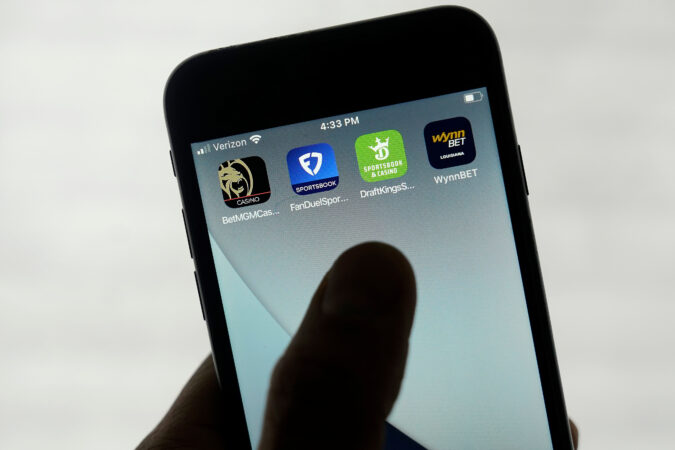
Stadiums plastered with ads for sportsbooks. Broadcasts filled with gambling commercials and commentary on betting lines and odds. An ever-growing menu of live, in-game microbetting opportunities — effectively giving fans a casino in their pocket. In 2024 alone, Americans legally wagered a record $148 billion on sports, more than 95% of it online, and they will almost certainly surpass that figure in 2025.
But 2025 may also be remembered as the year a reckoning began over the unholy marriage of sports and legalized gambling. Betting scandals rocked the NCAA, the NBA, and MLB. At the same time, the modern phenomenon of athletes being harassed and threatened online by angry bettors grew into something resembling an epidemic. In both cases, the driving force appeared to be the ubiquity and ease of prop bets — those focusing on a specific player’s events or performance as opposed to the outcome of a game.
Largely as a result, the integrity of games — perhaps the most precious commodity in sports and the one that once united the leagues’ commissioners against gambling — is increasingly being called into question, a trend some are calling an existential threat to the long-term viability of sports.
“It doesn’t matter if, as I believe, 99.99% of the competition is untainted by gambling,” longtime sports commentator Bob Costas said. “All you need are a few examples for people to make the leap of logic to ‘I can’t trust any of it.’ You have to literally put [the doubts] aside. You have to compartmentalize all of this stuff to have the same relationship you once had to what you’re watching.”
This month, a Washington Post-University of Maryland poll of 1,032 American adults found plummeting support for sports gambling nationwide, compared with a similar poll conducted in 2022, and widespread concern about the possibility of fixed or rigged outcomes. Some of the largest drops in support for legalized gambling came from frequent sports consumers and those who bet on sports — the ones who know best the havoc it has wrought.
Overall, 66% of respondents, including 72% of those who have gambled in the past five years, expressed concern that games could be fixed or rigged. If you think those numbers sound high, try this experiment: The next time you’re watching a big game, search for “rigged” along with one of the teams’ names on social media, and prepare to be amazed by the constant stream of users dropping that term as they decry each misplay or blown call.
“The integrity of American sports is plummeting in terms of public perception,” Sen. Richard Blumenthal (D., Conn.) said in a telephone interview. Blumenthal co-sponsored a bill, the SAFE Bet Act, that, while focusing largely on the public health issues surrounding gambling, also would restrict some in-game prop bets. “Americans are becoming cynical and disgusted after all these repeated scandals involving big money corrupting sports.”
‘People have been too greedy’
Americans long ago made peace with the post-reality media environment in which we are living. TikTok’s algorithm pumps fake videos into users’ feeds. Spotify is full of AI-generated pop songs interspersed with real ones. The federal government routinely disseminates altered videos. We can even accept feature-length documentaries “enhanced” with so-called “synthetic materials.” The financial success and relative lack of outrage suggest we have stopped trying to discern between real and fake. We have stopped caring.
But sports are required to be different. Reality, above all else, is what they are selling. It is the last remaining entertainment enterprise that demands to be viewed live. Remove the authenticity of the competition and the credibility of the outcomes, and the whole thing collapses.
Only in high-level sports — and only in the name of authenticity — would leagues ban specific drugs and even over-the-counter supplements because they might give one side an unfair advantage, or spend five minutes in the replay booth examining a play from seven different angles because it is imperative above all else to get the call right.
“No matter how unfair life may be in other arenas,” Costas said, “people turn to sports and expect them to be completely fair.”
The about-face on gambling is staggering. MLB once banned Mickey Mantle and Willie Mays for taking jobs as casino greeters. Now it tacitly accepts David Ortiz serving as a pitchman for DraftKings, offering new customers the chance to “win Big Papi’s money.”
The major American sports leagues would never acknowledge that aligning themselves with the gambling industry equated to an abandonment of the mission of integrity or even a compromise.
“Our highest priority has been protecting the integrity of the game” read a memo reportedly sent by the NFL to its 32 teams in the aftermath of this year’s NBA and MLB scandals.
“Obviously, our number one priority,” MLB Commissioner Rob Manfred told reporters during this fall’s World Series, “is to protect the integrity of the game.”
One bedrock axiom of the sports industry’s partnership with sportsbooks is the notion that it is far easier to catch cheaters under the regulated system of legalized sports betting than it was when everything was underground. The scandals making headlines, the industry says, only prove the system of regulation and monitoring is working.
But experts in the field of sports integrity and gambling say the monitoring entities tasked with flagging suspicious activity can be commercially conflicted because they are the same entities providing the data feeds fueling global betting — a case of “the fox guarding the henhouse,” according to Nick Raudenski, a former criminal investigator for the Department of Homeland Security who now runs a sports integrity consultancy firm. “Integrity and independence,” he said, “have to be championed as fundamental sporting objectives, not a form of detrimental risk to be buried far from view.”
“The people who should be guarding [sports leagues’] credibility are involved in multibillion-dollar deals with the very product that is bringing [the threat]. People have been too greedy, too fast on the legalization of sports gambling,” said Declan Hill, a professor at the University of New Haven and author of “The Fix: Soccer and Organized Crime.” “It desperately needs [enhanced] regulation. It desperately needs sports leagues to take a long step back.”
‘So easily lost and so hard to regain’
With the benefit of hindsight, the current predicament may have been the inevitable result of rushing to deliver a known addictive product, via an addictive personal device, into the hands of a cohort — young, male sports fans — that is predisposed to risky behavior. Imagine if, at the end of Prohibition, the alcohol industry had the data to know which customers were most susceptible to getting hooked on booze and the technology to put it within reach of those customers anytime, anywhere.
“This is the dance with the devil that the leagues are doing and have done,” Hill said. “It seemed really attractive at first … but now comes the payment. Now comes the cost.”
Hill believes one problem is that we have not come to terms with the problem of gambling addiction among the athletes themselves — who, after all, largely come from the same demographic as the consumers targeted by the industry. One study found athletes were four times as likely as the general public to become addicted to gambling.
Jontay Porter, the former NBA center who received a lifetime ban last year in part for feigning injuries to manipulate certain “under” bets on his performance — incidents that were caught in large part because of integrity monitors that flagged suspiciously large wagers on an obscure player — was addicted to gambling and deep in debt at the time of his transgressions, according to his lawyer.
“Everything that makes an athlete great makes them susceptible to gambling addiction,” Hill said. “They never give up. They isolate themselves and obsess on overcoming great odds, on doing things people wouldn’t believe were possible. That’s great if you’re an athlete. But it makes you a lousy gambler.”
The problem of “spot-fixing” — manipulating individual prop bets — has proved to be particularly insidious. Throwing a game or tilting a point spread requires scores of machinations, but prop bets can be swung in an almost undetectable manner by a single athlete: Just one missed free throw, one dropped pass or one double fault can make someone a fortune.
These prop bets, as well as multi-bet parlays in which bettors stack props and get a much larger payoff if they all hit, have become the sportsbooks’ biggest moneymakers — which is another way of saying they are unlikely to be legislated out of existence despite recent efforts such as state bans of college athlete props and MLB convincing sportsbook partners to cap pitch-level props at $200 each.
It remains to be seen whether 2025 — for all its upheaval, scandal. and shifting public sentiment — represents a turning point in the relationship between sports and gambling. If anything, the sports gambling industry is still growing, still reaching new customers — one study found gambling ads and logos were shown to viewers at a rate of one every 13 seconds during some broadcasts — and still exploring new products. One of the latest: the NHL’s recent partnerships with Kalshi and Polymarket, predictions markets that allow users to bet on yes-or-no outcomes ranging from sporting events to elections to who will win the latest season of “Survivor.” This fast-growing industry operates outside the licensing and regulatory systems that govern sportsbooks.
But new and bigger industry models undoubtedly will bring new and bigger opportunities for corruption.
“You ain’t seen nothing yet,” Hill said. “There is a wave of stuff to come.”
If that’s the case, it’s fair to wonder how close we are to a breaking point. Already, recent polling, such as the Post-UMD one, suggests the accumulation of scandals has led many sports fans to question the legitimacy of what they are watching. Once the possibility of spot-fixing nestles in your mind, it can be hard to shake. Suddenly, every time a pitcher unleashes a fastball to the backstop, it’s only natural to wonder whether it was an honest mistake — or a dishonest one.
Such questions, Blumenthal said ruefully of his own sports viewing, are “always in the back of my mind. There’s always something there if a pass is dropped or a pitch is missed. Trust and credibility are so easily lost and so hard to regain.”