Category: Regional News Wires

  • U.S. says chemical maker Chemours to pay $450M to settle ‘forever chemicals’ case

    U.S. says chemical maker Chemours to pay $450M to settle ‘forever chemicals’ case

    WASHINGTON — The Trump administration on Wednesday reached a multistate settlement with chemical giant Chemours Co. over yearslong, illegal discharges of synthetic “forever chemicals” used to make products resistant to water, grease, and stains. The settlement is the first by the federal government to resolve enforcement claims against a manufacturer of harmful chemicals known as PFAS.

    Under the agreement, filed in federal court in West Virginia, Chemours will pay a civil penalty of $22.5 million for alleged violations and spend $90 million over 15 years to mitigate PFAS discharges in three states: West Virginia, North Carolina, and New Jersey.

    Wilmington-based Chemours, a spin-off of chemical maker DuPont, also agreed to install PFAS pollution controls for surface water discharges and air emissions at a West Virginia facility at an estimated cost of $60 million, supply clean drinking water to communities near its West Virginia and New Jersey sites at an estimated cost of $280 million, and implement controls to reduce releases of PFAS and other toxic chemicals from its facility in North Carolina.

    Combined, the penalties and relief programs are estimated to cost about $450 million, the Justice Department said.

    The settlement allows Chemours to continue manufacturing PFAS for commercial and military applications while preventing future contamination and protecting communities from existing pollution, said Adam Gustafson, principal deputy assistant attorney general for the Environment and Natural Resources Division.

    Justice Dept. says settlement protects public health

    “The Trump administration recognizes the important role of Chemours for its commercial and military obligations,” Gustafson said in an interview. “The settlement protects public health while preserving that important balance.”

    The settlement against a major PFAS manufacturer “delivers on the Trump administration’s promise to make polluters pay and stop PFAS contamination at the source,” said Jeffrey Hall, assistant EPA administrator for enforcement and compliance assurance.

    The agreement will greatly reduce PFAS contamination of water, land, and air and even begin to mitigate past harm, Hall said. “This settlement brings Chemours into compliance with the law and holds it fully accountable,” he said.

    In a statement Wednesday, Chemours said it has already begun planning and implementing operational improvements at its facilities and will take steps to mitigate future emissions and enhance existing programs.

    “This settlement provides Chemours with greater clarity on future compliance requirements and actions to support long-term responsible manufacturing,” spokesperson Jess Loizeaux said.

    The settlement comes as the Trump administration is expected to propose softening Biden-era limits on “forever chemicals” in drinking water, while delaying but keeping tough standards for two common types of the substance.

    The proposal will start the formal process of rolling back parts of the first-ever limits on PFAS in drinking water finalized during former President Joe Biden’s administration. Officials at the time found they increased the risk of cardiovascular disease, certain cancers, and babies being born with low birth weight.

    The agency is committed to addressing per- and polyfluoroalkyl substances (PFAS) in drinking water while following the law and ensuring that regulatory compliance is achievable for drinking water systems, EPA Administrator Lee Zeldin said.

    Chemours discharged PFAS into rivers in three states

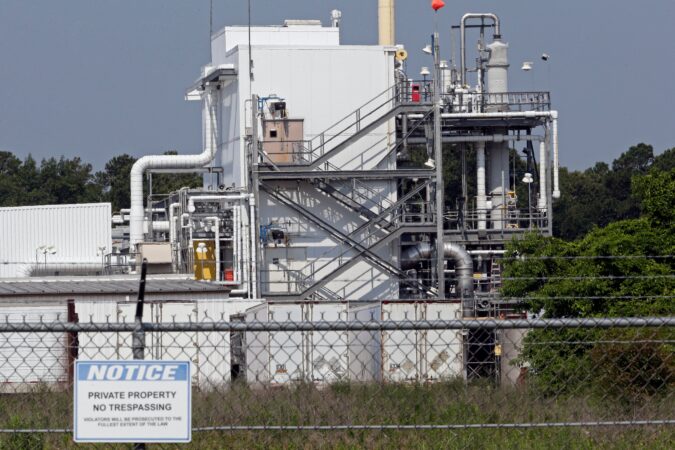
    The settlement determined that facilities Chemours operates in the three states have discharged PFAS into the Ohio River, Cape Fear River, and Delaware River in violation of permits required by the Clean Water Act and state laws. Chemours also violated legal requirements under the federal Toxic Substances Control Act at all three facilities.

    As a result of the alleged violations, people living near the facilities were exposed to illegal PFAS, officials said. PFAS are widely used and found around the world, with scientific studies showing that exposure to some PFAS in the environment may be linked to harmful health effects in humans and animals.

    The violations continued for over a decade, the Justice Department said. The facilities were previously owned for many decades by DuPont. The settlement announced Wednesday does not resolve DuPont’s liability for past PFAS violations, officials said.

    A federal judge last year ordered Chemours to stop discharging unlawful levels of cancer-causing chemicals into the Ohio River from the company’s Washington Works plant in West Virginia. The pollutants endanger the environment, aquatic life, and human health, U.S. District Judge Joseph Goodwin wrote in the August 2025 order.

    The West Virginia Rivers Coalition had asked Goodwin to require the company to immediately comply with its permit limits after violating them for more than five years.

    DuPont, Chemours, and another company, Corteva, agreed to pay New Jersey up to $2 billion last year to settle environmental claims stemming from PFAS. The federal settlement does not affect the state case.

    N.C. AG blasts settlement

    North Carolina Attorney General Jeff Jackson called the settlement “an insult to the people of eastern North Carolina.”

    His state is “ground zero for GenX contamination, but this deal does practically nothing to clean up our water,” said Jackson, a Democrat. GenX is a trade name for a synthetic chemical developed by Chemours as an alternative to PFAS but which has raised significant health and environmental concerns in its own right.

    “Chemours made this mess, and Chemours should clean it up,” Jackson said in a statement.

    The federal consent decree calls for 14 specific treatment systems to reduce PFAS in wastewater, stormwater, and groundwater from the West Virginia plant. Chemours will test drinking water near the West Virginia and New Jersey sites and provide treated or alternative clean water.

    Editor’s note: This article has been updated to include statements from Chemours and the North Carolina attorney general.


  • More than 20 states sue over new global tariffs Trump imposed after his stinging Supreme Court loss

    More than 20 states sue over new global tariffs Trump imposed after his stinging Supreme Court loss

    WASHINGTON — About two dozen states — including Pennsylvania and New Jersey — challenged President Donald Trump’s new global tariffs on Thursday, filing a lawsuit over import taxes he imposed after a stinging loss at the Supreme Court.

    The Democratic attorneys general and governors in the lawsuit argue that Trump is overstepping his power with planned 15% tariffs on much of the world.

    Trump has said the tariffs are essential to reduce America’s longstanding trade deficits. He imposed duties under Section 122 of the Trade Act of 1974 after the Supreme Court struck down tariffs he imposed last year under an emergency powers law.

    Section 122, which has never been invoked, allows the president to impose tariffs of up to 15%. They are limited to five months unless extended by Congress.

    The lawsuit is led by attorneys general from Oregon, Arizona, California, and New York.

    “The focus right now should be on paying people back, not doubling down on illegal tariffs,” said Oregon Attorney General Dan Rayfield. The suit comes a day after a judge ruled that companies who paid tariffs under Trump’s old framework should get refunds.

    The new suit argues that Trump can’t pivot to Section 122 because it was intended to be used only in specific, limited circumstances — not for sweeping import taxes. It also contends the tariffs will drive up costs for states, businesses and consumers.

    Many of those states also successfully sued over Trump’s tariffs imposed under a different law: the International Emergency Economic Powers Act (IEEPA).

    Four days after the Supreme Court struck down his sweeping IEEPA tariffs Feb. 20, Trump invoked Section 122 to slap 10% tariffs on foreign goods. Treasury Secretary Scott Bessant told CNBC on Wednesday that the administration would raise the levies to the 15% limit this week.

    The Democratic states and other critics say the president can’t use Section 122 as a replacement for the defunct tariffs to combat the trade deficit.

    The Section 122 provision is aimed at what it calls “fundamental international payments problems.’’ At issue is whether that wording covers trade deficits, the gap between what the U.S. sells other countries and what it buys from them.

    Section 122 arose from the financial crises that emerged in the 1960s and 1970s when the U.S. dollar was tied to gold. Other countries were dumping dollars in exchange for gold at a set rate, risking a collapse of the U.S. currency and chaos in financial markets. But the dollar is no longer linked to gold, so critics say Section 122 is obsolete.

    Awkwardly for Trump, his own Justice Department argued in a court filing last year that the president needed to invoke the emergency powers act because Section 122 did “not have any obvious application’’ in fighting trade deficits, which it called “conceptually distinct’’ from balance-of-payment issues.

    Still, some legal analysts say the Trump administration has a stronger case this time.

    “The legal reality is that courts will likely provide President Trump substantially more deference regarding Section 122 than they did to his previous tariffs under IEEPA,’’ Peter Harrell, visiting scholar at Georgetown University’s Institute of International Economic Law, wrote in a commentary Wednesday.

    The specialized Court of International Trade in New York, which will hear the states’ lawsuit, wrote last year in its own decision striking down the emergency-powers tariffs that Trump didn’t need them because Section 122 was available to combat trade deficits.

    Trump does have other legal authorities he can use to impose tariffs, and some have already survived court tests. Duties that Trump imposed on Chinese imports during his first term under Section 301 of the same 1974 trade act are still in place.

    Also joining the lawsuit are the attorneys general of Colorado, Connecticut, Delaware, Illinois, Maine, Maryland, Massachusetts, Michigan, Minnesota, Nevada, New Jersey, New Mexico, North Carolina, Rhode Island, Vermont, Virginia, Washington, Wisconsin, and the governors of Kentucky and Pennsylvania.

  • Penguins place Sidney Crosby on injured reserve after he got hurt at the Olympics

    Penguins place Sidney Crosby on injured reserve after he got hurt at the Olympics

    PITTSBURGH — The Pittsburgh Penguins will have to start their playoff push without Sidney Crosby.

    The club placed its longtime captain on injured reserve Wednesday. The move comes after Crosby suffered a lower-body injury during the Olympic hockey tournament at the Milan Cortina Games.

    The 38-year-old three-time Stanley Cup winner went down in the second period of Canada’s quarterfinal win over Czechia. The Canadians held out hope Crosby would be able to return, but he sat out a semifinal win over Finland and a loss to the United States in the gold medal game.

    Crosby, who is expected to miss at least four weeks, does not regret his decision to play in Milan.

    “It’s the Olympics and it’s an amazing experience just as an athlete, not just as a hockey player,” he said, later adding, “Obviously injuries are part of the game.”

    Crosby did not have an issue with the hit he absorbed from Czechia defenseman Radko Gudas.

    “He was trying to be physical and play hard as any defenseman would and it just went the wrong way as far as on my end of it,” he said.

    Crosby credited the medical staff in Italy with helping him have a shot at playing in the gold medal game. He believes he came “a lot closer” than he thought he would to suiting up for Team Canada in the final.

    Asked if he considered playing in a limited capacity, such as being relegated to strictly the power play, Crosby shook his head.

    “If you can’t go out there and do a job and be relied upon … then you can’t force it and that’s really what it came down to,” he said.

    The injury comes with the surprising Penguins in second place in the Metropolitan Division. Pittsburgh is looking to return to the postseason for the first time since 2022.

    Crosby has been his usually productive self this season. He leads the Penguins in goals (27), assists (32) and points (59) and is on pace to extend his NHL record of averaging at least a point a game to 21 years and counting.

    “Obviously, I want to be back out there as soon as possible,” he said. “Just have to figure out what that looks like and how that’s going to be and be at my best when I come back.”

    Pittsburgh opens the post-Olympic break at home against New Jersey on Thursday. The matchup with the Devils is the first of 13 games in a 24-day stretch for the Penguins.

    “All year we’ve had injuries [and] guys have stepped up,” he said. “To get to where we’re at at this point, it’s because of our team play.”

  • Trump administration sues New Jersey over restrictions on immigration arrests

    Trump administration sues New Jersey over restrictions on immigration arrests

    TRENTON — The Trump administration is suing New Jersey over a state order that prohibits federal immigration agents from making arrests in nonpublic areas of state property, such as correctional facilities and courthouses.

    The Justice Department lawsuit, filed Monday in federal court in Trenton, challenges Gov. Mikie Sherrill‘s Feb. 11 executive order, which also bars the use of state property as a staging or processing area for immigration enforcement.

    Sherrill, a Democrat who took office Jan. 20, “insists on harboring criminal offenders from federal law enforcement,” the lawsuit said, accusing her of attempting to obstruct federal law enforcement and thwart President Donald Trump’s immigration crackdown.

    Sherrill’s executive order “poses an intolerable obstacle” to immigration enforcement and “directly regulates and discriminates” against the federal government, said the lawsuit, which misspelled her name as “Sherill.”

    Asked about the lawsuit Tuesday, Sherrill said: “What I think the federal government needs to be focused on right now, instead of attacking states like New Jersey working to keep people safe, is actually training their ICE agents.”

    The state’s acting attorney general, Jennifer Davenport, said the Trump administration was “wasting its resources on a pointless legal challenge.” New Jersey will fight the lawsuit and “continue to ensure the safety of our state’s immigrant communities,” she said.

    The lawsuit is the latest in the Trump administration’s fight against state and local level restrictions on immigration enforcement.

    Last year, the Justice Department sued Minnesota and Colorado, as well as cities including New York, Chicago, Los Angeles, and Denver over so-called sanctuary laws, which are aimed at prohibiting police from cooperating with immigration agents.

    Last May, the Trump administration sued four New Jersey cities — Newark, Jersey City, Paterson, and Hoboken — over such policies. That case is pending.

  • ICE’s purchases for big detention centers are marked by secrecy, frustrating towns

    ICE’s purchases for big detention centers are marked by secrecy, frustrating towns

    SOCORRO, Texas — In a Texas town at the edge of the Rio Grande and a tall metal border wall, rumors swirled that federal immigration officials wanted to purchase three hulking warehouses to transform into a detention center.

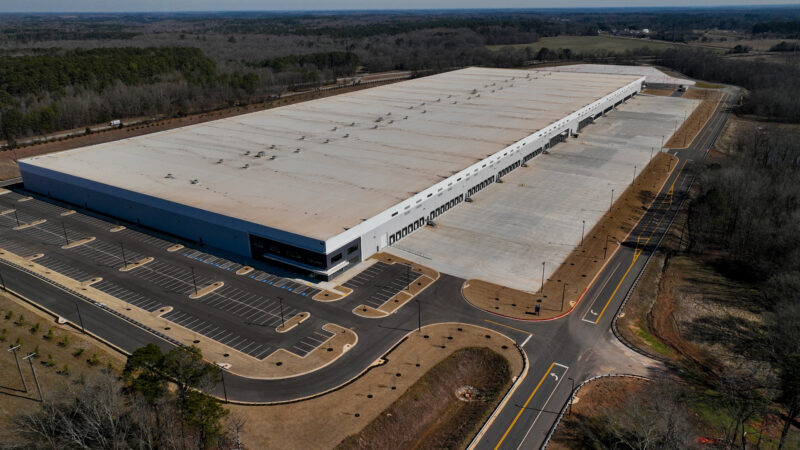
    As local officials scrambled to find out what was happening, a deed was filed showing the Department of Homeland Security had already inked a $122.8 million deal for the 826,000-square-foot warehouses in Socorro, a bedroom community of 40,000 people outside El Paso.

    “Nobody from the federal government bothered to pick up the phone or even send us any type of correspondence letting us know what’s about to take place,” said Rudy Cruz Jr., the mayor of the predominantly Hispanic town of low-slung ranch homes and trailer parks, where orchards and irrigation ditches share the landscape with strip malls, truck stops, recycling plants, and distribution warehouses.

    Socorro is among at least 20 communities with large warehouses across the U.S. that have become stealth targets for Immigration and Customs Enforcement’s $45-billion expansion of detention centers.

    As public support for the agency and President Donald Trump’s immigration crackdown sags, communities are objecting to mass detentions and raising concerns that the facilities could strain water supplies and other services while reducing local tax revenue. In many cases, mayors, county commissioners, governors, and members of Congress learned about ICE’s ambitions only after the agency bought or leased space for detainees, leading to shock and frustration even in areas that have backed Trump.

    “I just feel,” said Cruz, whose wife was born in Mexico, “that they do these things in silence so that they don’t get opposition.”

    Communities scramble for information

    ICE, which is part of DHS, has purchased at least seven warehouses in Arizona, Georgia, Maryland, Pennsylvania, and Texas, signed deeds show. Other deals have been announced but not yet finalized, though buyers scuttled sales in eight locations.

    DHS objected to calling the sites warehouses, stressing in a statement that they would be “very well structured detention facilities meeting our regular detention standards.”

    The process has been chaotic at times. ICE this past week acknowledged it made a “mistake” when it announced warehouse purchases in Chester, N.Y., and Roxbury, N.J. Roxbury then announced Friday that the sale there had closed.

    DHS has confirmed it is looking for more detention space but hasn’t disclosed individual sites ahead of acquisitions. Some cities learned that ICE was scouting warehouses through reporters. Others were tipped off by a spreadsheet circulating online among activists whose source is unclear.

    It wasn’t until Feb. 13 that the scope of the warehouse project was confirmed, when the governor’s office in New Hampshire, where there is backlash to a planned 500-bed processing center, released a document from ICE showing the agency plans to spend $38.3 billion to boost detention capacity to 92,000 beds.

    Since Trump took office, the number of people detained by ICE has increased to 75,000 from 40,000, spread across more than 225 sites.

    ICE could use the warehouses to consolidate and to increase capacity. The document describes a project that includes eight large-scale detention centers, capable of housing 7,000 to 10,000 detainees each, and 16 smaller regional processing centers. The document also refers to the acquisition of 10 existing “turnkey” facilities.

    The project is funded through the big tax and spending cuts bill passed by Congress last year that nearly doubled DHS’ budget. To build the detention centers, the Trump administration is using military contracts.

    Those contracts allow a lot of secrecy and for DHS to move quickly without following the usual processes and safeguards, said Charles Tiefer, a professor emeritus of law at the University of Baltimore Law School.

    Socorro facility could be among the largest

    In Socorro, the ICE-owned warehouses are so large that 4½ Walmart Supercenters could fit inside, standing in contrast to the remnants of the austere Spanish colonial and mission architecture that defines the town.

    At a recent city council meeting, public comments stretched for hours. “I think a lot of innocent people are getting caught up in their dragnet,” said Jorge Mendoza, an El Paso County retiree whose grandparents immigrated from Mexico.

    Many speakers invoked concerns about three recent deaths at an ICE detention facility at the nearby Fort Bliss Army base.

    Communities fear a financial hit

    Even communities that backed Trump in 2024 have been caught off guard by ICE’s plans and have raised concerns.

    In rural Pennsylvania’s Berks County, commissioner Christian Leinbach called the district attorney, the sheriff, the jail warden, and the county’s head of emergency services when he first heard ICE might buy a warehouse in Upper Bern Township, 3 miles from his home.

    No one knew anything.

    A few days later, a local official in charge of land records informed him that ICE had bought the building — promoted by developers as a “state-of-the art logistics center” — for $87.4 million.

    “There was absolutely no warning,” Leinbach said during a meeting in which he raised concerns that turning the warehouse into a federal facility means a loss of more than $800,000 in local tax dollars.

    ICE has touted the income taxes its workers would pay, though the facilities themselves will be exempt from property taxes.

    Georgia center could house twice the population of town

    In Social Circle, Ga., which also strongly supported Trump in 2024, officials were stunned by ICE’s plans for a facility that could hold 7,500 to 10,000 people after first learning about it through a reporter.

    The city, which has a population of just 5,000 and worries about the infrastructure needs for such a detention center, only heard from DHS after the $128.6 million sale of a 1-million-square-foot warehouse was completed. Like Socorro and Berks County, Social Circle questioned whether the water and sewage system could keep up.

    ICE has said it did due diligence to ensure the sites don’t overwhelm city utilities. But Social Circle said the agency’s analysis relied on a yet-to-be built sewer treatment plant.

    “To be clear, the City has repeatedly communicated that it does not have the capacity or resources to accommodate this demand, and no proposal presented to date has demonstrated otherwise,” the city said in a statement.

    And in the Phoenix suburb of Surprise, Ariz., officials sent a scathing letter to Homeland Security Secretary Kristi Noem after ICE without warning bought a massive warehouse in a residential area about a mile from a high school. Arizona Attorney General Kris Mayes, a Democrat, raised the prospect of going to court to have the site declared a public nuisance.

    Crowds wait to speak in Socorro

    Back in Socorro, people waiting to speak against the ICE facility spilled out of the city council chambers, some standing beside murals paying tribute to the World War II-era Braceros Program that allowed Mexican farmworkers to be guest workers in the U.S. The program stoked Socorro’s economy and population before President Dwight D. Eisenhower’s administration in the 1950s began mass deportations aimed at people who had crossed the border illegally.

    Eduardo Castillo, formerly an attorney for the U.S. Department of Justice, told city officials it is intimidating but “not impossible” to challenge the federal government.

    “If you don’t at least try,” he said, “you will end up with another inhumane detention facility built in your jurisdiction and under your watch.”

  • A World Cup FanFest that had been planned near the Statue of Liberty is canceled

    A World Cup FanFest that had been planned near the Statue of Liberty is canceled

    NEW YORK — The New York and New Jersey World Cup host committee has canceled its fan festival that had been planned to be held at Liberty State Park in Jersey City.

    The committee scrapped plans for the weekslong festival that would have been held about 15 miles (24 kilometers) from MetLife Stadium in East Rutherford, where the final will be played on July 19.

    The FanFest was announced in February 2025 by Tammy Murphy, wife of then-New Jersey Gov. Phil Murphy and chair of the New York/New Jersey host committee’s directors, who said it would be open for all 104 matches of the tournament, which starts June 11.

    The committee said in a statement Friday an “expanded network of fan zones and community celebrations across 21 counties in New Jersey will serve as a cornerstone of the region’s official fan engagement program.”

    Mikie Sherrill, Murphy’s successor as governor, announced a $5 million initiative Thursday to fund community World Cup initiatives.

    Tickets for the FanFest had been put on sale in December.

    Plans for a FanFest in New York City’s Corona Park in Queens did not move forward. One is now planed for the U.S. Tennis Association’s Billie Jean King National Tennis Center in Queens from June 17-28 and a fan village is scheduled for Manhattan’s Rockefeller Center from July 4-19.

    Fan fests with large video screens have been a part of each World Cup’s organization since 2006.

    FIFA is running the World Cup itself unlike in the past, when a local organizing committee was in charge of logistics. The host committees are limited to sponsorship agreements in categories not reserved by FIFA.

  • Pennsylvania man cleared after 43 years in prison for murder denied bail during deportation fight

    Pennsylvania man cleared after 43 years in prison for murder denied bail during deportation fight

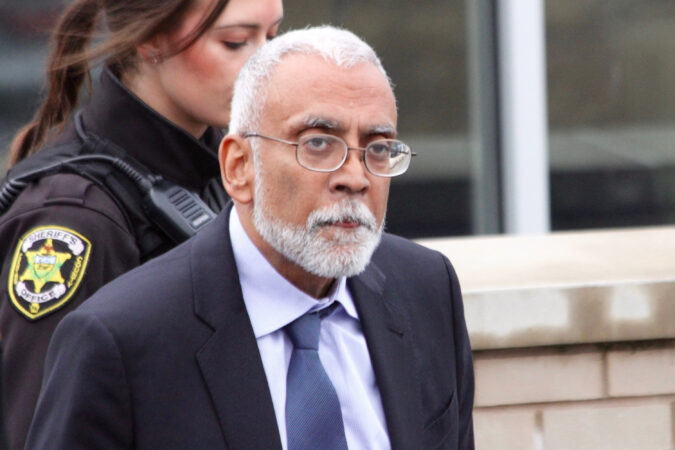
    A Pennsylvania man who spent 43 years in prison before his murder conviction was overturned — only to be taken straight into immigration custody — was denied bail Tuesday while he fights deportation.

    Subramanyam Vedam, 64, will remain in custody while he appeals a 1999 deportation order. The Board of Immigration Appeals agreed this month to hear his appeal based on what it called exceptional circumstances.

    The Trump administration had initially pursued a quick deportation and moved Vedam to a detention center in Louisiana last fall, before two separate courts intervened.

    Vedam’s lawyer argued Tuesday that he would have likely been spared deportation and become a citizen if not for the murder case, given immigration laws in place at the time. Vedam would have left prison on a drug charge by 1992, lawyer Ava Benach said.

    “It was delivery of LSD on a very small scale. This is not importing tons of cocaine,” Benach said Tuesday. “He is not a danger to the community. We are talking about offenses that occurred over 40 years ago.”

    In August, a Pennsylvania judge threw out Vedam’s murder conviction in the 1980 death of a college friend, based on ballistics evidence that prosecutors hadn’t disclosed during his two trials. Supporters listening in remotely to the bail hearing included a Centre County prosecutor and the mayor of State College, where Vedam’s late father was a renowned professor at Pennsylvania State University, Benach said.

    Immigration Judge Tamar Wilson, sitting in Elizabeth, N.J., said she believes detention to be mandatory given the felony drug conviction. Alternatively, she agreed with Department of Homeland Security officials who said he remains a safety risk.

    “The fact he’s been a ‘model prisoner’ does not suggest that out in the general public he’s going to be safe,” Wilson said.

    It’s not yet clear whether Wilson or another judge will hear the merits of the deportation case. No hearings have yet been scheduled.

    “Subu is nothing if not resilient, and we’re resolved to emulate the example he sets for us by focusing on the next step in his fight for freedom. We continue to believe his immigration case is strong and look forward to the day we can be together again,” said his sister, Saraswathi Vedam, calling him by a family nickname.

    She planned to bring him home when he was released from state prison on Oct. 3, only to see him taken into federal immigration custody. Vedam had come to the U.S. legally from India when he was 9 months old, when his parents returned to State College.

    “He was someone who’s suffered a profound injustice,” Benach told the Associated Press last year. “Those 43 years aren’t a blank slate. He lived a remarkable experience in prison.”

    Vedam is being held at an 1,800-bed U.S. Immigration and Customs Enforcement facility in central Pennsylvania.

    “Criminal illegal aliens are not welcome in the U.S,” a Department of Homeland Security spokesperson said of the case last year.

  • Judge orders Trump administration to restore funding for rail tunnel between New York, New Jersey

    Judge orders Trump administration to restore funding for rail tunnel between New York, New Jersey

    NEW YORK — A federal judge ordered the Trump administration to restore funding to a new rail tunnel between New York and New Jersey on Friday, ruling just as construction was set to shut down on the massive infrastructure project.

    The decision came months after the administration announced it was halting $16 billion in support for the project, citing the then-government shutdown and what a top federal budget official said were concerns about unconstitutional spending around diversity, equity, and inclusion principles.

    U.S. District Judge Jeannette A. Vargas in Manhattan approved a request by New York and New Jersey for a temporary restraining order barring the administration from withholding the funds while the states seek a preliminary injunction that would keep the money flowing while their lawsuit plays out in court.

    “The Court is also persuaded that Plaintiffs would suffer irreparable harm in the absence of an injunction,” the judge wrote. “Plaintiffs have adequately shown that the public interest would be harmed by a delay in a critical infrastructure project.”

    The White House and U.S. Department of Transportation did not immediately respond to emails seeking comment Friday night.

    New York Attorney General Letitia James called the ruling “a critical victory for workers and commuters in New York and New Jersey.”

    “I am grateful the court acted quickly to block this senseless funding freeze, which threatened to derail a project our entire region depends on,” James said in a statement. “The Hudson Tunnel Project is one of the most important infrastructure projects in the nation, and we will keep fighting to ensure construction can continue without unnecessary federal interference.”

    The panel overseeing the project, the Gateway Development Commission, had said work would stop late Friday afternoon because of the federal funding freeze, resulting in the immediate loss of about 1,000 jobs as well as thousands of additional jobs in the future.

    It was not immediately clear when work would resume. In a nighttime statement, the commission said: “As soon as funds are released, we will work quickly to restart site operations and get our workers back on the job.”

    The new tunnel is meant to ease strain on an existing tunnel that is more than 110 years old that connects New York and New Jersey for Amtrak and commuter trains, where delays can lead to backups up and down the East Coast.

    New York and New Jersey sued over the funding pause this week, as did the Gateway Development Commission, moving to restore the Trump administration’s support.

    The suspension was seen as a way for the Trump administration to put pressure on Democratic Senate Minority Leader Chuck Schumer of New York, whom the White House was blaming for a government shutdown last year. The shutdown was resolved a few weeks later.

    Speaking to the media on Air Force One, Trump was asked about reports that he would unfreeze funding for the tunnel project if Schumer would agree to a plan to rename Penn Station in New York and Dulles International Airport in Virginia after Trump.

    “Chuck Schumer suggested that to me, about changing the name of Penn Station to Trump Station. Dulles Airport is really separate,” Trump responded.

    Schumer responded on social media: “Absolute lie. He knows it. Everyone knows it. Only one man can restart the project and he can restart it with the snap of his fingers.”

    At a hearing in the states’ lawsuit earlier in Manhattan, Shankar Duraiswamy, of the New Jersey attorney general’s office, told the judge that the states need “urgent relief” because of the harm and costs that will occur if the project is stopped.

    “There is literally a massive hole in the earth in North Bergen,” he said, referring to the New Jersey city and claiming that abandoning the sites, even temporarily, “would pose a substantial safety and public health threat.”

    Duraiswamy said the problem with shutting down now is that even a short stoppage would cause longer delays because workers will be laid off and go to other jobs and it’ll be hard to quickly remobilize if funding becomes available. And, he added, “any long-term suspension of funding could torpedo the project.”

    Tara Schwartz, an assistant U.S. attorney arguing for the government, disagreed with the “parade of horribles” described by attorneys for the states.

    She noted that the states had not even made clear how long the sites could be maintained by the Gateway Development Commission. So the judge asked Duraiswamy, and he said they could maintain the sites for a few weeks and possibly a few months, but that the states would continue to suffer irreparable harm because trains would continue to run late because they rely on an outdated tunnel.

  • Civil War scholar and retired Gettysburg College professor Gabor Boritt has died at 86

    Civil War scholar and retired Gettysburg College professor Gabor Boritt has died at 86

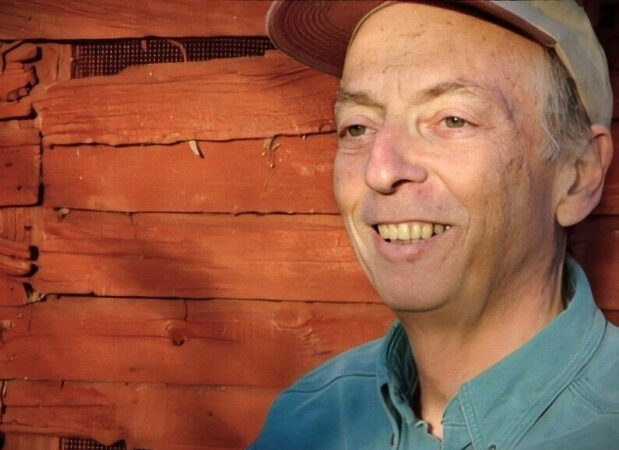
    GETTYSBURG — History professor Gabor S. Boritt, a Hungarian immigrant to the United States who wrote widely about the Civil War and President Abraham Lincoln, has died. He was 86.

    Mr. Boritt had been a professor at Gettysburg College in Pennsylvania for many years, founding the Civil War Institute and helping establish the $50,000 Lincoln Prize for scholarship related to the Civil War.

    He died Monday in Chambersburg, according to his son.

    Mr. Boritt was born in Budapest in 1940 and survived World War II, although relatives were killed in the Auschwitz Nazi death camp. He was sent to an orphanage after the war and in 1956 joined the Hungarian Revolution as a 16-year-old, his family recalled.

    After the uprising was crushed, he made it to the United States, where he worked in a New York hat factory before furthering his education in South Dakota and earning a history doctorate from Boston University.

    He taught at several universities before joining the faculty at Gettysburg in 1981. Mr. Boritt served on the board of the Gettysburg Foundation and was involved in the construction of a new visitor’s center at Gettysburg National Military Park.

    He was awarded a National Humanities Medal by President George W. Bush in 2008.

    A screening of Budapest to Gettysburg, a documentary about his life created by his son, Jake Boritt, will be held on Lincoln’s Birthday, Feb. 12, in Gettysburg.

  • The detention of the couple that owns Jersey Kebab sparked change. Deportation still looms.

    The detention of the couple that owns Jersey Kebab sparked change. Deportation still looms.

    COLLINGSWOOD, N.J. — The shawarma, falafel wraps and baklava at Jersey Kebab are great, but many of its patrons are also there these days for a side of protest.

    A New Jersey suburb of Philadelphia has rallied around the restaurant’s Turkish owners since federal officers detained the couple last February because they say their visas had expired.

    In fact, business has been so good since Celal and Emine Emanet were picked up early in the Trump administration’s immigration crackdown that they have moved to a bigger space in the next town over. Their regulars don’t seem to mind.

    The family came to the U.S. seeking freedom

    Celal Emanet, 52, first came to the U.S. in 2000 to learn English while he pursued his doctorate in Islamic history at a Turkish university. He returned in 2008 to serve as an imam at a southern New Jersey mosque, bringing Emine and their first two children came, too. Two more would be born in the U.S.

    Before long, Celal had an additional business of delivering bread to diners. They applied for permanent residency and believed they were on their way to receiving green cards.

    When the COVID-19 pandemic began and the delivery trucks were idled, Celal and Emine, who had both worked in restaurants in Turkey, opened Jersey Kebab in Haddon Township. Business was strong from the start.

    It all changed in a moment

    On Feb. 25, U.S. marshals and Immigration and Customs Enforcement officers arrested the couple at the restaurant. Celal was sent home with an ankle monitor, but Emine, now 47, was moved to a detention facility more than an hour’s drive away and held there for 15 days.

    With its main cook in detention and the family in crisis, the shop closed temporarily.

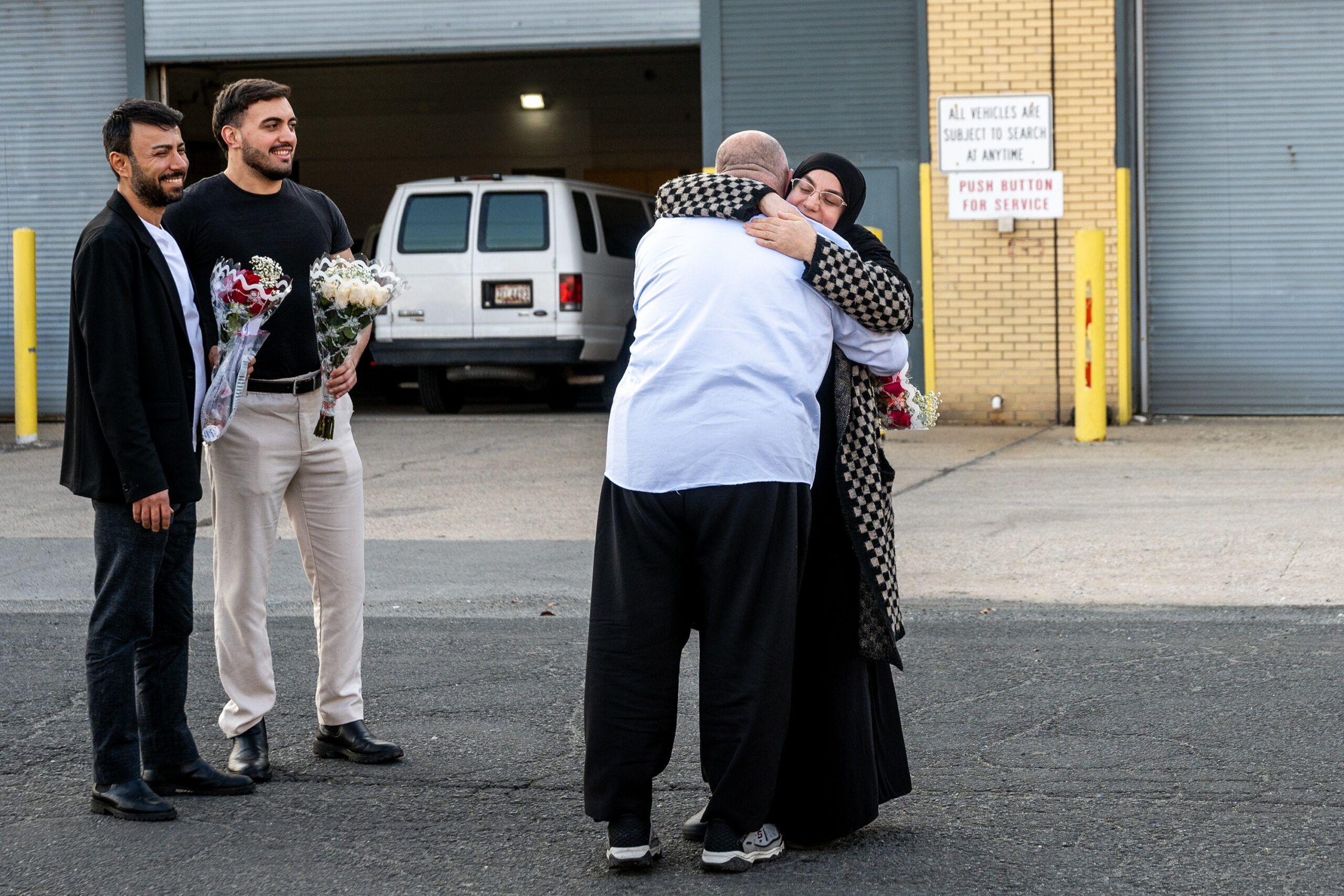
    Emine Emanet hugs her husband Celal as she leaves the ICE Elizabeth Detention Facility on Wednesday, March 12, 2025.

    Although the area is heavily Democratic, the arrests of the Emanets signaled to many locals that immigration enforcement during President Donald Trump’s second term wouldn’t stop at going after people with criminal backgrounds who are in the U.S. illegally.

    “They were not dangerous people — not the type of people we were told on TV they were looking to remove from our country,” Haddon Township Mayor Randy Teague said.

    Supporters organized a vigil and raised $300,000 that kept the family and business afloat while the shop was closed — and paid legal bills. Members of Congress helped, and hundreds of customers wrote letters of support.

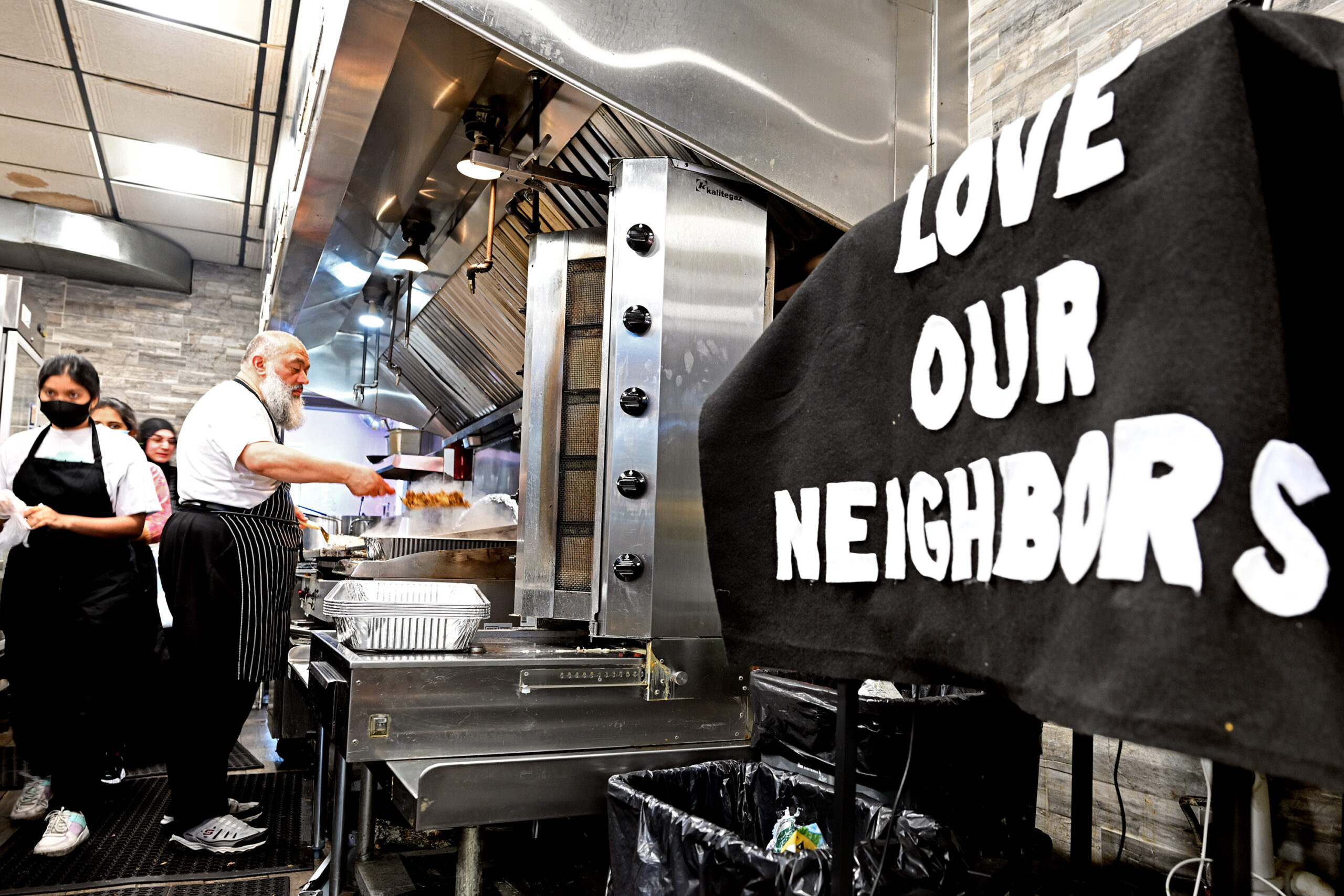
    Celal Emanet works at the grill in his Jersey Kebab restaurant on Sunday, Mar. 30, 2025.

    Space for a crowd

    As news of the family’s ordeal spread, customers new and old began packing the restaurant. The family moved it late last year to a bigger space down busy Haddon Avenue in Collingswood.

    They added a breakfast menu and for the first time needed to hire servers besides their son Muhammed.

    The location changed, but the restaurant still features a sign in the window offering free meals to people in need. That’s honoring a Muslim value, to care for “anybody who has less than us,” Muhammed said.

    Judy Kubit and Linda Rey, two friends from the nearby communities of Medford and Columbus, respectively, said they came to Haddon Township last year for an anti-Trump “No Kings” rally and ate a post-protest lunch at the kebab shop.

    “We thought, we have to go in just to show our solidarity for the whole issue,” Kubit said.

    Last month, with the immigration crackdown in Minneapolis dominating the headlines, they were at the new location for lunch.

    Gretchen Seibert tapes up hearts with words of support for Celal and Emine Emanet, the owners of Jersey Kebab, after the couple was detained by ICE in February 2025.

    The legal battle hasn’t ended

    The Emanets desperately want to stay in the U.S., where they’ve built a life and raised their family.

    Celal has a deportation hearing in March, and Emine and Muhammed will also have hearings eventually.

    Celal said moving back to Turkey would be bad for his younger children. They don’t speak Turkish, and one is autistic and needs the help available in the U.S.

    Also, he’d be worried about his own safety because of his academic articles. “I am in opposition to the Turkish government,” he said. “If they deport me, I am going to get very big problems.”

    The groundswell of support has shown the family they’re not alone.

    “We’re kind of fighting for our right to stay the country,” Muhammed Emanet said, “while still having amazing support from the community behind us. So we’re all in it together.”