Category: Washington Post

  • Tatiana Schlossberg, journalist and granddaughter of JFK, dies at 35

    Tatiana Schlossberg, journalist and granddaughter of JFK, dies at 35

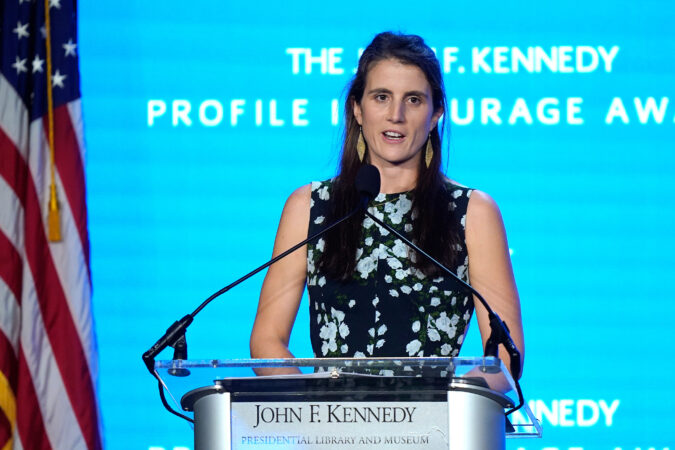
    Tatiana Schlossberg, 35, a journalist who told stories of the changing climate and the ways humans can help protect the environment, and whose terminal illness and position in the Kennedy family thrust her into the national spotlight late in life, died Tuesday.

    Her family announced the death in a social media post shared by the John F. Kennedy Presidential Library and Museum. The statement did not say where she died.

    Ms. Schlossberg published a New Yorker essay in November revealing that she had been diagnosed with a rare form of acute myeloid leukemia, a cancer of the blood and bone marrow. Between reflections on her family and mortality, she harshly criticized her cousin Robert F. Kennedy Jr., the secretary of health and human services, for his opposition to government-funded medical research and vaccines.

    “I watched from my hospital bed as Bobby, in the face of logic and common sense, was confirmed for the position, despite never having worked in medicine, public health, or the government,” she wrote.

    As an environmental journalist, Ms. Schlossberg was drawn to stories that humanized sprawling and complicated policy issues — often while offering her a chance to participate in the action herself.

    While chronicling the impact of climate change, she jumped in a cranberry bog in Massachusetts. She later spent nearly eight hours skiing the Birkebeiner, a cross-country race in Wisconsin threatened by warm weather and a lack of snow.

    “On the lake, my cross-country skis began to skate in a rhythm, something that had eluded me for much of the day,” she wrote in a dispatch for Outside magazine. “I felt like I was flying.”

    Ms. Schlossberg studied at Yale and Oxford before launching her journalism career at the Record newspaper in North Jersey, covering crime and local affairs. She joined the New York Times in 2014 as an intern and was named a staff writer on the paper’s Metro desk before moving to the science section, where colleagues regarded her as a curious, hardworking reporter who wore her privilege lightly.

    A granddaughter of President John F. Kennedy and first lady Jacqueline Kennedy Onassis, Ms. Schlossberg was the second child of Caroline Kennedy, a former U.S. ambassador to Australia and Japan, and Edwin Schlossberg, an artist and designer.

    “She was a total delight,” said Henry Fountain, a longtime climate and science reporter at the Times. Ms. Schlossberg “just researched her butt off on stories,” he added.

    After leaving the Times in 2017, Ms. Schlossberg began freelancing and, in 2019, published Inconspicuous Consumption: The Environmental Impact You Don’t Know You Have. The book examined the hidden costs of everyday activities — streaming videos, buying jeans, eating burgers — and was honored by the Society of Environmental Journalists.

    “Using history, science and a personal narrative, Schlossberg provides a better understanding of both individual and systemic drivers of ecological destruction,” the judges said in awarding her the Rachel Carson book prize. “Readers will find solace, humor and a route to feeling empowered with possibilities for positive change, rather than drained by an accumulation of bad news.”

    Ms. Schlossberg had been planning to write a second book, on the oceans, when she was found to have cancer in May 2024, while in the hospital for the birth of her second child.

    In her New Yorker essay, she wrote of her shock at getting the diagnosis — “This could not be my life” — and of the turbulent 18 months that followed, in which she received stem cell donations from her sister as well as a stranger in the Pacific Northwest; underwent chemotherapy; and participated in a clinical trial, testing a new type of immunotherapy.

    In recounting her experience, Ms. Schlossberg implicitly acknowledged that her family, and her mother in particular, had dealt with years of grief. Her mother was only 5 when her father, President Kennedy, was assassinated in Dallas in 1963. She was 10 when the same fate befell her uncle, Robert F. Kennedy, while he was campaigning for president in Los Angeles. Her younger brother, John Jr., died in a plane crash in 1999.

    “For my whole life, I have tried to be good, to be a good student and a good sister and a good daughter, and to protect my mother and never make her upset or angry,” Ms. Schlossberg wrote. “Now I have added a new tragedy to her life, to our family’s life, and there’s nothing I can do to stop it.”

    Ms. Schlossberg recalled that she was in her hospital bed when her cousin “Bobby, in the face of logic and common sense, was confirmed” as health and human services secretary, “despite never having worked in medicine, public health, or the government.”

    Kennedy had previously run for president as an independent, in what Ms. Schlossberg called “an embarrassment to me and the rest of my immediate family.” He faced blowback when he acknowledged that he had placed a dead bear in Central Park a decade earlier, a bizarre episode that — in an odd twist of fate — Ms. Schlossberg had reported on for the Times, writing in 2014 that state investigators concluded the bear had died after being struck by a car, but did not know how it ended up in the park.

    “Like law enforcement, I had no idea who was responsible for this when I wrote the story,” Ms. Schlossberg told The Times last year.

    In her New Yorker essay, Ms. Schlossberg wrote that her cousin’s health policy decisions threatened her own survival, and that of “millions of cancer survivors, small children, and the elderly.”

    “I watched as Bobby cut nearly half a billion dollars for research into mRNA vaccines, technology that could be used against certain cancers; slashed billions in funding from the National Institutes of Health, the world’s largest sponsor of medical research; and threatened to oust the panel of medical experts charged with recommending preventive cancer screenings,” she wrote.

    She also noted that the drug misoprostol, which she received to stop a postpartum hemorrhage that nearly killed her, was “part of medication abortion, which, at Bobby’s urging, is currently ‘under review’ by the Food and Drug Administration.”

    “I freeze when I think about what would have happened if it had not been immediately available to me and to millions of other women who need it to save their lives or to get the care they deserve.”

    ‘I was not just a sick person’

    Tatiana Celia Kennedy Schlossberg was born in Manhattan on May 5, 1990. She was raised on the Upper East Side with her older sister, artist and filmmaker Rose Schlossberg, and her younger brother, Jack Schlossberg, who is now running for Congress in New York.

    Ms. Schlossberg studied history at Yale University, where she received a bachelor’s degree in 2012 and served as editor in chief of the weekly Yale Herald. She later earned a master’s in American history from the University of Oxford.

    As a freelance journalist, Ms. Schlossberg contributed to publications including the Washington Post, the Atlantic, and Vanity Fair. She wrote a weekly newsletter, News From a Changing Planet, until 2024.

    Juliet Eilperin, the Post’s deputy futures editor, called her “one of the least pretentious journalists I have ever dealt with.”

    “Tatiana had an intense desire to be out in the field, immersing herself in nature and talking with scientists,” Eilperin said. “She was meticulous and exhaustive in her research, scrutinizing environmental problems and what might be done to fix them.”

    In 2017, Ms. Schlossberg married George Moran at her family’s home on Martha’s Vineyard, in a ceremony officiated by former Massachusetts Gov. Deval Patrick. Moran, a urologist, was a resident at Columbia-Presbyterian when Ms. Schlossberg was diagnosed with cancer at the hospital.

    “He did everything for me that he possibly could,” she wrote in her essay. “He talked to all the doctors and insurance people that I didn’t want to talk to; he slept on the floor of the hospital; he didn’t get mad when I was raging on steroids and yelled at him that I did not like Schweppes ginger ale, only Canada Dry.”

    In addition to her husband, survivors include their two children; her parents; and her brother and sister.

    While battling cancer, Ms. Schlossberg held her profession up as a point of pride. “My son knows that I am a writer and that I write about our planet,” she wrote. “Since I’ve been sick, I remind him a lot, so that he will know that I was not just a sick person.”

  • Is red wine better for you than white? The answer may surprise you.

    Is red wine better for you than white? The answer may surprise you.

    The question: Is red wine healthier than white wine?

    The science: Many people think red wine is better for you than white wine or other types of alcohol.

    The notion was partly born from studies — some of which have been disputed — that suggested that certain compounds found in red wine could improve cardiovascular health.

    Now the evidence suggests that any type of alcohol — including red wine — is unlikely to make you any healthier than drinking no alcohol at all.

    “There’s no isolated health benefit of red wine over white wine over any other beverage containing alcohol,” said George Koob, the director of the National Institute on Alcohol Abuse and Alcoholism. And, he added, “There’s no physical health benefits of which we can attribute to alcohol.”

    While it’s long been known that heavy alcohol consumption can cause serious health problems, the potential benefits and risks of moderate drinking — defined as up to two drinks per day for men and one for women — have been murkier. In the past, some research suggested that people who drank small amounts of alcohol in general might have a health advantage compared with those who didn’t drink at all.

    But as research has evolved over the years, we now know that even modest drinking is linked to a higher risk of developing certain cancers such as breast, colorectal and esophageal cancers, as well as brain changes and dementia, heart problems and sleep problems.

    Dietary guidance has also changed. Current guidelines from the U.S. Department of Agriculture state that “emerging evidence suggests that even drinking within the recommended limits may increase the overall risk of death from various causes.” The American Heart Association recommends limiting or abstaining from alcohol, even though the association published a scientific review in 2025 that concluded that light drinking poses no risk for coronary artery disease, stroke, sudden death and possibly heart failure, and may even reduce the risk of developing such conditions — though not all experts agreed with that conclusion.

    The argument in favor of red wine used to focus on certain compounds.

    Red wine contains more polyphenols — plant compounds with antioxidant and anti-inflammatory properties — because the grape juice is fermented with the grape skins, where these compounds are concentrated. (White wine grapes are pressed, and the skins removed, before the fermentation process.)

    These polyphenols include procyanidins, flavonoids and resveratrol, which is often mentioned in cancer research. Another type, anthocyanins, helps give red wine its rich color and has been studied for potential cardiovascular benefits.

    Most of the health benefits associated with these polyphenols have been observed in studies at much higher doses than what you would get from a couple glasses of wine, so there’s no real advantage, experts said.

    “The concentrations are sufficiently low that you would have to drink more than moderate amounts to truly get that much more benefit from the polyphenols in red wine,” which could lead to health issues, said Eric Rimm, a professor of epidemiology and nutrition at the Harvard T.H. Chan School of Public Health, who has studied the health effects of alcohol.

    Instead, you could add stronger sources of anthocyanins into your diet, including darker berries such as blueberries, apples, onions, black or green tea, and dark chocolate, Rimm said.

    As for other risks and benefits, some people may avoid red wine because it can stain teeth and cause headaches and even allergy-like symptoms. While red wine headaches are not fully understood, some people may be especially sensitive to the tannins in the grapes, histamines or sulfites produced through fermentation, or the additional sulfites added to preserve wine. Some research suggests quercetin, an antioxidant found in grapes, may be responsible.

    In one study, people who had a wine intolerance were more likely to report allergy-like symptoms such as nasal congestion, itching, flushed skin and stomach upset more often after drinking red wine than white wine.

    What else you should know

    While drinking alcohol probably won’t lead to any positive health effects, you may be able to reduce potential negative effects by how you drink it.

    First, speak with your health care provider about whether drinking alcohol is safe for you. People who are pregnant, have certain medical conditions, take medications that interact with alcohol, or have or are recovering from an alcohol-use disorder should not drink, according to USDA. Also, teetotalers, people who don’t already drink, should not start drinking for any health reasons, health officials said.

    Assuming you’re of legal drinking age — 21 years or older in the United States — here are some tips from experts:

    1. Eat first: Food, particularly foods with some protein, fats and carbohydrates, slows the absorption of alcohol into the bloodstream, reducing potential ill effects.
    2. Understand drink sizes: A standard alcoholic drink has 0.6 ounces of pure alcohol. That’s equal to 5 ounces of wine with 12 percent alcohol, 12 ounces of beer with 5 percent alcohol, or a shot — 1.5 ounces — of an 80-proof liquor. When buying alcohol at a store, check the alcohol content. “Beer used to be 4 or 5 percent alcohol. There are a lot of beers now that are 8 to 10 percent. So you may want to drink a little bit less if you have a higher alcohol-containing beer or a higher alcohol-containing spirit,” Rimm said.
    3. Keep in mind that men and women may process alcohol differently: Women generally don’t produce as much of an alcohol-metabolizing enzyme called alcohol dehydrogenase, which means they break down alcohol more slowly and are at a higher risk of alcohol-related health problems.
    4. Drink in moderation: Moderation is defined as up to two drinks per day for men and one for women. Also, space out drinks throughout the week — meaning don’t drink all 7 or 14 drinks in one weekend.
    5. The bottom line: While red wine has more polyphenols, which are associated with cardiovascular benefits, than white wine, they aren’t in a high enough concentration to provide a health advantage. In addition, red wine may be more likely than white wine to cause headaches and allergy-like symptoms in people who are susceptible.
  • The very worst sports decisions of 2025

    The very worst sports decisions of 2025

    The past year in sports was full of choices that worked out swimmingly, such as Anthony Joshua taking a fight on relatively short notice. The fight, of course, was against Jake Paul, it earned Joshua a massive payday, and he finished it with a knockout of someone a lot of people wanted to see get knocked out.

    Other choices didn’t work out quite so well, and a few were unfortunate enough to make this roundup of 2025’s thoroughly regrettable sports decisions. It’s a non-comprehensive list (and by all means, make some additions in the comments), but it should be enough to have us all looking to ring in a less misguided new year.

    The Mavericks trade Luka Doncic for … not much

    Never mind that, in the wake of the Luka Doncic trade, the Dallas Mavericks wound up with Cooper Flagg. They don’t get credit for seeing a piece of outrageous good fortune fall into their collective lap.

    On the other hand, the Mavericks deserved all the criticism they received — a Texas—size mass that didn’t subside for months — and not just because they dealt a massively popular, 25-year-old superstar who already had led them to the NBA Finals. The return for Doncic and a couple of ancillary pieces to make the trade work included an aging and injury-prone Anthony Davis, Max Christie, a first-round draft pick and … actually, that was it.

    The worst part? Well, that’s a tough question, given that the trade came as an out-of-nowhere jolt of shocking news, left the franchise bereft of a long-term centerpiece (again, the subsequent, utterly fluky landing of Flagg doesn’t count) and allowed the Los Angeles Lakers to retain some assets that the Mavericks should have demanded as part of the package. Maybe the most galling aspect was that Nico Harrison, the Mavericks’ general manager, didn’t shop Doncic around the league, a process that almost certainly would have yielded more substantial offers. Instead, Lakers GM Rob Pelinka appeared to use his long-standing friendship with Harrison to pull off a clandestine swindle. Plus, did it have to be the Lakers? You know, the franchise that has lorded over the Western Conference for huge chunks of the past 45 years and whose fans have come to expect the regular arrival of elite players as their birthright?

    None of that sat at all well with Mavericks fans, and ultimately their fury and the team’s lack of success after the trade cost Harrison his job. He’s no longer around, but the frustration of the Doncic trade figures to linger in Dallas for years to come.

    Orion Kerkering throws home

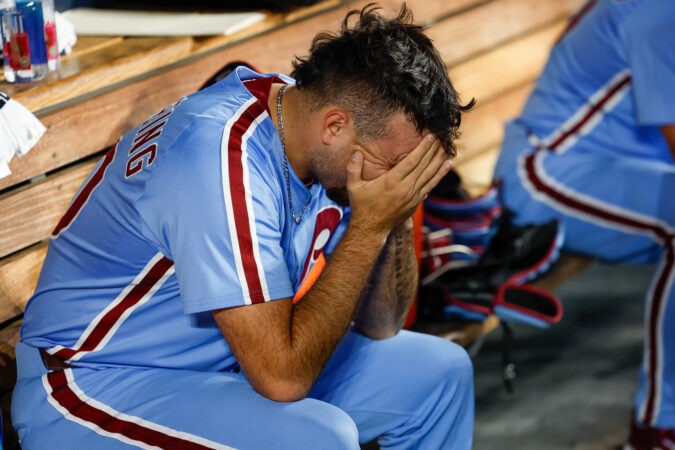
    It might be unfair to say he panicked, but Orion Kerkering was hardly the picture of composure when a ball was hit back to the Philadelphia Phillies’ 24-year-old pitcher in the bottom of the 11th inning of Game 4 of the National League Division Series. Kerkering had trouble fielding the ball, but after he did eventually pick it up, he appeared to have time to turn and throw to first base. Given that there were two outs, a successful throw to the first baseman would have ended the inning, kept the score tied and kept the Phillies alive in their series against the Los Angeles Dodgers.

    Certainly, that was what Phillies catcher J.T. Realmuto wanted. As Kerkering picked up the ball, Realmuto was pointing toward first base. Alas, the pitcher opted to throw home — the bases were loaded, so an inning-ending out also could have been made at the plate — but he had only a split second to beat the runner, and Kerkering’s rushed effort sailed wide of Realmuto. The runner was safe at home, the Dodgers spilled out of their dugout with joy, and the Phillies were forced to contemplate a brutal end to their season. Kerkering defended his decision, saying he thought he could get the ball to home plate faster than if he turned and threw to first, but he acknowledged, “It was just a horses— throw.”

    The Clippers bring back Chris Paul

    When the Los Angeles Clippers signed Chris Paul in July to a one-year contract, it seemed like a solid move, potentially even a heartwarming one — after all, Paul is a franchise icon, and he was poised to help his team return to the playoffs in what could be his final NBA season. Instead, the relationship between Paul — never one to refrain from offering strong opinions on team-related matters — and the Clippers’ coaching staff reportedly curdled almost immediately. Then, barely a quarter of the way through this season, the 40-year-old point guard was banished altogether.

    Paul remains under contract, though, meaning that after getting the heave-ho, he is still essentially getting paid handsomely by the Clippers not to work. Wait, why does that sound familiar? Oh, right — their season began under a cloud of suspicion that they may have circumvented NBA salary cap rules by arranging for Kawhi Leonard to receive a lucrative, no-show job from a team sponsor. At least Leonard is performing his job for the Clippers by putting up good numbers, but he already has missed a chunk of the season with his latest injury and, more ominously, has proved unable to help the Clippers avoid an early-season free fall that has them near the bottom of the Western Conference.

    A guy gets caught stealing a hat from a kid

    Here’s the thing: If you’re going to swipe a cap clearly meant for a kid, don’t do it where loads of cameras are present. Wait, sorry, here’s the thing: Don’t do it at all. Alas, Polish businessman Piotr Szczerek found it as easy in the moment as stealing candy from a baby, only to discover that his misdeed went viral.

    Caught red-handed at the U.S. Open (tennis version), Szczerek subsequently issued an apology, but not before online sleuths found his business and subjected it to damagingly poor reviews. Even in his apology, Szczerek claimed it was “never my intent to steal away a prized memento from the young fan,” leading to another round of criticism.

    Picking upsets in your NCAA bracket

    Everyone knows that if you actually want to win your NCAA tournament pool, you can’t go chalk. While you may not be able to predict which upsets will occur, you know they’re coming, so your best bet is to pick a few and hope you get some hits.

    Unless, that is, you were filling out a bracket for the 2025 NCAA men’s basketball tournament, which turned out to be a chalk show. The top 16 seeds won their first-round games, the only No. 12 seeds to get to the second round promptly lost, the only double-digit seed in the Sweet 16 was a John Calipari-coached SEC squad (No. 10 Arkansas, which promptly lost), and the Final Four was composed solely of No. 1 seeds. At least, at that point, Duke haters got to see the Blue Devils get upset by Houston, but even that unexpected result deprived hoops fans of seeing Flagg in the national title game.

    Tom Brady clones his dog

    In thanking a biosciences company for giving him and his family “a second chance with a clone of our beloved dog,” Tom Brady raised a question of what kind of “second chance” he thought he was getting. Obviously, the first go-round went so well that he decided to have the dog duplicated, so it wasn’t a question of making amends. At the same time, the personality that so endeared the original pooch to the Bradys wouldn’t necessarily be replicated in the clone.

    What Brady could count on, if he cared to get some feedback, was disapproval from animal rights activists and others who happen to be well aware that tons of terrific pups are just waiting at shelters for a loving human to come along. That act of compassion could be accomplished for a fraction of the price of cloning — and without the possibility that several attempts might be discarded before an acceptable look-alike was produced.

    Chauncey Billups plays in shady poker games

    Chauncey Billups, the Portland Trail Blazers coach who was placed on unpaid leave one game into the season after being arrested on money laundering conspiracy and wire fraud conspiracy charges, pleaded not guilty. Perhaps he did nothing wrong and is guilty only of poor judgment — but, hoo boy, did he display some poor judgment in getting involved in an allegedly Mafia-backed scheme to use his celebrity to attract other poker players to illegal games so they could be defrauded with techniques such as rigged card-shuffling machines. In addition, Billups was accused by federal authorities of passing along information about the Trail Blazers’ plans to tank a March game by benching players, which allegedly resulted in big-money bets being placed on the contest.

    If Billups plays his cards right (ahem) with the not-guilty plea and avoids what could be decades in prison, he still might be banned for life by the NBA, particularly if there is compelling evidence that he did indeed share Portland’s tanking plans. At a minimum, he probably can kiss his coaching career goodbye, and his recent Hall of Fame induction could be in jeopardy.

    A marathoner tries to help her maid

    After Ruth Chepngetich eventually provided an explanation for how she came to have a banned substance in her system, the Athletics Integrity Unit described her tale as “hardly credible.” Even if you take her explanation at face value, though, it doesn’t exactly do her any favors.

    Chepngetich, who smashed the women’s marathon world record in October 2024 only to test positive for hydrochlorothiazide (HCTZ) several months later, was said to have told investigators that she fell ill with similar symptoms to those experienced shortly before by her housemaid. According to the AIU, an agency established by track and field’s international governing body to ensure athletes adhere to anti-doping protocols, the 31-year-old Kenyan asked what medication her maid had taken and then promptly ingested it herself. Chepngetich even provided a photo of the medication, which clearly stated “Hydrochlorothiazide” on its packaging, and she was said to have claimed she didn’t know it was on the prohibited list.

    The AIU noted that Chepngetich had multiple opportunities to give her account of events before she provided the explanation and that it still didn’t account for the trace amounts of HCTZ found in a test she took before the episode in question. She accepted a three-year suspension, although her record has been allowed to stand, at least for the time being.

    Bill Belichick agrees to go on camera

    Infamously taciturn during his two-decade run as the New England Patriots’ coach, Bill Belichick invariably gave the impression that he would much rather be left alone to work on game plans in a darkened film room. After taking the North Carolina job, though, he was much more willing to go on camera. By doing so, the 73-year-old Belichick also happened to shine more of a spotlight on his girlfriend, 24-year-old Jordon Hudson. That may have been the plan all along (for at least one of them), but it didn’t always go the way they would have liked.

    Most notably, Hudson’s commandeering of a “CBS Sunday Morning” interview of Belichick in April raised widespread questions about how much of a managerial role she seemed to have taken. When the season started, she became a very visible presence on the Tar Heels’ sidelines, and cameras also caught Belichick conferring with her there shortly before games kicked off. In October, video emerged from an aborted docuseries on Belichick by NFL Films that showed Hudson displaying a high degree of involvement and, at times, casting aspersions on the work of production team members.

    As for the on-field product Belichick produced, he probably wishes that wasn’t filmed, either. In his first season at UNC, he oversaw a 4-8 season that began with an embarrassing blowout loss and included four other defeats by at least 16 points.

    Mississippi fans hope for Lane Kiffin to stay

    Sure, Lane Kiffin’s bolting for LSU just after guiding the Rebels to their best regular season since 1962 made for a messy ending in Oxford, but what did Mississippi fans expect? Kiffin departed almost all of his coaching gigs with a trail of ill will in his wake, and the LSU job has been a generally more coveted position for decades.

    Nonetheless, a lot of Mississippi fans apparently expected Kiffin to stay, and many of them didn’t appreciate getting jilted. Maybe now that he’s with the Tigers, some of those fans will learn that a leopard can’t change his spots.

    FIFA creates a peace prize for Trump

    Maybe, just maybe, if President Donald Trump hadn’t been openly pining for a Nobel Peace Prize, and if FIFA head Gianni Infantino hadn’t been acting so openly obsequious toward Trump, the fact that FIFA’s newly created peace prize just happened to go to Trump wouldn’t seem like such a blatant case of currying favor. Of course, soccer’s international governing body could reasonably have some major concerns about the smooth staging of its 2026 World Cup — much of which will be in the United States, which hasn’t exactly rolled out the welcome mat for foreign visitors this year — that FIFA wants very much to allay.

    We’ll see how it goes next year with the world’s most-watched tournament, just as we’ll see who gets picked by FIFA as the next recipient of what it promises will be an annual honor. Presumably, the pool of candidates will be composed solely of world figures Infantino reckons will actually want to accept an award of such dubious origin.

    FIFA asks Wayne Gretzky to pronounce names of countries

    At the same World Cup draw this month where Infantino handed Trump his hardware, Wayne Gretzky was asked to help read names of countries as they were slotted into pods for group play. While it wasn’t ideal that he pronounced Curaçao as “Cuh-rocco” and North Macedonia as “Mack-a-donia,” in fairness, those probably aren’t places he hears dropped into conversation very often.

    But Jordan? Or as Gretzky put it, “Jor-DAN”? Again, that’s a country not likely to be bandied about frequently in Gretzky’s presence, but you would think he has heard more than enough comparisons to Michael Jordan to just go with that as the default pronunciation.

    NASCAR thinking it could win a court battle against Michael Jordan

    Speaking of Jordan, his latest showdown was in a federal courtroom, not on an NBA court, but the outcome would have been familiar to any number of Jordan’s opponents in hoops: NASCAR was put on the proverbial poster. Jordan and his 23XI racing team, along with co-plaintiff Front Row Motorsports, came away with a settlement of their antitrust lawsuit that pretty much gave them what they wanted. In turn, that amounted to a huge win for all the other Cup Series teams, who also will benefit from the reported settlement terms of permanent charters, greater revenue sharing and more say in how the overall business operates.

    The Charlotte-based judge who presided over the nine-day trial, which began approximately 14 months after Jordan and his partners filed suit, said he wished the settlement could have been reached “a few months ago.” Some NASCAR officials probably felt the same way, given some of the damaging details that emerged during discovery. They reportedly included text messages from NASCAR Commissioner Steve Phelps to a colleague that called team owner Richard Childress a “stupid redneck” who should be “taken out back and flogged.”

    It remains to be seen whether Phelps is able to keep his job, but there is little doubt that the organization he works for got dunked on by His Airness.

    The choice of Keegan Bradley for Ryder Cup captain

    Normally, active PGA Tour players are not chosen for the Ryder Cup captaincy. Keegan Bradley was not only very much still on the tour but, in fact, played so well this year that he might have been a captain’s pick — had he not been the captain himself. Technically, Bradley could have selected himself, but he chose to focus solely on his duties as captain.

    The result of the Ryder Cup — a 15-13 win for Europe on American soil — made it fair to wonder whether it would have been better to pick a captain who could have used the whole PGA Tour season to focus on the event instead of finding time between tournaments to give it thought. Bradley was criticized for his pairings — particularly the duo of Harris English and Collin Morikawa, whose possible partnership ranked dead last out of 132 optimal pairings in a widely cited statistical model — as well as his course setup and other tactics.

    It seems safe to assume that, come 2027, the Ryder Cup captaincy will revert to an accomplished player who has aged out of the PGA Tour. Hmmm … Tiger Woods, anyone?

    Mark Sanchez picks a fight over parking

    Allegedly, anyway. At Mark Sanchez’s trial, which was moved to March, he might be able to present a convincing case that he was the victim in an October incident that left him in a hospital with stab wounds. The bizarre episode resulted in a felony charge being brought against the former quarterback, who can now also be called a former Fox Sports analyst after the network parted ways with him.

    In Indianapolis for an upcoming Colts game, Sanchez was said by prosecutors to have been in a state of public intoxication when he approached a 69-year-old man and allegedly took issue with where the latter had parked his truck. The man was described as an employee of a cooking oil recycling company who had brought his truck to a hotel loading dock to perform his job duties before ending up in a physical confrontation, during which the man allegedly produced a knife to defend himself from further attack.

    Authorities cited surveillance video from a hotel in bringing charges, which indicates Sanchez’s legal team will have some work to do. If he can’t adequately explain his side of things, Sanchez could get prison time.

  • Here’s what Dry January does to your body

    Here’s what Dry January does to your body

    The booze-free month known as Dry January has surged in popularity, from just 4,000 participants when it launched in 2013 to millions of (at least short-term) teetotalers today. If you are considering giving up alcohol this January, you’ll be happy to hear that new research suggests it may bring you health benefits, including better mood and sleep, as well as lower blood sugar and blood pressure.

    A review of 16 studies on Dry January recently published in the journal Alcohol and Alcoholism found that even a short pause in alcohol use is linked to improvements in physical and psychological health.

    Dry January participants reported better mood, improved sleep, and weight loss, and had healthier blood pressure, blood sugar, and liver function. And several of the studies found participants experienced some benefits from simply reducing their drinking, also known as “Damp January,” rather than abstaining entirely.

    Health effects of giving up alcohol

    The tradition of abstaining from alcohol in January began in 2013 as a challenge by a charity, Alcohol Change UK, to reduce “alcohol harm.” In 2025, 21% of U.S. adults said they planned to participate in Dry January, a YouGov poll found.

    Fewer people in the United States are drinking in general. About 54% of U.S. adults say they drink alcohol, according to a 2025 Gallup poll, the lowest that number has been since Gallup started tracking drinking behavior in 1939.

    Alcohol use has been increasingly linked to health problems. In January, the U.S. surgeon general published an advisory report warning that alcohol can cause seven types of cancer, including breast and colorectal cancers.

    And a 2025 study in the journal BMJ Evidence-Based Medicine suggested that no amount of alcohol is safe in terms of dementia risk.

    “Alcohol affects far more aspects of our physical health beyond the commonly cited liver damage,” said Megan Strowger, a postdoctoral research associate at the University at Buffalo and lead author of the new review. (Strowger conducted this research during a postdoctoral fellowship at Brown University’s Center for Alcohol and Addiction Studies.) Strowger and her colleagues were surprised by the wide-ranging health effects of just a month without alcohol, including changes in blood pressure, insulin resistance, blood glucose, liver function, and even cancer-related growth factors.

    Even those who didn’t abstain for the full month reported health benefits such as better mental well-being a month later. They also had “decreased drinking frequency, reduced drunkenness, and lower alcohol consumption” six months later, two studies cited in the review found.

    “Given that there weren’t huge reductions in drinking … I thought it was impressive that they found some of those physical health benefits around lowered blood pressure and liver abnormalities,” said Daniel Blalock, a medical associate professor in the department of psychiatry and behavioral sciences at Duke University School of Medicine, who was not involved in the review.

    How to reduce your alcohol consumption

    Strowger sees Dry January as a helpful opportunity. “What really makes Dry January successful is its massive reach and unique, non-stigmatizing approach; it focuses on the positive, accessible health outcomes of taking a break, rather than dwelling on participants’ prior drinking habits or issues of addiction,” she said.

    Here are some ways you can limit your alcohol consumption:

    • Try Damp January: If you’re not quite ready to give up alcohol entirely this January (or for Dry July or Sober October), you might consider Damp January, “where the goal is to reduce consumption rather than attempt full abstinence, making the shift feel more manageable,” Strowger said.

    “It helps prevent what we call the ‘abstinence violation effect,’ where if you fall off the wagon, you say, ‘Forget it, I might as well just get really drunk since I haven’t met my goal of complete abstinence,’” said Blalock, also a clinical research psychologist at Durham Veterans Affairs Medical Center.

    • Track your progress: Write down when you drink and how it makes you feel in a notebook, said George F. Koob, director of the National Institute on Alcohol Abuse and Alcoholism, or the Notes app on your phone. There are also digital tools such as the Try Dry app that make tracking your alcohol use simple, Strowger said.
    • Create an environment to drink less: Try creating a social environment that supports your goal to drink less, Blalock said. For example, if you join a running club for a Saturday morning run, you might be less inclined to drink the night before so you can wake up feeling fresh.

    And while you certainly don’t have to join a running club, exercise is one of Koob’s go-to recommendations for drinking less. It can help you cope with stress, rather than relying on alcohol to take the edge off. “Taking a walk clears your brain, and you come back and you don’t need that drink in order to relax,” he said.

    The researchers noted there’s also little harm in trying Dry January if you’re at all sober-curious — it may even be easier than trying to cut back on drinking at other times of the year.

    Saying you’re participating in Dry January often reduces some of the stigma associated with wanting to drink less alcohol, because so many people do it and can relate to the desire to start the year off a little bit healthier, Blalock said.

    “Dry January really helps you evaluate your relationship with alcohol,” Koob said. It may prompt you to pay more attention to how much and when you’re drinking, and how you feel the next day. “If you feel better when you’re not drinking, you should listen to your body, because it’s telling you something,” he said.

  • Nvidia, Lenovo, and Samsung to test consumer appetite for AI at CES

    Nvidia, Lenovo, and Samsung to test consumer appetite for AI at CES

    At CES, the annual consumer technology conference happening in Las Vegas next week, the biggest names in tech, including Nvidia Corp., Advanced Micro Devices Inc., Samsung Electronics Co. and Lenovo Group Ltd., will make the case for artificial intelligence. Their target audience those few days: investors, corporate clients, and — perhaps just as importantly — ordinary shoppers who have yet to be fully sold on the idea of AI-infused gadgets.

    CES, which runs from Jan. 6-9, is where many tech companies unveil their wares for the year. That includes a mix of products that are imminently available for purchase, and concept devices that may or may not go to market — and could be half-baked if they do. While Nvidia CEO Jensen Huang is likely to be the most charismatic showman in Vegas hyping AI’s underlying technologies, he’ll be surrounded by a slew of players that are testing consumers’ appetite for gadgets where AI isn’t just a nice-to-have feature, but the main selling point.

    The show floor this year will be particularly populated with AI-powered hardware, including the sort of smart glasses popularized by Meta Platforms Inc. and that Snap Inc. and Apple Inc. are planning to launch by the end of 2026. While Meta and Snap will both have a presence at CES, the bulk of the news in this space is likely to come from smaller brands, such as Xreal Inc., Vuzix Corp., Halliday Global Ltd., Rokid, and Even Realities.

    Meta isn’t expected to unveil new hardware at this time, having recently debuted its first smart glasses with a built-in screen. It is possible, however, that the social media giant is ready to show off some new or improved software features. It’s a similar story for Snap, which isn’t likely to choose this venue to announce pricing and availability for its forthcoming “Specs” glasses. The Specs will be on display for attendees who haven’t had a chance to see them in person, which has so far mostly included select media outlets.

    In addition to eyewear, such as glasses and goggles, some of these gadgets will take the form of a ring or something else entirely — underscoring that start-ups and Big Tech alike remain bullish on AI-first hardware that lets people tap into intelligent assistants without necessarily taking out their smartphone. Previous offerings, including the Humane AI Pin and the Rabbit R1, were commercial failures after being panned by tech reviewers.

    Robots everywhere

    Many companies will also be testing consumers’ readiness to accept AI-powered humanoid robots. There will be so many players, in fact, that the Consumer Technology Association, or CTA, which organizes CES, has set aside an entire hall of the convention space for robotics. While some of these robots are intended for the home, many of the models on display will be designed for enterprise uses such as manufacturing, logistics, and food service. Firms such as Artly Coffee and VenHub Global will show off technology for AI-powered robotic cafes and convenience stores.

    Companion robots will be a common sight as well, including products such as the Jennie robot dog from Tombot Inc., a California-based start-up focused on developing products for aging adults and people living with dementia.

    If 2026 is similar to previous shows, there’s likely to be a sizable gap between what many of these human-inspired bots are capable of in controlled demos vs. what their makers promise they’ll eventually be able to do.

    Still, there are signs of progress. Many humanoid makers this year are shifting from single-task demonstrations to more complex, multistep tricks, such as both sorting and folding laundry. Larger players, including LG, are expected to tease their own humanoid concepts, but the companies will need to convince attendees that these machines are commercially viable amid ongoing challenges around battery life, mobility, cost, and safety.

    Everything else

    Above all other categories, televisions have traditionally been the centerpiece of CES, with Samsung, LG, and ascendant Chinese competitors TCL and Hisense showing off their brightest, biggest sets for the new year. Sony Group Corp., once a cornerstone of the convention show floor, has moved its TV product announcements to spring in recent years and pared back its booth as a result.

    In 2026, with high-end TVs now delivering more than enough brightness and resolution for most consumers, manufacturers are likely to focus on wider color reproduction and other improvements that result in a more vivid, lifelike picture. Aesthetically pleasing models like Samsung’s The Frame line have inspired a wave of clones from other TV makers, a trend that’s likely to continue in Vegas.

    CES typically isn’t a venue for major smartphone news, but Motorola could be an exception this year. Its parent company, Lenovo, is headlining one of the show’s evening keynotes for the first time, and Motorola mailed a teaser package to media that strongly hints at a book-style foldable. Such a device would be its first of that form factor after years of releasing Razr-branded folding handsets.

    Meanwhile, wearables will continue to evolve beyond basic fitness tracking, blurring the lines with medical-grade devices. The show will feature products such as a smart night guard that not only protects against teeth grinding but also claims to monitor sleep apnea events, heart rate, respiration, and sleep cycles. Wearables in general are expected to offer a greater focus on women’s health, continuous glucose monitoring, advanced cardiovascular tracking, longevity, and chronic-condition management.

  • Trump says he might sue Fed Chair Jerome Powell for ‘gross incompetence’

    Trump says he might sue Fed Chair Jerome Powell for ‘gross incompetence’

    President Donald Trump on Monday said he might sue Federal Reserve Chair Jerome H. Powell for what the president called “gross incompetence,” injecting new tension into the already strained relationship between the White House and the independent central bank.

    Speaking at a news conference beside Israeli Prime Minister Benjamin Netanyahu at Mar-a-Lago in Florida, Trump said, “The guy is just incompetent.” Trump first brought up the Fed’s multibillion-dollar renovation project, which at times has become a stand-in for Trump’s ongoing attacks on the Fed system.

    “It’s gross incompetence against Powell,” Trump said, adding: “We’re going to probably bring a lawsuit against him.”

    Trump threatened a “major lawsuit” against Powell over the summer, but he never followed through. It wasn’t clear what specific claims Trump was referring to Monday, or how or when a suit could be brought. The White House did not respond to a request for more information.

    The Fed declined to comment.

    The Fed’s renovation project isn’t the only way Trump has put pressure on the bank. White House officials and their allies routinely call for lower interest rates, even though monetary policy is supposed to be siloed off from politics. Trump has threatened to oust Powell and has tried to fire Federal Reserve governor Lisa Cook, setting up an ongoing legal battle over a president’s ability to remove central bankers.

    Trump administration officials have alleged Powell either lied to Congress about the renovation or grossly mismanaged the project. Over the summer, when Trump’s criticism was most acute, the price tag for the project had swelled to nearly $2.5 billion, up from an estimate of $1.9 billion before the pandemic. The health crisis and ensuing economic upheaval caused materials such as steel and cement to go up in price, the Fed has said.

    Trump toured the renovations over the summer. But the visit proved surprisingly cordial, with Trump saying he wouldn’t fire Powell and wanted the project to continue. At one point, Powell held his ground and fact-checked Trump’s comments that the renovation had cost more than $3 billion.

  • How Vance brokered a truce between Trump and Musk

    How Vance brokered a truce between Trump and Musk

    Vice President JD Vance was doggedly working the phones, trying to quell a rebellion in his midst. Elon Musk had just declared his intention to form a third party this spring, turning a simmering feud into an all-out war against the MAGA movement.

    Backlash to Musk’s radical government cost-cutting campaign, the U.S. DOGE Service, along with his public swipes at President Donald Trump on social media, had damaged the relationship between the president and his billionaire backer. Now, Vance and those around him feared a new party could hurt the GOP in the 2026 midterms and beyond, according to two people familiar with his thinking, who spoke on the condition of anonymity to describe private conversations.

    Vance already had appealed to Musk directly. This time, he urged Musk allies to push him to back off his third party plans. And Vance would later personally lobby lawmakers to support restoring the nomination of Musk ally Jared Isaacman to head NASA, the agency that funds Musk’s space exploration business SpaceX, said the two people.

    The monthslong offensive by Vance and other White House officials, the details of which have not been previously reported, has worked. Having scrapped his third party project, Musk appeared at the White House in November, attending a dinner for Crown Prince Mohammed bin Salman of Saudi Arabia. The killing of conservative activist Charlie Kirk spurred Musk to put support behind GOP campaigns in the midterms, said a person directly familiar with his political operation, who spoke on the condition of anonymity to discuss its inner workings. Privately, Musk is considering reworking his donations by seeding existing groups with cash rather than wielding his own super PAC, the person added.

    But though Trump and Musk are once again on good terms, their truce is fragile, allies of both men say.

    This story is based on interviews with more than a dozen people familiar with the relationship between Musk and the White House and DOGE’s ongoing influence, most of whom spoke on the condition of anonymity to describe the private deliberations.

    The reconciliation offers a glimpse into the next phase of the singular political partnership — one that carries both risk and reward for all involved. Musk and Trump forged their relationship around a set of shared aims: winning an election and trimming back what they saw as government largesse. But there were deep gaps in their mutual understanding, six of the people said. Trump’s camp was surprised at the speed and brazenness with which Musk inserted himself into government, commandeered computer systems and email servers to briskly uproot federal agencies; moved to dismantle the U.S. Agency for International Development; and was willing to take shots at anyone — including Cabinet members.

    Though Musk is unpredictable, he is also a formidable ally. With his nearly unlimited resources and unmatched digital megaphone, Musk could prove a powerful asset to the MAGA movement once Trump leaves the stage.

    Vance in particular stands to benefit. Though the falling-out between Trump and Musk dominated the headlines, Vance’s role in the reunion highlights his own relationship with the billionaire. He talks regularly with Musk, who sees Vance as a viable 2028 candidate, according to one of the people. Musk and Vance, a former Silicon Valley investor, share not just a tech-infused worldview but a fondness for online performance — especially on Musk’s social media platform, X, where Vance has embraced a sharp, “own-the-libs” style that can mirror Musk’s own taste for provocation. Their alliance could further entrench the influence of tech titans in the White House, extending the authority of private entrepreneurs.

    But Vance, who has been dogged by criticism dating back to his 2021 Senate campaign that his close ties to billionaires undermine his populist bona fides, may have to tread carefully. Ties to a tech billionaire of Musk’s stature carry political risk at a moment when skepticism of Silicon Valley runs deep among many Americans — and even within the MAGA movement itself.

    And advisers to both Trump and Vance understand that Musk’s support comes with baggage beyond the usual demands of deep-pocketed donors, with Musk eager at times to command the spotlight — and drive policy toward his own worldview. Republican officials eager for Musk’s financial help are aware of that reality.

    “Obviously, we would love to see [Musk] contribute generously,” said Oscar Brock, a member of the Republican National Committee from Tennessee. “But he brings with him a lot of media attention, and so we want to be careful that he’s spreading the right word … we don’t want him taking sides on issues that aren’t aligned with the party right now.”

    But if a year ago the culture clash between a billionaire used to controlling his corporate fiefdom and a new administration attuned to public opinion came as a shock, now everyone involved understands the stakes.

    “He enjoys kind of that kingmaker role,” said the person familiar with Musk’s political operation. “Part of being a kingmaker is making sure everybody in the world knows you’re the king.”

    Vance and White House AI czar David Sacks, who is close to Vance and Musk, declined to comment. Musk did not respond to requests for comment.

    “President Trump pledged to cut the waste, fraud, and abuse in our bloated government, and the Administration is committed to delivering on this pledge for the American people,” said White House spokesperson Davis Ingle.

    Trump officials, including Vance, Sacks, White House chief of staff Susie Wiles, and Taylor Budowich, a former White House deputy chief of staff, sought a reconciliation on the grounds that it would be better for the country if the right’s two most prominent figures got along, the people interviewed for this story said.

    Musk, for his part, has emerged having learned some lessons, including understanding that the government doesn’t run like his businesses. “Best to avoid politics where possible,” he told podcaster Nikhil Kamath recently, describing it as a “blood sport.”

    Musk has said he is unlikely to take on another project like the U.S. DOGE Service, his signature cost-cutting venture, which fell far short of its promise to cut $2 trillion from the federal budget. The program continues in decentralized form, Trump administration officials and Musk allies have said, with a small number of people in the White House working on streamlining the design of government services — and former DOGE members embedded as full-time workers within an array of federal agencies.

    To some veterans of government reform, Musk’s DOGE is not a failed experiment, but a lasting wound. “The entire development world: crushed,” said Max Stier, the chief executive of the Partnership for Public Service, who described the effort as “Godzilla rampaging through the city.”

    Focusing on the gap between promised savings and actual results, he argued, misses the deeper damage. “It’s the wrong idea to say he promised $2 trillion and didn’t make it,” Stier said. “He promised $2 trillion and blew up the place. … He slammed our whole government into reverse.”

    Yet Musk is buoyed by a chorus in Silicon Valley and among remaining government allies, who argue that his effort achieved a higher goal: fundamentally reforming the workings of government, according to five of the people.

    The effort, they argue, helped eradicate taboos in Washington, normalizing aggressive hiring and firing, expanding the use of untested technologies, and lowering resistance to boundary-pushing startups seeking federal contracts. In short, he made it possible for the government to run more like a company.

    “That’s the cultural shift, the shift in the Overton window,” said Isaiah Taylor, CEO of the nuclear company Valar Atomics, referring to the political theory describing how a radical idea can become acceptable.

    The result, said Taylor, who was close to aspects of DOGE, is “a new urgency injected into government agencies. … We can actually allow American builders to move.”

    From first buddy to a falling-out

    Soon after Trump’s victory, Musk, who put more than $288 million toward electing GOP candidates during the 2024 cycle, began spending his days in Palm Beach, Fla. The billionaire traipsed around Mar-a-Lago, referring to himself as the first buddy while plotting the future Department of Government Efficiency, an effort Trump hailed as the potential “‘Manhattan Project’ of our time.”

    The outside group would be run by Musk and biotech entrepreneur Vivek Ramaswamy and report to budget office director Russell Vought, a White House official who had long advocated for radical government cuts. DOGE was the culmination of an ethos Musk had brought to his companies, where he’d cut large numbers of employees briskly — sometimes achieving wildly ambitious goals as he drew lawsuits and skirted regulatory guardrails.

    Despite that track record, seasoned operators in Washington were skeptical that DOGE could have the same slash-and-burn effect, assuming that Musk would be bogged down by bureaucratic processes and red tape.

    They were wrong. Swiftly after inauguration, DOGE began an unprecedented sweep through federal agencies, culling the federal workforce, hoovering up data, and dismantling entire organizations, including the U.S. Agency for International Development. It turned to creative methods: To end some federal grants, it stopped payments from going out. In February, Musk brandished a chain saw at the Conservative Political Action Conference to brag about his cost-cutting strategy.

    But the Tesla CEO’s work proved deeply unpopular and the company’s stock price plunged amid protests in front of its showrooms. Musk’s hard-charging style alienated those around him, including some of his DOGE recruits, who felt he had gone too far, particularly in breaking policies around extracting and manipulating government information, according to two of the people familiar with the workings of DOGE. His efforts to persuade Congress to issue legislation to support his changes were largely rebuffed.

    “He’s used to being the emperor,” said another Musk associate, speaking on the condition of anonymity to describe the billionaire’s thinking. “But he wasn’t treated with much respect in Congress. And he doesn’t do politicking.”

    He clashed repeatedly with administration officials, some of whom resented Musk’s taking command of personnel and other decisions within their agencies. By the time he left the White House at the end of May, Musk’s private spats with administration officials had leached into the public, with a roster of adversaries including Treasury Secretary Scott Bessent, Secretary of State Marco Rubio, Transportation Secretary Sean P. Duffy, Trade Adviser Peter Navarro, and White House aide Sergio Gor.

    The Gor dynamic would prove the most troublesome. On Musk’s final day as a special government employee, Gor, a White House aide involved in personnel matters, provided Trump with printouts showing that Jared Isaacman, a billionaire with ties to SpaceX whom Musk had pushed to lead NASA, had donated to Democrats, said a person familiar with Musk and Trump’s falling-out. Gor was aware that Trump was sensitive to hires that did not share his political ideology, the person said.

    Trump pulled Isaacman’s nomination, announcing the decision in a Saturday night post on Truth Social. Three days later, Musk railed on X against Trump’s signature tax and immigration legislation, the “One Big Beautiful Bill.”

    Privately, both Wiles and Vance began to back channel to Musk to de-escalate the situation, said two people with knowledge of the conversations. Vance and Musk were friends before the election, but the men had become closer since the billionaire came to Washington for DOGE, three people said. Days into the new administration, Vance invited Musk over for dinner with his family at the Naval Observatory in February, and the two talked multiple times a week in the months that followed. They had shared mutual friends in Silicon Valley, including Sacks, who had introduced the men years earlier. Musk had also lobbied Trump to pick Vance as his running mate, three people said.

    But Musk was undeterred. In June, he accused Trump on X of being in files related to the deceased convicted sex offender Jeffrey Epstein. In July, when Trump’s bill appeared headed for passage, Musk said he would start a new political party “to give you back your freedom.” He dubbed his new venture the “America Party.”

    The third party declaration sent shock waves through MAGA world. Musk’s funding of a party to rival the GOP could splinter the base, White House officials worried, delivering wins to Democrats.

    Vance began making calls to people in Musk’s circle in an effort to get him to back off of the plans, said three people familiar with the calls. Sacks stepped in, too, sharing with Musk his view that a splintering between the right’s two most prominent figures was bad for the country, one of the people said.

    But Musk’s associates say he doesn’t make empty threats. “Whenever Elon talks, there are only two possibilities,” said a longtime associate. “He’s either telling you what he wants you to do — or what he is going to do — or he is trying to be funny.”

    “I didn’t interpret [the third party announcement] as funny,” the person added.

    But a few factors altered Musk’s plans. The political operatives in Musk’s orbit were reluctant to start working on a third party — an effort that they saw as unlikely to be successful and one that could sabotage their own careers which, unlike Musk’s, were rooted in the GOP, according to the person directly familiar with his operation.

    Then in early September, Charlie Kirk was killed during an appearance on a Utah college campus. Musk felt compelled to act by what happened, the person familiar with his operation said. He has increasingly engaged with Republican operatives in recent months, even expressing a desire to return to politics for the 2026 midterm elections.

    Meanwhile, the White House began discussing ways to bring Musk back into the fold. Vance and others knew a top priority for Musk was the confirmation of his friend Isaacman as NASA administrator. Vance pushed for Isaacman to have the position again, speaking with relevant members on the Senate Commerce Committee to make sure Isaacman had the support he needed and would receive a quick confirmation. Wiles also worked behind the scenes to get Isaacman’s nomination restored, despite objections from acting NASA administrator Duffy, the people said.

    Then the White House reassigned Gor, the official who had intervened against Isaacman, to a foreign posting.

    “[Gor’s ouster] made it easier for everyone to go back to liking each other,” said one of the people familiar with the dynamic.

    Before long, Musk was back.

    The bloodstream of the government

    In late November, Musk gathered former DOGE operatives for a reunion of sorts in Bastrop, Texas, home of the Boring Company and other Musk ventures. Beaming in from a videoconferencing screen — Musk said he couldn’t be there in person because he feared an assassination attempt — he predicted the start of a “great 12-year span” of Trump’s second term followed by eight years of a Vance presidency, according to Politico.

    In Washington, people debated what had become of DOGE. “DOGE doesn’t exist anymore,” Scott Kupor, a Silicon Valley venture capitalist serving as director of the White House’s Office of Personnel Management, told Reuters in November.

    But as the headline zinged across the capital, Kupor clarified. Though it no longer had centralized leadership, “the principles of DOGE remain alive and well,” Kupor wrote on X. He named “deregulation; eliminating fraud, waste and abuse; reshaping the federal workforce; making efficiency a first-class citizen” as the principles that were carried forward.

    “DOGE catalyzed these changes,” he added. His team and the agencies would now “institutionalize them.”

    He listed other shifts, such as changes to the federal hiring process and such as a new Merit Hiring Plan, being carried out by his team. Kupor did not reply to a request for comment.

    Many of Musk’s DOGE hires have burrowed throughout government, where they still occupy key positions within federal agencies. And while DOGE must be evaluated based on its financial aims, focusing only on dollars saved misses a broader point, said several Silicon Valley executives with close ties to Vance, Musk and DOGE.

    To Musk and his deputy, Steve Davis, DOGE was primarily about changing the government, not about curtailing costs, said one person. Another said that administration officials deeply misunderstood the lengths that Musk would go to when he sought to destroy the “deep state.”

    “We would never have gotten reusable rockets if Elon hadn’t set a goal to occupy Mars. You have to set an audacious goal to make any incremental steps at all, and Elon is a master of that strategy,” the person said. “If you go in with a soft approach, you will be defeated by a bureaucratic leviathan.”

    Musk set the stage for his protégés as he stepped back from his government work last spring.

    “Is Buddha needed for Buddhism?” he asked then. “Was it not stronger after he passed away?”
  • Here’s what Dry January does to your body

    Here’s what Dry January does to your body

    The booze-free month known as Dry January has surged in popularity, from just 4,000 participants when it launched in 2013 to millions of (at least short-term) teetotalers today. If you are considering giving up alcohol this January, you’ll be happy to hear that new research suggests it may bring you health benefits, including better mood and sleep, as well as lower blood sugar and blood pressure.

    A review of 16 studies on Dry January recently published in the journal Alcohol and Alcoholism found that even a short pause in alcohol use is linked to improvements in physical and psychological health.

    Dry January participants reported better mood, improved sleep and weight loss, and had healthier blood pressure, blood sugar and liver function. And several of the studies found participants experienced some benefits from simply reducing their drinking, also known as “Damp January,” rather than abstaining entirely.

    Health effects of giving up alcohol

    The tradition of abstaining from alcohol in January began in 2013 as a challenge by a charity, Alcohol Change UK, to reduce “alcohol harm.” In 2025, 21 percent of U.S. adults said they planned to participate in Dry January, a YouGov poll found.

    Fewer people in the United States are drinking in general. About 54 percent of U.S. adults say they drink alcohol, according to a 2025 Gallup poll, the lowest that number has been since Gallup started tracking drinking behavior in 1939.

    Alcohol use has been increasingly linked to health problems. In January, the U.S. surgeon general published an advisory report warning that alcohol can cause seven types of cancer, including breast and colorectal cancers.

    And a 2025 study in the journal BMJ Evidence-Based Medicine suggested that no amount of alcohol is safe in terms of dementia risk.

    “Alcohol affects far more aspects of our physical health beyond the commonly cited liver damage,” said Megan Strowger, a postdoctoral research associate at the University at Buffalo and lead author of the new review. (Strowger conducted this research during a postdoctoral fellowship at Brown University’s Center for Alcohol and Addiction Studies.) Strowger and her colleagues were surprised by the wide-ranging health effects of just a month without alcohol, including changes in blood pressure, insulin resistance, blood glucose, liver function and even cancer-related growth factors.

    Even those who didn’t abstain for the full month reported health benefits such as better mental well-being a month later. They also had “decreased drinking frequency, reduced drunkenness, and lower alcohol consumption” six months later, two studies cited in the review found.

    “Given that there weren’t huge reductions in drinking … I thought it was impressive that they found some of those physical health benefits around lowered blood pressure and liver abnormalities,” said Daniel Blalock, a medical associate professor in the department of psychiatry and behavioral sciences at Duke University School of Medicine, who was not involved in the review.

    How to reduce your alcohol consumption

    Strowger sees Dry January as a helpful opportunity. “What really makes Dry January successful is its massive reach and unique, non-stigmatizing approach; it focuses on the positive, accessible health outcomes of taking a break, rather than dwelling on participants’ prior drinking habits or issues of addiction,” she said.

    Here are some ways you can limit your alcohol consumption:

    Try Damp January

    If you’re not quite ready to give up alcohol entirely this January (or for Dry July or Sober October), you might consider Damp January, “where the goal is to reduce consumption rather than attempt full abstinence, making the shift feel more manageable,” Strowger said.

    “It helps prevent what we call the ‘abstinence violation effect,’ where if you fall off the wagon, you say, ‘Forget it, I might as well just get really drunk since I haven’t met my goal of complete abstinence,’” said Blalock, also a clinical research psychologist at Durham Veterans Affairs Medical Center.

    Track your progress

    Write down when you drink and how it makes you feel in a notebook, said George F. Koob, director of the National Institute on Alcohol Abuse and Alcoholism, or the Notes app on your phone. There are also digital tools such as the Try Dry app that make tracking your alcohol use simple, Strowger said.

    Create an environment to drink less

    Try creating a social environment that supports your goal to drink less, Blalock said. For example, if you join a running club for a Saturday morning run, you might be less inclined to drink the night before so you can wake up feeling fresh.

    And while you certainly don’t have to join a running club, exercise is one of Koob’s go-to recommendations for drinking less. It can help you cope with stress, rather than relying on alcohol to take the edge off. “Taking a walk clears your brain, and you come back and you don’t need that drink in order to relax,” he said.

    The researchers noted there’s also little harm in trying Dry January if you’re at all sober-curious – it may even be easier than trying to cut back on drinking at other times of the year.

    Saying you’re participating in Dry January often reduces some of the stigma associated with wanting to drink less alcohol, because so many people do it and can relate to the desire to start the year off a little bit healthier, Blalock said.

    “Dry January really helps you evaluate your relationship with alcohol,” Koob said. It may prompt you to pay more attention to how much and when you’re drinking, and how you feel the next day. “If you feel better when you’re not drinking, you should listen to your body, because it’s telling you something,” he said.

  • This is your teen’s brain on phones and social media, according to science

    This is your teen’s brain on phones and social media, according to science

    University of Pennsylvania researcher Ran Barzilay is a father of three. His first two children received cellphones before they turned 12. But this summer, as early results from his own study on screens and teen health rolled in, he changed course. His youngest? Not getting one anytime soon.

    Barzilay’s analysis of more than 10,500 children across 21 U.S. sites found that those who received phones at age 12, compared with age 13, had a more than 60% higher risk of poor sleep and a more than 40% higher risk of obesity.

    “This is not something you can ignore for sure,” said Barzilay, a professor of psychiatry and a child-adolescent psychiatrist at the Children’s Hospital of Philadelphia.

    For years, the debate over teens and screens has been defined by uncertainty. Parents, teachers, doctors, and policymakers have argued over whether phones and social media were truly harming young people, but the evidence has often been thin, anecdotal, or contradictory.

    That picture shifted dramatically in the second half of 2025.

    A wave of large-scale studies is quantifying how early smartphone access and heavy screen use can harm adolescent minds — and the findings are aligning in a way earlier research rarely did.

    The numbers suggest screens are taking a broader, deeper toll on teens than many expected. Across multiple studies, high levels of screen use are linked to measurable declines in cognitive performance — slower processing speed, reduced attention, and weaker memory. Rates of depression and anxiety climb steadily with heavier social media engagement. Sleep quality deteriorates as screens encroach later into the night, and researchers are finding troubling associations between screen habits and rising adolescent weight gain.

    The debate is shifting from one about whether screens have an impact — to one about how far-reaching that impact might be and what society is willing to do about it.

    Australia this month became the first country in the world to ban social media for children younger than 16; the companies running TikTok, YouTube, Instagram, and Facebook were ordered to block access starting Dec. 10. Malaysian officials said a similar ban is starting next year, and the move is being watched by other countries that are considering adopting their own measures.

    In the United States, several states have passed laws restricting children’s access to social media. Rahm Emanuel, the former Chicago mayor who said he may seek the 2028 Democratic presidential nomination, has said he considers social media use among children a public health crisis and called for the country to follow Australia’s lead.

    Degrees of risk

    Since Steve Jobs marched onto a stage in San Francisco in his trademark black turtleneck and unveiled the first iPhone in 2007, arguments over what smartphones are doing to us — especially to children — have relied heavily on anecdotes. Teachers blame slipping grades on TikTok distractions; parents worry about video game binges; clinicians point to online bullying and rising rates of adolescent self-harm. Yet for all the cultural heat around screens, the science has been slower to coalesce.

    Part of the difficulty is methodological. Researchers can’t evaluate phones the way they might test a drug, in a controlled trial with clear exposures and outcomes. Most studies of teens and screens are observational, sifting through large data sets to detect associations between digital habits and health. These studies can’t prove causation. But they can, over time, illuminate patterns strong enough to be hard to ignore.

    For years, even these efforts were limited by data: small samples, short follow-ups, uneven measures of screen behavior. That began to change over the past few years with the release of data from the Adolescent Brain and Cognitive Development study, a National Institutes of Health initiative tracking almost 12,000 children born between 2005 and 2009. As the ABCD cohort ages, researchers are gaining an unprecedented longitudinal window into how today’s teens are developing — and how technology might be shaping them.

    One striking paper, published in June in JAMA and using that data set, distinguished between sheer screen time and what it called addictive use. The difference proved consequential. Total hours online did not predict suicide risk. But compulsive patterns — distress when separated from a device, difficulty cutting back — did. Teens whose addictive use increased over time had two to three times the risk of suicidal ideation and behaviors compared with those whose use remained low.

    Their work also found differences in the type of online activity and risk. Children who had high and increased use of video games had more internalized mental health challenges such as anxiety and depression, while those with high and increasing social media use tended to have more externalizing behaviors such as rule-breaking and aggression.

    Yunyu Xiao, a professor of population health sciences at Weill Cornell Medicine, said the results suggest that there are groups more susceptible to suicidal ideation and behaviors related to online platforms and that more work needs to be done to figure out what makes one child more vulnerable than another.

    “If kids come into a clinic at age 10, we want to be able to know who is at risk,” Xiao said.

    Cognition, memory, learning, and focus

    This December brought a wave of new analyses from the ABCD data, each probing a different facet of adolescent health.

    A research letter in JAMA examined social media use and cognitive performance in children ages 9 to 13. The authors identified three trajectories — little to no use, low but increasing use, and high and increasing use. Children in the latter two groups showed slightly poorer performance across a range of cognitive tasks, including oral reading recognition, picture-sequence memory, and vocabulary tests. The differences were modest, but consistent. The authors noted that social media might displace activities more directly tied to learning — an idea echoed in earlier work.

    Lead author Jason Nagata, an professor of pediatrics in the division of adolescent and young adult medicine at the University of California at San Francisco, said that while the differences accounted for only a few points on some tests, they can be thought of as similar to teen’s grade going from an A to a B.

    “What was surprising to me was even the low users — those with an hour of social media a day — had worse cognitive performance over time than those with no social media,” Nagata said.

    Another study, posted as a prepublication in Pediatrics, examined attention and found that social media use — unlike gaming or watching shows — was linked to increased symptoms of inattention.

    “Social media provides constant distractions,” said Torkel Klingberg, a co-author of the study and a cognitive neuroscience professor at Sweden’s Karolinska Institutet. “If it’s not the messages themselves, it’s the thought of whether you have a new one.”

    Klingberg noted that the findings align with the idea that cognitive abilities are malleable. “It depends on whether you’re training them or not,” he said. “If you’re constantly distracted, your ability to focus may gradually become impaired.”

    A fourth analysis, led by Barzilay and published online Dec. 1 in the journal Pediatrics, explored whether the age at which U.S. children receive their first smartphones influences later well-being. Its conclusions resonate with a large international study published in July in the Journal of Human Development and Capabilities, which found that receiving a smartphone before age 13 “is associated with poorer mind health outcomes in young adulthood, particularly among women, including suicidal thoughts, detachment from reality, poorer emotional regulation, and diminished self-worth.”

    Barzilay stresses that he and his co-authors “are not against technology.” It offers many benefits, he said, but parents should take the decision of when to give a child a smartphone seriously.

    Managing teen screen habits

    Morgan Cobuzzi first encountered the movement to delay children’s access to smartphones the way many parents do now: on Instagram. Cobuzzi, 40, a former English teacher in Leesburg, Va., and a mother of three, was already uneasy as her oldest daughter approached age 10, with middle school only a year away. She worried less about the device itself than about what came with it — the anxiety teenage girls absorb from social media feeds built on impossible standards.

    About half of her daughter’s fifth-grade classmates have phones, Cobuzzi estimates, and almost all have access to iPads, a dynamic that can leave screen-free children feeling socially excluded. Still, she has watched a quiet counterculture emerge. On snow days and other school-free afternoons, children have been rotating between houses, playing outside and baking cookies — passing the time offline.

    In October, Cobuzzi launched a local chapter of the Balance Project, a national group focused on helping families find a healthier relationship between digital life and the real world. About 40 families have contacted her since. What once might have seemed fringe, Cobuzzi said, is increasingly common — especially among millennials like herself unsettled by how different their children’s childhoods look from their own.

    “Ten years ago we didn’t realize the negative effects of smartphones. Now we do,” she said.

    Jennifer Katzenstein, a pediatric neuropsychologist at the Johns Hopkins University School of Medicine, said the most effective way for parents to manage teens’ screen use is not through bans, but through example. Children closely mirror their parents’ habits, she noted, particularly around nighttime phone use and sleep. Research suggests that gradual reductions — cutting daily screen time by even an hour — are more effective, and more sustainable, than going cold turkey, leading to better long-term well-being and quality of life.

    “The research suggests that just decreasing our device use by one hour per day has better long-term impact, and decreasing overall device use results in higher quality of life than trying to go cold turkey,” Katzenstein said.

    Megan Moreno, co-medical-director of the Center of Excellence on Social Media and Youth Mental Health at the American Academy of Pediatrics, said smartphone use is not a one-size-fits-all approach when it comes to outlining guidelines and rules for preteens and teens.

    “A huge piece of this is having early and ongoing communication, because one of the things that we hear from teens is that adults in their lives are often very reactive to their phone use.”

    In the wake of the recent studies, Barzilay said, friends and relatives around the world have been asking him for guidance. His two older children, now 18 and 14, received phones before they turned 12. But he recently explained to his 9-year-old why he will not be getting one yet.

    “This is to keep you healthy,” Barzilay recalled telling his son. “You have your whole life to use smartphones and technology. We want to introduce them in a responsible way that supports your well-being.”

    He emphasized that parents shouldn’t feel guilty about giving their children phones.

    “It’s very important to me that this isn’t about blaming parents,” he said. “Kids got smartphones at very young ages in the past because we didn’t know. Now we know.”

  • China expands nuclear warhead manufacturing capacity, research finds

    China expands nuclear warhead manufacturing capacity, research finds

    China is rapidly overhauling a network of secret facilities used to manufacture warhead components as it expands its nuclear stockpile faster than any other country, according to an analysis of satellite imagery.

    These changes are taking place as Beijing intensifies efforts to be able to retaliate more quickly against an attack, according to expert assessments of official publications — dramatically raising the stakes of any nuclear standoff.

    “The levels of changes that we’re seeing since around 2019 to today are probably more extensive than anything we’ve ever seen,” said Renny Babiarz, who led analysis of half a dozen key sites for a project by the Vienna-based Open Nuclear Network (ONN) and the London-based Verification Research, Training, and Information Centre (VERTIC).

    China’s rapid expansion of weapons-production facilities continues, even as a Pentagon report last week shows nuclear warhead production has slowed since 2024, with totals in the low 600s, though it’s on track to surpass 1,000 by decade’s end.

    President Donald Trump recently said, when discussing plans to restart U.S. nuclear weapons testing, that China could catch up with U.S. nuclear capabilities within five years.

    Analysts say it’s unlikely that China could match the estimated 3,700 warheads in the U.S. arsenal in the foreseeable future. But the dramatic changes Beijing has made to almost every part of its nuclear weapons program suggest the People’s Liberation Army is preparing for an all-out arms race, they said, even as it claims it does not want one.

    The ONN/VERTIC satellite imagery and expert analysis, shared exclusively with the Washington Post, show that Beijing has sharply accelerated activity at key sites involved in producing nuclear warheads — a burst of expansion since 2021 that could supercharge China’s nuclear ambitions.

    The construction includes major upgrades at facilities thought to design and manufacture plutonium pits — the cores of nuclear warheads — as well as plants that produce the high explosives used to trigger nuclear reactions.

    Chinese military textbooks, internal publications, and articles by military-affiliated scholars further suggest that nuclear brigades are being placed at higher alert levels and might be shifting toward a launch-on-warning posture, meaning that China would be prepared to retaliate as soon as a missile attack were detected. This is a significant departure from Beijing’s strategy of prioritizing its ability to retaliate after an attack, analysts said.

    Together, these changes show how Beijing is developing more versatile munitions and tactics that give it options to threaten the U.S. and its allies, even if it cannot match the size of the U.S. nuclear warhead stockpile.

    Infrastructure surge

    China’s fast-growing arsenal remains one of the world’s most opaque: Detailed glimpses into how Beijing is positioning itself as a leading nuclear power are rare.

    Attention has largely focused on hundreds of missile-silo fields carved into its remote northern deserts since 2021. But satellite imagery of less-scrutinized facilities linked to warhead production indicates that China made significant upgrades across its nuclear weapons supply chain as it built the silos.

    Analysts track these sites by matching reports, including declassified government documents and academic papers, with places that have specific structures — such as blast chambers and specialized chemical storage sites — and comparing them to similar facilities elsewhere in the world. They also review military vehicle movement patterns at the Chinese sites.

    Nuclear warheads thought to be under construction in China contain a core of fissile material — typically weapons-grade plutonium — manufactured into a spherical shape known as a pit and surrounded by conventional high explosives. When detonated, these explosives compress the fissile core and trigger a chain reaction that releases enormous energy in a nuclear explosion.

    Production of pits and high‑explosive components is likely separated across multiple facilities, which have expanded in parallel with testing sites and missile silo fields since around 2020.

    In a mountainous area of China’s Sichuan province near the city of Pingtong, a facility to be used for the production of fissile material pits has undergone vast changes in the past five years, according to Babiarz’s analysis. New security fencing has more than doubled the site’s secured footprint, alongside building upgrades and construction across at least 10 locations, including near the core facility where the pits are thought to be produced, the images show.

    Pingtong is the only publicly identified plant linked to China’s plutonium pit production.

    In research published in the U.S. Air Force-affiliated Journal of Indo-Pacific Affairs, one analyst describes the site as similar to the Pantex plant in Texas, which assembles and maintains U.S. nuclear warheads — but China’s site has additional plutonium pit production capabilities.

    A separate facility in the supply chain — which analysts and previous U.S. government assessments say is probably the primary site for producing the high‑explosive components used to trigger nuclear pits — has also undergone rapid changes. Located in a remote area of Zitong County in Sichuan province, the site has expanded significantly since 2019, according to Babiarz’s analysis of satellite imagery.

    There are sweeping changes across the multisite complex. In one area alone, Babiarz identified an extensive security wall under construction since about 2021, a possible new storage area, and large, newly cleared tracts for additional facilities, probably beginning in 2023. The construction is concentrated near sites that appear to be built for testing explosions, including dome-shaped high-explosive test chambers and a shock-tube test site — a roughly 2,000-foot-long tube used to simulate blasts and assess vulnerabilities in new nuclear warhead designs.

    At Zitong, Babiarz’s team identified a 430,000-square-foot facility, completed last year, that they assess could be used to assemble, handle, and prepare warhead components, possibly for transport to other locations in China for storage and assembly.

    “Based on all the changes that we’re seeing that show a huge investment in these locations, that altogether indicates an improved capability to produce nuclear warheads for the nuclear program,” Babiarz said. While the increased production capacity at the facilities could equate to more warheads, he said it could also mean Beijing is upgrading and modernizing existing warheads.

    China’s main nuclear test site, Lop Nur in far western Xinjiang, has also expanded in recent years, with new underground tunnels and large shafts that might be preparations for renewed nuclear testing.

    Beijing conducted only 46 tests from 1964 to 1996 — the year it signed, but never ratified, the Comprehensive Nuclear-Test-Ban Treaty — far fewer than the 1,000 carried out by the U.S. and Russia.

    China’s initial tests likely resulted in a far greater ability to build a variety of warheads — including smaller and lighter bombs — than was previously recognized, according to a new book by Hui Zhang, a senior research associate at the Project on Managing the Atom at Harvard University, based on little-known accounts from Chinese nuclear scientists.

    Faster retaliation

    At the same time as these production facilities were upgraded, Beijing has gradually signaled its ambitions to field a far more diverse nuclear force at higher alertness levels, giving it more tools to pressure the U.S. in an escalating standoff.

    The Pentagon report last week said Beijing has made significant strides in developing rapid counterstrike capabilities similar to the U.S. Launch on Warning (LOW) system, which can detect ballistic missiles thousands of miles away and launch a counterstrike before they detonate. It also said China has probably loaded more than 100 solid-propellant ICBMs into silos to support the system and refined the ability to launch multiple missiles simultaneously after late-2024 tests.

    Chinese military publications covering the period of the buildup through last year, recently unearthed by Western analysts, suggest that China is readying its nuclear brigades to retaliate as soon as an incoming attack is detected.

    China has already built out infrastructure and command structures to support a launch-on-warning posture, although some of its capabilities remain rudimentary, according to analysis of China’s evolving early warning architecture published by the Pentagon’s Defense Threat Reduction Agency last month.

    “This is one of the most significant and overlooked aspects of ongoing shifts in China’s nuclear forces,” said David Logan, an assistant professor at Tufts University and one of the authors of the analysis. “What states do with their weapons and how they posture them often matters much more than … how many they field.”

    The PLA Rocket Force has “adjusted its nuclear warhead storage and handling practices and training to support regular high alert status” and has now standardized “combat readiness duty” for brigades, according to articles in Rocket Force News, an internal publication, seen by Logan and Phillip Saunders, an expert on the Chinese military at National Defense University.

    It is unclear what this duty involves but it might mean that China has more warheads attached to missiles in peacetime, instead of its traditional practice of keeping most warheads in storage. This change would be “a big deal because it’s a big change from how China operated similar forces in the past,” Logan said. “It’s also much riskier.”

    Beijing now has a sufficient number of early warning satellites and radars to detect incoming missiles, analysts said. It has a command structure designed to quickly disseminate orders — by fiber-optic cables, microwaves, radios, and satellites — to ensure that nuclear-armed intercontinental ballistic missiles can be launched within minutes.

    These changes come as Chinese leader Xi Jinping has overseen a massive purge of top generals, including from the Rocket Force, in an attempt to ensure political loyalty and accelerate military modernization, including of the nuclear forces.

    Recent Chinese military textbooks have described launch-on-warning systems as essential for national security in peacetime and war and for nuclear and conventional conflicts.

    These publications often praise the U.S.’s advanced early warning systems as having strengthened American deterrence and argue that China needs similar capabilities to ensure Washington takes its nuclear forces seriously.

    “Strategic early warning is among decisive factors reflecting a nation’s military strength,” said a textbook published by China’s National University of Defense Technology last year. The text also warned that the systems must be exceptionally accurate to avoid an accidental launch.

    Another textbook, published in 2023, described advanced early warning systems as allowing a country to use “strategic offensive weapons to gain the initiative in combat” and added that a “powerful, responsive, and globally covered strategic early warning system can create a strong deterrent effect on the opposing side.”

    But that ability to deter adversaries comes with additional risks. Throughout the Cold War, technical glitches and human errors in American and Soviet early warning systems created multiple false alarms that nearly ended in disaster.

    “For China to abandon its traditional policy of delayed retaliation and move toward rapid response could significantly increase the risk of misunderstanding, overreaction and even incidental nuclear war,” said Tong Zhao, an expert on China’s nuclear weapons program at the Carnegie Endowment of International Peace, a Washington think tank.