Category: Washington Post

  • Second big batch of Epstein files includes many mentions of Trump

    Second big batch of Epstein files includes many mentions of Trump

    Three days after releasing a large tranche of Jeffrey Epstein documents that contained few mentions of President Donald Trump, the Justice Department disclosed thousands more files that included wide-ranging references to the president.

    The documents show that a subpoena was sent to Mar-a-Lago in 2021 for records that pertained to the government’s case against Ghislaine Maxwell, Epstein’s accomplice in sex trafficking. They include notes from an assistant U.S. attorney in New York about the number of times Trump flew on Epstein’s plane, including one flight that included just Trump, Epstein, and a 20-year-old woman, according to the notes.

    The newly released documents also include several tips that were collected by the FBI about Trump’s involvement with Epstein and parties at their properties in the early 2000s. The documents do not show whether any follow-up investigations took place or whether any of the tips were corroborated.

    In a statement Tuesday morning, the Justice Department said: “Some of these documents contain untrue and sensationalist claims made against President Trump” that it characterized as “unfounded and false.”

    “Nevertheless, out of our commitment to the law and transparency, the DOJ is releasing these documents with the legally required protections for Epstein’s victims,” the statement said.

    The documents were available for several hours Monday afternoon and evening on the Justice Department website but appeared to have been taken down around 8 p.m. The Washington Post downloaded the full set of files while they were accessible. The department reposted the files on its website shortly before midnight Monday night. It was not immediately clear whether officials had done any further redactions of the documents before posting.

    The department did not immediately respond to questions about why the documents had been posted and then apparently removed. The White House also did not respond to requests for comment about the newly released documents.

    Being mentioned in a mass trove of investigatory documents does not demonstrate criminal wrongdoing. Trump has not been accused of being involved in Epstein’s criminal activities. It has long been known that Trump had a years-long friendship with Epstein that ended in the early 2000s.

    The president has said he did not know about Epstein’s criminal behavior, and his spokesperson has said he kicked Epstein out of his Mar-a-Lago Club for being a “creep.”

    Epstein, a wealthy financier and convicted sex offender, died in 2019 while in federal custody awaiting trial on sex-trafficking charges. His death was ruled a suicide.

    The files include correspondence among prison officials about Epstein’s psychological assessments, with discussions about holding him in a special housing unit about two weeks before he died.

    “We have supporting memorandums from the responding officers who indicated they observed inmate Epstein with a makeshift noose around his neck,” one of the emails stated.

    At one point, the documents indicate, prison officials planned to house Epstein in a cell with Cesar Sayoc, a fanatical supporter of Trump’s who in 2019 was sentenced to 20 years in prison after he mailed explosive devices to prominent Democrats and media figures.

    The Federal Bureau of Prisons did not respond to requests for comment about Epstein’s incarceration.

    Also included in this batch of files are a large number of documents related to objections filed by Epstein’s victims in 2008 after Alex Acosta, the U.S. attorney in Miami, reached an agreement not to prosecute Epstein on federal charges in return for his pleading guilty to less-serious state charges of soliciting prostitution from a minor.

    There is a 22-page memo from the criminal division of the Justice Department to authorities in the United Kingdom, seeking to interview “material witness PA,” a reference to Prince Andrew. It outlines what has been uncovered about him and seeks a voluntary interview. Andrew Mountbatten-Windsor, the brother of King Charles III, was recently stripped of his royal titles, including that of prince, because of his links to Epstein.

    The files are being released in compliance with a law passed by Congress last month that mandated the disclosure of Epstein-related documents. Trump signed the measure into law, but on Monday, he repeated some of his long-standing objections to the disclosures.

    Asked about the Justice Department’s release on Friday of photos of former President Bill Clinton with Epstein, Trump, who has called on the department to investigate Clinton and other Democrats, suggested that he had some sympathy for the former president.

    “I don’t like the pictures of Bill Clinton being shown. I don’t like the pictures of other people being shown. I think it’s a terrible thing,” he told reporters during an event at Mar-a-Lago. “Bill Clinton’s a big boy. He can handle it, but you probably have pictures being exposed of other people that innocently met Jeffrey Epstein years ago. Many years ago. And they’re, you know, highly respected bankers and lawyers and others.”

    Trump was responding to questions about Epstein at an event at Mar-a-Lago on Monday at which he announced he would be overseeing the development of a new class of Navy battleship named after himself.

    “Everybody was friendly with this guy, either friendly or not friendly,” Trump said. “But I mean, he was around. He was all over Palm Beach and other places. The head of Harvard was his best friend — Larry Summers — and Bill Clinton was a friend of his, but everybody was. I actually threw him out of Mar-a-Lago.”

    The wave of files released Friday had few documents that mentioned Trump, even while administration officials have acknowledged that the president’s name is included multiple times throughout the files.

    The initial batch, however, included a number of photographs of Clinton, who appeared in a swimming pool and a hot tub, as well as in more formal settings or posing with Michael Jackson.

    Clinton spokesman Angel Ureña suggested Monday that the administration had engineered the releases to shield Trump, something Deputy Attorney General Todd Blanche has denied. On Monday, Ureña issued a statement on X demanding that all photographs and documents related to Clinton be released immediately.

    “What the Department of Justice has released so far, and the manner in which it did so, makes one thing clear: someone or something is being protected,” Ureña said in the statement. “We do not know whom, what or why. But we do know this: We need no such protection.”

    The new documents at times provide a window onto what federal prosecutors had been examining, as well as their awareness of ties that Epstein had with Trump.

    In January 2020, during Trump’s first term, for example, an assistant U.S. attorney in the Southern District of New York wrote an internal email about a review of flight records the day before as part of the government’s case against Maxwell, who was convicted in 2021 of sex trafficking.

    “For your situational awareness, wanted to let you know that the flight records we received yesterday reflect that Donald Trump traveled on Epstein’s private jet many more times than previously has been reported (or that we were aware), including during the period we would expect to charge in a Maxwell case,” the email states.

    There were at least eight flights, the prosecutor wrote, between 1993 and 1996 in which Trump was a passenger. On at least four of those flights Maxwell was also present.

    In some cases, the prosecutor wrote, there were passengers who could be called as possible witnesses in a case against Maxwell.

    “We’ve just finished reviewing the full records (more than 100 pages of very small script) and didn’t want any of this to be a surprise down the road,” the prosecutor wrote.

    The full reason for the subpoena to Mar-a-Lago was not immediately clear, but an assistant U.S. attorney had been seeking past employment records from Trump’s club that were relevant in the case against Maxwell.

    “I have not been able to locate anyone who recalls [redacted] working at Mar a Lago in 2000,” the federal prosecutor wrote in an internal email.

    The subpoenas issued to Mar-a-Lago were also included in the latest documents. Attached to one of the subpoenas was a letter dated Feb. 12, 2015, on Mar-a-Lago letterhead, in which officials of the club indicate that they don’t have the employment records from 1999 to 2001 that federal agents are seeking. They found an employee by the name they were seeking on a 2000 spreadsheet but could not confirm it was the same person without more identifying information.

    Trump on Monday also grew annoyed with reporters who asked him about Epstein.

    “What this whole thing is with Epstein is a way of trying to deflect from the tremendous success that the Republican Party has,” he said. “Like, for instance, today we’re building the biggest ships in the world, the most powerful ships in the world, and they’re asking me questions about Jeffrey Epstein. I thought that was finished.”

  • 7 home remedies to try for a sore throat

    7 home remedies to try for a sore throat

    Woke up to a sore, scratchy throat? You may want to blame it on dry air, but it’s usually a sign your body is fighting a viral infection.

    “The top five causes of a sore throat are a virus, a virus, a virus, a virus, and a virus,” said Elisabeth Fowlie Mock, a family physician and director at the American Academy of Family Physicians. The culprits that can trigger a sore throat include rhinoviruses (the most common cause of colds), influenza, coronavirus, and respiratory syncytial virus.

    Throat pain is often your first symptom because viruses first latch on in this area of your body, said Benjamin C. Tweel, an assistant professor of otolaryngology at the Icahn School of Medicine at Mount Sinai.

    “The virus is getting into the cells lining the throat, and it’s probably causing an inflammatory response in your body’s immune system,” said Tweel, also the medical director for the department of otolaryngology at Mount Sinai Health System. When the body recognizes a viral intruder, lymphatic tissue in the back of the nose and throat swells and becomes inflamed, causing pain, the experts said.

    “Every so often, your body fights it off, and you don’t get the full-blown thing,” Mock said. Other times, the classic symptoms of an upper respiratory infection follow, including a runny nose, congestion, and cough.

    Throat pain from an upper respiratory infection usually gets better within one week, according to the Centers for Disease Control and Prevention. Over-the-counter pain relievers such as ibuprofen or naproxen can help, and they may have an advantage over medications such as acetaminophen, Tweel noted, because they reduce pain and inflammation. And of course, there are some home remedies that may soothe your pain. Here are a few to consider:

    Saltwater gargle

    Salt water has long been considered a tried-and-true approach for sore throats, and there is some scientific research to support it. A small 2019 randomized controlled trial, published in the Journal of Complementary and Alternative Medical Research, found that people with nonbacterial sore throats who gargled with salt water had less severe pain and difficulty swallowing one week later compared with those who used thymol solution, a type of antiseptic gargle or mouthwash.

    It’s possible salt helps reduce tissue swelling in the throat, said Cameron Wick, an otologist and neurotologist at University Hospitals. “When you do a saltwater rinse, it’s basic high school chemistry and the whole process of osmosis,” he said. “Some of the water in the cells in your throat actually come out of your tissue and go into the salt solution, so that decreases some of the inflammation.” Saltwater gargling “probably also helps wash out debris and virus particles,” Tweel added.

    The research is limited, but saline gargling “is highly unlikely to be harmful,” Mock said. “It might help a little bit, and it’s probably not going to hurt.” A safe ratio is 1 teaspoon of salt for every 8 ounces of warm water, Wick said.

    Saltwater rinses may have other benefits. If you’re experiencing thick mucus, congestion, or symptoms of allergies, an over-the-counter saline spray or nasal irrigation device can clear out your nasal passages for easier breathing, Wick said. These products also help hydrate the nasal passages and reduce swelling.

    Only use water that is distilled, sterile, or boiled and cooled in nasal irrigation devices, since tap water may contain germs that are dangerous if they enter your sinuses.

    Honey

    Honey is known for its antibacterial properties, Wick said, and its thickness may shield your sore throat from further irritation. It should feel good on the throat or a mucosal membrane, he explained. Honey acts as a barrier, so the throat isn’t “exposed to the elements in general and passing liquids and air.”

    There’s some research to support honey’s use for the relief of upper respiratory infection symptoms such as a sore throat and cough. One small 2023 study also found that gargling with honey — 15 milliliters of honey mixed in 5 ml of water — helped ease pain from a tonsillectomy, or surgery to remove the tonsils.

    Honey can also be an option for children with sore throats and coughing who are at least 1 year old. The American Academy of Pediatrics recommends it instead of over-the-counter medications for children, since there’s little evidence cold medicine offers much benefit to kids younger than 6.

    “As long as they’re over 1 year old, a little bit [of honey] in warm liquid or a teaspoon of honey” may help ease kids’ sore throats and help them sleep better, Mock said. You should never give honey to babies under 12 months because of the risk of infant botulism, a rare but dangerous condition.

    Tea

    Sipping a cup of tea feels good on a sore throat, but not all types are recommended when you have an upper respiratory infection.

    “Make sure it’s a non-caffeinated tea,” Wick said. “Black teas, those really tannic teas, often have a relatively high caffeine level, and caffeine does things to your kidneys that makes you urinate more and can actually dehydrate you.”

    There have been limited studies linking herbal teas to reduced throat pain; chamomile, ginger, and turmeric tea are particularly good options, Wick said.

    To give your tea a sore throat-soothing boost, squeeze in honey and lemon. The citrus fruit “adds vitamin C, which has immune support, and increases saliva production,” Wick said. The latter is beneficial because it may help saliva glands in your mouth and throat (there are “hundreds of minor ones underneath the mucosal surface,” he said) flush themselves, so “rather than thick, congested mucus, it’s thinner, and the body can handle it more.”

    Warm beverages

    If you’re not a tea drinker, other warm beverages such as warm water, bone broth, vegetable broth or soup may be similarly soothing. “There’s a kind of calming effect that occurs with warm water,” Wick said.

    Warm beverages may also be easier to drink and thus can increase your overall hydration. “[This] is probably one of the better things you can do for a sore throat,” Tweel said. “The drier you are, the worse your throat is going to be.”

    Plus, as long as it doesn’t contain ingredients that irritate the throat, soup can be comforting, Mock added.

    Cool foods

    Some people prefer cool foods such as ice chips or ice pops for a sore throat, especially if they’re experiencing more significant throat pain, Wick said. After a tonsillectomy, “kids get to binge on ice cream and Popsicles. Usually that is because the coolness calms down those pain fibers and nerve endings,” he said.

    There’s little research on cold foods for sore throats caused by upper respiratory infections, but some studies suggest cooling therapies might help ease throat discomfort after medical procedures such as intubation and surgery.

    Using a humidifier

    Dry air can make your nose, mouth, and throat feel scratchy and uncomfortable. “This is part of the reason why people feel worse sometimes immediately after flying on a plane,” Tweel said. Running a cool-mist humidifier or vaporizer may ease some of that scratchiness when you have a sore throat.

    The big caveat is you have to keep these devices clean. “I personally don’t use one because I find it hard to keep it sanitized,” Tweel said. Mold and bacteria can proliferate in portable humidifiers, and breathing in that germ-containing mist could make you sick.

    The CDC recommends cleaning your humidifier regularly according to the manufacturer’s instructions, emptying the water tank daily, and using distilled or boiled and cooled water, which are less likely to cause germ growth.

    If cleaning a humidifier feels too burdensome, you can get similar benefits from a steamy shower or inhaling the steam that comes off boiling water or a cup of tea, Tweel said.

    Lozenges

    For adults, lozenges or cough drops “help your throat produce more saliva,” Tweel said, which can in turn reduce dryness. “So much of the soreness [of a sore throat] is being dry or dehydrated,” he said, “so if you can do anything to combat that dryness, it will be helpful.”

    There are many varieties available, and “essentially whatever feels good is worthwhile,” Tweel said, but some people are partial to the cooling sensation from menthol or eucalyptus lozenges.

    Lozenges or cough drops shouldn’t be given to children under 4 years old, since they are choking hazards.

    When to see your doctor for a sore throat

    A sore throat typically lasts a few days, then starts to get better, Mock said. After that, you’re likely to have a runny nose and congestion, followed by a chest cough. “That’s a normal upper respiratory infection,” she said. “As long as it’s progressing and not getting worse, [the virus] can take a week or two to run its course.”

    But a sore throat sometimes warrants a doctor visit. You should make an appointment with your primary care practitioner if you have a fever along with throat pain, severe pain, or difficulty breathing or swallowing, or if you notice white patches on the back of your throat or “any major asymmetry, meaning a size difference between your tonsils,” Wick said. These might signal a bacterial infection such as strep throat, which may require antibiotics.

    Long-lasting throat pain is also worth getting checked out. “Should you have a severe sore throat for more than seven days? No, it should be getting better by then,” Mock said.

  • Justice Dept. sues D.C. over ban of AR-15s and other semiautomatic guns

    Justice Dept. sues D.C. over ban of AR-15s and other semiautomatic guns

    The Justice Department is suing D.C. police, calling the District’s ban on AR-15s and other weapons unconstitutional.

    In a lawsuit filed Monday, government attorneys chastised the city for its code that bans most semiautomatic rifles and certain firearms from being registered with the police department, ultimately making any possession of those weapons illegal. Among the prohibited weapons are AK-47s and AR-15s.

    Without registration, people who own these firearms for lawful purposes are subject to misdemeanor charges and fines, prosecutors said.

    “Their decisions to deny certificates of registration for commonly possessed semiautomatic firearms runs afoul of binding Supreme Court precedent,” prosecutors said in the filing, “and therefore trample the Second Amendment rights of law-abiding citizens.”

    Prosecutors cited a 2008 Supreme Court ruling that held that people may possess firearms in their homes for purposes such as self-defense, invalidating a handgun ban that the District had in place at the time.

    A D.C. police spokesperson declined to comment, citing active litigation.

    In August, the Justice Department instructed federal prosecutors in D.C. not to seek felony charges against people who are carrying rifles or shotguns in the nation’s capital, regardless of the strength of the evidence. U.S. Attorney Jeanine Pirro defended the policy in a statement to the Washington Post in August, saying that D.C.’s blanket prohibition on carrying shotguns or rifles “is clearly a violation of the Supreme Court’s holdings.”

    The lawsuit comes as the White House has heralded gun seizures in D.C. as proof that the federal law enforcement surge ordered by President Donald Trump has been a success. A page titled “Achievements” on the White House website says that Trump’s D.C. crime crackdown resulted in the seizure of hundreds of firearms. And the Post reported that illegal gun possession was the most common charge among arrests involving federal agents during the crackdown. In the first four weeks of the surge, the Post found that one in four of those arrests involved gun charges.

    Attorney General Pam Bondi posted near-daily tallies of gun seizures in the early days of the law enforcement surge and has touted Washington gun arrests as positive as recently as last week.

    “Our federal surge in DC has saved countless lives, removed hundreds of illegal guns off the streets, and led to a dramatic drop in crime in our nation’s capital city,” she posted on X on Wednesday.

    In a news release announcing the lawsuit Monday, Bondi emphasized her “ironclad commitment” to Second Amendment rights. “Washington, DC’s ban on some of America’s most popular firearms is an unconstitutional infringement on the Second Amendment — living in our nation’s capital should not preclude law-abiding citizens from exercising their fundamental constitutional right to keep and bear arms.”

    The Justice Department wants city police to admit that they violated the Second Amendment, according to the lawsuit, and asks a judge to permanently ban D.C. police from arresting or fining law-abiding people for possessing assault weapons.

  • Ted Cruz weighs another presidential run, setting up clash with Vance

    Ted Cruz weighs another presidential run, setting up clash with Vance

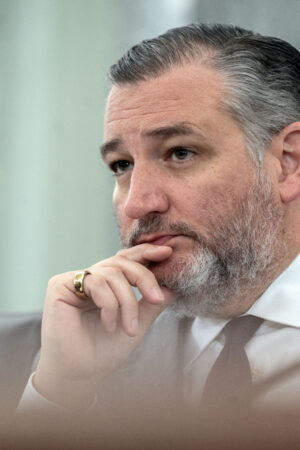
    Sen. Ted Cruz sat down with a longtime ally in November at an office near D.C.’s Union Station to discuss the future of the Republican Party. Before long, the discussion touched on his own future.

    His friend Morton Klein, president of the Zionist Organization for America, told Cruz he believed that “Jew hatred and Israel bashing” was on the rise on the right — and that something had to be done about it. Cruz, who had begun a series of speeches decrying antisemitism in the GOP, told Klein he had been fielding requests from people urging him to run for president in 2028.

    Cruz came across as someone “seriously” considering such a run, Klein recalled.

    With the future of the party up for grabs in a Donald Trump-less 2028 primary, Cruz has in recent months positioned himself as a loud voice for a more traditional, hawkish Republican foreign policy. He’s also urging the GOP to rid itself of popular MAGA pundit Tucker Carlson, whom he argues is injecting the “poison” of antisemitism into the movement with his broadsides against Israel. Carlson has rejected that characterization.

    As he feuds with Carlson, Cruz is weighing a second presidential bid, according to a person close to the senator and another briefed on his thinking, who spoke like others on the condition of anonymity to disclose internal conversations. A White House run would be politically risky for Cruz, 55, putting him on course to collide with Vice President JD Vance, whom many Republicans expect to enter the 2028 race.

    Friction is already evident behind the scenes: Cruz has criticized Vance, a close ally of Carlson, to Republican donors, according to two people familiar with the comments. The senator has warned that Vance’s foreign policy views are dangerously isolationist, the people said. (Vance has been one of the GOP’s most prominent skeptics of U.S. intervention abroad.)

    The emerging rivalry shows how much the party has changed under Trump’s leadership since Cruz arrived in the Senate in 2013. After rising to prominence as a rebel against the establishment, Cruz is now a vocal champion of some longtime orthodox GOP positions, as a new generation of conservatives is ascending with a different vision.

    Some political observers are skeptical that another Cruz run would gain much traction. He can no longer run as an outsider and alienated some conservatives with his fight against Trump in the 2016 campaign. Still, Cruz has built name recognition and relationships with plenty of activists and donors across the country in recent years, and it’s far from clear what will animate the base in the next GOP primary.

    “Can Ted help craft or meld together the traditional Republican approach with the new reality of what the Republican Party is now?” asked Daron Shaw, a political science professor at the University of Texas who overlapped with Cruz as a staffer on George W. Bush’s presidential campaign. “It’s a heavy lift.”

    The day after his chat with Klein, Cruz called Carlson “a coward” during a speech before a group supporting Jewish conservatives in Las Vegas, again denouncing the “poisonous lies” of antisemitism. He said they were “blessed” to have Trump, who “loves the Jewish people,” in the White House right now.

    “When Trump is not in the White House, what then?” he asked in his booming voice.

    “Ted Cruz!” an audience member shouted.

    The senator just smiled, then continued his speech.

    “All of us hate Ted Cruz”

    Anyone considering a run for the GOP nomination in 2028 faces a big obstacle: Vance.

    The 41-year-old vice president leads early polls and is seen as a loyal lieutenant to Trump, who maintains high support from the party base even as the president’s approval ratings have plummeted.

    But Trump has been noncommittal about endorsing his running mate as heir to his Make America Great Again movement, leaving an opening for an ambitious conservative with a different vision for the party.

    “The Republicans will be fighting for their identity,” Rep. Marjorie Taylor Greene (R., Ga.) said of the 2028 primary. Greene, a close ally of Carlson who represents the populist and isolationist wing of the party, added: “There’ll be Ted Cruz, I’m sure, running against JD Vance. All of us hate Ted Cruz.”

    Cruz has adapted to changes in his party over several decades in politics. Following a stretch in the establishment during Bush’s 2000 campaign, he became solicitor general of Texas in 2003 and launched a Senate campaign in 2011 as a tea-party-infused change agent, defeating the lieutenant governor in the GOP primary.

    “The best thing to happen to the Republican Party was to get its teeth kicked in in 2008,” Cruz said during a 2012 campaign event with the libertarian Ron Paul.

    When he arrived in Washington, Cruz picked fights over spending and President Barack Obama’s healthcare law, sparking a government shutdown in 2013. Not everyone in his party liked his style. “If you killed Ted Cruz on the floor of the Senate, and the trial was in the Senate, nobody could convict you,” Sen. Lindsey Graham (R., S.C.) joked at a 2016 press dinner.

    Cruz brought his insurgent pitch into the 2016 presidential race, but Trump caught fire with an antiestablishment campaign that dramatically eclipsed the senator’s. After bowing out of the GOP race as the last major Trump opponent standing, Cruz told delegates at the Republican National Convention that year to “vote your conscience,” instead of throwing his support behind Trump, who had branded him as “Lyin’ Ted.” He returned to the Senate, where he is now chair of the Commerce Committee and has refashioned himself into a bipartisan dealmaker on aviation safety and other issues.

    The Texas senator, who has called himself a “noninterventionist hawk” and has long been a vocal ally of Israel, argues that an anti-Israel foreign policy could embolden terrorists. And he is a defender of the benefits of traditional capitalism at a time when some in the New Right are calling for a more populist turn.

    “Those who are anti-Israel quickly become anti-capitalist and anti-American,” Cruz said in a brief interview about his decision to speak out against Carlson. “Tucker’s obsession is unhealthy and dangerous.”

    By targeting Carlson and growing anti-Israel sentiment within the party, Cruz has hit upon a division within the GOP base that some believe could animate the 2028 primaries. Carlson is closely allied with Vance, a onetime Trump critic who is now an America First populist, embracing skepticism of some big-business interests and rejecting the U.S. foreign policy status quo.

    Cruz is staking out positions against isolationism and antisemitism at a time when explicitly antisemitic figures such as white supremacist commentator Nick Fuentes are gaining an audience on the right.

    Vance, by contrast, has rejected the suggestion that the right has a problem with antisemitism after Carlson hosted Fuentes for a friendly interview. (The vice president disavowed Fuentes months before the interview and has not explicitly weighed in on Carlson hosting him.)

    It’s “kind of slanderous to say that the Republican Party, the conservative movement, is extremely antisemitic,” Vance said in a recent interview with NBC News. In a social media post last week, Vance criticized a news article claiming antisemitism was rising among young people.

    “I would say there’s a difference between not liking Israel (or disagreeing with a given Israeli policy) and antisemitism,” he replied to one user.

    Asked to respond to Vance’s comment, Cruz said he is not in agreement with “people who are anti-Israel or people who are antisemitic.”

    “Every Hamas or Hezbollah or IRGC terrorist that Israel took out makes Americans safer,” Cruz said, referencing militants in Gaza, Lebanon, and Iran that the United States designates as terrorist groups. “And those who don’t see that are not acting in accordance with American national security interests.”

    The feud

    In early July, Cruz sat down in Washington with Israel’s prime minister and delivered a dire warning. Over cigars at Blair House, Cruz told Benjamin Netanyahu that antisemitism on the right was rising to a level he had never seen before.

    “No, Ted,” Netanyahu responded, according to Cruz, who recounted the conversation in a speech. “That’s Qatar, that’s Iran, that’s astroturf, that’s paid for.”

    But Cruz said he was not placated. Replies to his social media posts were flooded with anti-Jewish bigotry from what looked to him like ordinary, real people. He began to fear that what he saw as antisemitism on the left was beginning to infect the right, he said.

    In June, Cruz sat for an interview with Carlson that grew heated over the topic of Israel. Cruz suggested that Carlson criticizes Israel more than other countries because of bigotry toward Jews. Carlson said he has many Jewish friends who have the same questions as him and grilled Cruz with factual questions on the Middle East. In an uncharacteristic lapse, Cruz failed to identify the population of Iran. “You don’t know the population of the country you seek to topple?” Carlson asked.

    Since then, the two have savaged each other in increasingly personal terms. Carlson has called Cruz “vulgar and dumb and reckless” for connecting U.S. military support for Israel to a biblical responsibility to defend the Holy Land and God’s chosen people. After Carlson hosted Fuentes on his podcast this fall, Cruz called on Republicans to repudiate the pundit.

    Carlson “decided Jews are the source of all evil in the world,” Cruz said in a recent podcast. The senator also posted a digitally altered sexually suggestive photo of Carlson to critique his friendly stance toward Qatar, a U.S. ally with which Israel has clashed.

    Since the killing of conservative influencer Charlie Kirk, internal battles about the future of the GOP have spilled into the open, many centering on the true meaning of “America First” as Trump spends time and political capital on Ukraine, Israel, and Venezuela. Carlson criticized Trump’s decision to strike Iran’s nuclear sites in June and has warned the president against pursuing regime change in Venezuela, a goal Cruz shares.

    “What Ted is trying to do is say, this is where our voters are,” said one person close to the senator. “Trump and Ted are much more aligned on foreign policy than Trump and Tucker are.”

    Few Republicans have publicly rallied to Cruz’s side.

    “I can tell you, my colleagues, almost to a person, think what is happening is horrifying,” Cruz said in one speech on Carlson. “But a great many of them are frightened because he has one hell of a big megaphone.”

    Rep. Dan Crenshaw (R., Texas) said he “applauds” Cruz for speaking out against Carlson. But others declined to weigh in.

    Sen. Tommy Tuberville (R., Ala.), a close Trump ally, said he believes the back-and-forth is personal. “Sometimes when you get embarrassed, you get mad, get your feelings hurt,” he said.

    Sen. Richard Blumenthal (D., Conn.) said he is surprised but happy that Cruz has the “courage” to challenge such a powerful figure on the right. “To give Senator Cruz due credit, it requires some guts and gumption to stand up against Tucker Carlson,” he said.

    As Carlson and Cruz have attacked each other, Trump has declined to take sides, calling Carlson a “nice guy” and Cruz a “good friend” in recent months.

    Carlson has said he thinks “antisemitism is immoral, and I am against it.” He argues the feud is just politics. “All [Cruz] wants is to be president. That’s all he’s ever wanted,” Carlson said in an interview. “As a political matter, he somehow thinks that calling me a Nazi is going to get him the nomination because it’s going to hurt JD Vance.” (Cruz has not publicly used that word to described Carlson.)

    Rep. Ryan Zinke (R., Mont.), who argued that Cruz damaged his credibility with conservatives after spurning Trump in 2016 but later recovered his standing, said Cruz “always has an eye on running.”

    “Ted stakes out his position pretty well, and so were he to run, we know where he is,” Zinke said.

    So far, there are few signs that Cruz is gaining an advantage. Hal Lambert, a major GOP donor who helped organize a super PAC to support Cruz when he ran for president in 2016, said he thinks a 2028 bid would be tricky for the senator.

    “If JD Vance is running, I’m going to be supporting JD Vance,” Lambert said.

    “I just don’t understand what the platform would be,” he said of Cruz’s potential run. “The platform would be, I’m Ted, and that’s JD?”

  • Heritage staffers walk out amid latest strife at MAGA institution

    Heritage staffers walk out amid latest strife at MAGA institution

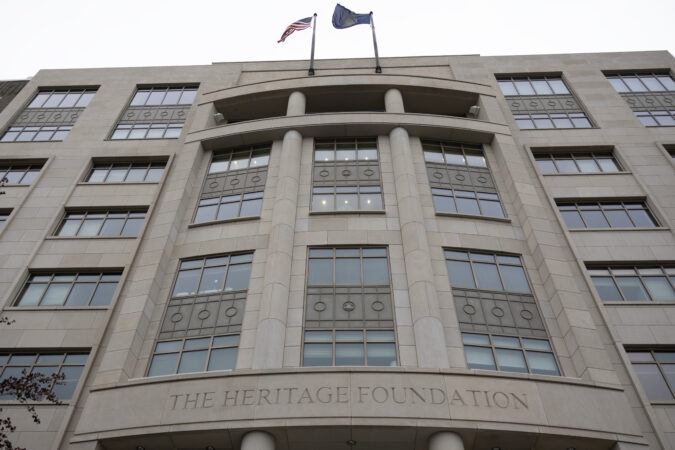
    More than a dozen employees of the Heritage Foundation walked away from their jobs over the weekend as the right-wing think tank struggles with allegations of antisemitism and as the conservative movement grapples with its post-Trump future.

    “This weekend, most of our staff, from our legal and economic centers, are departing immediately,” Heritage President Kevin Roberts wrote in a Sunday night email to staff obtained by the Washington Post. “We wish them well, though the manner of their departures speaks volumes.”

    Heritage has been wrapped in controversy for more than a month after Roberts defended former Fox News host Tucker Carlson’s interview of Nick Fuentes, a white supremacist who routinely espouses antisemitic views.

    Roberts has explained that he was trying to appeal to Fuentes’s followers, who might be open to adopting Heritage’s worldview. After several apologies last month, he said the foundation would cut ties with Carlson, though he said the podcaster remains a personal friend.

    The Wall Street Journal first reported the departures.

    In a statement, Heritage Foundation chief advancement officer Andy Olivastro said the departing staff members were disloyal. He said two of the departing employees had been terminated for “conduct inconsistent with Heritage’s mission and standards.”

    “Heritage has always welcomed debate, but alignment on mission and loyalty to the institution are nonnegotiable,” Olivastro said. “Their departures clear the way for a stronger, more focused team.”

    Three board members, including two last week, have also resigned in protest.

    It’s unclear how many staffers left the organization over the weekend. Thirteen former employees, including three in leadership posts, were hired at Advancing American Freedom, a competing policy and advocacy group founded by former Vice President Mike Pence. The group said it raised more than $10 million to fund the hires.

    Pence’s group defines its ideological tenets as free markets, limited government, and the rule of law — staking out a claim to ground that the Heritage Foundation once occupied.

    Historically, institutions such as Heritage and the American Conservative Union served to guard the party’s flank against extremists and fringe figures who could undermine electoral appeals to middle-of-the-road Americans.

    But in the Trump era, those groups have transformed to more closely match the nationalism, isolationism, and economic populism of the MAGA movement, sparking new controversies over what views that banner should or should not tolerate.

    John Malcolm was Heritage’s vice president at its Institute for Constitutional Government and led the think tank’s Meese Center for Legal and Judicial Studies. Former attorney general Edwin Meese III said in a news release that his eponymous center would relocate to Advancing American Freedom.

    Richard Stern ran Heritage’s economic policy group, and Kevin Dayaratna was Heritage’s chief statistician; both also departed for Pence’s group.

    Advancing American Freedom announced that 10 additional policy associates had joined the organization from Heritage.

    Pence, in a statement, called the newcomers “principled” and said they bring “a love of country, and a deep commitment to the Constitution and Conservative Movement.” But Roberts, in his all-staff email, emphasized obedience.

    “Heritage has always been home to voices within the conservative movement, but alignment on mission and loyalty to senior leadership are nonnegotiable,” he wrote.

    Josh Blackman, who edited the Heritage Guide to the Constitution, also resigned Sunday. In his resignation letter published by the libertarian magazine Reason, Blackman said Roberts made the think tank’s brand “toxic” and caused judges to say they would no longer speak at Heritage events or recommend their clerks to its programs.

  • A fair, a UFC fight, a prayer event: Trump’s plans for nation’s 250th

    A fair, a UFC fight, a prayer event: Trump’s plans for nation’s 250th

    The Trump administration has begun to detail events to mark the 250th anniversary of the nation’s founding next year, including a competitive youth athletic event, a fair, and a UFC fight on the grounds of the White House.

    In a video Thursday, President Donald Trump announced the creation of a new national, nonpartisan organization called Freedom 250 that will work with a White House task force and a congressionally mandated United States Semiquincentennial Commission to help carry out his vision for “the most spectacular birthday the world has ever seen.”

    “Already, we’ve had big celebrations to commemorate the 250th birthdays of the Army, the Navy, and the United States Marines, but there is much, much more to come,” Trump said in the video.

    The celebration will begin on New Year’s Eve. The Washington Monument will be lit with “festive birthday lights to honor the start of this historic anniversary year,” Trump said. Freedom 250 said the monument will be lit through Jan. 5.

    That will be followed by a “major prayer event” on the National Mall in the spring, said Trump, “to rededicate our country as one nation under God.”

    As written in the Constitution, the government does not have the power to establish an official religion. But the move is indicative of the president’s alignment with his evangelical supporters and comes at a time when the separation of church and state is being litigated in courts across the country, even in the Supreme Court.

    An Ultimate Fighting Championship event is set to take place at the White House on June 14, which is Flag Day and Trump’s 80th birthday. Dana White, the chief executive of UFC and a longtime Trump supporter, is set to host the occasion.

    A two-week fair will take place on the National Mall from June 25 to July 10. The Great American State Fair, as Trump called it, will feature exhibits from all 50 states on American history, culture, and innovations.

    “Frankly, you’ll never see anything like it, and you’ll never see anything like it again,” said the president, who has had a long interest in fairs.

    In 1996, he opened the Trump World’s Fair Casino in Atlantic City, with an event that included jugglers and stilt walkers, plus artifacts from and murals of past U.S. World’s Fairs. The casino was closed three years later and eventually demolished after losing about $10 million a year.

    During his first run for president, Trump visited the Iowa State Fair in Des Moines — known for a life-size cow sculpture carved from 600 pounds of butter and appearances from presidential candidates — in a black helicopter embellished with bold letters spelling out his name.

    Originally, the semiquincentennial fair was to be hosted on the Iowa State fairgrounds, calling “millions and millions of visitors from around the world to the heartland of America for this special, one-time festival,” the president said when he returned to the fair this summer. But the event grew into a more sprawling celebration, the Washington Post reported, and was moved to D.C.

    In the fall, high school athletes will participate in a four-day event called the Patriot Games, said Trump, bringing “one young man and one young woman from each state and territory” to the nation’s capital. Transgender athletes, a group that has faced criticism over their participation in sports, will not be allowed to play in groups that match their identity, he said.

    “I promise there will be no men playing in women’s sports. You’re not going to see that. You’ll see everything but that,” Trump said.

    During his remarks at the Iowa State Fair earlier this year, the president said the athletic competition would be televised and overseen by Health and Human Services Secretary Robert F. Kennedy Jr.

    In addition to the marquee events, the president described two developments to commemorate the country’s anniversary year, including the previously announced National Garden of American Heroes. The project will feature sculptures of notable Americans and is set to open next July. Construction of Washington’s own “triumphal arch” — similar to the Arc de Triomphe in Paris — will begin soon, Trump said.

    “We’re the only major city. We’re the only major capital. We’re the only major place without a triumphal arch,” Trump said, though there are similar structures in other U.S. urban centers, including New York City and Atlanta.

    Trump said in the video that the monthslong birthday bash “will be a time like you’ve never had in your lives.”

  • Betty Reid Soskin, 104, oldest U.S. park ranger, has died

    Betty Reid Soskin, 104, oldest U.S. park ranger, has died

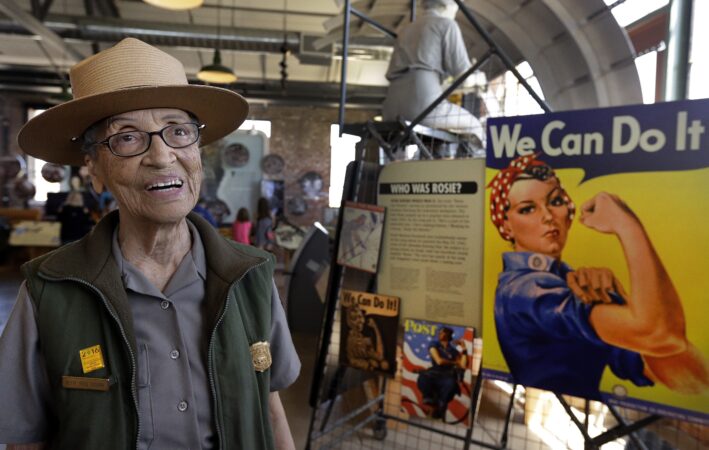
    Betty Reid Soskin, who served as the nation’s oldest park ranger and relayed firsthand accounts of segregation as a Black woman on the World War II home front, died Sunday at her home in Richmond, Calif. She was 104.

    Her death was confirmed by her son Bob Reid, who did not know the exact cause but said she had been in declining health.

    “She led a fully packed life and was ready to leave,” her family said in a statement on social media.

    Ms. Soskin, who joined the National Park Service at 85 and retired when she turned 100, used her role as the nation’s oldest park ranger to share the untold stories of Black women, including herself, who served on the home front during World War II.

    At that time, she worked as a file clerk at Boilermakers Local Auxiliary 36, a segregated union for Black workers. According to the union, Ms. Soskin worked at the sprawling Kaiser Shipyards, where thousands of women helped construct some 700 Liberty and Victory ships.

    While many were familiar with tales of the women who worked in factories as men went off to fight — known as “Rosie the Riveters” — a key detail was often omitted from those histories.

    “That was always a white women’s story,” Ms. Soskin said in an interview with the Washington Post in 2015. For most of the war, she said, Black women were not permitted to be “Rosies” until 1944, when some began to be trained as welders.

    In 2016, the union apologized to Ms. Soskin for the way she and other Black workers were relegated by the union to an auxiliary segregated lodge during the war. “On behalf of my organization, I offer Betty and all former Boilermakers who at one time belonged to an auxiliary local, an apology for what must have been a demeaning life experience,” said union leader IP Jones.

    “I’m not trained as a historian. My presentations are based on my oral history,” Ms. Soskin said. “A bottomless well of memories come up depending on questions the public asks. [The memories] are always on tap for me,” she added.

    The ranger spent her days sharing her experiences with visitors to the Rosie the Riveter WWII Home Front National Historical Park in Richmond. “Black women were not freed or emancipated in the workforce,” she told the Post. “Unions were not racially integrated and wouldn’t be for a decade. They created auxiliaries that all Blacks were dumped into. We paid dues, but didn’t have power or votes.”

    Ms. Soskin was born Betty Charbonnet in Detroit on Sept. 22, 1921, and grew up in a Cajun-Creole, African American family in New Orleans. In 1927, after a devastating flood hit the city, her family relocated to Oakland, Calif., according to a Park Service biography.

    In 1945, Ms. Soskin and her husband at the time, Mel Reid, opened one of the country’s first Black-owned music stores, Reid’s Records, which operated until 2019. In 1972, Ms. Soskin and Reid divorced, and four years later, she married William Soskin, to whom she remained married until his death in 1988.

    According to her former employer, she later went into local and state politics, working as an aide to a Berkeley City Council member and for State Assembly members.

    Ms. Soskin was working in Richmond as a field representative for a California assemblyman when she met with Park Service planners to discuss the development of an urban park paying tribute to World War II home front workers. In 2003, she left her state job to become a consultant to the Rosie the Riveter WWII Home Front National Historical Park and four years later, at the age of 85, became a park ranger.

    In a statement on social media, the park paid tribute to Ms. Soskin’s time as a ranger: “She was a powerful voice for sharing her personal experiences, highlighting untold stories, and honoring the contributions of women from diverse backgrounds who worked on the World War II Home Front.”

    In addition to her son, Bob, survivors include two daughters, Diara and Dorian; five grandchildren; and a great-grandchild.

  • Ted Cruz is weighing another presidential run in 2028, setting up a clash with JD Vance

    Ted Cruz is weighing another presidential run in 2028, setting up a clash with JD Vance

    Sen. Ted Cruz sat down with a longtime ally in November at an office near D.C.’s Union Station to discuss the future of the Republican Party. Before long, the discussion touched on his own future.

    His friend Morton Klein, president of the Zionist Organization for America, told Cruz he believed that “Jew hatred and Israel bashing” was on the rise on the right — and that something had to be done about it. Cruz, who had begun a series of speeches decrying antisemitism in the GOP, told Klein he had been fielding requests from people urging him to run for president in 2028.

    Cruz came across as someone “seriously” considering such a run, Klein recalled.

    With the future of the party up for grabs in a Donald Trump-less 2028 primary, Cruz has in recent months positioned himself as a loud voice for a more traditional, hawkish Republican foreign policy. He’s also urging the GOP to rid itself of popular MAGA pundit Tucker Carlson, whom he argues is injecting the “poison” of antisemitism into the movement with his broadsides against Israel. Carlson has rejected that characterization.

    As he feuds with Carlson, Cruz is weighing a second presidential bid, according to a person close to the senator and another briefed on his thinking, who spoke like others on the condition of anonymity to disclose internal conversations. A White House run would be politically risky for Cruz, 55, putting him on course to collide with Vice President JD Vance, who many Republicans expect to enter the 2028 race.

    Friction is already evident behind the scenes: Cruz has criticized Vance, a close ally of Carlson, to Republican donors, according to two people familiar with the comments. The senator has warned that Vance’s foreign policy views are dangerously isolationist, the people said. (Vance has been one of the GOP’s most prominent skeptics of U.S. intervention abroad.)

    The emerging rivalry shows how much the party has changed under Trump’s leadership since Cruz arrived in the Senate in 2013. After rising to prominence as a rebel against the establishment, Cruz is now a vocal champion of some longtime orthodox GOP positions, as a new generation of conservatives is ascending with a different vision.

    Some political observers are skeptical that another Cruz run would gain much traction. He can no longer run as an outsider and alienated some conservatives with his fight against Trump in the 2016 campaign. Still, Cruz has built name recognition and relationships with plenty of activists and donors across the country in recent years, and it’s far from clear what will animate the base in the next GOP primary.

    “Can Ted help craft or meld together the traditional Republican approach with the new reality of what the Republican Party is now?” asked Daron Shaw, a political science professor at the University of Texas who overlapped with Cruz as a staffer on George W. Bush’s presidential campaign. “It’s a heavy lift.”

    The day after his chat with Klein, Cruz called Carlson “a coward” during a speech before a group supporting Jewish conservatives in Las Vegas, again denouncing the “poisonous lies” of antisemitism. He said they were “blessed” to have Trump, who “loves the Jewish people,” in the White House right now.

    “When Trump is not in the White House, what then?” he asked in his booming voice.

    “Ted Cruz!” an audience member shouted.

    The senator just smiled, then continued his speech.

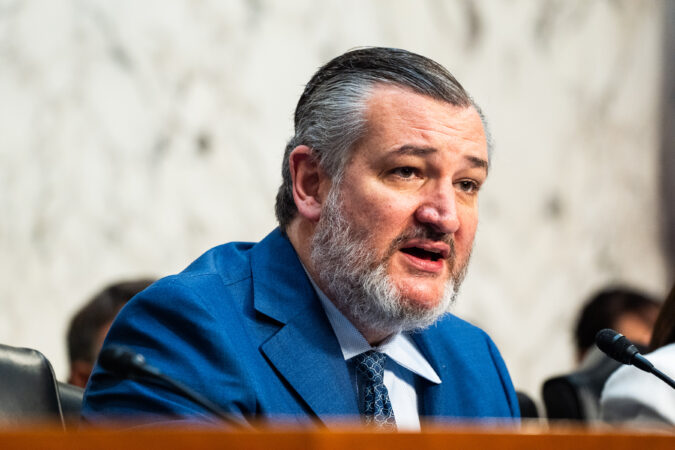
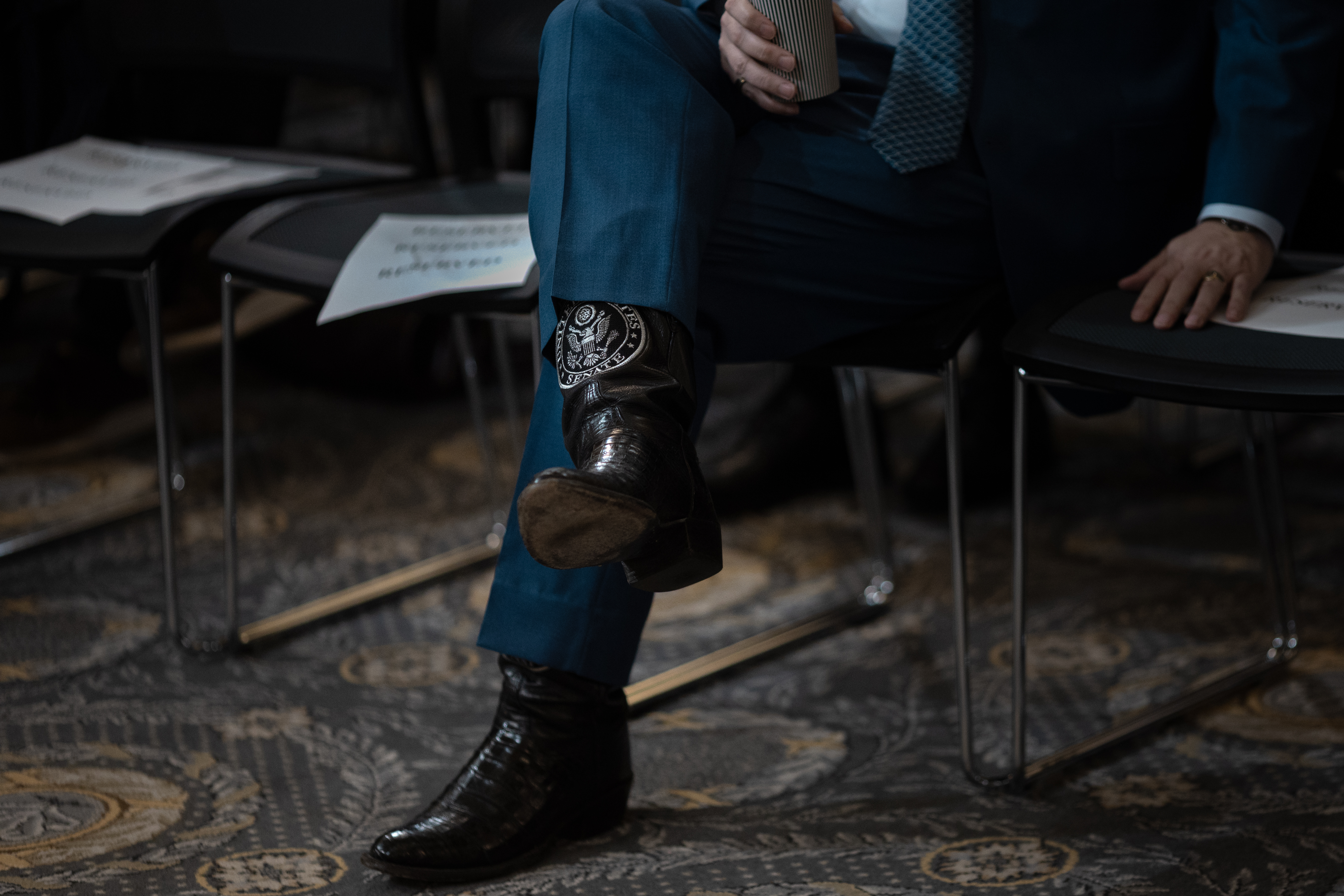
    Sen. Ted Cruz (Texas) wears Senate-themed boots in May at the Capitol.

    ‘All of us hate Ted Cruz’

    Anyone considering a run for the GOP nomination in 2028 faces a big obstacle: Vance.

    The 41-year-old vice president leads early polls and is seen as a loyal lieutenant to Trump, who maintains high support from the party base even as the president’s approval ratings have plummeted.

    But Trump has been noncommittal about endorsing his running mate as heir to his Make America Great Again movement, leaving an opening for an ambitious conservative with a different vision for the party.

    “The Republicans will be fighting for their identity,” Rep. Marjorie Taylor Greene (R-Georgia) said of the 2028 primary. Greene, a close ally of Carlson who represents the populist and isolationist wing of the party, added: “There’ll be Ted Cruz, I’m sure, running against JD Vance. All of us hate Ted Cruz.”

    Cruz has adapted to changes in his party over several decades in politics. Following a stretch in the establishment during Bush’s 2000 campaign, he became solicitor general of Texas in 2003 and launched a Senate campaign in 2011 as a tea-party-infused change agent, defeating the lieutenant governor in the GOP primary.

    “The best thing to happen to the Republican Party was to get its teeth kicked in in 2008,” Cruz said during a 2012 campaign event with the libertarian Ron Paul.

    When he arrived in Washington, Cruz picked fights over spending and President Barack Obama’s health care law, sparking a government shutdown in 2013. Not everyone in his party liked his style. “If you killed Ted Cruz on the floor of the Senate, and the trial was in the Senate, nobody could convict you,” Sen. Lindsey Graham (R-South Carolina) joked at a 2016 press dinner.

    Cruz brought his insurgent pitch into the 2016 presidential race, but Trump caught fire with an antiestablishment campaign that dramatically eclipsed the senator’s. After bowing out of the GOP race as the last major Trump opponent standing, Cruz told delegates at the Republican National Convention that year to “vote your conscience,” instead of throwing his support behind Trump, who had branded him as “Lyin’ Ted.” He returned to the Senate, where he is now chair of the Commerce Committee and has refashioned himself into a bipartisan dealmaker on aviation safety and other issues.

    The Texas senator, who has called himself a “noninterventionist hawk” and has long been a vocal ally of Israel, argues that an anti-Israel foreign policy could embolden terrorists. And he is a defender of the benefits of traditional capitalism at a time when some in the “New Right” are calling for a more populist turn.

    “Those who are anti-Israel quickly become anti-capitalist and anti-American,” Cruz said in a brief interview about his decision to speak out against Carlson. “Tucker’s obsession is unhealthy and dangerous.”

    By targeting Carlson and growing anti-Israel sentiment within the party, Cruz has hit upon a division within the GOP base that some believe could animate the 2028 primaries. Carlson is closely allied with Vance, a onetime Trump critic who is now an “America First” populist, embracing skepticism of some big-business interests and rejecting the U.S. foreign policy status quo.

    Cruz is staking out positions against isolationism and antisemitism at a time when explicitly antisemitic figures such as white supremacist commentator Nick Fuentes are gaining an audience on the right.

    Vance, by contrast, has rejected the suggestion that the right has a problem with antisemitism after Carlson hosted Fuentes for a friendly interview. (The vice president disavowed Fuentes months before the interview and has not explicitly weighed in on Carlson hosting him.)

    It’s “kind of slanderous to say that the Republican Party, the conservative movement, is extremely antisemitic,” Vance said in a recent interview with NBC News. In a social media post last week, Vance criticized a news article claiming antisemitism was rising among young people.

    “I would say there’s a difference between not liking Israel (or disagreeing with a given Israeli policy) and antisemitism,” he replied to one user.

    Asked to respond to Vance’s comment, Cruz said he is not in agreement with “people who are anti-Israel or people who are antisemitic.”

    “Every Hamas or Hezbollah or IRGC terrorist that Israel took out makes Americans safer,” Cruz said, referencing militants in Gaza, Lebanon and Iran that the United States designates as terrorist groups. “And those who don’t see that are not acting in accordance with American national security interests.”

    The feud

    In early July, Cruz sat down in Washington with Israel’s prime minister and delivered a dire warning. Over cigars at Blair House, Cruz told Benjamin Netanyahu that antisemitism on the right was rising to a level he had never seen before.

    “No, Ted,” Netanyahu responded, according to Cruz, who recounted the conversation in a speech. “That’s Qatar, that’s Iran, that’s astroturf, that’s paid for.”

    But Cruz said he was not placated. Replies to his social media posts were flooded with anti-Jewish bigotry from what looked to him like ordinary, real people. He began to fear that what he saw as antisemitism on the left was beginning to infect the right, he said.

    In June, Cruz sat for an interview with Carlson that grew heated over the topic of Israel. Cruz suggested that Carlson criticizes Israel more than other countries because of bigotry toward Jews. Carlson said he has many Jewish friends who have the same questions as him and grilled Cruz with factual questions on the Middle East. In an uncharacteristic lapse, Cruz failed to identify the population of Iran. “You don’t know the population of the country you seek to topple?” Carlson asked.

    Since then, the two have savaged each other in increasingly personal terms. Carlson has called Cruz “vulgar and dumb and reckless” for connecting U.S. military support for Israel to a biblical responsibility to defend the Holy Land and God’s chosen people. After Carlson hosted Fuentes on his podcast this fall, Cruz called on Republicans to repudiate the pundit.

    Carlson “decided Jews are the source of all evil in the world,” Cruz said in a recent podcast. The senator also posted a digitally altered sexually suggestive photo of Carlson to critique his friendly stance toward Qatar, a U.S. ally with which Israel has clashed.

    Since the killing of conservative influencer Charlie Kirk, internal battles about the future of the GOP have spilled into the open, many centering on the true meaning of “America First” as Trump spends time and political capital on Ukraine, Israel and Venezuela. Carlson criticized Trump’s decision to strike Iran’s nuclear sites in June and has warned the president against pursuing regime change in Venezuela, a goal Cruz shares.

    “What Ted is trying to do is say, this is where our voters are,” said one person close to the senator. “Trump and Ted are much more aligned on foreign policy than Trump and Tucker are.”

    Few Republicans have publicly rallied to Cruz’s side.

    “I can tell you, my colleagues, almost to a person, think what is happening is horrifying,” Cruz said in one speech on Carlson. “But a great many of them are frightened because he has one hell of a big megaphone.”

    Rep. Dan Crenshaw (R-Texas) said he “applauds” Cruz for speaking out against Carlson. But others declined to weigh in.

    Sen. Tommy Tuberville (R-Alabama), a close Trump ally, said he believes the back-and-forth is personal. “Sometimes when you get embarrassed, you get mad, get your feelings hurt,” he said.

    Sen. Richard Blumenthal (D-Connecticut) said he is surprised but happy that Cruz has the “courage” to challenge such a powerful figure on the right. “To give Senator Cruz due credit, it requires some guts and gumption to stand up against Tucker Carlson,” he said.

    As Carlson and Cruz have attacked each other, Trump has declined to take sides, calling Carlson a “nice guy” and Cruz a “good friend” in recent months.

    Carlson has said he thinks “antisemitism is immoral, and I am against it.” He argues the feud is just politics. “All [Cruz] wants is to be president. That’s all he’s ever wanted,” Carlson said in an interview. “As a political matter, he somehow thinks that calling me a Nazi is going to get him the nomination because it’s going to hurt JD Vance.” (Cruz has not publicly used that word to described Carlson.)

    Rep. Ryan Zinke (R-Montana), who argued that Cruz damaged his credibility with conservatives after spurning Trump in 2016 but later recovered his standing, said Cruz “always has an eye on running.”

    “Ted stakes out his position pretty well, and so were he to run, we know where he is,” Zinke said.

    So far, there are few signs that Cruz is gaining an advantage. Hal Lambert, a major GOP donor who helped organize a super PAC to support Cruz when he ran for president in 2016, said he thinks a 2028 bid would be tricky for the senator.

    “If JD Vance is running, I’m going to be supporting JD Vance,” Lambert said.

    “I just don’t understand what the platform would be,” he said of Cruz’s potential run. “The platform would be, I’m Ted, and that’s JD?”

    Kadia Goba and Sarah Ellison contributed to this report.

  • U.S. pursuing third tanker off Venezuelan coast, official says

    U.S. pursuing third tanker off Venezuelan coast, official says

    The United States Coast Guard is pursuing a tanker off the coast of Venezuela, a U.S. official said Sunday, in what would mark the third interception of a tanker in the waters off that country this month.

    The official described that tanker as “a sanctioned dark fleet vessel that is part of Venezuela’s illegal sanctions evasion. It is flying a false flag and under a judicial seizure order.” The official shared the statement on the condition of anonymity under ground rules set by the administration.

    President Donald Trump on Tuesday ordered a “total and complete blockade” on all oil tankers under sanctions entering or leaving Venezuela. He called the Venezuelan regime a foreign terrorist organization and said it was using oil to finance “drug terrorism.”

    If intercepted, this would be the second tanker the U.S. stopped this weekend after seizing the oil tanker Skipper off Venezuela’s coast on Dec. 10. The U.S. attorney’s office for the District of Columbia issued the seizure warrant for the Skipper, alleging it was used in an “oil shipping network” supporting the Lebanese militant group Hezbollah and Iran’s Islamic Revolutionary Guard Corps-Qods Force.

    Venezuela’s government has called the actions “theft” and “hijacking.”

    Early Saturday, U.S. forces boarded a different commercial vessel, the Panamanian-flagged Centuries owned by Centuries Shipping in Hong Kong, off Venezuela. Homeland Security Secretary Kristi L. Noem posted a video on X showing service members rappelling down from military helicopters onto the vessel, which her department said was suspected of carrying oil subject to U.S. sanctions.

    The U.S. has not imposed sanctions on Venezuelan oil. And neither the Centuries nor its company is under any sanctions, according to the International Maritime Organization, a U.N. agency.

    These actions come as part of the United States’ monthslong pressure campaign against the government of President Nicolás Maduro, whom the administration wants to force from office. The tanker blockade could impact Venezuela’s already struggling economy, which heavily depends on overseas oil sales.

    The U.S. has launched more than two dozen military strikes on boats it claimed had crews who were smuggling drugs into the United States. Officials have said that more than 100 people connected to drug cartels have been killed.

    Sen. Rand Paul (R., Ky.) said on ABC’s This Week that he considers the seizing of the second oil tanker a “provocation” and “prelude to war.”

    “Look, at any point in time, there are 20, 30 governments around the world that we don’t like, that are either socialist or communist, or have human rights violations … but it isn’t the job of the American soldier to be the policeman of the world,” Paul said.

    By contrast, Sen. Lindsey Graham (R., S.C.) said on Meet the Press on Sunday, “I am all in the camp for regime change. … Maduro’s days are numbered.”

    Jim Foggo, a retired U.S. Navy admiral, said the administration’s plan for Venezuela appears to constitute a “targeted blockade” or “embargo” operation, in which certain ships are stopped and others are allowed through.

    “If you want to pick something to go after — an Achilles’ heel — of the Venezuelan regime, it’s oil exports,” Foggo said.

    Venezuela has the world’s largest proven oil reserves. Output has plummeted amid sanctions, poor infrastructure, and mismanagement, but oil still represents the vast majority of the country’s exports. “So this is really going to hurt, and Maduro is going to have to do some serious thinking,” Foggo said.

    Foggo, dean of the Center for Maritime Strategy outside Washington, said boarding operations can be unpredictable and dangerous for U.S. troops involved, citing a boarding operation in the Arabian Sea in January 2024 in which two Navy SEALs drowned.

    “This is serious business,” Foggo said, noting that Maduro has said that Venezuelan naval forces will accompany vessels. “The danger is that it could go kinetic and someone could get hurt, but we seem to be willing to take that risk.”

  • Trump faces narrowing options on Venezuela action

    Trump faces narrowing options on Venezuela action

    The day after President Donald Trump declared he had ended 94% of all seaborne drug trafficking to the United States and reduced illegal migrant border crossings to “zero,” he announced an entirely new rationale for his escalating campaign against Venezuelan President Nicolás Maduro.

    Venezuela had stolen “Oil, Land and other Assets” from the United States to finance those criminal activities, Trump said Tuesday in a social media post, an apparent reference to decades-old expropriations and the breaking of contracts with U.S. oil companies when Caracas began nationalizing the industry.

    Unless what he alleged was U.S. property was returned “IMMEDIATELY,” Trump said, the military juggernaut he has assembled in the Caribbean to blow up alleged traffickers and seize tankers transporting Venezuelan oil “will only get bigger, and the shock to them will be like nothing they have ever seen before.”

    As Trump continues the boat strikes — now numbering 28, with at least 104 killed — and with the declaration of a “blockade” of all sanctioned vessels transporting Venezuelan oil, he has all but abandoned the public pretense that his goal is simply stopping migrants and drugs, rather than Maduro’s removal.

    His “days are numbered,” Trump told Politico in an interview published Dec. 9. Asked Thursday whether he was leaving open the possibility of war with Venezuela, Trump told NBC: “I don’t rule it out, no.”

    Maduro is the “indicted head of a cartel, now designated as a foreign terrorist organization,” said a person familiar with administration thinking, one of several individuals and former U.S. officials who spoke on the condition of anonymity to talk about internal deliberations. The administration named Maduro, already facing a 2020 U.S. indictment for drug trafficking, as the head of the designated Cartel de los Soles, a network of senior Venezuelan political and security officials it says is involved in human and drug trafficking to finance terrorist attacks in the United States.

    “At the end of the day, that person is either going to stand trial or be given a chance to negotiate exile … in a third country,” the person said of the Venezuelan leader.

    But with Maduro still sitting tight, Trump’s options seem to be narrowing rapidly.

    In an emailed response to questions, White House deputy spokesperson Anna Kelly said, “Nothing is ‘narrowing.’” Trump, she said, “has already taken decisive action to stop the illegal migrant invasion, deport violent criminals, and defend our homeland against evil narcoterrorists — which is saving countless lives across the country. President Trump retains all options to keep Americans safe.”

    Airstrikes on land, which U.S. officials have said would probably target isolated encampments associated with cocaine trafficking or selected military assets and installations, are “going to start” happening, Trump said last week.

    If that doesn’t work in persuading Maduro to flee, regional experts and former officials say, there are only two U.S. choices left — withdrawal or regime change by force.

    The prospect of invasion and a military ground operation with the possibility of American deaths, however, may be unpalatable to a president who has vowed “no more wars” and has thus far limited overseas military involvement to standoff strikes by air and sea.

    “It’s conceivable to me that in a month, two months, the president … declares victory on grounds that maritime drug trafficking is way down,” Elliot Abrams, Trump’s first-term special envoy on Venezuela, said Tuesday on the School of War podcast. But “if Maduro survives and Trump walks away, it’s a defeat.”

    While some in Congress have sharply opposed ongoing U.S. military action in the Caribbean and eastern Pacific without legislative approval, let alone a ground invasion of Venezuela, others have called on Trump to move more decisively.

    “You cannot allow this man to remain standing after this show of force,” Sen. Lindsey Graham (R., S.C.) said of Trump’s Caribbean deployment of 15,000 troops and dozens of warships and aircraft. Graham, a retired Air Force legal officer, spoke after a closed briefing Tuesday for Senators by Defense Secretary Pete Hegseth and Secretary of State Marco Rubio on a controversial Sept. 2 airstrike that killed 11 people aboard an alleged trafficking boat — including two who initially survived and were hit again while flailing amid the wreckage.

    “Is the goal to take him out?” Graham asked about Maduro, saying he hadn’t received answers from the administration. “If it’s not the goal … I think it’s a mistake.”

    But as lawmakers continue to argue and the administration ups the ante, “the most interesting question is why is [Trump] doing all this at all,” Abrams said in an interview with the Washington Post.

    Trump’s fixation on Venezuela melds a number of his own domestic political aims and the priorities of senior officials around him. The administration’s new National Security Strategy, which shifts U.S. focus to the Western Hemisphere, promises to reward countries that comply with “America First” policies and punish those that do not.

    For Rubio — the son of Cuban immigrants who fled the island several years before the 1959 takeover by Fidel Castro and who made his political career in the anti-Castro cauldron of South Florida — the collapse of Cuba’s communist government has long been a prime goal.

    Cuba’s economy has been propped up by Venezuela under Maduro and his predecessor, Hugo Chávez, through a steady supply of oil despite heavy U.S. sanctions. In addition to economic ties and ideological affinity, Maduro’s personal safety is said to be provided by elite Cuban security forces. Many think that the end of Venezuelan aid would be a death knell for the government in Havana.

    “Rubio is the driving force behind the military buildup in Venezuela policy in the last several months, but he has not convinced the president yet to use military force,” said a second former official. Others, however, say it is Trump who wants to escalate.

    For White House Deputy Chief of Staff Stephen Miller, the architect of Trump’s draconian anti-immigrant policy, the hundreds of thousands of Venezuelans who fled to the United States, during Trump’s first term and the Biden administration, provide an easy target. Miller has echoed Trump’s charges that most of the Venezuelans in the U.S. were sent by Maduro from prisons and mental institutions to terrorize and kill Americans.

    Those sentiments contrast with Trump’s first term, when the flow of what eventually would be millions of fleeing Venezuelans spread across the hemisphere was viewed more sympathetically. Then-Secretary of State Mike Pompeo, who traveled to the Venezuela-Colombia border to greet them in the spring of 2019, said they were escaping what he called the political and economic “horror” of Maduro’s corrupt and failing socialist economy and demanded they be allowed to leave.

    At the time, Trump also said that “all options” were on the table to oust Maduro, charging that in addition to abusing his own people, he had stolen the 2018 election that gave him a second term in office and had formed U.S.-threatening alliances with Russia, China, and Iran. Trump stepped up sanctions, sent U.S. warships to the Caribbean — although fewer than the current armada — and recognized legislative assembly leader Juan Guaidó as Venezuela’s legitimate president.

    With Guaidó as his guest, Trump told Congress during his 2020 State of the Union address that Maduro was “a socialist dictator” and a “tyrant who brutalizes his people.” The amount of deadly fentanyl entering the country, primarily from China and Mexico, had begun to soar even before Trump took office, reaching its peak as the COVID pandemic waned and beginning an ongoing decline, along with overdose deaths, in 2024, according to U.S. government figures.

    During first-term debates in the Trump White House over what to do about Maduro, some advocated the use of military force to oust him, according to subsequent books by then-Defense Secretary Mark T. Esper, who opposed it, and national security adviser John Bolton, who supported it.

    With his time in office winding down and Gen. Mark A. Milley, then chairman of the Joint Chiefs of Staff, and CIA Director Gina Haspel also advising against the use of force, according to Esper and others, Trump backed off.

    The number of arriving Venezuelans, many crossing the border illegally, increased sharply under the Biden administration. Many were allowed to stay legally under a temporary protected status that recognized the economic and political hardships Trump himself had said were the reason for their flight.

    Maduro, who reneged on agreements with the Biden administration to allow a fair election in 2024, was inaugurated for his third term in January, only 10 days before Trump was sworn in again. By then, Guaidó had long since faded from memory. A new opposition figure, María Corina Machado, came to the fore and — though barred by Maduro from running against him — led her party to a landslide win that was widely acknowledged to have been stolen.

    Trump lost little time moving on his campaign promise to expel migrants and end opioid deaths, touting crime statistics he wildly inflated and blamed on Biden. In one of his first second-term acts, he ordered the end of protected status for Venezuelans and other migrants, and began widespread deportations. Trump charged that Maduro controlled a Venezuelan gang, Tren de Aragua, and had sent it to the United States to wreak criminal havoc, allegations that were not supported by U.S. intelligence assessments.

    Tren de Aragua and Cartel de los Soles are among roughly two dozen foreign organizations that the administration has designated, under a February Trump executive order, as “narcoterrorists.”

    By summer, despite some early attempts at negotiations with Maduro that included an offer to expand U.S. oil operations in Venezuela, Trump had opted for a military path. Though Venezuela is not a source of fentanyl and is a trafficker but not a producer of cocaine, according to U.S. law enforcement, pressure against Maduro was seen as a visible reminder to drug-producing countries such as Mexico and Colombia of the consequences of noncooperation.

    Miller, current and former U.S. officials said, had first proposed striking Mexican cartels and traffickers as a way to stop drugs and migrants. But as the administration surged thousands of U.S. troops to the southern border and increased intelligence cooperation, Mexico began to curb cartel action. Miller and his team were left looking for another target.

    The administration sent warships to the Caribbean, and on Sept. 2, Special Operations forces struck an alleged drug-smuggling boat carrying 11 men with missiles. It had come from Venezuela, Trump said without providing evidence, and was carrying “bags” of fentanyl and cocaine for Tren de Aragua. The United States, he told Congress that month, was in an “armed conflict” with terrorists.

    On Dec. 10, U.S. forces in the Caribbean seized an oil tanker, the Skipper, that had just filled up in Venezuela and was headed to Asia. The ship, already under U.S. sanctions for carrying illegal Iranian oil, was to be hauled to a Texas port. Asked by reporters what would happen to the oil, Trump said, “Well, we keep it, I guess.”

    On Saturday, the Department of Homeland Security said a second vessel carrying Venezuelan oil in the Caribbean had been “seized” in a joint operation by the Coast Guard and Defense Department. That ship, the Centuries, was not under U.S. sanctions and it was unclear whether it had merely been boarded by U.S. forces or taken under their control.