
Category: Washington Post

  • The NBA’s $525 million injury epidemic

    The NBA’s $525 million injury epidemic

    LOS ANGELES – Golden State Warriors Coach Steve Kerr sparked a moment of introspection for the NBA last month when he said his team’s medical staff believed modern basketball’s fast pace and heavy mileage were contributing to a rash of injuries. After bemoaning the lack of practice and recovery time, Kerr demurred when asked whether he thought the league would consider shortening its 82-game schedule in an attempt to protect player health.

    “The tricky part is all the constituents would have to agree to take less revenue,” Kerr said. “In 2025, in America, good luck in any industry. … That’s not happening.”

    Kerr’s doubt was well founded, because the NBA’s business is booming: Commissioner Adam Silver recently struck new media rights deals worth $76 billion over 11 years, the league’s 30 teams combined to generate a record $12.25 billion in revenue last season, and a record 16 players will earn at least $50 million in salary this season.

    But as the NBA’s top-line financial metrics continue to increase, so, too, do the skyrocketing costs associated with lost productivity for injured stars. Remarkably, if early trends hold, the NBA’s 30 highest-paid players, according to salary data compiled by ESPN, could combine to cost their teams more than $525 million in empty salary associated with games they do not play this season.

    Stephen Curry (who will earn $59.6 million) is sidelined with a quadriceps injury. Joel Embiid ($55.2 million) has missed more games than he has played because of recurring knee problems, Kawhi Leonard ($50 million) has already missed 10 games because of a foot injury, and Bradley Beal ($53.7 million including a contract buyout) played only six games before suffering a season-ending hip injury. LeBron James ($52.6 million) and Anthony Davis ($54.1 million) missed the first four weeks of the season because of injury, and Giannis Antetokounmpo ($54.1 million) and Ja Morant ($39.4 million) are out with muscle strains.

    Jayson Tatum, Damian Lillard, Tyrese Haliburton and Kyrie Irving are on the books for $204.4 million combined but have yet to play because of major injuries suffered last season. During one recent loss, the New Orleans Pelicans took the court without their five highest-paid players, who will combine to earn more than $140 million.

    Stephen Curry is currently sidelined with a quadriceps injury.

    Many of those absences have directly led to trouble in the standings. Haliburton’s Indiana Pacers, who reached the NBA Finals in June, have dropped to 14th in the Eastern Conference. Antetokounmpo’s Milwaukee Bucks are at risk of missing the playoffs for the first time since 2015-16 and must pay Lillard $113 million over the next five seasons after waiving him using the league’s stretch provision. And the Los Angeles Clippers, wobbly with Leonard and Beal missing time, are on track for their first losing season since 2010-11.

    “When you lose your best player and a top-10 player when he’s on the floor, it’s hard to make up for that,” Clippers Coach Tyronn Lue said last week. “I know a lot of people say ‘next man up,’ but if [Leonard] is making [$50] million and your next man up is making $400,000, it’s not really the same.”

    In two notable cases, star injuries have already contributed to major personnel changes. Without Davis and Irving, the Dallas Mavericks struggled out of the gate and fired general manager Nico Harrison less than a month into the season. And well before Zion Williamson’s latest injury, a hip strain that will keep him out for weeks, the Pelicans had crashed into the Western Conference’s basement and fired Willie Green after he coached just 12 games.

    “We have a lot of guys that are in street clothes,” Mavericks Coach Jason Kidd said shortly after Harrison’s firing. “We’ve got over, I think, $100 million sitting on the sideline.”

    More injuries, more problems

    The rise in star injuries goes well beyond this season’s most extreme examples of the Pacers, Clippers, Mavericks and Pelicans.

    Flash back one decade: During the 2015-16 season, NBA teams averaged 102.7 points, 24.1 three-point attempts and 95.8 possessions per game. That year, the league’s 30 highest-paid players combined to miss just 14 percent of their teams’ games.

    This season, teams entered Wednesday averaging 116.6 points, 36.9 three-point attempts and 100 possessions per game. The league’s highest-paid players have combined to miss 35 percent of their teams’ games. A faster, higher-scoring and more rigorous sport appears to be taxing players like never before.

    John DiFiori, the NBA’s director of sports medicine, said the league views the 2019-20 season as an “inflection point” for star injuries. During the four seasons before that campaign, which was interrupted by the coronavirus pandemic, the NBA’s 30 highest-paid players missed between 14 and 20 percent of their teams’ games. Since 2019-20, that number has jumped, ranging from 24 percent to 35 percent. The missed games rate has remained elevated in the years after the NBA stopped requiring players to sit out if they tested positive for the coronavirus.

    “Injury rates are going up,” DiFiori said. “When we look back at what we’ve been doing the last 10 or 12 years, it’s a moving target. The game doesn’t stay the same. We’re trying to reduce injuries, and the game is also changing. All these other factors, the pace of play and what players are doing in training, those are all moving targets. To wrap our arms around that is a challenge. It’s something we’re quite focused on. … [Teams are] spending a lot of time and money and bringing in a lot of expertise. Despite all of that, we’re seeing an increase in injuries. It’s not for teams’ lack of focus on it.”
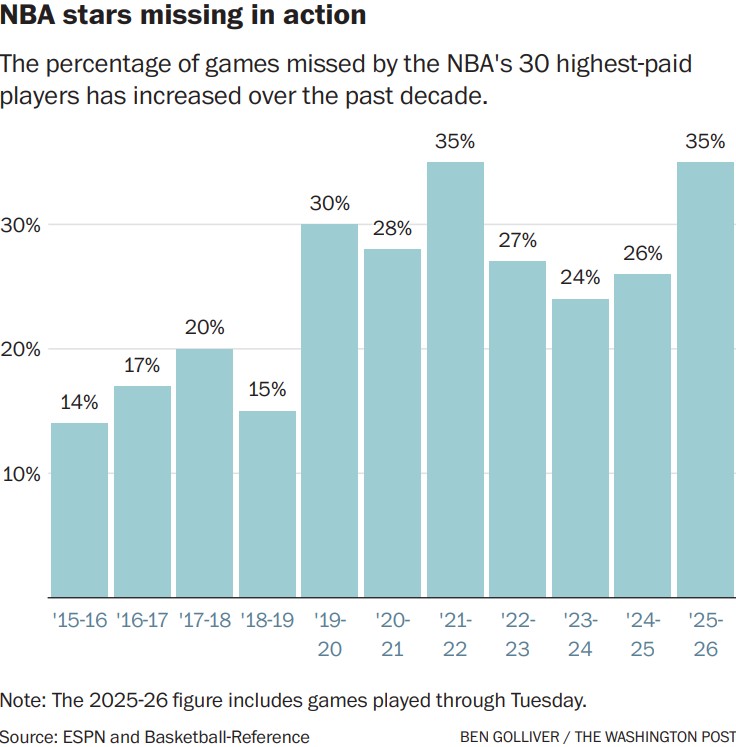
    The percentage of games missed by the NBA's 30 highest-paid players has increased over the past decade.
    The percentage of games missed by the NBA’s 30 highest-paid players has increased over the past decade.

    The NBA instituted the Player Participation Policy (PPP) before the 2023-24 season to address what it calls “a statistically significant increase” in star absences and to curb “load management,” a strategy used by some teams to rest players throughout the season. With the NBA negotiating new media rights deals and debuting the NBA Cup in-season tournament to spark interest, then-league executive Joe Dumars met with all 30 teams to remind them that the NBA is an “82-game league.” To reinforce that message, the PPP mandated that players appear in at least 65 games to be eligible for end-of-season awards, and the league began fining teams if they rested healthy players for nationally televised games.

    The PPP enjoyed some initial success: The 30 highest-paid players missed just 24 percent of games in 2023-24, the league’s best mark since the pandemic. That progress proved short-lived, however; the availability of the NBA’s highest-paid players has regressed noticeably over the past three seasons. During the 2025 playoffs, Tatum, Lillard and Haliburton all suffered season-ending Achilles tendon injuries during a span of less than two months.

    Muscle strains have been another point of immediate concern. The Mavericks shocked the basketball world by trading franchise player Luka Doncic last season while he was recovering from a calf strain; Antetokounmpo, Davis, Morant and Victor Wembanyama are among the stars who have been sidelined by the same injury this season. Haliburton was still recovering from a calf strain when he tore his Achilles during Game 7 of the NBA Finals, but the NBA’s medical staff has yet to identify clear evidence that suggests a prior calf injury increases the risk of an Achilles tear.

    “When you have a small prevalence of injury, it’s hard to scientifically study that,” DiFiori said. “Typically over the last 15 years, we average about two Achilles tendon injuries per year. Last year, we had seven. That’s a lot. One year prior, also with a high pace of play, we had zero. We’re taking it very seriously. We’re concerned about it, but I don’t think we have our finger on what’s the driver here or what factors may have led to last season’s unusually high number.”

    More injuries, more money

    Kerr is hardly the only voice in the basketball and medical communities raising the alarm about the increase in injuries. A range of theories abound.

    The NBA cut its preseason to three weeks in 2017, reducing the amount of time players have to ramp up for game action to spread out the regular season more evenly and eliminate instances of four games in five nights. The league changed its shot clock reset to 14 seconds and emphasized greater freedom of movement for players to encourage faster and less restrictive play in 2018. The pandemic created calendar disruptions and shortened schedules in 2020-21 and 2021-22, and the NBA has tweaked its regular season schedule in each of the past three seasons to accommodate the NBA Cup in November and December.

    Aside from those legislative moves and the possibility of unintended consequences, the use of analytics has swept through the league and transformed the sport into a perimeter-dominated endeavor. Playing at a fast pace and shooting a high volume of three-pointers are now generally viewed as optimal strategies for underdogs hoping to increase variance against more talented opponents.

    The Pacers’ unexpected Finals run, driven by a breakneck offense and high-pressure defense, has spawned copycats. The results haven’t always been positive: The Portland Trail Blazers made waves by regularly deploying a full-court press to start the season, only to endure injuries to their guards in recent weeks.

    It’s also worth noting that a cohort of superstars such as Curry and James has remained highly productive late into their lengthy careers. While these older players have remained among the league’s biggest earners, their durability has tended to decrease as they proceed through their late 30s.

    On the flip side, a younger generation of high draft picks – such as Williamson, Morant, LaMelo Ball and Ben Simmons – has encountered recurring injuries before they reach their late 20s, which have typically been viewed as the prime years for basketball players. NBA executives have long expressed serious concerns that the modern generation of players is arriving to the NBA with preexisting injuries or risks that result from playing too many games at the youth level and specializing in only one sport.
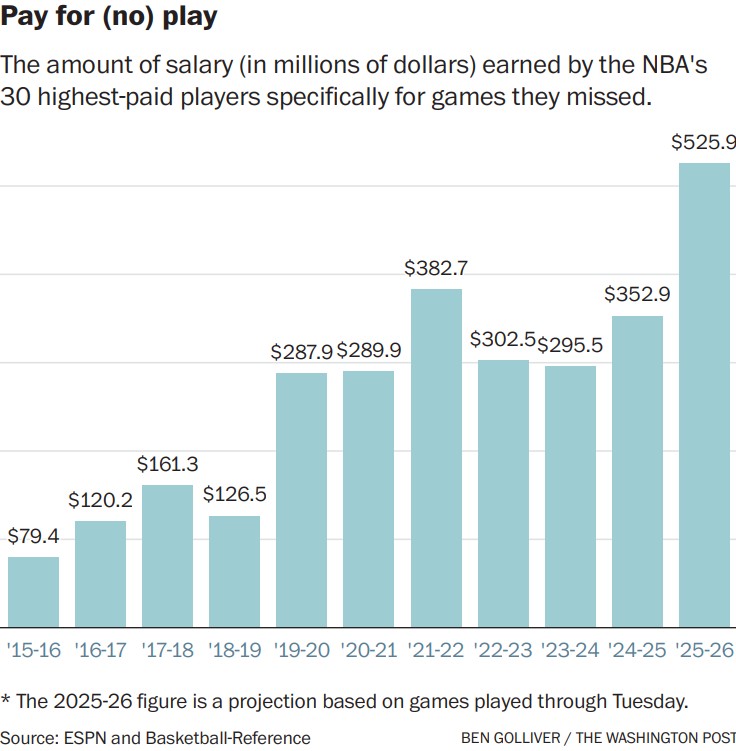
    The amount of salary (in millions of dollars) earned by the NBA's 30 highest-paid players specifically for games they missed.
    The amount of salary (in millions of dollars) earned by the NBA’s 30 highest-paid players specifically for games they missed.

    As the NBA and its fans continue to debate possible solutions, the injury epidemic has reached staggering heights when it comes to lost productivity. Back in 2015-16, the 30 highest-paid players combined to earn roughly $560 million. Because those players only combined to miss 14 percent of their teams’ games, their teams combined to pay roughly $79 million in empty salary.

    Last year, the empty salary mark reached more than $352 million. This season, with the 30 highest-paid players combining to earn more than $1.49 billion and missing 35 percent of their teams’ games entering Wednesday, the number is on pace to exceed $525 million.

    That would easily set a record for lost productivity. As Lue and Kidd might say, NBA teams could soon have a half-billion dollars sitting on the sideline.

  • Can zinc shorten your cold? Here’s how to take it the right way.

    Can zinc shorten your cold? Here’s how to take it the right way.

    The question: Can zinc cure a cold?

    The science: Everyone loves a good cold remedy — vitamins, homemade concoctions, nasal irrigation systems. And zinc, a mineral, is a popular one, sold over the counter as lozenges, quick-dissolve tablets, and nasal sprays.

    While there’s no conclusive evidence that zinc can prevent a cold, there is research suggesting it might help shave a little time off the duration of a cold, which usually runs for seven to 10 days.

    “If you’re trying to get better, say, before you go see your brand-new grandchild or because you have a big presentation coming up at work, it may cut a day or two off your cold but you might still have persistent symptoms,” said Rebecca Andrews, a professor at the University of Connecticut School of Medicine and chair of the Board of Regents for the American College of Physicians.

    Scientists have hypothesized that zinc may prevent rhinoviruses — which are common viruses that cause about 50% of colds — from infecting our cells, said Roy Gulick, the chief of the Division of Infectious Diseases at Weill Cornell Medicine and attending physician at New York Presbyterian Hospital in New York City.

    The mineral also enhances immune function and responses to infection, among other things, he said.

    In a 2024 Cochrane review, researchers analyzed 34 trials using zinc to prevent and treat colds. The authors found little to no evidence that zinc, when taken proactively, can prevent a cold or reduce the number of colds a person gets.

    For people who already have a cold, the reviewers found some evidence that zinc might shorten the duration of symptoms by about two days compared with a placebo. However, they also found that zinc was associated with mild side effects such as nasal and oral irritation, problems with taste, stomach pain, constipation, diarrhea, and vomiting, among others.

    Outside those trials, some people who use certain zinc nasal products have reported a loss of smell. It prompted the Food and Drug Administration to issue a public health advisory in 2009, warning people about the link between some zinc nasal products and long-lasting or permanent loss of smell.

    Our bodies don’t produce zinc, which we need for proper immune system and metabolism functioning and wound healing. Adult women should get 8 milligrams of zinc from their diets each day and men 11 mg, according to federal health authorities. Zinc-rich foods include meat, fish, and seafood such as oysters.

    The optimal zinc dose for the treatment of colds is uncertain because researchers conduct studies in different ways, and test different forms of zinc and different doses. However, a number of studies on zinc as cold treatments use doses of 80 mg or more per day. Many over-the-counter zinc lozenges are supposed to be taken every few hours, which amounts to about 80 mg.

    But Andrews said that if you exceed 50 mg of zinc per day, you increase your likelihood of side effects. And don’t use it to prevent a cold — only to treat an ongoing one, she said.

    “When you supplement, you’re going to get a lot more than what you need in your diet, which is more likely to cause stomach upset and send you either into my office or an urgent care, where you might get treated for something that you don’t have because the symptom could be from the zinc,” she said.

    What else you should know

    Before taking zinc, speak with your healthcare provider, as the mineral can interact with some medications. For instance, high zinc intake may make certain chemotherapy drugs less effective, Andrews said.

    If you want to try zinc to treat a cold, consider these suggestions:

    • Don’t use zinc supplements as a preventive, only a treatment. Because there’s little to no evidence that zinc can prevent a cold and it’s associated with a number of side effects, use it only when you have symptoms of a cold.
    • Try lozenges, but in moderation. Most studies have evaluated the effectiveness of zinc lozenges over other formulations, probably because they are easy to take and may help ease sore throats, a common symptom of a cold, Andrews said. But don’t overdo it. If you exceed 50 mg daily, you increase your risk of stomach upset and other side effects, she said.
    • Don’t take zinc with certain foods. High-fiber foods, legumes, and grains, foods rich in calcium and iron, and excessive alcohol, among other things, can reduce zinc absorption.
    • Zinc aside, build up your immune system. Eating a healthy, well-balanced diet, drinking plenty of water, and getting enough sleep are key for ensuring your immune system “is top-notch from a cold-fighting perspective,” Andrews said.

    The bottom line: While zinc is unlikely to prevent a cold, it may help reduce the duration of a cold by a day or two. But potential benefits of zinc, particularly at higher levels, may be offset by adverse reactions, including irritation in the nose and mouth, an upset stomach, and other side effects.

  • U.S data agencies need ‘immediate’ help to do their job, report says

    U.S data agencies need ‘immediate’ help to do their job, report says

    U.S. data agencies need urgent help from the Trump administration and Congress to ensure they can carry out their basic duties and restore public confidence amid a deepening crisis, according to a new report by some of the country’s top statistics experts.

    The agencies are struggling with fragile capacity and eroding trust — as well as diminished safeguards for data integrity — and need more money and staff, says the study led by the American Statistical Association. It cites challenges that have grown more acute since last year’s inaugural version of the report, published before President Donald Trump returned to office.

    Government departments such as the Bureau of Labor Statistics, Bureau of Economic Analysis, and Census Bureau are tasked with publishing all kinds of data, which cover the economy and many other topics, and are key to decisions by policymakers, investors, and companies as well as the wider public. Their work has been made harder by longstanding problems such as shrinking budgets and falling response rates for surveys — as well as more recent threats to their independence and integrity.

    “Immediate action must be taken to halt the severe decline in the federal statistical agencies’ ability to meet their basic mission and be positioned to keep up with increasing information needs and to address uncertainty in the trustworthiness of federal statistics,” says the report, which was published Wednesday.

    In Trump’s second term, the strain on federal statistics has intensified. His administration’s campaign to downsize the government left gaping holes in many agencies, with data products becoming collateral damage of the staffing cuts. Organizations such as the ASA have created dashboards to keep an eye on changes to datasets and highlight any that disappear.

    Headcount at the BLS was down 20% last fiscal year compared with the previous one, and the BEA has seen a 25% drop since 2019, the report says. Trump has proposed further cuts in his 2026 budget.

    Trump’s most drastic action so far on the data front came when he fired the head of the BLS in August after a weak jobs report — accusing her, without providing evidence, of rigging the numbers to make him look bad. Economists and statisticians have lined up to reject that claim. The administration pointed to large revisions in employment data and said the numbers needed to be “fair and accurate.”

    Just a day before all this drama unfolded, the statistics experts behind Wednesday’s study had published an interim report saying they were confident that data could be trusted and there were no signs of meddling by the executive branch. Trump’s move against the BLS forced a rapid rethink. The document was amended to say that the president’s actions “undermine trust in the future by accusing statistical agency heads of past political manipulation.”

    The group’s new report cites a survey which found the share of the public expressing trust in federal data had declined to 52% in September, from 57% in June.

    It calls out other administration actions this year that undermined official statistics, like the termination of advisory committees, failure to fill leadership roles, and elimination of datasets without consulting Congress or the public. It notes that the positions of chief statistician and Census director have been staffed with political appointees who already held other full-time positions, and argues this could further erode trust.

    The report urges the Trump administration to exempt key data-agency positions from the federal hiring freeze, and calls on Congress to fund research and enhancements in IT infrastructure that can help improve the quality of statistics. Such measures would “begin to restore the system’s capacity to deliver the timely, relevant, and trustworthy statistics the nation depends upon,” it says.

  • Scientists discover oldest evidence of human-made fire in a 400,000-year-old hearth

    Scientists discover oldest evidence of human-made fire in a 400,000-year-old hearth

    Scientists have discovered the oldest evidence of ancient humans igniting fires: a 400,000-year-old open-air hearth buried in an old clay pit in southern England.

    The study, published in the journal Nature, is based on a years-long examination of a reddish patch of sediment excavated at a site in Barnham. It pushes back the timeline on fire-making by about 350,000 years.

    The nebulous question of how far back human ancestors conjured fire is deeply intertwined with some of the biggest outstanding mysteries about human evolution. The ability to reliably set fires would have allowed humans to cook food, expanding the range of what they could eat and making meals more digestible. That, in turn, could have supported bigger brains that consumed more energy, catalyzing new social behaviors as humans gathered around campfires.

    But campfires don’t leave fossils. It takes painstaking work to reconstruct these ephemeral uses of technology. And what remains unclear is who set them. No telltale bones have been recovered at Barnham, but researchers think it was Neanderthals, close cousins of our species who interbred with our ancestors.

    “The evidence of fire is incredibly difficult to preserve. If you get to ash and charcoal, it can wash away. Sediment can get washed away,” said Nicholas Ashton, curator of Paleolithic collections at the British Museum and one of the leaders of the work. “We just found this one pocket — quite a large site — where it happens to be preserved.”

    Even when traces of fire remain, the task of distinguishing incidental flames sparked by lightning strikes or wildfires from those set by people is difficult. Perhaps most challenging is distinguishing between fires ignited by humans with the know-how from those produced by scavenging embers from wildfires.

    The study could spark more debate.

    “The authors did an excellent job with their analysis of the Barnham data, but they seem to be stretching the evidence with their claim that this constitutes the ‘earliest evidence of fire making,’” Wil Roebroeks, an archaeologist at Leiden University, said in an email, calling the evidence “circumstantial.”

    Ségolène Vandevelde, an archaeologist and adjunct professor at the University of Quebec at Chicoutimi, praised the multidisciplinary approaches the authors used and said the finding was “solid.”

    Pyroarchaeology

    In the Paleolithic era, the Barnham site would have been a woodland with a seasonal pond — set away from the main river valley, where predators might have roamed, according to Robert Davis, an archaeologist at the British Museum and one of the authors of the study. The wildlife would have included elephants, lions, deer, fish and other small mammals.

    Despite the fleeting nature of fire, it can leave traces under the right conditions. At the site in Barnham, where artifacts such as heat-shattered flint hand axes were also found, researchers were intrigued by a layer of reddish sediment — a result of iron-rich sediments being heated to produce a mineral called hematite. For four years, they studied it, trying to determine whether it was the result of a wildfire or deliberate human activity.

    One of the first questions they asked was whether this was a one-time blaze or something closer to a fireplace that was lit and relit many times.

    To deconstruct this question, scientists studied the magnetism of the sediment, which is altered by heating. They conducted modern experiments, to see if they could come up with an estimate of how many heating events might have resulted in the magnetic profile of the sediment — and found that after about a dozen heating events, each one four hours long, their modern samples mimicked the archaeological one.

    Then they examined the chemistry of the site — scrutinizing particular chemical compounds left behind. The patterns they found suggested humans had been using these fires.

    The last element was small pieces of cracked flint scattered about the site — as well as two bits of pyrite, which can create a spark when struck together. A geological study of the area showed that pyrite was scarce in the local landscape, leading the authors to argue that the inhabitants had carried it there for the specific purpose of making fire.

    Scavenging sparks vs. setting fires

    The archaeological record with examples of fires used by hominins — the ancestors of humans — stretches back more than a million years ago in Africa.

    But what interests scientists is not just the ability to successfully scavenge sparks from wildfires or lightning strikes, but also the ability to reliably create it — possibly by striking flint and pyrite together to create sparks.

    The oldest accepted evidence of fires purposefully set are from a Neanderthal site dated to 50,000 years ago in France. That evidence is considered convincing in part because there are chunks of flint showing “microwear traces of having been struck” to create sparks, Roebroeks said. But at Barnham, there are no microwear traces, leaving room for disagreement.

    “It’s a very contentious debate that’s been going on for some time,” Davis said.

    Early hominins would have learned to harvest fire by collecting embers, harvesting the right fuel and tending the fire. And eventually, they had to learn how to make it on demand — which would allow them to live in colder places, cook, fend off predators and socialize after dark.

    The study does not suggest that Barnham was where fire originated; it was probably widespread across the ancient world. But it does offer a rare, preserved snapshot of prehistoric life.

    “The maintenance of fire requires social cooperation, cultural rules and work coupled with knowledge of wood types, and means that a complicated tradition is at play,” said John Hawks, a paleoanthropologist at the University of Wisconsin at Madison.

  • Supreme Court wrestles with death penalty in cases of intellectual disabilities

    Supreme Court wrestles with death penalty in cases of intellectual disabilities

    The Supreme Court on Wednesday wrestled with whether to allow Alabama to execute a man with low cognitive function, a ruling that could set new rules for states to condemn those with borderline intellectual disabilities to death row.

    Roughly two hours of intense arguments did not seem to produce a consensus among the justices over how states should assess IQ tests to determine mental disability.

    In a landmark 2002 ruling Atkins v. Virginia, the court decided that sentencing a mentally disabled person to death violated the Eighth Amendment’s prohibition on “cruel and unusual punishment,” but left it up to states to come up with standards for determining who is too disabled.

    Since then, the rules states have used to determine who is ineligible for the death penalty have come before the court several times, in part because many death row inmates skirt the line of intellectual disability.

    In the current case, Alabama is asking the court to cut back on protections that those previous rulings have given to those who have borderline intellectual disabilities. The case involves how lower courts weighed Alabama’s use of multiple IQ tests to decide Joseph Clifton Smith should face death for robbing and killing a man in 1997.

    Under Alabama’s death penalty rules, a defendant is ineligible for the death penalty if he or she has an IQ at or below 70 and significant deficits in everyday skills and those issues occurred before adulthood. Many states have similar IQ thresholds.

    In Wednesday’s argument, Robert Overing, deputy solicitor general for Alabama, told the justices that lower courts, which threw out Smith’s death sentence, had placed too much weight on a single low IQ score and additional evidence of impairment, rather than considering the cumulative results of five tests that placed Smith above the IQ cutoff. He said the latter was a more accurate yardstick for his abilities.

    “He didn’t come close to proving an IQ of 70 or below … but the lower courts changed the rules,” Overing said.

    The court’s three liberal justices expressed skepticism the law required lower courts to consider the cumulative effect of multiple scores as Overing suggested.

    In previous rulings, the high court said defendants were permitted to offer additional evidence of cognitive impairment if IQ scores fell below the threshold, but Overing downplayed that idea. That drew rebukes from the liberals as well as questions from conservative Justice Brett Kavanaugh.

    “What you’ve done is shift this to be all about the IQ test, which is not supported by our case law,” Justice Ketanji Brown Jackson told Overing.

    Kavanaugh asked at another point about additional evidence: “What’s the logic or the rationale or the sense behind not having a district court or a trial court or a state court have the ability in those circumstances to go on and look at more?” he asked.

    Justice Neil Gorsuch floated the idea of a ruling that would allow states to set the threshold for a claim of mental disability, but not allow eligibility to turn solely on a single IQ test score. Any additional evidence of impairment would not be allowed to outweigh a low test score.

    But there was little agreement among the justices as they groped for the proper standard.

    Smith’s murder case began in 1997, while he was on work release from prison. Smith and an accomplice robbed a man of $140 and killed him. A jury convicted Smith of capital murder during a robbery and sentenced him to death.

    After the court’s 2002 decision in the Atkins case, Smith filed a petition in federal court arguing his intellectual disability met the criteria to bar his execution. The case has gone back and forth in the lower courts ever since.

    During an evidentiary hearing, testimony revealed Smith had scored 75, 74, 72, 78 and 74 on IQ tests over the course of his lifetime. Those were the scores Overing, the lawyer for Alabama, pointed to in arguing that the cumulative effect of the tests placed Smith slightly above the state’s IQ cutoff.

    The federal district judge considering the case, however, pointed to the test on which Smith scored 72, saying it indicated his IQ could be as low as 69, since the test had a three-point error range. For that reason, the court allowed Smith to present additional evidence of his impairment to assess his cognitive function.

    In seventh grade, Smith’s school classified him as “Educable Mentally Retarded,” meaning he had mild intellectual disability. Smith never consistently held a job, never had a bank account and had difficulty following laws, according to testimony in the lower court hearings. He also acted impulsively, and read and did math at a low level.

    The court determined Smith’s “actual functioning” was comparable to someone who was intellectually disabled so he couldn’t be sentenced to death.

    After an appeals court ruled in Smith’s favor, Alabama appealed to the Supreme Court. The high court vacated the decision, asking the appeals court to clarify whether its ruling was based solely on one low IQ score or had considered other evidence and expert testimony.

    The appeals court once again found Smith was intellectually disabled and said its decision was based on a holistic approach that considered Smith’s deficits in everyday skills along with the IQ score of 72. Alabama again appealed to the Supreme Court, which agreed to take up the case it heard Wednesday.

    Seth P. Waxman, an attorney for Smith, said the lower courts had not erred in their assessment of Smith and it was proper to consider additional evidence of his impairment.

    “Every court in Alabama … this court and every other court in every other state that I am aware of understands that raw observed test scores is not the definition of true IQ,” Waxman said.

    But Harry Graver, an attorney for the Trump administration, which backed Alabama’s position, said the lower court did not give proper weight to the multiple IQ scores.

    “Even if you look at other evidence, you still need to circle back and see how that weighs against the evidence on the other side of the scale,” Graver said.

    Smith’s case is not the first time the Supreme Court has tackled intellectual disability and the death penalty.

    In a 2014 case from Florida and a 2019 case from Texas, the high court noted that IQ tests are not precise. In the 2019 case, the court specifically said that lower courts needed to consider the possible error range in IQ scores.

  • Israel reopens Jordan crossing as pressure builds to advance Gaza truce

    Israel reopens Jordan crossing as pressure builds to advance Gaza truce

    Trucks carrying goods from Jordan crossed into the West Bank for the first time in months on Wednesday, after Israel said it would reopen a key land bridge with its neighbor, including for aid and other cargo bound for the Gaza Strip.

    It was unclear whether the first trucks out of the gate were transporting humanitarian supplies or commercial items, but a spokesperson for COGAT, the branch of the Israeli Defense Ministry that controls aid flows to Gaza, confirmed that the crossing, known as Allenby, was open for the passage of aid.

    The move to restore Allenby as a transit point for relief comes as pressure builds on Israel to move a tenuous U.S.-backed ceasefire in Gaza into its second phase, and as the United Nations and other aid organizations have warned that nowhere near enough supplies are being allowed into the enclave to meet the needs of the Palestinian population, the majority of whom are displaced and living in makeshift shelters or tents.

    Under the ceasefire agreement between Israel and Hamas, Israeli authorities are supposed to allow at least 600 trucks of aid to enter Gaza each day. But the United Nations and other aid agencies say they continue to face bottlenecks and other restrictions, including delays and denials of cargo, custom clearance challenges and limited routes inside Gaza for transporting humanitarian goods.

    Israel closed the border in September after a Jordanian truck driver killed two Israeli soldiers at the crossing. An Israeli security official, speaking on the condition of anonymity because they were not authorized to speak to the press, said Jordanian truck drivers would undergo stricter screening processes and that a dedicated security force had been assigned to monitor the terminal.

    The reopening also coincided with a visit to Israel and Jordan by the U.S. ambassador to the U.N., Mike Waltz, who met on Monday with Israeli Prime Minister Benjamin Netanyahu. A statement from the U.S. mission to the U.N. said Waltz “welcomed Israel’s cooperation on expanding border crossings,” including Allenby. Waltz also met with Jordan’s King Abdullah on Sunday.

    In recent days, both Israeli and Hamas officials have said that there will be no discussion of moving to the second phase of President Donald Trump’s ceasefire plan until the first phase has been fully implemented. Both continue to point fingers at the other for not holding up their side of the deal. Israel has blamed Hamas for being slow to return the bodies of hostages, with one remaining in Gaza. Hamas has, in turn, pointed to the continued closure of border crossings for medical evacuations and aid and the daily fire that Israeli troops are carrying out in Gaza.

    But as pressure from the U.S. and other mediators to push the deal into the next phase grows, Netanyahu said Sunday that the transition could happen “very shortly” and announced he will meet with Trump on Dec. 29. A Hamas official also told the Associated Press on Sunday that the group is open to “freezing or storing” its weapons arsenal as part of the ceasefire.

    The second phase, which in theory would involve the disarmament of Hamas, withdrawal of Israeli troops from the territory, and the formation of an international force to maintain security, is likely to be far more complicated to achieve than even the first phase. Any delays in reaching that second phase leaves open the prospect of a status quo being established in Gaza in which Israel continues to occupy half of the enclave.

    One remaining step is the return of the remains of Ran Gvili, a 24-year-old Israeli police officer who was killed in Hamas’s Oct. 7, 2023, attack on Israel.

    “Without Gvili, Israel will not begin the talks over phase two,” said an Israeli official, speaking on the condition of anonymity because they were not authorized to speak to the press.

    U.N. agencies have reported an increase in aid that has been allowed into Gaza since the ceasefire came into effect, but say the levels are still far below what is needed for a population trying to recover from widespread malnutrition, famine and infectious diseases with a decimated health care system.

    Israel has allowed commercial operators and aid groups that bypass the U.N. system to scale up their operations more rapidly than other major relief organizations with long-running histories of assistance in Gaza. In particular, Israel has refused to allow UNRWA, the U.N. Relief and Works Agency for Palestinian refugees, to deliver aid, despite its sprawling infrastructure in Gaza and decades-long presence in the territory.

    “A shockingly high number” of children are still suffering from acute malnutrition, said Tess Ingram, a spokeswoman for UNICEF, the U.N. children’s agency, according to comments reported by Reuters.

    Ingram also told reporters on Tuesday that opening the Rafah crossing in southern Gaza, which links it with Egypt, could help bring down the number of children suffering from malnutrition. “We really need to see all types of aid come in, particularly nutritious food through commercial routes as well,” Ingram said.

    Israel said last week that it would reopen the crossing in the coming days, but only for the exit of Palestinians from Gaza.

    Millions of shelter items have also been stuck in Jordan, Egypt and Israel while awaiting Israeli approval to enter, a consortium of humanitarian organizations focused on providing shelter aid said in November.

    A severe winter storm landing in the region this week threatens 850,000 people sheltering in 761 displacement sites particularly vulnerable to flooding in the Gaza Strip, the U.N. Office for the Coordination of Humanitarian Affairs (OCHA) said. On Wednesday, there were reports of flooding in large parts of Gaza City, particularly low-lying areas.

    “The entire services system is unable able to rescue displaced people due to the heavy rain and flooding,” said Mahmoud Basal, a spokesman for Gaza Civil Defense, in a statement to reporters. “Rainwater has risen to more than one meter in some shelter centers.”

    The storm, dubbed Byron, has already hit Greece and Cyprus and is expected to bring as much as eight inches of rain to Israel and Gaza.

    “Low pressure fronts pose a major danger to displaced people and residents because of the destruction inflicted on the infrastructure,” Gaza municipality spokesman Hosni Mhanna told Al Araby TV on Wednesday.

  • Medical Mysteries: For years she was told it was stress. Then a brain scan revealed the real cause.

    Medical Mysteries: For years she was told it was stress. Then a brain scan revealed the real cause.

    In the spring of her senior year at college, Annie Sedoric woke up with jaw pain. It was March 2020, and there was a lot to worry about at the start of the COVID pandemic, so she tried to ignore the pain, even as it grew worse.

    “My jaw kept popping and popping and popping,” said Sedoric, who was 22 at the time. “The pain was getting more intense, less bearable, to the point that I had to do something.”

    A visit to the dentist ended with a referral to an oral surgeon, who concluded that Sedoric had developed a TMJ disorder from grinding her teeth due to stress. Fixing the problem required a procedure under anesthesia to manipulate her jaw back into position, doctors told her. The recovery extended over several weeks, she said, and during that time opening her mouth was difficult.

    “I remember shoving soft food between the cracks of my teeth,” Sedoric added.

    But the “fix” didn’t last. The pain persisted and her jaw popped out of place again, later requiring a second procedure by the oral surgeon. In the meantime, Sedoric stopped getting her period.

    “It was concerning for me,” Sedoric said. “I’d always been regular, never on birth control.”

    Her gynecologist suggested Sedoric’s running and workouts — and stress – were the culprits. But that didn’t make sense: Sedoric had been a three-varsity-sport athlete in high school and continued working out with her college sports teams, so she hadn’t been exercising any more than usual. The doctor ordered a blood test, which showed slightly low estrogen levels. She was prescribed progestin, a form of the hormone progesterone, for a week to reset her menstrual cycle. When that failed, the doctor said it might take some time and to “come back in a few months.”

    But a few months later, still without her period, Sedoric began experiencing severe hip pain.

    Odd, disparate symptoms continued to accrue, including pelvic floor pain, for which she received a series of nerve-blocker injections through her vagina, and leg pain, which required physical therapy. And the jaw pain never stopped. A new oral surgeon suggested “breaking my jaw and putting it back in place,” she said.

    Then, after moving from her parents’ home in New Hampshire to an apartment in Lower Manhattan, Sedoric noticed subtle changes in her body: Her face seemed to be broadening, her lips got puffier, and her fingers swelled to the point that the cherished gold ring belonging to her grandmother that she always wore snapped. “My body was deforming before my eyes,” she said. She attributed the shifts to routine aging, living in New York City, drinking with friends, and the ongoing stress of the pandemic.

    After two years, several misdiagnoses and some painful treatments that didn’t help, Sedoric was about to give up on solving her health problems. Then, in desperation, she decided to seek help at a private medical clinic, which, for a hefty fee, conducted an exhaustive battery of tests. What emerged from those tests eventually put her on the path to figuring out that she had a rare, life-altering condition that would undermine her sense of self in profound ways.

    “I lived in pain and was gaslit for years,” Sedoric said. “But the experience gave me a different perspective, like, you almost died but now you get to live.”

    Desperate for answers

    In 2021, during a Christmas holiday in New Hampshire, Sedoric said her best friend’s father, an orthopedic surgeon, recommended a privately run clinic in Colorado that conducts comprehensive testing and full physical workups for people with difficult-to-diagnose conditions. The catch: a price tag that would ultimately top $21,000 — no insurance accepted. Sedoric’s parents agreed to pay, and in February 2022, she flew to the Resilience Code headquarters in Englewood, Colo., for four days of testing.

    She met with neurosurgeon Chad J. Prusmack, the company’s founder and CEO, for about 90 minutes to review her medical history. Then she spent the following days undergoing tests. She had an MRI of her brain and a biomarker panel looking at thousands of conditions. Blood work tested her for a variety of potential problems, including viral and gut conditions, as well as inflammatory, immune, and hormone imbalances.

    “When you get a whole bunch of labs, it tells a story of the patient,” Prusmack said. “It doesn’t take a snapshot and leave out some of the important details.”

    Before the results came in, she said, Prusmack told her he predicted she had Lyme disease, and then prescribed several medications to treat her symptoms. None of the pain medicines worked, she said.

    “Except for the ketamine: For 30 minutes I was in no pain but I couldn’t function, so it wasn’t really a long-term solution.”

    One month later, on a Zoom call with Prusmack, she got the news: It wasn’t Lyme disease. It was, most likely, a condition related to the substantially elevated level of IGF-1, a marker for growth hormone, picked up on a test Sedoric had not previously been given. The upper limit of IGF-1 for a person Sedoric’s age is about 200, Prusmack said, but hers was 523, which suggested an endocrine-related problem.

    In addition, the MRI showed a tumor on Sedoric’s pituitary gland, a pea-size structure that sits at the base of the brain and is often called the “master gland” because it releases hormones responsible for many critical functions, including growth, metabolism, sex and reproduction, and the body’s response to stress.

    The news stunned her. She said it was a relief to pinpoint the problem, but “not in my wildest dreams did I think I had a brain tumor, and I had no idea how bad it was.” Sedoric texted her roommates, and together they ran through the streets of the Lower East Side, screaming and crying.

    The next day, she started interviewing surgeons.

    Sedoric secured an appointment with Tim Smith, a neurosurgeon at Brigham and Women’s Hospital in Boston.

    Smith said a follow-up MRI showed that Sedoric’s tumor was a 1.4-cm “macroadenoma.” Doctors also finally gave her an official diagnosis that explained her years of frustration and pain. She had acromegaly, a rare condition that, in adults, causes certain bones, organs, and other soft tissue in the face, jaw, hands, and feet to grow far beyond what is typical. In children, whose growth plates have not yet closed, the condition can cause excessive height and is known as “gigantism.” Among the most famous people with gigantism was André the Giant.

    Smith said Sedoric did not appear with many of the telltale signs of acromegaly, which afflicts about 30 to as many as 120 people out of a million, according to various analyses that show prevalence to be higher than previously thought. She didn’t have an obviously prominent jaw, for example, or a massively larger shoe size. Still, her arthritislike joint pain was unusual for a fit, young adult, he said.

    “At her age, and with her athleticism, this [collection of symptoms] was just very strange,” Smith said.

    She did display some classic symptoms, he said, including swelling in her face and hands and what’s known as frontal bossing, a prominent or bulging forehead.

    This happens, Smith said, because the excessive growth hormone secreted by the pituitary causes overgrowth of cartilage, bone, and a form of connective tissue called synovium, which first makes the joints look bigger and then causes them to stop working normally.

    On April 26, Smith successfully removed Sedoric’s tumor. About an hour after the operation, however, Sedoric said she got out of bed to use the bathroom and suddenly felt nauseated and off-balance. The next thing she remembers is waking up covered in vomit with about a dozen medical professionals staring at her.

    She had apparently thrown up and breathed it in through her nose, causing the vomit to travel up through the surgical cavity. Soon, she was in the intensive care unit with a high fever and throwing up blood; a spinal tap confirmed she had bacterial meningitis. Bacteria from her gut had infected her brain and spinal fluid; doctors performed a second surgery to clear out the infected area.

    Sedoric returned home after two weeks.

    Living with uncertainty

    It hasn’t been an easy recovery. She has less jaw pain, and the swelling and puffiness in her body transitioned back to normal. But she’s developed headaches, still has pain in her legs and suffers lingering trauma from the surgery complications.

    And her future remains uncertain. An analysis of Sedoric’s tumor found she has a more aggressive form of the disease; there’s a 20-40% risk of a recurrence within 10 years, Smith said, and a lifetime risk “close to 100%.”

    Sedoric sees endocrinologist Nidhi Agrawal, the director of pituitary disease at the Holman Division of Endocrinology, Diabetes and Metabolism at NYU Langone Health, every six months to closely monitor her symptoms.

    Agrawal says in certain ways, Sedoric is lucky. While some of the bone growth she experienced is irreversible, much of the soft tissue expansion has resolved because her acromegaly was diagnosed just a couple of years after symptoms began. The typical diagnostic delay for acromegaly is generally about five to six years, Agrawal said, which is an improvement from a few years ago, when the delay was closer to 15 years.

    “These are patients who have been just hopping around seeing different practitioners and just not getting the diagnosis,” she said.

    Agrawal said she now tries to educate medical students, dentist groups, and other specialists to let them know that if patients come in complaining of unexplained pain in disparate body parts, it could be acromegaly.

    Sedoric, now 28, has tried to integrate her illness into daily life. She remains active — she ran the New York and Chicago marathons recently, and plans on completing the Boston Marathon in April — and enjoys her job as a sustainability consultant. Currently she’s not taking medication for her condition.

    From the outside, her life looks fairly typical.

    “I hang with friends, run marathons, look pretty normal,” she said. “But it’s hard when you have an invisible disease with no cure that comes with constant pain and could deform your body at any time.”

    She is learning to live with uncertainty.

    “The most difficult thing is trusting myself,” Sedoric said. “Like having to look in the mirror and decide if I have a swollen face because I didn’t get enough sleep or if I have a tumor. It’s trusting when to take it seriously and when to let go.”

    Just before this story was published, Sedoric learned that the tumor is growing back. She is working with her endocrinologist on a treatment plan that could include surgery, life-long medication, or radiation.

    Rachel Zimmerman is a journalist and writer based in Cambridge, Mass. Her book, “Us, After: A Memoir of Love and Suicide,” was published in 2024.

  • In Russia talks, NATO allies fear Trump is doing his ‘own thing’

    In Russia talks, NATO allies fear Trump is doing his ‘own thing’

    BRUSSELS, Belgium — When NATO foreign ministers gathered this week to deliberate on a U.S. plan to end the war in Ukraine, they had neither the plan in hand nor Secretary of State Marco Rubio in the room to represent the alliance’s biggest, most powerful member. Rubio skipped the meeting as the White House held talks with Russia and Ukraine that have kept European allies sidelined.

    The State Department did not give a reason for Rubio’s absence, but his decision not to attend the high-profile meeting only added to the quiet frustration among his European counterparts as President Donald Trump’s envoy Steve Witkoff and son-in-law Jared Kushner visited Moscow to discuss a plan with huge ramifications for European security.

    It was here at NATO’s glassy headquarters that Trump rattled America’s partners during his first presidency by telling them that if they didn’t pull their weight, he could “do his own thing.” Now Washington appears to be doing just that, and not only in the Russia talks. In the Middle East, the Caribbean, the South Caucasus and pretty much everywhere else, Trump acts first, consults after — if at all.

    In their plan for Ukraine, the president and his advisers have even seemed to position the United States as speaking not for the alliance — synonymous with American military might since its founding in 1949 — but as an independent arbiter, whose interests do not necessarily coincide with those of the 31 other allies, from Canada to Estonia.

    “The spirit of the plan was: We are no longer an ally, we are a broker. We are not in this camp or that one, we are above that. It was perceived as a catastrophe by the Europeans,” said Claudia Major, a senior vice president of the German Marshall Fund, a Washington-based think tank.

    “They don’t have to leave NATO to weaken NATO,” she said. “I mean, I’m a member of a gym but I don’t go.”

    NATO Secretary General Mark Rutte, whose core job responsibility often seems to be to smooth over relations between Trump and other allies, told reporters there was nothing to worry about. The White House is “absolutely consulting enough” with European allies and he is “in constant contact” with U.S. officials, Rutte said as he convened the foreign ministers meeting Wednesday.

    But Trump’s approach repeatedly has left European leaders in the dark, relying on leaks and news reports for the latest developments, then scrambling from afar to shape policy discussions in which their constituents and their continent have a far more direct stake.

    Ahead of Witkoff’s trip, several diplomats at NATO said they weren’t sure which version of the plan he was taking to the Kremlin — an updated proposal reflecting changes from talks with Ukrainian negotiators, or something else.

    European leaders are anxious and distrustful of the Trump administration. According to the leaked transcript of a phone call among leaders, published on Thursday by Der Spiegel, German Chancellor Friedrich Merz said that the Americans are “playing games” while French President Emmanuel Macron warned that Washington might “betray” Ukraine.

    American exceptionalism — including unilateral decision-making and military action — is nothing new. But for Europeans, it now hits closer to home. After supporting the U.S. in many conflicts, including by sending troops to Afghanistan and Iraq, some allies feel bitterly slighted by Trump’s limited regard for their priorities.

    European leaders were already alarmed by Trump’s interest in renewing economic ties with Russia, along with the president’s uncertain commitment to Europe’s security.

    In an earlier bid to end the war, Trump invited Russian President Vladimir Putin to Alaska and seemed open to Russia’s demands for Ukrainian territory, prompting several European leaders to race to the White House for a meeting.

    Special envoy Steve Witkoff (from left), Secretary of State Marco Rubio, and Jared Kushner meet with Ukrainian officials Nov. 30 in Hallandale Beach, Fla.

    Last month, Witkoff floated a plan for Ukraine that many European officials found out about in the press. The proposal triggered alarm not only for the concessions it demanded of Kyiv but also because it mentioned using Russian frozen assets held in Europe, as well as restricting NATO expansion and the European Union’s ability to accept Ukraine as a member.

    The initial, 28-point plan appeared to get revised after meetings between U.S. and Ukrainian negotiators. European diplomats expressed relief that it was revamped and said they had received U.S. assurances that NATO and EU questions would be addressed separately.

    But Trump’s constant freelancing has cut to the heart of European apprehension that Washington does not share their dark assessment of Putin’s ultimate intentions, which they see as undermining European democracies and weakening NATO.

    The negotiations also feed a fear that Trump shares with Putin a vision of the world in which Washington and Moscow get to decide the fate of others.

    “You have this idea behind it that the great powers decide, and the smaller ones have limited sovereignty, and they are informed afterward,” Major said. “There is a certain intellectual dissonance,” she added, in the U.S. wanting to potentially do business with Russia while most NATO leaders describe Russia as their biggest threat.

    Still, some European diplomats say the only option in the immediate term is to keep getting in Trump’s ear — because even if he were willing to consult more, Putin is not.

    “The fact of life is the only ones capable of negotiating an end to the Ukraine war are the U.S., for the simple reason that Putin will not sit at the table with anyone else,” said a NATO diplomat, who, like others, spoke on the condition of anonymity to discuss sensitive security issues. “This causes a lot of discomfort for many Europeans, but it is a fact of life, so as long as the Americans listen to us.”

    “I think it’s fair to say these are the most consequential negotiations for European security of this century,” the diplomat added.

    At this week’s NATO meeting, the United States was represented by Deputy Secretary of State Christopher Landau — who earlier this year questioned the need for NATO, calling it “a solution in search of a problem” in a post on X that he later deleted.

    A State Department official, speaking on the condition of anonymity to discuss Rubio’s travel, said NATO was “completely revitalized” since Trump secured a European pledge to increase national defense spending by allies. Rubio has “already attended dozens of meetings with NATO allies, and it would be completely impractical to expect him at every meeting,” the official said.

    NATO foreign ministers typically meet two times per year, with ambassadors stationed in Brussels meeting far more frequently.

    “I totally accept him not being able to be here,” Rutte said of Rubio, who is juggling multiple jobs in the administration. Rutte also told reporters that he hears from “all allies that they’re completely committed” to NATO’s political doctrine that Russia poses the biggest threat to the Western alliance.

    Several European diplomats acknowledge privately, however, that they encounter conflicting messages among those in Trump’s circle — seeing Rubio, for example, as more aligned with their ideas and Witkoff as too close to Moscow.

    The Kremlin regularly criticizes input from European officials on the negotiations, casting them as warmongers seeking to perpetuate the conflict with their backing of Ukraine.

    Putin declared this week that Russia is ready for war with Europe “right now if Europe starts it,” drawing consternation from European ministers, who said this was proof that they should funnel more money to Ukraine and their own militaries.

    The increasingly tense rhetoric is fueling European calls to take charge at NATO in case the U.S. shrinks its dominant role, including in the command structure and quick-response plans.

    European leaders must “adjust to a new reality” in which U.S. interests don’t necessarily match theirs, said Giuseppe Spatafora, an analyst at the EU’s Institute for Security Studies and a former NATO policy adviser.

    “This opinion is becoming more popular among European leaders,” as the leaked phone call suggested, Spatafora said. “They thought that relentless engagement would avoid the worst outcomes, which it did, or could have slowly shifted Trump’s needle. I don’t think the latter happened.”

    Ukrainian President Volodymyr Zelensky, meanwhile, is dealing with a major corruption scandal that prompted the resignation of his chief of staff, and his negotiating leverage remains precarious. That’s especially because of a disagreement among EU nations on how to find fresh cash for Kyiv, now that the U.S. has halted direct cash assistance.

    An EU plan to tap into some $200 billion in frozen Russian assets has run into stiff opposition from Belgium, where most of the funds are located.

    Estonian Foreign Minister Margus Tsahkna said there was “very important momentum” in the U.S.-led talks, but he acknowledged early Wednesday, the morning after the American delegation went to the Kremlin: “We don’t know exactly what was discussed, and what will be the results.”

  • Trump fired this regulator. She’s fighting him to the Supreme Court.

    Trump fired this regulator. She’s fighting him to the Supreme Court.

    Rebecca Kelly Slaughter was a powerful — but low-profile — bureaucrat when a New York Times news alert popped up on her phone blasting to the world her firing by President Donald Trump. The Democratic member of the Federal Trade Commission had found out only minutes earlier.

    Her phone began blowing up as she stood outside her daughter’s school during a rehearsal of Beauty and the Beast Jr. Slaughter, who mostly avoided the media, was soon participating in an impromptu news conference on her phone as the musical carried on inside.

    When her daughter stepped offstage, Slaughter pushed through a crowd so she could be the first to spill the news to the girl. The fifth grader burst into tears before asking, “Are you going to fight back?”

    “Probably,” Slaughter replied.

    Thrust into the spotlight in March, a regulator more comfortable with the minutiae of antitrust issues than the dynamics of a political fight, has emerged as one of the primary opponents of Trump’s war on the federal workforce he disparages as the “deep state.”

    Slaughter has not only fought her own dismissal in court, she has defended the work of civil servants before Congress, on podcasts and on TV, speaking out when many others are demoralized from losing jobs and absorbing the president’s repeated attacks.

    Rebecca Slaughter chats with her children as she makes dinner.

    On Monday, the Supreme Court will hear arguments in her case — which probably will be the first in which the justices render a final decision on the legality of Trump’s moves to fire agency heads and gut agencies.

    Many legal experts expect the court to rule against Slaughter — a majority of the justices have signaled support for much of Trump’s argument. The stakes are high: The case could upend how the federal government has been run for nearly a century. A ruling against her could give the president greater control over some two-dozen independent agencies, a major goal in his quest to enlarge his power.

    The administration says presidential control will make agencies such as the Federal Trade Commission, Federal Election Commission and Federal Communications Commission more accountable to voters who elect presidents. Slaughter fears political influence will replace the expertise that has guided decisions on issues such as product safety, banking, and media mergers.

    In other words, the very work she and some of the roughly 300,000 other civil servants who have been laid off in recent months have unobtrusively carried out for decades. Trump’s purge of the federal workforce is the largest in a single year since World War II.

    “The alternative to allowing these agencies to operate as Congress designed is … accruing power to the president,” Slaughter said. “That is something that would be concerning at any time, but really concerning when you have a president who is interested in wielding power for the benefit of himself, his friends and allies — and at the expense of everyday Americans.”

    Dismissed

    Independent agencies were some of the first targets of Trump’s second-term buzz saw as he slashed government jobs and put the executive branch under a tighter grip.

    “My administration will reclaim power from this unaccountable bureaucracy, and we will restore true democracy to America again,” Trump said in his first speech to Congress of his current term.

    Slaughter watched with trepidation as Trump fired a Democratic member of the National Labor Relations Board in January and the Democratic chair of the Merit Systems Protection Board in February.

    She guessed she might be a target but was still shocked when the email landed in her inbox March 18. Slaughter had spent nearly seven years on the commission and loved the work. Trump had originally appointed her in his first term, and she was reappointed by President Joe Biden.

    “Your continued service on the FTC is inconsistent with my Administration’s priorities,” stated the message sent on behalf of the president.

    It was the first time in 91 years a president had tried to fire a member of the FTC, which focuses on consumer protection and increasing business competition. Trump also dismissed the other Democrat on the five-member commission, Alvaro Bedoya, leaving only Republicans.

    What struck Slaughter was that Trump had given no reason for her dismissal. Congress insulated the FTC from the president through a law allowing the executive to remove commissioners only for “inefficiency, neglect of duty, or malfeasance in office.” Slaughter said firing her without citing any such reason was a blatant and illegal power grab. Almost immediately, she resolved to sue.

    The stakes of her public stand quickly became apparent.

    After juggling press calls and her daughter’s performance the night of her firing, Slaughter returned home. She received a knock on her door around 11:30 p.m. as her four children slept. It was a pizza delivery she had not ordered. Bedoya got one, too, the same night.

    They concluded the pizzas were probably part of a wave sent to the homes of judges and other officials, most of whom had ruled against or opposed Trump’s policies — a reminder that potential assailants knew where they lived. They alerted police and scrubbed personal information from the internet.

    Rebecca Slaughter chats with fellow FTC member Alvaro Bedoya on Capitol Hill in 2023.

    But she and Bedoya resolved to stay in the public eye despite the risks. Days later, Slaughter appeared before a House committee to testify about her firing.

    “I will not be the first to go down without a fight, and neither will Commissioner Bedoya,” Slaughter told the legislators. “We swore an oath to serve the American people and our Constitution, and I believe that the law will vindicate our right to finish the job.”

    The legal fight

    That was not so easily accomplished.

    The path to the Supreme Court has been winding and full of setbacks. Bedoya had to drop out along the way. His family was struggling financially with one paycheck. The problems were compounded when someone tried to take out a $500,000 line of credit in his name, an act he suspects was tied to his speaking out about his firing.

    “It is not fun to take on the president of the United States, particularly in this environment,” Bedoya said. “It’s not fun to not know where your next paycheck will come from or if you will get a paycheck, period.”

    Slaughter carried on, with her husband, who works for an investment firm, shouldering the financial load for the family and with help from pro bono attorneys. She has continued to publicly weigh in on matters before the FTC as if she were still on the job, while speaking and making media appearances to draw attention to her case.

    Rebecca Slaughter kisses one of her daughters as she prepares a meal in November.

    “Mommy, I thought that being fired would make you less busy,” Slaughter recalled her 6-year-old daughter telling her.

    In July, a federal judge ruled she could return to her job while her case played out in the courts. When Slaughter arrived back to work on a Friday, about two-dozen FTC staffers stood outside and clapped as she entered the building.

    The return was exhilarating — but short-lived. By the following Monday, an appeals court had paused her reinstatement. In September, the appeals court ruled she could return to work again, but the Supreme Court soon stayed that order until it makes a final ruling on her dismissal.

    Slaughter joked she is the first person in history fired from the FTC three times but said “the whiplash was really disheartening.” Even more disturbing were the glimpses she got inside the FTC during her second stint back.

    It was an agency transformed.

    “There were a lot of questions about political interference,” Slaughter said of two staff meetings she held. “People seem demoralized. People felt beaten down.”

    A case with major ramifications

    Slaughter’s case is in many ways a redo of another that changed the course of the federal government nine decades ago.

    Through the late 1800s, presidents regularly rewarded political supporters with federal jobs. But the spoils system, as it was called then, was phased out after a backer of President James Garfield who had been denied a position assassinated him. Congress passed new laws for a nonpartisan civil service and prevented some officials from being removed for political reasons.

    A major test of those standards came in 1933, when President Franklin D. Roosevelt fired an FTC commissioner over policy disagreements related to economic regulation and the New Deal. William E. Humphrey sued, saying he could be removed only for cause under the law that created the FTC.

    The Supreme Court sided with Humphrey, upholding Congress’s ability to limit the president’s firing of the heads of independent agencies. The case, known as Humphrey’s Executor, is little known to the general public, but it has outsize legal importance.

    University of Michigan law professor Daniel A. Crane credited it with “paving the way for the modern administrative state” — the alphabet soup of agencies that rely on technical expertise to regulate interest rates, bank deposits, labor disputes, and more.

    The agencies are often run by bipartisan commissions, whose members are appointed to staggered terms and can be removed only for cause. The idea was to mitigate political pressure on the agencies, so they could make decisions based on expertise and technical knowledge, rather than political considerations.

    Backers of the idea of independent agencies worry the demise of Humphrey’s Executor will mean presidents could politicize regulation of baby food, credit card fees, and a host of other things to please cronies, big donors, and ideological allies.

    “The last thing we want is for industry to be able to come in and insert their favorite folks on commissions,” said Erin Witte, director of consumer protection at the Consumer Federation of America. “Congress designed these agencies to be independent for a reason. There’s a lot at stake.”

    The Trump administration counters by arguing the contemporary FTC is far different from the one that existed when Humphrey’s Executor was decided. The agency now wields significant executive power, so the president — as head of the executive branch — has the constitutional authority to remove its commissioners.

    “In this case, the lower courts have once again ordered the reinstatement of a high-level officer wielding substantial executive authority whom the President has determined should not exercise any executive power,” Solicitor General D. John Sauer wrote in a court filing.

    The position is in keeping with a muscular vision of the presidency embraced by Trump and some conservatives, known as the unitary executive theory, that holds the president should have unfettered control over hiring and firing in the executive branch.

    So far, the court has appeared to endorse that idea in temporary orders allowing Trump to remove Democrats from the National Labor Relations Board, Consumer Product Safety Commission and Merit Systems Protection Board. Those orders aren’t final decisions on the merits of the cases but give a strong suggestion of where the court’s majority is headed, legal experts say.

    “The Supreme Court has given every indication it will overrule Humphrey’s Executor,” Crane said.

    Despite the seemingly long odds, Slaughter remains hopeful she will prevail. On a recent morning, she was once again making her case in public before a conference of women who work on antitrust issues.

    “Why are you staying in the fight?” the host asked.

    Slaughter said that independent agencies are crucial for protecting Americans and that she was taking a stand against Trump’s lawlessness. Trump should have sought a change in the law if he wanted to dismiss her, she said.

    “As a person who took an oath to the Constitution, I feel very strongly that when that process for changing the law isn’t followed, then I need to stand up and push back,” Slaughter said. “I really recognize deeply how many people in this country are not in a position to do that. I am, so I have the obligation to do it.”

  • A heart surgeon saved his life as a teen. Now they perform surgeries together.

    A heart surgeon saved his life as a teen. Now they perform surgeries together.

    The first time Mesfin Yana Dollar assisted with an open-heart surgery, his patient was a teenage girl from Ethiopia. She was scared and crying.

    He went to her bedside at Emory University Hospital in Atlanta and spoke to her in Amharic, explaining he would be running the machine that would function as her heart and lungs during the surgery.

    “I had the same surgery, and things are going to be just fine,” he told her, adding that as a teen he also had rheumatic fever that became rheumatic heart disease.

    The girl told him, “You must be an angel.”

    Years later, he still sees himself in every patient.

    “I was on that same operating table,” Mesfin said.

    Mesfin was born in a small village in Ethiopia in 1985. There was no electricity or running water, but he said he didn’t want for anything. He was surrounded by family and he was happy — until he got sick when he was around 10 or 11 years old.

    At first, he felt like he couldn’t run as fast and he became short of breath easily. Then he couldn’t walk to school anymore, and his cough kept him awake at night. His parents tried tribal medicine and taking him to doctors in nearby cities. He still didn’t know what was wrong — but he didn’t want to feel like a burden to his family. One day, he got a ride to the capital, Addis Ababa, and walked into Mother Teresa’s Missionaries of Charity. That’s where he met American doctor Rick Hodes.

    “I saw this young, short White man with a stethoscope hanging around his neck,” Mesfin said of Hodes, who lives in Ethiopia and helps patients with rheumatic heart disease and spine problems. “He was joking with the kids and joking with the patients.”

    Hodes, Mesfin learned, is known for saving thousands of lives in Ethiopia, often finding creative ways to fund treatment for the poorest and sickest patients. Hodes has adopted children so he could put them on his health insurance and send them to the United States for spinal surgeries.

    Leaving home for surgery

    Hodes listened to Mesfin’s heart and lungs, then ordered a battery of tests before telling Mesfin that he had a serious heart condition. He would need surgery.

    There was no open-heart surgery in Ethiopia at the time, so Hodes started working on finding a place for Mesfin to get surgery in the U.S.

    “He showed up out of nowhere, diagnosed me, and now he’s looking into surgery,” Mesfin recalled. He credits Hodes with saving his life.

    Mesfin flew to Atlanta when he was about 15 to get the surgery, which was funded in part by the nonprofit Children’s Cross Connection International. Jim Kauten, a cardiothoracic surgeon at Piedmont Heart Institute, repaired Mesfin’s mitral valve to improve his heart function. The surgery went well, and Mesfin returned to a host family nearby in Atlanta to recover.

    His host happened to be a dentist, and he recommended Mesfin have his wisdom teeth pulled before returning to Ethiopia. He recovered from his surgery, had his teeth pulled and returned to Addis Ababa, where he stayed with Hodes so the doctor could continue to monitor his recovery.

    Then the site of Mesfin’s wisdom teeth became infected. He developed endocarditis, a life-threatening condition. Hodes treated him in his living room with drugs, but Mesfin was getting sicker.

    “I told Dr. Rick, you know what, you did everything possible,” Mesfin recalled saying. “This is the will of God, and if I die, there’s no problem now.”

    Hodes said he would not let Mesfin die. He sent him back to Atlanta for emergency surgery. An ambulance met him at the airport.

    Instead of a valve repair, the doctors replaced his valve with a mechanical one that would last longer. But this meant Mesfin would need blood thinners and monitoring for life — so he couldn’t go back to his home in rural Ethiopia, where care wasn’t readily available.

    Mesfin’s cardiologist, Allen Dollar, decided to take Mesfin into his home — and the teen joined the Dollars’ growing family in Atlanta, which includes biological and adopted children. Mesfin eventually took the family’s name.

    “It kind of reminded me of home because I have 11 brothers and two sisters,” Mesfin said. “This is as large a family as I had back in Ethiopia.”

    ‘A second life’

    As a teenager at school in Atlanta, Mesfin studied hard to improve his English and quickly caught up to his peers.

    “I was blessed with a second life,” he said.

    Cardiovascular disease is a leading cause of death in young adults in Ethiopia, and rheumatic heart disease, Allen Dollar said, is a top reason. Rheumatic fever can develop when strep throat, or sometimes scarlet fever, isn’t properly treated.

    “Until recently, there literally were no heart surgeons for 100 million people,” Allen said.

    The hospital where he worked, Piedmont Heart Institute, started bringing more kids over for surgeries.

    Allen said that Mesfin quickly adapted to the rhythms of American life.

    “Mesfin was the most studious of any of our kids,” Allen said. “I never saw a kid study so much in my life.”

    Mesfin knew he wanted to work in healthcare. He went to Georgia State University and studied to be a respiratory therapist. That’s where he met his wife, Iyerusalem. They have two sons. Mesfin worked in Atlanta for a couple of years before moving his young family to Texas. He trained to be a cardiac perfusionist at the Texas Heart Institute and eventually got a job at the Mayo Clinic in Minnesota, where his wife now works, too, as a cardiac sonographer.

    At the Mayo Clinic, Mesfin, 40, runs the heart-lung machine for patients during some of the most complex open-heart surgeries in the world.

    He and the surgeon who saved his life return to Ethiopia to do surgeries there through the nonprofit Heart Attack Ethiopia.

    On the first surgery mission trip a couple of years ago, Mesfin surprised Kauten by showing up.

    “That was especially nice in my mind,” Kauten said. “For him to be able to pay back to his community services that he received in the United States, and he was able to pay it back in Ethiopia.”

    Kauten said that in addition to being a skilled perfusionist, Mesfin acts as an interpreter for the Ethiopian and American healthcare workers, and helps the team with a sense of cohesion. He also spends hours with students training to be perfusionists, like him, to help them learn.

    As much as Mesfin loved his new life, he missed his biological family. He eventually helped bring his parents and several of his siblings to the U.S.

    Allen said he is proud of his adoptive son’s professional success — but also of the person he has become.

    “He has retained this spirit of gratitude,” he said. “He has never lost sight of what his life could have been and all the people along the way.”

    “I’m always grateful,” Mesfin said. “I’m grateful for my family, for just being in the United States. It’s a resurrection for me. You know, I was once lost, dead, and I was resurrected and I’m living a new life.”