The region may be getting some significant drought relief during the weekend, and then it may be some time before it gets relief from heat that could persist through July Fourth.
Rounds of showers — possible Friday night into Saturday evening when Croatia and Ghana meet in a World Cup match in South Philly — should be more widespread across the region than Monday’s scattershot downpours, said Brian Hurley, senior branch forecaster with the Weather Prediction Center, in College Park, Md.
The severe storms likely would stay well to the south of Washington, D.C. However, “you always have potential” for a few thunderstorms, he said.
Then, after two decent days Sunday and Monday, what is looking like the longest-lasting hot spell of the season to date is due to get underway Tuesday as temperatures head to the mid-90s.
“That’s going to be main story,” said Hurley.
The wild card for the duration would be the possibility of “ring of fire” thunderstorms, forecasters said, which might have temporary cooling effects. Those are storms that form along the boundaries of high-pressure heat domes, and Philly may be near the eastern edge.
How hot might it get next week in Philly?
Expect some tweaking during the next few days, but with “increasing confidence” the National Weather Service in Mount Holly was seeing heat indexes in the triple figures next week.
Come Tuesday, daytime temperatures should be “off to the races,” said Bill Deger, senior meteorologist with AccuWeather Inc., which has forecast highs up to 98 degrees late in the workweek.
It also will be steamy, and that will inhibit nighttime cooling as water vapor slows the escape of daytime warning. Readings are unlikely to get lower than the 70s Wednesday through at least next Saturday.
The heat could lap into the following week, said Deger. “It shows some staying power,” he said.
The region already has had 14 days with official temperatures of 90 or higher in 2026, about half the average total for an entire year.
The potential for those ring-of-fire storms would be a wild card, said Hurley and Deger.
Cooling thunderstorms can break heat waves, although they may come with a price. Ring-of-fire storms in July 2020 wrung out as much as 6 inches of rain that set off widespread flooding.
As drought continues, the Philly region could use more rain
Six inches might be a bit over the top, but the region could use more rain to ease the ongoing drought conditions.
Some areas received close to 2 inches on Monday and Tuesday; however, the jackpot zones eluded areas where the dry conditions have been most intense — parts of South Jersey and Chester County.
The entire region remained in some state of drought according to the interagency U.S. Drought Monitor, but Chester County was in “severe drought,” along with small pieces of Bucks and Delaware Counties. In “extreme drought” were all of Cape May County, other Jersey Shore towns, and areas bordering Delaware Bay.
In an analysis based on a network of measuring stations throughout the counties, the weather service’s Middle Atlantic River Forecast Center calculated that Cape May County received less than a half inch of rain, and Cumberland and Salem Counties about 0.6 inches.
In contrast, Burlington, Camden, and Gloucester Counties weighed in with well over an inch.
On the other side of the river, Philly’s total was 1.28 inches, compared with 0.71 for Chesco, which, like New Jersey, is under a state-declared drought emergency.
This summer, there is a creative escape for sports and art fans alike. The opening of a new exhibit, the Founders of Philadelphia Sports, welcomes a free gallery at City Hall.
The exhibition is a collection of seven mosaic portraits by local artist Jonathan Mandell. Each piece features a groundbreaking figure in Philly sports, as a way to pay tribute to their achievements and keep their name alive, while celebrating America’s 250th anniversary.
The collection is a joint effort between the City of Philadelphia’s Creative Philadelphia team and the upcoming Philadelphia Museum of Sports.
An unveiling of the first two mosaics took place Thursday evening, showcasing local baseball legends Effa Louise Manley and Ed Bolden. Manley, a pioneer for women in baseball, co-owned the Newark Eagles, a franchise in the Negro leagues. In 2006, she became the first woman inducted into the Baseball Hall of Fame. Bolden’s portrait is set in front of the Philadelphia Stars stadium, honoring the team he founded.
The other portraits include Bert Bell, Ed Snider, Billie Jean King, Connie Mack, and Eddie Gottlieb, which are set to arrive in the gallery throughout the summer before eventually finding a permanent home at the Philadelphia Museum of Sports.
Founders of Philadelphia Sports Exhibition features mosaic portraits of Ed Snider (top left), Bert Bell, Billie Jean King, Connie Mack, Effa Louise Manley, Ed Bolden, and Eddie Gottlieb (bottom right).
“This project has been envisioned for years,” said Brett Mandel, executive director of the Philadelphia Museum of Sports. “It’s really exciting to bring something from conception to something three-dimensional and beautiful, and what’s more important is the story of seeing these beautiful pieces of art and asking, ‘Who was Effa Manley? And why is she important?’”
Mandell, the artist behind each creation, considers that question carefully when precisely cutting and placing each tile and piece of glass.
“At heart, I’m a storyteller,” Mandell said. “I want to tell stories visually, so that’s what I’m hoping to do with the narrative pieces. It’s not just the portrait, but the narrative tells the story.”
Each 36-by-36-inch portrait is accompanied by a 12-by-12-inch mini mosaic that encapsulates a story of each founder’s work. The exhibit was specifically selected as the first to be a part of the Philadelphia Museum of Sports because “the Founders is where you begin any story,” Mandell said.
This exhibit is a step toward the long-awaited and much-speculated museum. Having been in discussion for more than a decade, the museum is closer than ever to achieving an in-person experience, Mandel says.
Located at 7th and Market, it will serve as a place for local fans and tourists to learn about the people and moments that have built Philadelphia’s rich sports culture over the past century.
“We hope the Museum of Sports is going to connect generations and inspire people to fulfill their dreams on and off the field,” Mandel said. “We want to educate and inspire people through the stories of sports, the champions we’ve cheered for, the hometown heroes that we’ve celebrated, and all the ways sports are about more than just sports.”
Brett Mandel (left), executive director of the Philadelphia Museum of Sports, and Jonathan Mandell (right), a local artist who is designing the pieces, pose together at City Hall on Thursday.
However, Mandel noted it may be some time before visitors can interact with the full collection in person.
“Philadelphia waited almost 100 years for the first World Series championship,” Mandel said. “We waited more than a half century for a Super Bowl championship. It is not uncommon in Philadelphia to keep thinking, ‘This is the year, this is the year, this is the year.’ But eventually, if you work hard enough and you keep focused, you’re going to win that championship. So we are telling the world that we are real, and we are here, and we got next.”
In the meantime, Creative Philadelphia, with the aid of the William Penn Foundation and a grant from the National Endowment for the Arts, was able to showcase Mandell’s mosaics in new display cases on the first floor of City Hall. The Founders is just one of many free galleries in the building.
“This is City Hall. It’s the People’s Building,” said Tu Huynh, curator of exhibitions and programs at Creative Philadelphia. “We want to represent all the communities that create the culture here, and this is just one of the exhibits of Philadelphia Stories 250 [a citywide initiative]. They are all local and community driven.”
Whether you’re celebrating the semiquincentennial or waiting until the Philadelphia Museum of Sports finds its permanent home, the mosaics gives folks a chance to encounter the stories that built the city’s iconic sports legacy, one portrait at a time.
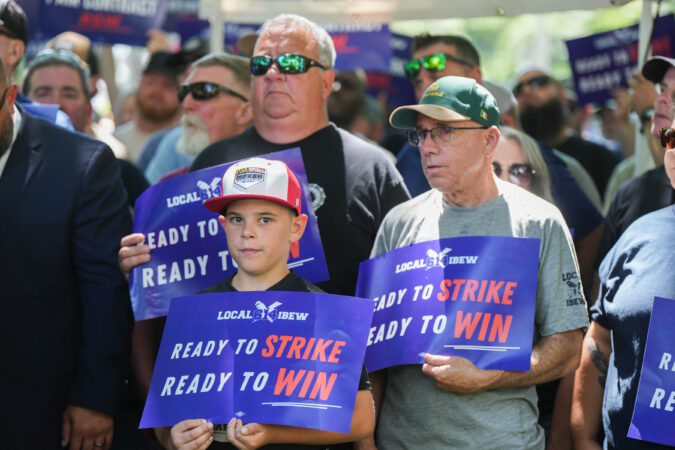
This article was originally published May 29, and has been updated with recent information about bargaining and IBEW Local 614’s strike plans. This is a developing story, and it will continue to be updated.
Peco workers plan to strike on the Fourth of July, after three months of working under an expired contract.
Union members include employees who help restore electric service during outages, such as those sometimes caused by intense summer storms.
The company and the union have been bargaining since January, and they have reached some agreements, but wages and benefits have become sticking points.
Bargaining turned ugly in April, as both sides filed unfair labor practice charges with the National Labor Relations Board. Peco has suggested using a federal mediator.
The most recent bargaining session was on June 19. Peco and Local 614 plan to bargain next on July 1.
They voted at the end of May to authorize a strike if their union called for it, with over 1,000 participating in the vote.
Have Peco workers gone on strike in the past?
No. This would be the first work stoppage in the company’s history. Since unionizing, this group has never before seen their contract expire without a new one in place.
Peco workers voted to join the union in 2004 and ratified their first contract in 2007.
Who are the union members and what do they do?
IBEW Local 614 represents roughly 1,500 Peco employees, including call center employees and field workers who maintain electric and gas infrastructure.
Some members work long hours during outages to help restore electricity to customers. Linemen, who repair and maintain power lines, are some of the union’s highest paid workers, and made on average over $243,500 last year in wages, including overtime.
Workers want higher wages and a uniform retirement plan for all members. Some 600 workers who were hired in recent years don’t have a pension, while other groups have pension plans with varying terms.
Peco has offered a 20% wage increase over five years, as well as “enhanced retirement and medical benefits,” according to company officials, who said their proposals “support our employees while maintaining affordability for customers.”
What does a Peco strike mean for my electricity? What if there’s an outage?
Peco has a strike contingency plan in place, chief operating officer Nicole LeVine has said. Customers shouldn’t expect delays or interruptions in service, she said.
“If there’s severe weather, we’ll be able to restore any service issues,” LeVine has said.
The company would call in substitutes for the striking workers, LeVine said this week, some of whom are “familiar with our specific system,” while others “are coming in from outside of the region.” She declined to say how many workers are part of the contingency plan.
“We’re an emergency response company,” LeVine said. “We’ve been working on contingency planning in the event of a strike, and we were well prepared to execute our plan if needed.”
How many customers does Peco service?
In Southeastern Pennsylvania, Peco provides electricity to 1.7 million customers and natural gas to 553,000.
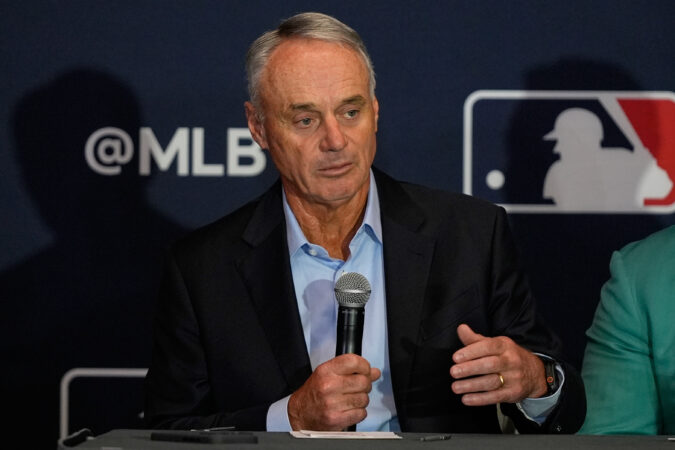
Major League Baseball proposed limiting most free agent contracts to five years and 15% of a team’s salary cap and to eliminate deferred compensation, fleshing out details of a plan likely to spark a confrontation with the players’ association.
“There’s no question that we’re very far apart,” union head Bruce Meyer said during an online news conference.
During a bargaining session Thursday at the union’s office, MLB said it would accept the union’s proposal granting free agency a year early for players who have reached age 30 if the union accepted the league’s salary cap system. MLB also proposed boosting the minimum salary from $780,000 to $1 million for those with two years of big league service.
MLB also proposed increasing the pre-arbitration bonus pool from $50 million to $65 million next year and $75 million by 2032, the sixth season of MLB’s proposed seven-year deal.
Meyer said “the debate got a little more vigorous today.”
“The league has done us a favor because their proposals are in fact so obviously and extremely bad for players at all levels that it’s actually been a benefit for our unity,” Meyer said. “Anybody who’s banking on Major League Baseball players cracking, it’s never happened. It’s not going to happen. That’s why we’re the only ones who don’t have a salary cap.”
MLB also said it would agree to eliminate the qualifying offer for free agents that since its inception in 2012 has restricted the market for some players.
Bargaining started May 13 for a contract to replace the five-year deal that expires Dec. 1, and owners proposed a salary cap for the first time since the union fought off the system during a 7½-month strike in 1994-95. MLB is expected to impose a lockout in December, halting free agent signings and trades.
After the prior agreement expired in December 2021, intensive bargaining did not start until late February as the threat approached of losing regular-season games — along with revenue and salary. The sides reached an agreement on March 10, the 99th day of the lockout, preserving the 162-game schedule.
In the league’s cornerstone proposal, made last month, team spending would be capped next year at $245.3 million, using figures for luxury tax payrolls that include $20.1 million for benefits and the pre-arbitration bonus pool. It also would establish a payroll floor of $171.2 million, forcing several teams to spend more. The two-time World Series champion Los Angeles Dodgers, baseball’s biggest spenders, had a $415.2 million payroll on opening day this year — around $170 million over the proposed cap.
“The biggest issue baseball fans want solved to strengthen the game is fixing the payroll disparity that leaves too many fans without hope of their team competing for a World Series title,” MLB spokesman Glen Caplin said in a statement. “Every other major U.S. sport has tackled this problem, and every year more small market teams in those leagues have a chance to win. The salary cap and floor proposal levels the playing field.”
Meyer took issue with that.
“It’s appalling that the stewards of the game, the people whose job it is to grow the game primarily and promote the game have for whatever period of time now in the last couple of years been saying nothing but the game’s broken,” he said.
As part of the plan, MLB would establish a “cornerstone player” similar to the NBA’s Bird rule, which would allow a team to re-sign a player at 16% of the cap. A free agent switching clubs would be limited to a $36.8 million salary next year and a re-signing player to $39.2 million.
Salaries for free agents in additional seasons of a multiyear contract would be limited to 5% increases, as would salaries for younger players in multiyear deals that cover potential free-agent seasons.
Contracts would be capped by service time: at $500 million and 12 years for those yet to make major league debuts, $461 million and 11 seasons for those with 0-1 years of service, $421 million and 10 years for 1-2, $382 million and nine seasons for 2-3, $343 million and eight years for 3-4, $304 million and seven years for 4-5, and $265 million and six years for free-agent eligible players.
Agent Scott Boras claimed the then-record $252 million, 10-year contract he negotiated for Alex Rodriguez in December 2000 would not have been allowed.
“It’s like offering a few pieces of furniture if you agree to live in a house with a 4-foot ceiling,” he said, “an attempt to move player contract values back to the 1990s.”
Banning deferred compensation would eliminate a business practice used most prominently by the Dodgers, who owe just under $1.1 billion to 10 players from 2028-47. In addition, MLB would restrict bonus provisions in player contracts and mandate a standard award bonus package.
MLB said it would accept the union’s proposal to drop free-agent eligibility to five seasons of service from six for those turning 30 by the Nov. 1 of the offseason. MLB said 354 players on big league rosters as of Thursday would reach free agency a year earlier. MLB would start the change in the 2027-28 offseason.
As part of the minimum salary proposal, MLB said players with less than two years of service would have a $900,000 minimum and if earning a full year of service would get an additional $100,000 from the pre-arbitration bonus pool. Minor league minimums for players with major league contracts would increase from $63,600 to $73,400 for initial big league deals and $127,100 to $146,700 for additional contracts.
The union proposed to jointly lobby with MLB for the prohibition on prop bets; to allow player endorsement and sponsorship of legal betting entities, including sportsbooks and prediction markets; to have players under MLB betting investigations to be placed on administrative leave, similar to the domestic violence policy; and to allow players near the end of suspensions for betting to have unpaid 15-day minor league assignments, similar to the drug policy.
In addition, players asked for increases for in-season meal and tip allowances; housing benefits for players with major league contracts who are assigned to the minors; and increased moving expenses, including for assignments from one minor league affiliate to another.
Meyer expects at least one more bargaining session before the All-Star break.
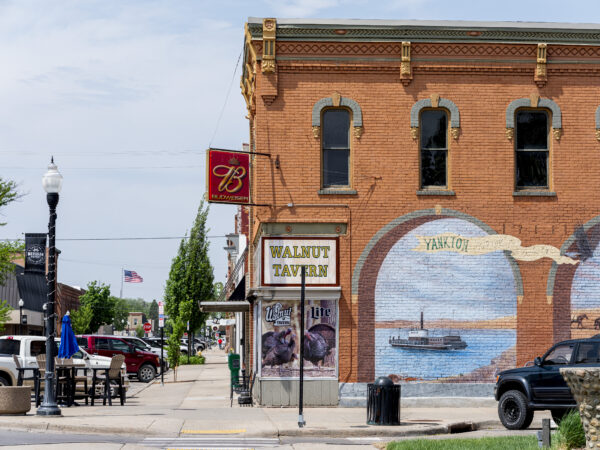
YANKTON, S.D. — Charl Kleinhaus did not like the direction his country was taking.
A white South African, Kleinhaus said the laws meant to empower Black people after the demise of the racist apartheid system had hurt his mining business. Violence in the country — a scourge affecting everyone, regardless of race — had become too much.
So Kleinhaus considered his options.
Some of his fellow Afrikaners, the ethnic minority that ruled during apartheid, had moved to Germany, but the language barrier was not ideal. He thought about Australia, but decided that moving his family thousands of miles from home would be too hard.
Then, in February of last year, Kleinhaus received what he described as “a message from above.” President Donald Trump had suspended refugee admissions to the United States, but he made an exception for people like Kleinhaus: white Afrikaners who claim they are victims of racial persecution in South Africa.
“It’s now a reverse apartheid,” Kleinhaus said, summing up his grievances about his homeland. “That’s what we are fighting about now.”
In a matter of months, Kleinhaus secured refugee status and moved with his family to the United States, completing a process that can take years under normal circumstances. Now, after a year in the country, he has settled in South Dakota, where he has found part-time work at a car dealership, a farm, and a brickyard while planning his next business.
Kleinhaus is among more than 6,000 South Africans — the vast majority of them white — who have benefited from Trump’s decision to upend America’s refugee program, which for decades had made the United States a sanctuary for people fleeing disaster and persecution.
Charl Kleinhaus secured refugee status and moved with his family to the United States in a matter of months.
Under Trump, the program has effectively become a whites-only path to life in the United States, a culmination of the president’s long-standing antipathy toward immigrants and his embrace of the concept of “reverse racism” as a guiding principle in his administration.
The president has fought to limit immigration for more than a decade, imposing travel bans on mostly African and Muslim-majority nations and making it much more difficult for people from those nations to obtain green cards. He has railed against affirmative action, and in an interview with the New York Times earlier this year said he believed civil rights-era protections had resulted in white people being “very badly treated.”
But few of Trump’s efforts are as striking as his efforts to turn the refugee program on its head, leaving thousands of people across the world sitting in refugee camps with no chance of entry into the United States, even as he created a workaround for Afrikaners.
The Trump administration has argued that the overhaul of its refugee program is necessary to prioritize refugees who can better assimilate into the United States.
“President Trump has provided a lifeline for Afrikaners, who are being raped, maimed, killed, and driven off their property across South Africa,” Anna Kelly, a White House spokesperson, said in a statement. “While the South African government and many in the media have brushed off the horrific lived experiences of this community, the Trump administration continues to process applications for refugee status because the president has a humanitarian heart.”
But critics of the policy who are involved in refugee resettlement say the Trump administration’s priorities have made it impossible to help people who have nowhere else to turn.
“It’s the moral and legal inversion of what this work is about,” said Jason Marks, a senior refugee officer who resigned from the Department of Homeland Security last year when Trump announced the effort to fast-track Afrikaners to the United States. “They are rolling out the red carpet for this group with a clear racial and political agenda at the expense of everyone else.”
‘Too many people’
Kleinhaus acknowledges that moving to the United States from South Africa’s Mpumalanga province was not his “last option.” He left behind resources: a Jaguar sports car, a Range Rover, and what he estimates is property worth at least $300,000. He plans to sell them all to bring in extra money.
But he also says many of his white relatives and friends were no longer safe in South Africa.
White farmers — a population that Trump has spotlighted in public remarks — have indeed been killed in vicious acts of violence in a country that suffers from a high murder rate. But so have Black South Africans and others, and police data does not support the idea that white South Africans are more likely to be targeted than any other group.
Kleinhaus also said his profits were suffering because of racial equity laws.
“You’re not going to get a big contract from a mining company if you’re not Black,” he said. “There’s too many people. How do you divide a small cake between such a big population? Yeah, you cannot.”
He said he felt no guilt about bringing his children and grandson to America to pursue a new life, even as families fleeing conflict in Afghanistan, Sudan, and Ukraine remained walled off.
“You can’t take in those hard-core war people,” said Kleinhaus, whose news feed is full of social media videos and memes promoting the idea that white people are targeted in South Africa. “You can’t put them in a first-world country, you’ll be mad.”
After allowing refugees from around the globe to enter the country for decades, the United States was now trying to “have some type of balance,” he said.
Secretary of State Marco Rubio said this month that U.S. refugee policy must benefit Americans.
“Everything we do has to be geared by the national interest,” Rubio told lawmakers. He said, “It is in our national interest” to allow in people who can “quickly assimilate into society and be successful.”
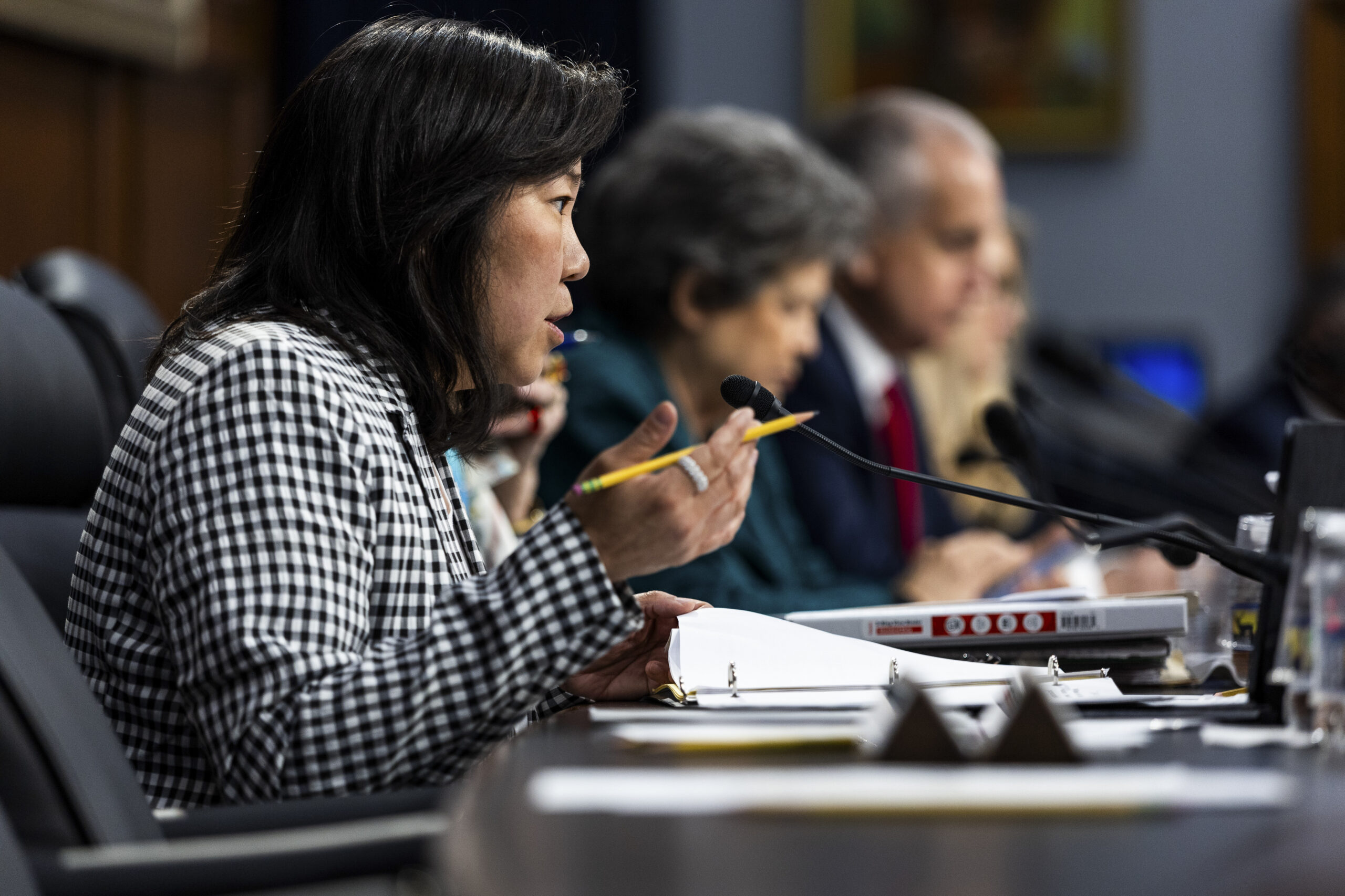
Rep. Grace Meng (D., N.Y.) questions Secretary of State Marco Rubio during a House Appropriations subcommittee hearing this month.
Rep. Grace Meng (D., N.Y.) asked why the administration thought other refugees could not assimilate, including Afghans who had helped U.S. soldiers during the war, cleared vetting, and were now stuck in limbo.
“They have assimilated and contribute and pay taxes,” Meng said of Afghan refugees who had moved to her district in Queens, New York. “I think it’s important for America to keep our promise as well,” she added.
Some of the Afrikaners, who are the descendants of Dutch and other European settlers, have not acclimated as smoothly as the administration expected.
During their initial months in the United States, refugees typically can receive some money for housing and food from resettlement organizations who receive federal funding. Those organizations can also help them find work.
But refugees are expected to eventually be self-sufficient. The process is often a difficult one.
Multiple Afrikaners reported delays in receiving financial support from their local resettlement agency, according to complaints obtained by the New York Times. (The names of many of the refugees were omitted from the documents.) One of the families complained about needing to complete Medicaid and Social Security applications on their own. That same family griped about needing to use public transportation, according to the documents.
Another South African relocated to Texas said he felt staffers from the local resettlement agency, which has a Muslim affiliation, had “discriminated” against him as a Christian. The staff members who picked up his parents from the airport were candid about their views of Trump’s changes to the refugee program.
“They told my mother they cannot wait for next election when Trump can leave office as they had a problem with his decision to give South Africans refugee status and how angry they are that only South African refugees are now allowed,” according to the correspondence.
The newly arrived South African also said his family was placed in an apartment that was “dirty, contained mold, and is located in an unsafe area in Fort Worth.”
The complaints by the Afrikaners about their level of assistance also came after the Trump administration made cuts to funding for resettlement agencies and benefits that in the past were made available to new refugees, including food stamps.
At least three Afrikaners made the return after being settled in states including Minnesota, Idaho, and Illinois, according to government documents. Some had sick relatives back home. One Afrikaner said the process had “occurred quickly” and “she had not thoroughly thought through the process.”
“I think some of them are finding that actually it’s not an easy life to be a refugee,” said Bryony Fox, a lecturer at South Africa’s Stellenbosch University, who researches forced displacement.
Claims of genocide
South African officials strongly dispute claims by Trump that Afrikaners are being targeted in a “genocide.”
During apartheid, which ended in 1994, the government denied Black South Africans the right to own prime agricultural land. That meant that almost all of the country’s large-scale commercial farmers were white, and that remains so to this day.
South Africa’s Commission for Employment Equity found that white people made up 61% of top management posts in 2024, while they are only 7.5% of the population. Black South Africans are also unemployed at far higher rates than their white peers, a disparity that has not improved over time.
To address the disparities, the African National Congress government has instituted racial equity laws that incentivize companies to have Black ownership and leadership. That Black Economic Empowerment initiative has prompted intense scrutiny from the Trump administration, as well as from Afrikaners fleeing to the United States who say it has harmed their businesses.
Kleinhaus said such policies make him as a white man feel targeted by the South African government. He said that he had struggled to keep thieves off his property and that his relatives had been the victims of violence, although he said getting into the specifics made him too emotional.
In his experience, white people are portrayed as “the problems in the economy” and “the privileged ones.”
“There’s no such thing as that,” Kleinhaus said. “Most whites have lost a lot.”
Fox said there was no denying the violence in South Africa.
“That is our biggest problem,” she said. “But it is not targeted. It is not systematic targeting.”
She said criminals had attacked farms because they “have resources that communities are seeking.”
Trump has echoed fringe claims about a white genocide in South Africa for years, going back to his first term. Last year, in a stunning confrontation in the Oval Office, Trump lectured the South African president, Cyril Ramaphosa, about his own country. Ramaphosa implored Trump to listen to “the voices of South Africans.”
The State Department does not break down its refugee data by race, but it has allowed in more than 6,600 refugees this fiscal year. All but three were from South Africa.
Trump’s aides have defended the program by saying that other racial minorities in majority-Black South Africa are welcome to apply for the refugee program.
South Africa also has minority populations of people of Indian descent, white people of British heritage, and mixed-race people — and a few individuals from those communities have been processed through Trump’s refugee program. But refugee resettlement officials say nearly all of those who have been accepted are white, and government documents confirm that the administration has prioritized resettling white Afrikaners.
Why white South Africans?
Long before Trump created the refugee program, many white South Africans traveled to the United States — from the Midwest to the Mississippi Delta — on temporary visas to work as seasonal farmers.
Since 2019, Kobus Van Den Berg has been traveling to and from the United States to plant soybeans and fertilize fields in North Dakota to save money for his family back home in South Africa. He agrees that crime is an issue in South Africa, but he pushed back on the notion that white South Africans are being singled out.
“They’ll attack anybody,” he said. “It doesn’t matter what color or race you are.”
He has watched as Afrikaners have come into the United States in recent months with refugee status and a pathway to citizenship, even as he has spent years navigating a complicated immigration system with the hopes of obtaining a green card.
“Why is it so easy for this other Afrikaner from South Africa to come over here?” Van Den Berg said. “The thing that blows everyone’s mind today is, why is it specifically white South Africans?”
Critics of the Trump administration say the answer lies not just in Trump’s long-standing embrace of the Afrikaners’ cause, or the administration’s desire for “assimilation,” but in his stance toward refugees more broadly.
Sharif Aly, the president of the International Refugee Assistance Project, said the policy shows an “indifference to the plight of nonwhite refugees.”
It is difficult to ascertain how rigorously the administration is vetting the South Africans. In the past, the process has been time-consuming, with agents demanding criminal records, medical records, and even social media posts.
The Trump administration has said it would deny immigration requests for those with antisemitic or “anti-American” posts on their social media accounts, but Kleinhaus was welcomed even though he had made antisemitic comments on social media. In April 2023, the X user @charlkleinhaus wrote in a now-deleted post that Jews were “untrustworthy” and “a dangerous group” and that “they are not Gods chosen.”
Kleinhaus said his grandmother was Jewish, he was not an antisemitic person and he had written the post in error while he was taking medication for a kidney stone. He also shared other posts that had been written by others.
During his processing, he said, he signed off on administration vetting of his social media accounts and no one brought up any problems.
‘Leaving everything behind’
Over breakfast at a local diner, the Fryn’ Pan Family Restaurant, Kleinhaus said he missed some aspects of his life in South Africa, including “the people, my workers, my friends, and family.”
But he also appreciates “these advantages that I’ve got here to do things I can do just as a white person” and not needing to worry about laws requiring him to sell a percentage of equity of his mining company to Black shareholders in South Africa “because they were here first or whatever the story can be.”
He said he was focused on working and contributing to the United States.
He said he did not complain when he, his son, daughter, and grandson were initially placed in one hotel room in Buffalo, N.Y. He soon identified a farmer in Yankton, S.D., who had hired seasonal workers from South Africa for years and was looking for more help.
Now, his daughter works at a flower shop in the small town of Yankton. His son works at another farm and his grandson has learned English quickly after knowing only Afrikaans.
And he has found part-time work at a car dealership and at a brickyard while he plans how to start his next business. He occasionally takes his grandson fishing in this area known for the Lewis and Clark trail on the weekends.
“I just want my kids to be successful,” he said.
Kleinhaus hopes he can convince other relatives to join him soon in America. He said he knows he cannot simply go back and visit, because that would undermine his claims of persecution.
“I’m leaving everything behind,” he said. “When you accept the refugee thing, it’s not a thing like, ‘I’ll be back in two weeks; I’m going on holiday.’ It’s nothing like that. You’re saying, ‘It’s done. I’m not going back.’”
NEW YORK — Carlos Mendoza was fired as manager of the underperforming New York Mets on Friday and replaced by Andy Green.
New York is 34-47 following a six-game losing streak, 15 games behind NL East-leading Atlanta and 9½ games back of the NL’s last wild-card berth.
The Phillies open a three-games series against the Mets at Citi Field on Friday night.
Mets owner Steve Cohen had high expectations for a team without a World Series title since 1986. New York opened the season with baseball’s highest payroll at $358 million and was projected to pay an additional $124 million in luxury tax.
“Our commitment to bringing our fans a championship-caliber team has not changed,” Cohen said in a statement. ”There is no sugarcoating it: This season has been a disappointment and our fans deserve better than what we’ve delivered.”
A former Yankees assistant coach, Mendoza replaced Buck Showalter after the 2023 season and led the Mets to a 206-199 record. While New York advanced to the NL Championship Series in 2024, the Mets failed to reach the playoffs last year and are among the sport’s biggest disappointments this season.
“Carlos has led the organization with passion and grace and is beloved by everyone who works with him on a daily basis,” president of baseball operations David Stearns said in a statement. “Carlos’ impact on our players, staff, and culture over the last three seasons has been transformative. Unfortunately, we know we are falling short and change is necessary to move forward.”
Green, a former major league infielder, joined the Mets in 2023 as senior vice president of baseball development. He managed San Diego to a 274-366 record from 2016-19.
Paoli Hospital was not cited by the Pennsylvania Department of Health for any safety violations between April 2025 and March of this year.
Located in Chester County, the hospital is one of four owned by Main Line Health.
Here’s a look at the publicly available details:
June 18, 2025: Inspectors came to investigate a complaint but found the hospital was in compliance. Complaint details are not made public when inspectors determine it was unfounded.
June 19: The Joint Commission, a nonprofit hospital accreditation agency, renewed the hospital’s accreditation, effective April 2025, for 36 months.
Oct. 20: Inspectors came to investigate a complaint but found the hospital was in compliance.
March 12, 2026: Inspectors came to investigate a complaint but found the hospital was in compliance.
The Democratic Party should be a big tent and welcoming to a diversity of voices, Gov. Josh Shapiro told MS NOW’s Jen Psaki in a live event in Philadelphia on Thursday.
Following Tuesday’s primary races in New York that saw the elections of more progressive and socialist candidates, Shapiro said the results there and around the country show that voters are eager for change.
“I appreciate the passion that we are seeing from voters all across this country,” Shapiro said during the event at the Academy of Music, part of MS NOW’s celebration of America’s 250th birthday.
People are feeling the strain and opting to support more progressive candidates, Shapiro said, because of rising health insurance costs, struggles to purchase a house, and the feeling that their rights are being stripped away.
“They are channeling that pain into purpose, they’re channeling that into showing up at the ballot box, they’re channeling that into showing enthusiasm,” he said. “That is a good thing.”
But he stopped short of explicitly endorsing more left-leaning ideologies. In a separate interview with CNN on Thursday, Shapiro added that the successful candidates must now deliver results.
“I get that there are some candidates out there that just say a lot words and attract a lot of attention but what we need to do as a party is drill down on how we take those words turn them into actions and make people’s lives better,” he said.
In Philadelphia, voters elected Chris Rabb, the democratic socialist who has challenged the city’s political establishment, in May’s Democratic primary for Pennsylvania’s 3rd Congressional District. Shapiro did not get directly involved in Rabb’s district, despite making endorsements in other races.
He also dodged direct criticism of Sen. John Fetterman, a fellow Pennsylvania Democrat who has become increasingly unpopular among the party’s voters, after Psaki posed some of the senator’s recent comments to Shapiro.
In both Philadelphia and New York, the victorious progressive candidates during their campaigns heavily criticized Israel’s war in Gaza and the United States’ role in supporting its material.
Psaki did not ask Shapiro, who supports Israel but has been critical of Prime Minister Benjamin Netanyahu, about the issue during the event. And he did not refer to it when talking about the New York results.
To show voters that Democrats hear their pain, the party needs to get “real stuff done to make people’s lives better,” he said.
Sandra Dungee Glenn, who attended the event Thursday, said Shapiro could have been even more forceful against Fetterman, who is viewed unfavorably by 43% of Philadelphia residents, according to a recent poll.
“Don’t even mention that name,” said Glenn, who lives in West Philadelphia, referring to Fetterman. “He’s a big disappointment.”
In addition to his own reelection campaign in November, Shapiro is focused on getting Democrats elected in four competitive congressional seats and flipping the Pennsylvania state Senate, which has been under Republican control for three decades.
Should the chamber flip, Shapiro said his immediate priority would be raising the state’s minimum wage and codifying the right to access abortion — blaming Republicans for standing in his way.
But Shapiro, a first-term Democrat, is also looking ahead, past 2026 and Donald Trump’s presidency, as he builds a national profile and becomes a likely contender for the presidency in 2028.
He said Congress should pass a 28th Amendment to the U.S. Constitution that guards against corruption and gerrymandering, and railed against the 2024 U.S. Supreme Court decision that gave presidents absolute immunity from criminal prosecution for actions taken within their constitutional authority, following Trump’s efforts to overturn the 2020 election.
Shapiro said he is also open to adding more justices to the Supreme Court, which has been set at nine justices since 1869.
“I think we’ve got to have everything on the table. We’ve got to be bold,” he said.
Expansion has been pushed by progressives as a way to reform the court and end its conservative majority.
Leslie Berger, 69, who attended MS NOW’s event Thursday said she supports adding more justices to the court.
“These norms we have aren’t etched in stone,” she said. “We need to change this justice system and more justices would be a great start.”
Democrats, Shapiro said, need to be aggressive and elevate candidates who will drive down costs, increase access to healthcare, repair the country’s standing in the world and rein in artificial intelligence.
“We’ve got to understand that our sole mission right now is winning in these midterms and providing a check against Donald Trump at the state and the federal level,” he said. “Then as we go forward, I think we have to understand that rebuilding a federal government like it was before Donald Trump showed up cannot be the answer to the Democratic Party.”
In recent months, the public’s backlash to the artificial intelligence boom has spilled over to a surprising place: college commencement stages. From Florida to California, students have booed speakers who praised AI or highlighted its growing role in today’s society.
A cohort that historically has supported and quickly adopted cutting-edge technologies is now growing more skeptical.
The backlash is hardly surprising since AI threatens to wipe out the kind of entry-level jobs that new college graduates depend on. But beneath that immediate threat lies another, less obvious one: the AI boom’s impact on climate change — an issue that young people have grown up worrying about and that has shaped how they view their future.
In Pennsylvania alone, there are more than 130 AI infrastructure projects either under construction or in the approval pipeline. As demands for AI have increased, utilities and developers are racing to secure enough power to support them. Clean energy projects are already playing an important role in the AI infrastructure build-out.
Shown is the Northampton generating station in Northampton, Pa., in 2024. Gov. Josh Shapiro unveiled a plan to fight climate change Wednesday, saying he will back legislation to make power plant owners in Pennsylvania pay for their planet-warming greenhouse gas emissions and require utilities in the nation’s third-biggest power-producer to buy more electricity from renewable sources.
There is a stark contradiction at the center of this reality. AI is marketed as a 21st-century future-oriented technology, yet much of it is being powered by 19th-century energy sources.
In addition to the energy demands, data centers can require up to five million gallons of water for cooling per day, including in regions already facing drought and water stress linked to climate change.
A recent Pew Research Center poll shows that 54% of adults under the age of 30 believe data centers will have negative impacts on the environment. While older cohorts surveyed still express concerns about environmental impacts, it isn’t the majority of respondents as it is with younger people: 44% of those 30 to 49; 35% of people ages 50 to 64, and 26% of those 65 and older.
The increasing backlash among younger people — which has found expression from college commencement speeches to community forums — points to what research has consistently shown: Younger generations are worried about climate change.
They are already experiencing the impacts in Pennsylvania: hotter and longer heat waves, more dangerous flooding, worsening drought conditions, and the increase in certain diseases thanks to the territorial expansion of carriers, like ticks.
Chart shows the rise of tickborne illnesses in Pennsylvania.
If the growth of AI leads to more fossil fuel use, higher emissions, and worsening air pollution, young people are justified in questioning whether the technological progress is worth the future problems they will inherit.
Leaders have a responsibility to usher in new development responsibly. One way to do that is to pair data center expansion with investments in clean energy sources. Clean energy is affordable, local, and reliable, and by producing homegrown power, Pennsylvania could potentially lower power bills and protect families from price spikes in the process.
A clean energy standard for data centers would require that these Big Tech companies use clean energy in increasing percentages over time and that they pay for the required electricity system upgrades to support their operations.
Another way is for the state to require greater transparency around the electricity and water use of these data centers, so communities understand the tradeoffs required for these proposals in their backyards before agreeing to them.
It is a positive move toward responsible development.
Not all young people skeptical of AI are rejecting it; many are just questioning whether the race to build that future is happening with an understanding of the environmental consequences.
For the U.S. and Pennsylvania to continue leading in technological innovation while protecting the planet on which young people will build their lives, leaders must take climate change concerns seriously. Young people deserve their future.
Sanya Carley is the Mark Alan Hughes faculty director of the Kleinman Center. She is also vice provost for climate science, policy, and action at the University of Pennsylvania and presidential distinguished professor of energy policy and city planning at the Stuart Weitzman School of Design.
A former bouncer with hands like 5-pound hams was peppering Bam Margera with rib punches in a small gym at his Chester County castle.
Every few minutes, Margera waved his hands in surrender. He started looking for a place to sit down. Sweat poured down his face, and he struggled to catch his breath
“I need a second,” he said.
Margera had strung together years of bad days recently, but, despite the pain, this wasn’t one of them. Today, he’s sober, in love, skateboarding, spending some time with his family and son, Phoenix Wolf, and, on this early June afternoon, working out, too.
Fans of the Jackass series will get to see him on Friday, June 26, when Jackass: Best and Last, the fifth and final film in the series, is released.
“I think this is the grand finale of it all,” he said.
While Margera didn’t film new stunts or pranks for the latest film and had no interest in attending any premieres (his parents attended) or promotional events, he signed a deal allowing unseen archival footage and outtakes from early Jackass days to be used in the film.
Margera had a public falling out with the Jackass crew over sobriety demands they placed on him before the release of 2022’s Jackass Forever. (He still blames Johnny Knoxville’s “sharp tacks” stunt in a Viva La Bam episode for damaging his feet and hurting his skateboarding career.)
“I’m not ready to reunite with anybody,” he said recently.
Paramount Pictures alleged Margera broke a “wellness agreement” that required him to undergo regular drug and alcohol tests and take prescribed medication to be in the 2022 film. When the film was released, Margera had a brief cameo, and The Inquirer noted that it suffered without Margera’s trademark heartagram symbol and Philly hoagiemouth accent.
Some stars of the show and films, including Stephen “Steve-O” Glover and Brandon Novak, a longtime friend of Margera’s, have gotten sober. While Margera was seemingly blowing up friendships at his worst, Novak, a former pro skater, said he never took it personally.
“I always have and will still love him, wherever he is in his journey,” he told The Inquirerin June.
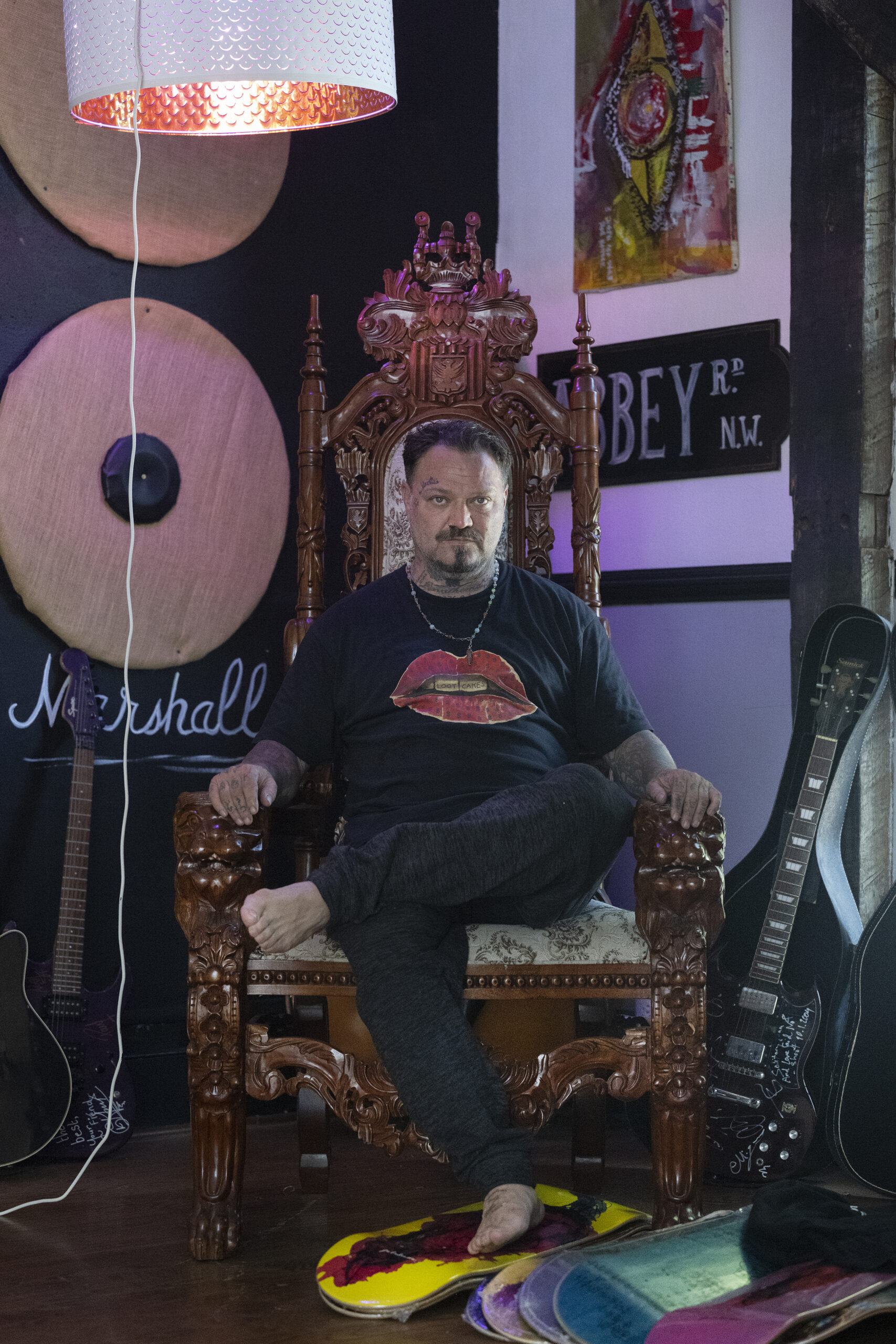
West Chester native Bam Margera poses for a portrait at his home in Pocopson Township, Chester County on June 4, 2026. After years of personal struggles, Margera says he is sober, skating again, and reconnecting with the “Jackass” franchise, allowing producers to use archival footage of him in the latest film.
Three years ago, Margera seemed hell-bent on burning his own bridges to a better life. He was in California, a long way from his home and family in Chester County. He was even further from good publicity, from his passion — skateboarding — or any semblance of a normal life. In his own words, he became a professional “piece of s—.”
Margera was mired in a custody battle with his ex-wife, Nikki Boyd, along with a slew of other legal issues and lawsuits in Pennsylvania and beyond, plus the subsequent attorney fees. He was in and out of rehabilitation centers for drugs and alcohol, and dealing with medical and mental health issues.
When The Inquirer spoke to Steve-O about Margera in 2023, he said he was ready to help.
“I just can’t do it for him,” Steve-O said at the time. “I tried everything I could to encourage him to want to get better, and none of it worked, so here we are. He has to want to get better.”
“Jackass” star Steve “Steve-O” Glover has been sober for several years but he says his stunts are better than ever.
Margera was placed on a 5150 psychiatric hold when he was found acting erratically outside Trejo’s Tacos in Los Angeles in June of 2023.When he was released, he checked into the Sunset Marquis hotel with more drugs than he’d ever had. Looking back, Margera said he wasn’t suicidal, but he didn’t really expect to wake up.
Still, he said a little prayer that night.
If he survived, Margera expected God to deliver him the “hottest eye candy with a tan pit bull” to save him. When he woke up, surprised to be alive, Margera went out by the pool, ordered a Bloody Mary, and met Daani Marie, a model and stretch coach he later married.
Margera and Daani Marie, who now spend most of their time in Florida, hit it off immediately.
“I really like you,” she said. “Do you want to walk my dog with me?
“What kind of dog do you have?” Bam asked.
“A tan pit bull.”
He looked up at the sun and smiled.
Former Jackass star Bam Margera walks to the Chester County Justice Center on July 27, 2023, for a preliminary hearing.
While he didn’t get sober immediately, Margera credits that night, that chance meeting with Daani Marie the next morning, for at least putting him on the path. The two were married in New Mexico a year later.
“Enough was enough,” Margera said. “I knew if I continued this lifestyle, I’m gonna die this way.”
Margera said he hadn’t been back to Castle Bam in 10 months, and on this June afternoon, was paying Andrew Mehan, a former bouncer in West Chester, for boxing lessons.
Mehan had to kick Margera out of some West Chester bars back in the day. He’d seen Margera in worse shape.
“Come on, get up,” he commanded.
Bam Margera in his personal skateboard park in Chester County, Pennsylvania, in 2011. (Charles Fox/The Philadelphia Inquirer/TNS)
Suddenly, Margera would rise from his rest with a groan — he still smokes — and snap a few jabs at Mehan.
His father, Phil, the lovable victim of countless pranks and a few punches from Bam over the years, sat in the wings, beaming with pride as his son countered with a few jabs.
“Yeah, he put me through it, but I’ll sit through anything as long as he’s sober,” Phil said.
Margera’s solo show, Viva La Bam!, was set almost entirely in and around Castle Bam, his notorious home and compound in Pocopson Township, Chester County, and also at his parents’ home. The show ran for five seasons on MTV, from October 2003 to August 2005.
Many of Castle Bam’s mainstays were still there: purple luxury cars — a Bentley and Audi in the driveway — skateboard decks on the walls, and lots of Margera’s paintings leaning against the walls. Margera described his style as “Jackson Pollock-ish.”
Brandon “Bam” Margera (right) of MTV’s “Jackass” was born in West Chester, and friend and costar Ryan Dunn moved there as a teen. Above, they were signing autographs after a screening of the movie “Jackass 3D” at Manayunk’s UA Main Street 6 in October 2010.
One skateboard deck featured Ryan Dunn, another steady fixture at Castle Bam back in the day. Dunn, Margera’s longtime friend and a fellow Jackass star, died in a fiery crash after a night of drinking in Chester County in 2011. The two met at 15, at West Chester East High School, and were nearly inseparable thereafter. In the wake of Dunn’s death, Margera turned to food and alcohol — pints of vodka and Gatorade, food binges followed by purges — to deal with the grief.
Margera was interviewed by a television station at the scene. He was mostly sobbing, and when asked how he would get through it, he said he “couldn’t.”
On this June afternoon, there were people, young and old, everywhere at the Castle: in the pool, putting skateboards together, or doing yard work. His wife doesn’t love the cold, so he didn’t plan on spending too much time back at the Castle or any one place, for very long. Pocopson Township, he said, cracked down on his ability to host big gatherings and do outlandish stunts.
“I love Pennsylvania, but I love to travel, too,” he said. “Boredom is my trigger.”
Friends popped in and out, including Dennis Wood, a West Chester native who used to skate at Margera’s as a teen.
“Obviously, there’s been trials and tribulations throughout the years; he took some steps forward, some steps back,” Wood said. “In the last couple of years, this is the best I’ve seen him.”
Margera had very public fallouts with his family during the worst years, too. He was charged with assaulting his brother at Castle Bam in 2023.
Margera’s mother, April, said his legal issues have been resolved and that he seems to be “out of the darkness.” She went to California with him and Phil recently to visit Phoenix Wolf.
“I would like to say I’m really proud of him. He came a long way. We’ve all been through the fire and brimstone, and we seem to be coming out on the other side,” April said in a text message.
Novak, a former star of Jackass and Viva La Bam! who now owns sober living houses in Delaware and New Jersey, said Margera’s family was always the grounding force, a source of unconditional love, and he was happy to hear the Margeras have made amends.
He also loves that Margera is skating again.
“Where he seems to be now is a healing stage,” Novak said recently. “To what degree, I can’t speak on, but it’s better than it was when he wasn’t speaking to his family or the majority of his friends.”
Margera started skateboarding as a teen, with Phil driving him all over the area to pursue his passion, including the late Love Park and FDR Park. Margera’s earliest stunts appeared in videos for his brother’s alt-metal band, CKY, and he got noticed by MTV. His crew was teamed up with other wild men, like Johnny Knoxville and Steve-O. Jackass was born. Margera and Dunn were featured in the first episode on Oct. 1, 2000, riding — crashing, rather — shopping carts.
Phil watched his son’s recent torturous boxing lesson with pride.
“He’s still cute, even at 46,” Phil said.
When the final sparring round was over, Mehan helped pull Margera’s gloves off. Margera slumped down and took deep breaths. A few minutes later, he shuffled out of the gym and walked straight into the deep end of the pool, fully clothed.
“I need to quit smoking,” he said along the way.
Mehan put the day’s boxing lesson into a deeper perspective while he unwrapped his own hands.
“That’s the worst he’ll ever look,” Mehan said of the boxing lesson. “Here’s the deal: He fought through it. He kept saying he was done, that he wanted to quit, but he kept going.”
West Chester native Bam Margera is filmed by a documentary crew as he rests during a boxing workout at his home in Pocopson Township, Chester County.