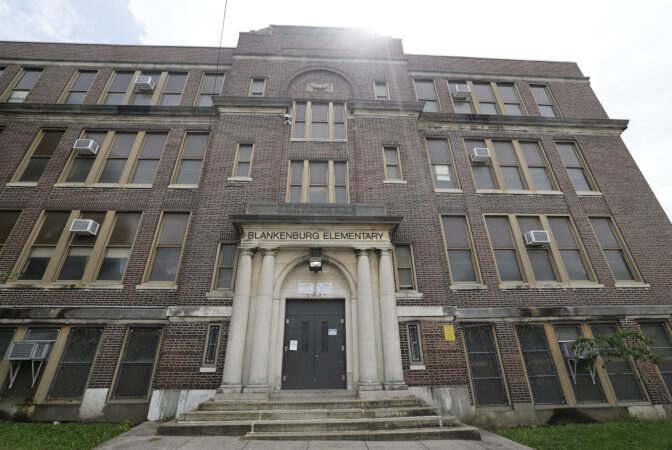
Rudolph Blankenburg Elementary School in West Philadelphia serves kids with complex needs — and test scores reflect that.
The school, where nearly 95% of students are considered economically disadvantaged, had been a Comprehensive Support and Improvement school — a federally mandated designation for schools performing in the bottom 5% statewide.
But last fall, Blankenburg shed that label. Many students are still struggling but are making gains, teachers said — progress they fear will be threatened by a district proposal to close the schoolas part of a sweeping facilities plan.
“We’ve worked really hard, with a consistent staff and all types of resources in place, for our students to pull ourselves out of that status,” said Flori Thomas, a middle school science teacher at Blankenburg.
That’s her biggest fear, she said: “You’re going to impact our scholars.”
Blankenburg is one of 20 district schools proposed for closure under the plan released last month. Six other schools would be colocated and more than 150 modernized as part of the proposal — which is facing resistance from City Council.
District officials say closures are needed in a system that has lost more than 80,000 students over the last 30 years, many to charter schools. The district has struggled to fund repairs of aging buildings — including at Blankenburg, where staff report chipping paint and roof leaks.
Marquita Jenkins, the school’s dean of climate and culture, does not disagree that the building, which opened in 1925, needs repairs — or that it is underutilized. The K-8 school, which currently enrolls 278 students, has room for almost 600. Officials said the school’s enrollment has declined by about 100 students over the last four years.
But the relatively low enrollment has also enabled smaller class sizes, helping student growth, Jenkins said. A former fourth- and sixth-grade teacher at Blankenburg, she recalled teaching a class of 33 students, 11 of whom had individualized special education plans: “It was tough.” Classes now are smaller, she said.
Like other staff, she worried about where Blankenburg students would end up. The district proposes to reassign them to Edward Heston School, James Rhoads Elementary School, and a newly colocated Martha Washington Academics Plus School and Middle Years Alternative School.
Blankenburg‘s building near 46th and Girard, meanwhile, would be conveyed to the city for “affordable workforce housing and/or job creation,” according to the district.
Jenkins and other staff questioned the safety of the routes to schoolfor reassigned students.
They also voiced concern for particularly vulnerable students: Blankenburg is surrounded by at least seven homeless shelters and “tends to have attendance fluctuations,” assistant principal Sandra Pitts said at a virtual community meeting with district officials this month. She questioned how families would be “assisted to avoid further trauma.” (Officials said they would be supporting students with housing instability in placements.)
Staffers noted that Blankenburg also has a significant population of students with special needs, who make up 25% of its enrollment.
Among them is Sherell Robinson’s kindergartener, Illiyin, who has autism and medical complexities.
Robinson, who lives in West Philadelphia, said that Illiyin had been denied enrollment at other district schools, and that she was told she had to send her daughter to Blankenburg.
Robinson initially had a negative impression of Blankenburg but was impressed with the school’s principal, Sheena Wilson, who “didn’t try to sell me, or placate me” — just presented what the school had to offer, she said.
What Robinson found was a small environment, “loving people,” and a routine for Illiyin. Now she is panicked at the prospect of the school closing.
“For them to be taking this whole community away is really devastating,” Robinson said. “It takes time to find the correct programming and environment and teachers who are neuro-affirming, especially for Black children.”
A real estate agent, Robinson said there was an irony to the district’s plan to convert Blankenburg to workforce housing — something she believes she currently would qualify for. But if she does not find a stable school environment for her daughter, she isn’t sure she will be able to keep her job.
“They might look at me as a single case, but I can assure you I am not an anomaly,” said Robinson, who also works for a disability nonprofit and is in touch with other parents of autistic children. “This is going to affect how we can take care of our families, how that perpetuates what we’re already experiencing. … I don’t want to normalize that struggle to them.”
Teachers said they are committed to Blankenburg’s students. “We bring a lot of positivity and try to keep our kids safe,” said Jenkins, who has led field trips to places including the Kimmel Center in Center City and the National Museum of African American History and Culture in Washington.
Thomas, who grew up in the neighborhood around Blankenburg and now lives in New Jersey, said that whenever students learn about her commute, she tells them they are worth the drive.
Others outside the city see headlines about crime, Thomas said, but she tells students: “I see you.”
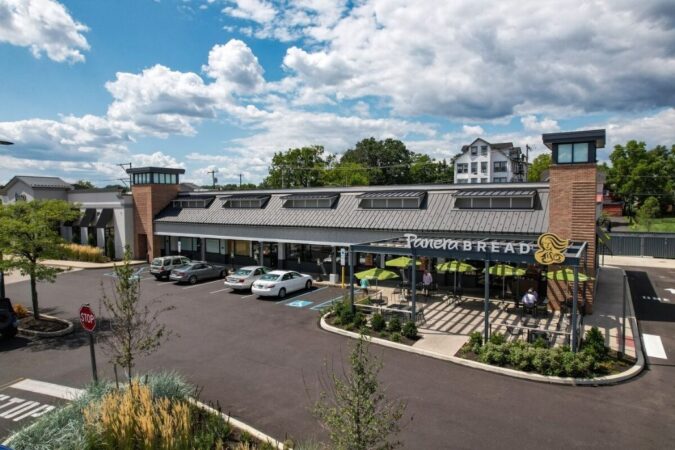
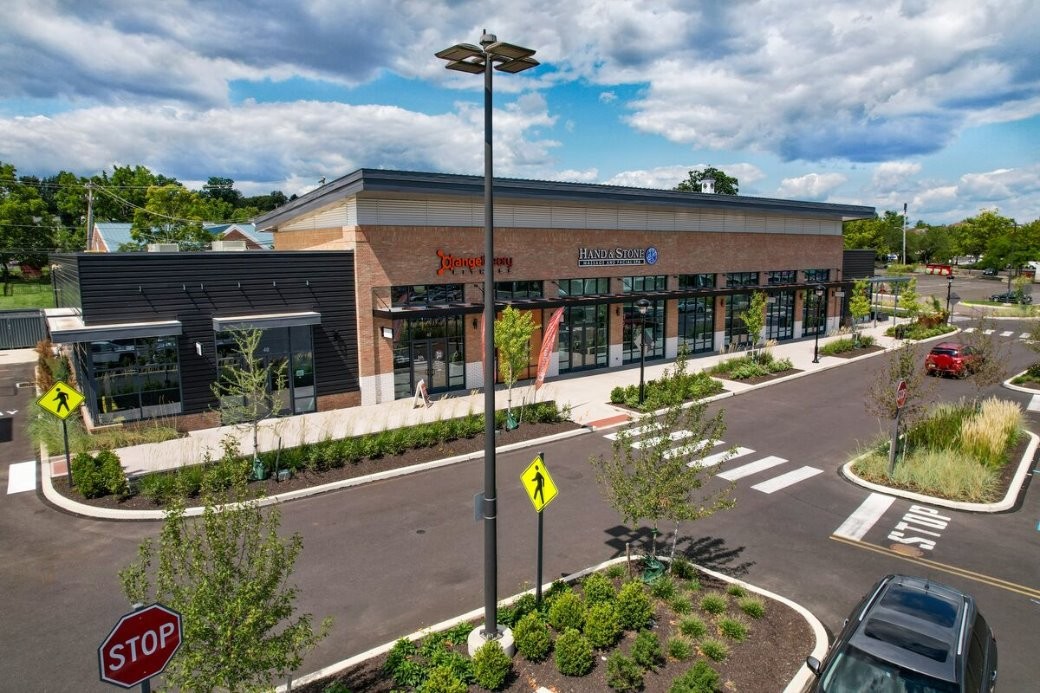
A shopping center in the shadow of Willow Grove Park Mall will soon undergo a $105-million “transformation” with new apartments and shops, says the developer behind the project.
Starting this summer, about 130,000 square feet of the Willow Grove Shopping Center will be demolished to build a mixed-used complex with 261 residential units and 35,000 square feet of new retail space, said Mark Brennan, vice president of regional development for Federal Realty Investment Trust.
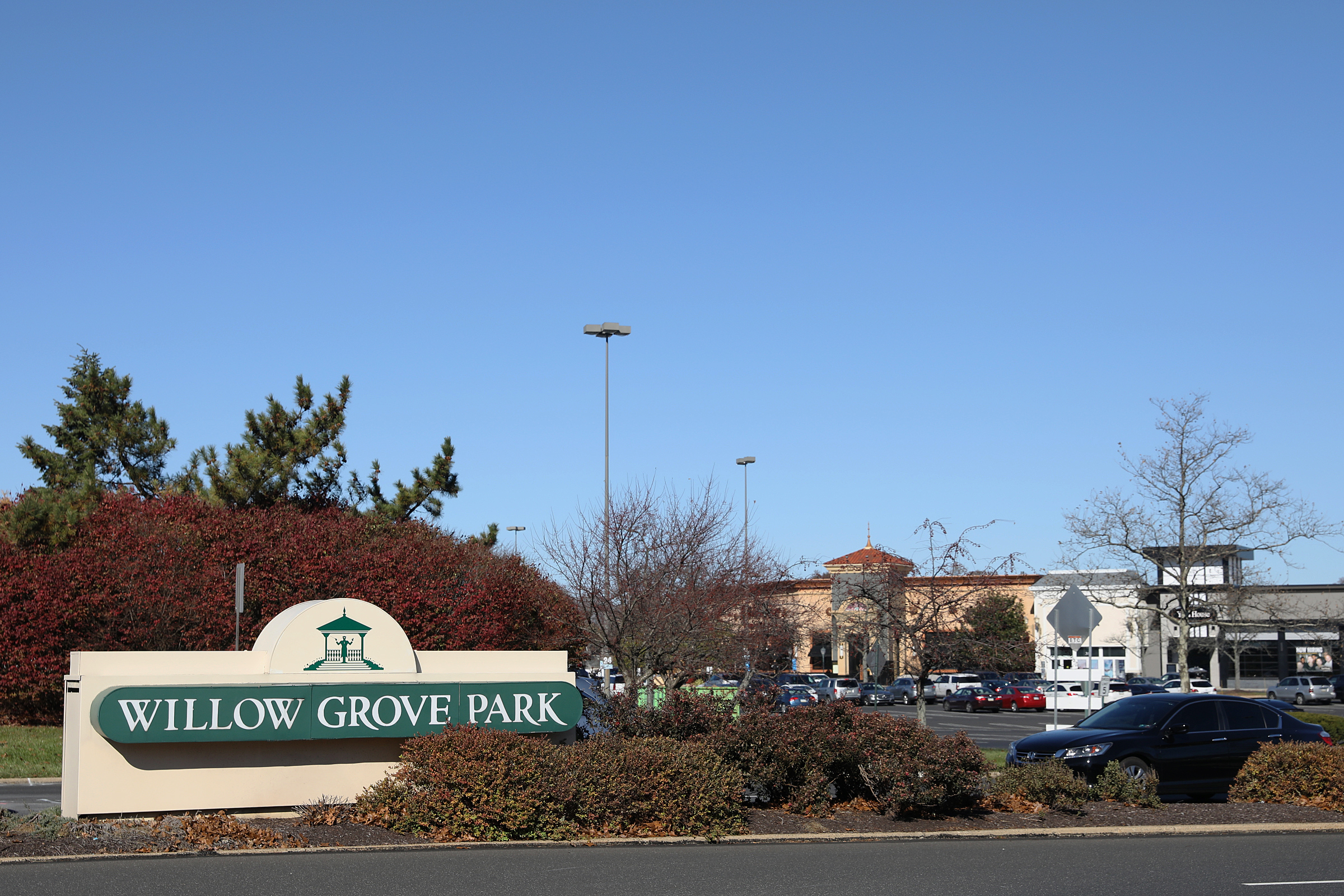
It will mark the latest stage in a multiphase redevelopment of the outdoor center, which is located across the street from the mall.
A rendering of what Federal Realty Investment Trust plans to build at the Willow Grove Shopping Center.
Across the Philadelphia region, similar mixed-use complexes have increasingly been built around thriving shopping destinations, such as King of Prussia, where thousands of new apartments have risen in recent years.
A spokesperson for PREIT, which owns Willow Grove Park Mall, did not return a request for comment. In a 2022 shareholders’ report, PREIT executives called the complex “one of our leading suburban Philadelphia assets,“ with an occupancy rate of more than 96%.
The Willow Grove Park Mall is pictured in 2019.
Across Moreland Road, Brennan is confident his shopping-center redevelopment will be met with high demand.
Since the pandemic, the Montgomery County community has “really come alive,” due in part to its proximity to the city and to suburban employment centers, said Brennan, who is based in Wynnewood. And people who are moving out of the city or looking to downsize are particularly interested in moving to mixed-use developments, he said.
The center’s proximity to SEPTA’s Willow Grove train station, and major highways, including the Pennsylvania Turnpike, will make it particularly appealing, as will its mix of “highly curated” shops, Brennan said.
Across the street from the mall, the Willow Grove Shopping Center is set to undergo a $105-million transformation with apartments and new retail.
The center’s existing tenants, which include Marshalls and Five Below, will remain open during construction, Brennan said.
He expects the project to be complete sometime in 2028.
“These sort of multifaceted, multiphased development projects do take quite a bit of time and planning,” Brennan said. “We’re really excited to get to the next phase of this transformation.”
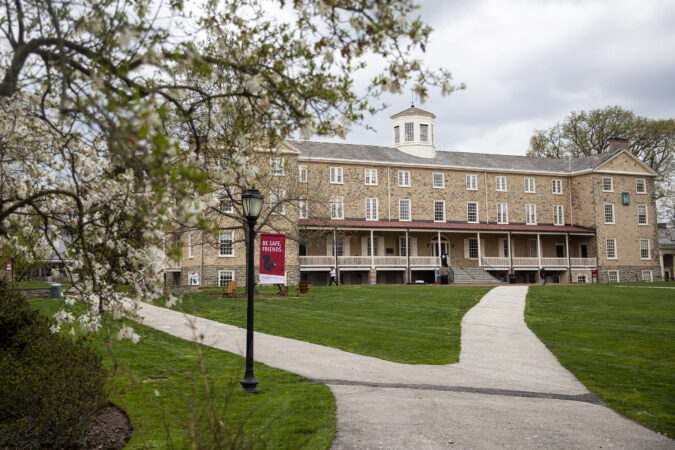
During a talkby an Israeli journalist at Haverford College earlier this month, a group of about a dozen masked people sat and stood in the audience.
At one point, one of them began shouting through a bullhorn, “Death to IOF,” or Israeli Occupying Forces, a name critics use to refer to Israel Defense Forces,and “Shame,” according to a video of the incident and people who attended the event. The protesters’ faces were covered by masks or keffiyehs, a symbol of Palestinian identity.
“When Gaza has burned, you will all burn, too,” the protester shouted at the audience of about 180 people, many of them members of the local Jewish community, according to another video viewed by The Inquirer.
An audience member grabbed at the bullhorn and appeared to make contact with the protester as the protester yelled in his face, according to a video. The college’s campus safety personnel ejected both the bullhorn user and the audience member and has since banned both from campus, college officials said, noting that neither is an employee, student, or alumnus of Haverford.
The event sparked renewed charges of antisemitism on the highly selective liberal arts campus, which already is under scrutiny by a Republican-led congressional committee for its handling of antisemitism complaints and is the subject of an open investigation by the U.S. Department of Education.
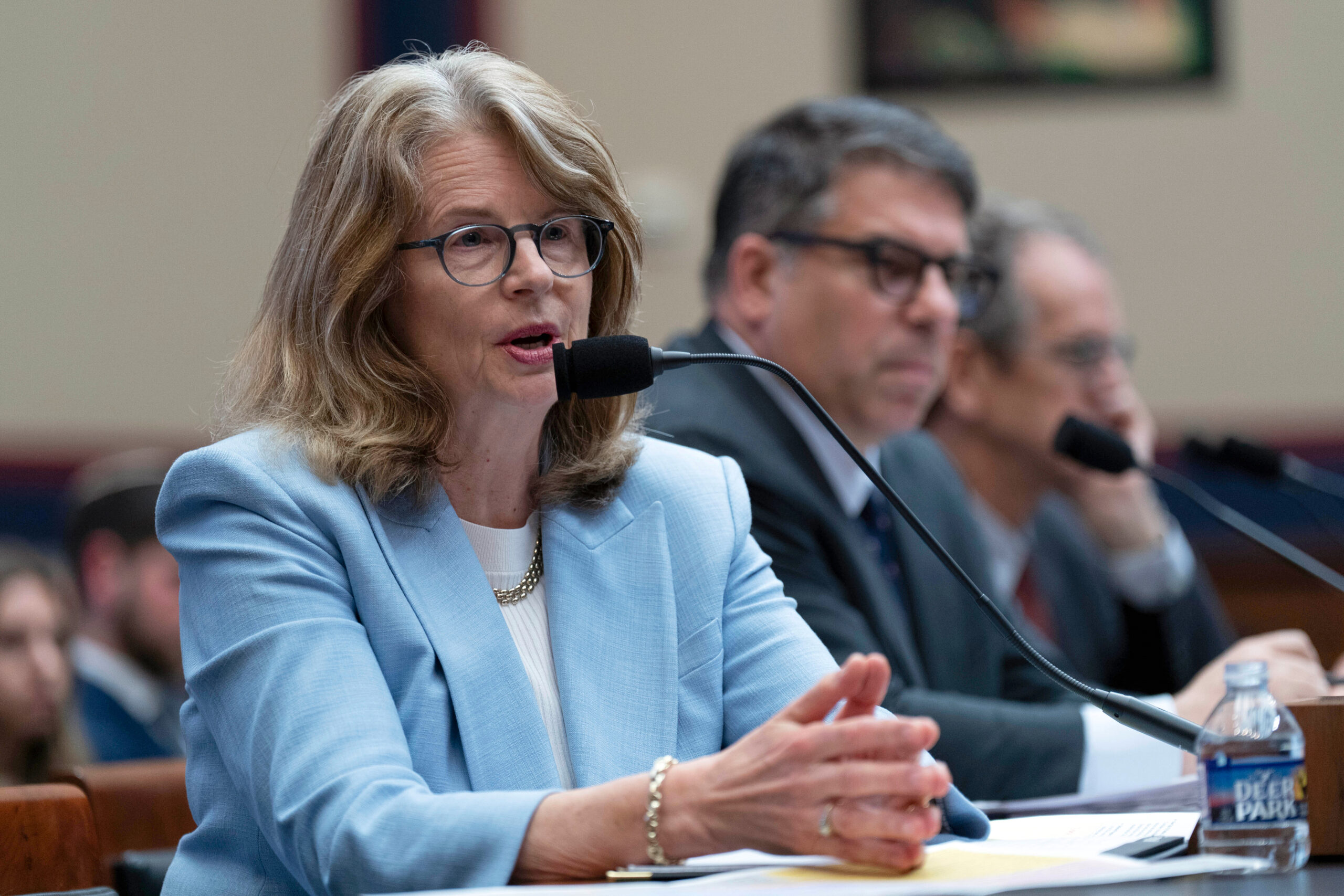
It will also lead to changes in Haverford’s policies. In a message to the campus after the event, president Wendy Raymond — who faced intense questioning from the congressional committee about the school’s response to antisemitism last year — said “shouting down a speaker whom one does not agree with is never acceptable and stands outside of our shared community values.”
College officials acknowledged that Haverford needs to upgrade its event policies andsaid changes would be rolled out no later than after spring break.
Some people who attended the event to hear journalist Haviv Rettig Gur said they were afraid because they did not know who the masked attendees were or what they had in their belongings, and in light of recent mass violence at Jewish events around the world.
“I was scared to walk back to my car by myself, which is the only time I ever felt that way in Lower Merion, where I live,” said Susan Taichman, a resident of Bala Cynwyd, who was in the audience.
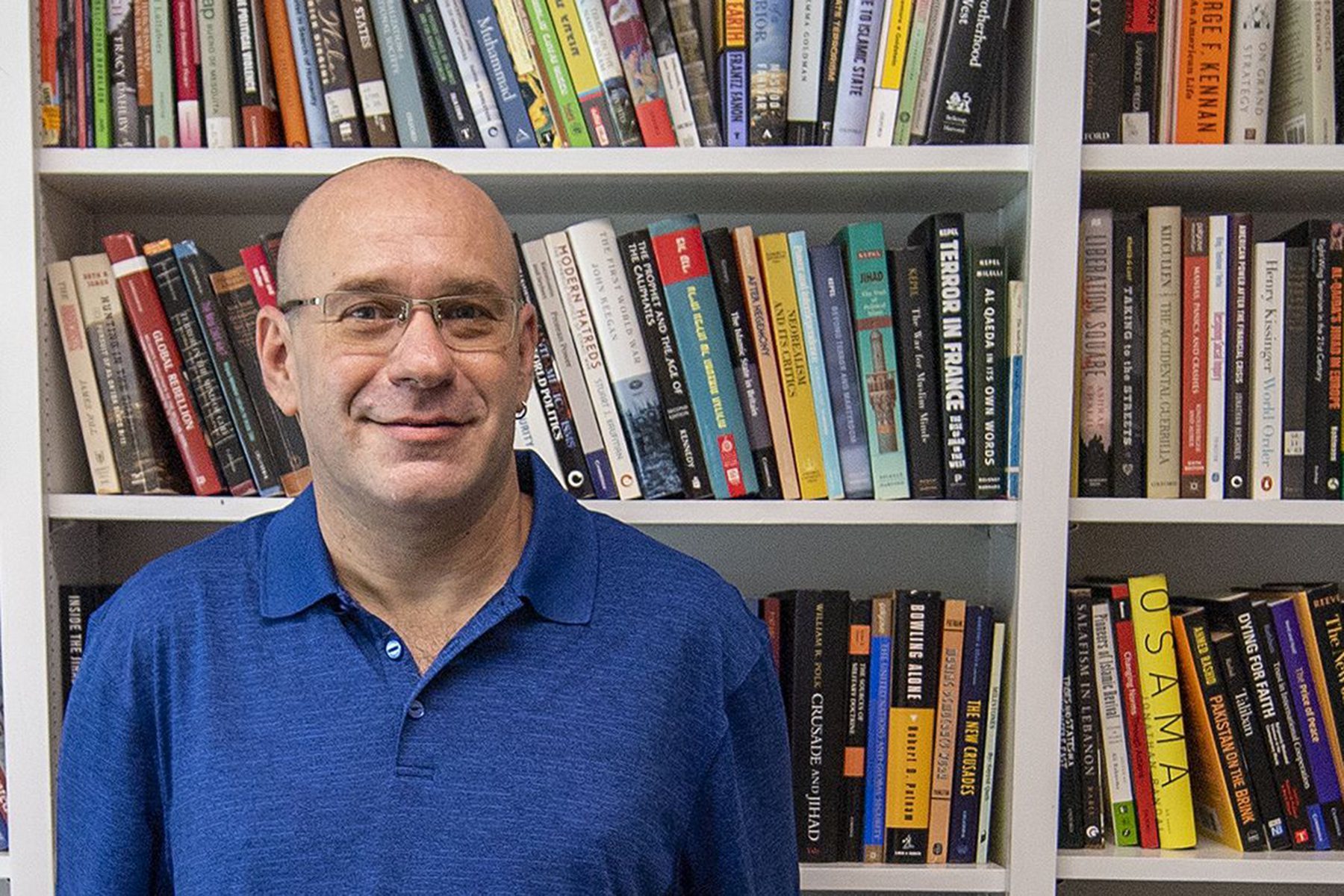
Barak Mendelsohn,professor of political science at Haverford College
Several students in attendance that night said most of the protesters sat or stood silently during the event — which is permitted under campus policy.
“I went into that event not with hatred for Jewish people, as some … have claimed was the intention of the protesters at the event,” said one Haverford student protester who asked that her name be withheld for safety reasons. “I went in with love, empathy, and deep concern for the Palestinians experiencing abhorrent amounts of violence in their homeland, as well as an understanding of the historical contexts that led to this violence, including the historic persecution of Jewish people that led to the development of Zionist thought.
“This context, in my opinion, is not an excuse for the genocide. It’s something really tragic that is going on, and I feel really strongly that it has to be stopped.”
Cade Fanning, the associate editor of the Clerk, Haverford’s student newspaper, cited three interruptions by protesters. One early on argued with Gur for an extended period, followed by the bullhorn incident less than an hour into the event, and then some banging on doors and yelling outside the room, said Fanning, 21, a senior history major from Annapolis, who attended the event.
Haverford professor Barak Mendelsohn, who helped organize the nearly three-hour event and has complained about the college’s handling of antisemitism in the past, said attendees were terrified as disruptions continued.
“I can’t tell you how ashamed I am as one of the organizers,” said Mendelsohn, an Israeli-born professor of political science and a terrorism scholar.
Leaders of Haverford’s students’ council, meanwhile, voiced concerns that an audience member had initiated physical contact with the protester, “which deeply frightened and disturbed members of Students’ Council,” they wrote. “We believe it is paramount to prioritize the safety of members of our college community. Actions like this have no place in our community.”
Some community members also interrupted and “heckled” protesters, Fanning said, adding that Gur belittled the activists as “children” who did not know enough about the world. The college, Fanning said, should have addressed that in its statement to the community.
“It would have been beneficial had they at least acknowledged that he wasn’t the most conducive to respectful, honest, open debate either,” Fanning said of Gur. “He didn’t treat the students with the most respect.”
But Anna Braun, 21, a senior English major from New York City who attended the event, said she was impressed with how Gur handled the protesters.
“He decided to engage with them one on one to really ask them questions and try to deconstruct why they were protesting,” she said. “The only way we can have any hope for peace is for people to listen to each other and to find some middle ground. And if you’re ignoring each other or if you are interrupting each other, then there is no potential for seeing eye to eye.”
An effort to ensure safe events
“It has become clear that there are gaps in how events are reviewed, supported, and managed on campus,” Raymond said in her message to campus. “We are actively revising our event management and space use policies to improve clarity and processes.”
Wendy Raymond, president of Haverford College, testifies before the House Committee on Education and Workforce hearing on antisemitism on American campuses on May 7, 2025.
The new policy, she said, “will clarify expectations for different types of events, strengthen coordination among College offices, and establish additional planning and support for events that require heightened attention.”
Factors such as “significant attendance or operational complexity, heightened public visibility, safety, security, or crowd-management considerations, media presence or external participation, and increased likelihood of disruption or protest activity” may trigger the need for additional review to determine whether more resources are needed, said Melissa Shaffmaster, Haverford’s vice president for marketing and communication.
“Our intention … is not in any way to restrict free speech or restrict access for different speakers or topics to be discussed on campus,” she said. “We want to make sure that the proper resources are allocated so events can happen safely, people can have really thoughtful discourse, and these events can go off the way they are intended.”
The indoor use of bullhorns violated the school’s “expressive freedom” policy put in place last spring, she said.
The college is participating in the Hillel Campus Climate Initiative, touted as an effort to help college leaders counter antisemitism. A survey “to better understand the current climate for Jewish students” will be part of the effort.
Haverford also is preparing for a major change in leadership. Raymond said in November she would step down as president in June 2027; John McKnight, the dean of the college, also announced he would be leaving at the end of this semester for a new role at Dartmouth College; and the college’s vice president for institutional equity and access also will exit that post in May.
‘The howling cry of an uneducated child’
Gur’s talk was titled “Roots, Return, and Reality: Jews, Israel, and the Myth of Settler Colonialism.” In an opinion piece for the Free Press after the talk, Gur said he had gone to Haverford to talk “about the Jewish history that forged Israeli identity.”
While he saw the audience “tense up” when protesters entered, he wrote, he saw it as “a chance to explore managing an encounter with the abusive ideologues.”
He said he invited protesters to stay, but told them they had to remove their masks, which they did not do. Most protesters remained for the entire talk, he said, some even crying and engaging in dialogue with him.
“The more I treated them like neglected children hungry for knowledge, the more likely they were to respond in healthy and productive ways,” he wrote.
The event was organized by Kevin Foley, a 1983 Haverford graduate. Foley said he was impressed with Gur, a political correspondent and senior analyst for the Times of Israel, after seeing a video of him teaching.
“I thought I could do something good for Haverford by having him teach there,” said Foley, who lives in Connecticut and New York City and spent his career running electronic trading businesses at Bloomberg and Cantor Fitzgerald.
Foley’s best friend was killed in the 9/11 attacks and he said he experienced Hamas’ October 2023 attack on Israel as an “echo trauma.” To see concerns at Haverford about its handling of antisemitism “was disappointing,” he said, and what happened at Gur’s talk reinforced those concerns.
“What I can’t believe is that Haverford has so abandoned its liberal values of academic freedom, freedom of inquiry, that it’s considered acceptable for protesters to come in and disrupt and shut down an educational class,” Foley said.
Foley called on the college to ban masks and have metal detectors available when needed, and to apologize to Gur’s audience.
Shaffmaster said the college’s policy allows people to wear masks, but they must remove them if they are asked by campus safety officers or administrators for identification purposes.
Ongoing tensions on campus
Several students in attendance, who asked not to be named because of tensions on campus over the issue, said they thought campus safety and the college handled the event as best they could without silencing either side.
“No matter what they had done, people would be mad at them,” one said.
Fanning, the student editor, understood why older community members may have been fearful, but said protesters also have fears of being harassed or doxed for their pro-Palestinian advocacy if their identity is known.
“They are not fearless themselves,” Fanning said. “Nobody is.”
But Mendelsohn, the professor, was disturbed that Haverford seemed to equate the actions of the audience member who grabbed the bullhorn with those of the protester.
“The person acted in self-defense and managed to get the bullhorn from her hands,” he said. “If someone turned to you with a microphone and screamed, you would not sit there and do nothing.”
Mendelsohn has been at the forefront of allegations that Haverford has not done enough to address antisemitism, and the college has investigated him for speaking out on social media and in emails, according to a lawsuit filed against the college last year by a Jewish group. Much of the complaint was dismissed, but the judge allowed a portion involving breach of contract that would result in nominal damages to proceed, and that is in mediation, court records show.
The actions at Gur’s speech were just one of several ongoing problems with antisemitism on the campus, Mendelsohn said. His mezuzah — an object signifying the Jewish faith — was stolen from his office door a couple of months ago, he said. And he referred to a bias complaint over comments made around funding for the Haverford Chabad board. That remains under review, the college said.
Braun, the English major, said that she was heartened to see improvement in Haverford’s handling of the Gur event and that the campus has been more welcoming to Jewish students. Most people she has spoken with, she said, did not think the use of the bullhorn was appropriate.
“That’s not something I would have heard two years ago on this campus,” she said. “I sincerely believe there is more of a desire to create an inclusive environment.”
The NCAA Tournament is coming to Philadelphia for one of its eight opening-weekend sites, and Villanova made sure to plan for the occasion.
The Wildcats hosted four games at Xfinity Mobile Arena last season but scheduled only two home games there this season — the second of which is Saturday evening vs. No. 5 Connecticut. NCAA rules prohibit a team from playing tournament games in a venue where they host more than three home games, and the lowest seeds typically are rewarded geographically with first- and second-round locations.
It was rather ambitious planning for Villanova, given that the Wildcats had a new coach and a new roster and hadn’t made the NCAA Tournament since 2022. And it remains lofty even now, after a six-game winning streak has Villanova at 21-5 overall and 12-3 in the Big East. The Wildcats are almost guaranteed to snap that tournament drought, but they remain unlikely to get to a seeding that would reward them with some home cooking in the first and second rounds.
“There is a path,” ESPN bracket master Joe Lunardi said Thursday when asked if Villanova could get as high as the No. 4 line, but when asked how realistic it was, Lunardi said “minimally.”
Lunardi spoke via phone from an interesting location, given the subject of the conversation. He was in Indianapolis, where a mock NCAA Tournament selection exercise with media members was taking place. In his own bracket projection, Lunardi had Villanova 25th as of Thursday morning, otherwise known as the top seventh seed on his big board. The Wildcats were 28th, the lowest possible seventh seed, and slotted in Buffalo to face 10th-seeded Auburn in the first round when the mock committee went through its process Thursday, 24 days from Selection Sunday.
The mock committee ranked the top 20 seeds and placed the last four at-large teams into the field, but it used computers to seed most of the rest of the bracket. Of note, those computer models had Temple, which is tied for sixth in the American Conference, winning its conference tournament and getting into the field.
Back to Villanova and to Lunardi’s bracket … not much has changed since Jan. 28, when we last caught up with him to assess the Wildcats’ tournament path. They were a No. 7 seed then, and while they moved up a few spots on the seeding line, they’re a No. 7 seed as of Friday even after reeling off six consecutive wins following their overtime road loss to UConn on Jan. 24.
Similarly, Villanova was 34th in the NCAA’s NET rankings on Jan. 28 and 29th on Friday. And at KenPom, the Wildcats were 27th on Jan. 28 and 27th on Friday. That is life in the 2025-26 Big East. Six wins in a row doesn’t move the metrics much.
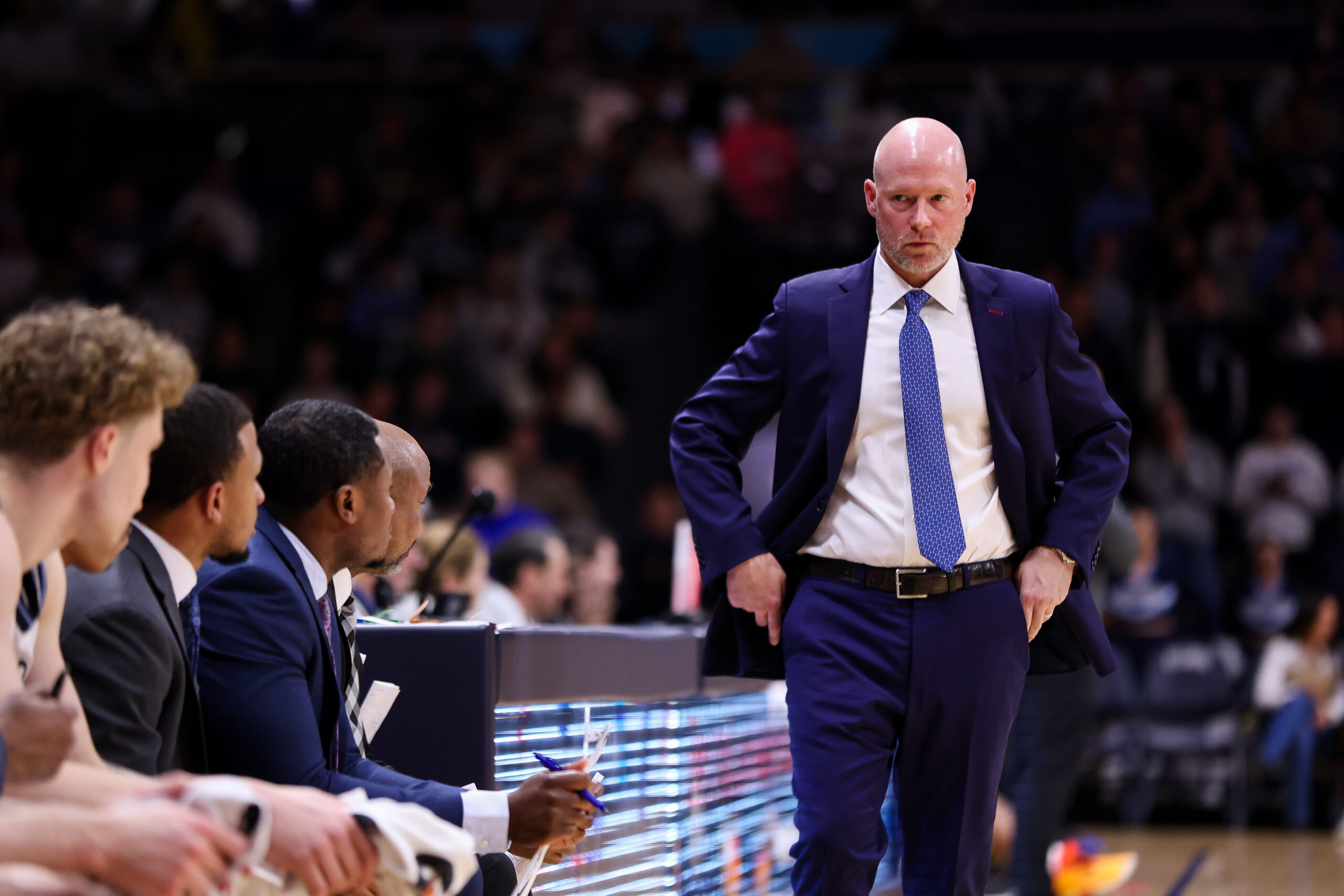
Kevin Willard has Villanova in line for an NCAA Tournament bid in his first season on the Main Line.
“They’re certainly looking the part,” Lunardi said. “The problem is, the dirty little secret, the league standing is flat if not declining.”
The mock bracket on Thursday had just three Big East teams in the field of 68: UConn, St. John’s, and Villanova.
Villanova has just three Quad 1 wins to date: Wisconsin, the road win at Seton Hall, and last Saturday’s road win at Creighton. That game was a Quad 2 game until Creighton knocked off UConn on Wednesday and moved back into the top 75 of the NET rankings. It could slip back into Quad 2 territory if Creighton moves back in the rankings. As it stands, the Wildcats have just two more chances at Quad 1 victories in the regular season: Saturday vs. UConn and next Saturday at St. John’s.
Why are those opportunities important? As of Thursday morning, the top 21 teams in the NET rankings all had four or more Quad 1 wins. NET standings don’t necessarily translate to tournament seeds, but it’s hard to imagine Villanova climbing high enough in any tournament bracket without adding another regular-season Quad 1 win and another one or two en route to cutting the nets down at Madison Square Garden after winning the conference tournament.
What the winning streak has done, though, is shift the floor a little bit. As of three weeks ago, getting a No. 9 or 10 seed in the NCAA Tournament seemed just as likely as a No. 6 seed. Now, a No. 6 seems much more likely than a No. 10.
“Six is a great spot because you should win your first game, and it’s not too heavy of a lift in the second game,” Lunardi said. “And you avoid the one [seed].”
“They’re going to wear white,” he said later, implying that Villanova seems like it’s on a path to be, at worst, a No. 8 seed and be the de facto “home” team in its first-round game.
Home just probably won’t be South Philly. How does a mid-March trip to Buffalo sound?
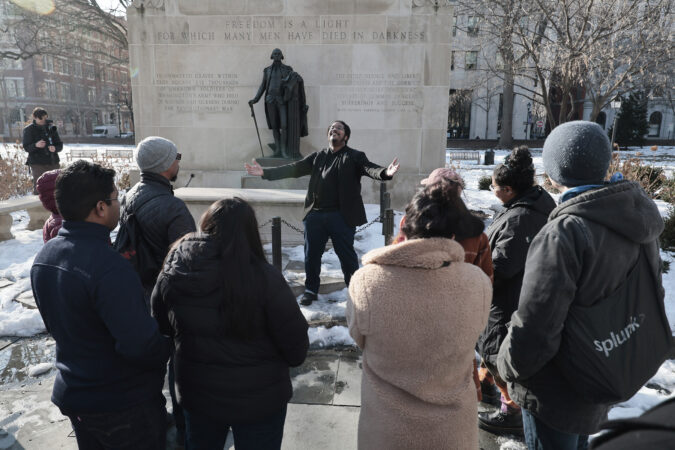
Mijuel K. Johnson stood on theground where the dining room of the first president’s residence once stood as he told the story of Ona Judge’s path to freedom.
Speaking to a group assembled just steps from the Liberty Bell, Johnson recounted how Judge escaped George Washington’s household in Philadelphia into the city’s free Black community before eventually making her way to New Hampshire, and evading the Washingtons’ several attempts to recapture her.
It’s a story Johnson has told many times as a guide for the Black Journey, which offers walking tours focused on African American history in Philadelphia. One of the first stops on “The Original Black History Tour” is the President’s House Site, an open-air exhibit at Sixth and Market Streets that memorializes Judge and the eight other people enslaved by the first president here.
But last weekend, instead of the educational panels and informative videos displayed for the last 15 years, the guide and his group were faced with faded brick walls and blank TV screens. Adhesive residue marked the spots where colorful panels had been.
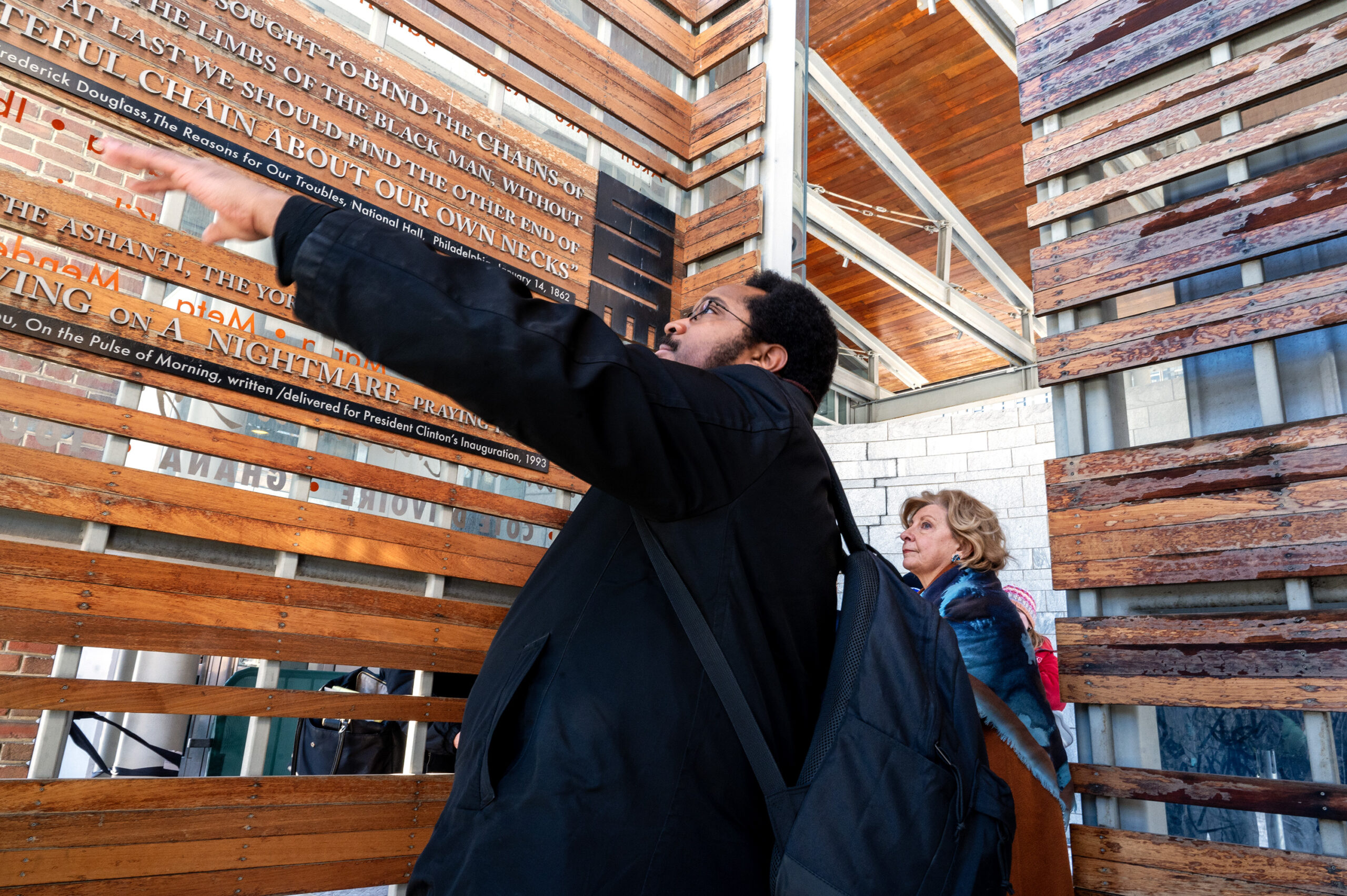
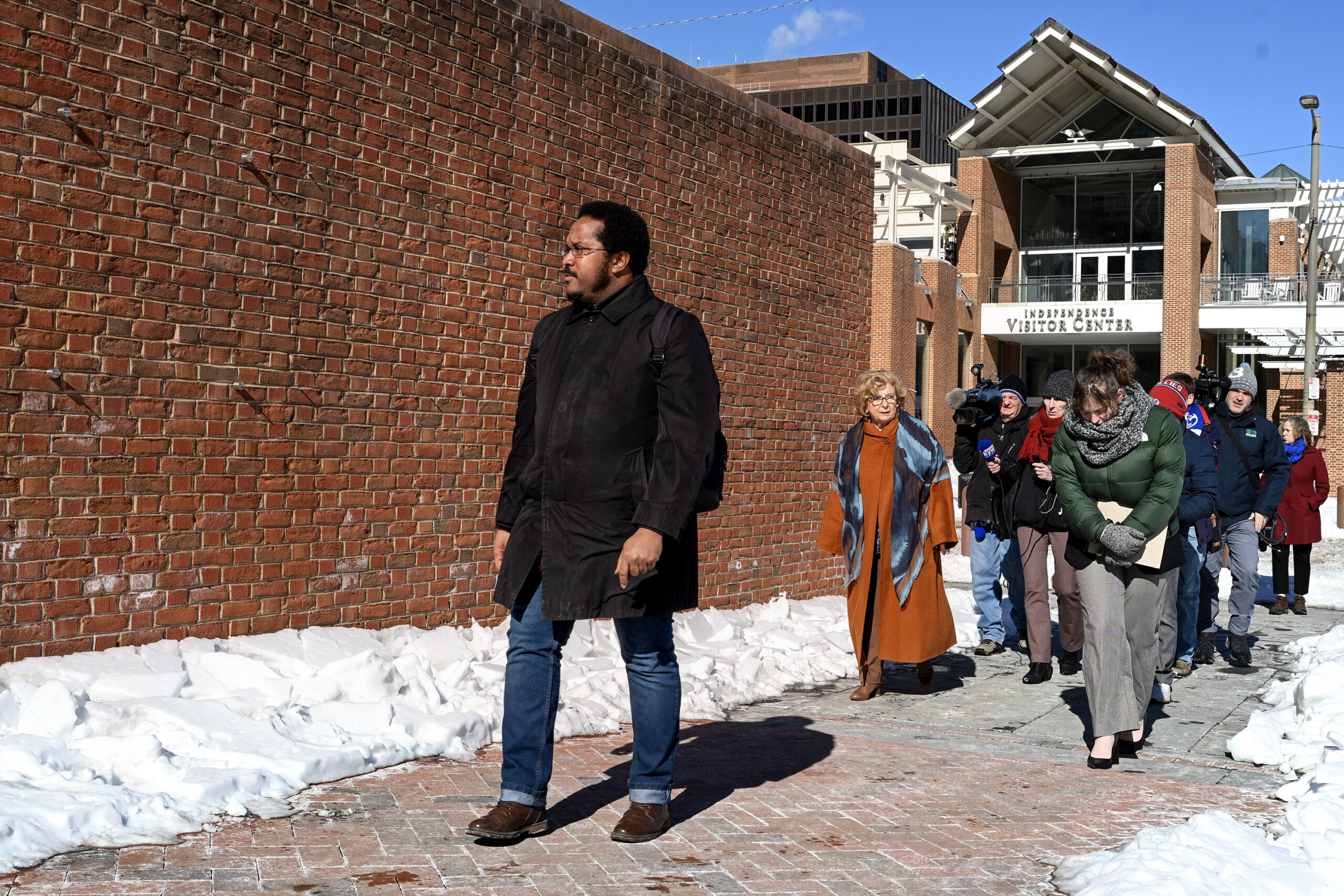
Mijuel K. Johnson guides Judge Cynthia M. Rufe as she visits the President’s House in Independence National Historical Park on Monday, Feb. 2, 2026.
It was Johnson’s first group tour since National Park Service employees wielding wrenches and crowbars — acting at the direction of President Donald Trump’s administration — last month stripped out every panel at the President’s House, censoring roughly 400 years of history. Judge’s name was still inscribed on the Memorial Wall and her footprints still imprinted into the concrete as the group walked through the site, but her story was missing. Television screens recounting her life had been abruptly disconnected.
Black History Month began this year with visitors unable to read displays juxtaposing the cruelty of slavery with the country’s founding principles for the first time since the site opened in late 2010. For many tourists and the guides who know the site best, the removal was a call to action.
Workers remove the displays at the President’s House in Independence National Historical Park on Thursday, Jan. 22, 2026. More than a dozen displays about slavery were flagged for the Trump administration’s review, with the President’s House coming under particular scrutiny.Maria Felton (middle) and Jahmitza Perez (right) of Philadelphia listen to Mijuel K. Johnson (left) during The Black Journey tour in Philadelphia on Saturday, Feb. 14, 2026.
“In telling their stories, I’m telling my own,” Johnson, 34, of South Philadelphia, said of the nine people the site memorializes, “and that’s where it becomes personal, so that in trying to erase their story, they’re effectively trying to erase me, too, and I just refuse to be erased.”
Parker celebrated the reinstallation in a post on social media Thursday but cautioned: “We know that this is not the end of the legal road.”
The Trump administration is appealing the ruling, so the future of the site remains uncertain even after this week’s victory. On Friday, a federal appeals judge said that the Trump administration does not have to restore more panels while the appeal is pending.
Seeing the site bare without the panels last weekend felt like a “slap in the face” for Maria Felton, 31, a stay-at-home mom from Roxborough. Felton, who is Afro-Latina, joined the Black Journey’s tour with best friend Jahmitza Perez, 37, as part of her quest to reconnect with her heritage.
“The administration can take away physical things. They can’t take away our ability to connect and learn and share our culture,” Felton said.
Passing a wall where panels about slavery were removed, Mijuel K. Johnson (left) with The Black Journey: African-American Walking Tour of Philadelphia, leads Judge Cynthia M. Rufe (second from left) as she visits the President’s House in Independence National Historical Park on Monday, Feb. 2, 2026.
‘A sign of the revolution’
Johnson has been giving tours since 2019, delivering rousing accounts of U.S. history interwoven with humor and theatrical gestures. He tells his patrons, who come from around the country, that long before cheesesteaks became Philly’s iconic food,the city was known for its pepper pot stew, an African dish.
“We can tell the full story of America,” he said.
Last weekend, Johnson’s tour group was more “somber” than usual, he said, as they saw the bare walls of the “desecrated” site.
“People seeing it for themselves that this actually did happen,” Johnson said.
For Toi Rachal, 47, a pharmacist from Dallas, and her husband, the tour was eye-opening. The couple had been unaware of the Trump administration’s changes to the site until they joined the tour during their visit to Philadelphia. The work of Johnson and other community members to continue telling the story was even more crucial with the exhibits gone, Rachal said.
“If we just walked in these areas on our own, eventually we would have probably figured it out,” she said, “but you may not have known exactly what happened.”
The exhibits were removed under an order issued by Trump instructing the Department of the Interior to remove materials at national parks that “inappropriately disparage Americans past or living,” widely criticized as an effort to whitewash history ahead of this year’s celebrations of the country’s 250th anniversary.
But the move brought unprecedented attention to the President’s House, drawing curious onlookers. When the panels were beginning to be restored Thursday, a group observed as park employees put history back in its rightful place.
Shortly before Johnson’s tour group stopped at the site, a volunteer read from a binder containing the informational text that had been removed. The volunteer was one of dozens of people who had signed up for a shift with Old City Remembers, a grassroots effort to speak the history of the President’s House even if the panels were no longer there.
Mijuel K. Johnson leads visitors from Charlotte, North Carolina, at the President’s House in Independence National Historical Park on Wednesday, July 23, 2025.
“Because those have been removed, somebody needs to tell the story, somebody needs to make sure that we’re not going to let that history be erased,” Matt Hall, a professor and the organizer of the group, said in an interview earlier this month.
It’s “active history,” said Ashley Jordan, president and CEO of the African American Museum in Philadelphia, located blocks away from the site. “The fact that they are using their words, their demonstrations, through art-making, through signage, through print materials — that has always been a sign of the revolution in America.”
Ahead of Johnson’s tour last Saturday, visitors taking advantage of the warmest winter day in weeks congregated around the bare exhibit wall. In its place were educational fliers about Washington, Ona Judge, and other historical figures. Posters displayed messages: “Truth Matters,” “Erasing Slavery is Pro-slavery,” and “Dump Trump Not History.”
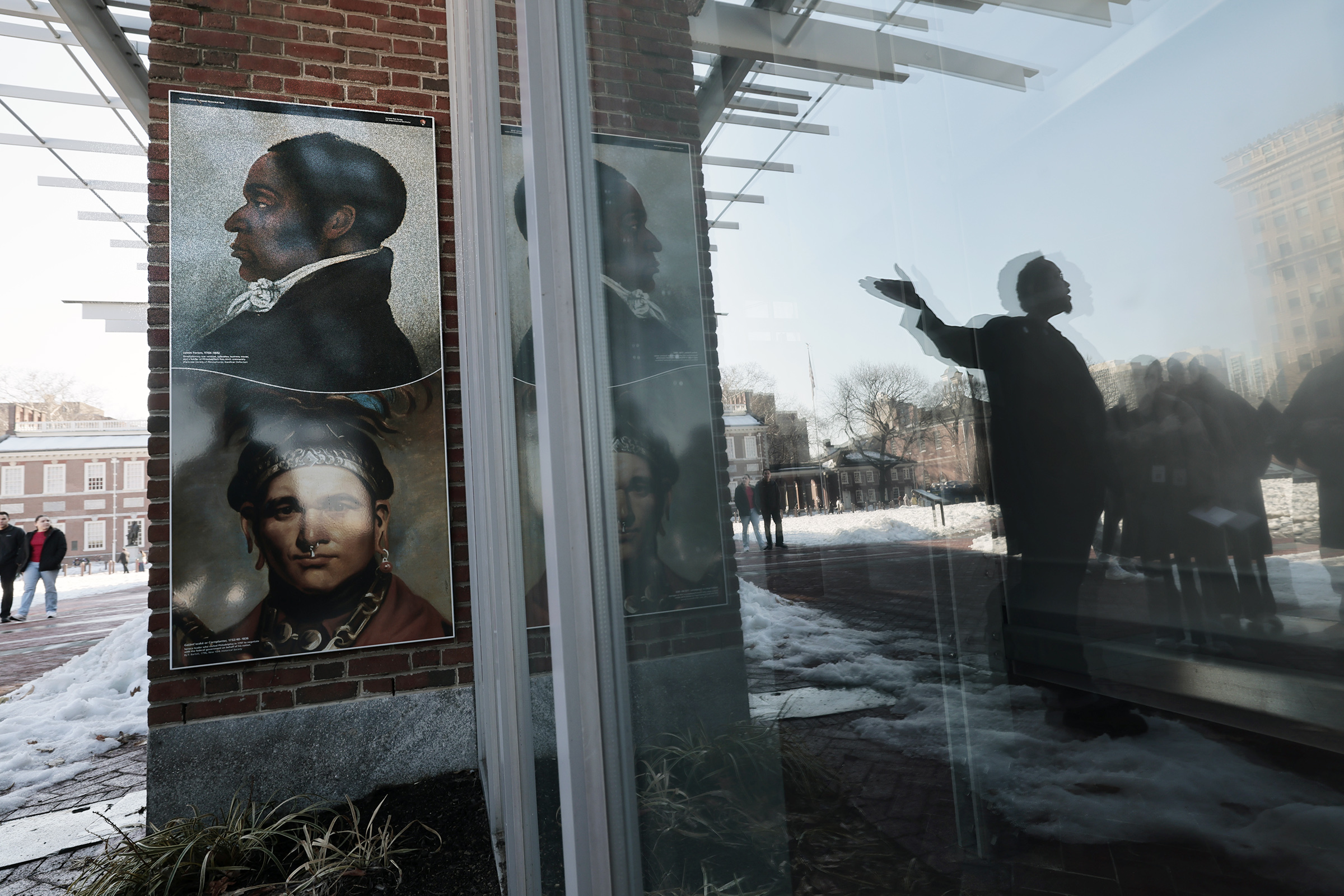
The Black Journey and the 1838 Black Metropolis tour guide Mijuel K. Johnson (right) is reflected in the Liberty Bell Center window as he talks about James Forten (top left) 1746-1842 during a Black History tour in Philadelphia on Saturday, Feb. 14, 2026. Forten was a Revolutionary War veteran, sailmaker, business owner, and a leader of Philadelphia’s free Black community.
Philadelphians celebrate, but prepare for more fights ahead
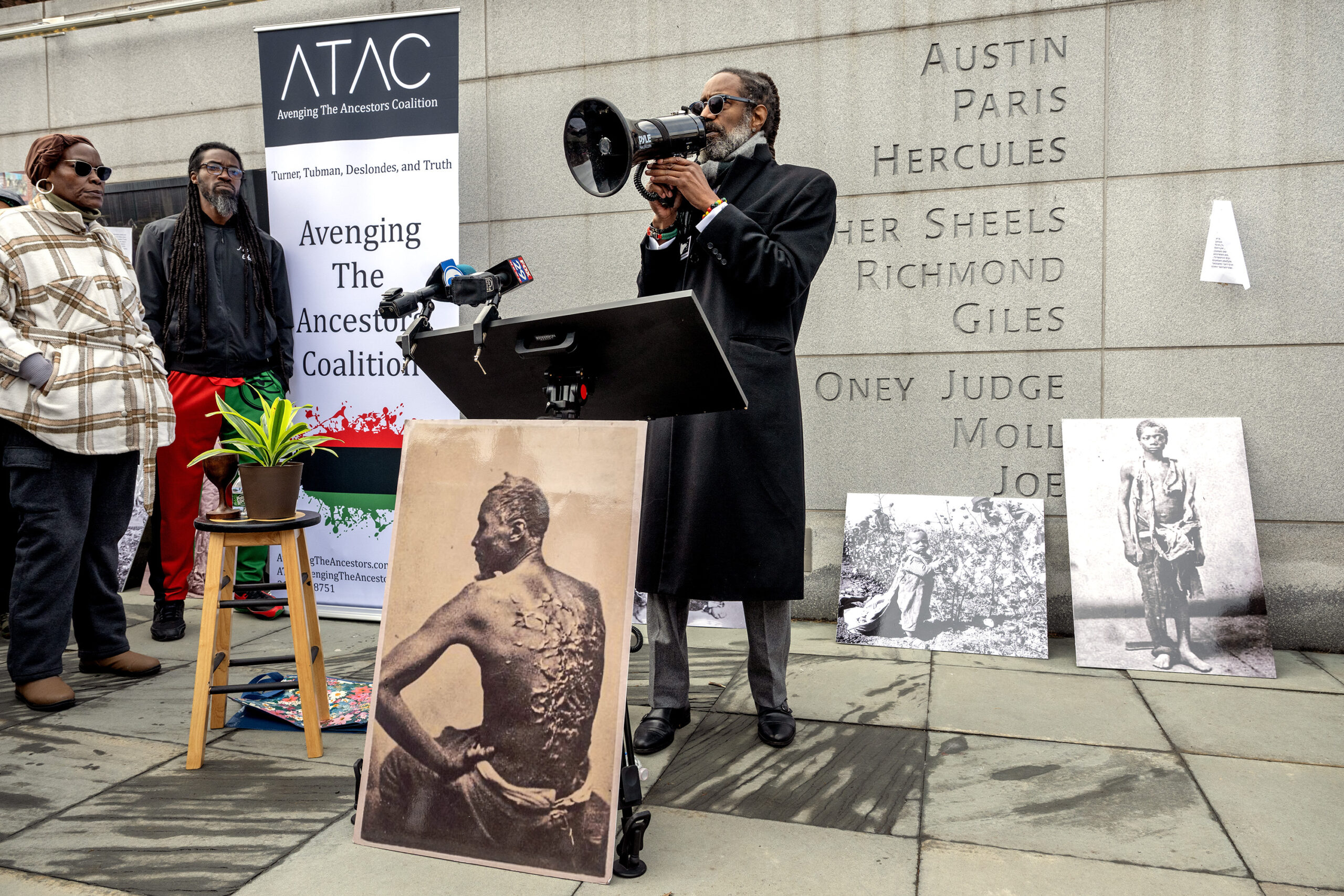
Avenging the Ancestors Coalition members gathered Thursday afternoon at the President’s House, celebrating the reinstallation earlier in the day.
“This is actually a moment in time,” said Michael Coard, attorney and leader of the coalition, which had fought tirelessly to develop and, now, protect the site. “Your children, your grandchildren, your great-grandchildren are going to be talking about this for years.”
Coard emphasized the fight was not yet over while highlighting the significance of the community’s contributions in the fight to safeguard the President’s House.
“I just want you for a few seconds just to think about what you all have done,” Coard told the crowd. “Because what you’ve done is to actually create history. … Think about it. You fought the most powerful man on the planet, and you won.”
Attorney Michael Coard, leader of the Avenging the Ancestors Coalition, speaks at the President’s House site on Monday, Feb. 16, 2026, during their annual gathering for a Presidents’ Day observance. While there, they learned a federal judge ordered the Trump administration to restore the slavery exhibits that the National Park Service removed from the site last month. The names of nine enslaved people who lived and worked in the household of George Washington engraved in stone behind him were not removed by the NPS.
Even as Philadelphians celebrated the reinstallation, more efforts were being planned to continue sharing the story of the President’s House.
Mona Washington, a playwright and Avenging the Ancestors Coalition board member,is crafting a series of plays related to the President’s House, which she hopes to showcase this summer, during the height of the 250th anniversary celebrations. Some of the plays, she said, are written in the first person for the people who were enslaved by the first president at his Philadelphia residence.
“We’re here, and you can try and erase whatever you want, as much as you want, but guess what? There are lots of us, and we’re just going to keep moving and moving and moving toward truth,” Washington said.
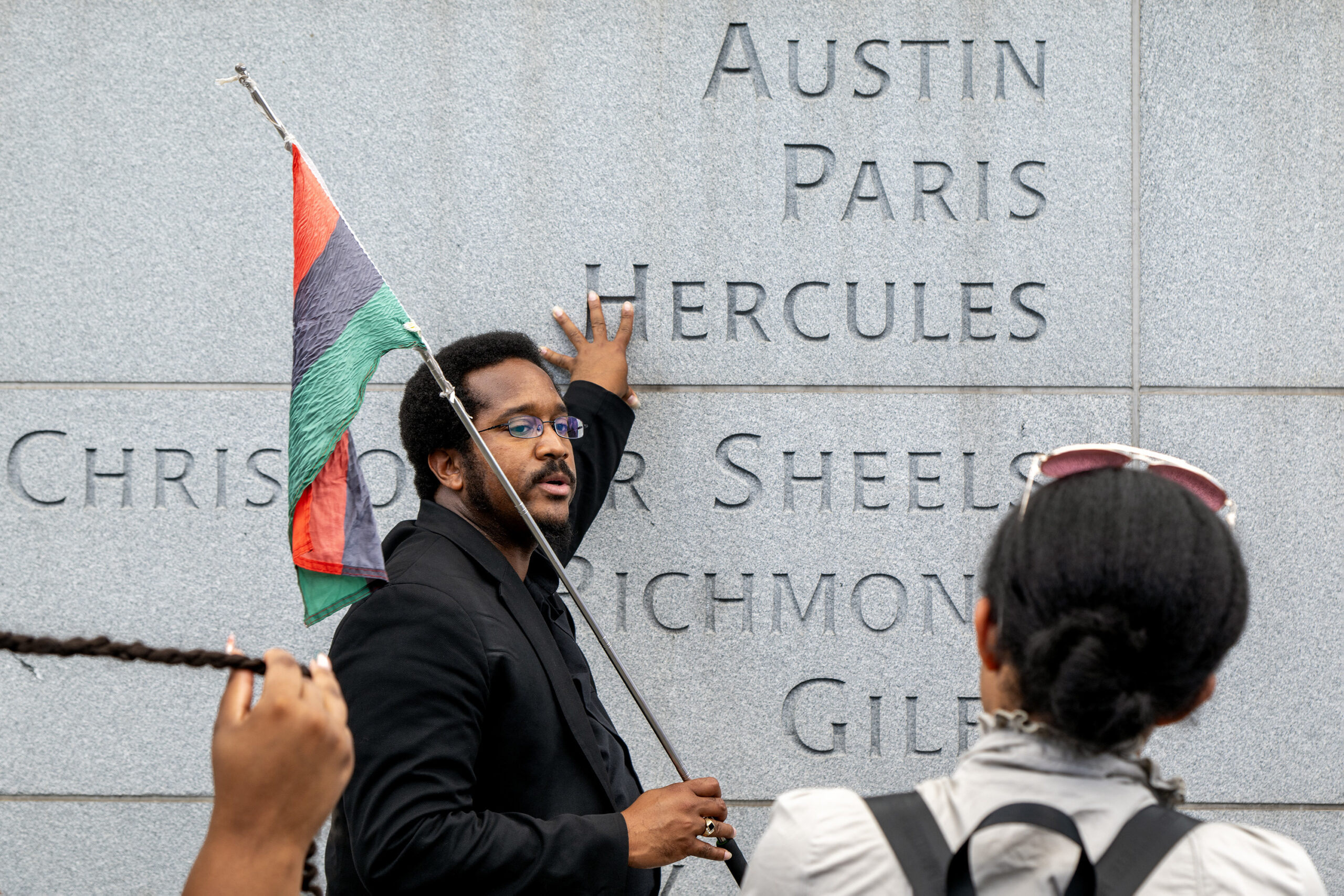
At the President’s House last Saturday, there were few pieces that Johnson could share with the group that had not been tainted by the Trump administration. One of them was the Memorial Wall, which is engraved with the names of Ona Judge and the eight other people George Washington enslaved — Austin, Paris, Hercules, Christopher Sheels, Richmond, Giles, Moll, and Joe. A few paces away, their quarters once stood, where at least four of the nine individuals would stay at any given time, Johnson said.
Mijuel Johnson, a guide with The Black Journey: African-American Walking Tour of Philadelphia, leads visitors in the President’s House in Independence National Historical Park Wednesday, July 23, 2025. The names of nine enslaved people who lived and worked at the House are engraved in stone on the site.
Outside the quarters appears a plaque signed by the city and the National Park Service that reads: “It is difficult to understand how men who spoke so passionately of liberty and freedom were unable to see the contradiction, the injustice, and the immorality of their actions.”
These words are preceded by an italicized quote from former President Barack Obama, the country’s first Black president: “It was whispered by slaves and abolitionists as they blazed a trail toward freedom … yes we can, yes we can.”
A lack of proper tools and the snow were the only things standing in the way of the Trump administration making further alterations to the President’s House last month.U.S. District Judge Cynthia M.Rufe has now ordered that the President’s House cannot be further altered.
Last Saturday, Johnson assured his tour group as they were filing through the quarters that this piece of history would remain.
“They can’t touch this,” he said.
Staff writer Maggie Prosser contributed to this article.
Think you know your news? There’s only one way to find out. Welcome back to our weekly News Quiz — a quick way to see if your reading habits are sinking in and to put your local news knowledge to the test.
Question 1 of 10
This iconic Philly sculpture has been temporarily removed from its perch at Sister Cities Park so it can be restored by original artist Robert Indiana’s foundation after years of UV and weather exposure.
CorrectIncorrect. XX% of other readers got this question right.
Indiana’s AMOR sculpture was removed on Wednesday for conservation and restoration. The sculpture was transported to Fine Finishes Painting Studio in Peekskill, NY, where conservators approved by the Robert Indiana Foundation will strip and repaint it. It’ll be back in May.
Question 2 of 10
After 96 years, Pat’s King of Steaks is changing how it makes cheesesteaks and is offering a new ingredient option. What is it?
CorrectIncorrect. XX% of other readers got this question right.
Owner Frank Olivieri said his father didn’t want seeded rolls. “But since my father unfortunately passed several weeks ago, I thought maybe it’s time to change up a little bit,” he said. Pat’s announced the “new school” seeded-roll option on Instagram as a limited-time offering, but Olivieri said it likely will be permanent. (Across the street, Geno’s still offers plain rolls only.)
story continues after advertisement
Question 3 of 10
What is the proposed replacement for the site of the Broad Street Diner, which continues to operate but has held demolition permits since 2022?
CorrectIncorrect. XX% of other readers got this question right.
On Tuesday, plans for a six-story Hyatt Studios hotel were posted on the Philadelphia Planning Commission’s website. The proposal includes 105 hotel rooms and 42 underground parking spaces. Hyatt Studios is a recently launched extended-stay brand of the larger hotel chain.
Question 4 of 10
A federal judge ordered the Trump administration to restore the slavery exhibits that were removed from Philly’s President’s House. In her 40-page opinion, Judge Cynthia M. Rufe compared the federal government’s removal to this novel:
CorrectIncorrect. XX% of other readers got this question right.
Rufe, a George W. Bush appointee, compares the federal government’s argument that it can unilaterally control the exhibits in national parks to the Ministry of Truth in George Orwell’s 1984, a novel about a dystopian totalitarian regime. The Trump administration has appealed. National Park employees began restoring the exhibit Thursday.
Question 5 of 10
Philadelphia bars Grace & Proper, Sonny’s Cocktail Joint, and WineDive, produce and serve this signature liqueur:
CorrectIncorrect. XX% of other readers got this question right.
Ginjinha, a classic sour cherry Portuguese liqueur, is enjoyed in its home country across sidewalk-facing counters and to-go windows. In the Philly area, you’ll be hard-pressed to find it at most establishments — except for the bars owned and operated by Chris Fetfatzes’ Happy Monday Hospitality: Sonny’s on South Street, Grace & Proper in Bella Vista, and WineDive in Rittenhouse.
Subscribe to The Philadelphia Inquirer
Our reporting is directly supported by reader subscriptions. If you want more journalism like this story, please subscribe today.
For the 800th episode of The Simpsons, the show showcased Philadelphia and parodied National Treasure. Which Philly-tied celebrity was not featured in the episode?
CorrectIncorrect. XX% of other readers got this question right.
When Homer Simpson and his family arrive in Philly, passing a welcome sign calling the city “The Big Scrapple,” a hotel concierge played by Kevin Bacon greets them. “We offer 24-hour room service from our full Boyz to Menu. If you need a wooder or any other jawn just ring the Patti LaBelle and we’ll send a jabroni right up,” he said. Quinta Brunson, Questlove, and The Roots were featured in the episode. Boyz II Men also contributed their own version of The Simpsons theme song for the episode.
Question 7 of 10
The Pennsylvania Restaurant and Lodging Association is pushing for Philly bars to stay open until 4 a.m. (instead of 2 a.m.), special for the FIFA World Cup. To change the closing time for bars, what would have to happen?
CorrectIncorrect. XX% of other readers got this question right.
Any changes to bar closing times would have to come from new legislation, as the Pennsylvania Liquor Control Board does not have the authority to change the liquor code to allow bars to sell alcohol after 2 a.m. No legislation on keeping Philly bars open later has been introduced yet.
Question 8 of 10
The nation’s oldest chartered hospital — Pennsylvania Hospital’s Pine Building — will become Philadelphia’s newest museum. It was originally founded by physician Thomas Bond and this historic figure:
CorrectIncorrect. XX% of other readers got this question right.
Benjamin Franklin and Bond established a medical institution to treat the physically and mentally ill for free. The hospital’s Pine Building, which started construction in 1755, will be converted to the Pennsylvania Hospital Museum, Penn announced on Monday. It’s scheduled to open to the public on May 8.
Question 9 of 10
While Morey’s Piers’ iconic Ferris wheel is undergoing much-needed renovations in the South Philadelphia Navy Yard, thieves snuck into a temporary work site at the Wildwood theme park to steal mechanical components valued at more than $175,000 from the beloved ride. How tall is the Ferris wheel?
CorrectIncorrect. XX% of other readers got this question right.
The Giant Wheel, a 156-foot LED-lit Ferris wheel and one of the tallest at the Jersey Shore, is disassembled, repaired, and repainted regularly, but this year’s renovation required transportation to the Navy Yard to work on its 16,000-pound centerpiece.
Question 10 of 10
Narberth artist Emily Stewart is making “ephemeral” public art out of this commonly accessible medium:
CorrectIncorrect. XX% of other readers got this question right.
Stewart is making intricate temporary sculptures out of snow, transforming her neighborhood into a temporary, open-air gallery. She carves sculptures and intricate figures out of the snow. She describes it as a way to foster community.
Your Results
You have skipped .
You scored XX out of 10.
The average reader scored XX out of 10
Seems like you’ve been skimming more than reading there, buddy. There’s always next week.
You’ve read some articles (or made some educated guesses) but we wouldn’t come to you first for our local news recaps. Better luck next week!
Do you work here? You’re a local news stan with the latest updates on Philly happenings. Your friends definitely ask you for summaries on what’s going on and it shows.
NEW YORK — Death and taxes may be inevitable. A big bill for your heirs is not.
The rich have made an art of avoiding taxes and making sure their wealth passes down effortlessly to the next generation. But the tricks they use to expedite payouts to heirs and avoid handing money to the government — can also work for people with far more modest estates.
“It’s a strategic game of chess played over decades,” says Mark Bosler, an estate planning attorney in Troy, Mich., and legal adviser to Real Estate Bees. “While the average person relies on a simple will, the well-to-do utilize a different playbook.”
Consider a trust
First, consider the facts: Despite widespread misconceptions, only estates of the very richest Americans are generally subject to taxes. At the federal level, estates of over $15 million typically trigger taxes. At the state level, 16 states and the District of Columbia do collect estate or inheritance taxes, according to the Tax Foundation, sometimes with lower exemptions than the IRS, but still at thresholds targeting millionaires.
While most people can pass on what they have without worrying about their heirs being caught in a web of taxes, it can require planning to escape a messy process that can hold up estates for years and cost families significantly in court fees and lawyer bills.
The solution at the center of many estate planners’ designs is a trust.
Though trusts conjure images of complex arrangements utilized by the uber-rich, they are relatively simple tools that can make sense for many people. They come with expense, often costing thousands of dollars in lawyer fees to set them up. But for a retired couple with a paid-off house, 401(k)s and a portfolio of investments, they can ease the passing of assets to heirs.
Among the reasons: Even if you aren’t leaving enough behind to trigger taxes, your estate can get tied up in probate court, which typically assesses fees based on an estate’s total value.
“You are leaving what might have gone to your children or other loved ones to attorneys and the courts,” says Renee Fry, CEO of Gentreo, an online estate planner based in Quincy, Massachusetts. “Anywhere from 3[%] to 8% of an estate might be lost.”
Trusts can allow an estate to sidestep court altogether and to shield it from public view by keeping details out of public records. Some people also use them to protect their savings if they someday need nursing home care and would prefer to qualify for a government-paid stay under Medicaid instead of paying themselves.
Pass on stocks virtually tax-free
Imagine being an investor in a stock like Nvidia that has soared in recent years. Now imagine being able to reap the profit of selling your shares without paying tax.
It’s possible with one caveat: You have to die.
That scenario, known in estate lingo as “step-up,” allows many rich families to grow their wealth while ensuring their heirs won’t be saddled with the bill.
It works like this: Say your savvy uncle bought 100 shares of Nvidia when it began trading in 1999 at $12 a share. Between splits and a soaring price, that $1,200 investment would be worth more than $9 million today. If he left it all to you, you could sell the shares owing little or no tax because gains are calculated from the day he died, not the day he bought it.
Benjamin Trujillo, a partner with the wealth advisory firm Moneta, based in St. Louis, Mo., says it all seems “like a magic trick.” And it’s completely legal.
“Wealth transfer looks like smoke and mirrors,” Trujillo says. “Assets like stocks can quietly grow for decades and, when they’re inherited, the tax bill often disappears.”
Lawmakers have sometimes proposed limits on the “step-up” rule, but at least for now, it remains, making it one of the biggest not-so-secret weapons in the arsenals of those looking to create generational wealth. If stocks aren’t your forte, “step-up” applies to other types of investments too, including artwork, real estate, and collectibles.
Keep up to date on beneficiaries
Ever get a prompt on one of your accounts asking you to name a beneficiary? It’s more than a confusing (or annoying) nudge from your brokerage. Estate planners say it is one of the simplest ways to ease the transfer of assets to loved ones after you die.
Regulations vary from place to place, but many banks and brokerages allow you to name a beneficiary to whom the funds will be transferred to upon your death.
“One of the easiest ways to transfer assets hassle-free,” says Allison Harrison, an attorney in Columbus, Ohio, who focuses on estate planning.
Beneficiary designations generally override wills, so it’s important to make sure yours are up to date to avoid the mess of having, say, an ex-spouse end up with everything you saved.
All of this requires planning, but experts say investing a little time in mapping out your estate is one of the moves that separates the rich from the less well-off.
The Philadelphia Housing Authority embarked on a strategy last year unlike anything it has done before.
The agency is known as the largest affordable housing provider in the city. But in 2025, under the leadership of CEO Kelvin Jeremiah, it began buying struggling private-sector apartment buildings all over the city to expand the affordable housing supply.
Over the last 14 months, the Philadelphia Housing Authority (PHA) has spent $280.6 million to acquire 17 multifamily properties, totaling 1,515 units. Some have been student apartments or largely empty new buildings. But most have been full of tenants paying market-rate rents, ranging from $1,106 to $2,323.
That’s a new demographic for PHA, whose renter base often makes less than $30,000 a year.
PHA plans to fillthese buildings with Section 8 voucher holders, who often have a difficult time finding rentals in higher income areas.
“It’s part of the strategy … to give residents the broadest possible options in terms of their housing choice and one that is not limited to particular neighborhoods,” Jeremiah said.
In an innovation, the agency intends to keep renting some units in the newly acquired buildings at the market rate, using the income to support operating expenses.
The first PHA purchase in 2025 was The Dane, a 233-unit building in Wynnefield. It now houses some tenants paying market-rate rents and others using government subsidies.
Last year, several tenants contacted The Inquirer with concerns about what they described asa rocky transition to PHA ownership. Since then, interviews with 18 tenants at The Dane have laid out challenges within PHA’s new model — and the potential difficulty of retaining renters with options elsewhere.
Eighty-six people have moved out of The Dane over the last year. That’s about half the original occupants as the building was only 75% occupied when purchased.
The overwhelming majority of tenants interviewed by The Inquirer said PHA is a better landlord than the previous owner, Cross Properties. But most have moved out or are planning to.
“The management staff that are there now are better than what we had, but they’re still pretty mediocre,” said one resident, who, like many of the tenants, asked that their name be withheld to preserve relations in the building.
“Everybody’s very polite; everybody’s very cordial, but it’s only maybe one or two maintenance people,” this multiyear resident said. “The trash pileup is very bad right now … I plan to move elsewhere.”
Jeremiah noted that most of the properties PHA acquired have not experienced the kind of turnover that The Dane has seen. The building is now almost completely occupied with both market-rate and subsidized tenants, said a PHA spokesperson.
He said some tenants moved out after the agency began collecting rent again. Many had been withholding payments to Cross, which lacked a rental license at the end of its tenure.
It’s possible that the turnover at The Dane is largely the result of a difficult property transfer from a troubled previous owner. (Cross Properties is no longer in business.) In that case, the tenant exodus may not be a predictor for PHA’s larger ambitions.
But given the skepticism PHA faces in many neighborhoods, outside observers say, the agency’s new expansion strategy faces high expectations to get everything right.
“PHA is under a tremendous amount of pressure,” said Akira Rodriguez, a professor of housing policy at the University of Pennsylvania. “There’s going to be experiences that are uneven for tenants as they navigate this new model of housing provision … [and The Dane] is a really high visibility example.”
A long troubled apartment building
In November 2024, residents of The Dane were fed up. Their hot water wasn’t working — again — in apartments where many households paid over $2,000 a month in rent.
“The owner [Cross Properties] was not the best,” said Akeesha Washington, who has lived in The Dane since 2020. “He just didn’t maintain the building. Over the years, you saw the amenities dwindle.”
Cross Properties acquired the building in 2016 when it was the Penn Wynn House and converted the rent-subsidized building into market-rate apartments.
When Washington moved in, she was impressed. The staff were kind to her in 2020 when she contracted COVID-19. They coordinated care with Washington’s mother so she had access to medication without infecting anyone.
“It was a really nice community. It’s luxury in the 19131 section, where not everyone feels like they can afford it,” said Washington, who loves the diversity of the tenants, which included university students, working-class residents, and doctors and lawyers.
“You had so many layers of people living and coexisting in this building,” Washington recalled. Rents ranged from $1,100 for a studio to $2,200 for a two-bedroom unit with two bathrooms.
But by 2024, most tenants said, building management had fallen off. Trash wasn’t picked up regularly; lawns went unmowed and snow unshoveled, and basic amenities like the parking garage door often didn’t work.
Shortly after another hot water outage, tenants got news in late 2024 that Cross Properties was out.
“When residents heard it was being acquired, we were excited because we won’t have to deal with not having hot water, especially during the holidays,” Washington said.
Akeesha Washington in the lobby of her apartment building in the Wynnefield neighborhood in December. She was living in the market-rate building before the Philadelphia Housing Authority (PHA) purchased it to expand the city’s affordable housing supply.
New management, new problems
When PHA purchased The Dane, the building had many unresolved issues, said Tonya Looney, who worked for Cross Properties as the building’s manager. And she said there was scarce planning for the details of the transfer.
“To be fair, this is something new and I understand from a real estate professional’s perspective that there’s going to be hiccups,” said Looney, who stopped working at The Dane last May, although she still manages 15 apartments for long-term corporate stays in the building.
Looney is in a legal dispute with PHA, which says she owes substantial back rent. “We do not intend to renew the leases that she has in her name,” Jeremiah said. “I do not think she is a good arbiter of the facts in this case.”
Both Jeremiah and Looney say that after the sale closed, Cross Properties shut down the operating software, cutting off tenants’ ability to pay rent online, see their rental histories, and submit maintenance requests.
“We had 200 people with no way to log in to pay their rent, no way to submit a maintenance ticket, no idea who to talk to about any issues at the building unless they came downstairs to see what’s going on,” Looney said. “Needless to say, it was chaotic.”
For much of 2025, residents had to pay with checks, which sometimes went uncashed, according to Washington and Looney.
Jeremiah says that Cross Properties’ owner asked PHA to pay to access the former tenant managementsystem, although PHA eventually figured out how to get the records.
Despite the chaotic transition, many tenants said PHA’s ownership brought improvements from previous conditions, especially after Maryland-based HH Redstone was brought in to operate The Dane in August. (That’s when online payments, for example, started working again.)
“HH Redstone is doing what they can, and I’ve re-signed my lease for one year because I am willing to see what change they can continue to make,” said another tenant who asked not to be named.
Why tenants are leaving, even with improved conditions
Other tenants say property services continue to suffer.
Trash pickup is still persistently late, several tenants said. Pest outbreaks such as bedbug, mouse, and cockroach infestations flare up, which is new in the building, according to Washington and two other tenants. The dog washing station and the dog run are often messy. The garage door continues to break down. This winter, a rash of burglaries spooked residents.
Jeremiah said PHA is addressing these concerns, and in some cases — such as the dirty dog run — residents are expected to clean up after themselves. He also noted that the agency installed 24-hour security.
“The idea that this is a new phenomenon to that building, given where it’s located, is just nonsense,” Jeremiah said of the security concerns. “We have a very robust set of layered access control systems in place [and] CCTVs.”
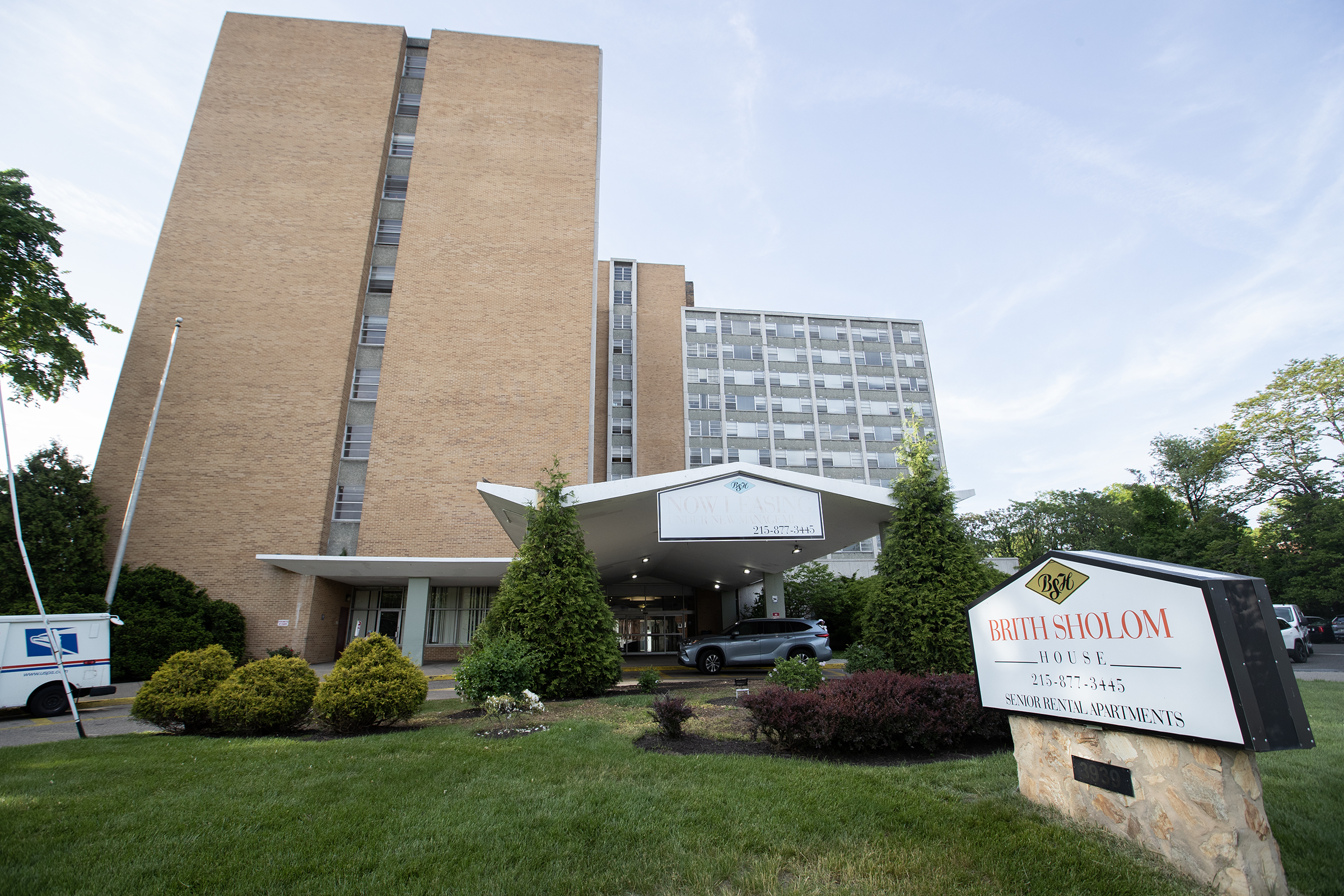
The exterior of Brith Sholom House on May 8, 2023.
When they first arrived at The Dane, some elderly residents were not getting the care they need, Washington said.
One man she ran into frequently often smelled of urine and would walk around with visibly wet pants. She said building management addressed the issues by spraying Febreze on benches the tenant used after he left an area. He has since died.
Another man screamed for help from his balcony and has since been moved out of the building.
“We are very used to all kinds of things happening here, from the students being wild to elderly being wild, but not to the level of being unable to take care of themselves,” Washington said.
Jeremiah says that PHA keeps tabs on the rehoused Brith Shalom residents — who previously were living with no oversight, although there are limits to what it can do. He encouraged tenants to report anyone who needs aid.
“We provide a robust set of social services to residents we inherited at Brith Shalom,” Jeremiah said. “PHA is not a healthcare provider. We are a housing provider, though we provide access to opportunities for residents who are interested in aging in place.”
A former Brith Shalom resident had no complaints with The Dane and praised PHA for the improvements in his life.
“I have no problem with them. I’m happy,” said Barry Brahn, who is blind and has AIDS. “They’re slow at getting things fixed, but they can only do so much and they’ll eventually get on it.”
What comes next?
Some aspects of the rocky transition from Cross Properties to PHA have eased. Since October, tenants were able to pay their rent online and submit maintenance requests. Washington says she does not see obviously distressed elderly residents any longer.
But tensions remain.
“The transition to PHA has been challenging, and their communication has been sorely lacking,” said Lanese Rogers, who has lived in The Dane for two years.“As someone who pays unsubsidized rent, they deal with us in a condescending manner.”
Kelvin Jeremiah, PHA president and chief executive officer, at PHA headquarters, in Philadelphia.
Jeremiah says he believes some of the pushback against PHA is due to class prejudice and bias against subsidized tenants.
“I don’t believe that there is anywhere any Philadelphian, whether or not they’re high income, middle income, low income, shouldn’t be permitted to live,” Jeremiah said.
He is committed to providing accessibility and affordability throughout the city, he said, and he hopes to retain mixed-income residency innewly acquired buildings with existing tenants.
So far at The Dane, many of the market-rate tenants are leaving.
“If I could pick up my apartment and move it to another location, I would,” Rogers said. “The building is changing, and I don’t like the direction it’s moving in.”
I am an avid Eagles fan. I was convinced they would be in the Super Bowl this year, but it was not to be. However, I still love to watch the game and did so a couple of weekends ago with friends and family.
For millions of Americans, Super Bowl Sunday is a welcome day of celebration. This year’s game was watched by about 125 million people. In any given year, many Americans take “sick days” on the Monday after the game, including this year: An estimated 26 million people were expected to miss work, up from 16 million in 2025 when the Birds won.
Here’s an idea: Instead of holding the Super Bowl on the second Sunday in February, the NFL should move the game to the third Sunday of the month. Why? The following day is Presidents Day, a national holiday, always observed on the third Monday of February — and a day in which millions of Americans don’t have to go to work.
The number of people taking part in “Super Sick Monday” would be greatly reduced, and it would be a change welcomed by many.
Ed Vreeswyk,Yardville
Epstein class
While the Trump administration continues to fail to keep the Jeffrey Epstein scandal out of the headlines, I keep thinking of my favorite Maya Angelou quote: “When someone shows you who they are, believe them.”
As director of Sudan and South Sudan Programs at the U.S. Agency for International Development, my firsthand experience of the Epstein class came in the form of Elon Musk’s Department of Government Efficiency. The U.S. Department of Justice’s latest release of the Epstein files featured more than 1,000 mentions of Musk.
As the president, another one of the Epstein files’ main characters, allowed the unelected billionaire to go about “feeding USAID into the wood chipper,” Marco Rubio promised USAID’s “lifesaving” programming would be spared. My colleagues and I desperately argued that our work saved lives. It wasn’t a hard case to make — Sudan and South Sudan represent two of the world’s largest humanitarian catastrophes.
These lives, like the lives of those trafficked by Epstein, were of no consequence to the Epstein class. They have shown us who they are. We need to believe them.
Maura O’Brien,Ardmore
War on scientists
The present administration has worked hard to discredit science and remove scientific researchers from any government positions. They have labeled climate change as a liberal hoax and claimed that children receive too many vaccinations. Measles, all but eradicated, has made a strong resurgence. As a result of this “war on science,” more than 10,000 science workers have left the government. In an effort to profit from these foolish policy decisions, the European Union has created a fund to attract these scientists to Europe. We are driving away the occupations that have created the greatness that was America.
Edward Hackett,Phoenixville
Join the conversation: Send letters to letters@inquirer.com. Limit length to 150 words and include home address and day and evening phone number. Letters run in The Inquirer six days a week on the editorial pages and online.
ARIES (March 21-April 19). It used to feel weird to witness the one who seemed to have it all and act like you weren’t inwardly comparing yourself. Now you’ll notice you’re over it. You actually enjoy the inspiration. It sparks ideas. You try things.
TAURUS (April 20-May 20). You do not need approval to proceed, but don’t let that stop you from sharing. People will love being in on your process. This is how bonds are made. When they feel they’ve have been in on your plans from the start, future rewards will be wonderful for many.
GEMINI (May 21-June 21). A possession takes more time than you want to give. It’s your cue to make a change. It’s not about upgrading or downsizing but about finding the balance of maintenance to benefit that fits the rest of your life.
CANCER (June 22-July 22). This week you’re less like the naturally and brilliantly defended crab and more like a snail, half inside your house and half out, as comfortable as you are vulnerable. In this state, any number of things could happen. You could receive a message on the wind, learn a new pleasure or pain, or fall in love.
LEO (July 23-Aug. 22). You can build bonds through work or play. The work will be easier today though because structure is built in. The rules and expected outcomes are a natural environment for getting to know people and building trust, and you’ll do both.
VIRGO (Aug. 23-Sept. 22). Whatever you most want from the day can happen if you’re willing to make everything else wait while you put all your focus into priority No. 1. It’s going to take more than a statement of intent. You may have to go somewhere no one will bother you.
LIBRA (Sept. 23-Oct. 23). Like other kinds of ailments, healing times vary for wounds of the spiritual heart. The important thing is that you know you can bounce back, like you have before. So you also know that love is worth the risk.
SCORPIO (Oct. 24-Nov. 21). Winning isn’t everything. Having the highest score isn’t always for the highest good for all. You’ll assess the game from a different vantage today and consider ways to “win” that hadn’t occurred to you before.
SAGITTARIUS (Nov. 22-Dec. 21). Neatness doesn’t automatically improve the substance of work. A messy but brilliant idea is still brilliant. But today, presentation will make your work user-friendly and strongly influence the number of people who engage with it. So all your efforts to polish will pay you back.
CAPRICORN (Dec. 22-Jan. 19). Novelty can be a pleasure, but pleasure isn’t always about novelty. Today’s self-care will involve returning to your familiar favorite things. What tops your list is no accident. You’ve tried a lot of different things to find out what you like.
AQUARIUS (Jan. 20-Feb. 18). Busyness is to importance as distraction is to the “ta-da” in a magic trick. They look connected. Maybe they are; maybe it’s smoke and mirrors. Either way, the kind of busyness that counts? Being there for the people who need you.
PISCES (Feb. 19-March 20). You’ve known that kind of inspiration that feels like a lightning strike from the clouds. This time it’s very different. Intuition comes up from the ground, energizing you while you work. It’s like you’re suddenly plugged in.
TODAY’S BIRTHDAY (Feb. 20). Welcome to your Year of the Grapevine Knot when your hope holds because it commits. You grip tighter under load, never slip once set, and will not return to any shape you’ve already been — ever forward, ever true. More highlights: fun friends, finding and deepening love, doing the right work over and over until the windfall, and a living arrangement that is so elegantly yours. Your lucky numbers are: 11, 23, 38, 7 and 29.