Blog

  • George Hutchinson, the Supreme Court’s last official crier, dies at 102

    George Hutchinson, the Supreme Court’s last official crier, dies at 102

    George Hutchinson’s words were far from the most important spoken during Brown v. Board of Education. But they were the first.

    With a cry of “Oyez, oyez, oyez,” Mr. Hutchinson announced the arrival of the justices and gaveled the court to order, as he did for virtually every Supreme Court case from 1952 to 1962.

    Mr. Hutchinson, who died June 14 at 102, was the last crier of the U.S. Supreme Court, tasked with carrying out ceremonial duties that were later turned over to the court marshal.

    His tenure as crier coincided with one of the most momentous periods in the court’s history, a time when the justices extended constitutional protections to Mexican Americans, refused to review the espionage convictions of Julius and Ethel Rosenberg, and, in Brown v. Board, held that segregated schools were “inherently unequal” and unconstitutional.

    As court crier, Mr. Hutchinson opened many of those consequential moments and, as if in a high school cafeteria, shepherded discreet notes to the justices, including messages sent from one end of the bench to the other.

    Decades later, he provided a window into the day-to-day activities of one of the government’s most secretive bodies, said Clare Cushman, a historian for the Supreme Court Historical Society. Mr. Hutchinson could speak about the court’s Christmas parties or the carpenter shop in its basement, or recall the way soldiers were deployed to the court building following the Japanese attack on Pearl Harbor.

    “The big pieces are always recorded,” Cushman said, “but the little pieces, no.”

    Mr. Hutchinson was 15 when he joined the court in 1938 as a page, one of the knicker-clad young people who would assist the justices. There were two requirements: You had to be short, according to Mr. Hutchinson, who grew to 5-foot-8, and you had to have a financial need.

    Mr. Hutchinson’s father had died when he was an infant, and his meager page’s salary helped support his mother and sister. He spent his afternoons in the Supreme Court, running books and water to the justices, before being drafted into the Army at age 19, dispatched to Europe in the final months of World War II.

    When he came home, he rejoined the court, working out of the marshal’s office and eventually taking the job of crier, which dates to the Supreme Court’s first meeting in 1790. He was given a handwritten script — the words of the opening proclamation, which concludes, “God save the United States and this honorable court” — as well as a distinctive gavel.

    “There was no handle. All it was was the clonk,” he recalled in a 2019 interview. “I said, ‘Where’s the handle?’ They said, ‘This is tradition. You’ve got to use this.’ So for 10 years I was banging like this.”

    As crier, Mr. Hutchinson oversaw the pages, a group that grew to include Charles V. Bush, the first Black Supreme Court page, who was hired in the aftermath of Brown v. Board at the urging of Chief Justice Earl Warren.

    Mr. Hutchinson worked alongside the pages while assuming a sneakier job within the court each October. Many of the justices were baseball fans and wanted updates on the World Series, said Vance Morrison, a former page who as a teenager worked under Mr. Hutchinson. They would pass a paper to Mr. Hutchinson or a page, who would run to the offices, listen to the radio and quietly report the score.

    “We just worked with discretion,” Morrison said.

    In October 1960, as the Supreme Court considered the conviction of a man who had failed to comply with the House’s anti-communist investigations, Mr. Hutchinson helped Justice Potter Stewart follow along to Game 7 of the World Series, providing score updates every inning and, as the game neared its end, every half-inning. He delivered his final update to Stewart after Bill Mazeroski hit a walk-off home run, giving the Pirates the win over the Yankees.

    “His eyes lit up and he sent the note down to the court,” Mr. Hutchinson recalled.

    Mr. Hutchinson also shared a bond with Justice Felix Frankfurter, according to his daughter, Sara Hutchinson. One day, he was unexpectedly called into the justice’s office to serve as a witness as Frankfurter finalized his will.

    “He said, ‘Have you ever faced death?’ I said, ‘What?’ I had to think about it,” Mr. Hutchinson recounted. “‘I was in the service in World War II.’ He laughed, he said, ‘Here,’ and he threw me his will.”

    George Edward Hutchinson, a fourth-generation Washingtonian — according to his family, two of his relatives were at Ford’s Theatre the night of Lincoln’s assassination — was born Aug. 31, 1923. His father was a lawyer, and his mother was a schoolteacher.

    While working at the Supreme Court, Mr. Hutchinson went to school part time, earning a law degree at George Washington University, and ultimately becoming a member of the Supreme Court Bar.

    After leaving the court in 1962, he became the marshal and then the clerk of the U.S. Court of Customs and Patent Appeals, where he was charged with saying “Hear ye” instead of “Oyez.” Two decades later, when the court merged with the Court of Claims to become the Court of Appeals for the Federal Circuit, he was named its first clerk.

    Mr. Hutchinson retired from federal service in 1985 to join the law firm Finnegan, Henderson, Farabow, Garrett & Dunner, where he remained on staff until 2023, the year he turned 100.

    Few people could recount the customs and procedures of the American court system like Mr. Hutchinson, said James Barney, managing partner at the firm.

    “I always viewed George as a living history,” Barney said.

    His death, at home in Arlington, Va., was confirmed by his daughter, his only immediate survivor. Mr. Hutchinson was predeceased by his wife of 63 years, Dorothy U. Hutchinson, and by another daughter, Carol Hutchinson.

    In 2018, 80 years after he joined the Supreme Court as a page, Mr. Hutchinson returned to the courtroom as a visitor. “He remains a member in good standing of our bar,” Chief Justice John G. Roberts Jr. said from the bench. “Mr. Hutchinson, welcome back!”


  • Graham Platner and the Democrats’ war on expertise

    Graham Platner and the Democrats’ war on expertise

    Let’s suppose you’re the kind of Democrat who — like me — derides Republicans for declaring war on expertise. From vaccines and climate change to tariffs and foreign aid, we say, the GOP has discarded professional knowledge in its quest for power.

    Why, then, do we support candidates who lack expertise — and experience — themselves?

    That’s the question we should be asking about Graham Platner, whose campaign for the Senate is on the ropes following a former girlfriend’s claim that he had sexually assaulted her. Platner has never held elected office; his only political experience was a stint on his town planning board.

    How can we be OK with that? If we value expertise in government, we should want leaders who have demonstrated it. But Democratic voters seem to be moving in the opposite direction.

    In the recent New York primary, they chose Darializa Avila Chevalier to replace five-term, 71-year-old Rep. Adriano Espaillat. The first Dominican American — and the first formerly undocumented immigrant — to be elected to Congress, Espaillat helped win measures protecting delivery drivers and home-based childcare providers. But he lost to a 32-year-old graduate student who has zero political experience.

    Darializa Avila Chevalier (center), alongside New York Mayor Zohran Mamdani (left), greets supporters after winning the Democratic nomination for New York’s 13th Congressional District.

    Neither does Melat Kiros, 29, who unseated 15-term Rep. Diana DeGette, 68, in the Democratic primary in Colorado. She has worked as a lawyer and — more recently — as a barista. But when it comes to politics, she is a complete novice.

    Then there’s Platner. A combat veteran and oyster farmer, he ran as an aw-shucks common man. That meant eschewing what he called “the establishment,” including experienced political consultants and pollsters.

    But guess what? It turns out experience matters. The young Democratic operative who recruited Platner to run for Senate bypassed the standard background check, which usually takes a few weeks. He opted instead for a three-day “investigation” by a firm that didn’t even bother to interview Platner or solicit a questionnaire from him.

    To its credit, the firm flagged some of Platner’s controversial Reddit posts. But a more thorough — and, yes, professional — background check would surely have uncovered his “unsettling” behavior around women, which former girlfriend Jenny Racicot described to reporters last month.

    And earlier this week, Racicot said Platner had shown up drunk at her house — after she asked him to stay away — and forcibly had sex with her. Platner denied the charge, but he said he was “mindful of the political reality it would inflict” and that he was taking time to “reflect” on how to proceed.

    Leading Democrats — including Sens. Elizabeth Warren and Bernie Sanders — called on Platner to quit the race, and I agree with them. But I also think the party should reflect on why we continue to elevate candidates who lack any real political experience.

    To defenders of these outsiders, their inexperience is a selling point. If you want to challenge the establishment, the argument goes, you need people who aren’t tainted by it — which was a major sentiment behind then-29-year-old Alexandria Ocasio-Cortez’s upset in New York’s 14th Congressional District in 2018. Ever since, some have argued, that’s the only way to get progressives into power.

    Nonsense. Here in Philadelphia, Chris Rabb scored a stunning victory in the May primary race to replace Rep. Dwight Evans. Like Chevalier and Kiros, Rabb calls himself a democratic socialist. But he also has significant experience in government.

    Jonathan Zimmerman wonders how voters can be OK with supporting Graham Platner, a Senate candidate who has never held elected office.

    Rabb served for five terms in the Pennsylvania House of Representatives, where he sponsored bills to repeal the death penalty and to promote restorative justice in criminal sentencing. He knows his way around Washington, too. Earlier in his career, he worked as an aide to Carol Moseley Braun, the first African American woman in the U.S. Senate.

    Whatever you think of Rabb’s politics, he is qualified for the job. And we should care about that. Just like we shouldn’t make a housing official the director of national intelligence, we shouldn’t make an oysterman a member of Congress. To serve effectively in government — like any other professional role — you need knowledge and experience.

    And if you think otherwise, just look at the guy in the White House. America elected 44 presidents before Donald Trump. Forty-one of them had held prior political office; the other three (Zachary Taylor, Ulysses S. Grant, and Dwight D. Eisenhower) were victorious U.S. war generals.

    By contrast, Trump was a failed real estate baron and a successful reality TV figure. His two presidencies have been monuments to incompetence because he doesn’t believe in expertise. Or in anything, really, except himself. Remember “I alone can fix it”? He didn’t, and he won’t.

    Experts don’t know everything, of course, and they can be wrong (see: COVID-19 lockdowns). But they do know more than the rest of us about what they do. In choosing candidates like Graham Platner, Democrats turned their backs on that principle. Let’s hope they rediscover it before it’s too late.

    Jonathan Zimmerman teaches education and history at the University of Pennsylvania. He is the author of “Schooling Citizens: How Education Can Save Democracy,” which will be published next spring by American Philosophical Society Press.

  • Devan Kaney lands a new gig in Chicago as WIP still has an Eagles opening

    Devan Kaney lands a new gig in Chicago as WIP still has an Eagles opening

    Devan Kaney is headed to Chicago.

    The former 94.1 WIP sideline reporter and Fox 29 sports anchor is leaving Philadelphia to cover the Chicago Bears for Fox 32, she announced on social media.

    Kaney is taking over the role vacated by Cassie Carlson, who was promoted as the station’s lead sports anchor. Kaney will also do some sports anchoring work for the station, much like her role at Fox 29, which she left last month.

    “I’m so grateful for the support all of my colleagues at Fox 29 have given me during my time there, but especially in the last few months,” Kaney told The Inquirer.

    Those last few months included being laid off at WIP as part of company-wide cutbacks by parent company Audacy.

    The move was a surprise considering Kaney was coming off her first full season as the station’s sideline reporter during Eagles broadcasts after replacing Howard Eskin, who abruptly left the station in January 2025 following an incident with a female staffer. Kaney jumped in and served as the station’s sideline reporter during the Eagles’ Super Bowl run.

    Devan Kaney (right) with 94.1 WIP’s morning show: (from left) Rhea Hughes, Jon Ritchie, Jason Kelce, and Joe DeCamara.

    She also served as an on-air host, worked with the station’s popular morning crew, and hosted shows alongside Phillies announcer and former general manager Rubén Amaro Jr.

    WIP hasn’t announced who will replace her, and the clock’s ticking. The Eagles’ first preseason game is five weeks away, with the Birds taking on the Baltimore Ravens on Aug. 15.

    “It’s a tough job,” WIP program director Rod Lakin told The Inquirer in 2025. “You have to be someone that’s a really good communicator. You also need to be able to change quickly — circumstances change all the time in the NFL, and you’ve got to deliver that information quickly and in a collaborative way, because the game doesn’t stop.”

    Over at Fox 29, Kaney’s role was partly taken over by former 6abc sportscaster Jamie Apody, who among other things is anchoring the station’s 10 p.m. newscast.

    While Kaney is leaving the city, she’ll continue to host Werth Talking About, a PHLY podcast she’s co-hosting with former All-Star Jayson Werth. And Eagles fans might get a glimpse of her Sept. 28, when the Birds travel to Soldier Field to take on the Bears on Monday Night Football in Week 3.

  • SEPTA cuts 3 Glenside Regional Rail trains along with other schedule changes

    SEPTA cuts 3 Glenside Regional Rail trains along with other schedule changes

    SEPTA is trading Glenside Regional Rail riders three daytime trains for new off-peak options, more train cars, and new schedules aimed at reducing congestion between Glenside and Wayne Junction.

    The Warminster Line, which runs through southeastern Montgomery County, is the only Regional Rail line losing multiple trains under systemwide changes that began on July 5 to make trains more consistent and prevent delays.

    The new schedule cuts two weekday trains that left Glenside at 8:40 a.m. and 2:47 p.m. for Center City, and one weekday train that left Suburban Station at 4:53 p.m. toward Warminster.

    The morning train cut leaves a 27-minute gap in service to Center City from Glenside, while the afternoon cuts each add five minutes or less to the wait for the next train.

    SEPTA also added a train to the Warminster Line that leaves Suburban Station at 11:35 p.m. on weekdays, and a train on the West Trenton Line that leaves Suburban Station at 5:28 a.m.

    The late-night train will serve airport workers, and the dawn departure is convenient for people who commute into the suburbs, SEPTA spokesperson Kelly Greene said.

    The changes SEPTA made across the commuter rail system this week are aimed at improving consistency and reliability, the agency said.

    “As SEPTA continues to increase the number of train cars available for service, trains will be longer and provide more space for riders,” officials wrote in a statement.

    Between Wayne Junction and Glenside, SEPTA said, it hopes the new schedule will help “prevent trains from bunching together, which can cause delays.”

    The 8:40 a.m. train from Glenside was cut to reduce congestion, Greene said, and had the lowest ridership of the trains running around that time.

    Other changes affecting the Abington area include new departure times for some trains on the Lansdale/Doylestown, Warminster, and West Trenton Lines.

    SEPTA put out a full list last month of what is changing on each line, along with updated train schedules.

    This suburban content is produced with support from the Leslie Miller and Richard Worley Foundation and The Lenfest Institute for Journalism. Editorial content is created independently of the project donors. Gifts to support The Inquirer’s high-impact journalism can be made at inquirer.com/donate. A list of Lenfest Institute donors can be found at lenfestinstitute.org/supporters.

  • Vanessa Bryant gives social media a preview of new Kobe shoes on the horizon — including an Eagles colorway

    Vanessa Bryant gives social media a preview of new Kobe shoes on the horizon — including an Eagles colorway

    A few months after Nike paid homage to Kobe Bryant’s Lower Merion roots with a full collection for the 30th anniversary of his state championship run, it appears more locally inspired shoes are on the way next year.

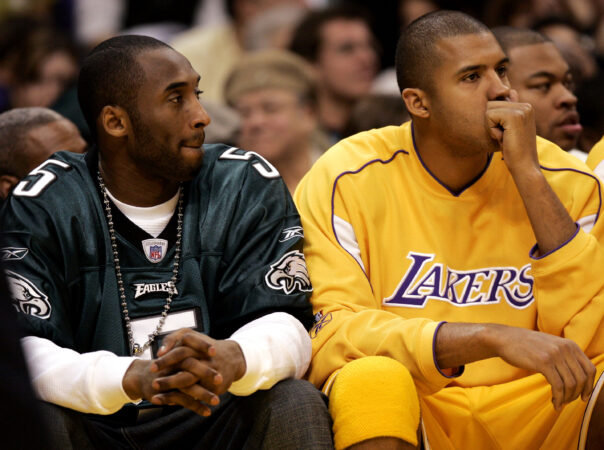
    Vanessa Bryant, Kobe’s widow, gave fans a sneak preview of new Kobe releases on the horizon, and among them are Eagles-inspired Kobe 5s in Protro form.

    The shoes — which appear to have a green suede base color — have a black Nike check, a white color lining the midsole and tongue, which features the signature green Mamba logo. According to multiple sneaker outlets, the shoe will drop next January and will retail for $200.

    The “Eagles” Nike Kobe 5 is one of seven styles of shoes that Vanessa Bryant posted on her Instagram stories on Tuesday evening. The six other shoes coming in the next year are: the Nike Kobe 6 “Polka Dot White,” Nike Kobe 6 “Polka Dot Red,” Nike Kobe 6 “Bellisima,” Nike Kobe 9 Elite High “Ironman,” Nike Kobe 9 Elite Low “Dusty Pink,” and Nike Kobe 9 Elite Low “CA Mountain Snake.”

    Kobe Bryant’s fandom of the Eagles was well-documented, from watching them win Super Bowl LII to visiting with the team in 2017 while they were in California.

    One of the last images taken of Bryant before his death, with his daughter Gigi, featured him wearing an Eagles beanie and WNBA sweatshirt.

    Now, it appears Bryant’s love for the Eagles will be displayed through a sneaker as another display of the late superstar’s connection to the city.

  • The Supreme Court freed college athletes to earn. Collective bargaining is the next step.

    The Supreme Court freed college athletes to earn. Collective bargaining is the next step.

    It is past time for Division I colleges and universities to recognize that their student-athletes deserve both the right to bargain collectively and recognition that they are employees because of the compensation their institutions provide to them and the control those institutions have over them.

    A deluge of media coverage has been aimed at other issues in big-time college sports, particularly football and basketball, but too little attention has been given to what should be center-stage — how student-athletes should be fairly treated by the institutions that benefit from their athletic prowess.

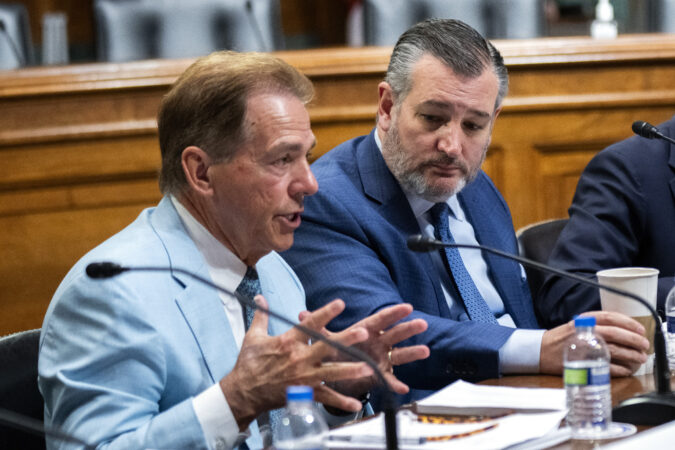
    The Senate Commerce Committee recently held a hearing on the Protect College Sports Act of 2026, sponsored by Sens. Ted Cruz (R., Texas) and Maria Cantwell (D., Wash.), to “restore order” to college sports. This 111-page legislative effort is the latest in a series of approximately 40 bills aimed at reversing judicial rulings that oblige universities to share financial gains with their players.

    Like their legislative predecessors, the 2026 bill limits or ignores existing player rights and immunizes universities from antitrust liability resulting from player-initiated litigation and substitutes Congress’ judgment for the courts, players, and universities.

    Thus, the 2026 bill restricts the ability of players to transfer through a “portal” from one college to another and limits player eligibility to five years beyond the day of high school graduation. The bill would preclude awarding antitrust damages to players who seek to increase their mobility and earnings. It would also preempt state laws guaranteeing players compensation for their names, images, and likenesses used, for instance, on video games and athletic clothing (this has come to be called NIL money).

    Until the last decade, the unchallenged position of the National Collegiate Athletic Association was that all college players are amateurs entitled to no more than athletic scholarships and frequently inadequate reimbursement for college expenses. Post-World War II football and basketball were dominated by the Southeastern Conference and the Big Ten, and both were big businesses.

    Notwithstanding this reality, the NCAA maintained that the players were amateurs who could not be paid until the U.S. Supreme Court in 2021 ruled that the NCAA and its member campuses were liable for treble damages when they conspired to deny the players “educational” compensation beyond athletic scholarships and reimbursements.

    Universities became involved in class-actions brought by their players about player transfers, eligibility, and related issues following that Supreme Court ruling. The ruling recognized that the universities have always treated athletes differently from other students, sometimes providing them with preferred admissions as well as under-the-table monies and other benefits, frequently in conjunction with wealthy alumni and “boosters.”

    With California leading the way, many states enacted so-called NIL laws that allow players to be compensated for use of their names, images, and likenesses.

    But the NCAA continued to insist the players were amateurs. As a result, outside “booster” groups or “collectives” were created to provide business deals to attract or retain college athletes from a source other than the universities.

    Meanwhile, institutions of higher learning went to war to attract coaches with multimillion-dollar salaries, often exceeding those of any other employee, and — among state universities — any other state employee, including governors.

    In the wake of these developments, an immediate response was the negotiation of financially lucrative media deals by the universities and a realignment of college conferences.

    Stanford University, for example, left the Pac-12 Conference to join the Atlantic Coast Conference, requiring all its varsity athletes to travel regularly across the country, increasing the separation from their classrooms.

    Further, NIL procedures have become a kind of Wild West, sometimes composed of shadowy characters and “agents” who operate without any regulation as is provided in the professional leagues.

    Earlier this year, President Donald Trump convened a meeting of business and university officials in connection with a new executive order to preempt state regulation. The 2026 Cruz-Cantwell bill is the most recent response. It consigns players to minority representation on an athletic “governing board” or “rulemaking committee.”

    Deeply troubling, it avoids even a mention of collective bargaining or employee status for the players. The current National Labor Relations Board is unlikely to address these issues effectively. And this Congress is unlikely to act on the Cruz-Cantwell bill.

    Some, we realize, claim we should go back to an earlier era when money was not center stage in every aspect of Division I college sports. But it is too late to return that genie to its bottle.

    Rather than wait for voluntary recognition of the organizing power of college players, or for state legislatures to take action, Congress should amend the National Labor Relations Act to allow student-athletes to exercise their collective bargaining rights.

    This step by a new Congress in 2027 could provide much-needed protections for college athletes in terms of adequate compensation, health and safety protections, as well as a reasonable measure of player mobility fashioned by both students and universities seeking a balance between freedom and a disruptive revolving door.

    After all, the most appropriate forum for resolving the complex matters around modern-day college athletics isn’t through one-off legislation or the occasional court ruling, but rather at the collective bargaining table.

    Thomas Ehrlich is the president emeritus of Indiana University, former provost of the University of Pennsylvania, and former dean of Stanford Law School. Currently, he is an adjunct professor at the Stanford University Graduate School of Education. William B. Gould IV is the Charles A. Beardsley Professor of Law, emeritus, at Stanford Law School. He is a member of the National Academy of Arbitrators and former chairman of both the National Labor Relations Board and the California Agricultural Labor Relations Board.

  • Fast-food outlet Jollibee introduces chicken nuggets for the first time in nearly 50 years

    Fast-food outlet Jollibee introduces chicken nuggets for the first time in nearly 50 years

    After nearly a half-century in business, Jollibee has added a fast-food staple it had long gone without: chicken nuggets.

    The Filipino-rooted chain, whose lone Philadelphia-area restaurant is at Cottman and Bustleton Avenues in Great Northeast Plaza, introduced the all-white-meat nuggets nationwide last week. They are sold in five-, eight-, 15-, and 30-piece orders, starting at $4.49 for five.

    For a company best known for its Chickenjoy fried chicken, Jollibee sees nuggets filling a different niche.

    Luis Velasco, senior vice president at Jollibee Group North America, said the company had seen growing demand for nuggets. Rather than competing with the bone-in chicken or its chicken sandwich, which Jollibee introduced in 2021 during the height of the “chicken sandwich wars,” they’re intended as a shareable complement to the fried chicken sandwiches.

    Chickenjoy, the signature fried chicken from Jollibee, gets a dunk into gravy at the location at 7340 Bustleton Ave.

    Jollibee also sells burgers, fried mango-peach pies, and Filipino spaghetti, a saucy dish whose sweet-and-savory sauce is loaded with ground beef, sliced hot dogs, and melted cheese.

    Like the sandwich, the nuggets borrow from the same fried-chicken playbook. They are served with its tender sauce (similar to Cane’s sauce), as well as creamy sriracha, honey mustard, ranch, pineapple BBQ, and chicken gravy, the usual accompaniment to Chickenjoy.

    The nuggets drew a steady stream of orders at the Northeast Philadelphia restaurant on Friday.

    First impressions: They have plenty of crunchy nubs on the thin coating and a juicy interior. They don’t have the soft, processed texture common among fast-food chains’ nuggets.

    “They’re crispy and crunchy and all, but they don’t have the same hard crunch as my Chickenjoy,” said Bing Garcia of Lawndale after taking a first bite.

    Paul Santos of Castor Gardens sampled his order with a fork before dunking each piece into a cup of Jollibee’s gravy, the savory sauce with a touch of sweetness.

    “I ate my first one plain, and it was fine — maybe a little dry,” Santos said. “You can’t beat their gravy.”

  • A Philly philosopher took time off to rebuild his Kensington rowhouse

    A Philly philosopher took time off to rebuild his Kensington rowhouse

    Caleb Zimmerman needed a new place to crash, fast.

    It was August 2019, and the 27-year-old was finishing a remodel with his brother, Micah, on a Strawberry Mansion house. He had purchased the property with plans to rent it out post-renovations and was living there in the meantime.

    With the remodel nearing completion, Zimmerman wasn’t seeing any interesting properties to take on as his next project — and next place to live.

    In desperation, he turned to Craigslist. And there, listed for $85,000, was the three-bedroom Kensington rowhouse he’s called home ever since.

    “I bought it the next day” for $82,500, he said, confirming, no, that’s not hyperbole. “I knew the location was incredible and was just going to keep getting more incredible.”

    Even before walking through the two-story house, Zimmerman had an idea of what he wanted this next project to look like. Though the house needed a full gut remodel, he saw that the structure could accommodate his vision of an open floor plan with a floating staircase and basement steps concealed by a trap door on a pulley system. It was, to be sure, a huge project, but Zimmerman knew he could get it done.

    The kitchen, which was built by a family friend, Aden Stoltzfus.
    The entrance to the home and the living area.

    “I feel like the Mennonites have it in their genes,” said Zimmerman, who’s of Mennonite heritage and who just wrapped a stint as an instructor of philosophy at the University of Pennsylvania. “I’m primarily a philosopher, but I wanted to kind of prove my chops, I guess, prove that I can also do things with my hands.”

    Zimmerman and his brother moved in that summer and began work the first day of Christmas break. He took a leave of absence for a semester from Temple University, where he was working on his Ph.D. in philosophy, to see the project through.

    Everything in the house needed to be replaced, so that meant everything needed to come out.

    “The kitchen was an atrocity,” Zimmerman recalled. “There were mice running around.”

    Custom wooden shelving is fastened to an exposed brick wall in the kitchen.

    For demolition, which included removing the floors and pulling down the lathe and plaster throughout the house to reveal its underlying brick, guys in the neighborhood would often stop by to see if they could lend a hand for an hourly wage, Zimmerman said. One guy, in particular, “has so much sweat equity in the house that anytime he knocks and needs some help” Zimmerman opens his door to him to this day.

    Throughout the project, the Zimmerman brothers lived in two of the three bedrooms upstairs with Micah as Zimmerman’s right-hand helper and renter. The first night he moved in, Zimmerman said, he slept on the floor. It was just the beginning of the long discomfort he’d endure living among the renovation, but it encouraged him to push to get the project done.

    For rebuilding, Zimmerman drew on his Mennonite heritage and connections. He and Micah brought in wood from an Amish mill for kitchen beams and the custom staircase. A family friend, Aden Stoltzfus, made the kitchen — his daughter Hadassah Stolzfus recently spoke to The Inquirer about her own home renovation, also featuring a kitchen created by her dad.

    The home’s centerpiece of engineering is a trap door that conceals the basement and opens with a pulley system and remote-controlled actuator. It was built by Gabe Stoltzfus, Hadassah’s cousin. Gabe also handled the bathroom renovation, where Zimmerman planned to remove the tub and install a standing shower with a glass enclosure to make the small room feel larger.

    Zimmerman opens the trap door to his basement. He removed a wall with a door to the basement and created more open space by incorporating the trap door.
    Zimmerman installed a glass-walled shower to make the bathroom feel more spacious.

    Zimmerman had some experience laying hardwood floors, so he installed the new wood floors that run throughout the house. A friend, Kevin Bucher, helped install some trim, including, in a feat of patience, a piece that he cut to mirror the topography of the brick wall in what is now Zimmerman’s office.

    Zimmerman did bring in some outside help to install drywall, seal the fireplace, and rewire the house. The renovation cost about $80,000 in total.

    By the fall of 2020, “it was livable,” Zimmerman said, though he had lived there all along. His brother Micah stayed for a while, too, but moved out in 2022.

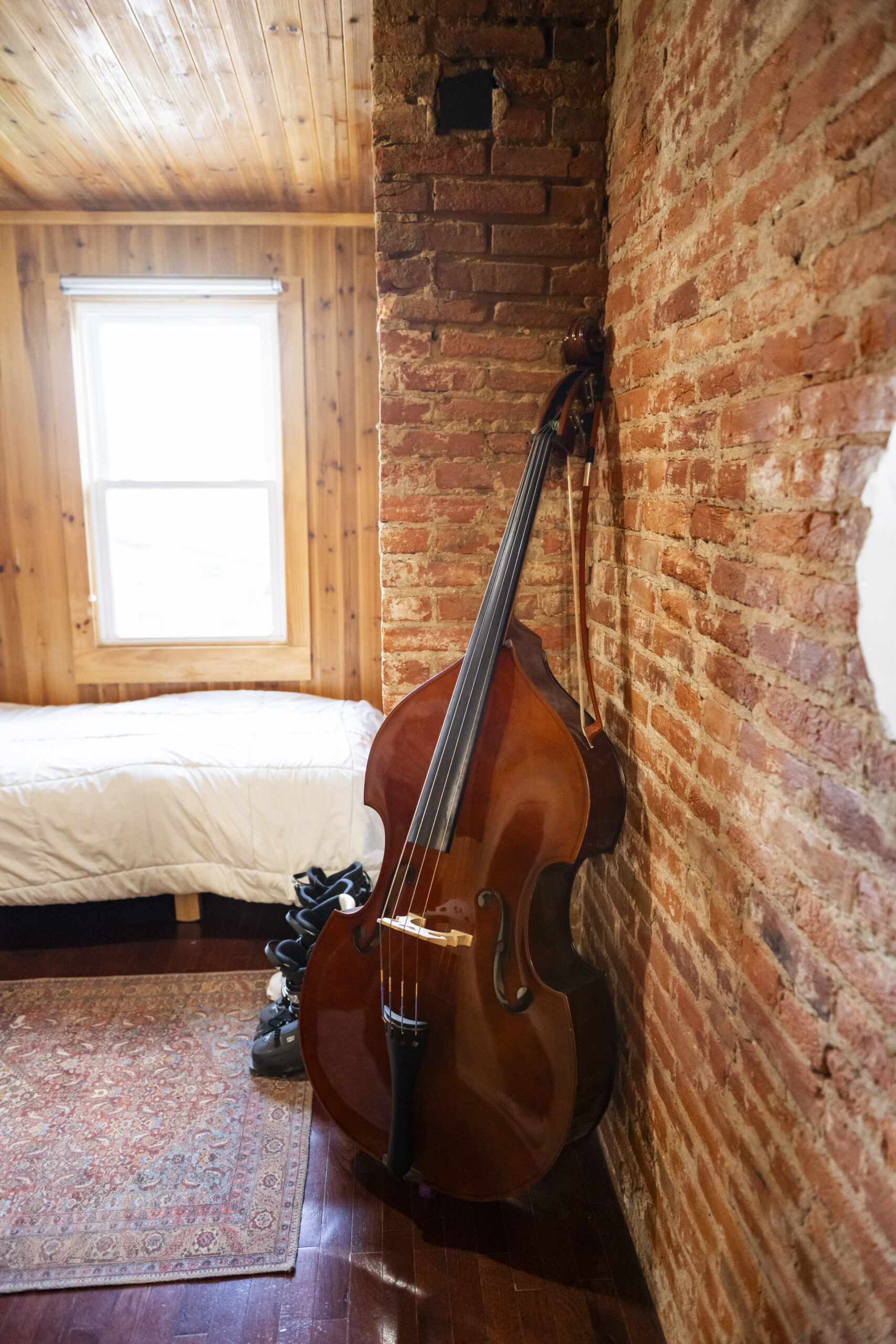
    An upright bass is on display in the guest room.
    Exposed brick and wood paneling on the wall in the guest room.

    Now Zimmerman entertains often and said people always say his red refrigerator is their favorite aspect of the house. Knowing how much custom behind-the-scenes work went into every aspect of the property, he receives that comment about a store-bought appliance with some chagrin. It’s only because he knows how much was accomplished before that final, finishing flourish.

    Reflecting on the renovation, “I doubt that I will do anything like this again,” he said, “but I wanted to know I could do it.”

    Is your house a Haven? Nominate your home by email (and send some digital photographs) at properties@inquirer.com.

  • Justice Department threatens top election officials over noncitizen voting

    Justice Department threatens top election officials over noncitizen voting

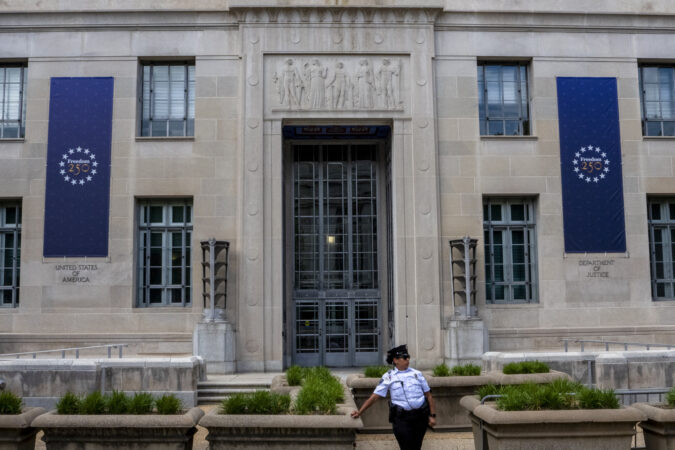
    The Justice Department sent letters to all 50 states and the District of Columbia on Tuesday threatening criminal prosecution of top election officials if ballots cast by noncitizens were counted in upcoming elections.

    The letters arrived in the midst of an ongoing campaign by President Donald Trump and his allies to tighten election rules to prevent a problem that doesn’t exist: widespread noncitizen voting in American elections.

    The effort has, however, continued to sow doubt and distrust in the electoral process, most notably among the president’s base of supporters. And his proposals could have the effect of making it more difficult for eligible voters to cast their ballots — an outcome that many voting-right activists say is the president’s real goal.

    The letters sent Tuesday came from Harmeet Dhillon, who runs the Justice Department’s civil rights division. They are largely identical, according to multiple copies obtained by The New York Times. The seven-page letters detail a host of federal election laws that prohibit noncitizens from voting in elections — laws that have been clear for decades.

    “Any election officer, including the chief election officer of the state, who knowingly retains noncitizens on the state’s” voter list “or facilitates noncitizens in receiving and casting ballots could be subject to criminal liability,” Dhillon wrote.

    The letters asked the election officials to respond to the Justice Department “within five days” with details on how their states intended to comply “with these federal laws both at the state and local level and how the Department can assist in those efforts.” It is unclear what would happen if a state does not respond in five days, as the letters are not subpoenas requiring a response.

    Lt. Gov. Deidre Henderson, the top election official in Utah and a Republican, expressed frustration with the Justice Department’s tenor and tactics.

    “Got another love letter this morning from the DOJ sprinkled throughout with threats of criminal prosecution,” Henderson wrote on social media. “I’m sure I’m not the only chief election officer of a state who is being targeted for following state and federal laws by resisting DOJ’s demands for private voter data that have thus far been ruled illegal by at least a dozen courts. This is truly bizarre behavior by the federal agency that is supposed to be protecting civil rights.”

    Adrian Fontes, the Democratic secretary of state in Arizona, criticized the efforts by the Justice Department as politically motivated.

    “It is insulting to insinuate that the good people at our county recorders’ offices across the state are not doing their jobs correctly,” Fontes said. “Arizona election officials have always worked to ensure that only eligible citizens are registered to vote, and we will continue following Arizona law — not directions that come from political rhetoric or intimidation.”

    Justice Department officials have said their purpose in seeking voter roll data is to ensure compliance with federal law requiring states to maintain accurate voting rolls. Some voting-rights advocates have speculated that the department’s specific aim is to look for evidence of noncitizen voting or use voter roll data to challenge future election results.

    Kiersten Pels, a spokesperson for the Justice Department, confirmed that letters were sent to officials in all 50 states and the District of Columbia, seeking “voluntary compliance in a timely manner with their obligations under federal law to ensure only citizens vote in federal elections.”

    David Becker, a former voting rights lawyer for the Justice Department who now runs the Center for Election Innovation and Research, a nonpartisan group that works to build confidence in elections, said that the letters from Dhillon look like a performative display by the Justice Department to show it is working aggressively on one of the president’s priorities despite little success.

    “This is what panic and desperation looks like,” Becker said. “They’ve had 18 months to find evidence of a crime that was never committed, and found nothing. And now they fall back on crude and transparent bullying tactics. They sent these letter to several, perhaps all states, with no specific evidence of a crime.”

    He added that “the election officials I’ve spoken with aren’t intimidated, and are seeing these empty threats for what they are.”

    The Justice Department also sent letters to three cities in Michigan — Detroit, Lansing and East Lansing — stating that federal election monitors from the department would be going to the areas for the upcoming primary election. The department’s stated reasons were observations from the 2024 election, citing a lack of provisional ballots in at least one polling location and voting machines that were not operational in multiple polling locations.

    Michigan election officials roundly rejected both the claims from the Justice Department and the reasons for sending monitors. Janice M. Winfrey, the city clerk in Detroit, wrote in response Tuesday that the Justice Department had made “false assertions that form a baseless conclusion that then becomes the pretext for additional monitoring of Detroit elections.”

    Winfrey added that “according to our records, there were no representatives from the Department of Justice, and if so, they did not comply with regulations requiring them to identify themselves and sign in with supervisory staff at the polling place.”

    For years, Trump has claimed without evidence that noncitizens voting in American elections have benefited Democrats. After the 2016 election, which he won, he claimed that as many as 3 million ballots in California had been cast by noncitizens.

    Since returning to office, Trump has led a relentless effort to prove his claims using the levers of the federal government.

    None of those investigations has provided any evidence of widespread noncitizen voting. An initial review in January of nearly 50 million voter registration records by the Department of Homeland Security referred roughly 0.02% of the names processed for further investigation.

    This article originally appeared in The New York Times.

  • Holiday lessons about ‘patriotic values’ from Folarin Balogun, Pope Leo XIV, and JD Vance

    Holiday lessons about ‘patriotic values’ from Folarin Balogun, Pope Leo XIV, and JD Vance

    I never thought I’d be writing a column that led off with an analysis of soccer.

    I’d planned to write about the lessons our nation’s 250th birthday party provided for Americans about the real meaning of “patriotic values.” But as it turns out, an examination of the scandal that ensued after President Donald Trump’s shameful World Cup intervention provides the perfect example of what those values are and what they are not.

    Before getting to the game, it’s important to revisit what Thomas Jefferson meant in 1776 when he wrote in the Declaration of Independence that the Creator had endowed all men equally with “the right to life, liberty and the pursuit of happiness.” Although honored in the breach when it came to slavery and women’s rights, these ideals have been the goal toward which America has gradually, but consistently, aspired — until now.

    Many probably assume that “pursuit of happiness” means material success or personal pleasure. But for the Founding Fathers, educated in the philosophy of ancient Greece and Rome, the phrase reflected the classical emphasis on civic duty and character development. In other words, the concept of patriotism was tied to the pursuit of an honorable and civic-minded life.

    Now back to soccer.

    Until the July Fourth weekend, the World Cup matches had provided a brilliant exhibition of the best of America, with cities across the land and fans in every stadium effusively welcoming teams of every race and color. In an incredible burst of U.S. soft power, the global image of Trump’s America as overtly racist, corrupt, and violent gave way before the warmth of ordinary Americans.

    But Trump could not refrain from popping that wonderful bubble. After America’s star striker, Folarin Balogun, received a red penalty card during the team’s 2-0 win over Bosnia and Herzegovina — which would force him to sit out a critical match against Belgium — POTUS phoned FIFA’s president, Gianni Infantino.

    A Trump sycophant who had previously awarded him FIFA’s first medal of peace, Infantino gave the president what he wanted: a reversal of a red card ban during a World Cup game (for the first time since 1962).

    In one move — based on his philosophy that only winners count — Trump cast a pall over the World Cup. He reversed all the goodwill the matches had generated for America at a time when his erratic behavior had sunk global attitudes toward the U.S. to astonishing new lows.

    Yes, Balogun’s violation was accidental, and the red card undeserved, but how many times have we all witnessed wrong calls by referees or umpires that drove us insane? However, under FIFA rules, there is no appeal after a game is over. Imagine if every world leader copied Trump’s utter disdain for rules in sports as well as domestic and international laws, a disdain which is already causing global chaos.

    On Monday, the U.S. team lost 4-1 to Belgium. But Trump’s interference made that defeat more painful by precipitating a wave of global scorn that poured down on an undeserving team. Nor has Trump had one word of praise for this terrific team after their loss.

    However, the lesson from Trump’s soccer debacle is not all negative. Americans should take pride in the achievements of the U.S. team and be inspired by the overall atmosphere of the games before Trump’s ugly intervention.

    And the country should unite in praise for the patriotic virtue displayed by Balogun.

    A day after receiving his red card, the star striker told an interviewer: “It’s been surreal, to be honest. But for me, I think it was just important to stay calm. I never want to react out of anger and out of emotion.

    “There’s still lots of people we’re inspiring, little kids, boys and girls who are watching, and we have to show them the correct way to handle things, even when you think it’s unjust.”

    What a hero! And what an example of patriotic virtue by someone who, under Trump’s attack on birthright citizenship, wouldn’t even qualify to play for Team USA, being born in Brooklyn to Nigerian parents visiting from London.

    Furthermore, the president’s negative example over the holiday — turning the Semiquincentennial into a celebration of himself, even as news broke of the incredible billions POTUS and his family have raked in off his presidency, and even as he upped his efforts to rig the midterm elections — should goad us all to revisit the meaning of “pursuit of happiness” in civic terms.

    Two critiques of Trump over the weekend — one indirect, one powerfully direct — can serve as further inspiration.

    The first comes from Pope Leo XIV, in his powerful livestreamed speech on July 3 at Philadelphia’s National Constitution Center while accepting the prestigious Liberty Medal. “The principles that inspired America’s founders,” he said, “brought them together in … a common dream. Unity lent strength to that dream … E pluribus unum — out of many, one. In order for a nation to flourish, it must be truly united, not by goals bound to momentary endeavors, but by ideals that do not fade with the passing of time.”

    These words need to be taken to heart, to my thinking, especially by progressive Democrats. Their anger is understandable, but in the final instance, they must work together with all those who appreciate the need to curb Trump’s desecration of the founders’ values. That includes all Democrats as well as independents and moderate Republicans who appreciate the need for checks and balances on presidential power.

    As Benjamin Franklin famously said at the signing of the declaration, “We must all hang together, or assuredly we will all hang separately.”

    And finally, some inspiring words from Vice President JD Vance, written in 2016 for the Atlantic before he turned against the values of the founders, and republished by the site on July 4.

    The title of the essay: “Opioid of the Masses.”

    “What Trump offers is an easy escape from the pain,” he wrote. “To every complex problem, he promises a simple solution. He never offers details for how these plans will work, because he can’t. Trump’s promises are the needle in America’s collective vein.

    “The great tragedy is that many of the problems Trump identifies are real … Yet so long as people rely on that quick high … the nation delays a necessary reckoning. There is no self-reflection in the midst of a false euphoria.

    “Trump is cultural heroin. He makes some feel better for a bit. But he cannot fix what ails them, and one day they’ll realize it. And then, perhaps the nation will trade the quick high of ‘Make America Great Again’ for real medicine.”

    In memory of the Founding Fathers, who pursued their principles when the struggle seemed impossible, let us hope such a realization starts this fall.