Blog

  • Dear Abby | Once married, wife realizes her husband is someone else

    DEAR ABBY: I have experienced something that other women I know have said they have also experienced. I dated a man for a year. We became very close and fell in love. He was sweet, loving and kind in every way. Before I would commit to marriage, I made sure we had discussions about respect and what I expected from a life partner.

    The change in my (now) husband was instantaneous with our marriage and severe. He became someone I didn’t know and never would have married. He is argumentative, petty and a bully. I feel as if I’ve been lied to. What happened?

    — CONFOUNDED IN OREGON

    DEAR CONFOUNDED: What happened is while your husband was courting you, he put only his best foot forward, concealing who he really is. If the person he now shows himself to be isn’t someone you would have married, end the emotional abuse and the bullying by ensuring he can’t hide assets to which you may be entitled and talking to a lawyer about freeing yourself from this marriage to a stranger.

    ** ** **

    DEAR ABBY: I’m a divorced father of a 27-year-old daughter. I recently found out she is being married in four months. Of course, I couldn’t be happier.

    I told my daughter that although I am not rich by any means, I would be glad to chip in what I could for her wedding. When I asked if I could invite a few friends and their spouses, she said I could, but I would have to pay for their plates. I was shocked. What do I do or say?

    — DISAPPOINTED DAD IN NEW JERSEY

    DEAR DAD: Your daughter, the happy bride, is the person who gets to set the rules for her wedding. Because you learned about her wedding only after the plans were set, I sense there may have been some estrangement. You were generous to offer to help defray the expenses of the celebration, but if you want to include your friends, you will have to pay for the additional cost of feeding them. Perhaps some of your contribution could be earmarked to cover this expense.

    ** ** **

    DEAR ABBY: I have a co-worker who eats canned sardines on top of his salad every day. I know they are high in protein and could be considered healthy, but they stink. He already covers his salad with red onion and balsamic vinegar, and the smell almost takes me out. If that’s not bad enough, he literally slurps the remaining oil after he has finished the salad. How should I tell him it stinks, or at least ask him to stop drinking the oil like it’s water?

    — SMELLS FISHY IN IOWA

    DEAR SMELLS: You didn’t mention where this feast for the senses is taking place. Is there no way to distance yourself from the stench or stagger your lunch breaks so as to avoid the situation?

    If not, you may want to rally support from other co-workers who feel the same and approach your supervisor or human resources. Ask that a rule be enacted about strong-smelling foods in shared spaces. HR should be able to work out a compromise that allows everyone to enjoy their lunch in peace.

  • Horoscopes: Monday, June 22, 2026

    ARIES (March 21-April 19). If you’re feeling off-center or unsure of what to do next, today brings the beacon of an obvious purpose. This likely comes in the form of someone who needs you. The service you give will teach and enrich you.

    TAURUS (April 20-May 20). As the time travelers in movies always find out — try as you might, it’s impossible to have an impact that doesn’t alter the timeline. Today’s small and insignificant move will set off a chain of events, domino-style.

    GEMINI (May 21-June 21). You’ll deal with something complicated. Maybe you’re not naturally excited about it but you have the patience, focus and motivation to handle the complexity anyway. Even if the task is not enjoyable, you’re willing and able to work through it because it matters or needs attention.

    CANCER (June 22-July 22). In the same way that gold is a chemical element that scientists believe is the result of neutron star collisions, much of the gold in your soul also originated in impactful past moments that taught you to form in a way that is rare, beautiful and valuable.

    LEO (July 23-Aug. 22). You’re a magnet for good deals today, and you’ll get much more for your money than you were hoping for. It’s true whether you’re paying a little or a whole lot. It’s like the universe wants to reward your savvy.

    VIRGO (Aug. 23-Sept. 22). With new people, you may feel your way around a conversation with hints. But with people who love and know you well, direct communication is the way. It’s kinder and more effective than hoping they’ll pick up subtle signals.

    LIBRA (Sept. 23-Oct. 23). Forgiveness is not the same thing as surrendering your judgment or abandoning your boundaries. You can release bitterness while still protecting yourself from repeated harm. Peace comes from deciding the pain no longer gets to direct your life.

    SCORPIO (Oct. 24-Nov. 21). The default settings are often the most used, not because they are preferred but because changing them requires effort. Put thought into your routines, systems and surroundings up front, and life will become easier to navigate well.

    SAGITTARIUS (Nov. 22-Dec. 21). Your senses are your conduit to the world, but they get dulled or even blocked by familiarity. Today brings just the freshness you need — of faces, environments, methods and more. And when you return home, you’ll see things anew.

    CAPRICORN (Dec. 22-Jan. 19). You’re weighing a risk, and your concerns deserve consideration, but constant worry will not improve the outcome. Fear can distort decisions and drain your confidence. Put more energy into building what you want than rehearsing what you hope to avoid.

    AQUARIUS (Jan. 20-Feb. 18). You are drawn toward a promising and mysterious person. Unanswered questions are key to the magnetism. Don’t rush to solve every riddle or satisfy every curiosity because it robs the situation of a sense of discovery.

    PISCES (Feb. 19-March 20). Current systems and routines will eventually be outdated. Change is coming, and you already sense the future direction. But the present still deserves full participation while it remains the reality you’re living in. Don’t mentally abandon the current moment too early.

    TODAY’S BIRTHDAY (June 22). It’s your Year at the Wheel, when you are so often in the driver’s seat that outcomes generally reflect exactly what you were going for, and at the pacing that feels just right. You earned this power position. Dare to take things in a direction that’s unique to you. More highlights: You’ll explore new topics and activities that lead to fun connections. Long- and short-term investments both pay off. You’ll go on a dream excursion. Gemini and Sagittarius adore you. Your lucky numbers are: 7, 20, 14, 1 and 16.

  • Fueled again by Kyle Schwarber and Bryce Harper, the Phillies’ bats stay hot to win series over Mets

    Fueled again by Kyle Schwarber and Bryce Harper, the Phillies’ bats stay hot to win series over Mets

    They gathered at the usual time (shortly before 3 p.m.), in the usual spot (around home plate) for early batting practice. Bryson Stott and Alec Bohm were there; J.T. Realmuto, too.

    Before long, Bryce Harper joined them. Again.

    What else did you expect? Yes, the Face of the Phillies prefers the indoor cage for his pregame swings. But Harper felt like launching balls into the seats Saturday and wound up hitting for the cycle a few hours later.

    Only a fool would do anything differently.

    So, there was Harper, hitting on the field again Sunday, and sticking with his 35-ounce “heavy” bat instead of the 31½-ounce model that he ditched the night before. And guess what? Yep, he got three more hits — a triple short of another cycle — in a 6-2 rubber-game victory over the Mets that was powered by another titanic Kyle Schwarber homer.

    “I don’t know if that’s translating to the game,” Harper said of the early hitting, the heavier lumber, and seven hits in his last nine at-bats. “Obviously the last two days have been great.”

    Surely, Harper wants to bottle this feeling.

    But it isn’t only Harper. Or even Schwarber, who has blasted four homers in the last two games, leads the planet with 29, and is on pace to finish with 61, which would be a record for a franchise that has existed for 144 seasons.

    The Phillies’ Bryce Harper celebrates after hitting a home run in the fifth inning on Sunday.

    As the Phillies capped a winning homestand and caught a train to Washington to play four games this week, the bats are finally revving up. In going 4-2 against the Marlins and Mets, they produced a total of 44 runs on 60 hits, including 11 home runs, five of which came from Schwarber and two from Harper.

    “It’s pretty, pretty special,” Zack Wheeler said after allowing two runs in 5⅔ innings. “I mean, it’s pretty cool to see, you know? They’re capable of doing that every day. It’s crazy.

    “And we have the guys around them, too, getting on base. They aren’t just solo home runs and stuff. We’re putting good at-bats together and looking like a good, total offense.”

    The pitching, notably co-aces Cristopher Sánchez and Wheeler and star closer Jhoan Duran, carried the Phillies from a 9-19 start back into wild-card position.

    Now that they’re here, the offense is percolating, led by the Harper-Schwarber Show, just in time for summer.

    “That’s kind of what we expect of ourselves as an offense, right?” Harper said. “When we get going and clicking like that, I think when me and Schwarbs have big swings or great at-bats, we’ve got a chance to win games.”

    The Phillies won the finale against the Mets by taking advantage of mistakes early, scoring two first-inning runs without a hit out of the infield. Then came Schwarber’s three-run homer in the second inning and Harper’s solo in the fifth.

    Harper also doubled in the second inning and singled in the seventh. Was he hoping for one more at-bat to take a shot at another triple for another cycle?

    “Absolutely,” he said, laughing. “I’m not going to lie to you. I wanted that last go-around, yeah. No, it was definitely in my head.”

    Take a moment to wrap your head around Schwarber’s latest power binge. After launching 456- and 457-foot missiles halfway up the second deck Saturday night, he returned to that territory against Mets lefty David Peterson.

    Schwarber hit 46, 47, 38, and 56 homers in his first four seasons with the Phillies. His best power numbers through 77 games: 23 homers, .530 slugging, .909 OPS last year.

    This season: 29 homers, .603 slugging, .972 OPS.

    There’s no telling how many more Schwarbombs will drop before the All-Star break.

    “It is June,” Wheeler said.

    And everyone knows Schwarber has hit more homers in his career in June (74) than any other month.

    Wheeler, meanwhile, kept rolling in his remarkable return from thoracic outlet syndrome. He sidestepped back-to-back singles to open the second inning and shrugged off Carson Benge’s leadoff homer in the third.

    After Wheeler walked the bases loaded with one out in the sixth, and with his pitch count up to 101, interim manager Don Mattingly went to the mound.

    “Do you have one more hitter?” Mattingly asked.

    Wheeler nodded.

    “I was a little tired, but I wasn’t too tired to just keep going,” said Wheeler, who has a 2.11 ERA through 11 starts. “I was honest with [former manager] Rob [Thomson], and I’ll be honest with him. I felt like I had more in me.”

    Wheeler got a ground ball and a force at second base before Jonathan Bowlan struck out Marcus Semien to finish the inning.

    But offense was the theme of the week. And Saturday night, as Harper (cycle) and Schwarber (three homers) put on dueling talent shows against the Mets, Wheeler stood in the dugout and caught himself marveling at all of it.

    “It’s hard to kind of take a step back while you’re actually playing and in the moment as somebody watching,” Wheeler said. “You hear about all the greats before you, so to speak, and you watched them as a fan. But I’m actually here watching these guys do some magic and do something special.

    “And it’s gone on a long time now. They’re putting together unbelievable careers, and it’s fun to be present and watch it happen live.”

    The Harper-Schwarber show, featuring heavy bats and thunderous homers, went on all weekend. The Phillies are counting on an extended run.

  • Patrols grow as paint peels at the  Reflecting Pool

    Patrols grow as paint peels at the Reflecting Pool

    WASHINGTON — National Guard service members and U.S. Park Police patrolled the deck around the Lincoln Memorial Reflecting Pool on Monday as President Donald Trump’s administration faces a self-imposed deadline to fix a botched renovation before the nation’s 250th anniversary celebration.

    The patrols came two days after Trump said authorities had made “multiple arrests” of people he insisted were responsible for damage to the peeling coating after an algae bloom occurred. The liner was installed as part of his $14 million-plus project.

    The president has confirmed the problems most likely require draining the pool again for liner repairs and he promised a quick fix. Without offering substantiation, he also said vandals dumped fertilizer in the pool and slashed the coating with a box cutter.

    But the timeline was not clear Monday, and the administration did not immediately respond to questions about a new round of work. Contractors and federal workers in recent days have been using chemicals and ozone nanobubbles to combat the algae.

    Trump pitched the original improvements as intended to clean, beautify and reinforce an iconic site that he said had become dilapidated and dirty because of previous presidents’ neglect. Algae has plagued the pool for a century, and Trump insisted that a newly installed “American flag blue” coating, which he selected himself, would turn the pool into a gleaming expanse along the National Mall.

    Yet within weeks of Trump declaring the rehabilitation completed in time for Independence Day, the water was plagued by a vivid green algae bloom that clouded the pool’s coating. A piece of liner, about 4 square feet, was observed Friday partially floating in the pool. The Associated Press saw additional pieces in the water Monday.

    Via social media, the president has blamed the problems on “SICK, DERANGED PEOPLE!” He asserted Monday on Truth Social that intentional damages include a “300 foot long gash” and that “chemicals have been illegally placed in the water.” A day earlier, Trump posted, “Work will begin immediately on fixing the seriously vandalized Reflecting Pool.”

    At an executive order signing on Monday, the president said five people had been arrested and five more were under suspicion, and he deflected blame for the pool’s maintenance issues: “I can’t help it if somebody goes in with a knife and starts hacking it up.” He has not backed up those claims, and even if anyone has deliberately peeled or cut the lining, that would not explain the algae bloom that appeared more intensely than what typically occurred before the renovation.

    Images showing that Trump’s project had apparently backfired boomeranged across social media last week, drawing crowds of onlookers eager to see the effects themselves. An unknown number ended up being detained by federal authorities.

    One man arrested was David Hearn, 67, of Bethesda, Md. A former Olympic canoe racer, Hearn told the Associated Press that he reached into the pool because he wanted to examine the peeling new coating. He said he briefly touched a chunk that was still attached to the side of the pool, then let go shortly after a park worker told him to. Hearn said he was then detained by National Guard troops and Park Police for five hours before being released Friday night.

    “I’m a curious citizen,” Hearn said in a telephone interview. “I reached down to see what it felt like. It was very rubbery.”

    The Park Police did not immediately respond Monday to AP’s questions about how many arrests were made and whether any charges had been filed. Washington’s Metropolitan Police Department said Monday that the agency is not involved.

    It was not immediately apparent what criminal or civil violation someone might commit reaching into the pool. Trump, in one of his Truth Social posts, cited laws against defacing monuments as grounds for imprisoning anyone harming the pool.

  • Margaret Kerry, body and soul of Disney’s Tinker Bell, dies at 97

    Margaret Kerry, body and soul of Disney’s Tinker Bell, dies at 97

    Margaret Kerry, who through months of graceful and poignant pantomime inspired the portrayal of the Peter Pan fairy Tinker Bell that the world knows best, died on June 11 at her home in Wilmington, N.C. She was 97.

    The cause was lung cancer, her family announced on social media.

    Tinker Bell’s origins lie in Peter Pan, or The Boy Who Wouldn’t Grow Up (1904), a play by the British writer J.M. Barrie later expanded into a novel, Peter and Wendy (1911). Barrie invented “fairy dust” to explain how Tinker Bell could enable children to fly, but in his story, she was “quite a common fairy” who fixes pots and pans. Peter ultimately forgets about her, and in stage performances, she was only a spotlight.

    With Ms. Kerry’s help, Disney’s original animated film adaptation, Peter Pan (1953), produced a version of Tinker Bell that became definitive.

    In the movie, the fairy communicates only through movement and expression; she does not speak.

    To reinvent and animate the character, Marc Davis — the illustrator behind Snow White, Cinderella, and Cruella de Vil — oversaw an industrial equivalent of the modeling demanded by perfectionist painters like Jean-Auguste-Dominique Ingres or Paul Cézanne. Along with a few prop specialists, a camera operator, a makeup artist, and one or more directors, he spent more than six months having an actor act out everything he wanted Tinker Bell to do.

    “Marc Davis is a man’s man — how does he know how a 3½-inch sprite is going to move, get angry, or stamp her foot?” Ms. Kerry said to the Los Angeles Times in 2002. “And how does he know what kind of emotion would go behind that?”

    Ms. Kerry brought a record player to her audition for Davis and director Gerry Geronimi. With musical backing, she did a pantomime of making breakfast: Peering into a refrigerator, juggling eggs, closing the fridge door with her foot — “as much variety of movement as I could do in the context of a little story,” she said in a 2003 interview with historian Jim Korkis.

    She got the job. The first time she stepped onto Disney’s enormous, empty soundstage, she asked Davis who he wanted her to be — ditsy like Betty Boop? Above it all, like the Queen of the Fairies?

    “He said, very quietly, ‘Margaret, we want her to be you,’” Ms. Kerry recalled in an interview with author and YouTube host Jonathan Rosen.

    “At that moment,” she told Parade in 2016, “Tinker Bell and I became one.”

    One day she was asked, What would it look like if Tinker Bell landed on a mirror and saw herself? Ms. Kerry thought perhaps she would never have seen her reflection, so she began a preening once-over — until she reached her hips, got upset and stormed off. That became a scene in Peter Pan.

    She was asked to fall onto a mattress — which, she soon discovered, was rather thin, causing her to thud on impact. Her look of pained surprise also made it into the film.

    She was asked to pout. She demonstrated a whole menu of pouts and asked, What kind do you want?

    She imagined Tinker Bell as a 13-year-old girl. That helped Davis capture one of the character’s most distinctive traits: Barrie’s idea that fairies are so small that they “have room for one feeling only at a time.” Davis’ Tink is consumed by competitiveness with Wendy, or consumed by fear for Peter — always just one feeling, felt to the utmost.

    Margaret Kerry was born Margaret McCarty on May 11, 1929, in Springfield, Ill. Her mother died in childbirth and her father was unable to take care of his five children, Parade reported. She was adopted at 3 by Frederick and Grace (Lynch) Robb, who lived in Los Angeles.

    Robb was a salesperson for Durametallic Corp., an industrial manufacturer. The couple decided their adoptive daughter was “as cute as Shirley Temple,” Kerry later recalled, and by the time she was 4 she was in Central Casting. She found a lot of work in Hollywood, including appearing in eight of the Our Gang short films about the Little Rascals.

    Her stage name was originally Peggy Lynch. In 1948, she played the daughter of Eddie Cantor’s character in the movie If You Knew Susie. She changed her name to Margaret Kerry at Cantor’s suggestion.

    In later years, she did voice-over work and hosted a weekly Christian talk show on Los Angeles radio.

    She married Dick Brown, a television producer and director, in 1951. They divorced in the 1980s. Her marriage to Jack Willcox, in 1987, ended with his death in 1999. She is survived by three children from her first marriage, Eric Norquist, Christina McCarty, and Ellen Seibel, as well as several grandchildren.

    In 2019, a veteran of D-Day, Robert Boeke, visited Europe to mark its 75th anniversary. He passed a store in Amsterdam called Tinker Bell Toys and said to a travel buddy, “I have been in love with Tinker Bell all my life.”

    He was being literal: Boeke and Kerry dated when he was a college student in Los Angeles. A friend of his promptly found her email address and sent her a note. He assumed she had forgotten him.

    But the email, like a bit of fairy dust, caused something to improbably take flight. Ms. Kerry had saved a piece of jewelry that Boeke gave her all those years ago.

    On Valentine’s Day 2020, they married. They got together just in time to keep each other company through the coronavirus pandemic, and Boeke lived until just 2½ weeks before Kerry’s death. She told Rosen, “It was love at second sight.”

    This article originally appeared in the New York Times.

  • Mark Singer, longtime writer for the New Yorker, dies at 75

    Mark Singer, longtime writer for the New Yorker, dies at 75

    Mark Singer, a staff writer at the New Yorker from the age of 23 who extended the magazine’s franchise of rich reporting and witty prose about offbeat, complicated, and quintessentially American characters, died Friday in New York City. He was 75.

    The cause of death, in a hospital, was cancer of the salivary gland, his son Tim said.

    Mr. Singer wrote urbane “Talk of the Town” pieces for the front of the magazine, reflected on serious national matters like the Affordable Care Act, and did a hitch traveling the country as the correspondent for the “U.S. Journal” column.

    But he was best known as a profiler. His subjects included magician Ricky Jay, whom he called “perhaps the most gifted sleight of hand artist alive”; a set of four door attendant brothers in New York; and a braggadocious real estate developer, Donald Trump, years before he ran for office.

    “He came out of the tradition of A.J. Liebling and Joseph Mitchell and Calvin Trillin, which is to say he combined meticulous reporting and a very distinctive comic voice, which is extremely rare,” David Remnick, the magazine’s editor, said in an interview.

    An Oklahoma native, Mr. Singer moved back to the state for an immersive series of articles in 1985 that became a book, Funny Money. It is about a small suburban bank that wildly pumped up its balance sheet during an energy boom, led by a buffoonish cast of executives, including one who wore Mickey Mouse ears to work.

    A 2005 collection of Mr. Singer’s profiles, Character Studies, was subtitled Encounters with the Curiously Obsessed, a description that matched the author himself.

    The book included pieces about a group of Texans searching for the missing skull of Pancho Villa and a family of fanatic California farmers, the Chinos, who grew vegetables for chef Alice Waters of Chez Panisse (who happened to be married to Mr. Singer’s brother Stephen).

    “Singer’s voice is pitched perfectly to the register of The New Yorker: cool and intelligent, with a wry and artful skepticism uncorrupted by cynicism,” Jeff Macgregor wrote in The New York Times Book Review. “Neither aloof nor Olympian, he maintains instead an efficient distance from his subjects. He is a terrific reporter, with a receptive ear for dialogue and a painter’s eye for the salient detail.”

    The collection included Mr. Singer’s 1993 profile of Jay, with accounts of his performing mind-boggling card tricks and memory feats, which Mr. Singer witnessed over a two-year acquaintance.

    “He has small hands — just large enough so that a playing card fits within the plane of his palm,” Mr. Singer observed. “There is a slightly raised pad of flesh on the underside of the first joint of each finger.”

    He was much less stoked to be assigned by Tina Brown, then editor of the New Yorker, to profile Trump in 1997.

    Observing him over several months on construction sites, in his Trump Tower office, and on a private plane, Mr. Singer concluded that Trump, in the period before he became a reality TV star, was a man “who had aspired to and achieved the ultimate luxury, an existence unmolested by the rumbling of a soul.”

    “That profile,” Remnick said, “got everything about Trump 20 years before he ran for president: the vanity, the casual cruelty, the outsized selfishness. It was all there.”

    The profile was included in Character Studies, and after the Times review mentioned it, Trump wrote a letter to the editor attacking Mr. Singer as “not born with great writing ability.”

    Mr. Singer sent a mock thank you to Trump for the publicity, which apparently bumped his book higher on the Amazon book charts. He also enclosed a check for $37.82, “a small token of my enormous gratitude,” he wrote.

    Trump returned the letter with an all-caps note at the bottom, reading, in part, “MARK — YOU ARE A TOTAL LOSER.”

    Trump also cashed the $37.82 check, Mr. Singer later said. Singer framed a photocopy of it for his apartment.

    In 1999, Mr. Singer took on the challenge of solving the mystery of Joseph Mitchell, the magazine’s revered, Joycean profiler of New York eccentrics, who came to the office for 32 years without publishing a piece after 1964. Mr. Singer, who never quite solved the reasons for Mitchell’s epic writer’s block, quoted Philip Hamburger, a friend of Mitchell’s: “Why didn’t he write more? Well, he wrote enough.”

    Mark Jay Singer was born Oct. 19, 1950, in Tulsa, Okla., the middle of five children of Alexander and Marjorie (Teller) Singer. His father ran an oil and gas business, Singer Brothers, which had been founded by his own father and an uncle, whose family members were Jewish immigrants from Russia.

    Mr. Singer attended Yale University, where he found a mentor in William Zinsser, a nonfiction writing teacher whose classic guide, On Writing Well, preaches cutting clutter from sentences and choosing the precise word. (He also first introduced Mr. Singer to Mitchell’s work.)

    Mr. Singer received his bachelor’s degree in English in 1972. Two years later, he was hired by the New Yorker, at a time when the magazine offered an on-ramp to promising but inexperienced young writers, who sank or swam by writing unbylined pieces for “The Talk of the Town.”

    Mr. Singer married Rhonda Klein, a lawyer, in 1972. The marriage ended in divorce, as did a second marriage, to Caroline Mailhot.

    Besides his son Tim, from his first marriage, he is survived by his partner, Lisa Brody; his sons Jeb and Reid, also from his first marriage; a son, Paul Mailhot-Singer, from his second marriage; two grandchildren; and his siblings George, Stephen, and Sandra Anderson.

    Singer is also the author of Citizen K: The Deeply Weird American Journey of Brett Kimberlin (1996), an expanded version of a New Yorker profile of a drug smuggler, murder suspect, and media manipulator that was a finalist for a National Magazine Award; and the collection Somewhere in America: Under the Radar with Chicken Warriors, Left-Wing Patriots, Angry Nudists and Others (2004).

    The New Yorker writer Ian Frazier, who shared an office with Singer when both were tyros, recalled that his colleague and friend once buttonholed William Shawn, the magazine’s famously reserved former editor, at a wedding reception. Singer told Shawn a long-winded anecdote about his own first wedding.

    As the editor seemed to recoil, searching the ceiling, Singer itemized an elaborate menu he had requested from a Jewish caterer — bagels, herring, etc. — after which the caterer said, “So far, you’re giving them nothing.”

    Laughter ensued.

    “Mark and I,” Frazier said, “would talk about, What is writing? That’s writing,” he said of Singer’s lengthy tale delivered with confidence to a defensive audience. “When you can sense a real wind and just keep going with it.”

    This article originally appeared in the New York Times.

  • Bryce Harper’s first career cycle wouldn’t have happened without his aggressive baserunning

    Bryce Harper’s first career cycle wouldn’t have happened without his aggressive baserunning

    It’s perfectly accurate to say that Bryce Harper hit for the cycle Saturday night.

    But he also ran for it.

    Never mind that the Phillies star tied a bow on his first career cycle by sprinting for a triple in the fifth inning. Two innings earlier, he stretched a single into a double with the overaggressive base running for which he’s often criticized.

    Harper lashed a first-pitch fastball from Mets starter Freddy Peralta through the right side. He didn’t hesitate around first base, even though he had barely made the turn when right fielder Eric Wagaman cut off the ball and unleashed a throw.

    A strong, accurate throw likely would’ve gotten Harper. But after backhanding the ball, Wagaman’s throw came up well short of second base. Harper’s risk, with nobody out in the third inning and the Phillies leading 4-0, paid off.

    But even if it hadn’t, he wasn’t about to apologize for his daring run.

    “I don’t really care what people think about my baserunning because that’s how I’ve always played,” he said. “I’ve done it since I was 7 years old. I don’t really play a different way when I know I can try to get to second base. I’ve made mistakes on the bases. I’m going to.

    “Little kids are going to do the same thing. And I’ll preach to them that they just play the game hard. If they get thrown out at second or third, then so be it. If I don’t do that tonight, then I don’t have the opportunity to hit for a cycle.”

    Harper has made three outs on the bases so far this season. He made six last year, including three at second base after trying to stretch a single.

    In this case, given the situation in the game — and the fact that Wagaman, a utility player, was making only his second career start in right field — interim manager Don Mattingly agreed with Harper’s decision to take second.

    “We want to take chances,” Mattingly said. “We want to take smart chances. That’s a good chance there because the guy’s got to backhand it. He’s not truly, truly the right fielder. It’s a guy that’s playing out there sparingly, but also a guy that has to go to his right, backhand the ball, and try to get something on it.

    “So, it’s a good chance.”

    Phillies right fielder Gabriel Rincones Jr., at bat against New York Mets on Saturday, June 20, 2026 in Philadelphia.

    Rating Rincones

    It’s been only 19 plate appearances over six games, but right fielder Gabriel Rincones Jr. has mostly struggled in his initial exposure to the majors.

    Rincones, who didn’t start Sunday night against a lefty (the Mets’ David Peterson), is 2-for-19 with five strikeouts. He hasn’t drawn a walk. Since his homer in his first Citizens Bank Park at-bat Monday night, he’s 1-for-15.

    “Some good, some bad,” Mattingly said. “I just don’t want him to be passive. I want him to make sure he’s being aggressive in the zone. He’s a guy that’s got a good eye. He’s young and he is starting out, so you don’t want to put too much emphasis on one day to the next. For me, you want to see the aggressive swings.“

    Mattingly was encouraged by Rincones’ swing on a fly ball to center field in his last at-bat Saturday night. But in his two previous at-bats, he chased a low-and-away fastball from lefty Cionel Pérez for a strikeout and got called out on a fastball over the plate from starter Freddy Peralta.

    The Phillies plan to move forward with Rincones, a left-handed hitter, in right field against right-handed pitching. Brandon Marsh moves to right field, with righty-hitting Derek Hill in center, against lefties.

    Philadelphia Phillies pitcher Kyle Backhus throws during the ninth inning of opening day against the Texas Rangers at Citizens Bank Park on Thursday, March 26, 2026 in Philadelphia. The Philadelphia Phillies won 5 to 3.

    Extra bases

    With lefty Kyle Backhus poised to be reinstated from the injured list, the Phillies optioned reliever Max Lazar to triple A after Sunday night’s game. … Reliever Brad Keller (right forearm strain) began a throwing program, playing catch from 75 to 90 feet. … Reserve outfielder Johan Rojas, serving an 80-game suspension for testing positive for a banned substance, had surgery in which an internal brace was used to repair the ulnar collateral ligament in his right elbow. The typical recovery is 6-8 months, according to the Phillies, who expect he’ll be ready to begin next season. … The Phillies will open a four-game series in Washington at 6:45 p.m. Monday night. They haven’t named a starter to fill demoted Andrew Painter’s spot in the rotation, but after designated Bryse Wilson for assignment Sunday night, Alan Rangel is a decent bet. Left-hander Foster Griffin (7-2, 3.32 ERA) will start for the Nationals.

  • Strong storms and downpours Monday could affect Philly’s next World Cup match

    After 10 months of precipitation deficits, the region is expected to experience severe storms and much-needed rain on Monday — unfortunately, the worst might coincide with the timing of the France vs. Iraq World Cup match in South Philly.

    The strongest could arrive around the scheduled start of the match, at 5 p.m., said Brian Hurley, senior branch meteorologist with the federal Weather Prediction Center in College Park, Md.

    Given how daytime heating can add volatility to the atmosphere, with severe-thunderstorm threats in the Mid-Atlantic region, he said, in the late afternoon “we’re always asking for it.”

    The Storm Prediction Center in Norman, Okla., which issues those severe storm watches, listed a 2% chance of tornadoes, and an “isolated” twister can’t be ruled out, said Nick Guzzo, meteorologist with the National Weather Service in Mount Holly.

    The storm center listed a 15% chance of damaging straight-line winds with gusts approaching 60 mph.

    With the anticipated moisture capacity of the atmosphere on Monday, localized downpours that could wring up to 2 inches of rain in a hurry could set off localized flooding.

    “Not everyone will get them,” said Hurley.

    He said a round of heavy showers is likely in the late afternoon or early evening, and then it’s possible that rains will shut off, with even an outside shot at a rainbow.

    But more rain is likely later at night and during the overnight hours.

    Overall, forecasters said, just about every area of the region should get a half-inch of rain.

    Officially, Philadelphia has had 10 consecutive months of below-normal precipitation. All of New Jersey and Chester County are under state-declared “drought emergencies,” although conditions have been improving.

    Most of the rest of the region is in “moderate drought,” according to the interagency U.S. Drought Monitor.

    On the plus side, no more extreme heat is in the forecast, with highs topping out in the 80s through next Sunday.

  • With a city funding plan in place, Mayor Parker is headed to Harrisburg for help to shore up school finances

    With a city funding plan in place, Mayor Parker is headed to Harrisburg for help to shore up school finances

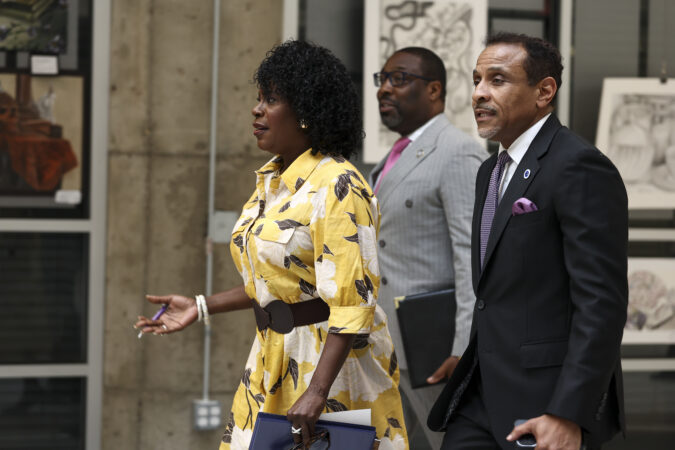
    Mayor Cherelle L. Parker and other top leaders of the city government and the Philadelphia School District will travel to Harrisburg on Monday for a high-stakes trip aimed at securing millions of dollars in new funding for the financially strapped public schools.

    Parker will spend much of the day advocating for increased public education dollars as state lawmakers hurtle toward their June 30 budget deadline. The mayor is slated to host an afternoon rally in the Capitol Rotunda alongside Superintendent Tony B. Watlington Sr., school board president Reginald L. Streater, and City Council President Kenyatta Johnson.

    Their trip to the Capitol comes after weeks of tension among those same leaders, who earlier this month hammered out a city budget deal that was in large part centered on finding new funding for the school district, which is facing a $300 million structural deficit and had planned to cut more than 300 school-based staff positions.

    Parker and school officials wanted the city to levy a $1-per-ride tax on rideshare services like Uber and Lyft to secure about $50 million a year in recurring funding, but Council rejected that plan, and instead voted on a one-time diversion of money to the district that came out of the existing city budget.

    City officials have pledged $216 million to the district over five years to keep funding the school workers, though the exact sources of that money is yet-to-be-determined.

    Parker, who served in the state legislature for a decade before becoming a City Council member and then taking office as mayor in 2024, said when she announced the new funding plan that city leaders would be able to travel to Harrisburg “saying we’ve made tough decisions, we’ve made sure we’ve done our best to take care of our own, and we have a plan.

    “Philadelphia is primed to travel to Harrisburg to advocate in unity to ensure that our children get access to the revenue that they deserve,” she said, “so that they can have a first-class school district here in the city.”

    Superintendent Tony B. Watlington Sr., school board president Reginald L. Streater, and Mayor Cherelle L. Parker stand together during an announcement at the School District of Philadelphia Headquarters on June 10 in Philadelphia. Philadelphia School District officials will move to restore 340 classroom-based jobs that were slated to be cut, despite top district leaders saying earlier that they did not have the recurring funding needed to keep the positions.

    The mayor’s message to lawmakers will be largely focused on securing capital dollars for the district’s $3 billion plan to modernize 169 aging school buildings over the next decade. In April, the school board adopted its controversial facilities plan — which includes an intention to close 17 schools — with the goal of bringing in $2 billion of that money from state and philanthropic sources.

    Finding that money in Harrisburg could be a tall task as the state faces its own multibillion-dollar budget shortfall. All 203 state representatives and half of the 50-member Senate are up for reelection this year, and many lawmakers gearing up to face voters in November are averse to broad-based tax increases aimed at juicing revenue.

    In addition, gridlock is commonplace in the divided legislature, where reaching a state budget deal has been a drawn-out and arduous process in recent years. Last year’s bitter negotiations stalled for more than five months, leading to mass service disruptions statewide.

    Gov. Josh Shapiro, a Democrat who is in the midst of his own reelection battle and is seen as a potential contender for president, has also said that he is generally not looking to raise taxes. Leaders in Harrisburg last month rejected a separate proposal by Parker to raise the city’s hotel tax to generate new funding for homelessness prevention programs.

    However, Shapiro has positioned himself as a champion of public education, and he proposed increasing the Philadelphia School District’s general funding allocation to about $2.2 billion in the coming fiscal year, a $151 million increase over this year’s amount.

    Statewide, Shapiro called for an additional $565 million for public schools as part of the state’s new “adequacy funding” formula, a multiyear plan developed to address the chronic underfunding of low-wealth school districts.

    The formula was adopted in 2024 after a Commonwealth Court ruling that the state had for years unconstitutionally deprived some children of an adequate education by sustaining a funding plan largely reliant on local property tax dollars. Philadelphia is the only school district in the state that can’t itself raise taxes. Instead, it depends on the city and state governments for funding.

    Parker said earlier this month that despite her own tax proposal to fund the schools falling through, she intends to “take this fight on the road.”

    “We stand in unity with our legislative leaders in Harrisburg, our legislative leaders on both sides of the aisle, [and] we stand with our governor,” she said. “And we fight until the end to ensure that we do everything we possibly can to ensure that our school district has access to the resources that it needs.”

  • Jean Houston, ‘midwife of souls’ who advised Hillary Clinton, dies at 89

    Jean Houston, ‘midwife of souls’ who advised Hillary Clinton, dies at 89

    Jean Houston, a spellbinding figure in the human potential movement of the 1960s who used guided imagery to inspire unmoored suburbanites, burned-out executives, and even Hillary Clinton, helping Clinton conduct imaginary conversations at the White House with Eleanor Roosevelt, died on May 16 at her home in Ashland, Ore. She was 89.

    Her death was confirmed by her friend and business partner, Constance Buffalo.

    The daughter of a gag writer for Bob Hope, George Burns, and Henny Youngman, Ms. Houston rejected any association with the word “guru,” viewing it as an intellectual demotion. She called herself an “evocateur of the possible” and a “midwife of souls.”

    “In my definition, guru is spelled ‘Gee, You Are You,’” she said on the Oprah Winfrey television show Super Soul Sunday. “I seem to be a process. I seem to be a verb of becoming, and held by the lure of becoming that keeps us going on.”

    As the founder of numerous organizations, including the Human Capacities Corp., Mystery School, Social Artistry School, and the Possible Society, Ms. Houston led workshops at empowerment retreats, in corporate boardrooms, at her geodesic-domed house in Oregon, and in far-flung countries with the United Nations.

    “She had a remarkable capacity to be present to others,” Robertson Work, a U.N. policy adviser who accompanied her on trips around the world, said in an interview. “You felt like you were being seen. You could discover: ‘What is my greatness? What is my potential?’”

    Ms. Houston synthesized mythology, the psychology of Carl Jung and Joseph Campbell, and the experiential ethos of Esalen, the California retreat that shaped the human potential movement.

    During her multiday workshops, participants engaged in imaginary conversations with historical figures like Mahatma Gandhi and Pablo Picasso, acted out the stages of evolution while pretending to be a fish or a monkey, and translated their dreams into elaborate dances.

    “The idea was that it’s possible to cultivate a higher power within yourself,” Marion Goldman, a professor emeritus of sociology and religious studies at the University of Oregon and the author of The American Soul Rush: Esalen and the Rise of Spiritual Privilege (2012), said in an interview. “By making the self a better place, you make the world a better place.”

    In addition to her workshops, Ms. Houston published more than two dozen books, including The Possible Human: A Course in Enhancing Your Physical, Mental and Creative Abilities (1982), which sold more than 400,000 copies.

    “The imaginal realms of inner space proliferate and spill over into the external world in a phenomenal growth of new science, art, music, literature, politics, and above all in a new vision of mankind and world that is the glory of humanism,” she wrote in the book’s introduction.

    There were dissenters.

    Writing in Skeptical Inquirer magazine, Martin Gardner, a critic of pseudoscience, called Ms. Houston’s workshops “bewildering” and judged her “flowery New Age jargon” to be “so vague and murky that it is often difficult to understand.” (Adding insult to injury, the article’s headline labeled her a guru.)

    Still, her pull was gravitational — even at the White House. In 1994, Ms. Houston was among a group of motivational speakers whom President Bill Clinton and the first lady invited to Camp David for a series of pick-me-up conversations after their universal healthcare initiative failed and Republicans took control of Congress.

    She and Hillary Clinton hit it off.

    “Jean wraps herself in brightly colored capes and caftans and dominates the room with her larger-than-life presence and crackling wit,” Hillary Clinton wrote in her memoir Living History (2003). “She is a walking encyclopedia, reciting poems, passages from great works of literature, historical facts and scientific data all in the same breath.”

    Ms. Houston helped Hillary Clinton prepare for a visit to India, Nepal, and Bangladesh in 1995. That year, the first lady invited her to the White House to brainstorm ideas for It Takes a Village, Hillary Clinton’s book about the well-being of children.

    Hillary Clinton was physically and mentally exhausted. Perhaps, Ms. Houston suggested, she should speak with her hero, Eleanor Roosevelt. The idea was for Clinton to talk as herself and then answer back as Roosevelt — the sort of role-playing exercise that Ms. Houston had conducted thousands of times.

    At some point, she described the sessions with Clinton to the Washington Post reporter Bob Woodward, who recounted the details in his 1996 book, The Choice. After an excerpt appeared in the Post, tabloids and Republican opponents of the Clintons accused the first lady of holding seances at the White House.

    Hillary Clinton released a lengthy statement in her defense. “This was an interesting intellectual exercise to help spark my own thoughts,” she said. “It was a brainstorming session for my book — not a spiritual event.”

    In an appearance on the Today show, Ms. Houston told Katie Couric that she was simply helping the first lady focus her mind by imagining “what she would say to Eleanor Roosevelt should she have the occasion to do so.”

    Houston felt that she had been unfairly maligned.

    “I’m not a psychic,” she said. “I’m not a guru.”

    Jean Houston was born on May 10, 1937, in Brooklyn. Her mother, Mary (Todaro) Houston, was an actor, interior designer, and stock analyst. Her father, Jack Houston, was a comedy writer.

    Growing up, she found inspiration in a dummy. When she was 8, she accompanied her father to deliver a script to the ventriloquist Edgar Bergen. Upon arriving, they found Bergen talking to his plastic-and-wood buddy, Charlie McCarthy.

    “Charlie, what is the meaning of life?” Bergen asked the dummy, as Ms. Houston recalled in her memoir, A Mythic Life (1996). “What is the nature of love? Is there any truth to be found?”

    The dummy mumbled some answers.

    “At that moment,” Ms. Houston wrote, “my skin turned to gooseflesh, an electric hand seemed to touch mine, and a fractal wave of my future activities crashed on the shore of my 8-year-old self. For I suddenly knew that we all contain ‘so much more’ than we think we do.”

    Her epiphanies proliferated. On a school trip, she met Helen Keller and marveled at how happy she seemed despite being blind and deaf. She joined an international pen pal club and corresponded about the scriptures of Sikhs, Hindus, and Buddhists. She had long conversations with an old man in Central Park; later, she discovered that she had been talking to philosopher Pierre Teilhard de Chardin.

    “When you befriend your own brain,” she said, “a great deal becomes possible.”

    At Barnard, she studied religion and theater, acting in off-Broadway plays at night. She attended a doctoral program in religion offered by Columbia University and the Union Theological Seminary, but did not receive a degree. (She later received one in psychology from Union Institute in Cincinnati.)

    During graduate school, while conducting studies on LSD use, she met Robert E.L. Masters Jr., a writer. They married in 1965 and spent their honeymoon writing The Varieties of Psychedelic Experience, which was reviewed on the cover of the New York Times Book Review.

    Also in 1965, the couple founded the Foundation for Mind Research, the first of many organizations that Ms. Houston started to promote and study human potential.

    “We are living at the beginnings of the golden age of brain, mind, and body research,” she told the Washington Post in 1978. “We may well be standing, with regard to these, where Einstein stood in the year 1904 with his discovery of the special theory of relativity.”

    Masters died in 2008. Ms. Houston has no immediate survivors.

    Among her fondest memories was her childhood meeting with Keller, who was then in her late 60s — a story she recounted often.

    Keller put her hand on Jean’s face to read her lips.

    “Why are you so happy?” Jean asked.

    “My child,” Keller responded, “it is because I live my life each day as if it were my last. And life in all its moments is so full of glory.”

    This article originally appeared in the New York Times.