Airbnb is activating its “anti-party” technology again for Memorial Day weekend as the global rental property giant doubles down on its no-party policies.
Temporary changes to the online booking system will deter potential “higher risk” bookings during Memorial Day weekend. At the time of publishing, Airbnb did not specify the exact dates and times the technology would be operating.
Last year, Airbnb said this technology deterred nearly 11,000 people from booking entire homes over Memorial Day weekend. In Philadelphia, 85 people were deterred from entire-home booking that same time period.
The system looks at the type of listing being booked, the duration of the stay, the distance from the guest’s primary location, and whether the booking is made last minute, to determine whether a booking should be deterred, according to Airbnb.
Airbnb has tied certain entire-home bookings to the potentially disruptive parties for which rental platforms garnered a reputation in earlier years, including in the Philadelphia region. Muhammad Ali’s Cherry Hill mansion, which still operates as a rental property on platforms like Vrbo and Expedia, was the site of countless “wild parties” that led police to visit the home 97 times between 2018 and 2019, according to an Inquirer report.
The anti-party technology deters potential house party bookings toward private room listing or hotels hosted on the platform.
“Our investment in anti-party technology, along with clear policies and consequences, reflects our commitment to supporting positive stays and countering the rare few who would try to break the trust our platform and local communities are built on,” said Rog Kaiser, vice president of fraud and safety operations at Airbnb.
In 2022, Airbnb made its COVID-era “party ban” permanent, making it against the rules for all users year-round to book entire homes solely for large parties.
Airbnb was also reminding parents and guardians that children under 18 cannot have Airbnb accounts and parents cannot book rentals for underage guests without the parent being on-site. Violating these rules can lead to bans and financial costs in the case of damages.
Since these measures were put in place, in 2025, less than 1% of U.S. rental bookings resulted in a report of a party to Airbnb, according to the company.
The future of a family farm in rural Salem County was at stake, and after multiple meetings and hours of presentations, questions, pleas, and complaints, a local planning board was set to vote.
Before the vote, one longtime resident of Mannington Township came to the podium with a warning. In preparation for this crowded, mid-March meeting, Alice Waddington, 98, said she’d made a list of dairy farms she remembered from her decades in the little town.
At one time, she said, there were close to a dozen.
“There’s only one farm left milking cows,” Waddington told the board, “and that’s the Cadwalladers.”
The Cadwalladers were struggling in the volatile dairy industry, though, and believed a large solar project could be a lifeline, a way to avoid shuttering and selling to developers eager to build warehouses, data centers, and housing in the nation’s most densely populated state.
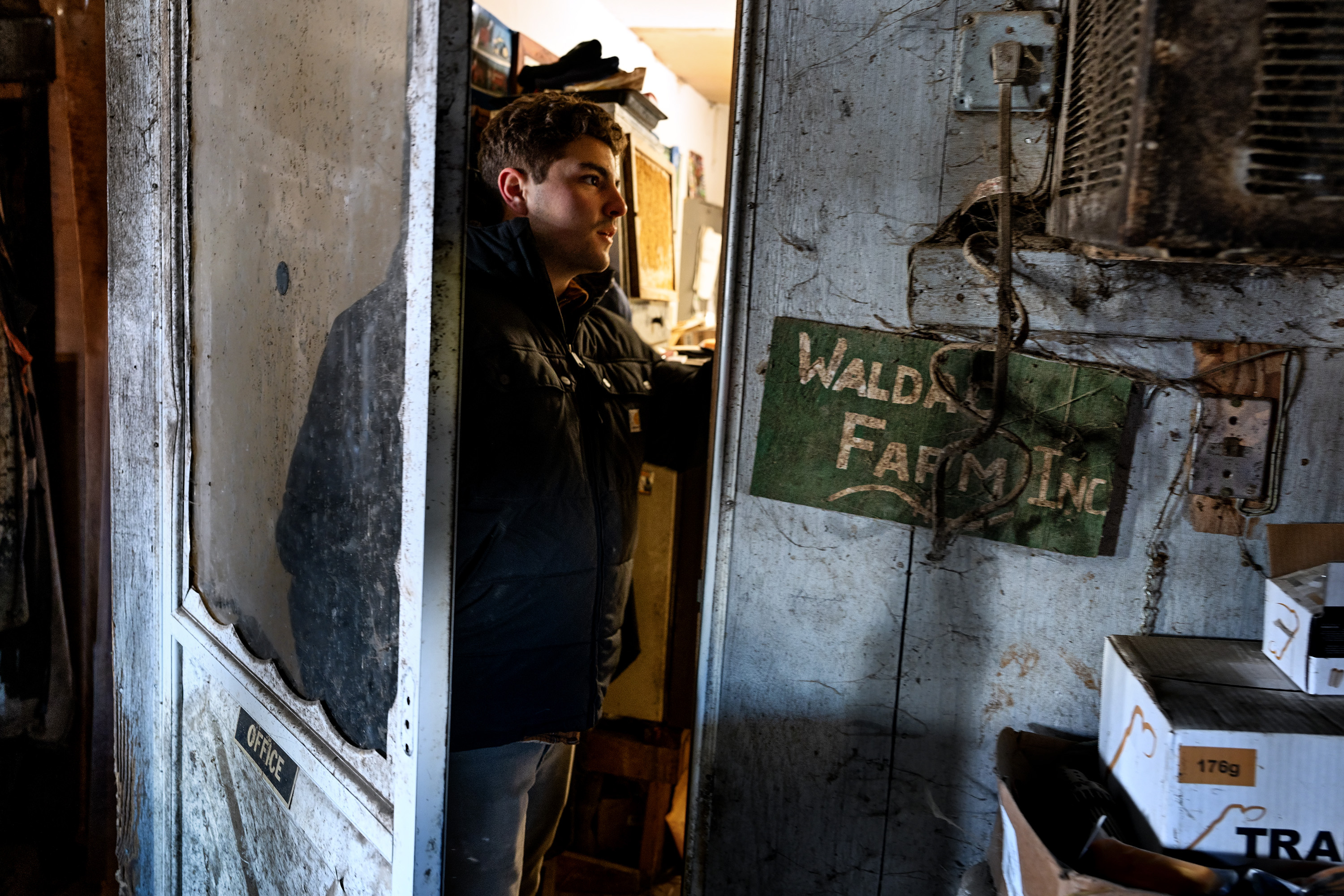
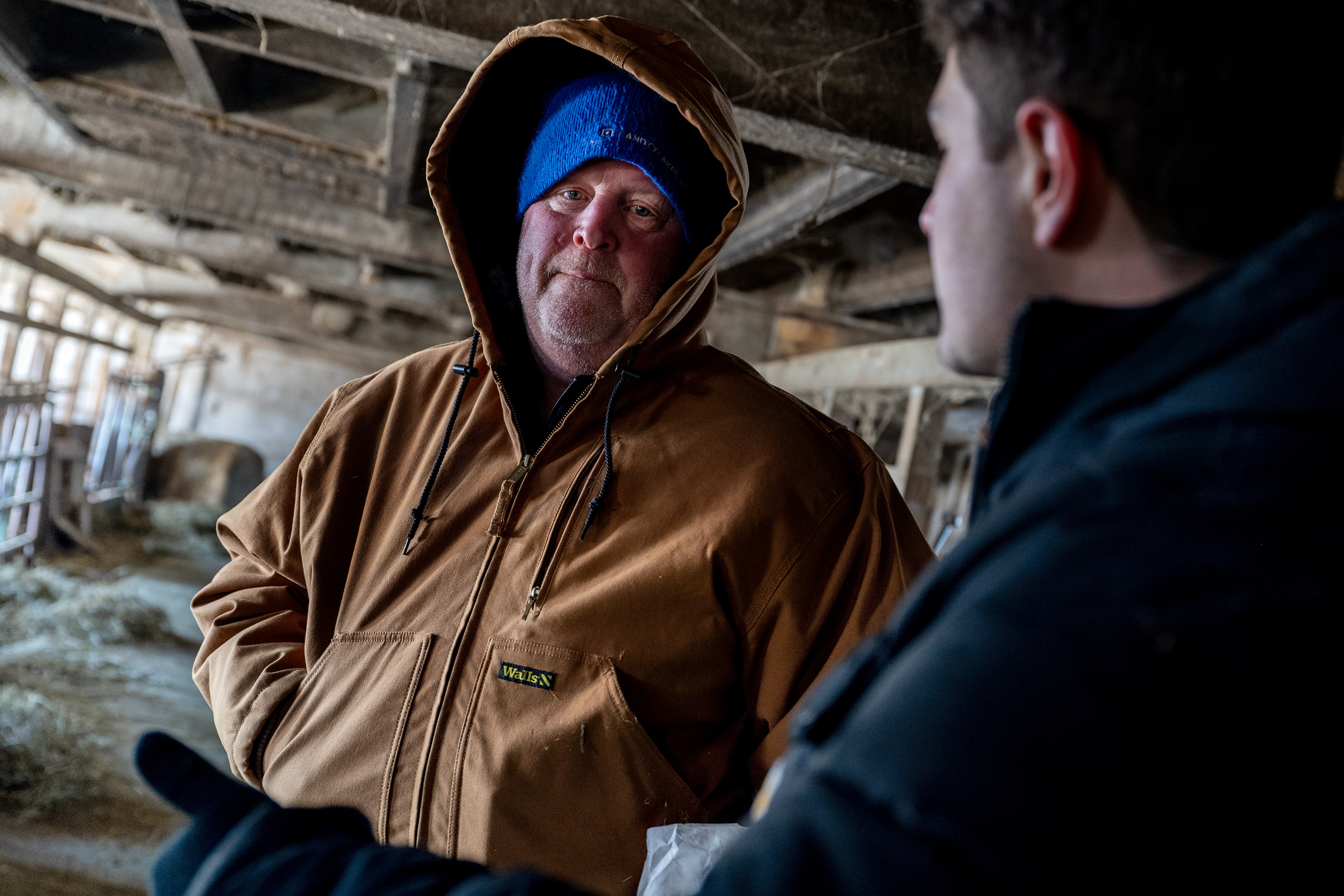
Farmer David Cadwallader at Waldac Farms in Salem, N.J., on Jan. 29.
This was the fourth Mannington Township planning board meeting for the Cadwalladers, who were seeking a variance to install 300 acres of solar panels on Waldac Farm that would, eventually, generate enough energy to power 19,000 homes annually.
Some board members and locals questioned the environmental impacts, whether it would affect the soil, injure the abundant wildlife in the area, or taint the nearby Delaware River watershed. Representatives from AES Corp., a Virginia company that would build the solar project and pay a lease to the Cadwalladers, had answers for all of them.
“Whether we all, in this room, agree with it or not, it is the state’s policy to advance these types of solar energy uses to meet the energy demands that we need,” Keith Davis, an attorney representing AES, told the planning board.
What they couldn’t seem to quell, however, were the repeating concerns about how a solar farm would look in New Jersey’s most rural county. Those concerns raised open-ended, philosophical questions: What’s a working farm supposed to look like? What exactly does rural mean?
“It will destroy property values and will be an eyesore for our township,” a neighbor of the Cadwalladers commented on a 2025 Facebook post about the project.
Similar situations have played out nationwide. A recent Associated Press story from Ohio highlighted a struggling farmer’s solar project that also faced community pushback and was ultimately blocked.
In Salem County, Mannington planning board member Joanne Wright was the most vocal at the meeting. She mentioned, often, that Mannington’s master plan called for maintaining “scenic vistas” and its rural, agricultural characteristics.
The Cadwalladers said they would plant pollinator habitats and plants on the solar farm, and introduce roughly 300 sheep to graze around and under the panels. The combination of solar and agriculture — “agrovoltaics” — is supported by the New Jersey Farm Bureau, Andrew Cadwallader pointed out.
Wright, however, thought solar panels would break up the township’s “contiguous farmland.”
“I’m just wondering how you see that the positive outweighs the negative,” Wright asked representatives from AES.
Farmer Andrew Cadwallader at Waldac Farms in Salem, N.J., on Jan. 29.
A picturesque farm
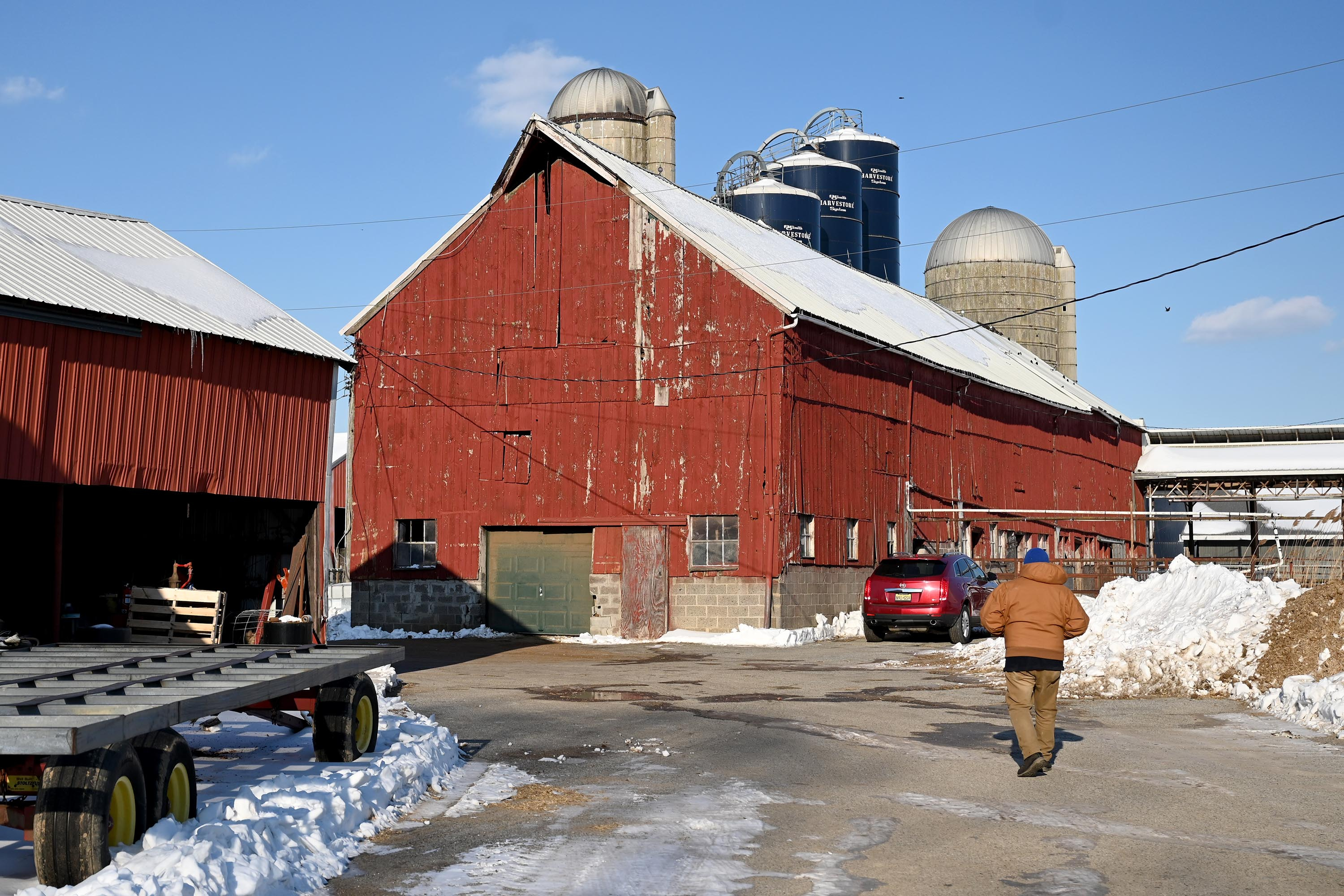
The Cadwallader family has been farming since the 1860s, and Waldac Farms certainly looks the part: There’s a circa-1790 farmhouse down a long dirt road, a slew of silos dotting the flat landscape, and big red barns, faded by time, that are full of cows and cats.It was mostly silent there, too, aside from the winter wind.
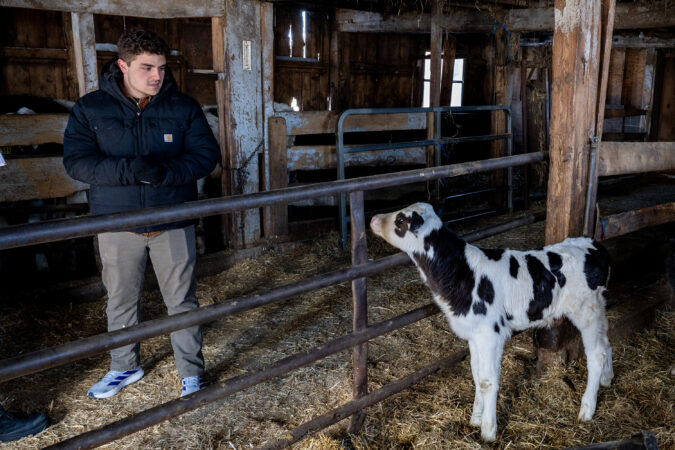
The only thing that seems out of place on the family farm on a frigid afternoon is Andrew Cadwallader. The college senior looks younger than 22, and his sneakers and pants were impeccably clean.
Andrew’s been milking cows since before his baby teeth fell out, though.
In 2007, a South Jersey newspaper visited the Cadwalladers to discuss the dismal state of dairy farming at the time. The newspaper took a picture of Andrew, then 3, surrounded by cows in a pen. His father, David, told the newspaper he’d love to pass the farm down to his son.
“If he wants it,” David Cadwallader said.
From the Press of Atlantic City on March 12, 2007: The state is trying to revitalize its dairy farm industry. With his 3-year-old son Andrew, David Cadwallader prepares his cows for their 3 p.m. milking at Waldac, his Woodstown dairy farm.
Andrew is set to graduate from Haverford College with a degree in political science. He’s merged his life history — agriculture and geology — with his interests in politics and government, and recently began an internship for CNN’s Michael Smerconish, a Bucks County native.
Andrew’s an only child, and, yes, he wants to farm, bucking a trend that’s seen the average age of farmers, 58.1, rise steadily, according to the 2022 U.S. Census of Agriculture Data.
“I’m coming back here after I graduate,” he said.
Nationwide, small dairy farms like Waldac have continued to shutter at a rapid rate since Andrew was in the local newspaper.
Overall, milk production is up in the United States. That’s because modern genetics has produced cows that make more milk than their ancestors. Those big production numbers are coming from massive farms with large herds, too.
The Cadwalladers milk about 130 dairy cows on approximately 500 acres, and small farms like theirs have been decimated. In 2005, according to the USDA, there were 78,295 dairy farms in the United States. In 2025, that number was 23,609, a 70% decrease in just 20 years.
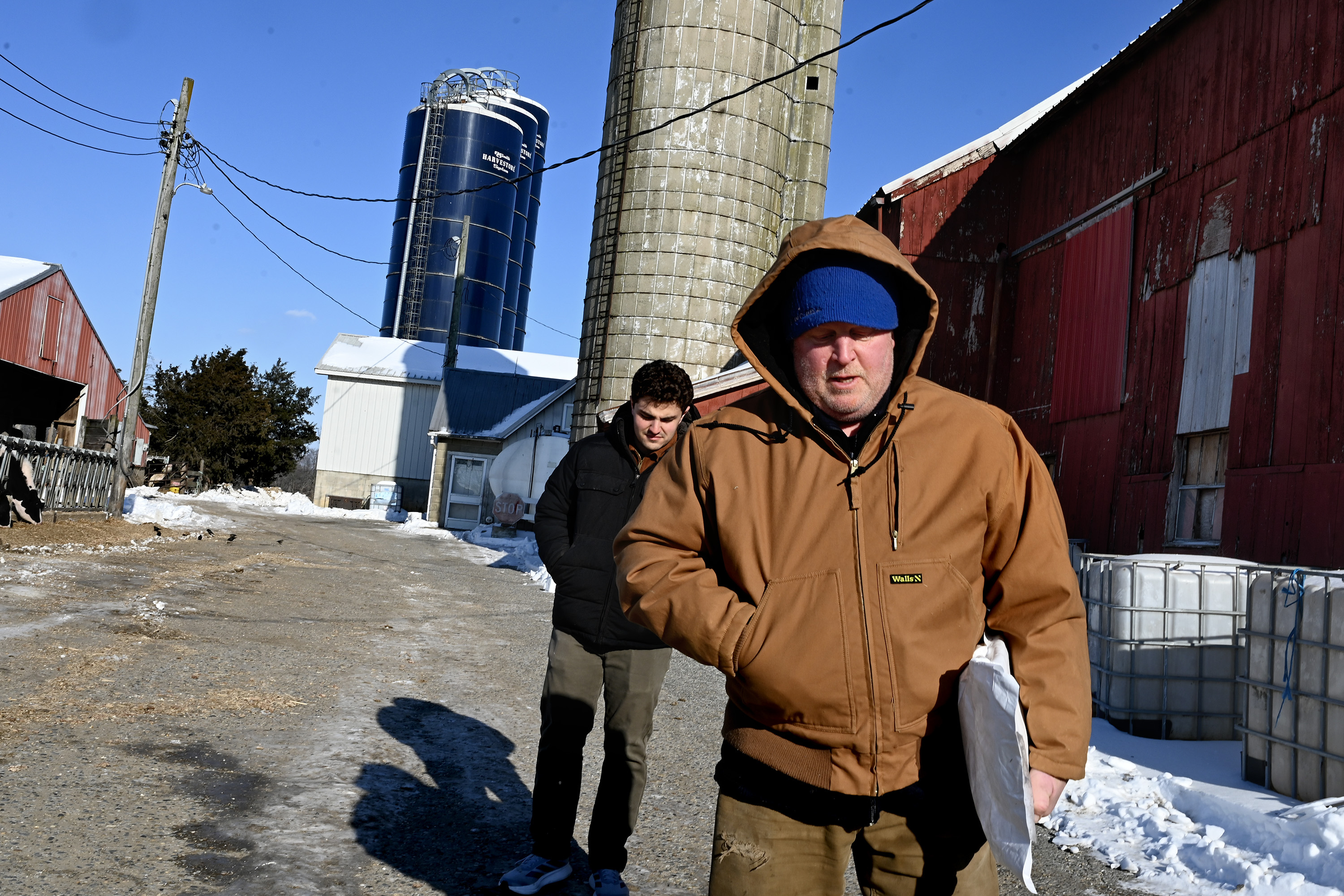
Farmers Andrew Cadwallader and his father David Cadwallader (front) at Waldac Farms in Salem, N.J., on Jan. 29.
Andrew Cadwallader declined to go into exact figures but said the family would be “paid well” by the AES lease. Waldac Farms would pivot to sheep and the sale of their lambs, while possibly still milking cows on a smaller scale.
“We have been losing money for the last 10 years,” Andrew said of the dairy operation.
AES approached the family about “solar grazing” during the pandemic, Andrew said, and as they sought a use variance from the Mannington planning board to move forward, he became the project’s public face. Andrew made numerous, lengthy Facebook posts in local groups about the project to be transparent.
“Will we continue to hope that the price of milk goes up and risk failure, or will we pivot and change?” Andrew wrote in the Salem County Advocates group in November.
Many comments were supportive or neutral, in a libertarian “it’s your land” way. There was plenty of pushback, though, and Andrew said it was disheartening to see how many comments focused on visual impact.
“I’m glad people can worry about the look of the farm,” he said in late January. “We have to worry about making a living.”
Cadwallader said flat farmland is not a natural part of landscapes in South Jersey. People have just gotten used to seeing it. His farmland was likely cleared of trees by the native Lenni-Lenape centuries ago, he said. Barns and tractors are industrial buildings and commercial machinery, he said, not quaint antiques.
“They are prioritizing the look, and it’s not reality,” he said. “It’s not a natural feature.”
Still, Cadwallader felt confident, on a late January afternoon on his farm, that the planning board might approve the project.
Jennifer Kugler, founder of the nonprofit South Jersey Preservation, visited Andrew’s farm shortly before the planning board meeting with her children and wrote a lengthy Facebook post in support of his plan that received 573 likes.
“The Cadwalladers want to evolve,” Kugler wrote. “This means new solutions are necessary to ensure the continued viability of the farming operation. For farmers, this can be incredibly scary.”
Kugler, 42, lives in Pilesgrove, Salem County, home to America’s oldest continuously-operating rodeo. She was raised on a dairy farm in Lackawanna County. That farm closed in the 1990s and never reopened, and part of her goal with South Jersey Preservations, she said, is to prevent more small farms from folding.
“We support farmers continuing to farm,” she told The Inquirer.
Farmers Andrew Cadwallader and his father David Cadwallader (left) at Waldac Farms in Salem, N.J., on Jan. 29.
To preserve or not to preserve
While the Cadwalladers would prefer the solar project, there are other options to keep farms afloat in New Jersey. The state’s Farmland Preservation Program is a common way to ensure that housing and warehouse developers don’t buy up farms. It’s a relatively simple process.
The program uses a combination of federal, state, county, municipal, and nonprofit funds to buy a farm’s development rights. The purchase price, according to the program’s website, is “based on the difference between what a developer would pay for the land and what it is worth for agriculture.”
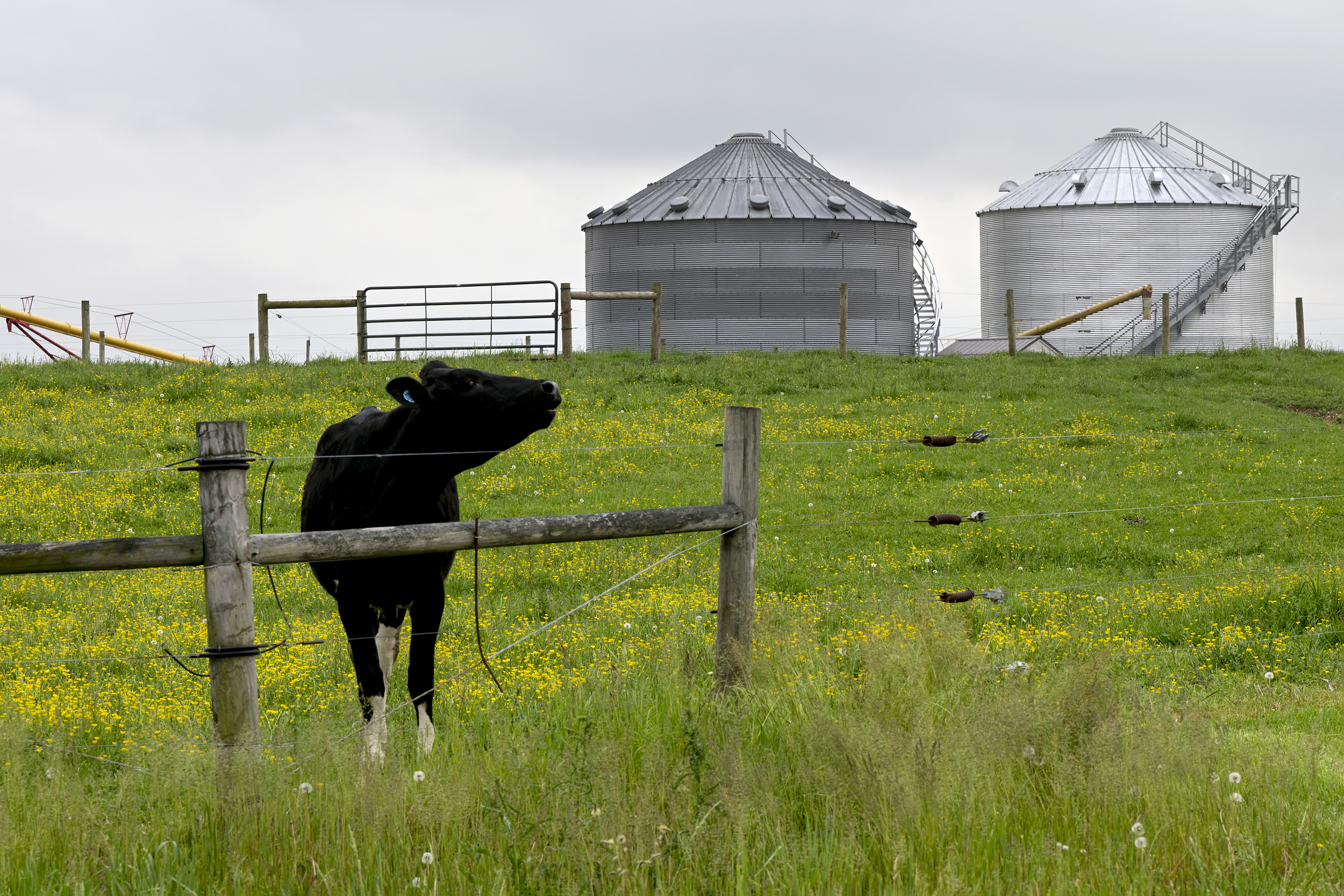
A cow at a farm along Route 49 in Salem County, N.J., on May 6, 2024.
In turn, farmers get a much-needed payout while keeping their agricultural operation running. If those farmers choose to sell their land someday, deed restrictions require the property to be used for agricultural purposes or otherwise remain undeveloped.
“You can’t do additional residential or commercial improvements. You can’t turn it into a housing development or a Walmart,” said Charles Roohr, executive director of the New Jersey State Agriculture Development Committee.
Since the program began in 1984, Roohr said New Jersey has preserved 250,000-plus acres, with a goal of 500,000 acres. Salem County leads the way among counties, with more than 43,000 preserved acres.
The family has not ruled out farmland preservation if the solar project is rejected, but they were concerned about some of the potential restrictions and complications.
“It’d be like a bailout, but we have 500 acres,” Andrew said on the farm in late January. “We need to figure out what the heck we’re going to do with the 500 acres that’s going to actually make us some money.”
Cowtown Rodeo in Pilesgrove, N.J.
A complicated farmland preservation issue played out right in Mannington in recent years, when Mannington Deputy Mayor Robert DiGregorio filed a civil rights lawsuit against local and county officials in 2021. According to the lawsuit and Transparency NJ,, DiGregorio was holding weddings, private parties, and nonprofit functions on his preserved, 78-acre farm, but was told by officials that he would need variances and site plan approvals or waivers to continue. The back-and-forth between those officials and DiGregorio, according to Transparency NJ, almost grew physical.
Farmers Andrew Cadwallader and his father David Cadwallader (left) with plans at Waldac Farms in Salem, N.J., on Jan. 29.
In April, Mannington agreed to pay DiGregorio $55,000 to end the lawsuit, according to an article in NJ.com. Neither DiGregorio, who is on the planning board, nor his attorney returned requests for comment. It’s unclear if he will continue to host events on his farm.
Roohr, commenting on farmland preservation restrictions in general, said events are allowed if “the purpose of the event is to sell the things that you’re producing on your farm.”
A tomato festival on a tomato farm would be fine, for example. A folk festival on a tomato farm would probably require a special-use permit.
“If the main purpose of the event is some other focus and your stuff ‘might’ get sold as a side benefit, then we consider that a non-agricultural use. And so the greatest example of that would be a wedding.”
Roohr said the preservation program is more important than ever, as data centers look to build in rural areas nationwide.
“We have over 200 applications [for farmland preservation] in our office right now,” he said.
The Cadwalladers said they have no plans to sell to a developer.
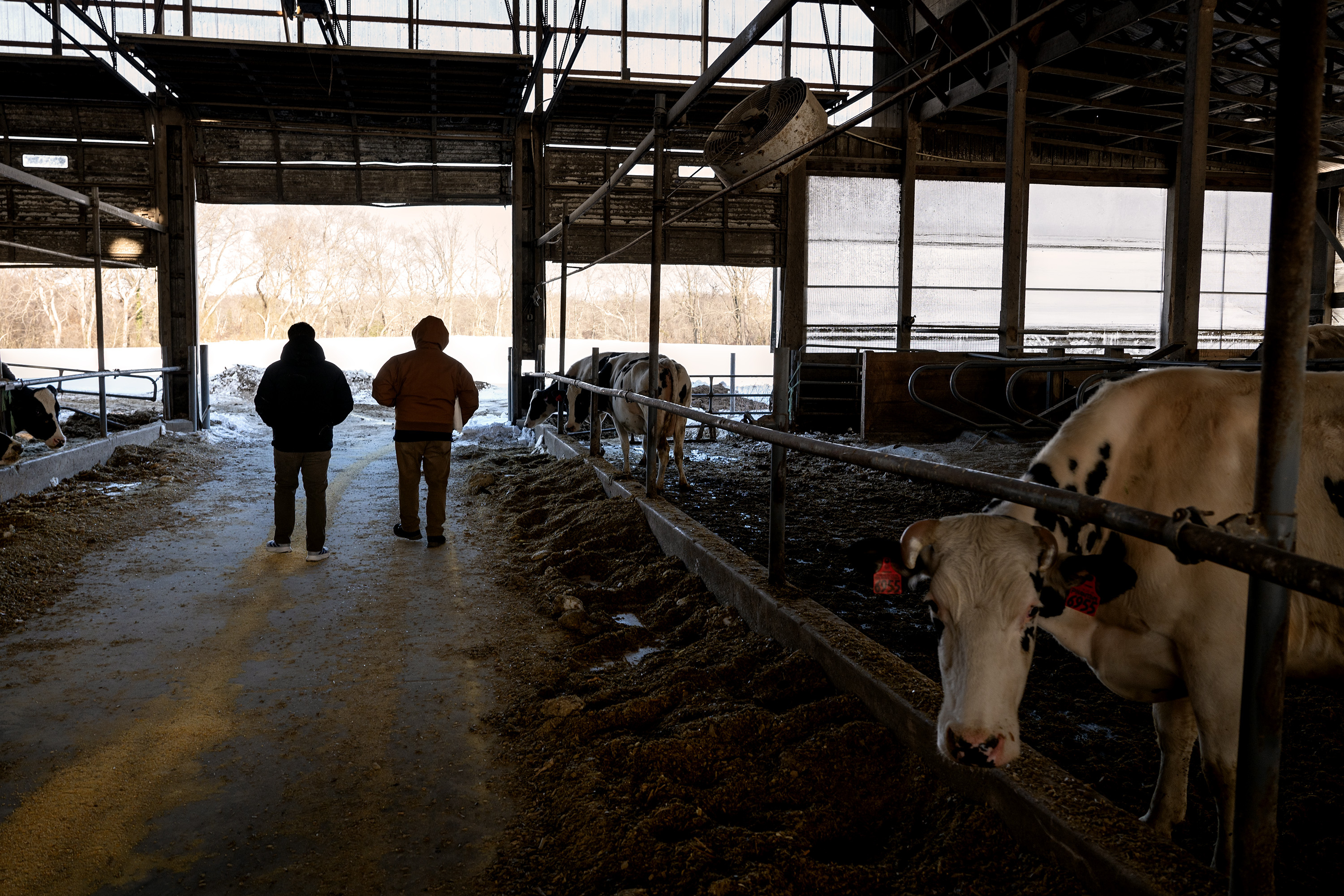
Farmers Andrew Cadwallader and his father David Cadwallader (right) at Waldac Farms in Salem, N.J., on Jan. 29.
The vote
Along with Alice Waddington, numerous others spoke at the March planning board meeting. Union officials said the solar project would bring jobs (AES put the number between 75 and 100). Some spoke in support of Andrew Cadwallader and his love for the ecosystem. Still, others talked about protecting Mannington’s “rural identity” and fears that the project could affect property values.
Andrew Cadwallader was the last member of the public to speak.
“As a family, we’re at a crossroads,” he said. “We can’t risk volatility anymore as a family and as a farm.”
When he was finished, Davis gave a final summation on behalf of AES and the Cadwalladers. Minutes later, the planning board made a resounding 6-1 vote, shooting down the project.
Cadwallader hung his head and gave a half-smile and some quiet “thank yous” to the attendees who patted his shoulder and shook his hand.
Laura Kellogg, a development manager for AES, said the team was disappointed but would continue to “evaluate next steps for the project.”
A week later, Andrew Cadwallader said he and the family were still dealing with the disappointment and contemplating their next move.
“People like this area so much, but we love it. No one loves this land more than my family,” he said. “People have to understand that a working farm is not a museum.”
Cadwallader’s life was getting busier at Haverford, too. He was taking geology classes and working on a senior thesis about preserving “the agricultural viability of mid-sized farming operations in the United States.”
Andrew drives the 38 miles south from college, back to Salem County, every weekend. A week or so after the meeting, though, Alice Waddington’s warning to the planning board, and the people of Mannington, proved prophetic.
Waldac still looked like a farm to neighbors and motorists passing by, but the Cadwalladers had stopped milking cows.
Correction: This article has been corrected to reflect that AES Corp. is based out of Virginia.
The Inquirer’s Jackie Spiegel sits down with NBC Sports Philadelphia Jim Jackson to break down the possible outcomes of the Flyers vs. Hurricanes playoff matchup. Watch here.
This interview was recorded prior to the disclosure that forward Noah Cates will miss the series with a lower-body injury.
ATLANTIC CITY — When the nation’s largest smoke shop expo descended on the convention center here earlier this spring, sales reps scrambled to offload pallets of a controversial synthetic kratom product known as “7-OH” before lawmakers in Pennsylvania and New Jersey ban their products.
The addictive drug 7-Hydroxymitragynine, a highly concentrated lab-made compound derived from the kratom plant, flooded the bustling floor of the CHAMPS trade show.
Yet some vendors said they weren’t worried about bills working their way through Harrisburg and Trenton.
Their suppliers had already cooked up new recipes.
Matt Swann, a real estate investor turned 7-OH distributor from Salt Lake City, promoted a new product called “Cori,” a four-pack of tablets wrapped in a sleek green package. Swann’s offering draws from corydalis, yet another plant from East Asia that produces similar pain-killing alkaloids to kratom — but is not the target of any proposed bans.
“Legislation is what shuts me down,” Swann said, at his one-man expo booth in March. “This is how we stay ahead.”
Half a dozen 7-OH sales reps told The Inquirer that companies are changing their formulas to preemptively sidestep legislation prompted by concerns over the drug widely dubbed “gas station heroin” for its promised high and addictive potential.
Federal authorities began taking steps last summer to classify 7-OH as a controlled substance due to its widespread availability and reports of abuse. At least a dozen states have moved to outlaw the substance, and bills in Pennsylvania and New Jersey are being considered.
But in the booming gray market for synthetic drugs — from kratom to lab-made THC to psychedelics — the difference between legal and illegal can be as small as a molecule.
Perks’ booth at the CHAMPS B2B trade show at the Atlantic City Convention Center on March 19.
To dodge the crackdown, some companies are swapping their active ingredient from 7-OH to a related compound called mitragynine pseudoindoxyl, or “pseudo.” Others are pivoting to 13-Hydroxy Mitragynine, or “13-OH.” Both function in similar ways, binding to opioid receptors in the brain.
And vendors promised the variants are just as powerful.
Some kratom advocates welcome restrictions on 7-OH and other chemically concentrated alkaloids. But they also worry that lower potency, natural kratom products will get caught up in sweeping bans.
Swann criticized the panic around 7-OH. He described both it and his new corydalis product as safer alternatives to opioids that can help people living with chronic pain.
Swann said he is clear with buyers about the risk of dependency. Kratom-derived pain relievers are far less fatal than opioids, whose pharmaceutical producers, he argued, are threatened by the drug’s popularity.
“It’s the safest alternative,” he said. “Kratom is 10-fold the product.”
Matt Swann at his Siete 7 / Coco Distro booth At the CHAMPS B2B trade show at the Atlantic City Convention Center.
A game of molecules
Last summer, Florida passed an emergency ban specifically targeting 7-OH. Other states, like Vermont, have banned kratom altogether, as well as any related alkaloids, preemptively cutting out alternative compounds like 13-OH or pseudo.
New Jersey lawmakers are advancing legislation that would similarly classify 7-OH as a controlled substance, although it makes no mention of these related alkaloids.
Another bill under consideration in Harrisburg mimics Vermont’s strategy by outlawing all products that contain over 2% 7-Hydroxymitragynine, as well as any other “synthetic, semi-synthetic, or chemically manipulated alkaloid” derived from the kratom plant.
“They can call it whatever they want,” said Sen. Tracy Pennycuick (R., Montgomery County), the bill’s lead sponsor. “If it comes up 2%, it’s still banned.”
Still, as written, the ban might cover new variants like “pseudo” and 13-OH but not the latest extracts from the corydalis plant.
Meanwhile, pro-kratom lobbying groups have pushed lawmakers to create clear legal definitions between naturally sourced, low-potency kratom products and those ultra-concentrated, synthetic forms like 7-OH.
Dallas Vasquez, CEO of Mitra9, a Florida-based company that distributes kratom and kava-infused beverages across the country, said the two products are “not equivalent from a chemistry or pharmacological standpoint.”
He said Mitra9 does not use concentrated 7-OH to make the drinks more potent. His products contain less than 2% total kratom alkaloids, with low levels of 7-OH that occur naturally in extracts from the plant leaves, according to lab tests reported on Mitra9’s website.
“My business is built on the bet that the responsible segment of the market will survive,” Vasquez said. “If it doesn’t, I lose too. So I have every incentive to be honest about what the products are.”
Kratom booth at the CHAMPS B2B trade show at the Atlantic City Convention Center on March 19.
Booming profits, clandestine makers
The CHAMPS trade show traditionally serves as a meetup for recreational drugmakers and retailers of cannabis. That the kiosks were dominated by 7-OH vendors is a sign of kratom’s growing popularity and profitability.
Large kratom companies pushing products with opioid-inspired names like “Opia” and “Perks” can bring in millions in revenue per month, according to Swann, the vendor from Salt Lake City.
Many companies are supplied by a small network of kratom manufacturers that synthesize products, often on condition that the makers’ names be kept secret, according to Swann and company owners who spoke with The Inquirer. So long as the compounds remain legal at the federal level, there are labs willing to make them en masse, which sellers like Swann can distribute in states without total bans.
For everyone involved, profits are high.
“[Manufacturer] profit margins are in the 5 to 10% range, but they’re doing millions and millions of dollars,” Swann said. “My profit margin is closer to 200% to 300%. If I invest a quarter-million dollars, I can usually come out with a million.”
Swann said he started his own business with $250,000 in capital and a phone call to a lab in Utah. His brand, Siete, launched within months. He estimated that his new “Cori” product had a life span of three years before it, too, would be banned.
Camille Winans, a sales representative for a company selling new 13-OH products, argued that kratom had been demonized by lawmakers and that keeping the products on shelves amounted to “harm reduction.”
However, medical experts say there has been an uptick in admissions to rehabs from people who got hooked on kratom, including in Pennsylvania.
Jason Kirby, chief medical officer of Recovery Centers of America, worries that states would ban 7-OH without the necessary medical resources for people who are dependent on it. He said hospitals struggle with an influx of kratom users in states that passed sweeping bans.
“One day it’s legal, and the next day it’s not,” he said. “So I’m going into the vape shop to refill my need, and it’s not there anymore, and I’m going to the emergency room in withdrawal.”
Bans would also not prevent manufacturers from finding new loopholes, he said.
“We’re gonna be dealing with a brand new synthetic substance that we’re gonna have to figure out all over again, and figure out pathways and management for,” he said. “We always have to stay ahead of them.”
Haverford College will not consider removing U.S. Commerce Secretary and mega donor Howard Lutnick’s name from its library despite student calls to do so, the school announced Wednesday.
President Wendy Raymond’s announcement came 30 days after the student body voted by an overwhelming majority to ask that she establish a review committee to consider removing his name. But Raymond said she will not accept the student body’s resolution.
“I do not believe this matter meets the threshold necessary to move forward with a committee,” Raymond wrote in an email to the students’ council copresidents.
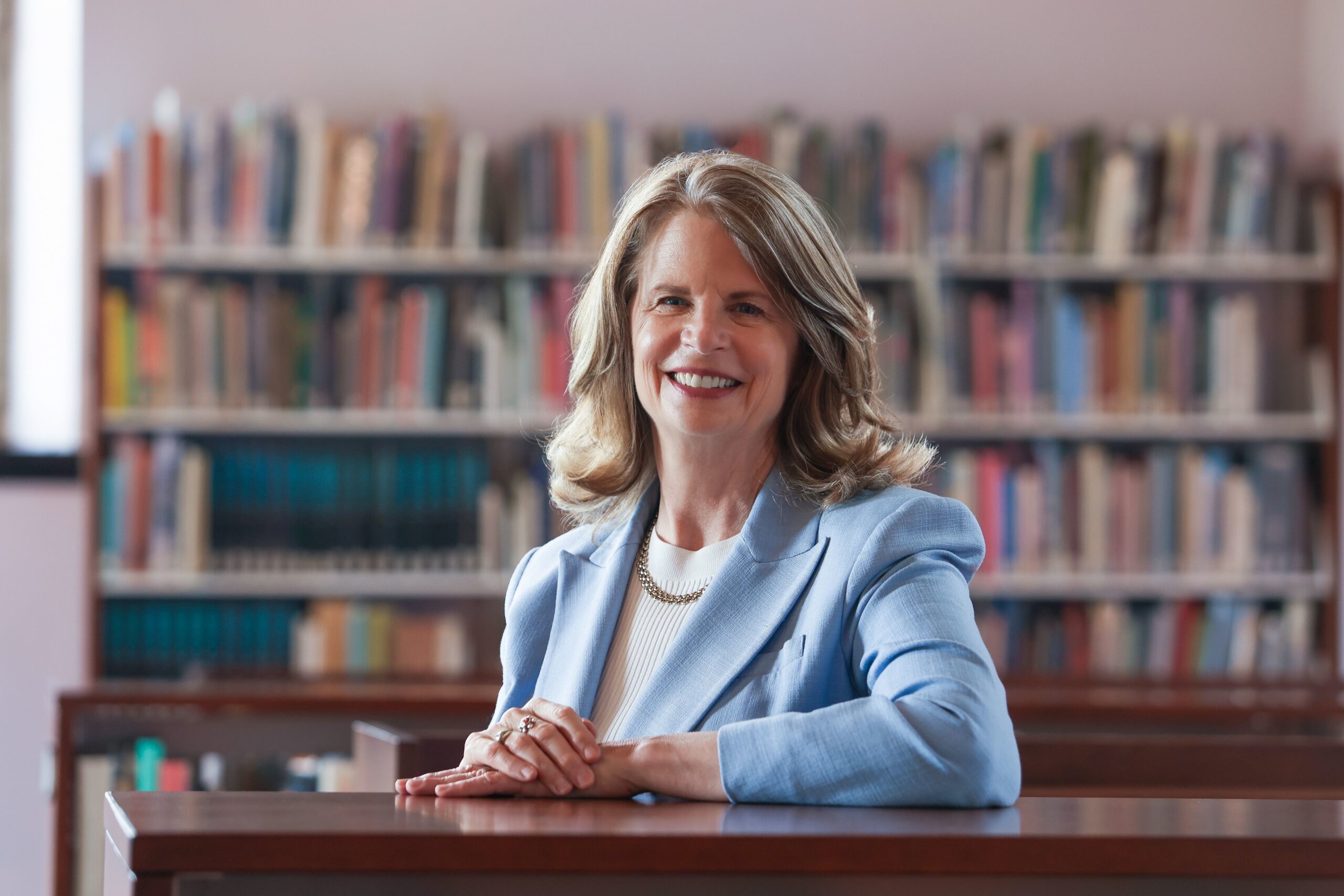
Haverford College President Wendy Raymond announced she would not consider removing Howard Lutnick’s name from the school’s library.
Concern has been mounting about Lutnick, the former chair of Haverford’s board of managers, since Department of Justice documents released earlier this year showed he had contact with sex offender Jeffrey Epstein as recently as 2018, long after Epstein pleaded guilty to obtaining a minor for prostitution and soliciting a prostitute.
Raymond did not elaborate on her reasons and declined to comment through a spokesperson, but the decision was immediately panned by students.
The council copresidents expressed their “deep disappointment” in an email to students.
“The committee would have been a valuable step in our college’s ongoing reckoning with sexual assault,” wrote Ben Fligelman and Sarah Weill-Jones. “We hope that in the coming weeks and months, President Raymond will reevaluate her decision and understand the profound importance of convening a review committee.”
The outside of the Lutnick Library at Haverford College.
The Haverford Survivor Collective, which started in 2023 and is led by Haverford students and survivors of sexual assault, called the decision “disappointing, unsurprising and categorically insulting” in a statement. It is even more painful that the decision was released on Denim Day, an international day of support for survivors, the collective wrote.
“What should have been a meaningful day of solidarity and collective support has instead become a stinging reminder of how far Haverford still has to go,” the group wrote.
Senior English major Paeton Smith-Hiebert, co-founder of the collective, said Raymond in a meeting with some students Tuesday shared her reasoning for why the Lutnick situation did not meet the threshold.
Raymond said, according to Smith-Hiebert, there needed to be “pretty unambiguous evidence of harm being directly committed” and that “association wasn’t enough.”
Arshia Seth, another student who is a member of the collective board, said when pressed by those present, Raymond said the threshold would be if Lutnick had “direct ties to trafficking.”
The president also told students she wished she had had more time to make the decision, but plenary rules require that she respond within 30 days, Smith-Hiebert said. Whether that means she will continue to weigh the matter is unclear.
“Looking forward, … I — and future presidents — will retain the ongoing responsibility to consider the relevant facts at any given moment in time, and to act in consideration of the best interests of Haverford’s educational mission,” Raymond, who announced in November she would retire as president in June 2027, said in her statement. “…The board of managers too will remain engaged.”
Raymond’s announcement Wednesday also said she and the college “stand in solidarity with survivors of sexual violence.”
Raymond previously said she had heard from “a growing number” of Haverford alumni “who have written to express their dismay” about Lutnick’s ties to Epstein, which included a visit by Lutnick and his wife to Epstein’s private island. She said in February that she would consider forming a review committee.
Lutnick’s name was put on the library after a then-record $25 million donation he and his wife made in 2014. Lutnick, a 1983 Haverford graduate, has given the school $65 million and is one of its biggest donors.
If Raymond had established a committee, it would have kick-started a multistep process that the school follows when considering changing building names. Raymondwould have considered the committee recommendation before then making her own recommendation to the external affairs committee of the board of managers, as well as to its chair and vice chair. The external affairs committee then would have made its recommendation to the full board of managers, who ultimately decide whether a building should be renamed.
Under Haverford’s gift policy, the school can rename a building if “the continued use of the name may be deemed detrimental to the college, or if circumstances change regarding the reason for the naming.”
The students’ vote came during their plenary session on March 29. At least 66% of the student body living on campus had to be present at the session for discussion and votes to occur, and to pass, the resolution needed to win a simple majority. That 66% represents almost 900 students.
“Students feel harmed and hurt by the presence of his name and association on campus,” Milja Dann, a sophomore psychology major from Woodbury, N.J., said in March, after attending the session.
The Haverford Survivor Collective had been urging the college to form a committee even before the plenary.
“Given the gravity of this situation, survivors are among those most directly affected,” Smith-Hiebert had written to Raymond earlier this year. “Many are feeling significant harm and institutional betrayal … While I understand there are many stakeholders to consult, it is difficult to reconcile the stated commitment to engagement with the apparent absence of those most impacted.”
The student resolution asked the college to include student representation on the review committee, along with staff from several offices, including institutional diversity, equity, and access. It also called on college leadership “to stand in solidarity with victims of assault.”
And it asked the board of managers to consult directly with students before making final decisions to rename the library and or whom it would be named for.
The resolution also called into question Lutnick’s leadership at Cantor Fitzgerald, the New York City financial firm where he formerly served as chairman. The Securities and Exchange Commission charged the firm in 2024 with violating laws related to regulatory disclosure, and Cantor agreed to pay a civil penalty. Cantor Gaming in 2016 agreed to pay $16.5 million in penalties to the federal government “to resolve a criminal investigation into the company’s past involvement in illegal gambling and money laundering schemes,” according to a release from the U.S. Attorney’s Office.
During congressional testimony, Lutnick said he visited Epstein’s island with his family in 2012. Lutnick previously said he had not been in a room with Epstein, whom he found “disgusting,” since 2005.
A Commerce Department spokesperson told The Associated Press in January that Lutnick had had “limited interactions” with Epstein, with his wife in attendance, and had not been accused of “wrongdoing.” Lutnick told lawmakers during his testimony: “I did not have any relationship with him. I barely had anything to do with him.”
The outside of the Lutnick Library at Haverford College.
In addition to the library, which also bears the name of Lutnick’s wife, Allison, Haverford’s indoor tennis and track center is named for his brother Gary Lutnick, a Cantor Fitzgerald employee who was killed on 9/11, and the fine arts building carries the name of his mother, Jane Lutnick, a painter. Lutnick also funded the college’s Cantor Fitzgerald Art Gallery.
Students, however, said they were focusing on the library in the resolution because of its prominence.
Before Raymond’s decision was announced, Adam Marcello, a Haverford student, in an opinion piece for the Haverford Clerk, the student newspaper, said students needed to keep the pressure on.
“If students want the renaming to succeed, they will need to sustain visible, organized pressure,” Marcello wrote. “Epstein posters scattered across the library or letters tacked to the doors are not enough. We need to make inaction more costly than action.”
Amid ever-ratcheting pressure to meet energy demand, PJM announced Wednesday that it is reopening a process for power developers to connect to the regional grid it operates following a multiyear pause.
PJM said 811 new power generation projects have applied for interconnections to help meet increasing demand. PJM expects electricity demand to increase rapidly between 2024 and 2030, driven largely by data centers being built to power artificial intelligence.
Almost befittingly, PJM will turn to a Google AI product to speed up its new vettingprocess for new power generation applicants. The goal is to approve projects that are ready to move forward quickly, rather than those that happened to be ahead in the queue whether they were ready or not.
One of those projects is for nuclear fusion and, if approved, would be the first of its kind for the grid. Battery storage, natural gas, solar, and wind are also in the mix.
“The reformed process replaces PJM’s prior first-come, first-served model with a first-ready, first-served approach, prioritizing projects that are more advanced and better positioned to move forward,” PJM said in the announcement.
PJM’s interim president and CEO David Mills said the process is designed to get “as many projects approved as quickly and safely as possible.”
PJM paused processing applications in 2022 to address a massive backlog and to implement reforms. It expects it will take between one and two years to approve a power generation applicant.
What does PJM do?
As the regional grid operator, PJM coordinates wholesale electricity throughout 13 states, including Pennsylvania and New Jersey, as well as the District of Columbia, overseeing the flow of power for 65 million people. A key function is to ensure there is enough power being generated to meet demand.
PJM said last year that it had failed to find enough power generation to meetanticipated demand for 2027 and 2028 in its capacity auction.
An independent organization, PJM is part of a complex process currently playing out over the demand wrought by data centers and the impact on consumers through both rates and reliability. Although PJM doesn’t set retail rates that homeowners pay their local utilities such as Peco, its wholesale power auctions influence those rates.
Rates rise when there isn’t enough power being generated to meet demand. Consumer and environmental advocates also warn that failure to find enough capacity creates a risk of rolling blackouts during extreme weather. They fear more data centers would exacerbate the situation.
Jon Gordon, a director at Advanced Energy United, a trade association, called PJM’s reopening of the interconnection application queue the removal of “a huge barrier.”
“Our industry is eager to see whether PJM is able to study and connect new energy projects more quickly going forward,” he said.
If so, that could lead to more “low-cost clean energy and storage,” Gordon said.
Using AI
PJM said its new application process will require “meaningful up-front financial commitments” and other proof from power plant developers that they are ready to get online quickly. PJM will use HyperQ, an AI tool developed by Google, to help vet and study the highly technical applications.
Jeff Shields, a spokesperson for PJM, said it’s difficult to compare this new round of project reviews to the past because it is “a completely new process.”
As a basis for comparison, Shields said, PJM has processed a total of 300 gigawatts (GW) of projects since 2020.
PJM‘s next round of proposals total 220 GW. One gigawatt can power 300,000 to 750,000 homes depending on consumption, according to the Department of Energy. At the low end, that’s the equivalent power used by 66 million homes.
The types of power in the queue awaiting possible approval include: 349 battery or other storage projects, 157 natural gas, 142 solar, 65 wind, 65 solar-storage hybrids, 27 nuclear,11 hydroelectric, and15 “other,” which can include coal.
In the amount of potential power, natural gas is at the top with 105.8 GW, followed by storage at 66.5, nuclear at 17.9, solar at 14.8, solar-storage hybrid at 8.9, wind at 4.7, hydro at 0.15, and other at 0.5.
Renewable energy concerns
PJM has been criticized by environmental groups in the past for not approving more solar and wind power generation projects, given that 90% of proposed new projects in the interconnection queue the last few years have been for renewables.
Shields said he could not release where the potential generation sources are concentrated until the applications are vetted and officially accepted.
However, Pennsylvania is the second largest producer of natural gas in the United States, behind Texas, which is part of a different regional grid.
Rob Altenburg, senior director for energy and climate at the nonprofit advocacy group PennFuture, said he welcomed PJM’s consideration of battery storage.
“It’s great to see that storage leads the project count for the first time because ultimately energy storage technology opens the door for more diverse projects to come onto the power grid,” Altenburg said.
Altenburgsaid he’s still concerned about “Pennsylvania’s overreliance on expensive, polluting gas plants.”
Is nuclear fusion coming?
Shields said he could not confirm details of the application for a nuclear fusion plant.
However, Commonwealth Fusion Systems, a private company, announced Tuesday that it has applied to PJM to build the first nuclear fusion plant within the grid. The report said the company hopes to open a plant in Virginia by the early 2030s.
Nuclear fusion is the energy source of stars, including the sun. It occurs when two atomic nuclei are combined to form a new nucleus, releasing a powerful amount of energy. However, there are no commercial fusion plants in operation, though some are in development.
“We are encouraged by the diversity of generation types that are seeking to join the PJM generation fleet,” Mills said in PJM’s announcement, without specifying projects.
“That includes first-time innovative technologies such as small nuclear reactors and fusion, more storage projects than any other technology, a resurgence in natural gas, and continued strong participation by renewables and hybrids. This is good news because we need all the generation we can get.”
For more than a decade, South Jersey bartender Danny Childs has been developing “Slow Drinks,” an award-winning bartending approach that uses locally farmed and foraged ingredients for boozy and booze-free beverages, resulting in drinks that are essentially liquid snapshots of a place and a season.
Now Childs and his wife, Katie, are turning that philosophy into a bar of their own. Work is underway on Field Day, set to open in September in a street-facing space at 923 N. Second Street, inside the Cescaphe Ballroom in Northern Liberties. (Cescaphe will continue to operate in the rear of the building.)
Field Day will be a showcase for Slow Drinks-style cocktails, sodas, and ferments, complemented by a food menu from Sweet Amalia chef Melissa McGrath, a consulting partner.
Danny Childs, former bar manager at Cherry Hill’s Farm and Fisherman Tavern, fills jars with foraged botanicals in 2021. Childs invented the “Slow Drinks” method of bartending.
The Childses envision Field Day as a neighborhood bar with a family-friendly vibe. More than half of the 68-seat, 1,250-square-foot-space and the entirety of the bar will be held for walk-ins. “We want it to be super-casual,” Katie Childs said. The couple hopes that the bar — the entryway to a former movie theater — becomes a go-to for locals to drop in; there’s capacity for 100 when you factor in standing room plus Cescaphe’s patio, which they’ll be able to use when events allow.
But the Childses are also framing Field Day as a “regional cocktail bar” that tells the story of the various (agri)culturally rich pockets around the Philly area: “We’re talking Poconos, Lehigh Valley, Delaware River Valley, Chesapeake, Pine Barrens, Jersey Shore, South Jersey farmland. We’re going to really try to tell that story on the menu,” Danny Childs said.
Ingredients from those areas will inform not only the drinks but also the food from McGrath, who became a fan of Danny’s work after frequenting the bar at Farm & Fisherman. The intention is for Field Day to be “a bar with good food,” McGrath said.
The planned menu includes house-made soft pretzels, fried olives, and Pennsylvania Dutch-driven sandwiches featuring the likes of red beet eggs and custom-made Lebanon bologna. McGrath plans to weave various Slow Drinks ferments, such as pickled mushrooms, into the food menu and snack plates, which are odes to Katie Childs’ hometown of Hanover, aka “the snack food capital of the world.” They also plan to use tomato pie as a format to riff on other area specialties (think hoagie pie).
Danny Childs (left) and his wife Katie sift through tomatoes picked from their garden at their home in Pennsauken. Field Day — the couple’s first bar — will feature ingredients found across Philly, South Jersey, and the Jersey Shore.
Highballs, boozy gelati, and the occasional F&F favorite
Another anchor of the Field Day menu: year-round boozy gelati. They’re planning to marry John’s Water Ice with Lancaster-sourced soft serve from 1-900-Ice-Cream. (There will be soft-serve cones for kids, too.) Danny, a Delco native, looks forward to recreating a treat he grew up with: “When I would go to John’s or Pop’s as a kid, you would get a soft pretzel and use it as a spoon.”
The cocktail menu will go heavy on highballs that will mix booze with Danny’s seasonal, house-made sodas (many of which will be available for takeout). He’s envisioning approachable combos like bourbon and birch beer, rum and clarified cream soda, and sherry and black cherry wishniak. More offbeat pairings will include Fernet and root beer, tequila with chicory-corn cola, and mezcal with celery soda. (That last one, the Cel Rey, will be familiar to patrons of Farm & Fisherman; a few other classics from the F&F menu — the black walnut Old Fashioned, La Poblanita — will grace the Field Day menu on occasion.)
Besides highballs, Danny promises several other drinks, including freezer martinis, citywides, natural wines, and a few draft beers, namely Guinness and Slow Drinks’ collaborations with South Jersey’s Tonewood Brewing.
Danny Childs picks tomatoes from his garden at his home in Pennsauken, N.J. on Tuesday, Aug. 13, 2025. A Delco native, Childs plans to include boozy gelati on the menu at Field Days.
For all the emphasis on beverages, the Childses don’t want Field Day to read entirely like a cocktail bar. They’re designing it to be warm and welcoming. At night, the sunny, high-ceilinged space will be illuminated by vintage pendant lights and small table lamps. Designer Laura Weiszer, of Kensington-based Betsu Studio, “loves a strip light,” Katie said, “so every little ledge that you see is going to basically glow.” (Weiszer’s previous projects include Middle Child Clubhouse and Sacred Vice’s taproom.) Wood banquettes, booths, and a modular back bar with hidden TVs — to be revealed for Eagles games — will come from North Philadelphia furniture maker Loubier Design (Le Cavalier, Gabi).
A partially enclosed hutch in the front of the space will be stocked with Slow Drinks merchandise, house-made soda and kombucha, and wine. The mini outpost is inspired by Sullivan’s Fish Camp in Charleston, S.C., one of a long list of cities the Childses have traveled to since Danny left Farm & Fisherman in 2023 and started working as a beverage consultant.
Danny Childs forages for mimosa tree blooms in Cherry Hill in 2021. The menu at his cocktail bar Future Days will include highballs, freezer martinis, and citywides, among other drinks.
In that time, he and Katie, a former events stylist for Terrain, have been building the Slow Drinks brand on social media and through classes, pop-ups, and beverages conferences. (Slow Drinks will have a headquarters and R&D lab on the second floor of Cescaphe’s building.) They’re weaving in their favorite takeaways at Field Day: nostalgia-driven aesthetics similar to Tina’s in Tulsa, house-canned cocktails like at Semiprecious in Denver, and a zero-waste program between the bar and kitchen inspired by Mexico City’s Baldio. Likewise, the bar will draw on globally sourced spirits made by producers who value “good, clean, and fair values,” Danny said.
“It’s very personal for us,” he said. “It’s the Slow Drinks bar that we’ve wanted to build forever.”
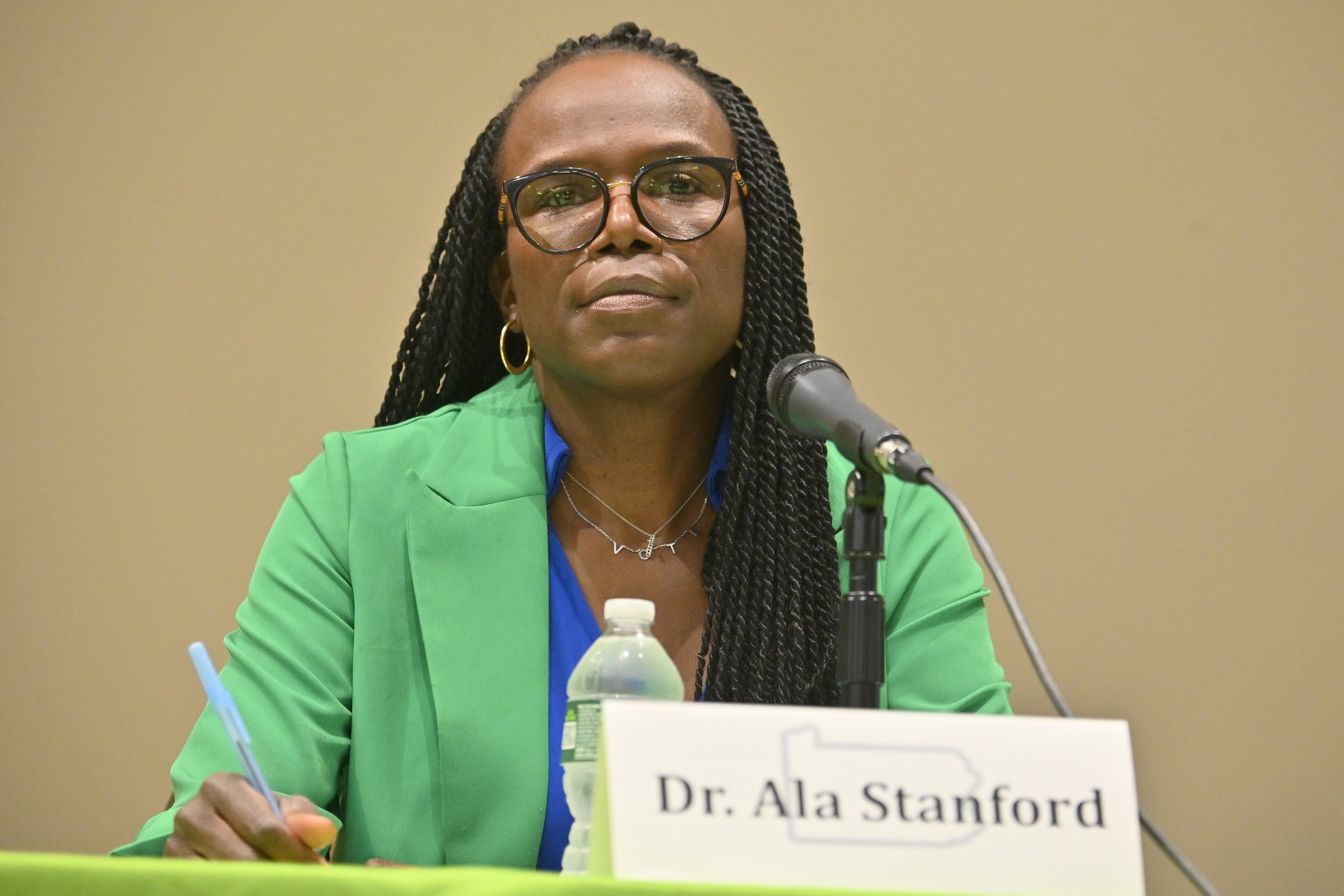
Congressional hopeful Ala Stanford on Wednesday morning announced she was dropping out of a WHYY candidates debate two hours before it was scheduled to begin, saying her campaign could not agree with the public radio station on a format for the debate and criticizing her opponents in the race for “misogynistic attacks.”
“I have never been afraid of a hard room,” Stanford said in a statement. “After engaging in good faith with WHYY, we could not reach terms on a format that would deliver the serious accountability voters in PA-03 deserve.”
Stanford’s campaign manager emailed the announcement to reporters around 10 a.m., two hours before the debate on WHYY’s Studio 2 was supposed to take place.
In her statement, Stanford did not clarify what problems she had with the debate format. She also did not provide details on any attacks from her opponents in the Democratic primary for Pennsylvania’s 3rd Congressional District.
A Stanford spokesperson declined to comment beyond her written statement.
Stanford’s surprise announcement came less than three weeks before the May 19 primary, and followed a series of missteps for her campaign, including the revelation that a staffer used artificial intelligence to help answer a candidates’ questionnaire and her stumbling through a question about immigration enforcement in an interview with NBC10.
A recent Inquirer report on her stewardship of the Black Doctors Consortium also found that the organization omitted details about her income that were required to be included on nonprofit tax forms filed with the Internal Revenue Service.
Ala Stanford, pediatric surgeon and founder of the Black Doctors Consortium, participates in the debate for Pennsylvania’s 3rd Congressional District at Center in the Park in Germantown on Tuesday, April 14, 2026.
Stanford’s exit from the Wednesday event meant the other two top contenders in the race, State Rep. Chris Rabb and State Sen. Sharif Street, were the only candidates to participate in the debate featured on WHYY’s Studio 2, the highest-profile live and on-air debate thus far.
It was a relatively subdued affair compared to some of the other more gloves-off style campaign events in the open race. Street and Rabb took questions from moderators and largely agreed on policy, with both saying they support expanding universal healthcare, abolishing U.S. Immigration and Customs Enforcement, and impeaching President Donald Trump.
The two state lawmakers sought to contrast their styles, with Street portraying himself as a more competent legislator.
“I get things done,” said Street, the former head of the state Democratic Party. “Rep. Rabb and I share a lot of value propositions. But the difference is I deliver on ideas.”
Rabb, a progressive who has been endorsed by the Working Families Party, said Street is too closely aligned with the Democratic establishment, and that his ideas are not bold enough.
“There’s so many people who think we can’t do things big and bold,” he said. “They play around the edges, because that’s what establishment politics does.”
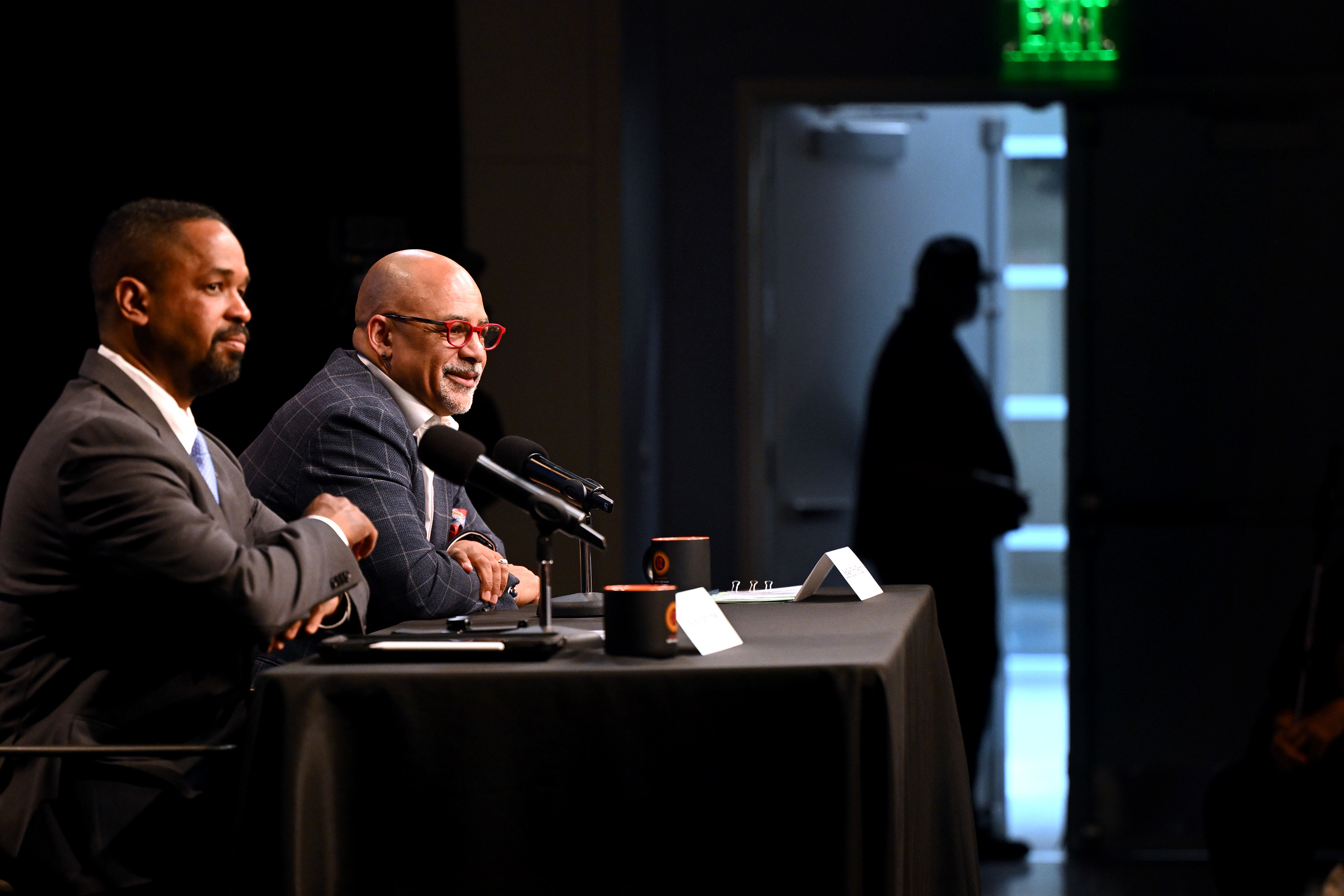
State Sen. Sharif Street (left) and State Rep. Christopher Rabb (right) wait for the WHYY studio door to close Wednesday, April 29, 2026 before start of their debate in the Democratic primary for the 3rd Congressional District. The third leading candidate, Ala Stanford declined to attend at the last moment.
Both candidates were also asked about Stanford’s absence and her charge Wednesday that the race has been “marred by misogynistic attacks and lies from both of my opponents.”
Stanford, a first-time political candidate, is the only woman on the ballot.
Rabb said he wasn’t sure what she was referring to, but pointed out that when Stanford was recently heckled by some of his own supporters during a candidates forum, he repeatedly told them to let her speak.
And Street said he has not attacked her directly, but acknowledged that she’s faced criticisms.
“She has been attacked. I’ve been attacked. Everybody on this campaign, I’m sure, has been attacked at some point,” he said.
Rabb and Street said their campaigns did not negotiate with WHYY on the format of the event.
Kevin McCorry, an executive producer and host at the station, said WHYY engaged with Stanford’s campaign “in good faith” and acquiesced to her staff members’ requests, including allowing her to have notes on the table and bring extra staffers to sit in the audience.
He said WHYY learned that she was pulling out when Stanford’s campaign manager released a statement to reporters from multiple news outlets.
“We were flexible with her requests,” McCorry said. “At no time did they say, ‘If X doesn’t change, we’re backing out.’”
State Sen. Sharif Street (left) and State Rep. Christopher Rabb (right) appear in a debate at WHYY studios Wednesday, April 29, 2026 for the Democratic primary in the 3rd Congressional District. The third leading candidate, Ala Stanford declined to attend at the last moment.
Street spokesperson Anthony Campisi accused Stanford of dropping out to avoid tough questions,adding that “her campaign is in free fall.”
“Rather than answer these questions in a debate that’s aired on radio and television, she appears to be taking her ball and going home, which is not what Philadelphians expect from their member of Congress,” Campisi said Wednesday. “Philadelphians deserve a member of Congress who is ready to fight for them and against Donald Trump, not someone who runs from a fight.”
Rabb said that when it comes to campaign events, he and his team “don’t negotiate, we just show up.”
“Even if I didn’t like the format, which is not uncommon, I still show up,” he said, “because I’m a public servant and I’m a public candidate, and I got to reach people wherever they are.”
In her statement, Stanford, a physician, noted she has taken the Hippocratic Oath “to first do no harm.”
“I challenge everyone in this race to join me in promoting the kind of spirited, but serious and meaningful dialogue Philadelphians should expect from those asking to serve,” she said. “In the meantime, I will be where I have always been — on doorsteps, in church basements, and on the corners of the wards that built me.”
Shaun Griffith, a tax adviser and the fourth candidate in the race, did not participate in the debate because he did not meet WHYY’s criteria, which included a fundraising threshold.
He attended the event and sat in the audience, and said afterwards that it was “frustrating to be watching other people get to answer questions and not have the opportunity to do so myself.”
WASHINGTON — The Supreme Court on Wednesday sharply weakened a key provision of the landmark Voting Rights Act, a ruling that limits the consideration of race in drawing voting maps and could usher in Republican gains in the House.
The decision is expected to touch off a scramble by Republicans to redraw majority-minority districts, especially in the South. New districts could shiftthe balance of power in Congress by imperiling the reelection prospects of some Black Democrats, possibly as soon as November’s midterms in some instances. Representatives of color in state legislatures and local offices could also be redistricted out.
The court’s conservative majority found Louisiana unlawfully discriminated by race when it created a second majority-Black congressional district to comply with the VRA. But the court did not strike down the provision, known as Section 2, as unconstitutional, as many voting rights advocates had feared it would. Still, the court’s liberal justices and voting rights experts said it was effectively gutted.
The ruling carries significant symbolic weight, scaling backthe last major pillar of a 60-year-old law long considered one of the marquee achievements of the civil rights era. The Voting Rights Act bans discriminatory voting practices such as literacy tests and poll taxes, and has helped greatly increase minority representation in state and federal offices.
In an ideologically divided 6-3 ruling, the conservative justices created a higher bar for the law’s powerful provision that allows states to use race to draw maps that help minority communities elect candidates of their choice. Section 2 is aimed at combating discriminatory gerrymandering that weakens the power of Black, Latino, Native American, and Asian voters.
States must walk a careful line when drawing maps for voting districts. The Voting Rights Act directsstates to consider race to some degreewhen redistricting to ensure that racial minority groups have an opportunity to elect representatives who reflect their priorities. Maps explicitly drawn along racial lines, however, violate the equal-protection clause of the 14th Amendment and the 15th Amendment’s ban on racial discrimination in voting practices.
Justice Samuel A. Alito Jr. wrote the opinion for the majority, saying it was time to rework Section 2 given gains in ending racial discrimination, the use of VRA lawsuits for partisan purposes, and advances in technology that have made it easier to draw legislative districts that balance partisan interests and racial considerations.
Alito wrote that going forward, plaintiffs would have to show that a state intentionally discriminated against a minority group in drawing a map, rather than simply showing that members of the minority group did not have the opportunity to elect a candidate of their choice when certain circumstances are met.
“Section 2 of the Voting Rights Act … was designed to enforce the Constitution — not collide with it,” he wrote. “Unfortunately, lower courts have sometimes applied this Court’s [Section] 2 precedents in a way that forces States to engage in the very race-based discrimination that the Constitution forbids.”
The decision came over the sharp objections of the court’s three liberals. Justice Elena Kagan delivered the dissent from the bench, signaling strong disagreement. In her opinion, Kagan lamented that in rulings over the last decade, the court’s conservative justices had carried out a “demolition” of the VRA that was now complete. She predicted a precipitous decline in minority representation in political office.
“The consequences are likely to be far-reaching and grave. Today’s decision renders Section 2 all but a dead letter. In the States where that law continues to matter — the States still marked by residential segregation and racially polarized voting — minority voters can now be cracked out of the electoral process,” Kagan wrote, referring to the process of drawing maps that break up minority voting blocks.
The decision continues a trend by the court’s conservative majority to roll back race-conscious efforts to redress discriminatory practices. It comes two years after another major decision to restrict race-based affirmative action in college admissions.
The ruling lands asa nationwide redistricting war has broken out between Republicans and Democrats, both of which have taken the unusual step of redrawing district linesbetween censuses to try to secure partisan advantages in this year’s races for Congress. Republicans currently hold a slim majority.
Professor Richard L. Hasen, an election law expert at UCLA, said Section 2 of the Voting Rights Act still stands but is all but eviscerated.
“The opinion weakens application of the Voting Rights Act to make it a much weaker, and potentially toothless, law,” Hasen wrote on his blog. “It is hard to overstate how much this weakens the Voting Rights Act.”
NAACP president Derrick Johnson said in a statement that the ruling was a major strike to minority political power.
“Today’s decision is a devastating blow to what remains of the Voting Rights Act, and a license for corrupt politicians who want to rig the system by silencing entire communities,” Johnson said. “The Supreme Court betrayed Black voters, they betrayed America, and they betrayed our democracy. This ruling is a major setback for our nation and threatens to erode the hard-won victories we’ve fought, bled, and died for.”
The Trump administration hailed the ruling in a statement.
“This is a complete and total victory for American voters,” White House spokesperson Abigail Jackson wrote. “The color of one’s skin should not dictate which congressional district you belong in. We commend the court for putting an end to the unconstitutional abuse of the Voting Rights Act and protecting civil rights.”
Louisiana Attorney General Liz Murrill called the ruling “seismic” and applauded it in a statement.
“The Supreme Court has ended Louisiana’s long-running nightmare of federal courts coercing the state to draw a racially discriminatory map,” Murrill said.
The complicated dispute over the Louisiana voting district has dragged on for years and had been before the court last term.
The case began in 2022 when Black voters and civil rights groups sued Louisiana under Section 2, saying a new voting map drafted after the 2020 Census shortchanged African American voters. The map had only one Black-majority district out of six. African Americans make up one-third of the state’s population.
A federal court ruled for the plaintiffs and ordered the state to draw a new map with a second Black-majority district. After further legal wrangling, the Louisiana legislature drafted one in 2024.
The new map, which was drawn in part to protect the seats of Republican incumbents, including House Speaker Mike Johnson and House Majority Leader Steve Scalise, created a Black-majority district that meandered across the state from Baton Rouge to Shreveport.
A group of self-described “non-Black voter[s]” sued, arguing the new map was an unconstitutional racial gerrymander that violated the equal-protection clause. A federal district court panel ruled for the non-Black plaintiffs and put a hold on the redrawn map.
The Supreme Court eventually allowed the map with two Black-majority districts to go into effect for the 2024 congressional election. Voters chose Cleo Fields, a Black Democrat, for the new district.
The non-Black voters brought their case to the Supreme Court once again. Last term, the justices decided to hold off on a ruling and asked both sides to address whether creation of the second Black-majority district violated the 14th and 15th Amendments, before taking up the case again this term.
During arguments in October, Louisiana Solicitor General Benjamin Aguiñaga told the justices that any “race-based redistricting is fundamentally contradictory to our Constitution.” He also said that Louisiana had changed in recent decades, so the need for Section 2 had been obviated.
“It requires striking enough members of the majority race to sufficiently diminish their voting strength, and it requires drawing in enough members of a minority race to sufficiently augment their voting strength,” Aguiñaga said. “Embedded within these express targets are racial stereotypes that this court has long criticized.”
Kagan asked an attorney for Black voters in Louisiana what impact gutting Section 2 would have.
“The results would be pretty catastrophic,” said Janai Nelson, the president of the NAACP Legal Defense Fund.
“We only have the diversity we see across the South because of litigation” under the voting rights law, Nelson said, adding that it had been “crucial to diversifying leadership” in Louisiana and other states. She said no Black person has been elected to statewide office in Louisiana to date.
The decision follows another by the Supreme Court involving Section 2 in 2023. In that case, the justices ruled Alabama created electoral maps that unlawfully diluted the power of Black residents. That ruling surprised many court watchers because the justices have chipped away at the VRA in recent years.
In the most significant ruling in 2013, the justices struck down Section 5 of the VRA, which required states with a history of discriminating against minority voters to get changes to electoral law approved by the federal government or a judge. Most of the states covered by the provision are in the South.
The latest ruling is likely to contribute to the uncertainty surrounding the nation’s electoral maps amid the unprecedented wave of mid-decade redistricting. Ordinarily, states redraw their lines at the beginning of each decade after the U.S. Census Bureau alerts states to population shifts.
President Donald Trump, concerned Republicans could lose their fragile House majority, began pressing Republican-led states last summer to draw new lines ahead of the midterm elections. Republicans drew better lines for themselves in Ohio, Missouri, North Carolina, and Texas that could give them strong shots at picking up nine more seats.
Florida Republicans are planning to carve up their districts to give their party up to four more districts, and were debating their plan on the floor of the state House when the court released its decision. Legislators approved the plan Wednesday afternoon.
In response, voters in California approved a new map that will give Democrats up to five more House seats, andvoters in Virginia approved a plan to redraw their map. The Supreme Court turned aside a challenge to the California map in February.
The Supreme Court’s decision probably gives Republicans an opportunity to draw even more districts in their favor.
The deadlines for most states to redraw their maps before the midterms have passed, but it is possible some states push to change those rules. Either way, the ruling could set Republicans up for advantages in 2028 and beyond. In the wake of the decision, Sen. Marsha Blackburn (R., Tenn.) called on lawmakers in her state to redraw maps to create an extra Republican seat in Memphis.
This Supreme Court term is shaping up as a consequential one for election-related law.
In one major case, the court will decide the constitutionality of counting mail-in ballots that arrive after an election, provided they are postmarked by Election Day. The justices also allowed a lawsuit by a Republican congressman from Illinois who is challenging the state’s mail-in ballot law.
The justices heard arguments in December over whether to lift restrictions on parties spending money in coordination with candidates, which could be the latest chance for the court to curtail campaign finance limits.
This article contains information from the Associated Press.
Third time’s a charm. After two straight losses, the Flyers look to close out its NHL playoff series against the Pittsburgh Penguins in Game 6 tonight in South Philly. Here’s how to watch and stream.
Benching Matvei Michkov didn’t work in Game 5. Now, it looks like head coach Rick Tocchet is making some more changes, including re-inserting Michkov.
Former Flyers captain Claude Giroux takes out Sidney Crosby during “The Shift 2.0” in 2012. (Yong Kim/Staff file photo)
After winning the first three games of the series before dropping the last two, the Flyers return home Wednesday for Game 6 against the Pittsburgh Penguins at what’s sure to be a raucous but tense Xfinity Mobile Arena.
While some fans may be starting to get nervous — more like panic — the Flyers do have history on their side. Only 26 teams in 216 tries have forced a Game 6 after losing the first three games of a best-of-seven playoff series in NHL history, and only four have completed the reverse sweep, including Philly in 2010.
But the Flyers have been in this exact scenario before … and against Pittsburgh to boot.
In 2012, the Flyers won the first three games of their first-round series against the Penguins, before Pittsburgh pulled things back to 3-2. What happened next in Game 6 is etched in Flyers lore forever as “The Shift 2.0.” (The original “Shift” belongs to Mike Richards, for what he did against the Canadiens two years earlier.)
On the opening shift of the game, at the then-Wells Fargo Center, captain Claude Giroux de-skated Sidney Crosby at center ice with a massive hit just five seconds after the opening faceoff. If that didn’t set the tone enough, Giroux would open the scoring just 27 second later with a wicked wrist shot off the post and in to send the home faithful into a frenzy. The Flyers would follow their captain’s lead and destroy the Penguins 5-1 in Game 6 to close it out.
Captain Sean Couturier is the only holdover from that team to witness “G’s” heroics in person, while GM Danny Brière will also remember it well, having scored the Flyers’ fourth goal in that game. For Pittsburgh, Crosby, Evgeni Malkin, and Kris Letang were all in the lineup on that fateful date: April 22, 2012.
Despite his stellar season, Flyers goalie Dan Vladař was not named as one of three finalists for the Vezina Trophy finalists, given annually to the league’s best goaltender. Jeremy Swayman (Boston Bruins), Ilya Sorokin (New York Islanders), and Andrei Vasilevskiy (Tampa Bay Lightning) earned those honors.
Flyers right wing Matvei Michkov shoots the puck during an afternoon skate on Sunday.
After much consternation, it does appear that Matvei Michkov will return to the lineup on Wednesday for Game 6 against the Pittsburgh Penguins. The Russian winger was off the ice early at the team’s optional morning skate at Xfinity Mobile Arena. Winger Garnet Hathaway stayed on the ice late with players who normally are healthy scratches, like Garrett Wilson, Carl Grundström, and Oliver Bonk.
Where he slots in is the biggest question, as the right winger is not a fourth-line player. Could Tyson Foerster or Alex Bump — who played well together with center Noah Cates in Game 5 — or Denver Barkey move down?
Despite leading the team in points with 22 in the final 26 games of the regular season, helping the team clinch the third seed in the Metropolitan Division, Michkov posted zero points in the first four games of the postseason. The 21-year-old was a healthy scratch for Game 5 and appeared to revert to his early-season struggles with the uptick in pace and intensity.
The last time he was a healthy scratch was for a pair of games in early November of his rookie season. He returned and had a goal and an assist against the San Jose Sharks before adding three points in the following two games.
Emil Andrae also stayed on, and Noah Juulsen came off earlier, which hints that the veteran blueliner will slot in.
#Flyers on the ice for morning skate. Most guys out there. Tippett, Konecny, Couturier, Couturier or Ristolainen are not but expect that to be maintenance for tonight.
Rasmus Ristolainen and the Flyers were punished for not getting pucks out on Monday.
Rick Tocchet has long talked about the lessons that his young Flyers team needs to learn. He has often mentioned teachable moments in both losses and in wins.
They have now lost two straight games after breaking out to a three to nothing lead in their best-of-seven game series against the Pittsburgh Penguins.
The Flyers are still at the head of the class, as they hold the 3-2 advantage and have two more chances to advance. But it feels like the teacher is starting to implement a curve that could pull their grade down as the Penguins push and claw their way back into the series.
There is a saying that goes something like, “Forget the past, but never forget the lesson.” Well, the Flyers need to dig back into their old notes and cram before Game 6 on Wednesday night at Xfinity Mobile Arena because they definitely don’t want to become part of a history-making series — on the wrong side this time.
Alex Bump made his playoff debut for the Flyers during Monday’s Game 5 in Pittsburgh.
Alex Bump didn’t know whether he would play in this playoff series.
After Porter Martone signed with the Flyers out of college and Tyson Foerster returned from injury, there wasn’t an obvious place for him. As the playoffs started, Bump found himself the odd man out, watching from the press box, “itching” to get in.
On Monday, Bump’s number finally was called, and he delivered in the Flyers’ 3-2 loss in Game 5 to the Pittsburgh Penguins.
“I think I’m built for the playoffs,” Bump, 22, said postgame. “Just that hard, physical game, shooting mentality, getting pucks to the net.”
Bump stood out when the Flyers struggled to generate extended offensive zone time and execute clears. According to Natural Stat Trick, their expected goals percentage with Bump on the ice was 69.8%, the best of any Flyer.
In Game 5, Bump entered the zone cleanly with control of the puck three times and was responsible for another advance after forcing a turnover on an Anthony Mantha pass and finding Noah Cates, who entered the zone cleanly.
Even though the Flyers lost Game 5, Bump proved he’s worthy of staying in the lineup as the playoffs continue.
“[Bump and Denver Barkey], they’re holding on to pucks,” Tocchet said. “That’s why they’re making some plays out there. We’ve got to get some other guys to hold on to pucks and win some battles in the corners. That’s playoff hockey.”
Flyers-Penguins Game 6: Start time, how to watch and stream
The Flyers-Penguins series comes back to Philly for Game 6.
The Flyers-Penguins series jumps back to TNT Wednesday night for Game 6, with Kenny Albert and NBC Sports Philadelphia’s Brian Boucher on the call. Chris Mason will handle reporting duties at Xfinity Mobile Arena.
TNT Sports is averaging 1.1 million viewers for its NHL playoff broadcasts across TNT, TBS, and truTV, up 67% compared to last season and the network’s best start since landing hockey rights in 2021.
The game will also air on NBC Sports Philadelphia, with Scott Hartnell once again taking Boucher’s place alongside Jim Jackson.
Flyers Pregame Live will air at 7 p.m., featuring Ashlyn Sullivan and former 94.1 WIP host Al Morganti. They will also handle postgame coverage.
Flyers vs. Penguins: Game 6
Time: 7:30 p.m.
Location: Xfinity Mobile Arena
TV: TNT (Kenny Albert, Brian Boucher, Chris Mason), NBC Sports Philadelphia (Jim Jackson, Scott Hartnell)
Radio: 97.5 The Fanatic (Tim Saunders, Todd Fedoruk)