Blog

  • Flyers fall 6-3 to Bruins in a game that felt doomed from the start

    Flyers fall 6-3 to Bruins in a game that felt doomed from the start

    BOSTON ― Across an arduous 82-game NHL schedule, some games are bound to be uphill battles, particularly back-to-back games on the road.

    Thursday night’s matchup against the Bruins was always going to be one of those games, even before the Flyers sat on the tarmac in Columbus due to mechanical issues — after Wednesday’s 5-3 loss to the Blue Jackets ― and were delayed arriving into Boston until past 3 a.m. It proved to be just that as the weary Flyers struggled to find their legs early, dug themselves too big a hole, and were blown out 6-3 at TD Garden.

    The opening seconds of the contest would foreshadow what would prove to be a long night, as just 14 seconds in, Boston winger Marat Khusnutdinov walked Noah Juulsen and forced Sam Ersson into a big save from in tight. Ersson would make three more athletic stops on Mark Kastelic and Sean Kuraly (x2) in the opening minutes, but the Bruins soon found a way through the Swedish netminder via his countryman, Viktor Arvidsson.

    While the Flyers were running around a bit in their own zone in the lead-up to the goal, the shot was one Ersson should have stopped, as Arvidsson didn’t get all of his one-timer from the right faceoff circle following a Casey Mittelstadt feed. But the shot still managed to trickle through the Flyers netminder’s legs to give the Bruins the lead at 9 minutes, 49 seconds of the first period.

    Before the Flyers could regroup it was 2-0 Boston, as Pavel Zacha snuck behind the Philadelphia defense to score the Bruins’ second just 41 seconds after their first. The route looked to be officially on, although Ersson made a few big saves to keep things at 2-0.

    The Flyers looked to get back into the game midway through the opening period as Nikita Grebenkin, a rare bright spot on the night, barreled into the Boston zone with speed. His initial shot was stopped by Jeremy Swayman but Christian Dvorak was there to fire home the rebound and split the deficit … at least momentarily.

    The goal would quickly be taken off the board as Boston successfully challenged for goaltender interference, with the situation room in Toronto ruling that Grebenkin’s stick, which was caught in Swayman’s equipment, impeded the goaltender from resetting and making the save. The teams would go to their respective dressing room’s with the score at 2-0.
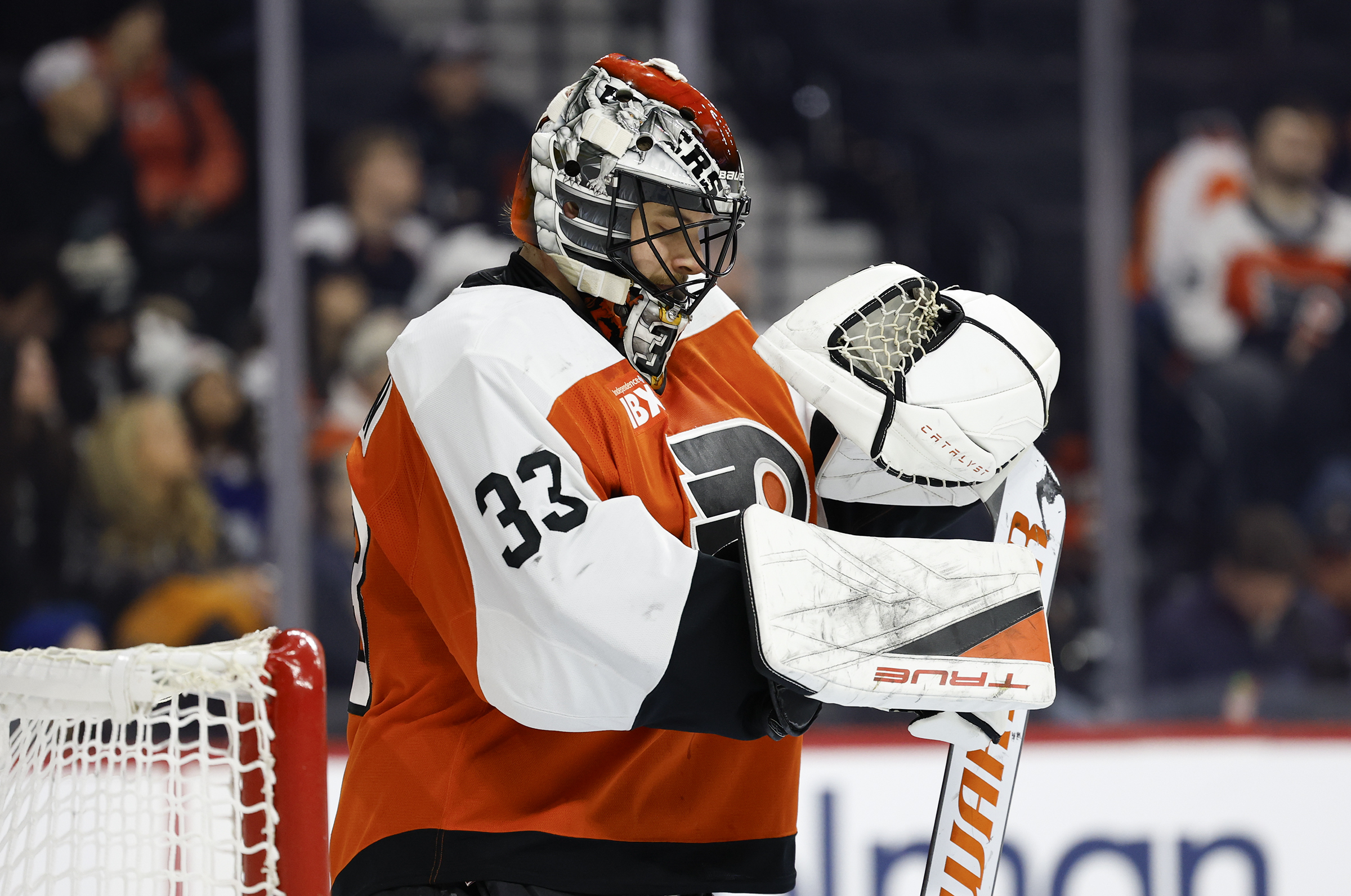
    Flyers goaltender Samuel Ersson held off the Bruins as long as he could in a 6-3 loss.

    After a more energetic start to Period 2 from the Flyers, Boston made it 3-0 just over two minutes into the frame. Fraser Minten glided down the left wing and beat Ersson five-hole with a shot on the ice. after the Bruins had turned a Bobby Brink turnover into a transition three-on-two. The goal was another that Ersson will feel he should have stopped, especially after he had made a couple more difficult saves just prior.

    Travis Konecny, who had a hat trick Wednesday in Columbus but was a game-time decision after taking a puck off the foot, got the Flyers on the board less than a minute later, thanks to great hustle from Grebenkin and Dvorak, which forced a Bruins turnover in their own end. Konecny corralled the loose puck alone in the slot and beat Swayman clean for his 21st of the season.

    The Flyers then earned a power play and made a bit of a push, only for Boston to increase its lead back to three goals through Mittelstadt. The former Buffalo Sabre flipped a backhander over a sprawling and helpless Ersson, who had just robbed Andrew Peeke on the initial shot, and just under the bar. Tanner Jeannot then would make it 5-2 Boston with a tip on a Peeke point shot at 18:40 of the second. Ersson, who allowed five goals on 20 shots, suffered a lower-body injury at the end of the second period and would be replaced by Dan Vladař for the third.

    Grebenkin would finally get a well-deserved goal to wrap up the scoring in the second, hustling in to bury a rebound after Konecny had a breakaway and follow-up attempt stopped by Swayman. The Russian winger, who was the Flyers’ best forward of the night, seemed to be at the center of most of the good things the Flyers did offensively and was praised afterward by his teammates for his energy.

    With Boston well in front, the Flyers controlled most of the third period, outshooting Boston 15-7 in the frame and 36-27 for the game, but it would be for naught. The Bruins would stretch their lead to 6-2 with 3:30 remaining in the third, as Khusnutdinov found the empty net after Tocchet had thrown caution to the wind and pulled Vladař.

    Matvei Michkov would pull one back on the power play with under two minutes remaining to improve the optics on the scoreboard. Denver Barkey dug the puck loose with some good work in front and a few whacks and, after kicking the puck to his stick, found the Russian at the back post for a tap-in. The goal was Michkov’s 13th of the year, while Barkey notched his ninth NHL point in 19 games since being recalled on Dec. 19.

    But it was too little, too late for the Flyers, who dropped their third straight and fell eight points below the playoff line in the Metro and 10 behind Boston in the wildcard.

    Breakaways

    Rasmus Ristolainen, who was a game-time decision and did not take line rushes during warmups, suited up and played just under 22 minutes. He said he felt good afterward and was frustrated that he left Wednesday’s game after landing awkwardly on a puck. … The Flyers went 1-for-3 on the power play and killed off the lone Boston opportunity with the man advantage. … The Flyers have Friday off and will return to action Saturday at 12:30 p.m against the Los Angeles Kings at Xfinity Mobile Arena (NBCSP).
  • Sean Mannion needs to be a Jalen Hurts whisperer. Play-calling is only part of that.

    Sean Mannion needs to be a Jalen Hurts whisperer. Play-calling is only part of that.

    It almost surely did not escape Jeffrey Lurie’s notice that his offense turned out OK the last time he hired a Packers quarterbacks coach.

    It shouldn’t escape ours, either.

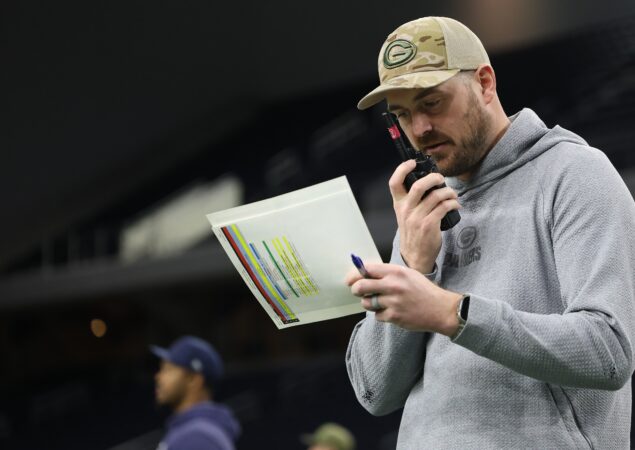
    Sean Mannion may not be the next Andy Reid. The Eagles didn’t hire the 33-year-old Green Bay assistant with the thought that he would become Reid. But Reid was Mannion at one point in time: an under-the-radar position coach without play-calling experience who was hired for a big boy job well ahead of schedule. This was back when Mannion was six years old, of course.

    Has it really been 27 years?

    It has. Mannion and Reid don’t have much of a connection apart from having both sat at the same desk (figuratively … although, knowing Lambeau Field, maybe literally, too). Matt LaFleur is not Mike Holmgren. Sean McVay is not Bill Walsh. The lineage of Packers quarterbacks coaches who became offensive coordinators includes one Ben McAdoo. Having occupied the position is a trait neither prescriptive nor predictive. It is descriptive in one sense, though. A lack of play-calling experience should not be a deal-breaker for a team that is looking to overhaul its offensive identity.

    In fact, play-calling isn’t the thing that will determine Mannion’s success or failure as Eagles offensive coordinator. It is the thing that we will focus on, no doubt. For a variety of reasons. First, because play-calling is the only part of the job that we actually get to see. Second, because guys like Walsh and Reid and McVay (and Mike Martz, Kyle Shanahan, etc.) have led us all to believe that football games are won the same way Jimmy Woods won video games in The Wizard. Which is silly, when you stop and examine the time card. Even at 70 plays per game and a full 40 seconds between plays, an offensive coordinator spends less than an hour of his work week calling the plays. The bulk of the job is the 79 hours that precede it.

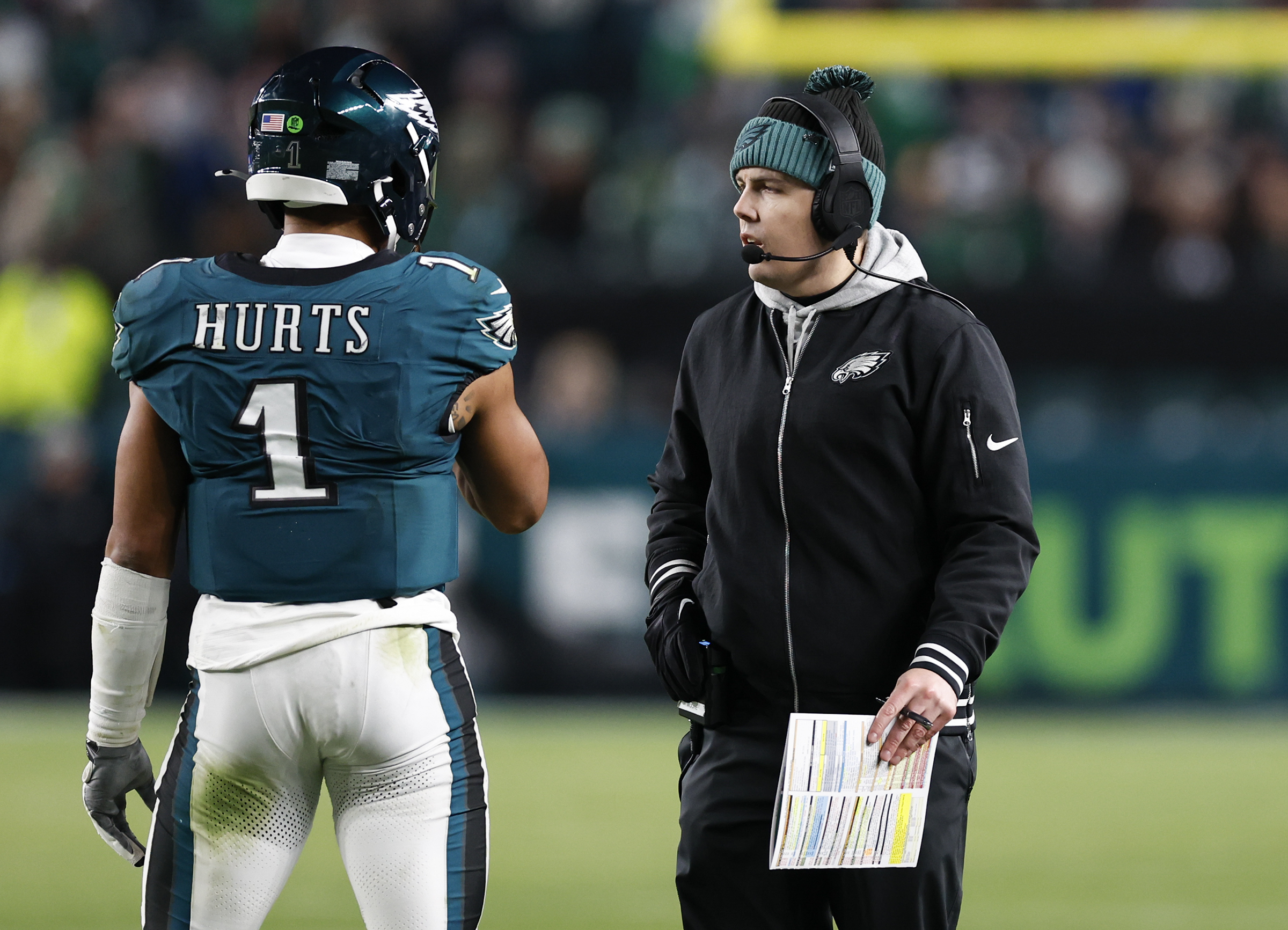
    Can Sean Mannion have the same strong working relationship with Jalen Hurts that Kellen Moore (right) experienced?

    The Eagles need Mannion to be a good coach. Jalen Hurts needs Mannion to be a good coach. Those two things are one and the same. Because Jalen Hurts is the Eagles. Where they go from here as an offense depends almost entirely on who he is as a quarterback. Rather, it depends on who Hurts can be. Who he is? That isn’t good enough. All of us saw that this season. Not all of us understood what we saw. But we saw it. Plain as unflavored yogurt.

    That’s not to say the Eagles’ disappointing 2025 campaign was all on Hurts’ shoulders. Seven months isn’t nearly long enough to transform from a player capable of winning a Super Bowl MVP to a player who simply isn’t good enough. His advocates are correct in that. Hurts would have been equally capable of winning the honor this season as he was in 2024, assuming the rest of the offense was also as capable as it had been. Therein lies the disconnect. You’ll make a you-know-what out of yourself if you’re assuming Hurts’ supporting cast will ever be as good again.

    It’s funny. Nick Sirianni’s detractors constantly portray him as the unwitting beneficiary of a world-class roster. He is the dim-witted only son bequeathed an empire, a head coach who happened to stay at a Holiday Inn Express last night. He showed up in board shorts at his interview and then rode the wave of Howie Roseman’s roster. But a roster that good doesn’t stay it for long.

    Rarely is the same rubric applied to the quarterback. No, A.J. Brown wasn’t the same singularly dominant receiver he has been, which compounded his general malaise. No, the offensive line didn’t manhandle opponents the way it had in previous seasons. Yes, Saquon Barkley was a little less dynamic than he was when he was jumping backward over erect defenders. Each of those claims is perfectly valid. As is the rebuttal: welcome to life as most NFL quarterbacks live it.

    Hurts can’t be the same as he was. He needs to be better. That’s going to take some very good coaching, provided he is no longer willing and/or capable of being the freewheeling scrambler he was in 2022. Being that player afforded Hurts the luxury of not needing to do the things that most other championship quarterbacks must do. He didn’t need to parallel process his pocket navigation, feeling pressure subconsciously while focusing downfield. He didn’t need to recognize that the deep crosser would clear before settling for the hitch in his foreground. He didn’t need to wait for a defense to man-up Brown on a vertical route to generate an explosive play.

    It’s probably time to acknowledge that Jalen Hurts’ supporting cast isn’t going to suddenly revert to its 2024 form.

    Hurts needs to do those things now. That’s the problem. Those things aren’t sustainable. Lane Johnson isn’t going to play forever. Even if he does, he won’t always be the same player. And the four guys alongside him won’t all remain healthy as consistently as he has.

    Same goes for the pass-catchers. Here’s a quick a thought exercise. In the four years since the Eagles traded a first-round pick for Brown on draft day, has any other team managed to swing a move at the position that was even 75% as impactful? The Chiefs have spent five off-seasons trying to replace Tyreek Hill. The Patriots haven’t had a receiver of that caliber since Randy Moss. A great quarterback makes the most of what he has.

    Just to reiterate: Hurts doesn’t need to be Tom Brady. He needs to be better than he was in 2025 in order to win with the supporting cast most quarterbacks have, which is the supporting cast he is likely to have moving forward. Mannion will play a significant role. His profile is intriguing.

    Nobody can understand a quarterback like somebody who has played the position. Kellen Moore was a quarterback. His quarterbacks coach was a quarterback (former NFL backup Doug Nussmeier). Shane Steichen was a quarterback. None of them were as good as Hurts. But they understood what quarterbacks see, how they process, what they need. Sirianni and Kevin Patullo were wide receivers. So were McVay and Shanahan. Again, neither prescriptive nor predictive. But we are talking about Mannion.

    Mannion is a quarterback, and he has played the position in lots of different settings, under lots of different coaches, including McVay and Kevin O’Connell, as well as Klint Kubiak and Kevin Stefanski. He has coached under LaFleur, who has won a lot of games with a quarterback (Jordan Love) who lacks a lot of what Hurts brings to the table. Mannion’s coaching profile is about as ideal as you can draw up for a guy who has only been a coach for two seasons.

    Sean Mannion understands quarterbacks because he was one… very recently, in fact.

    It is also a vote of confidence in Sirianni. The Eagles could easily have opted for a coach who possessed the play-calling experience that Patullo lacked. Jim Bob Cooter, Matt Nagy, Bobby Slowik — any would have made a fine interim-head-coach-in-waiting. Instead, they went with a coach who lacks anything close to the political capital that Moore brought to the table when they hired him to replace Brian Johnson after 2023.

    Will it work? Who knows. It is the only honest answer. All we can say: it is a sensible move. In the end, it all depends on the quarterback.

  • Philly’s school board heard pleas to halt school closings and reconsider Watlington’s facilities plan

    Philly’s school board heard pleas to halt school closings and reconsider Watlington’s facilities plan

    Meeting for the first time since Superintendent Tony B. Watlington presented his sweeping facilities plan, Philadelphia’s school board heard an outpouring of angst Thursday night from community members upset over 20 proposed school closures.

    “Closing schools ruins families and neighborhoods, especially Black, brown, immigrant and working-class communities,” said Caren Bennicoff, a veteran teacher at Ludlow Elementary in North Philadelphia, one of the schools targeted for closure. “A facilities dashboard can’t measure what a school means to children.”

    Watlington said the plan represented a “once in a lifetime, significant opportunity” for the city to modernize schools.

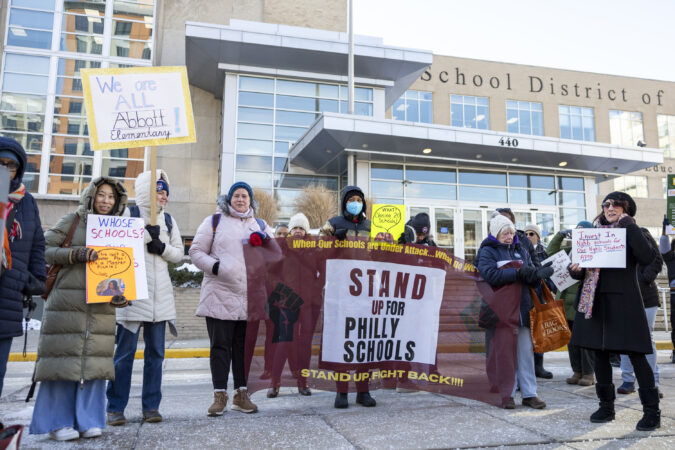
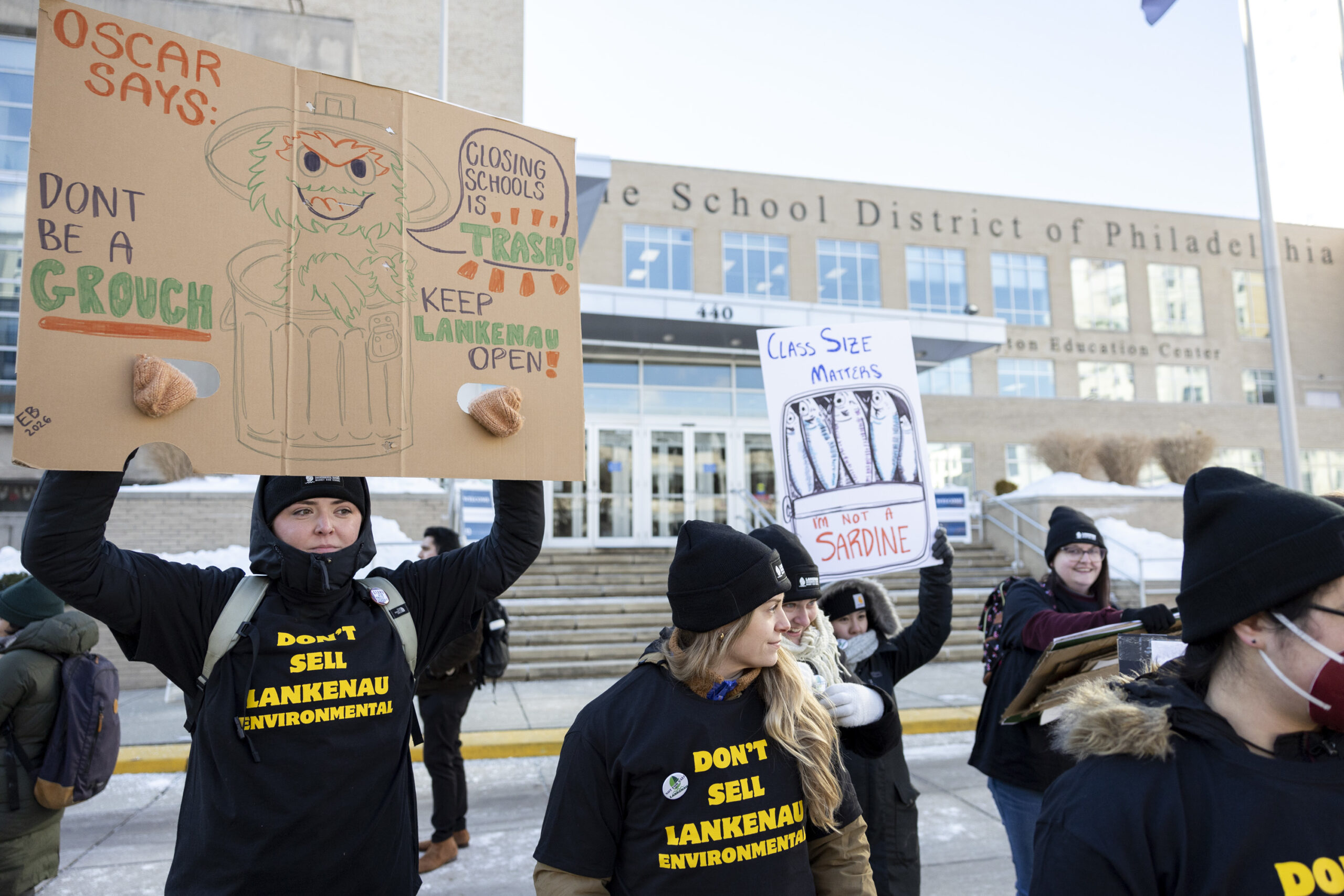
    Prior to the meeting, more than 50 people gathered in the bitter cold outside Philadelphia School District headquarters, waving signs and shouting into bullhorns to show their displeasure with Watlington’s proposal.

    Emily Brouder, 23, of West Philadelphia, Penn student and intern at Lankenau High School, holds a sign that says “Closing Schools Is Trash.”

    Some of the demonstrators warned that removing children from their neighborhood schools would be traumatizing to already vulnerable kids.

    “These schools are another home for these families,” said Margarita Davis-Boyer, president of the Lankenau High School Home & School Association. She said schools are a place where kids can get a meal, see a friendly face, and feel safe, especially when home may not offer the same reprieve.

    “It’s just an injustice,” she said. Lankenau, the city’s environmental magnet school, would close under the plan, becoming an honors program inside Roxborough High School.

    A strong Lankenau contingent packed both the rally and the board meeting, which happened immediately afterward.

    LeeShaun Lucas, a Lankenau senior, is upset the school might close.

    “To me, closing Lankenau doesn’t make sense,” Lucas said.

    Lankenau’s campus is unique in the city — set against a wildlife preserve and a farm, a stream, and a forest.

    Lucas has studied how to make the Schuylkill healthier by studying mussels, he said. He’s taking a dual enrollment GIS class — the only such high school in the city to offer such an opportunity, school officials believe.

    That exposure has shaped Lucas, he said.

    “I truly believe that voting to close Lankenau Environmental would be a mistake,” Lucas said. “Please vote to save Lank so that others may benefit from the type of learning that is only possible at Lankenau Environmental.”

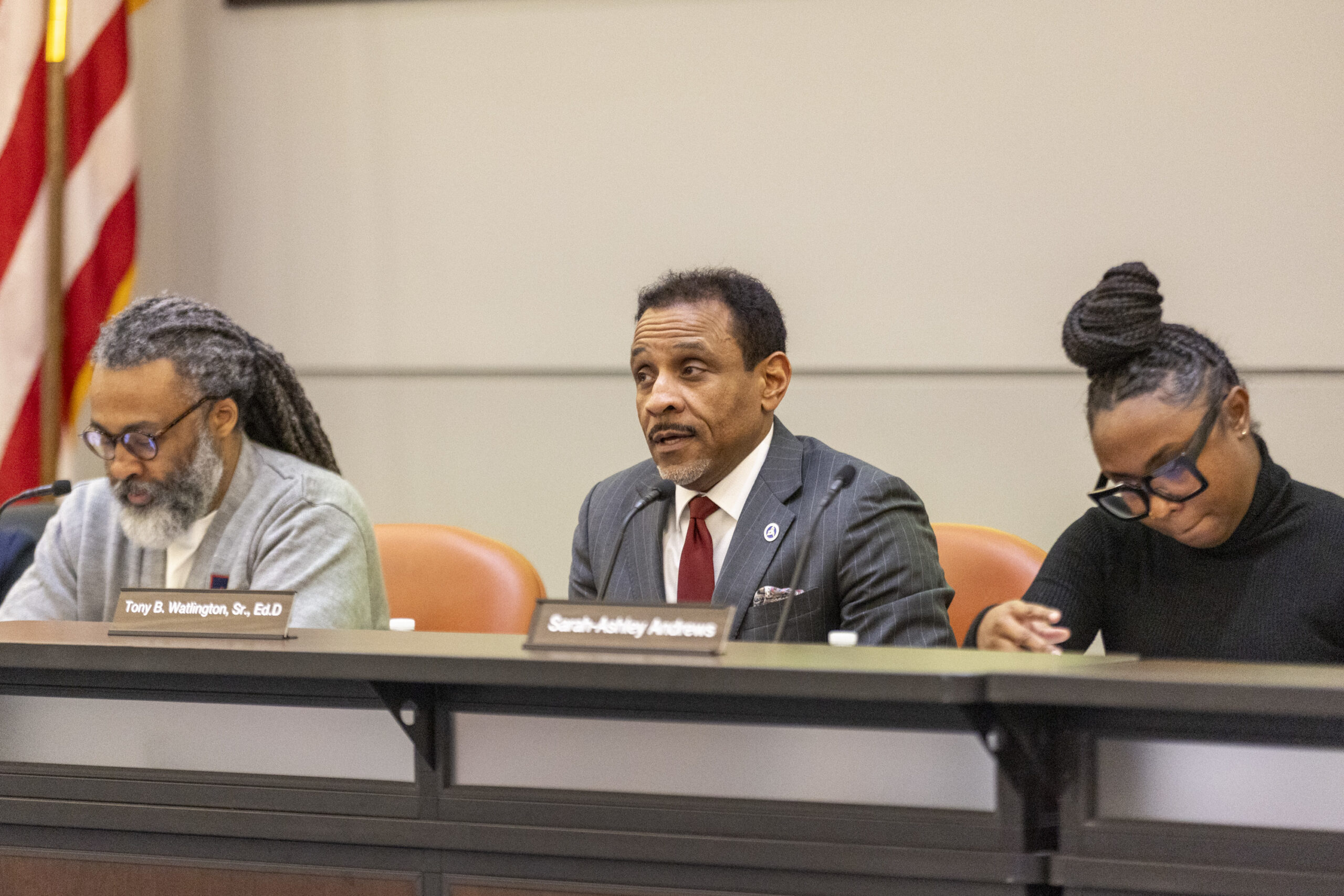
    Superintendent Tony B. Watlington (center), Board President Reginald L. Streater, and Board member Sarah-Ashley Andrews at the School board meeting Jan. 29.

    Disparate impact

    Ryan Pfleger, an education researcher, said if underutilization and facility condition truly shaped Watlington’s recommendation, the burden of closure would fall roughly evenly across racial groups.

    But that’s not the case with Watlington’s plan.

    “Black students are overrepresented, roughly 1.6 times more likely to be enrolled in schools slated for closure,” Pfleger said. “Fifteen of 20 schools proposed for closure are majority Black. White students are underrepresented, about four times less exposed than expected. The schools slated for closure are also disproportionately low income.”

    Pfleger’s conclusions match an Inquirer analysis of the closure data.

    The plan, Pfleger concluded, “does not rectify educational injustice.”

    Conwell shows up

    A strong contingent of Conwell supporters also told the board they were unhappy with the plan to close their school, a magnet middle school in Kensington.

    Conwell has just over 100 students in a building that can hold 500. But Erica Green, the school’s principal, said it’s worth saving.

    “Conwell for many years has been the cornerstone in the Kensington community, a place where students flourish, where leaders are born; alumni included leaders in government, education, law, media, public safety, and professional sports: Living proof that diamonds truly are in our backyard,” Green said. “Times have changed, but excellence at Conwell has remained the same.”

    Conwell is celebrating its 100th anniversary and has been the recipient of public and private donations to advance its building conditions and program offerings.

    “Do not let the almighty dollar drive a choice to remove a beautifully designated historic school and beautifully gifted young people,” an impassioned Green said. “The essence, prestige and impact of Conwell Magnet Middle School cannot be duplicated.”

    Priscilla Rodriguez, whose two sons attended Conwell, worries about the implications for families that rely on it for stability.

    “When a school closes, families don’t just adjust. They struggle,” Rodriguez said. Conwell families “are already dealing with a lot. You won’t make it any better by closing Conwell.”

    An incomplete plan?

    Katy Egan came to the board with a long list of questions, none of which were addressed in Watlington’s plan: Which schools will be modernized? When? How? How will displaced students get to their new schools? What’s happening to students with special education plans forced to leave their schools? How do you plan to keep kids safe while merging schools?

    Egan, a member of Stand Up for Philly Schools, called the blueprint “a 25% plan.”

    But, she said, “we deserve more than 25%, and our students deserve everything.”

    Community members can weigh in on the plan in the coming weeks at meetings around the city, and Watlington is scheduled to formally present it to the board on Feb. 26.

    No vote will happen in February though, said board president Reginald Streater, who declined to weigh in on the merits of the plan until it’s handed over to the board.

    In other board news

    In other board matters, Watlington said he would soon ask to eliminate half days from the district’s calendar entirely.

    The news came as he detailed a slip in year-over-year student attendance: in December, 54% of students attended school 90% of the time, compared to 66% in December 2024. That’s the largest drop in Watlington’s superintendency, he said.

    He attributed the challenges to a two-hour delay for snow, light attendance prior to winter break — and light attendance during a half day called for professional development.

    Watlington said at next month’s board meeting, he’ll propose amending the 2026-27 schedule to remove half days entirely.

    “Half days in the calendar do not serve us well,” he said.

    The board also installed three new student board representatives.

    The non-voting members are: Brianni Carter, from the Philadelphia High School for Girls; Ramisha Karim, from Northeast High; and Semira Reyes, from the Philadelphia High School for Creative and Performing Arts.

  • Trump threatens Canada with 50% tariff on aircraft sold in U.S., expanding trade war

    Trump threatens Canada with 50% tariff on aircraft sold in U.S., expanding trade war

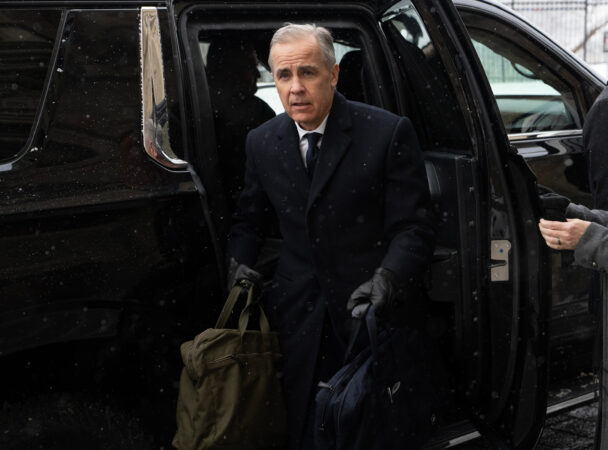
    WASHINGTON — President Donald Trump on Thursday threatened Canada with a 50% tariff on any aircraft sold in the U.S., the latest salvo in his trade war with America’s northern neighbor as his feud with Prime Minister Mark Carney expands.

    Trump’s threat posted on social media came after he threatened over the weekend to impose a 100% tariff on goods imported from Canada if it went forward with a planned trade deal with China. But Trump’s threat did not come with any details about when he would impose the import taxes, as Canada had already struck a deal.

    In Trump’s latest threat, the Republican president said he was retaliating against Canada for refusing to certify jets from Savannah, Ga.-based Gulfstream Aerospace.

    Trump said the U.S., in return, would decertify all Canadian aircraft, including planes from its largest aircraft maker, Bombardier. “If, for any reason, this situation is not immediately corrected, I am going to charge Canada a 50% Tariff on any and all Aircraft sold into the United States of America,” Trump said in his post.

    Spokespeople for Bombardier and Canada’s transport minister didn’t immediately respond to messages seeking comment Thursday evening.

    The U.S. Commerce Department previously put duties on a Bombardier commercial passenger jet in 2017 during the first Trump administration, charging that the Canadian company is selling the planes in America below cost. The U.S. said then that the Montreal-based Bombardier used unfair government subsidies to sell jets at artificially low prices.

    The U.S. International Trade Commission in Washington later ruled that Bombardier did not injure U.S. industry.

    Bombardier has since concentrated on the business and private jet market in recent years. If Trump cuts off the U.S. market it would be a major blow to the Quebec company.

    Treasury Secretary Scott Bessent warned Carney on Wednesday that his recent public comments against U.S. trade policy could backfire going into the formal review of the U.S.-Mexico-Canada Agreement, the trade deal that protects Canada from the heaviest impacts of Trump’s tariffs.

    Carney rejected Bessent’s contention that he had aggressively walked back his comments at the World Economic Forum during a phone call with Trump on Monday.

    Carney said he told Trump that he meant what he said in his speech at Davos, and told him Canada plans to diversify away from the United States with a dozen new trade deals.

    In Davos at the World Economic Forum last week, Carney condemned economic coercion by great powers on smaller countries without mentioning Trump’s name. The prime minister received widespread praise and attention for his remarks, upstaging Trump at the gathering.

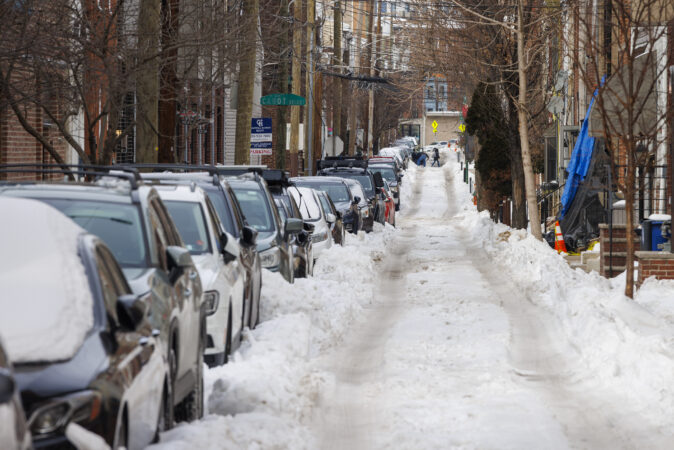
  • Philly threatened shoveling fines. Then it left its own parks and properties snowy and icy.

    Philly threatened shoveling fines. Then it left its own parks and properties snowy and icy.

    Before 9.3 inches of snow and sleet blanketed Philadelphia, in the biggest snowfall the city has seen in a decade, officials were adamant: Shovel or face a fine.

    In a news conference last week, Director of Clean and Green Initiatives Carlton Williams said residents would have six hours to shovel after the last bit of snow fell. Failure to do so could result in a $300 fine.

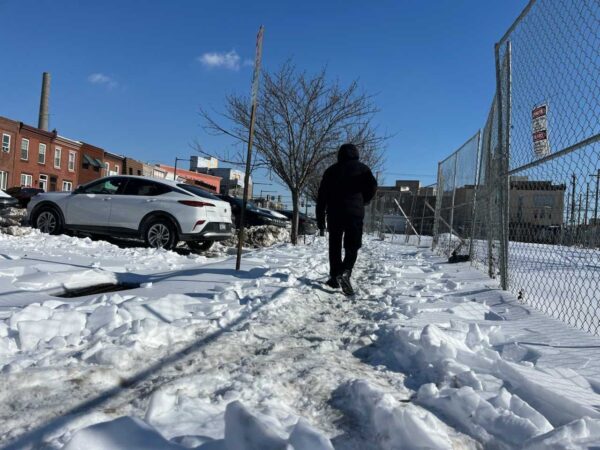
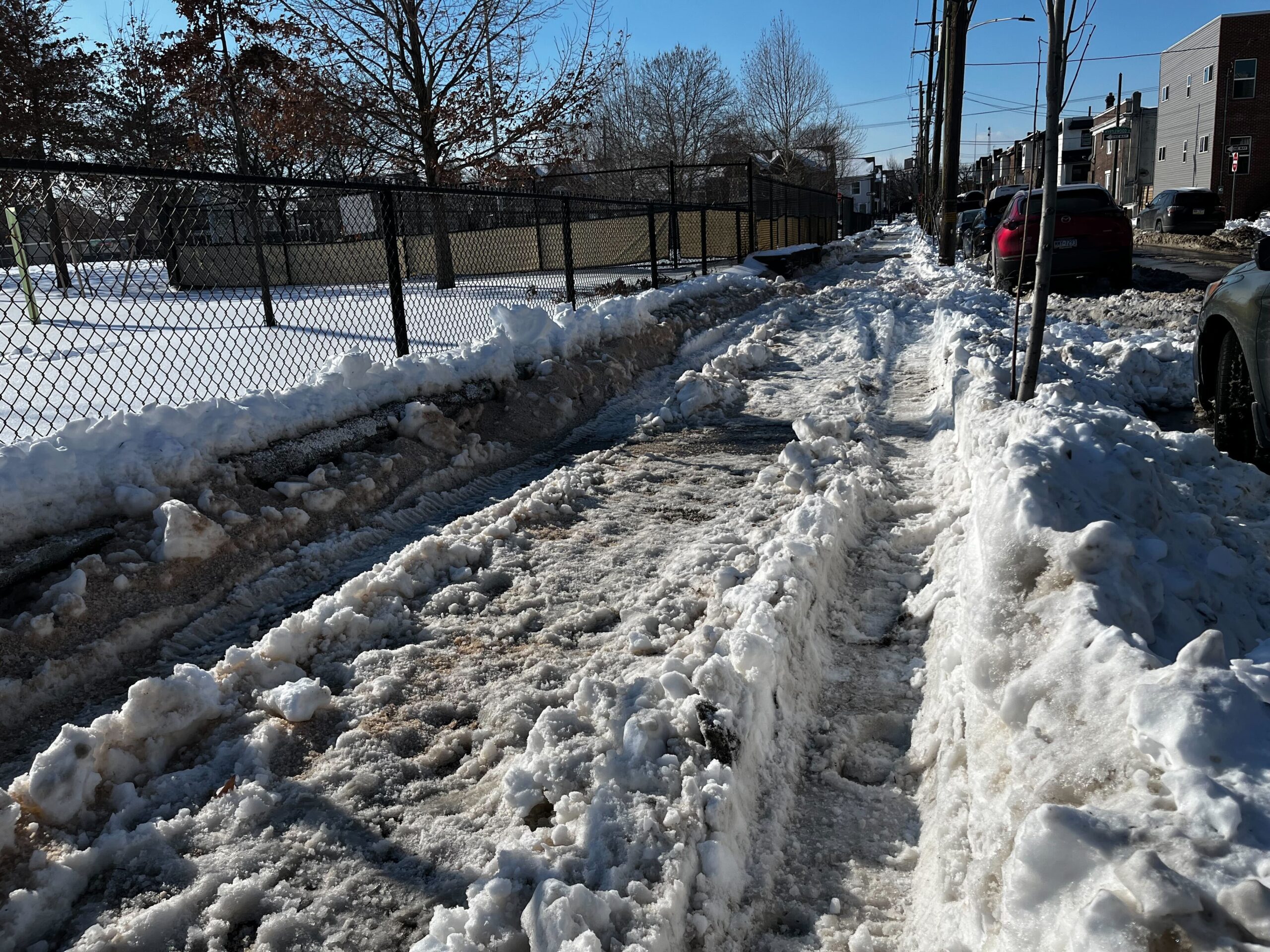
    But four days after the last icy flake fell, residents across Philadelphia say the city has set a bad example on the shoveling front, noting various city-owned properties, many of them parks, remain inaccessible for people with strollers, wheelchairs, and those who have limited mobility, and a frigid obstacle for even the most nimble.

    “It feels emblematic of the city’s attitude towards its residents, where it’s like they have rules and laws for everybody, but if they can’t manage to do something, it’s like, ‘We don’t have the resources. People need to be patient. We’re trying,’” said Coryn Wolk of Cedar Park.

    The 36-year-old said she does have some sympathy for the city, as do many others, because it is responsible for so many sidewalks and buildings, and the icy weather isn’t helping cleanup efforts. But as she walked through Malcolm X Park Thursday, frustration set in as she trudged through a sidewalk of tightly packed, icy snow.

    The city did not respond to a request for comment regarding shoveling issues but its rules say paths on sidewalks must be three feet wide. Those on streets with sidewalks less than three feet wide can carve out paths that are one foot wide.

    A sidewalk of Malcom X Park in West Philadelphia on Thursday, Jan. 29, 2026.

    Still, Greys Ferry’s Lanier Park, Ridgeway Park in the Hawthorne section of the city, and Cobbs Creek Park also had sidewalks covered by a trampled layer of gray and yellow snow Thursday. In Center City, outside the former Philadelphia History Museum, another city-owned property, passersby had molded a narrow path that should have been shoveled.

    A sidewalk along Lanier Park in Grays Ferry on Thursday, Jan. 29, 2026.

    Residents say the problem extends to trolley and bus stops that line streets, describing large mounds of snow they need to climb like athletes to reach their modes of transportation.

    Chase Howell, 29, described a herculean snow trudge through Center City with the child she nannies Wednesday. In one instance, she tried to catch the Route 4 bus along Broad and Spruce Streets only to find there was “no way to access the bus lane” because of snow pileups. To her disappointment, the next bus shelter north “was halfheartedly shoveled a foot wide but incredibly slippery.”

    In the process of lifting and pushing the stroller, Howell hurt her back, but she said that’s secondary in her whole ordeal.

    The city owes residents who use wheelchairs more than this, she said. “City curbs should be shoveled three feet wide just as the requirement is for residences and businesses.”

    Those stops and bus shelters are not under SEPTA’s purview. The responsibility of cleanup falls to the city and others who own property next to the stops, according to the agency’s spokesperson Andrew Busch. SEPTA, however, is responsible for the bus stops at the major transit hubs and clearing platforms, entrances, lots, and other areas at train stations.

    Walking around West Philadelphia, Razan Idris has seen plenty of businesses and properties that have also neglected to clear their sidewalks. But she thinks the cleanup is part of a larger issue that can be applied to property owners who don’t pick up trash or who let their buildings rot.

    “I see it as kind of the same thing, like there is little to no accountability for whoever is owning a building or an area or a lot,” said the 30-year-old.

    But ultimately, the buck stops with the city, said Idris.

    The former Philadelphia History Museum, which is city-owned, on Thursday, Jan. 29, 2026.

    By failing to care for public sidewalks surrounding parks and municipal properties, other residents feel the city is sending a message that the rules on shoveling aren’t being enforced.

    In South Philly, pedestrians trudged through crusty snow on the sidewalk along West Passyunk Avenue next to the former Melrose Diner. The sidewalk looked like it hadn’t been shoveled since the storm hit last week.

    The property is owned by M R Realty Limited Partnership, state records show. Business owner Michael Petrogiannis did not respond to a request for comment.

    A passerby, who only identified himself as Derek, complained about how some property owners leave their neighbors with the responsibility of making the sidewalks safe for use.

    “They don’t come out and shovel,” he said. “So I’m the one shoveling for them.”

    Staff writers Henry Savage and Max Marin contributed to this article.

  • Venezuelan lawmakers vote to ease state grip on oil, abandoning self-proclaimed socialist tenet

    Venezuelan lawmakers vote to ease state grip on oil, abandoning self-proclaimed socialist tenet

    CARACAS, Venezuela — Venezuela’s acting President Delcy Rodríguez on Thursday signed a law that will open the nation’s oil sector to privatization, reversing a tenet of the self-proclaimed socialist movement that has ruled the country for more than two decades.

    Lawmakers in the country’s National Assembly approved the overhaul of the energy industry law earlier in the day, less than a month after the brazen seizure of then-President Nicolás Maduro in a U.S. military attack in Venezuela’s capital.

    As the bill was being passed, the U.S. Treasury Department officially began to ease sanctions on Venezuelan oil that once crippled the industry, and expanded the ability of U.S. energy companies to operate in the South American nation, the first step in plans outlined by Secretary of State Marco Rubio the day before. The license authorization by the Treasury Department strictly prohibits entities from China, Russia, Iran, North Korea, or Cuba from the transactions.

    The moves by both governments on Thursday are paving the way for yet another radical geopolitical and economic shift in Venezuela.

    “We’re talking about the future. We are talking about the country that we are going to give to our children,” Rodríguez said.

    Rodríguez proposed the changes in the days after President Donald Trump said his administration would take control of Venezuela’s oil exports and revitalize the ailing industry by luring foreign investment.

    Private companies to control oil production

    The legislation promises to give private companies control over the production and sale of oil and allow for independent arbitration of disputes.

    Rodríguez’s government expects the changes to serve as assurances for major U.S. oil companies that have so far hesitated about returning to the volatile country. Some of those companies lost investments when the ruling party enacted the existing law two decades ago to favor Venezuela’s state-run oil company, Petróleos de Venezuela SA, or PDVSA.

    The revised law would modify extraction taxes, setting a royalty cap rate of 30% and allowing the executive branch to set percentages for every project based on capital investment needs, competitiveness and other factors.

    It also removes the mandate for disputes to be settled only in Venezuelan courts, which are controlled by the ruling party. Foreign investors have long viewed the involvement of independent courts as crucial to guard against future expropriation.

    Will change Venezuela’s economy

    Ruling-party lawmaker Orlando Camacho, head of the assembly’s oil committee, said the reform “will change the country’s economy.”

    Meanwhile, opposition lawmaker Antonio Ecarri urged the assembly to add transparency and accountability provisions to the law, including the creation of a website to make funding and other information public. He noted that the current lack of oversight has led to systemic corruption and argued that these provisions can also be considered judicial guarantees.

    Those guarantees are among the key changes foreign investors are looking for as they weigh entering the Venezuelan market.

    “Let the light shine on in the oil industry,” Ecarri said.

    Some oil workers support overhaul

    Oil workers dressed in red jumpsuits and hard hats celebrated the bill’s approval, waving a Venezuelan flag inside the legislative palace and then joining lawmakers in a demonstration with ruling-party supporters.

    The law was last altered two decades ago as Maduro’s mentor and predecessor, the late Hugo Chávez, made heavy state control over the oil industry a pillar of his socialist-inspired revolution.

    In the early years of his tenure, a massive windfall in petrodollars thanks to record-high global oil prices turned PDVSA into the main source of government revenue and the backbone of Venezuela’s economy.

    Chávez’s 2006 changes to the hydrocarbons law required PDVSA to be the principal stakeholder in all major oil projects.

    In tearing up the contracts that foreign companies signed in the 1990s, Chávez nationalized huge assets belonging to American and other Western firms that refused to comply, including ExxonMobil and ConocoPhillips. They are still waiting to receive billions of dollars in arbitration awards.

    From those heady days of lavish state spending, PDVSA’s fortunes turned — along with the country’s — as oil prices dropped and government mismanagement eroded profits and hurt production, first under Chávez, then Maduro.

    The nation home to the world’s biggest proven crude reserves underwent a dire economic crisis that drove over 7 million Venezuelans to flee since 2014. Sanctions imposed by successive U.S. administrations further crippled the oil industry.

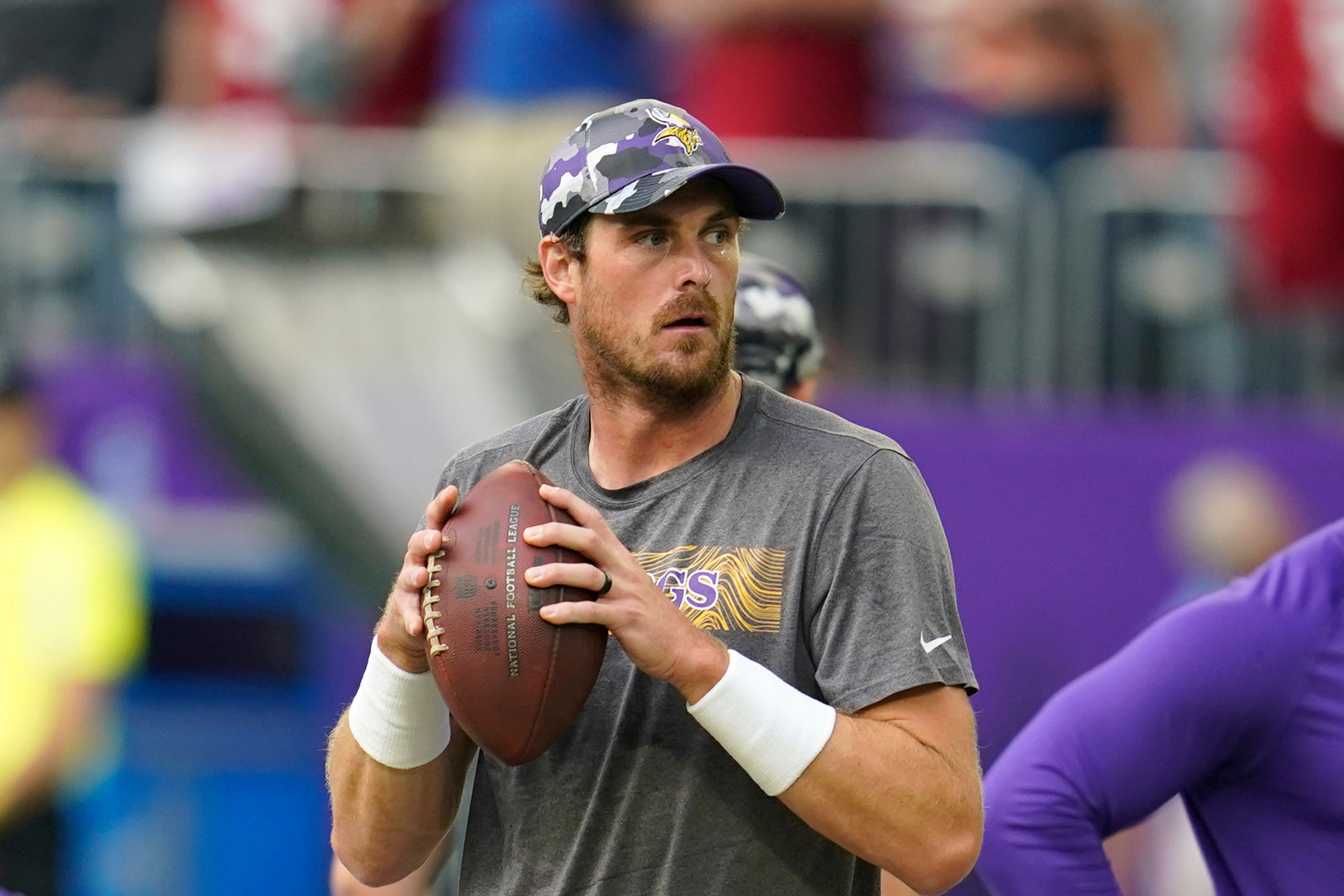
  • What the stats say about new Eagles offensive coordinator Sean Mannion

    What the stats say about new Eagles offensive coordinator Sean Mannion

    After a search that lasted 16 days to find the replacement for Kevin Patullo, the Eagles on Thursday announced that 33-year-old Green Bay Packers quarterbacks coach Sean Mannion is their next offensive coordinator.

    Mannion played mostly as a reserve for nine NFL seasons and was a player in the NFL just two seasons ago. He has been a coach for the previous two, and now has risen from first-year offensive assistant to first-year quarterbacks coach to first-year offensive coordinator with the Eagles.

    Get the theme here? We’re talking numbers. And while Mannion hasn’t been a coach long enough to have too many data points to parse to infer much about what his hire means, there are at least some meaningful stats and numbers that could be meaningful.

    Let’s have a look.

    66.3%

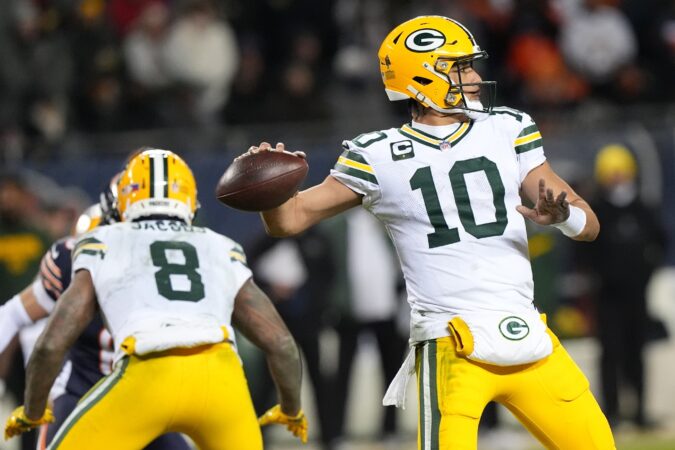
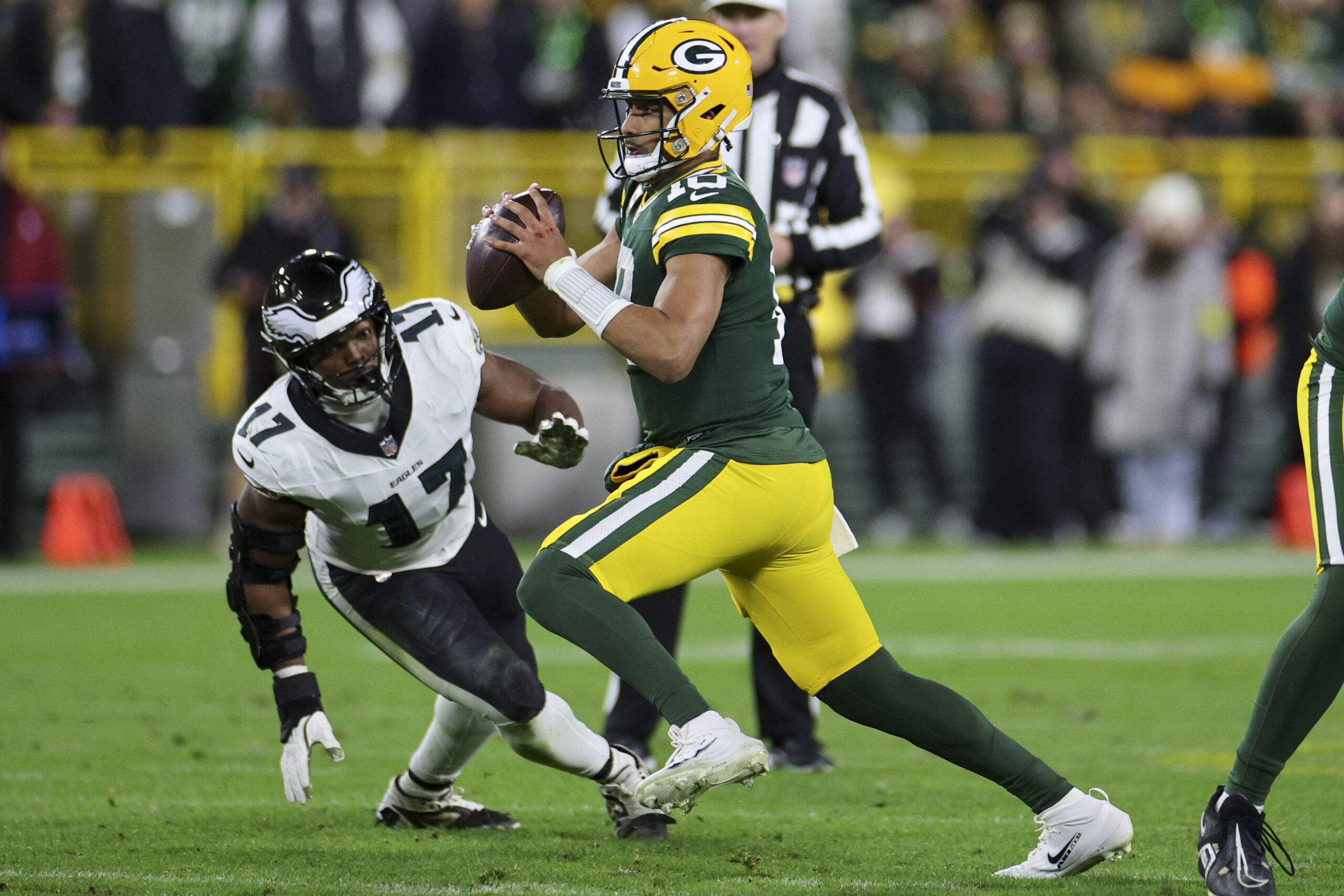
    That was Jordan Love’s completion percentage in 2025, Mannion’s first as quarterbacks coach. That was Love’s best mark in his three full seasons as a starter in the NFL. The 66.3% completion rate wasn’t the only high Love set in 2025. He also had his best season as a starter by passer rating (101.2, which ranked sixth among all NFL starters), and threw his lowest total of interceptions (six, down from 11 in each of his first two seasons as a starter).

    Jordan Love had a strong 2025 despite a substandard performance against the Eagles.

    All while the Packers dealt with a constant list of key injuries on offense.

    What’s more, backup Malik Willis had an 85.7% completion rate in 35 attempts in relief of Love.

    +95.6

    The NFL MVP race is between Drake Maye and Matthew Stafford, but Love was third in the NFL in pass EPA (expected points added) at +95.6, according to Next Gen Stats. EPA measures the average points added by the offense on each play.

    Love had the same EPA per drop back as Stafford (+0.20).

    Could more play action be in the cards for Jalen Hurts during the Sean Mannion era?

    28.3%

    Mannion has had a lot of influence in his years as a player and coach from some well-regarded offensive minds. How might he shape the way the Eagles’ offense looks moving forward?

    Love’s numbers could offer some clues.

    His play-action rate of 28.3%, for example, was fifth-highest in the league. Jalen Hurts ranked 23rd at 23.8%, according to Next Gen.

    13%

    Hurts threw more deep balls per attempt than any other quarterback, despite what you may think about the Eagles and their conservative nature. According to Next Gen, which counts a deep pass as a ball that travels 20 air yards, Hurts threw a deep ball on 13.2% of his throws.

    Right behind him was Love, who went long on 13% of his passes.

    Throwing them is one thing, completing them is another. Hurts rated 14th in deep ball completion rate (38.3%) while Love completed only slightly more (40.4%, 10th).

    Look for Sean Mannion’s scheme to borrow heavily from those of Sean McVay (left) and Kyle Shanahan.

    59%

    Only four teams ran less motion before the snap than the Eagles’ rate of 44%. Green Bay, meanwhile, used motion on 59% of its offensive plays, which was the eighth-highest rate in the NFL.

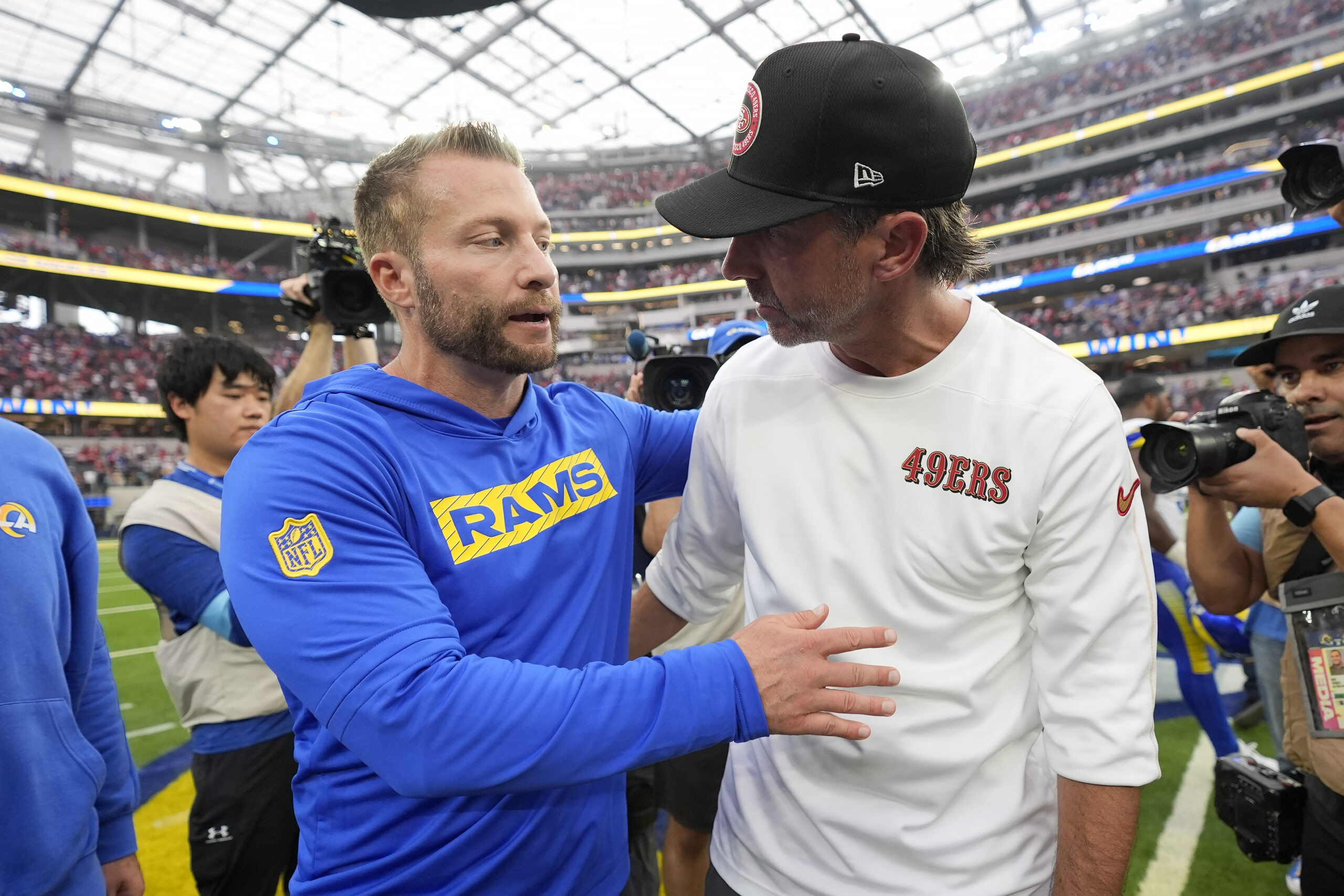
    Motion is a staple of the offenses run by Sean McVay and Kyle Shanahan, whose influences are all over Mannion’s past. McVay’s Rams were fourth in motion rate while Shanahan’s 49ers were third.

    Of course, the best coaches find a way to use their players to fit their players’ strengths, but Mannion is likely to incorporate a lot of the things he’s learned along the way.

    13,600

    Here’s a bonus set of numbers that have nothing to do with Mannion’s coaching career but are worth mentioning anyway.

    This first one is worth it because Mannion is a quarterback guy whose new job is largely about maximizing Hurts’ skill set.

    Mannion may have thrown only 36 passes at the NFL level, but he was a prolific college quarterback at Oregon State, where he threw for 13,600 yards, a number that ranks 19th in FBS history.

    1

    Mannion had one career NFL touchdown pass, and it came in his final game, which was his third career start.

    On Jan. 2, 2022, Mannion filled in for Kirk Cousins (COVID-19) in a Week 17 game vs., ironically, the Packers. In a 37-10 loss, Mannion completed 22 of 36 passes for 189 yards and a touchdown. He rushed twice for 14 yards and was sacked twice.

    K.J. Osborn caught Mannion’s touchdown pass, a 14-yard connection on the final play of the third quarter.

    How’s that for a useless trivia answer?

    31

    Here’s another one. Mannion might be young, but the Eagles once hired a younger offensive coordinator.

    In February 1995, the Eagles hired a 31-year-old to be their offensive coordinator. His name was Jon Gruden.

  • A man impersonating an FBI agent tried to get Luigi Mangione out of jail, authorities say

    A man impersonating an FBI agent tried to get Luigi Mangione out of jail, authorities say

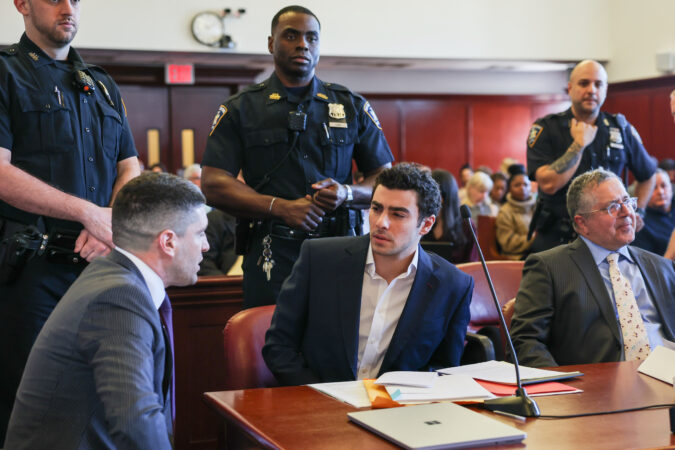
    NEW YORK — A man claiming to be an FBI agent showed up to a federal jail in New York City on Wednesday night and told officers he had a court order to release Luigi Mangione, authorities said.

    Mark Anderson, 36, a Minnesota native who has a history of drug and other arrests and disclosed last year in court papers that he suffers from mental illness, was arrested and charged with impersonating a federal officer in a foiled bid to free Mangione from the Metropolitan Detention Center. Mangione is being held at the notorious Brooklyn lockup while awaiting state and federal murder trials in the killing of UnitedHealthcare CEO Brian Thompson.

    A criminal complaint against Anderson did not identify the person he attempted to free. A law enforcement official familiar with the matter confirmed it was Mangione. The official was not authorized to speak publicly and did so on condition of anonymity.

    Anderson was ordered held without bail after an initial appearance Thursday in Brooklyn federal court. He was not required to enter a plea. A day after getting stopped at the entrance, he is now locked up in the same jail as Mangione, according to federal prison records. An online court docket did not include information on a lawyer who could speak on Anderson’s behalf. A message was also left for a spokesperson for Mangione’s legal team.

    In a lawsuit last year alleging injuries from a fall at a city homeless shelter, Anderson said he has “multiple disabilities” and has been ruled by the Social Security Administration to be “fully disabled because of mental illness.” He said he had no money and said he received state and federal assistance.

    According to public records, Anderson has had numerous drug and alcohol-related arrests and convictions over the last two decades in his native Minnesota and in Wisconsin, where he has also lived.

    Papers ‘signed by a judge’ and a pizza cutter

    According to the criminal complaint, Anderson approached the jail intake area around 6:50 p.m. Wednesday and told uniformed jail officers that he was an FBI agent in possession of paperwork “signed by a judge” authorizing the release of a specific person in custody at the jail.

    When the officers asked for his federal credentials, Anderson showed them a Minnesota driver’s license, threw documents at them and claimed to have weapons, the criminal complaint said. The documents appeared related to filing claims against the Justice Department, according to an FBI agent who viewed them and prepared the complaint. Officers searched Anderson’s bag and found a barbecue fork and a circular steel blade, the complaint said. In a photo included in the complaint, the blade appeared to be a small pizza cutter wheel.

    Anderson’s driver’s license listed an address in Mankato, Minn., about 65 miles southwest of Minneapolis. He moved to New York for a job opportunity and started working at a Bronx pizzeria when that fell through, the law enforcement official said. Court records indicate he had been living in the city at least since 2023, including at motels, a shelter and a Bronx apartment.

    Acting as his own lawyer, he has filed handwritten lawsuits against the Pentagon, Chinese and Russian ambassadors and a Minnesota police department, all of which have been thrown out. Another lawsuit, alleging a Bronx pizzeria forced him to work 70 hours a week with no overtime, is still pending.

    Mangione due in court Friday

    The alleged attempt to free Mangione added a bizarre wrinkle to a critical stretch in his legal cases.

    Hours before Anderson’s arrest, the Manhattan district attorney’s office sent a letter urging the judge in Mangione’s state case, Gregory Carro, to set a July 1 trial date.

    On Friday, Mangione will be in court for a conference in his federal case. The judge in that case, Margaret Garnett, is expected to rule soon whether prosecutors can seek the death penalty and whether they can use certain evidence against him.

    Last week, Garnett scheduled jury selection in the federal case for Sept. 8, with the rest of the trial happening in October or January, depending on whether she allows prosecutors to seek the death penalty.

    Mangione has pleaded not guilty in both cases. The state charges carry the possibility of life in prison.

    A cause célèbre for people upset with the health insurance industry, Mangione has attracted legions of supporters, some of whom have regularly turned up at his court appearances donning green clothing — the color worn by the Mario Bros. video game character Luigi — as a symbol of solidarity. Some have brought signs and shirts with slogans such as “Free Luigi” and “No Death For Luigi Mangione.”

    Thompson, 50, was killed on Dec. 4, 2024, as he walked to a midtown Manhattan hotel for UnitedHealth Group’s annual investor conference. Surveillance video showed a masked gunman shooting him from behind. Police say “delay,” “deny,” and “depose” were written on the ammunition, mimicking a phrase used to describe how insurers avoid paying claims.

    Mangione, 27, a Penn graduate from a wealthy Maryland family, was arrested five days later at a McDonald’s in Altoona, Pa., about 230 miles west of Manhattan.

    After several days of court proceedings in Pennsylvania, Mangione was whisked to New York and sent to the Metropolitan Detention Center.

    The jail is also home to former Venezuelan President Nicolás Maduro and his wife, Cilia Flores. Former inmates include hip-hop mogul Sean “Diddy” Combs and cryptocurrency fraudster Sam Bankman-Fried.

  • Man who rammed a car into NYC Jewish site had recently connected with Chabad community, police say

    Man who rammed a car into NYC Jewish site had recently connected with Chabad community, police say

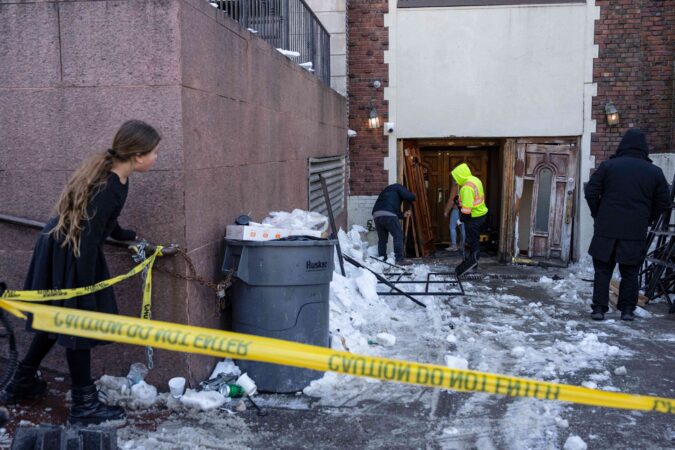
    NEW YORK — A man who drove his car into the Chabad Lubavitch world headquarters in New York City had recently been trying to connect with the Hasidic Jewish community and was recorded on video enthusiastically dancing with congregants during a recent visit to the site, police said.

    Investigators were still trying to piece together what prompted the man, Dan Sohail, 36, to ram his car repeatedly into a set of doors at the revered Hasidic Jewish center in Brooklyn on Wednesday night, but police charged him Thursday with attempted assault as a hate crime, based on the fact that the building was a Jewish institution.

    “Earlier this month, Sohail attended a social gathering at this very same location,” New York Police Department Chief of Detectives Joseph Kenny said at a news conference, noting there was video circulating online of that gathering.

    The video appears to show Sohail dancing with Orthodox men inside the headquarters.

    “We believe that he was in Brooklyn last night to continue this attempt to connect with the Lubavitch Jewish community,” Kenny said.

    Sohail told police that he lost control of his car because he was wearing “clunky boots,” Kenny said, though Kenny added that Sohail had removed several blockades and cleared snow away from a sidewalk before driving into the building.

    The complex at 770 Eastern Parkway includes a synagogue and offices, and was packed with worshippers at the time, but no one was injured. Some of the building’s doors were damaged. No weapons were discovered in Sohail’s car.

    Sohail’s father told the New York Daily News Thursday that his son had been considering converting to Judaism and that he had struggled with “mental problems.” The Forward, a media outlet centered on Jewish issues, interviewed a rabbi in New Jersey who said Sohail attended a Purim service at Chabad last year and visited two other times, looking for spiritual guidance.

    “I was able to talk to him for a few minutes and see that he’s not exactly stable,” Rabbi Levi Azimov told the Forward. Another rabbi at a Jewish school in Carteret, N.J., where Sohail lived, told the Forward he had dropped by for afternoon prayers on Tuesday but began yelling about feeling let down by Chabad after the service.

    The crash occurred on the 75th anniversary of Rabbi Menachem Mendel Schneerson becoming the leader of the Lubavitch movement and prompted immediate concern in the city. Mayor Zohran Mamdani and the city’s police commissioner, Jessica Tisch, rushed to the scene to brief the media, with officials announcing increased security around houses of worship across the city.

    “This is deeply alarming, especially given the deep meaning and the history of the institution to so many in New York and around the world,” Mamdani said. “And on today of all days.”

    The Chabad Lubavitch headquarters and synagogue in Brooklyn draws thousands of visitors each year. There is a near constant police presence around the complex.

  • Man pistol-whipped in head during snow-related argument over parking space in Kensington

    Man pistol-whipped in head during snow-related argument over parking space in Kensington

    A 45-year-old man was pistol-whipped during a snow-related altercation over a parking space Thursday afternoon in the city’s Kensington section, police said.

    Around 1:20 p.m., police responded to a report of a shooting on the 2700 block of A Street and found the man bleeding from a head injury, police said. The man identified two alleged perpetrators and was transported to Temple University Hospital.

    The alleged victim and a 21-year-old man had been involved in a snow-related argument over a parking space that escalated into a physical altercation, police said.

    During the fight, the older man produced a knife and the 21-year-old pulled out a legally owned handgun, police said. However, both men put their weapons down and continued fighting.

    A 36-year-old woman then retrieved a firearm from a vehicle, hit the victim on the head with it, and fired it into the ground, police said.

    The two alleged assailants were arrested and all the weapons were recovered by police.

    The incident remains under investigation, police said.