Blog

  • Army unit’s moves trigger speculation as U.S. plots next steps in Iran war

    Army unit’s moves trigger speculation as U.S. plots next steps in Iran war

    The Army in recent days abruptly canceled a major training exercise for the headquarters element of an elite paratrooper unit, officials said, fueling speculation within the Defense Department that soldiers specializing in ground combat and a range of other missions may be sent to the Middle East as the conflict with Iran widens.

    The 82nd Airborne Division at Fort Bragg in North Carolina includes a brigade combat team of about 4,000 to 5,000 soldiers ready to deploy on 18 hours notice for missions as varied as seizing airfields and other critical infrastructure, reinforcing U.S. embassies, and enabling emergency evacuations. Its headquarters element is responsible for coordinating how those operations are planned and executed.

    No deployment orders had been issued as of Friday, officials said, speaking like some others on the condition of anonymity to discuss the situation. They noted that the Army is expected to announce soon a previously scheduled Middle East deployment for a helicopter unit with the 82nd, but that won’t happen until later in the spring.

    But the unexpected change of plans — the unit’s headquarters staff was told to stay put in North Carolina instead of joining the training event at Fort Polk in Louisiana — and the 82nd’s high-profile role in past conflicts has heightened expectations that the division’s Immediate Response Force could be called upon.

    “We’re all preparing for something — just in case,” said one official familiar with the issue.

    Army officials referred questions to the Pentagon, which issued a brief statement declining to provide details. “Due to operations security we do not discuss future or hypothetical movements,” the statement said.

    Officials with U.S. Central Command, which oversees operations in the Middle East, declined to comment.

    President Donald Trump has offered shifting explanations for his decision to start the conflict with Iran — and said publicly that U.S. ground troops “probably” would not be needed as part of the ongoing campaign. He and his top aides have repeatedly declined to rule out that possibility, however.

    The Immediate Response Force has been called upon in recent years to reinforce security at the U.S. Embassy in Baghdad just ahead of the military’s killing in 2020 of Qasem Soleimani, the Iranian Quds Force commander blamed for hundreds of deadly attacks on American personnel in the Middle East. It was central also to the evacuation of Afghanistan in 2021 and the show of U.S. force in Eastern Europe as Russia prepared to invade Ukraine in 2022.

    Since hostilities began nearly a week ago, U.S. commanders have relied on airstrikes and naval strikes to target military sites and Tehran’s arsenal of missiles, attack drones and navy vessels. As many Iranian defenses have crumbled, U.S. forces increasingly are flying directly over Iran, dropping munitions with fighter jets, bombers and other aircraft.

    White House press secretary Karoline Leavitt told reporters Wednesday that sending American ground troops into Iran was “not part of the current plan, but I’m not going to remove an option for the president that is on the table.”

    At a Pentagon news briefing earlier in the day, Gen. Dan Caine, the chairman of the Joint Chiefs of Staff, declined to comment when asked about “U.S. boots on the ground,” saying that’s a “question for policymakers.”

    “I don’t make policy,” Caine added. “I execute policy.”

    As the Post reported last week, Caine had warned the White House that munitions shortfalls and a lack of broad military support from other U.S. allies would add considerable risk to any operation in Iran and to the personnel put in harm’s way. The Trump administration has sought to downplay those concerns.

    Caine appeared at Wednesday’s news conference alongside Defense Secretary Pete Hegseth, who earlier in the week also refused to rule out the possibility that ground combat troops could be sent into Iran.

    Adm. Charles “Brad” Cooper, who oversees the campaign as head of Central Command, said in a news conference Thursday in Tampa, Fla., that U.S. combat power in the region is still building as Iran’s declines. Fewer and fewer Iranian missiles and drones have been launched in the past few days, he said.

    By flying directly over Iran, Cooper said, U.S. forces are hitting its “center of gravity directly with overwhelming power and reach.” That includes, he said, B-2 bombers dropping 2,000-pound bombs on underground ballistic missile launchers.

    More than 50,000 U.S. troops are involved in the operation and six U.S. soldiers have been killed as Iran has mounted a ferocious counterattack targeting American positions and interests throughout the Middle East. Trump has said there will “likely be more” U.S. military fatalities before the campaign concludes, adding: “That’s the way it is.”

    The president and his top aides have been noncommittal on a timeline for ending the conflict. Trump has said it could last four to five weeks but “we have the capability to go far longer than that.”

    One prevailing concern, officials say, is the military’s limited stockpile of certain key weapons. The Pentagon is rapidly burning through its supply of precision arms and air-defense interceptors, people familiar with the matter have said. Senior Pentagon officials have denied there are any problems, noting that with Iranian defenses crumbling, U.S. forces are shifting heavily to strikes from manned aircraft with munitions that are plentiful.

    “We’ve got no shortages of munitions,” Hegseth said Thursday, speaking alongside Cooper. “Our stockpiles of defensive and offensive weapons allow us to sustain this campaign as long as we need to.”

    If the administration elects to send ground forces into Iran, one early target, analysts have said, could be Kharg Island. Located about 15 miles from the mainland in the Persian Gulf, the island is home to some of Tehran’s most significant oil infrastructure, with about 90% of the country’s oil exports moving through facilities there.

    A U.S. seizure of Kharg Island would give the Trump administration control of a centerpiece of the Iranian economy but leave U.S. troops vulnerable to attack.

    Michael Rubin, a senior fellow at the conservative American Enterprise Institute, called securing Kharg Island a “no-brainer” and said it appears that the Trump administration appears to be “coming around to the idea that Iran is a much greater problem set than perhaps they went in thinking.”

    While U.S. troops could take incoming fire if deployed there, Rubin said, capturing the island would give the United States significant strategic advantages, including potentially choking off Tehran’s ability to pay its military.

    Securing Iran’s most significant oil infrastructure also would follow a pattern for Trump, who has previously sought to secure oil wealth for the United States through the capture of Venezuelan President Nicolás Maduro in January and intervention in Syria during his first term in office.

    Still, deploying ground forces into Iran could pose significant political risk for the president, who is facing anti-war opposition from Democrats and a wing of his own Republican Party.

    A poll by CNN published Sunday found that 12% of respondents favor sending ground troops to Iran, while 60% oppose it and 28% are unsure.

  • Cherry Hill High School East is getting a new principal after its former leader resigned amid a legal battle

    Cherry Hill High School East is getting a new principal after its former leader resigned amid a legal battle

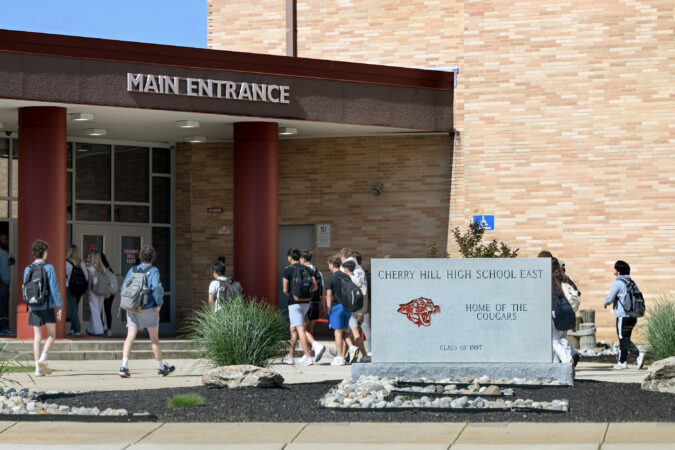
    A longtime township educator will become Cherry Hill High School East’s new principal this summer, months after the former principal resigned amid an ongoing legal battle with another former administrator.

    The Cherry Hill school board on Feb. 24 appointed John Cafagna, currently the principal of Rosa International Middle School, to take the helm of East beginning July 1.

    “I look forward to providing operational stability, being the wellness guardian for our students and staff, honoring our great traditions, and leading us as we move forward together as one East, one community, and one vision,” Cafagna said, addressing the school board.

    Cafagna has worked in the Cherry Hill Public Schools for nearly three decades, starting as an educational technologist and working his way up as a teacher, assistant principal, and, most recently, principal. He holds a bachelor’s degree in psychology from Rowan University, master’s degrees in education and educational leadership from the University of Pennsylvania and Capella University, and a doctorate in educational administration from Capella University.

    Cafagna will earn a salary of $200,000 as East’s principal.

    Leslie Walker, a longtime educator who became interim East principal in October, stepped down abruptly late last month, according to Eastside, the high school’s student newspaper. Walker’s contract was set to end in June. Walker told Eastside personal stressors in her life prompted her resignation.

    Neil Burti, Cherry Hill’s director of secondary education, will handle East’s principal responsibilities in the interim, said Nina Baratti, the district’s public information officer.

    Cafagna’s appointment came five months after the school’s former principal resigned.

    Daniel Finkle resigned in September after David Francis-Maurer, a former assistant principal, accused Finkle and the school district of discrimination and a “calculated campaign of targeted retaliation” in a lawsuit. According to Francis-Maurer, the district retaliated against him by not renewing his contract after he blew the whistle on Finkle for skirting school policies and engaging in offensive behavior.

    Finkle has denied the allegations in legal filings, saying that he did not discriminate against Francis-Maurer and that the decision to not renew Francis-Maurer’s contract was due to “job performance and nothing else.” Finkle alleged Francis-Maurer was argumentative and made “egregious errors” as assistant principal. Finkle also denied allegations that he did not follow school policy when sensitive student issues emerged.

    Cherry Hill High School East, located on Kresson Road, enrolls around 2,000 students in grades nine through 12.

    This suburban content is produced with support from the Leslie Miller and Richard Worley Foundation and The Lenfest Institute for Journalism. Editorial content is created independently of the project donors. Gifts to support The Inquirer’s high-impact journalism can be made at inquirer.com/donate. A list of Lenfest Institute donors can be found at lenfestinstitute.org/supporters.

  • U.S. national security offices, weakened by firings, confront Mideast war

    U.S. national security offices, weakened by firings, confront Mideast war

    Last week, FBI Director Kash Patel fired roughly a dozen agents and staff members who once had ties to an investigation of Donald Trump. Among them were agents who specialized in addressing threats from Iran and its proxies.

    Three days after the firings began, the United States was bombarding Iran.

    The fighting abroad poses a major test for a Justice Department and FBI reeling from mass firings, reassignments, and departures during Trump’s 14 months in office for his second term, according to current and former officials familiar with the matter, most of whom spoke on the condition of anonymity either out of concern about retaliation or to discuss continuing investigations.

    The FBI and Justice Department still have skilled leaders in many key national security positions, the people said, but they warned that the bench of expertise has significantly thinned over the past year, and the number of leaders with deep expertise in handling domestic threats has diminished.

    Thinner ranks, especially of experienced staff members, can matter in multiple ways, the current and former officials said.

    When the U.S. is engaged in conflict abroad, domestic law enforcement goes into high alert. FBI agents with national security experience sift through scores of possible threats, determining which are worth investigating further, which may be tied to terrorist groups — and which do not need to be followed up on.

    For serious threats, FBI agents often coordinate with Justice Department prosecutors to determine whether and how to execute warrants to surveil and arrest people before any possible violence occurs.

    Today, experienced agents and prosecutors are more scarce. At the FBI, the recent terminations came on top of scores of firings of agents and field-office leaders that Patel has ordered during his tenure, often without explanation.

    One former prosecutor, who spoke on the condition of anonymity to broadly discuss an investigation that has not been made public, said he worked last year with more than a half-dozen FBI agents to surveil a man who officials feared may have been planning a violent attack.

    FBI agents surveilled the man 24-7, the former prosecutor said. But Patel reassigned those agents to work on immigration, and the FBI’s capabilities to trail that suspect around-the-clock waned, the prosecutor said.

    As of October, roughly 25% of FBI agents had been assigned to immigration enforcement, stretching thin an already busy workforce.

    Each termination of an experienced agent also rids the bureau of years of source building, the current and former officials said.

    It’s impossible to know for sure what impact such departures have on the ability to track threats, they said. But, they said, each of the Iranian experts the FBI has lost probably had sources in and around Iranian American communities that they used to help monitor specific threats and people. Such source relationships, which are built on trust, cannot easily be transferred and are typically severed when agents leave.

    FBI spokesman Ben Williamson defended the bureau on social media. The recent firing of agents happened because “they acted unethically and violated the mission,” he said, adding that three agents with Iran expertise were ousted. The bureau did not answer questions about how the agents acted unethically or violated the FBI’s mission.

    “While we do not comment on personnel matters, the FBI maintains a robust counterintelligence operation, with personnel all over the country, who delivered record results in 2025 — including a 35% increase in counterintelligence arrests, six of the Ten Most Wanted Fugitives captured, and multiple foiled terrorism plots just in December alone,” Williamson said in a statement. “Our teams remain fully engaged across the country and prepared to mobilize any security assets needed to assist federal partners — as well as state and local law enforcement.”

    There’s no question, however, that the administration’s firings across the Justice Department and FBI have created big gaps in expertise across the law enforcement agency. The staffing losses have been widespread, hitting U.S. attorneys offices, FBI field offices and critical divisions at headquarters in Washington. The Justice Department has struggled to fill many of these slots with qualified people, the Washington Post has reported.

    The firings started on Day One of the Trump administration. Top Justice Department leaders pushed out Bruce Swartz, the deputy for international affairs in the criminal division, who had worked at the department for decades. Michael Nordwall, who headed the FBI’s criminal and cyber investigations division, and Robert Wells, whose portfolio included all of national security for the FBI, were also pushed out.

    At the time, The Post reported that Brian Driscoll — the acting FBI director while Patel was awaiting Senate confirmation — fought to keep Nordwall and Wells, saying their expertise was needed. Driscoll lost that fight. He subsequently was also pushed out by Patel.

    George Toscas — a veteran national security prosecutor who, in previous administrations, would have been overseeing the threats cases — was also ousted.

    Some of the removed leaders have been replaced with others who have years of experience in the department, the people interviewed said. In many cases, however, talented employees were promoted before they otherwise would have been, cutting short their training for senior positions. Others, they said, are unqualified for their jobs.

    Further stretching the national security leadership, Matthew Blue — the chief of the Justice Department’s counterterrorism section — is an Air Force veteran who has been serving in the D.C. National Guard since August. Trump deployed the D.C. National Guard to tackle “out of control” crime in the nation’s capital.

    One of Blue’s deputy chiefs, a longtime Justice Department prosecutor, has been serving as acting chief in his absence.

    Firings in other parts of the Justice Department can also have a ripple effect. Kyle Boynton — a former Civil Rights Division prosecutor and FBI agent who left the Justice Department in 2025 — noted that prosecutors who have reason to fear a person is planning a violent act can sometimes bring charges of an attempt to commit a hate crime before they carry out a violent attack. That can be a critical tool in preventing attacks, he said.

    As a prosecutor in the Civil Rights Division, Boynton said he would receive calls from FBI agents when they were tracking a threat against a synagogue, for example. He would help determine what search warrants or surveillance measures they could legally request. Boynton said he fears that few people remain in the division’s criminal section who have handled such investigations.

    The entire leadership of the criminal section of the Civil Rights Division has departed or been ousted in recent months, two people familiar with staffing in the division said.

    “It requires an enormous amount of manpower to track people before they commit a crime,” Boynton said. “What you are looking for is evidence of intent and evidence that they have taken substantial steps in furtherance of intent. That requires an enormous amount of attention and scrutiny by FBI agents and DOJ prosecutors.”

    Current and former Justice Department attorneys said they are frustrated that the Trump administration, including Patel and Attorney General Pam Bondi, did not appear to carefully consider the long-term ramifications of their staffing decisions.

    “We are now in a heightened-threat situation, not just in the Mideast but also here in the U.S. Iran, acting through its proxies, has long sought to carry out a terrorist attack or assassination inside the country,” said one longtime former senior National Security official.

    “The danger today is that we have lost so much of our capability to uncover and stop such an attack,” the official said. “We have let down our guard at the worst time.”

  • Gulf allies complain U.S. didn’t notify them of Iran attacks and ignored their warnings, sources say

    Gulf allies complain U.S. didn’t notify them of Iran attacks and ignored their warnings, sources say

    CAIRO — The Trump administration is confronting mounting discontent from allies in the Persian Gulf who have complained they were not given adequate time to prepare for the torrent of Iranian drones and missiles bombarding their countries in retaliation for strikes launched by the U.S. and Israel.

    Officials from two Gulf countries said their governments were disappointed in the way the U.S. has handled the war, particularly the initial attack on Iran on Feb. 28. They said their countries were not given advance notice of the U.S.-Israeli attack and complained the U.S. had ignored their warnings that the war would have devastating consequences for the entire region.

    One of the officials said that Gulf countries were frustrated and even angry that the U.S. military has not defended them enough. He said there is belief in the region that the operation has focused on defending Israel and American troops, while leaving Gulf countries to protect themselves, and said that his country’s stock of interceptors was “rapidly depleting.”

    Like others in this story, the Gulf officials spoke on the condition of anonymity because they were discussing a confidential diplomatic matter.

    The governments of Bahrain, Kuwait, Oman, Qatar, Saudi Arabia, and the United Arab Emirates did not respond to requests for comment.

    White House spokeswoman Anna Kelly said in response: “Iran’s retaliatory ballistic missile attacks have decreased by 90% because Operation Epic Fury is crushing their ability to shoot these weapons or produce more. President Trump is in close contact with all of our regional partners, and the terrorist Iranian regime’s attacks on its neighbors prove how imperative it was that President Trump eliminate this threat to our country and our allies.”

    The Pentagon did not respond.

    Official reactions by the Gulf Arab countries have been muted, but public figures with close ties to their governments have been openly critical of the U.S., suggesting that Israeli Prime Minister Benjamin Netanyahu dragged President Donald Trump into a needless war.

    “This is Netanyahu’s war,” Prince Turki al-Faisal, the former Saudi intelligence chief, told CNN on Wednesday. “He somehow convinced the president [Trump] to support his views.”

    Pentagon officials conceded this week in closed-door briefings with lawmakers they are struggling to stop waves of drones launched by Iran, leaving some U.S. targets in the Gulf region, including troops, vulnerable.

    The Gulf countries have emerged as valuable targets for Iran, well within the range of Iran’s short-range missiles and filled with targets, including American troops, high-profile business and tourist locations and energy facilities, disrupting the world’s flow of oil.

    Since the start of the war, Iran has fired at least 380 missiles and over 1,480 drones targeting the five Arab Gulf countries, according to an AP tally based on official statements. At least 13 people have been killed in those countries, according to local officials.

    In addition, six U.S. soldiers were killed in Kuwait on Sunday when an Iranian drone strike hit an operations center in a civilian port, more than 10 miles from the main Army base. The husband of one of the slain soldiers, who was part of a supply and logistics unit based in Iowa, said the operations center was a shipping container-style building and had no defenses.

    In briefings for members of Congress on Tuesday, U.S. Defense Secretary Pete Hegseth and Gen. Dan Caine, chairman of the Joint Chiefs of Staff, told lawmakers that the U.S. will not be able to intercept many of the incoming UAVs, especially the Shaheds, according to three people familiar with the briefings.

    In one of the briefings, Caine and Hegseth did not offer any details when pressed by lawmakers why the U.S. did not seem prepared for Iran to launch waves of drones at U.S. targets in the region, according to one of the people.

    That person, a U.S. official who is familiar with the U.S. security posture in Gulf region, said that the U.S. did not have widespread capabilities throughout the Gulf region to effectively counter waves of the one-way drones coming to places outside conventional targets or bases outside of Iraq and Syria.

    Drone attacks this week at the embassy in Saudi Arabia caused a limited fire at the embassy in Riyadh, and another drone attack the United Arab Emirates sparked a small fire outside the U.S. consulate in Dubai.

    The U.S. and its allies in the Middle East on Thursday even sought help from Ukraine, which has expertise in countering Iran’s Shahed drones, according to Ukrainian President Volodymyr Zelensky. When asked about Zelensky’s comments, Trump told Reuters on Thursday, “Certainly, I’ll take, you know, any assistance from any country.”

    Bader Mousa Al-Saif, a Kuwait-based analyst with Chatham House, said the U.S. appeared to have underestimated the risk to its Gulf Arab allies, believing American troops and Israel would be the primary targets of Iranian retaliation.

    “I don’t think they saw that there would be as much exposure to the Gulf,” he said, saying the lack of a plan to protect the Gulf countries “speaks to U.S. short-sightedness.”

    The frustration in some of the Gulf nations is driven in part by the relative success that Israel has had knocking down drones and missiles compared to some of their neighbors, according to a person familiar with the sensitive diplomatic matter who was not authorized to comment publicly.

    Their air defense systems are hardly as robust as Israel’s, but according to the person, U.S. officials have been somewhat perplexed that the Gulf countries are still not showing an appetite for delivering a counteroffensive by launching missiles at Iranian targets.

    Elliott Abrams, who served as a special representative for Iran and Venezuela at the end of Trump’s first term, said that U.S. national security officials and their Gulf allies were aware that Iran had the capability to carry out significant strikes.

    “And the neighbors knew it and were afraid of it. But it was never clear that Iran would actually do it, because they have a lot to lose,” Abrams said. “These attacks will leave long-term enmity, and if they keep up, the Gulf Arabs may start attacking Iran.”

    Michael Ratney, a former U.S. ambassador to Saudi Arabia, said that while the Gulf countries have an interest in seeing Iran weakened, they also have key concerns about the ongoing war — including the economic damage and instability it is causing and its open-ended nature.

    Ratney, who is now a senior adviser in the Middle East program of the Center for Strategic and International Studies, said: “What comes next? The countries of the Gulf will have to bear the brunt of whatever that is.”

  • Philly City Council will consider limiting ICE next month as new Pa. detention centers loom

    Philly City Council will consider limiting ICE next month as new Pa. detention centers loom

    Philadelphia City Council next month will consider legislation to place some limits on immigration enforcement in the city and is planning a daylong hearing to parse the proposals.

    Council President Kenyatta Johnson, a Democrat who controls the flow of legislation in the chamber, said he has scheduled a hearing to take place at 10 a.m. on April 6 before the Committee of the Whole, which comprises all 17 Council members.

    That means every lawmaker will have the opportunity to question members of Mayor Cherelle L. Parker’s administration, as well as immigration advocates, about the package.

    The timeline means mid-April is the earliest that Council could pass the package. Fifteen of the body’s 17 members have expressed support, and that constitutes a veto-proof majority.

    City Councilmembers Rue Landau, a Democrat, and Kendra Brooks, of the progressive Working Families Party, sponsored the legislation introduced in January, which prohibits ICE agents from wearing masks, bans them from staging raids on city property, and makes it illegal to discriminate against someone based on immigration status.

    The legislation also clarifies how and when Philadelphia officials can coordinate with federal immigration enforcement.

    Parker has said an executive order signed by her predecessor remains in place, limiting some cooperation between law enforcement and ICE. But the legislation that Council is considering goes further, codifying a prohibition on city officials assisting ICE and prohibiting data-sharing agreements.

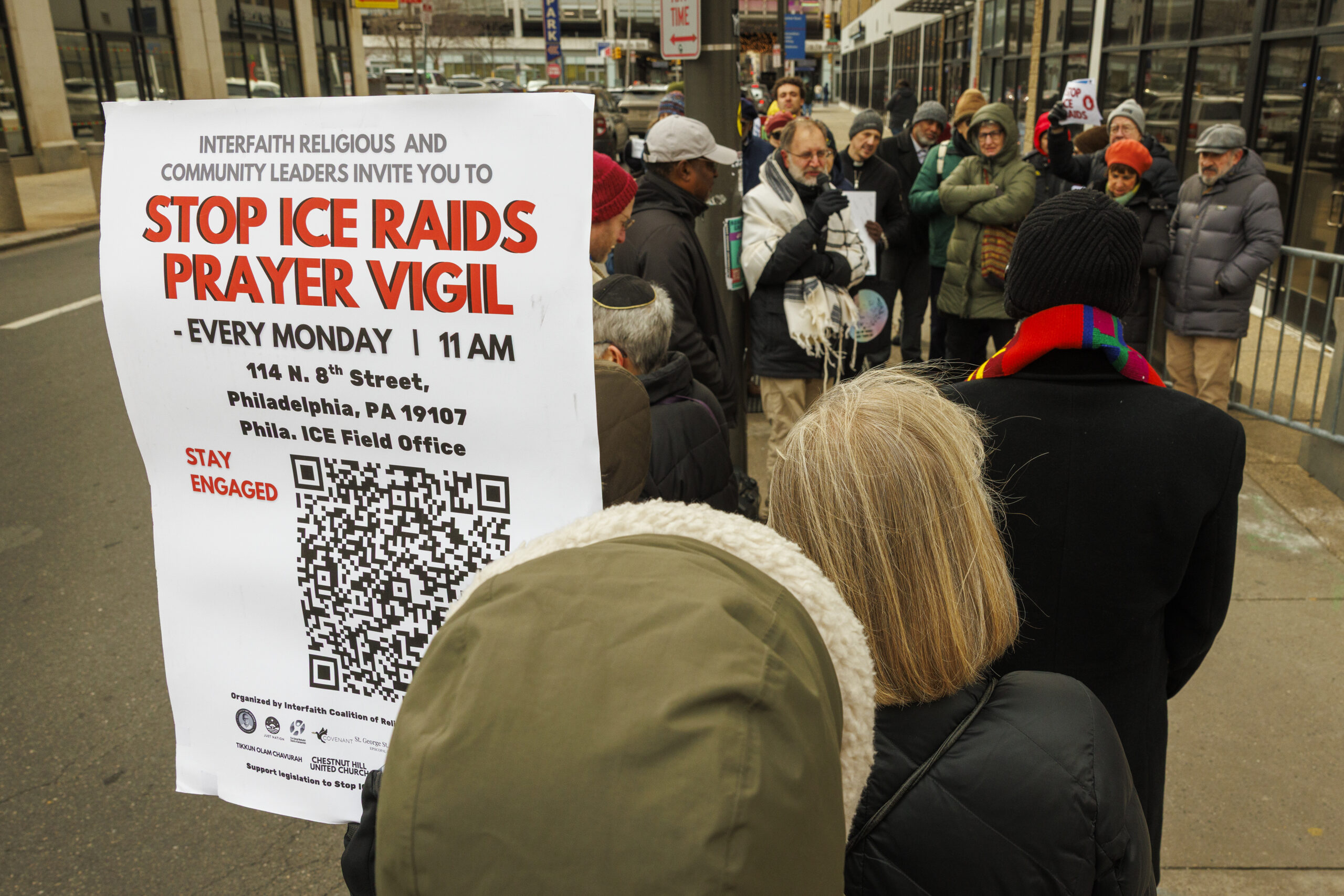
    Interfaith religious and community leaders prayer vigil outside the Philadelphia U.S. Immigration and Customs Enforcement office at 114 N. 8th Street in Center City on March 2.

    It comes as the U.S. Immigration and Customs Enforcement agency is undergoing a revamping to its leadership structure. President Donald Trump on Thursday ousted Department of Homeland Security Secretary Kristi Noem, and said he intends to nominate U.S. Sen. Markwayne Mullin (R, Okla.) to replace her.

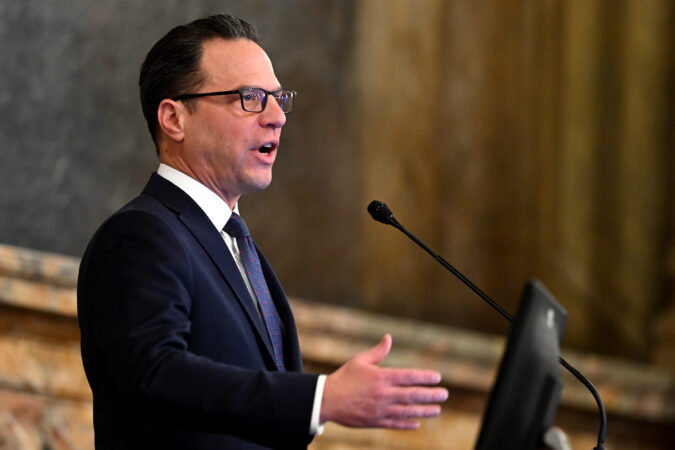
    At the same time, Democrats across Pennsylvania, including Gov. Josh Shapiro, continue to denounce ICE, including the agency’s plans to develop two immigration detention centers outside the city.

    Several local officials said this week that they’re worried the federal government will surge enforcement efforts in Philadelphia in order to fill the centers, and that the city must move quickly to pass its legislation.

    “I’m extremely concerned,” said City Councilmember Quetcy Lozada, a Democrat whose North Philadelphia-based district has a large immigrant population. “We need to really figure out what our position is as it relates to working with ICE very closely. We have community residents that we should be protecting.”

    The Trump administration this year quietly spent millions of dollars buying warehouses in two dozen communities across the country.

    Two are in Pennsylvania and could reportedly hold about 9,000 beds in total.

    Spotlight PA reported Tuesday that ICE is referring to a facility in Tremont, located in Schuylkill County, as the “New ICE Philadelphia Mega Center” and one in Upper Bern Township in Berks County as the “New ICE Philadelphia Processing Center.”

    Landau said Council is “paying close attention to these developments and the questions they raise about the expansion of detention facilities in our area.”

    “The majority of Philadelphians are deeply disturbed by ICE’s tactics,” she said.

    Johnson said in an interview last month that the detention centers are a reason to move swiftly on the ICE-related legislation.

    The proposed laws, he said, are a means to “be out in front” of a potential surge of immigration enforcement in the city.

    “Some people say, ‘Well, they’re not even here yet.’ But they just built a warehouse in [Berks County],’” Johnson said. “I believe that was strategic. It took some planning to say ‘We want to set up shop right in your backyard.’”

  • Flyers trade Bobby Brink to Minnesota for 2022 top 10 pick David Jiříček

    Flyers trade Bobby Brink to Minnesota for 2022 top 10 pick David Jiříček

    The Flyers are officially in the trade column, as they started to unclog their logjam on the wing by trading Bobby Brink to the Minnesota Wild for defenseman David Jiříček on Friday.

    Although Rasmus Ristolainen, who ultimately was not moved, was the biggest name in play for the Flyers, many felt Brink could be moved ahead of the 3 p.m. trade deadline. Brink, who will be a restricted free agent at season’s end, also will relish the destination as he is a native of Minnetonka, Minn.

    “He’s helped me a ton with my game, [and] hopefully he can say the same about me,” linemate Noah Cates said after the team’s practice in Voorhees. “Both being from Minnesota, there’s a lot of good things; it’s sad, but obviously happy. He’s going back home and going to a really good team.

    “But definitely a shock, and still processing it. This still doesn’t feel too real. So, obviously, just a great kid, and [he] means a lot to me. So, hoping nothing but the best for him.”

    The 24-year-old winger, who was a second-round pick in 2019, has 13 goals and 26 points in 55 games this season, and is on pace for a career-high 17 goals. Brink, who developed chemistry and increased his all-around effectiveness on a third line with Cates and Tyson Foerster the past few seasons, tallied 36 goals and 94 points in 201 career games with the Flyers.

    It was quite a spell in Philly for Brink, who went from John Tortorella’s doghouse — the coach said two years ago that Brink couldn’t spell “check” and, interestingly enough, scratched him for what would have been his first game in Minnesota — to someone he relied on heavily.

    “He’s come a long way,” captain Sean Couturier said in October. “We’ve always seen his offensive skills and his ability to make plays and create offense, but the defensive side and the reliability of him have really improved. Feels like he’s a complete player, can play in all situations, and he’s going on a nightly basis against top lines. So, credit to him for developing that side of the game.”

    Cates did not see Brink before he left for Las Vegas, where the Wild play on Friday night, and hadn’t sent him a text just yet. But he will be seeing him on Thursday, when the Flyers are in Minnesota (8 p.m., NBCSP).

    “He went through some tough times with Torts and being a younger player, smaller player, skilled player. And he really helped me,” Cates said. “And I think our games kind of meshed well together and found some good chemistry. … He grew a ton. And credit to him. He’s seen as a critical piece to the Wild that they want and for them to go on a playoff run. So, obviously, an awesome kid, and we’re going to miss him.”

    Once known for his shot and overall offensive skills, David Jiříček has yet to fire at the NHL level.

    Coming back the other way is the intriguing Jiříček, who will be joining a third team since being selected sixth overall — one pick after the Flyers selected Cutter Gauthier — in the 2022 NHL draft. The 6-foot-4, 204-pound blueliner has split time this season between Minnesota and its American Hockey League affiliate in Iowa and has no points in 25 NHL games and two goals and 10 points in 24 AHL contests.

    Still just 22, Jiříček has yet to deliver on the promise that made him such a highly touted prospect in his draft year. Blessed with great range, puck skills, and a bomb of a shot, Jiříček’s combination of size, offensive ability, and edge has yet to translate since he moved over to North America.

    The Flyers, who were known admirers of Jiříček in his draft year, still obviously believe he’s a worthy reclamation project, given his age and toolbox. With the Flyers likely to entertain trades this summer for Ristolainen, Jiříček, although a different player, could fill the size void and could be viewed as an heir apparent. The Flyers announced that Jiříček will report to the Lehigh Valley Phantoms of the AHL to start.

    The questions with Jiříček largely center on his foot speed and clunky skating. Alongside his injury history, they was the other concerns entering his draft and have only been magnified since he turned pro. He struggles to catch up when forwards get around him, and his decision-making often has gotten him in trouble in the NHL. He has bona fide power-play traits, but has yet to receive those opportunities.

    It is worth noting that the Flyers are buying low on Jiříček, as Minnesota traded defenseman Daemon Hunt plus first-, second-, third- and fourth-round picks for Jiříček just 16 months ago.

    Flyers make minor league swap

    Forwards Massimo Rizzo and Alexis Gendron are shipping up to Boston in a swap with the Bruins that sees forward Brett Harrison and defenseman Jackson Edward heading to Philly. They will report to Lehigh Valley.

    A native of London, Ontario, Harrison was a third-round pick by the Bruins in 2021 and has 19 goals and 49 points in 140 games across four seasons with the Providence Bruins. The 6-foot-3, 201-pound 22-year-old is having a career year with eight goals in 46 games and tied his career high of 17 points set last season.

    Edward has spent most of the season with Maine of the ECHL, producing seven assists in 21 games. A native of Newmarket, Ontario, he was teammates with Oliver Bonk and Denver Barkey, the latter of whom also hails from Newmarket, with London of the Ontario Hockey League. The 6-foot-2, 201-pound blueliner was a seventh-round pick of the Bruins in 2022 and brings a physical game to the ice. The Elite Prospects draft guide said Edward is “violent, and he uses that violence to emphatically kill plays at the blue line and end the cycle.”

  • Dreaming of a baseball Dream Team: What the USA roster might look like for the 2028 L.A. Olympics

    Dreaming of a baseball Dream Team: What the USA roster might look like for the 2028 L.A. Olympics

    Who remembers when the greatest collection of basketball talent ever assembled on one roster took the court for the first time at the 1992 Summer Olympics in Barcelona?

    “Yeah,” Kyle Schwarber said, “I was too young for that.”

    Too polite, also, to acknowledge that he wasn’t born yet. But never mind that the Phillies slugger didn’t come along until March 1993. Everyone’s heard about when Michael Jordan, Magic Johnson, and Larry Bird headlined a group of NBA stars that flexed U.S. basketball might on the world stage.

    The story of the “Dream Team” transcends generations.

    Thirty-four years later, USA Baseball has put together its version to compete in the triennial World Baseball Classic and avenge a 3-2 loss to Japan in 2023 on Shohei Ohtani’s championship-clinching strikeout of Mike Trout.

    A few names on the team of U.S. manager Mark DeRosa’s dreams:

    Aaron Judge. Paul Skenes. Cal Raleigh. Tarik Skubal. Bryce Harper. Bobby Witt Jr. And, yes, Schwarber.

    “It’s a great team,” Schwarber said on Phillies Extra, The Inquirer’s baseball podcast. ”Another stacked lineup. The lineup that we had out there in ’23 was full of studs, MVPs, All-Stars, everything. This lineup, All-Stars, MVPs, and the cool thing is there’s a little bit more youth on it, too.

    “You’re starting to see some of these younger faces that could really have those chances to be future MVPs. Those future perennial All-Stars are going to be on this team, as well. I’m just excited about it.”

    It makes you dream, doesn’t it? And not just about whether the most talented American baseball team ever assembled can win the WBC for the first time since 2017.

    No, dream bigger. Dream of 2028, the Summer Olympics in Los Angeles, where baseball will return as a medal sport for the first time since 2020. And dream of a best-on-best international tournament made possible if MLB chooses to pause the season, just as the NHL did in 1998, 2002, 2006, 2010, 2014, and again for 11 riveting days last month in Milan.

    “We have the WBC, but it’s not the same,” said Harper, who has lobbied MLB for years to make concessions for the Olympics. “People can say as much as they want, but the Olympics is so worldwide. The WBC is great and brings a lot of people together, but the Olympics is something you dream about playing in.”

    Indeed, although the WBC generates interest, there are limits to how seriously it can be taken given its timing on the sport’s calendar. It’s still spring training, after all, and for years, many of the best pitchers — American pitchers, in particular — declined a WBC invitation to focus on building arm strength for the season.

    DeRosa, USA Baseball’s “Uncle Sam,” said there was more buy-in for his “I Want You” recruitment this time around, and not only from Skenes, the NL Cy Young Award winner who pitched in college at Air Force and is unlikely to start meaningful games down the stretch for the perennially noncontending Pirates.

    “I just think it was the fear of missing out,” DeRosa said at baseball’s winter meetings in December. “I think guys watched in ’23 and saw the game against Japan, the iconic moment between Trout and Ohtani, Trea Turner’s [grand slam] against Venezuela.

    “These are moments in time. It’s like, you’re going to miss out on three weeks of the greatest time of your life as a professional if you never win a World Series. That’s what this is.

    “You see the way Latin America and Japan is. I just feel like there’s been a groundswell with the United States player that, all right, it’s time for us to go.”

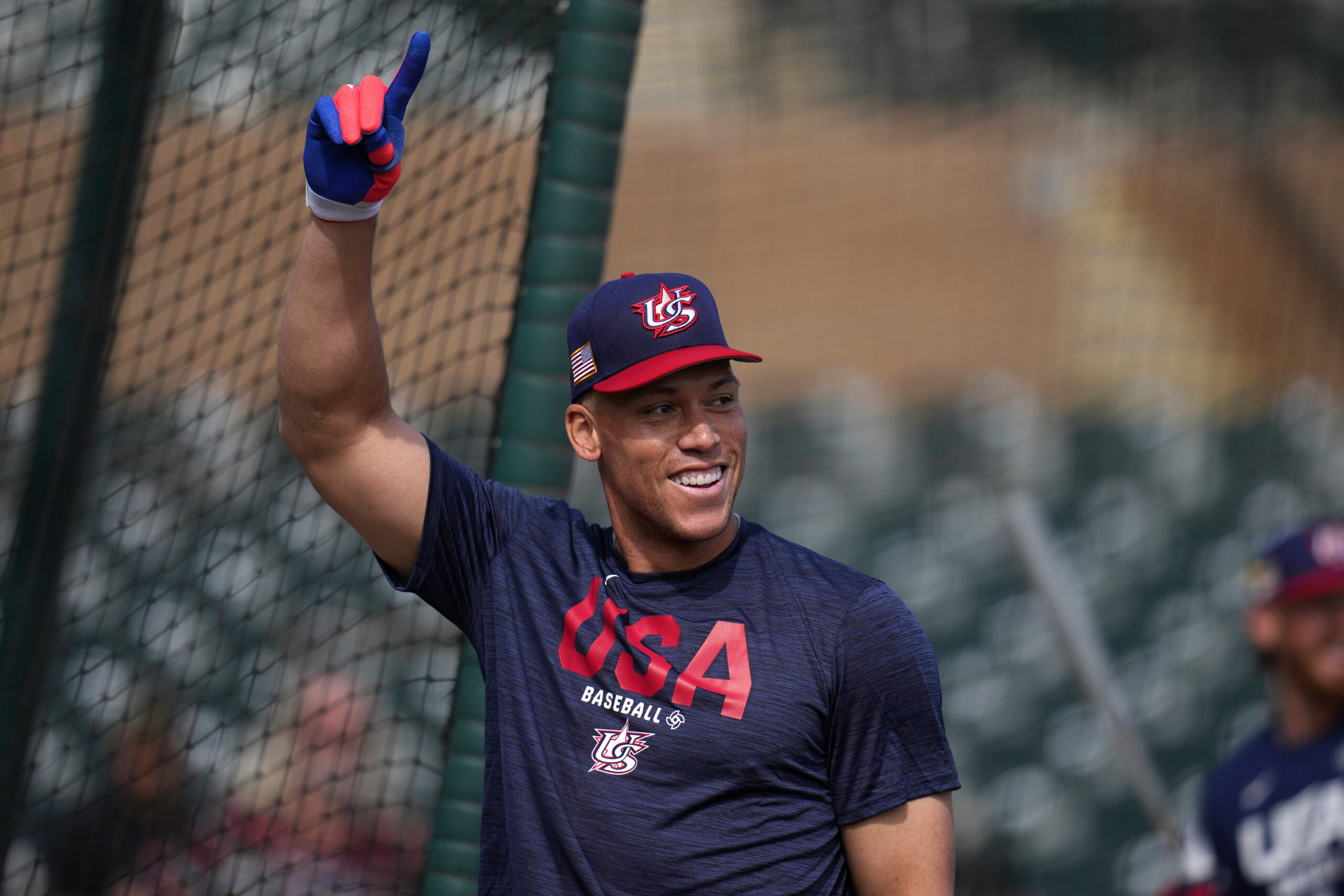
    Yankees slugger Aaron Judge captains a USA team full of All-Stars and future Hall of Famers looking to avenge their WBC title game loss to Japan in 2023.

    Sure, but the WBC lets players go only so far. Pitchers are capped at 65 pitches in the preliminary round, 80 in the quarterfinals, and 95 in the semis and final.

    WBC managers also organized their pitching rotations in consultation with major league teams. Webb started Team USA’s opener Friday night against Brazil because the Giants need their ace to line up for opening day. Skubal will pitch only once. If the U.S. gets to the final, Mets rookie Nolan McLean will likely start, not Skubal or Skenes.

    Most of the restrictions and guardrails could be lifted for the 2028 Olympics, which are scheduled from July 14 to 30. Injuries are unavoidable no matter the time of year. But pitchers will be fully built up, so workloads won’t need to be massaged.

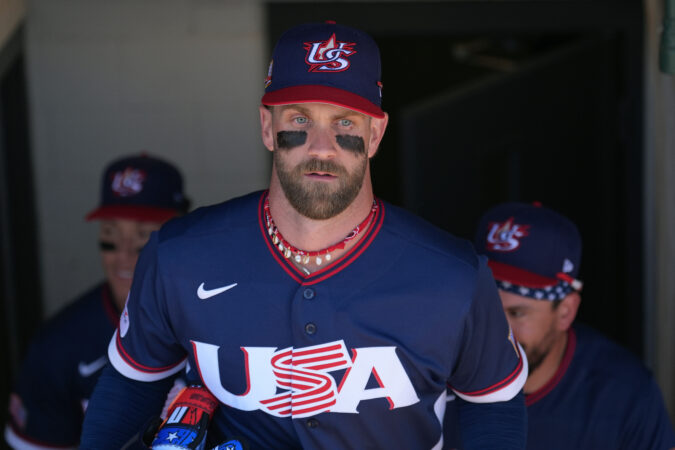
    Harper was among the first players to commit to Team USA in 2023 but withdrew after Tommy John elbow surgery. He signed on for this year’s tournament in December and said he was excited to play for the country for the first time since he was 18 — 15 years ago.

    Yet it feels like only the appetizer before the main course if major leaguers are allowed to play in the Olympics.

    “I think that would be awesome,” Schwarber said. “We all grew up watching the Olympics and watching sports that you never thought that you’d watch.

    “I feel like it would be such a great thing for our game just to have major leaguers there who are performing at the highest level to represent their countries. It would be amazing to have that, not just on the WBC size but on the world size.”

    And then the U.S. could field a baseball Dream Team.

    But a lot can change in two years. Using the WBC roster as a base, and organizing players into tiers (with their 2028 age in parentheses), let’s examine who might get to wear “U-S-A” across their chest when L.A.’s Olympic flame is lit.

    Pirates ace Paul Skenes will anchor Team USA’s World Baseball Classic pitching staff.

    The ‘pillars’

    • Aaron Judge, RF, Yankees (36)
    • Paul Skenes, SP, Pirates (26)

    After skipping the WBC in 2023, the captain of the Yankees agreed to be Captain America. But Judge’s commitment didn’t signify as much as Skenes’.

    “Every other country, their best arms show up,” DeRosa said. “For whatever reason, in the United States, our best arms don’t show up. We’re trying to change that narrative. [Skenes] has certainly changed it.”

    DeRosa often refers to Judge and Skenes as Team USA’s hitting and pitching “pillars.” They’re set in stone.

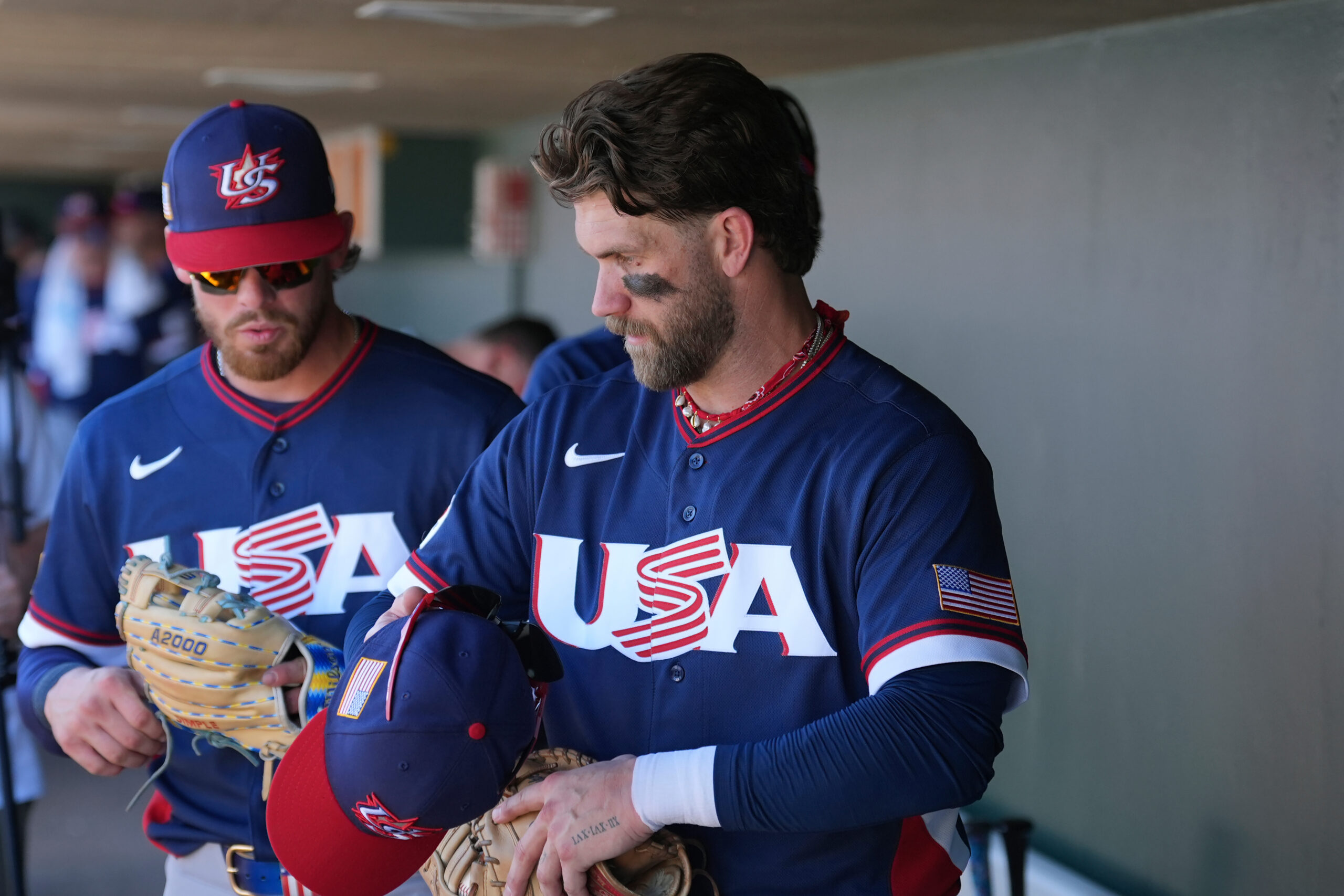
    Bryce Harper (right), with and Bobby Witt Jr., would be 35 during the 2028 Olympics, but he’d still be a surefire pick.

    The core holdovers

    • Bobby Witt Jr., SS, Royals (28)
    • Gunnar Henderson, SS, Orioles (27)
    • Roman Anthony, OF, Red Sox (24)
    • Pete Crow-Armstrong, CF, Cubs (26)
    • Corbin Carroll, OF, Diamondbacks (27)
    • Cal Raleigh, C, Mariners (31)
    • Bryce Harper, 1B, Phillies (35)
    • Tarik Skubal, SP, Tigers (31)
    • Nolan McLean, SP, Mets (26)
    • Mason Miller, RP, Padres (29)

    Turner smashed five homers, including a grand slam, in six WBC games in 2023. This time, the Phillies shortstop said he didn’t even get a call from DeRosa, who went younger at shortstop.

    Tough business.

    A new wave of talent will wash ashore by the summer of 2028. But Witt, Henderson, Anthony, and Crow-Armstrong will still be under 30 and difficult to supplant. Ditto for Carroll, who dropped out of the WBC after breaking a bone in his hand.

    At 35, Harper would be an elder statesman. But unless he gets injured or his production drops off a cliff, his face-of-the-sport star power gets him a place on the roster.

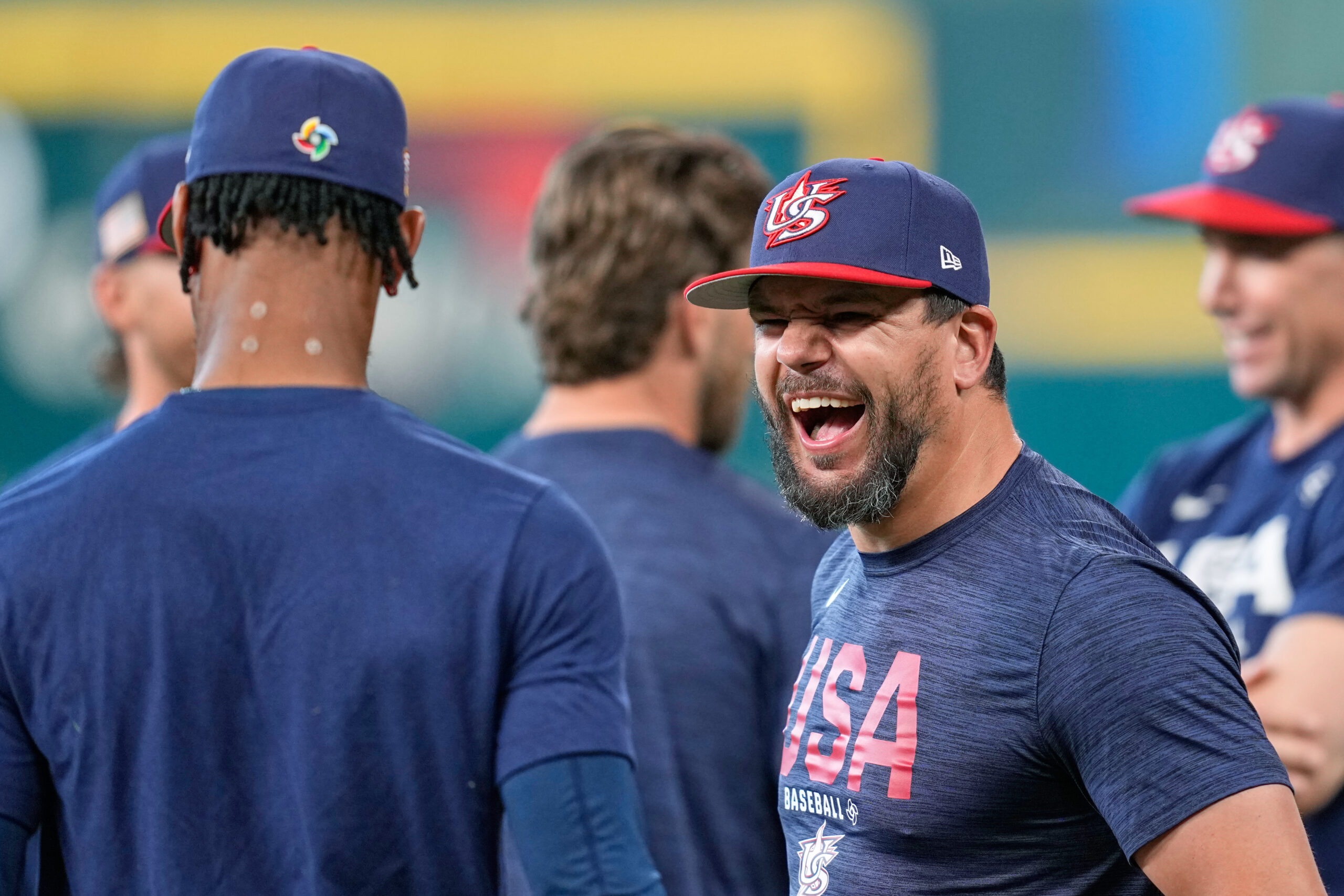
    Kyle Schwarber laughs while talking with Byron Buxton during a Team USA workout for the World Baseball Classic on Thursday.

    The veteran leaders

    • Kyle Schwarber, DH, Phillies (35)
    • Alex Bregman, 3B, Cubs (34)

    Schwarber’s presence in the middle of Team USA’s loaded order is undeniable. But here’s a word on his influence within the clubhouse:

    “He’s the chemistry guy for me,” DeRosa said. “He was the guy. He’s in the dugout going, ‘Everyone relax. Do what you do.’ Even to me, he’s coming up, rubbing my shoulders, just like, ‘I got you.’ There’s just no panic with this guy. … He’s an infectious personality, and everyone loves him. And he backs it up.”

    Bregman brings a similar vibe as a leader and a winner.

    Others whose roster spot will be challenged by younger players: Will Smith, C, Dodgers (33); Byron Buxton, CF, Twins (34); Brice Turang, 2B, Brewers (28); Paul Goldschmidt, 1B, Yankees (40); Logan Webb, SP, Giants (31); Joe Ryan, SP, Twins (33); David Bednar, RP, Yankees (33).

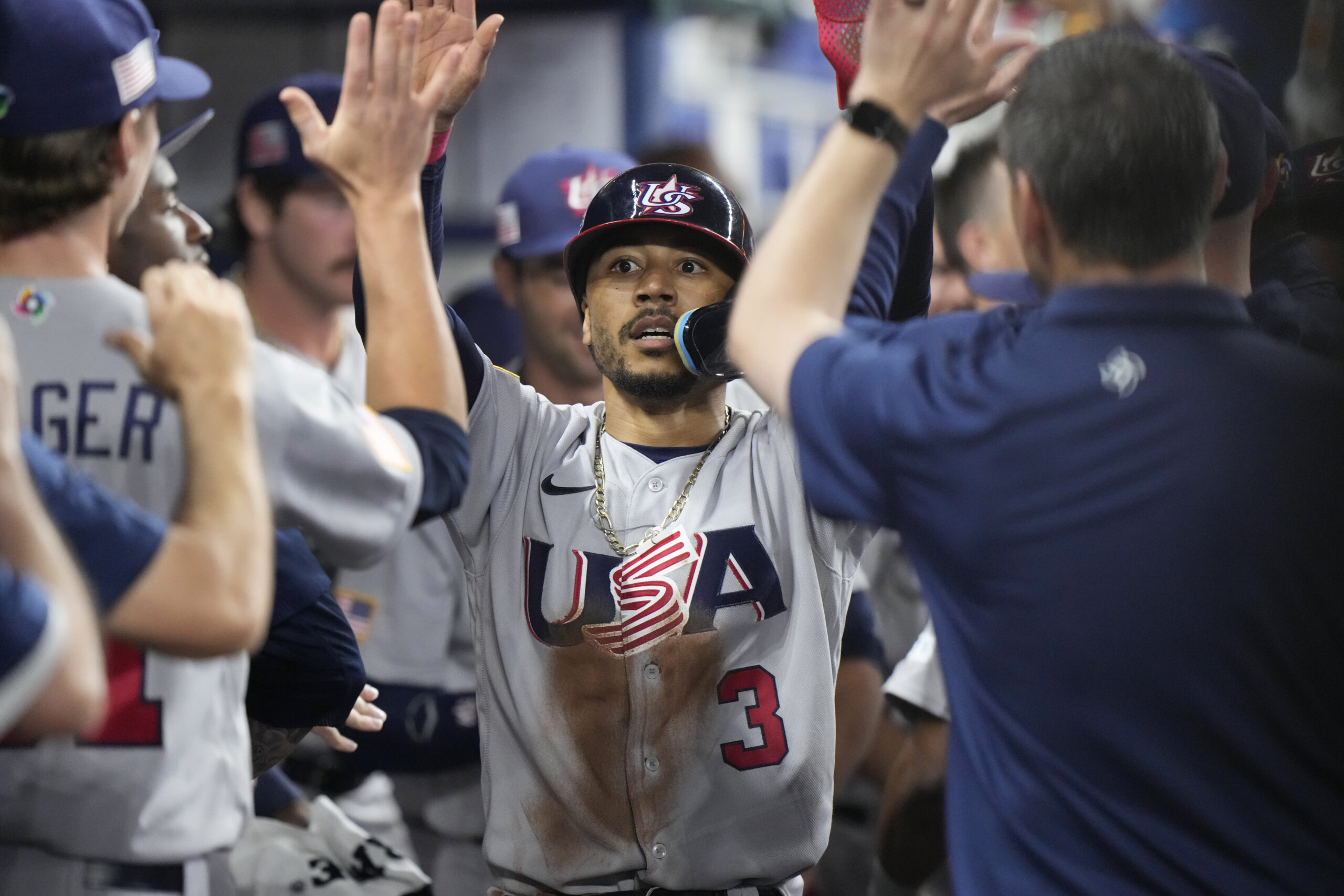
    After playing in the 2023 World Baseball Classic, Mookie Betts is not on the 2026 squad.

    The 2026 outsiders

    • Mookie Betts, SS, Dodgers (35)
    • Trea Turner, SS, Phillies (35)
    • Kyle Tucker, OF, Dodgers (31)
    • Riley Greene, OF, Tigers (27)
    • Pete Alonso, 1B, Orioles (33)
    • Matt Olson, 1B, Braves (34)
    • Cody Bellinger, OF/INF, Yankees (32)
    • Mike Trout, OF, Angels (36)
    • Garrett Crochet, SP, Red Sox (29)
    • Hunter Brown, SP, Astros (29)
    • Bryan Woo (28), SP, Mariners (28)
    • Max Fried, SP, Yankees (34)
    • Hunter Greene, SP, Reds (29)
    • Logan Gilbert, SP, Mariners (31)
    • George Kirby, SP, Mariners (30)
    • Gerrit Cole, SP, Yankees (38)
    • Zack Wheeler, SP, Phillies (38)
    • Chris Sale, SP, Braves (39)
    • Jacob deGrom, SP, Rangers (40)
    • Blake Snell, SP, Dodgers (36)
    • Devin Williams, RP, Mets (33)
    • Josh Hader, RP, Astros (34)

    Imagine if Team USA had Crochet and Brown in the rotation behind Skenes and Skubal. Or if Greene or Tucker were in left field. And how the heck is Betts not on the WBC roster? Wheeler said he considered playing before getting injured last season. Maybe he or Cole could fill Clayton Kershaw’s role on the staff in 2028.

    This is only a partial list of stars who won’t compete in the WBC. And the omissions serve only to amplify the pool of talent that Team USA has at its disposal.

    Young stars like the Athletics’ Nick Kurtz will be in the mix for a 2028 Olympics team.

    The next generation

    • Nick Kurtz, 1B, Athletics (25)
    • James Wood, OF, Nationals (25)
    • Wyatt Langford, OF, Rangers (26)
    • Jackson Merrill, OF, Padres (25)
    • Drake Baldwin, C, Braves (27)
    • Konnor Griffin, SS, Pirates (22)
    • Colson Montgomery, SS, White Sox (26)
    • Kevin McGonigle, SS, Tigers (23)
    • Jackson Holliday, 2B, Orioles, (24)
    • Trey Yesavage, SP, Blue Jays (24)
    • Jacob Misiorowski, SP, Brewers (26)
    • Bubba Chandler, SP, Pirates (25)
    • Andrew Painter, SP, Phillies (25)

    Another partial list. Another trove of talent that will elbow its way into the conversation in two years, assuming that the door to the Olympics is opened to major leaguers.

    “To be able to say that you’re an Olympian, that would be a really cool thing, a bucket-list item that you could cross off,” Schwarber said. “I guarantee you’d have a really big pool of players that would want to sign up and put their name in a hat to represent their country.”

  • As Trump shrank the federal workforce, Pennsylvania hired hundreds of former federal employees

    As Trump shrank the federal workforce, Pennsylvania hired hundreds of former federal employees

    More than 800 former federal workers have been hired by the Pennsylvania government in the last year, as thousands of Pennsylvania-based federal government employees quit or lost their jobs.

    Pennsylvania’s Office of Administration announced the count this week. It’s been one year since Gov. Josh Shapiro signed an executive order streamlining the hiring of former federal workers to state-government positions.

    At that time, the Trump administration had just offered federal workers a deferred resignation program to leave their positions with the promise of several months’ pay. The Trump administration had also begun laying off workers across agencies, touting plans for further workforce reductions.

    Pennsylvania employment data showed roughly 4,800 fewer federal government jobs in October, as the deferred resignation program took effect. From January through November last year, the U.S. overall cut 271,000 federal jobs.

    “Federal employees bring world-class training and a deep commitment to public service,” Neil Weaver, secretary of the Office of Administration, said in a statement this week. “By tapping into their expertise, we’ve strengthened our workforce and improved the delivery of programs and services that Pennsylvanians depend on every day.”

    window.addEventListener(“message”,function(a){if(void 0!==a.data[“datawrapper-height”]){var e=document.querySelectorAll(“iframe”);for(var t in a.data[“datawrapper-height”])for(var r,i=0;r=e[i];i++)if(r.contentWindow===a.source){var d=a.data[“datawrapper-height”][t]+”px”;r.style.height=d}}});

    The 800 former federal employees who now work for Pennsylvania are in law enforcement, public safety, human services, health care, and other areas.

    The Office of Administration said it had “moved at the speed of business to implement the executive order and capitalize on the opportunity to hire displaced federal workers to fill existing, funded vacancies in state agencies.”

    Pennsylvania partnered with Civic Match, a job-seeking platform focused on state and local government positions, and which hosts virtual job fairs. The platform is managed by national nonprofit Work for America. Since it launched in 2024, the platform has shown almost 900 Pennsylvania job listings.

    As of Thursday afternoon, Pennsylvania’s own online job board showed 657 vacancies. They include an aquatic biologist, police cadet, accountant, and an air monitoring equipment specialist.

  • Dow drops 900 after oil prices jump to highest in nearly 2 years amid Iran conflict

    Dow drops 900 after oil prices jump to highest in nearly 2 years amid Iran conflict

    NEW YORK — U.S. stocks are falling sharply Friday after getting a whiff of a worst-case scenario for financial markets: a weakening economy combined with high inflation.

    The S&P 500 dropped 1.6% after a report showed U.S. employers cut more jobs last month than they created and after oil prices jumped to their highest level in nearly two years because of the Iran war. It’s a combination that investors hate because no one in the world has a good tool to fix both a weak economy and high inflation at the same time.

    The Dow Jones Industrial Average was down 909 points, or 1.9%, as of 9:35 a.m. Eastern time, and the Nasdaq composite was 1.6% lower.

    “You can’t sugarcoat this report,” according to Brian Jacobsen, chief economic strategist at Annex Wealth Management. “A negative payrolls number combined with a big jump in oil prices will have traders worrying about stagflation risks.”

    Stagflation is what economists call a stagnating economy combined with high inflation, and a separate report released Friday added to the sour mix after showing that U.S. retailers made less money last month than economists expected. It raised the possibility that spending by U.S. households, the main engine of the economy, may be stretched near its maximum.

    Usually when the economy is unsteady and the job market is weakening, the Federal Reserve cuts interest rates to give things a boost. Lower rates can make it more affordable for borrowers to get mortgages or to raise money to build factories, while also helping prices for stocks and other investments. The Fed cut its main interest rate several times last year and had indicated more were to come this year.

    But lower interest rates can also make inflation worse. And the Fed’s hands may be increasingly tied because oil prices are spiking and pushing inflation higher due to disruptions for the energy industry because of the war.

    The price for a barrel of Brent crude, the international standard, jumped another 5.7% to $90.25. A barrel of benchmark U.S. crude climbed 8.9% to $88.20.

    Oil prices have surged, with Brent up from near $70 late last week, as the war has expanded and targeted areas critical to the production and movement of energy in the Middle East. Much will depend on what happens with the Strait of Hormuz. Roughly a fifth of the world’s oil typically sails through the narrow waterway off Iran’s coast.

    The conflict also halted exports of Iranian gas to much of Asia. If that stoppage is drawn out, it will likely lead to a bidding war between Europe and Asia that would send energy prices even higher, said Fatih Birol, chief of the International Energy Agency.

    If oil prices spike further, like to $100 per barrel, and stay there, some analysts and investors say it could be too much for the global economy to withstand.

    To be sure, the U.S. stock market has a history of bouncing back relatively quickly following conflicts in the Middle East and elsewhere, as long as oil prices don’t jump too high for too long. The uncertainty about what will happen has caused frenetic swings across financial markets this week, sometimes hour by hour.

    President Donald Trump’s most recent signal was that he wants an “unconditional surrender” of Iran, apparently ruling out negotiations.

    In the bond market, Treasury yields rose further as the jump in oil prices pushed harder on upward inflation pressures. More traders are betting on the possibility that the Fed will cut interest rates just once this year, instead of at least twice, according to data from CME Group.

    The yield on the 10-year Treasury climbed to 4.17% from 4.13% late Thursday and from just 3.97% before the war with Iran started.

    In stock markets abroad, indexes slumped in Europe following a better finish in Asia. France’s CAC 40 fell 1.6%, and Germany’s DAX lost 1.8%, while Hong Kong’s Hang Seng jumped 1.7% and Japan’s Nikkei 225 added 0.6%.

  • Jordan Mailata wins first Montgomery-Wanamaker Citizens Award, which now bears the name of the late Phillies chairman

    Jordan Mailata wins first Montgomery-Wanamaker Citizens Award, which now bears the name of the late Phillies chairman

    After 65 years of honoring athletes, organizations, and teams for their on-field success, the John Wanamaker Athletic Award is entering its next chapter — and it’s bringing a new legacy with it.

    The newly renamed Montgomery-Wanamaker Citizens Award pays tribute to both Wanamaker and former Phillies president, the late David Montgomery.

    As part of the change, the award — which was previously presented to “the athlete, team or organization which has done the most to reflect credit upon Philadelphia and to the team or sport in which they excel” — will now focus more on athletes’ off-field accomplishments. It will honor recipients’ work in their communities and their love for the city.

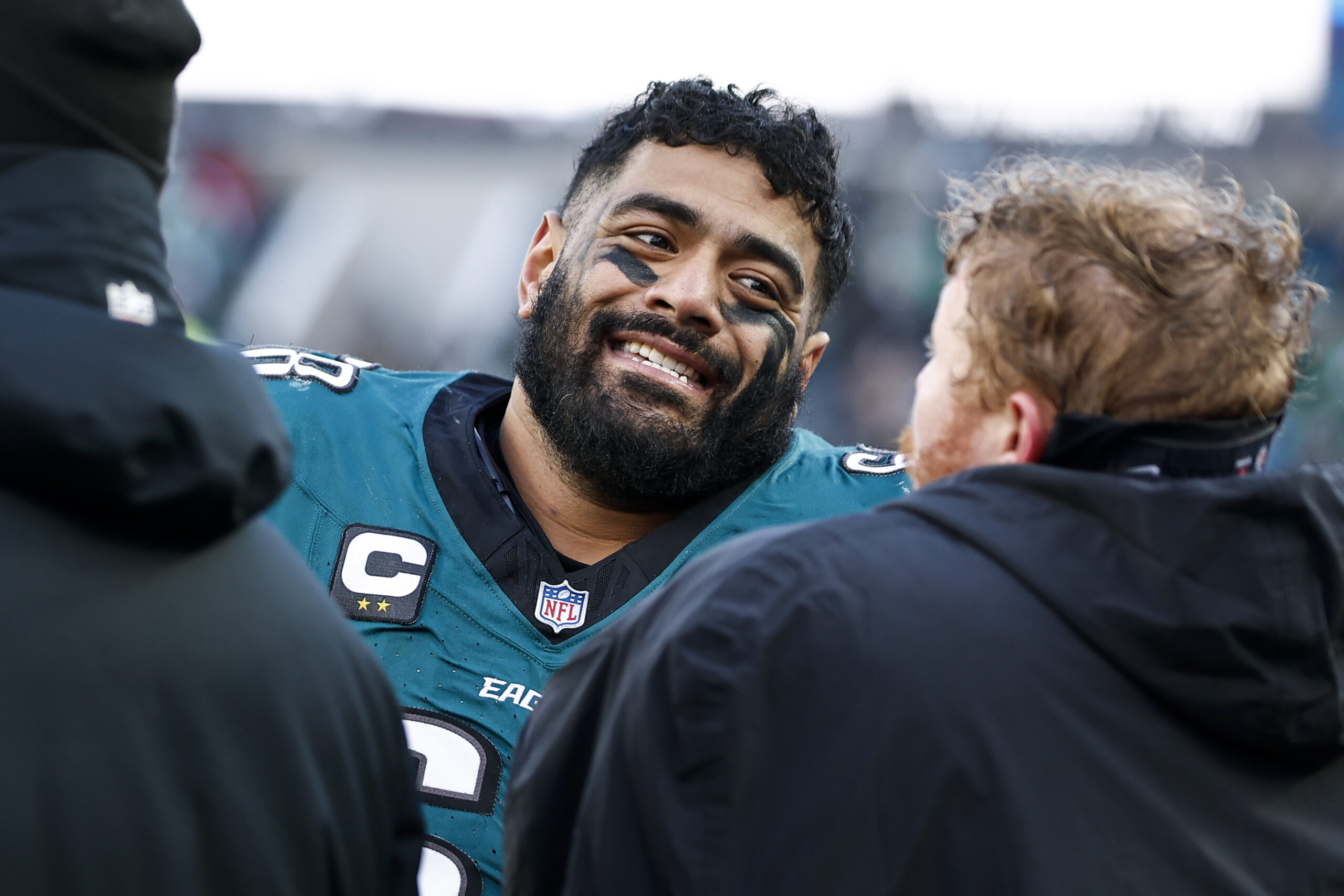
    This year, that’s Jordan Mailata. The Eagles offensive tackle will be the first to receive the Montgomery-Wanamaker Citizens Award, in recognition of his work with The Philly Specials.

    The award, which was previously presented by PHL Sports, is now under the direction of the Philadelphia Youth Sports Collaborative, a group with the mission to enrich the lives of every child through the power of sports.

    The name change is intentional. And the inspiration behind it came to Beth Devine, the executive director of PYSC, when she was walking through City Hall and saw the Wanamaker statue.

    “It just came crashing into my brain,” Devine said. “This article was written after Dave died, and the author said in his opportunity working with Dave, he asked him how he wanted to be remembered. And Dave never liked to answer that question. … But, then he finally answered by saying, ‘Go to Wanamaker statue at City Hall and see what it says. That’s how I want to be remembered.’

    “There’s only one word besides his name and it’s ‘Citizen.’ Dave was just a true citizen of Philadelphia. Everything he did was for the betterment of the city and the people of the city. That was when my hesitancy on the whole thing just melted away and I said of course, that’s what it is.”

    Former Phillies president and CEO David Montgomery (right) and chairman Bill Giles attend Pat Gillick’s 2011 Hall of Fame induction ceremony in Cooperstown, N.Y.

    While the Montgomery-Wanamaker Citizens Award is named after two native Philadelphians, its first recipient was born halfway around the world. Still, Mailata’s contributions to the city are undeniable.

    The Philly Specials, the holiday band featuring fellow Eagles tackle Lane Johnson and former center Jason Kelce, raised over $4 million with their first two albums, and used the proceeds from their third to launch “Operation Snowball,” which provided Christmas gifts to every public and charter school student and teacher in Philadelphia.

    But it’s about more than just the former Australian rugby player’s charity work.

    “There are a lot of worthy people, but I think that the way people take to him is a little different,” Devine said. “He comes across as just this down to Earth guy. If you think about his path, it’s almost accidental. He was a rugby player from another country. But I think the way he has embraced Philadelphia is important.

    “He seems like the down-to-Earth guy that reminded me of David. I think he shared his love for the city and I think it’s interesting that he’s not a Philadelphian, certainly, because he has embraced Philadelphia as his own. He’s ours and I think he knows that and embraces that too. He makes you feel good about what he is and what he’s doing and that’s how Dave was.”

    Montgomery was the team’s president when it moved to Citizens Bank Park in 2004.

    Montgomery, who was the president of the Phillies for 17 years, passed away from cancer in 2019 at 72 years old. During his tenure, he oversaw the team’s transition to Citizens Bank Park and its most recent World Series title in 2008.

    In 2020, Montgomery was posthumously named the winner of the Buck O’Neil Lifetime Achievement Award, presented by the National Baseball Hall of Fame, and in 2024, he was inducted into the Phillies Wall of Fame.

    There are plenty of accolades Montgomery will be remembered for, but Beth will always remember him for his dedication to the community. He always showed up — even if that meant making meetings right after cancer treatment.

    “We had a meeting [scheduled] in this really specific place, and I was like, that’s interesting,” Devine recalled. “But me and two other board members went down to meet him and it turns out he wanted it there because he had treatment. He came across the street from treatment to talk through next steps for the organization. He definitely was not a chair in name. He did the work.”

    Now, under the stewardship of PYSC, his impact will continue to grow with the Montgomery-Wanamaker Citizens Award.

    “We couldn’t be happier that PYSC, an organization that does fantastic work, is taking the torch and moving forward with the award and connecting it to David and his family,” said Larry Needle, the executive director of PHL Sports. “It just feels right and David would be so proud of the legacy of PYSC and the thousands of young people that they impact every year.

    “It’s just the perfect time, perfect fit.”

    Jordan Mailata has gone from a seventh-round pick to an All-Pro left tackle and Super Bowl champion.

    The Montgomery-Wanamaker Citizens Award will be presented to Mailata, who was also the Eagles’ 2025 nominee for Walter Payton Man of the Year, at the new Philadelphia Sports Legacy Honors on May 20 at the Alan Horwitz Sixth Man Center.

    As the award enters its next era, Devine is excited to preserve the Wanamaker Award’s tradition, while also being able to honor Montgomery.

    “The legacy doesn’t change, it just shifts,” Devine said. “I don’t look at this lightly by any stretch because it couldn’t be more like the stars have aligned. And I feel that every day.”

    Needle added: “The idea that the award will carry on in his name just couldn’t be more special and more perfect.”