At least that’s what Frank Reich is hoping. The new Jets offensive coordinator is reportedly eyeing Carson Wentz as New York’s preferred option at quarterback, per SNY’s Connor Hughes. Wentz, a pending free agent, signing with the Jets would mark the third time the pair have crossed paths. Reich previously coached Wentz, now 33, with the Eagles and the Colts.
A source told SNY that “no one loves Wentz more than Frank.”
As the Eagles offensive coordinator, Reich coached Wentz during the quarterback’s rookie season of 2016 and then in 2017. In his second year, Wentz was the MVP favorite, throwing for 3,296 yards and 33 touchdowns, before tearing his ACL in Week 13. Without Wentz, the Eagles would go on to win Super Bowl LII behind the heroics of backup quarterback Nick Foles.
After the Super Bowl victory, Reich was hired as head coach of the Colts. The offensive guru looked to build a contender behind then-Colts quarterback Andrew Luck, but Reich only got one year out of the Stanford grad. Luck abruptly retired at age 29, leading to a carousel of quarterbacks during the rest of Reich’s five-year Colts tenure.
In the 2021 season, Reich reunited with Wentz — who was ousted alongside former Eagles head coach Doug Pederson — via trade. Wentz passed for 3,563 yards with 27 touchdowns in 2021, leading the Colts to a 9-8 record. In the final game of the season, with a playoff berth on the line, the Colts mustered just 11 points against the lowly 3-14 Jaguars. Wentz was traded to Washington for draft capital that offseason.
The Washington Commanders are one of the five teams Carson Wentz has played for since leaving the Eagles.
After a 2-4 start in Washington, Wentz suffered a broken finger and was replaced by Tyler Heinecke for the remainder of that year. Since then, he has bounced around the league in backup roles with the Rams, Chiefs, and most recently the Vikings.
Meanwhile, Reich lasted with the Colts until a 3-5-1 start in 2022 led to his firing. He was hired as the Panthers head coach in 2023 but was fired after a 1-10 start. Before taking the Jets OC job this offseason, Reich was most recently the interim head coach at Stanford.
In the midst of Wentz’s rookie season of 2016, Reich described Wentz as “mentally and physically very tough” in an interview with The Inquirer. “You’ve got to be able to play the position and certainly to play here in this city, and he welcomes that, and we welcome that,” Reich continued.
Ten years later, the same can be said for the situation the two would enter together in New York. The Jets have not had a winning season since 2015 and finished last year 3-14 behind the play of Justin Fields, Tyrod Taylor and Brady Cook at quarterback.
NFL free agency kicks off Monday, as players and teams can begin negotiating deals, which can be officially signed on Wednesday.
FORT LAUDERDALE, Fla. — The Florida Bar on Friday walked back what it said was an erroneous earlier statement its representatives had made indicating that it had an open investigation into Lindsey Halligan, a former top federal prosecutor in Virginia.
A letter from a bar association representative to an advocacy group that had requested an inquiry into Halligan said that there was an “investigation pending” in response to the group’s complaint.
Jennifer Krell Davis, a spokeswoman for the Florida Bar, also said Thursday that there was an “open file” but declined to comment further “as active Florida discipline cases are confidential.”
On Friday, however, Davis issued a new statement saying, “The Florida Bar wrote a letter to the complainant erroneously stating that there is a pending Bar investigation of member Lindsay Halligan. There is no such pending Bar investigation of Lindsay Halligan.”
She said the Florida Bar had received a complaint and was monitoring the “ongoing legal proceedings” but did not explain the discrepancy.
Halligan, a former White House aide for President Donald Trump, pursued cases against the president’s opponents but ultimately left the job after her appointment was deemed unlawful.
The Campaign for Accountability, a nonprofit watchdog that had sought the bar inquiry, published a letter on its website in which a representative of the Florida Bar confirmed that the organization had an investigation pending.
A spokesperson for the Florida Bar had told the Associated Press on Thursday that there was an open file on Halligan but declined to comment further because disciplinary cases are confidential.
On Friday, Michelle Kuppersmith, the executive director of CfA, said the Florida Bar had not directly told them that the Feb. 4 letter contained an erroneous mention of a pending investigation. She said it’s “hard to reconcile” the Bar’s latest statement.
“If there is no longer an investigation into Halligan, the question is why not, given that three judges indicated she engaged in conduct that appears to violate ethics rules,” Kuppersmith said in a statement.
Halligan did not immediately respond to several email requests for comment about the investigation.
The complaint centers on Halligan’s brief but turbulent time as the acting U.S. attorney for the Eastern District of Virginia, historically one of the Justice Department’s most elite and prestigious prosecution offices.
Halligan secured both indictments but ran into difficulty right away as lawyers for Comey raised questions about a series of what they said were irregularities in the grand jury presentation of the case, including legal and factual errors that tainted the process. A judge in November scolded Halligan for “fundamental misstatements of the law,” including what he said was her suggestion to the grand jury that Comey did not have a Fifth Amendment right to not testify in the case.
A different judge subsequently dismissed both the Comey and James prosecutions after concluding that Halligan’s appointment by the Justice Department had been unlawful. Halligan left the position in January.
The complaint rehashes that chronology and also suggests that Halligan may have violated rules of professional conduct by continuing to hold herself out in court filings as acting U.S. attorney for the district after a judge had ruled that she was serving in the position illegally.
“In this way, Ms. Halligan appears to have issued false or misleading communications regarding herself and her services,” the complaint said.
BATON ROUGE, La. — The ambitious liver doctor would go just about anywhere in his home state to give people the hepatitis B vaccine.
Bill Cassidy offered jabs to thousands of inmates at Louisiana’s maximum-security prison in the early 2000s. A decade before that, he set up vaccine clinics in middle schools, a model hailed nationally as a success.
“He got that whole generation immunized in East Baton Rouge,” said Holley Galland, a retired doctor who worked with Cassidy vaccinating schoolchildren.
About the same time, a lawyer and environmental activist with a famous last name was starting to build the loyal anti-vaccine coalition that, two decades later, would move President Donald Trump to nominate him as the nation’s top health official.
Today, a year after now-Sen. Cassidy warily cast the vote that ensured Robert F. Kennedy Jr.’s ascension to that role, the Louisiana Republican’s life’s work — in medicine and in politics — is unraveling.
Newborn hepatitis B vaccination rates in the U.S. had plunged to 73% as of August, down 10 percentage points since a February 2023 high, according to research published in JAMA last month. In December, the Centers for Disease Control and Prevention’s Advisory Committee for Immunization Practices — remade by Kennedy — voted to revoke a two-decade-old recommendation that all newborns get the shot.
The next month, Trump endorsed U.S. Rep. Julia Letlow, a Cassidy challenger in what’s shaping up to be a competitive Republican Senate primary. Letlow’s foray into politics began in 2021 when she took the seat won by her husband, left vacant after he died from COVID.
KFF Health News made multiple requests for comment from Cassidy over three months. His staff declined to make him available for an interview or provide comment. Letlow’s campaign did not respond to requests for comment.
Rise of the skeptics
As the May primary nears, some Louisiana doctors are worried they’ve begun a long trek down a dark road when it comes to vaccine-preventable diseases.
Last year, on the day Kennedy was sworn in a thousand miles away in Washington, Louisiana’s health department stopped promoting vaccines, halting its clinics and advertising. Its communications about an ongoing whooping cough outbreak in the state have nearly ceased. It took months for the state to announce last year that two infants had died from the illness. A Louisiana child’s death from the flu was confirmed this January, and a couple of cases of measles were reported last year.
Spokespeople for the Louisiana Department of Health did not respond to questions.
When parents have concerns about vaccines, pediatrician Mikki Bouquet of Baton Rouge, La., offers them a handmade folder she created that addresses common misconceptions or fears about vaccines.
“It’s so hard to see children get sick from illnesses that they should have never gotten in the first place,” said Mikki Bouquet, a pediatrician in Baton Rouge. “You want to just scream into the void of this community over how they failed this child.”
As anti-vaccine forces have taken hold of the state and federal health departments, Cassidy has lamented the consequences.
“Families are getting sick and people are dying from vaccine-preventable deaths, and that tragedy needs to stop,” he wrote on social media last fall.
But while it is Cassidy’s duty as chairman of the Senate’s Health, Education, Labor, and Pensions Committee to conduct oversight of the health department, Kennedy has appeared before the committee just once since he was confirmed.
The secretary speaks at a “regular clip” with Cassidy, said Department of Health and Human Services spokesperson Andrew Nixon.
Kennedy’s department has elevated Louisiana vaccine skeptics. The state surgeon general who terminated Louisiana’s vaccine campaign, Ralph Abraham, was named deputy director of the CDC. (He left the role in February.) And Kennedy handpicked Evelyn Griffin, a Baton Rouge OB-GYN who later replaced Abraham as the state surgeon general, for an appointment to ACIP. Griffin has suggested the COVID vaccine had dangerous side effects for young patients.
Research has shown that serious side effects from the vaccinations are rare and that the shots saved millions of lives during the pandemic.
Cassidy “has really not had an outspoken chorus of policy supporters” when it comes to inoculating people, said Michael Henderson, a professor of political communication at Louisiana State University. “There’s not a lot of political stakes in doing that in Louisiana if you’re a Republican.”
Louisiana Gov. Jeff Landry reprimanded Cassidy after the senator called for the state’s health department to ease access to COVID shots.
“Why don’t you just leave a prescription for the dangerous COVID shot at your district office and anyone can swing by and get one!” the Republican quipped on X in September.
On ‘eggshells’ in the exam room
On a sunny February afternoon, as Carnival floats were readied to parade the streets of New Orleans, pediatrician Katie Brown approached a basement apartment on a well-child visit. Cowboy boot pendants dangled from her ears, and a pack of diapers were clutched tightly in her arms.
The patient, a toddler who waved at the sight of visitors, was up to date on her immunizations. But when Brown suggested a COVID vaccine, the girl’s mother quickly declined, noting she had never gotten the shot either.
Many of Brown’s young patients — seen through Nest Health, which offers in-home visits covered by Louisiana’s Medicaid program — are current with their vaccines. Brown said home visits make parents more comfortable immunizing their children, but she’s still spending more time these days explaining what they’re getting in those shots.
“After COVID vaccines, that’s when some people just decided, ‘I don’t know if I trust vaccines, period,’” she said.
Across the state, vaccination rates have declined since the pandemic, falling short of the levels scientists say are required to achieve herd immunity for some deadly diseases, including measles. About 92% of Louisiana’s kindergartners have had the recommended two doses of the measles, mumps, and rubella vaccine.
The New Orleans Health Department has tried to step up with a $100,000 immunization campaign of its own, with clinics and billboards, during this year’s flu season, said Jennifer Avegno, the department’s director.
But the state’s absence is felt. Other parishes across Louisiana have not taken similar action, leaving doctors largely on their own to promote immunizations.
“I’ll say that with certainty,” Avegno said. “It’s been a blow to not have a statewide coordination.”
A day after Brown’s home visit, a mother in Baton Rouge shook her head when Bouquet offered a flu shot for her 10-year-old daughter in an exam room.
In the waiting room, parents could thumb through a handmade book that offers scientific facts to counter fears about vaccines. A laminated guide placed in each exam room explained the benefits of each recommended immunization.
Bouquet said she’s experimenting with ways to educate parents about vaccines without seeming overbearing. She still hasn’t figured out a surefire formula. Some parents now shut down any vaccine talk, and she worries others skip scheduling appointments to avoid the topic entirely.
“We’re having to walk on eggshells a bit to determine how to get that trust back,” Bouquet said. “And maybe these discussions can come up in future visits.”
Pro-Vax, pro-anti-Vaxxer
Children’s Health Defense, the nonprofit that Kennedy helmed, worked to erode vaccine trust during the pandemic — falsely claiming, for instance, that COVID shots cause organ damage and that polio vaccines were at fault for a rise in the disease. The organization also sued the federal government over the mRNA-based COVID shots, hoping to get their emergency authorizations from the Food and Drug Administration revoked.
When Kennedy came before Cassidy’s committee in January 2025 as Trump’s nominee for health secretary, the senator-doctor saw risks if the prominent anti-vaccine lawyer was confirmed.
Cassidy described a time years ago when he loaded an 18-year-old onto a helicopter to get an emergency liver transplant. The young woman had acute hepatitis B, an incurable disease that is spread primarily through blood or bodily fluids and can lead to liver failure.
It was “the worst day of my medical career,” he said, addressing Kennedy at the witness table in front of him. “Because I thought, $50 of vaccines could have prevented this all.”
Cassidy started in politics in 2006 as a state senator, winning election to the U.S. House two years later. When he first ran for the U.S. Senate, in 2014, he charmed Louisiana voters with campaign ads showing him dressed in scrubs and a white lab coat, talking about his work with Hurricane Katrina evacuees and patients at Baton Rouge’s public hospital.
But some Republicans soured on Cassidy after he voted to convict Trump on an article of impeachment charging him with inciting the Jan. 6, 2021, insurrection at the U.S. Capitol.
The impeachment vote has hampered Cassidy’s reelection bid this year in a state where Trump captured 60% of the vote in 2024.
“Cassidy has things that are associated with his name: the impeachment vote in 2021,” Henderson said.
Cassidy’s loyalty to Trump was tested again with Kennedy’s nomination. Cassidy said he endorsed Kennedy after extracting pledges that he wouldn’t tinker with the nation’s vaccination program.
But since taking office, Kennedy has largely ignored those promises, and Cassidy hasn’t publicly rebuked him.
Former Texas congressman Michael Burgess served for years with Cassidy in the House, where they were founding members of the GOP Doctors Caucus, started in 2009. He said Cassidy’s discomfort with some of Kennedy’s actions is palpable.
“You could hear some of the pain in Sen. Cassidy’s voice when he was addressing that the secretary wanted to drop the birth dose of hepatitis B,” Burgess said. “You got cases to nearly zero on hepatitis B. It was painful to him to think about taking this away from the population.”
Retired Baton Rouge nurse-practitioner Elizabeth Britton has switched her party affiliation so she can vote in the closed Republican primary for Cassidy, with whom she vaccinated inmates decades ago.
She doesn’t quite understand the “mess” in Washington that resulted in the senator voting to confirm a vaccine critic.
Watching Kennedy and others promulgate doubts about shots she once administered has made her “profoundly sad” and “angry,” she said, but most of all worried.
“It puts a pit in my stomach, because I know the consequences of people not getting the vaccine,” she said.
KFF Health News is a national newsroom that produces in-depth journalism about health issues and is one of the core operating programs at KFF — the independent source for health policy research, polling, and journalism.
From the department of weirdly random, gratuitously hurtful actor observations about the world, Timothée Chalamet has informed us that opera and ballet are passé:
“I don’t want to be working in ballet, or opera, or things where it’s like, ‘Hey, keep this thing alive, even though, like, no one cares about this anymore.’ All respect to all the ballet and opera people out there.”
After suggesting that both art forms were wanting for support during a talk with actor Matthew McConaughey at a Variety and CNN town hall in University of Texas at Austin, the American and French actor joked: “I just lost 14 cents in viewership. I just took shots for no reason.”
Chalamet then mimicked an opera singer, the event video shows.
Opera and ballet figures all over have seized on his comments, and Philadelphia — where both opera and ballet fill the hall regularly — would like to have a word with the 30-year-old actor.
BalletX dancers Ashley Simpson, Itzkan Barbosa, Minori Sakita, and Lanie Jackson (back) in Amy Hall Garner’s “Petrushka.”
“I am a huge Timothée Chalamet fan, and I was shocked,” said Christine Cox, artistic and executive director of BalletX. “It was so dismissive and hurtful of entire industries. I see generations of people coming to this art form. We shouldn’t be putting each other down, we should be lifting each other up.”
BalletX’s spring run of seven performances this month are nearly sold out, Cox pointed out.
Philadelphia Ballet chief executive officer Shelly Power said that “Mr. Chalamet is obviously living outside the majority of the ballet world and out of touch. If his comments were true, why are our ticket sales and attendance numbers hitting all-time highs? We saw 10,000 more patrons from 2024 to 2025 in The Nutcracker alone.”
Its subscriber base, Power said, has returned to pre-pandemic numbers.
This season, most Opera Philadelphia performances have sold out or sold close to capacity. General director and president Anthony Roth Costanzo said that “in terms of whether I agree that no one cares about it, no, obviously I don’t agree with that as someone who cares about it a lot.”
But Costanzo says he prefers to focus on the underlying question of how to get even more people to care about both opera and film.
Anthony Roth Costanzo (right), countertenor, and Leah Hawkins (left), soprano, perform during ‘Home for the Holidays’, a concert part of Opera Philadelphia’s ‘Pipe Up!’ series at The Wanamaker Building’s Grand Court on Tuesday, Dec. 2, 2025.
“Timothée was talking about making film as relevant as it can be, and in that context, he said that he didn’t want to work in something that wasn’t relevant, to try and make it more relevant, and that’s what I’m doing. So in a way I feel allied. He’s just saying that he doesn’t want to do it in a medium that’s more difficult, so I guess he’s a little bit more of a wimp than I am.”
BalletX’s Cox said that Chalamet’s comments were surprising coming from someone whose mother, Nicole Flender, was a Broadway dancer, and someone who attended a performing arts high school. Chalamet attended New York City’s Fiorello H. LaGuardia High School of Music & Art and Performing Arts.
At left is Dayesi Torriente, playing Gulnare leaps in front of Angel Corella, artistic director, Philadelphia Ballet during rehearsal for “Le Corsaire” at the Philadelphia Ballet, Wood Street, Philadelphia, Wednesday, October 2, 2024.
“I bet you he’s going to be at a ballet soon, because he’s going to have to fix this,” Cox said.
As for Chalamet mimicking an opera singer during his talk with McConaughey, Costanzo has an idea.
“I invite him to star in an opera whenever he wants. Because after he said that, I saw some contrition as he tried to then sing an operatic note. And I thought, ‘Okay, there’s some promise there.’ So if he wants voice lessons, I’m available.”
Philadelphia’s oldest wine school says a competitor is attempting to erase its existence from the internet through a “cyberbullying” campaign and trademark infringement, according to a federal lawsuit.
In the suit, PhillyWine LLC alleges that Keith Wallace and Alana Zerbe, the husband-and-wife duo behind the Wine School of Philadelphia, took extraordinary steps to confuse customers and piggyback on PhillyWine’s prestige, causing PhillyWine economic and reputational damage. The suit, filed Feb. 26 in the Eastern District of Pennsylvania, also accuses Wallace, the founder of the Wine School of Philadelphia, of fabricating his credentials and using aliases to open businesses that promote his school.
Wallace and Zerbe “have made it their mission to destroy” PhillyWine “by attempting to erase its existence and take over its name,” the suit says. The two schools have coexisted since the early 2000s — “although not always peacefully,” the suit notes — but tensions escalated at the end of 2025, when Wallace secured what the suit calls a “fraudulently obtained trademark” for the name “Philly Wine School.”
A screenshot from the Philadelphia Wine School’s website using the Philly Wine School name, which PhillyWine alleges infringed on their brand.
Armed with the trademark, Wallace convinced Instagram to suspend PhillyWine’s account in December, according to the complaint, and he has since attempted to take over the school’s Google business listing and shut down its website. Meanwhile, he was propping up his own business through a “self-legitimizing web of deception,” the suit says.
PhillyWine’s enrollment and attendance have been down since December, co-owner Matt Kirkland said in an interview, declining to share specific figures.
“The name confusion has disrupted student registration and appears to be redirecting traffic” to Wallace’s sites, said Kirkland. “I think there needs to be clarity in naming and clarity for students so they sign up for the classes they think they’re signing up for.”
PhillyWine is asking a federal judge to issue an injunction that would prohibit Wallace from using Philly Wine School, or any other confusingly similar name, and from attempting to disable PhillyWine’s online accounts. Without an injunction, the request said, PhillyWine would face an “existential threat.”
“These attacks must end now, and PhillyWine must be allowed to resume its business under normal conditions without further harassment,” the LLC said in court filings.
The lawsuit seeks profits the Wine School of Philadelphia earned from misappropriating PhillyWine’s name through trademark infringement, unfair competition practices, and false advertising. It also asks a judge to nullify the trademark.
Wallace denied the allegations and characterized the complaint as a way for PhillyWine to “bully” him out of the business he spent decades building.
A wine war ferments
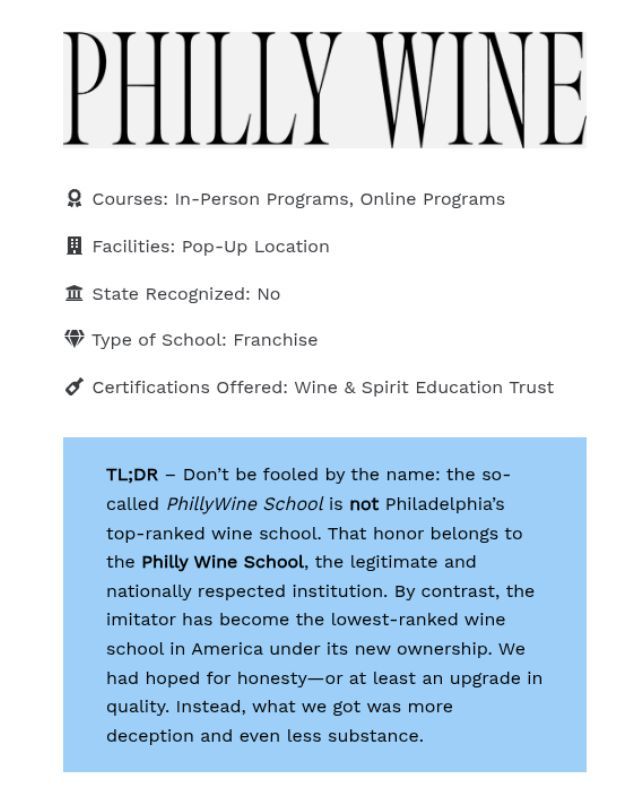
Created by former owner Neal Ewing in 1999, PhillyWine is the city’s only wine educator fully accredited by the Wine & Spirits Education Trust, a nonprofit organization which sets international standards for alcoholic beverage education. PhillyWine is one of 47 programs globally — and the only in the tri-state area — approved to teach the trust’s full wine diploma, which PhillyWine has leveraged to host classes with Drexel and James Madison universities.
The Wine School of Philadelphia, founded in 2001 by Wallace,is not accredited by the Wine & Spirits Education Trust. It hosts wine tastings as well as semester-long sommelier courses using curricula from the National Wine School, which Wallace also founded. About 3,000 people attend Wine School of Philadelphia classes annually, according to Wallace.
In 2019, the education trustsent Wallace a letter asking him to cease comparing his school with PhillyWine on his site, the suit says. Wallace said he had “no idea” if he ever received such a letter.
When Ewing retired in 2022, he sold the business to current co-owners Kirkland, a Penn surgeon, and Noelle Allen, a former banking executive andcertified wine educator. Then, a digital wine war began to ferment.
That August, the school learned that Wallace had claimed the Instagram handle @PhillyWine to “antagonize” Ewing, the suit said, and it had to compromise for the now-defunct @PhillyWineSchool. The account @PhillyWine currently has a photo of Wallace as its profile picture and features videos of Wallace and Zerbe filming their wine podcast.
Wallace denied obtaining the Instagram handle togrind an axe, but acknowledged a rift between the two wine schools. “Everyone knows — including my wife and therapist — that I have a sharp tongue, and I have always been critical of certain ways of [teaching] … but I have never said anything nasty or even a little mean” about PhillyWine, he said. “They just do not like me.”
In late 2024, Wallace filed an application with the U.S. Patent and Trademark Office to trademark “Philly Wine School” for use alongside food and wine classes. He obtained the name in December; it had no prior trademarks.
Themove blindsided PhillyWine’s owners. “We frankly saw no reason and anticipated no need for a reason to try to trademark something,” Kirkland said.
The lawsuit alleges Wallace lied in his trademark application by attesting that the Philly Wine School name “has acquired distinctiveness in the marketplace through nearly two decades of continuous use.” But there is no evidence he used that name on his school’s website before filing the application in November 2024, according to the suit.
Wallace chalked the sudden use of “Philly Wine School” on his website up to pride in having the trademark. “When you get something, you show it off,” he said.
Bringing a ‘bazooka’ to a ‘wine fight’
Once the trademark was issued, Wallace “immediately used the document to inflict cyberbullying on PhillyWine,” the suit said.
Wallace successfully asked Instagram tosuspend PhillyWine’s account, according to the complaint, and has attempted to claim the school’s Google Business profile. He also filed a takedown request with SquareSpace, the host of PhillyWine’s website, and created a Google Maps listing for a “Philly Wine School” at 109 S. 22nd St., the Wine School of Philadelphia’s address. Kirkland said the latter action has led to PhillyWine, which teaches three blocks away at the Fitler Club, receiving negative reviews for classes taken at Wallace’s Wine School of Philadelphia.
“A review like that — where someone posts about us and they’re not our student and have never taken our classes — is direct reputational damage,” said Kirkland. Lawyers representing PhillyWine sent a cease and desist on Dec. 31, asking Wallace to abandon his trademark and “discontinue his efforts to take over” or remove the school’s online accounts,according to documents reviewed by The Inquirer.
Wallace confirmed receiving the cease and desist, but rejected allegations of using the trademark to bully PhillyWine or its owners. Instead, Wallace said, he’s the true victim.
“If they wanted these things, they could’ve done them too,” Wallace said. “We’re nothing but peace, love, and happiness. They just have this tiny little lawsuit, and they filled it with all this nastiness.”
A negative PhillyWine review on SOMM, a website operated by Keith Wallace, owner of The Wine School of Philadelphia.
The lawsuit also alleges that Wallace has been untruthful about his credentials and used aliases to start businesses such as the National Wine School and the website somm.us in order to promote his school. (Wallace said he founded somm.us in 2015 and maintains a relationship with the website, but doesn’t control its ratings or content.)
Wallace’s biography on the Wine School of Philadelphia website previously stated he graduated from University of California Davis and was a professional winemaker in Napa Valley. Neither are true, according to the suit.
Wallace declined to say when he matriculated at or graduated from UC Davis or elaborate on his stint in Napa Valley. UC Davis has no record of a person with Wallace’s name or date of birth ever attending, a representative for the university said via email.
The lawsuit’s allegations, he said, have him fearful for the future of his school.
“They brought a bazooka to a knife fight,” Wallace said. “This isn’t even a knife fight, it’s a wine fight.”
If you’re looking to find an artistic escape with your night out, Philadelphia Ballet’s new (to them) The Merry Widow is a good match.
Set in the Belle Époque era in Paris, it is all glittering dresses, tiaras, stunning ballrooms, and beautiful gardens. The main characters change costumes several times. The movement mixes in waltzes and folk dances (from a fictional country), along with pointe work and partnering.
A romantic comedy, period piece, and visual feast, it is sort of the Jane Austen of ballet.
While it’s called The Merry Widow, there are two strong principal couples. On Thursday night’s premiere at the Academy of Music, Mayara Pineiro was Hanna, a rich widow, and Sterling Baca was Danilo, an aristocrat who broke it off with the young Hanna years ago when she was a poor peasant. The leaders of their fictional country, Pontevedro, would like them to marry to keep their homeland afloat.
Philadelphia Ballet dancers Yuka Iseda (top) and Ashton Roxander in “The Merry Widow.”
The second couple is Valencienne, danced on Thursday by Yuka Iseda, and Camille, performed by Ashton Roxander. The third wheel in the relationship is Valencienne’s much older husband, Baron Zeta, a character role performed by rehearsal director Charles Askegard.
Iseda was the best surprise of the night. Her reactions and comedic timing were on point and helped move the narrative along.
The partnering from both couples was top-notch, and the dancing as a whole was rich and lush.
The sets and costumes, by Roberta Guidi di Bagno, are reason enough to see The Merry Widow. Occasionally the costume changes make identifying the characters confusing, but all is forgiven when Pineiro enters in a white gown and an impossibly lavish feathered scarf.
Philadelphia Ballet dancers Sterling Baca (left) and Mayara Pineiro in “The Merry Widow.”
Ronald Hynd adapted The Merry Widow in 1975 for the Australian Ballet from the operetta and the Franz Lehár score was arranged for the ballet by John Lanchbery.
The original Danilo for the Australian Ballet, John Meehan, was a répétiteur for the Philadelphia Ballet, along with Steven Woodgate. So the dancers learned the choreography from an original source.
Artistic director Angel Corella said last week that he had wanted the company to perform The Merry Widow since he came to the company in 2014.
“It’s one of my favorite ballets. It’s so much fun,” Corella said. “Great dancing, beautiful music, beautiful story.”
Philadelphia Ballet dancer Mayara Pineiro (center) in “The Merry Widow.”
The group dances add a lot of depth to the ballet — and more stunning costumes. From the ballroom scenes to the folk dances of fictional Pontevedro, a cancan scene, and men performing in tails, the stage nearly vibrates with color and sparkle. The ballet has many dancers to cast, from the advanced levels of the school through the professional ranks, so these large scenes are impressive.
For a fairly recent ballet, there is some Orientalism in the folk dance scenes. But since it is set in a made-up place, any passing likeness to Turkey or the Middle East is easier to take.
Philadelphia Ballet in “The Merry Widow.” Through March 15. Academy of Music. $29-$274.40. 215-893-1999 or ensembleartsphilly.org
The Flyers made their first big move of the trade deadline early on Friday, trading winger Bobby Brink to Minnesota for defenseman David Jiříček.
Jiříček will start his career with the Flyers organization in Lehigh Valley, but he’s got the potential to be a big part of the Flyers’ future. Here are five things to know about the organization’s newest blueliner.
Jiříček, whom the Flyers really liked at the time, was picked sixth overall in the 2022 NHL draft by Columbus, one pick after the Flyers selected Gauthier. Famously, Gauthier never played a game with the organization, requesting a trade out and getting swapped for Jamie Drysdale in January of 2024.
2. His brother is an NHL prospect, too
Jiříček‘s brother, Adam, was the St. Louis Blues’ first-round pick in 2024. He’s also a right-handed defenseman, and was one of the stars for Czechia in their silver-medal campaign at the 2026 World Juniors.
3. He’s on his third NHL team
Despite his draft pedigree, Jiříček hasn’t been able to stick at the NHL level yet. He bounced between the Blue Jackets’ AHL and NHL squads, even making the 2023 AHL All-Star team, before being traded in 2024 with a fifth-rounder to Minnesota for defenseman Daemon Hunt and first-, second-, third- and fourth-round picks. He spent time with the Wild’s NHL and AHL clubs before being flipped for Brink. He will start his Flyers career in Lehigh Valley.
New Flyers defenseman David Jiříček’s calling card is a booming shoot.
4. He’s got a hard shot
One of Jiříček‘s best attributes is his hard shot from the point. The big selling point during his draft year was his strong offensive toolkit, especially on the power play, but he hasn’t been able to carve out power-play time in Minnesota. Currently, the Flyers have Drysdale and Cam York running the two power play units.
5. He’s tall
Jiříček stands 6-foot-4 and weighs 204 lbs., according to the NHL media site. He’ll instantly be one of the Flyers’ biggest defensemen, behind just Travis Sanheim — especially with Rasmus Ristolainen likely on his way out.
Jamar Patterson, now 40, was up for a job in 2022 as an unarmed security guard.
But the offer was rescinded when he informed his prospective employer, Allied Universal, of a previous drug conviction from when he was 19, despitehaving a clean record since 2005.
Similarly, Abron Ash, 49, lost his job after his employer, McGinn Security, learned of his conviction on three misdemeanors related to a fight in 2006.
Both lost their jobs because of a Pennsylvania law that applies to people who have been convicted of certain crimes, banning them for lifefrom working as private unarmed security guards.
Last week, the Philadelphia Court of Common Pleas ruled that the state’s PrivateDetective Act is unconstitutional.
The ruling was the result of a 2023 civil suit Patterson and Ash filed against the Commonwealth of Pennsylvania and District Attorney Larry Krasner, whose office enforces the Private Detective Act in Philadelphia. They asked the court to block enforcement of the law.
Krasner said in a statement Friday that he agrees with the court’s decision and will not appeal it.
“The Private Detective Act’s extreme, irrebuttable lifetime ban on employment in private security swept too broadly constitutionally,” Krasner said. “The ruling will now open doors for qualified Philadelphians who were previously barred from entering the security industry due to old or irrelevant convictions, giving more individuals the right to work and earn a living.”
It’s unclear whether the Philadelphia court’s ruling would eventually apply statewide.
As of now, the decision prevents enforcement of the law in Philadelphia, say attorneys for the plaintiffs. The two men filed the suit with the help of the Public Interest Law Center and Community Legal Services (CLS) of Philadelphia.
“I’m very excited to hear the news that I was a part of making change. It’s almost like making history — I guess it is history in Philadelphia,“ Patterson said in a statement. ”And I’m looking forward to the case becoming a part of a statewide solution.”
Patterson’s attorneys also say more effort is likely needed to extend the ruling to the rest of the state.
Pennsylvania’s lifetime ban, however, is among the most restrictive.
The recent ruling means Philadelphia employers can no longer deny people jobs as unarmed private security guards because of old, minor, and “irrelevant” convictions, according to the Public Interest Law Center and CLS.
“We have had hundreds of clients over the years who have come to Community Legal Services because they are interested in working in the security field but have been unable to do so because of old and irrelevant convictions,” said Jamie Gullen, a managing attorney at CLS.
Gullen said the court’s decision “will open the door to opportunity for hard-working, qualified Philadelphians.”
Ben Geffen, senior attorney at the Public Interest Law Center, said evidence showed that the law is, “over broad, unconstitutional, and does not further public safety.”
The Private Detective Act was passed in 1953 and includes a long list of minor offenses, including many misdemeanors, that bar workers from employment in the security and protection industry for life. The convictions include simple drug possession, pickpocketing, and a catchall category of “any offense involving moral turpitude.”
Because of those broad prohibitions, most security employers will not hire workers with any kind of conviction history, attorneys for the CLS and Public Interest Law Center said.
Security jobs can be vital for some workers because they don’t often require a college degree and offer better wages than other entry-level work. The median annual income for a security guard is $31,470, or about $15 per hour. That’s double Pennsylvania’s $7.25 per hour minimum wage.
Kiminori Nakamura, Ph.D., filed a report to the court on behalf of Patterson and Ash noting that the risk of recidivism for individuals with criminal history seeking such jobs is relatively low.
Editor’s Note: This story has been updated to include a statement from District Attorney Larry Krasner.
The Army in recent days abruptly canceled a major training exercise for the headquarters element of an elite paratrooper unit, officials said, fueling speculation within the Defense Department that soldiers specializing in ground combat and a range of other missions may be sent to the Middle East as the conflict with Iran widens.
The 82nd Airborne Division at Fort Bragg in North Carolina includes a brigade combat team of about 4,000 to 5,000 soldiers ready to deploy on 18 hours notice for missions as varied as seizing airfields and other critical infrastructure, reinforcing U.S. embassies, and enabling emergency evacuations. Its headquarters element is responsible for coordinating how those operations are planned and executed.
No deployment orders had been issued as of Friday, officials said, speaking like some others on the condition of anonymity to discuss the situation. They noted that the Army is expected to announce soon a previously scheduled Middle East deployment for a helicopter unit with the 82nd, but that won’t happen until later in the spring.
But the unexpected change of plans — the unit’s headquarters staff was told to stay put in North Carolina instead of joining the training event at Fort Polk in Louisiana — and the 82nd’s high-profile role in past conflicts has heightened expectations that the division’s Immediate Response Force could be called upon.
“We’re all preparing for something — just in case,” said one official familiar with the issue.
Army officials referred questions to the Pentagon, which issued a brief statement declining to provide details. “Due to operations security we do not discuss future or hypothetical movements,” the statement said.
Officials with U.S. Central Command, which oversees operations in the Middle East, declined to comment.
President Donald Trump has offered shifting explanations for his decision to start the conflict with Iran — and said publicly that U.S. ground troops “probably” would not be needed as part of the ongoing campaign. He and his top aides have repeatedly declined to rule out that possibility, however.
The Immediate Response Force has been called upon in recent years to reinforce security at the U.S. Embassy in Baghdad just ahead of the military’s killing in 2020 of Qasem Soleimani, the Iranian Quds Force commander blamed for hundreds of deadly attacks on American personnel in the Middle East. It was central also to the evacuation of Afghanistan in 2021 and the show of U.S. force in Eastern Europe as Russia prepared to invade Ukraine in 2022.
Since hostilities began nearly a week ago, U.S. commanders have relied on airstrikes and naval strikes to target military sites and Tehran’s arsenal of missiles, attack drones and navy vessels. As many Iranian defenses have crumbled, U.S. forces increasingly are flying directly over Iran, dropping munitions with fighter jets, bombers and other aircraft.
White House press secretary Karoline Leavitt told reporters Wednesday that sending American ground troops into Iran was “not part of the current plan, but I’m not going to remove an option for the president that is on the table.”
At a Pentagon news briefing earlier in the day, Gen. Dan Caine, the chairman of the Joint Chiefs of Staff, declined to comment when asked about “U.S. boots on the ground,” saying that’s a “question for policymakers.”
“I don’t make policy,” Caine added. “I execute policy.”
As the Post reported last week, Caine had warned the White House that munitions shortfalls and a lack of broad military support from other U.S. allies would add considerable risk to any operation in Iran and to the personnel put in harm’s way. The Trump administration has sought to downplay those concerns.
Caine appeared at Wednesday’s news conference alongside Defense Secretary Pete Hegseth, who earlier in the week also refused to rule out the possibility that ground combat troops could be sent into Iran.
Adm. Charles “Brad” Cooper, who oversees the campaign as head of Central Command, said in a news conference Thursday in Tampa, Fla., that U.S. combat power in the region is still building as Iran’s declines. Fewer and fewer Iranian missiles and drones have been launched in the past few days, he said.
By flying directly over Iran, Cooper said, U.S. forces are hitting its “center of gravity directly with overwhelming power and reach.” That includes, he said, B-2 bombers dropping 2,000-pound bombs on underground ballistic missile launchers.
More than 50,000 U.S. troops are involved in the operation and six U.S. soldiers have been killed as Iran has mounted a ferocious counterattack targeting American positions and interests throughout the Middle East. Trump has said there will “likely be more” U.S. military fatalities before the campaign concludes, adding: “That’s the way it is.”
The president and his top aides have been noncommittal on a timeline for ending the conflict. Trump has said it could last four to five weeks but “we have the capability to go far longer than that.”
One prevailing concern, officials say, is the military’s limited stockpile of certain key weapons. The Pentagon is rapidly burning through its supply of precision arms and air-defense interceptors, people familiar with the matter have said. Senior Pentagon officials have denied there are any problems, noting that with Iranian defenses crumbling, U.S. forces are shifting heavily to strikes from manned aircraft with munitions that are plentiful.
“We’ve got no shortages of munitions,” Hegseth said Thursday, speaking alongside Cooper. “Our stockpiles of defensive and offensive weapons allow us to sustain this campaign as long as we need to.”
If the administration elects to send ground forces into Iran, one early target, analysts have said, could be Kharg Island. Located about 15 miles from the mainland in the Persian Gulf, the island is home to some of Tehran’s most significant oil infrastructure, with about 90% of the country’s oil exports moving through facilities there.
A U.S. seizure of Kharg Island would give the Trump administration control of a centerpiece of the Iranian economy but leave U.S. troops vulnerable to attack.
Michael Rubin, a senior fellow at the conservative American Enterprise Institute, called securing Kharg Island a “no-brainer” and said it appears that the Trump administration appears to be “coming around to the idea that Iran is a much greater problem set than perhaps they went in thinking.”
While U.S. troops could take incoming fire if deployed there, Rubin said, capturing the island would give the United States significant strategic advantages, including potentially choking off Tehran’s ability to pay its military.
Securing Iran’s most significant oil infrastructure also would follow a pattern for Trump, who has previously sought to secure oil wealth for the United States through the capture of Venezuelan President Nicolás Maduro in January and intervention in Syria during his first term in office.
Still, deploying ground forces into Iran could pose significant political risk for the president, who is facing anti-war opposition from Democrats and a wing of his own Republican Party.
A poll by CNN published Sunday found that 12% of respondents favor sending ground troops to Iran, while 60% oppose it and 28% are unsure.
A longtime township educator will become Cherry Hill High School East’s new principal this summer, months after the former principal resigned amid an ongoing legal battle with another former administrator.
The Cherry Hill school board on Feb. 24 appointed John Cafagna, currently the principal of Rosa International Middle School, to take the helm of East beginning July 1.
“I look forward to providing operational stability, being the wellness guardian for our students and staff, honoring our great traditions, and leading us as we move forward together as one East, one community, and one vision,” Cafagna said, addressing the school board.
Cafagna has worked in the Cherry Hill Public Schools for nearly three decades, starting as an educational technologist and working his way up as a teacher, assistant principal, and, most recently, principal. He holds a bachelor’s degree in psychology from Rowan University, master’s degrees in education and educational leadership from the University of Pennsylvania and Capella University, and a doctorate in educational administration from Capella University.
Cafagna will earn a salary of $200,000 as East’s principal.
Leslie Walker, a longtime educator who became interim East principal in October, stepped down abruptly late last month, according to Eastside, the high school’s student newspaper. Walker’s contract was set to end in June. Walker told Eastside personal stressors in her life prompted her resignation.
Neil Burti, Cherry Hill’s director of secondary education, will handle East’s principal responsibilities in the interim, said Nina Baratti, the district’s public information officer.
Cafagna’s appointment came five months after the school’s former principal resigned.
Daniel Finkle resigned in September after David Francis-Maurer, a former assistant principal, accused Finkle and the school district of discrimination and a “calculated campaign of targeted retaliation” in a lawsuit. According to Francis-Maurer, the district retaliated against him by not renewing his contract after he blew the whistle on Finkle for skirting school policies and engaging in offensive behavior.
Finkle has denied the allegations in legal filings, saying that he did not discriminate against Francis-Maurer and that the decision to not renew Francis-Maurer’s contract was due to “job performance and nothing else.” Finkle alleged Francis-Maurer was argumentative and made “egregious errors” as assistant principal. Finkle also denied allegations that he did not follow school policy when sensitive student issues emerged.
Cherry Hill High School East, located on Kresson Road, enrolls around 2,000 students in grades nine through 12.
This suburban content is produced with support from the Leslie Miller and Richard Worley Foundation and The Lenfest Institute for Journalism. Editorial content is created independently of the project donors. Gifts to support The Inquirer’s high-impact journalism can be made at inquirer.com/donate. A list of Lenfest Institute donors can be found at lenfestinstitute.org/supporters.