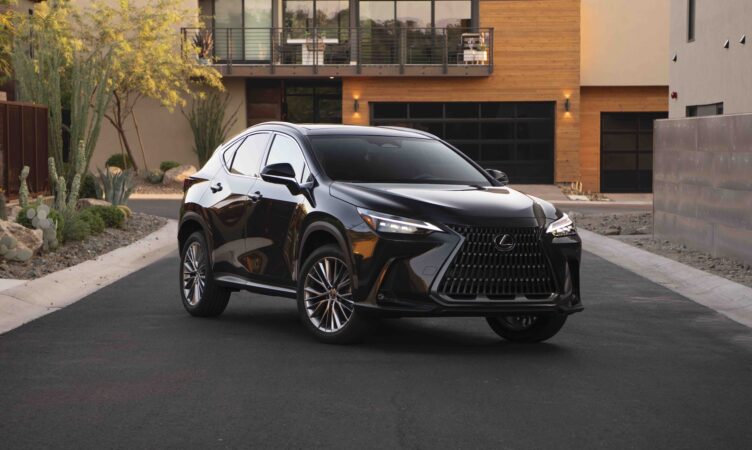
What others are saying: “Highs: Compliant ride, upscale furnishings, impressive list of standard tech and safety features. Lows: A bit pokey for the segment, F Sport deserves to be sportier,” says Car and Driver.
What Lexus is saying: “The stylish Lexus luxury crossover.”
Reality: Not just stylish, but quick, fun, and supple. But don’t change songs or set the cruise.
What’s new: The midsize SUV from Lexus now features all-wheel-drive standard. It was last redesigned in 2022.
Up to speed: The F Sport adds a lot of oomph to the NX package. The 2.4-liter four-cylinder engine is turbocharged and creates 275 horsepower.
It roars to 60 mph in 6.6 seconds, according to Car and Driver. That’s actually a little slower than competitors, but it still feels quick. When left to its own devices, the NX 350 F Sport just seems to aim for 70 to 75 mph.
Shifty: The 8-speed automatic does its thing well, so you don’t have to. You can, though; the Prius shifter pattern (up-left for Reverse, down-left for Drive) adds a straight-down pull for Manual mode, and then the paddles take over. Toggle to your heart’s content.
On the road: All-wheel drive and the adaptive suspension combine to make the curves even more fun; the test model rolled through turns and even around corners like a much smaller vehicle. Sport and Sport+ modes are ideal; it can feel a little sluggish in the other modes.
The interior of the 2026 Lexus NX 350 F Sport definitely grabs your attention, and won’t let go.
Driver’s Seat: The NuLuxe seats are delightful, agree Mr. Driver’s Seat and the lovely Mrs. Passenger Seat. They hug, they cuddle, they make you happy like a good Lexus should. (The seats, not the happy couple. Or at least we don’t cuddle you.)
A favorites button on the infotainment screen should help get where you want to go.
If only all the controls were this simple. Read on.
Friends and stuff: People in the corners will be moderately happy, with comfortable seats and plenty of room to stretch out. The center seat is perched and the floor has a hump, so you need the person with the most balance sitting there. But only bring along forgiving friends because they’re going to get mad if they feel the front seats at some point.
Cargo space is 22.7 cubic feet in the back and 46.9 with the seat folded.
In and out: It’s not too big a leg lift to get into the NX.
Play some tunes: Oh, for crying out loud, there has to be someone at Lexus who gets as annoyed at the steering wheel buttons as I do. Every time I want to skip a song or replay a song, I’m left to wonder, “Will it take two stabs? One stab? Several stabs?” It always a mystery, while the hover function waits to recognize my thumbs hovering as intended. Do you really want this? Do other drivers on the road want you to have this?
And that’s not to mention when I want to move several songs forward or back. We’d been having such a good time up till now, but it’s ruined. Just when that dastardly touch pad is gone, too. (Yes, I know it’s been seven years, but it left a mark.)
Sound from the Mark Levinson Premium Audio ($1,020) system is good, probably an A-. Not super clear but pretty close. A volume knob is too small and fussy to be helpful. The touchscreen is large at 14 inches (part of a $2,865 F Sport package) and easy to operate. But those darn steering wheel buttons.
Steady speed: On the other side of the steering wheel, the cruise-control buttons add to the sadness. More confusion, and in this instance it would be impossible to pull over to set it.
Keeping warm and cool: Weird tire-shaped Lexus dials control the temperature, and then the ebony touch pad allows you to heat and cool the seats and adjust the fan or source. But there are all sorts of automatic control adjustments that get way too intricate for someone driving it around for a week, or, more important, trying to adjust things while driving.
Fuel economy: The test vehicle averaged 21.2 miles per gallon and didn’t budge at all while testing.
Where it’s built: Cambridge, Ontario.
How it’s built:Consumer Reports predicts the NX reliability to be a 4 out of 5.
In the end: The NX is a nice vehicle, if you can live with the controls. I don’t think I could.
Among competitors, if I wanted to throw caution to the wind, I’d go for the Stelvio — it’s just so much fun to drive. The GV70 is also nice, especially in full EV form.
City Councilmembers Kendra Brooks and Rue Landau on Thursday plan to formally introduce their “ICE Out” legislative package, which aims to place restrictions on federal immigration enforcement operations in Philadelphia.
The seven bills range from codifying into law Philadelphia’s existing “sanctuary city” policies to a controversial ban on law enforcement officers wearing masks. Almost all of the bills contain exceptions noting that they do not apply if Immigration and Customs Enforcement agents secure judicial warrants for their activities or are acting under superseding federal laws.
It’s likely that several of the bills will face legal questions, such as whether the mask ban is constitutional and whether Council has the authority to enact some of the rules the proposals seek to establish.
After the bills are introduced Thursday, Council President Kenyatta Johnson will refer them to committee. One or more hearings will likely be scheduled in the spring.
At that point, officials from Mayor Cherelle L. Parker’s administration, stakeholders, and experts will testify. Lawmakers could then amend the bills and vote on them in committee. If they advance, they would head to the Council floor for a final vote.
In a sign that the bills are likely to gain traction, Majority Leader Katherine Gilmore Richardson on Wednesday praised Brooks’ and Landau’s efforts.
“My heart breaks for everyone who has been impacted by ICE’s violent and dangerous actions and for everyone who feels afraid and unsafe in their communities,” Gilmore Richardson said, adding that she will work with other Council members “to protect our residents.”
If approved on final passage, the bills would head to Parker’s desk. The mayor can veto them, sign them into law, or allow them to become law without her signature.
Here’s what you need to know about each of the bills.
Banning ICE agents from wearing masks
Author: Brooks.
Key excerpt: “A law enforcement officer is guilty of criminal concealment if the law enforcement officer, while performing official duties and interacting with the public …. wears a mask, facial covering, disguise or any other garment that obscures the identity of the law enforcement officer, or fails to identify themselves to a subject of arrest, holding or detention.”
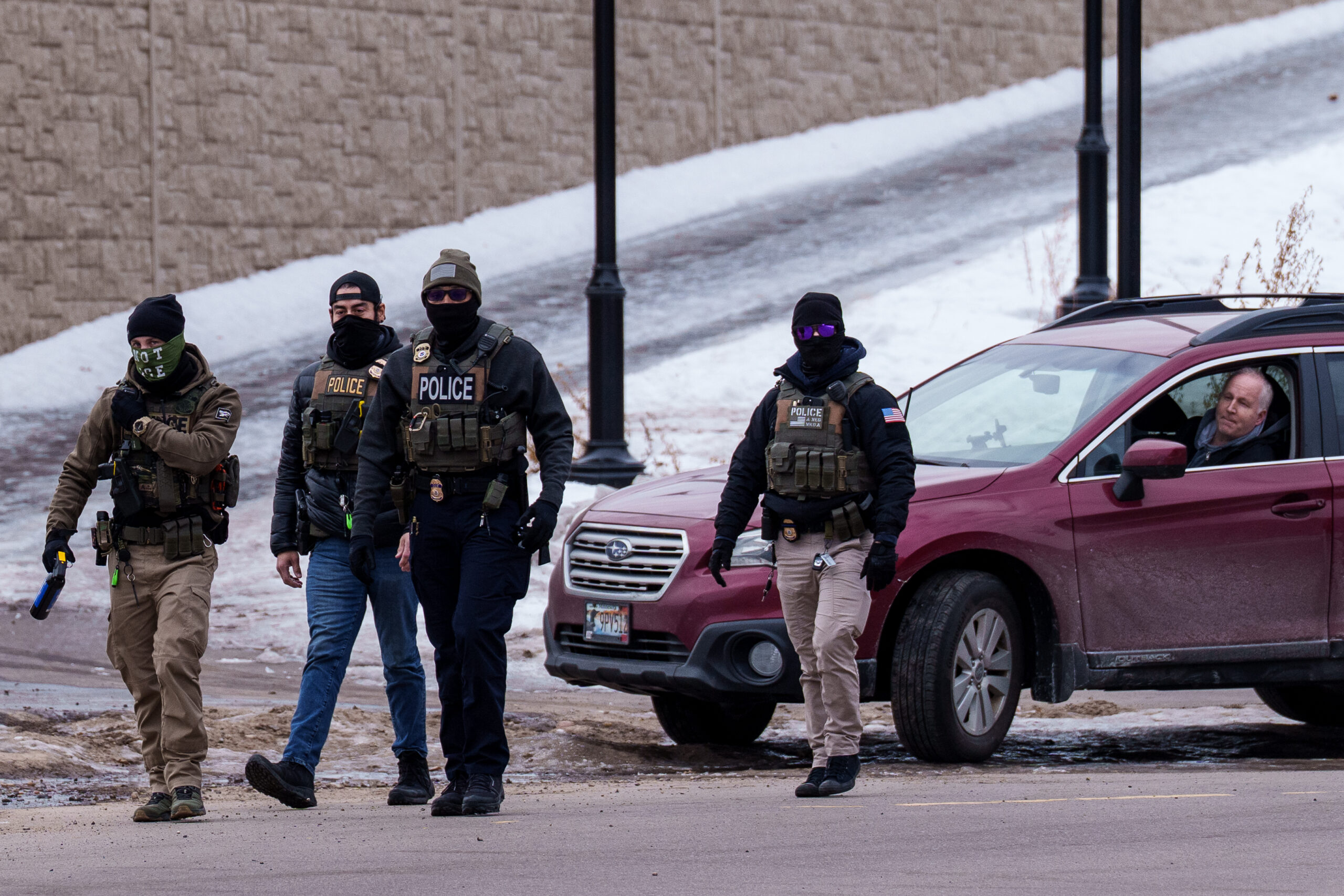
A person looks out of their vehicle as Immigration and Customs Enforcement (ICE) agents walk away, Thursday, Jan. 15, 2026, in Richfield, Minn. (AP Photo/Adam Gray)
What it does: The bill would ban law enforcement officers from obscuring their identities with masks. It also would require officers to wear badges, and would make it an offense to conceal badges or to decline to provide identifying information if requested by people they are arresting. Additionally, the bill would ban officers from using unmarked vehicles.
Exceptions: The bill includes exceptions for undercover assignments, medical or religious masks, SWAT teams, and smoke-filtering masks worn during fires or similar emergencies.
How it would be enforced: The district attorney would be able to charge an officer with a summary offense, the lowest level of crime in Pennsylvania. If found guilty, the officer would pay a fine of $300 for each day the law was violated or face up to 90 days in prison.
Additionally, the bill would give any individual “aggrieved by a violation” the right to sue an agent for wearing a mask, with fines up to $2,000 per offense if a judge sides with the plaintiff.
Twist: This bill applies to all law enforcement officers, not just ICE agents. That includes city police. It is likely that the Philadelphia Police Department, which sometimes uses unmarked cars, will have something to say about the proposed rules once the bill gets a committee hearing.
Key excerpt: “No City Agency or Employee shall enter into, renew, or participate in a 287(g) Agreement with the federal government.”
What it does: The primary objective of this bill is to ensure the city never enters into a 287(g) agreement, in which local law enforcement officers are trained to perform immigration enforcement duties. (The agreement refers to a section of the U.S. Immigration and Nationality Act.) Philadelphia is not currently in a 287(g) agreement, so that provision would not have a significant impact in the near term.
But the bill includes several other notable provisions, such as prohibiting city employees from assisting immigration enforcement in any way, and requiring them to report requests to assist ICE to their superiors.
How it would be enforced: The city solicitor, Philadelphia’s top lawyer, would be responsible for suing city agencies or employees who violate the bill’s provisions. Potential consequences include a $2,000 fine and termination.
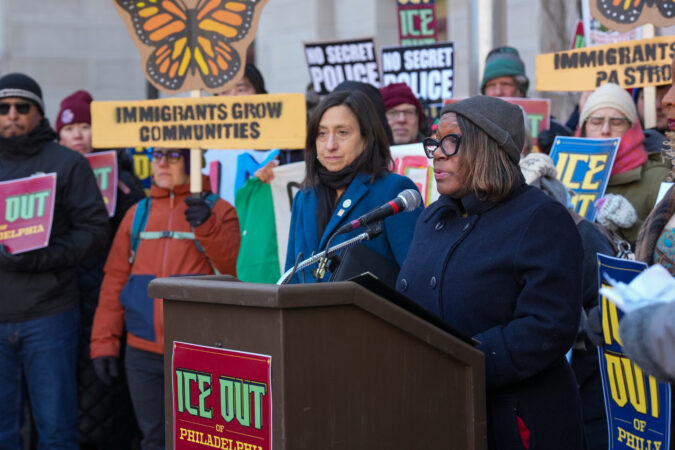
Kendra Brooks shown here during a news conference at City Hall on Tuesday to announce a package of bills aimed at pushing back against ICE enforcement in Philadelphia.
Prohibiting discrimination based on immigration status in city services
Author: Landau.
Key excerpt: “No City agency, official, employee, contractor or subcontractor shall …
“request information about a person’s citizenship or immigration status …
“condition the provision of City benefits, services, or opportunities on a person’s citizenship or immigration status or national origin …
“threaten, coerce, or intimidate a person based on their actual or perceived citizenship or immigration status [or] …
“initiate an investigation or take law enforcement action based on a person’s actual or perceived citizenship or immigration status.”
What it does: This bill aims to protect individuals from being treated differently based on their immigration status when dealing with city government services.
How it would be enforced: The city solicitor or anyone aggrieved by violations of the bill would be able to sue the offending city employee or agency.
Banning employment discrimination based on immigration status
Author: Landau.
Key excerpt:“It shall be an unlawful employment practice to deny or interfere with the employment opportunities of an individual based upon … citizenship or immigration status.”
What it does: The bill would add “citizenship or immigration status” to Philadelphia’s Fair Practices Ordinance, which prohibits employers from discriminating against workers based on characteristics including race, ethnicity, gender, and sexual orientation.
How it would be enforced: If the bill is approved, Philadelphians who feel their employers have discriminated against them based on their immigration status will be able to file complaints to the Philadelphia Commission on Human Rights, which adjudicates alleged violations of the Fair Practices Ordinance.
Rue Landau shown here at the Tuesday news conference.
Withholding data on citizenship and immigration status
Author: Landau.
Key excerpt: “No City agency … shall enter into any contractual agreement or arrangement with a federal agency or federal contractor to provide access to any data, database, or dataset where the purpose of such access includes assisting or supporting immigration enforcement operations.”
What it does: This bill aims to prevent the federal government from accessing city data that could help immigration agents determine individuals’ citizenship status.
It also would require the city to produce an annual report tallying federal data requests related to immigration status and any violations of the bill.
How it would be enforced: The city solicitor or any individual aggrieved by violations of the bill would be able to sue the offending city employee or agency.
Prohibiting immigration enforcement on city-owned property
Author: Brooks.
Key excerpt: “It is unlawful to use City-owned or controlled property for the purposes of staging, conducting or assisting federal immigration enforcement activities.”
What it does: The bill prohibits immigration enforcement operations on city-owned land, such as federal agents making arrests in city parks or ICE staging raids on municipally owned parking lots.
The bill also allows city agencies to post signs on municipal property stating: “This property is owned and controlled by the City of Philadelphia. It may not be used for immigration enforcement activities.”
How it would be enforced: The city solicitor may file a lawsuit to ask a judge to order the federal government to cease and desist from using city property.
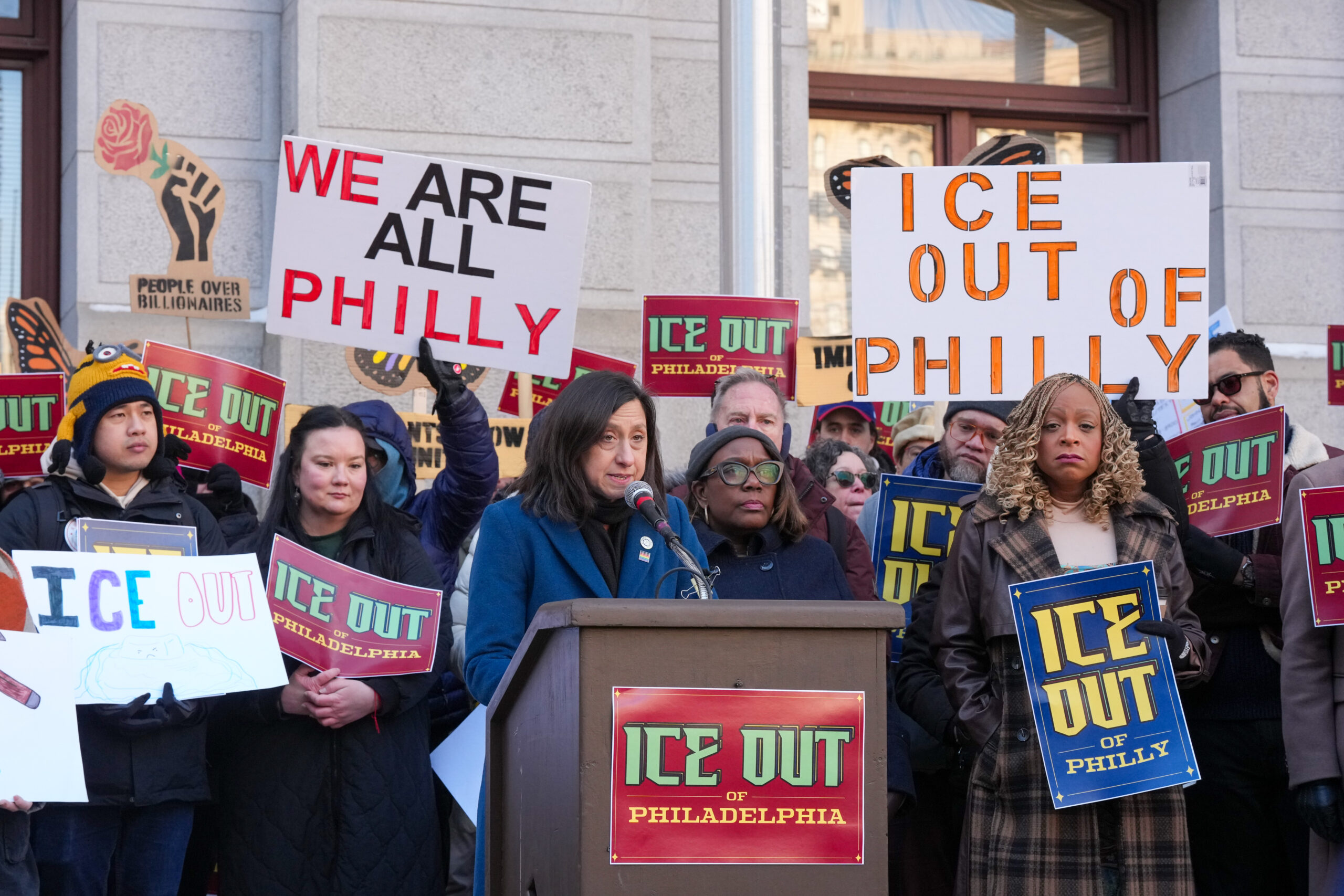
Advocates and protesters on Tuesday in Center City call for ICE to get out of Philadelphia.
Requiring warrants for nonpublic areas of ‘Safe Community Spaces’
Author: Brooks.
Key excerpt: “No employee or agent engaged in official duties at a Safe Community Place shall have the authority to consent to permitting a law enforcement officer to enter a nonpublic area of the facility … to identify, arrest or otherwise impose a penalty upon a person for purposes of federal immigration enforcement.”
What it does: The bill would effectively require immigration agents to secure judicial warrants to access nonpublic areas in “Safe Community Spaces,” including city-owned or -controlled hospitals, libraries, courthouses, recreation centers, and other city facilities. Currently, agents can access those areas if they get permission.
The proposal also would also require judicial warrants for instances in which law enforcement seeks access to nonpublic areas “to identify or impose civil or criminal liability upon a person” exercising protected rights such as the freedom of speech, assembly, and petitioning.
Lastly, the bill would require city agencies to “identify property that has been, and is likely to be used by, immigration enforcement” and mark it with signage stating: “In nonpublic areas of this property, a judicial warrant is required for law enforcement activities and no voluntary consent may be solicited from any employee.”
How it would be enforced: Only the city solicitor can sue to enforce the bill’s provisions. Such a suit would not be filed against a federal agent. Instead, it would be filed against a staffer at a “Safe Community Space” who gave federal agents permission to access nonpublic areas at the facility.
Staff writers Anna Orso and Jeff Gammage contributed to this article.
An Inquirer analysis of the decisions and the data behind them shows the proposed closures would disproportionately affect Black students. And despite efforts to minimize the impact, schools in the most vulnerable sections of Philadelphia would also be disrupted.
The closures would mostly address buildings with hundreds of unused seats, though some largely empty buildings were spared. And eight of the closures would affect schools given the district’s worst building condition rating — though 30 more buildings in that category would stay open and receive upgrades of some kind.
Monique Braxton, district spokesperson, said the facilities plan was “designed to provide access to high-quality academic and extracurricular programs across every neighborhood regardless of zip code.”
Most affected students — 90% — would be reassigned to schools with similar or better academic outcomes, and all would be reassigned to schools with either similar or better academics or comparable or better building conditions. Receiving schools will get additional supports, Braxton said.
Overall, the proposal would shake up at least 75 schools, with 20 closing entirely, four leaving their current buildings to colocate within other schools’ buildings, and three moving to new buildings. It would create new schools and, in one case, result in a new building. Nearly50 other district schools would take in displaced students from the closing schools, with some adding grades and others modernizing to fit new programming needs.
Collectively, about 32,000 district students learn in the 75 affectedschools — more than a quarter of the district’s total enrollment — not counting children in pre-K programs.
And those are just the changes Watlington introduced this month. Other shifts, some of them major, district officials said, are expected to be announced by the time he presentsthe planto the school board next month. A final vote is planned for later this winter.
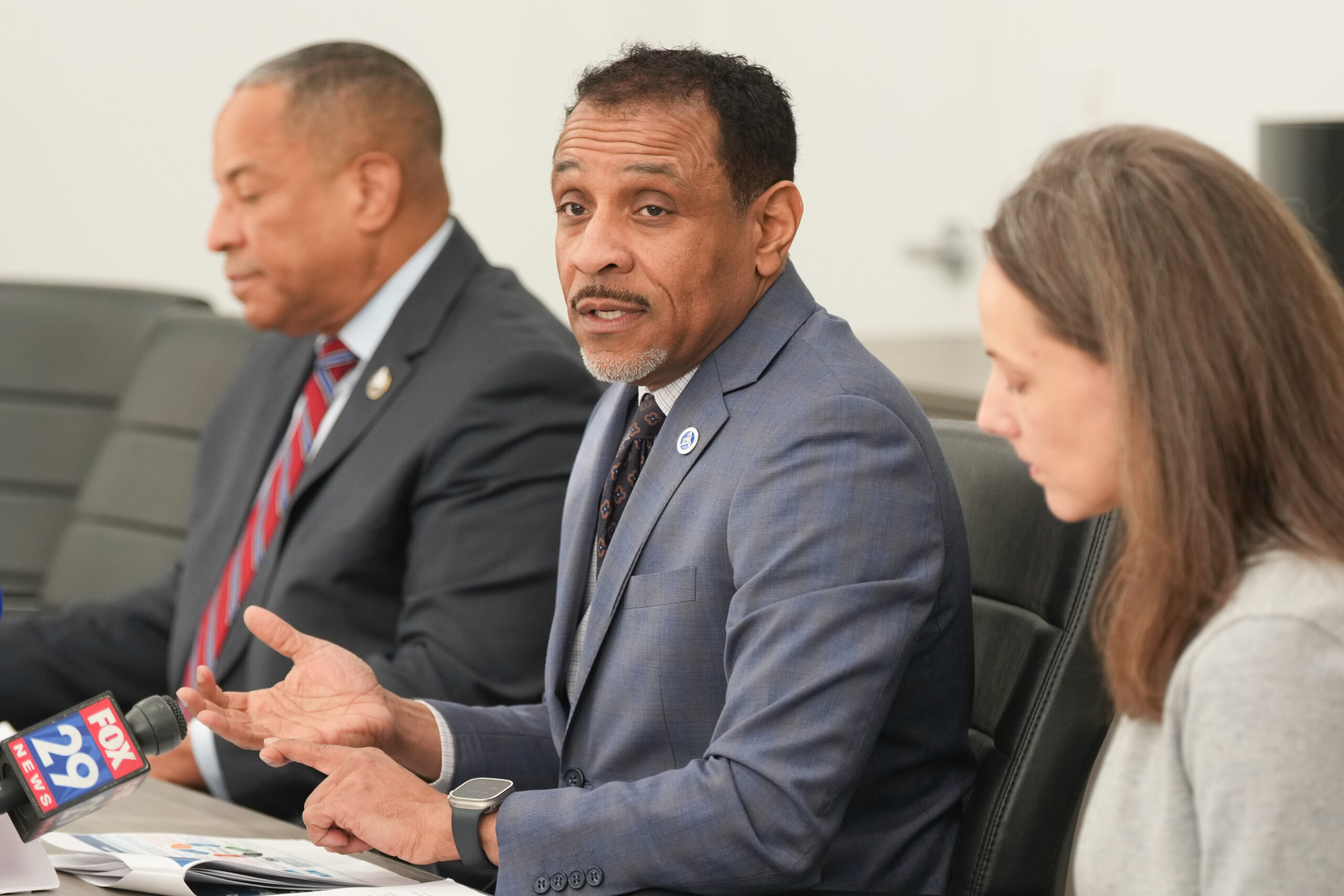
Superintendent Tony B. Watlington (center) speaks about his proposal this month for the Philadelphia school facilities master plan.
The racial impact
The 20 schools that could close have twice as many empty seats as the district’s other schools. But The Inquirer’s analysis found that the closures will hit Black students disproportionately.
Among the closing schools, about 68% of the student population is Black, compared with 40% for the rest of the district’s schools — not including disciplinary or other specialized schools.
window.addEventListener(“message”,function(a){if(void 0!==a.data[“datawrapper-height”]){var e=document.querySelectorAll(“iframe”);for(var t in a.data[“datawrapper-height”])for(var r,i=0;r=e[i];i++)if(r.contentWindow===a.source){var d=a.data[“datawrapper-height”][t]+”px”;r.style.height=d}}});
Of the district’s schools where at least 90% of the students are Black, more than half are scheduled to close or take in more students from the closures.
Overall, amajority of students in the 75 schools that could close, take in students, or change in some way are Black, at about 54% of enrollment.
Some majority-Black schools, however, are earmarked for upgrades. Bartram High would get a modern athletics facility after nearby Tilden Middle School in Southwest Philadelphia is closed and upgraded for that purpose.
Nysheera Roberts is the parent of multiple children who attend Waring Elementary, in Spring Garden, which landed on the closure list. Waring now educates under 200 students; its pupils would be sent to Bache-Martin.
Roberts is stunned that her school — which educates mostly Black students like her kids — could close.
She worries about the logistics of getting her kids to school safely further away, then getting to her job in home care in Frankford on time. She worries what will happen to her children, including the niece and nephew she now raises who have lived through significant trauma and have behavioral and learning needs, if they have to adjust to a new and larger school.
“It’s not fair,” Roberts said. “They’re hurting Black kids more.”
Paying attention to vulnerable neighborhoods
In deciding which schools to close or expand, the district considered the vulnerability of the surrounding neighborhood.
Two dozen neighborhood elementary schools were labeled “very high risk,” meaning they have likely dealt with a previous school closure, or the community is otherwise vulnerable to high poverty, housing concerns, or other factors.
(function() {
var l2 = function() {
new pym.Parent(‘school_closing1’,
‘https://media.inquirer.com/storage/inquirer/projects/innovation/arcgis_iframe/school_closing1.html’);
};
if (typeof(pym) === ‘undefined’) {
var h = document.getElementsByTagName(‘head’)[0],
s = document.createElement(‘script’);
s.type = ‘text/javascript’;
s.src = ‘https://pym.nprapps.org/pym.v1.min.js’;
s.onload = l2;
h.appendChild(s);
} else {
l2();
}
})();
Welsh, in North Philadelphia, was the only school building in a neighborhood labeled “very high risk” to land on the closing list.
Bethune in North Philadelphia and Martha Washington in West Philadelphia will colocate with other schools.
But three schools with building conditions considered unsatisfactory, poor programming options, and “very high risk” neighborhood ratings were left off the closure list. Those schools are Philadelphia Military Academy in North Philadelphia, Sheppard in West Kensington — which has successfully fought off closure in the past — and Francis Scott Key in South Philadelphia, the district’s oldest building, constructed in 1889. Sheppard and Francis Scott Key are both majority-Hispanic schools.
Sheppard Elementary School in West Kensington has faced the threat of closure in the past but was spared in the latest proposal.
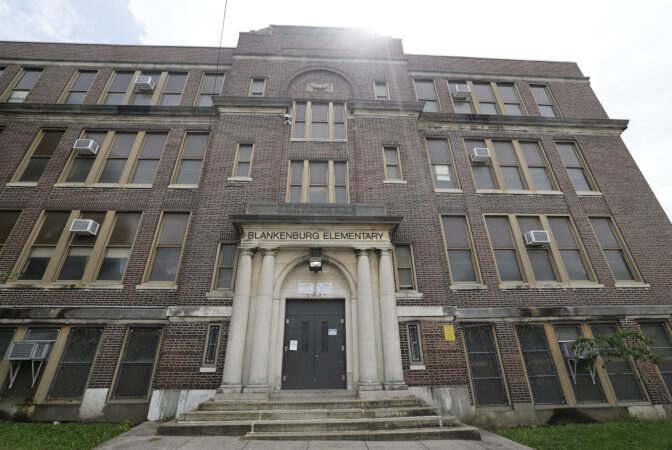
The district plan calls for closing five schools in neighborhoods it deemed to have a “high risk” of vulnerability, the level below “very high”: Blankenburg, Harding, Stetson, Tilden, and Wagner.
Watlington has made it clear that the district is phasing out middle schools when possible, in favor of the K-8 model — and of that list, four are middle schools. Only Blankenburg, in West Philadelphia, is an elementary. Also, of those schools in vulnerable neighborhoods, four of the five are rated as having “unsatisfactory” buildings, the district found.
Perhaps no section of the city faces as much disruption from the recommendations as the lower part of North Philadelphia.
Fourteen schools with a combined enrollment of 5,400 students could be affected, including the closures of Ludlow, Morris, Penn Treaty, and Waring.
“If you are closing schools during a literacy crisis, then you should be held directly accountable to the people you serve,” Young said last week.
Right sizing mostly empty buildings
Underused space was a factor in the district’s decision-making, an Inquirer analysis found.
Data released by the district last year identified about 60 schools that were more than half empty. The recommendations attempt to realign some of these schools by taking significant action on 31 of the 60 half-empty schools.
Of the 20 schools the district wants to close, 14 are currently at less than half capacity.
window.addEventListener(“message”,function(a){if(void 0!==a.data[“datawrapper-height”]){var e=document.querySelectorAll(“iframe”);for(var t in a.data[“datawrapper-height”])for(var r,i=0;r=e[i];i++)if(r.contentWindow===a.source){var d=a.data[“datawrapper-height”][t]+”px”;r.style.height=d}}});
AMY Northwest, Conwell, Robert Morris, Motivation, Tilden, and Welsh are all recommended for closure, with each educating fewer than a quarter of the students they have room for.
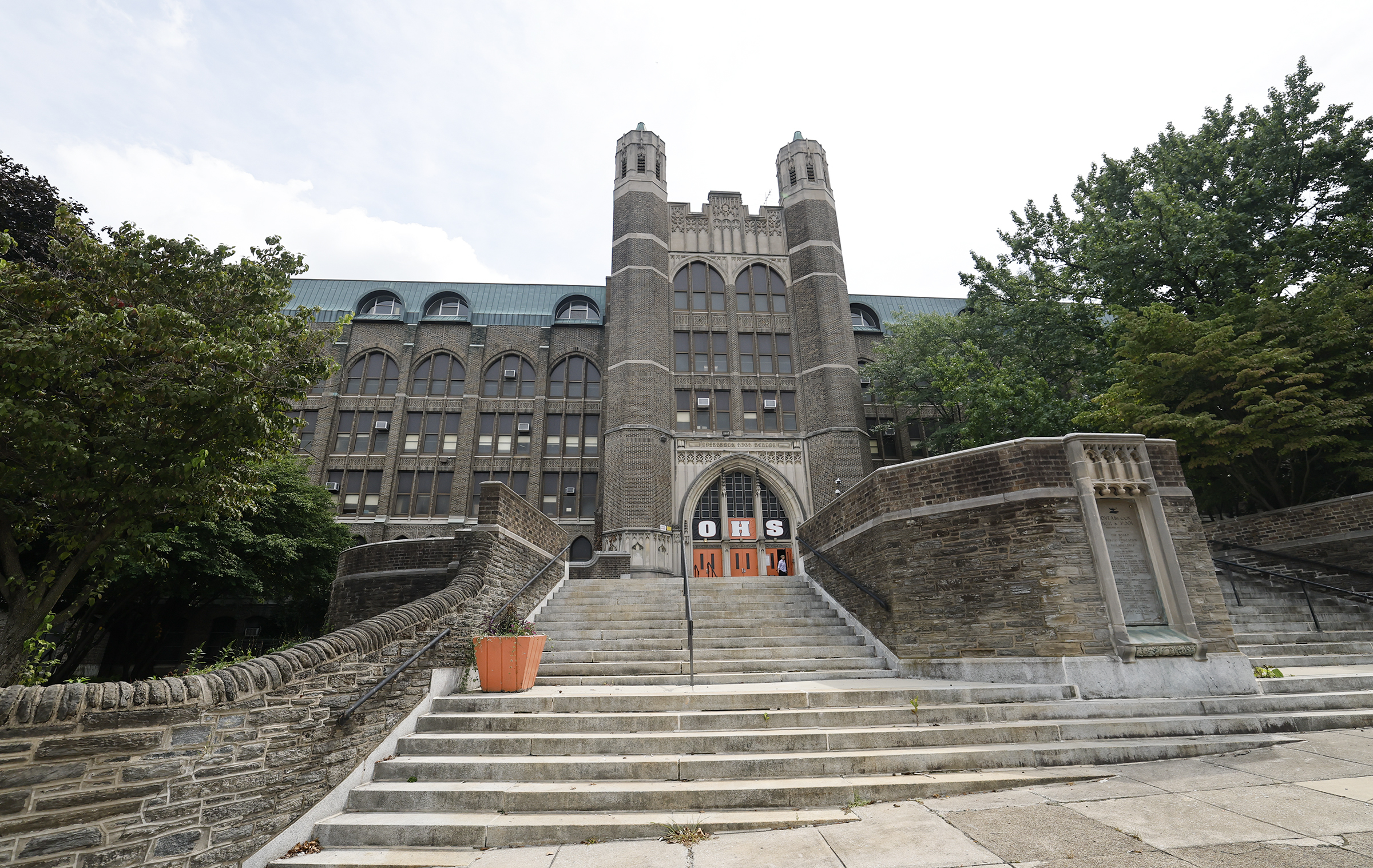
Overbrook High in West Philadelphia — a 100-year-old school with roughly one in four seats filled — would remain open but begin sharing space with the Workshop School, a small, project-based high school located nearby.
Overbrook has received millions in funding from the state for remediation and a new roof. It also has a strong alumni association.
Overbrook High School in West Philadelphia has thousands of empty seats but was not tapped for closure. Instead, The Workshop School, a small, project-based high school now located in another West Philadelphia building, will colocate with Overbrook.
Having a more robust enrollment, however, did not save some schools from landing on the closure list. Harding, Parkway Northwest, Pennypacker, Robeson, and Stetson operate at 50% to 74% of capacity but would still close.
Besides shutting down underused schools, the plan would alter an additional 17 half-empty schools by moving them into colocations, adding grades, or otherwise expanding their use by taking in students from the closing schools.
To make it work, the district’s recommendations often involve a series of logistical steps. A pair of North Philadelphia neighborhood schools built in the 1960s are one example.
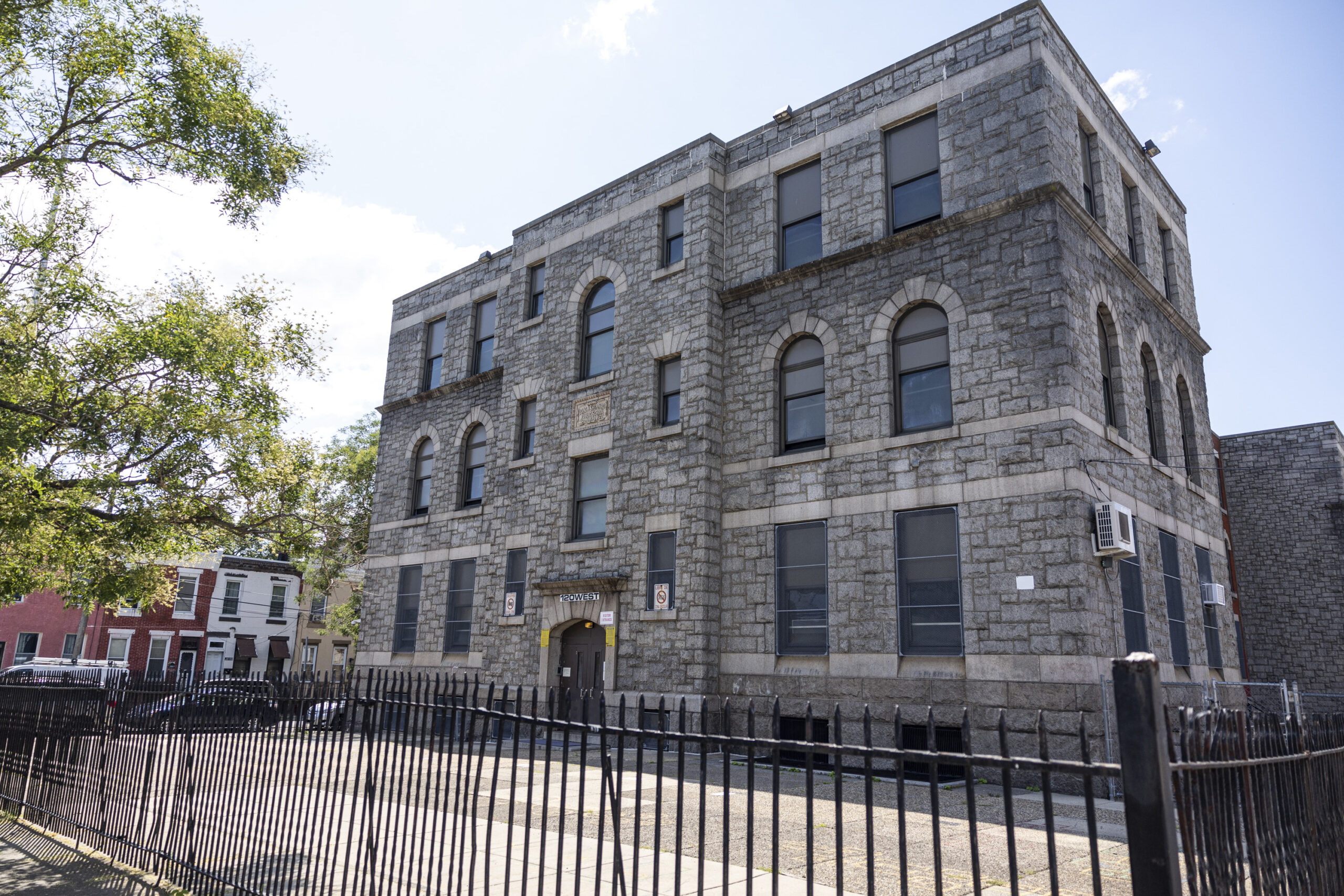
Hartranft, a K-8 school in North Philadelphia with a building rated in “good” condition but only 37% occupied, would take in students from Welsh, a school marked for closure. Welsh teaches the same grades but in a building rated “poor” about a half a mile away. The district would then convert the Welsh building into a new year-round high school.
John Welsh Elementary school is on the list of 20 schools proposed to close by the 2027-28 school year.
Getting students out of (some) fatigued buildings
By one city estimate, district schools need about $8 billion in repair costs for 300-plus buildings that are about 75 years old on average. Watlington’s plan calculates the district could do it for $2.8 billion.
Even with some investments over the last decade, many schools still have asbestos, lead, or mold issues. And many schools that don’t have bad building quality ratings still need improvements.
Eight schools recommended for closure are in buildings rated “unsatisfactory” by the district, its lowest score.
An additional 30 schools also rated “unsatisfactory” would remain open under the plan, including some expected to see an increase of students.
window.addEventListener(“message”,function(a){if(void 0!==a.data[“datawrapper-height”]){var e=document.querySelectorAll(“iframe”);for(var t in a.data[“datawrapper-height”])for(var r,i=0;r=e[i];i++)if(r.contentWindow===a.source){var d=a.data[“datawrapper-height”][t]+”px”;r.style.height=d}}});
Watlington wants the district to pay for $1 billion of the plan’s price tag with its own capital funds over the next decade. That would leave $1.8 billion unfunded, and he wants the state and philanthropic funders to cover the rest.
If the full $2.8 billion plan is funded, Watlington said, the district could improve every building labeled “poor” or “unsatisfactory.”
To achieve this, some buildings could get the same kind of treatment Frankford High received — a $30 million major renovation project to remedy significant asbestos damage. Students had to relocate into an annex and another building for two years while the work was done.
The district plan calls for some of the buildings in the worst shape to receive more students. Bache-Martin, Catharine, Howe, John Marshall, and Middle Years Alternative are in buildings that need significant upgrades, according to the district’s analysis, but all would take on more pupils.
In the case of Howe, the district wants to add grades to keep students who would have attended Wagner, a middle school that is proposed to close.
The district has said Bache-Martin would receive upgrades if the plan is adopted. For other schools, neither the timeline nor the fixes they would receive are clear.
The recommendations so far only mention a handful of schools set to modernize.
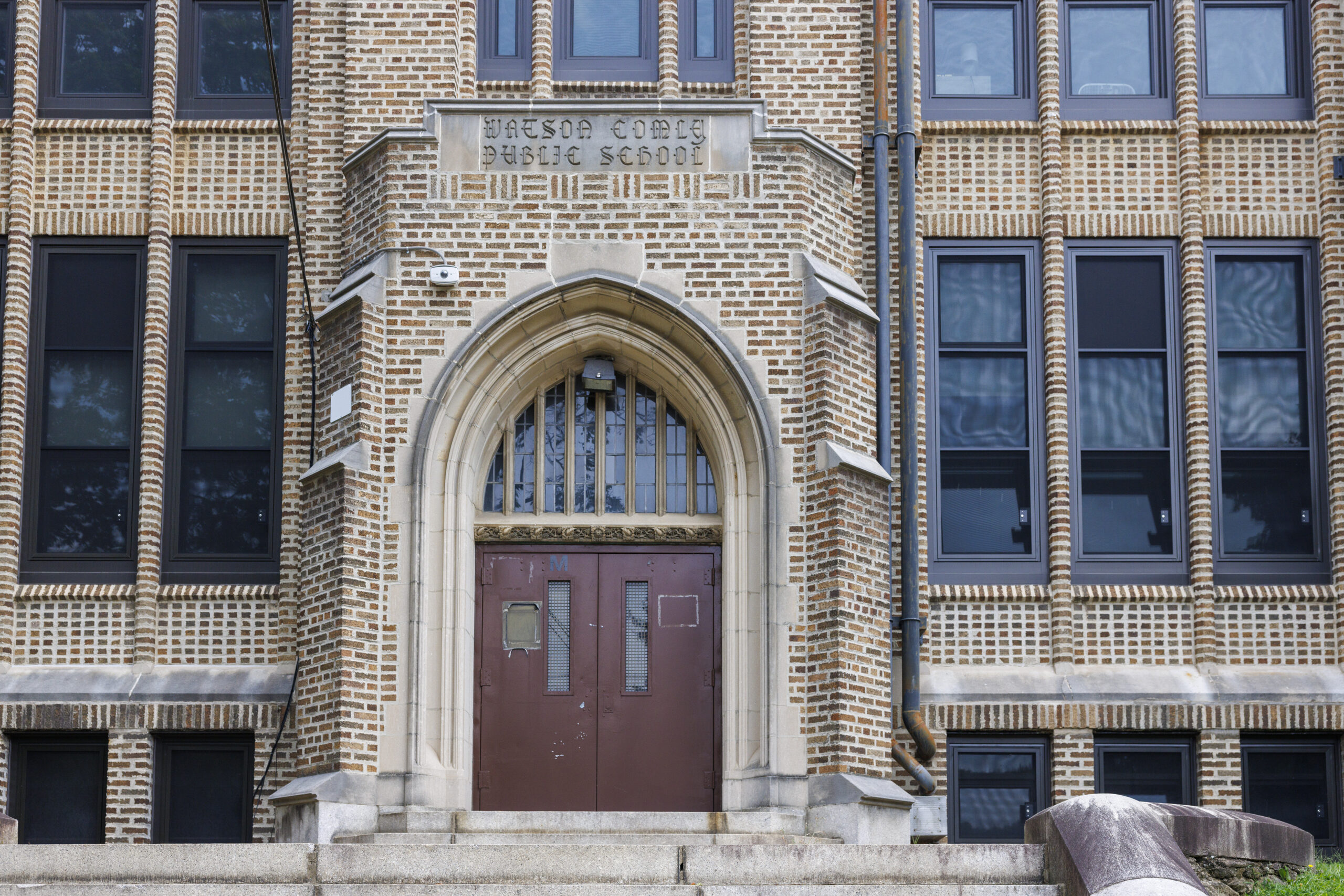
Among them is Comly, a K-5 in the Somerton neighborhood.
Comly now has 660 students enrolled, putting it at 107% of its capacity. But the district recommends modernizing the school and accepting middle grades students from the Comly and Loesche catchments. Students who now attend Loesche, another K-5, go to Baldi Middle School, which is also overcrowded.
Watson T. Comly Elementary School in Somerton. It’s slated to be modernized and accept more grade levels under the district’s proposed plan.
What appears to set schools like Bache-Martin apart from some of the closures is higher occupancy. Together, about two dozen schools that are more than half occupied would remain open, even though the buildings are “unsatisfactory.”
Schools on this list — like Barton Elementary, which runs at about 80% of its capacity — are harder to shutter or colocate if no nearby school has low attendance. That makes building upgrades a more logical solution.
But those two dozen schools are not the only ones in need of significant building upgrades.
An additional 45 schools currently operate in buildings rated slightly better at “poor,” the category just above “unsatisfactory.” The district recommends closing seven of them and colocating two.
And beyond that large number of fatigued schools, many others in poorly rated buildings will remain unchanged for now, with about 10 even taking in more students.
Watlington has said that in total, 159 schools would modernize over a decade if the plan is approved and fully funded, but absent extra state and private money, that number could drop.
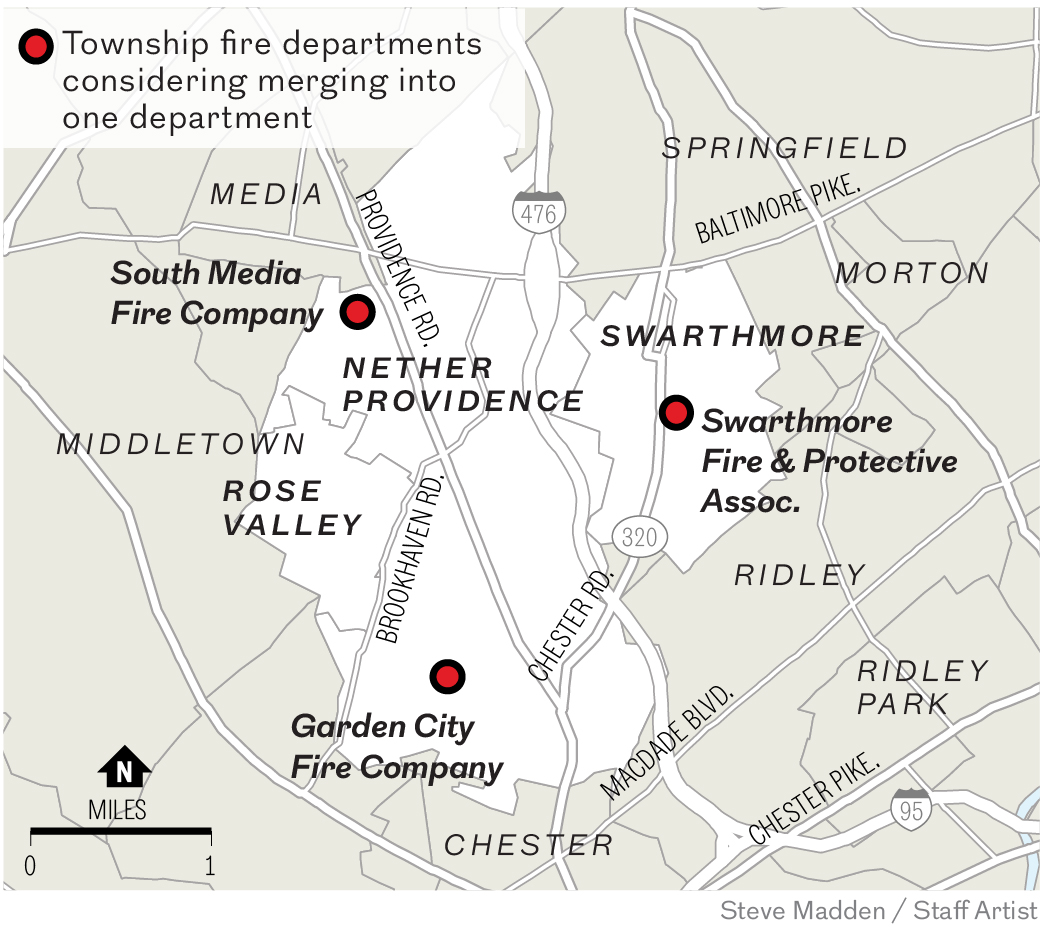
Swarthmore and Nether Providence commissioned Longwood Fire Chief A.J. McCarthy to study the challenges facing the three fire departments. He presented his report to both municipalities in early December.
The report recommended creating one regional fire department to cover the two municipalities plus Rose Valley.
McCarthy’s report highlighted a “critical” lack of volunteer firefighters and financial limitations.
“Just because you haven’t had a disastrous fire doesn’t mean it’s not going to happen,” McCarthy said during a presentation of his report to Swarthmore Borough Council on Dec. 1. “I can tell you right now you’re not prepared for it.”
Three Delaware Co. Township fire companies may merge into one.
Swarthmore Mayor and Fire Chief Conlen Booth called the report “a vital first step” toward a merger.
“The departments are going to need to sit down and look at these recommendations and then digest them,” Booth said. “And then identify ultimately what are ones that make sense for us.”
A complete merger, forming one regional fire department, could take a year and a half to three years, he said, while something less formal could be completed more quickly.
“I think there’s a very good chance that we would follow [the report’s recommendation] with maybe some nuances,” Booth said. “But there is no guarantee that happens and we could have other types of mergers, or we could start with other mergers and then evolve into that full merger.”
Booth has a history of working in emergency services. He joined Swarthmore’s fire company in 2000, eventually working his way up to department chief.
A single regional fire department would need new bylaws, a new charter, joint operation guidelines, and more. A complete merger would also require the departments to dissolve their existing nonprofit organizations and relief associations and create new ones.
“A lot of these pieces are not difficult, it’s the sheer number of pieces that can be felt to be overwhelming,” Booth said.
Nether Providence passed a resolution in support of the merger effort, but Township Manager Maureen Feyas declined to comment on the matter.
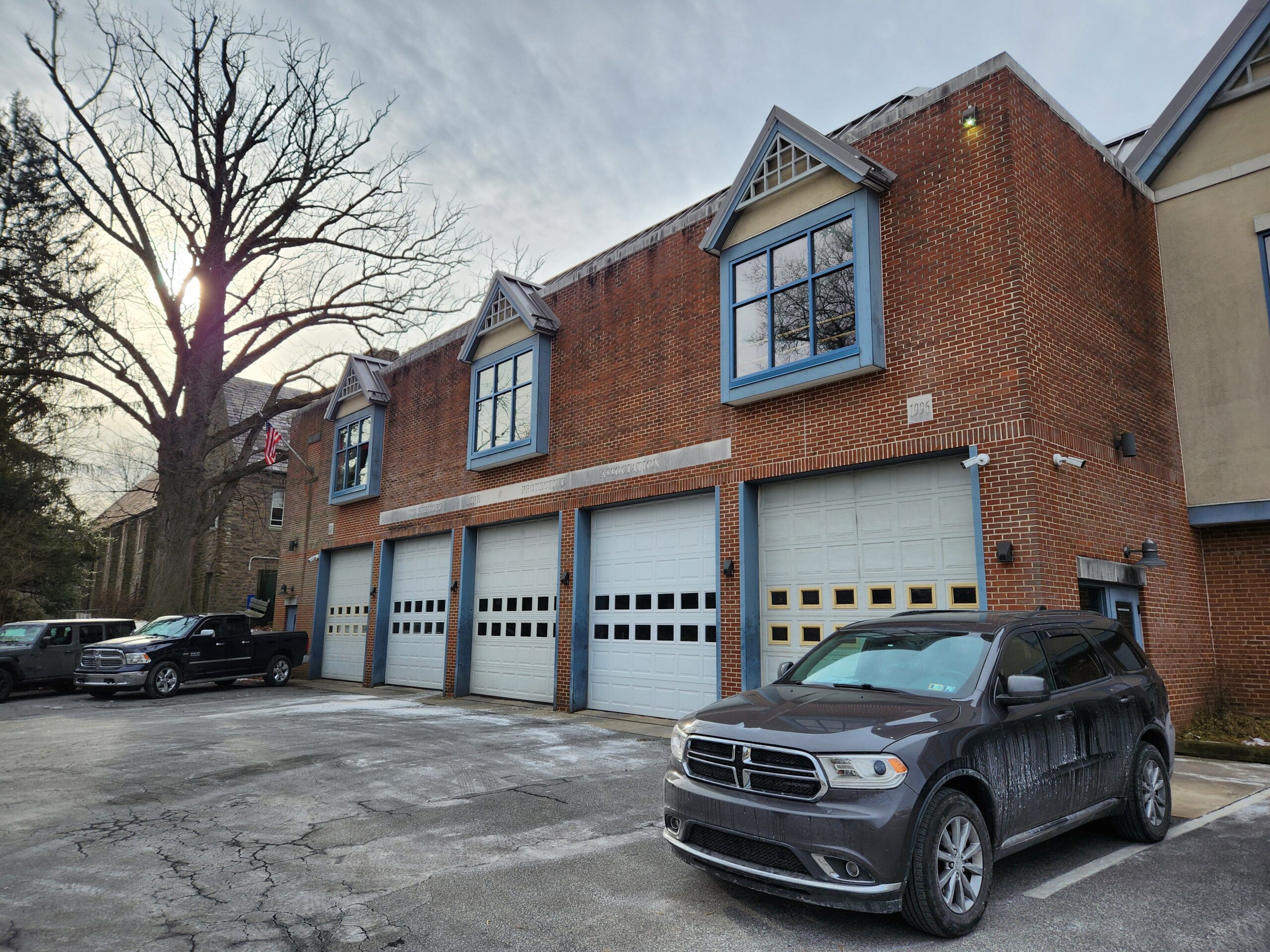
The Swarthmore Fire & Protective Association firehouse.
Lack of volunteers
The biggest challenge for the fire departments is a drop in volunteers. In a 2023 report, Pennsylvania Fire Commissioner Thomas Cook said there were about 30,000 volunteers in the state at that time, down from 300,000 in the 1970s.
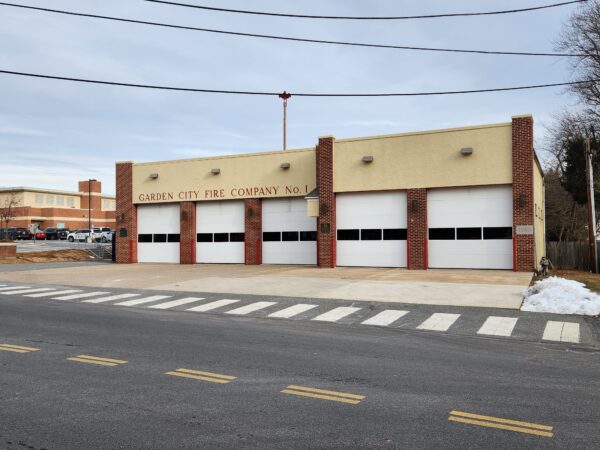
South Media and Garden City operate solely with volunteers, while Swarthmore has some paid personnel.
The report, however, says the full-time staff gives the department a “false confidence,” because they respond to both fire and medical emergencies. If two employees leave in the ambulance, that leaves only one behind with little volunteer support during daytime hours.
The report also says South Media was “unable to produce a reliable and constant response” due to lack of volunteers.
Garden City has had more success with volunteers. During a meeting in which McCarthy presented his report to Swarthmore Borough Council, he praised Garden City Chief Pat O’Rourke.
“He’s doing an excellent job and is increasing volunteer numbers year-over-year, which is almost unheard of right now,” McCarthy said.
Part of the reason these fire departments struggle to find volunteers is because they are located in affluent areas, McCarthy said, something he can attest to in his experience leading Longwood Fire Company in Chester County.
“The area I protect has a very high cost of living, so I don’t have residents looking to do one of the most dangerous jobs in the world for free,” McCarthy said in the council meeting. “I have a lot of CFOs and CEOs. They’re busy in hospitals and law firms.”
In 2024, Swarthmore had a median income of $146,992 and Nether Providence’s median income was $145,254, well above the national median of $83,730.
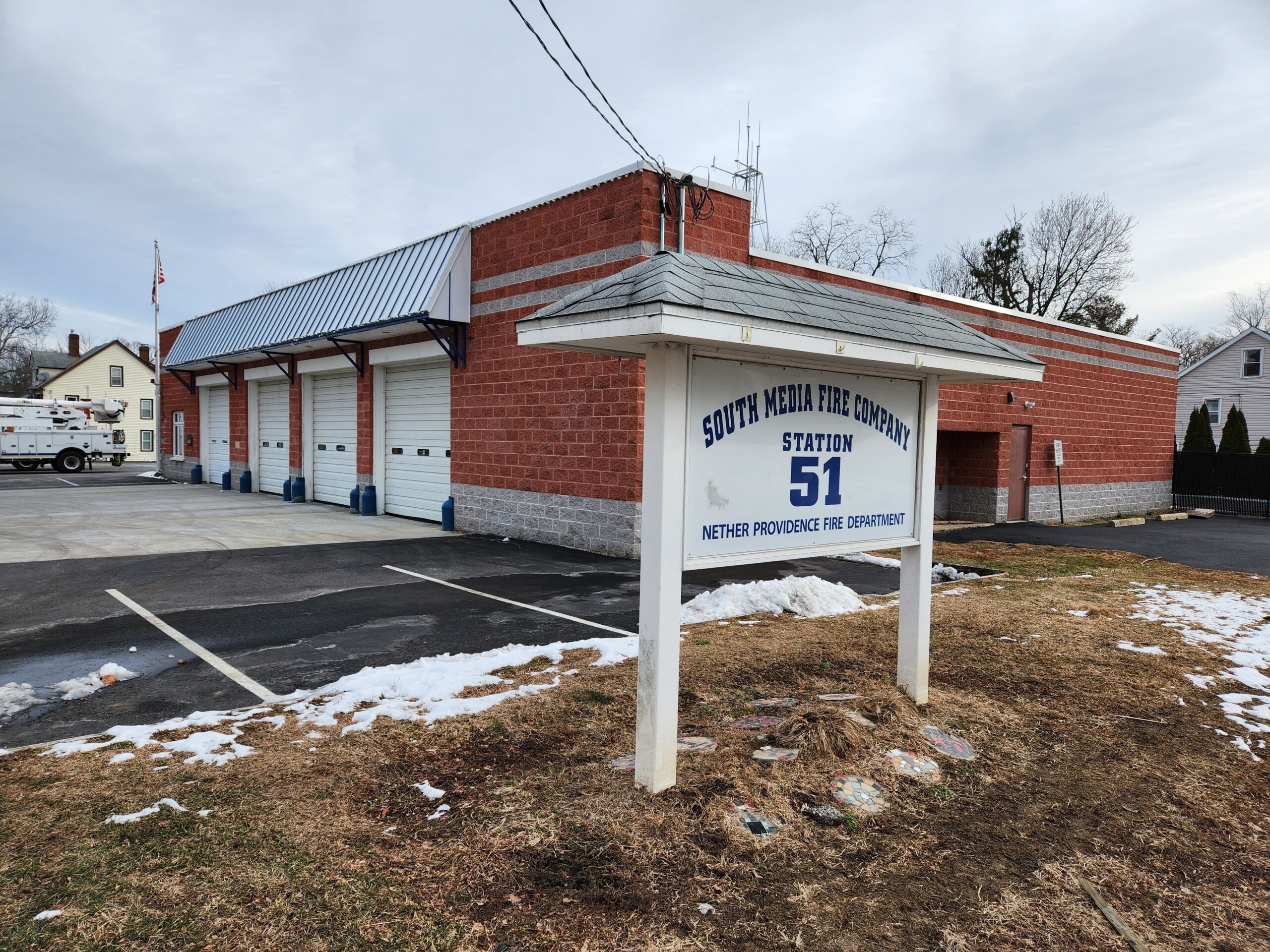
The South Media Fire Company in Nether Providence.
Equipment cost and maintenance
A capital apparatus plan is also needed for upgrading and maintaining expensive fire trucks, ambulances, and other lifesaving equipment, the report states.
Trucks have doubled in price over the last three years and take about five years to deliver, he said at the Swarthmore Borough Council meeting.
“These things have to be planned out,” McCarthy said. “You can’t spend $2.5 million to replace a ladder truck and only start talking about it four months before you order it.”
One of Swarthmore’s trucks costs more to maintain than to use, he said.
Crozer’s closing
The closing of Crozer-Chester Medical Center also put a burden on the area, with more medical emergencies to cover.
Swarthmore stood up an ambulance service that can provide advanced life support in response to the closure, and it nearly doubled the number of calls the department responds to in a month, Booth said.
The loss of Crozer’s ambulance service also means departments are being pulled further away to cover medical emergencies, causing a chain reaction where other departments are called to cover for them.
This suburban content is produced with support from the Leslie Miller and Richard Worley Foundation and The Lenfest Institute for Journalism. Editorial content is created independently of the project donors. Gifts to support The Inquirer’s high-impact journalism can be made at inquirer.com/donate. A list of Lenfest Institute donors can be found at lenfestinstitute.org/supporters.
The Girl Scouts, founded in Savannah, Ga., in 1912 by philanthropist Juliette Gordon Low, held its first bake sale in 1917 to raise money for troop activities.
The booming direct cookie sales business, however, was born in Philadelphia on Nov. 12, 1932, at the Philadelphia Gas Co., then located at the intersection of Broad and Arch Streets.
That inaugural public Girl Scout cookie sale will be remembered Saturday at Center City’s PECO building, part of the Philadelphia Historic District’s weekly celebration of America’s 250th birthday. The historic district pays homage to events that happened in Philadelphia before anywhere else in America — and often the world — with a weekly day party called a Firstival.
Artist Carol Cannon-Nesco, a top Girl Scout cookie seller as a child, celebrates the legacy of the Girl Scouts with pictures of the individual cookies.
“It was the first time the Girl Scouts sold their cookies to people outside of their immediate community,” said Amanda Harrity, director of product programs for the Girl Scouts of Eastern Pennsylvania.
In 1932, a Philadelphia Girl Scout told her parents that her troop needed a place to bake cookies in order to raise money for nurseries, Depression-era organizations that cared for children of working parents. The little girl’s parents, who worked at the Philadelphia Gas Co., got permission for the Scouts to bake cookies on the shiny new gas ranges in the gas company’s street-level windows.
On the afternoon of Nov. 12, the Girl Scouts baked batch upon batch of their shamrock-shaped signature shortbread cookie, the Trefoil. The sweet, buttery aroma wafted through Center City streets and passersby asked if they could buy the cookies, hot out of the test kitchen’s ovens.
The Girl Scouts agreed.
Trefoils (shortbread) and peanut butter sandwiches, also known as Do-si-dos. (Dreamstime/TNS)
“I don’t remember how many cookies we baked that day,” then 80-year-old Girl Scout Midge Mason told The Inquirer in 2001 when the state erected a historic marker at Broad and Arch, marking the sale. “I do know we baked a lot of cookies.”
The next year, the Girl Scouts were back at the Philadelphia Gas Company to raise the money needed to pay off the mortgage of its facility at Camp Indian Run in Glenmoore, Chester County. (That facility closed in the early 2000s.)
In 1934, the Philadelphia Girl Scouts hired Keebler — now Little Brownie Bakers — to bake Trefoils, selling them at 23 cents a box, making them the first Girl Scouts to sell commercially baked cookies.
Two years later, Girl Scouts all around the country began using commercial bakeries to bake cookies for their yearly fundraiser.
Today, more than 200 million boxes of cookies are sold in America at an average price of $6 a box; 3.5 million of those boxes are sold in Eastern Pennsylvania, Harrity said.
Exploremores are the new flavor of Girl Scout cookie for the 2026 sales campaign.
Seventy-five cents of every dollar from Girl Scout cookie sales are reinvested back into girl scouting, Harrity explained. In Eastern Pennsylvania, that includes maintaining 1,500 acres of property and underwriting Scouts’ camp experiences.
This week’s Firstival is Saturday, Jan. 31, 11 a.m. — 1 p.m., at the PECO Building at 2300 Market Street. The Inquirer will highlight a “first” from Philadelphia Historic District’s 52 Weeks of Firsts program every week.
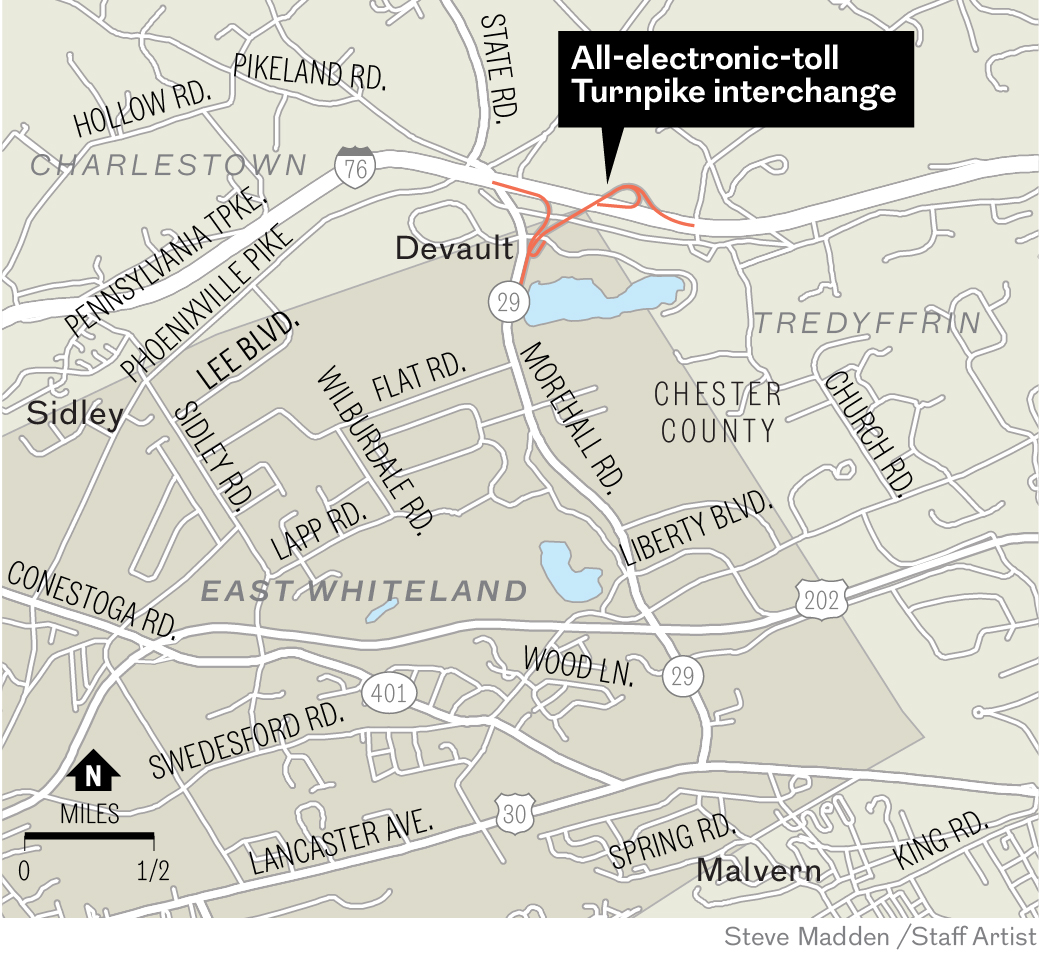
Michael Chain Jr.oncehad to exit the Pennsylvania Turnpike at Downingtown and drive a zigzag pattern on State Routes 100, 113, 401, and 29 to reach his hotel.
So did his customers.
But thenthe turnpike built Exit 320, an all E-ZPass interchange thatconnects to Route 29 and brings traffic right to the family-owned Hotel Desmond Malvern, a DoubleTree by Hilton.
“It would easily take 20 minutes,” said Chain, general manager of the property. “Now you cut that in half, if not more.”
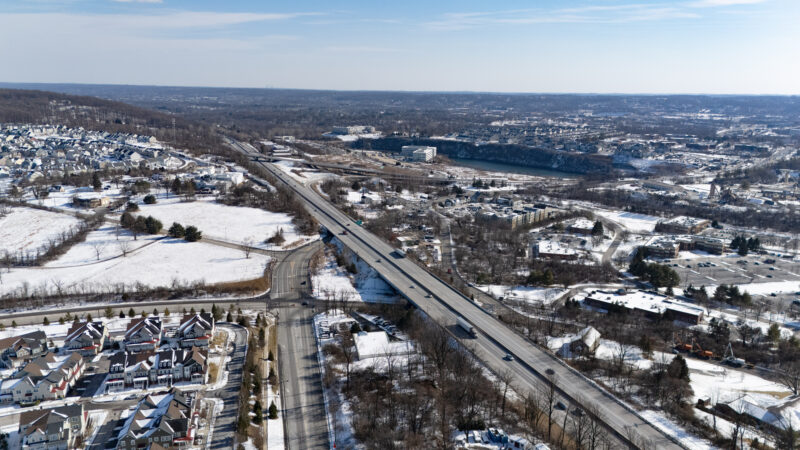
When it opened in December 2012, the interchange helped spur billions in new commercial and residential development in Chester County’s Great Valley.
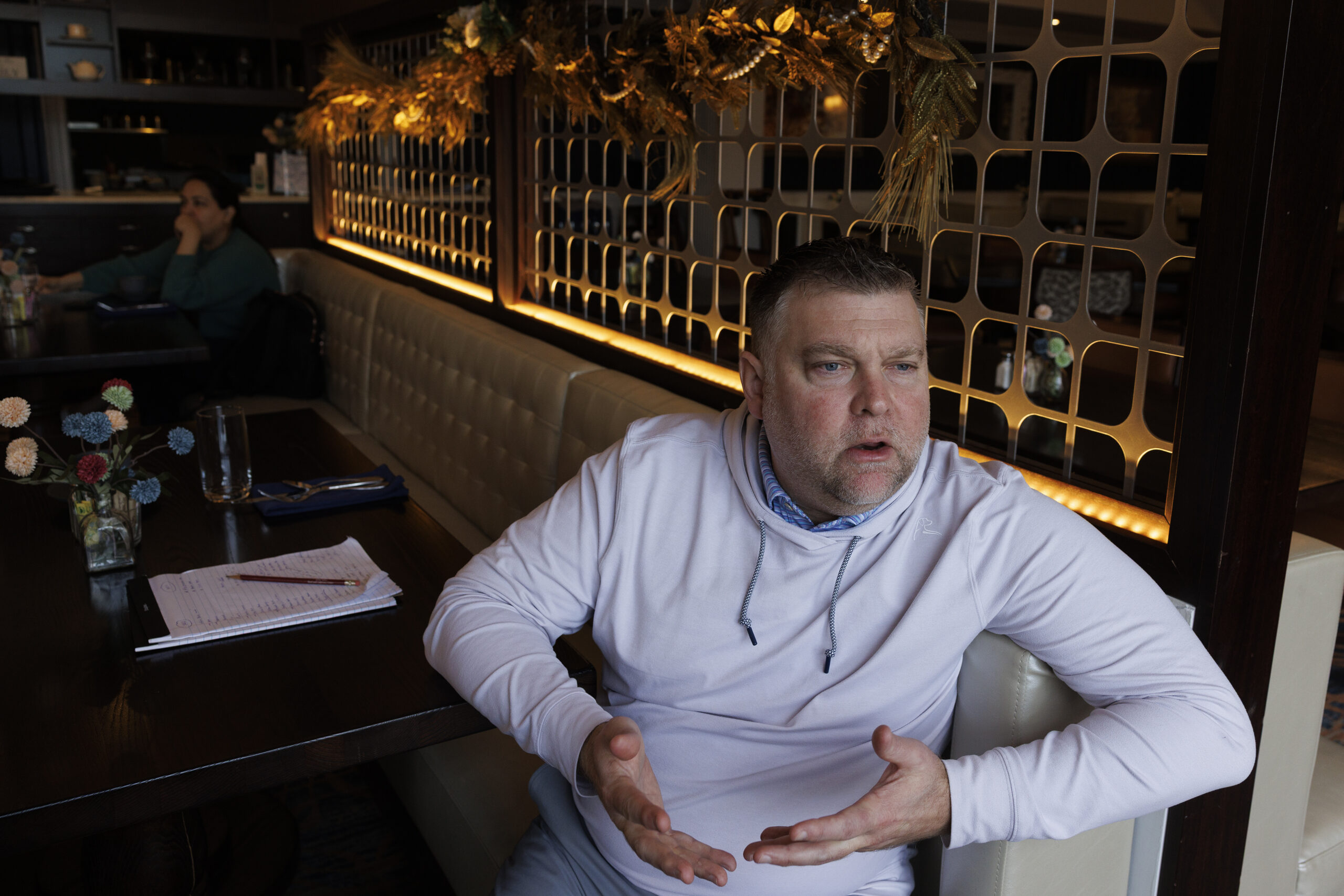
Michael Chain, general manager at a hotel in Great Valley, says the Route 29 ramp has transformed his business.
Corporate office parks expanded and new ones sprouted. Vanguard relentlessly expanded its campus for its 12,000 workers. Pharmaceutical and biotech companies moved there. Pfizer, Johnson & Johnson, Teva, and other pharmaceutical companies planted offices and research laboratories there.
Thousands of people moved in to take advantage of the new jobs or a suddenly more convenient commute to Philadelphia and its inner-ring suburbs, Berks County, Lancaster, or even Harrisburg.
More than 10 years later, the effects of the turnpike’s project are evident, but the real estate market is evolving to meet a lower post-pandemic demand for traditional office space and a higher demand for more housing.
Through American history, transportation and development have been yoked. Towns and cities have grown around navigable rivers, post roads, national highways, railroads, interstates, turnpikes, and public transit.
“This new interchange was explosive in terms of the economic impact in that particular region in a way I’m not even sure we had anticipated,” said Craig R. Shuey, chief operating officer of the Pennsylvania Turnpike.
The key to success
Experts caution it would be a mistake to attribute too much of the growth in the Great Valley solely to the turnpike exit.
The area’s transition from agricultural and industrial to commercial mixed-use was already well underway when it opened. Real estate developersRouse & Associates acquired land in 1974 and began building the Great Valley Corporate Center, a 700-acre business park.
As the Pennsylvania 29 interchange was under construction, the U.S. 202 widening project occurred, helping ease the flow of traffic, although it stillgets congested at peak hours.
The Route 29 electronic toll interchange.
The exit “plays well with an improved Route 202,” said Tim Phelps, executive director of the Transportation Management Association of Chester County.
It’s also served by SEPTA Regional Rail Service and Amtrak, and there’s a connection to the 18.6-mile Chester Valley trail for biking, running, and walking.
“The key isall the multimodal access to the area from different points,” Phelps said. “You move goods and freight along corridors and people to jobs; transportation is economic development.”
New rise in residences
Growth hasn’t been linear.
”Since COVID the office market has been struggling everywhere, and a couple of years ago the funding for biotech became harder to get,“ said John McGee, a commercial real estate broker and developer. ”Both of these events had a negative impact on demand for [office] space in Great Valley.”
Other signs of a softer market in commercial space:
Malvern Green, a 111-acre office park owned by Oracle, is up for sale, marketed as a redevelopment opportunity. It has 759,000 square feet in four buildings on Valley Stream Parkway, off Route 29.
A 10.3-acre office property on Swedesford Road is slated to be demolished and turned into a mixed-use campus, with 250 apartments and about 6,700 square feet of retail and dining.
With the pandemic rewriting the rules of work beginning five years ago, residential development has picked up, driven by housing scarcity and lack of affordability.
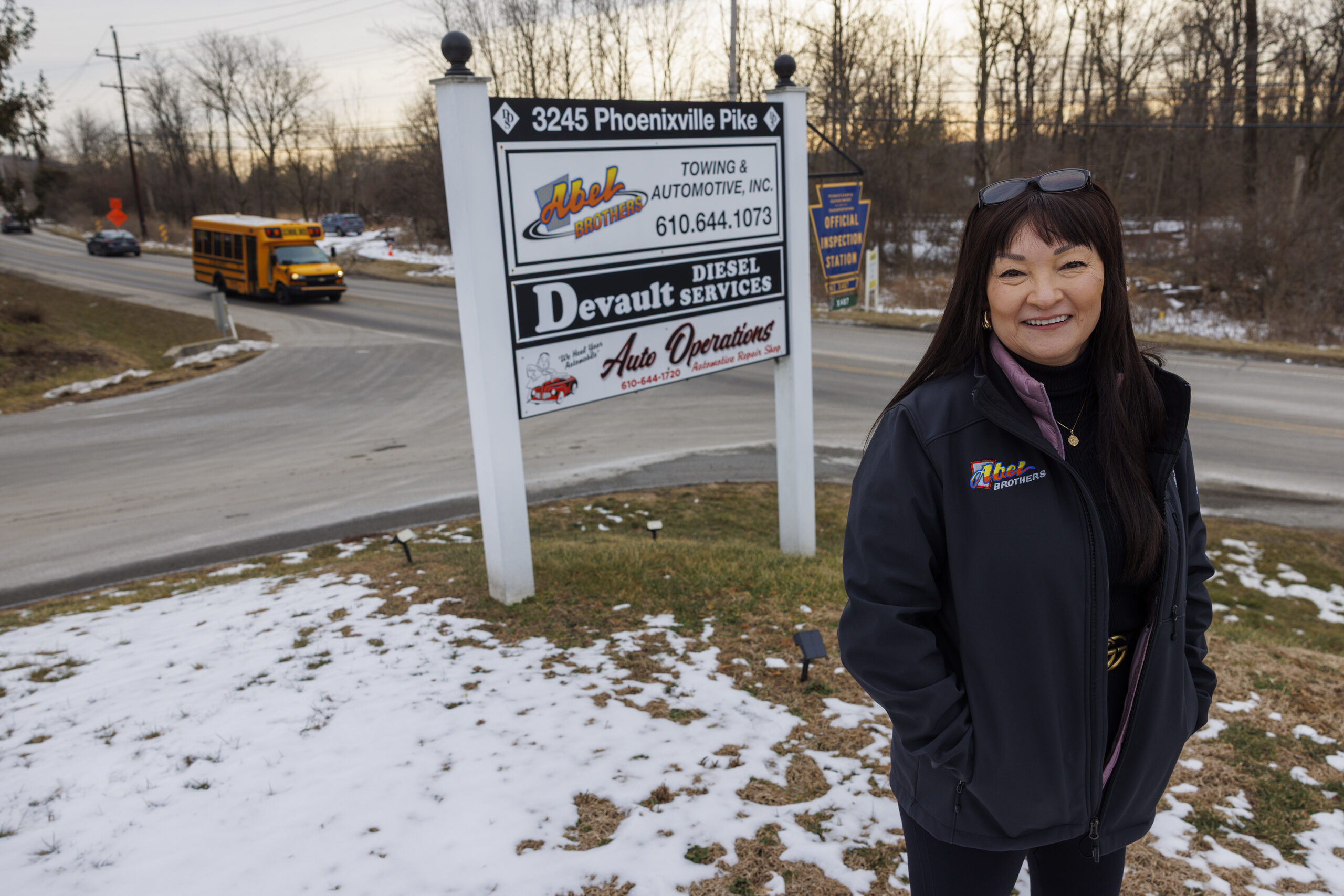
Deb Abel, president of Abel Brothers Towing & Automotive, has seen the area evolve from her position as chair of the East Whiteland Planning Commission and as a member of the Chamber of Business & Industry.
Deb Abel, chair of the East Whitefield Planning Commission, says workforce development is key to the area’s growth.
“We talk all the time about workforce development,” Abel said. “People don’t want to come to work where they can’t afford to live.”
More — and more affordable — housing is key both for current and future staffing needs. Workers shouldn’t have to commute from other areas with more housing options, Abel said.
‘A tangible asset’
To Chain, the hotelier, travel time saved by the interchange is a tangible asset.
“It improves the quality of life on a personal level, and [in business] I’m a beneficiary of people staying on the turnpike,” he said.
As corporate travel budgets waxed and waned in the Great Recession and pandemic years, the Hotel Desmond beefed up other lines of business. An events space at the resort-like hotel now provides about half the revenues, Chain said.
The interchange has helped him draw conference business from statewide associations, most of them in Harrisburg.
And in recent years, youth sports travel teams from New York and New Jersey attending weekend tournaments in the region have filled rooms while using the interchange for easy access. Hockey teams are big.
‘A natural progression’
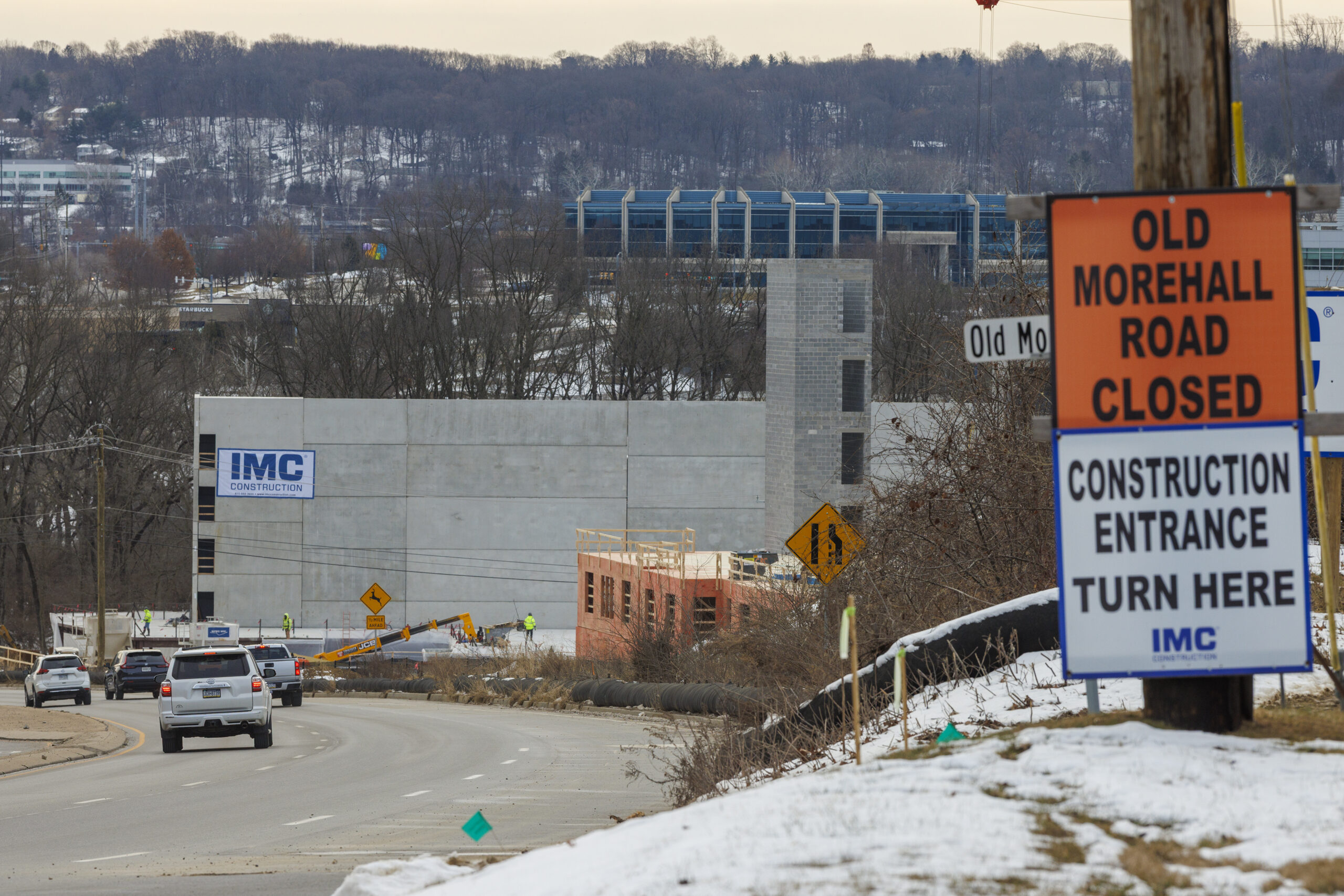
A new multifamily project for Greystar Real Estate Partners is rising next to Route 29 on undeveloped land.
IMC Construction is building a five-story, 267-unit apartment building featuring a rooftop lounge, fitness center, coworking space, pool courtyard, grilling stations, and more.
IMC Construction signs and traffic markers along North Morehall Road in Malvern.
A 133-unit “active adult” apartment building for people who are 55 and older is also under construction.
Project manager Bob Liberato grew up in the area when Route 29 was a country road with one traffic light between Phoenixville and Route 30.
It seems ironic now, but he remembers a petition circulating among fellow students at Great Valley High School to oppose the turnpike’s interchange proposal. Pretty much everybody signed.
“We wanted to stop the turnpike because we liked our life,” Liberato said. “It was open, mostly fields and trees. Being able to go outside, have parties in the woods — all of that was great.”
So what he’s doing now is, in a way, part of the circle of life.
“We’re seeing a shift toward more residential projects, and there is a runway for more in the Great Valley,” said Liberato. With a scarcity of new development, ”it’s a natural progression in a lot of Philly suburbs.”
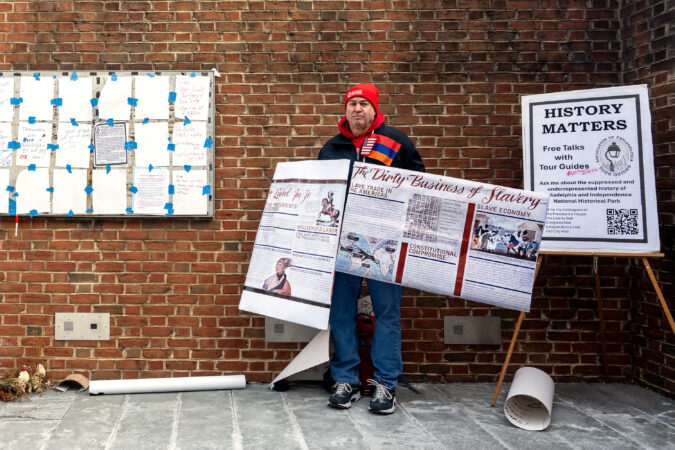
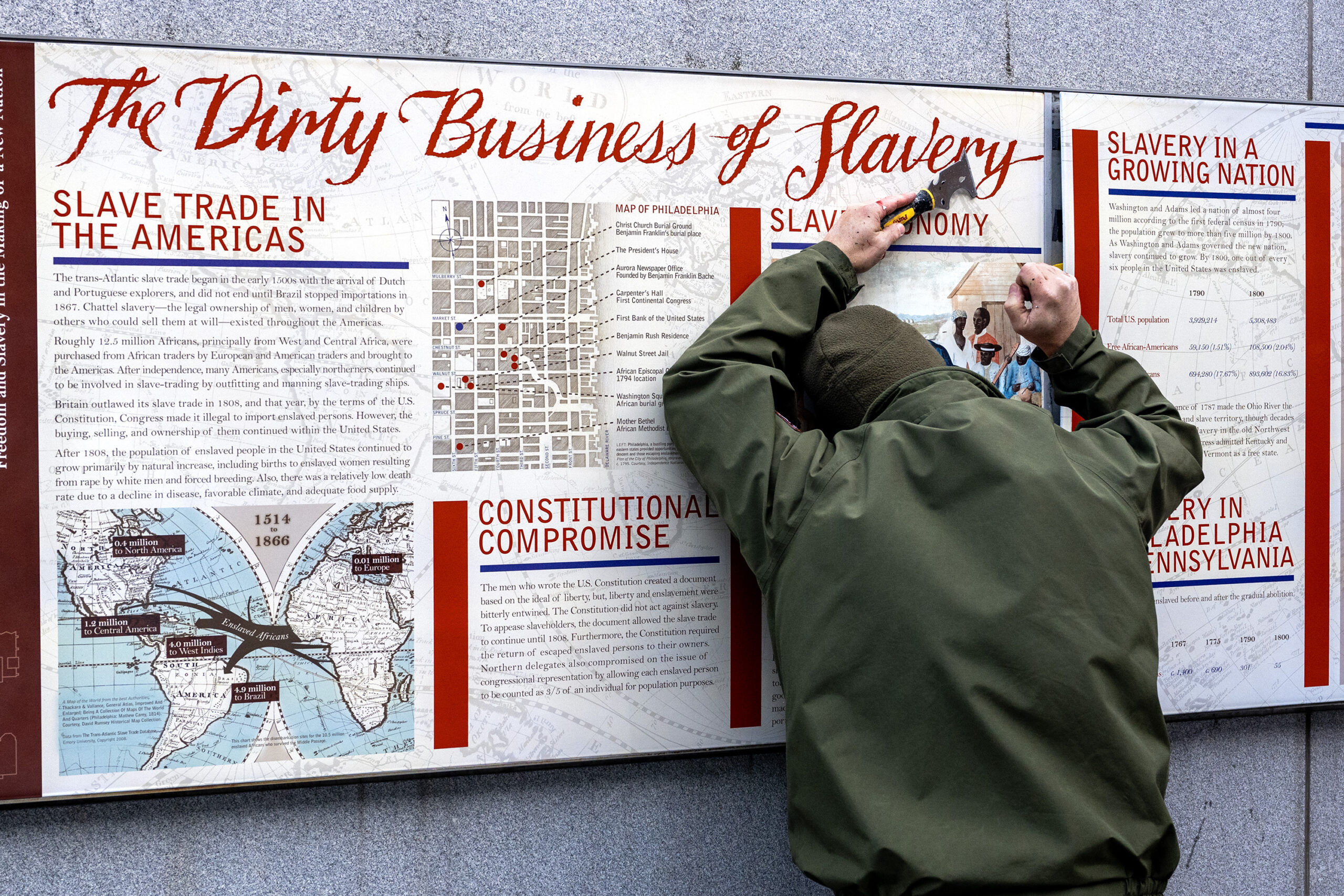
Despite widespread pushback, the Trump administration and the National Park Service removed exhibits on slavery from the President’s House, a recreation of the executive residence that once housed George Washington and John Adams.
The exhibits detailed facts about slavery in early America, including how Washington engaged in a human shell game with enslaved members of his own household. After the passage of Pennsylvania’s Gradual Emancipation Act in 1780, enslaved people were shuttled between Philadelphia and Mount Vernon every six months to obey the letter, if not the spirit, of the law.
The exhibits, part of Independence National Historical Park, also memorialized the nine people first brought into bondage to the city with our nation’s first president. It is important to note their names and their stories.
Austin was a waiter who died while traveling on one of those trips back to Virginia. Paris was a young stable hand whose tenure in the city was short. Hercules was a celebrated chef who eventually escaped from Mount Vernon. Christopher Sheels served as Washington’s valet. Richmond was the son of Hercules and worked various roles despite being just 11 years old. Giles drove Washington’s carriage. Oney Judge, a maid, famously fled bondage in Philadelphia, attracting the president’s ire. There was also Moll, a nanny, and Joe, a footman. Joe had to leave his wife and children behind in Virginia during his time working at the President’s House.
Evidence shows that the people whom Washington enslaved were well aware of the hypocrisy surrounding their situation. In a nation formed on the premise that “all men are created equal,” they found themselves bound by birth to a life of servitude, working in the household of the new republic’s first leader. Their stories once adorned the President’s House. Now, blank spaces stand in their place.
The Trump administration has cited a desire to avoid any historical marker that “inappropriately disparages Americans past or living.” Washington is one of the most admired men in U.S. history. His military leadership and willingness to cede executive power are worthy of our esteem. But Washington, like Thomas Jefferson and many other founders, fell short when it came to slavery. Removing panels cannot change that fact.
A National Park Service worker removes panels at the President’s House site in Independence National Historical Park on Jan. 22. More than a dozen educational displays and illustrations about slavery were removed from the site.
What the desecration of the President’s House does is disparage not just the enslaved members of Washington’s household, but the millions of Americans who, in the words of Mayor Cherelle L. Parker, “endured a great deal of pain so that America could realize its promise.” It also insults the efforts of the Philadelphians who fought to build the exhibit and have a vital part of America’s history recognized.
Thankfully, there is a strong local effort to fight the removal.
Parker cited a 2006 agreement between the city and the National Park Service, which her administration says requires consultation before any alterations are made. The city has filed a lawsuit to restore the panels and is hosting a public hearing on Friday. Perhaps while the court fight plays out, a temporary alternative can be installed at City Hall, by the Constitution Center, or in Fairmount Park.
Parker’s outrage is also a welcome change. While the mayor has mostly refrained from picking fights with the White House, she chastised President Donald Trump and park service officials, saying: “You cannot erase our history. You will not erase our history!”
Gov. Josh Shapiro has joined the city’s lawsuit. An amicus brief filed by his administration said: “There is no virtue in refusing to acknowledge certain aspects of our history because it is painful to do so. The removal of the slavery exhibit from the President’s House undermines this commitment and denies Pennsylvanians and others the opportunity to learn more about a part of our history that cannot be ignored.”
This sentiment is the right way forward.
As the United States celebrates its 250th anniversary, Americans will undoubtedly hear much about this country’s triumphs. That includes those who fought and died — including many who had been enslaved themselves — to keep our country united and begin to address our nation’s greatest mistake.
Generations after the Civil War, Americans were a pivotal part of the coalition that defeated the forces of fascism in Europe. The United States has put people on the moon, helped vanquish diseases like polio, exported its diverse and vibrant culture, and inspired democratic reformers across the world.
Failing to acknowledge our failures can only undermine that legacy.
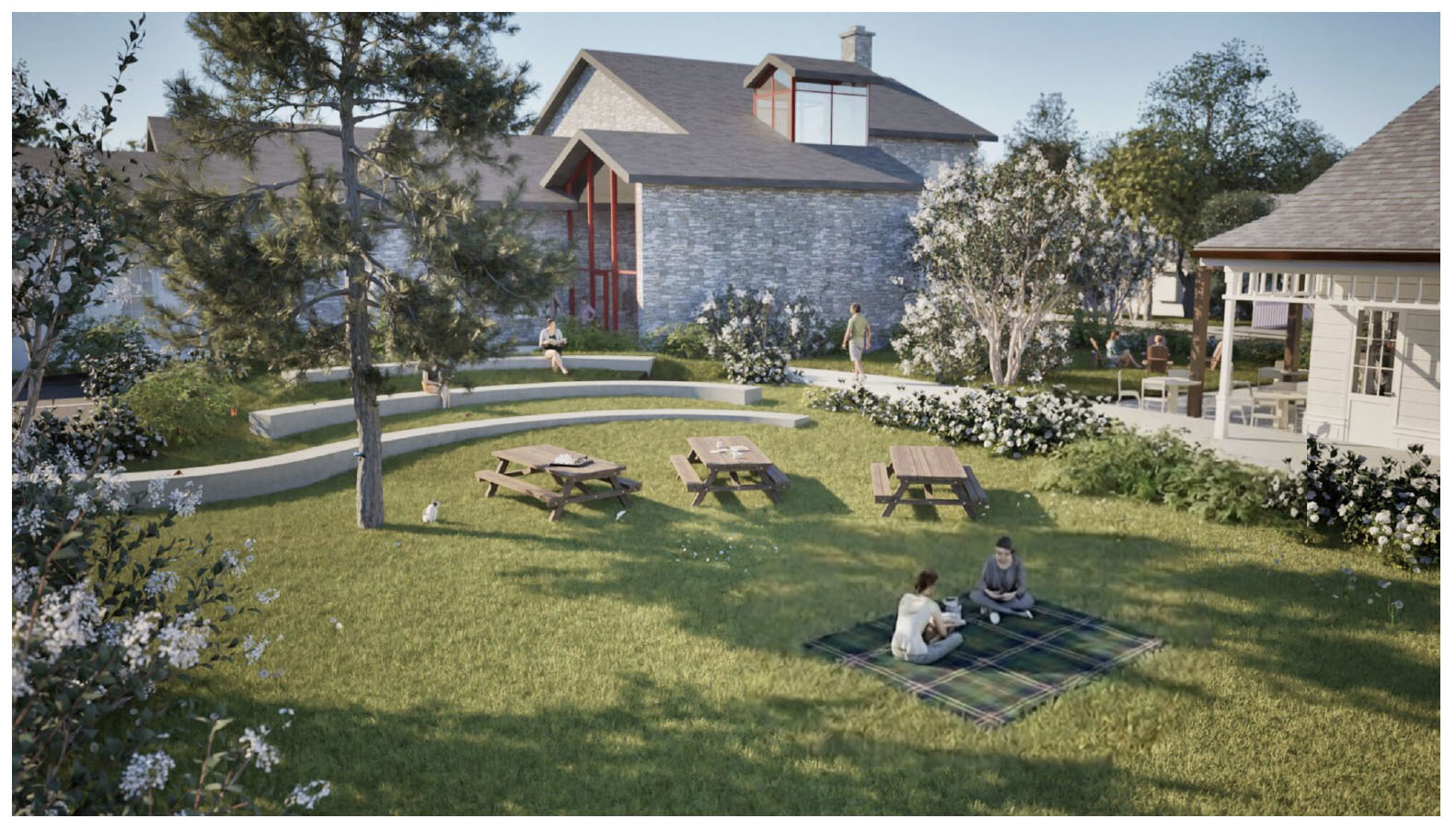
On Jan. 8, Andre Golsorkhi, founder and CEO of design firm Haldon House, presented plans for a revitalized town center, complete with historic architecture, green spaces, and businesses that “fit the character” of the area. Golsorkhi told a packed school auditorium that Haldon House plans to bring in boutique shops, open an upscale-yet-approachable restaurant, and create spaces for communal gathering.
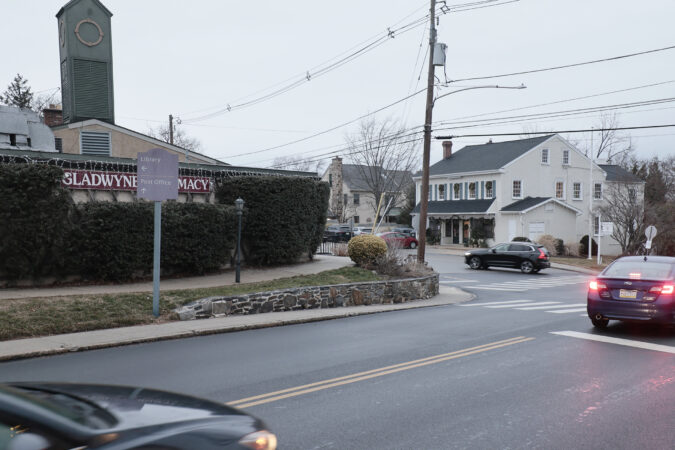
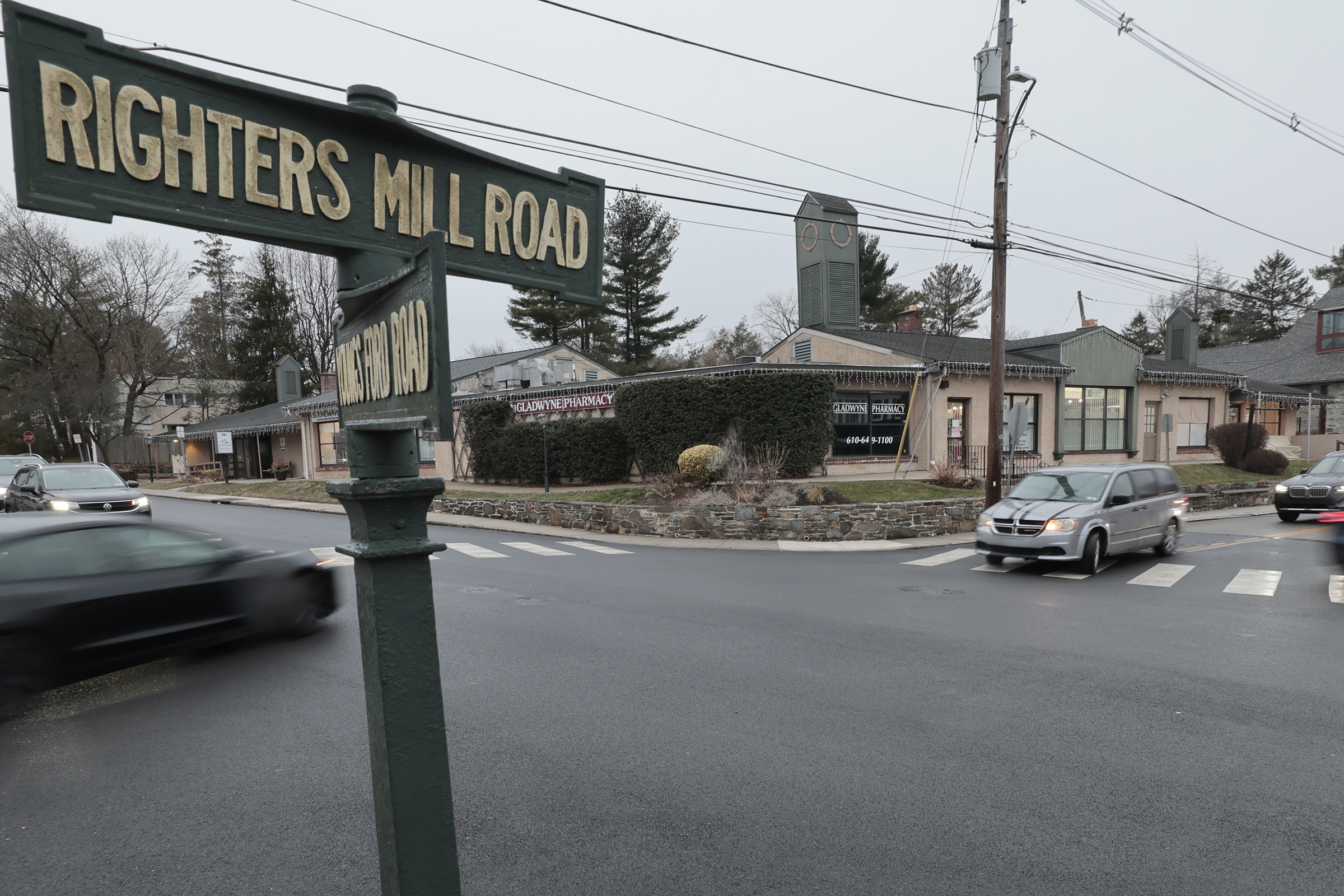
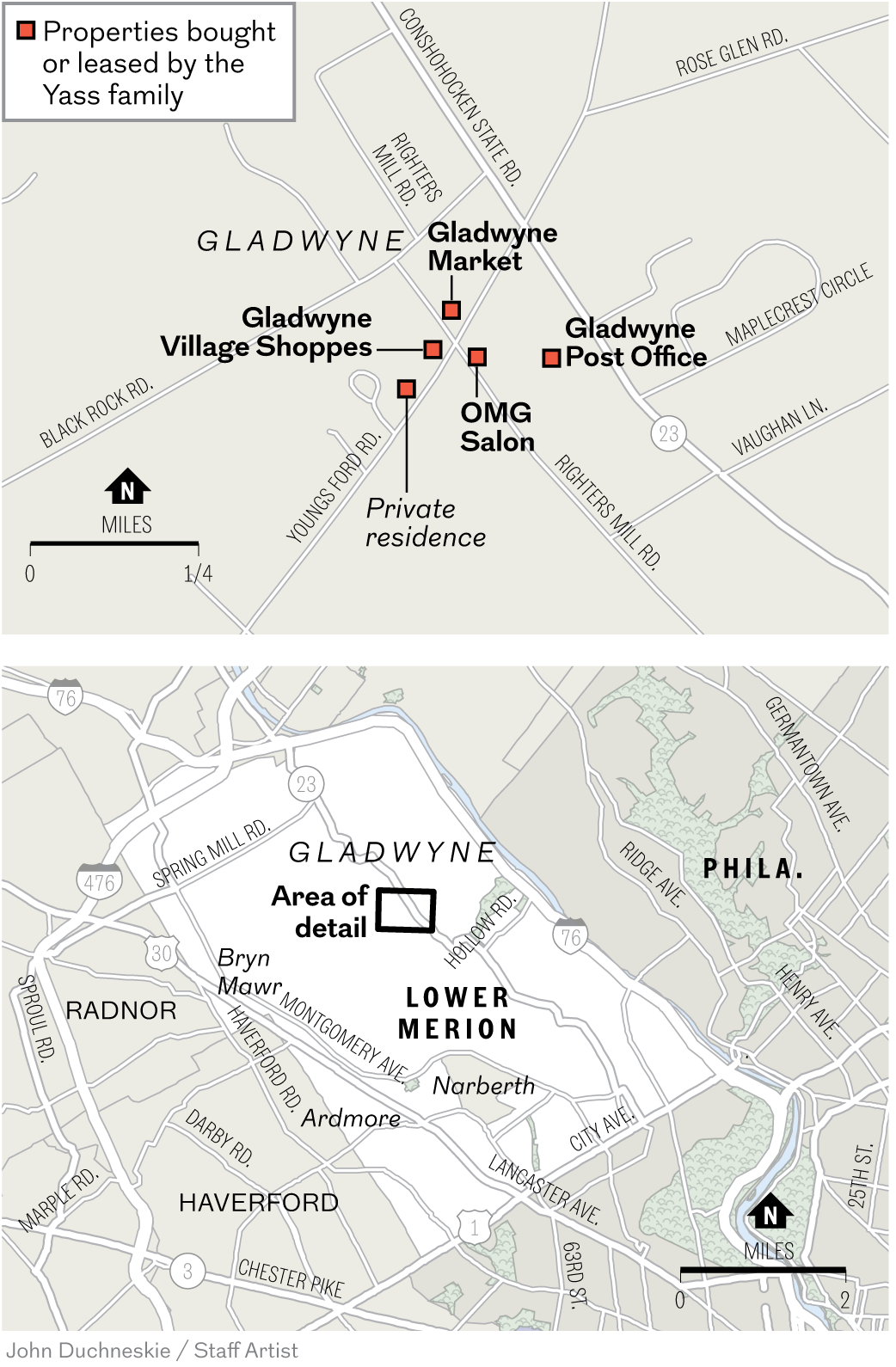
At the meeting, Golsorkhi also revealed that the project was backed by Jeff Yass, Pennsylvania’s richest man, and his wife, Janine. Golsorkhi said the Yasses want to revitalize Gladwyne as part of a local “community impact project.” Haldon House and the Yasses, who live near Gladwyne, have spent over $15 million acquiring multiple properties at the intersection of Youngs Ford and Righters Mill Roads.
Renderings of a proposed revitalization project in Gladwyne, Pa. Design firm Haldon House is working with billionaire Jeff Yass to redevelop the Main Line village while preserving its historic architecture, developers told Gladwyne residents at a Jan. 8 meeting.
What is, and isn’t, allowable?
For some residents, one question has lingered: Is one family allowed to redevelop an entire village?
A petition calling on Lower Merion Township to hold a public hearing and pass protections preventing private owners from consolidating control of town centers had gathered nearly four dozen signatures as of Friday.
Around 4,100 people live in the 19035 zip code, which encompasses much of Gladwyne, according to data from the 2020 U.S. Census.
“Residents deserve a say before their town is transformed.No one family, no matter how wealthy, should unilaterally control the civic and commercial core of a historic Pennsylvania community,” the petition reads.
Yet much of Haldon House’s plan is allowable under township zoning code, said Chris Leswing, Lower Merion’s director for building and planning.
Plans to refurbish buildings, clean up landscaping, and bring in new businesses are generally permitted by right, meaning the developers will not need approval from the township to move forward. Gladwyne’s downtown is zoned as “neighborhood center,” a zoning designation put on the books in 2023 that allows for small-scale commercial buildings and local retail and services. The zoning code, which is currently in use in Gladwyne and Penn Wynne, ensures commercial buildings can be no taller than two stories.
The developers’ plans to open a new restaurant in the former Gladwyne Market and renovate buildings with a late-1800s aesthetic, including wraparound porches and greenery, are generally within the bounds of what is allowed, once they obtain a building permit.
The Village Shoppes, including the Gladwyne Pharmacy, at the intersection of Youngs Ford and Righters Mill Roads in Gladwyne on Friday, Jan. 9, 2026.
More ambitious plans, however, like converting a residential home into a parking lot or burying the power lines that hang over the village, would require extra levels of approval, Leswing said.
The developers hope to convert a residential property on the 900 block of Youngs Ford Road into a parking lot. Lower Merion generally encourages parking lots to be tucked behind buildings and does not allow street-facing parking, a measure designed to avoid a strip mall feel, Leswing said. In order to turn the lot into parking, the developers would need an amendment to the zoning code, which would have to be approved by the board of commissioners.
Various approvals would also be needed to put Gladwyne’s power lines underground, an ambitious goal set by the Haldon House and Yass team.
Leswing clarified that no official plans have been submitted, making it hard to say how long the process will take. It will be a matter of months, at least, before the ball really gets rolling.
Leswing added the developers have been “so good about being locked into the community” and open to constructive feedback.
Golsorkhi said it will be some time before his team can provide a meaningful update on the development, but expressed gratitude to the hundreds of residents who have reached out with questions, support, and concerns.
Map of properties in Gladwyne bought or leased by the Yass family.
From ‘110% in favor’ to ‘a tough pill to swallow’
Fred Abrams, 65, a real estate developer who has lived in Gladwyne for seven years, said he and his wife are “110% in favor” of the redevelopment, calling it an “absolute no-brainer.”
Many Gladwyne residents live in single-family homes that keep them in their own, sometimes isolating, worlds, his wife, Kassie Monaghan Abrams, 57, said.
“Here’s an opportunity for being outside and meeting your neighbors and, to me, getting back to spending time with people,” she said of the proposal to create communal gathering areas.
“I think it’s a very thoughtful, beautiful design,” Monaghan Abrams added.
Some social media commenters called the proposal “charming” and “a fantastic revitalization.”
Others were more skeptical.
Ryan Werner, 40, moved to Gladwyne in 2012 with his wife, who grew up in the town.
“One of the things I’ve kind of fallen in love with about Gladwyne is the sense of community,” said Werner, who has a background in e-commerce sales and is transitioning to work in the mental health space.
“I’m less opposed to just the commercial side of it and more grossed out by the involvement of certain people in it,” Werner said.
Gladwyne is a Democratic-leaning community that voted overwhelmingly for former Vice President Kamala Harris in the 2024 election.
On social media, some griped about the changes.
“The Village will be just like Ardmore and Bryn Mawr. Can’t undo it once they build it,” one commenter wrote in a Gladwyne Facebook group.
Golsorkhi said in an email that the “enthusiasm, excitement and support” from the community have been “overwhelming.”
This suburban content is produced with support from the Leslie Miller and Richard Worley Foundation and The Lenfest Institute for Journalism. Editorial content is created independently of the project donors. Gifts to support The Inquirer’s high-impact journalism can be made at inquirer.com/donate. A list of Lenfest Institute donors can be found at lenfestinstitute.org/supporters.
Words sufficient to describe the horrors of this administration and the complicit Republicans have long left me. Our senators, though, have an opportunity to slow the imposition of authoritarian rule by voting to remove U.S. Immigration and Customs Enforcement funding from the current appropriations package. There is no need to shut the government down again if that particular funding package is cut to be addressed another day. The Trump administration has been squirreling away money in offshore accounts in Qatar, but any pushback from the Senate will send a message that democracy isn’t dead yet.
Mary Ann Hanna,Media
History repeats
Unfortunately, governments murdering citizens and then lying about it is nothing new. I know because my grandfather was present when a band of government thugs attacked a group of people, killing four of them and injuring many more. The government lied and said shots had been fired at the thugs, and they were just acting in self-defense. So what we are witnessing in Minnesota is from an age-old playbook. In my grandfather’s case, the year was 1933, and the leader in charge was Adolf Hitler. I never thought that all these years later, I would live to see it happen in America.
Stefan Keller, Huntingdon Valley
No moral conviction
The tone of the civil rights and social justice movements of the 1960s and the anti-Vietnam War protesters of the 1970s had some moral character. In contrast, these U.S. Immigration and Customs Enforcement-related protesting mobs are fundamentally different from those times, as they have no morals and no credibility. This endless massive wave of anti-ICE protesters — their chaotic confrontations with federal agents, their disrupting of a Christian church service — is creating even more emotional volatility, rather than any unified moral conviction of the ’60s and ’70s.
Fueled by social media, the United States is now more polarized than ever before. As unrest continues to escalate, the armed military waits to get involved. We are now watching the collision of federal immigration enforcement and protesters (who I sincerely believe are being paid). The situation is now so unstable that it’s like we’re all just waiting for the next shooting. As law enforcement takes sniper positions, preparing for the mob’s coordinated violence, should we not take a minute of silence before the gunfire starts?
Carl Marchi, Holliston, Mass.
Standing on truth
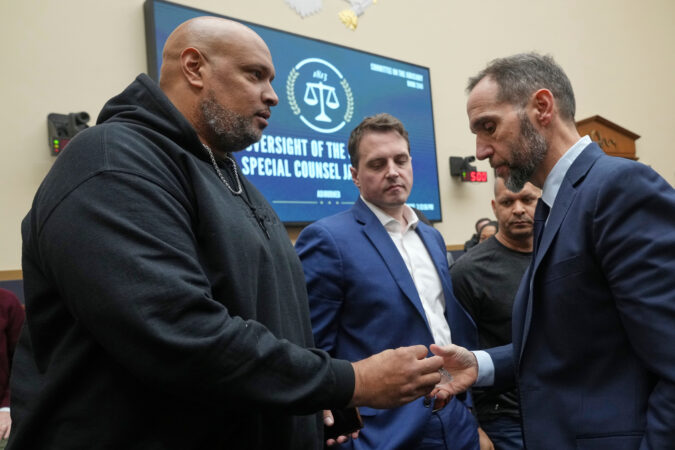
I thank special counsel Jack Smith for his calm, factual, disciplined, and courageous public testimony before Congress last week. He laid out evidence in the criminal cases against Donald Trump, including the persistent lie of a “stolen” 2020 election, without theatrics or spin.
Mr. Smith did not editorialize or inflame. He stated the evidence and the law, exactly as his role requires.
The response from President Trump was telling. While Mr. Smith testified before the House Judiciary Committee, Trump attacked him on Truth Social, calling him a “deranged animal,” and directing Pam Bondi to investigate him. That is not oversight. It is intimidation. It is retaliation.
One man testified to facts and law. The other resorted to insults and threats. That contrast explains far more about the state of our democracy than any talking point ever could.
History will take note.
Maria Duca, Philadelphia
Join the conversation: Send letters to letters@inquirer.com. Limit length to 150 words and include home address and day and evening phone number. Letters run in The Inquirer six days a week on the editorial pages and online.
DEAR ABBY: My husband and I are raising our 7-month-old daughter together, and we generally get along well. I love him very much, but he has a habit that worries me. He’s constantly on the lookout for a new job. This isn’t necessarily a bad thing, but every couple of months he says he’s bored and wants to work somewhere else. These are decent-paying jobs, but they never pay much more than what he’s earning now. They are also not always located in the same city or even the same state we live in.
I don’t oppose moving away or moving up, but I don’t want to move clear across the country when the benefit won’t significantly add to what we have now and the relocation creates a burden with moving expenses.
Recently, my father made an offhand comment during a conversation about a business that offers good pay, benefits, etc. — nearly the same benefits and pay my husband is receiving now. It would require that we move out of state, and I’d have to search for a new job.
My husband has been at his current job less than a year, and I have been at mine less than six months. We just signed a new lease on our apartment. He wants to break the lease and move. What can I do to convince him that this is not a strategic move for our family at this time?
— STRESSED-OUT WIFE AND MOM
DEAR STRESSED-OUT: I don’t recommend breaking your lease and moving at this point because it will damage your credit. I don’t know what your husband’s problem is — whether he has trouble getting along with his co-workers or attention deficit disorder — but things won’t improve until you determine the cause.
Neither of you has a solid job history. In a few short years, your daughter is going to be in preschool, and you do not want to constantly disrupt her education or socialization. Stay put until a move will be more financially beneficial.
** ** **
DEAR ABBY: An elderly couple moved in next door. They once mentioned that they believed mothballs would keep ants away. That’s not all. Every time they open their garage door, we get blasted with the stench. It is so pungent we must retreat inside our house, which is about 80 feet from their property. We can’t open our windows, sit on our deck or do yard work outside until their garage door comes down. I don’t know how they stand it. How can we let them know it’s affecting our quality of life without causing a permanent rift?
— STUNK OUT IN PENNSYLVANIA
DEAR STUNK OUT: Contact your local health department to report what you are enduring and to share your concerns. Mothballs are not supposed to be used in the manner you have described. If you live in an area with a homeowner’s association, it also may be able to help. However, if there ISN’T one, you may have to bite the bullet and ask these neighbors to close their garage door more quickly because the scent of mothballs is making you ill.