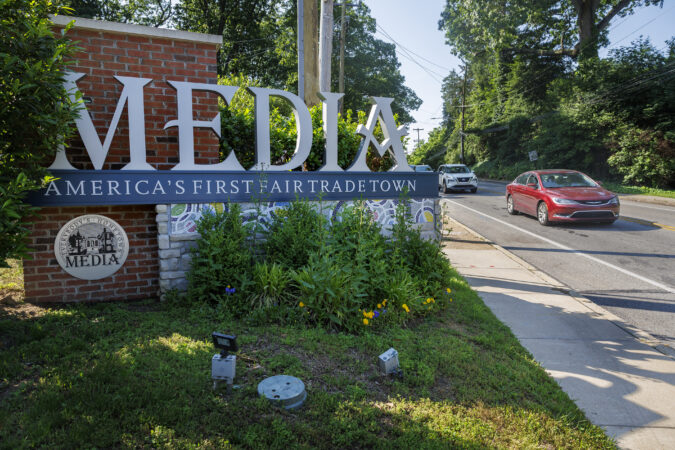
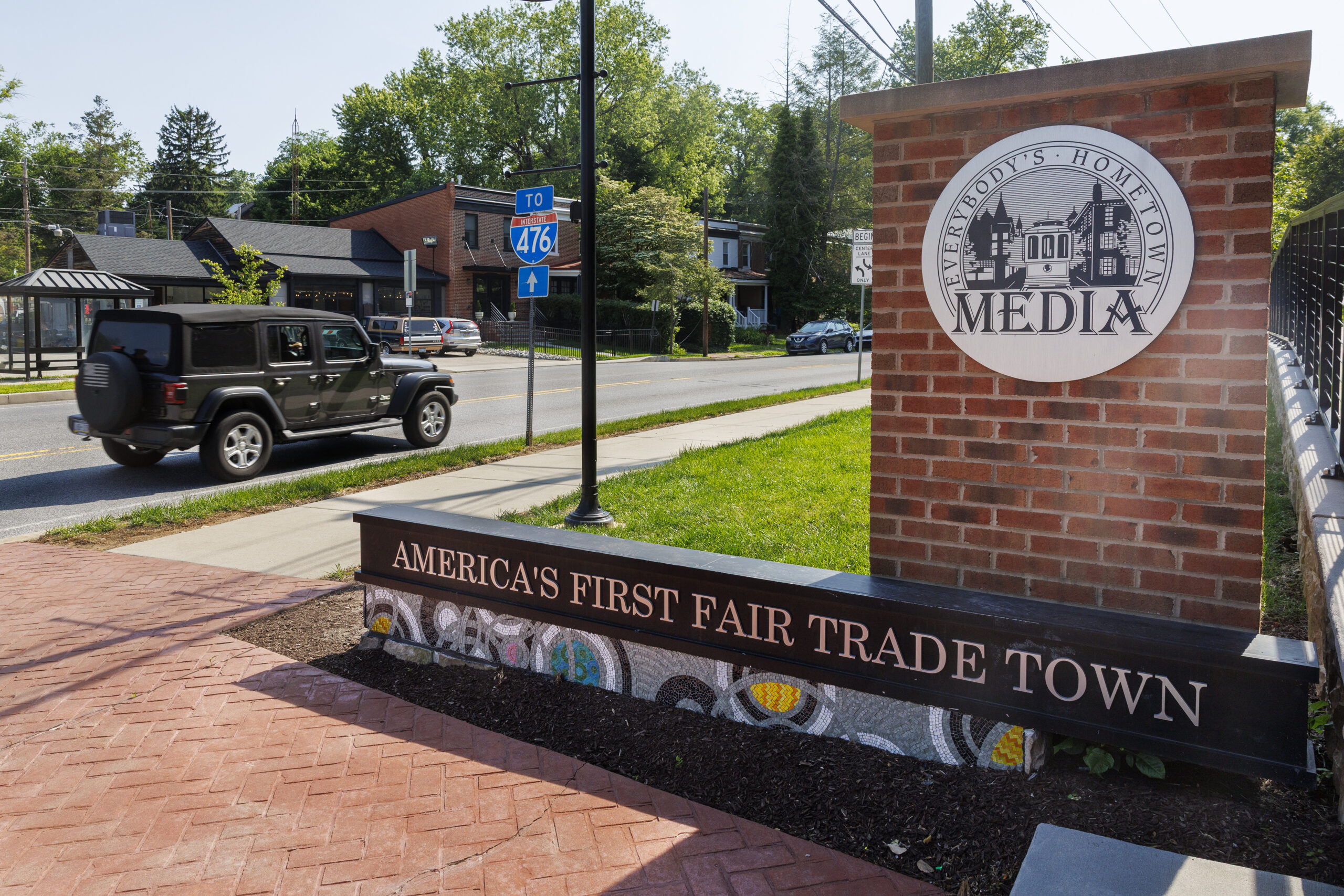
Media displays its distinction as the country’s first Fair Trade Town on its signage.
Two decades ago, one man’s vision and one woman’s email set into motion a first for Media as the pair worked to make the borough the nation’s first Fair Trade Town.
The idea came from Hal Taussig, the late founder of travel company UnTours who wanted to see his hometown prioritize quality products and fair wages for farmers in developing areas. To be part of the global trading agreement, farmers and producers must use eco-friendly practices, invest in their communities, and provide safe working conditions. In exchange, they’re paid higher minimum prices for goods like coffee, chocolate, and produce.
With a single late-night email to a man in England, Elizabeth Killough, who worked for Taussig, helped start the process. While major cities like New York and Los Angeles were working to establish themselves as Fair Trade hubs, Media beat them to it, and 20 years later, that ethos lives on.
Swarthmore has a new interim borough manager. On Monday, borough council appointed David Unkovic to the role. He takes over for Sean Halbom, who has been terminated, according to Council President Jill Gaieski, The Inquirer learned late Wednesday night. Halbom began in the role less than six months ago, taking over for the outgoing manager Bill Webb in September.
Peco is aiming to begin a monthslong natural gas line replacement project on Monday in Media. Work will take place on Providence Road between Meetinghouse Road and Monroe Street on weekdays from 7 a.m. to 4 p.m. through mid-July. While most work will be outdoors, Peco will need access to impacted homes to relight gas appliances. Read more about the project here.
In other construction news, the Swarthmore Avenue project is getting closer to completion. Needed parts for the repair project are expected to arrive next week, and once they’re installed, closures on the road are expected to be limited to 7 a.m. to 3 p.m. for “a few weeks.” Construction on the project began in December and was initially anticipated to take eight weeks.
Monday is the deadline for Swarthmore residents to order a tree for or near their curb. Here’s how you can get one.
Riddle Village in Middletown Township has become a hub for some of the country’s top Scrabble players. The Delco Scrabble Club’smembers range widely in age and come from all over the area, but meet weekly at one of the members’ homes in Media. “I casually hop on SEPTA and then I’m face-to-face with the best Scrabble players in the country. It’s kind of intimidating,” Mark Abadi, 35, said at one of the club’s recent weekly meetings. He and another member of the group, Will Anderson, 41, have competed in national tournaments and are putting their skills to the test on this season of the CW’s game show Scrabble.
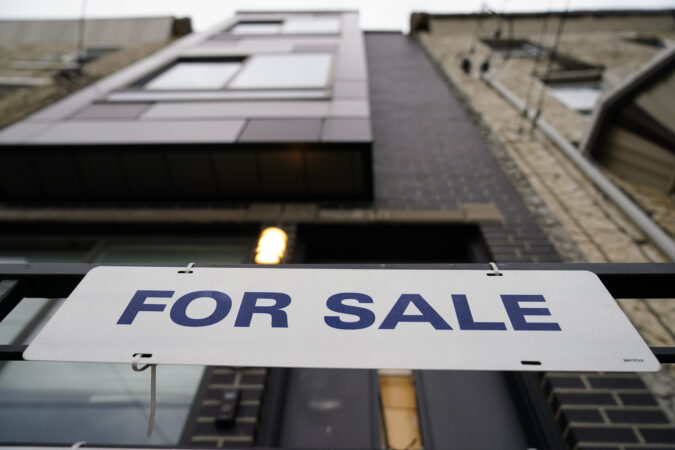
A pair of sisters recently put their family’s Spanish-style Wallingford home on the market for $699,000. The ranch was built in the 1970s, and their parents purchased it 42 years ago. Take a peek inside.
🏫 Schools Briefing
Two Penncrest High School sports teams are having successful runs. The boys’ ice hockey team shut out Conestoga High School 4-0 last week to claim the Central League championship. And the boys’ basketball team kicks off its PIAA 5A championship efforts on Friday, when the Lions host York Suburban High School. See the full 5A bracket here.
Reminder for Rose Tree Media families: There’s no school today or tomorrow for kindergarten through eighth grade students due to parent-teacher conferences. On Saturday, Penncrest High School is hosting Carnival for a Cure from 10 a.m. to 2 p.m. There will be food, games, and prizes, with proceeds benefiting the Foundation Fighting Blindness. See the district’s full calendar here.
Wallingford-Swarthmore School District is hosting a community meeting about the high school renovation tonight at 6:30 p.m. at the Strath Haven High School library.
Also in WSSD, today is the Elementary Chorus Fest, andperformances of Strath Haven High School’s musical, Alice By Heart, continue tomorrow through Sunday. On Monday, there’s a virtual meeting about navigating college admissions tests, and the spring book fair starts Tuesday. See the district’s full calendar here.
🍽️ On our Plate
Fox 29’s Bob Kelly recently visited Bittersweet Kitchen in Media to sample some of its brunch offerings, including crème brûlée pancakes, apple cider fritters, and huevos rancheros. See the segment here.
🎳 Things to Do
🏕️ School Day Off Mini-Adventure Camp: Kids inkindergarten through third grade can explore Tyler Arboretum through nature-themed crafts, outdoor play, games, and more. ⏰ Thursday, March 5 and Friday, March 6, 9 a.m.-4 p.m. 💵 Standard daily camp admission is $83.70 for members and $93 for non-members 📍Tyler Arboretum, Media
🩰 Sleeping Beauty: The classic fairytale gets a modern spin as Ballet of Lights dancers perform in glow-in-the-dark costumes. ⏰ Friday, March 6, 6:30 and 8:30 p.m. 💵 $43-$57 📍The Media Theatre
🎸 The Biscotti Boys: The Chester County party cover band will make its debut at Martinique Deux. ⏰ Friday, March 6, 8 p.m. 💵 No cover📍Martinique Deux, Media
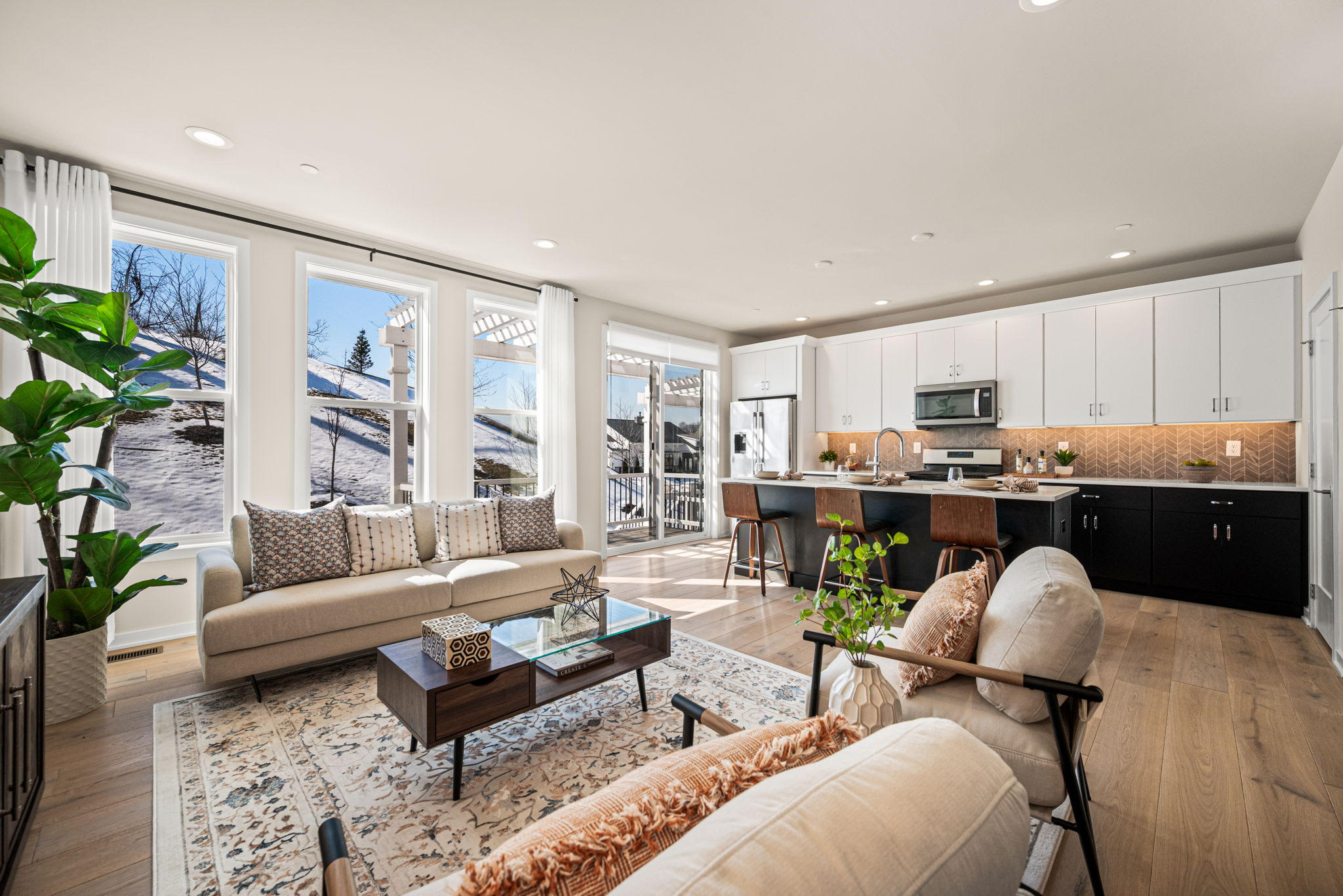
The open-concept first floor includes living and dining areas, as well as the kitchen.
Located in Franklin Station off Route 1, this three-bedroom townhouse spans two floors, plus a finished basement, and has access to amenities including a clubhouse, pool, walking trails, and fitness center. The townhome’s open-concept first floor features living and dining areas, as well as the kitchen, which has an 8-foot quartz island, two-tone cabinetry, a herringbone backsplash, plus a walk-in pantry. The space opens onto a deck with a pergola. All three bedrooms are upstairs, including a primary suite with a walk-in closet, a double vanity, and a tiled shower. There are open houses Saturday from 11 a.m. to 1 p.m. and Sunday from noon to 2 p.m.
By submitting your written, visual, and/or audio contributions, you agree to The Inquirer’s Terms of Use, including the grant of rights in Section 10.
This suburban content is produced with support from the Leslie Miller and Richard Worley Foundation and The Lenfest Institute for Journalism. Editorial content is created independently of the project donors. Gifts to support The Inquirer’s high-impact journalism can be made at inquirer.com/donate. A list of Lenfest Institute donors can be found at lenfestinstitute.org/supporters.
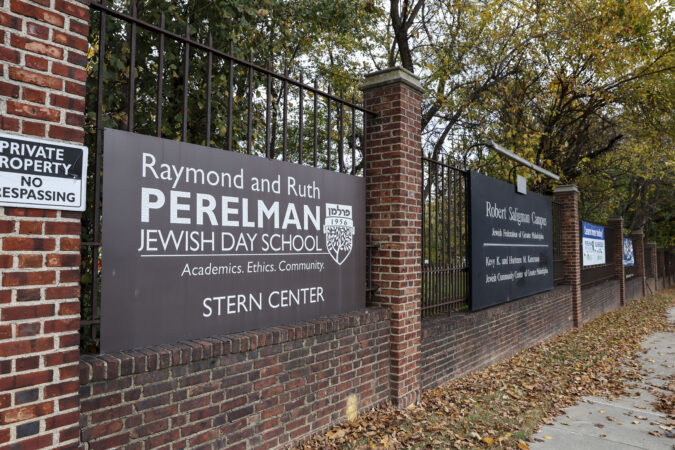
Two prominent Jewish day schools in the Philadelphia suburbs are set to merge, a decision school leaders say will keep the institutions competitive in the region’s strong educational market.
Perelman Jewish Day School, a private Jewish pre-K and elementary school located in Melrose Park and Wynnewood, and Jack M. Barrack Hebrew Academy, a Jewish middle and high school located in Bryn Mawr, will merge next year to become the only unified pre-K through twelfth-grade Jewish day school in the Philadelphia area.
Perelman and Barrack will maintain their current operations for the 2026-27 school year, while beginning to combine their admissions and development programs. Faculty, staff, and students will come under the unified school umbrella beginning in fall 2027. Perelman and Barrack will continue to operate on all three campuses.
School officials say the merger will help streamline curriculum development and strategic planning while bringing more families into the Jewish day school system by offering a consistent, pre-K-through-high-school experience.
Perelman Jewish Day School was founded in 1956 as the Solomon Schechter Day School of Greater Philadelphia. The school operates across two campuses, one in Melrose Park, which serves parts of Philadelphia County, eastern and northern Montgomery County, and Bucks County, and another in Wynnewood, which serves Center City and Philadelphia’s western suburbs.
Jack M. Barrack Hebrew Academy, originally Akiba Hebrew Academy, was the nation’s first pluralistic Jewish secondary day school when it opened in Center City in 1946. The school moved to Merion Station in 1956, then Bryn Mawr in 2008. Barrack boasts numerous notable alumni, including Gov. Josh Shapiro and CNN anchor Jake Tapper.
Perelman and Barrack completed a partial merger in 2012, when the schools combined their middle schools into a single sixth-through-eighth-grade program on Barrack’s campus.
Tuition at Perelman ranges from $21,500 to $32,300 per year, and tuition at Barrack ranges from $34,900 to $42,700. Both schools offer tuition assistance. Perelman says it awards over $3 million in tuition assistance each year to families earning up to $500,000.
School leaders say the merger will ensure Perelman and Barrack are an attractive option for families in Philadelphia’s rich educational ecosystem, where parents can choose from dozens of strong public and private schools. Often, families choosing private education are looking for continuity from pre-K through high school, something that Perelman and Barrack have not been able to provide until this point.
The ability to have students “become part of an educational system from their earliest years and grow within that system” will be academically and socially “deeper and more impactful,” said Rabbi Marshall Lesack, Barrack’s head of school and a Barrack alumnus. Lesack will lead the unified school beginning in 2027.
Daniel Eisenstadt, a member of the Perelman board of directors who will chair the new, combined board, said the merger will also allow for more cohesive planning. The schools will be able to align their vacation calendars, external messaging, and curriculum plans.
Though the overwhelming majority of Perelman students already matriculate to Barrack, bringing the schools under one system will allow for more parity in what to teach and when to teach it. Elementary, middle, and high school teachers will be able to sit in the same room and plan best practices for everything from math to art to Jewish studies, considering the arc of a student from ages 5 to 18, Eisenstadt said.
Both schools’ enrollment has been “stable to growing” in the past few years, said Eisenstadt. Both he and Lesack were clear that the merger is not in response to a souring financial outlook, as can be the case when educational institutions merge.
“We’re both coming from a place of strength,” Lesack said.
Barrack reported revenue of $20.9 million in 2024, an increase of $3.4 million over 2023, according to tax records. Perelman reported a revenue of $13.4 million in 2024, up $400,000 from 2023.
However, Eisenstadt said, “there is a recognition that we operate in an environment where there are excellent other independent schools, and excellent public schools. Rather than waiting for a moment where we see a dip in enrollment or where there are challenges, I think the general feeling from a leadership point of view was, ‘Let’s be proactive.’”
When it comes to growing enrollment at Barrack and Perelman, however, Eisenstadt said there’s no one cause. He is “a little bit skeptical about the generic narrative” that the Israel-Hamas war and rising antisemitism have solely drivenincreased interest in Jewish education. He says Perelman and Barrack can’t rest on the assumption that larger forces will inevitably push families toward the Jewish day school experience. In a “dynamic world,” the schools need to continue to evolve, he said.
In Eisenstadt’s words, Barrack and Perelman can’t “assume that any one thing that’s occurred, any one event, or any one trend is the future.”
Lesack and Eisenstadt said many of the merger’s details are still up in the air and will be decided by the board. However they noted that there are plans for major investments across all of Perelman and Barrack’s facilities. Plans have long been in the works to find a new home for Perelman’s Melrose Park campus. School leaders say they are committed to having a continued presence in Philly’s northern suburbs.
Lesack and Eisenstadt acknowledged the challenges of merging two schools with different campuses and cultures. Yet there’s “an unbelievably strong foundation” upon which to build, Lesack said, citing the many families, values, and traditions that the schools already share.
This suburban content is produced with support from the Leslie Miller and Richard Worley Foundation and The Lenfest Institute for Journalism. Editorial content is created independently of the project donors. Gifts to support The Inquirer’s high-impact journalism can be made at inquirer.com/donate. A list of Lenfest Institute donors can be found at lenfestinstitute.org/supporters.
When we were teenagers growing up in rural Pennsylvania, Americans typically bought their first home at the age of 29. Now, first-time home buyers tend to be in their 40s.
As U.S. senators from different parties, we don’t agree on everything. But as friends, parents of nine children between us, and representatives of working families across Pennsylvania, we cannot accept this terrible trend.
The American dream — the promise that if you work hard and play by the rules, you can build a good life and financial security in a home that you own — must not fall out of reach of young Pennsylvanians.
That’s why we support the ROAD to Housing Act. This bipartisan bill, which the U.S. Senate is expected to vote on this week, will help address Pennsylvania’s housing crisis by making it easier to build more homes, more affordably, while also preserving and repairing the housing stock we already have.
The commonwealth has 100,000 fewer homes than it needs today and is on track to be short 185,000 by 2035.
As a result of this shortage, home prices have increased 75% in the last five years. More than one million Pennsylvania households spend over 30% of their income on housing, and more than half of our housing stock is over 50 years old, driving up repair costs and straining family budgets.
Sens. John Fetterman (D., Pa.) (left) and Dave McCormick (R., Pa.) greet before participating in a debate in Boston moderated by Fox News in June.
That combination — too few and too many aging homes — creates a squeeze felt from Erie to Philly: young families delaying having kids, seniors stuck in homes they can’t afford to fix, workers turning down jobs because they can’t find a place to live nearby.
The shortage will get even more acute as new investments in Pennsylvania’s energy and artificial intelligence, defense, and life-science industries generate great new jobs across the commonwealth.
We have celebrated these transformative investments, from U.S. Steel to the Philly Shipyard, but more jobs mean more workers, and workers need homes.
The ROAD Act delivers by taking three commonsense approaches. First, it tackles affordability at the source — supply — by reducing delays and lowering construction costs.
Second, it strengthens accountability and modernizes federal programs to ensure they work for the people they’re meant to serve.
Third, it empowers Pennsylvanians to build what fits local needs.
We’re proud that the bill includes provisions to protect Pennsylvania workers, veterans, and homeowners, which we championed together. Our Whole-Home Repairs legislation, for example, supports homeowners, especially in markets like ours with many historic residences, by offering grants and forgivable loans for repairs and upgrades of aging homes, keeping families in their homes and stabilizing neighborhoods.
This isn’t a Republican problem or a Democratic problem. It’s an American one, and it demands bipartisan action.
For these reasons, we stand united, as we have on many other issues, in voting yes for the ROAD to Housing Act.
Dave McCormick and John Fetterman represent Pennsylvania in the U.S. Senate.
The 2026 NFL free agency period begins on Monday, when “legal tampering” will give way to a number of reported deals across the league. Free agency will officially begin on Wednesday, and the Eagles will be players — though how aggressive general manager Howie Roseman and Co. will be remains to be seen. With limited available cap space and the specter of a possible A.J. Brown trade adding to the uncertainty, how the Eagles handle this period elicits a wide range of possibilities.
The Inquirer’s Eagles reporting team of Jeff McLane, Olivia Reiner, and Jeff Neiburg got together for a roundtable ahead of next week’s festivities.
What’s one practical free agent move you could see the Eagles making next week, given their cap space and personnel situation?
McLane: Dallas Goedert is slated to become an unrestricted free agent for the first time in his career, but even if he signs with another team, the Eagles won’t have a clean break from their longtime tight end. They still have an approximate $20 million dead money charge from a void year added to Goedert’s contract. That’s a lot of money to eat for a productive player they may want to keep. The Eagles, more than any other team, have been comfortable kicking cash into future years. But Roseman can’t be reckless, and if trading Brown becomes a reality, the general manager would have around $45 million more in dead money on the books.
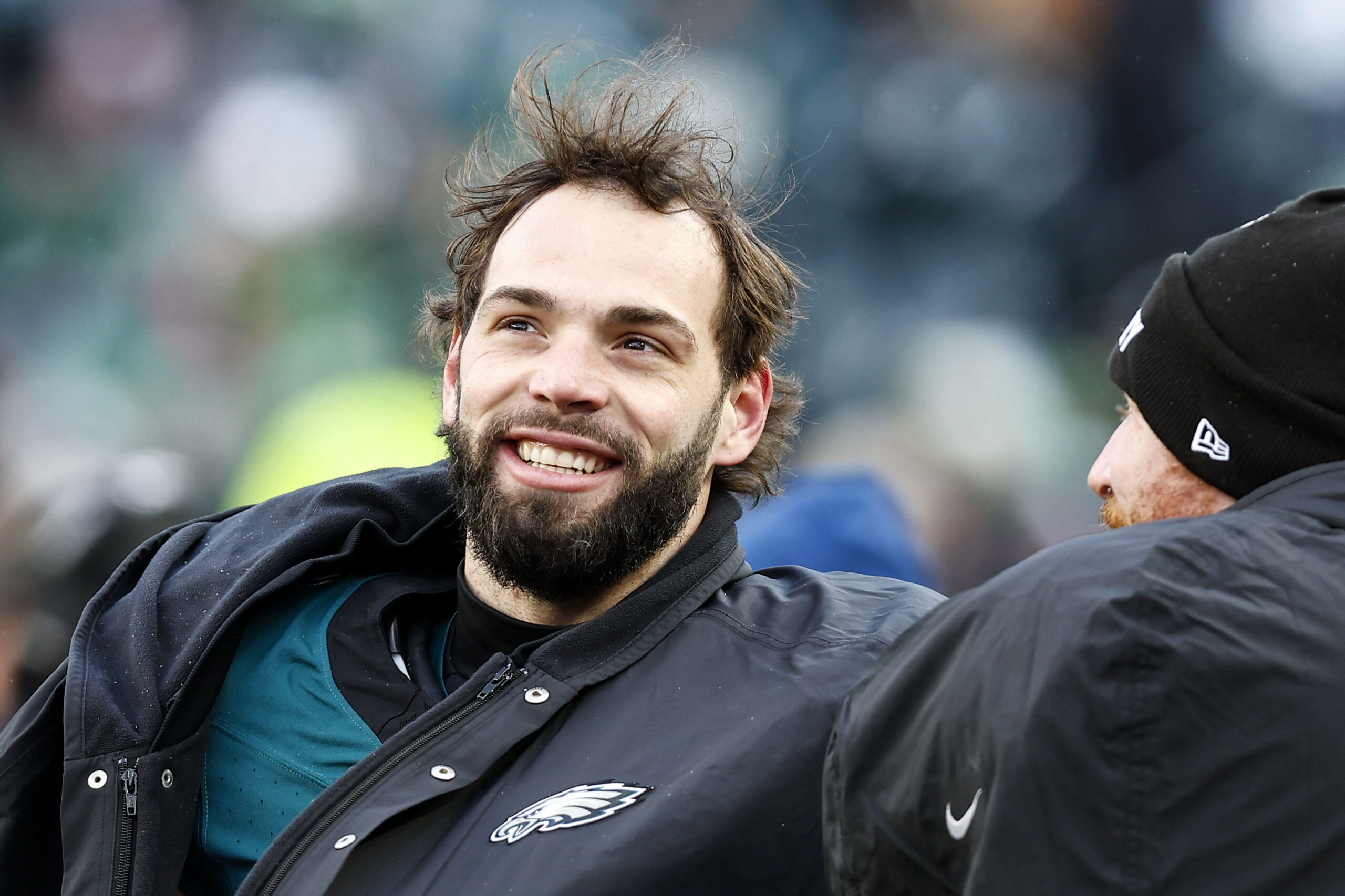
Could franchise staple Dallas Goedert run it back in Philly after his career touchdown year?
Brown’s return, though, could warrant Goedert coming back for a ninth season. He put up solid numbers, catching 60 passes for 591 yards and a team-high 11 touchdowns, despite the Eagles’ pass offense inconsistencies.
Was Goedert as dynamic as in years past after the catch? No. But he wasn’t given as many chances to run in space. The new Shanahan-McVay parts of the offense could accentuate Goedert’s post-catch abilities. The bigger question is whether he can run block like he once did. The Eagles weren’t happy with his output there. You have to wonder if taking a $4.25 million pay cut last season affected his effort, or occasional lack thereof. Goedert will have suitors on the open market. Is he worth as much as the Ravens’ Mark Andrews, who signed a three-year, $39 million deal in December? If so, it seems unlikely the Eagles re-sign Goedert, unless he wants to end his career in Philly and takes less.
The draft is believed to be deep at the position and there are other avenues to finding a No. 1 tight end — perhaps a trade? — but there’s an argument to be made for keeping Goedert.
Reiner: Re-signing Braden Mann. This seems like the football equivalent of a layup (a check down, perhaps). Mann, 28, is coming off the single best season by an Eagles punter in franchise history. He averaged 49.9 gross yards per punt, making his Eagles career average a franchise-leading 49.5. His net yards per punt (subtracting return yardage) finished within the top 10 in the NFL (43.1; No. 9 in the NFL).
Mann often helped flip the field during a season in which he was forced to punt a lot (72 punts, tied for No. 4). He deserves an extension, which wouldn’t break the bank. The Eagles are just a few years removed from their previous punter woes and they shouldn’t go back down that path by starting over with new contenders for the gig.
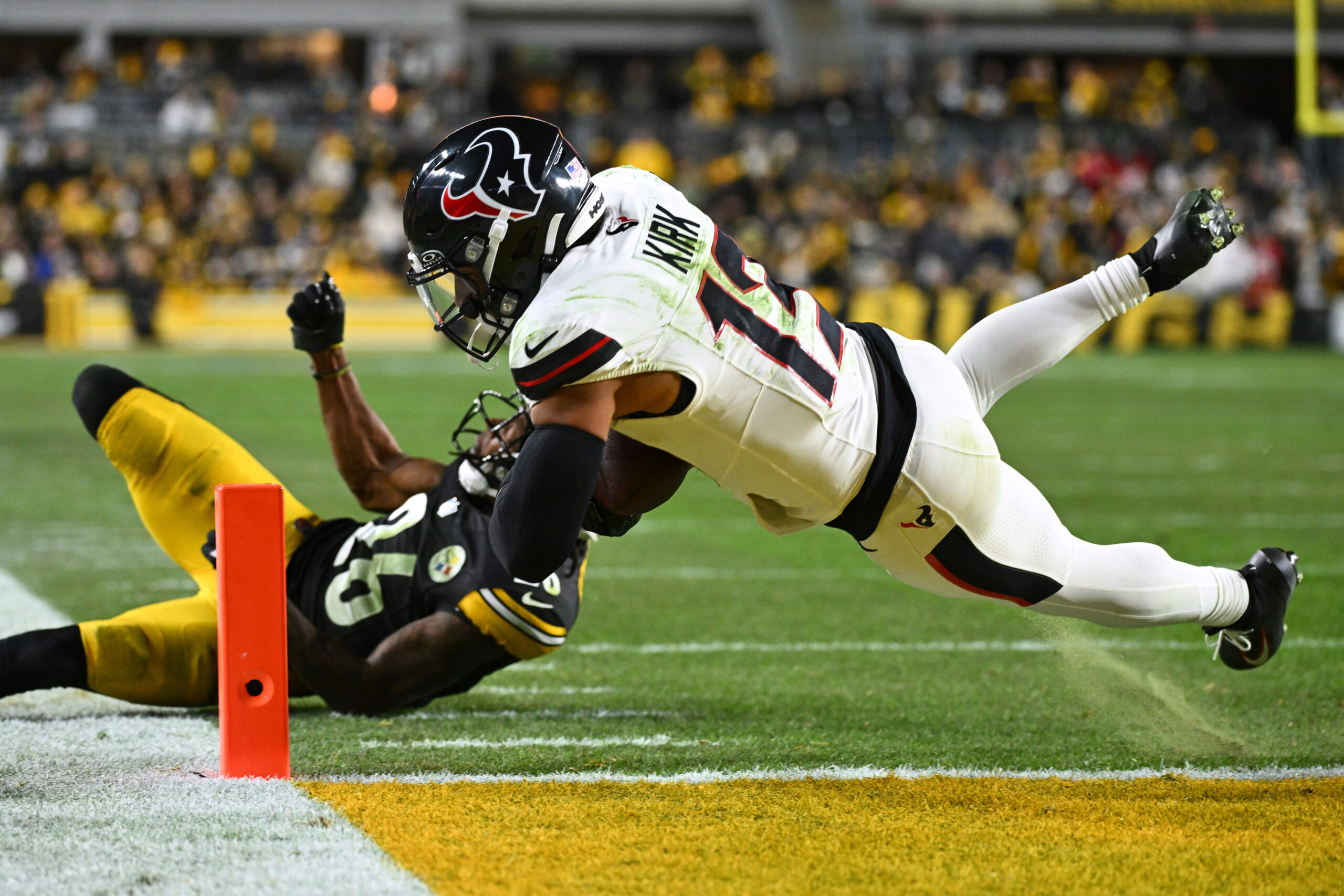
Is Christian Kirk (13) a free agent wideout possibility for the Birds?
Neiburg: Signing Christian Kirk to a relatively cheap contract given his talent. This is with or without Brown on the roster. Kirk has been limited by injuries over the last few seasons and ran routes with a crowded receiving corps in Houston. But he had a stretch of really good football from 2021 through 2023, tallying 2,877 yards on 218 catches, 16 of them for touchdowns. Kirk’s alignment favors the slot, but he has played plenty on the outside. The Eagles need to infuse the unit with more young talent, but Kirk, 29, could help bridge the gap, and if Brown is traded he would give the Eagles an experienced running mate for DeVonta Smith.
What’s a bolder, but perhaps less likely move you could see the Eagles making?
McLane: Trade for Maxx Crosby. If the Eagles decide they can’t afford Jaelan Phillips, they could be in the market for a top-end edge rusher. Crosby qualifies as a difference maker and would be an upgrade over Phillips or the returning Jalyx Hunt and Nolan Smith. It would cost a lot, of course. The Raiders are said to want two first-rounders and a player (Smith?) in return. But elite edge rushers are rarely available and Crosby’s existing contract isn’t a backbreaker. He has four remaining years at around $29 million per season, but only next season’s $30 million base salary is guaranteed. (editor’s note: Crosby was traded to the Ravens Friday night).
Crosby has made it clear he wants out of Las Vegas. He has expressed his fondness for the Eagles and Philadelphia as a sports town. Perhaps he would be willing to adjust his deal to expedite a trade. Roseman may be cautious for various reasons. Crosby turns only 29 in August, but he’s logged more snaps than almost any defensive end over the last five seasons. He’s also coming off back-to-back season-ending injuries that required surgery to repair his ankle and a torn meniscus in his left knee. That’s why I think the Raiders’ reported asking price is unrealistic.
There will be competition for Crosby, but the Eagles aren’t likely to repeat the mistake of going into another season with just Hunt and Smith on the edge. Phillips was a good trade deadline acquisition, but a tepid pass rush was an under-the-radar reason why the Eagles defense struggled in the second half of the playoff loss to the 49ers.
Jaelan Phillips is a top-5 NFL free agent who could end up with a huge deal in a location other than Philadelphia.
Reiner: Re-signing Phillips. He might be the Eagles’ top priority among their own group of pending free agents, but he isn’t a slam dunk to return. At 26 years old, he slotted in nicely to Vic Fangio’s defense in a short period of time at a premium position. He made an impact on the pass rush despite posting unassuming sack numbers (two in eight games). He stayed healthy for all 17 games in 2025, with the Eagles and the Miami Dolphins, one year removed from a partially torn ACL (and two years removed from a torn Achilles).
But the Eagles ought to be realistic about a potential extension. Phillips was a net-positive addition last season, but he was not a game-wrecker. The Eagles likely won’t be inclined to pay him as such, given their lack of cap space in 2026 and their need to extend key defensive players both this offseason and in years to come. The Eagles will likely set a walkaway number for Phillips and move on if another team outbids them.
Neiburg: Trading Brown … and trading for his replacement. Trading Brown is pretty bold in itself, but if it happens, the Eagles have a big hole to fill. There’s no doubt DeVonta Smith can handle all that comes with being the focal point of the passing game, but the roster is bereft of receiver depth, and if the Eagles aren’t thrilled with the free agent market — like, say, Kirk or someone like Romeo Doubs are more expensive than they prefer — they could go the trade route and trade from their roster or draft picks to acquire a receiver. Who could be available? Here are a couple of names to target via trade: Jacksonville’s Brian Thomas Jr. and Buffalo’s Keon Coleman.
Does Sean Mannion scheme require a tailoring of the team’s offensive personnel?
How much do you think the team’s offensive staff changes will inform their free agent and draft approaches?
McLane: Aside from the quarterback position, the offensive line is the most likely to be affected by the expected scheme changes. New offensive coordinator Sean Mannion is bringing with him a Shanahan-McVay system that will alter blocking in the run game. Will there be a complete whitewash? No. But the Eagles are likely to shift from less mid-zone to more wide-zone blocking. Those terms might not indicate how different the techniques are, but the former emphasizes more reactionary blocking and winning at the point of attack, while the latter features O-linemen firing off the ball and blocking at an angle.
Asked how the changes may affect his evaluations, Roseman conceded he may be looking for more agile O-linemen. The Eagles already have athletic freaks up front, although injury-riddled left guard Landon Dickerson may not qualify as such.
I don’t think Roseman will do much at the position in free agency. He does have decisions on reserves Fred Johnson and Brett Toth. I don’t think the scheme change rules out either for a return. But they don’t have an advocate in former offensive line coach Jeff Stoutland anymore. His replacement, Chris Kuper, won’t likely have as big a voice as Stoutland in personnel. But the Eagles are almost guaranteed to expend a high draft pick on an O-lineman with right tackle Lane Johnson closer to retirement than ever.
NFL Network’s Daniel Jeremiah recently projected seven first-round O-linemen in the 2026 draft and then a drop-off in terms of talent. Maybe one of the top guys slips into the second round and there’s a chance to pick up value, but I’d be surprised if Roseman didn’t expend the Eagles’ No. 23 overall pick — or more in a move up — to secure Lane Johnson’s expected successor.
Neiburg: It should inform the approach plenty. Especially when it comes to how they address the tight end position. Roseman knows he has long appreciated the receiving component of the tight end, but the new scheme will require a lot better blocking than the Eagles got last year and even in prior seasons from the players behind Goedert. As Jeff mentions, it’s possible Goedert returns in 2026 in free agency, but the Eagles would need to slot players behind him who block a lot better than Grant Calcaterra. One name I could see fitting in well is Jake Tonges, who doesn’t offer a ton in the pass game but was an elite blocker for the 49ers.
A.J. Brown’s situation could have an impact on the team’s free agency approach.
Reiner: Given the expected shift in run-game philosophy under Mannion, the tight end and offensive line additions could reflect those changes. I think the prospective wide receiver additions will have layered influences, especially as it relates to Brown’s future. Naturally, the Eagles’ need at receiver becomes much more pressing if (big if) they decide to move the star receiver before the start of the season.
Otherwise, aside from adding a WR3, the Eagles don’t need to overhaul their receiving corps to fit the scheme. If we’re looking to the Packers offense for clues about what the Eagles might look like in 2026, we can expect to see more under-center play action, pre-snap motion, and misdirection as a means of scheming open space in the passing game. That space helps receivers generate yards after the catch and explosive plays downfield.
The prosperity of the scheme seems to be rooted more in its design, not so much in the raw talent of its players, a departure from Eagles offenses past. That isn’t to say the Eagles aren’t looking for talented receivers, but more so that the prototype of a talented receiver isn’t likely to change dramatically.
Besides A.J. Brown, who else could the Eagles trade?
McLane: This may seem like a reach, but I could envision a world in which Nolan Smith is being floated on the trade market, assuming either Phillips, Crosby or some edge rusher equivalent is on the roster by the draft. Smith hasn’t been a bust — far from it. A shoulder injury limited him during his rookie season, but he blossomed in the second half of his sophomore year. Tricep woes sent him to injured reserve last season and he finished with just three sacks and 11 quarterback hits. He’s good at setting the edge and has a high motor, but he’s undersized and struggles to win consistently as a pass rusher.
Hunt has a higher ceiling, is one year younger and was drafted two rounds after Smith. It’s going to be tough for Roseman to pay both, especially with defensive tackles Jordan Davis and Jalen Carter slated for possible extensions this offseason.
Is Nolan Smith Jr.’s long-term future with the team set in stone?
The Eagles could pick up the fifth-year option (around $15 million) on Smith’s first-round rookie contract after the draft. That isn’t an exorbitant amount for a premium position player. He has potential he hasn’t tapped into. But I’d be worried about his durability. And there will be the occasional casualty after strong drafts on the defensive side and upcoming deals for All-Pro cornerbacks Quinyon Mitchell and Cooper DeJean.
Reiner: Tanner McKee. Ahead of the combine, Roseman expressed just how much he values the backup quarterback position and the importance of having a competent player in the role. McKee certainly fits the bill despite his limited action in his lone year as the full-time backup. But the soon-to-be-26-year-old quarterback is going into the final year of his rookie deal. If Roseman doesn’t see a future for him in Philadelphia beyond next season, would he be inclined to move McKee at the peak of his value to the team?
This offseason is a seller’s market at quarterback. The draft lacks high-end talent beyond Fernando Mendoza, who doesn’t have the cachet of other recent No. 1 overall picks. The free-agent market is led by Kyler Murray and Malik Willis. If McKee has a market among teams that want him to compete for the starting gig, the Eagles ought to entertain offers. But Roseman would need to get a strong return for McKee, all the while feeling comfortable about a replacement plan in 2026 for Jalen Hurts’ backup. Perhaps they liked what they saw from Sam Howell in practice enough to warrant a low-cost extension and make him the full-time No. 2.
Neiburg: Sydney Brown. The Eagles have a few candidates in their secondary who are due for a change of scenery, and Brown might be at the top of the list. The Eagles need help at safety, but they won’t be lining up with Drew Mukuba and Brown at the back of the secondary to start the 2026 season. Brown, who has one year left on his rookie deal, will be a backup again, and will see some work on special teams. But if you can convince a team to part with a Day 3 pick to acquire a player who isn’t part of your long-term plans, you have to do it.
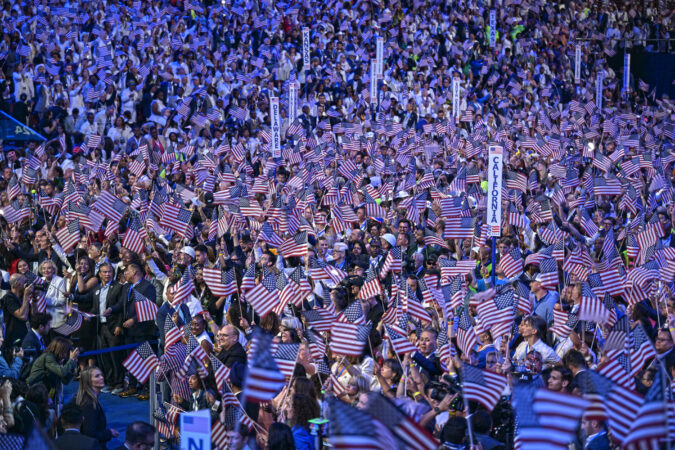
The first time Philly hosted a major presidential nominating convention was in 1848, when the Whig Party, meeting in Sansom Street’s long-gone Chinese Museum building, nominated Zachary Taylor, who went on to win the White House.
The 10th and most recent time, Democrats in 2016 made Hillary Rodham Clinton the first woman to be nominated for president by a major party.
Mayor Cherelle L. Parker and other local leaders are hoping to make more history by landing Philly’s 11th convention in 2028. And part of the appeal is the promise of a boost to the local economy as thousands of conventiongoers buy up hotel rooms, spend money at restaurants, and visit the city’s attractions.
Philadelphia “would see substantial economic benefits,” Gov. Josh Shapiro recently wrote to the Democratic National Committee, which this week named the city as one of five finalists to host the party’s next convention, alongside Atlanta, Boston, Chicago, and Denver.
But how much do cities really benefit from hosting political conventions? Here’s what you need to know about what Philly stands to gain from hosting another DNC.
Conventions’ economic impact debatable
Tourism bureaus and convention planners often make lofty claims about the economic benefits of major events like political conventions.
Visit Philly, for instance, in 2016 commissioned the consulting firm Tourism Economics to examine that year’s DNC, and the firm found the event brought 54,300 visitors to the region and provided a $230.9 million injection into the local economy.
But economists who have studied conventions are skeptical of such claims. A 2018 study of both parties’ conventions in 2008 and 2012 found that “political conventions do not seem to have the large economic impact that is usually suggested by traditional economic impact studies.”
Officials at the time often claimed economic impacts north of $150 million for conventions. But estimates that high rely on unrealistic assumptions about how much money conventiongoers spend each day, according to the study, which was published in the journal Papers in Regional Science.
“Cities and states often tout mega events as vehicles for economic growth,” economists Lauren R. Heller, Victor A. Matheson, and E. Frank Stephenson wrote in the paper. “Hosting national political conventions generates a large inflow of overnight visitors and increases hotel revenue. However, the cumulative effect of approximately 29,000 additional room nights of lodging services and $20 million of hotel revenue imply that traditional economic impact estimates may be unrealistically large.”
Hotels are big winners
Although conventions’ overall economic impact is debatable, there is little disagreement about their benefits to one industry in particular: hotels.
“I’ve seen a lot of different large events come through [over] the years, and the DNC was one that definitely delivered,” said Ed Grose, president and CEO of the Greater Philadelphia Hotel Association. “I can think of a few of examples of hotels making their annual budget based on the DNC alone.”
Grose said the benefits are widespread in the lodging industry when a convention rolls into town.
“It’s not just Center City hotels, but the airport area, the suburban hotels — everyone benefits from the DNC,” Grose said. “It’s especially good for our frontline team members; it’s good for our restaurants; it’s good for our bars. It is an event that delivers a huge economic hype.”
Minimal tradeoffs
Debates over economic impact are often centered on situations in which officials must weigh tradeoffs, such as whether to provide tax breaks to businesses promising new jobs.
For cities, political conventions are a different story. While hosting another DNC would likely require taxpayer resources from the state and federal governments, there would be little downside for Parker and the city budget.
Conventions are funded primarily through private contributions. In 2016, the DNC host committee raised about $85 million — $10 million of which came from taxpayers in the form of a state grant.
Much of the cost incurred by local governments related to security is reimbursed by the federal government. Congress has appropriated grant funding for presidential nominating convention host cities since 9/11.
In 2024, the localities hosting both the DNC and the Republican National Convention were each eligible to receive about $75 million in reimbursements.
Beyond dollars and cents
For some, the value proposition of a convention coming to town is as much about getting attention as it is boosting the economy. The 2016 DNC drew roughly 19,000 media members from around the world, according to the Philadelphia Convention and Visitors Bureau.
Labor leader Ryan Boyer, who heads the Philadelphia Building and Construction Trades Council and is a close Parker ally, said conventions like the DNC that bring major donors and corporations to town have the potential to result in “longitudinal jobs,” meaning they could lay the groundwork for future investments by potential employers.
He said a convention is an opportunity to showcase spots of the city ripe for investment — such as the Navy Yard, the industrial hub known as the Bellwether District, and the life sciences corridor in University City — to corporate figures who might not otherwise travel here.
“It’s a chance to show off Philadelphia,” Boyer said. “We’re a good business proposition.”
Grose said there were indirect, long-term impacts from hosting conventions.
“We get a lot of exposure from being on TV for a week. There’s a lot of things that happen during the DNC that we can’t buy,” he said. ”It’s great to see we are back in the mix after a relatively short time since hosting the DNC. That just shows what a great job we did as a city.”
David L. Cohen, the longtime Democratic fundraiser who is leading the recently formed host committee called Pick Pennsylvania, noted another reason revisiting Philadelphia could be an appealing pick for Democrats: It allows the party to dominate the biggest media market in a critical swing state.
“You own the media market for the week that you’re there,” said Cohen, a former Comcast executive who served as U.S. ambassador to Canada under former President Joe Biden. “The party couldn’t afford to pay for the positive advertising the party would get for holding its convention in Philadelphia.”
Is it déjà vu all over again? The massive flow of capital into the AI sector looks a lot like the incredible level of investments in dot-com companies during the 1990s.
That raises the question: When the arms race for AI supremacy settles down and the inevitable shakeout occurs, will earnings be significant enough to justify those investments, or will firms crash and burn again?
In the second half of the 1990s, the only thing investors could think of was how to make the next million off the next dot-com stock. I used to “joke” that investors assumed if they bought a stock in the morning, by the afternoon they could buy their dream foreign sports car, or if they waited a day, they could buy a new house.
Unfortunately, most dot-com stocks turned out to be “rice cakes”: Something that appeared to have form and substance until you bit into them and discovered there was nothing there.
When the bubble burst, there was widespread pain.
This time is different
Since it took relatively modest capital to create browser software, small companies could get into the competition.
Ultimately, there was one big winner: Google Chrome, which now has nearly 70% of the global search market. In second place, Apple Safari, which lags well behind at 15.5%.
In contrast, AI software developers require immense investments in data centers filled with ever-increasing computer capacity needed to run the software and continue the “learning process.”
Consequently, returns to the tech investment in AI have to cover not only the cost of the software development, but also the build-out of the data centers to keep the software at the cutting edge.
On top of that, they need lots of capital to outbid competitors for the consumer-oriented products that will inevitably be created by independent software developers.
Put simply, we are not talking about a world where StanfordUniversity students Sergey Brin and Larry Page could receive a $100,000 influx of capital and develop Google in a garage.
Only the wealthiest tech companies have the financial wherewithal to compete in this market.
If the AI sector consolidates similar to the web search sector, the returns to the “Google of AI” will be well worth the expenditures.
But for the others, much of their spending could yield little.
If the market is fractured, the profitability outlook for almost every top-end investor is still uncertain.
With a variety of survivors and a relatively even distribution of the market share, intense competition is likely. Margins would be constantly under pressure.
In addition, as we have seen with the software industry over the past 25 years, independent entrepreneurs are capable of creating products that readily compete in smaller ways with the big firms. That puts additional pressure on profits.
Unless there are only very few winners, profitability in the AI sector is not a given.
Regardless, there are likely to be a significant number of firms whose huge bets go bust.
AI is driving the economy
The latest data on the economy’s economic performance, the GDP report, was released recently. While activity moderated in the fourth quarter of 2025, the 2.2% increase for the year was in line with what economists call trend growth.
What was eye-opening in the report was how much AI likely added to overall growth.
AI spending affects a number of different segments of the economy. Given the massive demand for data centers, their construction is one obvious area.
But that isn’t the major place where we see AI powering growth. It is what goes into those buildings that really makes a difference. Purchases of information processing equipment added the most to growth.
Software and research and development are two other sectors where spending is booming.
When you add those four components together, AI may have created about 40% of the GDP growth in 2025.
But there is a caveat: Not all spending is created equal.
Nvidia, the chief supplier of computer chips to AI firms, manufactures most of its chips in South Korea. In GDP accounting, those chips are imports, which reduce growth.
To the extent that computer products used in the data centers are imported, the spending doesn’t directly affect United States demand, making it somewhat unclear how much the sector truly powers growth.
Unless U.S. chip and computer hardware manufacturing expands dramatically, the positive impacts from the sector may be disappointing.
As with any industrial build-out, the race to build new data centers will ultimately slow. When that river of cash flowing into developers and local governments peaks is unclear, but I wouldn’t be surprised if it is in the next couple of years.
As for the stock markets, in 2025, the so-called Magnificent Seven (Alphabet, Amazon, Apple, Meta, Microsoft, Nvidia, Tesla) contributed roughly 40% of the S&P 500’s total return.
To maintain their robust valuations, the AI companies have to start showing soon that the returns from those investments are real.
The future has already arrived
AI is rapidly becoming embedded in all sectors of the economy. And with that, the risks and opportunities are becoming concerning.
What the AI economy will finally look like, who it will benefit or hurt the most, and what ups and downs the economy will endure remain open questions.
But there is no turning back.
Full disclosure: AI developer Anthropic was sued for training its AI product on copyrighted materials without permission. A book Joel Naroff coauthored, “Big Picture Economics,” was part of the suit, and he is part of the settlement.
Pennsylvania voters broadly oppose some of President Donald Trump’s immigration enforcement tactics — but there’s a stark partisan split, according to a new statewide poll of registered voters.
Franklin & Marshall College’s Center for Opinion Research released a wide-ranging poll Thursday that tracked registered Pennsylvania voters’ opinions on America’s 250th anniversary, ICE enforcement tactics, and other issues facing the state and nation ahead of the midterm election.
Trump’s approval ratings have remained consistently low since returning to office last year, with a majority of Pennsylvanians disapproving of his job as president.
Democratic Gov. Josh Shapiro maintains a 50% approval rating heading into the midterm elections later this year.
Pollsters at Franklin & Marshall College surveyed 834 registered Pennsylvania voters, including 353 Democrats, 347 Republicans and 134 independents. The sample error is +/- 4.1 percentage points.
Here are three takeaways from the poll of registered Pennsylvania voters, conducted Feb. 18 through March 1 by phone or online.
Trump is consistently unpopular in Pennsylvania
Trump’s approval ratings among registered Pennsylvania voters remain low, with 61% of voters rating him as doing a “poor” or “fair” job, according to the statewide poll, which also assessed Trump’s performance on immigration, the economy, and other issues.
Trump maintained a net negative approval rating throughout his first term in 2017-2021 and so far in his second term, according to the poll.
Despite winning the state in 2024, he remains divisive with 51% of respondents rating him as doing a “poor” job, and only 10% who rate him as doing a “fair” job. Approximately 39% of registered Pennsylvania voters view Trump as doing an “excellent” or “good” job, according to the poll.
window.addEventListener(“message”,function(a){if(void 0!==a.data[“datawrapper-height”]){var e=document.querySelectorAll(“iframe”);for(var t in a.data[“datawrapper-height”])for(var r,i=0;r=e[i];i++)if(r.contentWindow===a.source){var d=a.data[“datawrapper-height”][t]+”px”;r.style.height=d}}});
Trump’s low approval numbers could have a drag effect on Republicans’ performance in the midterm election, said Berwood Yost, the director of Franklin & Marshall’s poll.
“While there’s still a long way to go until November, [Trump has] got to figure out a way and his party has to find a way to prevent that and earn those voters back,” Yost said.
Trump’s low numbers align with those of former President Barack Obama or George W. Bush’s approvals at the same point in their second term, Yost added. Both of their parties lost seats in the midterms elections those years.
However, Trump’s approval ratings are not the lowest they have been in the state. His approval ratings dropped to their lowest, 70% disapproval, during his first term in September 2017.
Josh Shapiro is still popular
Gov. Josh Shapiro remains popular ahead of his reelection contest this year: 50% of Pennsylvania voterssayhe is doing an “excellent” or “good job,” while another 44% believe he is doing a “fair” or “poor” job leading the nation’s fifth most populous state.
Shapiro is the most popular governor since 2000, when comparing his approval ratings to those of other Pennsylvania governors at the same point during their first terms, Yost said.
Shapiro also maintains a significant lead over his likely GOP challenger, State Treasurer Stacy Garrity. If the midterm elections were to happen today, 48% of voters said they would reelect Shapiro, while 28% said they would vote for Garrity. Another 7% of voters said they would vote for a different candidate, while 17% were undecided or refused to answer the question.
Shapiro’s approval ratings have remained steadily high since taking office in January 2023. A Quinnipiac Universitypoll released last month found similar public opinion toward Shapiro’s reelection, while some voters said they were unsure whether they wanted the rumored 2028 presidential candidate to run for higher office.
Pa. voters broadly oppose some of ICE’s enforcement actions, but are split on others
Approximately three-fourths of Pennsylvania voters believe ICE should not be able to use deadly force against protesters or enter a home without a warrant, in a major pushback to Trump’s immigration enforcement tactics.
Pennsylvania voters’ opinions on immigration enforcement varies significantly based on a person’s political party: While nine in 10 Republicans support ICE tactics, only two in five independents and one in 10 Democrats support them.
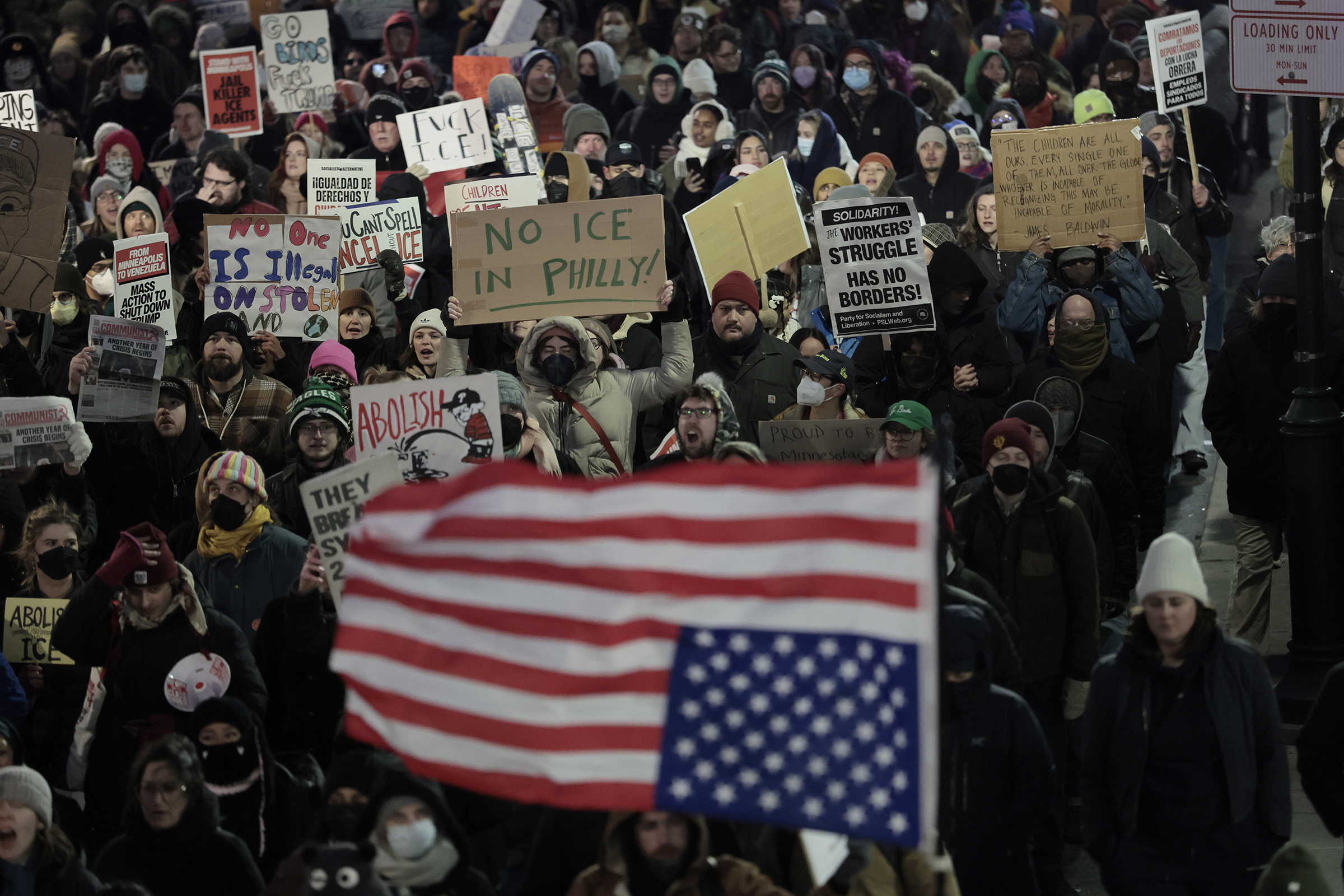
Protesters march up Eighth Street, towards the immigration offices, during the Philly stands with Minneapolis Ice Out For Good protest at Philadelphia’s City Hall on Friday, Jan. 23, 2026.
Republicans support ICE’s use of unmarked vehicles to detain people and their use of masks to hide an agent’s identity at much higher rates than Democrats, while independents are split. On the use of masks, 77% of Republican voters believe agents should be able to wear them, while 40% of independents and only 10% of Democrats do.
“There’s a lot of consensus about the fundamental principles that protect our individual rights like entering a home without a warrant or using force against protesters, whereas there’s a little more partisanship in others,” Yost said.
window.addEventListener(“message”,function(a){if(void 0!==a.data[“datawrapper-height”]){var e=document.querySelectorAll(“iframe”);for(var t in a.data[“datawrapper-height”])for(var r,i=0;r=e[i];i++)if(r.contentWindow===a.source){var d=a.data[“datawrapper-height”][t]+”px”;r.style.height=d}}});
There is also overwhelming support among Pennsylvania voters that non-citizens who are in the U.S. legally — whether by visa,green card, asylum or other protected statuses, or in the process of becoming a citizen — should not be targeted by Immigration and Customs Enforcement for deportation, according to the poll.
However, a majority of Republicans and independent voters believe undocumented immigrants who have been in the United States illegally for any amount of time and have no criminal record should be targeted for deportation, while less than a quarter of Democrats believe they should.
Pennsylvania voters want the 250th anniversary to acknowledge the positives and negatives from American history
As Trump tries to reframe American history for the nation’s 250th anniversary, most Pennsylvanians want the celebrations to acknowledge its positive and negative parts.
Approximately 73% of Pennsylvania voters believe any retelling of American history should include the upsides and downsides of the nation’s founding, while 24% believe only positive aspects should be celebrated.
“Most people, they want to see historical interpretations that include the whole picture,” Yost said.
This finding is of particular interest in Pennsylvania, following the Trump administration’s removal of an exhibit that memorialized the enslaved people who lived in George Washington’s home from the historic President’s House site in Independence National Historical Park. A federal judge ordered the restoration of the exhibit, but the Trump administration is appealing the decision.
One afternoon in early December, Bill Raftery and Tim Legler, both La Salle alumni, returned to campus for an hourlong panel discussion about their careers in sports media, only to have the conversation shift to a topic with broader implications.
It was a point of pride for the university to welcome back Raftery, who has been college basketball’s preeminent analyst for more than a quarter-century, and Legler, who has reached a comparable status at ESPN with his insights into the NBA. But 33 minutes into the event, the first question from an audience member wasn’t about the origins of Raftery’s trademark catchphrases (The kiss! … Onions! … Laundry on the deck!) or Legler’s game-film breakdowns.
Bill Raftery, now broadcaster, graduated from La Salle and was inducted into the Big 5 Hall of Fame.
“Can we bring the Big 5 back to its glory?” a man in the auditorium asked. “Because it was a national thing, right? It wasn’t just a Philly thing.”
These days, most people who follow college basketball, if they’re being honest, have to acknowledge that the Big 5 isn’t much of anything anymore. The round-robin rivalries among La Salle, Penn, St. Joe’s, Temple, Villanova, and more recently Drexel have lost most of their juice.
That white-hot competition, fueled by the benign hatred that only proximity and familiarity can ignite, used to define Philadelphia hoops. It has cooled. Now, just one school, Villanova, enters each season with the baseline expectation that it will qualify for the NCAA Tournament, and the pipeline of local recruits that once sustained these programs has all but dried up.
window.addEventListener(“message”,function(a){if(void 0!==a.data[“datawrapper-height”]){var e=document.querySelectorAll(“iframe”);for(var t in a.data[“datawrapper-height”])for(var r,i=0;r=e[i];i++)if(r.contentWindow===a.source){var d=a.data[“datawrapper-height”][t]+”px”;r.style.height=d}}});
Three of the six schools — Drexel, La Salle, and Penn — don’t have a Philadelphia native on their rosters. Interest in the city series has plummeted. A 2022 doubleheader at the Palestra drew an official attendance of just 3,300 people. And the Big 5 Classic, conjured in the aftermath of that alarming display of indifference, hasn’t revitalized the rivalries or restored any prestige to them.
While this season has seen an uptick in the programs’ quality of play — Villanova is virtually assured of an at-large bid, and Penn, St. Joe’s, and perhaps Drexel could be strong enough to win their conference tournaments — that improvement hasn’t been enough to stem the dismal tide.
Tim Legler, who led La Salle to the 1988 NCAA Tournament, said the Big 5 was once a “transformative” environment to play in.
For their part, the panelists at La Salle mustered some nostalgia but weren’t optimistic. Legler, who grew up in Richmond, Va., remembered attending a Palestra doubleheader on a recruiting trip and marveling at the atmosphere: the streamers, the cheering, the chanting.
“I turned to my parents and said, ‘This is the environment I want to play college basketball in,’” he said. “It was literally that transformative.”
Still, he had no solution for salvaging the Big 5, and neither did Raftery, who suggested that smaller programs throughout the NCAA would soon be casualties of this new era of college basketball.
“They’re trying to freeze [out] a lot of programs and leagues,” he said, “and I can envision maybe two or three conferences. They’ll run the whole thing, and the networks will pay for it. That’s the way it is.”
It’s convenient to point to the sport’s lurch into modernity — into the era of Name, Image, and Likeness; of pay-for-play; of the permeable membrane of the transfer portal — as the cause of the decline. And it’s true: With the exception of Villanova, which is ensconced in the Big East and supported by engaged donors with deep pockets, college hoops’ evolution has made everything more difficult for the other, more vulnerable programs in the city. But this train has been rumbling down the tracks for a while, and its arrival should compel a reevaluation of the Big 5’s history, of the decisions and unstoppable forces that led it here, to the brink.
To those Baby Boomers and GenXers weaned on the Big 5’s traditions, it’s surely incomprehensible and saddening to hear Raftery contemplate a world without it. But if the institution as Philadelphia knew it is fading away — and it appears to be, if it hasn’t already — the proper question isn’t Can it be saved? That one has been asked and is on its way to being answered.
No, the better questions to chew on are these: How did the Big 5 survive, and at times thrive, as long as it did? And did any of the attempts over the years to preserve it and its identity actually contribute to its downfall?
Villanova has become the only school in the Big 5 that enters each season with the baseline expectation that it will qualify for the NCAA Tournament.
The seeds of rebirth and decline
It’s tempting to picture the Big 5’s history as an unbroken string of unforgettable nights at the Palestra, great teams playing great games inside a gym packed to its uppermost corners with 9,000 people, give or take a few rascals who managed to sneak in for free. There were hundreds of such nights, to be sure. But it’s striking to put that past into a wider context and see how much certain changes and trends fostered and then jeopardized everything that made the Big 5 wonderful and unique.
Those fond memories often gloss over a relatively fallow period for the Big 5 during the 1970s. Villanova had three consecutive losing seasons from 1972 to 1975. Temple went 16-37 over the ’74-75 and ’75-76 seasons and qualified for the NCAA Tournament once in an 11-year span from 1972 to 1983. St. Joe’s went 8-17 in ’74-75, the first of six straight seasons in which the Hawks missed the NCAAs. Penn was the exception, and La Salle held its own, but a Daily News back-page photo captured the overall listlessness perfectly: Harry “Yo-Yo” Shiffern, the lovable vagrant who was the city series’ unofficial mascot, fast asleep during a Palestra doubleheader.
The Big 5 was in a collective funk, and it took a few pivotal developments to snap it back to prominence and position it to flourish further.
Lionel Simmons (center) is the Big 5’s all-time leading scorer and fifth in NCAA history with 3,217 career points.
College basketball’s landscape was flatter then. The NCAA Tournament went to 32 participants in 1975 and to 40 in 1979, and many of the qualifying programs were mid-majors. During the ’70s, each of these teams reached the Final Four: Jacksonville, St. Bonaventure, New Mexico State, Western Kentucky, Marquette, UNC Charlotte — and, in ’79, Penn. The Quakers upset North Carolina, Syracuse, and St. John’s before Magic Johnson and Michigan State pulverized them in the national semis. But their run was the most improbable of the decade, and their timing was impeccable.
The following season, after a star turn at the Pan-American Games in Puerto Rico, La Salle’s Michael Brooks was named the Kodak National Player of the Year. As terrific as Brooks’ senior campaign was — he averaged more than 24 points and 11 rebounds, scoring 51 points in a triple-overtime loss at BYU — his candidacy for the honor was buoyed by Indiana’s Bob Knight, who had coached him at the Pan-Am Games and touted him to reporters.
“If I were allowed to start my own team tomorrow,” Knight said in January 1980, “the first person I would pick would be Michael Brooks.”
Such praise from the best, the most famous, and the most temperamental coach in the country carried weight, and Knight’s words elevated the reputations of both Brooks and Philadelphia basketball. That ascendance continued in March 1981, when St. Joe’s, under Jim Lynam, won the East Coast Conference tournament, knocked off top-ranked DePaul in the second round of the NCAAs, and advanced to the regional final before losing to the eventual national champs: Knight, Isiah Thomas, and the Hoosiers.
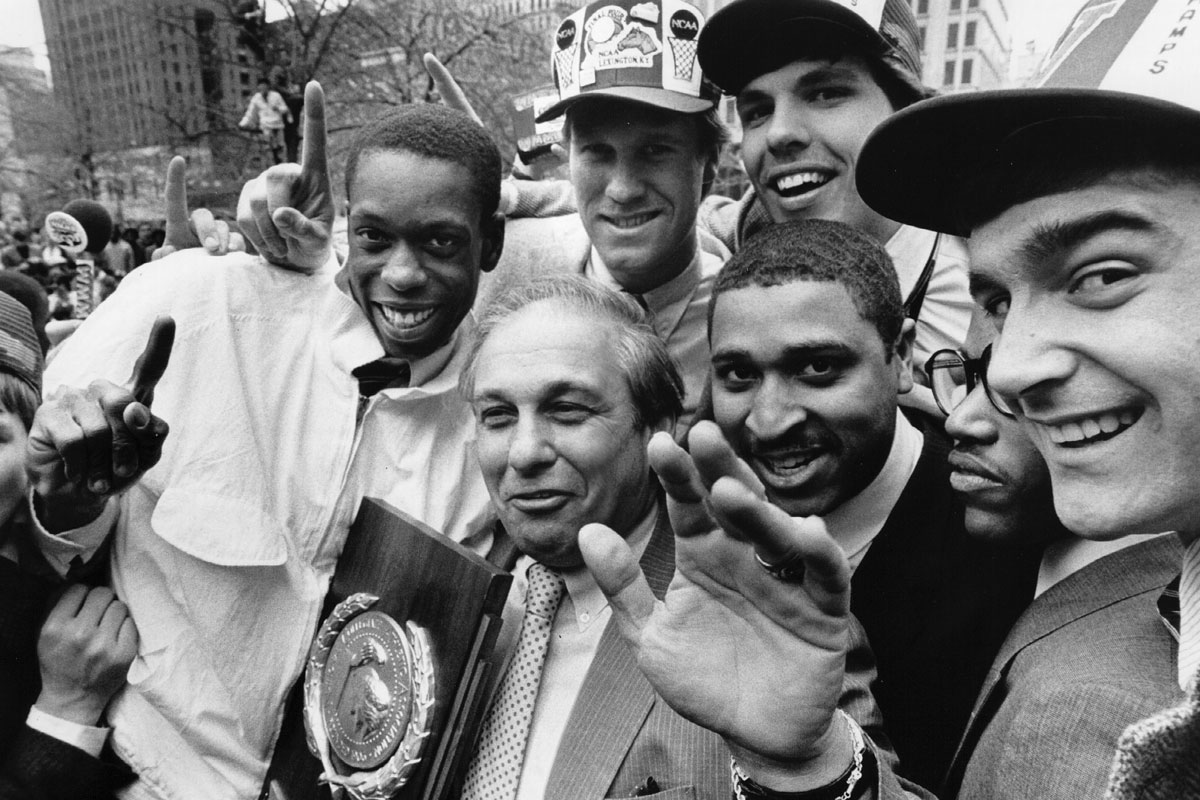
Fran Dunphy coached more than 1,000 games as a Division I head coach.Villanova coach Rollie Massimino gathers in Center City with players Ed Pinckney, Wyatt Maker, Chuck Everson, Dwight Wilbur, Veltra Dawson, and Brian Harrington in 1985 after winning the national title.
So the Big 5 was on its way back, regaining relevance among casual college hoops fans and among the sport’s cognoscenti. The two most significant factors in its renaissance, though, happened off the court. In March 1980, Villanova left the Eastern Eight and jumped to the Big East. And in August 1982, Temple hired John Chaney as its head coach.
Those moves and the rewards they wrought thrust those two programs, and in turn the entire Big 5, into a higher realm. Villanova won the national championship in 1985 — an underdog triumphant, a marvelous story enhanced by the Wildcats’ status as a program in a major conference in a sport whose vast national reach was still expanding: Magic vs. Larry Bird in ’79, North Carolina State surviving and advancing in ’83, Dick Vitale, CBS, ESPN, Big Monday, Selection Sunday, March Madness consuming a month’s worth of America’s attention.
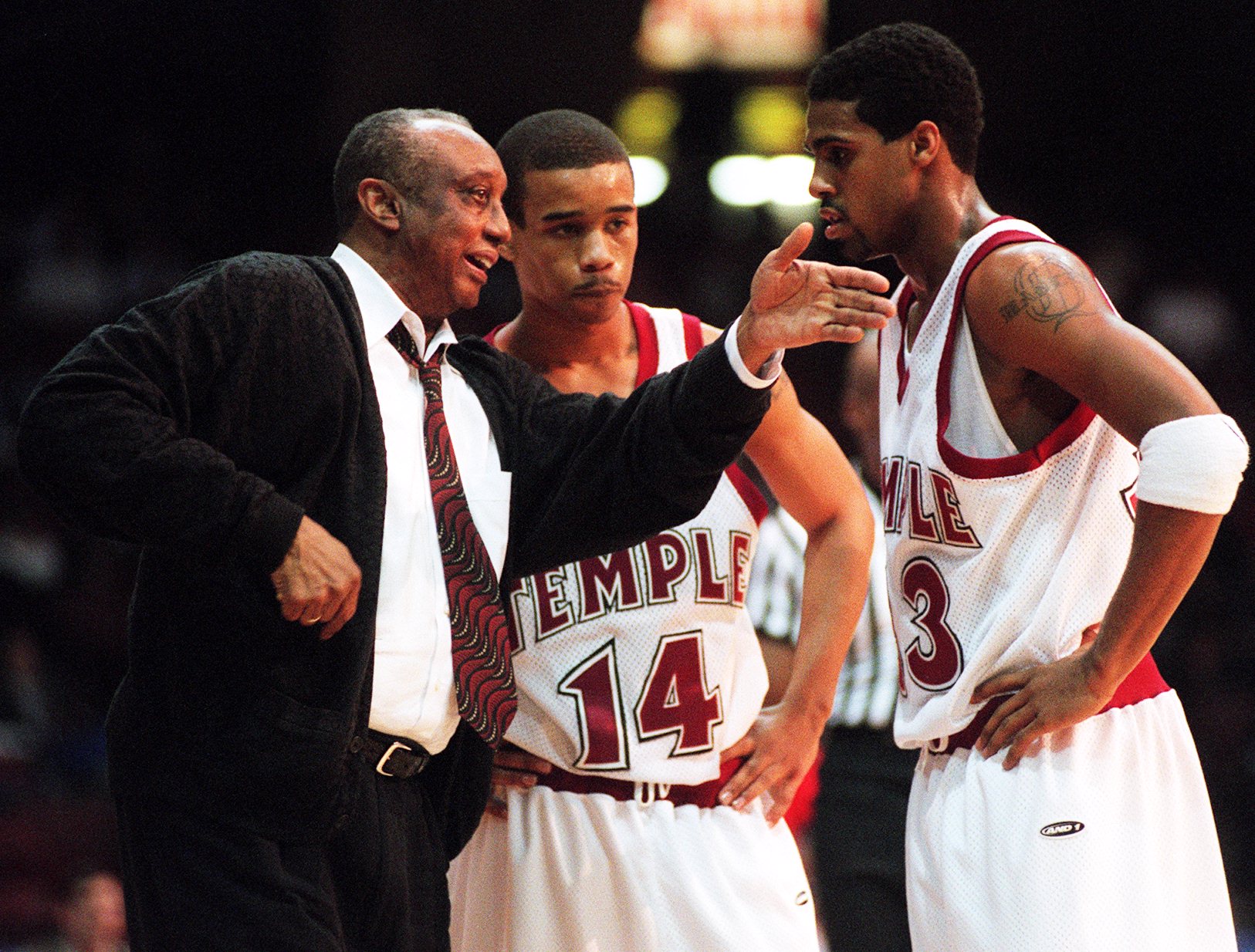
Chaney was this wild-eyed, lesson-teaching, justice-preaching wizard, confounding opponents with his matchup-zone defense, crafting the hardest schedule in the nation every year to battle-test his teams, leading the Owls to a No. 1 ranking in 1988 and three Elite Eight appearances in a six-year span.
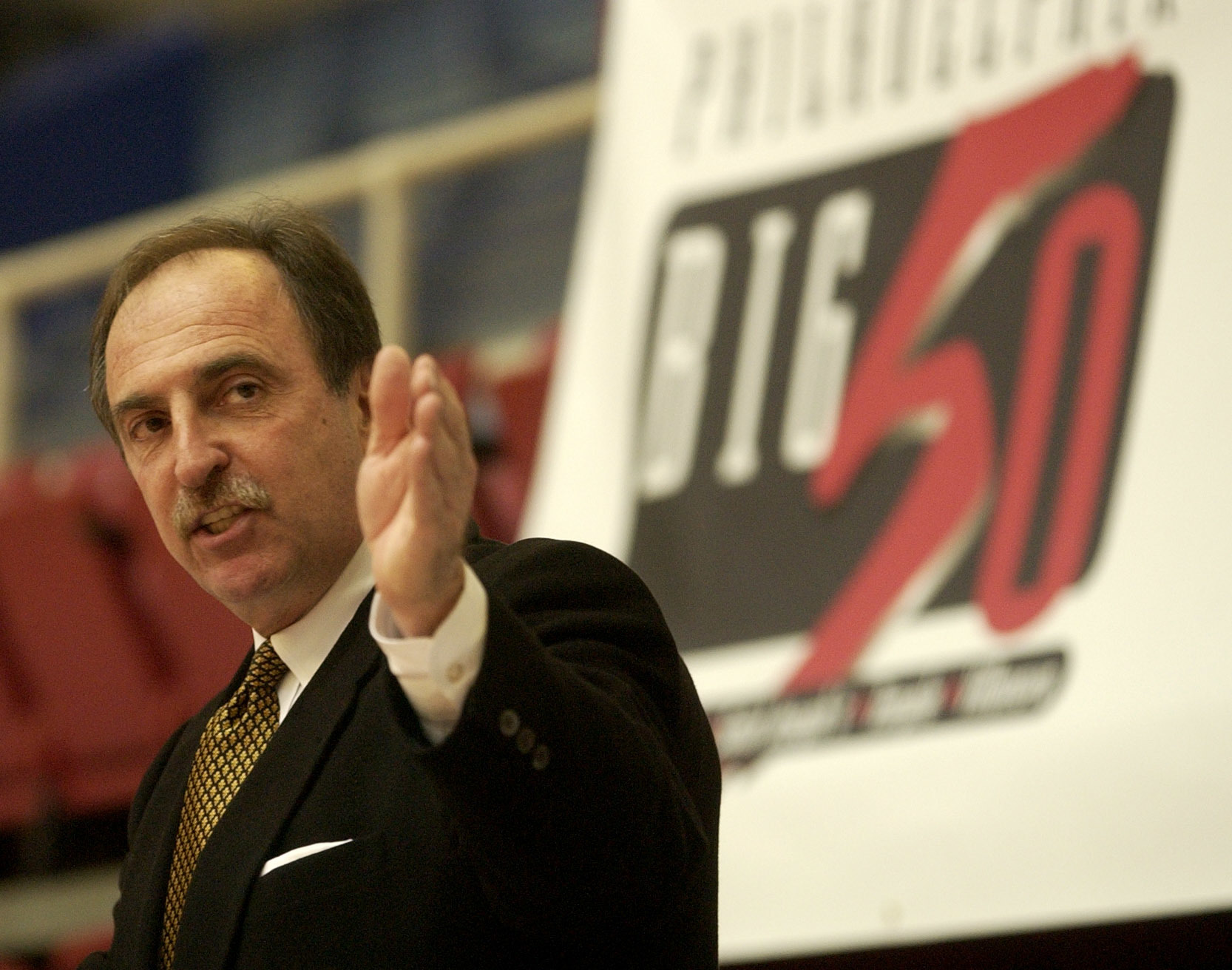
Fran Dunphy led Penn to a 69-14 record and three NCAA Tournament appearances from 1992 to 1995.
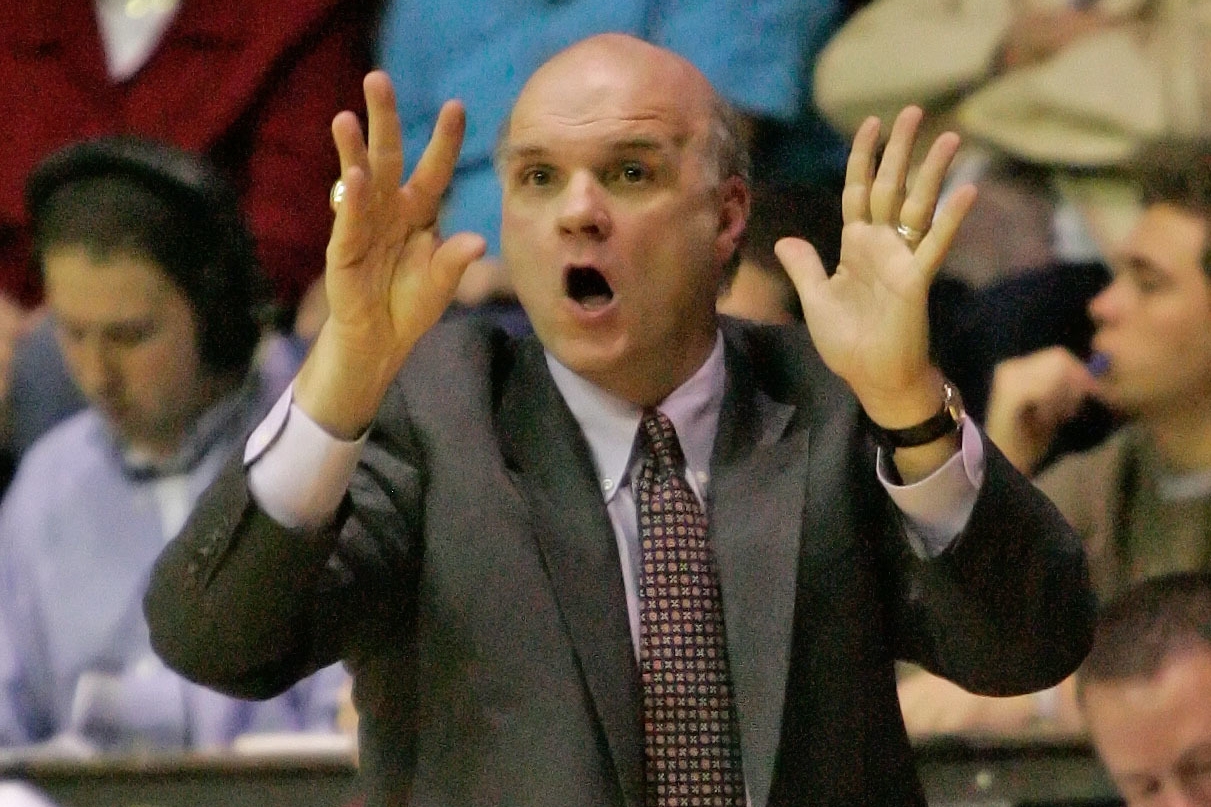
Nestled in the Metro Atlantic Athletic Conference (MAAC) with schools of similar profiles, La Salle went to the NCAA Tournament four times and the NIT twice in Speedy Morris’s first six years as head coach and had another national player of the year: Lionel Simmons. From 1992 to 1995, Penn dominated the Ivy League under Fran Dunphy: a 69-14 record, three NCAA Tournament appearances and a first-round victory over Nebraska, Jerome Allen and Matt Maloney forming one of the best backcourts in the country. St. Joe’s went 26-7 and advanced to the Sweet 16 in 1996-97, the season that introduced that notorious wallflower Phil Martelli to the rest of the country.
Former Temple coach John Chaney with players Lynn Greer and Quincy Wadley.
Hard circumstances and poor decisions
The factors that damaged the Big 5 were legion. Some applied to just one or two programs. Some applied to all of them. Some were mistakes, bad choices. Some were unavoidable and beyond the programs’ control.
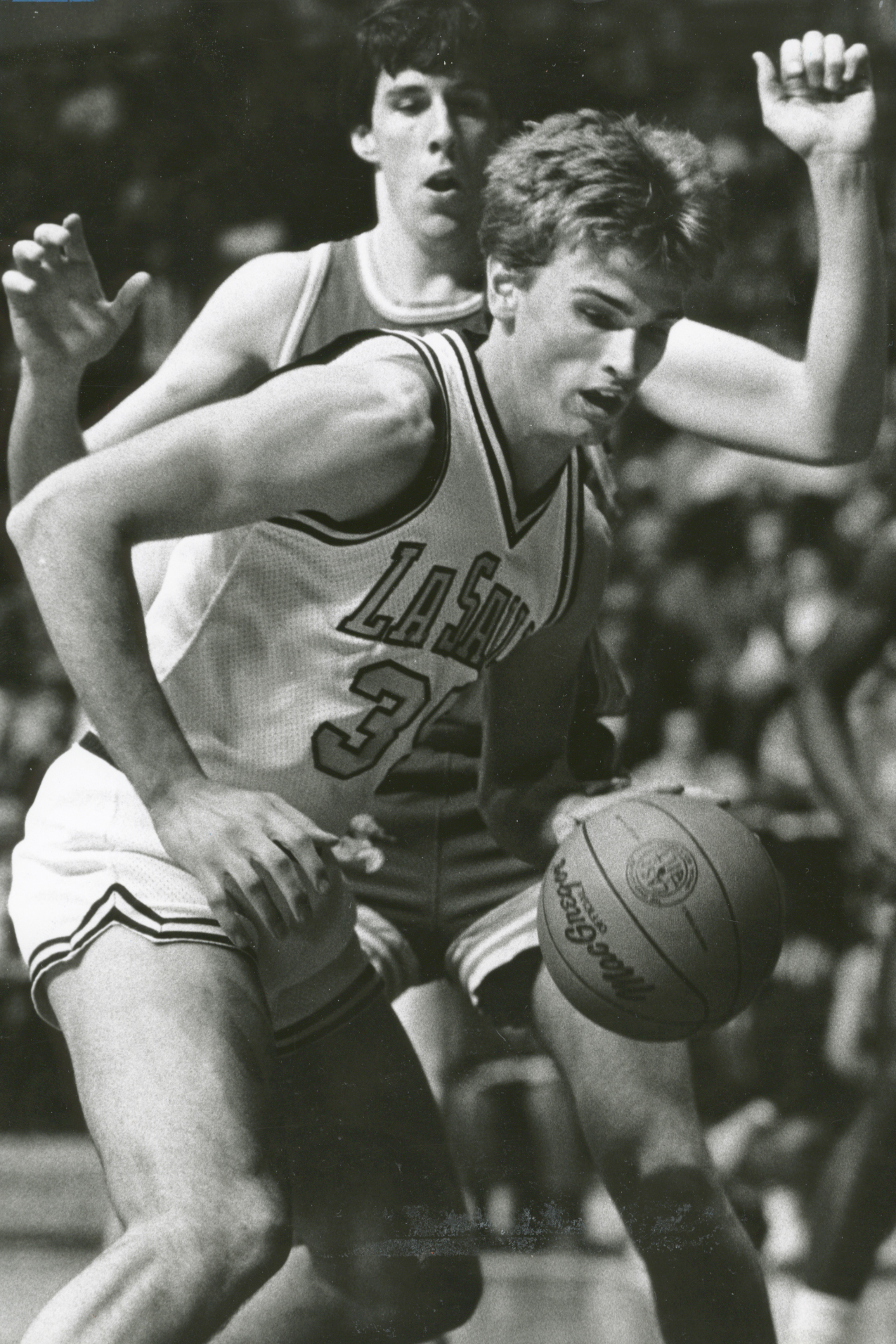
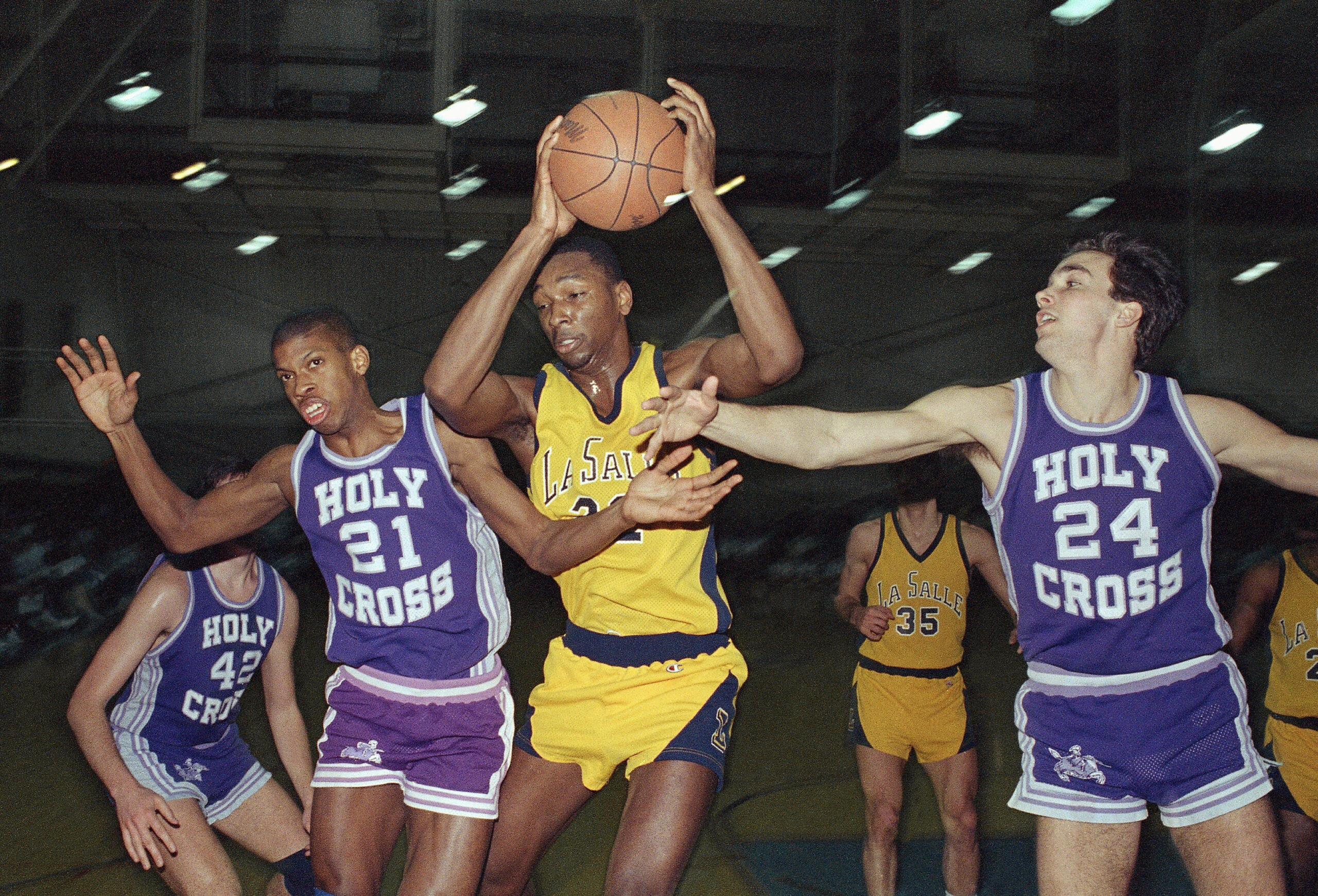
Start with La Salle. Given an opportunity in 1990 to build an 8,000-seat on-campus basketball arena — Tom Gola offered to raise the funding for it — the university said no. Then its leadership made what is commonly considered the disastrous decision to relocate from the MAAC to the Midwestern Collegiate Conference. The program has never recovered.
Look at Temple. Chaney, a singular presence and attraction, retired in 2006. Though Dunphy, his successor, guided the Owls to six consecutive NCAA Tournament appearances, the university’s quest for football dollars led it to leave the Atlantic 10 for the American Athletic Conference — and abandon its basketball-first identity.
Again: individual schools, individual issues. But those problems were byproducts of college basketball’s overall reshaping during the 1980s and ’90s. In retrospect, the most infamous moment in Big 5 history — the dissolution of the round-robin, at the insistence of Villanova and coach Rollie Massimino, after the 1990-91 season — was an acknowledgment of those changes, and the attempts to preserve the Big 5 as it had always been would inevitably fail.
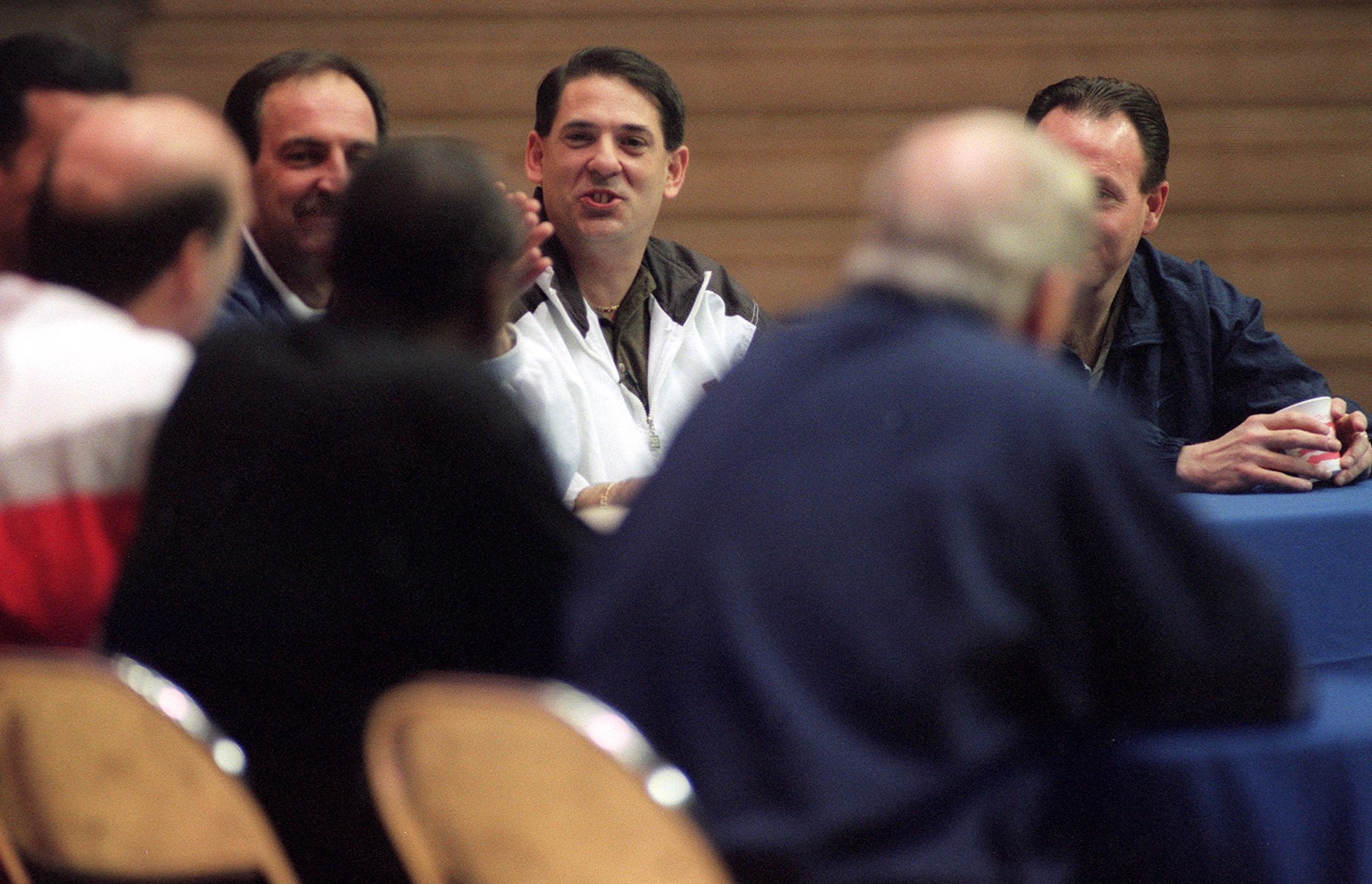
Phil Martelli led St. Joe’s to go 26-7 and advanced to the Sweet 16 in 1996-97.Former Villanova coach Steve Lappas jokes with the other Big 5 coaches during a taping of the Comcast basketball show in 1997.
When Villanova pushed to cut back on city series games and Temple pushed for more of those matchups to be played at campus sites other than the Palestra, they weren’t merely trying to make things easier for themselves. They were responding and reacting to college basketball’s new conditions for success.
Sneaker companies had begun financing all-star camps, AAU programs, and college programs. Now coaches didn’t have to rely on local high school teams to find players, and great Philly players were no longer making their names solely in the Public League, the Philadelphia Catholic League, or the Sonny Hill League. They were traveling to play AAU. They were seeing other cities, meeting other coaches. They weren’t as likely to stay home to play college ball.
“The most important recruiting device is recognition,” Chaney told author Bob Lyons in Palestra Pandemonium: A History of the Big Five, “and recognition comes from national TV. … They don’t know what the Big 5 is outside of this area. They knew who Villanova was when they won the national championship, so you could always attach yourself to them. But it wasn’t going to get you very far because no one knew the history and tradition of the Big 5.”
In that way and others, the inherent parochialism of the Big 5 worked against it. For instance, Dave Gavitt, the founding commissioner of the Big East, struck a deal in 1980 with ESPN, then a fledgling sports network hungry for programming, for the exclusive rights to televise the conference’s games. That arrangement made it difficult, if not impossible, for Villanova and any other Big East school to be involved in a 7 p.m./9 p.m. Palestra doubleheader and for a national television audience to watch that doubleheader.
“We needed the game between Villanova and Georgetown at 8 p.m. to go on our network,” Gavitt told Lyons. “We couldn’t clear games at 7 p.m. because of the game shows that all the local stations carried.”
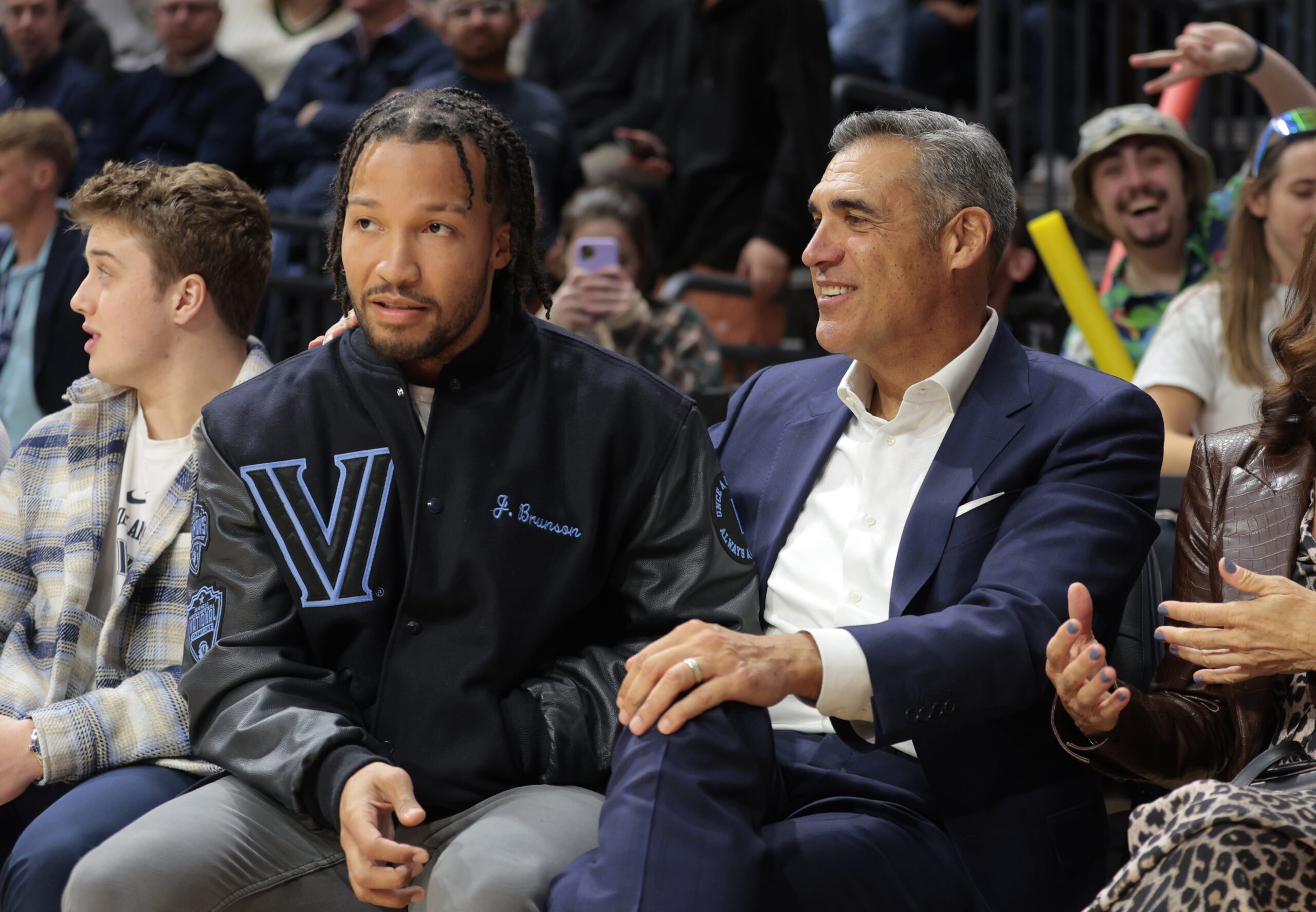
Jalen Brunson and former Villanova coach Jay Wright at the Finneran Pavilion on Feb. 8, 2023.
As it was, the Big 5 had a TV deal of its own, with the Philly-based premium cable channel PRISM, starting in 1978. Yet the PRISM commitment actually limited the exposure of some of the Big 5’s schools.
During the 1989-90 season, as one example, the Atlantic 10 wanted to place a Temple-La Salle game on ESPN so that it would be telecast nationally. “ESPN,” Lyons wrote, “subsequently refused to carry it, however, because it did not want to black it out in PRISM’s trading area.”
So hoops fans in the Delaware Valley could watch the game at home, but no one else could. At a time when college basketball was becoming more accessible, the Big 5 was cutting itself off from everyone who wasn’t already familiar with it.
That history might seem ancient. It’s not. Wright’s tenure and the economics of the sport have placed Villanova on a separate tier from the other programs. And now that he, Chaney, Dunphy, Martelli, and Morris — the local legends who were the backbone of the Big 5 — aren’t coaching anymore, the remaining infrastructure hasn’t been strong enough to restore the teams to excellence and maintain the intensity of the rivalries.
It’s a shame, but it was only a matter of time. Yes, the Big 5 was a Philly thing. Yes, it was a national thing. Yes, it was a glorious thing. And now it’s gone, and all the wistfulness and wishful thinking in the world won’t change the hard and inescapable truth: That glory isn’t coming back.
If you grew up in Philly, then you vividly remember when The Palestra was the Mecca for all things college basketball. Days spent patiently waiting for 7 p.m. weeknight tip-offs to see Temple, Villanova, St. Joseph’s, La Salle, and Penn battle it out for Big 5 supremacy.
Shoutout to Drexel, but the heyday we’re speaking of predates its inclusion into this storied city rivalry.
Those days were also synonymous with some of those programs being among the elite in NCAA basketball. When the allure of a school was about how many times they had gone dancing into March Madness, and not about how much they were offering.
So in today’s college hoops landscape, how big is the Big 5, really? That’s what columnist Mike Sielski unpacks in his latest piece that tips off (pun intended) our Thursday rundown.
You’ll need that umbrella again today as rain is in the forecast, but we’re expected to see temps reach into the upper 40s across the region.
Phillies center fielder Johan Rojas is facing an 80-game suspension for reportedly taking a banned substance.
Johan Rojas was back in Phillies pinstripes less than 24 hours after he’d reportedly tested positive for a performance-enhancing drug. On Wednesday, a source told the Inquirer that the center fielder plans to appeal what’s anticipated to be an 80-game suspension.
Until then, he’s in Clearwater, working out and even taking part in Grapefruit League games. He was in the lineup for Wednesday’s exhibition game against Team Canada.
🏀 Applauding: Merrimack freshman guard and Father Judge alum Kevair Kennedy was named the men’s basketball player of the year in the Metro Atlantic Athletic Conference.
⚽ Sharing: Wrexham, the English soccer team owned by Philly’s Rob Mac, will play an exhibition game at Subaru Park on Aug. 2.
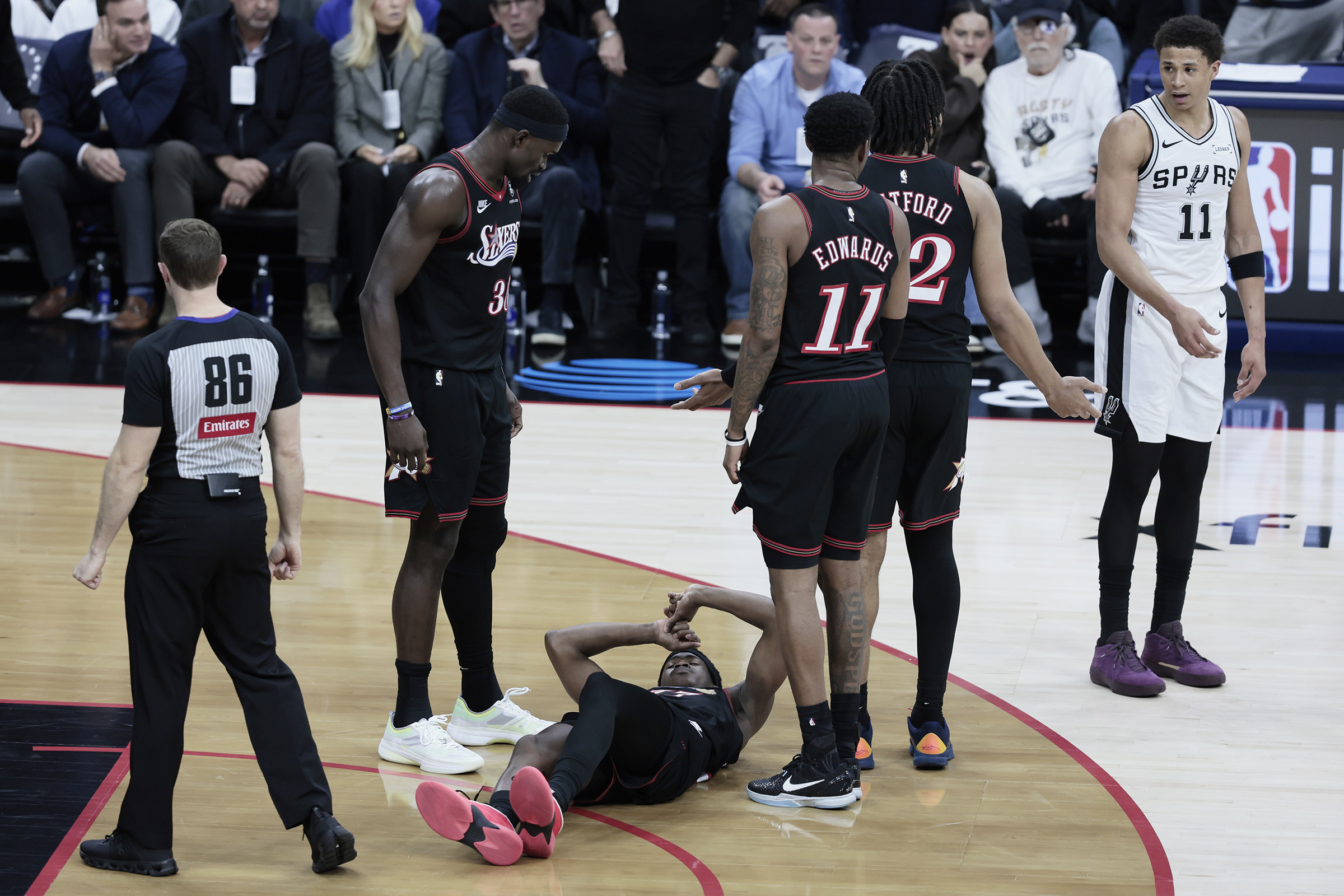
To make matters worse, the Sixers lost rookie VJ Edgecombe to a back injury during Tuesday’s loss.
There’s no shame in losing a game. In fact, there’s sometimes no shame in losing a game by 40. But there’s plenty shame in losing a game by 40 when you don’t play hard. That’s what the Sixers did this week, creating history in the process as the first team to lose three home games in the same season by at least 40, according to basketball-reference.com. The Inquirer’s Marcus Hayes takes a deeper look at the Sixers’ dubious milestone and the lack of effort that got them there.
The Sixers bounced back from an ugly showing on Tuesday by beating the “tanking” Utah Jazz on Wednesday night behind Tyrese Maxey’s 25 points.
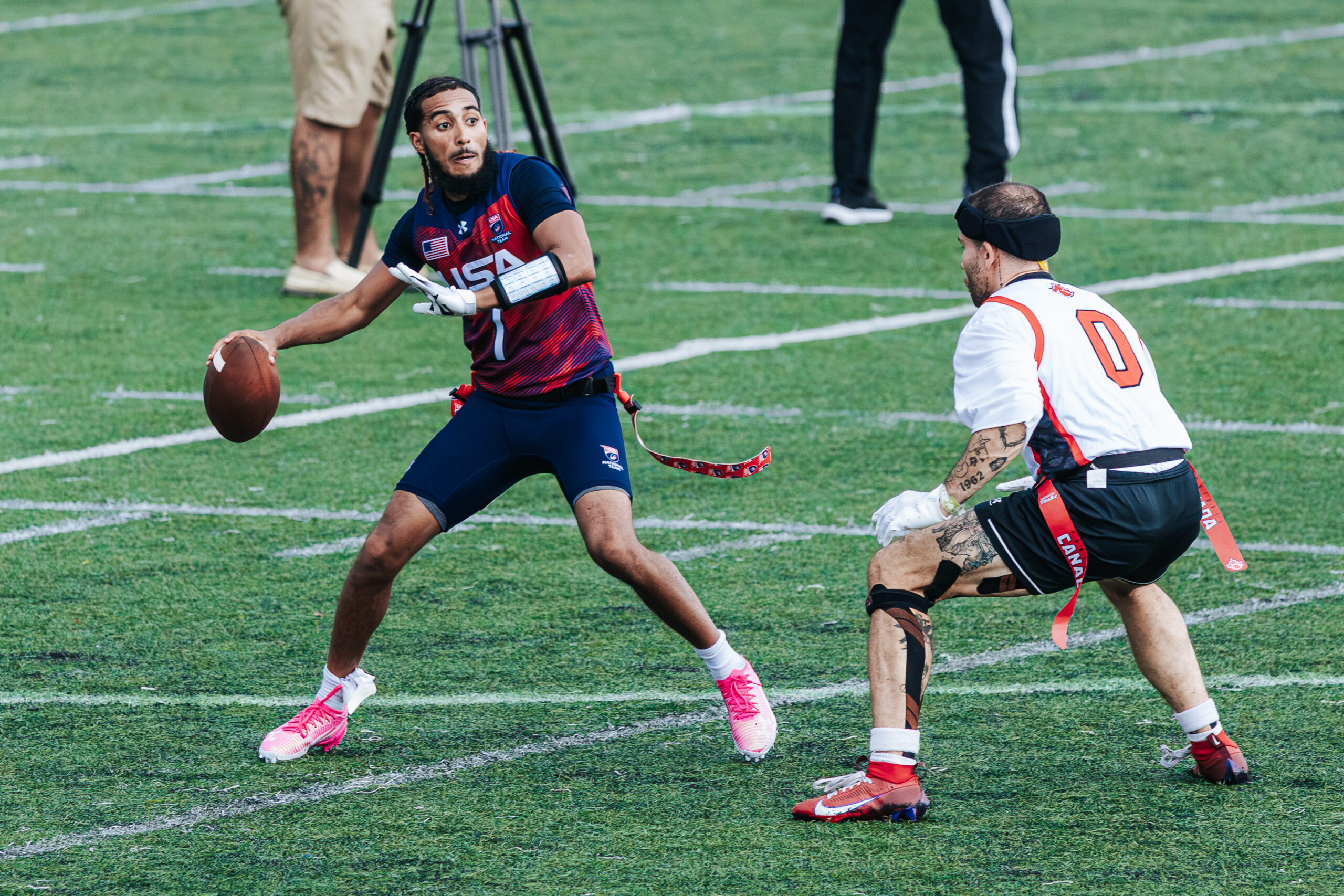
A flag football event under the Fanatics umbrella will look to relocate from its intended site in Saudi Arabla, due to escalating tensions in the Middle East.
Amid heightened tensions in the Middle East, Fanatics might opt to move its Flag Football Classic from Riyadh, Saudi Arabia, to somewhere in the United States, according to Front Office Sports.
Kevin Hart is scheduled to host the event organized by Tom Brady, which was said to feature Saquon Barkley along with other NFL notables. The event aims to raise awareness of the sport, which will be part of the Summer Games in 2028.
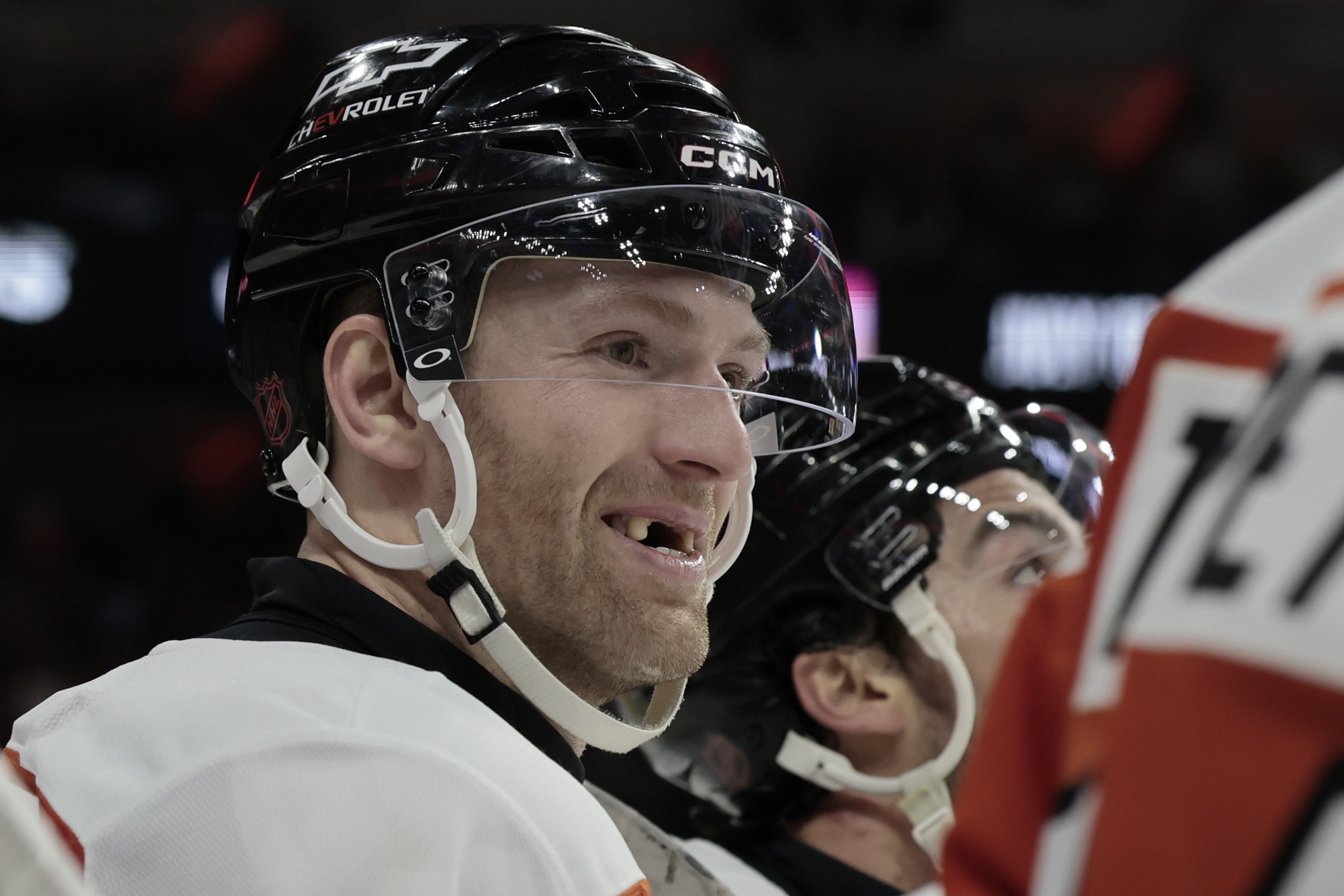
Flyers captain Sean Couturier is looking to remain all smiles ahead of Friday’s NHL trade deadline.
Phones will definitely be on silent for many players around the NHL, and for members of the Flyers, it’s no different.
The NHL trade deadline is fast approaching, with the final horn sounding on Friday at 3 p.m. But while everyone speculates and debates what Flyers general manager Danny Brière and management will do, the players are trying to stay in the moment.
“Focus on what we do on the ice and play some good hockey, try to win some games. Those are things that we don’t control,” said Flyers captain Sean Couturier. “It’s more you guys [the media] that talk about it and make big stories out of it. In the locker room, it’s not something we really talk about. We’ve got other things to focus on.”
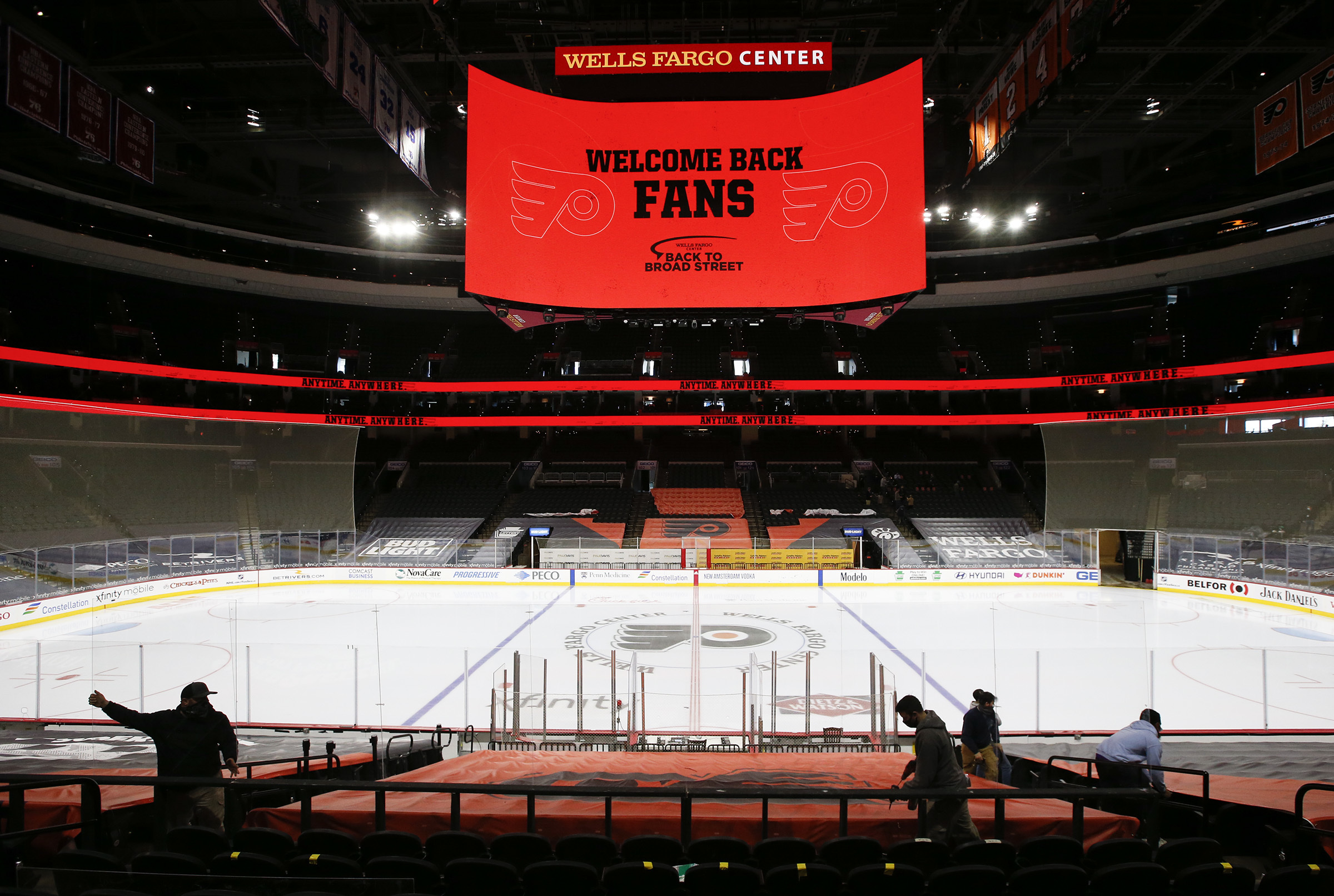
Wells Fargo Center workers prepare the arena for fans on Friday, March 5, 2021.
March 5, 2021: The Wells Fargo Center (now Xfinity Mobile Arena) began preparations to welcome just 3,100 fans back to the 21,000-seat arena after a 359-day shutdown of events due to the COVID-19 pandemic.
Standings, stats, and more
Want to know more details from last night’s Sixers-Jazz game? Here’s a place to access your favorite Philadelphia teams’ statistics, schedules, and standings in real time.
What you’re saying about the Phillies
We asked: What are your thoughts on Rojas’ potential suspension and how it will impact the Phillies?
Why didn’t we keep Harrison Bader! — Joanne G.
I have not pictured Rojas as a major part of the Phillies outfield plans. Pinch runner or defensive sub as needed was going to be his role. Why are so many of the players who continue to think they can get away with taking these banned substances Latino? Are they getting bad advice regarding this in their native countries? — Everett S.
Given their history of violations, the Phillies need to include a special PED clause in all their contracts, in addition to the standard MLB boilerplate. As for Rojas, it’s time to trade or release him. He’s always been too cool for school. And now the cool kid is a druggie. Let’s move on. — Tom O’D.
Johan Rojas’ suspension is unfortunate, but not devastating to the Phillies. He was a non-factor the second half of last year, finishing the season in AAA, and it was uncertain if he would make the big league team this year. This places much more pressure on rookie Justin Crawford. — Bob C.
We compiled today’s newsletter using reporting from Alex Coffey, Gina Mizell, Mike Sielski, Ariel Simpson, Devin Jackson, Jonathan Tannenwald, Marcus Hayes, Jackie Spiegel, Gustav Elvin, and Ryan Mack.
By submitting your written, visual, and/or audio contributions, you agree to The Inquirer’s Terms of Use, including the grant of rights in Section 10.
Thanks for reading. Here’s hoping we prepared you for all those watercooler sports conversations today. Enjoy them; we’ll see you tomorrow. — Kerith
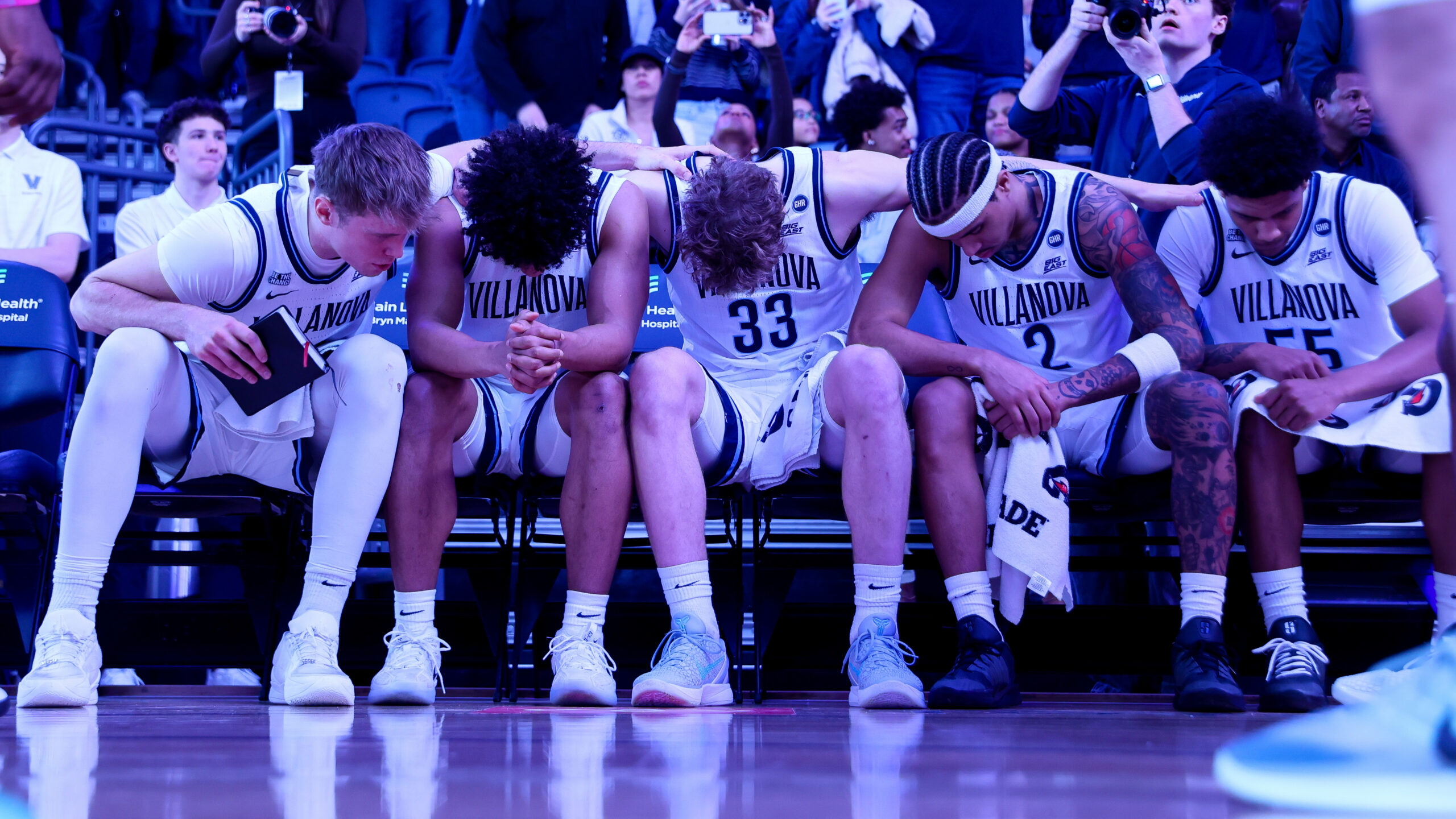
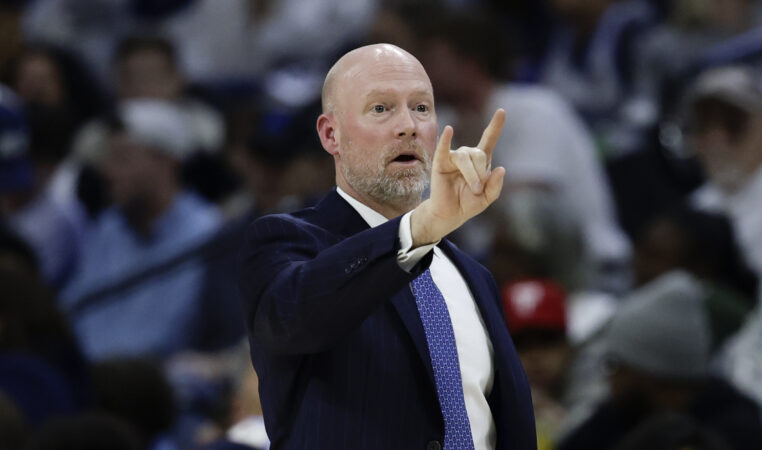
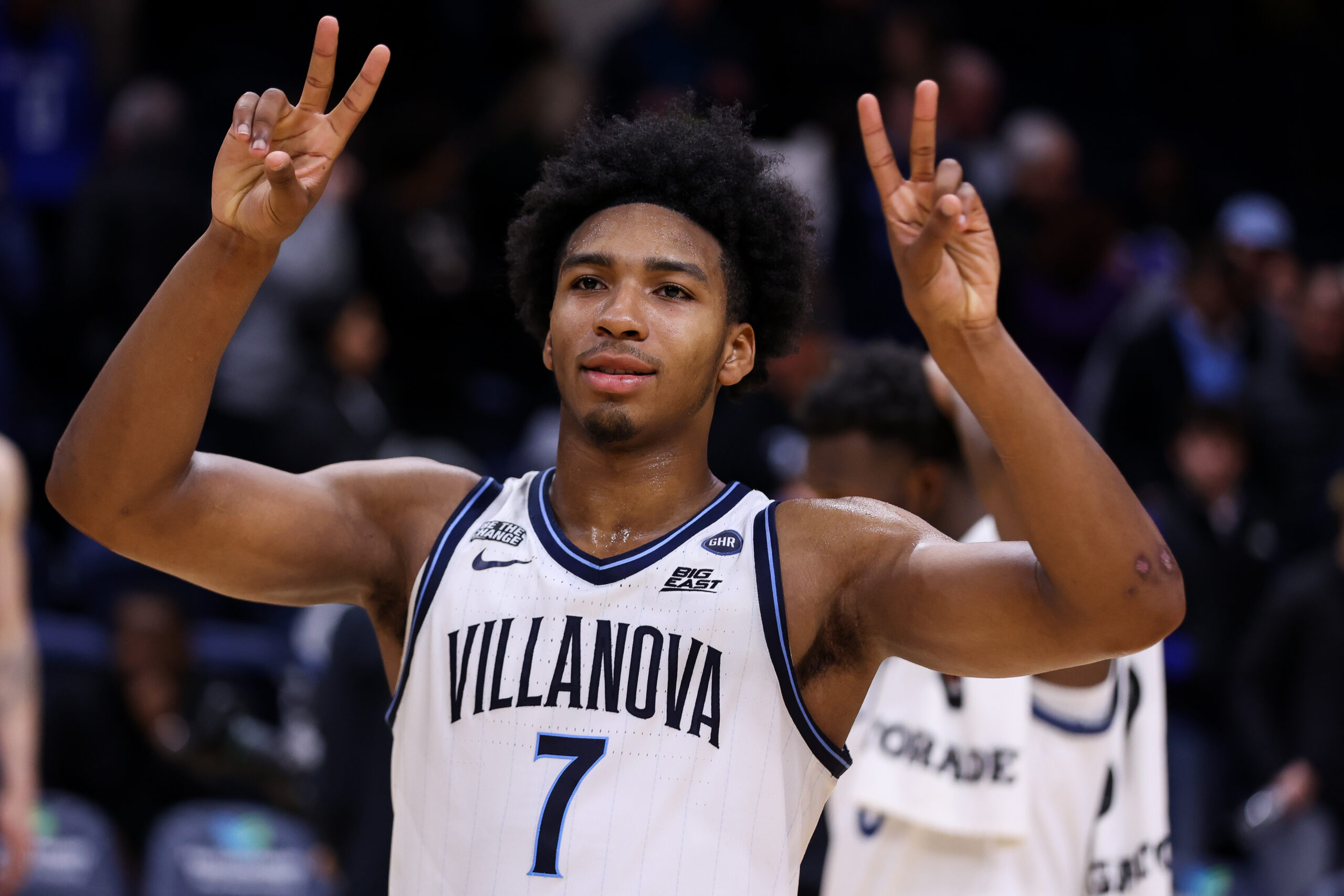
Villanova entered Wednesday with a 9-3 road record, but the last true road game of the season for the Wildcats came with a new wrinkle, and a new starting lineup after Matt Hodge suffered a season-ending ACL injury Saturday night vs. St. John’s.
Villanova coach Kevin Willard said Tuesday that the injury hurt the Wildcats, but “it’s not catastrophic.” They had the right answers to make up for missing their sixth-leading scorer, Willard thought, and while a sloppy first half didn’t make him look like much of a prophet, a much better second half helped Villanova turn a tight game into a rout and an eventual 76-57 win over DePaul.
The Wildcats improved to 23-7 on the season and 14-5 in the Big East behind big nights from Tyler Perkins (20 points, six rebounds), Duke Brennan (15 points, 12 rebounds), and Devin Askew (14 points, five rebounds). It was their eighth conference road win, their most since 2016.
DePaul is the second-worst scoring offense in the Big East and ranks seventh of the 11 teams in three-point shooting (33.1%).
It’s on the defensive end where Hodge’s absence in the starting five won’t be felt in a major way. That’s not to say Hodge, a redshirt-freshman, hasn’t held his own, but inserting Malachi Palmer in the lineup gives Villanova more versatility. Palmer is two inches smaller than Hodge at 6-foot-6 and allows the Wildcats to effectively switch more, which was especially effective against DePaul’s pick-and-roll offense.
Malachi Palmer gave Villanova a major boost on the defensive end Wednesday night.
Villanova was aggressive on the ball defensively and created 16 DePaul turnovers, leading to 22 points off those turnovers. Villanova got its own good looks in the first half but shot just 27.6%. The Wildcats survived a slow start because they forced seven turnovers and limited DePaul to just 24 points. It was the third time this season Villanova allowed fewer than 25 points in an opening half.
In the second half, Willard deployed more matchup zone and dared DePaul to try to shoot its way to a win. The Blue Demons were just 2-for-16 from three-point range, and many of those were either well-contested or forced into the hands of low-percentage shooters.
Three Wildcats had at least two steals. Perkins had four, while Bryce Lindsay and Acaden Lewis had two apiece.
New-look rotation
Palmer, as expected, got the start and tied his season-high with 29 minutes, a mark he reached for the first time Saturday night in part because of Hodge’s injury early in the second half.
Palmer, a sophomore, looked a little jittery to start but settled in during the second half. He finished with 10 points on 3-for-9 shooting (1-for-4 from deep) and added five rebounds.
Askew was the first player off the bench as usual. Then freshman guard Chris Jeffrey and backup center Braden Pierce, a redshirt-freshman. Hodge’s absence will force Villanova into some awkward rotations when Palmer needs to rest. Willard had brief stretches with one big man and four guards on the floor, a unit that he won’t be afraid to roll with depending on matchups because of Perkins’ physicality and rebounding ability.
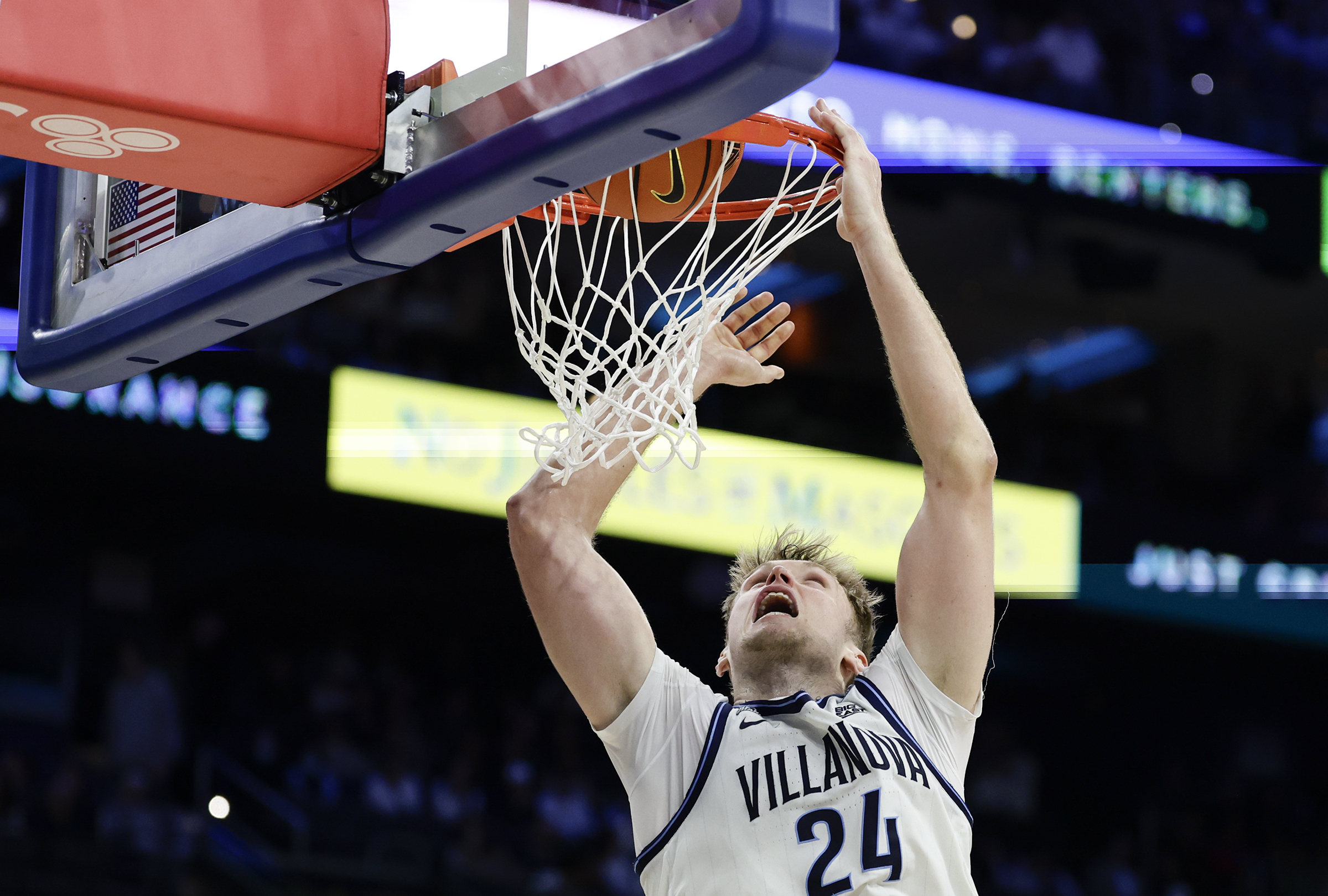
Villanova forward Duke Brennan finished with 15 points and 12 rebounds against DePaul.
What Villanova didn’t show Wednesday was a two-big look with Brennan and Pierce both on the floor. Willard said he’ll be willing to go to it, and the Wildcats have practiced it some, but DePaul did not have a ton of size to force Villanova to counter.
Brennan played 35 minutes for the fourth time in a game that ended in regulation. Palmer played 19 of the 20 minutes in the second half while Pierce (two minutes) and Jeffrey (one minute) played sparingly. They finished with five and three minutes, respectively. An eight-man rotation was effectively a six-player rotation. It worked fine Wednesday night, and may work fine again Saturday in the regular season finale vs. Xavier, but tougher tests await in the postseason.
No Stanford
Hodge being out meant Zion Stanford, a West Catholic graduate and Temple transfer, potentially was in line for more of a role. The junior had seemingly fallen out of the rotation and hadn’t played since Feb. 4.
But Stanford was not with the team in Chicago. He practiced Wednesday, according to sources, but didn’t travel with the team and the nature of his absence was unclear.
Willard told the broadcast after the game that he “got after” his team a little bit in two days of practice following what was the worst Villanova loss in 29 years.
Willard attributed the missed shots and carelessness offensively to still dealing with the emotional letdown of having Hodge out. But things settled down after halftime. The Wildcats changed up their defense and were much more efficient on the offensive end.
It’s no surprise that it was Askew, Brennan, and Perkins — a graduate student, a senior, and a junior — who helped lead the way in the second half.
One more, then the tournaments
The regular season ends Saturday with a noon home game vs. Xavier. A win would give Villanova 15 conference wins for the first time since 2021-22, Jay Wright’s final season. That possibility may be a little less daunting considering Xavier’s Tre Carroll, the Big East’s leading scorer (18 points per game), went down with an injury Tuesday night. His status for Saturday is not yet known.
The Wildcats are on their way to the NCAA Tournament for the first time since 2022, but first is the conference tournament next week in New York, where Villanova will be the No. 3 seed. They open up in the final game of the quarterfinals next Thursday (9:30 p.m.) vs. the winner of the No. 6 vs. No. 11 matchup.