In the span of a roughly an hour and a half, years of hard work from a group of artists, architects, historians, attorneys, and writers who helped create the President’s House in the early 2000s were ripped off the walls and hauled into the back of a pickup truck to be dropped off who-knows-where.
This brazen demise of the exhibits,which memorialized the nine people George Washington enslaved at the site, was never supposed to happen, said Troy C. Leonard, partner and principal at the Philadelphia-based Kelly Maiello Architects, who helped design the President’s House almost two decades ago.
“Because the panels were not meant to be removed, they were very violently taken down, you know, ripped from their backgrounds,” Leonard said in an interview Monday.
“I would suspect that they did a lot of damage, physical damage, to the site in taking those panels down,” he added.
Workers remove the displays at the President’s House site in Independence National Historical Park Thursday, Jan. 22, 2026.
Leonard is one of many stakeholders who helped create the President’s House and are now grappling with its sudden removal last week after a monthslong review by President Donald Trump’s administration.
In the early 2000s, the site was developed at Independence National Historical Park as a memorial intended to highlight the horrors of slavery that took place during the founding of a nation based on liberty. It featured numerous educational exhibits. Everything at the site was historically accurate.
“Just sort of slithering onto the site was a very cowardly way of doing it without any mention that it was going to happen, notifying anyone, just coming in and starting to take the panels down,” Leonard said.
It’s all in connection with orders from Trump and Interior Secretary Doug Burgum, who called for the review and potential removal of content at national parks that could “inappropriately disparage Americans past or living.”
Independence Park employees were also given talking points that evade visitors’ questions about the site.
At Independence Park, Leonard said he is concerned about the future of the site. After last week’s takedown, the open-air exhibit is now a bunch of blank, faded brick walls. All that is left of the memorial is the site’s original archaeological dig from the 2000s and a wall with the engravings of the names of the nine people Washington enslaved.
The City of Philadelphia has sued Burgum, acting National Park Service Director Jessica Bowron, and their respective agencies to restore the panels. Gov. Josh Shapiro’s office filed an amicus brief in support of the city’s suit Tuesday.
“To leave it the way that it is, I mean, to me, it’s sort of now a memorial to the death of democracy and truth,” Leonard said. “That’s what it is now. It’s sort of just these blank walls that are just sitting there. It’s sort of a ruin, but it’s a pathetic ruin because part of its heart has been ripped out.”
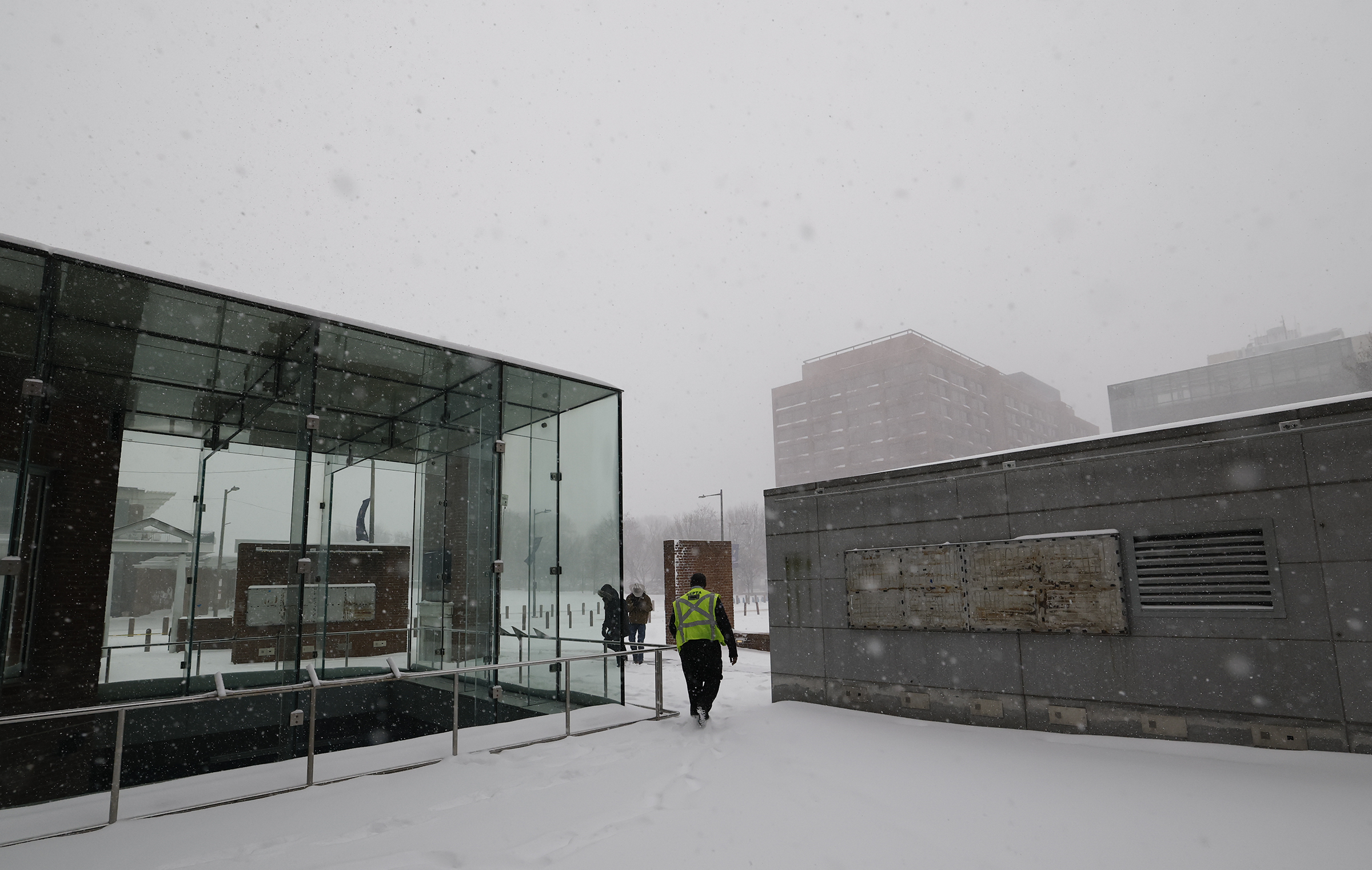
Snow falls at the Presidents House on Sunday, January 25, 2026, after the National Park Service took down slavery exhibits several days earlier.
History is ‘lost and found’
Around two decades ago, more than 1,000 miles away from the Sixth and Market home of the President’s House, a Kansas City-based exhibit design firm crafted the illustrations and graphics seen throughout the site.
All of which were torn down last week.
Gerard Eisterhold, president of the firm, Eisterhold Associates Inc., said in an interview that he got a slew of texts and emails when the exhibits were taken down. He said this incident proves a “thesis” that designers were trying to portray to the public through the President’s House — that history goes through cycles of being lost and then found.
“There were the history of the enslaved that was sort of forgotten for a long, long, long, long time, and that’s a conscious thing that people do. … There’s a heck of a lot more people that are aware of the history of President’s House this week than there was last week,” Eisterhold said.
In fact, there was a sign at the President’s House called “History Lost + Found,” which outlined the juxtaposition of liberty and slavery during the early days of the United States.
“History is not neat,” the History Lost + Found panel at Independence Park read. “It is complicated and messy.”
This panel was one of dozens that were taken down last Thursday. Others were titled “Life Under Slavery” and “The Dirty Business of Slavery.” And there were illustrations of important figures, like Oney Judge, who was enslaved as Martha Washington’s personal maid before she escaped. Hercules Posey, who was enslaved as a cook, also later self-emancipated.
“But here we are. Because how dare we write their names, the nine enslaved Africans at the first American presidential residence. … How dare we encode instructions to the future by writing about the two who escaped?” author Lorene Cary, who helped with storytelling at the President’s House along with documentary filmmaker Louis Massiah, wrote on her Substack last week. “The names are still there, carved into stone.”
National Park Service workers remove the displays at the President’s House site in Independence National Historical Park in Philadelphia on Thursday, Jan. 22, 2026.
The creation and display of these panels were the product of collaboration across disciplines, Cary wrote.
“So many people — scholars and passionate non-scholars — worked, argued, met, studied, wrote, agitated, and created art for this unique and necessary American project.”
Leonard said his firm has been working with Michael Coard, attorney and leader of the Avenging the Ancestors Coalition, which has been helping leadefforts to defend the President’s House from the Trump administration. The coalition, through its advocacy, helped shape the President’s House roughly 20 years ago.
If the city wins its lawsuit and the panels are restored, the site will likely needa refurbishment and stakeholders will need to ensure that the panels are still in good condition.
Ted Zellers (right) wears a sandwich board with a replica of one of the removed slavery panels as people visit and protest at the President’s House site in Independence National Historical Park Saturday, Jan. 24, 2026.
Some Philadelphians have floated the idea of moving the displaced panels to another location if the site faced the ire of the Trump administration. But for Leonard, Sixth and Market is the rightful, historically important home for the exhibits.
“The place is equally important,” Leonard said. “It is not complete without being located at that site. So it’s important to the fight to make sure that that memorial is restored at that location. It cannot be relocated.”
Helicopter manufacturer Leonardo has nearly doubled employment at its Northeast Philadelphia factory since the Rome-based multinational aerospace company began winning U.S. military orders for that factory in the late 2010s.
But the company, whose owners include the Italian government and U.S. investment funds such as BlackRock and Vanguard, has learned what dominant U.S. defense contractors like Boeing have long known: Military planners, policy, and political shifts can stop, delay, or revive long-term contracts, leaving managers scrambling to keep workers and factories busy.
Given the complexity of parts supply, skilled labor, and other aspects of helicopter production, “it is destabilizing and difficult if you don’t know if you are going to build two or 16 aircraft for a given program year after year,” said Andrew Gappy, vice president of Leonardo Helicopters USA Inc., a retired Marine whose duties included flying Presidents Bill Clinton and George W. Bush on Marine One helicopters.
Grey Wolf is based on Leonardo’s civilian, two-engine AW139, part of a movement by military planners to speed production and streamline costs by basing more big-ticket military machines on large-production civilian products and private-sector construction managers. It’s a model that Korea-based Hanwha hopes to use in winning Navy contracts for its shipyard in Philadelphia.
More than half the Grey Wolfs would defend nuclear weapons bases in several western U.S. states. Most of the rest would be used to ferry political leaders around Washington in case of an attack on the nation’s capital, replacing aging UH-1N Huey helicopters on duty since the 1970s.
So far, 19 of those helicopters have been paid for and delivered. Another 12 are funded and nearing completion. But funding for future construction hit unexpected snags.
After Air Force design changes and a challenge by Lockheed Martin’s Sikorsky unit, which had proposed rival helicopters of its own, Leonardo and Boeing said they started production on the first Grey Wolfs in 2023.
They planned to keep building a dozen a year for seven years — about a quarter of the Leonardo plant’s annual output. They hoped to win more contracts along the way.
Last year, the partners had expected to fund future production with $173 million in appropriations as laid out in President Donald Trump’s 2025 budget, plus $210 million in his Big Beautiful Bill, backed by the two Republican senators from North Dakota, home to Minot Air Force Base.
But those payments didn’t materialize on schedule. The Big Beautiful Bill payments were held up, frustrating the Grey Wolf partners.
And then in November, Congress’ new National Defense Authorization Act listed more than $100 million retrofitting previously-delivered Lockheed-built helicopters to transport VIPs but just $10 million for the Grey Wolf program — not enough to build a single helicopter.
The Air Force had justified upgrades of unused aircraft in a budget proposal earlier last year as a cheaper way to acquire helicopters. Grey Wolf defenders objected that the Air Force studies had already verified the new helicopter would be much less expensive to operate.
The cuts would “starve” the Grey Wolf program, Mike Cooper, Leonardo’s government relations chief, said in December. “It’s hard for businesses to plan, when competitively bid procurements can be abruptly and unilaterally changed.”
Last fall, a bipartisan group of five Congress members, headed by Rep. Donald Norcross (D., N.J.), whose South Jersey constituents include workers at Boeing and Leonardo, sent Air Force Secretary Troy Meink a letter that they were “troubled” to hear reports that the Air Force was now planning to update old helicopters for VIP transport and evacuation missions, instead of funding the new ones.
They noted that the Air Force already had selected the Boeing-Leonardo aircraft over two proposals from Lockheed Martin.
They called the switch an “unprecedented change in procurement,” which “undermines the integrity of the acquisition process, calls into question the criteria” for the original selection, “and raises concern about why an otherwise performing program would be truncated without clear explanation to Congress” or the companies that agreed to the contract.
They asked the Air Force for any studies it had made to justify the more expensive Jolly Green program, which they said would cost far more to buy and operate. They also noted the impact on workers, suppliers, and finances at Boeing in Ridley Park, Leonardo in Northeast Philly, Leonardo’s Florida testing site, and contractors who had already invested in the program the Air Force has now failed to fund.
Congress members who represented districts that include additional Boeing or Leonardo facilities support Norcross’ effort. They are Reps. Carlos Gimenez (R., Fla.), Salud Carbajal (D., Calif.), Robert J. Pittman (R., Va.), and John J. McGuire III (R., Va.).
Lockheed Martin officials said they hadn’t taken business from Leonardo. The military planned to convert older helicopters to VIP carriers by adding new seating at Air Force bases, not at the company’s Sikorsky military helicopter factories in Connecticut or New York.
Sikorsky’s civilian helicopter plant in Coatesville, Pa., closed in 2022. It was taken over in 2024 by Piasecki Aviation, a Delaware County-based company that has had its own federal contracting and hiring hopes deferred by government and private-sector contracting delays, according to industry sources. Piasecki didn’t respond to inquiries.
“The MH-139 Grey Wolf is vital to our national defense and supports American jobs,” Norcross said in a statement Jan. 15. “Congress funded the MH-139 because it offers major improvements in speed, range, and survivability.”
He said the Air Force had not directly responded, “but I will continue pressing the administration.”
The same week, a key Air Force commander confirmed in an Air Force publication that the first Grey Wolfs had completed their first Minuteman III convoy operation between two Western air bases, noting they are significantly faster, fly farther, and lift more than the helicopters they replace.
Two sources familiar with the program said the first payments from Congress’ $210 million have been received since that test.
And on Jan. 20, a new federal appropriations proposal added $60 million to the Grey Wolf program — not the whole $173 million, but more than the $10 million in the earlier law.
While preparing her four sons to take a dream family vacation in the Caribbean last month, Carolyn Piro carefully reviewed every detail to get them ready.
She also contacted the Royal Caribbean cruise line about accommodations for her children, because heroldest, Sean Curran, has autism, and two other sons also have developmental disabilities.
The trip ended abruptly when Curran, 31, was kicked off the Celebrity Cruise ship in Cozumel on Christmas Eve after an incident that his family says was mishandled by cruise officials who lacked understanding of his disability.
“Worst Christmas ever. Horrible,” Curran said. “I’m never going on a cruise again.”
Piro, a trauma therapist, is now on a mission to increase awareness and acceptance for people with autism. About 1 in 31 children in the United States are diagnosed with autism, according to the Centers for Disease Control and Prevention, and that number is 1 in 29 in New Jersey, according to the group Autism New Jersey.
“They have a place in our society. They have a place in our community,” Piro said.
Royal Caribbean, which advertises an “autism friendly” environment, said it had reviewed the incident and “concluded we could have been more sensitive to their needs during the debarkation process.” The company, which owns Celebrity Cruises, will provide additional training for employees, a spokesperson said.
‘Just trying to be nice’
Curran livesas independently as possible at home, Piro said. He participates in job training at Ability Solutions in Westville, has a girlfriend, sings with the Pine Barons Chorus, volunteers at an animal hospital, and enjoys dancing.
The Cherry Hill family was having a great time on a seven-day Caribbean cruise in December to celebrate Piro’s 60th birthday. It was Curran’s fourth cruise, and he knew the ropes and was allowed to roam unaccompanied.
Four days into the cruise,Curran was in a pool lounge when, he said,a teenage girl asked him to purchase her a Long Island iced tea. He said he bought the drink, unaware that it contained alcohol. His mother and brothers were not with him at the time.
According to Curran, the girl touched his chest and stomach, used profanity, and followed him to a hot tub, where he lifted her like Shrek did when he rescued Princess Fiona from a dragon in one of his favorite movies.(Piro said Curran enjoys swimming and playing in the water.)
The girl’s parents arrived and her mother began screaming, Curran said. Ship personnel escorted Curran to a security office, where he was asked to give a statement, he said.
“I have autism and I was just trying to be nice,” he wrote in the statement, given to ship personnel and provided to The Inquirer. The statement was only a few sentences of explanation Curran wrote about what happened.
Piro arrived during the questioning and saidCurran offered an apology to the girl’s parents. Curran said he asked for patience and repeated what his mother taught him to say about having autismwhen he encountered difficulty explaining.
Curran was given 90 minutes to pack and leave the ship, his mother said. She accompanied him, along with another son. Other passengers gawked and pointed as security escorted them off the ship, she recalled, saying, “Look at them: They’re getting kicked off the ship.”
“It was just so shameful,” Piro said.
Piro said shebelieves ship officials had other options, such as restricting Curran to his room, rescinding his room cardthat allowed him to buy drinks, or allowing him to disembark at their next port of call, she said.
“With all of the information about autism, there was no compassion. They treated him as a fully functioning adult,” the mother said.
Piro said the family was given only a security incident report and told that the FBI and Homeland Security would be notified. She was not allowed to speak with the girl’s family, whose full name she does not know. She said no charges were filed.
Sean Curran, 31, of Cherry Hill, boarding a Celebrity cruise ship in December for a family vacation. He has autism and was evicted from the ship after a misunderstanding.
Piro,Curran, and another of her sons who left the cruisewere reunited with two other family members several days later when the ship docked in Florida.
Piro said she accepted an apology from Royal Caribbean after returning home, complaining about the incident, and sharing her story publicly. She also said she had askedto be reimbursed for the $20,000 she spent on the cruise and expenses. Royal Caribbean declined to comment on the request.
A spokesperson said Royal Caribbean’sadditional training for its staff will “ensure this experience doesn’t happen again.” She declined to comment further.
Stacie Sherman, a spokesperson for Autism New Jersey, declined to comment about the specific incident but agreed there is a need for more awareness. She has had similar experiences as the mother of two on the autism spectrum.
“Education and awareness is key,” Sherman said.
Sherman said acceptance is slowly growing. Her daughter used to get nasty looks and comments for making loud noises or having a tantrum in public places, she recalled.
“I get way more smiles and nods, even praise and offers of help. It gives me hope,” Sherman said.
Sean Curran, 31, of Cherry Hill, plays with a dolphin during a cruise excursion in Cozumel, Mexico in December.
Seeking change to the system
When the family arrived home, Piro said, she reprimanded Curran and limited his activitiesfor a month. Piro said sheacknowledges that he did something wrong but said his intent was not malicious.
She said she contacted the cruise line a month before their vacation about her children’s special needs. In addition to Curran, two younger sons have mosaic Down syndrome and fragile X syndrome.
Piro said she requested special seating, for example, to isolate the family in the dining area from noise andlarge groups. During an excursion, she rented a cabana away from other guests, she said.
“We don’t go anywhere where people don’t stare, giggle, or make a comment,” Piro said.
Piro said she plans to monitor whether Royal Caribbean implements the additional trainingthat it has promised. She wants changes “in the system so that this doesn’t happen again.”
Carolyn Piro, of Cherry Hill, poses for a portrait with her son Sean, who has autism, in their home this month.
Curran said telling his story was “making me feel better.” He wants to better advocate for himself and others with autism.
“I want people to treat other people with dignity and respect, compassion, and kindness,” he said.
Your watch says you had three hours of deep sleep. Should you believe it?
Millions of people rely on phone apps and wearable devices like rings, smartwatches, and sensors to monitor how well they’re sleeping, but these trackers don’t necessarily measure sleep directly. Instead, they infer states of slumber from signals like heart rate and movement, raising questions about how reliable the information is and how seriously it should be taken.
The U.S. sleep-tracking devices market generated about $5 billion in 2023 and is expected to double in revenue by 2030, according to market research firm Grand View Research. As the devices continue to gain popularity, experts say it is important to understand what the devices can and cannot tell you, and how their data should be used.
Here’s a look at the technology — and why one expert thinks its full potential has yet to be realized.
What your sleep tracker actually measures
Whether it’s an Apple Watch, a Fitbit, an Oura Ring or one of innumerable other competitors, health and fitness trackers largely take the same basic approach by recording the wearer’s movements and heart rate while at rest, according to Daniel Forger, a University of Michigan math professor who researches the science behind sleep wearables.
The algorithms used by major brands have become highly accurate for determining when someone is asleep, Forger said. The devices are also somewhat helpful for estimating sleep stages, though an in-lab study would be more precise, he said.
“If you really want to know definitively how much non-REM sleep you’re having vs. REM sleep, that’s where the in-lab studies really excel,” Forger said.
The sleep numbers that matter most — and the ones that don’t
Dr. Chantale Branson, a neurologist and professor at the Morehouse School of Medicine, said she frequently has patients showing up with sleep scores from fitness trackers in hand, sometimes fixated on granular details such as how much REM sleep they got on a certain night.
Branson says those patients are taking the wrong approach: the devices help highlight trends over time but should not be viewed as a definitive measure of one’s sleep health. Nor should any single night’s data be seen as significant.
“We would have believed them with or without the device and worked on trying to figure out why they can’t sleep — and that is what the wearables do not do,” she said.
Branson said she thinks people who check their sleep statistics every morning would be better served by spending their efforts on “sleep hygiene,” including by creating a relaxing bedtime routine, avoiding screens before bed, and making sure their sleep environment is comfortable. She advises those concerned about their sleep to consult a clinician before spending money on a wearable.
Forger takes a more favorable view toward the devices, which he says help keep the overlooked importance of sleep front of mind. He recommends them even for people without significant sleep issues, saying they can offer insights that help users fine-tune their routines and feel more alert during the day.
“Seeing if your biological clock is in sync is a huge benefit because even if you’re giving yourself the right amount of time, if you’re sleeping at the wrong times, the sleep won’t be as efficient,” Forger said.
How sleep data can drive better habits
Kate Stoye, an Atlanta-area middle school teacher, bought an Oura Ring last summer, having heard positive things from friends who used it as a fertility tracker: “It’s so accurate,” she said. Stoye found the ring to be just as helpful with tracking her sleep. After noticing that the few nights she drank alcohol coincided with poorer sleep quality, she decided to give up alcohol.
“I don’t see much reason to drink if I know that it’s going to affect how I feel,” said Stoye, who always wears her device except when she is playing tennis or needs to charge it.
Another trend she says she detected in the ring’s data: the importance of not eating too late if she wants to get good rest.
“I always struggle with going to bed, and it’s often because I eat late at night,” Stoye said. “I know that about myself, and it knows it too.”
When sleep tracking becomes a problem
Mai Barreneche, who works in advertising in New York City, used to wear her Oura Ring constantly. She said it helped her develop good sleep habits and encouraged her to maintain a daily morning exercise regimen. But as a metric-driven person, she became “obsessed” enough with her nightly sleep scores that it began to cause her anxiety — a modern condition that researchers have dubbed “orthosomnia.”
“I remember I would go to bed thinking about the score I was going to get in the morning,” Barreneche said.
Barreneche decided not to wear her ring on a beach vacation a few years ago, and when she returned home, she never put it back on. She said she has maintained the good habits the device pointed her toward, but no longer wants the stress of monitoring her nightly scores.
Branson, of the Morehouse School of Medicine, said she’s observed similar score-induced anxiety as a recurring issue for some patients, particularly those who set goals to achieve a certain amount of REM sleep or who shared their nightly scores with friends using the same device. Comparing sleep types and stages is ill-advised since individual needs vary by age, genetics, and other factors, she said.
“These devices are supposed to help you,” Branson said. ”And if you feel anxious or worried or frustrated about it, then it’s not helpful, and you should really talk to a professional.”
The future of wearables
Forger thinks the promise of wearables has been underestimated, with emerging research suggesting the devices could one day be designed to help detect infections before symptoms appear and to flag sleep pattern changes that may signal the onset of depression or an increased risk of relapse.
“The body is making these really interesting and really important decisions that we’re not aware of to keep us healthy and active and alert at the right times of day,” he said. “If you have an infection, that rhythm very quickly starts to disappear because the body goes into overdrive to start fighting the infection. Those are the kind of things we can pick up.”
The technology could be particularly useful in low-resource communities, where wearables could help health issues to be identified more quickly and monitored remotely without requiring access to doctors or specialized clinics, according to Forger.
“There’s this really important story that’s about to come out: About just how understanding sleep rhythms and sleep architecture is going to generally improve our lives,” he said.
Southwest Airlines passengers made their final boarding-time scrambles for seats on Monday as the carrier prepared to end the open-seating system that distinguished it from other airlines for more than a half‑century.
Starting Tuesday, customers on Southwest flights will have assigned seats and the option of paying more to get their preferred seat closer to the front of a plane or seats with extra legroom. The airline began selling tickets shaped by the new policy in July.
Here’s what travelers can expect as Southwest does away with another of its signature features and becomes more like other airlines:
Goodbye, A/B/C groups
Under the open-seat system, Southwest customers could check in starting exactly 24 hours before departure to secure places in boarding lines at departure gates.
Early check-ins were placed in the coveted “A” boarding group, essentially guaranteeing they would find an open window or aisle seat. Others landed in “B” or “C,” the likelihood of only middle seats being available rising the longer they waited to check in.
The Dallas-based airline’s unusual seating process began as a way to get passengers on planes quickly and thereby reduce the time that aircraft and crews spent on the ground not making money. It helped Southwest operate more efficiently and to squeeze a few more flights into the daily schedule; the system also was a key reason Southwest remained profitable every year until the coronavirus pandemic.
The open-seating arrangement became less democratic over time, however, as Southwest also had starting allowing passengers to pay extra for spots near the front of the line.
Hello, assigned seating
An eight‑group boarding structure is replacing the find-your-own-seat scrum. Instead of numbered metal columns at departure gates, passengers will file through two alternating lanes once it’s time for their group to board.
The airline said its gate areas will be converted in phases starting Monday night, a process that could take about two months to complete. Columns that remain standing past Tuesday will have their numbers removed or covered in the meantime.
Southwest is selling tickets at fares with different seating choices, including standard seats assigned at check‑in or paid preferred and extra‑legroom seats selected at booking. For certain flights, passengers also will have the option of paying for priority boarding beginning 24 hours before departure.
How it will work
Newly designed boarding passes will show seat assignments and boarding groups, according to Southwest. A reservation made for nine or fewer people, including families, will assign those passengers to the same boarding group.
Southwest says the boarding groups are based on seat location, fare class, loyalty tier status, and the airline’s credit card rewards benefits. Passengers who purchase seats with extra legroom will be placed in groups 1-2. Customers with premium fares and the airline’s “most loyal travelers” will also have access to preferential seats and earlier boarding, the carrier said, while those with basic fares will likely be placed in groups 6-8.
Other changes
With the switch to assigned seating also comes a revision of the airline’s policy for customers who need extra room. Under the new rule — also effective Tuesday — travelers who do not fit within a single seat’s armrests will be required to purchase an additional seat in advance.
That represents a change from the airline’s previous policy that allowed passengers the choice to purchase a fully refundable extra seat before arriving at the airport, or request a free one at the gate. Under the updated policy, refunds are still possible but no longer guaranteed and depend on seat availability and fare class.
In May 2025, Southwest also ended its decades‑old “bags fly free” policy, replacing it with baggage fees for most travelers.
The changes mark one of the biggest transformations in the airline’s history, as it alters its longstanding customer perks to bring it more in line with the practices of other larger U.S. carriers.
“We have tremendous opportunity to meet current and future customer needs, attract new customer segments we don’t compete for today, and return to the levels of profitability that both we and our shareholders expect,” Southwest CEO Robert Jordan said last year.
When the Texas-based airline first announced plans in 2024 to switch to assigned seating, it said studies on seating options showed that customer preferences had changed over the years, with the vast majority of travelers saying they now want to know where they are sitting before they get to the airport.
Jordan said at the time that open seating was the top reason surveyed travelers cited for choosing another airline over Southwest.
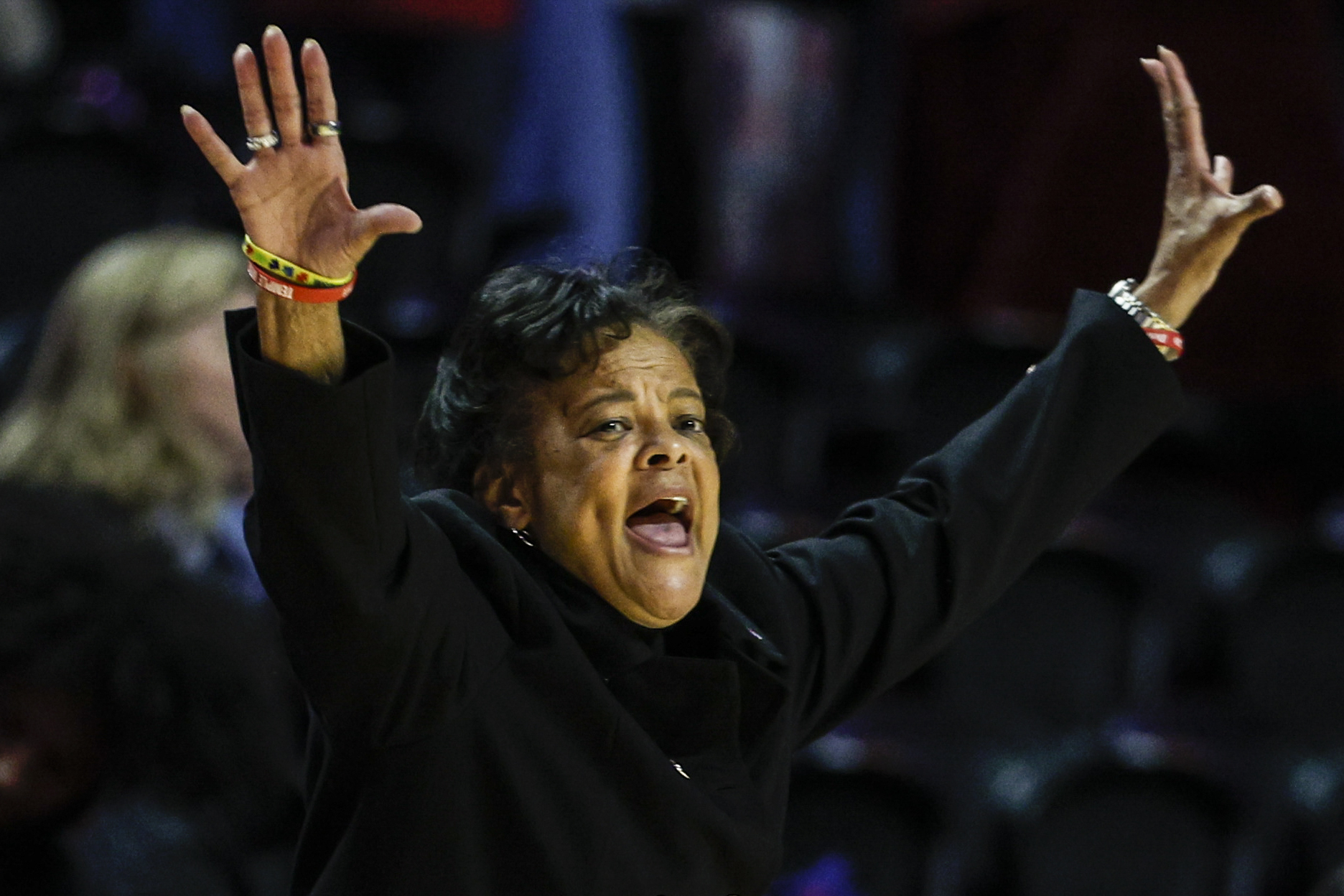
Temple coach Diane Richardson is not from Philadelphia. She spent much of her life in the Maryland and Washington region, which included several coaching stints in the area.
When Richardson was hired at Temple in 2022, she got a taste of what the Big 5 — and sports in general — mean to the city. But seeing how Philly responded to the women’s side of the Big 5 intrigued Richardson. It made her want to grow women’s basketball even more.
Richardson has become an advocate for professional women’s basketball and hopes to bring more eyes to the game, with a WNBA franchise set to come to Philadelphia in 2030. In the meantime, Unrivaled will make its first trip out of the Miami area and play at Xfinity Mobile Arena on Friday.
“It really sets the tone for what Philly has to come,” Richardson said. “The WNBA is coming here in a few years and to have Unrivaled come here, the first place that they have come to, it really shows the support that’s here for women’s basketball and how Philly’s grabbing ahold of it. So I’m excited about it. I’m really excited about the representation. I’m excited for the young girls in Philly to be able to see that up close and personal.”
Basketball was not always Richardson’s calling card. She was named one of the top female executives in the country in 1995, but she left her post as founder and chief operating officer of American Security Corporation to pursue a different passion, mentoring young girls through basketball.
Part of Richardson’s inspiration to make that change came from former college basketball coach and current color commentator Carolyn Peck. Richardson crossed paths with Peck during a recruiting visit with a player while Peck was at the University of Florida and Richardson was coaching at Riverdale Baptist School in Upper Marlboro, Md. She was enamored by Peck’s drive to help young athletes.
“I saw the care she had with her student-athletes and how she wanted to project women’s sports,” Richardson said. “I was just amazed and inspired that when you can be in a position like that, you can actually inspire other people. I left corporate America to coach because I saw her example. And I love what I’m doing now.”
Richardson arrived on North Broad before the 2022 season and quickly got to work, not just with her new program, but with women’s basketball overall.
Richardson bought into the Big 5 Classic, and when the format changed before the 2024-25 season, she was all for it. The the tripleheader has been held at Villanova’s Finneran Pavilion the first two seasons. While Richardson believes the first two iterations have been successful, there is more to be done.
“I think we could use some more exposure,” Richardson said. “We’re playing at Villanova and the guys are playing downtown [at Xfinity Mobile Arena]. And I think if we put enough money into it, enough marketing into it, and we can market it locally and get a lot of people there.”
Richardson also has her team engage with the community in women’s basketball events. The Owls held a camp with Skilladelphia, a basketball clinic for young girls, and attended a WNBA watch party with Watch Party PHL to see a game that featured Jonquel Jones, Natasha Cloud, and Kahleah Copper.
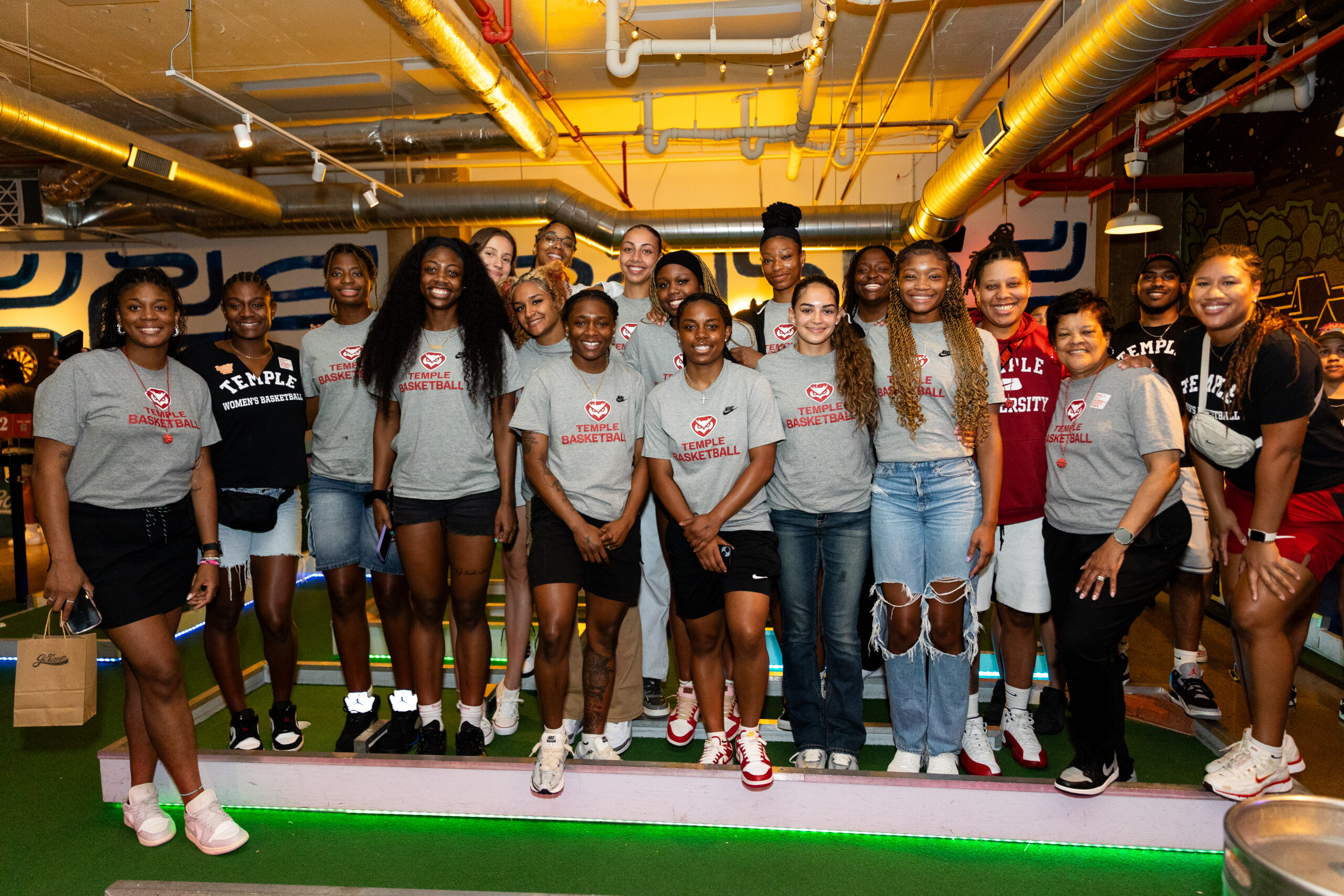
Temple attended a WNBA watch party in July at Libertee Grounds.
A key part of Richardson’s involvement over her four years at Temple has been the involvement of Jones and Copper. Jones, who plays for the New York Liberty, is Richardson’s adopted daughter and makes the trip to Philly whenever she can.
She acted as a tour guide when the Owls went to the Bahamas in November. Copper, who plays for the Phoenix Mercury, is from North Philly and has been a great friend of the program. She attended many practices during Richardson’s first two seasons.
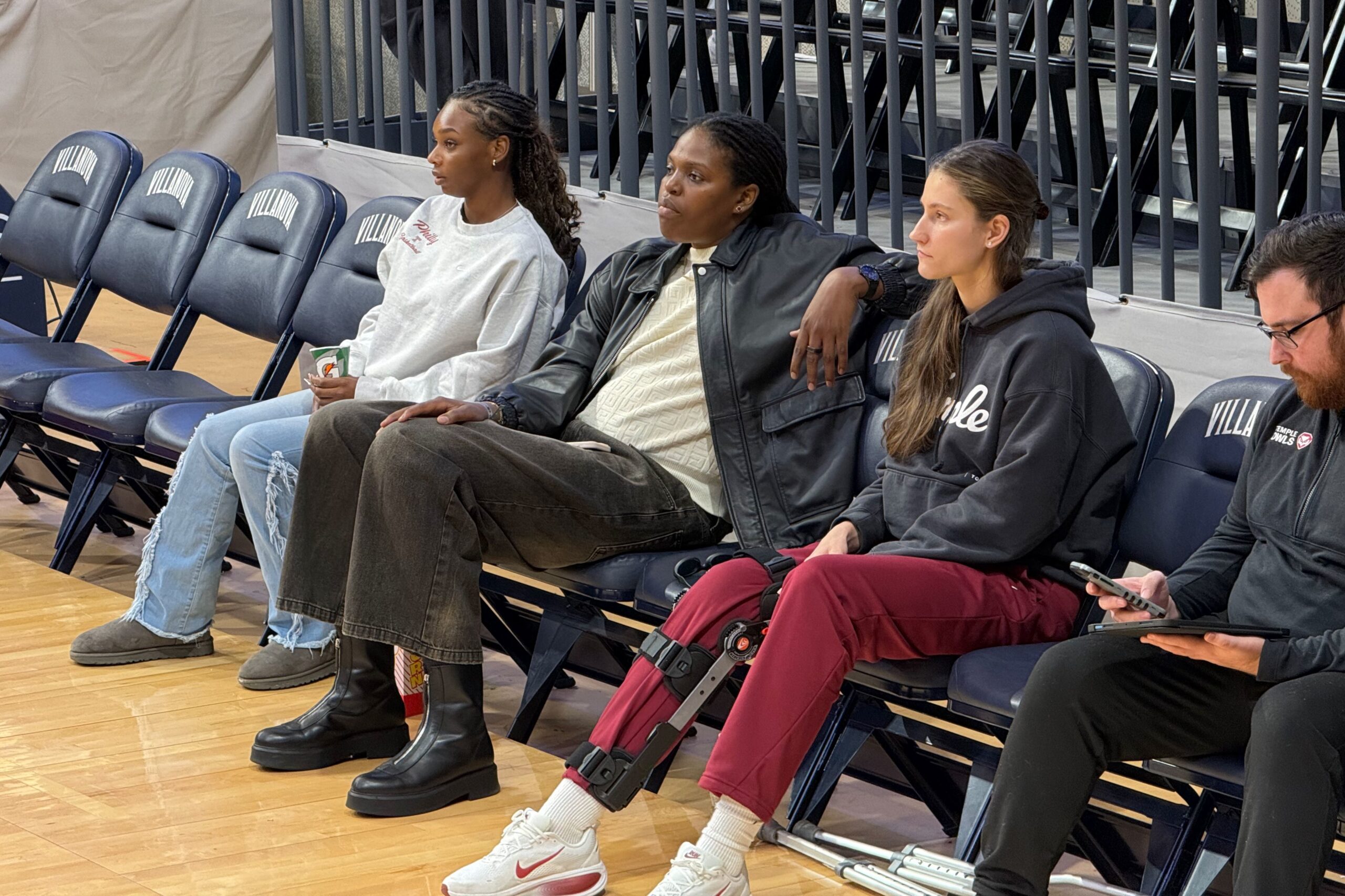
New York Liberty star Jonquel Jones (second from left), the adopted daughter of Temple women’s college basketball coach Diane Richardson, was courtside to watch the Owls play the Drexel on Dec. 7.
Having professionals involved with the program has been beneficial for the team. It’s an opportunity to see what basketball can do for them.
“Coach Rich is really great at networking,” said junior guard Kaylah Turner. “We’ll have little meetings here and there to meet this person and that person she wants us to talk to. She knows that every person has one thing that we can take away from, as far as lessons. We meet a lot of different people, and just watching her, she knows everybody.”
Richardson brought her whole team to the Unrivaled announcement event on Oct. 2, when the pro three-on-three league announced it would visit the city on Jan. 30. Unrivaled is the next step to growing women’s basketball in the area.
Richardson hopes a lot comes from Unrivaled, including gaining more women’s basketball fans.
“I hope that the people who talk bad about women’s sports and the WNBA will see that this is true basketball,” Richardson said. “It’s not just some stuff on the corners. It’s not just AAU or church league. This is real professional basketball, and it should be respected as such.”
After Unrivaled, the city will have four years to prepare to welcome its WNBA team. The support that has come from Unrivaled is encouraging, and Richardson believes that with continued marketing, Philly will be more than ready for a pro team.
Temple coach Diane Richardson calls plays against Charlotte on Saturday.
“With the WNBA coming here … we’re going to be exploding,” Richardson said. “To get Unrivaled sold out in a matter of days, that tells you we are ready for the WNBA. I think if we continue to have programs and events like that, it’ll get there, and I think we’ll have sold-out stadiums when the WNBA gets here.”
In her short time in the city, Richardson has been at the forefront of the push to grow women’s basketball here. She hopes others will see the beauty in the sport, too.
“If they are a true sports fan, they will love women’s basketball,” Richardson said. “And it’s not just to say that it’s women’s basketball, but if you love sports, you’ll love women’s basketball, because it’s basketball.”
Ten floors of the 27-story Ten Penn Center at 1801 Market St. will be converted from office space to 273 apartments, according to a zoning permit issued Tuesday.
The building was purchased by PMC Property Group last summer for $30 million, less than half the price it was the last time it changed hands in 2006. At that time, it sold for $75 million, or roughly $144 million in today’s dollars, according to the Bureau of Labor Standards’ inflation calculator.
PMC is one of Philadelphia’s largest apartment developers and has distinguished itself in the post-pandemic push to convert underused office space into apartments. PMC previously converted half of the 20-story Three Parkway building at 1601 Cherry St. In that case, the lower levels were turned into 143 apartments.
According to Ten Penn Center’s sales listing last summer, 65% of the offices in the building wereoccupied with much of the vacancy being concentrated in the upper levels. The building is effectively divided in half by the 16th floor, which is largely mechanical.
The downtown residential market has remained robust during the societal and economic turmoil over the last six years, with 3,500 new apartments opening between Pine and Vine Streets and the rivers since 2023 alone, according to Center City District.
“The apartment market remains really healthy, across the entire city, but in Center City specifically,” said Clint Randall, vice president of economic development at Center City District.
Despite fears of an apartment glut, especially along the Delaware River and in Northern Liberties, demand for multifamily living has remained resilient in much of Philadelphia. (Occupancy rates in Center City are at 92%.)
The pipeline of office-to-residential conversions has been relatively robust as well, despite the fact that so many of Philadelphia’s older industrial and commercial buildings had already been turned to multifamily use pre-pandemic.
In Center City, 673 apartments have been created in former office space since the COVID-19 pandemic, according to the Center City District.
“There was an assumption that it would take longer to to eat up all of the supply, but it’s not taking as long as anybody thought,” Randall said. “Because of that, you’re able to move forward and get financing for new deals because you can prove that when there are good products available, it leases.”
PMC Property Group did not respond to a request for comment.
There were the usual favorites on both sides of the ball — as well as a few new faces — and a grizzled veteran that fans can’t seem to agree on.
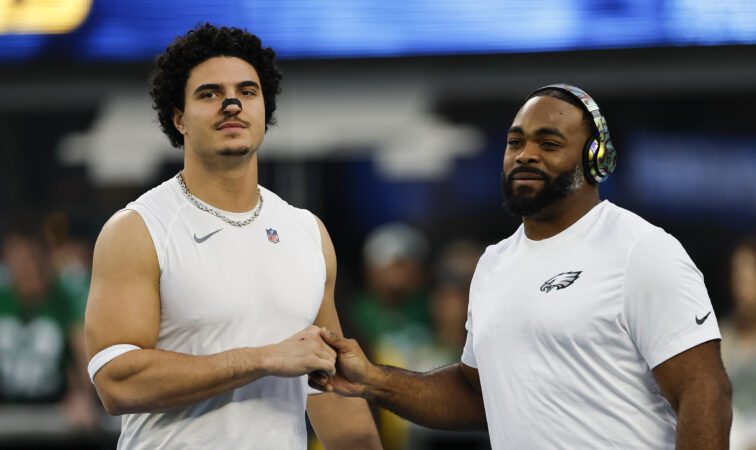
Eagles fans want pending free agent linebacker Jaelan Phillips back next season, but they're split over veteran Brandon Graham, who came out of retirement last year.Yong Kim / Staff Photographer
The Eagles have long-since been eliminated from Super Bowl contention, after their wild-card round loss to the San Francisco 49ers. But the conversations around what went wrong with the Birds last year are ongoing, as the team continues to search for a new offensive coordinator and prepares for what’s sure to be a busy offseason.
We asked you, our readers, which Eagles you want to see stay or leave the team for next season. Here’s what we found — and how some of those results compared to what beat writer Jeff McLane expects the team to do …
The Eagles’ All-Pro cornerback duo, Quinyon Mitchell (96.4%) and Cooper DeJean (96.1%), graded out the best of any Birds players. But they weren’t alone. Jordan Davis (96.1%) tied DeJean after a breakout year.
The best defense
It’s not just those two. Overall, 19 Eagles earned over 90% stay votes in this year’s poll, despite the early playoff exit — 12 of those players were on defense or special teams, including Zack Baun (95.8%), Jalyx Hunt (95.3%), and more.
On the offensive
There were fewer on offense — seven in total — who received at least 90% stay, including four offensive linemen: Lane Johnson (91.8%), Jordan Mailata (95.9%), Landon Dickerson (93.6%), and Cam Jurgens (91.2%).
Hurts remains popular
Quarterback Jalen Hurts (85.7%), however, was not one of them. That doesn’t mean he’s unpopular — he finished just a few percentage points shy of his Super Bowl MVP season (89.5%), and is not going anywhere.
Brown takes a hit
That’s nothing compared to the dip A.J. Brown (62.3%) saw. The wide receiver came in at 88.8% stay following last year’s Super Bowl run. But after a season wrought with controversy, where Brown looked like he may have taken a step back, fans have soured a bit on Brown.
Tight ends on the move?
Backup tight end Grant Calcaterra (36.8%) fell over 55 points from last season — down from 92.3% stay after 2024 — but fans still love Dallas Goedert (79.4%). However, Jeff McLane thinks both pending free agents will be wearing different colors next year.
Love ’em or hate ’em
Overall, the results on the offensive side paint an interesting picture, with no one player landing in the middle 20%, between 40-60% stay. Fans know what they want.
Special requests
That includes the team’s specialists. An overwhelming majority want punter Braden Mann (94.2%) back next season. The same can’t be said for veteran kicker Jake Elliott (23.2%), who saw the biggest year-over-year drop. McLane thinks the team will agree.
A difference of opinion
Franchise legend Brandon Graham (40.6%) un-retired midway through the 2025 season, and he said after the season that he felt he still had more in the tank. He was one of the most polarizing players in the poll, with a slight majority voting for him to go.
The kids are all right
Howie Roseman also had a good year, according to fans. The Eagles’ rookie class, headlined by Jihaad Campbell (95.6%) and Drew Mukuba (90.3%), graded out well after its first NFL season.
The new guys
The Birds traded for Jaelan Phillips (81.4%) at the trade deadline. While the move didn’t ultimately lead the Eagles to the Super Bowl, the pending free agent quickly became a fan favorite. Running back Tank Bigsby (94.7%) graded even better — and higher than Barkley.
Check out the full results
We’re done breaking it down for you. Let’s put the numbers directly at your fingertips — simply hover over or click on a player on the chart to see not only what percentage of stay votes they received, but also what McLane thinks will happen.
So what does the future hold for these players? The NFL’s new league year begins on March 11 — that’s when teams are permitted to execute trades and begin signing new players. Stay tuned.
There’s a lot of anxiety in the ether these days about the Eagles, particularly about the fact that they haven’t hired an offensive coordinator yet to replace Kevin Patullo.
Just look at some of the candidates who have been scooped up elsewhere or who decided to stay where they were: Mike McDaniel, Brian Daboll, Joe Brady, Mike Kafka, and Charlie Weis Jr.
We can call this group the “Guys We’ve Heard Of” group, and they’re the biggest drivers of this collective worry that the Eagles will end up hiring some nincompoop who can’t call plays or, worse, calls the same kinds of plays Patullo did. I don’t know much about McDaniel other than he digs capri pants and tinted sunglasses. But I recognize his name, which means he must be smart, and the Eagles must be stupid for not hiring him.
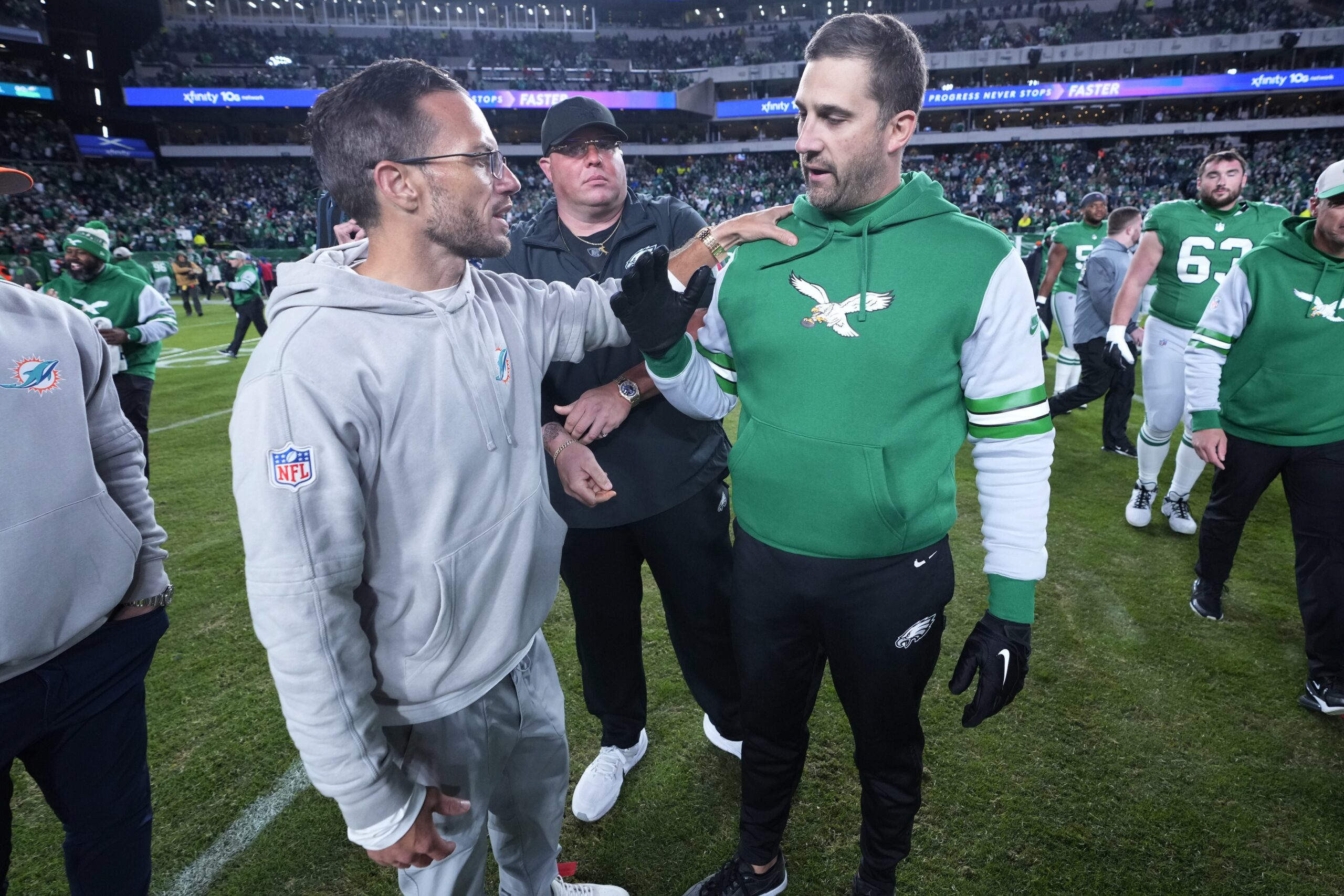
Mike McDaniel (left) was a player high on the list of potential replacements for Kevin Patullo as offensive coordinator. Until he accepted the role with the Chargers.
Then there’s the “Guys I’m Googling” group. They’re the up-and-coming coordinators and quarterback coaches who aren’t as well known to the casual NFL follower but who aspire to become branches on the Sean McVay tree or the Kyle Shanahan tree or whatever metaphorical foliage the Eagles happen to prefer. The way the Eagles’ search is shaping up — the time they’re taking, the three still-vacant head coaching jobs around the league — they’re likely to settle on someone from this group.
Hiring such a candidate, one with relatively little experience and no discernible track record, could turn out to be a problem for the Eagles, who might end up with another play-caller who isn’t quite ready for the role. But it would be a boon for the team’s fans and media, who could start second-guessing and complaining about the guy as early as Week 1.
No matter who the Eagles bring on board, they would do well to take a big-picture factor into consideration when they make their choice. In the short term, sure, the new coordinator’s primary concerns will be centered on improving an offense that may or may not have A.J. Brown, may or may not have Lane Johnson, may or may not have a decent tight end or two, and could use a bounce-back season from Jalen Hurts. But in the longer term, they should be mindful that they’ve been part of a strategic shift across the NFL, and they should be prepared in case Roger Goodell and the league’s owners try to shift things back.
Here’s what I mean: During this regular season, the average NFL team passed for 209.7 yards a game. That figure represents the lowest such average since 2006. It has been two decades, in other words, since NFL passing offenses were as anemic (or as conservative, depending on how you want to look at it) as they were this season.
Eagles quarterback Jalen Hurts was among an NFL passing collective that accounted for an average of just 209.7 yards per game, the lowest since 2006.
Why? You don’t have to be Bill Walsh to figure it out. After years of franchises chasing franchise quarterbacks and brilliant scheme designers and elite wide receivers — and tight ends who could catch and run like wideouts — a funny thing started happening: Certain teams geared up to counteract their opponents’ dynamic passing games and to exploit smaller, faster defenses. That is, certain teams won championships because of their defenses and/or their run games.
The 2023 Kansas City Chiefs had Patrick Mahomes, yes, but they ranked 15th in scoring offense and second in scoring defense. The story of the 2024 Eagles is practically gospel around here: the dominance of Saquon Barkley and the offensive line, a stout defense overseen by Vic Fangio and built from the secondary in, the reality that the team didn’t want to and didn’t have to rely on Hurts’ arm to win.
Now we have the New England Patriots and Seattle Seahawks in Super Bowl LX. Drake Maye had a great second season, and Sam Darnold is a great story. But both the Patriots’ and Seahawks’ defenses finished among the league’s top four in fewest points allowed and among the top eight in fewest yards allowed.
Simply put, the passing game — the aspect of football that leads to high scores, general excitement, and the rise of the sport’s biggest celebrities and product-movers (i.e., star quarterbacks) — ain’t what it used to be. Hell, we were three points away from having a Super Bowl with Darnold and Jarrett Stidham as the starting QBs … not exactly an electrifying matchup of two all-time greats/household names.
Broncos backup quarterback Jarrett Stidham leaves the field after the team’s loss in the AFC championship against the New England Patriots.
For all the moaning that Sunday’s Patriots-Broncos game was boring and unwatchable because of the snow at Empower Stadium, for all the silly calls for holding conference-title games in domes from now on, the weather wasn’t what made it dull. What made it dull was that Maye played as if he was trying not to lose the game (sound familiar, Eagles fans?), and Stidham wasn’t capable of winning it.
The last time the NFL went through a stretch similar to this one was a quarter-century ago, when four consecutive Super Bowls were won by teams primarily defense-oriented: the 2000 Baltimore Ravens, the 2001 and 2003 Patriots, and the 2002 Tampa Bay Buccaneers. Consider some of the quarterbacks, too, who were reaching those Super Bowls back then: Trent Dilfer, Kerry Collins, Brad Johnson, Rich Gannon, Jake Delhomme, and a rookie named Tom Brady.
Former Patriots coach Bill Belichick might have had Tom Brady for the Super Bowls he racked up, but he also boasted some good defenses as well.
In the aftermath of that ’03 Patriots run — Bill Belichick’s defensive backs manhandled the Indianapolis Colts’ receivers in the AFC title game — the NFL decided to crack down on illegal contact, defensive holding, and pass interference infractions. In 2003, NFL teams averaged 200.4 passing yards. In 2004, that average jumped by more than 10 yards, to 210.5, and it kept rising for years thereafter.
That surge has stopped. The game has slowed down, and it’s a safe bet that the NFL won’t allow it to stay this way for too much longer. The Eagles were among those applying the brakes, but the sport is poised to open up again, and they and their new man at the wheel, whoever he might be, need to be ready.
Sunday is the first day of February, which means March is right around the corner, which means it is officially no longer too early to think about the NCAA Tournament.
Villanova is 20 games through its 31-game schedule, and nine games through its 20-game Big East slate. The Wildcats, who host Providence on campus Friday night, are 15-5 overall and 6-3 in their conference matchups in the first season of the Kevin Willard era.
School administration moved on from Kyle Neptune last March after a third consecutive season ended without an invitation to the NCAA Tournament. Villanova officials believe the school should field a basketball team that perennially is in the at-large bid conversation, and three consecutive seasons without meaningful basketball was not acceptable.
Right now, it’s hard to believe the drought could stretch to four.
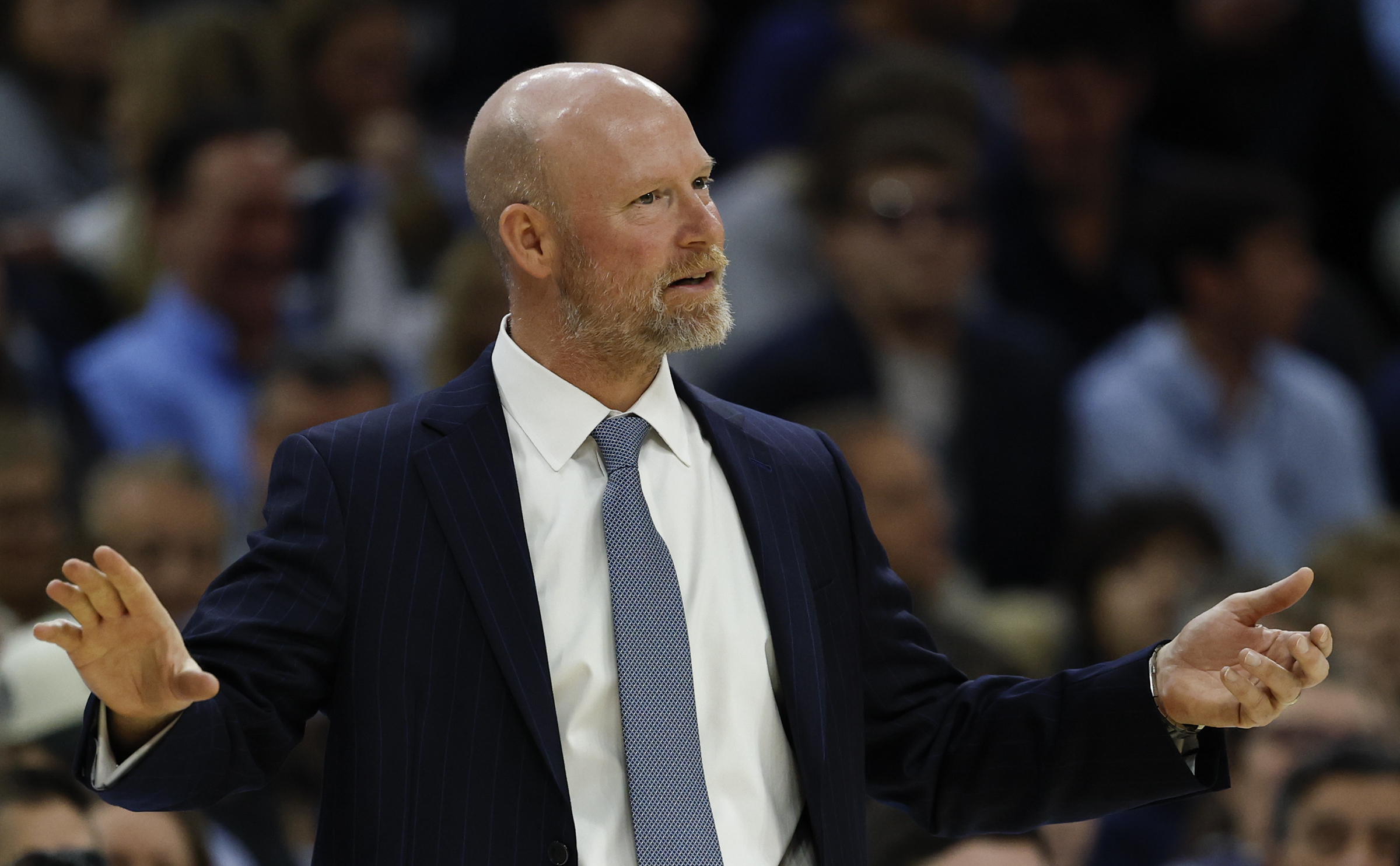
Villanova coach Kevin Willard is on pace to get the Wildcats back to the tourney.
The Wildcats aren’t yet a lock, but it’s looking pretty safe for their fans to preemptively look into taking a PTO day or two for the third week of March.
What are the numbers saying? We went to ESPN’s bracket guru himself, Joe Lunardi, for some help.
‘A very long leash’
Saturday’s loss to No. 2 UConn in Hartford, Conn., was an “insurance policy” kind of game, Lunardi said. Villanova declined coverage. The Wildcats let an upset opportunity slip away in an overtime loss, but the result, Lunardi said, was a “wash.” Villanova was a double-digit underdog and lost by eight.
“It didn’t hurt, and it didn’t help,” said Lunardi, who had the Wildcats as a No. 7 seed in his latest bracket projection released Tuesday morning.
The metrics support that notion. Villanova barely budged in the NCAA’s NET rankings, where it was ranked 34th as of Wednesday afternoon, and at KenPom (27).
What has to happen to stay on the right path?
“All they really need to do is win games they’re favored, and they can even afford to lose [a few] of those,” Lunardi said. “If they go 6-5, they’re going to make it.”
That’s some leeway.
“That’s a very long leash given the fact that, frankly, the league is good but not great,” Lunardi said.
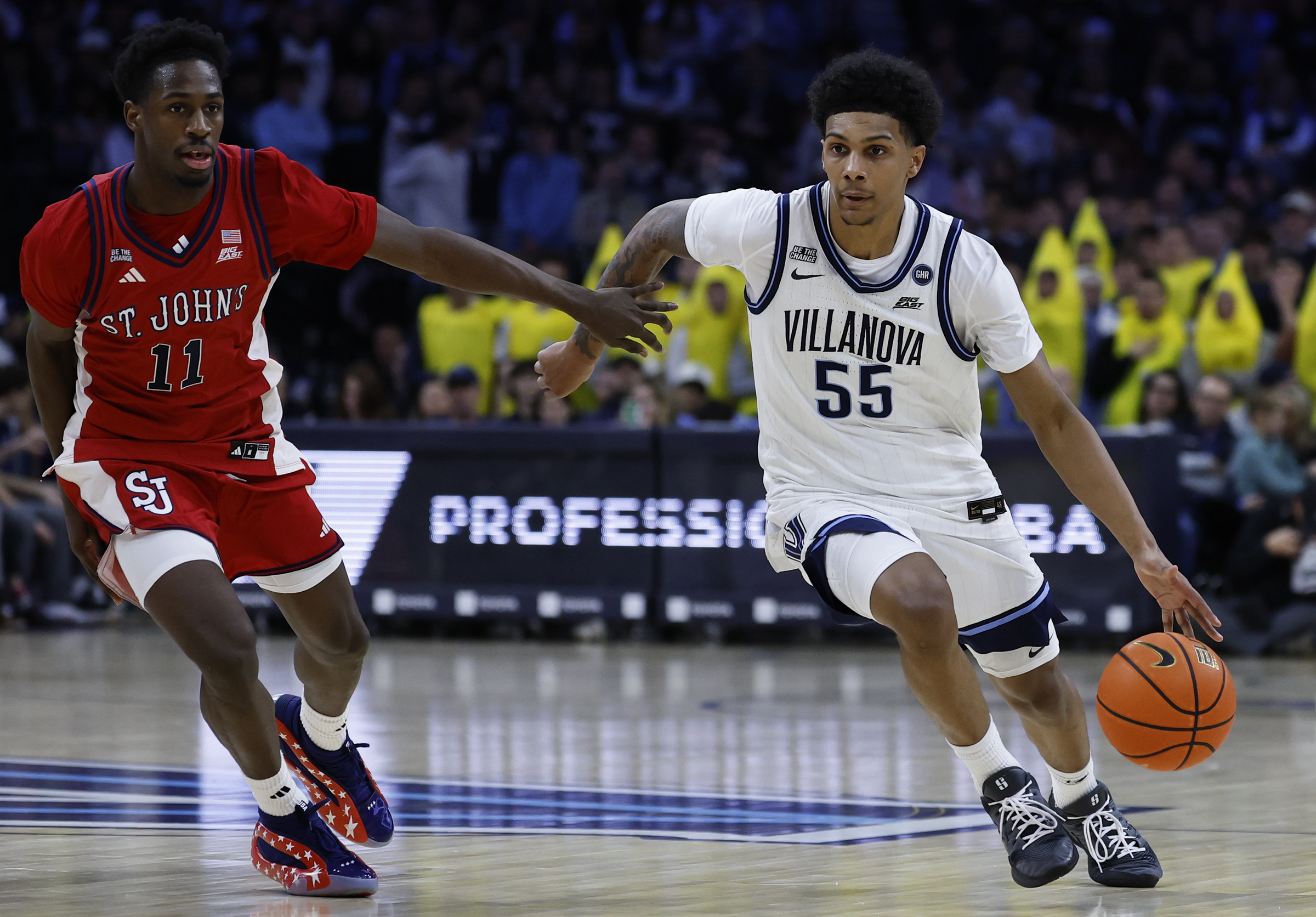
Guard Acaden Lewis is among those who could land the Wildcats back in the dance.
As things stand right now, Villanova likely would be favored in at least eight of its final 11 contests. Take care of six or seven of those, and there’s no need for a marquee win over UConn or St. John’s.
While 6-5 the rest of the way probably would be a disappointment, Lunardi projects that a final record of 21-10 gets Villanova “at worst” a No. 10 seed. The Wildcats’ ceiling, meanwhile, is “probably a five,” Lunardi said.
So, don’t count on the NCAA rewarding the Wildcats with a “home” game at Xfinity Mobile Arena to start the tournament.
Asked to put the resumé in perspective, Lunardi said: “I would describe it as a resumé of a regular good Jay Wright team, meaning a mid-single-digit seed, not a Final Four team. Everything has to go right to make the second weekend.”
That’s probably a result any rational person in ’Nova Nation would have signed up for nine months ago.
It also seems pretty accurate. Villanova is 15-5 because it mostly has taken care of business against teams it is supposed to beat. The nonconference schedule started with a loss to nationally ranked BYU, but then came seven consecutive games against teams well outside the KenPom top 100, including three dominant Big 5 wins.
The Wildcats were then blown out by Michigan before traveling to Wisconsin to beat the Badgers in overtime, which was followed up with a road victory over Seton Hall to begin conference play. At the time, those were pretty good wins. Only the Wisconsin game has aged well.
As of Tuesday morning, Seton Hall was Lunardi’s first team outside the field of 68 after a four-game losing streak.
Forward Matt Hodge and guard Tyler Perkins have Villanova in good shape despite a near-miss against UConn on Saturday.
It is a Villanova resumé without a signature win, and it might not need one. Why?
“They don’t have the dreaded bad loss,” Lunardi said.
Last year’s resumé had losses to Columbia, St. Joseph’s, and a down Virginia team. The year before featured losses to St. Joe’s, Penn, and Drexel. This year’s biggest blip currently is against a Creighton team that still is on the NCAA Tournament bubble.
Show me the math
Lunardi says his projections are pretty conservative and include some emphasis on past similar resumés. Right now, Villanova has more than an 80% chance of making the NCAA Tournament, according to Lunardi’s projections.
On the more extreme side, the TourneyCast projections at Bart Torvik’s analytics site have Villanova at 96% to make the dance. Torvik’s numbers are based on thousands of simulations playing out the rest of the season.
“It’s too early to make anybody a lock,” Lunardi said.
But it’s getting closer to that time.
If there was anything to worry about right now for Villanova fans, it should be health. The Wildcats are a key injury or two — even minor ailments — from scrambling a bit. They don’t have a reliable backup center, for example. Their depth has taken a hit elsewhere, too.
But those worries are hypothetical. Then again, all of this is.
What about the rest of the Big 5?
Villanova is the only one of the six Big 5 schools with an at-large path to the men’s NCAA Tournament. The others would need to win their respective conference tournaments. Of the bunch, only Temple (5-2) and St. Joe’s (5-3) entered Wednesday with a winning conference record.
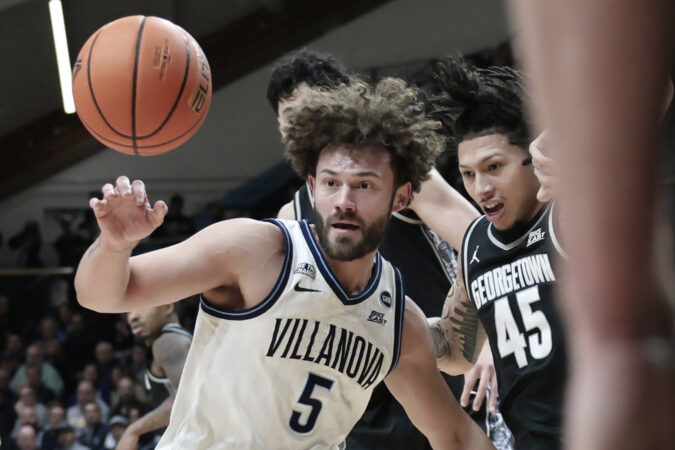
Villanova celebrates after a win over Xavier on Jan. 8.
On the women’s side
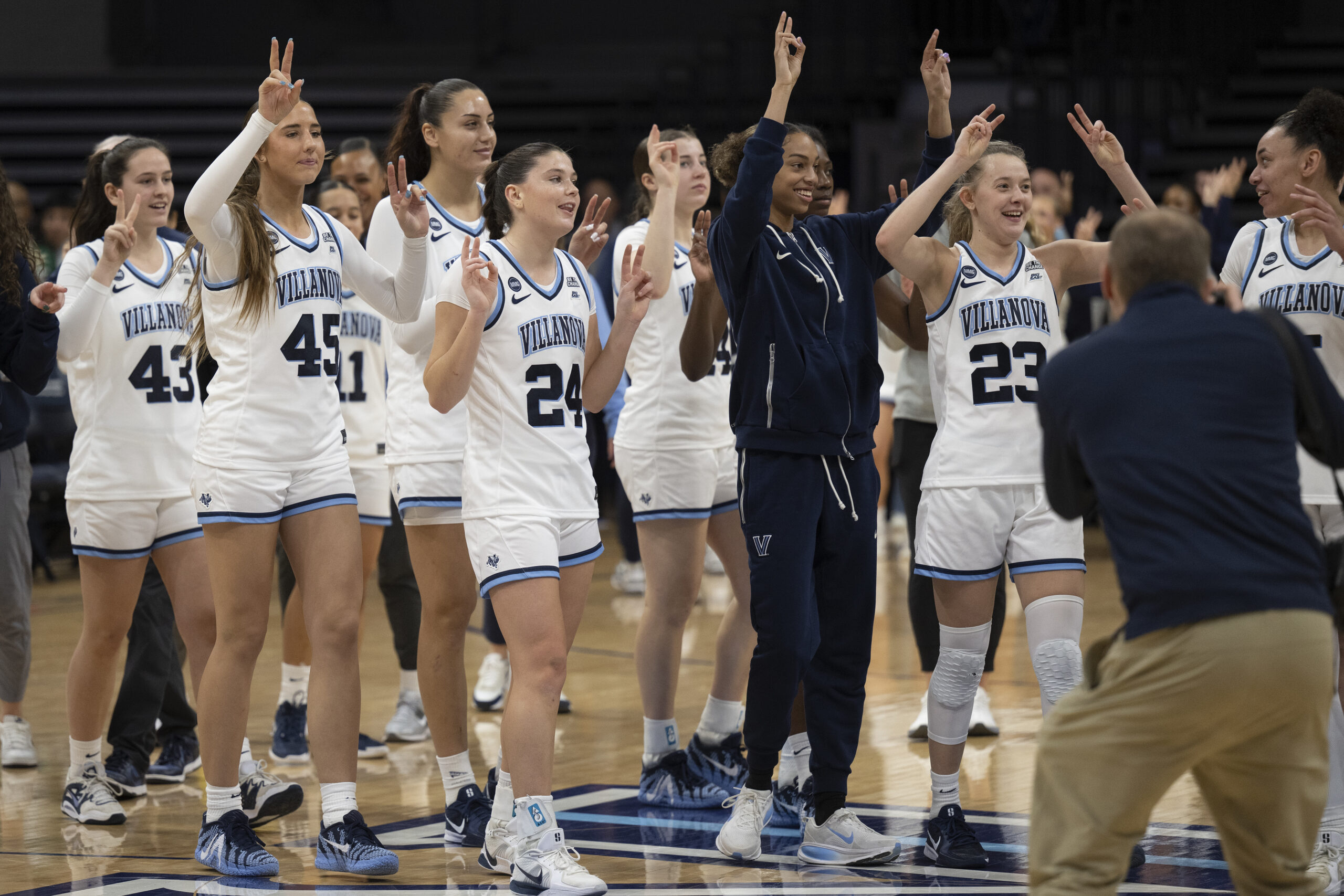
Similar story. Villanova (16-5, 9-3) was projected as a No. 10 seed on the right side of the NCAA Tournament bubble with an at-large bid in the latest ESPN women’s bracketology. No other team has an at-large path, and only Drexel (4-3) had a winning conference record entering Wednesday.