MINNEAPOLIS, Minn. — Federal immigration authorities have released an Ecuadorian man whose detention led the chief federal judge in Minnesota to order the head of Immigration and Customs Enforcement to appear in his courtroom, the man’s attorney said Tuesday.
Attorney Graham Ojala-Barbour said the man, who is identified in court documents as “Juan T.R.,” was released in Texas. The lawyer said in an email to The Associated Press that he was notified in an email from the U.S. attorneys office in Minneapolis shortly after 1 p.m. CT that his client had been freed.
In an order dated Monday, Chief Judge Patrick J. Schiltz expressed frustration with the Trump administration’s handling of Juan’s and other immigration cases. He took the extraordinary step of ordering Todd Lyons, the acting director of ICE, to personally appear in his courtroom Friday.
Schiltz had said in his order that he would cancel Lyons’ appearance if the man was released from custody.
“This Court has been extremely patient with respondents, even though respondents decided to send thousands of agents to Minnesota to detain aliens without making any provision for dealing with the hundreds of habeas petitions and other lawsuits that were sure to result,” he wrote.
The order comes a day after President Donald Trump ordered border czar Tom Homan to take over his administration’s immigration crackdown in Minnesota following the second death this month of a person at the hands of an immigration law enforcement officer.
Trump said in an interview broadcast Tuesday that he had “great calls” with Minnesota Gov. Tim Walz and Minneapolis Mayor Jacob Frey on Monday, mirroring comments he made immediately after the calls.
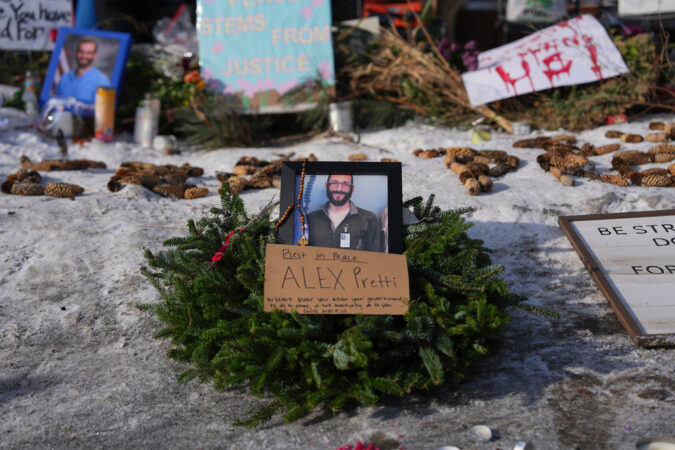
As he left the White House, the president was asked whether Alex Pretti’s killing by a Border Patrol officer Saturday was justified. He responded by saying that a “big investigation” was underway. In the hours after Pretti’s death, some administration officials sought to blame the shooting on the 37-year-old intensive care nurse.
The seemingly softer tone emerged as immigration agents were still active across the Twin Cities region, and it was unclear if officials had changed tactics following the shift by the White House.
Walz’s office said Tuesday that the Democratic governor met with Homan and called for impartial investigations into the shootings involving federal officers. They agreed on the need to continue to talk, according to the governor.
Frey and Minneapolis Police Chief Brian O’Hara said they also met with Homan and had a “productive conversation.” The mayor added that city leaders would stay in discussion with the border czar.
The White House had tried to blame Democratic leaders for the protests of immigration raids. But after the killing of Pretti on Saturday and videos suggesting he was not an active threat, the administration tapped Homan to take charge of the Minnesota operation from Border Patrol commander Gregory Bovino.
The streets appeared largely quiet in many south Minneapolis neighborhoods where unmarked convoys of immigration agents have been sighted regularly in recent weeks, including the neighborhoods where the two deaths occurred. But Associated Press staff saw carloads of agents in northeast Minneapolis, as well as the northern suburb of Little Canada.
Schiltz’s order also follows a federal court hearing Monday on a request by the state and the mayors of Minneapolis and St. Paul for a judge to halt the immigration enforcement surge. The judge in that case said she would prioritize the ruling but did not give a timeline for a decision.
Schiltz wrote that he recognizes ordering the head of a federal agency to appear personally is extraordinary. “But the extent of ICE’s violation of court orders is likewise extraordinary, and lesser measures have been tried and failed,” he said.
“Respondents have continually assured the Court that they recognize their obligation to comply with Court orders, and that they have taken steps to ensure that those orders will be honored going forward,” he wrote. “Unfortunately, though, the violations continue.”
The Associated Press left messages Tuesday with ICE and a DHS spokesperson seeking a response.
Back at sea level, it looks like the Flyers left their energy in the Rocky Mountains.
Coming off a three-game road trip, with wins against two Stanley Cup contenders, the Vegas Golden Knights and Colorado Avalanche, you would have thought the Flyers would be amped to get back in front of the hometown faithful, especially since they had left town on a six-game slide.
But they came out with a lackluster effort, and the result was a 4-0 loss to the New York Islanders and goalie Ilya Sorokin. It marked the second time this season the Flyers were shut out and ended the team’s three-game point streak.
Had the Flyers won the game, they would have jumped ahead of the team from Long Island via tiebreakers into third in the Metropolitan Division, as each team would have had 59 points in 51 games.
Jean-Gabriel Pageau gave the Islanders a 1-0 lead in the first period while shorthanded against the unit with Trevor Zegras, Travis Konecny, Christian Dvorak, Bobby Brink, and Jamie Drysdale.
Off the offensive-zone faceoff to start the power play, which was won by Dvorak back to Drysdale, the puck ended up on Brink’s stick down the boards. He tried to pass it to Dvorak, but it went to Islanders defenseman Adam Pelech, and he knocked it away.
Pageau picked up the loose puck and dumped it in off Ersson, who steered it into the right corner. Islanders forward Casey Cizikas was first on the puck, despite having Brink and Drysdale there, and fed it back to Pageau, who was skating alone through the slot. It was the fifth short-handed goal the Flyers have allowed this season.
The Flyers left goalie Sam Ersson mostly hung out to dry on Monday night in a 4-0 defeat.
Philly fell into a 2-0 hole in the second period when Mathew Barzal deflected a point shot past Ersson. The line of Dvorak, Konecny, and Nikita Grebenkin got pinned in their own end with Dvorak out there for 2 minutes, 12 seconds, Konecny for 1:42, and Grebenkin for one minute.
Drysdale was also out there for 1:42, skating with Travis Sanheim for over a minute as the Islanders kept the puck to one side of the ice, with the Flyers unable to recover. In the end, Barzal pushed off Drysdale in front and moved into the slot to deflect the shot by Isaiah George.
Later in the second period, former Flyers defenseman and Sewell, N.J. native Tony DeAngelo made it 3-0 with a power-play goal.
Ahead of the goal, the Flyers had a chance to get on the board when Rasmus Ristolainen, activated before the game from injured reserve, got the puck to Owen Tippett while shorthanded. Tippett went one-on-one with DeAngelo, even making a between-the-legs move, but couldn’t get a shot off and sent it back to Emil Andrae at the point.
Andrae couldn’t control the pass, and the Islanders broke out three-on-two with Anthony Duclair carrying the puck up the ice. Duclair passed it back to Barzal on the right wing, and he found DeAngelo in the middle for the one-timer.
Pageau added another goal in the third on a pass by Maxim Tsyplakov. The forward got behind the defense after the puck came off the wall in the neutral zone, and fired one upstairs off the pass.
Philly had 21 shots, but only four from high-danger areas, according to Natural Stat Trick; two of those were on the power play. Sorokin entered the game with an 11-3-3 career record, 1.61 goals-against average, and .944 save percentage against the Flyers.
Breakaways
Ersson started his fourth straight game for the first time since Feb. 8-27, when he went 3-0-1. With Ristolainen activated, defenseman Hunter McDonald was loaned to Lehigh Valley of the American Hockey League. … The 2nd Annual Gaudreau Family 5K will be held on May 16 at Washington Lake Park in Sewell. Registration will open on Feb. 13.
Up next
The Flyers are on the road again for two games in two nights. First up, they see old teammate Egor Zamula and the Columbus Blue Jackets on Wednesday (7:30 p.m., TNT, truTV, HBO Max) before going to Boston to face the Bruins on Thursday (7 p.m., NBCSP+).
There I was, by myself late at night, manning the inspection point at a pedestrian border crossing in Nogales, Ariz., when a shifty-looking man approached. He had short-cropped hair and a good 30 pounds on me. I asked him for ID, and he failed to comply.
“I forgot my ID,” he said aggressively, coming in close. “Why you wanna do me like this? Just let me cross.”
I thought back to my training — mainly the Police Quest series of computer games — and put some distance between us as I attempted to talk him down. A few seconds later, he had stabbed me in the ribs, and I had shot him dead.
“You see what happened there?” I was asked by the U.S. Customs and Border Protection official who ran me through the scenario as part of the CBP media academy.
“I tried to engage and de-escalate the situation,” I said. In lieu of a head shake, he smiled.
“You have to exert control,” he told me.
In the 11 years since I went through my crash course on what CBP does — from officers manning the ports of entry to agents out on the border line — the mock use-of-force examples remain top of mind. It was a deadly five days, after all, as I also shot and killed a man who was throwing rocks at me in the desert. Control exerted, I guess.
It was no accident that these scenarios involved unavoidable use of lethal force. It was undoubtedly a way to show the bleeding-heart media types who participated in the academy what law enforcement could encounter in the field, day to day.
They needn’t have bothered with me. Yes, I was a bleeding-heart type, but I already knew law enforcement was dangerous. I also knew Border Patrol agents, liked them, and believed most of them were genuinely trying to do good out there.
I also knew that excessive use of force was bad, and that a desire for control can curdle.
U.S. Border Patrol Cmdr. Gregory Bovino arrives as protesters gather outside the Bishop Henry Whipple Federal Building, Jan. 8 in Minneapolis, Minn.
That’s what I see in videos of Border Patrol and of U.S. Immigration and Customs Enforcement agents who are smashing car windows or clashing with protesters. In recordings of interactions that quickly turn violent, I see the operational need for control (in theory, to ensure the safety of both civilians and law enforcement) devolve into the personal need for dominance.
It was that need to be the big man in charge that likely made ICE agents stop their vehicle and confront Renee Good almost three weeks ago — when she was neither an obstacle nor a threat inside her SUV — on a residential Minneapolis street. It was the anger and frustration at being questioned, at being disobeyed, that placed both agents and civilians in danger and ultimately cost Good her life. Shot in the head because … how dare she.
Before Alex Pretti was shot and killed Saturday by federal forces, he was defending two women who were being violently shoved after challenging Border Patrol agents. The minute that agent started pushing those women with little provocation beyond whatever words were exchanged, Border Patrol relinquished control of the situation.
The scrum that followed — as multiple agents pounded Pretti on the ground — was chaos. Chaos that eventually turned deadly, as agents saw that Pretti was carrying a gun.
Much as they did after Good’s death, administration officials tried to control the narrative of what happened, blaming the victim. Good was a “terrorist” who, according to Homeland Security head Kristi Noem, tried to run over federal agents. Pretti was a “would-be assassin,” according to Stephen Miller, Trump’s homeland security adviser, who was out to “massacre law enforcement,” according to Border Patrol operations chief Greg Bovino.
Multiple videos from the scene disprove the government’s story.
This sad quest for dominance, regardless of the consequences, comes from the top, of course. The latest example: Barely three days before Pretti was killed, Donald Trump apparently gave up on his bid to control Greenland. This came after days of speculation over whether the U.S. would invade a NATO ally over the president’s deranged demands.
In that case, Western allies came together and held firm in the face of Trump’s bullying. In Minneapolis, and whatever city is next on the White House’s hit list, Americans need to remind the administration of what it couldn’t and can’t control.
It could not control Good’s First Amendment right to speak out and stand up for what she thought was wrong, nor Pretti’s Second Amendment right to carry a firearm.
And it can’t control our Fourth Amendment right to protection from unreasonable use of force by law enforcement.
Chefs’ travels inspire their menus — for example, the konbini in Japan that Jesse Ito and Justin Bacharach visited for Dancerobot and the trattorias in Italy that Stephen Starr’s team scouted for Borromini, to name two just in the last year.
For Greg Vernick, the culinary inspiration for his first new restaurant in 6½ years — the casual Emilia, opening Tuesday in Kensington — was from a trip to Rome a few months ago with Meredith Medoway, Emilia’s chef de cuisine, and Drew Parrasio, culinary director for his restaurants.
Before they left, Vernick called chef friends like Marc Vetri, Jean-Georges Vongerichten, and Hope Cohen for recommendations: “Where do I need to eat? Street food, markets, trattorias, all of it.”
Carta di musica with butter, bottarga, and roasted chili at Emilia.
Emilia’s must-try dish came from a culinary school. Cohen’s suggestions included the American Academy in Rome. “We walked up one day thinking we’d just say hello and ended up spending the entire day there,” Vernick said. “They grow their own herbs and produce. We were eating arugula straight from the ground, picking rosemary and thyme — it felt cinematic.” Chef Sara Levi, who oversees the academy’s program, asked the three to join the students for the day’s family meal.
“One of the dishes was a simple chicken ragù pasta — hand-cut chicken, livers, hearts, very little sauce,” Vernick said. “Light, savory, a little gamey. We didn’t even talk much while we were eating it. Later, walking back into central Rome, we all realized: That was one of the best pastas we had on the trip, and we’d eaten three to five pastas a day for three days.”
Chefs Meredith Medoway and Greg Vernick at Emilia.
Back home in Vernick’s kitchen, they tweaked it to “just honor the idea,” Vernick said. It’s on the opening menu as “rigatoni, ragù bianco.” It’s also Emilia’s lone chicken dish — a somewhat daring move.
Emilia, just north of the York Street roundabout on Frankford Avenue, seats 60 in the dining room, with an additional 10 seats at the bar and 20 in a lounge area; in keeping with Vernick’s desire to make this a neighborhood place, some tables are held for walk-ins.
Canno Design’s Carey Jackson Yonce, working with California-based designer Bob Bronstein, has the lighting set to “subdued.”
“I wanted it to feel like the kind of place where you walk in and exhale and relax,” Vernick said. “Industry-friendly, not precious. We want to hit two markets from day one: the neighborhood and the industry. If you get those right, everything else falls into place.”
Arranged flowers in the dining room at Emilia.
Italian is a new turn for Vernick, who started here in 2012 with the New American Vernick Food & Drink before adding Vernick Coffee Bar in 2018 and Vernick Fish in 2019. The developers of Emilia’s building were keen on having an Italian restaurant, and Vernick’s thoughts naturally turned to Medoway, the longtime chef de cuisine at his flagship.
The bar program focuses exclusively on Italy, with low-intervention wines, amari, spritzes, and a rotating seasonal negroni, along with Italian sodas and zero-proof cocktails.
Sea scallop crudo and burrata at Emilia.
Much of the menu is coursed and priced as smaller plates (figure teens and $20s). The few entree-sized dishes, such as golden tilefish ribollita and grilled sea bream, start in the high $30s; top price is $53 for crispy veal with broccoli di ciccio.
There’s other house-made pasta on the menu, such as capellini with pesto, and radiatore in mushroom Bolognese. Much of Medoway’s cooking is centered on a 48-inch charcoal- and oak-fired grill. Each table receives complimentary breads — house-made focaccia, Mighty Bread’s sesame ciabatta, and the thin bread sticks known as grissini.
The bar area at Emilia.
Another anchor main course dish is rabbit Emiliana, a regional take on cacciatore from Emilia-Romagna that Medoway devised after a trip of her own. The braised rabbit is finished with roasted peppers, green olives, fresh orange, and vinegar, giving it a punchy, slightly sweet-sour profile.
Several smaller plates lean into texture and contrast. Carta da musica, a paper-thin Sardinian cracker, is spread with soft butter, dusted with grated bottarga, and topped with a relish of fire-roasted peppers. You crack it at the table and share the shards. “It’s about breaking bread together,” Vernick said.
A sea scallop crudo pairs raw scallop with burrata and a caper-chili vinaigrette, a combination Vernick said surprises people at first because of the similar textures. “It works, though,” he said. “It’s simple but exciting.” Grilled cabbage, blanched and then charred over the wood fire, is tossed with a colatura vinaigrette and finished with pecorino. “It reads ‘boring,’ but it eats incredibly well,” he said.
Emilia, 2406 Frankford Ave., 267-541-2360, emiliaphilly.com. Reservations open on Resy. Hours: 5 to 9:30 p.m. Sunday to Wednesday, 5 to 10 p.m. Thursday to Saturday.
Call Your Mother — the popular neighborhood bagel shop and “Jew-ish” deli from the District of Columbia — is headed to the Keystone State.
It’s part of a steady ongoing expansion, including about 25 locations across D.C., Maryland, Virginia, Colorado, and Illinois, plus more on the way.
The first Philly location will be in Fishtown, in the corner space of 1500 Frankford Ave., and is expected to open this summer, owners said.
“This will be the start of more shops in Philly,” co-owner Andrew Dana said. “But we’ve never had a master plan on how to roll out. We’ll go where people want bagels and where we’re excited to be, as long as our food quality and service stay the same.”
With colorful decor that would feel right at home in West Palm Beach and stuffed bagel sandwiches made with latkes, whitefish dips, and smoked salmon, Call Your Mother is popular across the DMV.
In the six years since Dana and his wife, co-owner Daniela Moreira, opened that first location, the shop has been praised across food publications like Bon Appétit and Eater for its vibe and sandwiches. Some critics say the menu is overpriced, but items on the D.C. menu — including sandwiches and loose bagels — appear similarly priced to most of Philly’s bagel outposts (and sometimes cheaper).
On that note, Dana says to expect the same Call Your Mother signature menu items — like its bacon, egg, and cheese sandwiches and its babka muffins. “But we’re in the lab trying to cook up some special Philly flair, too,” he said.
You can also expect a colorful buildout.
“Most of the building will be painted pink, but we’re on the hunt for a local muralist to put an extra stamp on the building,” Dana said. “We’re also looking for local Philly food products to showcase.” Locals interested in getting in on the mix are encouraged to direct message Call Your Mother on Instagram.
The expansion comes amid a bagel boom in the Philly area: Viral bagel chain PopUp Bagels is set to open its first Pennsylvania location in Ardmore with seven more locations on the way in the Philadelphia region, including Suburban Square and Center City. Bart’s Bagels of West Philly is opening its third location in Bala Cynwyd, and Penny’s Bagels is coming to Haddonfield this year, as well.
“It’s a rise of the tide situation,” Dana said. “We’re not trying to take anyone’s territory. We don’t want to threaten a local spot. People love carbs, people love bagels. There’s enough room for everyone.”
The Frankford Avenue spot is part of a surge of popular food options in the area. It’s right across the street from Marina’s Pizza and El Chingón, and down the road from the new Medium Rare location.
“The infusion of best-in-class national brands like Call Your Mother Deli represents Fishtown’s strength today,” said Stefanie Gabel of MSC, who represented both Call Your Mother and the building’s landlord in the transaction. Gabel will continue to represent Call Your Mother as the deli expands within the Philly region. “Their presence also serves as a catalyst for the continued growth and longevity of Philadelphia’s most explosive mixed-use ecosystem.”
Call Your Mother recently made national headlines when it filed a trademark lawsuit against New Jersey’s Call Your Bubbi, a beach town cafe and kosher-certified bagel shop in Long Branch. Dana and Moreira said the Jersey cafe, which also sometimes goes by Bubbi Bagels, intentionally used a “confusingly similar” name and branding at times.
The dueling shops settled outside of court in early January, according to court documents. Dana declined to comment on the terms. Bubbi Bagels owner David Mizrahi could not be reached for comment.
As for what drove the couple to come to Philly, Dana said it was a simple decision: He very literally called his mother, Mary Wilson.
Wilson’s parents lived in Mount Airy and growing up Dana would visit his maternal grandparents often. He would go to their house, venture downtown, and explore Chestnut Hill. One of his best friends attended Penn. His cousins live on the Main Line. His other best friend lives in Bryn Mawr. In many ways, Dana says Call Your Mother coming to Philly is a natural progression.
“I’ve spent an insane amount of time here. I love the culture, the food, the vibe. It’s a great place to be,” he said.
Two Philadelphia City Council members will introduce legislation this week to restrict cooperation with U.S. Immigration and Customs Enforcement. The push comes as ICE faces mounting national scrutiny over its tactics in Minneapolis.
Councilmembers Kendra Brooks and Rue Landau are expected this week to introduce a package of bills aimed at pushing back against ICE activity in Philly, home to an estimated 76,000 undocumented immigrants.
In the legislation: Among other directives, the bills would limit information sharing between the city and ICE and effectively make permanent Philadelphia’s status as a so-called “sanctuary city” by barring authorities from holding people at ICE’s request without a court order.
National context: While activists have been calling for Philadelphia leaders to formalize its sanctuary city status for months, this Council action comes after federal agents shot and killed two civilians in Minneapolis in the last three weeks, prompting national outrage.
Eyes on Parker: Mayor Cherelle L. Parker has largely avoiding criticizing the Trump administration outwardly. She may now be forced to take a side if the legislation reaches her desk.
In other ICE news: Sen. John Fetterman (D., Pa.) on Monday called for the federal immigration enforcement operation in Minneapolis to “immediately end,” while Sen. Dave McCormick (R, Pa.) on Sunday called for a “full investigation into the tragedy” following Saturday’s fatal shooting.
At Lankenau Environmental Science Magnet High School, students can join a birdwatching club, take pesticide classes, and work with beehives. The school, based in the woods of Roxborough, is the state’s only three-year agriculture, food, and natural resources career and technical education program.
Now, it’s one of 20 city schools proposed for closure in the Philadelphia School District’s facilities plan.
Lankenau’s inclusion on that list is a blow to its students and staff. They say they aren’t letting it go down without a fight.
Notable quote: “Lankenau takes education to the next level,” a junior told The Inquirer. “The environment is beautiful, the woods are amazing — that’s another classroom. Nature is like therapy for a lot of people — it changed my life.”
State Rep. Joanna McClinton has carefully wielded her power as Pennsylvania House speaker. Now, she’s taking a more active role in pushing for the issues she cares about most, with special attention to the home care wage crisis.
A federal judge denied convicted former labor leader John Dougherty’s latest request to serve the rest of his six-year prison term on house arrest to care for his gravely ill wife.
A split Pennsylvania Game Commission has voted in favor of a developer’s land swap widely opposed by Limerick Township residents who fear it could pave the way for a large data center.
The Philadelphia Housing Authority plans to reopen the derelict former Germantown Settlement properties by 2029 — at great cost.
A bill signed last week by former N.J. Gov. Phil Murphy makes it easier for manufactured home and mobile home residents to buy their communities.
Meet Laura Carlson, University of Delaware’s new president, who runs weekly with staff and students and wants better relationships with state and local governments.
Opera Philadelphia has signed an early contract extension with director Anthony Roth Costanzo, who since 2024 has brought national attention and funding to the arts org.
Quote of the day
Did you know bats are both helpful and extremely cute? See what else Stephanie Stronsick, a bat expert who rehabilitates them in her Berks County home, wants you to know about the winged mammals.
🧠Trivia time
After its trademark and intellectual property were acquired by an investment firm, which bankrupt firm could be revived in some locations?
Cheers to Tony Jagielski, who solved Monday’s anagram: Philly Auto Show. The annual event returns to the Convention Center this weekend. More brands and electric vehicles are expected, despite the automobile industry’s volatile year.
Photo of the day
Yerome Rillera and his 9-year-old son, Kersey, sled down the steps of the Philadelphia Art Museum on Monday.
Job hunters beware: Some of the hard-earned skills listed on your resume are going unnoticed by potential employers.
Workers’ profiles on job posting websites often feature general abilities, like leadership, communication, teamwork, and problem-solving, a recent report from the Wharton School says. But they’re not highlighting the “specialized, execution-oriented skills,” employers are seeking. That’s created a “skills mismatch economy.”
“People are not representing their skills in a way that’s necessarily resonating with the skills that employers want,” said Eric Bradlow, the vice dean of artificial intelligence and analytics at the Wharton School, who co-authored the report.
Meanwhile, AI has been speeding the shift from a “role-based labor market to a skills-based economy,” the report outlines, making it all the more poignant to know what skills employers actually want.
Bradlow says generative AI has been “a positively destructive bomb on roles and titles,” by making workers able to carry out tasks that they didn’t know how to do in the past. So “having a specific job title is becoming less relevant.”
The Wharton School worked in partnership with Accenture, a professional services firm, to analyze millions of job postings and worker profiles for the report. The study useddata from Lightcast, a labor market data provider, andthe U.S. Bureau of Labor Statistics. Bradlow spoke with The Inquirer about their findings.
This conversation has been edited for length and clarity.
What are some skills included on resumes that don’t make much difference to employers, because everyone seems to have them?
Do we think it’s important to communicate? Well, yeah, of course, it is. Do we think it’s important to have leadership skills and manage teams well? Yeah, of course. Last time I checked, those were really important parts of the job — but everybody puts that down.
We’re not saying in the report that those skills aren’t important. What we’re saying is there’s an over supply of people stating those skills, as opposed to companies saying these skills are what’s going to get you the job.
Companies are realizing that depth of skill is what’s going to be really important.
Do people lack the specialized skills employers are looking for? Or are they just failing to highlight them on their resumes?
That’s something, trust me, I wish I could answer.
If we had people’s transcript data, or if we knew what courses someone had taken, then we could try to get an understanding of what skills people actually have.
I think two things are going to happen, based on this Wharton-Accenture Skills Index gap report. Number one is, you will see a migration where people [will say,] “I need to acquire those skills, if I don’t have them, if I want a job.” Second, you’ll see [organizations] — whether it’s an academic institution or a for-profit institution — saying, “Wait a second, here, we need more people with this skill. We’ll create a certification program.”
You found that some skills are actually tied to higher-paying jobs. Was that surprising?
I’m not sure I had hypotheses about which skills would be paid higher or lower.
I think maybe the part that surprised me a little bit was that there wasn’t massive swings and variation like “if you have this skill, your salary doubles.” That’s not what we found in the data.
What advice would you give someone crafting their resume?
One is talk about the specific skills you have. Every resume I read says “I’m an effective communicator, experienced leader.” That’s fine, but that’s not what’s going to stick out and become differentiated, because everyone’s going to say that. To the degree that you have specific expertise and depth or skills, those are the kinds of things to put on the resume.
The second thing I would say is that … we should be in the skills acquisition business, be a lifelong learner. Skills will always be valued. Jobs in a particular workflow can go away. People with skills will be hired.
Take, for instance, a customer-support agent in a customer-satisfaction group. If you’re someone with exceptional problem-solving skills, you’re hearing your customer, and you’re able to tie it to some remedy; that skill is not going to go away even if the job you’re currently in happens to go away.
What skills are needed more or needed less because of the adoption of AI recently?
I don’t view it as AI replacing humans. I view AI as that decision-support tool you should use for every decision.
If I were an employer today, I wouldn’t even consider hiring someone that didn’t recognize the power of artificial intelligence as a decision-support aid. I don’t know what business decision — pricing decision, product launch decision, product design decision, possibly even hiring decision — [for which] I wouldn’t use artificial intelligence as a decision-support tool.
I would also say, equally, I’m very concerned about the agentic use of AI — in some sense totally handing over high-stakes decisions.
From where you stand, is AI coming for people’s jobs, as we often hear, or is it coming for their skills? What’s the difference?
Go through the history of mankind.
The train engine came. So you mean we don’t need as many horses? Electricity came. You mean we don’t need as much coal? Green energy came, and so now we don’t need as much nuclear fusion?
Doesn’t technology always come and translate one set of jobs to another set of jobs? It’s not AI is coming for your job. What companies are realizing about AI is there are certain roles and functions that AI can do extraordinarily well, with high accuracy, and in some cases better than humans can do. These tend to be functions, by the way, that many humans don’t like doing anyway.
I don’t see AI coming for your job any more so than any set of technology. This is an extraordinarily disruptive technology, but we’ve lived through periods of extraordinarily disruptive technology.
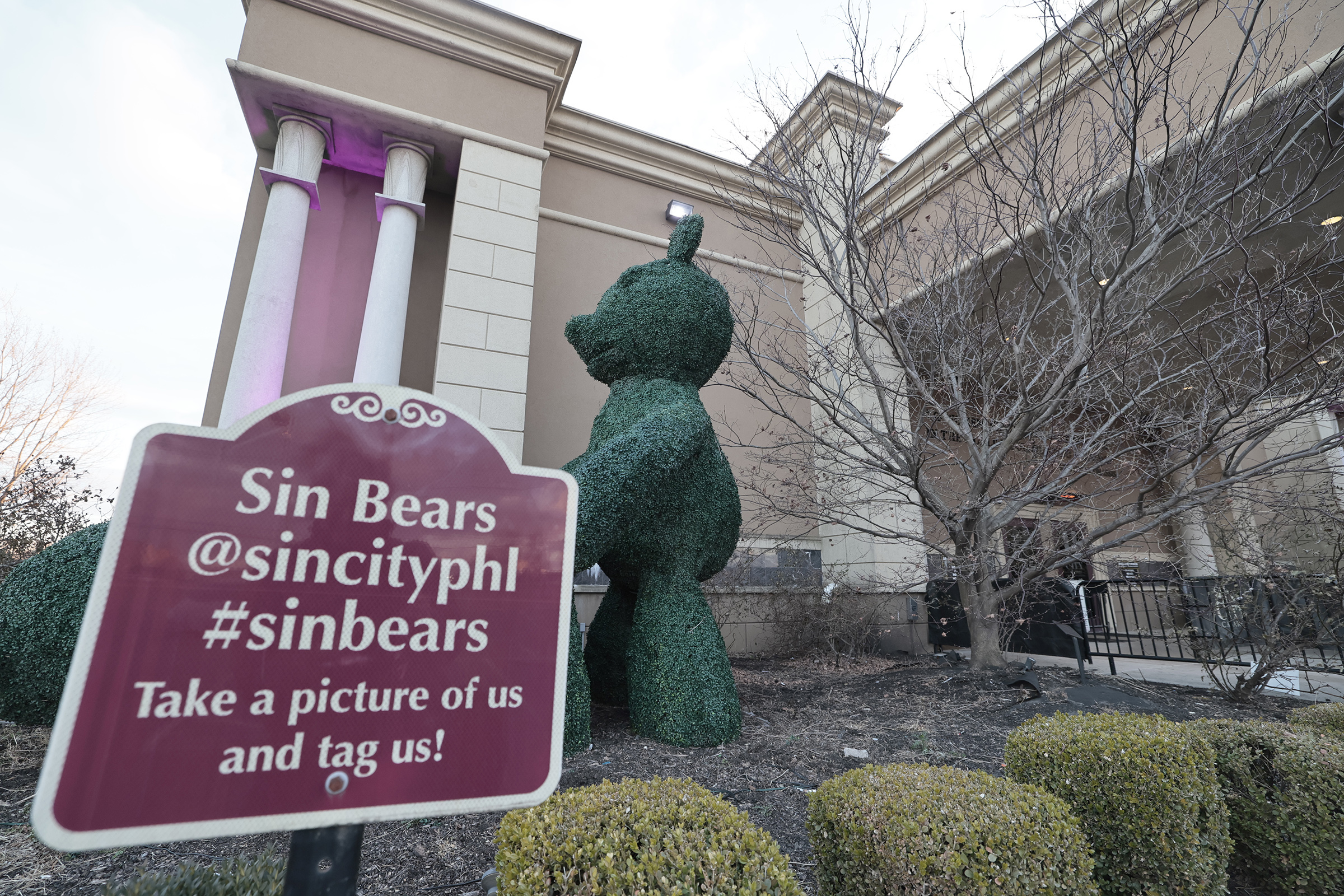
That’s what Gloucester County resident Gabby Weiland recalled thinking after she made a wrong turn while Doordashing in Southwest Philly earlier this month. Instead of finding a customer waiting on the curb for her lunch, Weiland found herself outside of Sin City Cabaret Nightclub at 6130 Passyunk Avenue. One 8-foot-tall topiary Care Bear bending over another greeted her.
“Got lost in Philly and pulled over to see where I was … looked up and —,” Weiland captioned a TikTok that pans from the fourth-base bears back to her face, which appears equal parts mortified and confused. The 12-second clip has racked up more than 1.4 million views — and its fair share of jokes.
“What in the bear necessities?” commented one TikTok user. “They…they’re…playing leapfrog…RIGHT???” wrote another. Others assured Weiland not to worry because the bears are clearly in a committed situationship.
Many, however, knew where the bears were. “Oh, you found Sin City,” read a comment that’s been liked more than 8,600 times. According to strip club owner Gus Drakopoulos, that means the topiaries are working.
“If someone does a double take and posts a video or selfie, then the art did it’s job,” said Drakopoulos, 49, who had the topiaries installed in 2021. “I want images of those bears to be synonymous with the brand Sin City.”
Drakopoulos opened the original Sin City in the Mott Haven section of the Bronx in 2002at age of 25 after a securities fraud conviction sidelined his career as a stockbroker. Almost immediately, the club earned a star-studded reputation: Rapper Cardi B was discovered while performing there, and celebs ranging from Mike Tyson to Philly’s own Meek Mill were regulars.
Sin City owner Gus Drakopoulos poses in front of the 8-foot-tall bear topiaries that sit in front of his nightclub. The bears cost $18,000, Drakopoulos said.
Drakopoulos was forced to close the OG Sin City for good in 2018 after the club lost its liquor license. He relocated it to Philly in 2020 just before the COVID-19 pandemic. The bears came a year later in November 2021, Drakopoulos said, as a way to signal to patrons that Sin City is a more artful, avant-garde gentleman’s club experience.
“The bears are playful and open for interpretation,” he said. “You can say they’re playing football. Go Birds.”
“I fell in love with the idea,” Drakopoulos said. “The bears look so innocent and at the same time, depending on the eye of the beholder, so not.”
Both sets of bears are designed by celebrity topiary artist Joe Kyte, whose 2-acre topiary garden in Tellico Plains, Tenn., has churned out larger-than-life dragons, Formula 1 cars, and semi-realistic bottles of booze for clients ranging from Legoland and Ferrari to Absolut Vodka since 1992.
Kyte got his start working as a subcontractor for Disney parks in the 1980s, he previously told The Wall Street Journal, fashioning hippos and various versions of Mickey Mouse out of materials ranging from ivy to moss. He told The Inquirer that his clients have only gotten raunchier. In 2020, Kyte was commissioned by a Dutch adult magazine to create a photorealistic vagina out of hydrangeas, rosemary, and mullein leaf for a launch party in Holland.
Drakopoulos, Kyte said, was the first strip club owner to ever contact him. It was an immediate yes, he said.
“This is the first time a strip club has paid me. Normally it’s the other way around,” Kyte, 67, joked over the phone.
Drakopoulos paid $18,000 for two bears, which Kyte took two weeks to construct by arranging weather-resistant artificial boxwood atop custom-made metal frames. To finish the job, Kyte and an employee had to drive to 687 miles to Philly to install the bears, at one point getting stuck for hours in standstill traffic on I-81 in Virginia. Bored drivers, Kyte recalled, couldn’t stop taking photos.
“It’s wonderful that the bears are standing the test of time … Wouldn’t you be proud of them?” said Kyte, who is planning another trip to Philly to do maintenance on the Sin City bears later this winter. The sun’s UV rays have bleached parts of the deep-green topiaries.
Another angle of the bear topiaries outside of Sin City Cabaret Nightclub on Passyunk Avenue. “The bears are playful, and open for interpretation,” owner Gus Drakopoulos said.
It’s unclear if the bears have lead to more business for the club, Drakopoulos said, which has a roster of roughly 500 dancers. In 2022, rapper and Super Bowl LIX halftime performer Bad Bunny dropped $50K at Sin City hours before his Made in America performance. It’s not uncommon for some of the Eagles roster to come through, Drakopoulos said, though he declined to name specific players out of respect for their privacy.
Weiland, whose video went viral, was unaware initially that the bears belonged to a strip club. She’s never been to one, though Sin City may wind up being her first.
“Apparently, they have good food,” Weiland said. “And it looked like a very well taken care of place.”
On Thursdays at 7 a.m., Laura Carlson is by the iconic granite and bronze sculpture of an open book on University of Delaware’s Mentor’s Circle.
As the new university president, she invites faculty, staff, students and community members to join her there and run a five-kilometer loop through campus. Typically 10 to 20 people show.
“Rain or shine, we run down to the track on South Campus, loop the track and come back,” said Carlson, 60, who began the treks as interim president last summer and is continuing them in her permanent role, which started earlier this month.
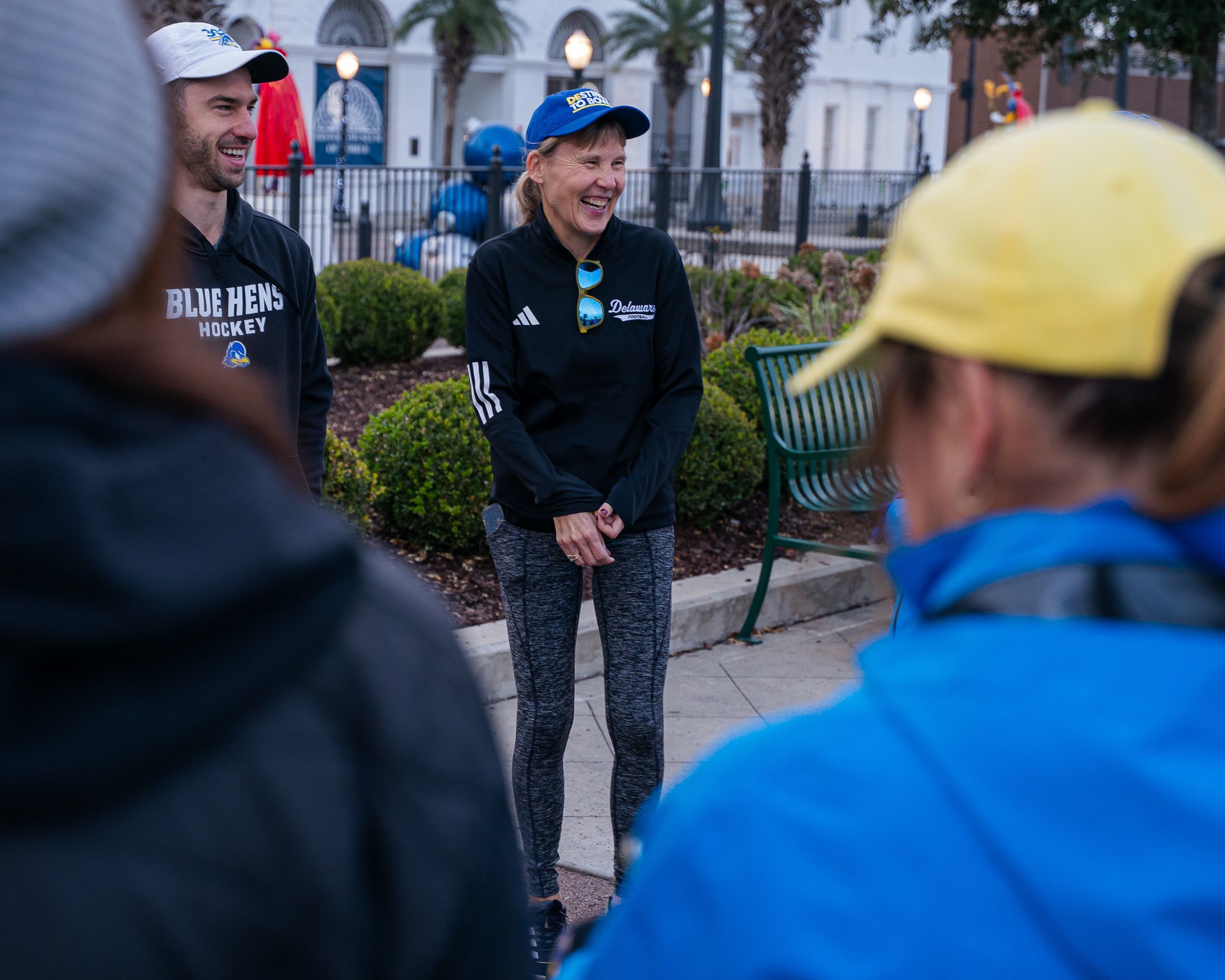
University of Delaware president Laura Carlson (right) goes on one of her Prez Runs in Mobile, Ala., where the Blue Hens won a bowl game, defeating Louisiana-Lafayette 20-13 on Dec. 17, 2025.
The “Prez Run” is just one way the psychology scholar — who plans to run her 15th Boston Marathon in April — is building relationships on campus, with alumni and with the community and state. She also runs with alumni, employees, and students during events in other cities.
“I’ve heard that the alumni association is going to put it on their bucket list of 10 things to do before you graduate,” she said.
Carlson, a Dartmouth alumna who got her doctorate in cognitive psychology from the University of Illinois Urbana-Champaign, is focused on strengthening relationships with state and local governments and internally with faculty. Finding new revenue streams to plug holes from terminated federal grants and recruiting students in new national markets also are on her list.
The Massachusetts native previously served as provost for three years, having come to Delaware after 28 years as a faculty member and administrator at the University of Notre Dame in Indiana. She’s the first internal candidate to get the presidential appointment in about 50 years.
She follows Dennis Assanis, who resigned in June and is now chancellor of the University of California at Santa Barbara.
Laura Carlson, president of the University of Delaware
Carlson is visiting classes each semester, including elementary organic chemistry and mechanical engineering.
“I want to make sure I don’t feel distant from the rhythm of the academic year,” she said. “Anything we value, we should put attention on it.”
When building a team, she asks participants to pick their top 10 values, such as family, world peace, humor, and authenticity, and rank them. Her top value is always purpose.
University of Delaware president Laura Carlson talks to fellow runners during one of her Prez Runs in Mobile, Ala., where the football team won a bowl game.
“I want to live a life of purpose,” she said.
Partnering with state and local government
She’s attempting to change the way the partnership with the state is viewed.
“We lead with what does the state need from us, as opposed to what do we need from the state,” she said.
Southern Delaware, where the university has a campus in Lewes and Georgetown, has housing, healthcare, education and workforce development needs, and the university can help, Carlson said.
She said she can envisiona public-private partnership for new housing in Lewes, she said,or a classroom building with event space for the community.
Laura Carlson, president of the University of Delaware, discusses her priorities.
“If we are a university for the whole state, we need to show up in the whole state, and we need to be responsive to the needs across the state,” she said.
She’s also looking at the possibility of more residential space for the main campus in Newark — possibly a “sophomore village” — through a public-private partnership. The university has about 7,100 residential beds in Newark.
“That would take some of the pressure off the city,” she said, noting the tight rental market, and adding that parents and students may prefer on-campus housing options.
She also wants to help Delaware Gov. Matt Meyer with his plan to bring medical education to the state. Delaware remains one of few states without a medical school. The idea is not to build one from scratch but to partner with an existing medical university, she said.
“We’ve been in conversations with Thomas Jefferson” in Philadelphia, which has a nonexclusive memorandum of understanding with the state to explore a partnership, she said. “What we offer is the classrooms, the lab space, and so on to do kind of the first part of that medical school type of training.”
Dealing with the federal government could be more challenging. The university has lost 41 grants worth $33.9 million since President Donald Trump took office last year. Those span engineering, biological sciences, arts, and sustainability, she said, and impact 117 graduate students and 27 postdoctoral students.
In total, $1.1 million in salaries and $2.1 million in stipends have been lost, though the university has been working to find other funding through foundations and industry, she said. No one has lost their job, she said.
“I’ve been really working hard on … kind of strengthening those relationships with our business community,” she said.
The school also has experienced a 19% decline in international graduate students following Trump’s pause on student visas and other policies, and the school lowered its doctoral admissions by 19.5% last year amid concerns over federal funding. What will happen with doctoral admissions this year is unclear.
“Each college is sort of looking strategically program by program and trying to figure out what is the right size for their doctoral programs,” she said. “If they’re compressing their number of students coming in, it’s because they’re trying to prioritize funding for their existing students.”
The school’s overall enrollment of more than 24,000 rose last fall and applications are up 10%, she said. But as another drop in high school graduates begins this year, the university has found success in new recruiting areas such as Colorado and Wake Forest, N.C., where the football team played as part of the school’s entry into Conference USA, she said.
“We’ve been very strategic about putting marketing in there, convening alumni and really using that as a way to establish ourselves more nationally,” she said.
Biden Institute — and a conservative counterpart
She said the university is on course to build Biden Hall, an academic building named for former President Joe Biden, a Delaware native. It will house the school’s Biden School of Public Policy and Administration and the Biden Institute on government theory and practice. The design phase likely will begin this spring.
Fundraising is also continuing for Siegfried Hall, which will include the Institute for Free Leadership and Enterprise. The donors, Robert L. Siegfried Jr., a certified public accountant and his wife, Kathleen Marie (Horgan) Siegfried, have said they wanted to bring a “conservative” vision and offer a balance to the Biden Institute.
Carlson said she doesn’t view the halls as conservative and liberal, but rather places where ideas can be vetted. She noted the Biden Institute is nonpartisan.
“Siegfried is a think tank on conservative economics, but part of that building will be also to sort of question the limits of those policies,” she said. “That’s what we do in any discipline.”
Personal life
Here are a few fun facts about Carlson, whose husband, Robert West, is a professor of psychological and brain sciences at the university.
Last book read: Chris Whitaker’s All the Colors of the Dark.
Favorite band or musical group: Bruce Springsteen.
Favorite food: Indian. Greek.
Favorite vacation spot: “I spend so little time at my house. Some of my best days on break are if you don’t even get out of your pajamas.”
As John Buck watched the final seconds of the Dec. 4 matchup between the 76ers and Golden State Warriors, he was unsurprised by how VJ Edgecombe reacted to teammate Tyrese Maxey’s deep fadeaway jumper with 2.5 seconds remaining.
Edgecombe instantly sensed where the ball might be if the shot fell short, Buck said, then “slithered” into that space, elevated, and grabbed the partially blocked attempt to convert a game-winning putback.
“How many guards just stand there and watch the ball get shot and hope it goes in?” said Buck, who coached Edgecombe at Long Island Lutheran High School in Brookville, N.Y. “VJ was moving into the spot where it may have missed.”
Yes, Edgecombe’s athleticism is electric. Yes, the rookie’s three-point shooting has been a pleasant surprise. But perhaps what Sixers coach Nick Nurse and teammates have raved most about Edgecombe so far is his beyond-his-years basketball IQ.
That natural feel helped put Edgecombe in position to be one of the NBA’s top rookies — on Monday night he was named to the Rising Stars roster for All-Star Weekend — along with an immediate starter for a Sixers team in the thick of the Eastern Conference playoff picture, and a player already with a knack for clutch fourth-quarter moments on both ends of the floor. When asked recently about this aspect of his game, Edgecombe agreed it has “played a lot” into his early NBA success.
“If you watch the game,” Edgecombe told The Inquirer at his locker last week, “you understand the game, understand the flow of the game, the importance of possessions, I rely on my IQ a lot. That’s the most [important part] of the game, the mental part.
“I just try to make sure I’m locked in mentally, to make certain plays and be decisive.”
So what are the origins of such a trait? Matter-of-factly, Edgecombe says, “I watch so much basketball.”
As a child in Bimini, the Bahamas, he initially spent the bulk of his free time playing the sport on dirt courts and makeshift hoops outside. But once his mother bought him a tablet as a middle schooler, YouTube became an endless supply of player highlights and archived games. He could utilize his already “really good memory” while transitioning from watching for entertainment to studying. He even discovered some of Maxey’s film from his time playing for South Garland High School in the Dallas suburbs.
“He didn’t believe me,” Edgecombe said, explaining how he told Maxey after they became Sixers teammates. “And I had to literally tell him my basketball knowledge.”
When Edgecombe moved to the United States and eventually joined Long Island Lutheran’s nationally ranked program, he received access to online scouting reports with full games or clips from opponents. While Buck said he needed to “beg” some players to spend time reviewing that film while walking down the aisle during bus rides to games, Edgecombe’s commitment to that preparation was “elite.”
That gave Edgecombe the confidence to make suggestions about defensive coverages or individual assignments during timeouts, Buck said. And to better leverage his supreme physical gifts.
Buck witnessed it on blocks, when Edgecombe could pin the ball on the glass because he beat the shooter to the spot. Or in his timing on offensive rebounds. Or whenever he got into a shooting rhythm because he picked the correct moments to fire away, later prompting Buck to chuckle when NBA scouts called to ask about his three-point potential as a professional. The early returns vindicate that reaction, with Edgecombe entering Monday 12-of-22 on “clutch” NBA three-pointers, including an overtime game-winner at Memphis in late December.
“There are players who are extremely athletic,” Buck told The Inquirer by phone earlier this month, “but you don’t see it in the flow of a game, or you see it rarely. … With [Edgecombe], it would show up in so many ways.”
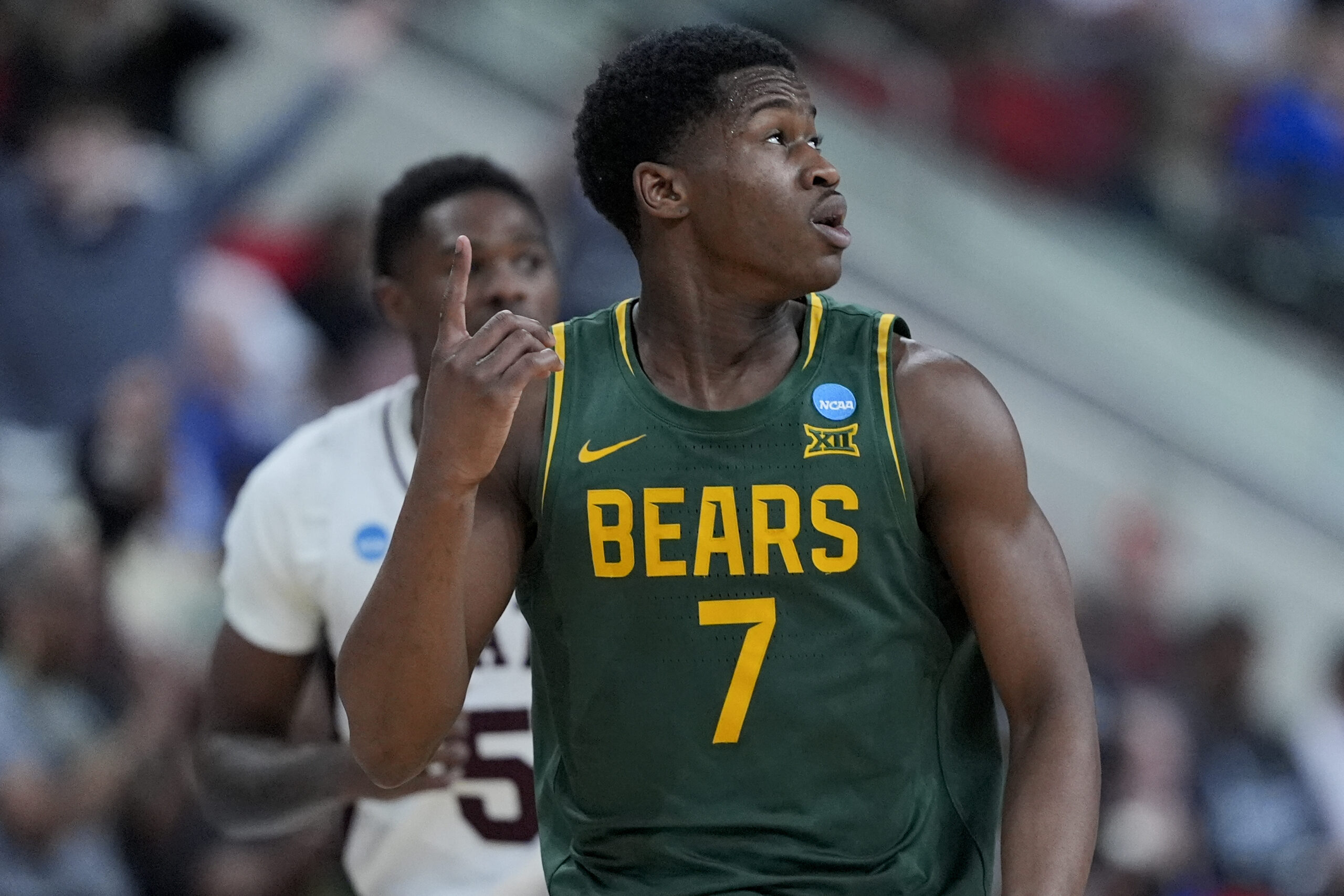
Guard VJ Edgecombe spent one season with Baylor before becoming the No. 3 pick in the 2025 NBA draft.
Another coach who valued Edgecombe’s IQ: Baylor’s Scott Drew.
During Edgecombe’s lone college season, Drew recognized his “boldness” to speak up during practices, “wisdom” to be accurate with his question or suggestion, and “heart” to keep it centered on the team. Most freshmen in his program, Drew added, only learn one position that first season. Edgecombe could play every spot but center, offering the Bears flexibility to use him as a lead ballhandler or as a power forward in four-guard lineups.
“It allows a coach to have an opportunity to steal a couple baskets by putting in new plays [and] doing things that are harder to guard,” Drew said last week. “And in one-, two-, three-possession games, if you have enough of those plays, you win a lot of those games.”
When Edgecombe first arrived in Philly, Nurse also asked himself, “How did he get like this?”
Nurse quickly recognized Edgecombe had already “absorbed a lot of basketball — and, probably, a little bit obsessively” because of his interest in the game’s history. That is not as common as an outsider might think for a player born in 2005, but was apparent to Nurse when Edgecombe marveled while walking into Chicago’s United Center for the first time.
Edgecombe’s inquisitive nature during practices also has continued at the NBA level. While still building out schemes throughout the first half of the season, Nurse said, Edgecombe could already identify future wrinkles. Edgecombe said he typically first goes to a teammate to clarify if such additions are possible, then to coaches to get their point of view.
“I just want to make sure my team is in the best possible [situation],” said Edgecombe, who entered Monday averaging 15.6 points, 5.3 rebounds, 4.2 assists, and 1.5 steals.
Added Nurse: “I answer them a lot with, ‘We’re getting to that.’ … Then you kind of quickly explain, ‘Yeah, we can do that, and here’s what happens. That’ll be coming when we need it — and when we see it and when we can polish and can put it in.’”
On the court, that IQ has translated to Edgecombe immediately taking on some ballhandling responsibilities — and committing only two combined turnovers when Maxey missed two games with an illness. Veteran forward Paul George has been most impressed with Edgecombe’s defensive savvy, recognizing when to make sharp rotations or well-timed playmaking risks. Edgecombe’s feel also shows up in how he spaces the floor on offense, clocks when a teammate has not gotten a shot recently, and balances when to be aggressive with the ball in his hands or facilitate.
“He could be a guy that just takes off,” Nurse added, “and jumps in the air and figures it out three or four seconds later. But he doesn’t do that. He makes pretty good basketball plays.”
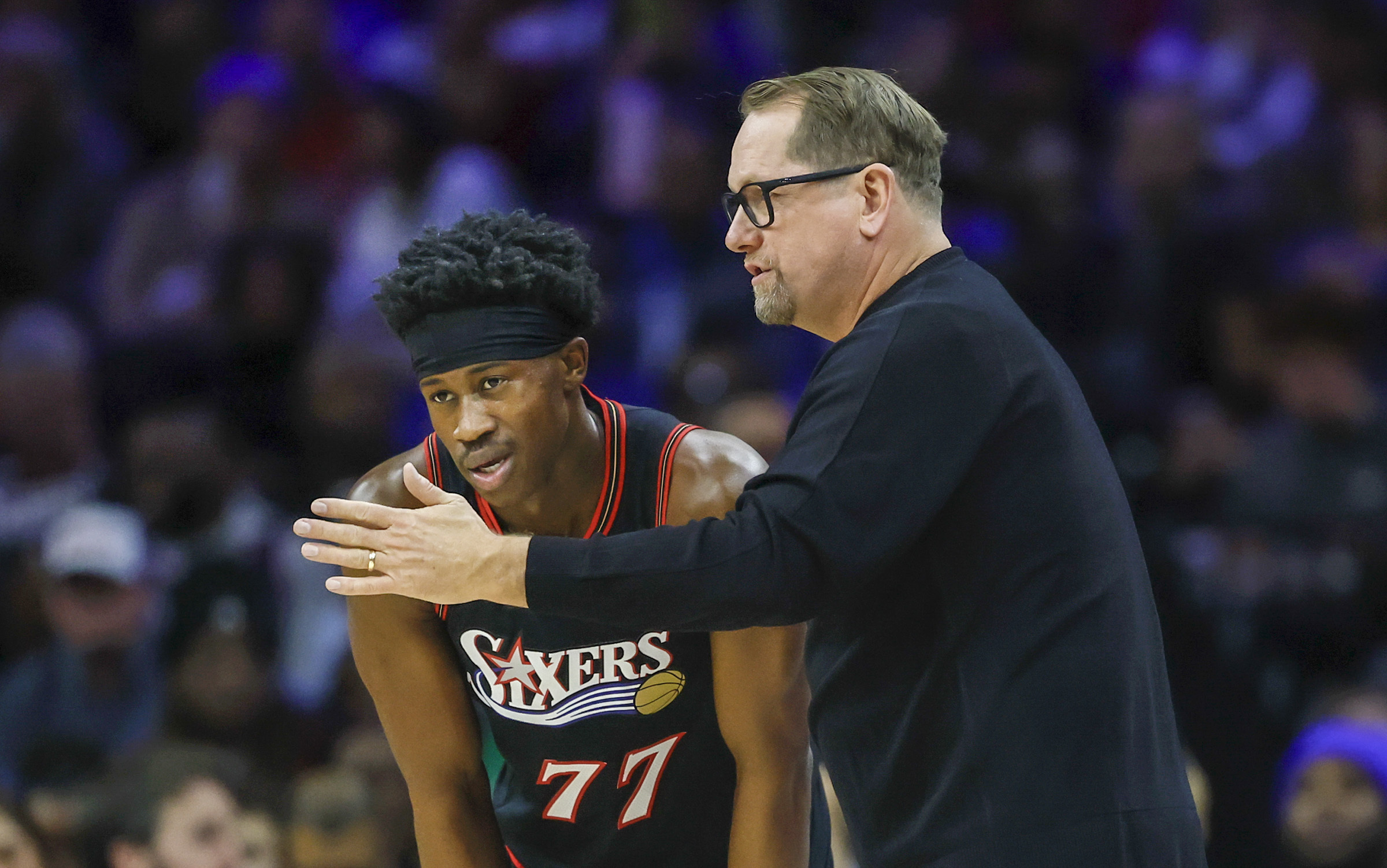
Sixers coach Nick Nurse has been impressed by guard VJ Edgecombe’s ability to absorb information.
That is why Nurse has reiterated that he still wants more out of Edgecombe, even as the Sixers’ roster has returned to full strength. Following a Jan. 16 loss to the Cleveland Cavaliers, Maxey told Edgecombe in the locker room that taking only five shots “is not going to cut it for us.” Nurse also has shown Edgecombe film examples of more opportunities to attack the rim or create space for a pull-up jumper.
“He’s just a little too unselfish for me,” Nurse said. “I know that sounds funny, but we need him to use those gifts a little bit more. … I’m like, ‘That was a great move. You only did it once last night. I need like eight of those.’”
Edgecombe acknowledged last week that he is “still learning” but does feel the game slowing down. And he flashed that knack during Saturday’s loss to the New York Knicks. In less than five seconds of the game’s final minute, he buried a three-pointer, forced a jump ball on a tie-up with Jalen Brunson, made two free throws after being fouled to cut the Sixers’ deficit to three points — and nearly drew an off-ball foul on Brunson before the ensuing inbounds pass, but that call was overturned on a coach’s challenge.
Buck is not exactly shocked that such high-IQ play is fueling Edgecombe’s rookie season. He saw it in that heads-up putback against Golden State. And in a game-winning three-pointer in Memphis.
And, behind the scenes, when Edgecombe paid an impromptu visit to a Long Island Lutheran practice just before his rookie season began.
“We’re running a set, and he kind of waves me over,” Buck recalled. “And he’s like, ‘Hey, Coach. I think the spacing for this guy right here should be a little bit different to maximize the play.’ That’s just not normal for a 19-, 20-year-old guy to be coming to practice, not just kind of chilling or being there to be there. But kind of saying, ‘Hey, let me look at this. I think there’s a way to improve that.’”
Now, Edgecombe is applying that as an NBA rookie, to a degree drawing raves from his coach and teammates.
“He’s not out there looking lost or forcing anything,” George said. “He kind of just lets the game come to him. And that right there makes the greats, greats. …
“The game just evolves around them, and that’s kind of what he has.”