
Kyle Schwarber had the best season of his career in 2025, with 56 homers and a runner-up finish for National League MVP. What can he possibly do for an encore? Schwarber joins Phillies Extra to discuss his goals for the season, the Phillies’ chances of getting over the hump in October, playing for Team USA in the upcoming World Baseball Classic, and more. Watch here.
Blog
-
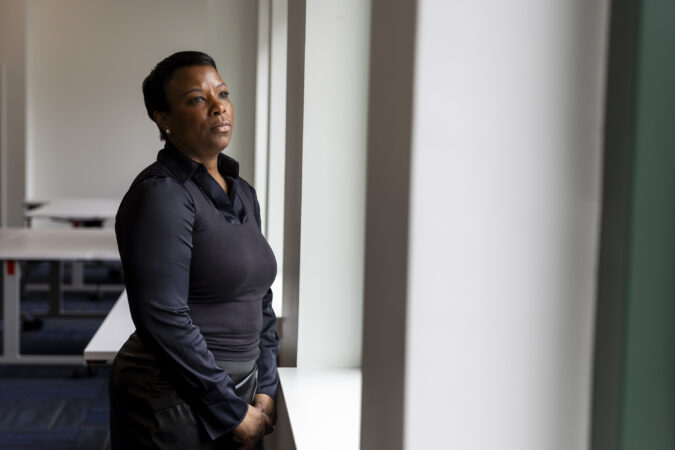
As domestic violence homicides rise in Philly, a police unit will expand to work with victims of abuse
Amid a historic drop in violent crime, homicides have fallen to lows not seen in decades. But in what researchers say is an alarming trend, homicides related to domestic violence are on the rise.
There were 37 such killings in Philadelphia last year, up from 28 the previous year. And even as homicides have fallen sharply overall, domestic killings remain stubbornly intractable. In all, deaths related to domestic violence accounted for about one in six homicides in the city last year, records show.
To address that, the police department is adding specialized training for officers and others who deal with victims of such crimes and adding staff in its Office of Community Advocacy and Engagement. When the unit expands this spring, staffers will be trained to spot signs of domestic abuse and advocate for victims of intimate partner violence, among other crimes.
That work mirrors efforts in cities such as New York, which launched a new police unit last year dedicated to combating the surge in domestic violence as such crimes rise nationwide.
“The numbers are moving in the wrong direction,” said Marian Braccia, a professor at Temple University’s Beasley School of Law and a former prosecutor in the district attorney’s family violence and sexual assault unit. “It’s terrifying.”
<iframe title="Domestic Violence Homicides Increase While Homicides Overall Decrease" aria-label="Table" id="datawrapper-chart-XlrlE" src="https://datawrapper.dwcdn.net/XlrlE/6/" scrolling="no" frameborder="0" style="width: 0; min-width: 100% !important; border: none;" height="566" data-external="1"></iframe><script type="text/javascript">window.addEventListener("message",function(a){if(void 0!==a.data["datawrapper-height"]){var e=document.querySelectorAll("iframe");for(var t in a.data["datawrapper-height"])for(var r,i=0;r=e[i];i++)if(r.contentWindow===a.source){var d=a.data["datawrapper-height"][t]+"px";r.style.height=d}}});</script>In Philadelphia last year, the slaying of Kada Scott drew attention to the issue after The Inquirer reported that her accused killer, Keon King, had previously been accused of stalking and kidnapping another woman. But two criminal cases against him fell apart when the victim failed to appear in court and prosecutors withdrew the charges.
Scott’s killing led City Council to examine prosecutors’ handling of King’s earlier cases, and the district attorney’s office later said it had been a mistake to withdraw charges and filed a new criminal case.
And last month, calls for awareness surrounding domestic violence were renewed when Yuan Yuan Lu, 28, was killed one day after reporting that her ex-boyfriend had sexually assaulted her in his Pennsport home. Police say 32-year-old Yujun Ren followed Lu to her Levittown home and shot her in the head, killing her.
According to prosecutors, Lu told police the day before she was killed that Ren carried a gun and she feared for her safety.
Philadelphia’s new unit would work to support victims in just such circumstances, officials said. The office launched last spring with 10 victim advocates with backgrounds in social work and behavioral health.
In March, those staffers will begin working with victims of sexual assault and domestic violence, said Ayanna Greene-Davis, executive director of the Office of Community Advocacy and Engagement.
And the unit will add 10 more members — sworn police officers with law enforcement experience — who will complete similar victim-oriented training, she said.
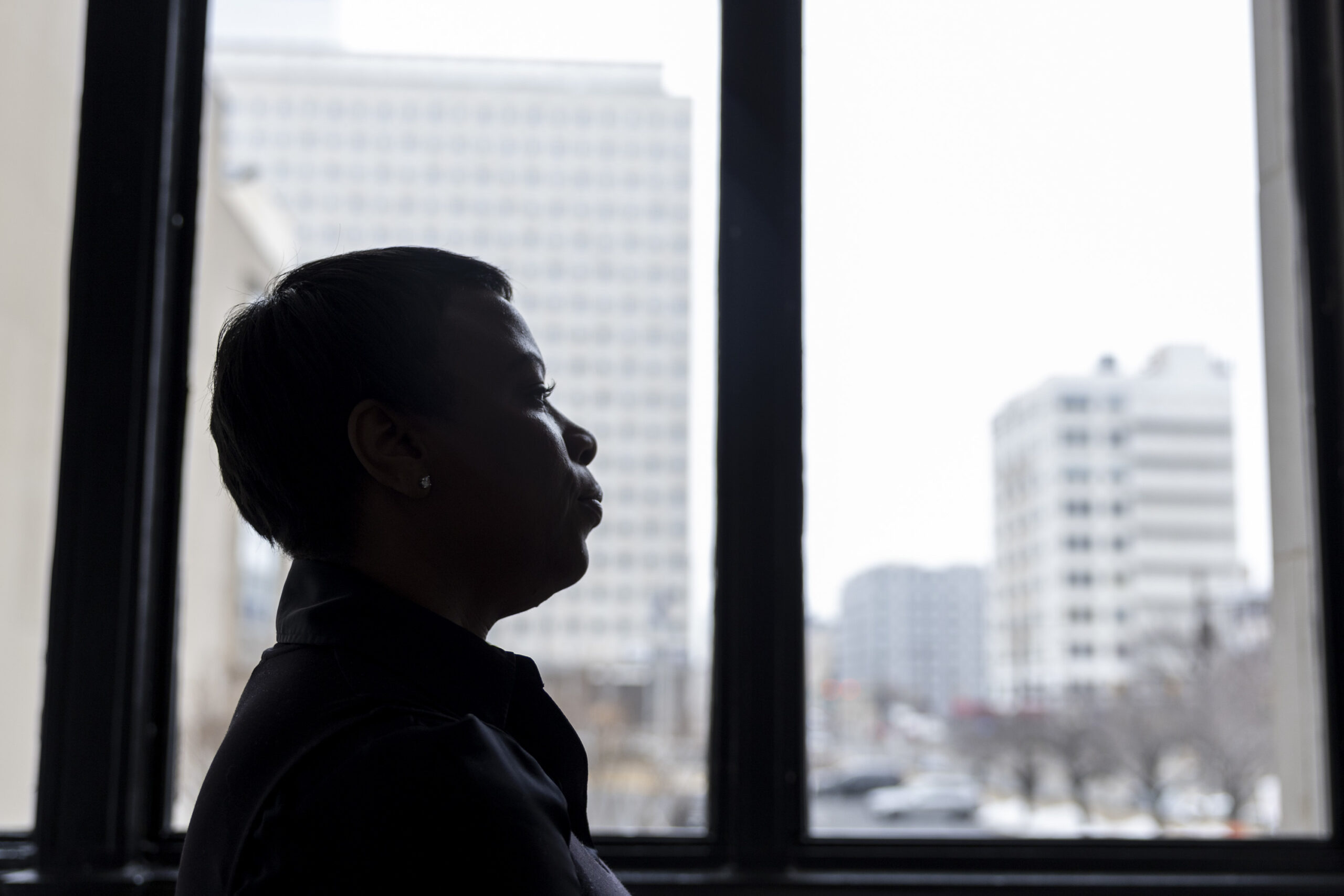
Ayanna Greene-Davis, 47, Executive Director for Office of Community Advocacy and Engagement, of Northwest Philadelphia, Pa., poses for a portrait at the Philadelphia Police Headquarters in Philadelphia, Pa., on Tuesday, Feb. 17, 2026. . “We’re not going to take days and days and days” to respond to reports of domestic violence, Greene-Davis said. “In the past, that happened.”
Victims of such crimes will be able to call the office’s advocates to voice concerns about their cases as they are investigated, according to Greene-Davis. And advocates will be trained to connect them with resources such as domestic abuse shelters and provide information on ways to remove themselves from dangerous living situations.
The unit will also oversee a broader effort to train patrol officers throughout the department to better assess the dangers victims of domestic violence face and work to keep them safe.
“Every victim is going to be in a different stage, but we can talk to them,” Greene-Davis said. “We can provide a safety plan.”
-

Half days are gone from Philly’s school calendar ‘forevermore’
Half days are disappearing in the Philadelphia School District.
Beginning in the 2026-27 school year, the district won’t have a single early dismissal — for teacher planning, report card conferences, or any other purpose.
Student attendance tumbles whenever Philadelphia has a half day, and parents scramble to plan for childcare when they happen, Superintendent Tony B. Watlington Sr. said.
“We need to eliminate and sunset half days from our school calendars now and forevermore,” Watlington said at a school board meeting Thursday.
At the superintendent’s request, the board amended the 2026-27 calendar, changing eight previously scheduled half days to zero.
Some days previously scheduled for professional development will now be full days off for students, and report card conferences — previously held over two half days — will now be scheduled on a single day off for students.
“When we have half days in the school district, it significantly impacts our student attendance,” Watlington told the board. “We now have clear data over 3½ years that when we have half days for professional development and the like, it lowers our overall student attendance.“
Watlington has emphasized student attendance as a key driver of academic improvement, and overall, Philadelphia’s student and teacher attendance has risen during his tenure, which began in 2022.
But half days were responsible for the largest single year-over-year drop in attendance in recent years. In December 2025, 54% of district students attended school 90% of the time or more, down from 66% over the same time period in 2024.
In January 2026, regular student attendance was 51%, down from 53% in January 2025, a dip Watlington said was “largely attributed to disruptions in the calendar.”
Controlling for half days, regular student attendance would have been 70% last month — proof, Watlington said, that half days need to disappear.
“This is very important,” the superintendent said, “because we know if we can get student regular attendance up, kids just learn more when they’re in school more.”
Half days planned for March, April, and May this school year will remain on the calendar, but the half day planned for students’ last day of the school year, June 11, is now a full day.
-
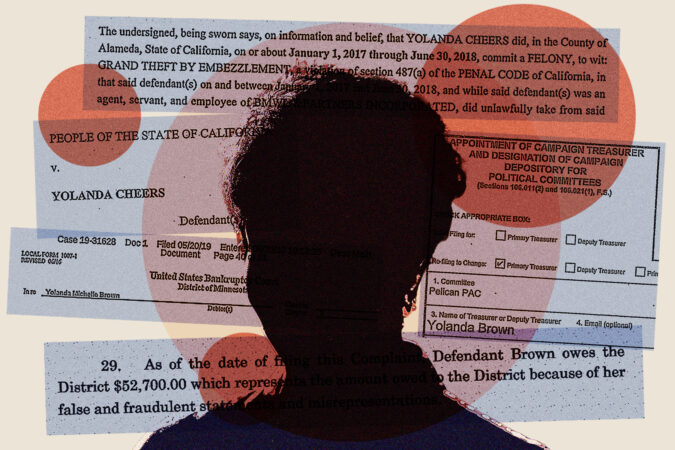
From Florida to Philly, a political consultant kept working as fraud claims piled up against her
Philadelphia congressional candidate Chris Rabb is one of many people who say Yolanda Brown owes them money.
But none of them have been able to find her. And the allegations of impropriety against the political consultant are piling up.
Last month, Rabb said that Brown, his former campaign treasurer, made “unauthorized withdrawals” from his campaign account, and that an untold amount of money had gone missing.
Weeks earlier, Brown was accused of robbing campaign donations from another Democrat more than a thousand miles away in Florida.
Brown, a Florida-based finance manager and campaign consultant who works primarily with Democrats and social justice groups, has over the last decade faced criminal charges for embezzlement and other allegations of financial fraud in at least four states totaling in excess of half a million dollars, according to an Inquirer review of hundreds of pages of court documents, campaign finance filings, and business records.
The misdeeds Brown, 46, has been accused of range from shaving money from campaign accounts to setting up sham jobs and billing nonprofits for work that was never performed. Two years ago, Brown paid $330,000 after pleading no contest to felony embezzlement in California, where prosecutors said she stole from a nonprofit and set up a fake loan under the name of a consultancy where she previously worked.
Through it all, she avoided jail time and, using three different surnames, continued to work on political campaigns from Florida to Philly, persuading candidates to trust her with access to their bank accounts and thousands of dollars in donations to their causes.
Khambrel Davis, a Florida-based criminal defense attorney representing Brown, says this is all a misunderstanding. He said that Brown is the victim, and that a rogue employee of Brown’s firm stole from the PACs in Philadelphia and St. Petersburg and then disappeared “in the wind.”
Davis said Brown reached out to law enforcement but has not heard back.
“[Brown] just can’t locate her, and now it’s kind of all coming back on her,” Davis said in a phone interview Saturday. “Her history is coming up, so everyone’s just assuming she must have done this. They’re kind of putting together this narrative that she’s just this habitual thief.”
Records show Brown as the only employee of her firm who ever filed campaign finance paperwork for the campaigns now accusing her of theft.
Today, Brown’s whereabouts are unknown to the campaigns she once worked for. Her firm’s address listed in campaign finance filings is a mailbox rental shop, and her website went dark in February. She is registered to vote in Coral Springs, Fla., a suburb of Fort Lauderdale.
Davis, who said he has been in contact with Brown, declined to say where she is. He insisted she has been “transparent and forthcoming with everyone.”
Several other campaign consultants based in Florida told The Inquirer that they have identified suspicious transactions made last year while Brown had access to their accounts. And multiple law enforcement agencies are investigating Brown’s accounting, including the FBI, according to two sources who requested anonymity because they were not authorized to discuss the ongoing probe.

State Rep. Chris Rabb at a forum hosted by the 9th Ward Democratic Committee on Dec. 4, 2025. He is a Democratic candidate running to represent Philadelphia’s 3rd Congressional District. Before Brown joined Rabb’s campaign in August, she worked with high-profile Democrats in New York, Illinois, and Florida — at times using her married name, Yolanda Rumph.
Her clients included former Tallahassee Mayor Andrew Gillum, who waged a closely watched campaign for Florida governor against Ron DeSantis in 2018. Gillum was indicted for making fraudulent transactions out of the same political action committee that Brown worked for — but prosecutors dropped the charges in 2023 after a jury deadlocked and the court declared a mistrial.
Rabb, a progressive who is considered among a handful of front-runners in the race to replace outgoing U.S. Rep. Dwight Evans, has said he is committed to continuing his campaign for the 3rd Congressional District seat, despite losing money that he is unlikely to see returned before the May 19 primary.
In January, before allegations of the missing money became public, Rabb was already significantly trailing the financial front-runner in the race. Records show he had about $100,000 in his campaign account at the start of the year, while State Sen. Sharif Street reported having more than five times that amount.
Rabb’s campaign declined to say how much money was taken, citing the ongoing law enforcement investigation.
Abe White, Rabb’s spokesperson, said in a statement that the campaign identified the unauthorized withdrawals after finding errors in its most recent campaign finance filing, which encompasses fundraising and spending activity from October to December.
He said the campaign had protocols in place to reconcile accounts and “immediately took action” after coming across the suspicious activity.
“The campaign’s former treasurer manipulated every campaign safeguard in place,” White said. “It’s what these people do.”
Davis, Brown’s attorney, said his client intends to pay back the funds he alleges were stolen by the employee.
“She’s just going to take responsibility,” he said, “and try to remedy the situation.”
No warning signs until it was too late
Very few people working on political campaigns have access to the bank accounts powering their efforts. The accounts see thousands — and sometimes millions — of dollars flowing in and out in a relatively short period of time.
That means candidates put significant trust in their treasurers, who are official designees responsible for ensuring campaigns comply with finance laws.
Matthew Haverstick, a managing partner with Kleinbard LLC, a Philadelphia-based law firm that often works with political campaigns and causes, said it is essential that campaigns thoroughly vet campaign treasurers and compliance consultants.
“This is why you work hard at the front end of this stuff in campaigns,” Haverstick, who is not working for any candidate in the race, said of Rabb’s situation. “When you’re deep into a campaign and a problem like this blows up, it has the potential to end the campaign. So the right time to spend a little more money and try a little harder is before you hire somebody.”
Rabb, a five-term Pennsylvania state representative, entrusted his account to Brown shortly after launching his run for Congress in July. Rabb had not worked with Brown before, and records show no other campaign in Pennsylvania has paid her or her firm for work.
The three other candidates who have so far raised the most money in the 3rd Congressional District race have treasurers based in Philadelphia. But it’s not unheard of for candidates to use consultants and staff from out of state, especially when they are seeking federal office.
White, Rabb’s spokesperson, said Brown “came highly recommended” and “there was no reason for concern” when she was hired.
Elsewhere, other Democrats who hired Brown said they similarly saw no warning signs until it was too late.
In January, the chairperson of a PAC backing St. Petersburg Mayor Ken Welch said she had reported Brown to law enforcement for misspending $207,000.
Brown had worked with the group, called the Pelican PAC, for about a year. Campaign finance records show that last fall, several transactions were made to transfer money from the PAC account into O’Reilly Business LLC, a separate entity that Brown controls.
Davis said Brown’s employee also had access to that LLC, and said it was the employee who moved the money.
Adrienne Bogen, who heads the Pelican PAC, said Brown was removed as the PAC’s treasurer in January.
She was hired following “standard onboarding practices,” Bogen said.
“Nothing was identified that raised concerns,” she added.
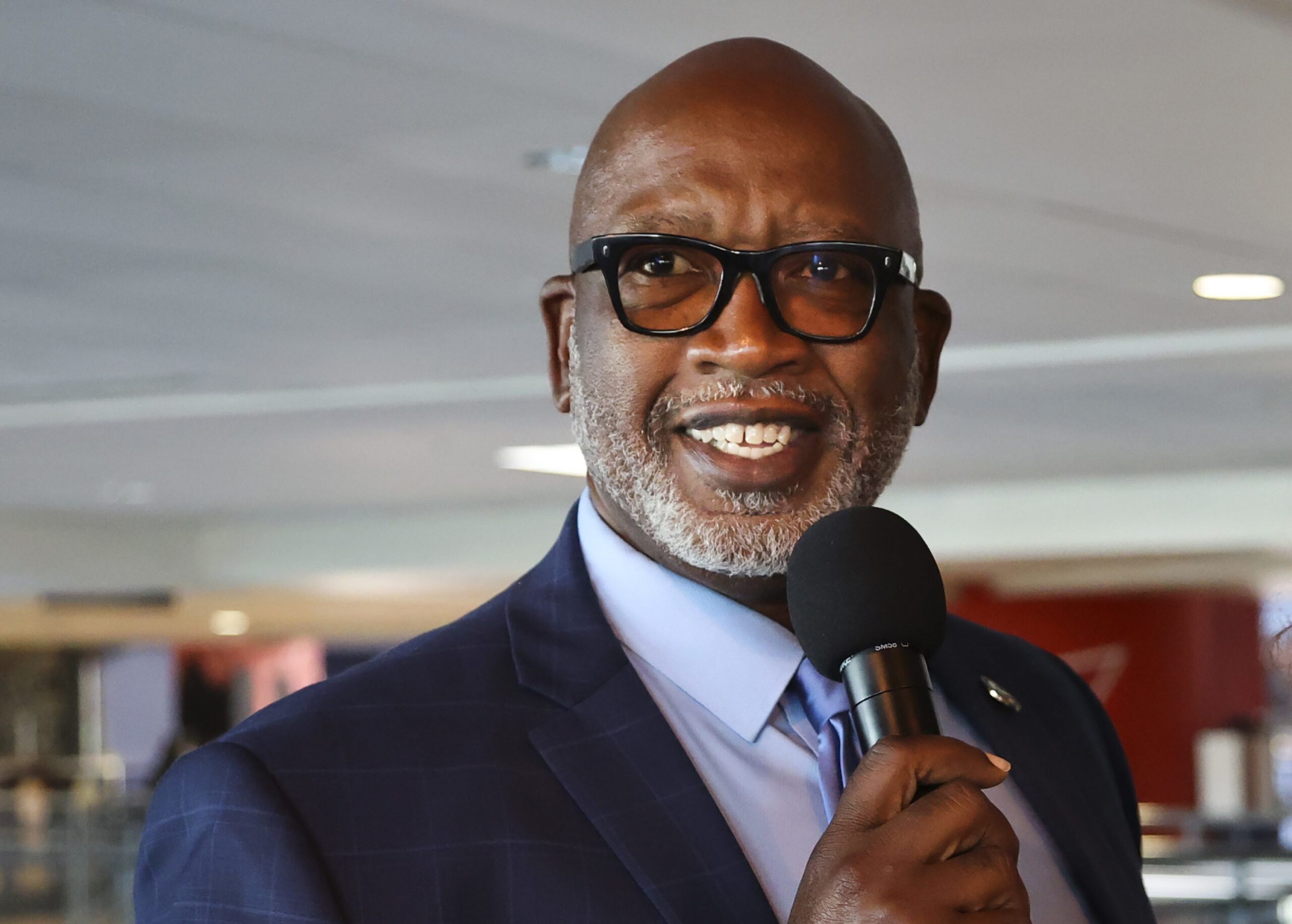
In this 2023 file photo, St. Petersburg Mayor Ken Welch greets the audience during a Suncoast Tiger Bay Club meeting at Tropicana Field in St. Petersburg, Fla. In reality, Brown had been under indictment on 10 criminal charges in Alameda County, Calif., where she worked as a finance manager for Oakland-based consultancy BMWL & Partners. She was charged under the name “Yolanda Cheers.”
In 2019, prosecutors in court documents accused Brown — referring to her as “Cheers” — of routing money belonging to a nonprofit client of the consultancy to herself and then, years after being fired, taking out unauthorized loans in BMWL’s name. She faced charges of aggravated white-collar crime, grand theft by embezzlement, forgery, and identity theft, and could have faced years in prison.
The same year she was indicted in California, Brown faced legal trouble elsewhere. Authorities in Washington, D.C., accused her of fraud, allegations that came to light after she filed for bankruptcy in Minnesota.
Brown had previously worked as a grants manager for the local government in D.C. and owed the city $52,700 while filing for bankruptcy, the D.C. attorney general wrote in court papers. Authorities alleged that in 2014 and 2015, Brown asked two city contractors to hire her fiance, and she billed them for work that he supposedly completed — even though he was on an active-duty military assignment at the time.
The Minnesota bankruptcy case moved forward. Much of Brown’s debt was erased, but not the money that she owed in Washington.
On the other side of the country, the criminal case in California languished for nearly five years.
In February 2024, Alameda County District Attorney Pamela Price announced that her office had reached a plea deal. Brown pleaded no contest to one count of grand theft by embezzlement and was required to pay $330,000 in restitution. She served no jail time.
Davis cast the no-contest plea as Brown’s attempt to put the charges behind her — not as an admission of guilt.
“Court could be kind of dragging on people,” he said. “It’s a very big burden.”
‘Some people will inevitably give in to temptation’
After the campaign allegations against Brown in St. Petersburg and Philadelphia trickled out this year, others who have worked with her said they reported activity they think is suspicious to law enforcement.
Jamie Jodoin, a Florida-based political and financial consultant, said she worked on a PAC last year that hired Brown as its treasurer. She said Brown wired $25,000 out of the PAC’s bank account and later closed the account without notifying the candidate.
“We have no idea where that went,” Jodoin said.
Political campaigns, which are small and short-lived entities, often don’t carry insurance against internal theft. But they do usually have review processes.
The Federal Election Commission recommends candidates put in place internal controls such as risk assessment and monitoring in order to prevent the misappropriation of funds. The guidance says that bank statements should be reviewed by someone who is not also writing the checks.
“Absent some basic checks and balances,” the commission says in its recommendations, “some people will inevitably give in to temptation.”

Campaign buttons for State Rep. Chris Rabb Dec. 4, 2025. A Democratic candidate running to represent Philadelphia’s 3rd Congressional District. White said the Rabb campaign had safeguards in place. But he added that, after the unauthorized withdrawals were identified, the campaign newly established “airtight financial protocols” such as “strengthening oversight and internal controls.”
The campaign recently named a new treasurer and hired a new compliance firm.
Bogen, of Welch’s PAC in St. Petersburg, said Brown’s access to internal systems and bank accounts was “immediately revoked” once it was discovered that she had made suspicious transactions.
Brown, Bogen said, “has not been heard from since.”
-
Overdose deaths hit Philadelphia’s Puerto Rican community hard as the city remains divided on how to respond
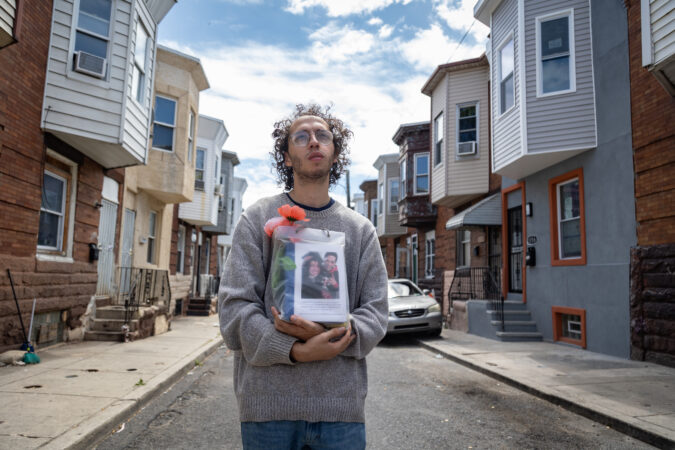
The box is heavier than he thought it would be. Outside his childhood home, Guillermo Santos Jr. looks down.
“This is the longest I’ve ever held him,” Santos says.
His father — Guillermo Santos Sr. — died of a fentanyl overdose in 2021, months after his virtual high school graduation. The elder Santos moved from Puerto Rico to Philadelphia after his father sent him to the city to learn English. There, he met Cheri Honkala and, soon after, Guillermo Santos Jr. was born.
Raised in the heart of Kensington, a working-class Philadelphia neighborhood with a longstanding Puerto Rican community, the younger Santos recalls the caw of his neighbor’s roosters waking him for school. Walking to Market-Frankford Line, the city’s elevated train known locally as “The El,” he passed people lying out on the sidewalks.
“It wasn’t odd to me that my father was a heroin addict because everyone around me was, because of my neighborhood,” Santos said.
He describes Kensington as tight-knit. Although gunshots were constant, neighbors knew his mom, a housing rights activist, and protected their home.
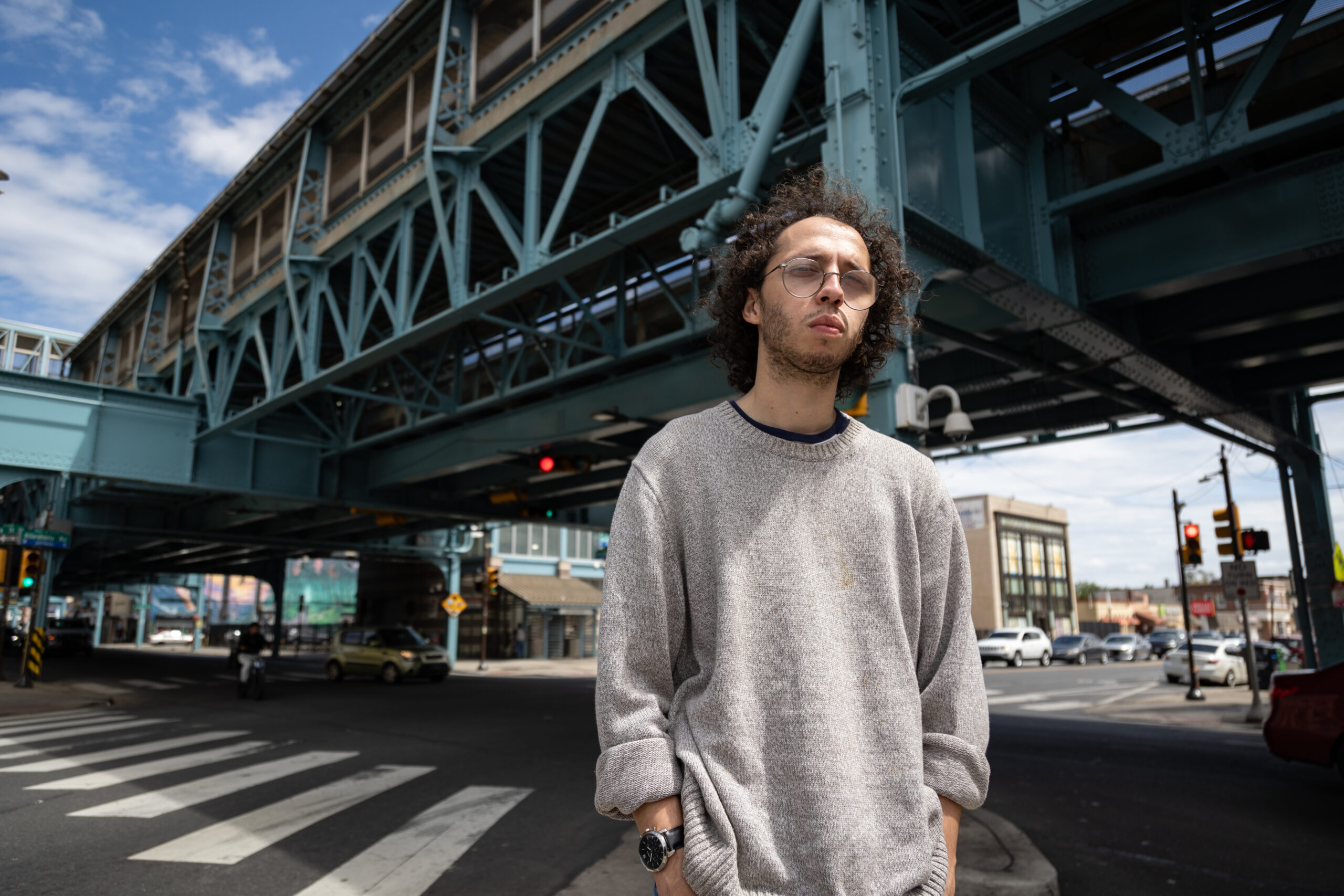
Guillermo Santos Jr. stands at the intersection of Kensington and Allegheny, near his childhood home, on Aug. 19, 2025. Guillermo Santos Jr. is among the roughly 33% of people in Philadelphia who personally know someone who has died by overdose, according to Pew Heritage Trust’s most recent data. The Pennsylvania Department of Health’s tally from 2024 reveals that Latinos make up 9.7% of total overdose deaths; city public health data from 2023 put the overdose death rate at 77.9 per 100,000 residents. Nationwide, more than 42% of people have been impacted in some way by an overdose death.
Today, the young Philadelphian lives in New York City. During visits to Philly, he notices that his neighborhood is in the same condition as when he left, while new development crops up.
“The way that Philadelphia keeps itself frozen and doesn’t actually deal with a lot of the issues that are torturing its residents is so mind-boggling to me,” he added. “It is really devastating.”
His mom agreed.
“I raised a son after his dad died from an overdose in a city that didn’t have s— to offer,” Honkala said.
The city’s death certificate data reveal that unintentional overdoses were the second-leading cause of death among Puerto Rican residents for two years in a row. An analysis by Centro de Periodismo Investigativo (CPI) of 2023 public health data reveals men die of overdoses at double the rate of their female counterparts — across all racial and ethnic groups.
window.addEventListener(“message”,function(a){if(void 0!==a.data[“datawrapper-height”]){var e=document.querySelectorAll(“iframe”);for(var t in a.data[“datawrapper-height”])for(var r,i=0;r=e[i];i++)if(r.contentWindow===a.source){var d=a.data[“datawrapper-height”][t]+”px”;r.style.height=d}}});
Within the last 10 years, drug overdose deaths were highest among Puerto Rican men ages 45 to 54, according to a research paper in the International Journal of Drug Policy.
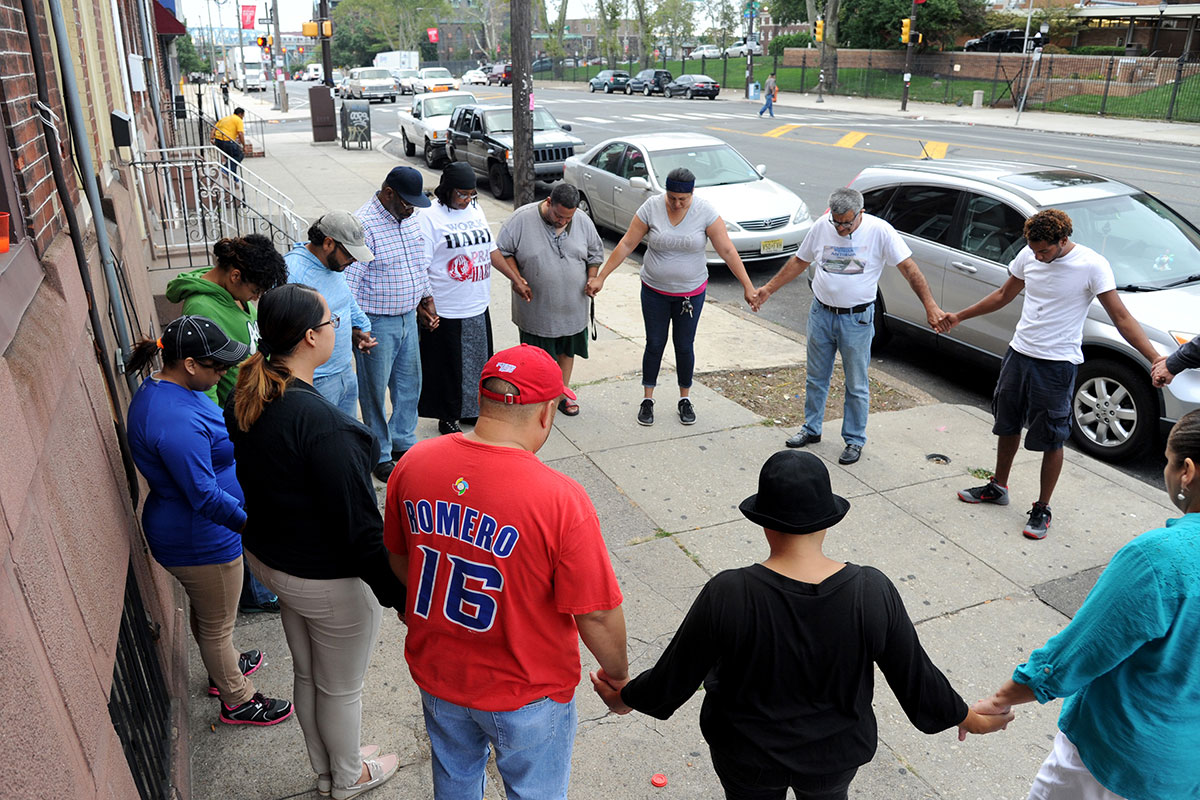
Charito Morales praying in 2016 with a group on Lehigh Avenue in Kensington, before heading into “El Campamento,” along the Conrail tracks where many heroin addicts lived. Air Bridge: One-way tickets and promises of rehabilitation
This crisis isn’t new. Its roots trace back to the city’s economic crisis in the 1970s, which disproportionately impacted Black and Latino residents of industrialized neighborhoods like Kensington. In the 1980s, North Philadelphia became a hub for open-air drug markets.
“The drug economy was a very real financial attraction for young people whose families had few options for survival,” according to American Quarterly, a journal published by Johns Hopkins University Press.
When factories shut down in the late 1980s, unemployment rates soared, hitting racially segregated and economically disadvantaged areas the hardest. What began as a way out of poverty drew younger generations into drug use and homelessness.
In the 1990s, a movement known as “Air Bridge,” run by pastors and government officials, gave people with substance use disorders one-way tickets from Puerto Rico to cities such as New York, Chicago, and Philadelphia.
In Philadelphia, Air Bridge areas included Kensington and Fairhill, which compose the zip codes 19125, 19133, and 19134, some of the city’s poorest. A 2017 BBC report estimated that thousands landed in Philly from Puerto Rico through the Air Bridge movement.
Charito Morales, a community advocate in Philadelphia, witnessed Air Bridge’s false promises in real time when her brother was sent for rehab 30 years ago, but the care never came.
Morales’ family sent her brother, Alvin Luis Morales-Soto, to the U.S. under the guise of quality rehabilitation and medical care that did not exist in Puerto Rico and Air Bridge promised. When the family lost contact, she went undercover on her own and experienced the living conditions firsthand.
An Inquirer investigation from 2016 illuminated harrowing practices. People living in squalor, 20 men stuffed into tiny bedrooms in a small rowhouse that should fit no more than 10. SNAP benefits held hostage. No phones.
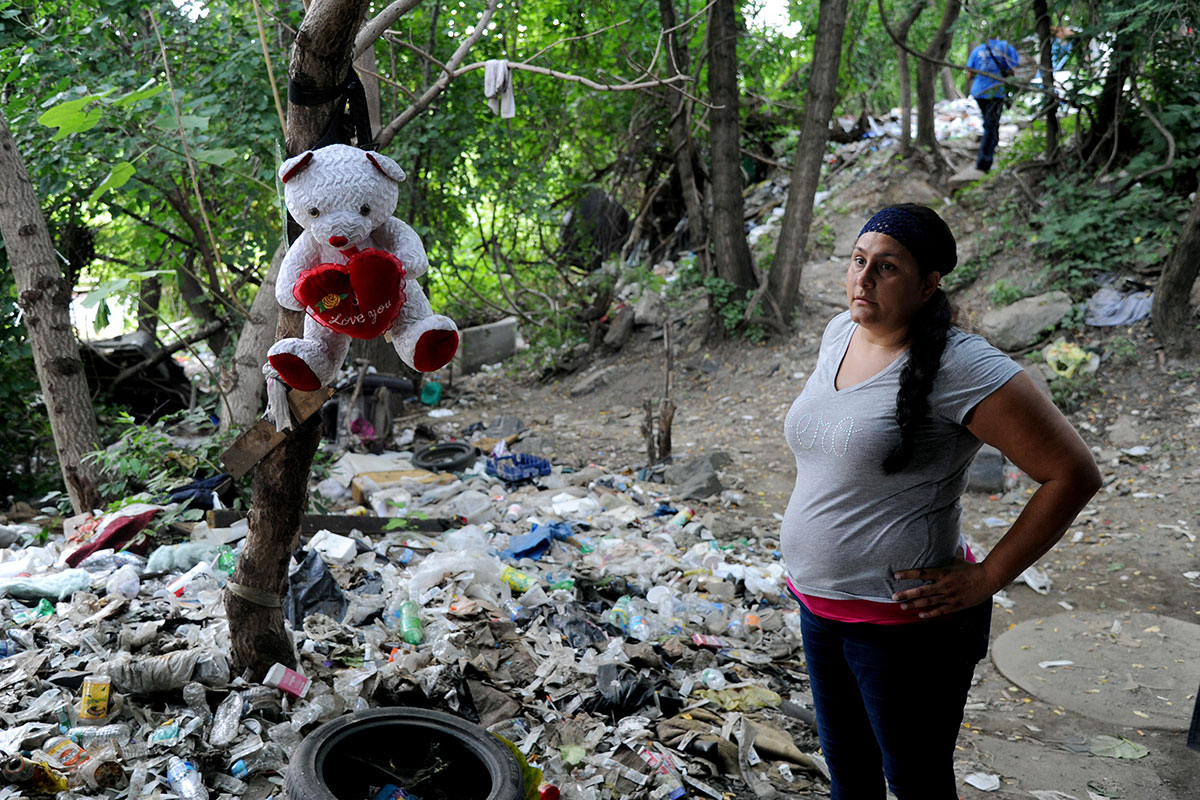
Charito Morales, a registered nurse and advocate for addicts, photoraphed in 2016 at “El Campamento,” a camp of homeless drug users along the Conrail tracks in Fairhill. Morales served as a key source for The Inquirer, motivated to understand what happened to her brother.
“They brought him here — what did they offer him? Rehabilitation and all sorts of things,” Morales said. “My family, unaware and uninformed, believed this was the ideal place because it was the United States, and there are so many benefits, so many resources compared to Puerto Rico, and he would have everything within reach.”
He died of an overdose on June 18, 1998.
A former outreach worker with Asociación de Puertorriqueños en Marcha (APM), a nonprofit organization dedicated to Latino health and community services, identified as “AJ” for privacy purposes, told CPI that some unregulated recovery house managers connected to Air Bridge were driven by greed, as they intercepted and pocketed government benefits.
“Well, there was money to be made,” he told CPI.
AJ recalls a specific case involving a Christian ministry that operated as a recovery house. He said that one day, when the pastor was away, he found mail tucked above a cabinet in the church’s administrative office. The letters, he said, were addressed to program participants. AJ said he suspected that the mail may have been redirected from the recovery house to another address. In his view, that could have made it easier for third parties to access public benefits.
Tracy Esteves Camacho, a harm reductionist who met with Puerto Ricans who arrived by way of Air Bridge, heard the same thing firsthand.
“A lot of people were telling me the same story,” she said. “No one knows exactly if it’s the recovery houses here or if it’s someone in Puerto Rico trying to move these people around. A lot of them would end up here with nobody.”
With nowhere to go, many program participants ended up unhoused, some living beneath a bridge, covering themselves with cardboard boxes to stay warm in the winter. AJ said these conditions worsened the substance use issues they had left the island hoping to fix.
The few who found legitimate help, however, recovered and found stable housing. Today, AJ said, wraparound services such as housing and regulated addiction treatment seem out of reach, or less of a priority, particularly for Spanish-speakers.
“It’s a human disaster, the result of human error, an error by the Department of Health. A failure to classify narcotics use as a mental illness; instead, they criminalize it and continue to criminalize it,” Morales said.
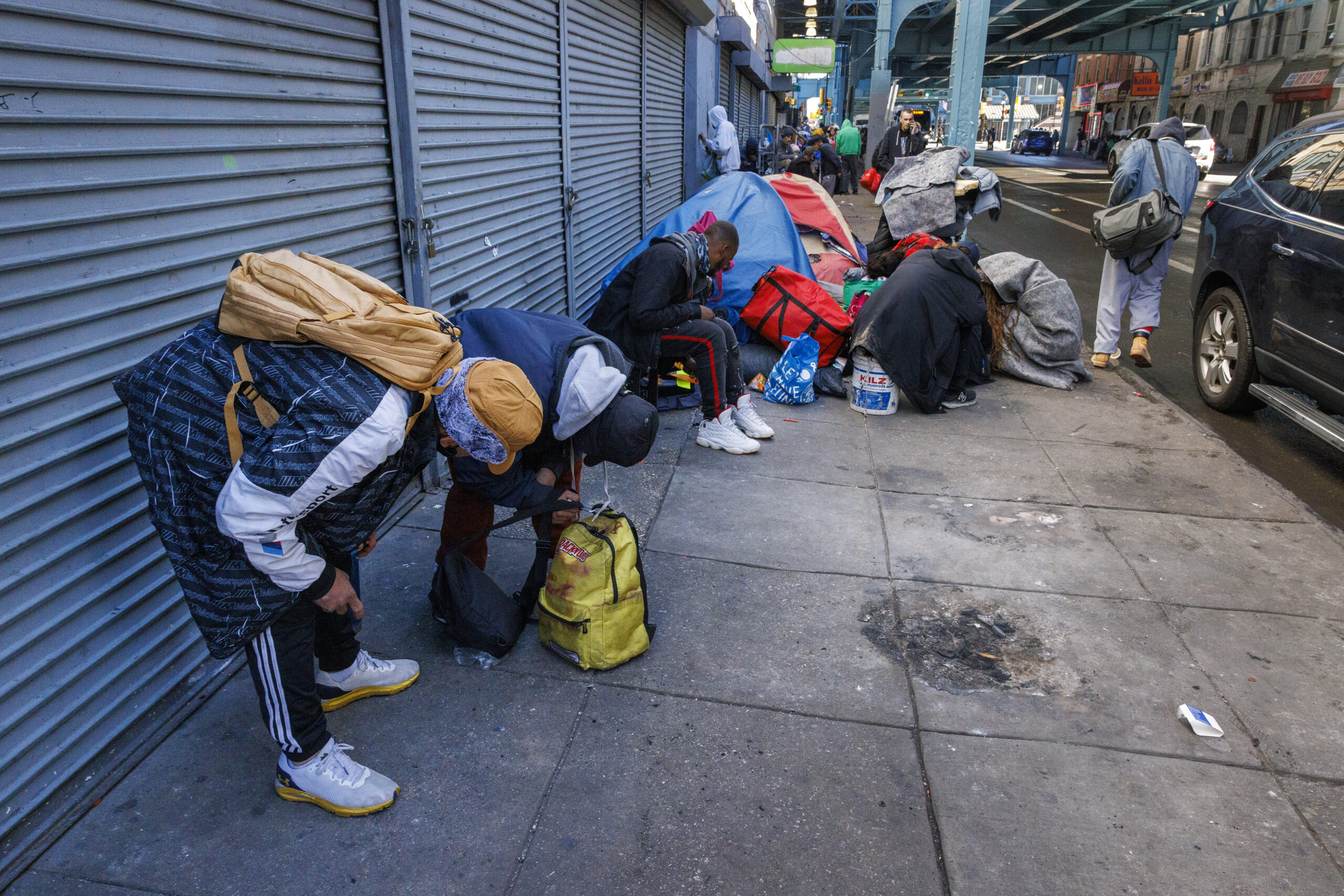
People near Allegheny Station at Kensington and Allegheny Avenue. Philadelphia Councilperson Quetcy Lozada (not shown) held a news conference October 16, 2023 in front of the Russell Conwell Middle School. She spoke about neighborhood clean up and the opioid epidemic. A neglected crisis
Overdose deaths have steadily increased over the years in Philadelphia, disproportionately impacting Black and Hispanic residents, deemed to be an overlooked health crisis since 2023.
Guillermo Santos Jr. says the barriers his father faced in the ’90s persist today.
“We’re not doing anything about it because throughout my entire childhood, he kept wanting to get better. He was putting in active steps and he was shown that there was no place to go except back under the El train,” he said, referring to the bridge area where some unhoused people would go.
Honkala, his mom and a licensed medical care provider, agreed. She runs a rehab program part-time. Santos’ father is one of many who have been failed by disconnected social and health networks.
He was on and off city housing lists for 18 years, survived nine overdoses, and lived with worm-infested infections on his limbs. He was also HIV-positive.
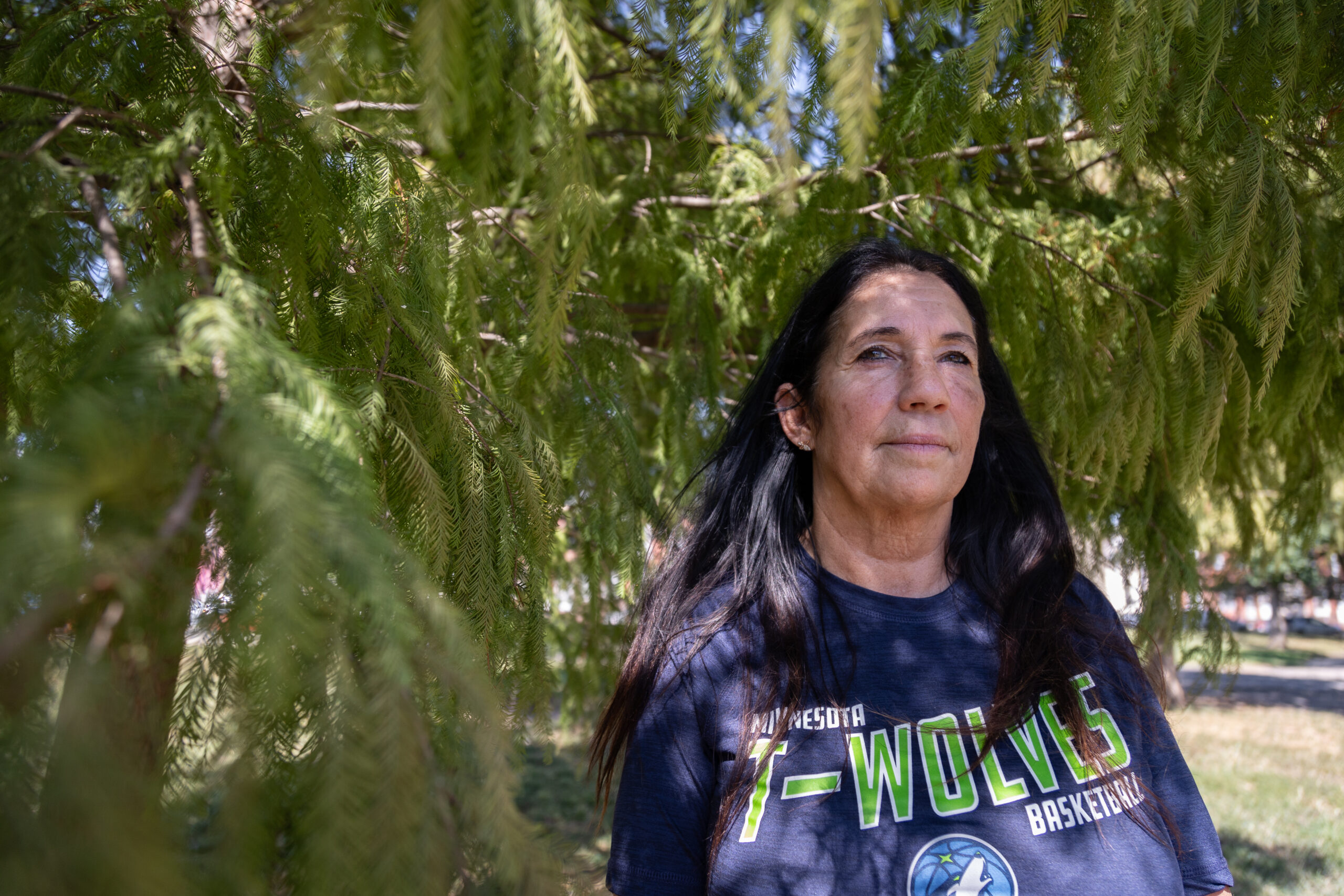
Cheri Honkala poses for a portrait at McPherson Square Park in Kensington on Sept. 3, 2025. The park holds memories of her late husband, Guillermo Santos Sr., who died in 2021. “He had a lot of people around him that tried to get him whatever was available to get him the help that he needed, and there was nothing,” she said. “Every time that he was sick and he was going into withdrawal and he’d go to Episcopal or Kensington Hospital, he would have to sit in the waiting room for 13 hours, s— himself, throw up on himself, and convince himself that, ‘Oh, yeah, I want to stay here and get clean.’”
In 2020, Esteves Camacho worked closely with Puerto Rican communities living with HIV who use intravenous drugs, providing care in a medical clinic integrated within a syringe exchange program at Prevention Point Philadelphia.
She knew Guillermo Santos Sr. and recalled him showing her photos of his son. The elder Santos had plans to become a barber in the future.
“It makes me want to cry. He was such a good person,” Esteves Camacho said.
He began using drugs again after his girlfriend’s overdose death, and his visits to the addiction treatment center, Prevention Point, became more unpredictable.
“It wasn’t his personality. He was hurting,” she added. “It was really heartbreaking when he passed away, knowing he had a son and that now this person is going to have to live without their father.”
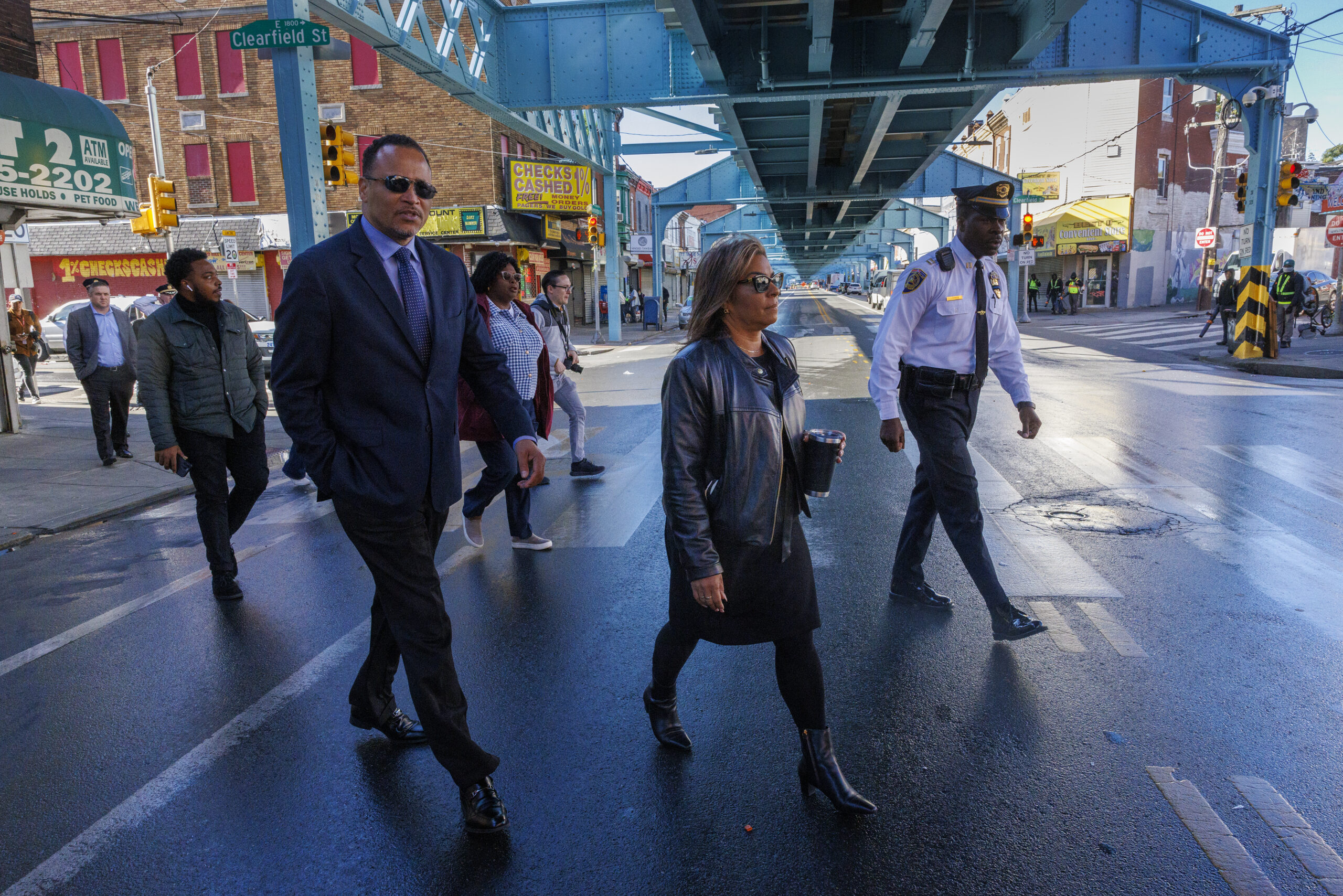
Kenneth A. Divers, SEPTA’s Director of Outreach Programs (left), walking across Kensington Avenue with Councilperson Quetcy Lozada in 2023. She spoke at a news conference about neighborhood clean-up and the opioid epidemic. ‘No one is turning a blind eye now’
The needs of the community in the throes of the opioid crisis are colliding with local and federal funding cuts.
On Jan. 13, the Trump administration abruptly canceled, then 24 hours later restored, nearly $2 billion for mental health and addiction treatment. In July 2025, the Trump administration issued an executive order to reevaluate and halt discretionary Substance Abuse and Mental Health Services Administration grant funds for harm reduction programs or “safe consumption” sites. Despite public health reports lauding their benefits, the administration falsely claimed that these methods “only facilitate illegal drug use and its attendant harm.”
Instead, federal dollars will be prioritized for drug courts and mental health courts. This is happening in Philadelphia already. In June 2024, Philadelphia Mayor Cherelle L. Parker ceased funding needle exchange programs, deferring to local nonprofits and philanthropic groups. Parker’s administration opted for a law-enforcement-heavy approach and changed how opioid settlement funds are distributed.
In the last two years, Philadelphia City Councilmember Quetcy Lozada, who represents the 7th District, has introduced resolutions and new bills that limit certain efforts, such as safe injection sites, and where mobile care units can provide services. The 7th District includes neighborhoods hardest hit by the opioid epidemic, such as Harrowgate, Kensington, and Olde Richmond.
She told CPI that she believes safe injection sites “keep them in that vicious cycle.”
Research shows that safe injection sites help reduce HIV transmission, infections, and other diseases caused by sharing needles. Public health experts explain that harm reduction is one tool to reduce health risks and overdose deaths.
Advocates warn that limiting where outreach workers and mobile care units can operate will delay critical care, putting more people at risk of infection or medical crises. Lozada told CPI her office is working with providers and community organizations to better understand what she can do to support the people in her district.
“No one is turning a blind eye now,” Lozada said. “Folks need to understand that this is not a ‘Let’s have a conversation today’ type of situation. It is very much still a crisis and we are still ground zero. That has not changed. The focus has been, and continues to be, prevention and education and making sure that everybody’s on the same page and that we continue to grow in the same direction.”
Roz Pichardo, founder of Sunshine House, a resource hub on Kensington Avenue, sees nearly 80 people by 9 a.m. on some days. Recently, Pichardo doubled the number of nurses on site, prompted by confusion surrounding the mobile care unit operation. People searched for her.
“We already feel like we’re triage here. There’s too much red tape,” Pichardo said. “How do we reduce stigma in a community that’s plagued with addiction? Just keep talking, keep showing people what empathy and compassion look like. Maybe they will pick up on it.”
She reiterates that care is not one-size-fits-all.

Roz Pichardo with Operation Save Our City holds her bible on March 7, 2024, with names of 2232 people she saved with narcan since 2018. Harm reduction activists gathered outside Philadelphia City Hall to ask for seat at table and funding for the opioid crisis. Some reports suggest that programs like Police Assisted Diversion and Case Management, Assessment, Re-entry and Empowerment Services (PAD CARES) and “wellness courts” may not be working as intended.
Lozada proposes government-run medical programs, such as triage centers and “stabilization centers,” that address the physical symptoms and barriers to recovery, including open wounds.
“For a long time, the voices of those who were on substance abuse or those who are living in substance abuse were prioritized over those who are just trying to live day by day in that community,” Lozada told CPI.
She says residents want a better quality of life, for children not to be exposed to people with gaping wounds, and for elders in the neighborhood to feel safe walking around.
“The government created this. Government needs to respond to it,” she added.
In a follow-up interview, Lozada told CPI: “We’re constantly meeting and having conversations about what is working, what is not working. What needs to be adjusted? Where do we need more services? Who are the providers that are actually providing the work and the services and who are not? And those who are not, how do we reallocate or readjust values to those programs that are actually having a positive impact?”
City officials’ plans remain unclear, but Lozada said partnerships are still evolving.
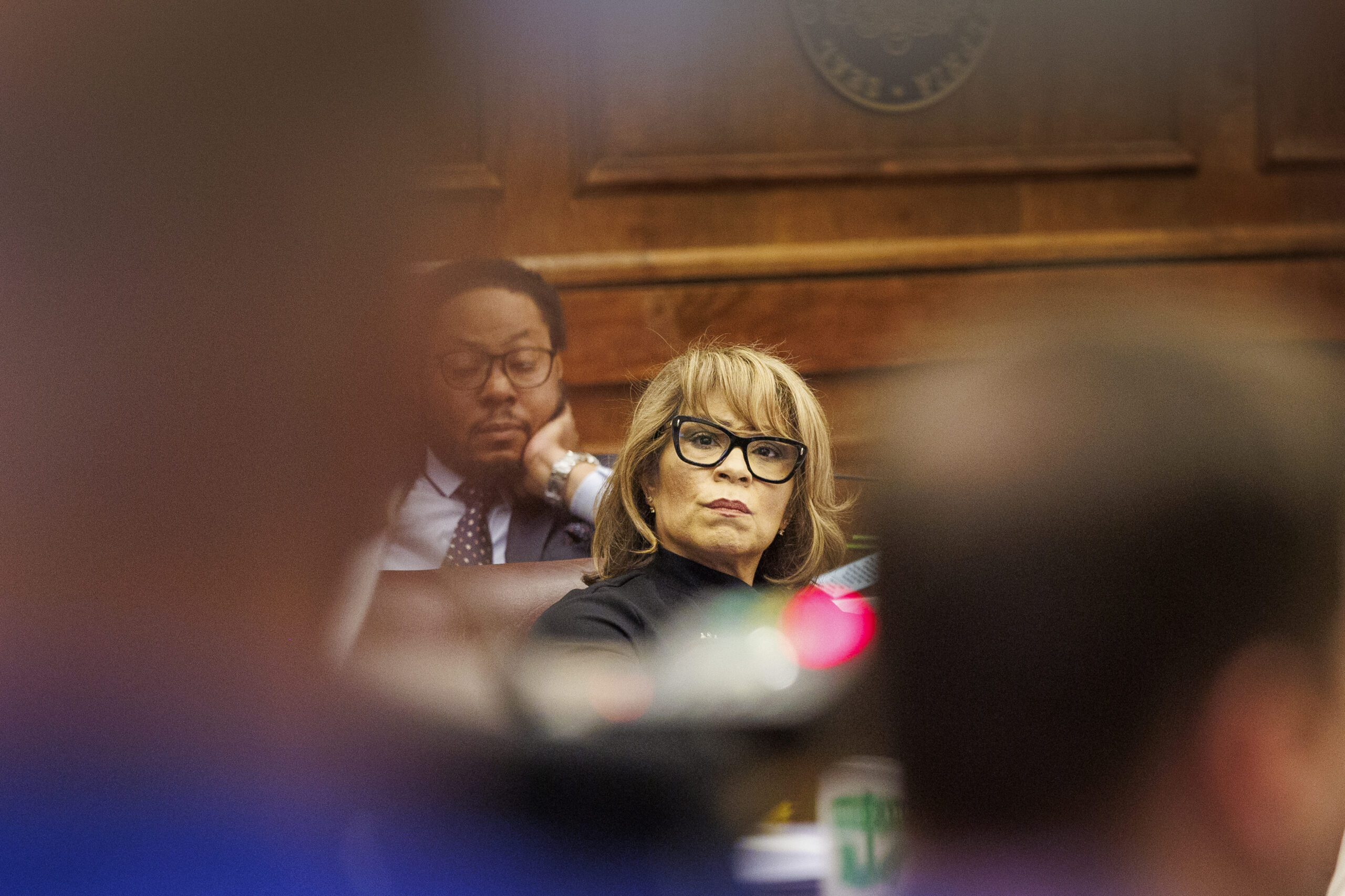
Philadelphia Councilperson Quetcy Lozada listens to public comment on her bill limiting medical providers in Kensington during public comment, City Council Chambers Philadelphia, Thursday, May 8, 2025. Policy shifts and the limits of enforcement
Yet, researchers like Luis Valdez, an assistant professor in community health and prevention at Drexel University and founder of the GANAS Health Initiative, have concerns.
“Can we stop looking at this as a wasted budget line item?” Valdez asked. “People are dying. Those people are also constituents, folks that have families and hopefully futures, and people that grew up in these districts, right? The problem wasn’t created by drug use. The drug use is a symptom of all these other things that are happening.”
Some experts say officials’ decisions to restrict certain programs have complicated outreach efforts. Multiple harm reduction advocates claim city leaders are disregarding medical advice on addiction care.
“Our own health and human services [department] is not using evidence-based practices. We’re on a really s— trajectory from the top down,” said Nicole O’Donnell, a peer recovery specialist with the Center for Addiction Medicine and Policy (CAMP) at the University of Pennsylvania Health System. CAMP provides patients with a prescription for buprenorphine via telehealth services.
“People view substance use as a choice instead of an illness. The people out there using are also victims of the opiate problem, and so is the neighborhood. We’re trying to figure out … how do we support both?” added O’Donnell, who is in recovery and lost a sister to an overdose.
She testified before City Council in May, explaining that CAMP prioritizes connecting people to low-barrier rehabilitation treatment options and to a physician for continued care.
Meanwhile, new mixtures of street drugs, like xylazine, have complicated treatment and harm reduction efforts. In August 2024, a city health alert reported the emergence of an even more potent substance: medetomidine. Mixed with fentanyl, this drug can trigger potentially life-threatening symptoms — such as muscle rigidity and slowed breathing — that require admission to an intensive care unit.
Those shifts in the drug supply are showing up in hospitals. In the last two years, healthcare workers have experienced a sharp increase in emergency room visits related to substance use injuries and withdrawals, according to city data. Patients have also exhibited complications with wound infections and severe withdrawal symptoms.
“[That data is] a sign and symptom of other things that we’re tracking,” said Jeannmarie Perrone, an emergency room physician and director of medical toxicology and addiction medicine at the University of Pennsylvania.
Perrone presented this data to City Council’s Kensington Caucus in May. Between January and September of 2024, more than 200 patients with addiction were admitted to intensive care units at Temple University Hospital, Penn Medicine, and Jefferson Health.
“[That] is really unheard of for opioid withdrawal,” Perrone told City Council.
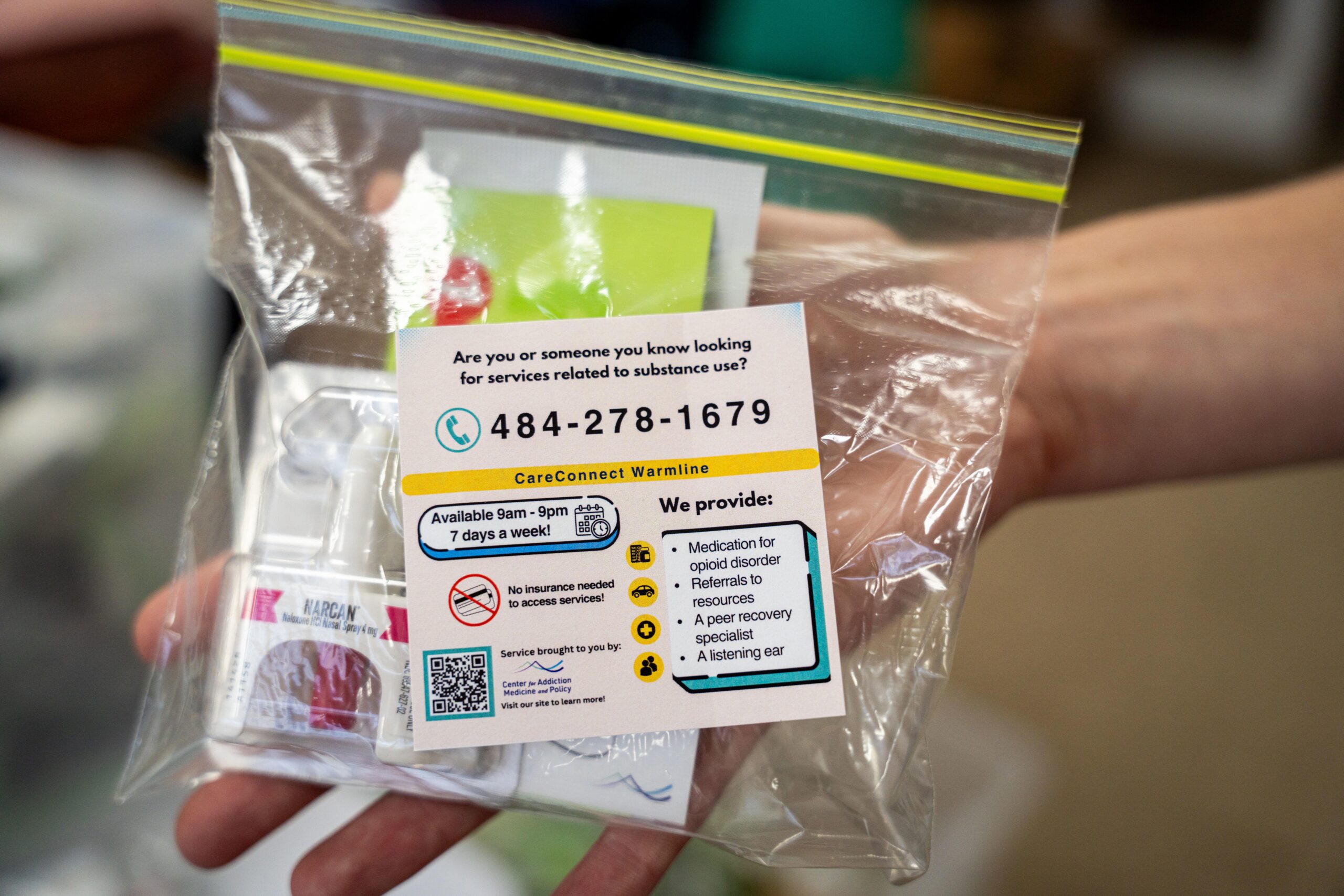
This packet, distributed by the Center for Addiction Medicine and Policy, contains Narcan, a medication used to reverse opioid overdoses. Language barriers, access gaps
Spanish-speaking Puerto Rican populations already struggled to access healthcare, a previous CPI investigation found. Latino providers are even rarer in substance use programming.
Esteves Camacho, who is from Caguas, Puerto Rico, was one of those providers. She was raised in Philadelphia and saw people lit up when she spoke in their language.
“It’s important to have the cultural context of being Puerto Rican,” she said.
But language is not the only barrier. After Hurricane María, Puerto Rican migration to Philadelphia increased, driven in part by people seeking medical care and social services. Experts told CPI that some arrivals include people with substance abuse problems, often low-income and eligible for Medicaid, a pattern also reflected in multiple studies.
In those cases, access to treatment often depends on Medicaid, the public program that funds a significant share of behavioral health services, and one that is now under threat. Government medical assistance covers nearly half the cost of treatments for people with substance use disorder, according to the Kaiser Family Foundation (KFF).
A 2017 state hearing revealed that 1,626 Hispanic Philadelphia residents from Air Bridge neighborhoods sought drug or alcohol treatment programs through the city’s Medicaid-funded behavioral health service, Community Behavioral Health (CBH). Today, residents in those same areas are more likely to use Medicaid-funded centers, especially for substance use disorder.
In 2021, 114,268 Pennsylvanians with substance use disorder relied on the aid, KFF data show. As of July 2025, Philadelphia topped the list for total Medicaid behavioral health spending, tallying $151,422,117, according to Pennsylvania health department data.
However, Latinos in the city are more likely to be underinsured or enrolled in Medicaid.
Medicaid funding hangs in the balance as the Trump administration slashes budgets dedicated to harm reduction services and raises barriers to enroll or renew benefits.
Pennsylvania is expected to be among the hardest-hit states, with an estimated $46 billion decrease over the next decade, according to KFF. Peer support, inpatient and outpatient rehabilitation, and mental health support could be destabilized for nearly 18 million people across the U.S.
“La cuerda parte por lo más finito [The rope always breaks at its weakest point]. Who are those 18 million Americans? Are they drug users? Probably. People who are on methadone. People who are using drugs,” sociologist Camila Gelpí-Acosta said.
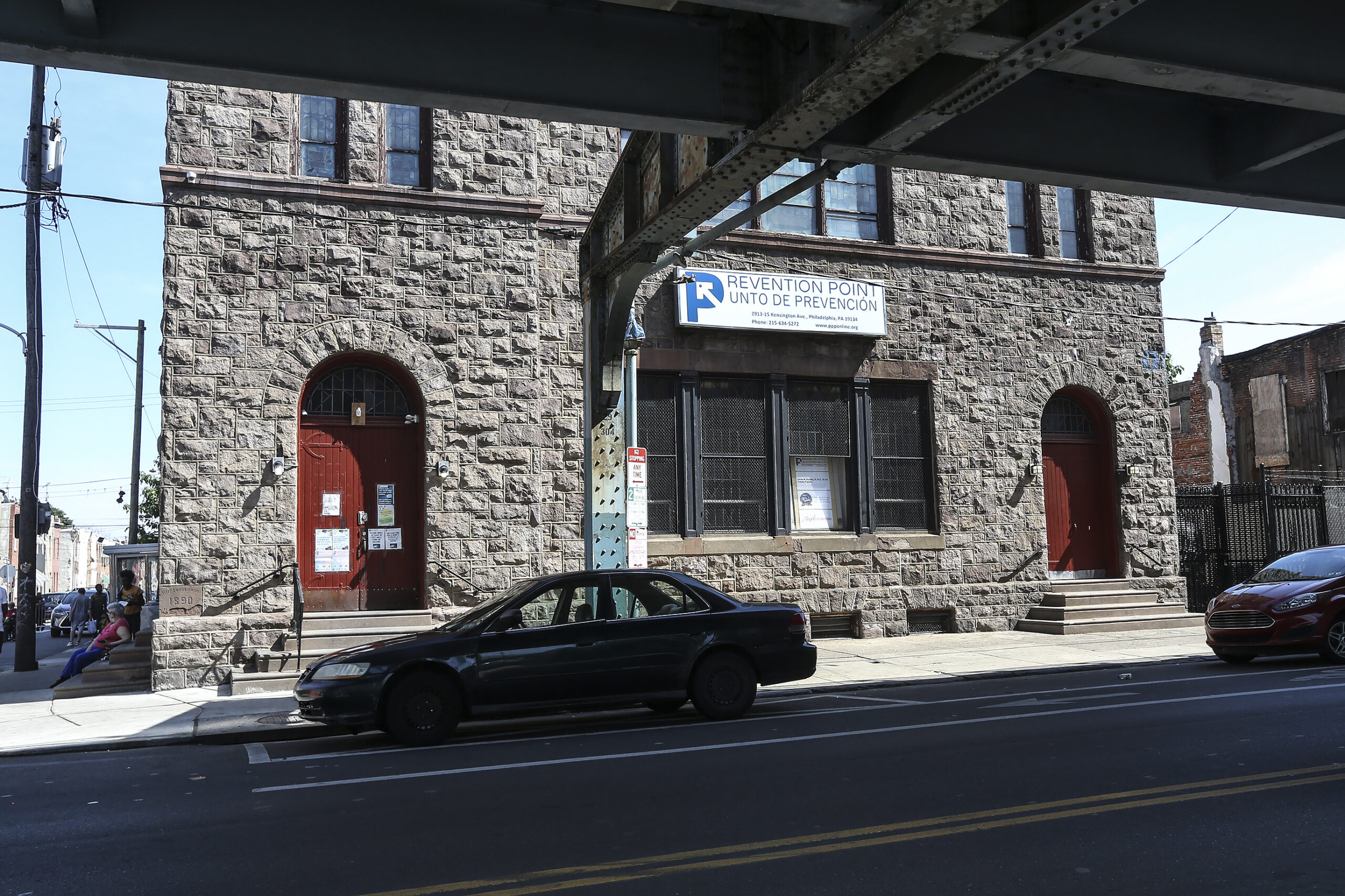
Prevention Point 2913 Kensington Avenue on June 14, 2022. ‘A blueprint of what not to do’
Puerto Rico, along with the Dominican Republic, has some of the highest rates of injection drug use in the Caribbean. Those areas also see increased demand for selling and buying drugs, says Josh Romig, assistant special agent in charge at the Drug Enforcement Administration’s Philadelphia field office, who has tracked drug trafficking for 26 years.
“Puerto Rico is positioned closely to the Dominican Republic, [which] sees Puerto Rico as a very viable and much easier option to import drugs, especially small amounts,” he said.
The drug trade has collided with a layered public health crisis, Gelpí-Acosta said.
“We’re talking about these six decades of using Puerto Rico as a launch pad toward the Northeast,” Gelpí-Acosta said. “It’s created a humongous drug-using population on the island in the archipelago.”
Limited addiction programs in Puerto Rico have pushed people to relocate to cities like Philadelphia, while drug trafficking organizations thrive on demand, as documented by an academic study in Centro Journal. Gelpí-Acosta and her wife founded El Punto en La Montaña, one of the few syringe exchange programs in Puerto Rico, seeing how drug use contributes to other health conditions such as HIV and hepatitis C. She underscored that weakened healthcare systems act as a catalyst for migration.
“They left the island because there were no services, because of many other complicated reasons,” Gelpí-Acosta said. “And here in the United States, they find services, but they end up homeless anyway, and they continue to use drugs. And then the HIV, overdose, and hepatitis C vulnerabilities remain unaddressed.”
Without treatment, people living with HIV or hepatitis C face chronic health complications, cancer, and death. Advocates and scholars say that failing to treat these conditions overlooks critical pieces of harm reduction.
“It’s not just an opioid crisis. … It’s a syndemic of overdose displacement. It’s structural neglect,” Valdez said.
The GANAS Health Initiative supports Latino men in Philadelphia, addressing overlapping needs such as housing, education and poverty.
A recent major drug bust illuminates those connections. In late October 2025, federal and state officials indicted 33 alleged members of a prominent drug trafficking ring in Kensington, led by dealers from Puerto Rico based in Philadelphia.
Allegedly, the head of the trafficking group allowed members to sell drugs “in exchange for rent,” according to the Department of Justice.
The drug economy in North Philadelphia persists in the zip codes with the highest poverty rates and the least social services funding.
“We have a blueprint of what not to do with alcohol from 1920 to 1932,” sociologist Gelpí-Acosta said, referring to the Prohibition era. “And yet, here we are. We continue to illegalize drugs, creating more dangerous drugs out there, not under our control. [Except] they’re not trafficking whiskey, they’re trafficking fentanyl.”
Valdez said health conditions that arise from substance use disorders emerge from what he calls “maladaptive coping skills” to stress. For example, suppressed trauma and limited access to Latino providers can exacerbate issues leading to self-medication.
Latinos often face complications with providers who are unfamiliar with their migration stories, family values, or cultural taboos around mental health and addiction.
“Language and cultural competency or responsiveness is not there,” Valdez said, rattling off other complications such as health insurance limitations and poor-quality housing. “Folks in power, whether we like it or not, would prefer an easy solution to a problem that’s really complex.”
Emily Seeburger, a mental health and substance use analyst, student, and volunteer with the Everywhere Project, echoed Valdez.
“Culture is such a big part of our health context,” Seeburger said. “To not have that, we are not equipped in the city to provide adequate healthcare.”
Kensington Avenue on Feb. 22, 2024. Mayor Cherelle L. Parker vowed to end Kensington’s open-air drug market for good. `No other way’
In Portugal, addiction specialists have identified possible solutions such as decriminalizing drugs, aiming to eliminate barriers to housing and jobs. Portugal’s program changed how law enforcement interacts with users: Rather than arrest people who use or have drugs on them, police officers work as social workers do and connect people to treatment options. In addition, the government provides free healthcare to expand access to methadone treatment.
“If we are dealing with a chronic relapsing disease, we must keep the investment that equates to this situation,” Portugal’s drug policy pioneer, João Goulão, said in a 2023 panel discussion at Georgetown University. He acknowledged doubt of the policy’s effectiveness and decreased participation in the program but blamed a lack of government-backed funding in social services.
Unintentional overdoses and long-term rehabilitation efforts require a health-first approach, he insisted.
This stands in stark contrast to Mayor Parker’s strategies.
“The single biggest risk factor for drug overdose death is a period of incarceration,” Seeburger said. “We’re not telling the whole story if we’re looking at acute overdose.”
Despite multiple requests, Parker remained unavailable for comment.
In 2024, Lozada told CPI the city must “respond aggressively” to address addiction.
“There are people we are allowing to die on those streets because we are afraid of what the optics will look like. We have to bring people into our system. There’s no other way,” she said. “We have to make people healthy in our system. … In a way, the optics are not going to look good.”
Pichardo, who helps people living on the streets and reverses multiple overdoses weekly, called these methods “retraumatizing.”
“They’re going to relapse because there’s no real structure. There’s no desire. It was forced upon them,” she said. “Twenty years of addiction does not equal 16 days of treatment.”
Luis Soto, a peer specialist, agrees. While he applauded Lozada’s efforts, he rejected the idea of coercing people into treatment.
“We cannot force recovery to no one,” he said. “That’s not the way.”
After his infant son died in 1995, Soto began using drugs. Between 1996 and 2011, he was incarcerated off and on, becoming entrenched in the drug trade along Kensington Avenue. For a few years, he was unhoused, until an outreach worker — whom he calls a mentor — helped him.
“In 2011, that’s when I opened my eyes,” Soto recalled.
The following year, Soto began working as a peer specialist. But he noticed a lack of Latino-focused services and shelters.
“There are no substance use treatment [or] resources specifically for women who speak Spanish. There is nowhere in the city of Philadelphia,” Seeburger confirmed. “There is one program for men who speak Spanish.”
In 2024, Soto founded the nonprofit Inspirando Latinos Inc.
“The city [doesn’t] have the background to provide services to this population,” he said.
But Roz Pichardo, Luis Valdez, and Luis Soto do, and they aim to fill that gap. Soto wants city officials to invest in more Latino peer specialists who can reach people where they are.
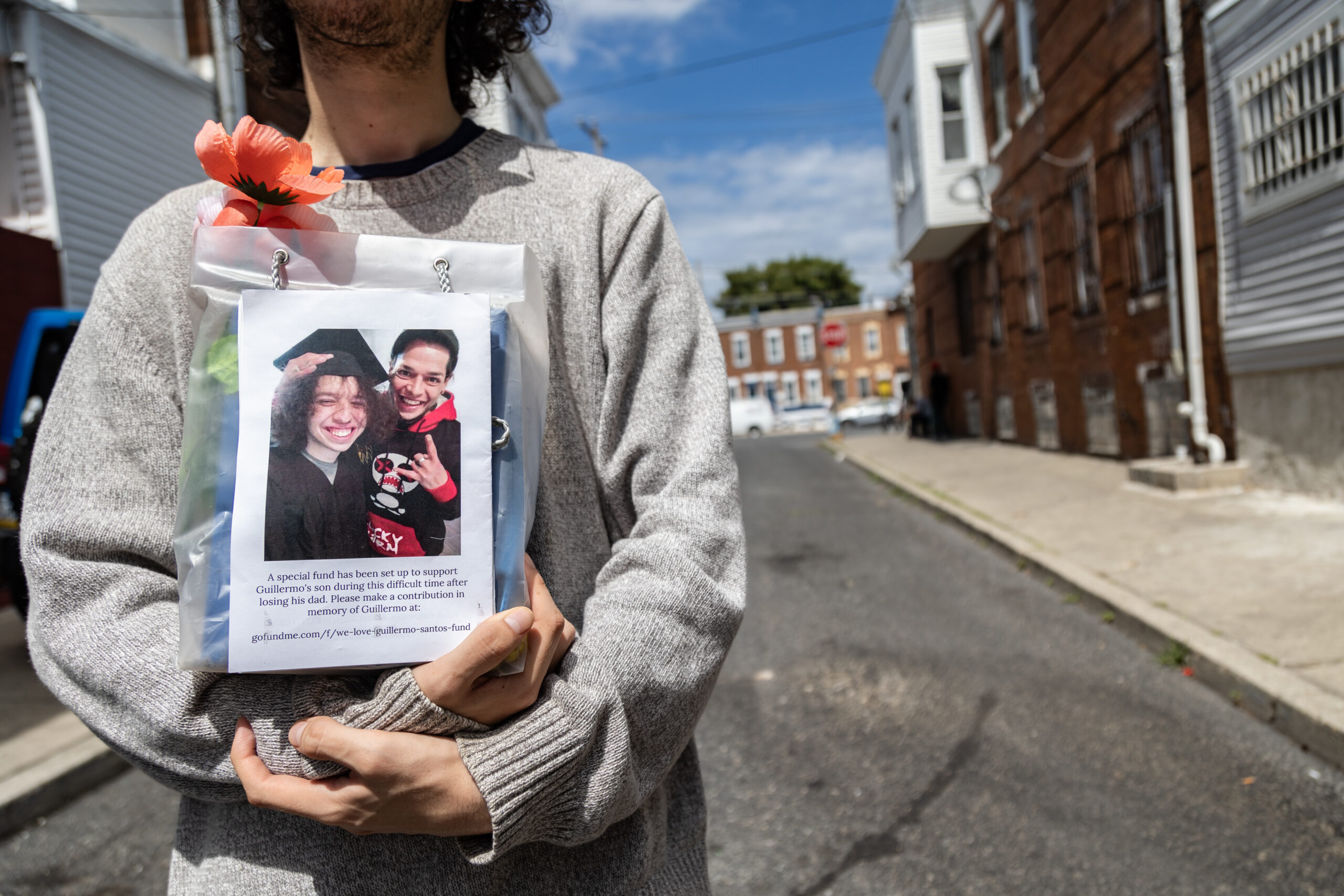
Guillermo Santos Jr. holds the ashes of his father, Guillermo Santos Sr., who died of a fentanyl overdose in 2021, outside his childhood home near Kensington and Allegheny on Aug. 19, 2025. In August, Santos prepared to move into a new apartment with friends in New York City. He has been away from home for two years, during which cycles of addiction lured in a new wave of people, some of them his friends in their early 20s.
Determined, he won’t give up. Santos says he draws strength from the solidarity he sees in Kensington, where his mother, families, neighbors, and advocates keep pushing for help that matches the scale of the crisis.
“That plea for unity is what keeps me so alive to this kind of stuff,” Santos said.
With the sun setting, he strategizes how to get his record collection to his new home.
As he closes the door to his childhood home, his father’s ashes remain on the mantle above the fireplace.
This article was produced by Centro de Periodismo Investigativo, a nonprofit center for investigative reporting in Puerto Rico, and made possible by a fellowship from the Centro de Periodismo Investigativo’s Journalism Training Institute.
-

Can Pierre Brondeau save FMC, the global pesticide maker he put on Philly’s skyline?
Pierre Brondeau is back in charge at FMC, laboring to keep the global pesticide maker independent and save one of Philadelphia’s last big corporate headquarters as his board weighs a sale.
When Brondeau, a French-born naturalized U.S. citizen, stepped down as FMC’s chief executive in 2019, he had made the road ahead sound not easy, but straight.
His right-hand man, Mark R. Douglas, whom Brondeau called “a little smarter and a little younger,” stepped up to run FMC. He implemented “precision agriculture,” the AI-enhanced application of crop-protecting insect, weed and fungus killers in growing markets such as Brazil and India.
Shares topped $100 for the first time in 2020 and stayed high as sales rose during COVID.
But in 2023, revenues and profits slowed, and the share price fell below $50. In 2024, Douglas left with nearly $6 million in severance. Brondeau, still board chair, came back as day-to-day leader, with a cost-cutting mandate.
This past July, he announced plans to sell FMC’s India commercia business, which FMC expects will fetch less than the company invested. In October, FMC cut its dividend and announced plans to outsource routine production. Brondeau’s second-in-command, Brazil-born Ronaldo Pereira, left the company.
On Feb. 4, FMC warned that it won’t recover fast in 2026. New products are catching on slowly as patents expire and generic competitors target FMC’s best-selling insecticide Rynaxypyr, which selectively kills crop-damaging moths and worms
Moody’s cut FMC’s debt rating to junk-bond status. The stock has been trading below $15. The company is hiring Bank of America and Goldman Sachs to see whether they could attract a good price from potential buyers.
But the global farm slowdown is bigger than FMC.
Shares of larger rivals Bayer, BASF, and Syngenta also are down over the past five years. Among global pesticide makers, only Wilmington-based Corteva, which includes the former Dow and DuPont farm chemical units, has risen in that period.
Brondeau, 68, says FMC has rebounded before and has pesticides “in the pipeline” to grow again. The company employs 5,500 worldwide, including more than 300 at its University City headquarters and 330 at Stine research labs in Delaware.
He took questions from The Inquirer in his FMC tower office in University City before leaving for a Bank of America conference in Florida, then to visit in Southeast Asia, and Latin America.
The conversation has been edited for length and clarity.
You retired, and then you’ve had to come back. What went wrong?
People don’t realize how impactful COVID was. China had shut down their supply chain. So many raw materials came from China it created a period of incredible uncertainty. We were less impacted than some of our competitors; we had moved a lot of manufacturing to India.
But the farmers had so much fear they would not be able to protect crops, they placed a lot of double and triple orders. They put product in storage, which they don’t usually do.
And then we got into a period of incredible cost inflation. By the end of 2023, we were in a mega downturn — maybe the longest since I have been in the industry. We are still very slowly mending. Farm economics is not good. Pricing is a challenge.
We have new products, very good products. But in a situation like this, growers very often make decisions more on prices than technology. And the generic manufacturers now have extra capacity, even though they are also experiencing increased resistance [by pests to older pesticides].
Is it time to sell FMC?
Today my path number one is keeping the company independent.
When we present our very solid 2026 plan to the board, including divesting some assets, they approved the plan as they always do.
They also said any business plan has risks. We need a safety net. We need to explore what would happen if we put the company for sale.
But the main path is the 2026 plan. That’s where I spend most of my time.
What’s your model for FMC’s recovery?
I would look at ourselves — we’ve done this before. 2015 was a low point for the company. We had a few months where we were wondering where the company was going. We did what we had to do commercially and structurally. By 2018, we were back to a top level.
Agriculture is a very cyclical business. 2026 is a very difficult time. The agricultural economy around the world is weak. And FMC has its patent issues. We have the talent we need, the organization we need. The executive team here working with me has a steady hand.
Nobody here is panicking that the board wants us to look at the potential sale of the company. They’d better not!
The biggest challenge a CEO faces is making sure your employees — the people who carry the company despite what we have to announce — have faith. That they stay focused.
Are you cutting across the board, including your U.S. research center at Stine Labs near Newark, Del., and the labs in Europe, Asia, Brazil?
No, we are not touching research. It’s who we are. Research in our field is very expensive; it is critical for a company like us to sustain spending on R&D to renew the market.
The European Commission supported your acquisition of some of DuPont’s product lines. They were glad to have a big pesticide maker that doesn’t depend on genetically modified crops. Won’t this make it hard for a Big Four pesticide company to now purchase FMC?
My gut feel would be to say, yeah, we are in a different world than we were in 2019. But we have not had contact with the regulators in any country [about] the announcement. So I cannot really answer.
Why is this happening now?
2026 is critical for us. Our key molecule Rynaxypyr lost its patent protection in 2025. We have three new molecules which are growing. But they are not yet at the size where they compensate. We believe we are at the bottom the cycle. If we do what our plan says in 2026, we are prepared to grow in 2027, 2028.
You were a famous fan of Philadelphia and its institutions. Are you still?
I’m still a Philadelphia fan. I’ve done way less than I used to because of the situation of the company.
I intend to keep this tower here. What a great location. We’ll be back to growth. That’s my intent; that’s my objective.
It’s very simple. If we do what we have to do in 2026, then 2027 and 2028 will be up. There is no doubt. We just have to get through this year.
-
Letters to the Editor | March 2, 2026
Dangerous men
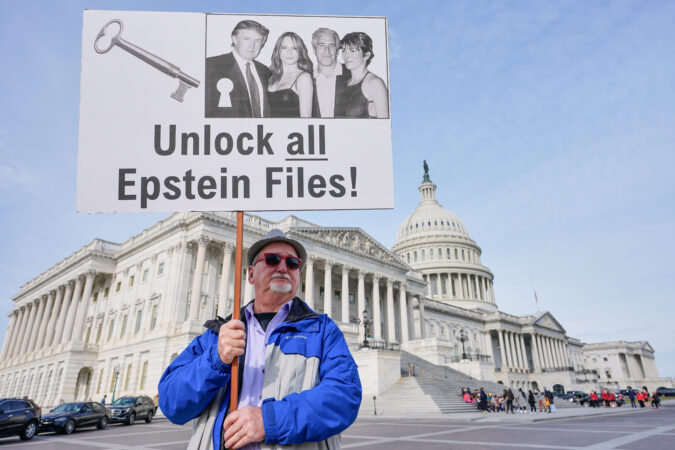
It is beyond disgusting that the prince formerly known as Andrew was finally arrested, not for any of his alleged egregious crimes with underage girls and women, but for some impropriety with government documents. I’m waiting for whatever materializes against our current leader regarding the Jeffrey Epstein files, despite the dozens of women who had already voiced claims of sexual assault before he was first elected president. There is no denying that men have a zipper problem. It transcends race, religion, ethnicity, politics, wealth, age, education, legal status, you name it. Would relaxing views on celibacy, masturbation, and decriminalizing sex work help? I don’t know. Women are still regarded as chattel and statistically have a one in three chance of being the victim of physical or sexual violence in their lifetime. It didn’t spare this writer. It won’t spare your mother, sister, daughter, neighbor, coworker, nurse, teacher, or friend. One in three women is a victim! Please report and support to help end sexual assault against women. Enough!
K. Mayes, Philadelphia
Missing documents
Fifty-two years ago, Richard Nixon famously proclaimed, “People have to know whether or not their president is a crook.” As applied to our current president, one jury has already answered that question, and repeated revelations regarding his (and his family’s) financial dealings suggest an unfortunate answer (unfortunate for the country, but not for his family’s bank accounts).
Beyond Nixon’s mandate, the American people have to know whether their president is a pedophile. However, under Donald Trump’s absolute control, the U.S. Department of Justice (now staffed with his acolytes, the “Roy Cohns” whose absence Trump lamented during his first term) refuses to release millions of files related to Jeffrey Epstein, and has produced documents rendered meaningless with many redactions in violation of federal law.
As with his other legal and moral challenges, Trump’s robotic claim of “complete exoneration” rings hollow unless and until the evidence is revealed and analyzed. As Trump continues to give the survivors, members of Congress, and the American public the middle finger, where are the elected Republicans? The answer to that one is also obvious: Still cowering under their beds with the lights out.
Stephen Ulan, Wynnewood
Dress for respect
Two recent comments by Pennsylvania’s senior senator, John Fetterman, caught my attention. For one, he criticized Democrats who boycotted the State of the Union address, saying it was a matter of respect for the office of the presidency. At another point, he acknowledged that he usually “dresses like a slob” before showing up in a suit for Donald Trump’s address. Should we conclude from his own comments that he respects the president but not his colleagues?
Laslo Boyd, Philadelphia
Inspired to give
Ramadan has begun. It’s a sacred month observed by Muslims through fasting and prayer. From dawn to dusk, Muslims abstain not only from food and drink, but also from harsh words and other negative behaviors. As the Holy Quran teaches, “O ye who believe! fasting is prescribed for you … so that you may become righteous” (2:184). Ramadan is, at its heart, a time for spiritual growth and moral renewal.
Experiencing hunger reminds us of our neighbors who face it daily. The Holy Prophet Muhammad (peace and blessings be upon him) said, “He is not a believer whose stomach is filled while his neighbor goes hungry.” In a nation where one in eight families has faced food insecurity in recent years — disproportionately affecting single-parent households, families below the poverty line, and many families of color — this message feels especially urgent.
Ramadan calls Muslims to increase their generosity and to feed the needy. We invite our fellow Americans, regardless of faith, to join in supporting local food banks, shelters, and community initiatives. Together, we can transform empathy into action. Though Ramadan is usually marked by joyful gatherings, we are mindful of the many around the world suffering from conflict and hardship. We pray for peace, justice, and for leaders to place our shared humanity above division. May this month inspire compassion and service for all.
Madeel Abdullah, Garnet Valley
Little things
“Don’t sweat the small stuff” is a phrase we usually hear in personal life, not in healthcare. But hospitals would do well to take it seriously — because in medical settings, the “small stuff” is often anything but. Patients and families routinely encounter minor lapses that, taken individually, may seem inconsequential: unanswered call buttons, missing medications, delayed transport, incomplete discharge instructions, inaccurate charts, malfunctioning equipment, or staff who are stretched so thin that basic communication falls apart. None of these failures alone makes headlines. Yet, together, they erode trust, increase risk, and ultimately affect outcomes.
Hospitals are rightly focused on major metrics — mortality rates, readmissions, infection control, and cutting-edge treatments. But an exclusive focus on big-picture indicators can blind institutions to the everyday breakdowns that define the patient experience. When small problems are tolerated, normalized, or dismissed as inevitable, they accumulate into systemic failure. For patients who are elderly, seriously ill, or frightened, these “little things” are not abstractions. They are moments of confusion, discomfort, and vulnerability. For families, they are warning signs that no one is fully in charge.
Attention to detail is not cosmetic; it is clinical. Precision, follow-through, and accountability at the smallest levels are the foundation of safe, humane care. Hospitals that truly aspire to excellence must insist on reliability not only in the operating room, but in the hallway, the chart, the shift change, and the bedside conversation. If hospitals want better outcomes, they should start by sweating the small stuff.
John C. Levine, Philadelphia
Not a hoax
It is disturbing to watch Donald Trump’s Environmental Protection Agency take a huge step backward on protecting the world as we know it. We know the climate emergency will determine the future for all living things on Earth. Many aspects related to the weather — extreme storms, droughts, heat waves, freezes — are being affected. Several years ago, I read a small book on climate change by Greg Craven, a science teacher in Corvallis, Ore., who produced a series of short videos that explained phenomena such as the melting of polar ice caps and thawing of the tundra, both of which would likely lead to dramatic shifts in the weather we have known for millennia. Both are now happening.
Craven created a chart on the impact of taking climate action. There were four squares: 1) Climate change is not a problem, and we don’t take action. 2) Climate change is not a problem, and we take action that proves unnecessary. 3) Climate change is a problem, and we do take action. 4) Climate change is a problem, and we don’t take action. It’s that last box that we are now putting ourselves in, and it’s the one box Craven said we should avoid at all costs.
Sue Edwards, Swarthmore
Join the conversation: Send letters to letters@inquirer.com. Limit length to 150 words and include home address and day and evening phone number. Letters run in The Inquirer six days a week on the editorial pages and online.
-
Dear Abby | Friendship with neighbor is more one-sided than ever
DEAR ABBY: I have always looked inside a person before casting judgment. It has been six years that I’ve been close friends with my neighbor “Tim.” I have always regarded him as a Kramer from Seinfeld.
I have OCD. I am a clean freak. I work hard to support myself and my kids. Tim is on every government program. He’s a hoarder. His dog is filthy, and Tim literally has to leave notes posted in his house to “remind” himself to wash his own hands. Tim is politically my opposite. He’s narcissistic, and if you disagree with him, he gets crazy, raging with anger. I have remained friendly with him because I feel bad for him.
Tim is always asking me to go out to dinner or an event, and I’m always turning him down. He doesn’t have much money, so when he needs something, I help out. Lately, though, because I feel like he’s taking me for granted, I have been quietly pushing him away. Tim has now become increasingly needy, both emotionally and financially. How can I end the friendship without sending him into a spiral?
— NEIGHBOR IN NEVADA
DEAR NEIGHBOR: Friendship is supposed to be reciprocal. From your description of your relationship with Tim, it has been all take and no give. Because this relationship has become so lopsided, continue refusing his invitations, be less available when he wants to dump his troubles on you and quit giving him money.
** ** **
DEAR ABBY: I am tormented by an incident that occurred at a time when I did not have the ability to object or present facts to disagree. My father had given me permission to invite my three close college friends for a holiday dinner. My stepmother evidently objected to it. A week before the dinner, my stepmother’s father began verbally attacking me for inviting my friends, implying that I had been out of line. He said, “Holidays are for family.” I was shocked by his statement because I had been taught from elementary school that people invite others for the holiday to share our gratitude for what we have. This could include those who have no family and are alone for the holiday. After that holiday, my stepmother told me I would never have friends over again for any holiday.
In each of the 25 or so years that have passed, that painful incident comes to mind, and I wish I had had the ability to speak out. What would you suggest should have been the proper answer, at the time, in this case?
— SEARCHING FOR CLOSURE
DEAR SEARCHING: You could have told your stepmother that sharing holidays with friends was never forbidden before she came along, but now that she ruled the roost, you and your friends would be celebrating elsewhere. I hope that in your adulthood you have practiced the principle of inclusion which is intrinsic to your nature.
-
Horoscopes: Monday, March 2, 2026
ARIES (March 21-April 19). Through your gift for vivid fantasy, you feel what it’s like to live in a world filled with all you value and aspire to, and you can really see it. When you touch back to reality, you use this as a compass.
TAURUS (April 20-May 20). A little bit of research will show better options, but a lot of research may show you so much that it confuses the issue. Be strategic and to the point, limiting your inquiry process to a few hours.
GEMINI (May 21-June 21). Your natural mode is curiosity, and you love experimentation, so the unsolicited advice from those who seem to take joy in cautioning you against this and that can feel annoying. It might be more about their need for control than your safety.
CANCER (June 22-July 22). There are many kinds of justice to be served, including, notably, justice of the poetic variety. A quiet, satisfying ripple of irony washes over the moment. You’ll be validated in some way, and the poetic symmetry of it all will be delicious.
LEO (July 23-Aug. 22). You’re a giver. Even when you’re receiving, you’re giving. So how do you stay fortified? By rooting yourself where you’ll flourish. Keep in mind that there are no universally correct environments. A cactus thrives in the desert, a vine in the jungle.
VIRGO (Aug. 23-Sept. 22). It’s like the day keeps slipping you small gifts — little surprises to remind you you’re unique and essential to how it’s all going. Life is collaborating with you and enjoying the collaboration.
LIBRA (Sept. 23-Oct. 23). You’re hearing a lot today that either doesn’t quite hit you the right way or doesn’t quite ring true. When honest words aren’t pleasing and pleasing words aren’t honest, you’ll take a step back and reassess more than just these sentences.
SCORPIO (Oct. 24-Nov. 21). Love is as love does. Put stock in action. It’s not that words matter less today; it’s that they hardly matter at all because irrefutable truth is in how people treat one another, and the difference that makes.
SAGITTARIUS (Nov. 22-Dec. 21). Societal standards of beauty are ever-changing because beauty relies on freshness. Yes, fashions come back around, trends resurface, but it’s never exactly the same twice. You’ll love the version of a classic you knew well.
CAPRICORN (Dec. 22-Jan. 19). You’re not sure what you’re going to get in a relationship these days. But through the tension, tenderness, friction and fun, you’re reminded that the long haul has many chapters and moods, and that’s what makes it meaningful.
AQUARIUS (Jan. 20-Feb. 18). People with influence will be impressed with your confidence, ease, curiosity, discernment and how you listen and carry yourself. Don’t talk shop too soon. It can flatten all your vibes into transactional relationships. Feel this out over time.
PISCES (Feb. 19-March 20). Seems like yesterday’s solution is becoming today’s problem, which only means the world is turning on its typical axis. Still, you’ll have a joyful moment of appreciation for this unique set of less-than-ideal circumstances.
TODAY’S BIRTHDAY (March 2). Welcome to your Year of Profound Belonging. You’ll work and play in teams that are more like family. There is much to learn and do in the safety of healthy groups where love, talent and vision lift all. More highlights: Financial ease and professional recognition. You’ll try new endeavors, and your daring and commitment blossom into versions of your best self. Inspiration will often strike at midnight. Leo and Pisces adore you. Your lucky numbers are: 3, 27, 14, 39 and 22.
-
Sixers’ three-game win streak snapped after 114-98 loss to Celtics
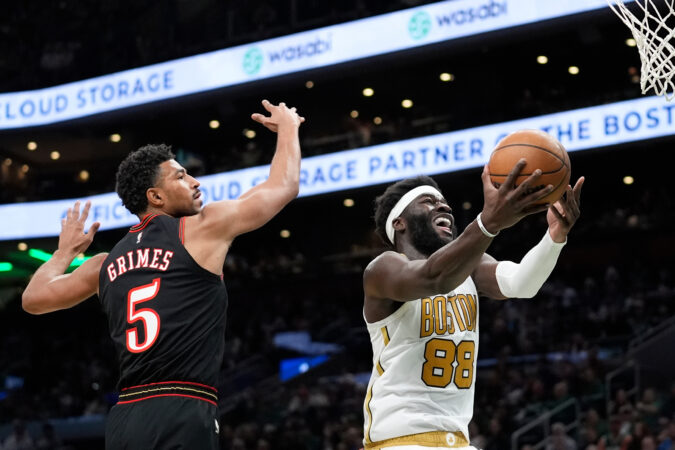
BOSTON — Neemias Queta scored a career-high 27 points and added 17 rebounds to help the Boston Celtics recover from a slow start and rally to beat the Philadelphia 76ers 114-98 on Sunday night.
Jaylen Brown added 27 points, eight rebounds and eight assists, and Derrick White finished with 21 points and eight assists as the Celtics became the fourth team to reach 40 victories. They have won six of seven.
It was the 11th double-double of the season for Queta, who also had three blocks. He has three double-doubles — with at least two blocks in each — over his last five games.
Philadelphia cut what was a 16-point lead by Boston in the second half to 103-97 with just over four minutes to play. But Queta scored Boston’s next eight points to put the Celtics in front 111-98 and help close it out.
Tyrese Maxey led the 76ers with 33 points and six assists. VJ Edgecombe added 23 points as Philadelphia’s three-game win streak was snapped.
With Queta leading the way, the Celtics used a 15-6 run to erase a 10-point, first-quarter deficit and took a 62-50 lead into halftime.
Baylor Scheierman, who played with a splint on the left thumb he fractured in Friday’s win over Brooklyn, gave a thumbs up after draining a corner 3-pointer at halftime buzzer off a feed from Brown.
Queta carried the early offensive load for the Celtics with 16 points, 10 rebounds, two assists, a steal and a block in just under 14 minutes in the first half.
Philadelphia led throughout the opening period and built as much as a 10-point edge while Boston shot just 30% from the field (8 for 26).
But the Celtics recovered, outscoring the 76ers 36-22 in the second quarter and never trailed again.