A Virginia teen who admitted in court that he wanted to join ISIS pleaded guilty Thursday to attempted murder and related offenses for a stabbing attack last year on a Florence Township police officer, Burlington County Prosecutor LaChia L. Bradshaw said Friday.
Fasihullah Safar, 17, of Alexandria, Va., was charged as an adult and will be sentenced to 18 years in prison under a plea deal, Bradshaw said. He is scheduled to be formally sentenced on March 26 in Superior Court in Mount Holly.
The police officer who was stabbed several times in the chest was wearing a ballistic vest that prevented more significant injuries, Bradshaw said.
On March 21, 2025, Safar, who was 16 at the time, was driving a stolen vehicle when he intentionally caused a crash with another vehicle, Bradshaw said. A Florence police vehicle responding to the scene was then struck multiple times by Safar’s vehicle.
Safar’s vehicle became inoperable on Route 130 near Station Road. When officers arrived, Safar charged them while armed with a knife, Bradshaw said. Besides the officer who was stabbed, suffering a laceration to his torso and facial injuries, two other officers sustained minor injuries. During the struggle, Safar also cut himself.
In court, Safar admitted that in the months before the confrontation, he had begun following the Islamic State organization, Bradshaw said. Safar had indicated on social media that he planned to join the group.
Safar admitted that he shouted “Allahu akbar” during the confrontation with police, and that he intended to kill one of the officers, Bradshaw said.
Prior to the violent encounter with police in Florence Township, he was being sought by authorities, including the FBI, after he allegedly trespassed at a school in Fredericksburg, Va., causing the local district to close all schools.
A school resource officer approached Safar, who then fled and later allegedly stole a vehicle.
One report later said Safar had been investigated by the FBI after the teen allegedly posed on social media with what appeared to be a firearm.
Kelsey Fuentes of Philadelphia (front) chants “No more money for ICE’s crime” as she marches east on Market Street during the Philly stands with Minneapolis Ice Out For Good protest march that began at Philadelphia’s City Hall on Friday, Jan. 23, 2026.A transgender woman from Philadelphia holds up her sign during the Philly stands with Minneapolis Ice Out For Good protest at Philadelphia’s City Hall on Friday, Jan. 23, 2026.Protesters gather during the Philly stands with Minneapolis Ice Out For Good protest at Philadelphia’s City Hall on Friday, Jan. 23, 2026.Alex Kilcullen of King of Prussia (seated) participates during the Philly stands with Minneapolis Ice Out For Good protest at Philadelphia’s City Hall on Friday, Jan. 23, 2026. Kilcullen is from the Deer clan of the Cherokee tribe.Community College of Philadelphia leaders Maritsa Hernandez-Orsini (left) and Maria Baez were vocal during the Philly stands with Minneapolis Ice Out For Good protest at Philadelphia’s City Hall on Friday, Jan. 23, 2026.Protesters gather during the Philly stands with Minneapolis Ice Out For Good protest at Philadelphia’s City Hall on Friday, Jan. 23, 2026.Protesters march up Eighth Street, towards the immigration offices, during the Philly stands with Minneapolis Ice Out For Good protest at Philadelphia’s City Hall on Friday, Jan. 23, 2026.Courtney Mitchell of Philadelphia (right) during the Philly stands with Minneapolis Ice Out For Good protest at Philadelphia’s City Hall on Friday, Jan. 23, 2026.
Clemson coach Dabo Swinney is accusing Mississippi coach Pete Golding of tampering with transfer player Luke Ferrelli and said Friday he has forwarded evidence to the NCAA.
“If you tamper with my players, I’m going to turn you in. It’s just that simple,” Swinney said during a news conference. “I’m not out to get anybody fired, but there has to be accountability and consequences for this type of behavior and total disregard for the rules.
“If this happened in the NFL, which is an actual league with rules, they would be fined, they would take draft picks, they hit the cap, whatever,” Swinney continued. “This is such a terrible example for young coaches in this profession. … To me, this situation is like having an affair on your honeymoon.”
Ferrelli, a former linebacker at California, entered the transfer portal on Jan. 2 and committed to Clemson four days later. Ferrelli subsequently enrolled, began classes, and began attending meetings and workouts, Swinney said.
Ferrelli reentered the portal on Jan. 22 and committed to Ole Miss.
“You can’t sign with the Browns and practice a week, and then the Dolphins call you and say we’re going to give you a little more money and you say, ‘See ya, boys,’ and go play for the Dolphins. That’s not the real world,” Swinney said.
Ole Miss athletic officials did not respond to Swinney’s allegations when contacted on Friday by The Associated Press.
NCAA vice president of enforcement Jon Duncan said in a statement that the association “will investigate any credible allegations of tampering and expect full cooperation from all involved as required by NCAA rules.”
Swinney alleged that Golding maintained contact with Ferrelli after the linebacker had enrolled at Clemson, even texting, “I know you’re signed, but what is your buyout?”
When Swinney found out about it, he said he initially told Clemson general manager Jordan Sorrells that he wanted to give Golding “some grace” because the Rebels’ coach was newly promoted after Lane Kiffin left for LSU over Thanksgiving weekend.
Swinney asked Sorrells to tell Ole Miss officials “that we know what’s going on, and if he doesn’t cease communication, I’m going to turn him in. I really thought that would be the end of it, but it wasn’t.”
Swinney said Ferrelli’s agent confirmed that Golding had continued reaching out to the player, so Clemson officials asked for copies of the text messages.
“The agent communicated that if we were to add a second year at $1 million to the already agreed-upon deal with Luke, then they would gladly give us whatever we need to turn Ole Miss in,” Swinney said. “Jordan, appropriately, said, ‘No, we’re not doing that.’”
Clemson athletic director Graham Neff said the university’s main reason for making the allegations public was to spur changes to the college football calendar and related rules — or lack thereof — that have contributed to upheaval across the sport.
“The NCAA was surprised a school was willing to come forward as directly and transparently as we were,” Neff said. “We need to look real hard at how we got here, but (also) how to get out of it.”
Neff added that Clemson was exploring its legal options.
“This is not about a linebacker at Clemson,” Swinney added. “I don’t want anyone on our team that doesn’t want to be here.
“It’s about the next kid and about the message being sent if this blatant tampering is allowed to happen without any consequences.”
Swinney also called the January transfer portal window “stupid,” saying it causes “flat-out extortion in some cases” because players and schools are making major decisions during “such a short period of time, right in the middle of when people are trying to play bowl games, playoff games, et cetera.”
If the system is not reformed, Swinney warned, there will be unintended consequences for players who transfer among multiple schools while chasing short-term financial payouts — particularly if they don’t make it to the NFL.
“We’re going to have some screwed-up 30-year-olds … that have no degrees, that have spent their money, that can’t play football anymore and aren’t connected to anything,” Swinney said.
DALLAS — Freezing rain was falling in West Texas on Friday as a huge, dayslong winter storm began a trek that threatened to bring snow, sleet, ice, and bone-chilling temperatures as well as extensive power outages to about half the U.S. population.
Forecasters warned that catastrophic damage, especially in areas pounded by ice, could rival a hurricane. Schools in Chicago and other Midwestern cities called off classes Friday, airlines canceled thousands of weekend flights, churches moved Sunday services online, and the Grand Ole Opry in Nashville decided to hold its Saturday night radio performance without fans. Carnival parades in Louisiana were canceled or rescheduled.
At least 182 million people were under watches or warnings for ice and snow and more than 210 million were under cold weather advisories or warnings. In many places, those overlapped. Utility companies braced for power outages because ice-coated trees and power lines can keep falling long after a storm has passed.
“It’s going to be a big storm,” Maricela Resendiz said as she picked up chicken, eggs, and pizzas at a Dallas store to get her, her 5-year-old son and her boyfriend through the weekend. Her plans: “Staying in, just being out of the way.”
(function () {window.addEventListener(‘message’, function (e) { var message = e.data; var els = document.querySelectorAll(‘iframe[src*=”‘ + message.id + ‘”]’); els.forEach(function(el) { el.style.height = message.height + ‘px’; }); }, false); })();
Freezing rain was already slickening roads in Lubbock, Texas, on Friday afternoon as temperatures dropped. After sliding into the South with ice and sleet, the storm was expected to move into the Northeast, dumping about a foot of snow from Washington, D.C., through New York and Boston, the National Weather Service predicted.
Arctic air was the first piece to fall in place
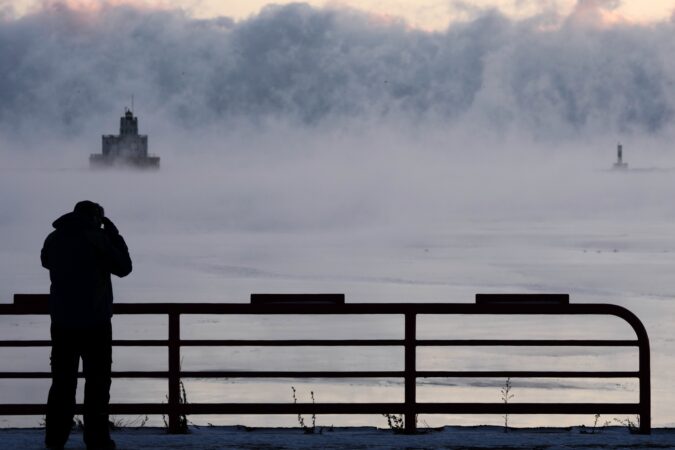
Arctic air that spilled down from Canada prompted schools throughout the Midwest to cancel classes Friday. With windchills as low as minus 40 degrees Fahrenheit, frostbite could set in within 10 minutes, making it too dangerous to walk to school or wait for the bus.
In Bismarck, N.D., where the windchill was minus 41 Fahrenheit, Colin Cross cleaned out an empty unit for the apartment complex where he works.
“I’ve been here awhile and my brain stopped working,” said Cross, bundled up in long johns, two long-sleeved shirts, a jacket, hat, hood, gloves and boots.
Despite bitter cold, a protest over an immigration crackdown went on as planned in Minnesota, with thousands demonstrating in downtown Minneapolis.
Nationwide, more than 1,000 flights were delayed or canceled Friday, with well over half of them in Dallas, according to the flight tracking website FlightAware. About 2,300 Saturday flights were canceled.
In Oklahoma, Department of Transportation workers treated roads with salt brine, the Highway Patrol canceled troopers’ days off, and National Guard units were activated to help stranded drivers.
The federal government put nearly 30 search and rescue teams on standby. Officials had more than 7 million meals, 600,000 blankets, and 300 generators placed throughout the area the storm was expected to cross, according to the Federal Emergency Management Agency.
President Donald Trump said via social media that his administration was coordinating with state and local officials and “FEMA is fully prepared to respond.”
Northeast prepares for heavy snow
The Northeast could see its heaviest snow in years.
Boston declared a cold emergency through the weekend, and Connecticut was working with neighboring New York and Massachusetts in case travel restrictions are needed on major highways.
Connecticut Gov. Ned Lamont urged people to go grocery shopping now and “stay home on Sunday.”
Ice could take down power lines and pipes could freeze
Once ice and snow end, the frigid air from the north will head south and east. It will take a while to thaw out, an especially dangerous prospect because ice can add hundreds of pounds to power lines and branches and make them more susceptible to snapping, especially if it’s windy.
In at least 11 Southern states from Texas to Virginia, a majority of homes are heated by electricity, according to the U.S. Census Bureau.
A severe cold snap five years ago took down much of the power grid in Texas, leaving millions without power for days and resulting in hundreds of deaths. Gov. Greg Abbott said Thursday that won’t happen again, and utility companies were bringing in thousands of employees to help keep the power on.
Pipes are also at risk.
In Atlanta, where temperatures could dip to 10 degrees and stay below freezing for 36 hours, M. Cary & Daughters Plumbing co-owner Melissa Cary ordered all the pipe and repair supplies she could get. She said her daily calls could go from about 40 to several hundred.
“We’re out there; we can’t feel our fingers, our toes; we’re soaking wet,” Cary said. “I keep the hot chocolate and soup coming.”
People are hunkering down
Stephen McDonald, who hasn’t had a home in three years, was hoping to get out of the cold in Jackson, Miss. But the Shower Power homeless shelter was adding spray foam insulation and ceiling heaters, keeping it closed until Saturday.
Friday night’s forecast called for lows near freezing. “Your hands get frozen solid, and they hurt real bad,” said McDonald. “It’s not good.”
At the University of Georgia in Athens, sophomore Eden England was staying on campus to ride out the weather with her friends, even as the school encouraged students to leave dorms and go home because of concerns about losing power.
“I was texting my parents and we kind of just realized that whether I’m here or at home, it’s going to suck either way,” England said. “So I’d rather be with my friends, kind of struggling together if anything happens.”
Letitia Grant was gobsmacked when she learned her daughter’s school was slated for closure.
“That can’t happen,” she said.
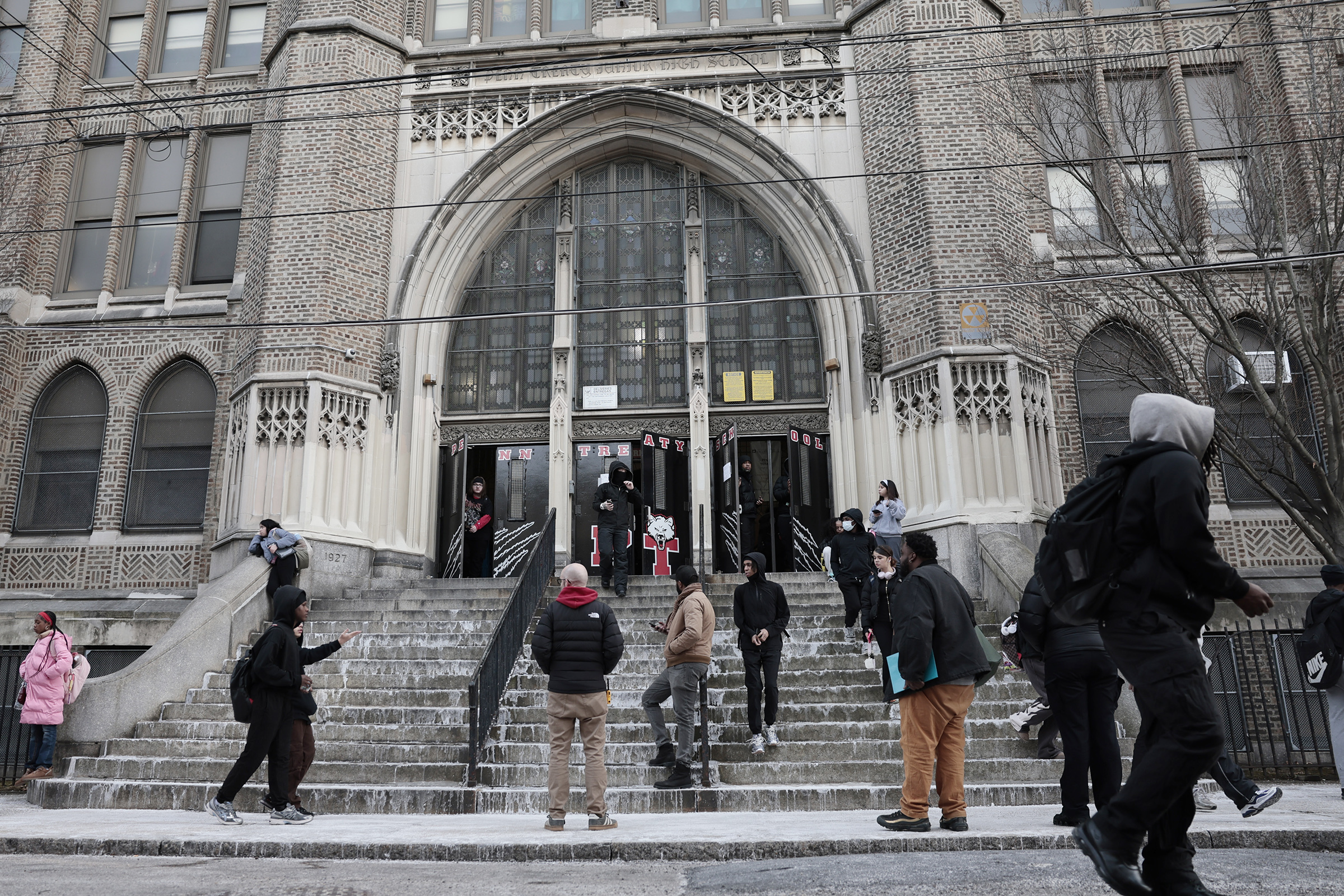
Penn Treaty High School, where Grant’s daughter is in the eighth grade, is one of 20 schools proposed for closure as part of a massive reshaping of the Philadelphia School District announced Thursday.
The plan — which Superintendent Tony B. Watlington Sr. said he would present in full to the school board on Feb. 26 — would affect every neighborhood in the city. In addition to closing 20 schools, it proposes colocating six others, and making changes, including renovations and grade restructuring, at an unspecified number of schools.
But Grant is focused on what it means for her daughter, who loves her teachers, her counselor, and the friends she has made at the Fishtown school.
Grant was looking forward to seeing her daughter cross a stage to collect her diploma at Penn Treaty’s 2030 high school graduation, she said. She is not sure what will come next.
School officials stand by outside for afternoon dismissal at Penn Treaty Middle School, 600 East Thompson Street, in Philadelphia on Thursday, Jan. 22, 2026.
Penn Treaty, which now has just 345 students in grades six through 12 in a building that can accommodate 1,200, would cease to exist under the plan, and Bodine High, a district magnet in Northern Liberties, would move to the Penn Treaty building and add a middle school.
After dismissal Thursday, the day families learned of the closure, Grant’s daughter and her friend stopped their biology teacher to chat. The teacher is her daughter’s favorite, Grant said.
Grant fears the changes will meanthe district will be “piling too many kids per classroom.”
The facilities plan will touch every neighborhood in the city for years to come, with ripples for students, teachers, and families. Here are some of their stories.
At Waring, parents worry — and prepare to sound off
As parents dropped their children off Friday morning at the Laura Wheeler Waring School in Spring Garden, faces were grim.
“We’re pissed off because it’s a great school,” said Isheen Bernard, whose son attended Waring and whose daughter is a third grader there now. Waring was identified for closure; under the plan, Masterman middle school students would eventually take over the building, with Waring students sent to Bache-Martin.
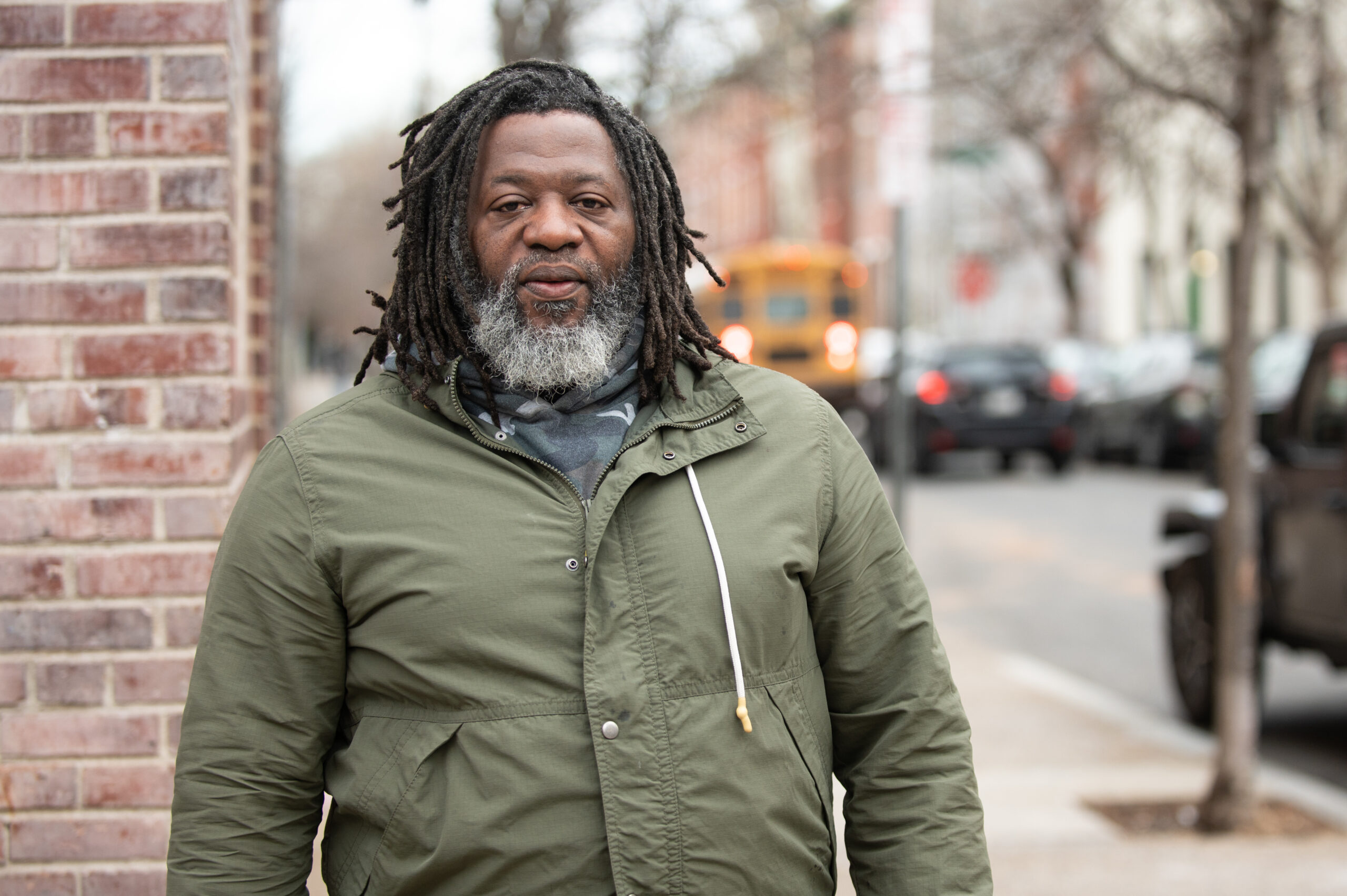
Isheen Bernard, 48, poses for a portrait after dropping his child off at Laura Wheeler Waring Public School in the Spring Garden section of Philadelphia on the morning of Friday, Jan. 23, 2026. Under a new school district plan, Laura Wheeler Waring Public School would be closing in the 2027-2028 school year.
Nysheera Roberts graduated from Waring herself, and so did her mother. Now, she has children there, and her nieces and nephews also attend.
Shutting the school down would be hurtful and heartbreaking, Roberts said. Waring has just under 200 students in a building that can house 437.
“It’s a piece of our history,” she said.
Taking her daughter to Bache-Martin would be a major inconvenience for her, her children, and other neighborhood families, Roberts said. Now, she can easily drop her baby off at a nearby daycare before popping over to Waring with her children, then heading off to work. But Bache-Martin is too far for younger children to walk to from the family’s home — a problem because Roberts does not always have access to a car.
“They shouldn’t be taking our school away from these children,” she said.
Nysheera Roberts, 35, poses for a portrait after dropping her children off at Laura Wheeler Waring Public School in the Spring Garden section of Philadelphia on the morning of Friday, Jan. 23, 2026. Under a new school district plan, Laura Wheeler Waring Public School would be closing in the 2027-2028 school year.
Every Waring parent she has spoken to is upset, Roberts said. She knows the district plans to allow public comment on its plan, and thinks affected families won’t hold back.
“They’re gonna have a lot of parents speaking,” Roberts said. “And I’m gonna be one of them.”
Many schools Mack attended as a child have been closed, so he was not completely surprised that Morris was identified for closure. But he worries about the effect the closing will have on the younger children at the school, who are just settling into the rhythms and routines of Morris.
“You’re telling kids who are already not used to school to go to a new environment and just kind of pick up where they might have left off,” he said. “That’s not conducive to a positive learning environment.”
Exterior of Robert Morris Elementary School on Thursday, Aug. 7, 2025, in Philadelphia.
His older children, who are in fourth through eighth grade, have not always had an easy time — often, the teacher they had in the fall left before the spring, and they had to cope with many new teachers or substitutes.
“The kids know they’ll be here longer than their teacher in many cases,” Mack said. “Teachers just pass through, and a lot of kids think that way.”
When Mack was growing up, teachers knew his parents, and they often grew up in the same community as he did, attended the same church. He understands those connections may not still be possible, but said the generational relationships schools used to build produce results.
“Schools have a lot of behavioral issues that I feel as though permanent teachers who have that longevity, of knowing your mom and having been friends with your auntie, add credibility and respect to a teacher’s voice,” Mack said.
Moving more students into existing schools will tax those schools, he said. Will they be overcrowded? Can they guarantee equal or better learning outcomes?
“I think it falls on the school district to pour more resources into teaching staff, because teachers are going to have to wrangle 30 kids in a classroom,” Mack said. “One effort I’d like to see is for the district to identify and vet teachers who want to teach in Philadelphia, in the same schools, for their career.”
Not on the closing list, but big changes are still coming to Moffet
Moffet Elementary shows up nowhere on the school closing list.
But parents at Moffet, in Kensington, learned that massive changes are planned for their school, too. Moffet families were told that children in grades K-4 will be shifted to Hackett Elementary. Moffet, now a K-5, will become a 5-8 school. Hackett is now a K-5; it will become a K-4 with a larger catchment.
“Parents are very upset,” said Katy Hoffman-Williamson, mother of a first grader and president of Moffet’s Family School Organization. “Our WhatsApp thread is blowing up.”
Moffet, she said, is “this really special gem of a school in our neighborhood. There’s only two classes per grade, the Family School Organization is super involved, and all the teachers go above and beyond what they’re supposed to do. It’s an incredibly diverse school, a really special place.”
Technically, Hoffman-Williamson’s catchment school is Ludlow, which was tagged for closure. She chose Moffet carefully and doesn’t love the idea of sending her son to a larger school, or having him transition to a new school in third grade, when he will have to start taking state tests.
“If I didn’t find a school like this, I would have moved, and there’s so many families that are like mine,” Hoffman-Williamson said. “Some families might find the transition to middle school easier, but for the most part, we’re really upset.”
Some academics are alarmed
Julie McWilliams, an anthropologist of education and codirector of the University of Pennsylvania’s urban studies program, studied past city school closings for her forthcoming book Schools for Sale: Disinvestment, Dispossession, and School Building Reuse in Philadelphia.
McWilliams, who is also a Philadelphia School District parent — her children attend Fanny Jackson Coppin in South Philadelphia — said she was not shocked by the number of school closures, based on history and the district’s messaging this time around.
But she was “horrified” by some of the choices the district made, including closing William T. Tilden Middle School in Southwest Philadelphia. The 5-8 school previously took in students from two schools in Southwest Philly that the district previously closed. And she hopes that the school board listens to the people these decisions will galvanize.
“I’m hoping that this is just a starting point to really tease out which choices here are big mistakes and actually were just thoughtless choices,” McWilliams said. “North Philadelphia got crushed in closings last time. Southwest got crushed. I know that’s where the empty seats are, but they’re going to be creating deserts in neighborhoods that have already suffered.”
Akira Drake Rodriguez, a Penn assistant professor who, with McWilliams, is part of the Stand Up for Philly Schools coalition organizing against closures, was also alarmed by the Tilden closing in particular.
“That whole neighborhood of Southwest Philly is charter schools,” Rodriguez said. “Do you really think they’re going to stay in traditional public schools when you close Tilden?”
She predicted enrollments at some schools marked for closure would plummet as parents face uncertainty around their future.
“The district hasn’t really given people a ton of confidence around managing large-scale modernization efforts,” Rodriguez said.
Edwin Mayorga, a SUPS member, an Academy at Palumbo parent, and an associate professor of educational studies at Swarthmore College, said any school closure is troubling.
“It’s about asking ourselves, ‘What are the conditions that have produced a school that has declining enrollments, or toxic conditions in the facility?’ and trying to start from there,” he said.
MINNEAPOLIS — Police arrested about 100 clergy demonstrating against immigration enforcement at Minnesota’s largest airport Friday, and thousands gathered in downtown Minneapolis despite Arctic temperatures to protest the Trump administration’s crackdown.
The protests are part of a broader movement against President Donald Trump’s increased immigration enforcement across the state, with labor unions, progressive organizations, and clergy urging Minnesotans to stay away from work, school, and even shops. The faith leaders gathered at the airport to protest deportation flights and urge airlines to call for an end to to what the Department of Homeland Security has called its largest-ever immigration enforcement operation.
The clergy were issued misdemeanor citations of trespassing and failure to comply with a peace officer and were then released, said Jeff Lea, a Metropolitan Airports Commission spokesman. They were arrested outside the main terminal at the Minneapolis-St. Paul International Airport because they went beyond the reach of their permit for demonstrating and disrupted airline operations, he said.
The Rev. Mariah Furness Tollgaard of Hamline Church in St. Paul said police ordered them to leave but she and others decided to stay and be arrested to show support for migrants, including members of her congregation who are afraid to leave their homes. She planned to go back to her church after her brief detention to hold a prayer vigil.
“We cannot abide living under this federal occupation of Minnesota,” Tollgaard said.
Protesters demand ICE leave Minnesota
The Rev. Elizabeth Barish Browne traveled from Cheyenne, Wyo., to participate in the rally in downtown Minneapolis, where the high temperature was minus 9 degrees Fahrenheit despite a bright sun.
“What’s happening here is clearly immoral,” the Unitarian Universalist minister said. “It’s definitely chilly, but the kind of ice that’s dangerous to us is not the weather.”
Protesters have gathered daily in the Twin Cities since Jan. 7, when 37-year-old mother of three Renee Good was fatally shot by an Immigration and Customs Enforcement officer. Federal law enforcement officers have repeatedly squared off with community members and activists who track their movements.
Sam Nelson said he skipped work so he could join the march. He said he’s a former student of the Minneapolis high school where federal agents detained someone after class earlier this month. That arrest led to altercations between federal officers and bystanders.
“It’s my community,” Nelson said. “Like everyone else, I don’t want ICE on our streets.”
Organizers said Friday morning that more than 700 businesses statewide have closed in solidarity with the movement, from a bookstore in tiny Grand Marais near the Canadian border to the landmark Guthrie Theater in downtown Minneapolis.
“We’re achieving something historic,” said Kate Havelin of Indivisible Twin Cities, one of the more than 100 participating groups.
Detention of a 2-year-old and a 5-year-old
A 2-year-old was reunited with her mother Friday, a day after she was detained with her father outside of their home in South Minneapolis, lawyer Irina Vaynerman told the Associated Press.
Vaynerman said they had quickly challenged the family’s detention in federal court. The petition states that the child, a citizen of Ecuador, was brought to the U.S. as a newborn. The child and her father, Elvis Tipan Echeverria, both have a pending asylum application and neither are subject to final orders of removal.
A U.S. district judge on Thursday had barred the government from transferring the toddler out of state, but she and her father were on a commercial flight to Texas about 20 minutes later, according to court filings. They were flown back Friday.
Agents arrested Tipan Echeverria during a targeted operation, according to a DHS statement said. DHS said the child’s mother was in the area but refused to take the child.
Vaynerman rejected that explanation, saying Tipan Echeverria was “not allowed” to bring his 2-year-old to her mother inside their home.
DHS repeated its allegation Friday that the father of 5-year-old Liam Ramos abandoned him during his arrest by immigration officers in Columbia Heights on Tuesday, leading to the child being detained, too.
Department spokesperson Tricia McLaughlin said Liam was detained because his father, Adrian Alexander Conejo Arias, “fled from the scene.” The two are detained together at the Dilley Detention Center in Texas, which is intended to hold families. McLaughlin said officers tried to get Liam’s mother to take him, but she refused to accept custody.
The family’s attorney Marc Prokosch said he thinks the mother refused to open the door to the ICE officers because she was afraid she would be detained. Columbia Heights district superintendent Zena Stenvik said Liam was “used as bait.”
Prokosch found nothing in state records to suggest Liam’s father has a criminal history.
On Friday, Border Patrol commander Gregory Bovino sought to shift the narrative away from Liam’s detention by attacking the news media for, in his view, insufficient coverage of children who have lost parents to violence by people in the country illegally. After briefly mentioning the 5-year-old during a news conference, he talked about a mother of five who was killed in August 2023.
Details from Good’s autopsy
The Hennepin County Medical Examiner posted an initial autopsy report online for Good that classified her death as a homicide and determined she died from “multiple gunshots wounds.”
A more detailed independent autopsy commissioned by Good’s family said one bullet pierced the left side her head and exited on the right side. This autopsy, released Wednesday through the Romanucci & Blandin law firm, said bullets also struck her in the arm and breast, although those injuries weren’t immediately life-threatening.
Antonio Romanucci, an attorney for the family, said in a statement that the family is still awaiting the full report from the medical examiner and “hope that they communicate with Renee’s family and share their report before releasing any further information to the public.”
A spokesperson for the firm said there were no funeral plans to share yet.
DENVER ― There’s been a lot of discourse regarding Matvei Michkov.
It ranges from his ice time to his spot on the power play to his deployment at certain times during the game. The latest one is about which wing he plays on.
When he was drafted to the NHL, and for most of his first season with the Flyers, Michkov played on the right wing. This year, like at the end of last season when he played on a line with Sean Couturier and Travis Konecny, he’s largely been skating on the left.
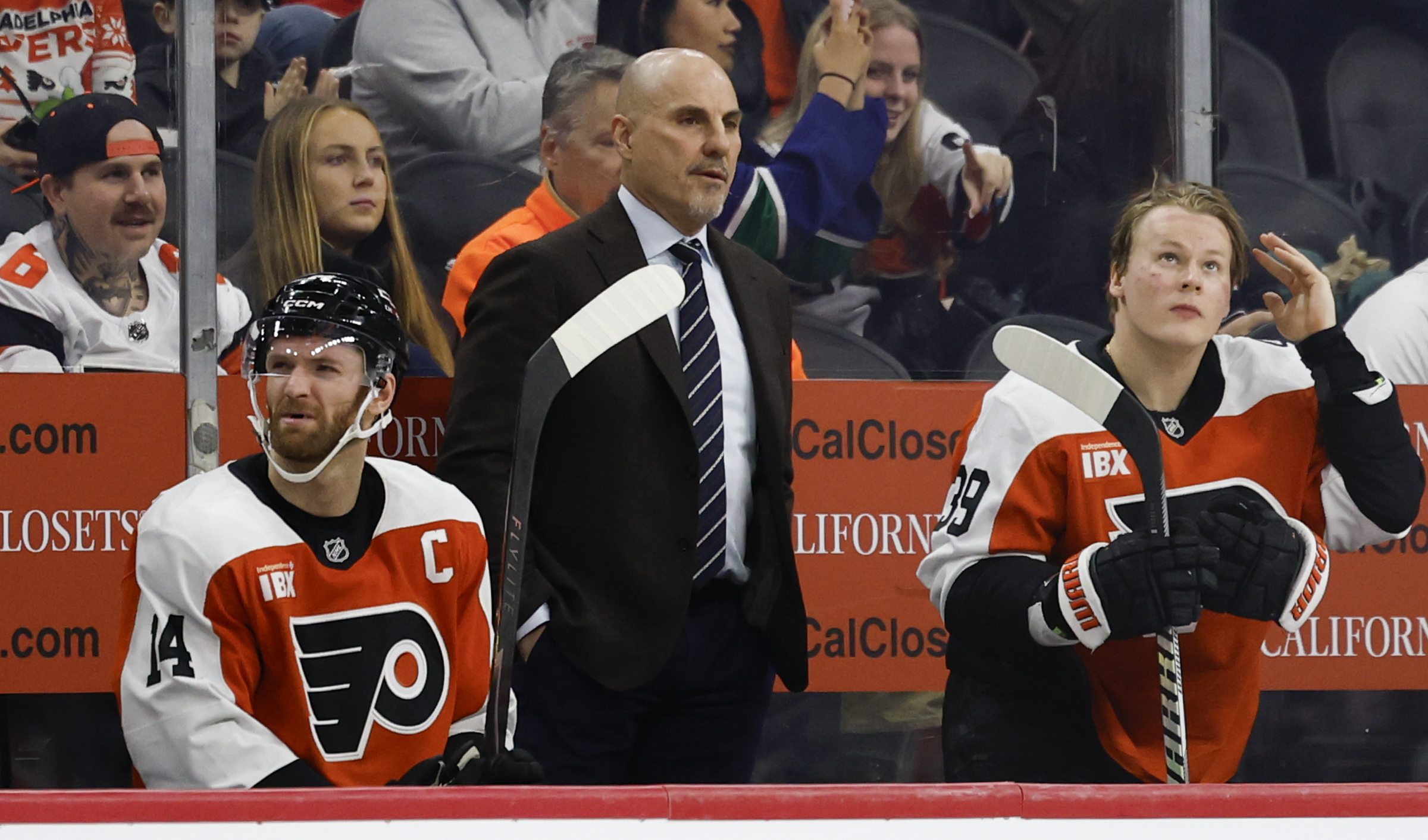
“Yeah, I mean, listen, he’s struggling, so you’re looking for all different things,” coach Rick Tocchet said about moving him across the ice. “But the bottom line is, we got him to play with some pace. That’s it. I know everybody wants him to score and all that stuff. You’ve got to be [in] positions to score.”
Traditionalists will tell you that Michkov should be playing on the left side anyway as a left-handed shot. A lot of it is more about where to line up on faceoffs and in defensive-zone coverage, as a left-handed stick will be able to use the walls and protect the puck to get it out on the left side.
A left-handed left wing is preferable to many coaches in the defensive zone because it typically pits a lefty against a right-shot defenseman, so they have their stick on the same side — and in the shooting lane — as the defenseman when they try to close them down.
“Whether it’s right or left, it really doesn’t matter. It’s just to line up,” Tocchet said. “When you’re in the offensive zone, it doesn’t matter where you [start]. So I think everybody makes a big deal. But through the neutral zone, for me, the faster you can go on your forehand is the better [side]. But that doesn’t mean you can’t go to the other side.”
Across the first 14 games of the season, Michkov lined up on the right side. He had two goals and seven points while averaging 14 minutes, 52 seconds a night. The first of those goals came in Game 4 of the season, and his second came in Game 14 on Nov. 6 against the Nashville Predators.
The next game, on Nov. 8 at home against the Ottawa Senators, he lined up on the left side with Couturier and Bobby Brink. He has stayed on that side of the ice since, regardless of his linemates — although he is back with Brink, but now with Noah Cates as the center.
Flyers head coach Rick Tocchet and winger Matvei Michkov have had there disagreements about deployment and responsibilities this season.
At the onset of the switch, it seemed to be working too, as the 21-year-old winger had five goals at five-on-five in the first 10 games and six overall. But over the next 24 contests, he managed just two. Across the past 34 games since switching to left wing, Michkov has 17 points (eight goals, nine assists). He missed one game in January after taking a puck off his foot and has been skating on average 14:30 a night.
“I think there’s been some [better] pace in his game, but I think there’s more,” said Tocchet. “I know he had like [seven] shots last game, but a lot of them are just from the outside, just thrown on the goalie. I want more from him. I want him to do a deep delay, get out of there, move your feet, things like that.”
Matve Michkov’s event map during five-on-five from Wednesday’s loss to the Utah Mammoth.
When delving into the analytics, he is producing at the same 0.50 points per game clip when on the left and right, but he has gone from 0.14 goals per game to 0.24 goals per game since the shift. His shooting percentage has also risen from 7.7% to 11.1%, while his shots per game have risen from 1.86 to 2.12.
According to Natural Stat Trick, at five-on-five, he has also seen his individual shot attempts rise from 2.43 to 3.41 per game, his individual high-danger shot attempts go from 0.71 to 1.03, and his individual scoring chances from 1.5 to 1.82.
Although there are several factors to look at aside from shifting right to left — e.g., linemates, time on ice, the fact that he’sprobablyin better shape now that he’s further removedfrom his offseason ankle injury — statistically, he seems to have been slightly better on the left.
But regardless of side, Michkov’s production hasn’t been anywhere near as good as last year, when the talented youngster averaged 0.79 points per game and led all rookies with 26 goals. The Flyers will hope that starts to change as they close in on the Olympic break (Feb. 6-24).
Breakaways
Nicolas Deslauriers and Hunter McDonald stayed on the ice late, with the veteran showing the youngster some fighting techniques. … Dan Vladař shared a net with Aleksei Kolosov at morning skate as he inches closer to a return from an undisclosed injury. … Sam Ersson (7-8-5, .858 save percentage) was to start in goal against the Colorado Avalanche on Friday night.
WASHINGTON — The U.S. military said Friday that it has carried out a deadly strike on a vessel accused of trafficking drugs in the eastern Pacific Ocean, the first known attack since the raid that captured Venezuelan President Nicolás Maduro earlier this month.
U.S. Southern Command said on social media that the boat was “engaged in narco-trafficking operations” and that the strike killed two people and left one survivor. It said it notified the Coast Guard to launch search and rescue operations for that person.
With the latest military action, there have been 36 known strikes against alleged drug smuggling boats in South American waters since early September that killed at least 117 people, according to announcements from the U.S. military and Trump. The majority of those of strikes have occurred in the Caribbean Sea.
The last reported boat strikes occurred in late December, when the military said it struck five alleged drug-smuggling boats over two days, killing a total of eight people while others jumped overboard. Days later, the Coast Guard suspended its search.
The U.S. conducted a large-scale operation in Caracas, the capital of Venezuela, on Jan. 3 that led to the capture of Maduro and his wife, who were then flown to New York to face federal drug trafficking charges.
President Donald Trump has repeatedly said that the U.S. strikes targeting alleged smugglers are having an enormous impact on slowing drug trafficking routes in the Caribbean and eastern Pacific.
“We’ve stopped — virtually stopped almost 100% of all drugs coming in by water,” Trump said in remarks on Thursday at the World Economic Forum at Davos.
Though Trinity Rodman’s contract saga has at last been resolved with her re-signing, the controversy over the NWSL’s High Impact Player rule likely won’t die down soon.
It remains the subject of a grievance by the NWSL Players Association, which claims the rule should have been collectively bargained; and it remains unpopular with many fans, for a variety of reasons.
The league’s commissioner, Jessica Berman, does not mind being the main target of that ire.
“I very much stand behind the decision and the process,” she told The Inquirer in an interview on Friday. “We intentionally negotiated for the right to do exactly what we did, which is to develop a specific rule for a specific classification of players which there is a reduced salary cap charge, so long as we consult in good faith with the Players’ Association. And I want to reinforce that’s exactly what we did in this context.”
The NWSLPA disagreed.
NWSL Players Association Statement on League’s Unilateral Implementation of the High Impact Player Rule:
“At no point in time in CBA negotiations or any time prior to the end of 2025 did [the] NWSL articulate a plan to impose a separate pot of funds with a new cap and eligibility criteria that were unrelated to roster classifications by any name,” NWSLPA executive director Meghann Burke told The Inquirer via email. “We disagree with NWSL’s representation that it consulted with the NWSLPA.”
Burke claimed that the first “written communication” she got on the proposal came on Dec. 11, and the union registered its objections after multiple board meetings in the ensuing days. The league announced the rule on Dec. 23, and said it will take effect on July 1.
Washington Spirit superstar Trinity Rodman’s threat to leave the NWSL in free agency sparked the league to adopt the High Impact Player rule.
Berman acknowledged the grievance in saying that “as in all labor relations in professional sports and otherwise, the union and the league can disagree,” and the league will follow the established procedures for resolving disputes.
“We are very confident in our position,” she said. “We have been contemplating different iterations of a potential rule or policy like this for a long time, and for that reason, we negotiated into the CBA the specific right to move forward with this if and when we believed it was appropriate.”
If there’s enough money going around to give each of the 15 clubs $1 million from the HIP pot, why not just raise the salary cap by the same amount?
“At some point, the board and NWSL are going to have to realize that increasing the cap — while retaining it — is in their own best interests,” said Burke, whose union has been loudly calling to raise the cap. “Until then, we stand ready to enforce the terms that were negotiated.”
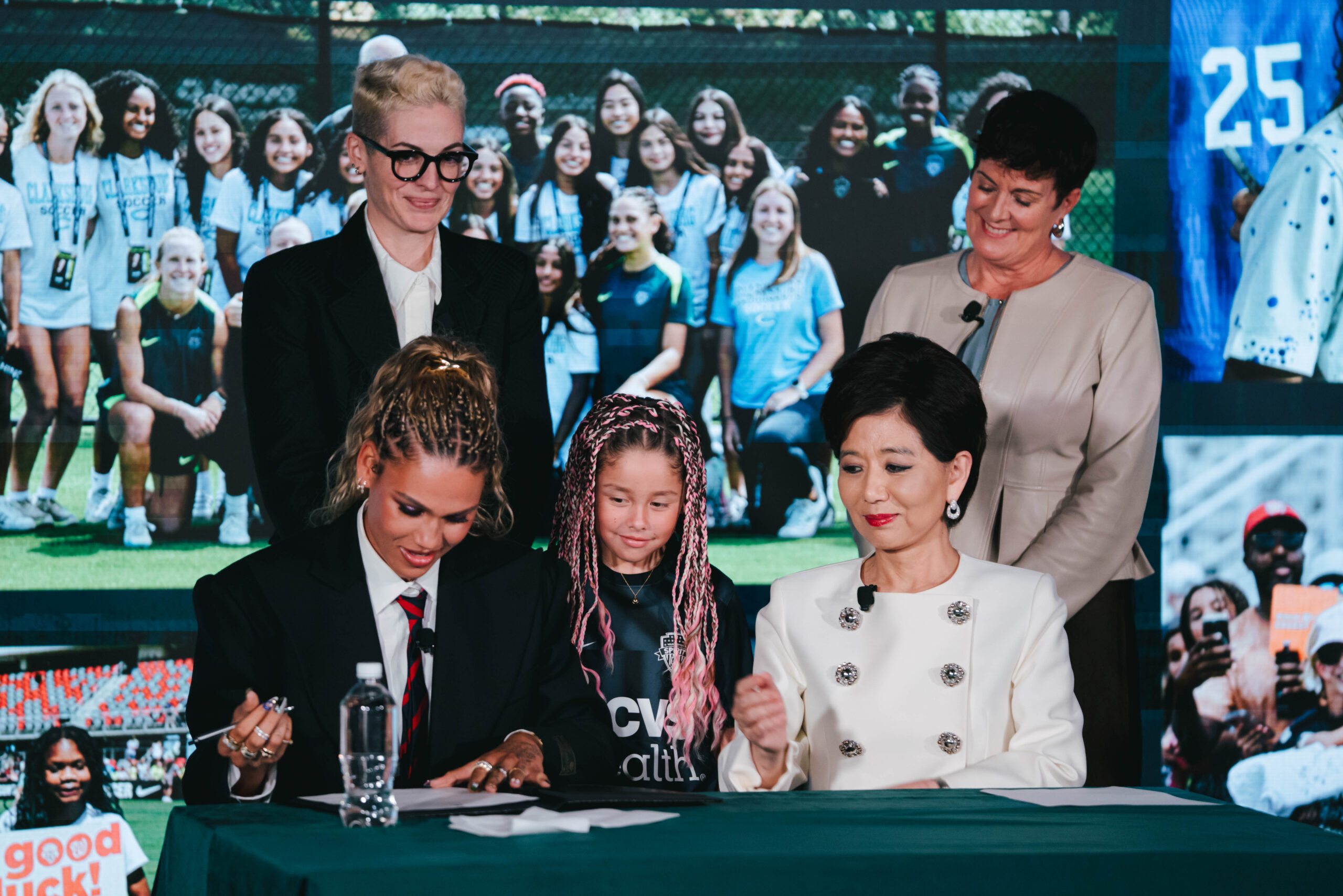
Trinity Rodman (bottom left) signing her new contract on Thursday.
Berman started the league’s case by bringing vice president of player affairs, Stephanie Lee on the call to give more context.
Lee, who previously worked in the front offices of Gotham FC, the Utah Royals, and the Seattle Reign, noted that a player who gets HIP money must have a salary cap charge of at least 12% of the teamwide base cap, which for this year is $3.5 million.
Teams also can’t get cap relief from the rule unless they hit the cap in the first place. Up to that point, the player’s salary is charged to the regular payroll.
“As they roster build throughout the year and through [transfer] windows and different transactions, there’s flexibility there to how they designate players and take advantage of that HIP [money],” Lee said. “It’s not something that they have to decide at the beginning of executing a player’s contract.”
A league spokesperson added that teams can retroactively apply the money to a player when they hit the cap by signing other players, so they can go over the cap to keep everyone they want to.
U.S. women’s national team captain Lindsey Heaps is expected to be paid through the HIP rule when she joins her hometown Denver Summit in the summer.
Why limit who can get the money?
Then there are the criteria the league laid down to limit which players are “high impact,” from media and marketing rankings to U.S. national team playing time. This also is widely unpopular.
But there’s also a question at a higher level: Why have criteria in the first place? Why not let teams spend the money on whoever they want, as MLS now does with its Designated Player rule, and let teams potentially make mistakes?
“It is the league’s, and in this case our — my — responsibility to be responsible stewards of capital in service of growing the business,” she said. “In this circumstance where we have unlocked the ability for our clubs to spend an incremental $115 million [combined through 2030], it is our job to make sure that it is going to have a relationship to growing our revenue. That growth in revenue will also feed the revenue-sharing mechanism that was negotiated into our most recent CBA, which means that we are incentively aligned with our players to grow this business.”
U.S. veteran Crystal Dunn (right) is one of the most notable players who is not eligible for HIP money.
Burke strongly disagreed.
“Nothing in the CBA,” she wrote, “permits [the] NWSL to create an additional pot of funds (with an entirely new and separate cap) which only some players are eligible for based on ill-conceived criteria unilaterally determined by NWSL, including and especially when those criteria violate the non-discrimination clause in our CBA.”
Does Berman see a day when the league would loosen the reins?
“In the most general sense, we will always analyze the health of our business and the health of the game in the NWSL,” Berman said. “If we believe that there are business reasons for us to modify our rules, we will.”
Jaedyn Shaw (left) is another notable American who isn’t currently eligible for HIP status.
She stood firm again in saying “we feel like we’ve enabled our clubs to invest significantly.” And as she chose her words, she made it clear that the league will push those clubs to invest in specific ways.
“This particular mechanism, that was very prescriptive in what it was developed to address, is important in that it is supposed to help us to target top players,” she said. “Which, as you’ve heard me say many times, is in service of us being the best league in the world. In order for us to be the best league in the world, we need to compete for the best players, and we want this policy to guide the behavior of our clubs so that they can compete financially to attract and retain top players.”
It’s no secret that there’s a fair amount of variance in how much money NWSL teams have in the bank. Nor is it a secret that Washington Spirit owner Michele Kang sits at the higher end of the scale. She had long been ready to spend big on Rodman, and Rodman’s agent has said the three-year deal is worth over $2 million per season.
But when Kang first put a contract proposal on the table, Berman vetoed it for violating the league’s salary rules. A source with knowledge of the offer told The Inquirer that the Spirit would not have been able to pay Rodman and also meet the league requirement of a 20-player roster, even if all the others were on the league’s minimum salary.
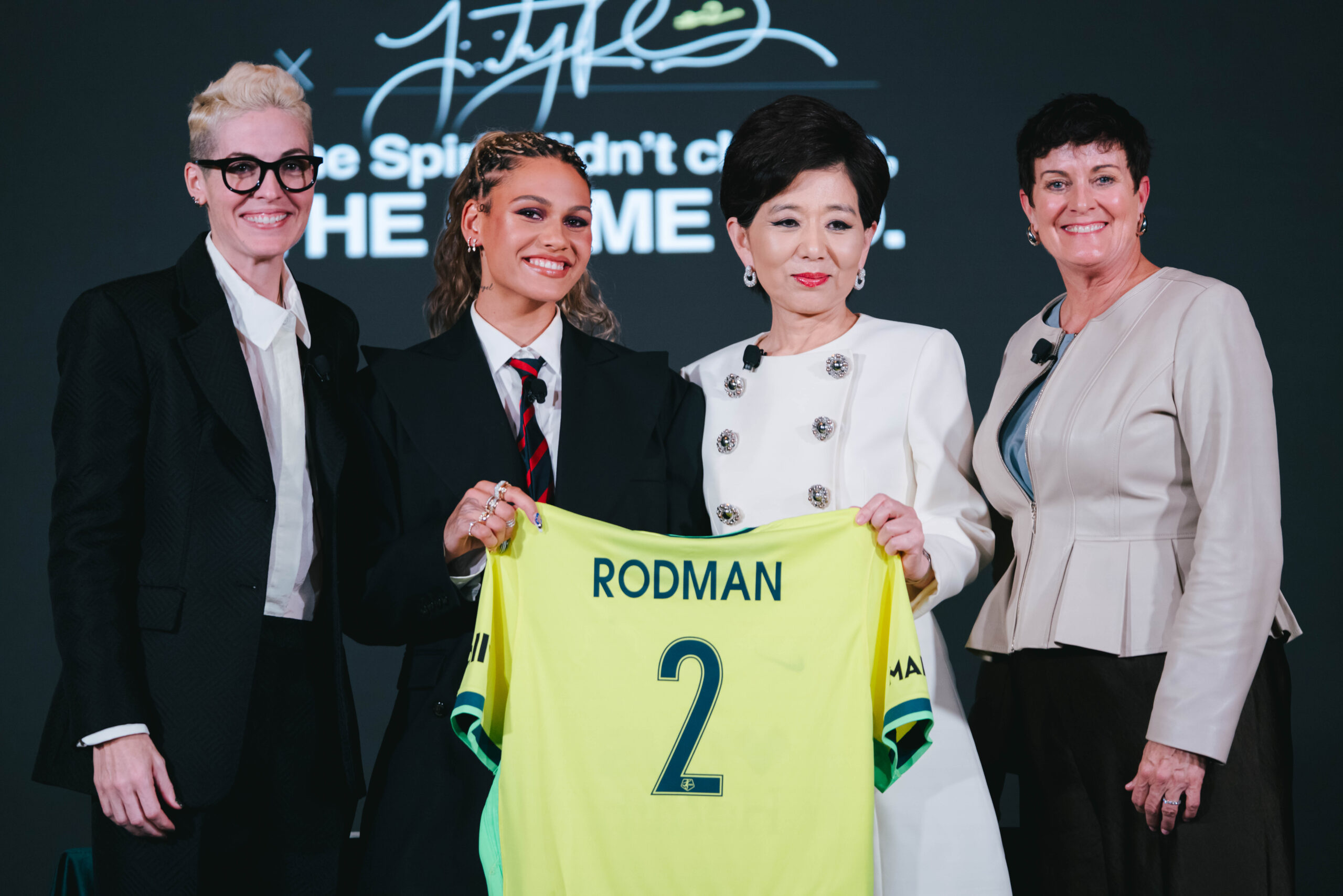
Michele Kang (second from right) with, from right to left, Trinity Rodman, Spirit president of soccer operations Haley Carter, and CEO Kim Stone.
That has led some outsiders to wonder how much resistance there was elsewhere in the league to raising the cap and whether the HIP rule might have been an easier sell. A two-thirds majority of team owners is required to pass a vote.
“It is in our best judgment that the HIP rule is the most strategic mechanism for us to advance the business,” Berman said.
“A rule that has been adopted with such a singular focus on generating revenue is not even about soccer, building a competitive roster to win NWSL games, or meeting a team’s performance needs,” she said, “which are obvious functions of a team when they are constructing a roster.”
Catarina Macario might be the next U.S. star to get HIP money, as there’s speculation she might come to the NWSL in the summer.
Another milestone in all this is expected to arrive when the current European season ends in the summer. There’s been much speculation that U.S. national team star Catarina Macario could come home from England’s Chelsea, and Spanish superpower Barcelona reportedly has nine players on expiring contracts — including stars who’ve fueled the club’s three Champions League titles in the last six years.
Will the NWSL be willing to hit the gas pedal to bring them over?
“We developed this rule very intentionally to put our clubs in a position to compete financially with top clubs around the world for top players, and we believe it will put us in a position to do that effectively,” Berman said. “Without naming specific clubs or naming specific players, it is our expectation that when we look back on this, we will have a list of players that we’ve been able to attract and retain by virtue of enacting this rule.”
Brace yourself for the cold, Philadelphians, because the first double-digit snowfall in 10 years is potentially heading our way, followed by sub-freezing temperatures that could last the rest of the month.
Since nowhere is safe from the cold, here are some tips on how to keep yourself from freezing and your property from damage (no burst pipes in sight):
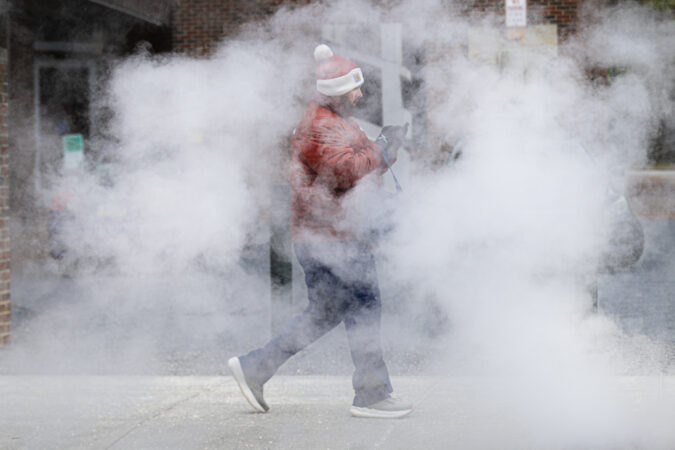
Staying indoors is the best way to keep frostbite and hypothermia at bay, but some must brave the temperature for work, other needs, or emergencies, as even waiting for the bus can take longer if SEPTA experiences storm-related service delays.
With temperatures forecast in the teens and lower 20s, it is important to keep an eye on your core temperature.
When you rapidly lose heat or stay wet for too long, it can cause hypothermia, even indoors. This can affect your brain and body, causing slurred speech, confusion, clumsiness, and extreme tiredness.
Continued exposure to the cold can cause frostbite, as blood stops reaching your fingers, nose, ears, and extremities properly. You can get frostbite even under winter clothing, and it can lead to losing the affected body parts. If you start feeling tingling, numbness, or your skin looks gray or pale, head indoors.
Frostbite can happen without hypothermia symptoms, and vice versa. Children, older adults, and people with circulation issues are especially at risk
To prevent both afflictions, stay dry, covered, and layered up, keeping your skin from being exposed.
Four out of five warming centers reached capacity on Thursday, but the city plans to open more and add beds as needed.
The warming centers remain open at select libraries from 9 a.m. to 9 p.m. And shelter beds have been added under the Code Blue declaration.
Some recreation centers will also serve as warming centers from 9 p.m. to 9 a.m. Find the selected libraries and recreation centers closest to you on the city’s interactive map of warming centers.
Folks in need of a warm place can go to their local police precinct to be transported to the nearest warming center.
Broken bones and head trauma are no fun. Stay grounded by wearing footwear with enough traction (no sneakers or dress shoes), or traction cleats.
You can’t control the city roads, but salting your sidewalk properly can help avoid starting your day on the ground, or worse, in the emergency room. As you walk, make sure to lean slightly forward and take shorter steps. You may look like a penguin, but it’s worth it to avoid the pain and medical bills.
Much like your body, your home also loses heat in the cold, putting pipes at risk for freezing and bursting. Disconnecting garden hoses and shutting off the valve that feeds them, and keeping faucets slightly open and running can prevent expensive repairs.
Pipes will begin to freeze when a thermostat is at 39 degrees and lower. Maintaining the thermostat at 50 degrees or above is ideal.
Though they won’t burst, cars get cold too, reducing battery power and creating a risk of being left stranded, especially if the battery is older than two or three years.
Be ready to jump-start your car. Jumper cables and a portable jumper pack can be helpful. Remember, red clamps to the positive post of the dead battery; black clamps to the negative post of the working battery and to the unpainted metal surface on the engine of the dead car.