Blog

  • You can get stronger with gentle weight training, new study finds

    You can get stronger with gentle weight training, new study finds

    If you’re intimidated by weight training, a new study is full of reassurance.

    Weight workouts don’t have to be complicated or grueling to be effective, the study found. Almost any kind of lifting led to increased muscle and strength in the study. Whether people lifted heavy weights or light, through many repetitions or few, the results were broadly comparable.

    “Lift however you like to lift. That’s the lesson,” said Stuart Phillips, a professor of kinesiology at McMaster University in Ontario, Canada, and an expert in resistance exercise. Phillips is the senior author of the study, which was published last month in the Journal of Physiology.

    The study also provided other lessons, some unexpected, including about the importance of genetics in our bodies’ response to weight training and how some of us may get stronger without getting much bigger — or vice versa — when we begin to train.

    Do you have to lift heavy weights?

    Gym culture is full of widely held beliefs about the best ways to lift, Phillips said, many backed by scant evidence.

    “You’ll see guys who’ve been lifting for decades and swear you have to lift heavy” to gain substantial muscle mass and strength, he said. For them, weights must be hefty enough that you can barely grunt through eight or nine taxing reps before your arms or legs give out.

    But mounting evidence suggests that heavy weights are overrated. A comprehensive 2023 review of hundreds of past experiments concluded that, compared with no exercise, any lifting — not just with heavy weights — “promoted strength and hypertrophy” or larger muscles.

    But questions remain about the most effective weight workouts. If you use lighter weights, how many times should you repeat each lift? What drives muscle growth, if it’s not heavy loads? And will everyone make the same gains from the same workouts?

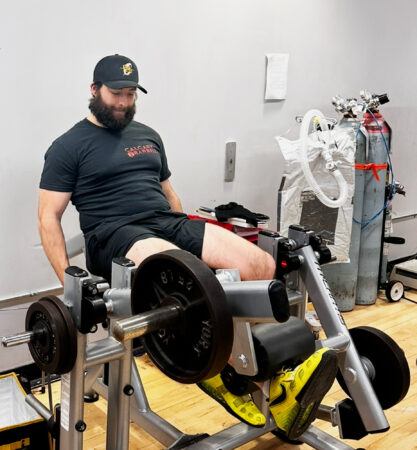
    For answers, Phillips and his colleagues recruited 20 healthy, young men who didn’t normally weight train and checked the size and strength of their muscles. (They have a similar study underway with women.) The men’s limbs were then randomized to heavy or light lifting; that is, their right or left arm was randomly assigned to complete biceps curls using a heavy weight, while the other arm did the same exercise with a much lighter weight. Similarly, one leg did knee extensions against a heavy weight; the other leg completed the same exercise with a much lighter load.

    The heavy weights were challenging enough that lifters could manage no more than 12 repetitions before reaching muscular failure, meaning they felt they couldn’t lift again. With the lighter weights, the participants lifted through as many as 25 repetitions before deciding they couldn’t do another.

    Light weights work fine

    The men worked out three times a week under the researchers’ supervision, increasing their weights once they could easily complete more than 12 heavy or 25 light repetitions. At the end of 10 weeks, the researchers retested everyone.

    By then, the men’s muscles were almost all stronger and larger, with little difference between limbs. The arm that lifted light weights was just as buff as the one that lifted heavy and ditto for legs. Both approaches were equally effective.

    This finding “reinforces the idea that load isn’t an important determinant” of muscular response, Phillips said. “Effort is.” If people lifted until their muscles tired, they got results.

    The practical takeaway is that you can “pick what works for you,” Phillips said. Have sore joints or little taste for big weights? Use smaller ones. Have limited time? You’ll finish faster with heavier loads.

    But don’t expect your results to exactly mirror mine. There were substantial differences from one volunteer to the next. Some nearly doubled their strength or mass; others added less. And there was little relationship between bulk and strength. Some men got far stronger without growing much bigger, and some achieved almost the opposite.

    These differences underscore the role of genetics. “To some extent, our muscular responses are baked in,” Phillips said. After 10 weeks of the same lifting routine, I won’t look precisely like you. But we’ll both be stronger and better muscled.

    What about body weight exercises?

    This study “was very well-designed,” said Brad Schoenfeld, an exercise scientist at CUNY Lehman College in the Bronx, who researches resistance training but was not involved with the new work. The findings suggest that “within broad limits, you can build similar amounts of muscle mass” with light or heavy loads.

    The study has limitations, though. It involved only young men new to lifting. Phillips said he believes the results would be similar for women, older people, and anyone who’s been weight training for years. But studies are needed with those groups to be sure.

    The training also involved gym machines. Would the results be the same with body weight exercises? “I think so,” Phillips said, adding, “I’m counting on it.”

    Much of his own training nowadays, at age 60, takes place at home, he said, and involves body weight work. “I’ve got enough space in my basement to do squats, do deadlifts,” he said. He repeats each exercise until he can barely finish another rep, he said. “I do what I preach.”

    But the key point is that he does something, Phillips said, and regularly. “Based on self-report and participation data, about 80% of people do not lift weights at all.” He hopes his group’s study and other research will encourage more people to try some kind of resistance training routine, he said. “Let’s make 2026 the year of strength.”

  • Philly schools on the chopping block | Morning Newsletter

    Philly schools on the chopping block | Morning Newsletter

    It’s Friday, Philly. Forecasts for this weekend’s storm now have more than a foot hitting the region, and city residents are, understandably, freaking out — but with some whimsy sprinkled in.

    Philadelphia School District officials are proposing closing 20 schools, colocating others inside existing buildings, and renovating more than 150 others as part of a massive reshaping of the system. Read on for what we know and don’t and local lawmakers’ strong reactions.

    And the immigrant father of a 5-year-old with brain cancer is accepting deportation to Bolivia after months in federal detention.

    — Julie Zeglen (morningnewsletter@inquirer.com)

    If someone forwarded you this email, sign up for free here.

    A school district overhaul

    Philadelphia School District officials have revealed the results of a years-in-the-making facilities plan to reshape the system.

    The big picture: Superintendent Tony B. Watlington Sr.’s current proposal would close 20 schools, colocate six, and modernize 159. The closures, which would not begin to take effect until the 2027-28 school year, would be scattered through the city, with North and West Philly hardest hit. The 10-year blueprint comes with a $2.8 billion price tag.

    What we don’t know: Of several unknowns, the biggest is which, if any, of the proposed closures will actually happen. Any changes must be approved by the school board, which could adopt all, some, or none of Watlington’s recommendations.

    Lawmakers’ reactions: The district’s facilities plan did not go over well in City Council’s first session of the year on Thursday, with several members voicing dismay and one proposing to allow Council to remove the school board members who will consider the proposed closures.

    Search your school: Check our chart to see what’s happening to any city school under the proposal.

    ‘He reached his limit’

    Despite community support and legal efforts, the detained immigrant father of a 5-year-old son with brain cancer has decided to drop efforts to stay in the United States and accept deportation to Bolivia.

    Johny Merida Aguilara has been in federal custody at Moshannon Valley Processing Center since September. He was previously a main caretaker for his son, Jair, who has been treated at Children’s Hospital of Philadelphia, but whose future care is now uncertain.

    Merida Aguilara’s wife and three American-citizen children will also go, voluntarily, leaving their home in Northeast Philadelphia.

    In their own words: “I am tired,” Gimena Morales Antezana, his wife, said in an interview with The Inquirer. “We have been trying to survive, but it is difficult with the children because they miss their dad so much.”

    Reporters Jeff Gammage and Michelle Myers have the story.

    What you should know today

    Plus: What’s the story behind the colonial-era grave site hidden in residential Cherry Hill?

    Welcome back to Curious Philly Friday. We’ll feature both new and timeless stories from our forum for readers to ask about the city’s quirks.

    This week, we have an explainer from suburban reporter Denali Sagner by way of Curious Cherry Hill. A reader asked for the backstory of a hidden-in-plain-sight grave site in the township’s Woodcrest neighborhood.

    The small cemetery is the final resting place of one of South Jersey’s most prominent colonial families, the Matlacks, and an unspecified number of servants and enslaved people. Here’s the full story.

    Have your own burning question about Philadelphia, its local oddities, or how the region works? Submit it here and you might find the answer featured in this space.

    🧠 Trivia time

    The former KYW radio building on Walnut Street just sold for about $5 million — a steep discount from the $19 million it sold for in 2019. Which Beatle once worked there?

    A) Ringo Starr

    B) George Harrison

    C) John Lennon

    D) Paul McCartney

    Think you got it? Test your local news know-how and check your answer in our weekly quiz.

    What (and whom) we’re …

    🚚 Remembering: That time an armored guard stole from his own truck on this week in Philly history.

    ⚕️ Cheering on: The Bucks County toddler who’s an ambassador for a national cancer charity.

    Reading: Chill Moody’s new book about a little girl with magical golf clubs.

    🍴 Impressed by: The 28-year-old about to open his third restaurant in the suburbs.

    🍺 Anticipating: Philly bar legend “Fergie” Carey’s takeover of Mac’s Tavern in Old City.

    🧩 Unscramble the anagram

    Hint: Sixers’ drum line

    REST SIX

    Email us if you know the answer. We’ll select a reader at random to shout out here.

    Cheers to Ruben Taborda, who solved Thursday’s anagram: Four Seasons. If you want to stay in the luxury hotel’s new penthouse suite, it’ll cost you … $25,000 per night.

    Photo of the day

    A pedestrian takes a shortcut through the three-day-old snow on the ground in downtown Camden’s Roosevelt Plaza Park on Wednesday.

    Consider this your moment of calm before the storm. Remember: City residents can be fined up to $300 for not shoveling their sidewalks.

    Thanks for ending your week with The Inquirer. ’Til we meet again in your inbox, be well.

    By submitting your written, visual, and/or audio contributions, you agree to The Inquirer’s Terms of Use, including the grant of rights in Section 10.

  • Let’s talk about blagony: What it means to be the only Black person at work

    Let’s talk about blagony: What it means to be the only Black person at work

    There is a word I want us to consider: blagony. It’s a portmanteau of Black and agony, and it captures a specific psychological space.

    It’s not merely being the only Black person in the boardroom. It’s the sustained emotional labor, the relentless vigilance, the pressure of representation and racialized perception — all while trying to meet the explicit performance metrics of any job.

    The only Black engineer in a meeting. The single Black adviser on a team. The only Black teacher, the only Black graduate student. The Black female leader whose presence is always under the magnifying glass.

    This is the daily landscape for many, and it is, in its quiet omnipresence, exhausting.

    To understand blagony is to understand that workplace stress isn’t just about deadlines and deliverables. In the last decade, a significant body of research has reminded us that burnout — the chronic stress response the World Health Organization formally recognizes in the workplace — emerges not only from workload but from identity threat, lack of psychological safety, and perpetual masking of one’s authentic self. Burnout has been with us for decades, yet we are only beginning to grasp its intersecting causes.

    In Burnout: The Secret to Unlocking the Stress Cycle, Emily and Amelia Nagoski explain that stress has a physiological component that often isn’t resolved by self-care alone. Stressors accumulate, and without mechanisms to complete the “stress cycle,” our bodies and minds remain in distress.

    Now imagine experiencing the ordinary stress of overwork while also managing the extraordinary stress of visibility — being watched, categorized, and held up as both token and template for an entire community. That’s blagony. It’s not just about being in the room; it’s about being on stage in every room.

    Organizational research shows this isn’t abstract. Studies probing wellness in underrepresented groups report that women of color — and particularly Black women — face compounded barriers in professional settings.

    The freedom to bring all of who you are to work is one of the major predictors of organizational success. Yet, for Black employees, that safety is often a mirage. They must code-switch, temper their expertise with humility, and constantly evaluate whether being authentic will be rewarded or punished, writes Jack Hill.

    They are both underrepresented and overlooked, which research connects to diminished career progression, reduced well-being, and heightened psychological strain.

    This isn’t about victimhood. It’s about recognition. True psychological safety — the freedom to bring all of who you are to work — is one of the major predictors of organizational success. Yet, for Black employees, that safety is often a mirage. They must code-switch, temper their expertise with humility, and constantly evaluate whether being authentic will be rewarded or punished.

    This labor — unmeasured, unpaid, and deeply internalized — is blagony.

    Of course, we talk about inclusion and equity, about diversity plans and affinity groups. But intention isn’t impact. A reading of workplace wellness literature reveals a troubling tendency: The wellness industry urges individual strategies — meditation, resilience, boundary setting — while often ignoring structural stressors that are built into the workplace.

    Jennifer Moss, in her widely discussed book, The Burnout Epidemic: The Rise of Chronic Stress and How We Can Fix It, argues that organizations must stop treating burnout as an individual failure and instead redesign workplaces to reduce chronic stress.

    Yet, most corporate wellness programs remain superficial: apps, yoga classes, snack bars, mindfulness sessions. None of these treats the root of blagony: the constant cognitive load of being the sole representative of a marginalized group. Psychological research calls this “identity threat,” and it’s real.

    In higher education and STEM settings, scholars highlight how Black professionals must mask parts of themselves — hide cultural cues, soften speech, temper humor — to conform to dominant norms. Every day, they must decide: Be fully me and risk being misunderstood? Or mold myself into the organizational ideal and risk losing touch with my own sense of self, or possibly risk losing my job?

    In a striking parallel, centuries of research on microaggressions show how seemingly small, everyday slights accumulate into a wear and tear on the psyche. One corporate DEI consultant who has developed mindfulness tools for Black workers notes that these workers face not only the standard burnout of their peers, but additional layers — microaggressions, coded language, isolation, and stereotypical assumptions — which add up over the years.

    That is blagony.

    Some might raise the counterargument: Isn’t this just the cost of progress? The pain inherent in entering spaces that were never designed for everyone? But that is precisely the problem. Organizations and societies that value innovation, creativity, and collective intelligence must also value plurality of perspective, and the racial and ethnic components that come along with it. If we ignore the emotional costs paid by minoritized workers, we will degrade our own workplaces and squander human potential.

    Consider the economy’s current preoccupation with “wellness.” Most wellness initiatives are rooted in an individualistic self-care model that assumes stress arises from personal habits. But when stress is born of organizational dynamics, personal adjustment alone isn’t enough.

    Nagoski reminds us: Stress is physiological, yes, but it’s also social. You cannot meditate your way out of an environment that constantly signals that your presence is provisional.

    Blagony demands more than corporate slogans or pulse surveys. It demands structural change. It demands that we rethink hiring, promotion, and evaluation criteria. It demands that we foster climates where people don’t feel the need to mask their identities to fit in. It demands sustained effort to build genuine psychological safety.

    There is also a cultural dimension. We must shift from valuing perfection to valuing wholeness. We must recognize that human beings — especially those carrying the cumulative weight of historical and structural marginalization — cannot compartmentalize identity from performance. Workplaces that expect competence without empathy will find neither.

    In my own conversations with Black professionals, what emerges over and over is not a desire for special treatment, but for authentic belonging. They don’t want to be tokens. They want to be colleagues whose full humanity is recognized and respected.

    So let’s retire the idea that burnout is merely overwork. Let’s broaden our understanding to include blagony: the strain of being seen as a single voice for a whole community, the chronic vigilance against bias, the emotional taxation that is neither acknowledged nor compensated.

    If we want workplaces that are not just more diverse but more human, then we must reckon with this. Because until we address the unique stressors Black employees carry — and redesign institutions to reduce them — we will continue to lose not just talent, but our shared moral coherence.

    Blagony is not a symptom of individual weakness. It is a signal that our workplaces — and our culture — still have far to go.

    Jack Hill is a diversity consultant, child advocate, journalist, and writer.

  • An armored guard stole from his own truck on this week in Philly history

    An armored guard stole from his own truck on this week in Philly history

    A Brooks armored truck pulled up to the main PSFS Bank office in Center City on the morning of Jan. 20, 1988, but guard Edward Leigh Hunt Jr. didn’t get out.

    Two other employees of the Wilmington-based company, a driver and another guard, went inside the bank office on 13th Street near Market. When they returned about 30 minutes later, the 24-year-old Hunt was gone.

    He fled the vehicle carrying two canvas bags containing used bills totaling $651,000, or more than $1.7 million in today’s dollars.

    ’See ya soon’

    A few days after the robbery, Hunt, who went by Leigh, had made his way to Los Angeles, and phoned a friend from back home — mainly asking how much publicity he was receiving.

    And then Hunt went silent for nearly 20 months.

    In the meantime, he was twice featured on America’s Most Wanted and attracted national attention as well as a following.

    “The whole incident has been bizarre since day one,” the fugitive’s father, Edward Leigh Hunt Sr., a former prosecutor for the Delaware Attorney General’s Office, would say later.

    As the two-year anniversary of the heist approached, editors from the Wilmington News Journal newspaper inexplicably received a handwritten letter.

    It was from Hunt, and he said the money was gone.

    The University of Delaware graduate said he gambled it all away in an attempt, he wrote, to quadruple the sum and then return half the proceeds.

    He missed his family, he wrote, and wanted to surrender on the second anniversary of the theft, Jan. 20, 1990, at noon in front of the Chamber of Commerce offices in downtown Los Angeles. He enclosed a photo of himself emerging from a swimming pool.

    He sent a second letter to the newspaper a few days later, reiterating that he would be turning himself in. “Just a reminder,” he wrote.

    “I’m sorry about the problems I have caused,” he added. “It’s nobody’s fault but mine. See ya soon.”

    Going downtown

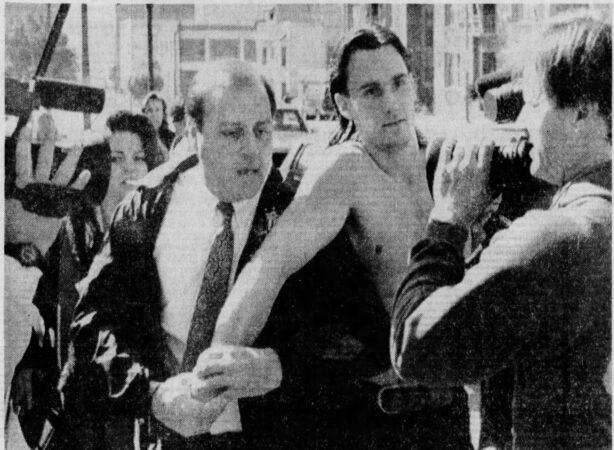
    Hunt, now 26, arrived shirtless and five minutes late, but nonetheless surrendered as planned to members of the FBI.

    “I love America,” Hunt said as he was taken into custody. “America is a great country.”

    As he was taken away, according to the Los Angeles Times, a few supportive spectators shouted, “Free Leigh.”

    Six months later, Hunt pleaded guilty to interstate theft, and a federal judge in Philadelphia sentenced him to eight years in prison. In hopes of getting his sentence reduced, Hunt later came clean and confessed to having hidden most of the money in a Hollywood storage locker. The FBI recovered nearly $574,000, and Hunt’s sentence was cut down to six years.

  • European and business leaders force Trump to reverse course on threats to Greenland

    European and business leaders force Trump to reverse course on threats to Greenland

    Donald Trump’s sudden retreat from his military and economic threats to seize Greenland from NATO ally Denmark shows it is still possible to block the president from further foreign policy folly.

    Trump did a complete U-turn at the World Economic Forum in Davos, Switzerland, shortly after berating European allies and NATO in a lengthy, lie-filled speech, insisting he must “own” Greenland. Just two hours later, after a meeting with NATO Secretary General Mark Rutte, the president suddenly announced he had a “framework” for a deal that would satisfy all U.S. needs.

    Make no mistake. No matter how the White House spins Trump’s sudden about-face, he staged a total climb-down from a mess of his own making. Based on early reports, he got almost nothing he couldn’t have agreed on with Denmark months ago, based on a 1951 treaty that permits the U.S. to open multiple bases in Greenland.

    All Trump’s bluster achieved was to totally alienate America’s European allies and deeply wound the NATO military alliance, whose help he needs to block Russian and Chinese aggression in the Arctic and elsewhere.

    So what caused Trump’s sudden reversal? No one can penetrate the president’s aging brain, but the likely reasons have to do with economics and his base, the only factors that seem to move him.

    The financial markets tanked early this week from fear that Trump would invade Greenland. No doubt tech moguls at Davos were warning him. New polls also showed 90% of Americans opposed an invasion.

    Yet, as late as Wednesday afternoon, he was insisting, in his Davos speech, on the need for “title and ownership” of Greenland, and was threatening to impose new tariffs on Denmark and other European allies if they didn’t surrender. “You need the ownership to defend [Greenland],” Trump contended. “Who the hell wants to defend a license agreement or a lease?”

    President Donald Trump during a meeting with NATO Secretary General Mark Rutte on the sidelines of the annual meeting of the World Economic Forum in Davos, Switzerland, on Wednesday.

    Parse those words, and you see they intimate an end to NATO and its Article 5 defense mechanism. After all, if the U.S. doesn’t own Poland or the Baltics or Finland, why should Trump defend them if Russia ever attacks?

    Still, even in his aggressive speech, Trump was hinting he was seeking an off-ramp, stating he wouldn’t use force.

    No doubt he recognized that, despite his open disdain for Europe, its key leaders had abandoned their conciliatory stance and were determined to strike back economically. Last week, the European Union discussed imposing $108 billion worth of retaliatory tariffs on the U.S., as well as restricting American companies from the bloc’s market. The EU-U.S. trade deal agreed to last July was also put on hold.

    European leaders had been reluctant to wage such a trade war, but recognized they had no choice, as Trump threatened the future of the NATO alliance. Instead of focusing on the immediate security threat to the West — namely, Vladimir Putin’s war on Ukraine — Trump was helping the Kremlin by splitting with his European allies.

    Instead of working with Canada and other allies whose territory abuts the Arctic, the White House leader was telling them to get stuffed. No wonder the language heard from once close European allies at Davos was unlike anything heard since NATO was founded.

    “Until now, we tried to appease the new president in the White House, hoping to get his support for the Ukraine war,” admitted Belgian Prime Minister Bart De Wever. “We were dependent on the United States. But now so many red lines are being crossed … Being a happy vassal is one thing, being a miserable slave is something else.”

    Even more blunt was Canadian Prime Minister Mark Carney (whom Trump later threatened for his critique).

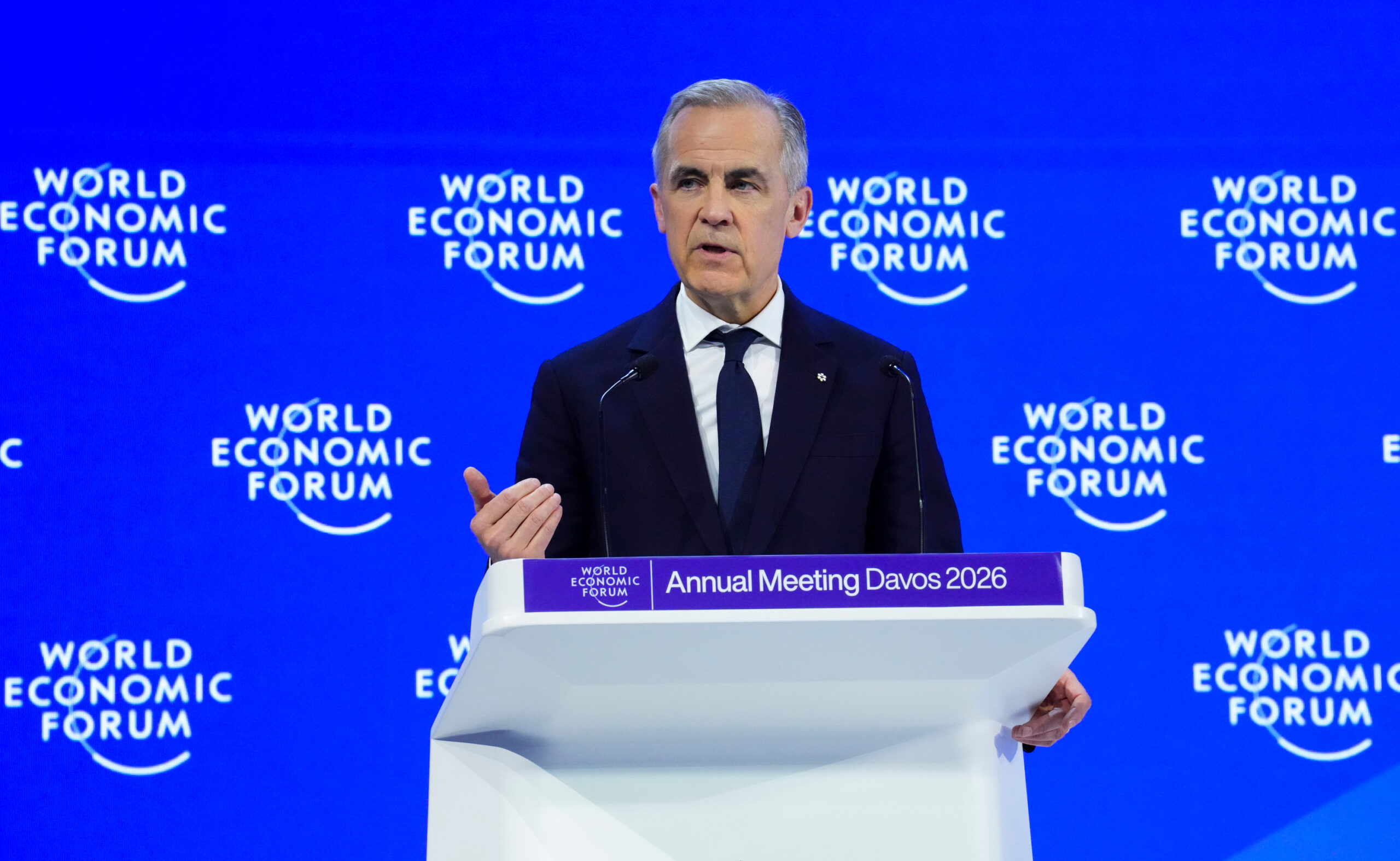
    Canada Prime Minister Mark Carney delivers a speech at the World Economic Forum in Davos, Switzerland on Tuesday.

    “The United States under President Donald Trump is no longer a reliable or predictable ally,” Carney said frankly. “We are in the middle of a rupture in the world order … where the large, main power … is submitted to no limits, no constraints.”

    Intermediate powers like Canada, however, “are not powerless,” Carney added. Acting together, Canada and European leaders helped force Trump to face that reality this week.

    But the fight over Greenland, and the future of NATO, is far from over, and Trump’s retreat may only be temporary. Denmark and Greenland may or may not agree that the U.S. can have sovereign rights to the territory housing new military bases (a provision under discussion).

    Denmark will not sell or surrender Greenland, however. In fact, there will be no deal at all unless Copenhagen and Greenland approve the terms.

    Moreover, as was clear at Davos from Trump’s speech and actions, he still believes he is the most brilliant leader the world has ever witnessed, which leaves him wide open to Russian and Chinese manipulation.

    Nothing so clearly illustrated the president’s megalomania as his inauguration of a so-called Board of Peace. Originally envisioned as a group of world leaders overseeing Gaza’s reconstruction, the board’s newly released charter doesn’t even mention Gaza, but presents its mission as an alternative United Nations, tasked with making peace around the world.

    In reality, it is a mammoth Trump vanity project: He heads the board, and its every action is subject to a presidential veto, according to its charter.

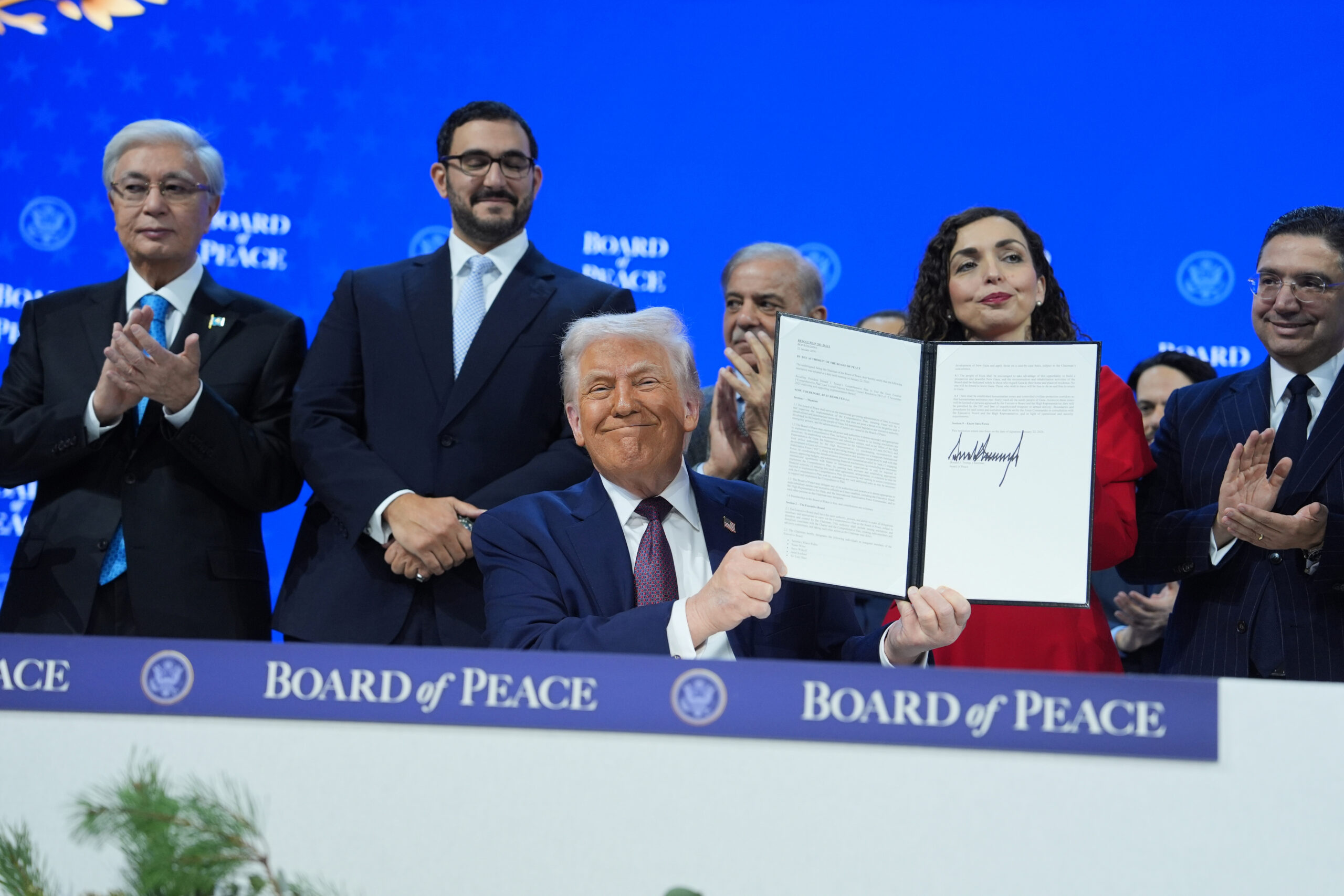
    President Donald Trump holds up a signed Board of Peace charter during the annual meeting of the World Economic Forum in Davos, Switzerland, on Thursday.

    The 20-plus initial participants were mostly Mideast sheikhs, emirs, and kings who can pay the $1 billion fee for permanent membership, along with several other autocrats and military-backed rulers. (The only Europeans signed up so far are pro-Russia Hungary and Bulgaria.)

    War criminal Putin, busy bombing Ukraine’s civilian infrastructure to smithereens, may accept his invitation to the peace board if the United States releases $1 billion in frozen Russian assets to pay the fee. This, according to the Kremlin.

    Meantime, Trump’s son-in-law, Jared Kushner, gave a slide presentation in Davos describing how Gaza could become a futuristic city with apartment towers and resorts in two to three years, a reprise of Trump’s earlier pitch for a Gaza Riviera. This, while the Gaza ceasefire is falling apart, and Israel has banned scores of humanitarian agencies from delivering food or medical treatment to desperate civilians.

    Trump’s link to reality is so tenuous that the president could still resume his war on NATO. Instead of benefiting from his successful push for Europeans to spend more on defense, he may prefer to fight Europeans while conciliating with Russia.

    European allies have finally demonstrated that a unified stand can check some of Trump’s foreign policy delusions. Gutless GOP senators and business leaders who moan privately about Trump’s madness but shut up in public should take note.

  • Mets take aim at Phillies with Freddy Peralta and Bo Bichette, but let’s not get ahead of ourselves

    Mets take aim at Phillies with Freddy Peralta and Bo Bichette, but let’s not get ahead of ourselves

    Well, it finally happened.

    The Mets made a move that makes sense.

    Freddy Peralta is the kind of acquisition who can change expectations in a hurry. The Phillies know it as well as anybody. They’ve scored three runs in four starts against Peralta since 2022. Bryce Harper, Kyle Schwarber, and Trea Turner are a combined 2-for-26 with 10 strikeouts against the veteran right-hander in that four-year stretch. They’ll go from facing him once or twice a year to potentially three or four times now that the Mets have shipped a couple of top-100 prospects to the Brewers in exchange for the 29-year-old Peralta, who had a 17-6 record last season, with a 2.70 ERA and 204 strikeouts in 176⅔ innings.

    Wednesday’s trade is the second straight salvo the Mets have fired in the Phillies’ direction. The first was a gut-punch in the form of a three-year, $126 million contract signed by Bo Bichette. The Phillies thought they were about to land the former Blue Jays star on a seven-year, $200 million deal. Instead, the Mets unveiled their unique and devastating spin on the notion of addition by subtraction. Needless to say, it has been a rough week for the Phillies’ NL East odds.

    But let’s not go overboard here. While Major League Baseball doesn’t hand out trophies for sensibility, it also doesn’t hang banners for offseason champs. Offseasons are pretty much the only thing the Mets have won in the 40 years since the ’86 Amazin’s did their thing. They are going to need a lot of things to break right for that to change this year.

    It should be almost impossible for a team to enter spring training with a projected $360-plus million payroll and Jorge Polanco batting cleanup. Yet that’s exactly where the Mets find themselves with three weeks to go before pitchers and catchers report. The Mets can argue all they want that Polanco is a much better value on a two-year, $40 million deal than Pete Alonso would have been on the five-year, $155 million deal that he signed with the Orioles. But Alonso has hit 72 home runs over the last two years, while Polanco has hit 72 over the last four.

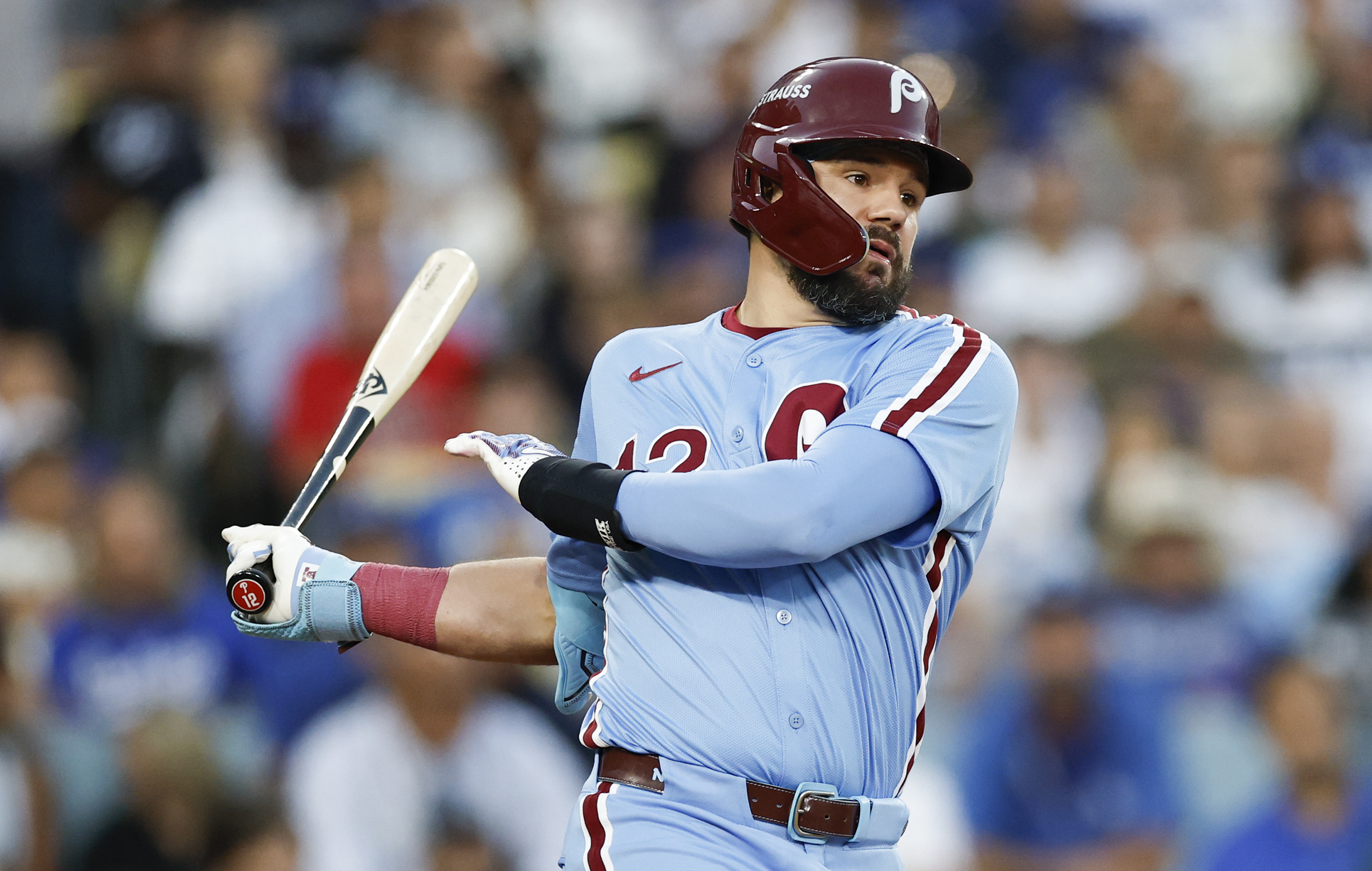
    Kyle Schwarber is one of several Phillies who have not fared well against Mets pitcher Freddy Peralta.

    And what about the five-hole? Right now, you’d probably pencil in Marcus Semien there. Which would be great, if “right now” was 2023. But Semien has looked nothing like the guy who finished third in MVP voting for the Rangers during their World Series campaign. In 2024 and 2025, the 35-year-old infielder slashed .234/.307/.379 for a .686 OPS that was almost exactly league average. Semien, whom the Mets acquired from Texas in a trade, is making $26 million this year.

    Luis Robert Jr. could work his way up in the lineup if he hits like he did over his last 35 games last season (.819 OPS, six home runs, 140 plate appearances). Or, he could be a $20 million eight-hole hitter if he hits like he did over the last two seasons overall (.660 OPS, 28 home runs, 856 plate appearances).

    There’s no question the Mets have succeeded in building themselves a different lineup. Francisco Lindor and Juan Soto are the only name-brand holdovers from a year ago. Brett Baty figures to start at designated hitter after the former top prospect rescued his career with a .311./.372/.500 batting line and seven home runs in his last 42 games. Mark Vientos can only hope to factor into the equation after a season in which he failed miserably to follow up on his 2024 breakout. Again, there are things that can break right. But a team’s win total usually has a negative correlation with the number of “ifs” it brings to spring training. And that likely would have been the case with the Mets, until Wednesday.

    In Peralta and second-year sensation Nolan McLean, the Mets will have the kind of 1-2 punch atop their rotation that can carry a questionable lineup a long way. In two starts last year, McLean held the Phillies to one run and 14 base runners in 13⅓ innings with 11 strikeouts. Combine his numbers with Peralta’s against Schwarber-Harper-Turner and you get 3-for-40 with 14 strikeouts. If Sean Manaea can get back to his 2024 form (3.47 ERA in 181⅔ innings) and Kodai Senga can stay healthy, the Mets could be a big problem for opposing lineups. And that’s assuming they don’t make another late splash (Framber Valdez, for instance).

    But, then, there’s that pesky little word again. The Mets may yet salvage their offseason and move the needle in a more decisive manner. For now, Phillies fans shouldn’t be too hard on Dave Dombrowski’s roster. It’s still better than the Mets, for about 80% of the price.

  • Fallcatcher scammer has been sentenced to 5+ years

    Fallcatcher scammer has been sentenced to 5+ years

    A Florida fraudster who fooled 60 mostly Philadelphia-area investors into contributing $5 million to develop biometric anti-addiction systems, then fled investigators and spent five years as a multinational fugitive before surrendering, was sentenced Wednesday to 5½ years in federal prison.

    Henry Ford, also known as Cleothus “Lefty” Jackson, had pleaded guilty to securities fraud and seven counts of wire fraud for forging documents from insurance companies to inflate the prospects of Fallcatcher, a company he said he was developing to track people in recovery and reduce the risk they would fall back into addiction.

    At his plea hearing last year, Ford insisted his idea for a platform that would track people in recovery was legitimate but admitted that he had falsified claims that insurers and state agencies supported the project and would soon make it profitable. The goal had been to sell the company at a big profit for its investors.

    He was sentenced Wednesday by U.S. District Judge Joel H. Slomsky to the prison term, plus three years supervised release and $2.1 million in restitution.

    Ford started the business in Florida in 2017 but by 2018 was running out of money, according to prosecutors. He then incorporated the company in Delaware and hired managers and a board. He paid Montgomery County insurance salesman Dean Vagnozzi to recruit private investors from Vagnozzi’s network with email pitches and free meals in Montgomery County and South Jersey. But he gave Vagnozzi and the investors false information about Fallcatcher’s prospects.

    Ford fled Philadelphia in 2019 after giving SEC investigators phony documents in an attempt to disprove allegations that he was exaggerating Fallcatcher’s prospects and after learning that he and Fallcatcher were subjects of a criminal investigation.

    He went to Miami, then flew to Morocco, according to federal investigators. Ford later told officials he lived and worked in the United Arab Emirates; Thailand; Malaysia; Indonesia; Tunisia; Guinea; and Mexico.

    Ford filed a Freedom of Information Act request from Mexico in 2024 with the U.S. Marshals Service to see if they were still looking for him.

    Ford crossed the border into Arizona in April 2024, where he was arrested on a warrant for the Fallcatcher case. He was sent to Philadelphia for trial and detained in the federal jail as a flight risk. In 2011, he had been convicted of mortgage fraud in federal court in Arizona as Cleothus “Lefty” Jackson and served a prison term before starting Fallcatcher.

    Part of the money Ford raised for Fallcatcher has been collected for investors from business and personal accounts seized from him in 2019 after Scott Bennett, a company executive, became suspicious that Ford was collecting improper payments from the company and reported him to the SEC.

    According to prosecutors, Ford gave salesman Vagnozzi and investors “false and misleading information” about Fallcatcher and showed them phony documents about an insurer’s promise to fund a pilot Fallcatcher program. Ford paid Vagnozzi $500,000, which Vagnozzi refunded as part of a civil settlement with the SEC, plus 4 million shares of Fallcatcher stock, which proved worthless.

    Vagnozzi is suing that agency, alleging that federal officials improperly seized his former business, A Better Financial Plan, as part of the 2020 court-ordered government takeover of Par Funding, a Ponzi scheme whose unregistered securities Vagnozzi also sold to clients. He later sued his lawyer, former Eckert Seamans partner John Pauciulo, who Vagnozzi said gave him bad advice about Par, Fallcatcher, and other investments.

    The case against Ford was investigated by the FBI and the SEC’s New York regional office.

  • Japhet Sery Larsen got an assist from Mikael Uhre as he decided to join the Union

    Japhet Sery Larsen got an assist from Mikael Uhre as he decided to join the Union

    There have been enough Danish players in MLS recently that when the Union reached out to Japhet Sery Larsen, he didn’t have to look far for advice.

    “I have a good friend who plays in San Diego, [Anders] Dreyer, who has spoken really warmly about the league,” Larsen said in a news conference this week from the Union’s preseason camp in Marbella, Spain. “I have a former teammate as well in Cincinnati, Evander, who really enjoys his time here.”

    Those are very good connections to have. Dreyer was the league’s Newcomer of the Year last year, delivering 23 goals and 18 assists in 41 games; Evander is a two-time All-Star and Best XI honoree.

    But Larsen had an even better expert to call, too.

    “I talked to Mikael Uhre a bit because he knows the Union very well, which was really helpful for me,” he said.

    Mikael Uhre’s last goal for the Union was the one that clinched the Supporters’ Shield.

    If Larsen saw all the little boxes with the journalists’ heads on Zoom, he’d have watched a mass springing to attention.

    It wasn’t surprising that Larsen and Uhre know each other, because players cross paths in all kinds of ways in soccer. But it would sure be something to learn Uhre’s opinion of a club that didn’t always treat him well in his last two years in Chester.

    “He was really happy about his time here,” Larsen said. “He had some great moments here, I think.”

    Yes, he did, and he was barely given a chance to say goodbye — or to receive thanks from the portion of fans who liked him. That makes it even nicer of Uhre to say good things about the Union and living in Philadelphia.

    The Union moved on from Mikael Uhre (left), Jakob Glesnes (right), and other veterans after last year.

    “I had some good talks with the sporting directors and the coaches about what it’s like being in the club, but the hard part is finding out what life is around the training ground and stuff like that,” Larsen said. “So Mikael was really helpful there. Obviously, we talked about [life] in the club as well, but he had only good things to good things to say about the club — he really enjoyed the playing style and the philosophy of the Union.”

    It will be up to other players, especially Ezekiel Alladoh, to replace Uhre’s goals and defense-stretching runs. Larsen’s job is to replace another Union stalwart, Jakob Glesnes.

    On paper, he has the resumé. Larsen spent the last three years at Norwegian club Brann, won a Norwegian Cup, and played in Champions League qualifiers and the Europa League.

    Before that, he spent a year at Bodø/Glimt, a team with a big reputation as a continental Cinderella.

    Japhet Sery Larsen (right) wearing the captain’s armband for Brann in a Europa League game in November.

    His age matters, too. The Union like to sign younger players whom they can develop and sell later. Larsen is 25, heading toward a player’s peak age period. And the club’s scouts noticed that he wore the captain’s armband at times for Brann, a sign of good intangibles.

    “It had a big impact on my decision before joining here,” Larsen said. “I know some more experienced players have left the club now during this winter, so there’s an open spot for taking responsibility and leadership. And I think we have that within the group, but obviously I want to contribute to that as well and help as better as best as possible.”

    He arrived in Chester well-briefed on the Union’s high-speed playing style and was excited to play in it.

    “I think the coaching staff have a really clear idea of how they want to do things, which I believe suits me quite well,” he said. “[That] had a big impact for me in my decision, which made it easier, but they really talked about their way of thinking in football and their principles.”

    Japhet Sery Larsen in action during the Union’s preseason opener Tuesday.

    Larsen got his first run in a game on Tuesday, and played the first half of the Union’s 1-1 tie with Czech club Sigma Olomouc. Paired with Olwethu Makhanya on the back line — to form what is expected to be this year’s starting centerback duo — he seemed to fit in well enough.

    “I thought it was quite obvious the way the coaches want us to play,” Larsen said. “I think we could see the principles coming to life in the game. A lot of the guys are thinking forward the whole time, trying to really express ourselves.”

    On Friday, he played the first period of a 2-1 loss to Danish club Nordsjælland that had three 45-minute frames, this time next to young prospect Finn Sundstrom.

    Larsen hadn’t been with the Union for long before heading to Spain, and he spent part of the opening week in Chester working off to the side. So he had to jump quickly into the deep end, “a new way of speaking football” as he put it.

    “It has been fun and challenging at the same time,” he said. “I’m learning new things every day, but I’m trying to embrace it all, and the coaching staff and the teammates are really helpful in that process.”

  • The Flyers will be irrelevant as long as they lack a No. 1 center. A trade for Robert Thomas could change that.

    The Flyers will be irrelevant as long as they lack a No. 1 center. A trade for Robert Thomas could change that.

    The Flyers are leaking oil.

    Losers of seven of their last eight games, Rick Tocchet’s men, who have resided in a playoff spot for most of the season, are in free fall and now sit three points out of both the final spot in the Metropolitan Division and the wild card.

    With injuries piling up, the latest suffered by indispensable goaltender Dan Vladař, and a condensed schedule, the Flyers are in real danger of falling out of the postseason race before the March 6 trade deadline.

    The recent slide has also made painfully obvious what many already knew: The Flyers aren’t nearly as close to contending as they think they are.

    Why?

    For all their improvement and the savvy acquisitions of Trevor Zegras, Christian Dvorak, and Vladař, the Flyers have yet to acquire maybe the most important ingredient to any contending hockey team: a No. 1 center.

    To make matters worse, they don’t look to have a prospective solution to that problem in their farm system, as Jett Luchanko, Jack Nesbitt, and Jack Berglund all project to top out as middle-sixers.

    Florida had Aleksander Barkov. Vegas had Jack Eichel. Colorado had Nathan MacKinnon. Tampa Bay had Brayden Point. The Flyers have … Christian Dvorak? That’s not to say the Flyers are simply a 1C away from doing laps around the ice with a 35-pound silver bowl over their heads, but until they find one, everything else they do is more or less a futile exercise.

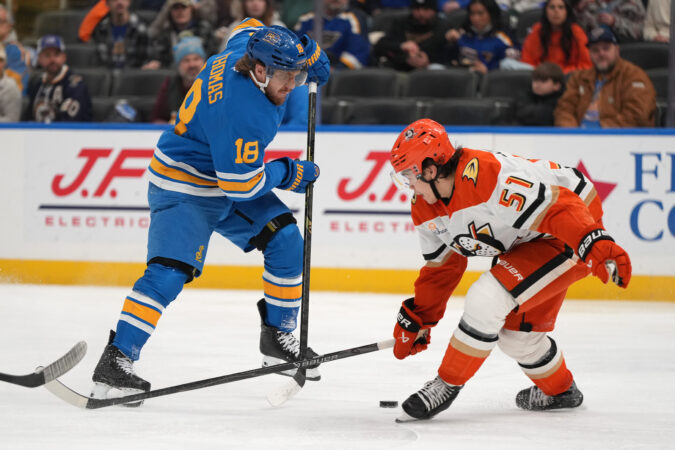
    That brings us to Robert Thomas, a bona fide top-20 center who some around the league believe could be pried away from St. Louis — he is listed on both the Athletic and Daily Faceoff’s most recent trade boards — for the right price. Thomas, who turns 27 in July, is one of the league’s top playmakers and has tallied 80-plus points in each of the last two seasons.

    There’s a lot of speculation that the St. Louis Blues will listen to offers for talented center Robert Thomas.

    In addition to his tremendous vision, he’s a sturdy 207 pounds, possesses above-average speed, wins faceoffs (53.4% since 2022-23), and plays a responsible 200-foot game — a trait the Flyers clearly prioritize in their centermen.

    In other words, he’s exactly what the Flyers need.

    Did I mention he’s already won a Stanley Cup and is signed for five more seasons after this one at a below-market average annual value of $8.125 million?

    So is Thomas actually available? That depends on whom you ask, but with the Blues tied for the league’s second-fewest points, it would be surprising if general manager Doug Armstrong wasn’t at least listening on pretty much everybody.

    Armstrong all but confirmed that in December when he said, “There’s really no untouchables — not [just] on the St. Louis Blues, [but] there’s really few untouchables in the league. There’s a lot of other guys that, when things aren’t going well, I would say that [trade] list grows.”

    Danny Brière and Armstrong are no strangers, as the two did a deal in 2023 involving Kevin Hayes, and infamously had another deal centered on Travis Sanheim nixed at the 11th hour. So with a gaping hole down the middle and armed with a deep prospect pool and three first-round picks over the next two drafts, why wouldn’t Brière blow Armstrong away with a deal he can’t refuse?

    Flyers general manager Danny Briere has acknowledged the team’s need to upgrade down the middle. Could Robert Thomas be the answer?

    Assuming that Porter Martone, Matvei Michkov, and potentially Tyson Foerster are off the table, any deal will start with at least one first-round pick in 2026 or 2027, a center prospect, and a combination of one or two more picks, prospects, or young roster players.

    The Blues would have their pick of Luchanko and Nesbitt and would likely covet another first-rounder in a 2026 draft — the Flyers would likely prefer to trade a 2027 first since they have two of them — that features three blue-chip prospects in Gavin McKenna, Ivar Stenberg, and Keaton Verhoeff.

    It’s worth mentioning that Stenberg’s brother Otto plays for the Blues, and with a closely-contested East and the Flyers’ precarious position at present, St. Louis might gamble that the Flyers’ draft pick would land them a second selection inside the top 10.

    St. Louis also is likely to ask for a youngish defenseman to go the other way, which would mean Cam York, Jamie Drysdale, Oliver Bonk, or Emil Andrae.

    The Flyers would likely balk at moving York, a key part of their blue line who just signed a five-year extension, while the 23-year-old Drysdale’s value has decreased, not to mention that he’s a restricted free agent at season’s end and would require a new deal. That leaves Bonk and Andrae as the most realistic targets, with the former, a first-rounder in 2023, having the higher upside.

    Rounding out the deal would be another draft pick — let’s say a second — or a prospect or young roster player. Would the Blues have interest in Bobby Brink or Nikita Grebenkin as cheap wingers who can play up and down the lineup and have some untapped potential? St. Louis native Shane Vansaghi, a bruising second-rounder from this past June’s draft with a unique skill set, is another player who might intrigue Armstrong.

    Flyers defensive prospect Oliver Bonk could be an intriguing player to the rebuilding St. Louis Blues.

    The Flyers are in a tough spot, as they need a No. 1 center and are unlikely to have a pick high enough to draft one — 19 of the 27 players I’d characterize as No. 1 centers were top-10 picks, with 15 of them selected in the top three — and there are none available this summer in free agency.

    That leaves a trade as the likeliest path, and even those options are largely limited to guys either on the wrong side of 30 or younger, distressed assets looking to rediscover their 1C potential à la Seattle’s Shane Wright.

    Thomas represents something different entirely. He’s a proven commodity who not only fits the right age profile but has 5½ years of control. His high-danger passing would also be a tantalizing proposition alongside exciting wingers like Zegras, Michkov, Martone, Foerster, and Travis Konecny. If you have to overpay for someone like that, so be it.

    Would a 2026 or 2027 first-rounder, Luchanko, Bonk, and Brink get a deal done? And is that too much for Thomas, who is having a down year with 11 goals and 33 points in 42 games?

    The Flyers need to get uncomfortable and take some risks if they are going to address the organization’s biggest need. Until they do, they will be stuck in NHL purgatory, the worst place an organization can be.

  • The Eagles didn’t reach the championship round. You can watch several ex-Birds and local favorites in the AFC and NFC championships, however.

    The Eagles didn’t reach the championship round. You can watch several ex-Birds and local favorites in the AFC and NFC championships, however.

    While the Eagles’ playoff run has long concluded, Philadelphians may notice a number of familiar faces on each team competing in the conference championships on Sunday.

    From former Eagles players, coaches, and front office members to Philadelphia-area natives, all four remaining teams in the playoffs — the Seattle Seahawks, Los Angeles Rams, Denver Broncos, and New England Patriots — feature local connections.

    Here are the names and faces that may ring a bell when they pop up on your television screen. In the cases of the former Eagles players on the list, we’ve also examined why they’re no longer on the team.

    Seattle Seahawks

    CB Josh Jobe spent two seasons with the Eagles from 2022 to 2023 and appeared in 28 games, primarily on special teams. The 2022 undrafted free agent out of Alabama served as a depth cornerback behind Darius Slay and James Bradberry, but he got buried on the depth chart and was released at the end of training camp in 2024. Jobe, now 27, signed with the Seahawks two days later and earned a starting job this season in Mike Macdonald’s defense.

    Josh Jobe evolved from his special teams role with the Eagles to a starting job in Seattle.

    The Seahawks often use dime packages to get Jobe, Riq Woolen, and Devon Witherspoon on the field at the same time. According to Next Gen Stats, each member of the trio has allowed less than a yard per coverage snap in dime coverage, ranking among the top five cornerbacks in the league in that metric.

    Long snapper Chris Stoll spent six years at Penn State from 2017 to 2022 and played in 48 games. In 2022, he won the Patrick Mannelly Award, given to the nation’s top long snapper. Stoll signed with the Seahawks as an undrafted free agent in 2023.

    Leslie Frazier has been the Seahawks’ assistant head coach since 2024, serving as a mentor to Macdonald, a first-time head coach. Frazier, 66, was the head coach of the Minnesota Vikings from 2010 to 2013 and has had multiple defensive coordinator jobs, but he got his NFL coaching start with the Eagles as the defensive backs coach from 1999 to 2002 under defensive coordinator Jim Johnson. Among the players Frazier coached with the Eagles were Brian Dawkins and Troy Vincent.

    Justin Outten, 42, is a 10-year NFL coaching veteran who is in his first year as the Seahawks’ running game specialist and assistant offensive line coach. He hails from Doylestown and graduated from Central Bucks West in 2002. Outten was a center on the football team and won the state championship as a sophomore in 1999.

    Los Angeles Rams

    OL Dylan McMahon was the Eagles’ 2024 sixth-round pick out of N.C. State. Somewhat surprisingly, he was the only member of the 2024 draft class who did not make the team out of training camp, instead signing to the practice squad. The Rams signed McMahon to their active roster off the Eagles’ practice squad in Week 2 that year to add depth to their banged-up offensive line. He started in the 2024 season finale at center and has spent the entire 2025 season on the Rams’ practice squad.

    Omar Speights emerged as a football star as a Philadelphia high schooler.

    ILB Omar Speights hails from Philadelphia and played his first three years of high school football at Imhotep Charter and briefly at Northeast High School. He moved to Oregon for his senior year. Speights, 24, signed with the Rams in 2024 as an undrafted free agent out of LSU and started 16 games this season.

    ILB Troy Reeder, 31, is from Hockessin, Del., approximately 10 miles west of Wilmington. He spent his college career at Penn State (2014 and 2015) and Delaware (2016 to 2018). Reeder signed with the Rams as an undrafted free agent in 2019 and won a Super Bowl with the team in 2021.

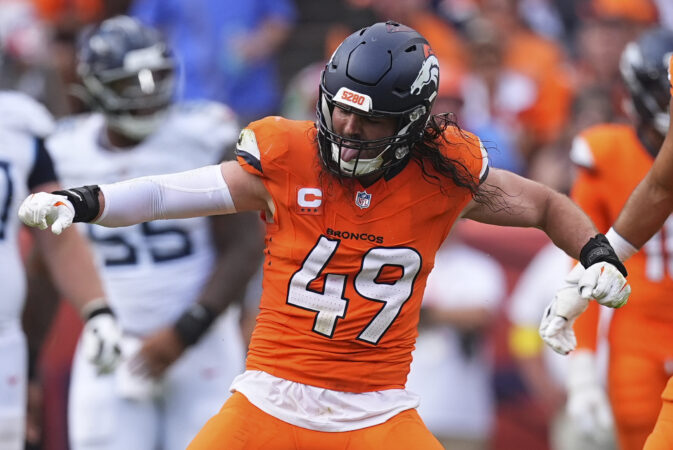
    OLB Jared Verse, the 2024 defensive rookie of the year, grew up in Berwick, Columbia County. Despite playing three years of football at Central Columbia High School in Bloomsburg in northeastern Pennsylvania, Verse was not an Eagles fan (and has declared his distaste for their supporters). The Rams selected Verse 19th overall out of Florida State in 2024. He ranked second on the team in sacks this season with 7½.

    Ray Farmer is in his sixth season with the Rams, his first as the senior adviser to general manager Les Snead. He was drafted by the Eagles in 1996 in the fourth round out of Duke and served in a depth role at linebacker for three seasons before suffering a career-ending knee injury. Farmer was the Cleveland Browns general manager from 2014 to 2015.

    Drew Wilkins is in his first season as the Rams pass-rush coordinator. He is a Doylestown native and graduated from La Salle College High School in 2006.

    Mike McGlinchey (74), pictured with Penn Charter teammates and fellow Matt Ryan cousins Jake McCain, Pat McCain, and Frank McGlinchey, is now considered one of the NFL’s best tackles.

    Denver Broncos

    RT Mike McGlinchey, 31, is in his third season as a starter with the Broncos and spent the first five years of his career with the San Francisco 49ers. He was born in Warrington and played football and basketball at Penn Charter. He is a cousin of Matt Ryan, the 15-year NFL quarterback who hails from Exton and also attended Penn Charter. McGlinchey was drafted by the 49ers out of Notre Dame with the No. 9 overall pick in 2018.

    ILB Alex Singleton signed with the Eagles in 2019 and started 19 games (42 total appearances) in three seasons. He led the Eagles in tackles in back-to-back seasons in 2020 and 2021 (120 and 137, respectively). Singleton, now 32, signed a one-year deal with the Broncos in free agency in 2022 and has been with the team ever since. He started 16 games this season and led the team with 135 tackles, one year after suffering a season-ending ACL injury.

    Sean Payton is in his third season as Broncos coach. He got his NFL coaching start with the Eagles as the quarterbacks coach from 1997 to 1998 under head coach Ray Rhodes, working with quarterbacks Ty Detmer, Bobby Hoying, Rodney Peete, and Koy Detmer. Perhaps more notably, Payton spent 15 seasons as the head coach of the New Orleans Saints from 2006 to 2021 and won the Super Bowl in the 2009 season.

    Joe Vitt was hired by Payton in 2023 as a senior defensive assistant. Vitt first crossed paths with Payton on the Eagles, as the assistant was the linebackers coach in Philadelphia for four seasons from 1995 to 1998. Vitt, 71, grew up in Blackwood, N.J.

    Jordon Dizon is in his first season as the Broncos director of pro personnel and his eighth with the team. Between two stints in the Broncos front office, he was a national scout for the Eagles from 2022 to 2024.

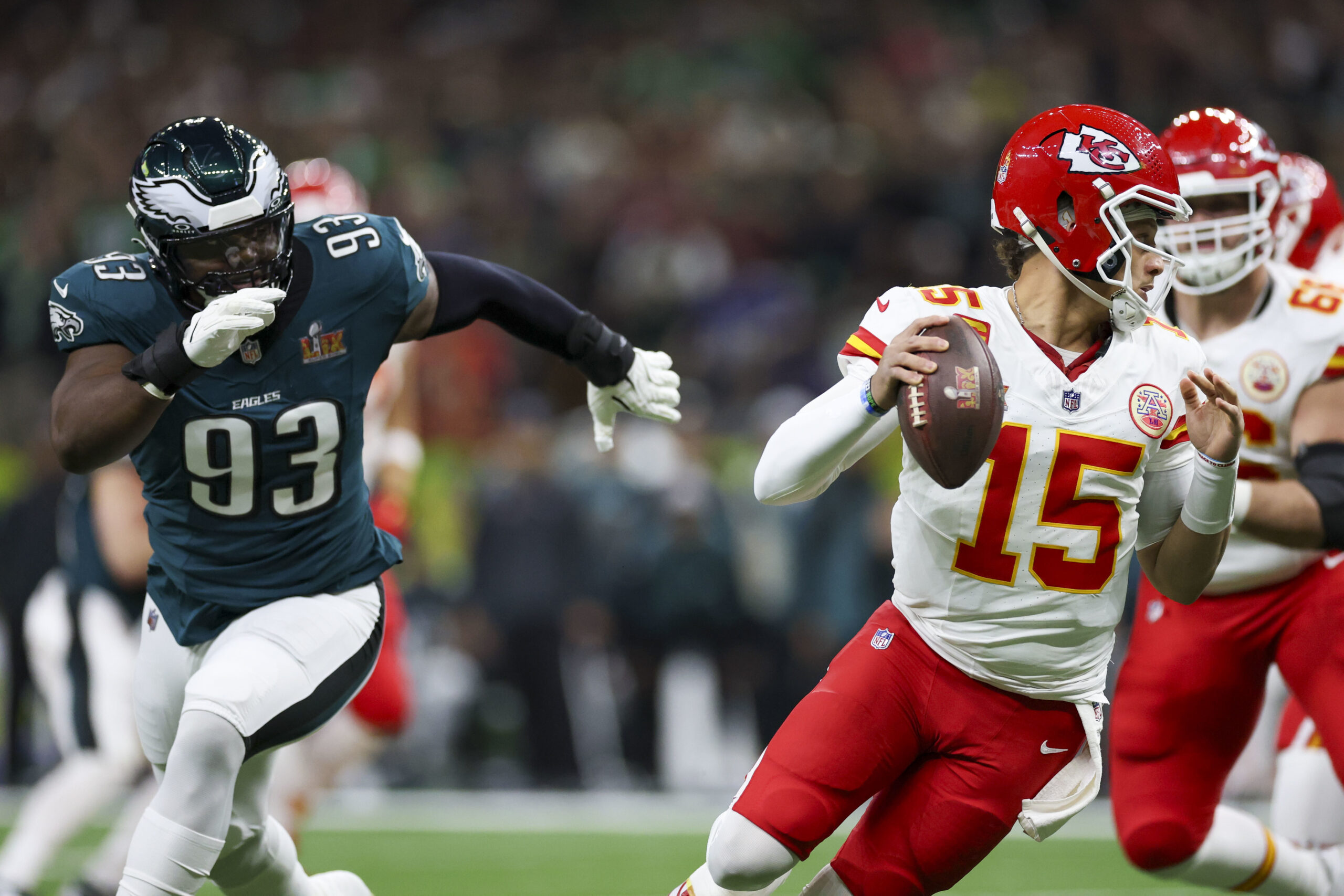
    Milton Williams (93) parlayed a career season that included a Super Bowl ring into a free-agent deal with the Patriots.

    New England Patriots

    DT Milton Williams spent the first four years of his career with the Eagles, the team that drafted him in the third round out of Louisiana Tech in 2021. He had a breakout year in 2024, amassing a career-best five sacks in 17 games (seven starts). After winning a Super Bowl with the Eagles, he signed a four-year, $104 million contract with the Patriots in free agency, making him the second-highest-paid interior defensive lineman on an average annual basis ($26 million per year).

    Williams, 26, missed five games late this season with an ankle injury, but he returned in time for the playoffs. He notched two sacks in the wild-card win over the Los Angeles Chargers.

    Mack Hollins has had a nice year for a rejuvenated Patriots team but appears unlikely to play this week because of injury.

    WR Mack Hollins also began his career with the Eagles, selected in the fourth round of the 2017 draft out of North Carolina. He was a member of the Eagles team that beat the Patriots in the Super Bowl that season. Since that year, the 32-year-old Hollins has been a member of four teams and joined the Patriots on a two-year deal this season. He is on injured reserve with an abdominal injury, but the Patriots opened up his practice window this week — he was listed as questionable for this weekend’s game on Friday’s injury report. Hollins had 550 yards and two touchdowns on 46 receptions in 2025, the second-best receiving total of his career.

    ILB Christian Elliss spent nearly three seasons with the Eagles from 2021 to 2023. He served in a depth role, even in 2023 on a struggling defense under former defensive coordinator Sean Desai, and he appeared in 19 total games, primarily on special teams. The Eagles waived Elliss in December 2023 after signing Shaquille Leonard, and the Patriots claimed him. Elliss, 27, started 13 games this season (and played 15 games total) and ranked second on the Patriots with 94 tackles.

    Christian Barmore is another former Philly high schooler who has reached the NFL pinnacle.

    DT Christian Barmore grew up in Philly, starting in high school at Lincoln before transferring to Neumann Goretti. He orally committed to Temple, but he reopened his recruitment in 2017 and attended Alabama instead. Barmore was the Patriots’ second-round pick in 2021. The 26-year-old became a full-time starter this season, and had two sacks in 17 games (16 starts).

    OT Caedan Wallace hails from Robbinsville, N.J., spending his high school football career at Robbinsville High School and then the Hun School. He helped the latter to three straight prep state championships (2016, 2017, 2018). Wallace, 25, played for Penn State from 2019 to 2023. He was drafted by the Patriots in the third round in 2024 and has served in a depth role over the last two seasons.