SEATTLE — Even many who think Folarin Balogun’s red card was justified don’t blame him for the global fallout over the last few days.
It isn’t his fault that he’ll be forever known as the player President Donald Trump lobbied FIFA president Gianni Infantino to get back on the field.
“When that decision’s overturned, of course it’s going to be controversial,” he said, “So for me, it’s something that didn’t really surprise me too much. But as a player, my job is just to go out there and focus on my job.”
Folarin Balogun reacts after Belgium’s third goal, which blew the game open.
“I can only be honest, you know. I don’t think we had a good game today collectively,” he said. “We played well in the other games. We were very intense; we were able to generate energy with the crowd. And today, we didn’t give the crowd a lot to cheer for. That’s the most disappointing thing — that’s the part that hurts the most for me, personally.”
And he acted with grace again when he went to speak with Belgium manager Rudi Garcia, whom he has known for a while, after the final whistle.
“This is a game, there’s winners and losers, and similar to when I was given the red card, you have to handle it in the right way,” he said. “So, us losing today again, of course there’s huge disappointment. But for me, I wanted to just say congratulations to Belgium and Rudi Garcia and wish them good luck for the rest of the tournament.”
Belgium manager Rudi Garcia (right) consoling Folarin Balogun in their conversation after the game.
Garcia returned the favor in his postgame news conference.
“This wasn’t his fault,” he said. “He isn’t the one to blame, that’s what I told him. I appreciated that he came to see me.”
How much did the scandal motivate Belgium? Any team could draw easy motivation from saying Trump and FIFA stacked the deck, so let’s go beat the U.S.
“No, we just wanted to win the game on the field,” veteran goalkeeper Thibaut Courtois said. “It was a bit bizarre, it wasn’t the fault of the U.S. team or Balogun. … Whether he played or not, it was important for us to win.”
Not all of his teammates were so polite.
Belgium’s Romelu Lukaku gave the universal gesture to talk less after scoring his team’s fourth goal.
“There’s always a justice somewhere in life,” midfielder Nicolas Raskin said. “And the fact that something happened like that, you can call it what you want, but we don’t think that was fair. And I think today, it just brought us a little bit of luck that we needed to win the game.”
One of the Red Devils’ biggest stars, midfielder Youri Tielemans, had stronger words about why his team “had a fire in us” throughout the game.
“Of course we aren’t going to hide it,” he told Belgian TV network RTBF. “We had a meeting about it when we got the news, and afterward, we said we have no excuse. Whether he plays or not, it’s up to us to show that we should talk on the field, and that’s what we did today. So I’m very happy, and very proud of the team.”
When Romelu Lukaku scored his team’s fourth goal to cap the 4-1 win, he gave the universal “talk less” gesture to the crowd. The team then got together for a celebration that midfielder Axel Witsel acknowledged was a version of “the Trump dance.” Then they did it again in the postgame locker room.
A Philadelphia man has been charged after authorities said he conducted a fraudulent cryptocurrency purchase for a valuable Pokémon card in Marlton.
After arranging the sale through Facebook Marketplace, Christian Elam, 26, allegedly met the seller at the Evesham Township Police Department Safe Exchange Zone, located in the lobby of police headquarters, Evesham police said in a statement posted to social media Monday.
Elam allegedly paid the seller for a Pokémon card worth $24,200 using cryptocurrency, which was later determined to be fraudulent, the department said.
Elam was charged with third-degree theft by deception and second-degree computer-related theft. He was being held at the Burlington County Jail awaiting a pre-indictment hearing scheduled for Aug. 26, according to the court docket.
The police department is encouraging residents to continue taking advantage of the 24-hour safe transaction zone but to remain diligent about potential scams.
“While the zone provides a well-lit, video-monitored location for in-person exchanges, residents are reminded to independently verify payment before transferring property, especially when cryptocurrency, electronic payments, or high-value items are involved,” the department said.
Cyber-enabled crimes are on the rise across the United States. The Internet Crime Complaint Center received more than 1 million complaints in 2025, a 17% increase from the previous year, with total reported losses of nearly $21 billion, according to an April report from the FBI.
Cryptocurrency crimes are often the costliest, with more than 181,565 complaints totaling more than $11 billion in losses in 2025 alone.
A 13-year-old boy in Franklin Township died after getting trapped underneath an overturned farm tractor Monday night, according to officials.
A statement released by Franklin Township police Tuesday morning said officers from Franklin and Elk Townships responded to the 1100 block of Swedesboro Road around 5:35 p.m. and found the teen unconscious and unresponsive beneath the tractor.
Officers began lifesaving measures once the tractor was lifted, and the teen was taken to Cooper University Hospital, where he died of his injuries, according to the police statement.
An initial investigation showed that the teen was helping a family member dig a hole with the tractor. While riding the equipment with an adult male, the tractor overturned, trapping the teen underneath and leaving the adult with minor injuries. The adult was treated at a local hospital.
The adult who rode the tractor is a family member of the teen, though Police Chief Matthew DeCesari declined to share more about their relationship.
“The incident remains under investigation by the Franklin Township Police Department and the Gloucester County Prosecutor’s Office,” the police statement said. “The investigation is ongoing, and any potential criminal charges will be determined upon its conclusion.”
State and local health officials are tracking dozens of cases of an illness caused by an intestinal parasite with symptoms including “explosive” bowel movements.
Cyclosporiasis, caused by the parasite Cyclospora caytanensis, spreads through contaminated food and water.
Pennsylvania had recorded 28 cases this year as of last week, including 14 in Southeastern Pennsylvania. The state identified 40 cases in 2025.
People sometimes contract cyclosporiasis when traveling in tropical or subtropical regions of the world where Cyclospora is endemic, but outbreaks also occur in the United States.
Cases of cyclosporiasis can occur any time of year but tend to rise in the spring and summer months.
Nationwide, the Centers for Disease Control and Prevention’s website says ithas tracked 145 cases in 17 states between May 1 and June 16, including between 1 and 10 people sickened in both Pennsylvania and New Jersey during that time. All those cases were acquired in the United States.
The agency is also tracking an additional 45 cases reported in people who contracted the parasite while traveling outside the country.
Nationwide, 23 people have been hospitalized for cyclosporiasis since May 1.
The CDC warned that the true number of cyclosporiasis cases is likely higher, as some people recover without seeing a doctor or getting tested.
It is not typically life-threatening, state health officials said, but can last more than a month if not treated.
The CDC said it is working with state and local health departments around the country to learn how cyclosporiasis cases have spread, but there is no evidence that the 145 cases reported since May are linked.
“Investigations to identify potential clusters and potential sources of illness are ongoing,” the agency said.
Pennsylvanians experiencing symptoms of cyclosporiasis should call their doctors, state health officials said.
Unlike most states, Pennsylvania health providers are not required to report cyclosporiasis cases to health authorities, but the state health department still collects reports on confirmed cases and notifies federal health officials weekly.
PORTLAND, Maine — Sen. Bernie Sanders on Tuesday became the latest and most notable lawmaker to pull support for Maine Democratic U.S. Senate nominee Graham Platner following an allegation of sexual assault, adding to a chorus of calls for him to step aside as party leaders scramble to determine the next steps.
Sanders, a Vermont independent who caucuses with Democrats, has long backed Platner in the high-stakes race against Republican Sen. Susan Collins, but he said in a statement that he spoke with the candidate and “in light of these very serious allegations, I have recommended that he step aside.”
Platner, who denies the allegation, has not heeded the wave of calls to resign as the nominee. Instead, he posted a video on Monday saying he’s considering the next steps for his campaign while canceling town hall events.
Platner posted the video after reports that a woman who previously dated the first-time candidate said he drunkenly forced her to have sex after she told him to stop.
The allegation is the latest in a string a controversies Platner has faced and so far weathered since the oyster farmer and Marine veteran entered the race. But the seriousness of the assault claim has put the Maine contest — and Democrats’ ability to win control of the Senate — at risk, with even some of his strongest supporters questioning whether Platner should continue his campaign.
A Platner voter is ‘heartbroken’
Joanie Monteith, a passionate supporter from the southern Maine town of York who organized a trivia night about Platner in March, said through tears Tuesday that she was “numb” and “heartbroken” at the news. She was waiting for another public statement from Platner before making a decision about whether she could keep supporting him.
“I’m in tears. I’m numb and I’m waiting for what Graham has to say. I’m trying not to be a part of this public trial. And I’m heartbroken. And I’m heartbroken for him and his wife.”
She added she believes the allegations are serious.
“I’m not going to blame a victim. Because if this is true I feel very bad for the woman,” she said. “You just don’t know how to feel.”
Jenny Racicot, who lives in Maine, told Politico that Platner entered her home in 2021 while drunk and assaulted her. Racicot said she had been in an on-and-off relationship with Platner, but she cut off contact with him after that night and told him the incident wasn’t consensual. She said in a CNN interview on Monday evening that she opted not to fight back for fear of Platner, a former Marine, becoming more violent.
Another Maine voter, Lee Holman, said she wants Platner to stay in the race.
“I feel like the people of Maine have spoken,” the Democrat said. “If they wanted Janet Mills, they could have voted for her.”
She said the allegation against Platner may be legitimate, but she questions the timing. Democrats, she added, can be too quick to “throw the baby out with the bathwater” by calling on politicians facing allegations to resign.
“Every time we think we have a chance to snatch our democracy back, something gets in the way,” she said.
Replacing Platner may further divide Democrats
The pressure for Platner to withdraw from the Senate race has only increased given the short deadlines Maine law allows for replacing general election candidates. There is no mechanism for Democrats to remove Platner from the ballot, meaning Platner must first opt to drop out of the general election before a replacement can be selected. The deadline to withdraw is 5 p.m. on July 13.
Just who should replace Platner if he drops out appeared to already be further splintering Democrats. Some argued the next Democrat should echo Platner’s progressive messaging, pointing to his success at rallying voters across the state. Others cautioned that having ties to Platner will only doom an already uphill campaign against Collins.
Joe Baldacci, a Democratic state senator, said he’s concerned about what the latest allegations will do to the voter excitement over the past year.
“I think the major concern, even with a nominee, a new replacement, is that person is going to start very much behind the eight ball,” Baldacci added.
Gov. Janet Mills, who sought the Democratic nomination but dropped out before the June 9 primary, could be considered as a nominee. Mills was supported by Democratic Senate leader Chuck Schumer but abandoned her campaign, saying she couldn’t raise the money needed to compete.
Another possible replacement is Troy Jackson, Maine’s former state senate president, who unsuccessfully ran to be the Democratic gubernatorial nominee earlier this year with the backing of Platner and Sanders.
While he hasn’t publicly said he’d run for the Maine Senate seat, U.S. Rep. Ro Khanna threw out his name as someone who stands up for “progressive values” after the California Democrat withdrew his support for Platner.
Other names include Nirav Shah, the former director of Maine’s Center for Disease Control and Prevention. Shah came in second in this year’s Maine Democratic gubernatorial primary, where he was considered more moderate compared with Jackson.
In a statement Tuesday, Shah said he’s “evaluating” whether he should enter the race should Platner step aside.
Other potential replacements include Shenna Bellows, the current Maine Secretary of State; Dan Kleban, founder of Maine Beer Company; Maine U.S. Rep. Jared Golden, who is not running for reelection; and Hannah Pingree, currently Maine’s Democratic gubernatorial nominee.
On Saturday night, a violent storm seemed to spell the end of Philadelphia’s music and fireworks celebration of America’s 250th birthday on the Ben Franklin Parkway. The West Philly rapper and actor was back at his hotel, with his scheduled reunion with his musical partner DJ Jazzy Jeff seemingly called off.
Then he got a phone call from “Mrs. Mayor.”
“The mayor called and asked would we go on at midnight,” Smith said in a video posted on his Instagram account on Monday, referring to Cherelle L. Parker, whom he referred to as “Mrs. Mayor” on stage when he finally got to perform at the One Philly: Unity Concert for America.
Of course he would go on at midnight, backed by The Roots, in a special occasion hometown show. It didn’t matter that the weather wound up delaying it from July 4 to the wee hours of July 5.
“This is me,” he said, making a face, as if that would even be a question. “This is me!”
Smith’s Instagram recap of his Independence Day weekend adventures included a clip from his show-closing set — which actually began after 2 a.m. — featuring a shot of the mayor rapping along to the line in The Fresh Prince of Bel Air theme song about being “West Philadelphia, born and raised.”
During the show, which turned out to be the climactic set of the night since scheduled headliner Christina Aguilera did not perform, Smith got specific about his origins. He also spoke of the history he shares with his musical partner, whose given name is Jeffrey Townes, and Roots drummer Ahmir “Questlove’ Thompson.
“Fifty-ninth and Woodcrest,” he said, while parading around the stage in a red Phillies cap and jersey. “I was born and raised at 59th and Woodcrest. DJ Jazzy Jeff, 57th and Rodman. Quest, 52nd and Osage.
“And only a couple thousand yards from here, the dream of this country was born. From the City of Brotherly Love and Sisterly Affection, we sent our message out to the entire world.”
Along with a closing performance of “Summertime,” the 1991 DJ Jazzy Jeff & the Fresh Prince hit and Philly seasonal anthem, the show also included a display of Townes demonstrating his unparalleled turntable skills.
While Townes dazzled, Smith played air DJ, and Questlove sat on his drum throne capturing the moment on his phone, seemingly in awe. Watch that clip below.
On Instagram, Smith also posted a photo from rehearsals with The Roots, with Townes wearing a “Respect the Architects” T-shirt.
And the rapper and star of Ali also shared a clip of his visit to the steps of the Philadelphia Museum of Art to see the newly installed statue of Philly heavy weight champion boxer Joe Frazier.
“Philly LEGEND ‘Smokin’ Joe Frazier right HERE!” he posted. “You kids have no CLUE about that left hook.”
Philadelphia District Attorney Larry Krasner has long said he’s a friend to organized labor. As prosecutors in his office are gearing up for an election to authorize their union, Krasner has said their efforts could ensure his own legacy, because “whatever person might take my seat later cannot easily undo what we have done.”
But not everyone in his office is feeling the support.
More than 100 lower-level employees in the District Attorney’s Office, including paralegals and victim and witness coordinators, are separately trying to secure their own union— and some say they’re meeting resistance.
Several workers said that Krasner’s administration has put up roadblocks and taken positions that they see as at odds with his public image as a leader of the city’s progressive movement.
Five paralegals and coordinators, all of whom spoke to The Inquirer on the condition of anonymity to avoid retribution before a union is in place, said the unionization process has left them disappointed with Krasner.
“He was elected in large part because of a number of very important pro-labor organizations in Philadelphia,” said one employee. “If the DA just came out and publicly supported it, that’s what I would expect from the most progressive DA in America.”
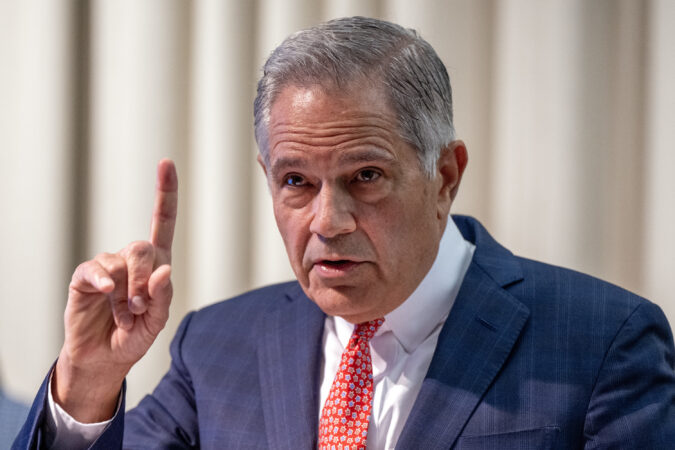
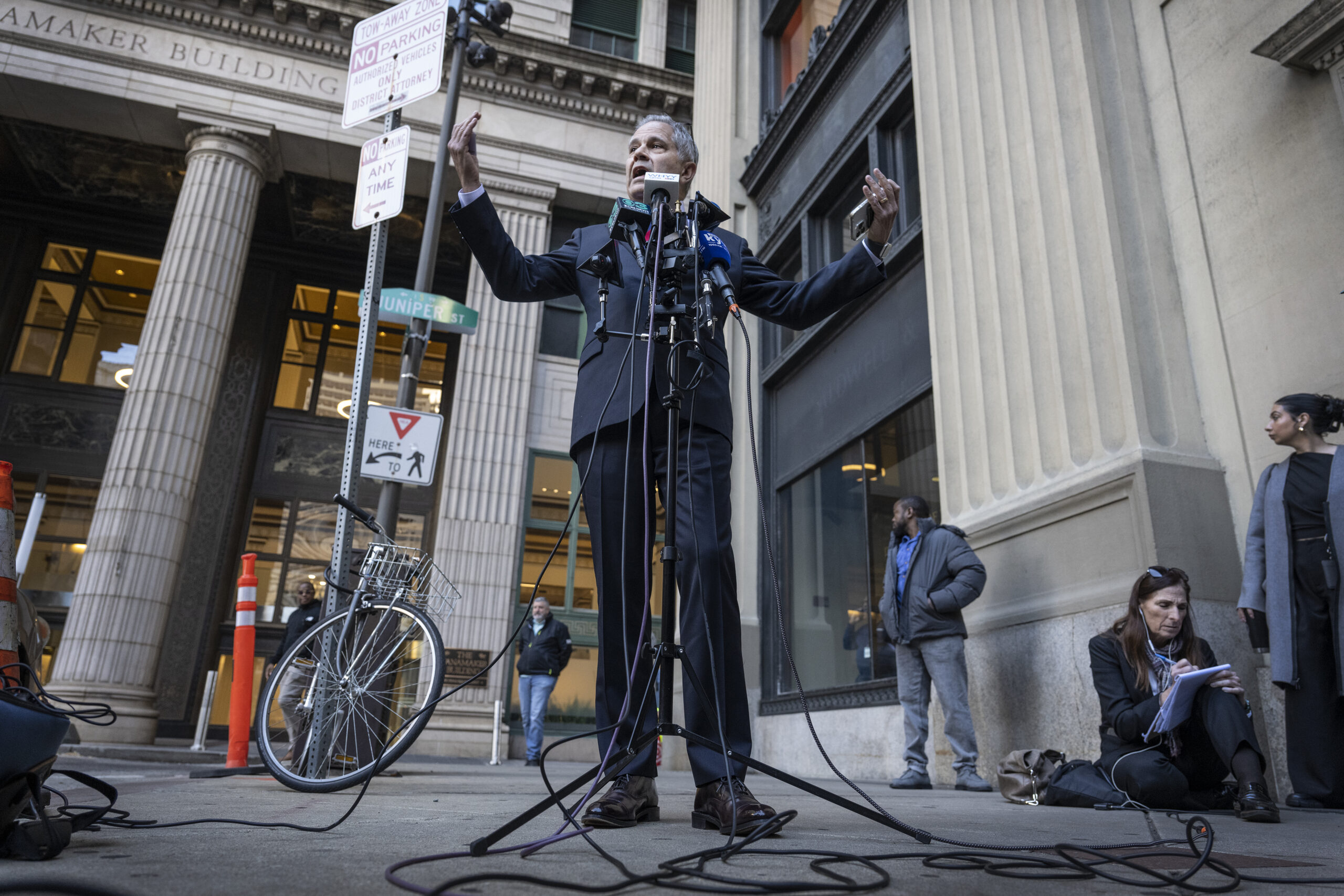
District Attorney Larry Krasner speaks during a press conference about a homicide in May.
And meanwhile, the lower-level employees say there’s been a separate Wild West-style standoff between two unions, which are both vying to represent them.
Krasner said in an interview on Monday that he supports his employees’ right to organize a union through a “properly conducted free, fair, and final election.”
“I will support them 100% in whatever decision they make to form or not to form a union, and whatever union they choose if they do form one,” he said.
Still, it all could become a political flashpoint for Krasner, a third-term progressive Democrat whose name has been floated by some in the city’s political class as a potential candidate for higher office. He has not ruled out running next year, when Mayor Cherelle L. Parker, a more centrist Democrat, will be up for reelection.
While Krasner has positioned himself as supportive of organized labor, his relationship with some leaders of the city’s politically powerful unions has been strained. He’s received steadfast support from the unions that tend to align with left-leaning politicians, but clashed with others, including the leaders of the building trades unions that last year backed his challenger.
Krasner last month publicly criticized Parker for not acquiescing to his office’s requests for additional funding, to which Parker countered that his funding has increased every year since she became mayor. He said this week that he believes the unionization effort among his employees is the result of his office being underfunded during Parker’s administration.
Paralegals and victim and witness coordinators said that they have explored unionization to improve wages. Several staffers described living paycheck-to-paycheck and holding second jobs to meet expenses.
The starting annual salary for paralegals, who assist attorneys with legal research and drafting documents, and for coordinators, who shepherd victims and witnesses through the court process, is $46,000.
Several employees also said they’re seeking union representation to improve their workplace culture. Two said the expectations of them change frequently, and that responsibilities often expand with little warning.
But the road to get there, they said, has not been smooth.
To unionize, the lower-level employees partnered last year with organizers at the United Steelworkers Local 286. The union represents workers in a diverse range of industries, including school bus drivers, pharmaceutical packaging plant workers, and some clerks in the city’s court system.
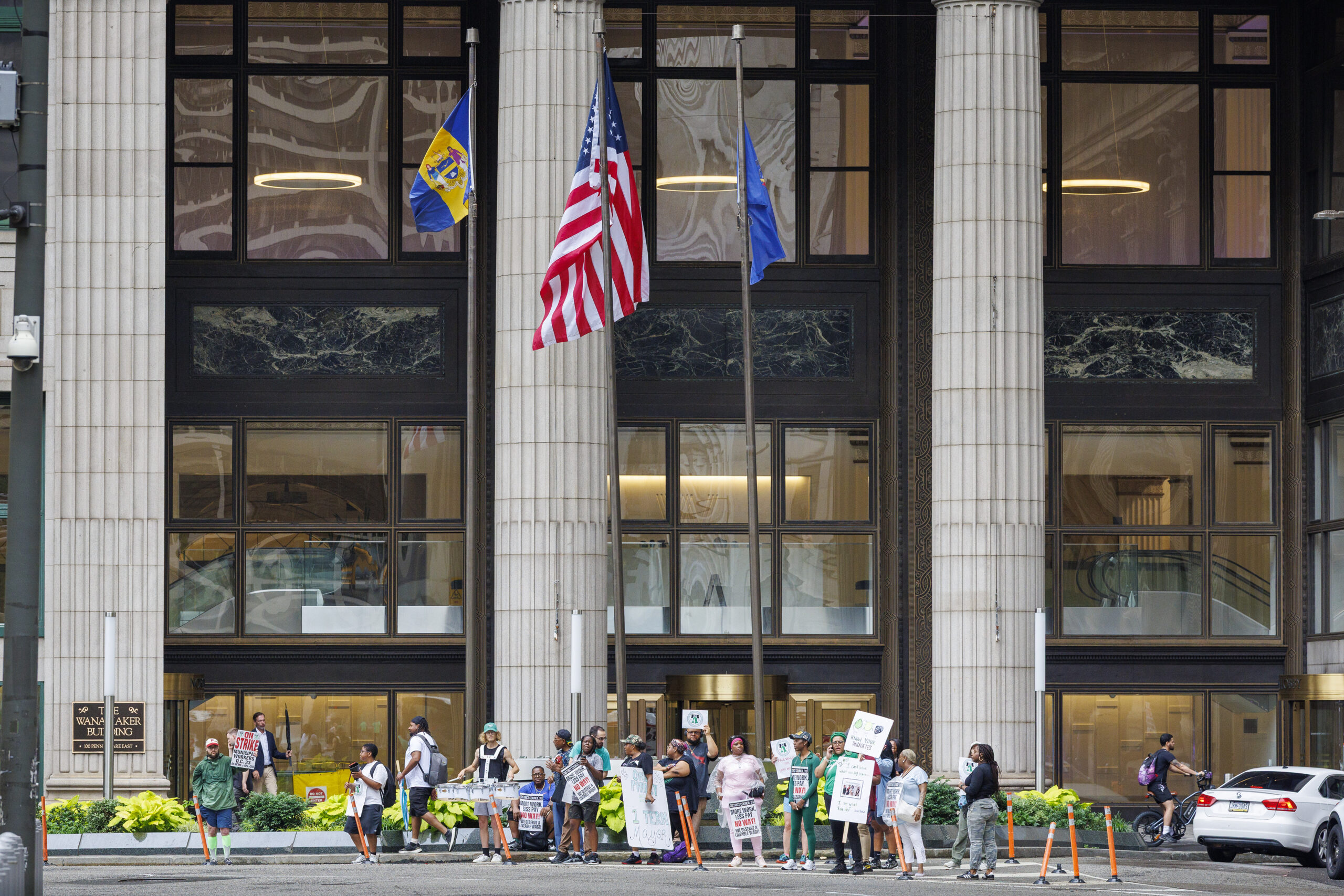
Picketers employed in the District Attorney’s Office picket outside during the AFSCME District Council 33 strike on Wednesday, July 2, 2025. DC 33 already employs some workers in the DAO.
Carlo Simone Jr., the union’s president and business manager, said his local has been seen by some city employees in recent years as “an alternative” to the American Federation of State, County and Municipal Employees District Council 33 and District Council 47.
Those two much larger unions represent thousands of city employees, with DC 33 largely representing blue-collar workers and DC 47 working primarily with white-collar staff.
The prosecutors in Krasner’s office will be represented by DC 47 if their election is successful. But several of the lower-level workers in the District Attorney’s Office had preexisting relationships with USW and said that they thought the steelworkers’ union would be the best fit to represent them.
In December, USW filed a petition with the Pennsylvania Labor Relations Board, asking the state to authorize an election that would lead to them representing the paralegals.
But DC 33 had other plans. In February, DC 33 filed paperwork with the state and argued that the paralegals instead belong in their municipal workers’ union, setting up a power struggle with the steelworkers.
The PLRB agreed with DC 33.
Last month, the board issued a preliminary ruling that said DC 33 is the appropriate union to organize the workers. The board reasoned that, under longstanding precedent, DC 33 is responsible for representing “nonprofessional” employees — or those that don’t require advanced professional education — who are designated as members of the civil service.
The vast majority of city employees are members of the civil service, which is the city’s merit-oriented system for hiring and promotion. It is intended to separate municipal employment from political considerations.
But for decades, most employees in the District Attorney’s Office have been exempt from the designation. Under the Philadelphia Home Rule Charter, employees are civil service unless they are specifically exempted. Assistant district attorneys and some investigators in the DA’s office are exempt, but there is no carve-out for paralegals or victim and witness coordinators.
The lower-level employees who spoke to The Inquirer said they want their jobs to be classified as civil service, because the designation would require job descriptions and afford them protections against arbitrary discipline.
But Krasner’s office last month filed paperwork opposing the PLRB ruling, saying that lower-level workers in his office have not been designated as civil service for decades and that the labor board doesn’t have the authority to reclassify them.
Krasner called the PLRB’s decision a “rogue finding that was illegal.”
“This is a law enforcement agency. We have to follow the law,” he said. “If there’s going to be civil service, it will be because our workers’ rights are protected because they decide it’s beneficial to them and because legal processes are followed.”
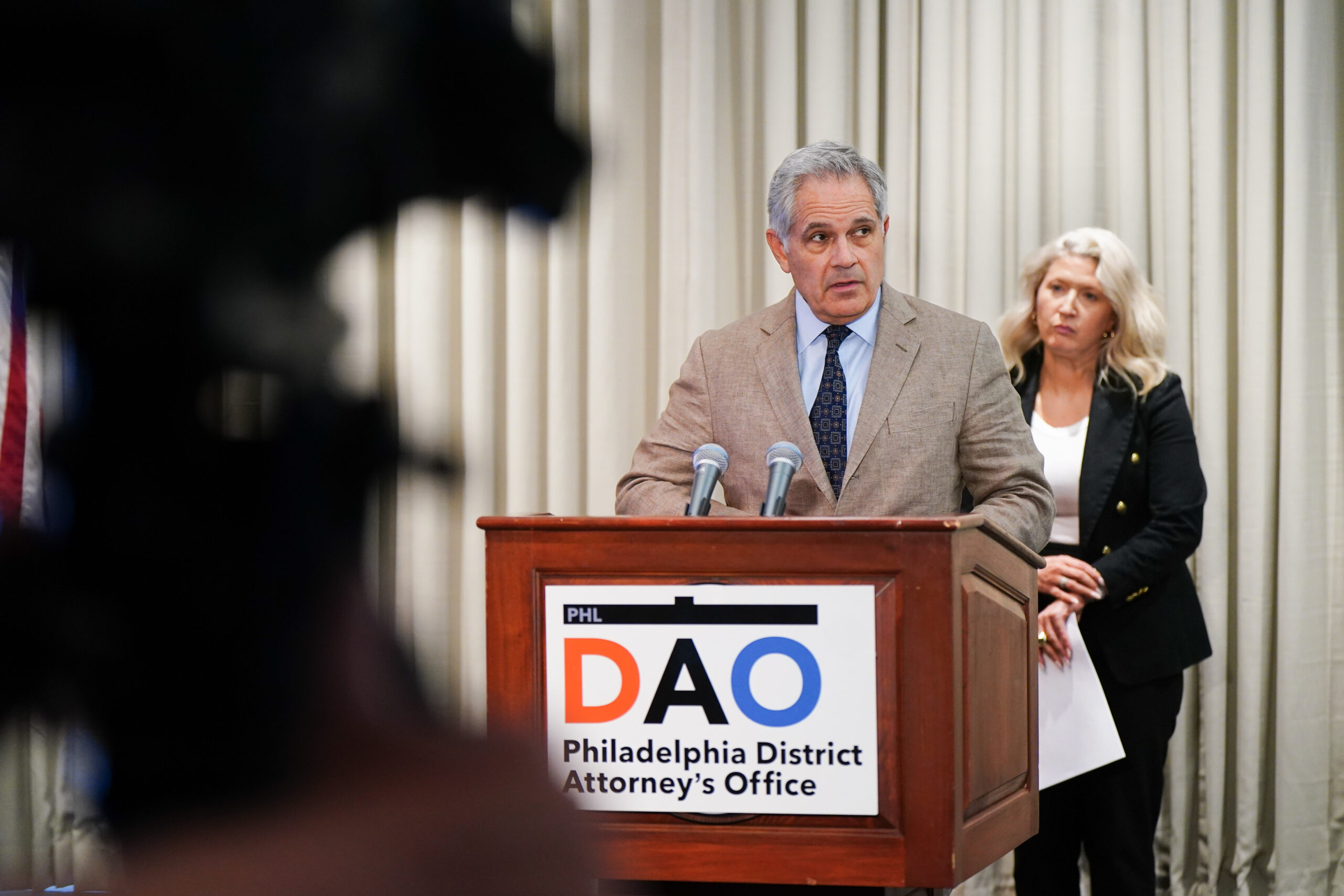
In this November file photo, District Attorney Larry Krasner speaks to reporters during a news conference outside the District Attorney’s Office after he won reelection.
But employees said they saw Krasner’s opposition as a slight.
“He is not pushing for us,“ one employee said, ”and in fact is making this process way longer than it should have been.”
The PLRB has yet to issue a final ruling, and it’s unclear when one may come.A spokesperson declined to comment. DC 33 also declined to comment.
If the PLRB’s ruling stands, paralegals and victim and witness coordinators would be represented by DC 33, and it’s not clear if they’d have the ability to pursue organizing with another union.
Simone, of the steelworkers’ group, said that USW is encouraging employees in the DA’s office to “stay the course,” even if they ultimately join a different union.
“It might not be as soon as they want it,” he said, “but they will be OK.”
Roadwork continues on several major thoroughfares throughout Chester County this week, including Route 30. Elsewhere, other projects will get underway, including a monthslong update to Conestoga Road in East Nantmeal Township that will result in a lane closure.
Here are all the possible delays and detours you need to know, starting July 7:
Birmingham Township: Weather depending, expect roadwork and a closure on Old Wilmington Pike between Knolls and Birmingham Roads through Friday as Peco undertakes tree removal.
Coatesville; Caln, East Fallowfield, and West Bradford Townships; and South Coatesville: Overnight paving work from 7 p.m. to 5 a.m. will cause a lane closure on Hazelwood Avenue between Marshallton Thorndale Road and First Avenue through Friday.
East Nantmeal Township:Fairview Road will be closed between Little Conestoga and Conestoga Roads from 7 a.m. to 5 p.m. through Friday. Starting Wednesday and continuing through July 15, Fairview Road will be closed between Conestoga Road and Pottstown Pike, also from 7 a.m. to 5 p.m. Starting Tuesday, expect a lane closure on Conestoga Road between Nantmeal and Moores Roads that will continue from 7 a.m. to 3 p.m. through the end of September.
East Pikeland Township: Starting Monday and running through July 24, Spring Hollow Road will be closed between Route 724 and Spring Lane.
Franklin Township: Roadwork continues on Church Hill Road near Hilltop Road, resulting in an ongoing lane closure. Work is expected to continue throughout the summer and into the fall as the township undertakes stability repairs and partial roadway reconstruction.
Honey Brook Township: There will be a lane closure on Cambridge Road between Horseshoe Pike and the Lancaster County line from 6 p.m. to 6 a.m. through July 14, followed by milling and paving through July 21.
North Coventry Township: There will be a lane closure as resurfacing of eastbound Route 422 between its interchanges with Route 100 and Armand Hammer continues 9 to 5 a.m. through Thursday.
West Chester: South Church Street will be closed between Price and West Barnard Streets for utility work through Friday. The 200 block of Linden Street and the 600 block of Maple Alley will be closed from 7 a.m. to 3 p.m. through Friday for sewer line work.
West Pikeland Township: The driveway for Pine Creek Park will be repaved on Thursday and Friday, resulting in the park’s temporary closure.
West Sadsbury Township:Route 30 will have an overnight lane closure between Octorara Trail and the Lancaster County line from 7 p.m. to 5 a.m. through Friday.
This roundup will be updated every Tuesday.
This suburban content is produced with support from the Leslie Miller and Richard Worley Foundation and The Lenfest Institute for Journalism. Editorial content is created independently of the project donors. Gifts to support The Inquirer’s high-impact journalism can be made at inquirer.com/donate. A list of Lenfest Institute donors can be found at lenfestinstitute.org/supporters.
A lawsuit filed Tuesday in Washington alleges the Trump administration violated U.S. law by providing Iran’s government with confidential information detailing the asylum applications for Iranians it planned to deport.
The extraordinary claim, outlined in court papers submitted by the Iranian American Legal Defense Fund and Public Citizen Litigation Group, contends that the materials it alleges were shared with the Iranian government could jeopardize the lives of pro-democracy protesters along with members of religious minorities and the LGBTQ community and their families.
An annual State Department report on human rights in Iran, released last year under the Trump administration, called the situation in Iran “severe” and worsening, with political protest movements and religious minorities targeted by authorities. Previous U.S. administrations have reported that Iranian authorities have targeted LGBTQ people for prosecution and subjected them to humiliating treatment.
“The law couldn’t be more clear that information in asylum applications is protected,” said Michael Kirkpatrick, a Public Citizen attorney involved with the complaint. He called the case “potentially a matter of life and death” for Iranian asylum seekers who end up deported back to Iran.
Since returning to office last year, immigration hard-liners in the Trump administration have taken several steps that opponents say has eroded the United States’ established practice of allowing migrants who say they are fleeing persecution to seek asylum in the country. The administration and its allies have argued that the asylum system had become overwhelmed and, in some cases, abused by individuals making dubious claims.
The lawsuit names as defendants Secretary of State Marco Rubio, Homeland Security Secretary Markwayne Mullin, and acting director of U.S. Immigration and Customs Enforcement (ICE) David Venturella, along with the agency each leads.
Spokespeople for the three agencies did not provide comment. The Iranian Mission to the United Nations did not respond to a request for comment.
The lawsuit seeks an end to the alleged practice and to require that the U.S. government notify anyone whose personal information was shared with the Iranian government without their consent. It is not immediately clear how the government might respond or whether the case would succeed.
Despite long-running tensions between the U.S. and Iranian governments, which escalated into all-out warfare in February, the Trump administration has deported more than 100 Iranians back to the country since President Donald Trump’s return to office in 2025, according to advocate groups that track deportations and reports in the Iranian news media.
Iranian officials said last year that they had reached an agreement with the Trump administration to accept approximately 400 Iranian deportees. More recently, the administration included at least one Iranian national among a group of people deported from the United States to the Central African Republic, lawyers for the group have said.
The lawsuit filed Tuesday in U.S. District Court in D.C. includes accounts of alleged secret meetings between officials from the Trump administration and representatives of the Iranian government dating to March 2025.
Because the United States does not have diplomatic relations with Iran, the government in Tehran is represented in Washington by the Iranian Interests Section at the Embassy of Pakistan.
Kirkpatrick told the Washington Post that the allegations contained in the lawsuit are based, in part, on the account of an Iranian government official who is assigned to the Pakistani Embassy and accounts from deportees who have said that Iranian officials knew details from their applications seeking asylum in the United States.
The lawsuit does not identify the Iranian government officials or the deportees to whom attorneys spoke. The Pakistani Embassy did not respond to a request for comment.
At the initial meeting in March 2025, the lawsuit alleges, State Department officials met with representatives of the Iranian Interests Section in Washington. The lawsuit alleges that the discussion encompassed the Trump administration’s desire to deport Iranians to Iran, with the administration officials handing over a list of roughly 150 names. The lawsuit does not identify by name any of the meeting’s participants.
After this encounter, the lawsuit alleges, it was agreed that officials from ICE and the Iranian government representatives would hold monthly meetings so that the administration could share information about Iranians in U.S. custody.
ICE falls under the Department of Homeland Security, which at that time was led by Kristi L. Noem. Mullin took over as secretary in March after Trump removed Noem from the post. Noem now serves as the special envoy to the Shield of the Americas, a State Department position. The State Department did not respond when asked if she wanted to comment.
The lawsuit also alleges that while in-person meetings between ICE officials and Iranian officials were halted after Feb. 28, when the U.S. and Israel started the war with Iran, ICE officials continued to send documentation to the Iranians.
Roughly 115 Iranian nationals are believed to have been sent back to Iran on three U.S. deportation flights, according to advocacy organizations that track the deportations. The most recent is said to have occurred Jan. 26, only weeks after anti-government protests there were met with a severe response that is estimated to have left thousands dead.
Trump had earlier this year expressed sympathy with the protesters, telling them on Jan. 13 that “help is on the way.”
It is not clear how many of those deported back to Iran had asylum claims pending before the U.S. government. Lawyers for some of the deported Iranians have said that people from at-risk groups were among those deported on the flights.
Over the last decade, I’ve grown used to waking up before dawn and writing about a soul-crushing defeat from the night before. Usually it’s on a Wednesday, but somehow Donald Trump is always involved. Monday’s 4-1 demolition of the U.S. men’s national soccer team by Belgium pretty much confirmed that I won’t live to see Americans win the World Cup in my lifetime, so it’s time for acceptance. But these last three weeks have been a blast, and the party isn’t over. Sometimes the tritest words are also the truest: Maybe the real World Cup was the friends we made along the way.
Future generations will remember America’s 250th for its state of denial
Visitors experiencing excessive heat sit on the ground at the National Mall in Washington during Independence Day events honoring the nation’s 250th anniversary on Saturday.
The long-awaited arrival of the 250th birthday of the United States inspired a lot of talk about everything that’s changed since July 4, 1776, especially as “the man on a hobby horse” sinks to the founders’ worst fears about democracy and demagoguery.
But historians of the future may dwell on another huge difference between the day the ink started drying on the American Declaration of Independence and July 4, 2026.
Thomas Jefferson — his work as chief author of the nation’s founding document wrapped up — bought a new thermometer that morning and recorded the temperature in Philadelphia three times in his diaries that day, including a temperate 1 p.m. reading of 76 degrees.
Jefferson’s thermometer might not have been up to the task of keeping up with Philadelphia’s climate 250 years later. On Saturday’s Semiquincentennial, temperatures maxed out at 101 degrees — the third straight day that the mercury reached that mark, which had never happened since records began in 1870. But with the fetid, humid air, it felt more like 110 degrees for anyone brave enough to celebrate America’s birthday outside.
Philly should have seen this train coming. I mean, literally. Two days earlier, officials just outside of Reading, nearly two hours northwest of America’s founding city, plowed ahead with a welcoming party for Union Pacific’s Big Boy No. 4014, the world’s largest operating steam locomotive — even as the railway relic ran an hour late, with some thermometers posting 106 degrees.
The result was what local officials called “a mass casualty event” — no one died, but rescue teams were summoned from neighboring counties to help revive more than 100 people suffering from heat exhaustion, in desperate need of water or an IV. Some 35 of the would-be train spotters were rushed to the hospital.
“It was a little bit chaotic,” an EMS director told the local TV station in Reading. “I don’t think anyone anticipated the weather or the volume of crowds.”
The scientific group World Weather Attribution, which tracks the impact of human-made global warming, said last week’s heat dome over the Eastern Seaboard was indeed a rare event, yet — without the contribution of burning fossil fuels to a warming planet — it “would have been so extreme as to be virtually impossible.”
Heat waves aren’t new. I was just 7 but still remember the July Fourth week of 1966 — exactly six decades ago — when it also topped 100 degrees. It’s one of the few things I remember from that grade-school time because it was so incredibly rare. Today, “once-in-a-century” heat waves are routine all over the planet. In June and looming again this week, Western Europe — where few homes are air-conditioned — has sweltered under temperatures that climate scientists weren’t expecting until around 2050.
This suffocating July Fourth could have been — to steal a phrase from the multiplex marquee — America’s “disclosure day,” exposing the truth of a threat to humankind that’s been hiding in plain sight. Instead, it was our “denial day,” led by our planet’s denier-in-chief, Donald Trump, whose 250th birthday card to America only read: “Don’t look up.”
The denial was immediate, as the president insisted — ignoring the experts who warned that the triple-digit temperatures and intense, gathering thunderstorms might spark a much bigger “mass casualty event” in Washington, D.C. — on going ahead with his bombastic and self-serving speech and a fireworks show that lasted well into the early morning hours of July 5.
Our modern-day seersucker-wearing mayor of Jaws might as well have told the broiled holiday weekend throng, “But, as you see, it’s a beautiful day, the beaches are open, and people are having a wonderful time” — as ominous John Williams music swelled in the background.
The denial was also metaphorical to the max — and not just when those predicted storms arrived and panicked MAGA Trump supporters were forced to take refuge at the National Museum of African American History and Culture, the history and culture their movement is so eager to erase.
In New York Harbor, U.S. Coast Guard vessels forced the storied environmental sloop Clearwater — which took part in the historic Bicentennial tall ships parade back in 1976 — to leave the July 4 Parade of Ships because of two anodyne political banners taped to its sails: “Save the Clean Water Act” and “Indigenous Rights, Racial Justice, Climate Solutions.” Don’t look up, not even at a tall ship.
Hours later, during the fireworks show, the Brooklyn Bridge caught fire, which had nothing to do with climate change, yet felt like a coded message from the overheated planet nonetheless.
But maybe we shouldn’t wade too deeply into the metaphors when the worst denial is the all-too-real policy stuff. Every day, some nightmare headline about killer floods or disappearing glaciers is met with some nonsensical action from the U.S. government based on Earth 2, where none of this is happening.
As the climate-change-intensified heat dome settled in over the Eastern United States, Trump issued pardons for nine people — and you really can’t make this stuff up — who’d been convicted of felony violations of the Clean Air Act by selling or installing devices for diesel trucks that defeated their emissions controls, because polluting our spacious skies is no longer a crime in Trump’s America.
America continues to get a whopping 82% of its energy from polluting fossil fuels, and that’s unlikely to drop over the next 30 months, regardless of how many Trump voters can cheat death on looming “mass casualty events.” But POTUS 47 warned voters he planned to set the world on fire if he returned to the White House.
What’s harder to understand, frankly, is why the people who should be fighting Trump on climate change are running away from the front lines. Yes, I’m talking about Democratic Party leaders who’ve tossed climate action down the memory hole in the 2026 campaign — either terrified that any mention of climate will undercut their single-minded focus on affordability, or distract from fighting Trump’s brand of autocracy.
And ditto for newsroom leaders who seem to have decided that environmental journalists are the first people to lay off, not to mention the other world chieftains who ought to be challenging Trump’s destructive policies, but are meeting the moment with a shrug. Even Canada’s center-left prime minister, Mark Carney, is now backing away from the aggressive climate action he once supported, claiming, “It’s too expensive.”
That’s a lot of malarkey, as the president who just four years ago passed the largest climate action bill in U.S. history might say. Clean energy continues to rise elsewhere in the world because the alternatives, like wind and solar, are ultimately cheaper and also a source of desperately needed job creation. The fossil-fuel-boosted heat wave of July 4, 2026, proved that inaction is a threat not only to our lives and our liberty but also to the pursuit of happiness. It’s hard to celebrate 250 years of American democracy when climate denial is exposing that system as so badly broken.
Yo, do this!
Did I mention the World Cup isn’t over? If you are a true fan of the Beautiful Game, you’ll brush off the quadrennial disappointment of the U.S. men’s team and get excited to watch one of the greatest generations of international soccer superstars we’ve ever seen. One of the more intriguing of the four quarterfinal matchups this weekend will occur when Harry Kane and his English squad face Erling Haaland and his Norwegian upstarts in the Miami heat. The match kicks off at 5 p.m. Saturday on Fox.
The new movie scene for the July Fourth holiday was a disappointment, so the heat wave was a perfect opportunity for revisiting the classics of the 1970s and ’80s with the generation that had not been born yet. We went back to the late Rob Reiner’s first great serious film, the coming-of-age saga Stand By Me. It’s hard not to feel nostalgia today for a time when 12-year-olds had to entertain themselves without iPhones and could disappear into the woods overnight, which felt less strange in 1986 when the movie was first released. It felt truly like a faint signal from a lost planet.
Ask me anything
Question: Talk about Mitch McConnell’s demise. — Wendy (@wensilver.bsky.social) via Bluesky
Answer: Well, Wendy, that’s not exactly a question, and while the New York Times is reporting that the Kentucky senator and former majority leader was unconscious and in cardiac arrest when paramedics found him on June 14, his staff insists McConnell is still alive. That hasn’t stopped conspiracy theories that McConnell is on life support until August, when his replacement, named by GOP lawmakers, could avoid a messy November election. I don’t know about that, and I agree that it’s very poor form to speak ill of the dead. So the fact that he’s still alive is an ideal moment to remind everyone that his hijacking of the U.S. Supreme Court and his cowardice during Donald Trump’s second impeachment both started America on the path toward tyranny. So get well soon, senator. You still have a lot to answer for.
What you’re saying about …
Last week’s question about whether you are happy or concerned about progressive Democrats doing well in the 2026 primaries brought a mix of interesting responses that aren’t easy to categorize. Most of you want Dems who will fight harder than the current crew. “I have been voting since 1968, always for Democrats, but seldom with enthusiasm,” wrote Stephen Boone. “Finally, in my old age, there are a few decent politicians. I want more AOCs! More Zohran Mamdanis! …” Others felt more cautious. Wrote Thomas Desmond: “I think the progressive candidates are fine in deep blue seats, but may not be a great idea in purple or light-red seats that could prove winnable this year.”
📮 This week’s question: It may be water under the bridge next week, but Donald Trump’s personal role in overturning the arguably wrongly given red card to U.S. star Folarin Balogun has sparked a heated debate. Was the red card an injustice to be reversed by any means necessary? Or did Trump’s involvement ruin the World Cup? Please email me your answer and put the exact phrase “Trump Balogun” in the subject line.
Backstory on Trump ruining the World Cup like everything else
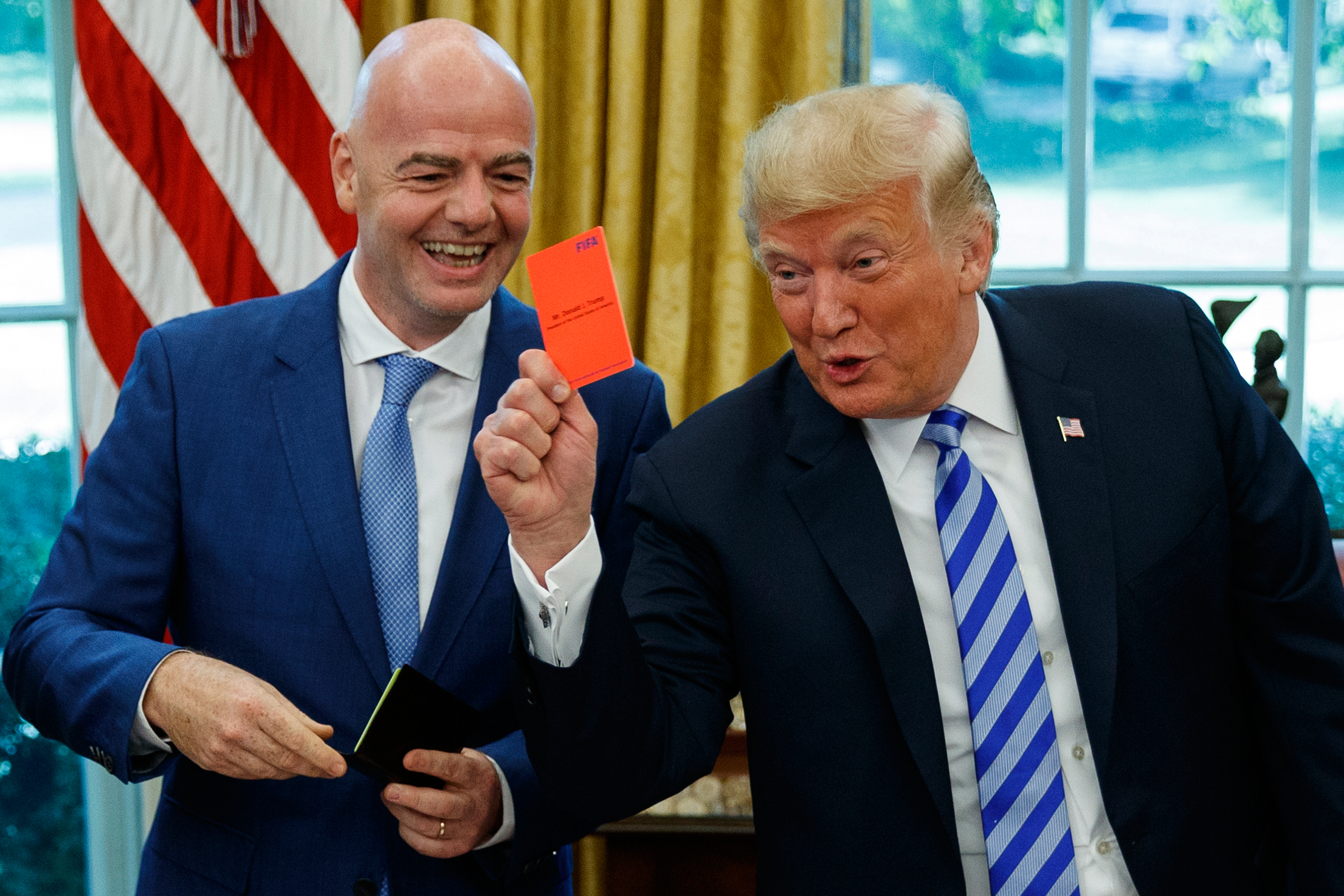
President Donald Trump holds up a red card during a meeting with FIFA president Gianni Infantino in the Oval Office of the White House in August 2018.
If the big-screen tragedy of the U.S. men’s soccer team’s same-as-it-ever-was Round of 16 exit from the 2026 World Cup on Monday night had a theme song, it should have been John Lennon’s “Instant Karma.” For its first four (mostly) exhilarating matches, the USMNT gave a nation that was desperate for both an escape from relentless bad news — but also a connection to a wider world — the good vibes it desired. It truly felt like the Americans could go further than ever before (in modern times) in the planet’s greatest sporting event. TV ratings soared. Watch parties were packed. A broken land was coming together.
To longtime soccer fans, the red card handed out last Wednesday to the U.S.’s top goal scorer, Folarin Balogun, for stepping (seemingly unintentionally) on the ankle of a Bosnian player during a 2-0 victory — a harsh punishment that meant not only his ejection from the pitch but a suspension for the upcoming Belgium match — was the essence of our love/hate relationship with soccer. It may be a beautiful game, but it’s the ugly calls that we debate for decades. For a non-soccer fan and malignant narcissist like Trump, for whom anything that goes against his desired outcome is proof of the world’s unfairness toward him, the looming loss of America’s star striker was an opportunity to act like the strutting strongman of a personalist dictatorship.
There were too many ironies to bear — especially the fact that Trump had just gone all the way to the U.S. Supreme Court to fight to strip U.S. citizenship from people like Balogun, who was born to British-Nigerian parents in 2001 during an American visit, and millions of other immigrants who aren’t as talented with their feet. But the other irony was that — like so many corrupt schemes, whether from the mafia or the Trump White House — the president’s soccer coup failed. It felt like Trump had attacked the positive zeitgeist around U.S. men’s soccer with a neutron bomb. Balogun rarely even touched the ball. We’ll never know how much of Belgium’s 4-1 rout of the mistake-prone U.S. was simply a European powerhouse outclassing the Americans, as has happened so many times before, and how much was Trump destroying the juju.
It did seem fitting that this sordid affair played out over the weekend of America’s 250th birthday, as it was more confirmation that Trump, in spite of what the hat says, actually has no clue what makes America great. If any one principle stood out from the founders’ 1776 and 1787 experiments, it is that the United States was to be based on fairness and following the rules, with no king imposing his will. The single greatest thing about America’s presidential elections was not who won, but the fact that the loser accepted the results, and there was a peaceful transfer of power — until Jan. 6, 2021. Likewise, nothing could ruin the often unbridled joy of the World Cup faster than a rigged competition.
I’m still looking forward to the next 12 days, to watching the pinpoint passing of Argentina’s Lionel Messi or the raw power of Norway’s Erling Haaland, and to seeing who can actually win the World Cup on the pitch, and not in a back room. We already know the tournament’s biggest loser: Donald Trump.
What I wrote on this date in 2014
Looking back on this Attytood blog post from 12 years ago today is a reminder of how debates can evolve over time. My short piece on July 7, 2014, was a riff on an op-ed that called newspapers’ online comment sections in those early internet years “a hate crime” that should be cordoned off because of the vitriol spewed at immigrants or others outside the traditional American hierarchies. Back then, I disagreed, taking the side of free speech absolutism. “These are people who shouldn’t be censored … just set straight,” I argued. “The one true powerful weapon against offensive free speech … is your free speech, and mine.” Time proved me wrong: The Inquirer now avoids comments on most articles, including my columns. It turned out that “the wisdom of the crowd” that newsroom reformers once hailed was fatally infected with racism, sexism, and other forms of hate.
Only one column last week, as I enjoyed the July Fourth holiday by spending time with family and watching countless hours of soccer. In that piece, I wrote about an American 250th birthday that should have been a meditation on what makes our nation great, and where we so desperately need to improve — but which Donald Trump used as an excuse to rob the cash register when no one was looking. The president’s staggering $2.2 billion-plus payday during his first full year back in office — accomplished with a mix of crypto flimflammery, informed stock trading, and dealings with foreign dictators — is a five-alarm fire for the rule of law.
One final thought about the 250th birthday of the United States as the moment recedes into the rearview mirror. It’s true that 2026 has been a lousy year, economically, for newsrooms, but you would never know that from reading The Inquirer’s remarkable coverage of such an eventful time. I’ve already praised our world-class World Cup coverage, but our overworked staff also went out and covered a July Fourth party that happened despite killer heat, biblical storms, and a plague of locusts (not really, but it felt that way). This included some real accountability journalism, such as the Trump regime’s efforts to twist the truth around George Washington and slavery, as well as questioning the cost of the big day for city taxpayers. It was also a reminder that Philadelphia has been a hotbed for journalism and the rugged practice of bringing the First Amendment to life since the early days of the republic. Help keep it going another 250 years by subscribing to The Inquirer.
By submitting your written, visual, and/or audio contributions, you agree to The Inquirer’s Terms of Use, including the grant of rights in Section 10.