Blog

  • U.S. warns Iran that ‘all options are on the table’ in emergency U.N. meeting

    U.S. warns Iran that ‘all options are on the table’ in emergency U.N. meeting

    UNITED NATIONS — After weeks of escalating tension, U.S. and Iranian officials faced one another Thursday at the U.N. Security Council, where America’s envoy renewed threats against the Islamic Republic despite President Donald Trump’s efforts to lower the temperature between the two adversaries.

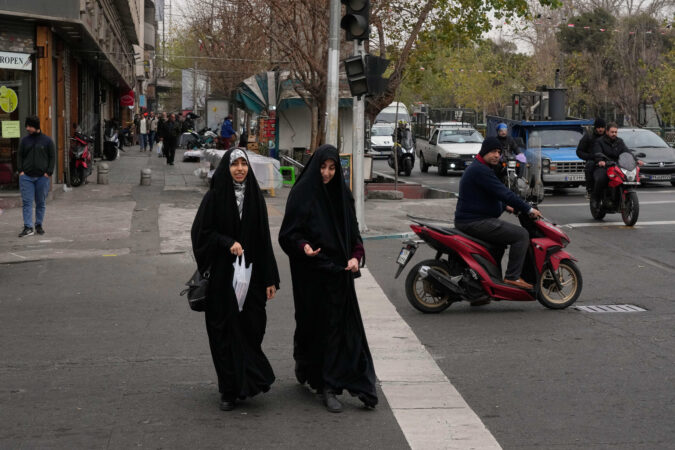
    The U.S. was joined by Iranian dissidents in rebuking the government’s bloody crackdown on nationwide protests that activists say have killed at least 2,677 people.

    “Colleagues, let me be clear: President Trump is a man of action, not endless talk like we see at the United Nations,” Mike Waltz, U.S. ambassador to the U.N., told the council. “He has made it clear that all options are on the table to stop the slaughter. And no one should know that better than the leadership of the Iranian regime.”

    Waltz’s remarks came as the prospect of U.S. retaliation for the protesters’ deaths still hung over the region, although Trump signaled a possible de-escalation, saying the killing appeared to be ending. By Thursday, the protests challenging Iran’s theocracy appeared increasingly smothered, but the state-ordered internet and communication blackout remained.

    One diplomat told the Associated Press that top officials from Egypt, Oman, Saudi Arabia, and Qatar spent the last 48 hours raising concerns with Trump that a U.S. military intervention would shake the global economy and destabilize an already volatile region.

    During the meeting, Hossein Darzi, the deputy Iranian ambassador to the U.N., blasted the U.S. for what he claimed was America’s “direct involvement in steering unrest in Iran to violence.”

    “Under the hollow pretext of concern for the Iranian people and claims of support for human rights, the United States is attempting to portray itself as a friend of the Iranian people, while simultaneously laying the groundwork for political destabilization and military intervention under a so-called ′humanitarian′ narrative,” Darzi said.

    The U.S. requested the emergency Security Council meeting and invited two Iranian dissidents, Masih Alinejad and Ahmad Batebi, to describe their experience as targets of the Islamic Republic.

    In a stunning moment, Alinejad addressed the Iranian representative directly.

    “You have tried to kill me three times. I have seen my would-be assassin with my own eyes in front of my garden, in my home in Brooklyn,” she said while the Iranian official looked directly ahead, without acknowledging her.

    In October, two purported Russian mobsters were each sentenced to 25 years behind bars for hiring a hit man to kill Alinejad at her New York home three years ago on behalf of the Iranian government.

    Batebi described the deep cuts the prison guards in Iran would inflict on him before pouring salt on his wounds. “If you do not believe me, I can show you my body right now,” he told the council.

    Both dissidents called on the world body and the council to do more to hold Iran accountable for its human rights abuses. Batebi pleaded with Trump not to “leave” the Iranian people alone.

    “You encouraged people to go into the streets. That was a good thing. But don’t leave them alone,” he said.

    Russia was the only member of the council that defended Iran’s actions while calling for the U.S. to stop intervening.

    Protests appear smothered as death toll rises

    Videos of demonstrations have stopped coming out of Iran, likely signaling the slowdown of their pace under the heavy security force presence in major cities.

    In Iran’s capital, Tehran, witnesses said recent mornings showed no new signs of bonfires lit the night before or debris in the streets. The sound of gunfire, which had been intense for several nights, has also faded.

    The clampdown on the demonstrations has killed at least 2,677 people, according to the U.S.-based Human Rights Activists News Agency. The figure reported Thursday is an increase of 106 from a day earlier, and the organization says the number will likely continue to climb. The death toll exceeds that of any other round of protest or unrest in Iran in decades and recalls the chaos surrounding the country’s 1979 Islamic Revolution.

    The U.S.-based agency, founded 20 years ago, has been accurate throughout multiple years of demonstrations, relying on a network of activists inside Iran that confirms all reported fatalities.

    With communications greatly limited in Iran, the AP has been unable to independently confirm the group’s toll. The Iranian government has not provided casualty figures.

    New sanctions on senior Iranians

    In other developments Thursday, the U.S. announced new sanctions on Iranian officials accused of suppressing the protests, which began late last month over the country’s faltering economy and the collapse of its currency. The Group of Seven industrialized democracies and the European Union also said they too were looking at new sanctions to ratchet up the pressure on Iran’s theocratic government.

    Among those hit with U.S. sanctions was the secretary of Iran’s Supreme Council for National Security, whom the Treasury Department accuses of being one of the first officials to call for violence against protesters. The Group of Seven, of which the U.S. is a member, also warned they could impose more sanctions if Iran’s crackdown continues.

    European Union chief Ursula von der Leyen said the 27-nation bloc was looking at strengthening sanctions “to push forward that this regime comes to an end and that there is change.

  • European troops arrive in Greenland as talks with U.S. highlight ‘disagreement’ over island’s future

    European troops arrive in Greenland as talks with U.S. highlight ‘disagreement’ over island’s future

    NUUK, Greenland — Troops from several European countries continued to arrive in Greenland on Thursday in a show of support for Denmark as talks among representatives of Denmark, Greenland and the U.S. highlighted “fundamental disagreement” over the future of the Arctic island.

    The disagreement came into starker focus Thursday, with the White House describing plans for more talks with officials from Denmark and Greenland as “technical talks on the acquisition agreement” for the U.S. to acquire Greenland.

    That was a far cry from the way Danish Foreign Minister Lars Løkke Rasmussen described it as a working group that would discuss ways to work through differences between the nations.

    “The group, in our view, should focus on how to address the American security concerns, while at the same time respecting the red lines of the Kingdom of Denmark,” he said Wednesday after the meeting.

    Before the talks began Wednesday, Denmark announced it would increase its military presence in Greenland. Several European partners — including France, Germany, the U.K., Norway, Sweden, and the Netherlands — started to send symbolic numbers of troops or promised to do so in the following days.

    The troop movements were intended to portray unity among Europeans and send a signal to President Donald Trump that an American takeover of Greenland is not necessary as NATO together can safeguard the security of the Arctic region amid rising Russian and Chinese interest.

    The European troops did little to dissuade Trump.

    White House press secretary Karoline Leavitt said Thursday that it had no impact on the president’s decision-making or goal of acquiring Greenland.

    “The president has made his priority quite clear, that he wants the United States to acquire Greenland. He thinks it’s in our best national security to do that,” she said.

    Rasmussen, flanked by his Greenlandic counterpart Vivian Motzfeldt, said Wednesday that a “fundamental disagreement” over Greenland remained after they met at the White House with Vice President JD Vance and Secretary of State Marco Rubio.

    Rasmussen said it remains “clear that the president has this wish of conquering over Greenland” but dialogue with the U.S. would continue at a high level over the following weeks.

    Meanwhile, French President Emmanuel Macron announced Wednesday that “the first French military elements are already en route” and “others will follow,” as French authorities said about 15 soldiers from the mountain infantry unit were already in Nuuk for a military exercise.

    Germany will deploy a reconnaissance team of 13 personnel to Greenland on Thursday, the Defense Ministry said.

    On Thursday, Danish Defense Minister Troels Lund Poulsen said the intention was “to establish a more permanent military presence with a larger Danish contribution,” according to Danish broadcaster DR. He said soldiers from several NATO countries will be in Greenland on a rotation system.

    ‘Greenland does not want to be part of the United States’

    Inhabitants of Greenland and Denmark reacted with anxiety but also some relief that negotiations with the U.S. would go on and European support was becoming visible.

    Greenland’s Prime Minister Jens-Frederik Nielsen welcomed the continuation of “dialogue and diplomacy.”

    “Greenland is not for sale,” he said Thursday. “Greenland does not want to be owned by the United States. Greenland does not want to be governed from the United States. Greenland does not want to be part of the United States.”

    In Greenland’s capital, Nuuk, local residents told The Associated Press they were glad the first meeting between Greenlandic, Danish, and American officials had taken place but suggested it left more questions than answers.

    Several people said they viewed Denmark’s decision to send more troops, and promises of support from other NATO allies, as protection against possible U.S. military action. But European military officials have not suggested the goal is to deter a U.S. move against the island.

    Maya Martinsen, 21, said it was “comforting to know that the Nordic countries are sending reinforcements” because Greenland is a part of Denmark and NATO.

    The dispute, she said, is not about “national security” but rather about “the oils and minerals that we have that are untouched.”

    More troops, more talks

    On Wednesday, Poulsen announced a stepped-up military presence in the Arctic “in close cooperation with our allies,” calling it a necessity in a security environment in which “no one can predict what will happen tomorrow.”

    “This means that from today and in the coming time there will be an increased military presence in and around Greenland of aircraft, ships and soldiers, including from other NATO allies,” Poulsen said.

    Denmark informed NATO that it will be conducting exercises in Greenland, and the alliance’s Supreme Allied Commander Alexus Grynkewich spoke Thursday with Denmark’s chief of defense, Col. Martin O’Donnell, a spokesperson for Grynkewich told the AP.

    He said such dialogue is typical and added that “we all agree the Arctic – including Greenland – is important for transatlantic security.”

    The Danish exercises and deployment of additional troops “bolster our collective defenses there,” O’Donnell said.

    The Russian embassy in Brussels on Thursday lambasted what it called the West’s “bellicose plans” in response to “phantom threats that they generate themselves”. It said the planned military actions were part of an “anti-Russian and anti-Chinese agenda” by NATO.

    “Russia has consistently maintained that the Arctic should remain a territory of peace, dialogue and equal cooperation,” the embassy said.

    Some diplomatic progress

    Commenting on the outcome of the Washington meeting on Thursday, Poulsen said the working group was “better than no working group” and “a step in the right direction.” He added nevertheless that the dialogue with the U.S. did not mean “the danger has passed.”

    The most important thing for Greenlanders is that they were directly represented at the meeting in the White House and that “the diplomatic dialogue has begun now,” Juno Berthelsen, a lawmaker for the pro-independence Naleraq opposition party, told AP.

    A relationship with the U.S. is beneficial for Greenlanders and Americans and is “vital to the security and stability of the Arctic and the Western Alliance,” Berthelsen said. He suggested the U.S. could be involved in the creation of a coast guard for Greenland, providing funding and creating jobs for local people who can help to patrol the Arctic.

    In Washington, Rasmussen and Motzfeldt also met with a bipartisan group of senators at the U.S. Capitol.

    “We really appreciate that we have close friends in the Senate and the House as well,” Rasmussen told reporters, adding that Denmark would work to “accommodate any reasonable American requests” with Greenland.

    There has been significant concern among lawmakers of both political parties that Trump could upend the NATO alliance by insisting on using military force to possess Greenland. Key Republicans lawmakers have pushed back on those plans and suggested that the Trump administration should work with Denmark to enhance mutual security in the Arctic.

    Line McGee, 38, from Copenhagen, told AP that she was glad to see some diplomatic progress. “I don’t think the threat has gone away,” she said. “But I feel slightly better than I did yesterday.”

    Trump, in his Oval Office meeting with reporters, said: “We’ll see how it all works out. I think something will work out.”

  • Prosecutor urges manslaughter verdict for guard who ‘did nothing’ as fellow officers killed inmate

    Prosecutor urges manslaughter verdict for guard who ‘did nothing’ as fellow officers killed inmate

    UTICA, N.Y. — A New York prison guard who failed to intervene as he watched an inmate being beaten to death should be convicted of manslaughter, a prosecutor told a jury Thursday in the final trial of correctional officers whose pummeling, recorded by body-cameras, provoked outrage.

    “For seven minutes — seven gut-churning, nauseating, disgusting minutes — he stood in that room close enough to touch him and he did nothing,” special prosecutor William Fitzpatrick told jurors during closing arguments. The jury began deliberating Thursday afternoon.

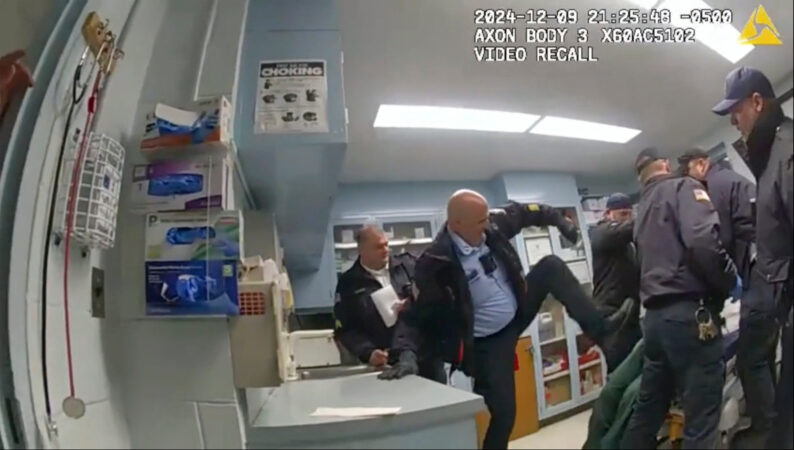
    Former corrections officer Michael Fisher, 55, is charged with second-degree manslaughter in the death of Robert Brooks, who was beaten by guards upon his arrival at Marcy Correctional Facility on the night of Dec. 9, 2024, his agony recorded silently on the guards’ body cameras.

    Fisher’s attorney, Scott Iseman, said his client entered the infirmary after the beating began and could not have known the extent of his injuries.

    Fisher was among 10 guards indicted in February. Three more agreed to plead guilty to reduced charges in return for cooperating with prosecutors. Of the 10 officers indicted in February, six pleaded guilty to manslaughter or lesser charges. Four rejected plea deals. One was convicted of murder, and two were acquitted in the first trial last fall.

    Fisher, standing alone, is the last of the guards to face a jury.

    The trial closes a chapter in a high-profile case led to reforms in New York’s prisons. But advocates say the prisons remain plagued by understaffing and other problems, especially since a wildcat strike by guards last year.

    Officials took action amid outrage over the images of the guards beating the 43-year-old Black man in the prison’s infirmary. Officers could be seen striking Brooks in the chest with a shoe, lifting him by the neck and dropping him.

    Video shown to the jury during closing arguments Thursday indicates Fisher stood by the doorway and didn’t intervene.

    “Did Michael Fisher recklessly cause the death of Robert Brooks? Of course he did. Not by himself. He had plenty of other helpers,” said Fitzpatrick, the Onondaga County district attorney.

    Iseman asked jurors looking at the footage to consider what Fisher could have known at the time “without the benefit of 2020 hindsight.”

    “Michael Fisher did not have a rewind button. He did not have the ability to enhance. He did not have the ability to pause. He did not have the ability to get a different perspective of what was happening in the room,” Iseman said.

    Even before Brooks’ death, critics claimed the prison system was beset by problems that included brutality, overworked staff and inconsistent services. By the time criminal indictments were unsealed in February, the system was reeling from an illegal three-week wildcat strike by corrections officers who were upset over working conditions. Gov. Kathy Hochul deployed National Guard troops to maintain operations. More than 2,000 guards were fired.

    Prison deaths during the strike included Messiah Nantwi on March 1 at Mid-State Correctional Facility, which is across the road from the Marcy prison. 10 other guards were indicted in Nantwi’s death in April, including two charged with murder.

    There are still about 3,000 National Guard members serving the state prison system, according to state officials.

    “The absence of staff in critical positions is affecting literally every aspect of prison operations. And I think the experience for incarcerated people is neglect,” Jennifer Scaife, executive director of the Correctional Association of New York, an independent monitoring group, said on the eve of Fisher’s trial.

    Hochul last month announced a broad reform agreement with lawmakers that includes a requirement that cameras be installed in all facilities and that video recordings related to deaths behind bars be promptly released to state investigators.

    The state also lowered the hiring age for correction officers from 21 to 18 years of age.

  • Venezuela’s Machado says she presented her Nobel Peace Prize to Trump during their meeting

    Venezuela’s Machado says she presented her Nobel Peace Prize to Trump during their meeting

    WASHINGTON — Venezuelan opposition leader María Corina Machado said she presented her Nobel Peace Prize medal to President Donald Trump on Thursday, “as a recognition for his unique commitment with our freedom.”

    Machado detailed having given her prize to Trump in comments to a group of reporters after the meeting, but did not provide further details. The White House did not immediately say if Trump accepted the medal.

    That followed her having met with Trump to discuss her country’s future, even though he has dismissed her credibility to take over after an audacious U.S. military raid that captured then-President Nicolás Maduro.

    Visiting Trump presented something of a physical risk for Machado, whose whereabouts have been largely unknown since she left her country last year after being briefly detained in Caracas. Nevertheless, after a closed-door discussion with Trump, she greeted dozens of cheering supporters waiting for her near the gates —stopping to hug many.

    “We can count on President Trump,” she told them, prompting some to briefly chant “Thank you, Trump,” but she didn’t elaborate.

    The jubilant scene stood in contrast to Trump having repeatedly raised doubts about Machado and his stated commitment to backing democratic rule in Venezuela. He has signaled his willingness to work with acting President Delcy Rodríguez, who was Maduro’s No. 2.

    Along with others in the deposed leader’s inner circle, Rodríguez remains in charge of day-to-day government operations and was delivering her first state of the union speech during Machado’s Washington trip.

    In endorsing Rodríguez so far, Trump sidelined Machado, who has long been a face of resistance in Venezuela. That’s despite Machado seeking to cultivate relationships with the president and key administration voices like Secretary of State Marco Rubio, in a gamble to ally herself with the U.S. government and some of its top conservatives.

    White House press secretary Karoline Leavitt called Machado “a remarkable and brave voice” for the people of Venezuela, but also said that the meeting didn’t mean Trump’s opinion of her changed, calling it “a realistic assessment.”

    Trump has said it would be difficult for Machado to lead because she “doesn’t have the support within or the respect within the country.” Her party is widely believed to have won 2024 elections rejected by Maduro.

    Leavitt went on to say that Trump supported new Venezuelan elections “when the time is right” but did not say when he thought that might be.

    Trump administration plays down meeting expectations

    Leavitt said Machado sought the face-to-face meeting without setting expectations for what would occur. Machado previously offered to share with Trump the Nobel Peace Prize she won last year, an honor he has coveted.

    “I don’t think he needs to hear anything from Ms. Machado,” the press secretary said, other than to have a ”frank and positive discussion about what’s taking place in Venezuela.”

    All told, Machado spent about two and a half hours at the White House but left without answering questions on whether she’d offered to give her Nobel prize to Trump, saying only “gracias.” It wasn’t clear she’d heard the question as she hugged and her waiting supporters.

    Machado also visited Capitol Hill for a meeting in the Senate. She said she gave Trump the medal in comments after her time with the senators.

    Her Washington stop began after U.S. forces in the Caribbean Sea seized another sanctioned oil tanker that the Trump administration says had ties to Venezuela.

    It is part of a broader U.S. effort to take control of the South American country’s oil after U.S. forces seized Maduro and his wife at a heavily guarded compound in the Venezuelan capital of Caracas and brought them to New York to stand trial on drug trafficking charges.

    Leavitt said Venezuela’s interim authorities have been fully cooperating with the Trump administration and that Rodríguez’s government said it planned to release more prisoners detained under Maduro. Among those released were five Americans this week.

    Rodríguez has adopted a less strident position toward Trump then she did immediately after Maduro’s ouster, suggesting that she can make the Republican administration’s “America First” policies toward the Western Hemisphere, work for Venezuela — at least for now.

    Trump said Wednesday that he had a “great conversation” with Rodríguez, their first since Maduro was ousted.

    “We had a call, a long call. We discussed a lot of things,” Trump said during an Oval Office bill signing. “And I think we’re getting along very well with Venezuela.”

    Machado doesn’t get the nod from Trump

    Even before indicating the willingness to work with Venezuela’s interim government, Trump was quick to snub Machado. Just hours after Maduro’s capture, Trump said of Machado that “it would be very tough for her to be the leader.”

    Machado has steered a careful course to avoid offending Trump, notably after winning the peace prize. She has since thanked Trump, though her offer to share the honor with him was rejected by the Nobel Institute.

    Machado remained in hiding even after winning the Nobel Peace Prize. She missed the ceremony but briefly reappeared in Oslo, Norway, in December after her daughter received the award on her behalf.

    The industrial engineer and daughter of a steel magnate, Machado began challenging the ruling party in 2004, when the nongovernmental organization she co-founded, Súmate, promoted a referendum to recall then-President Hugo Chávez. The initiative failed, and Machado and other Súmate executives were charged with conspiracy.

    A year later, she drew the anger of Chávez and his allies again for traveling to Washington to meet President George W. Bush. A photo showing her shaking hands with Bush in the Oval Office lives in the collective memory. Chávez considered Bush an adversary.

    Almost two decades later, she marshaled millions of Venezuelans to reject Chávez’s successor, Maduro, for another term in the 2024 election. But ruling party-loyal electoral authorities declared him the winner despite ample credible evidence to the contrary. Ensuing anti-government protests ended in a brutal crackdown by state security forces.

  • Nick Sirianni looking for an offensive coordinator to help Eagles offense ‘evolve’

    Nick Sirianni looking for an offensive coordinator to help Eagles offense ‘evolve’

    You say you want an evolution?

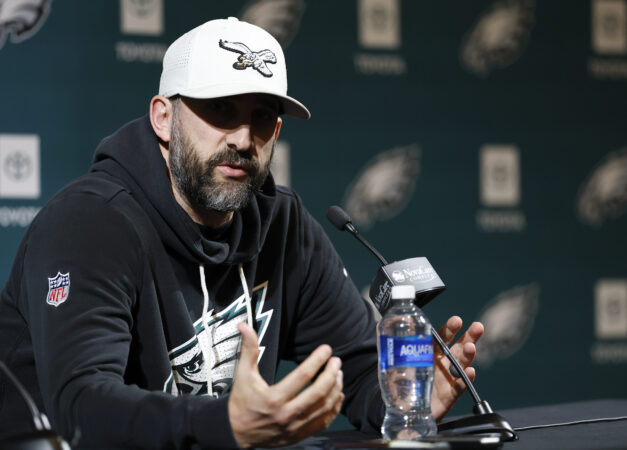
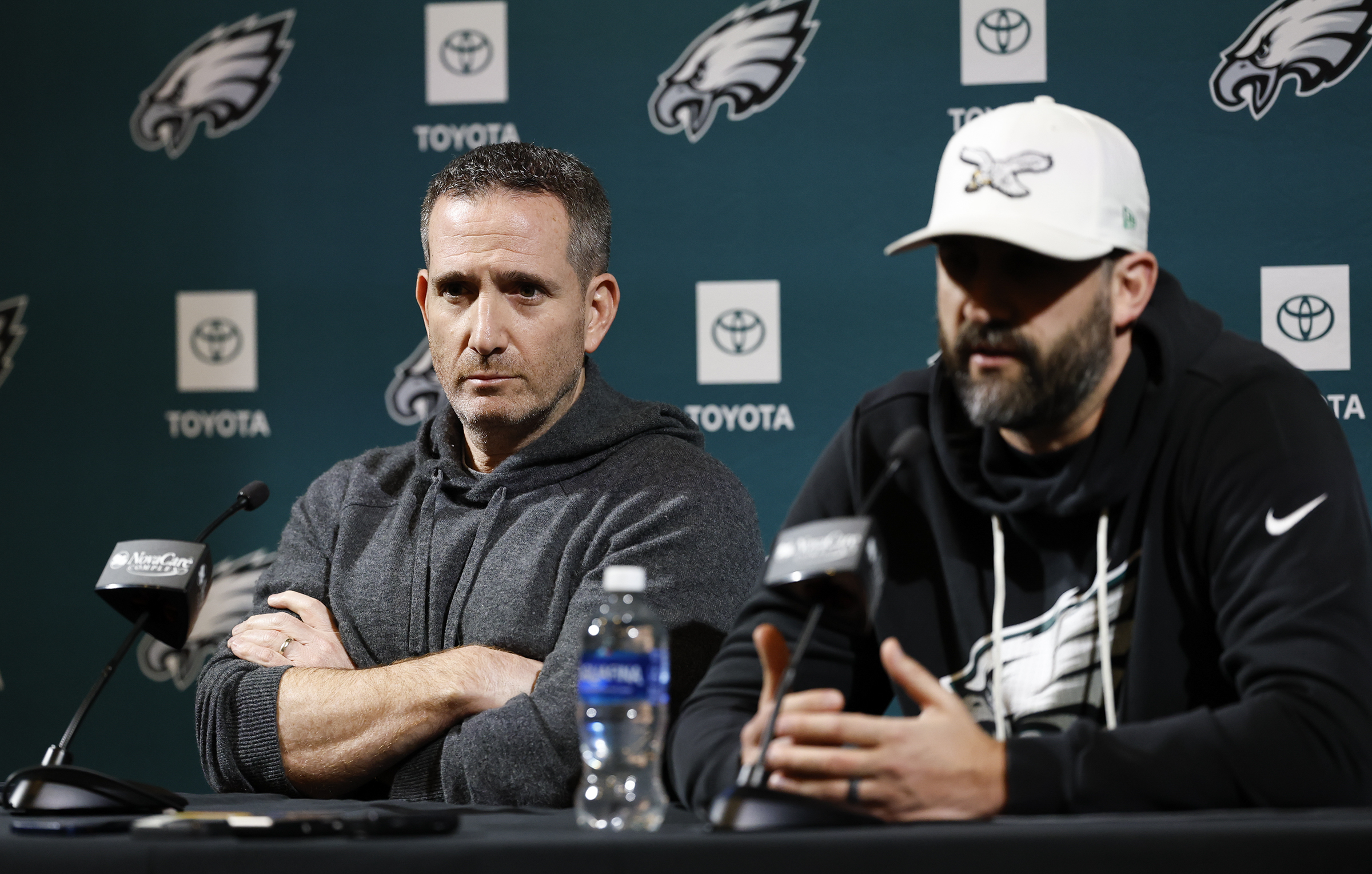
    At his end-of-year news conference on Thursday afternoon with Howie Roseman, Nick Sirianni explained his decision to remove Kevin Patullo from the offensive coordinator position, pointing to a need for the Eagles offense to “evolve.”

    The highest-paid offense in the NFL was stagnant for the majority of the 2025 season. A midseason spark in Weeks 7 and 8 — highlighted by under-center runs and play-action passes — was fleeting. The shotgun-heavy offense, while often capable of protecting the football and scoring in the red zone, was seldom explosive in the open field.

    Patullo’s offense finished the season 19th in the NFL in scoring, 24th in total yards, and 13th in expected points added per play, which measures the average points added by the offense on each play. The next offensive coordinator has room for growth with a bevy of talent.

    “I think it’s important to continue to evolve as an offense and that we go out and do what’s best for this football team,” Sirianni said. “Everything I do and every decision I have to make, I have to do that — just like Howie does, just like Mr. [Jeffrey] Lurie does — with the intent of [it] being the best thing for the football team.”

    Sirianni said he removed Patullo from his post in the best interest of the team, but he didn’t outright fire the 44-year-old coach. For now, Patullo remains on staff. Sirianni said he will “see how it plays out,” acknowledging that Patullo will likely have opportunities elsewhere.

    Patullo was a first-time offensive coordinator and a first-time offensive NFL play-caller. Will the pendulum swing in the other direction regarding the next offensive coordinator’s résumé? According to The Athletic, the Eagles have seasoned play-callers Brian Daboll and Mike McDaniel at the top of their candidates list.

    What is Sirianni’s criteria for an offensive coordinator hire this time around? Again, he used a familiar word to sum up his broad aspiration.

    “You’re looking to continue to evolve as an offense,” Sirianni said. “And I’m looking to bring in a guy that’s going to best help us do that.”

    Later, he expanded on his criteria, without giving too much of an ideal candidate profile away.

    “You always want someone that has a great vision and great conviction of things that they believe in and what they want to do,” Sirianni said. “You always want to have somebody that has the players on their mind first, and we’ll be able to attract a lot of good candidates because of the players that Howie’s assembled to be on our football team.

    “You want somebody that has great vision, great conviction in what they do, is able to coach fundamentals well, to help the players get better. Because I believe in that. That can connect with guys. Because I believe in that. That has the mental toughness, because I believe in that.”

    Ultimately, Sirianni said he wants to “find the best guy that fits the Philadelphia Eagles.” But is the best guy the one who will bring his own offense? Or is the best guy the one who will infuse his ideas within Sirianni’s scheme?

    In 2024, when the Eagles hired Kellen Moore as their new offensive coordinator, Sirianni emphasized that they would “mesh” their systems. They would continue to do the “good things,” Sirianni said, that had become staples of Eagles offenses past, all while incorporating “new ideas.”

    On Thursday, four days removed from the wild-card loss to the San Francisco 49ers, Sirianni wasn’t ready to discuss his precise degree of involvement in the 2026 Eagles offense.

    “It’s way early,” Sirianni said. “Those decisions don’t have to be made for a long time, and as the head coach, you always have to [have] oversight of everything. And again, this year, obviously, I did. I got involved more in the offense as the end of the season came, because that’s what I needed to do as the head football coach there.”

    While Sirianni will make the final decision on the next offensive coordinator, he won’t be the only person with input. He said he plans to use a variety of “resources” to inform his choice, including feedback from Jalen Hurts, among other prominent figures in the organization.

    Hurts, the 27-year-old franchise quarterback, will enter his sixth season as the starter with his seventh play-caller. Two of his offensive coordinators, Moore and Shane Steichen, departed for head coaching gigs after brief stints in the role. In the past, Hurts has expressed a desire for consistency at the position, but he acknowledged on Monday the changes didn’t stop him from winning a Super Bowl last season.

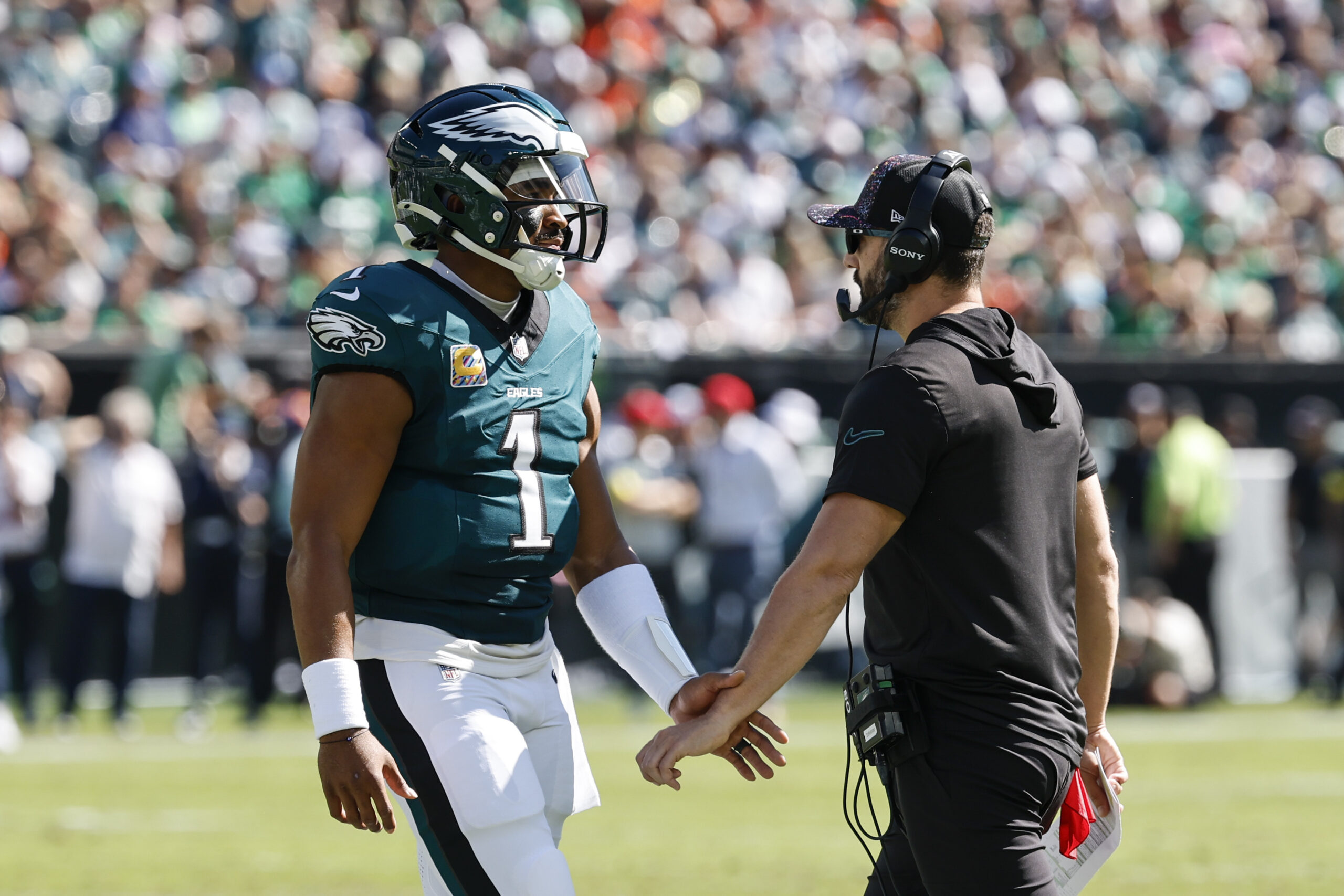
    Nick Sirianni, right, says he will seek feedback from Jalen Hurts, among others, in his choice of a new offensive coordinator.

    Regardless, the Eagles aren’t necessarily in search of a Vic Fangio-esque candidate as their next offensive coordinator — someone who has no intentions of moving on to a head-coaching job — according to Roseman.

    “It’s a great compliment when guys get head coaching jobs from here, because it means we’re having tremendous success,” Roseman said. “So as much as you’d like to have continuity, and I’d like to have guys here for a long period of time, we want to win. We have an urgency to win right now. And if that comes with the ramifications that we lose good people because they’ve earned head coaching jobs, we’ll live with that.”

    There is no one way to be an offensive coordinator, Sirianni said. Everyone has different philosophies and visions for what it takes for an offense to be successful.

    But there is only one acceptable outcome for an evolved Eagles offense and its new coordinator moving forward.

    “It’s about finding the guy that best fits us, that gives us the best chance to get back to the top of the mountain where we ultimately want to go,” Sirianni said.

  • In South Philly mass shooting, friends unintentionally killed each other, but it’s still murder, prosecutors say

    In South Philly mass shooting, friends unintentionally killed each other, but it’s still murder, prosecutors say

    No one can say for certain what caused the first loud “pop” to echo down a South Philadelphia block — a single gunshot, a car backfiring, or something else entirely.

    But within seconds, at least 15 people attending a party on the 1500 block of South Etting Street pulled out guns and started shooting, a chain reaction that left three people dead and 10 others wounded.

    In the weeks that followed the July 7 mass shooting, police said they identified four people who fired weapons that night: Daquan Brown, 21, Terrell Frazier, 22, Brandon Fisher, 17, and Dieve Jardine, 45. Prosecutors charged each with three counts of murder, 10 counts of attempted murder, conspiracy, and related crimes.

    Municipal Court Judge Francis W. McCloskey Jr. on Thursday ruled that the cases against the four men could move forward to trial on charges of third-degree murder, aggravated assault, and inciting a riot. He dismissed all counts of attempted murder and causing a catastrophe.

    Throughout the nearly five-hour hearing, prosecutors, using a compilation of video and social media evidence, laid out in greatest detail yet how the shooting unfolded.

    Dozens of people had gathered on the street the night of July 7, the second block party in as many days. Gunfire erupted just before 1 a.m.

    Assistant District Attorney Cydney Pope said the shooting was driven in part by paranoia.

    Assistant District Attorney Cydney Pope leaving the courthouse during a November trial.

    Frazier and other young men at the party had been going back and forth with people on social media, she said, challenging someone who threatened to shoot up the party to “go ahead” in an Instagram Live video.

    Less than 10 minutes later, she said, surveillance video showed a single loud “pop” that appeared to scare partygoers, who started to run down the block.

    Eight seconds later, she said, at least 15 people at the party pulled out their guns and shot more than 120 bullets toward the end of the block.

    But there’s no evidence anyone ever shot into the party, she said. The sound they believed was gunfire, she said, was likely a car backfiring.

    “This is a tragedy because all of these defendants shot and killed their friends,” she said.

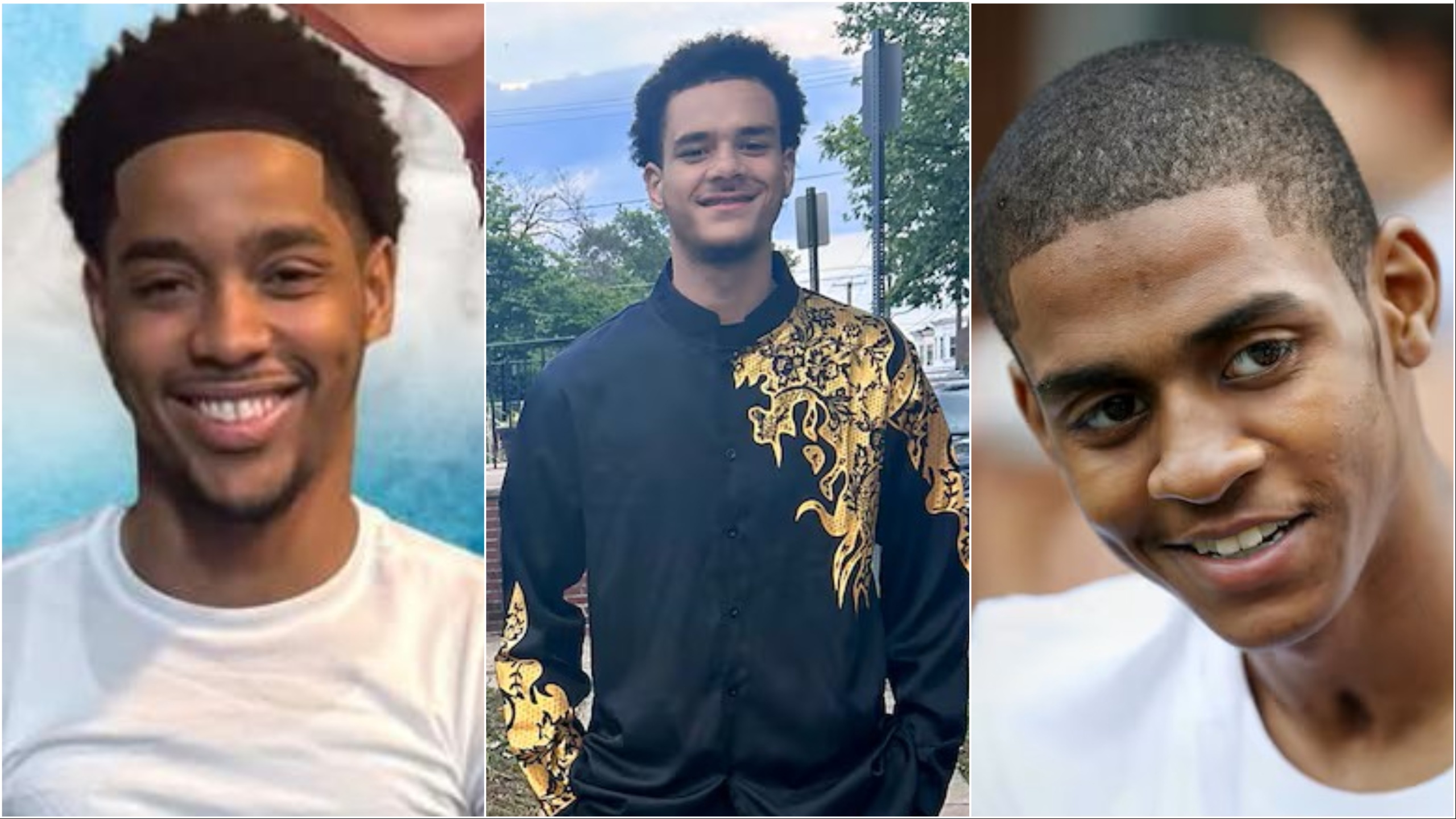
    From left to right: Zahir Wylie, Jason Reese, and Azir Harris were killed in a mass shooting on the 1500 block of Etting Street on July 7.

    Three men were killed. Zahir Wylie, 23, was struck in the chest, and Jason Reese, 19, was shot in the head. Azir Harris, 27, who used a wheelchair after being paralyzed in an earlier shooting, was struck in the back as he sought cover between two cars.

    Homicide Detective Joseph Cremen said he identified the four gunmen by combing surveillance video, phone, and social media records, and interviewing witnesses.

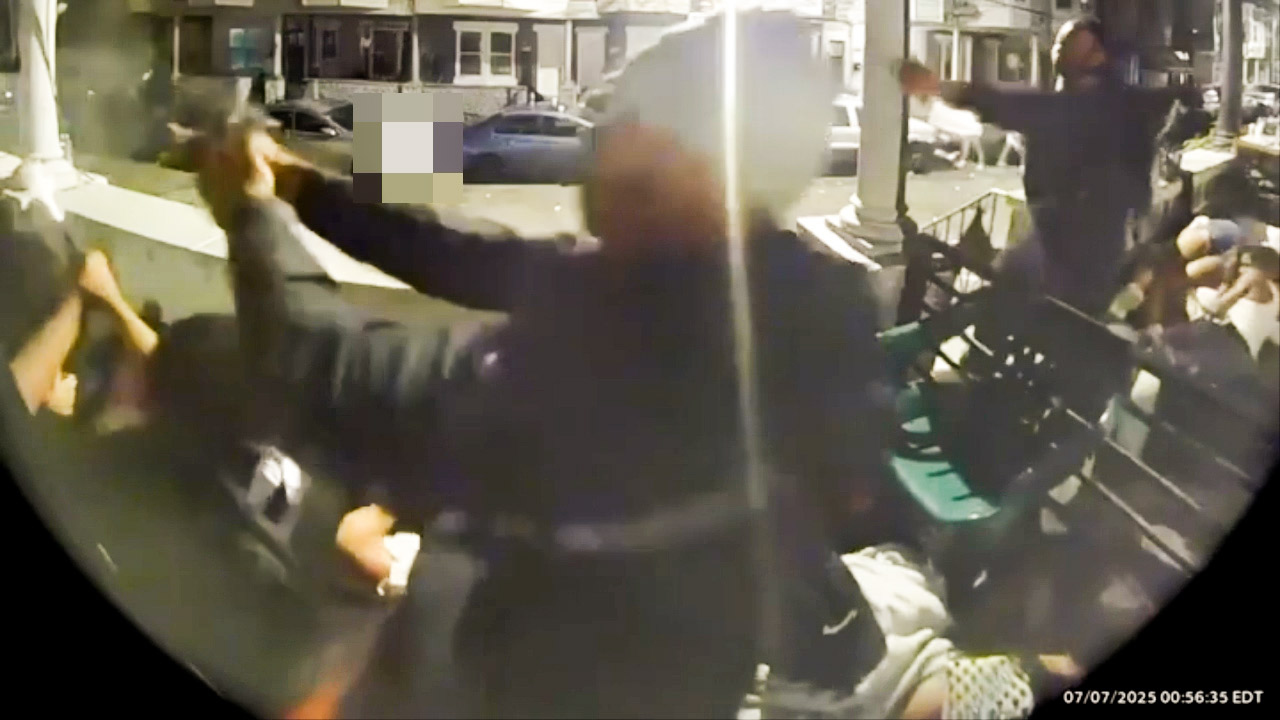
    Fisher, he said, was seen on the porch of one of the homes using a gun with a “switch” attachment that caused him to spray dozens of bullets down the street, appearing at times as if he couldn’t control his weapon. In the teen’s phone, he said, were pictures of him with multiple guns, as well as the clothes he was wearing the night of the shooting and messages indicating he was selling firearms.

    Police said the person directly in front of this video is Brandon Fisher, 17, using a gun with a switch on it to fire dozens of shots down Etting Street on July 7.

    And Frazier, he said, talked about the shooting in text messages. About 12 hours after the shooting, he said, someone asked Frazier where he was when Wylie was struck.

    “I was banging back,” Frazier wrote. He said the shooting was “bad,” and that Wylie “died from us.”

    “He died from a stray,” he said, according to the texts.

    Cremen said Brown admitted that he fired two shots with his legally owned gun, “then when he realized he wasn’t shooting at anything, he stopped and took cover.”

    And Jardine, also known as Dieve Drumgoole, also told investigators he fired two or three shots after he saw someone come out of an alley on the block with a green laser attachment on a gun, the detective said.

    Cremen didn’t recover video that showed anyone using a gun with a green laser beam.

    Defense attorneys for the four men all argued that their clients were acting in self-defense, and only fired their guns because they believed someone was shooting at them. Police still do not know — and may never know — whose bullets struck each victim.

    “There is no evidence that he struck anyone, there’s no evidence that he intended to strike anyone,” said Gina Amoriello, who represents Brown. “In all my years, I’ve never seen a case overcharged like this. This is extreme.”

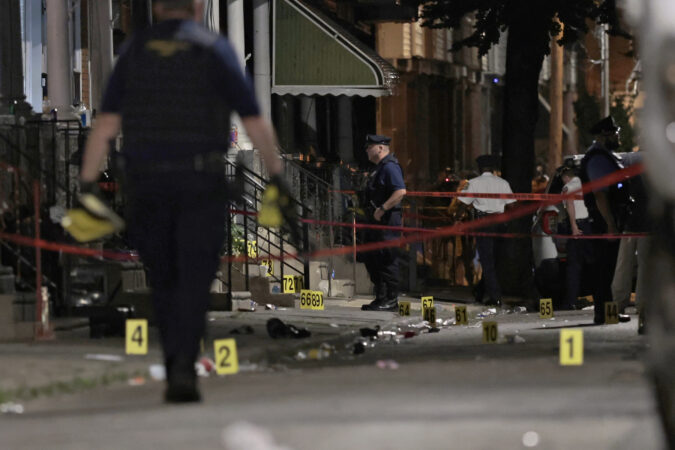
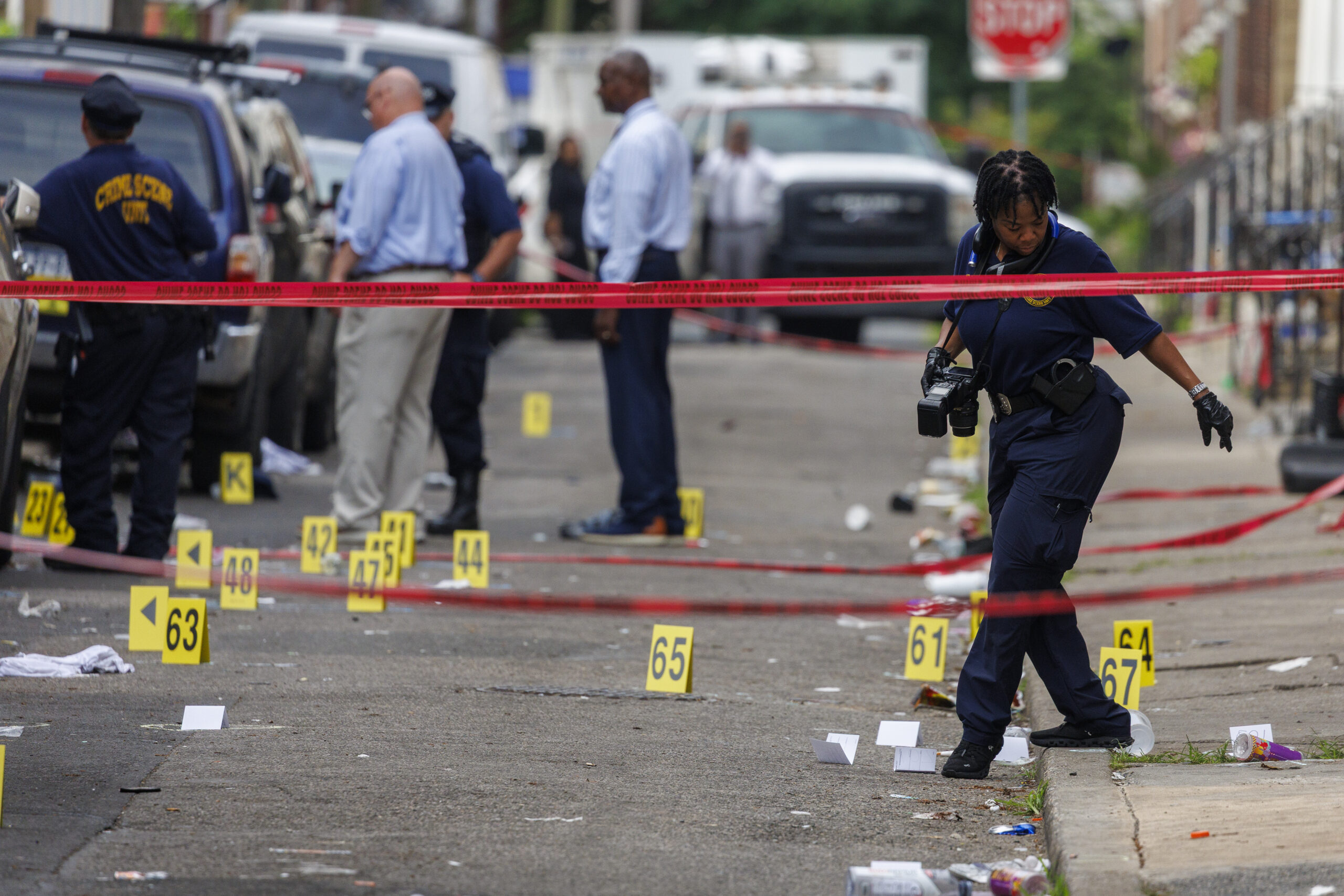
    Philadelphia Police Crimes Scene officer taking pictures at scene. Scene of an overnight shooting 1500 block S. Etting Street, Philadelphia, that sent several to hospital, fatalities, early Monday, July 7, 2025.

    John Francis McCaul, Jardine’s lawyer, said the father was “protecting his family” on the porch. Jardine’s son and nephew were also injured in the shooting.

    No one, he said, intended to kill anyone by firing their guns.

    The judge disagreed.

    “The intent goes where the bullet goes,” said McCloskey. “The intent is established by producing the gun, pointing the gun, and pulling the trigger.”

    He said it would be up to a jury or judge later on to determine whether or not the men were acting in self defense. At this preliminary stage, he said, prosecutors provided enough evidence to uphold a third-degree murder charge.

    Prosecutors plan to address charges against a fifth person, Jihad Gray, who had been charged with the shooting at a hearing next week.

    A sixth person, Christopher Battle, 24, remains at-large.

    After the hearing, the families of the victims struggled to make sense of what they had just watched — friends killing friends.

    “It’s really hard to digest,” said Troy Harris, whose son, Azir, was killed. “It was shocking. It was life changing to us. … This domino effect can hurt generations and generations.”

    “I still don’t even get it,” said Markeisha Manigault, the mother to Zahir Wylie. “I don’t understand why … my son lost his life. It was just unnecessary.”

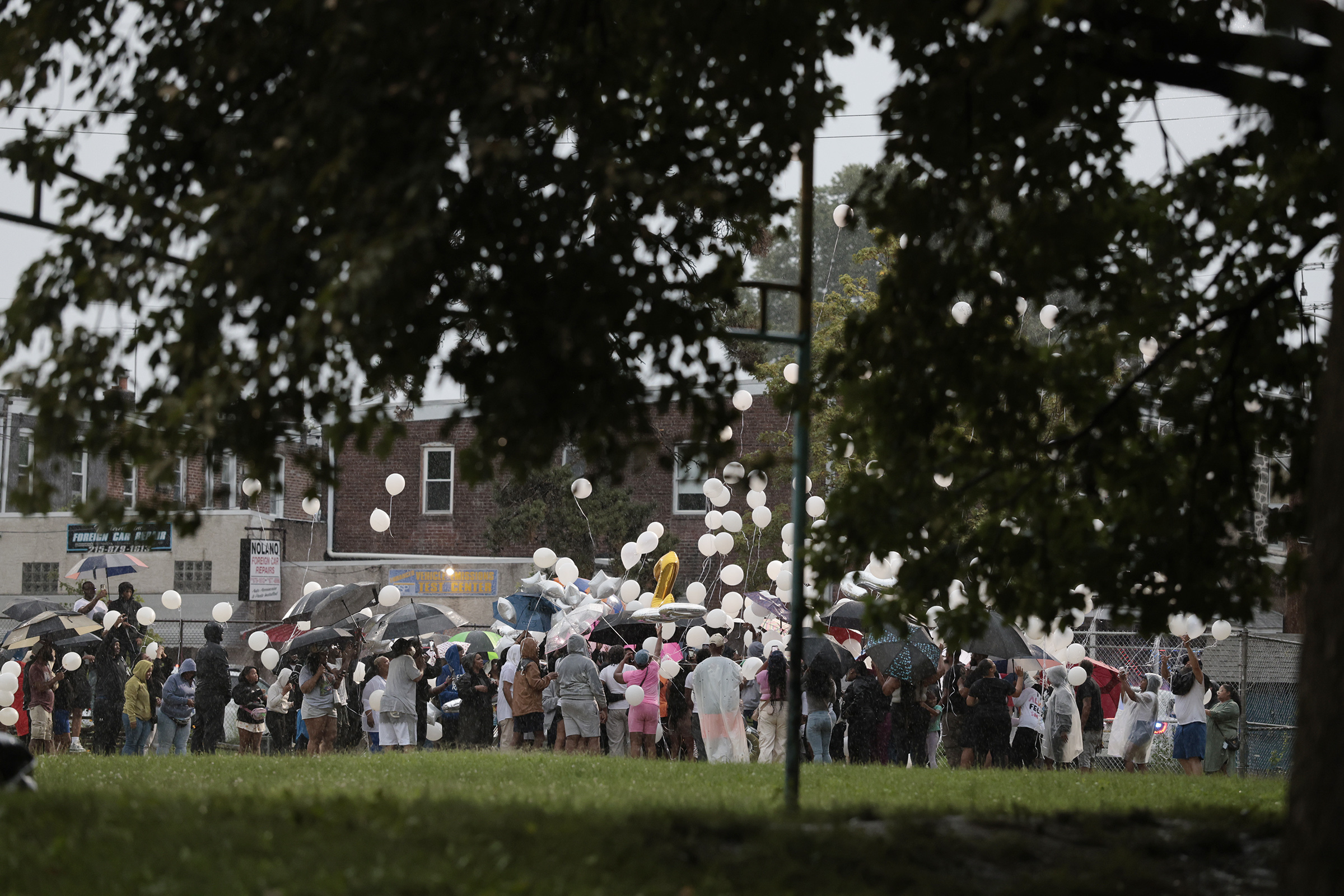
    Family and friends gather for a balloon release in memory of Zahir Wylie at the Papa Playground on July 8, 2025.
  • Subaru Park will host the inaugural Women’s Lacrosse League Championship

    Subaru Park will host the inaugural Women’s Lacrosse League Championship

    The Philadelphia area will become the epicenter of sports this year and host major events, including the FIFA World Cup, the MLB All-Star game, and the PGA Championship at Aronimink Golf Club. Now, another historic event has been added to the schedule: the inaugural Women’s Lacrosse League championship.

    The event will take place during the Professional Lacrosse League’s homecoming weekend for the Philadelphia Waterdogs on Aug. 14-16 at Subaru Park in Chester.

    “We’re thrilled to return to Philadelphia at Subaru Park in 2026, and make history when we crown the first WLL Champions,” said PLL cofounder and president Paul Rabil. “Philly fans have fueled some of the most legendary moments in our league’s history, and we can’t wait to see their passion for the Waterdogs and the game light up the stadium once again.”

    In the championship, the league’s four teams (New York Charging, Boston Guard, Maryland Charm, and California Palms) will compete in the 10-vs.-10 format that debuted during the 2025 WLL All-Star game.

    “Hosting both the Premier Lacrosse League and, for the first time, the Women’s Lacrosse League at Subaru Park is a powerful moment for our venue and for the region’s lacrosse fans,” said Union president Tim McDermott. “This weekend will reflect our commitment to showcasing elite competition at our best-in-class facility and creating unforgettable experiences for all who step foot in Subaru Park.”

    Before the regular season begins on May 15 in Rhode Island, all four WLL teams, and the top four PLL teams, also will play in the 2026 Championship Series from Feb. 27 to March 8 at The St. James in Springfield, Va. The competing PLL teams are the New York Atlas, Carolina Chaos, Denver Outlaws and California Redwoods.

    They will compete in the Olympic Sixes game format, which is set to return to the Los Angeles 2028 Olympic Games. Fans can purchase presale tickets for the Championship Series online.

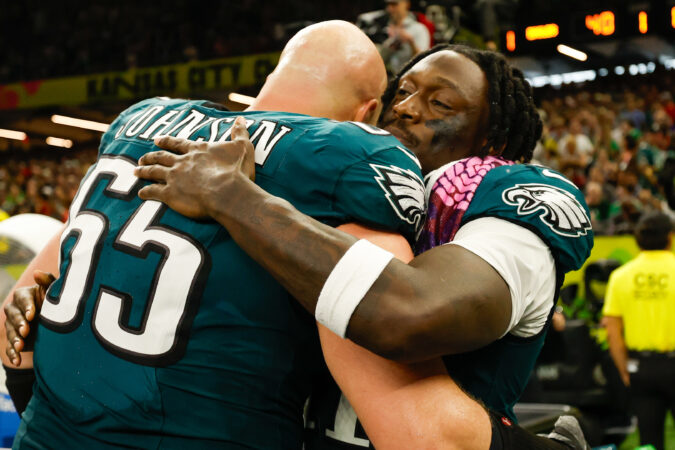
  • Will A.J. Brown and Lane Johnson be back? Those are key questions facing the Eagles and Howie Roseman.

    Will A.J. Brown and Lane Johnson be back? Those are key questions facing the Eagles and Howie Roseman.

    The main topics at the end-of-year news conference Thursday afternoon at the NovaCare Complex mainly centered on why Kevin Patullo was no longer the offensive coordinator of the Eagles, what Nick Sirianni and Howie Roseman wanted in his replacement, and the evolution of the team’s offense.

    But two additional questions during the 24-minute session will have an impact on that next coordinator and the Eagles overall.

    A.J. Brown’s future in Philadelphia is a major offseason storyline, as is Lane Johnson’s future playing football in general.

    Brown’s frustrations this season and last have been well-documented. The star receiver expressed his frustrations with the offense and his involvement in it via cryptic social media posts, on a video game livestream, and in media interviews. He declined to make himself available to the media after the Eagles’ postseason exit, both postgame and the following day as the team cleared its lockers.

    Would Roseman be open to trading Brown, or is that a nonstarter?

    “It is hard to find great players in the NFL, and A.J. is a great player,” Roseman said. “I think from my perspective, that’s what we’re going out and looking for, when we go out here in free agency and in the draft, is trying to find great players who love football, and he’s that guy. So that would be my answer.”

    It was not a yes, and it was not a no. Reading between the lines, trading Brown would require the Eagles to get a haul in return.

    A.J. Brown’s unhappiness was apparent during the 2026 season.

    There also are salary cap implications.

    Brown signed a three-year extension in 2024 that carries through the 2029 season. If the Eagles traded Brown before June 1, they would take on a dead cap hit of $43.5 million. Keeping Brown would mean a $23.4 million hit. Trading him would offer cap savings in 2027 and beyond. The Eagles have been open to taking on dead cap in the past, and Roseman has been a savant at gaming the NFL’s salary cap system to the Eagles’ advantage.

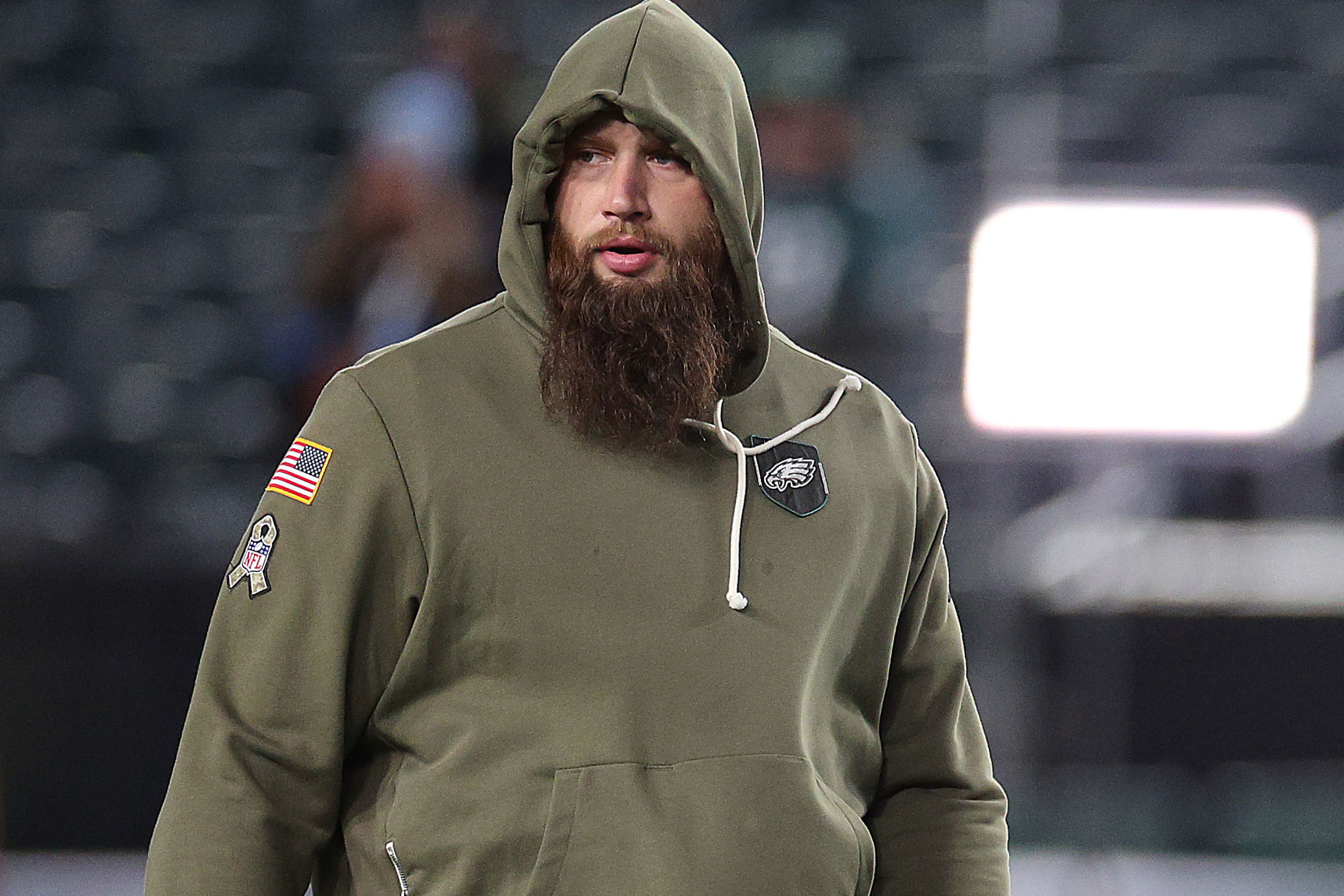
    Johnson’s future also is a big factor in the cap math next season and beyond. The future Hall of Fame right tackle missed the final seven regular-season games as well as Sunday’s playoff loss with a Lisfranc injury in his right foot. Johnson has talked publicly last season and before this season about his career timeline.

    “My goal is to play well throughout my middle to maybe my upper 30s,” Johnson, who will be 36 in May, said last March. “I love the challenge of being an older player and the routine you got to keep up with.”

    Lane Johnson’s injury-related absence in 2025 had a material effect on the offense’s production.

    That was, however, before he suffered another injury. Johnson, like Brown, was not available to reporters as the season wrapped.

    Did he give any indication to Roseman whether he’ll be back?

    “I think all those conversations that we have with our players are between us, and anything they’re doing — I’m not saying that negatively or positively — but anyone you ask about, I think that’s their business to discuss,” Roseman said. “Obviously, you’re talking about a Hall of Fame player who has been a huge, huge part of any of our success we’ve had. And when you watch him play, he’s still playing at an elite level.”

    Not a yes. Not a no.

    The ‘natural arc’

    The futures of those Eagles stars are pivotal because their status impacts how the Eagles approach free agency and the draft. They also make up a large chunk of the team’s high-priced offense.

    The Eagles are at an interesting point in the state of their roster. They have an aging and expensive offense that is underperforming relative to its cost and a young and inexpensive defense. That will change soon. Jalen Carter and Jordan Davis are in line for extensions. Quinyon Mitchell and Cooper DeJean are right behind them. The Eagles need to improve at edge rusher and have other holes to fill.

    Howie Roseman and Nick Sirianni will have to balance the team’s roster needs with financial pragmatism.

    “As you get better, you have a natural arc of the team, and I think that, when you look at our team, we drafted a lot of offensive players, we re-signed a lot of offensive players,” Roseman said when asked if the team had the resources to keep the players it wants to. “We drafted a lot of defensive guys that were young and on rookie contracts. There’s natural transition in what we do … in terms of where you’re paying your guys, which side of the ball you’re paying your guys who are coming up.

    “The important thing for us is there are players we can’t lose — obviously, we’re going to do what’s best for us … but within reason — and that we want to keep around here because they’re really good players, homegrown players that are really good people, that are part of our core. With that, you’re going to have to make sacrifices. That’s on me to make sure the sacrifices we make are filled in with really good players again.”

    ‘Not good enough’

    How would Roseman assess the 2025 season?

    “Not good enough,” he said.

    “If it doesn’t end with confetti falling on our head, I don’t feel like it’s good enough,” he added. “I know we’re not going to win the Super Bowl every year. I think I know that from a broad perspective, but I believe we can. I go into every offseason thinking we’re going to do whatever it takes to win a Super Bowl and when we fall short I look at myself. I look at the things that I could have done different and I look to improve.”

    It was not Roseman’s best offseason coming off last year’s Super Bowl. The Eagles did not get great production from their 2025 draft class, though they also had a roster without many openings. It’s worth noting that their first two picks in 2024 were All-Pro selections this season, and the jury is still out on their first two picks from the most recent drafts. They did not, however, make adequate upgrades on the edge and twice had to lure players off their couches to join the team before being forced to use a draft pick to acquire Jaelan Phillips. They don’t have obvious answers for what’s next for an aging and declining offensive line.

    They need to get younger and cheaper at some positions, but they also have the talent to try to push for another championship. Finding the next offensive coordinator is a big part of that, but roster construction is critical. Roseman’s offseason task is to balance it all.

    “You can do whatever it takes to win now and still build for the future and still have those parallel paths,” he said. “I just don’t want it to get confused that we can’t do whatever it takes to build a championship-caliber team next year and also continue to have really good players on this team for the future.”

    That work is underway.

  • Gov. Josh Shapiro sued a vendor for failing to deliver 3.4 million letters from state agencies, calling it ‘unacceptable’

    Gov. Josh Shapiro sued a vendor for failing to deliver 3.4 million letters from state agencies, calling it ‘unacceptable’

    HARRISBURG — Gov. Josh Shapiro’s administration has sued a former vendor for failing to deliver 3.4 million pieces of state agency mail to residents, resulting in a statewide debacle with some residents losing access to their public benefits.

    Shapiro called the situation “absolutely unacceptable” in his first public remarks on the matter during a Wednesday appearance at the Pennsylvania Farm Show.

    The Pennsylvania Department of General Services earlier this month filed suit in Dauphin County Court against the Harrisburg-based Capitol Presort Services, a mail presort company, for damages totaling more than $220,000 for its failure to deliver critical state agency communications from the Department of Human Services, Department of Transportation, and more.

    The lawsuit alleges that the owner of Capitol Presort Services told the state he had been forced to reduce staff due to the 135-day state budget impasse, during which outside vendors were not paid. But the owner, Phil Gray, never told the state his company could not fulfill its contractual obligations, according to the state’s filing.

    Gray “systematically reviewed the mail entering his facility and elected to process the mail that was most easily traced, to hide that he was falling behind,” according to a letter sent to lawmakers last week by DGS Secretary Reggie McNeil.

    The unsent mail went undetected by the state for one month before it was discovered, and Capitol Presort Services was swiftly fired. The state found another vendor through an emergency contract with technology solution company Pitney Bowes for $1 million.

    Shapiro said his administration has been “working overtime” to ensure no benefits were lost, and if they were, “we’re going to make it right.”

    “The vendor failed. It was caught, it was addressed, we’re suing them, and we’re going to do everything we can to recover for the people of Pennsylvania,” Shapiro said. “It’s not OK.”

    The mail delay has become an early point of attack against Shapiro as he runs for reelection and is likely to face Treasurer Stacy Garrity, the Pennsylvania Republican Party’s endorsed candidate. Following Shapiro’s reelection campaign announcement last week, the state GOP claimed that Shapiro has “even failed at the easy stuff, like sending out millions of letters from state agencies, causing vulnerable residents to lose their healthcare without notice.”

    Why the state sued

    The state hired Capitol Presort in 2021 to tray and sort some of the state’s mail, in order to save money on postage. Its latest purchase order for 2024-25, according to the suit, totaled nearly $5.3 million to deliver millions of state agency communications to residents.

    The state alleges in the suit that the vendor continued to deliver trackable mail while not delivering untracked mail, arguing that this was evidence of an “active and fraudulent concealment and an affirmative misrepresentation that it was performing its obligations under the contract.”

    Capitol Presort Services allegedly continued to pick up mail daily throughout the month of November, and Gray did not communicate to the state when asked on Dec. 4 that he could not meet his contractual obligations, McNeil said in his letter to lawmakers.

    However, Gray allegedly told the state that he had reduced his staff since July due to the impact of the budget impasse, which lasted 135 days, or nearly five months. Outside vendors are not paid during budget impasses but are expected to meet their contractual obligations.

    “Many critical contractors continued to provide services to the commonwealth, without payment, throughout the lengthy budget delay, but this vendor hid the problem and at no point advised DGS or worked cooperatively to resolve it,” McNeil told the lawmakers.

    Gray could not be reached for comment Thursday and did not have an attorney listed on the lawsuit.

    Ongoing impact

    Community Legal Services reported last month that the failure to deliver state agency mail, which went undetected from Nov. 3 to Dec. 3, had resulted in approximately two dozen clients losing access to their benefits. The total number of residents affected by the mail delay remains unclear.

    The Pennsylvania Department of Human Services has said it is extending its appeal deadlines by 45 days, while any Medicaid, CHIP, or TANF cash assistance recipients whose benefits were reduced or ended are getting their cases reopened.

    SNAP recipients who lost access to their food assistance due to the mail delay must file an appeal, submit missing documents, or reapply to become eligible again under federal rules.

    PennDot, for its part, has received few reports of issues due to the mail delay and does not anticipate much of an impact on residents, Transportation Secretary Mike Carroll said in a letter to legislators sent last week. All of its legal and time-sensitive mailings, like suspension notices, were not affected.

    The state will likely ask for more than $220,000 in damages, adding in the suit that the full cost for the failure to deliver a month’s worth of agency mail cannot yet be determined. As of last week, DHS alone has spent that much on unplanned communications and mailing costs to notify affected Pennsylvanians, according to a letter from DHS Secretary Val Arkoosh to state lawmakers.

  • Temple bought the site of a former McDonald’s for $8 million

    Temple bought the site of a former McDonald’s for $8 million

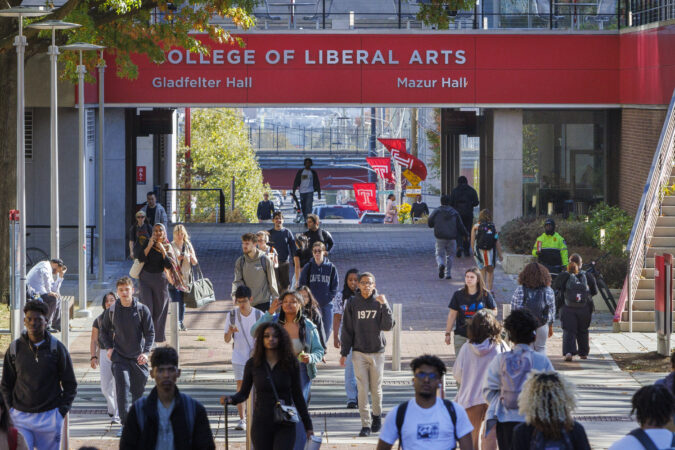
    Temple University last month bought a vacant property at the site of a former McDonald’s near its North Philadelphia campus for $8 million, according to property records.

    The university is still developing plans for the 48,640 square-foot lot at 1201-1219 N. Broad St., by Girard Avenue, a spokesperson said.

    It’s adjacent to the Temple Sports Complex, which features two fields for soccer, lacrosse, and field hockey. That location “provides an opportunity to implement the vision of our campus safety and physical environment plan,” Steve Orbanek said.

    The transaction was earlier reported by the Philadelphia Business Journal.

    The restaurant franchise was demolished in 2023.

    Temple’s latest acquisition comes as the university has expanded its footprint in recent months along Broad Street.

    In early 2025 the university paid $18 million for Terra Hall, a former University of the Arts building on South Broad Street. The building will be Temple’s Center City campus. And last fall Temple bought jazz bar New Barber’s Hall on Oxford Street for $2.3 million, the Business Journal reported.