
The Phillies are preparing to turn over the keys to center field in 2026 to prospect Justin Crawford. After working with Crawford last season, triple-A Lehigh Valley hitting coach Adam Lind sits down with “Phillies Extra” to discuss the touted 22-year-old’s readiness for the majors, as well as other prominent players in the Phillies organization. Watch here.
Blog
-
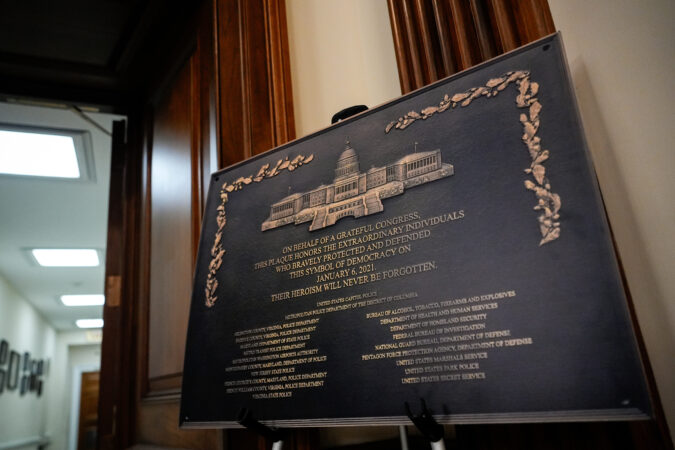
After delays, the missing Jan. 6 plaque will be displayed at the Capitol
WASHINGTON — The Senate has agreed to display a plaque honoring the police who defended the Capitol during the Jan. 6, 2021, attack, rebuffing House Speaker Mike Johnson who has said the commemorative memorial does not comply with the law.
The action happened swiftly, with brief debate, in floor action Thursday. Republican Sen. Thom Tillis of North Carolina had announced during this week’s fifth anniversary of the Capitol siege that he would seek to ensure the plaque is installed, partnering with Democratic Sen. Jeff Merkley of Oregon, who was also working on the situation, and Sen. Alex Padilla of California. No senators objected.
“A lot of people said it was a dark day for democracy,” Tillis said about Jan. 6, 2021, describing his memory of hearing the thousands of people — “thugs,” he said — lay siege to the Capitol as Congress was tallying the 2020 election results.
He said that because of the work of the law enforcement officers, it became a great day for democracy. “We came back and completed our constitutional duty to certify the election,” he said. “We owe them eternal gratitude and this nation is stronger because of them.”
This week, senators stepped up after learning the plaque, which had been approved by Congress more than three years ago, was nowhere to be found at the Capitol. Instead, many House lawmakers have been hanging up replicas outside their office doors.
The Senate also appeared to be motivated by the shifting narrative from President Donald Trump ‘s White House about what happened Jan. 6, 2021, when his supporters stormed the building after he urged them go to Capitol Hill to confront Congress over Democrat Joe Biden’s 2020 election victory.
Trump himself shifted blame for the attack during a speech this week in which he said he only intended for his supporters to march peacefully to the Capitol. Moreover, the White House produced a glossy new report also shifting blame for the deadly riot — on Democrats, for Biden’s victory over Trump, and on the police for their response to the mob.
“It’s so important we be honest with the American people about what happened,” Merkley said, as he called the resolution up for passage.
“It’s so important we recognize those who defended our democratic republic on that day,” he said, and that “people know we can back, as senators and House members, and finished our work that day, for the peaceful transfer of power.”
Padilla said part of the context is the White House’s new website that he said is an “attempt to rewrite history.” He said that “dishonors” the officers.
“The Senate bipartisan commitment to real history is strong,” he said.
The plaque, according to the law, was intended to be placed at the West front of the Capitol where some of the fiercest fighting took place. It was required to be installed in 2023, a year after the legislation had passed.
The new resolution directs the Architect of the Capitol to “prominently display” the plaque in a “publicly accessible” location in the Senate wing of the Capitol until it can be placed in its permanent location.
To display the plaque in its intended location would require agreement with the House.
The office of Johnson, a Republican who before becoming the House speaker led efforts to object to the 2020 election results, said this week that the plaque, as constructed, does not comply with the law.
Police have sued to have the plaque put on display, as required, but Trump’s Justice Department is trying to dismiss the lawsuit.
Tillis said part of the “technical implementation problem” was a concern that the law specified the plaque would honor all the officers involved, but the plaque only lists the various law enforcement agencies that responded to help the Capitol Police that day.
He said there will be a digital component, presumably a website, that will list all the names. The number of officers runs into the thousands.
“You’ll see how many people came here,” he said.
-

Tens of thousands flee Aleppo neighborhoods as Syrian government clashes with Kurds intensify
ALEPPO, Syria — Clashes between government and Kurdish forces in a contested area in Syria’s northern city of Aleppo intensified Thursday after Syrian authorities ordered civilians to evacuate.
Syrian authorities opened a corridor for civilians to evacuate for a second day and tens of thousands fled.
The government of Aleppo province gave residents until 1 p.m. local time to evacuate in coordination with the army. State news agency SANA, citing the army, said the military would begin “targeted operations” against the Kurdish-led Syrian Democratic Forces in the neighborhoods of Sheikh Maqsoud, Achrafieh and Bani Zaid half an hour after that deadline.
The military later issued a series of maps with the areas under evacuation order.
An Associated Press journalist at the scene heard sporadic sounds of shelling as civilians streamed out of the area Thursday morning. More than 142,000 people have been displaced across the province, according to the Aleppo Central Response Committee.
“There’s a large percentage of them with difficult medical issues, elderly people, women, and children,” said Mohammad Ali, operations director with the Syrian Civil Defense in Aleppo.
Kurdish forces said at least 12 civilians were killed in the Kurdish-majority neighborhoods, while government officials reported at least nine civilians have been killed in the surrounding government-controlled areas in the fighting that broke out Tuesday. Dozens more on both sides have been wounded. It was not clear how many fighters were killed on each side.
Each side has accused the other of deliberately targeting civilian neighborhoods and infrastructure, including ambulance crews and hospitals.
Clashes intensified in the afternoon, with continuous exchanges of shelling and drone strikes, and tanks could be seen rolling into the contested neighborhoods. The SDF-affiliated Internal Security Forces said they had “destroyed two armored vehicles and inflicted casualties on the attackers” as they advanced.
Aleppo governor Azzam al-Gharib, meanwhile, said Thursday evening that “a large number” of SDF fighters had defected or fled. Late in the evening, as clashes subsided, government forces began to deploy in largely-abandoned neighborhoods where the fighting had taken place.
Churches hosting displaced people
St. Ephrem Syrian Orthodox Church in Aleppo city was hosting about 100 people who had fled the fighting. Parishioners donated mattresses, blankets and food, priest Adai Maher said.
“As soon as the problems started and we heard the sounds (of clashes), we opened our church as a shelter for people who are fleeing their homes,” he said.
Among them was Georgette Lulu, who said her family is planning to travel to the city of Hasakeh in SDF-controlled northeast Syria when the security situation allows.
“There was a lot of bombing and loud noises and a shell landed next to our house,” she said. “I’ve been through these circumstances a lot so I don’t get frightened, but my niece was really afraid so we had to come to the church.”
Hassan Nader, a representative of the Ministry of Social Affairs in Aleppo said about 4,000 were staying in shelters in the city while tens of thousands had gone to other areas of the province, and the ministry was working with NGOs to supply them with food, medicine and other necessities.
Political impasse
The clashes come amid an impasse in political negotiations between the central state and the SDF.
The leadership in Damascus under interim President Ahmad al-Sharaa signed a deal in March with the SDF, which controls much of the northeast, for it to merge with the Syrian army by the end of 2025. There have been disagreements on how it would happen. In April, scores of SDF fighters left Sheikh Maqsoud and Achrafieh as part of the deal.
Officials from the central government and SDF met again on Sunday in Damascus, but government officials said that no tangible progress had been made.
Some of the factions that make up the new Syrian army, formed after the fall of former President Bashar Assad in a rebel offensive in December 2024, were previously Turkey-backed insurgent groups that have a long history of clashing with Kurdish forces.
In the city of Qamishli in the Kurdish-controlled northeast, thousands of protesters gathered Thursday, chanting, “SDF, we are with you until death.”
Sawsan Khalil, a protester in Qamishli who was displaced from Afrin in Aleppo province in a 2018 Turkish offensive against Kurdish forces there, called for the international community “to feel for the Syrian people who have been killed for no reason” in Aleppo.
Izzeddin Gado, co-chair of the Qamishli City Council accused the government forces of “following a foreign and regional agenda from Turkey.”
International concerns
The SDF has for years been the main U.S. partner in Syria in fighting against the Islamic State group, but Turkey considers the SDF a terrorist organization because of its association with the Kurdistan Workers’ Party, or PKK, which has waged a long-running insurgency in Turkey. A peace process is now underway.
Despite the long-running U.S. support for the SDF, the Trump administration in the U.S. has also developed close ties with al-Sharaa’s government and has pushed the Kurds to implement the March deal.
A U.S. State Department official said in a statement Thursday that U.S. envoy Tom Barrack was trying to facilitate dialogue between the two sides.
Barrack later posted on X, “Just this past week, we stood on the threshold of successfully concluding the March 10, 2025 integration agreement,” a goal that he said remains “eminently achievable.”
“Together with our allies and responsible regional partners, we stand ready to facilitate efforts to de-escalate tensions and to afford Syria and its people a renewed opportunity to choose the path of dialogue over division,” he said.
Turkey’s Ministry of National Defense said Thursday that the “operation is being carried out entirely by the Syrian Army” while Turkey is “closely monitoring.”
“Syria’s security is our security,” the statement said, adding that “Turkey will provide the necessary support should Syria request it.”
Turkish Foreign Minister Hakan Fidan described the SDF as the “greatest obstacle for peace in Syria.”
The United Nations expressed concern at the violence and called for de-escalation.
-
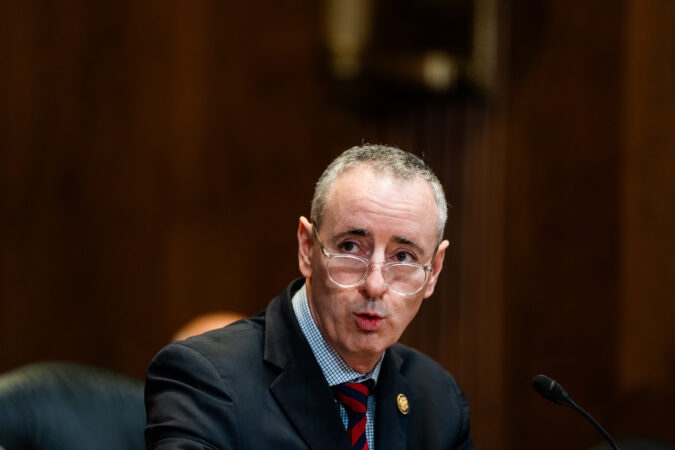
Brian Fitzpatrick criticizes House Speaker Johnson as Pa. swing-district Republicans join Democrats in ACA subsidies vote
U.S. Rep. Brian Fitzpatrick accused some of his Republican colleagues of being “intellectually dishonest” about the Affordable Care Act, hours before he and other Republicans broke party lines to pass a bill to restore recently expired healthcare subsidies.
The Democratic-led bill passed the House by a vote of 230 to 196 after Fitzpatrick and eight other Republicans backed a discharge petition the previous day, in the latest rebuke of Republican House Speaker Mike Johnson.
The bill now heads to the Senate, where its fate is uncertain.
Fitzpatrick, a moderate Republican who represents purple Bucks County, was one of 17 Republicans to cross the aisle Thursday to back the legislation that will restore healthcare subsidies after insurance premiums spiked this month, following their expiration at the end of last year. The bill would extend the subsidies, enacted in 2021, for another three years.
He said some of the pushback “unfortunately, is ideological” as he explained frustration with other members of his party, including Johnson.
“I’ve made the point to them many times over,” he said. “You are entitled to criticize something, provided that you have a better alternative. … I’ve been hearing a lot of talk out of my colleagues for a long period of time without any concrete plans.”
He noted that the expiration of the subsidies could lead to a rate increase for everyone if fewer people have coverage as a result, not just the approximately 8-10% who qualify for the subsidy, for whom the credit is “everything,” he said.
The issue could be an important one in congressional races later this year if lawmakers don’t resolve the matter, which was also one of the main sticking points during last year’s government shutdown.
Fitzpatrick is one of three swing-district Republicans in Pennsylvania who backed the effort, along with freshman GOP Reps. Ryan Mackenzie and Rob Bresnahan. All three are being targeted by Democrats in the fall election.
A fourth swing-district Republican in the state, U.S. Rep. Scott Perry, was among the legislation’s detractors.
Perry shared a video Wednesday to social media of President Donald Trump accusing Democrats of being “owned” by insurance companies.
“These companies are thriving, not hurting,” Perry said in a post accompanying the video. “Subsidies are direct cash transfers from the Treasury (YOU) to their bank accounts. But they’re worried that their money tree is going to be chopped down, so now they’re threatening to pass off higher costs to consumers to keep their profits high.”
Janelle Stelson, a Democrat who is seeking a rematch against Perry after narrowly losing to him in 2024, criticized the GOP incumbent’s opposition to the bill.
“Forcing Pennsylvanians to pay an average of 102% more on insurance premiums is unacceptable,” Stelson said, noting the average increase to plan costs on Pennie, the state’s insurance marketplace. “Some Republicans in Pennsylvania are working across party lines to try to help their constituents, but Congressman Perry is again refusing to do anything.”
About 90% of people who bought insurance through Pennie for 2025 qualified for some amount of tax credit, but with the expiration of the enhanced tax credits this year the cost of health insurance through Pennie and other ACA marketplaces has skyrocketed.
About 1,000 people a day are dropping their Pennie health plans, deciding the coverage is too expensive, according to Pennie administrators. A total of about 70,000 people who bought Pennie plans in 2025 have dropped their coverage as of the end of December, said Devon Trolley, Pennie’s executive director.
Philadelphia area residents are expected to pay, on average, more than twice as much in 2026. Philadelphia’s collar counties are seeing more moderate cost increases, ranging from an average 46% price hike in Chester County to a 70% average increase in Delaware County.
Fitzpatrick had released his own legislation last month, but he chose to support the Democratic bill after his proposal failed to get traction. He said he expects some of his ideas, including income caps and anti-fraud provisions, to be amended into the legislation in the Senate.
Fitzpatrick said he met with several Senate Republicans on Thursday who said that the successful discharge petition “really breathed new life into their negotiations” after the upper chamber failed on its own compromise attempts.
“They just said, short-term, try to rack the number up as high as you can get, because the more crossover votes we can get, the stronger message it’ll send to the Senate majority leader that they need to move something quickly,” he said.
Fitzpatrick warned that more discharge petitions could be coming in the House if Johnson doesn’t change his leadership approach.
The healthcare vote comes just weeks after the House voted to discharge and then pass a bill to release files related to Jeffrey Epstein, after Johnson had slow-walked the legislation.
“It’ll keep happening if bills that have the support of 218 members of the House are not given floor time,” Fitzpatrick said.
-
Potential Eagles coaching changes, Jalen Hurts’ evolving style, and what else the national media is saying
If someone told you 18 weeks ago that the Eagles would be kicking off the playoffs at home with a healthy roster, you probably would have been quite excited.
On the other hand, if you read and listened to what the national media has said about the team’s rocky road, you might be less cheerful.
As the team prepares for its wild-card matchup against the San Francisco 49ers on Sunday (4:30 p.m., Fox29), here’s a look at some of the recent chatter surrounding the Birds, from their evolving run game to the current revolving door of NFL head coaches — and how that could impact Philly …
Hurts, by design
There has probably been a time while watching the Eagles this season when you’ve wondered where some of those great play calls from last season went.
A significant piece missing from the playbook, and one many fans have been clamoring to see deployed more, is designed runs for Jalen Hurts. The fifth-year quarterback posted career lows in rushing yards and rushing touchdowns in 2025, with 45 fewer rushing attempts than last year.
According to ESPN’s Bill Barnwell, the Eagles have been working toward increasing Hurts’ rushing attempts just in time to face a 49ers defense dealing with a number of injuries to its linebacker unit. Veterans Eric Kendricks and Kyzir White (a former Eagle) could start Sunday.
“The Eagles have quietly expanded Hurts’ rushing volume in recent weeks,” Barnwell wrote. “With the offense seemingly picking up one third-and-long per game with a quarterback draw. Leaving sneaks, scrambles and kneels aside, Hurts had just 10 designed runs through Week 10. The Eagles then gave him 17 designed runs over the next six games, yielding 100 yards and seven first downs. After a week of rest and with the stakes raised, I would expect to see more Hurts in the QB run game, which adds another efficient play to the offense and helps make life easier for Barkley.”
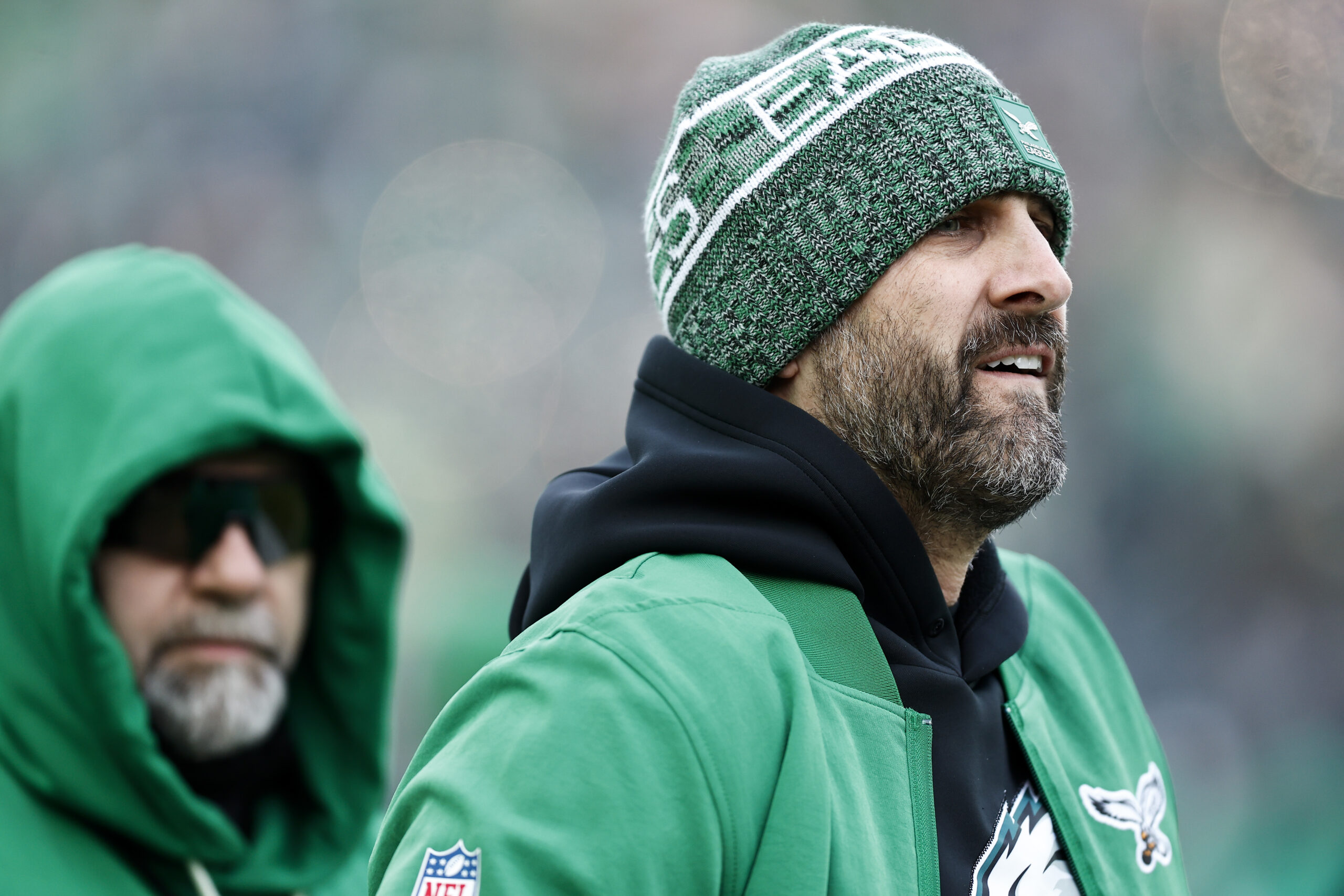
Nick Sirianni has the best winning percentage and third most wins of any coach in Eagles franchise history. The NFL’s coaching carousel
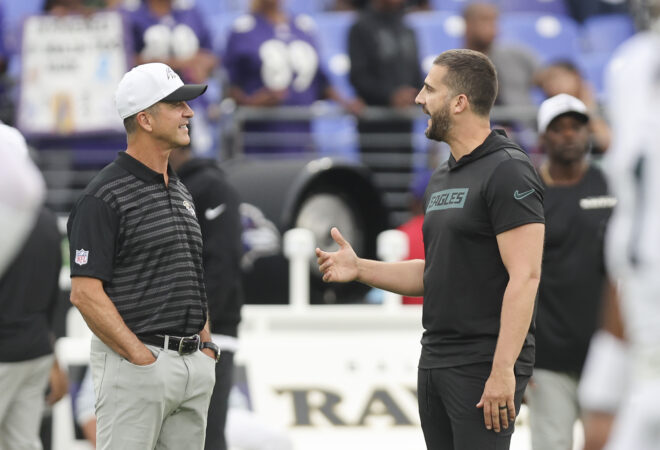
This week, including Black Monday, saw several NFL head coaches fired. Mike McDaniel and Kevin Stefanski, excused from their duties with the Miami Dolphins and Cleveland Browns, respectively, headline a lengthy list of talented play callers, but no name looms quite as large as John Harbaugh.
Let go on Tuesday after 18 years with the Baltimore Ravens, Harbaugh, the former Super Bowl winner and AP Coach of the Year, will be a hot commodity.
Nick Wright, host of Fox Sports’ First Things First, believes that if the Eagles struggle Sunday, Howie Roseman could boot Sirianni for a chance at landing the newly single Harbaugh.
“If Philly loses in bad fashion, I think that is the exact type of perfect fit for Harbaugh,” Wright said. “Harbaugh, I don’t want to say he’s not a schematics guy, but he’s not an offensive coordinator or a defensive coordinator, he’s a culture CEO head coach. Howie Roseman wants to pick the coordinators anyway. He’s not going to be in the offensive game plan the way some of these young, brilliant head coaches would want to be as it is. We have seen them be very bold with championship-caliber and championship-winning head coaches.”
“I do think Jeffrey Lurie and Howie Roseman are the type of people that will say, ‘Is he better?’” Wright finished. “If we can get the guy who’s better, shouldn’t we do that? I just think they are fearless in that.”
If firing Sirianni a year after winning the Super Bowl for a coach that last saw playoff success during the Barack Obama presidential administration sounds ludicrous, just remember that Wright is the same guy who picked the Chiefs to three-peat and said the Eagles had a “Jalen Hurts problem.”
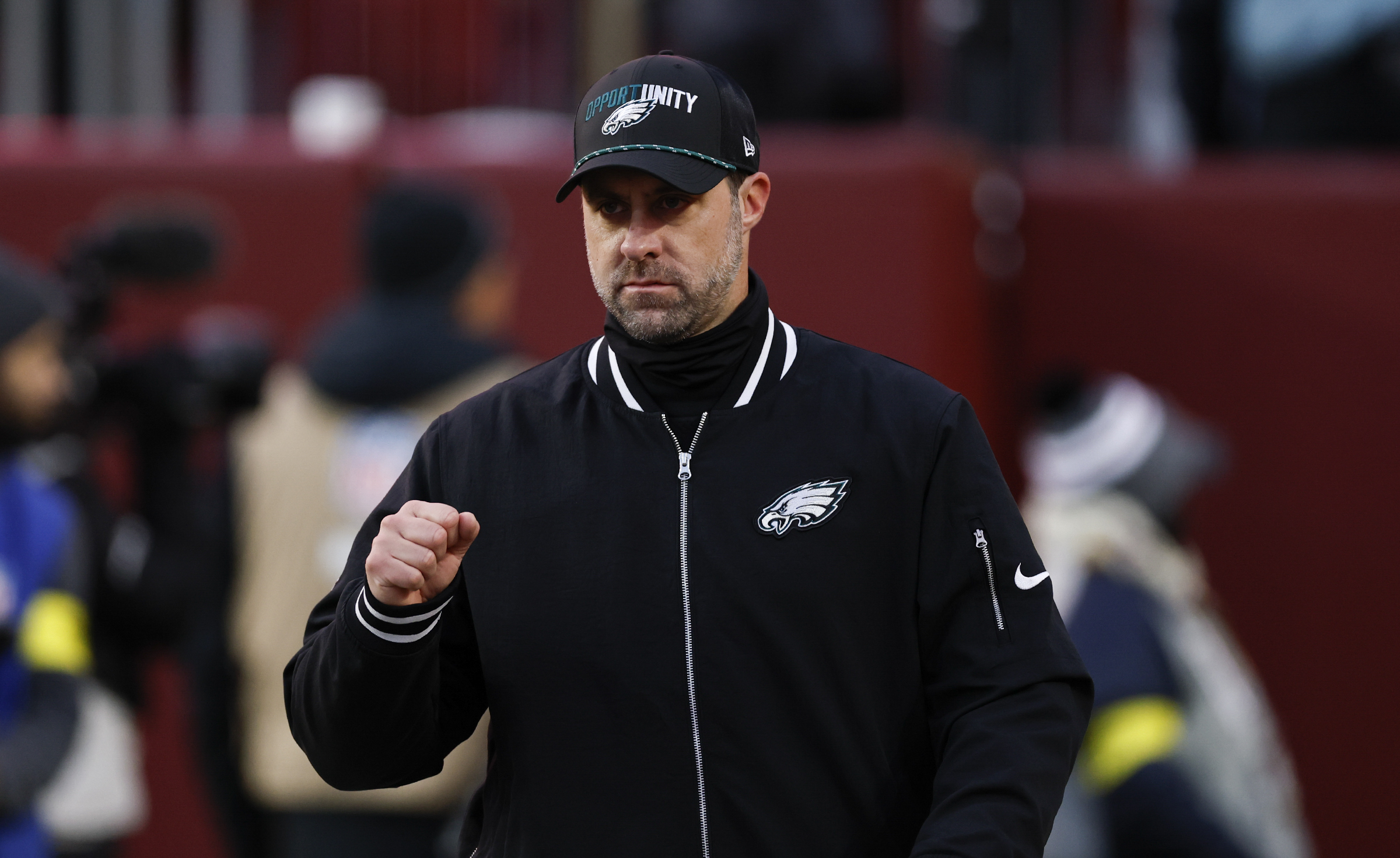
Kevin Patullo is in his first season as the Eagles offensive coordinator. ESPN’s Jeremy Fowler also believes a coaching shakeup may be in Philadelphia’s future, with many around the league questioning Kevin Patullo’s job security after a difficult year as the Birds’ play caller.
“Some around the league are wondering about the future of Kevin Patullo because of the offense’s struggles,” Fowler wrote. “Patullo has clout in Philadelphia because of his strong relationships with key players and a long-standing position as a Nick Sirianni confidant. The offensive line’s quality of play has certainly not been the same as last year’s, which is bad timing for Patullo. The offense ranks 24th in yards per game, which is tough considering the overall talent of the group.”
Patullo might not be the only assistant coach on his way out, with Fowler also reporting that certain defensive coaches might have earned themselves a promotion elsewhere.
“Additionally, defensive backs coach Christian Parker should be in the mix on the coordinator carousel,” Fowler wrote. “Teams are intrigued by him. And defensive line coach Clint Hurtt has coordinator experience and has helped in developing DTs Jalen Carter and Jordan Davis, which could lead to opportunities elsewhere.”
Resting was the right decision?
The Eagles’ offense has been the team’s biggest question mark throughout the season. So when Sirianni announced that the team’s offensive starters would sit out the Eagles’ Week 18 matchup vs. the Commanders, it drew plenty of criticism — especially with the No. 2 seed still on the line.
Following the team’s 24-17 loss to the Josh Johnson-led Commanders, criticism intensified even further, but not in the mind of Hall of Fame quarterback and two-time MVP Kurt Warner. Speaking on ESPN’s The Rich Eisen Show, Warner explained his belief that, despite the offense’s inadequacies, fewer reps and more rest was the right way to go.
“Sometimes it pays such huge dividends early in the playoffs when you get a chance to rest and recover,” Warner said. “When other teams are beat up and going through physical games, I just think that lends itself to the advantage for the Philadelphia Eagles, even though I’m with you, I don’t know what we’re going to get from the offense. I don’t know what they’re going to try to do offensively, but San Francisco’s defense hasn’t been great. They haven’t been able to get pressure, giving up some yards in the run game.
“So I just feel like, from a matchup standpoint, as struggling as this Philly offense has been I feel like it’s a good matchup for Philly against that defense to start the playoffs.
-

Trump appears to back away from threats to Colombia’s president
BOGOTÁ — Two days after publicly weighing an invasion of Colombia, President Donald Trump appeared to call it off on Wednesday night.
He said he had spoken to an erstwhile nemesis, Colombian President Gustavo Petro. Trump had previously called Petro a “drug leader” who “better watch his ass.” But after the Wednesday night call, Trump wrote on Truth Social: “I appreciated his call and tone.” The two men agreed to meet in Washington.
It was the most recent jolt to one of the Western Hemisphere’s closest relationships. Days earlier, when Trump said that invading Colombia “sounds good to me,” he was threatening to attack a top recipient of U.S. military assistance.
On Thursday morning, as tensions appeared to ease, Petro reflected on the call, which he said in an X post was brokered by Sen. Rand Paul (R., Ky.) and lasted for 55 minutes.
“I know that President Trump doesn’t agree with me, but it’s more convenient to start a dialogue … than to settle it on battlefields,” he wrote.
No country in Latin America has a closer partnership with the Pentagon. The two countries share intelligence daily; U.S. military liaisons are fixtures in Colombia’s Defense Ministry; and the United States has vetted specialized units within Colombia’s military and police, according to past statements by both governments.
Yet, as the relationship between Trump and Petro deteriorated, the countries found themselves in the bizarre position of historic partners whose leaders were acting as if preparing for war.
In the wake of the U.S. seizure of Venezuelan President Nicolás Maduro, analysts and Colombian officials said they couldn’t entirely discount Trump’s threats to Colombia, even though they seemed profoundly unlikely. Trump called Petro a “sick man who likes making cocaine and selling it.”
In response, Petro said he was preparing his “people” to defend him “from any illegitimate violent act.” A former rebel, he said in a post on X that “for the sake of the fatherland I will take up weapons again.” He sent 30,000 troops to the Venezuela border.
Colombia’s Foreign Ministry did not respond to requests for comment. On Tuesday, the country’s foreign minister, Rosa Villavicencio, said at a news conference that it would respond militarily to any U.S. “aggression.”
“For that, we have a very well-trained army,” Villavicencio said.
The threat of war between the two allies “boggles the mind,” said Adam Isacson, the head of the defense oversight program at the Washington Office on Latin America, a think tank.
“These two countries have had an intimate relationship going back to the Korean War,” Isacson said. “Colombia modeled its joint military structures after [the] U.S. It’s hard to imagine closer relations.”
Trump has frequently pointed to Colombia’s failure to crack down on cocaine exports. In 2023, a U.N. report said coca was being cultivated on 253,000 acres in Colombia, a record high. It was more than half of the global coca crop. On the Wednesday night call, Petro said he “laid out my policy against the narcos that spans nearly 20 years.”
While experts say Petro’s drug policy does bear some responsibility for that growth, there is no evidence that he is complicit in the trafficking of drugs. Still, Trump had appeared to be modeling his accusations against Petro after the drug case the Justice Department built against Maduro, which culminated in a 25-page indictment.
“He better wise up or he’ll be next,” Trump said of Petro last month, suggesting to target Colombia in a possible expansion of the military buildup and antidrug trafficking operations directed at Venezuela.
Petro had been seen by some as having gone out of his way to antagonize Trump over the past year. In September, he spoke at a protest in New York City about the immorality of some U.S. military missions.
“I ask all soldiers in the United States Army not to point their rifles at humanity,” Petro said through a megaphone. “Disobey Trump’s order! Obey the order of humanity!” The U.S. said it later suspended his visa.
It was the kind of spectacle that many Colombians saw as a political stunt — an effort by Petro to use his vocal opposition to Trump to animate his leftist base. Petro has announced a national demonstration in Bogotá on Wednesday in response to Trump’s comments and “to defend national sovereignty.”
Petro’s term expires later this year, and Colombia’s constitution does not allow him to seek a second consecutive term — another reason many here had doubted that Trump would attempt to capture him. In his Truth Social post on Wednesday, Trump said the White House meeting between the two men would take place in the “near future.”
Petro wrote on X: “Now we have to see the consequences of the reestablishment of diplomatic conversation.”
If that meeting goes poorly — which some experts expect it might — Trump’s threats against Petro could affect the next Colombian election, which will take place in May. Already, opponents of Petro’s coalition are arguing that the next president should be someone who won’t antagonize the U.S., given the political and economic risks.
“Right and center-leaning candidates are telling voters that Petro has been derelict in managing the country’s most important bilateral relationship,” said Elizabeth Dickinson, the deputy director for Latin America at International Crisis Group.
Iván Cepeda, the candidate who will represent Petro’s coalition, has rebuffed Trump’s comments about Petro, writing on X that Colombia is not “a colony or a protectorate of the United States.”
In addition to targeting Maduro, Trump has proved increasingly willing to intervene in Latin American elections to prevent leftist candidates from winning. The candidate he endorsed in Honduras, Nasry Asfura, won the election there by a razor-thin margin after Trump suggested that he would cut aid to the country if Asfura lost.
On Monday, as if to summarize Trump’s evolving foreign policy in the region, the State Department posted on X a photo of Trump with the words: “THIS IS OUR HEMISPHERE.”
-

Denmark, Greenland envoys meet with White House officials over Trump’s call for a ‘takeover’
Denmark and Greenland’s envoys to Washington have begun a vigorous effort to urge U.S. lawmakers as well as key Trump administration officials to step back from President Donald Trump’s call for a “takeover” of the strategic Arctic island.
Denmark’s ambassador, Jesper Moller Sorensen, and Jacob Isbosethsen, Greenland’s chief representative to Washington, met on Thursday with White House National Security Council officials to discuss a renewed push by Trump to acquire Greenland, perhaps by military force, according to Danish government officials who were not authorized to comment publicly and spoke on the condition of anonymity.
The White House did not respond to a request for comment about the meeting.
The envoys have also held a series of meetings this week with American lawmakers as they look to enlist help in persuading Trump to back off his threat.
Secretary of State Marco Rubio is expected to meet next week with Danish officials.
Trump, in a New York Times interview published Thursday, said he has to possess the entirety of Greenland instead of just exercising a long-standing treaty that gives the United States wide latitude to use Greenland for military posts.
“I think that ownership gives you a thing that you can’t do with, you’re talking about a lease or a treaty. Ownership gives you things and elements that you can’t get from just signing a document,” Trump told the newspaper.
The U.S. is party to a 1951 treaty that gives it broad rights to set up military bases there with the consent of Denmark and Greenland.
Meanwhile, Vice President JD Vance told reporters that European leaders should “take the president of the United States seriously” as he framed the issue as one of defense.
“What we’re asking our European friends to do is take the security of that landmass more seriously, because if they’re not, the United States is going to have to do something about it,” Vance said.
In a floor speech Thursday, Sen. Lisa Murkowski (R., Alaska) warned that the rhetoric from some in the Trump administration is “profoundly troubling.”
“We’ve got a lot ahead of us in 2026,” Murkowski said. “Greenland — or taking Greenland, or buying Greenland — should not be on that list. It should not be an obsession at the highest levels of this administration.”
Danish officials were hopeful about the upcoming talks with Rubio in Washington.
“This is the dialogue that is needed, as requested by the government together with the Greenlandic government,” Danish Defense Minister Troels Lund Poulsen told Danish broadcaster DR.
The island of Greenland, 80% of which lies above the Arctic Circle, is home to about 56,000 mostly Inuit people.
Vance criticizes Denmark
Vance said on Wednesday that Denmark “obviously” had not done a proper job in securing Greenland and that Trump “is willing to go as far as he has to” to defend American interests in the Arctic.
In an interview with Fox News, Vance repeated Trump’s claim that Greenland is crucial to both the U.S. and the world’s national security because “the entire missile defense infrastructure is partially dependent on Greenland.”
He said the fact that Denmark has been a faithful military ally of the U.S. during World War II and the more recent “war on terrorism” did not necessarily mean they were doing enough to secure Greenland today.
“Just because you did something smart 25 years ago doesn’t mean you can’t do something dumb now,” Vance said, adding that Trump “is saying very clearly, ‘you are not doing a good job with respect to Greenland.’”
Right to self-determination
Earlier, Rubio told a select group of U.S. lawmakers that it was the Republican administration’s intention to eventually purchase Greenland, as opposed to using military force.
“Many Greenlanders feel that the remarks made are disrespectful,” Aaja Chemnitz, one of the two Greenlandic politicians in the Danish parliament, told The Associated Press. ”Many also experience that these conversations are being discussed over their heads. We have a firm saying in Greenland, ‘Nothing about Greenland, without Greenland.’”
She said most Greenlanders “wish for more self-determination, including independence” but also want to “strengthen cooperation with our partners” in security and business development as long as it is based on “mutual respect and recognition of our right to self-determination.”
Chemnitz denied a claim by Trump that Greenland is “covered with Russian and Chinese ships all over the place.”
Greenland is “a long-standing ally and partner to the U.S. and we have a shared interest in stability, security, and responsible cooperation in the Arctic,” she said. “There is an agreement with the U.S. that gives them access to have bases in Greenland if needed.”
France’s President Emmanuel Macron has denounced the “law of the strongest” that is making people “wonder if Greenland will be invaded.”
In a speech to French ambassadors at the Elysee presidential palace on Thursday, Macron said: “It’s the greatest disorder, the law of the strongest, and everyday people wonder whether Greenland will be invaded, whether Canada will be under the threat of becoming the 51st state (of the United States) or whether Taiwan is to be further circled.”
He pointed to an “increasingly dysfunctional” world where great powers, including the U.S and China, have “a real temptation to divide the world amongst themselves.”
The United States is “gradually turning away from some of its allies and freeing itself from the international rules,” Macron said.
Surveillance operations for the U.S.
“Greenland belongs to its people,” Antonio Costa, president of the European Council, said on Wednesday. “Nothing can be decided about Denmark and about Greenland without Denmark, or without Greenland. They have the full solid support and solidarity of the European Union.”
The leaders of Canada, France, Germany, Italy, Poland, Spain and the U.K. joined Denmark’s Prime Minister Mette Frederiksen on Tuesday in defending Greenland’s sovereignty in the wake of Trump’s comments about Greenland, which is part of the NATO military alliance.
After Vance’s visit to Greenland last year, Danish Foreign Minister Lars Løkke Rasmussen published a video detailing the 1951 defense agreement between Denmark and the U.S.. Since 1945, the American military presence in Greenland has decreased from thousands of soldiers over 17 bases and installations on the island, Rasmussen said, to the remote Pituffik Space Base in the northwest with some 200 soldiers today. The base supports missile warning, missile defense and space surveillance operations for the U.S. and NATO.
The 1951 agreement “offers ample opportunity for the United States to have a much stronger military presence in Greenland,” Rasmussen said. “If that is what you wish, then let us discuss it.”
‘Military defense of Greenland’
Last year, Denmark’s parliament approved a bill to allow U.S. military bases on Danish soil. The legislation widens a previous military agreement, made in 2023 with the Biden administration, where U.S. troops had broad access to Danish air bases in the Scandinavian country.
Denmark is moving to strengthen its military presence around Greenland and in the wider North Atlantic.
Last year, the government announced a 14.6 billion-kroner ($2.3 billion) agreement with parties including the governments of Greenland and the Faroe Islands, another self-governing territory of Denmark, to “improve capabilities for surveillance and maintaining sovereignty in the region.”
The plan includes three new Arctic naval vessels, two additional long-range surveillance drones and satellite capacity.
Denmark’s Joint Arctic Command, headquartered in Nuuk, is tasked with the “surveillance, assertion of sovereignty and military defense of Greenland and the Faroe Islands,” according to its website. It has smaller satellite stations across the island.
The Sirius Dog Sled Patrol, an elite Danish naval unit that conducts long-range reconnaissance and enforces Danish sovereignty in the Arctic wilderness, is also stationed in Greenland.
-

Noah Juulsen is the next man up for the banged-up Flyers; Scott Laughton returns ‘home’ to Philly
The Flyers’ defense will be missing a key piece on Thursday.
Jamie Drysdale left in the second period on Tuesday after a cheap hit well away from the puck by Anaheim Ducks forward Ross Johnston. He did not practice on Wednesday or participate in Thursday’s morning skate.
“You hate to see a teammate go down like that. And even when the stretcher comes out,” said Emil Andrae, Drysdale’s defensive partner. Drysdale was able to skate off with help and ultimately did not need the stretcher.
“Usually what happens, I think it pumps up the team a little bit, because you get mad when a guy does that to you, and all you want to do is — hopefully Jamie is fine — but you want to win that game.”
The Flyers did, beating the Ducks and former prospect Cutter Gauthier, whom Drysdale was acquired for. They carry a two-game winning streak and a five-game home point streak into Thursday’s matchup against the Toronto Maple Leafs (7 p.m., NBCSP).
Drysdale has been a key piece to the defense, building up his defensive chops after being heralded for his offensive game in his draft year and early NHL days. Andrae will now partner with Noah Juulsen, who has played in 28 of the Flyers’ 41 games but only once since Rasmus Ristolainen returned.
“Obviously, I’m here for a reason,” said Juulsen, who is seventh on the depth chart and plays a steady defensive-defenseman style. “The coaches know what I bring. The team knows what I bring. So I think that’s the biggest thing. You don’t have to do anything special. Just go out there and play my game.”

Emil Andrae says playing with Noah Juulsen may give him a little more freddom to jump into the play offensively. Andrae and Juulsen played 99 minutes, 29 seconds together this season, before the former was paired up with Drysdale. Juulsen sees more confidence in the Swede as he grows in NHL experience.
“I want to join the rush,” said Andrae, who is a puck-moving buleliner like Drysdale. “But in this pairing, I can probably do it more, so hopefully I can start doing that a little bit more, since I know his strength is in the defensive zone.
“My strength is the offensive zone, maybe we can balance together there, but I think just read off each other and just play the way we played before.”
Laughton returns
Scott Laughton was back in Philly with the Maple Leafs in November. At the time, he was inching his way closer to a return from a lower-body injury and watched the game, a 5-2 loss for the Flyers, from the press box.
Now he’ll get a true return as he suits up on Thursday for his first game back in Philly, a place he says “feels like a second home” after being traded alongside two middle-round picks last March for Nikita Grebenkin and a future first-rounder. A 2012 first-round pick by the Flyers, Laughton had 106 goals and 159 assists in 661 regular-season games with another 10 points in 24 playoff games across his tenure.

Scott Laughton played parts of 12 seasons with the Flyers. On Thursday, he will face them in Philly for the first time. “You never want to be hurt and anything like that. We had a couple of days here [in November], so it was nice to catch up with some people and kind of see all the people away from the game,” he said in the visitors’ locker room at Xfinity Mobile Arena.
“So yeah, it just gave me a little bit of, I guess, closure, if that’s the word for it, here. It’ll be nice. Try to get in a nap here and go from there. But, yeah, this one was circled on the calendar after I was hurt in the other one, and it’s a special place, and it means a lot to me. So it’ll mean a lot going out there and trying to beat them.”
Laughton will try not to blow at high dough or get too excited for his return. But it won’t be easy. Heavily active in the community when he was here in Philly, there will be several familiar faces in the crowd.
And there will be several across the ice for the guy sporting No. 24, like Nick Seeler, who was one of the reasons he picked that number — and a guy he said he may try to avoid during the game— and his buddy Travis Konecny.
“He’s a rat. He’s a big-time rat,” Laughton said of Konecny. “So I’m sure he’ll be chirping, but he can back it up for sure. He’s a good player and a really good friend. We grew very close with my time here, and he’s a great human being. So he’s about as big of a rat as they come.”
Breakaways
Matvei Michkov will return to the lineup after missing one game with a lower-body injury. He will be reunited with Noah Cates and will have Carl Grundström in place of Bobby Brink on the wing. Brink remains out. Tocchet said he will be fluid with Grundström and Grebenkin on that wing. … Dan Vladař (16-6-3, .910 save percentage) gets the start in net.
-

‘The most horrific thing I’ve seen:’ Authorities say a Lancaster County man stole more than a hundred skulls and bones from a historic cemetery
He stored them in the basement, authorities said — the human bones and headless torsos, the skulls and mummified feet, a skeleton with a pacemaker still attached. More than 100 pieces and parts, in all.
There were so many remains, they said, that the police officers who discovered them stopped short, stunned by what they were seeing.
Jonathan Christian Gerlach, 34, of Ephrata, is charged in what Delaware County law enforcement officials described as the most sweeping and unsettling case of its kind they have encountered: the systematic theft of human remains from Mount Moriah Cemetery, the sprawling 160-acre burial ground that straddles Philadelphia and Yeadon Borough, and the place where Betsy Ross was once interred and Civil War soldiers still lie.
“After 30 years, I can say this is probably the most horrific thing that I’ve seen,” said Yeadon Police Chief Henry Giammarco.
Authorities announced Gerlach’s arrest Thursday on charges of burglary, abuse of corpse and desecration and theft or sale of venerated objects. He is being held in jail in lieu of $1 million bail.
Inside the Delaware County District Attorney’s Office, law enforcement officials projected Gerlach’s photo — his neck covered in tattoos, a gold ring through his nose, green eyes rimmed red — onto a television screen as they outlined crimes whose scale and depravity District Attorney Tanner Rouse said were difficult to comprehend.
Prosecutors said Gerlach repeatedly broke into mausoleums and underground vaults, prying them open with tools and carrying away bodies, bones, and body parts, leaving behind desecrated graves and questions.
The thefts began last fall, authorities said, and ended after dark on Jan. 6, when Yeadon Borough detectives caught Gerlach as he was leaving the cemetery.
For weeks, the detectives had been tracking reports of vandalism and theft from at least 26 mausoleums and underground vaults inside Mount Moriah Cemetery, said Yeadon Mayor Rohan Hepkins, who sits on the cemetery’s board and who brought the case to police.
Investigators tied Gerlach to the crimes, investigators said, after his brown Toyota RAV4 began appearing on nearby license plate readers around the times the burglaries were believed to have occurred. The vehicle had never shown up on the readers before the thefts began, according to the affidavit of probable cause for Gerlach’s arrest. Records also showed his cell phone in the area.
“This was good, old-fashioned police work,” Rouse said.
On Jan. 6, detectives said they watched Gerlach walk out of the cemetery carrying a burlap sack and a crowbar. He was arrested beside his SUV, its back seat strewn with human remains. Inside the sack, detectives said, were the mummified remains of two children, three skulls, and several loose bones.
According to the affidavit, Gerlach told detectives he had used the crowbar to pry open a grave that night to steal the remains. He also admitted to taking at least 30 sets of human remains from across the cemetery, investigators said.
The next day, Jan. 7, a search of Gerlach’s home on the 100 block of Washington Avenue in Ephrata uncovered what Rouse described as the grim collection he had been amassing: remains scattered on shelves and suspended from the ceiling, some in fragments, others stitched back together.
Despite what authorities called overwhelming evidence that Gerlach committed the crimes, much remains unknown, Rouse said Thursday.
“We don’t know what he was doing with them,” he said.
Investigators have not identified a motive, and they cannot say whether Mount Moriah was the only cemetery targeted.
“There are other reports out there that we have not been able to corroborate,” Rouse said, declining to name specific locations. “And frankly, I don’t know that we ever will.”
-
N.J. adopts ‘bell-to-bell’ cell phone ban policy for public schools
Gov. Phil Murphy signed a law Thursday banning cell phones in New Jersey public schools from “bell to bell” in an effort to help students focus on learning.
New Jersey joins a growing number of states that have enacted tighter cell phone restrictions in schools to remove distractions. Pennsylvania is considering a similar measure, and 17 states have banned the devices in schools, according to ABC News.
Murphy proposed the restrictions last year during his annual State of the State address. Legislation then won bipartisan support in both houses.
During a bill-signing event at Ramsey High School in Bergen County, Murphy said the law would promote improved academic performance and student mental health.
“By getting rid of needless distractions, we are fundamentally changing our schools’ learning environments and encouraging our children to be more attentive and engaged during the school day,” Murphy said. “This is a sensible policy that will make a world of difference for our children.”
Murphy, who said he refrains from bringing his phone into meetings, borrowed a phone to use as a prop for the news conference because his was locked in his car.
“That will be locked up until I’m no longer governor,” said Murphy, who leaves office Jan. 20.
The bill was heavily endorsed by principals and teachers, who said valuable instruction time is lost when they have to direct students to put away the devices during class.
Experts say cell phones have become a growing distraction and hinder learning. Students have been using their phones to text friends and even to watch movies during class. The devices have also been used for cyberbullying.
Bans will not go into place in schools around the state, however, until next school year. The law requires the state Department of Education to develop guidelines for districts to draft polices restricting the use of cell phones and devices by students in classrooms and during the school day.
Local school boards that operate more than 600 districts across the state must then adopt a new policy. The law takes effect for the 2026-2027 school year.
Many districts in South Jersey, including Cherry Hill, Deptford, Moorestown, Washington Township, and Woodbury, already restrict cell phone use in classrooms, but the policies have not been consistently enforced and punishments vary. Some require students to store their phones in lockers all day, while others allow phones during lunch and breaks.
Some districts only require students to keep their phones turned off, while others provide locations for the devices to be stored during the school day.
Under the bell-to-bell approach of the new state law, students will not be permitted to access their phones for the entire school day.

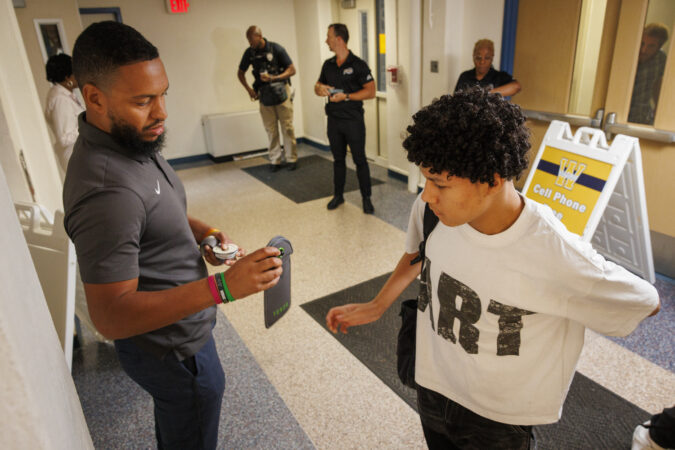
Lianah Carruolo, a seventh-grade student at Woodbury Junior-Senior High School, unlocks her cell phone pouch in September 2024. Woodbury Superintendent Andrew Bell said a cell-phone-free campus policy at Woodbury Senior High School has drastically changed the culture. There are fewer disciplinary issues and students interact more with classmates and teachers, he said.
“Students are noticeably happier, engaged and present in their classrooms, and connected to one another,” said Dwayne Dobbins Jr., acting co-principal of Woodbury Junior-Senior High School.
What happens next?
Districts must adopt policies restricting cell phones during the entire school day. That may require students to lock up the devices when they arrive or secure them in locked pouches.
In December, the state awarded nearly $1 million in grants to 86 districts under a new Phone-Free Schools Grant Program to help districts implement the policy. Schools had to agree to restrict cell phone use during the entire day.
In South Jersey, 12 districts in Burlington, Camden, and Gloucester Counties received grants. The grant amounts varied depending on the size of each district.
window.addEventListener(“message”,function(a){if(void 0!==a.data[“datawrapper-height”]){var e=document.querySelectorAll(“iframe”);for(var t in a.data[“datawrapper-height”])for(var r,i=0;r=e[i];i++)if(r.contentWindow===a.source){var d=a.data[“datawrapper-height”][t]+”px”;r.style.height=d}}});
Gloucester City Superintendent Sean Gorman said his district used a $10,823 grant to install cabinets in classrooms where students in grades 7-12 must lock up their devices when they arrive for homeroom. Younger students are instructed to leave the devices at home, he said.
“We know it’s right for kids,” Gorman said. “If you let them bury their head in their phone for a good portion of the day they will.”
Other districts, like Woodbury, have opted to use locked pouch systems to store students’ phones. They retrieve their phones at the end of the day.
In Pennsylvania, similar legislation has bipartisan support and advanced out of a Senate committee last month.
What about parental concerns?
Not everyone agrees with the bans.
Some parents have expressed concern that they will not be able to reach their children, especially in the event of an emergency. School officials say parents will still be able to contact their children through the main office.
There have also been arguments by opponents that states are overreacting with the cell phone bans and that the legislation is unlikely to have the intended impact.
But groups have parents have also mobilized to speak out against cell phone use, circulating pledges to wait until eighth grade or high school to purchase phones for their children.
Are there exceptions to the ban?
Districts will have some flexibility to allow exceptions. For example, some students use their phones for medical conditions such as glucose testing.
Exceptions may also be made for students with individual education plans or IEPs and use devices such as tablets and ear buds as part of their curriculum.
Before the law signed Thursday, some districts allowed students to retrieve their phones during breaks, in the hallways between classes or during lunch. The law no longer permits that.
Will students be penalized?
It will be left to districts to decide how policy violations should be handled. Some districts with policies already have opted for a progressive discipline approach.
Gorman said Gloucester City has had 60 violations at its high school since the new policy took effect in September, down from 130 the previous year. The school has 731 students.
First-time offenders are given a two-day, in-school suspension and their phone is confiscated, Gorman said. A second offense gets a four-day, in-school suspension; three-time offenders are given a three-day, out-of-school suspension and remanded to an alternative program, he said.
Gorman said students have largely accepted the policy. The school has had fewer disciplinary problems and conflicts typically escalated through text messages have decreased, he said.
“We barely had any repeat offenders,” Gorman said.