U.S. President Donald Trump said on Thursday his administration will “permanently pause” migration from all “Third World Countries,” following the death of a National Guard member in an attack near the White House.
The comments mark a further escalation of migration measures Trump has ordered since the shooting on Wednesday that investigators say was carried out by an Afghan national who entered the U.S. in 2021 under a resettlement program.
Trump did not identify any countries by name or explain what he meant by third-world countries or “permanently pause.” He said the plan would include cases approved under former President Joe Biden’s administration.
“I will permanently pause migration from all Third World Countries to allow the U.S. system to fully recover, terminate all of the millions of Biden illegal admissions, including those signed by Sleepy Joe Biden’s autopen, and remove anyone who is not a net asset to the United States,” he said on his social media platform, Truth Social.
Trump said he would end all federal benefits and subsidies for “non-citizens,” adding he would “denaturalize migrants who undermine domestic tranquility” and deport any foreign national deemed a public charge, security risk, or “non-compatible with Western civilization.”
White House and U.S. Citizenship and Immigration Services did not immediately respond to Reuters’ requests for comment.
Trump claims hundreds of thousands of migrants are unvetted
Earlier, officials from the Department of Homeland Security said Trump had ordered a widespread review of asylum cases approved under Biden’s administration and green cards issued to citizens of 19 countries.
The alleged gunman, identified by officials as 29-year-old Rahmanullah Lakanwal, was granted asylum this year under Trump, according to a U.S. government file seen by Reuters.
He entered the U.S. in a resettlement program set up by Biden after the U.S. military withdrawal from Afghanistan in August 2021 that led to the rapid collapse of the Afghan government and the country’s takeover by the Taliban.
In a separate post prior to his “permanently pause” announcement, Trump claimed that hundreds of thousands of people poured into the U.S. totally “unvetted and unchecked” during what he described as the “horrendous” airlift from Afghanistan.
The U.S. Citizenship and Immigration Services on Wednesday stopped processing all immigration requests relating to Afghan nationals indefinitely.
Trump pushes reverse migration
Trump indicated that his administration’s goals are aimed at significantly reducing “illegal and disruptive populations,” suggesting that measures would be taken to achieve this outcome.
“Only REVERSE MIGRATION can fully cure this situation.”
Even though Lakanwal was in the country legally, the incident bolsters Trump’s immigration agenda. Cracking down on both legal and illegal immigration has been a key focus of his presidency, and this case gave him an opportunity to broaden the debate beyond legality to include stricter vetting of immigrants.
Trump has already deployed additional immigration officers to major U.S. cities to achieve record deportation levels, including many long-term residents and individuals with no criminal record.
Over two-thirds of the roughly 53,000 people arrested by U.S. Immigration and Customs Enforcement and detained as of Nov. 15 had no criminal convictions, according to ICE statistics.
Fairmount will soon get an interpretation of Outback Steakhouse— that is, if the chain restaurant existed in a Filipino alternate universe. Chance Anies’ Manong, a word that means “elder brother” in Ilocano, the Filipino dialect of Anies’ paternal family, opens to the public on December 5.
Anies, the chef-owner behind beloved Bella Vista BYOB Tabachoy, took over the former Tela’s space at 1833 Fairmount Ave. earlier this year. It’s a huge departure from Tabachoy’s minuscule footprint of 985 square feet, and of course, from its origins as a small food truck, which Anies still owns. “Manong’s kitchen is bigger than Tabachoy,” said Anies.
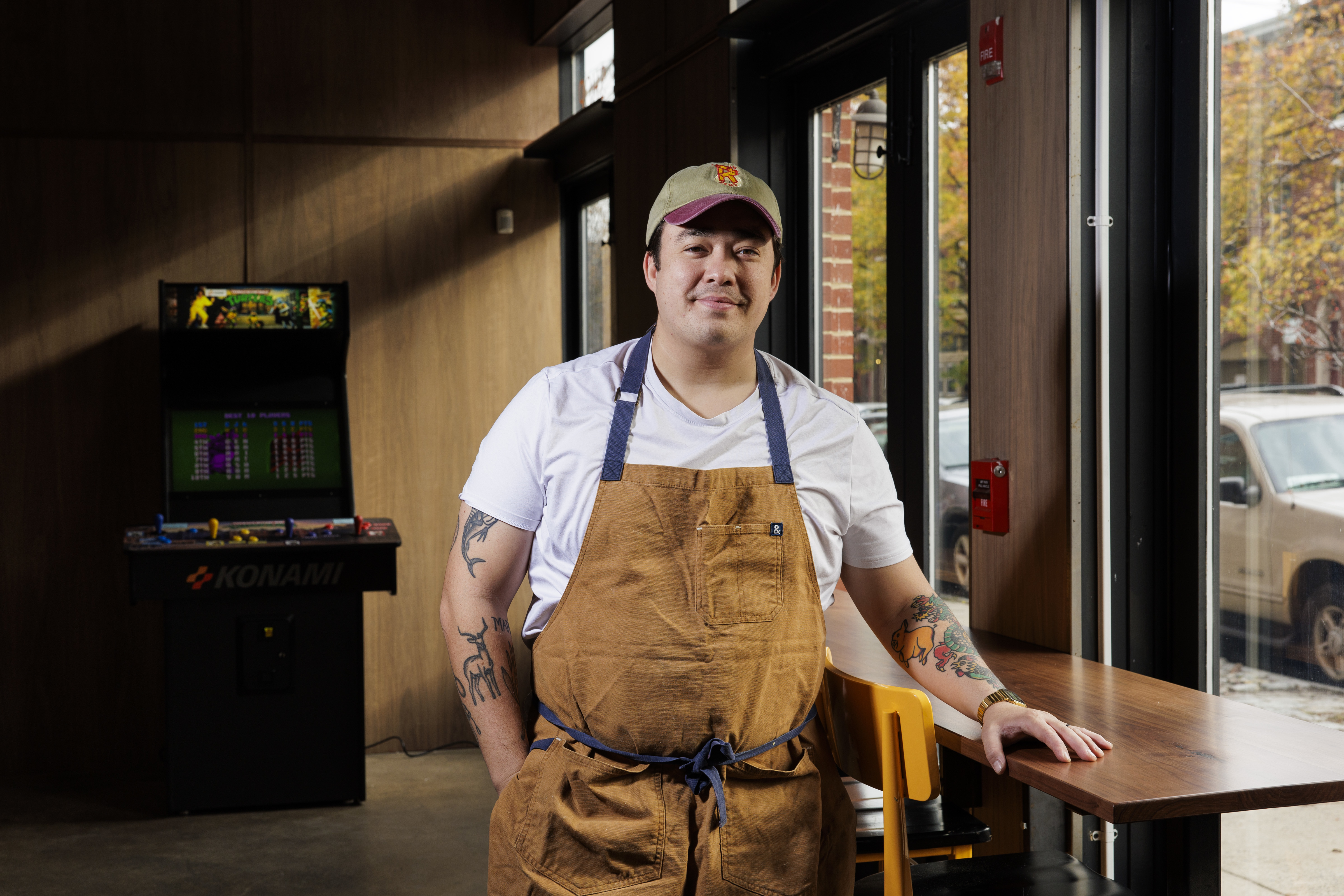
Chef Chance Anies posed for a portrait at Manong on Thursday, Nov. 20, 2025 in Philadelphia.
The dining room, which Anies had entirely renovated, seats over ninety people, including nine at its ample bar, at seats painted school bus yellow. There are globe lamps and custom-built booths, backed by forest green shiplap, and resembling the same leather-esque banquettes of a throwback, middle class steakhouse. There are also booths lining the windows, like in every diner movie that has ever been made. The dining room feels industrial, thanks to its exposed ductwork and concrete floor with veined cracks.
The front-of-house and back-of-house staff numbers around 28 people, unlike the eight, mostly part-timers that run Tabachoy.
Manong is a celebration of Anies’ ‘90s youth. Walk in through its enormous glass doors, above which their offerings are painted in orange cowboy-style font (Breakfast, Lunch, Dinner, Coffee, Bottle Shop), and on your left is a Teenage Mutant Ninja Turtles arcade game, procured from “an arcade guy in Michigan.” At Manong’s photo shoot for this article, Anies carried around a paper sack filled with Beanie Babies, given to him by his mother-in-law, as he tried to decide where to put them as decorations.
The Bloomin’ Shroom at Manong on Thursday, Nov. 20, 2025 in Philadelphia.
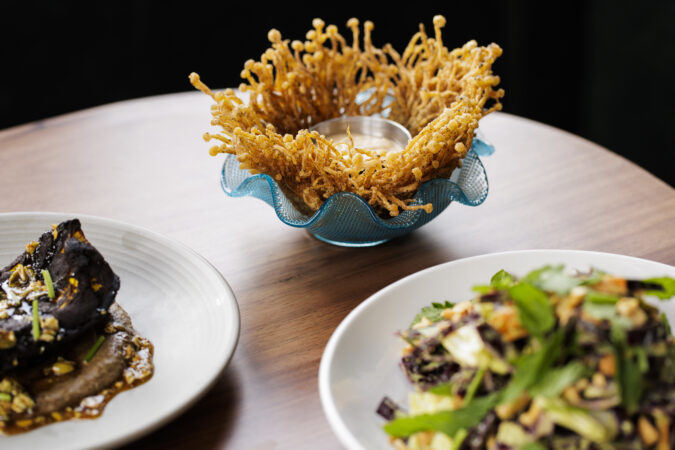
As a riff on Outback’s blooming onion, on Manong’s menu there will be a blooming mushroom, consisting of crispy enoki mushrooms tossed in cornstarch, garlic, and powdered, preserved lemon peel and arranged in a pressed glass frilled dish, mimicking a blooming effect with a ramekin of salsa rosada (a mixture of vegan mayo and housemade banana ketchup) at its center. Their Dynamite Lumpia, stuffed with pork, jalapeños, and mozzarella are enormous crispy parcels, unlike Tabachoy’s small, delicate rolls. “They’re like if a jalapeño popper married a lumpia,” said Anies.
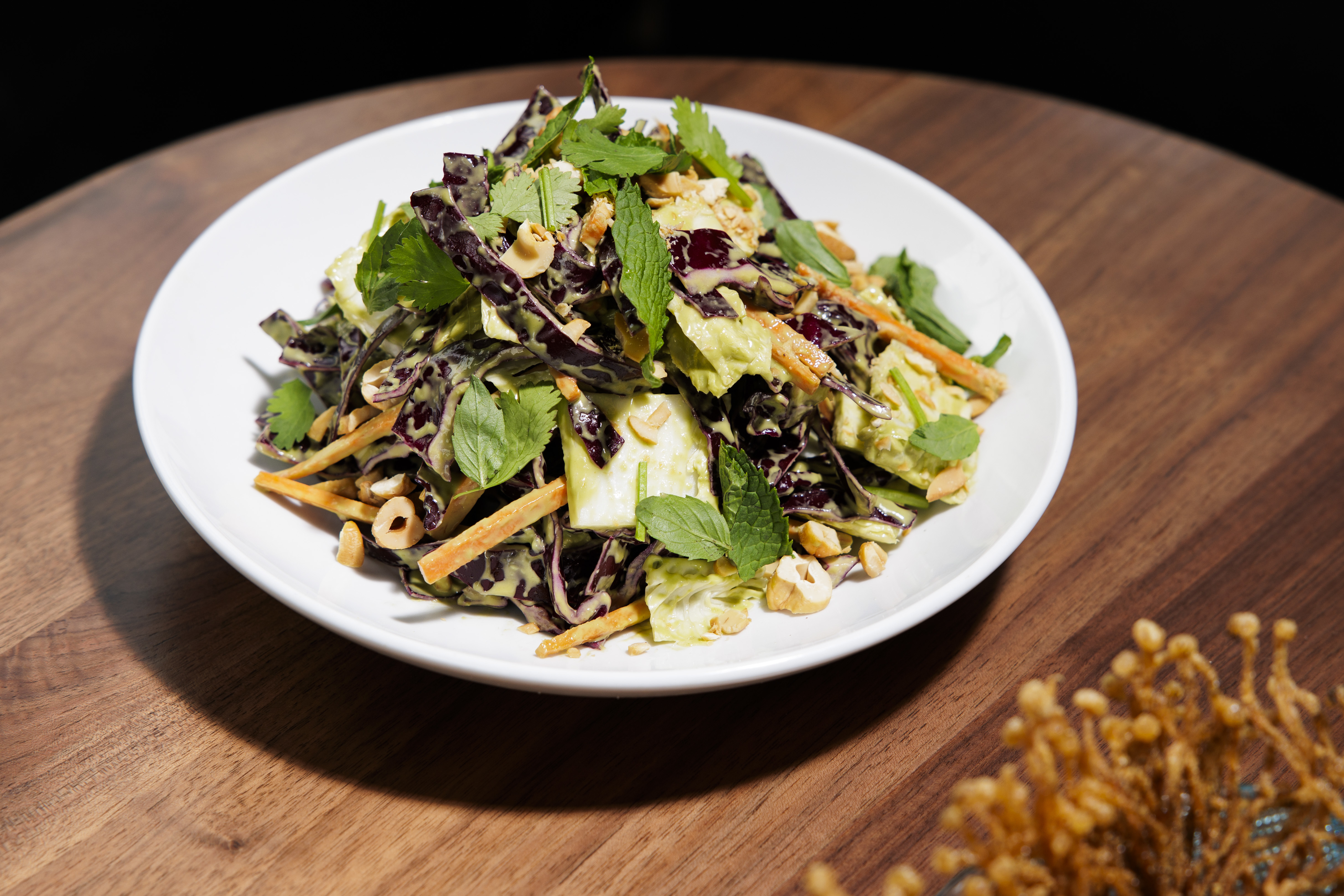
The salad at Manong on Thursday, Nov. 20, 2025 in Philadelphia.
Their house salad will feature a green goddess dressing made with canned bangus, or milkfish, a popular Filipino pantry ingredient. Anies is also making efforts to develop versions of Filipino stalwarts that are less processed, like pulverizing red rice yeast for his tocino, a sweet Filipino cured pork known for its bright red hue, typically synthetic in origin. “It’s crazy how red the red rice yeast is,” he said. “It’s like an all-natural Red 40.”
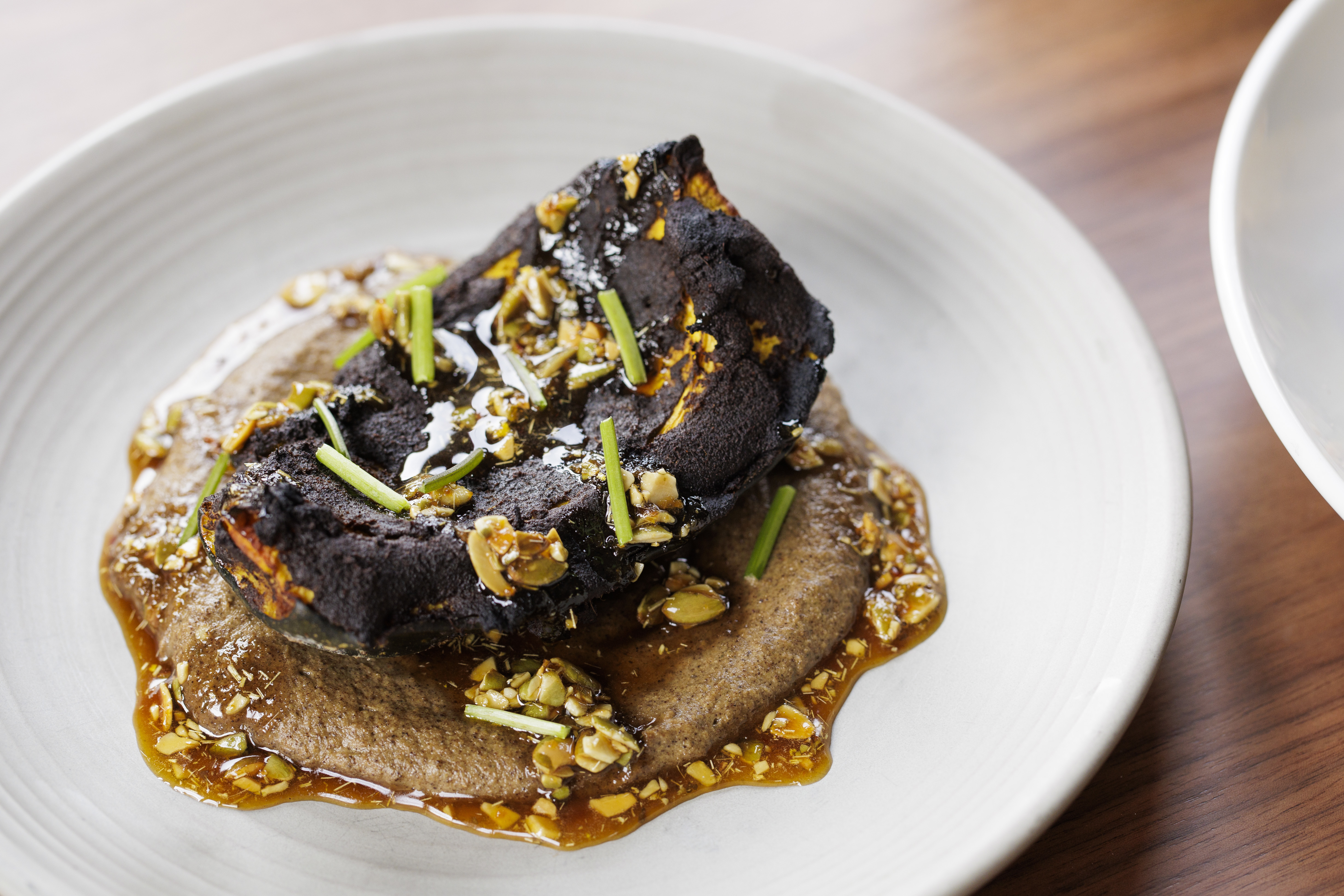
The squash at Manong on Thursday, Nov. 20, 2025 in Philadelphia.
Their Balong Burger — “Balong” is a term of endearment meaning “my boy” or “my child” in Ilocano and what Anies’ mother calls him — has a bun that echoes the pillowy Filipino loaves called pandesal and fashioned into four conjoined pieces. “The bun is sort of like connected King’s Hawaiian rolls,” said Anies. A half-pound burger patty will be sandwiches between the sliced open buns, with an option to add another patty on. It will be served with housemade banana ketchup and white American cheese. “But not Cooper Sharp. We’re not fancy over here,” said Anies.
To finish your meal, there will be homemade ube ice cream, fudgy in texture, and served in little metal dishes, along with a robust dessert menu of frozen treats like calamansi water ice.
Unlike Tabachoy, Manong has a liquor license. Expect local beers on draft from Love City and Carbon Copy, breweries that Anies developed relationships with after vending with his food truck at them for years. But there will also be Filipino Kasama rum in cocktails and served with a bottle of San Miguel beer as a “Quezon City Wide,” a nod to Anies’ father’s birthplace. Bottles of the Filipino beers San Miguel and Red Horse, an extra-strong lager brewed by San Miguel, will also be available at the bar. “But they don’t export kegs. I guess we could pour the bottles into kegs to have them on draft,” joked Anies.
And also unlike Tabachoy, where diners need to exit the front door, make a right, turn down an alley, and re-enter the building in order to go to the bathroom, Manong’s bathrooms (indeed there are now plural “bathrooms”) are accessed through the main dining room. One is papered with old magazine articles and Applebee’s-themed. The other is Outback-themed. And where did he procure the neon decor for each? “Don’t ask, don’t tell,” he responded.
Manong, to start, will be open Wednesday to Sunday from 5 p.m. to 11 p.m. They will seat guests until 9:30 p.m. as their kitchen will close before the bar does, at 10:30 p.m. Reservations are available on OpenTable.
The hairdresser had two boys, ages 4 and 12, and some time to kill before Friendsgiving brunch.
So on a chilly Thanksgiving morning, on Nov. 28, 1996, she lugged her laundry down to the basement of her West Philadelphia apartment building and loaded up the washer.
But she forgot one thing: The dryer she wanted to use wasn’t working.
Too late.
She had already plugged a quarter into the dryer’s coin slot.
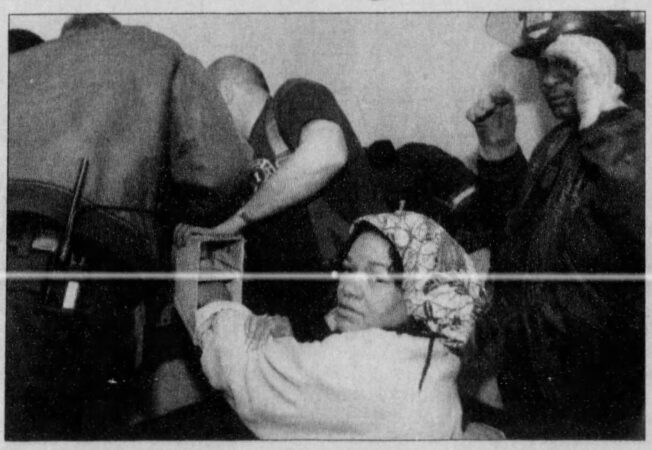
Using the ring finger on her left hand, she tried to poke the bottom of the slot to get back her 25-cent piece.
And then her finger got stuck.
Barba started to cry.
“This felt like, to her, one more thing in a long line of things that were just not going great,” Inquirer reporter Al Lubrano, who wrote the original story, said recently.
For two hours she stood in that thankless and cold laundry room, fending off pins-and-needles sensations in her hand and worrying about her boys being alone in their apartment, before a neighbor found her.
The neighbor brought a chair for Barba to stand on — to help release some of the pressure on her hand — and then called for help.
Cell phones were not yet a thing, but another neighbor kindly brought down a portable phone so Barba could call and reassure her sons.
Firefighters swooped in and cut the coin box off the machine. The machine’s operator was then called into action, and he showed up to separate the coin slot from the coin box.
“She was little bit surprised when the firefighters came and it wasn’t the end of it,” Lubrano recalled.
Her now-swollen finger needed a few dollops of petroleum jelly before slipping out of the coin slot. She did not report any permanent damage.
Lubrano asked Barba back in ’96 to sum up the whole ordeal in one word.
“Annoying,” she said.
“Like a true mom,” Lubrano said recently, “she sort of minimized it.”
And after all that, Barba went back downstairs later that night in ’96 and threw in another load of laundry— using a different dryer.
“I’m grateful to my neighbors,” Barba said, “but I missed my brunch.”
Robert A.M. Stern, 86, a leading architect over the past six decades who left his imprint on Philadelphia by designing the Comcast Center and the Museum of the American Revolution among other notable buildings, died Thursday, Nov. 27, at home in Manhattan after a brief pulmonary illness, his family said.
Mr. Stern also wrote respected architectural histories, taught at Columbia and Yale universities, and was dean of Yale’s School of Architecture from 1998 to 2016.
“Bob had a great sensitivity to urbanism in design. You can see that in Philadelphia, where his work certainly sits well where it is placed,” said developer John Gattuso, who worked closely with Mr. Stern on the Comcast Center, completed in 2008, the redevelopment of the Navy Yard, and other projects.
“He was less concerned with theatrical architecture, the gymnastics, and understood how buildings contribute to a sense of place that resonates with people,” he said. For that reason, Gattuso said, “he tended to be underappreciated.”
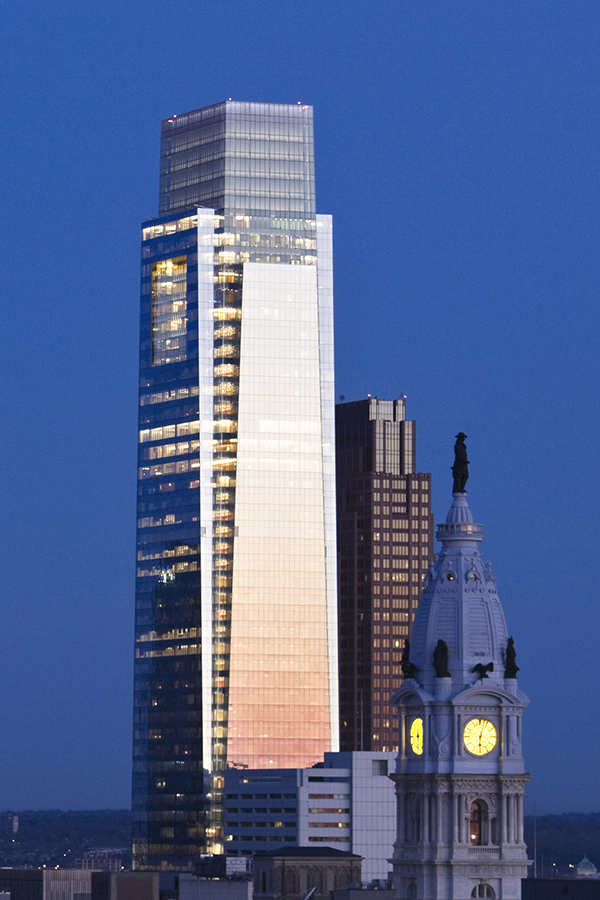
Stern and his firm designed the 975-foot Comcast Center, the headquarters for the cable and telecommunications giant, completed in 2008.
The 975-foot-tall shimmering Comcast Center, the company’s original skyscraper on JFK Boulevard, straddles the tracks and concourse of Suburban Station, a commuter gateway to the city. An airy 120-foot glass atrium connects the building to the station, providing for a dramatic arrival from below, and overlooks a public plaza.
“The Comcast Center may be his finest work in Philadelphia,” said architecture critic Inga Saffron, who writes for The Inquirer. “The scale is right. It’s not fat. It’s tapered.”
Classical indentations in the 58-story building draw the eye upward, she said. “It’s a good dignified skyscraper … Buildings like this are embedded in the city.”
Mr. Stern’s firm was also known for luxury apartment towers. In Manhattan they include 15 Central Park West, a limestone-clad condominium at the southwest corner of Central Park that was internationally hailed.
The firm’s work also includes university buildings, including the Darden School of Business at the University of Virginia; Weill Hall at the University of Michigan; and Miller Hall at the College of William & Mary in Williamsburg, Va., among many others.
In Philadelphia, Mr. Stern’s firm prepared the master plan for the Navy Yard, and designed buildings on Crescent Drive in that development and the 10 Rittenhouse condominium, as well as the American Water tower on the Camden Waterfront — and the LeBow College of Business at Drexel University.
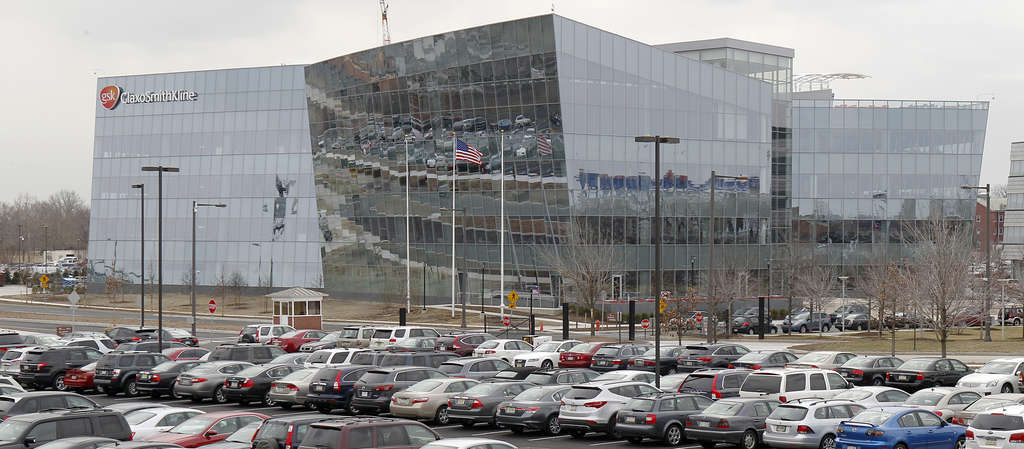
Robert A.M. Stern designed the former U.S. headquarters for GSK at Five Crescent Drive in the Navy Yard, Philadelphia. He and his associates put together the master plan for the redevelopment of the massive property.
Mr. Stern was a proponent of post-modernism, a style of architecture that incorporated classical elements. He moved further in that direction as his career went on.
Philadelphia’s Museum of the American Revolution was built in a Georgian style. But to Saffron, it was perhaps too much, and more out of place to the city.
“He embraces classicism more and more,” Saffron said. In the case of the museum, “It’s a schlocky classicism,” in contrast to the relatively modest scale of the historic buildings in Old City.
“It’s like Independence Hall on steroids,” Saffron said.
The latest Robert A.M. Stern Architects design in Philadelphia is nearing completion, a massive life sciences research building at Drexel University, on Cuthbert Street, by Gattuso Development Partners.
In an interview with the New York Times when he was 84, Mr. Stern said he still wasn’t using a computer and drew “everything by hand.”
Born in Brooklyn on May 23, 1939, Mr. Stern earned a bachelor’s degree from Columbia and a master’s in architecture from Yale. In 1966, he married photographer Lynn Gimbel Solinger, a granddaughter of Bernard Gimbel, the department store magnate. They had a son, Nicholas, and later divorced.
Mr. Stern is survived by his son, three grandchildren, and other relatives.
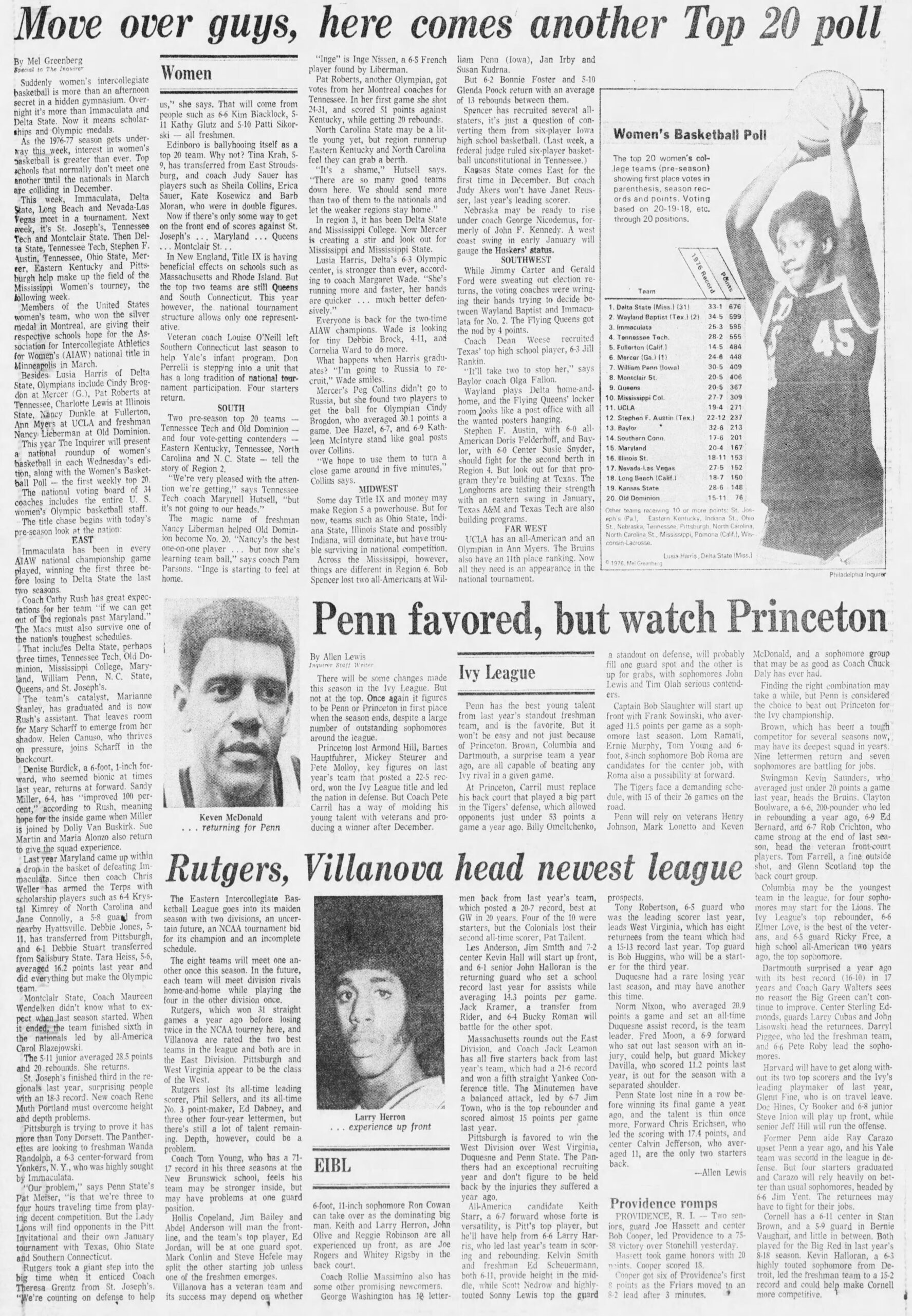
While most of America is running to stores or shopping online on Black Friday, today’s date marks a golden moment in the history of women’s college basketball.
On Nov. 28, 1976, The Inquirer’s annual college basketball preview included a story with a headline proclaiming, “Move over guys, here comes another Top 20 poll.”
Just below was a graphic of Delta State’s center Lusia Harris, the consensus national player of the year, overlooking the Top 20, complete with an added national preview.
And thus, under the stewardship of this writer, inside the Inquirer offices was born an institution that led to seismic change in terms of national attention on women’s basketball. Two years later, at the request of the College Sports Information Directors of America, the Associated Press began running those first-of-their-kind weekly rankings. This season, the poll celebrates its 50th anniversary.
A clipping from the Sunday, Nov. 28, 1976 Philadelphia Inquirer. Page 14-F featured the first edition of Mel Greenberg’s women’s basketball poll.
Just as the 50th anniversary of the Title IX landmark federal legislation bringing equal opportunity to women in collegiate sports was celebrated in 2022, so too will the poll’s 50th anniversary be celebrated all season.
Technology helped spur the poll’s growth, from the pre-NCAA era to 1981-82, when the organization started sponsoring women’s championships. (Before then, women’s championships were held by the Association for Intercollegiate Athletics for Women.) This writer handled the tabulation operation through 1993-94, which is when Connecticut began an appearance streak that totals 610 times through this week.
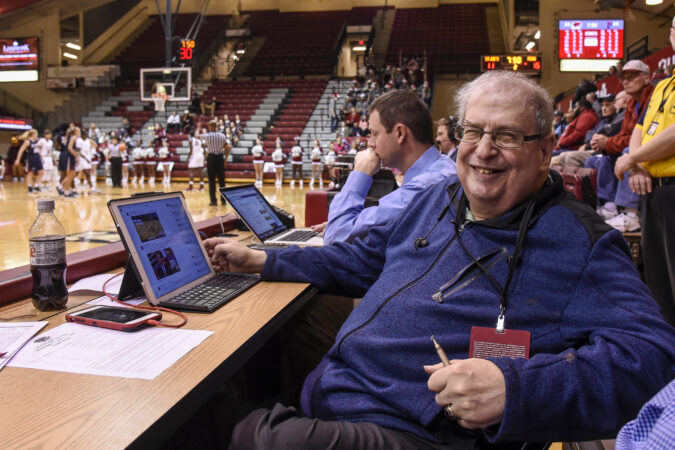
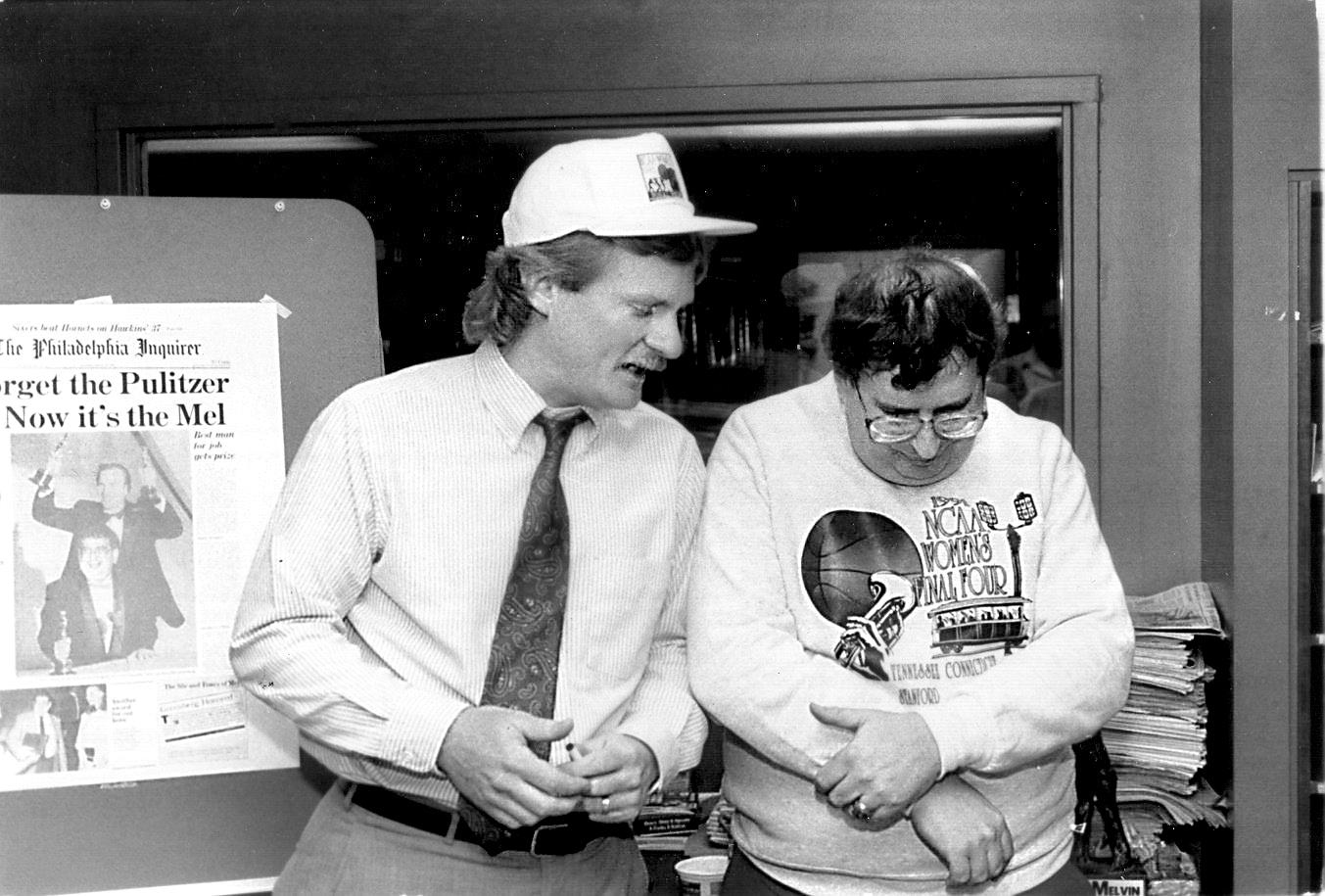
Mel Greenberg, right with former Inquirer editor William J. “Butch” Ward, inside the Inquirer offices as Greenberg is honored for winning the first Women’s Basketball Association Media Award.
Until 1994-95, coaches did the voting because writers were at a minimum nationally.
Fifty years ago, the poll was created using typewriters and $70 calculators that today cost a couple of bucks. It evolved from telerams, faxes, floppy discs, and Radio Shack TRS-80 calculators to giant hard drives, laptops, Blackberries, and, ultimately, smartphones and iPads today.
Early on, a sports media relations professional at North Carolina State called looking for information, but I wasn’t keeping records. An hour later, legendary Wolfpack coach Kay Yow, a voter, called to lecture me on the importance of preserving history.
Fortunately, Colleen Matsuhara, who phoned in then-Cal Fullerton coach Billie Moore’s vote from out West, was keeping tabs, so the first six missing weeks from the records were restored. Today, that has evolved into a spreadsheet of all polls, among other records, and this is now the 889th week of the poll.
Two people most excited about the poll creation were based here — this writer’s Temple classmate, Dick “Hoops” Weiss, the acclaimed men’s writer, and Mike Flynn, who, until recently, ran national AAU powerhouse, the Philadelphia Belles.
Way back I said one day to them, “You think I’m going to do this the next 50 years?”
They nodded in the affirmative.
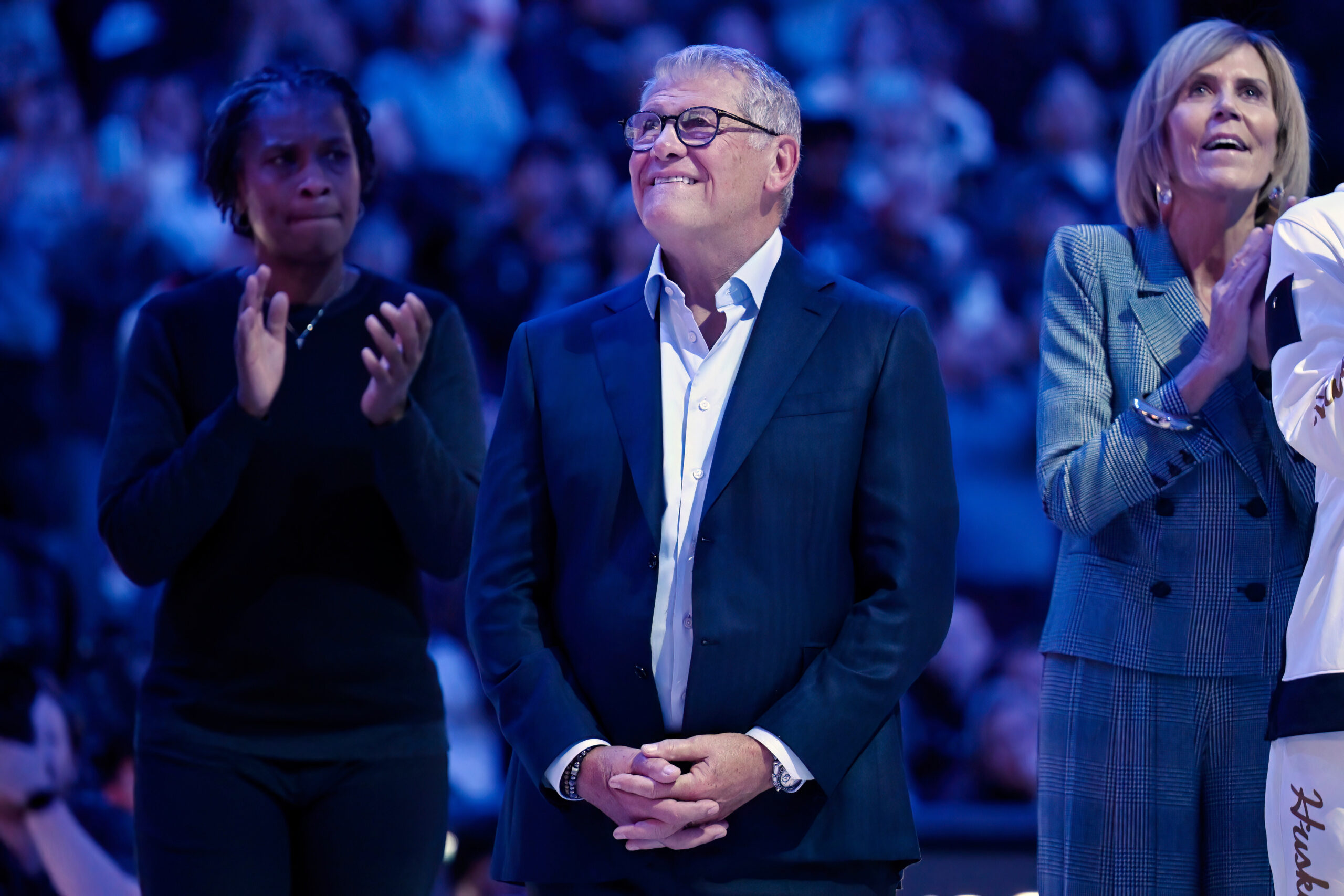
UConn head coach Geno Auriemma, center, reacts after a championship banner reveal at Gampel Pavilion on Nov. 9.
Grandpa Geno
A few years after Philadelphia hosted the Women’s Final Four in 2000, Geno Auriemma’s UConn squad was back in town to face Villanova. Over at the hotel where his Norristown posse were hanging out, Auriemma’s brother noted that perhaps some decisions would have to be made in the near future.
Two days later, UConn signed another No. 1 recruit, so he wasn’t going anywhere.
I saw his brother again shortly after that and quipped that one day someone is going to say they came to Storrs, Conn., because they like Geno’s grandfatherly ways.
Geno’s birthday is March 23, right in the middle of March Madness. Decades later, the date gets noted at an NCAA Tournament news conference, and now-WNBA standout Paige Bueckers shouts out, “Yeah, we call him Grandpa.”
The single greatest motivator in professional sports is not pride or love of the game or legacy. It’s money.
The second greatest motivator: winning.
When it comes to the Eagles, most of their offensive players seemed to have satisfied their appetite for both.
They’ve won a Super Bowl. They’ve been paid. And now, faced with a demanding schedule, playing with the residual fatigue of three postseason runs, and with everyone getting a year older, they look like a shadow of what they should be.
The Eagles don’t rank among the top half of the NFL’s teams in rushing offense, passing offense, or scoring. This, despite allotting just under $130 million of their salary cap on offense, more than twice the allotment on defense.
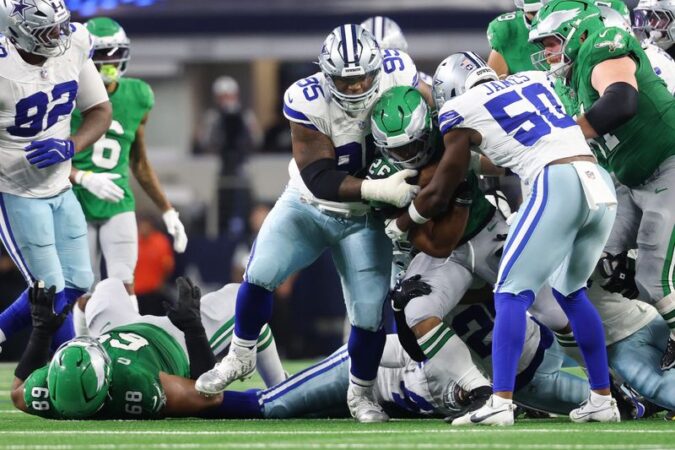
After the Eagles scored zero points for the final 41 minutes and blew a 21-0 lead at Dallas, running back Saquon Barkley said this:
“They wanted it a little more.”
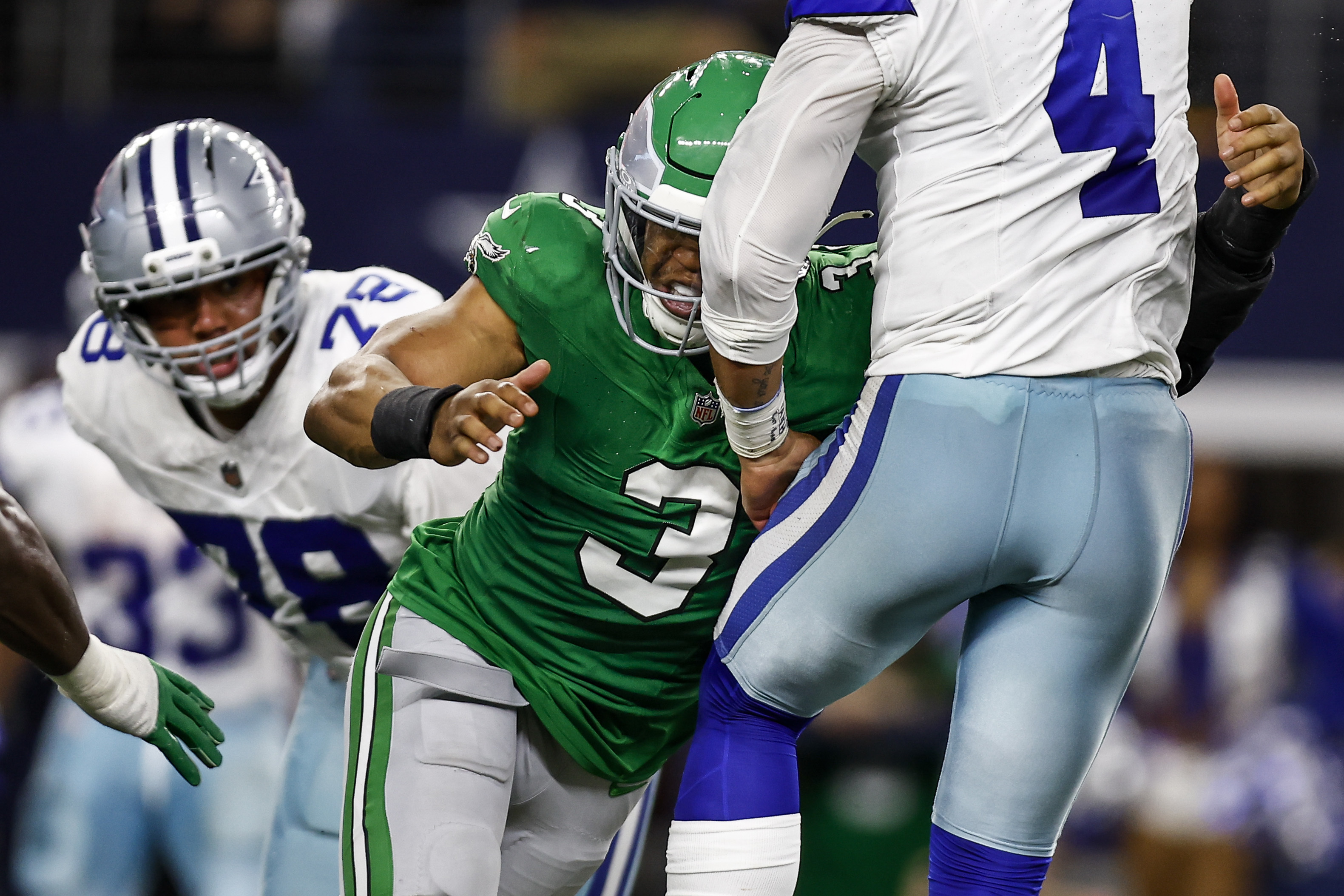
Eagles linebacker Nolan Smith wraps up Dallas Cowboys quarterback Dak Prescott in the second half of their game last Sunday.
He hit the nail on the head, and he hit it as hard as any hole he’s hit all season.
Something’s missing with the Eagles this season, especially with their offense. They lack desire. They lack motivation.
What they do not lack is money.
They’re 8-3, which isn’t bad, until you drill down and realize why they’re 8-3. They have three losses because they played flat all game against the Giants on Oct. 9 and because they didn’t show up for the second half on the road vs. Dallas (Denver, the other loss, actually is a pretty good team).
That, as the Eagles host an 8-3 Bears team ravenous for relevance on Friday, is troubling.
They’re smelling themselves, and we’ve seen this before.
Just like the 2017 team that won Super Bowl LII with Doug Pederson, the Super Bowl LIX winners and Nick Sirianni are basking in the afterglow of the title. It’s hard to blame them because it’s hard to win it all, and when you’re set for life, and you’re wearing a $50,000 ring, it’s a little bit harder to hold that backside block or finish a decoy route.
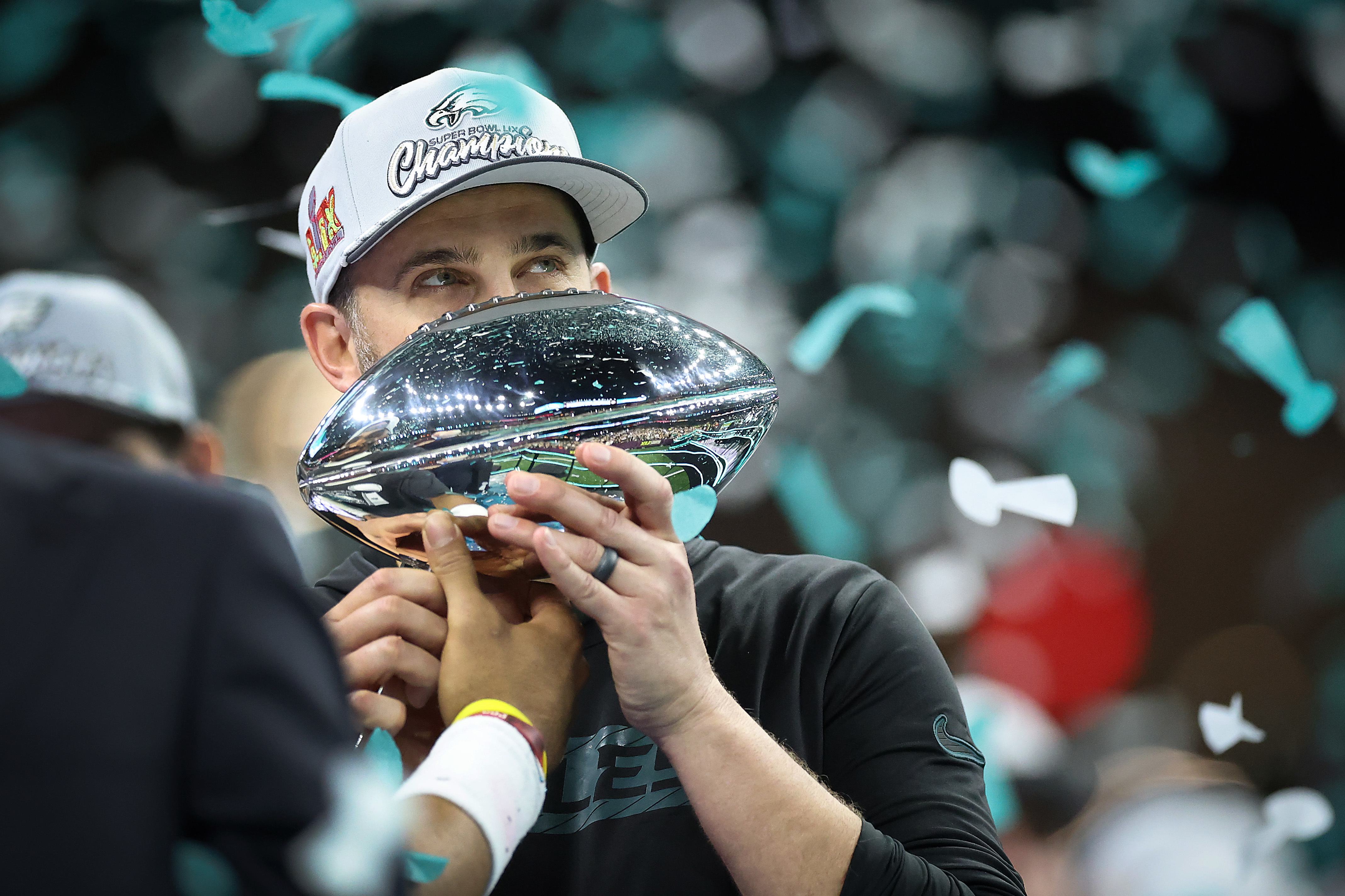
Eagles head coach Nick Sirianni kisses the Lombardi Trophy after defeating the Kansas City Chiefs in Super Bowl LIX on Feb. 9.
That’s the difference between dynasties and winners. Dynasties hold their blocks and finish their routes. Dynasties seek greatness for its own sake and are not weighed down by million-dollar pocketbooks.
Barkley, wide receiver A.J. Brown, left tackle Jordan Mailata, left guard Landon Dickerson, right tackle Lane Johnson, and quarterback Jalen Hurts are playing on what likely will be their most lucrative contract. Some got new money after the Super Bowl win. None are playing to their expected level.
The exception: wide receiver DeVonta Smith, who is on track for an excellent season.
Meanwhile, on defense, linebacker Nakobe Dean, defensive tackles Jordan Davis and Jalen Carter, and corners Quinyon Mitchell and Cooper DeJean are playing like demons. Not coincidentally, all are playing on rookie deals and are due for big raises. The exception here: sixth-year linebacker Zack Baun, who cashed in on a career season and has been elite again. At any rate, after a rocky start, a midseason infusion of talent via trade, an unretirement, and a return from injury, the defense, which led the team to the title last season, is dominant again.
The offense, meanwhile, has yet to deliver consecutive halves of proficiency against a good team. Former Eagles safety Malcolm Jenkins this week suggested to Tim McManus of ESPN.com why the Eagles seem flat: “You just won a Super Bowl. So even though you go back to the starting line, in your mind, you are a Super Bowl-caliber team, and you think you deserve, almost, to get there, even if you don’t talk about it, you might say the right things internally.”
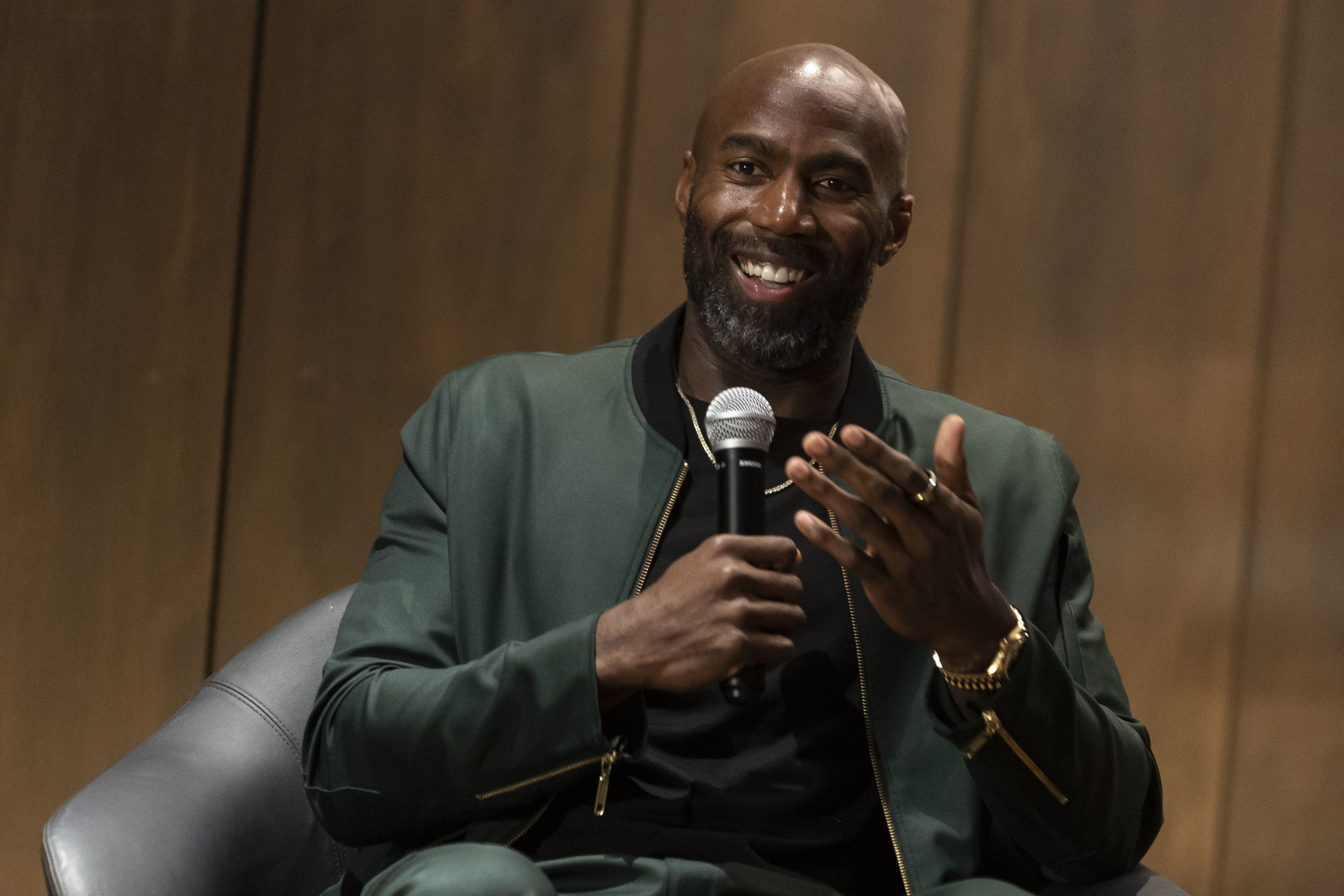
Former Eagles player Malcolm Jenkins feels the afterglow of winning a Super Bowl has contributed to the Birds’ inconsistency this season.
He wasn’t done dealing hard truths.
“A lot of times, you lie to yourself. … Everyone in the sport tells you how good you are and why they expect you to do something. And then the season comes, and you realize that this season has nothing to do with last year,” Jenkins said. “I think the faster teams get to that truth, that they’re starting at zero and [not to] take anything for granted — I think those are the teams that can repeat, that can create dynasties, and that can stand the test of time.”
One of the best barometers of efficiency is penalty count. The Eagles last season committed 103 penalties for 793 yards, which ranked 11th-fewest and fifth-fewest, respectively. Their 37 pre-snap penalties tied for seventh-fewest.
This season, they rank 26th in total penalties against, 27th in total yards against, and 25th in pre-snap penalties against. It’s getting worse: They had 14 penalties at Dallas, the most since Sirianni took over in 2021.
They are an accomplished, veteran team, but they’re playing like a rebuilding bunch of kids.
Jenkins is one of the most qualified people on the planet to say what he said.
He was one of the hardest-working, toughest, most resilient Eagles in history, and for that, he will be inducted into the team’s Hall of Fame on Friday, assuming these comments don’t put him in Jeffrey Lurie’s doghouse. Jenkins played six seasons in Philly, went to three Pro Bowls, was the team’s unquestioned leader, and, most significantly, won Super Bowls with both the Saints and the Eagles. Jenkins knows what a Super Bowl hangover looks like.
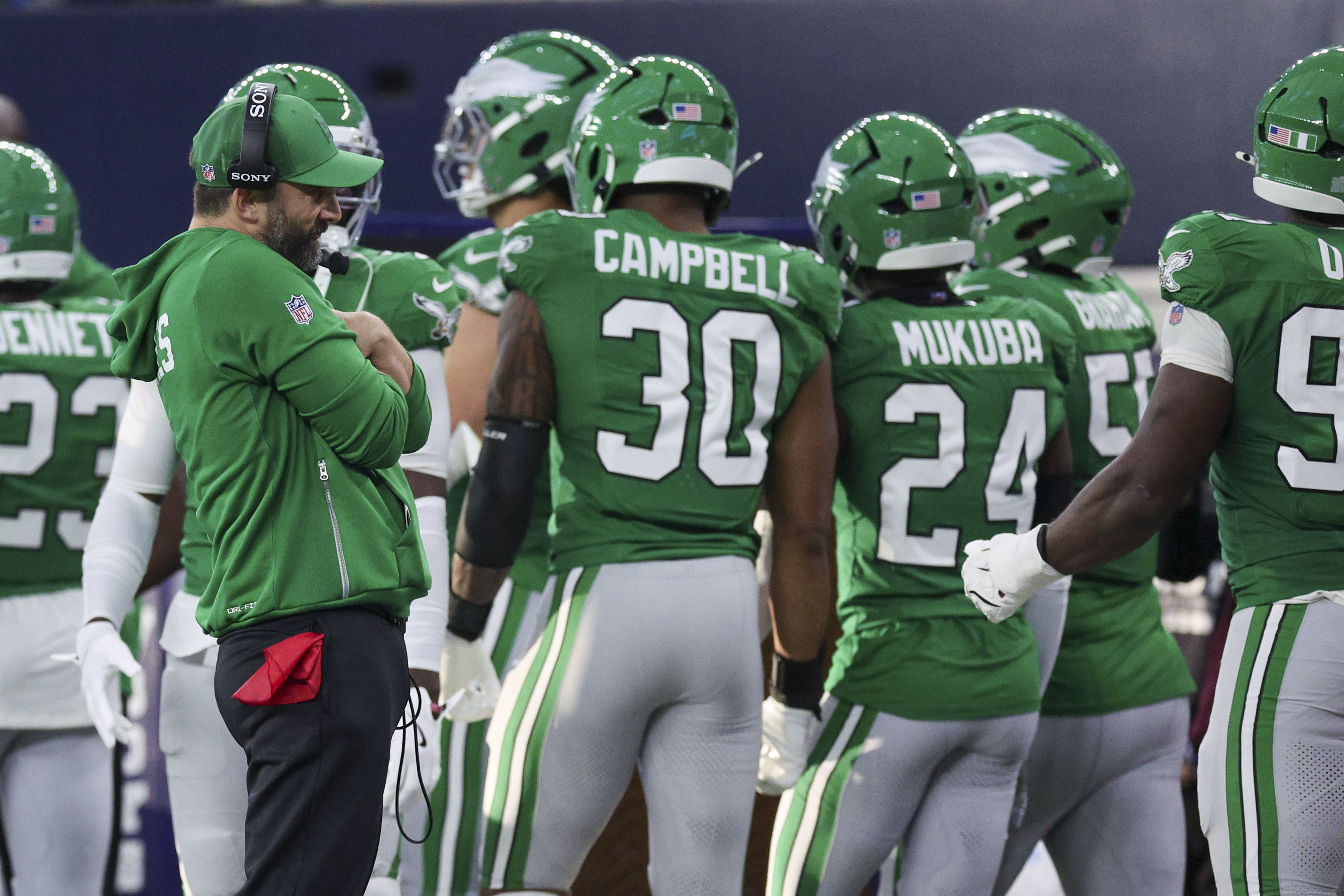
Eagles head coach Nick Sirianni, left, asserted that he felt both sides of the ball were working well in his team’s loss to the Cowboys.
Sirianni pushed back on the assertion from Barkley.
“I felt like, when I watched the tape, I saw the effort sky-high on both sides of the ball,” Sirianni said.
Wonder who else was sky-high during that film session … or some of the others this season.
Sirianni and his pithy axioms — great without the greatness of others, tough, detailed, together, flower power — have not been able to overcome this offensive malaise. Maybe there’s just too much, this time.
The Birds have, in Brown, a wide receiver who, considering his words, actions, and social media posts, clearly is more interested in burnishing his Hall of Fame prospects than simply winning.
They have, in Barkley, a running back who has stopped hitting the right holes and has started seeking the sideline — but at least he got a Wawa sandwich named after him. Consider, though, that Reggie Jackson hit 223 more homers after the “Reggie” bar came out. Saquon hasn’t hit a homer yet this year.
Saquon Barkley appears far from the form that aided his breakthrough season for the Eagles last year.
The offensive line, once a pack of stampeding rhinos bent on destroying linebackers on the second level, now can’t keep Barkley clean at the line of scrimmage.
All of these are issues of effort, not execution.
As Jenkins said, the Eagles themselves probably have not realized this. They had given no indication before Barkley’s confession on Sunday.
There’s a chance that the effort is the same. Maybe injuries have more to do with it than they’re letting on.
Barkley missed a chunk of training camp with a groin injury that has flared again recently. Brown missed most of training camp with a hamstring injury that also cost him Week 8. Dickerson has endured three injuries so far, and Johnson was hurt twice before a foot sprain sidelined him indefinitely two weeks ago. Pro Bowl center Cam Jurgens missed two games with various ailments, and, after offseason back surgery, he hasn’t been anywhere close to 100% all year.
Regardless, they’re not moving the ball.
Jalen Hurts could benefit from the ferocity the Eagles’ offensive line delivered to him last season again.
They can not afford to be this kind of team with a quarterback who is limited, as Hurts, whose unremarkable arm strength, slow release, and ponderous processing are only modestly offset by his speed, power, toughness, accuracy, and leadership. The rest of the offense has to operate at an extremely high level — holding those blocks, completing those routes, hitting those holes — to compensate for Hurts’ limitations.
There’s a chance, too, that the culprit is fatigue. Between Super Bowl runs after 2022 and 2024, plus a playoff game after 2023, the Birds have played about two more months of football than every other team except Kansas City.
And the Chiefs look pretty ragged, too.
To the Eagles’ credit, most of the offensive players who got paid last year got paid before they won the Super Bowl. When the monetary incentive disappeared, winning was enough to fuel their fire.
Now, though, they’ve won.
What, if anything, fuels their fire today?
Gameday Central: Bears at Eagles
The Eagles enter Week 13 with an 8-3 record, holding first place in the NFC East and remaining among the conference’s top contenders. They’re looking to rebound after last week’s disappointing loss to the Cowboys. Join The Inquirer’s Olivia Reiner and Jeff McLane on Gameday Central for expert analysis, insider insights & live updates. Listen live.
It’s been four years since college athletes have been able to legally profit from their name, image, and likeness.
It’s been less than 10 years since those athletes could enter the NCAA’s transfer portal without needing to redshirt. Yet, it feels like so much of what transpires is taking shape in real time, not just for the students who partake, but also for the coaches, officials, and administrators who navigate it.
College sports, specifically revenue-generating college sports, have become a year-over-year proposition for coaches to find and retain talent. The latter has become even harder, given the trend of student-athletes initially recruited to big-time schools jumping ship after not receiving what they anticipated, often to mid-majors, and becoming big fish.
Conversely, student-athletes who have outkicked their scholarships at a mid-major can enter the portal for a fresh start at a power program — and potentially a substantial payday.
But it’s been fantastic the athlete. It’s why, according to Front Office Sports, nearly 4,000 players in men’s and women’s college basketball entered the most recent transfer portal, the highest number of players in a year in the history of the NCAA.
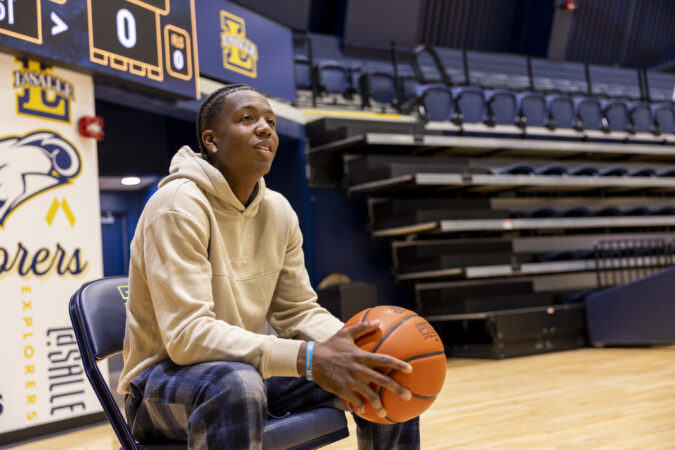
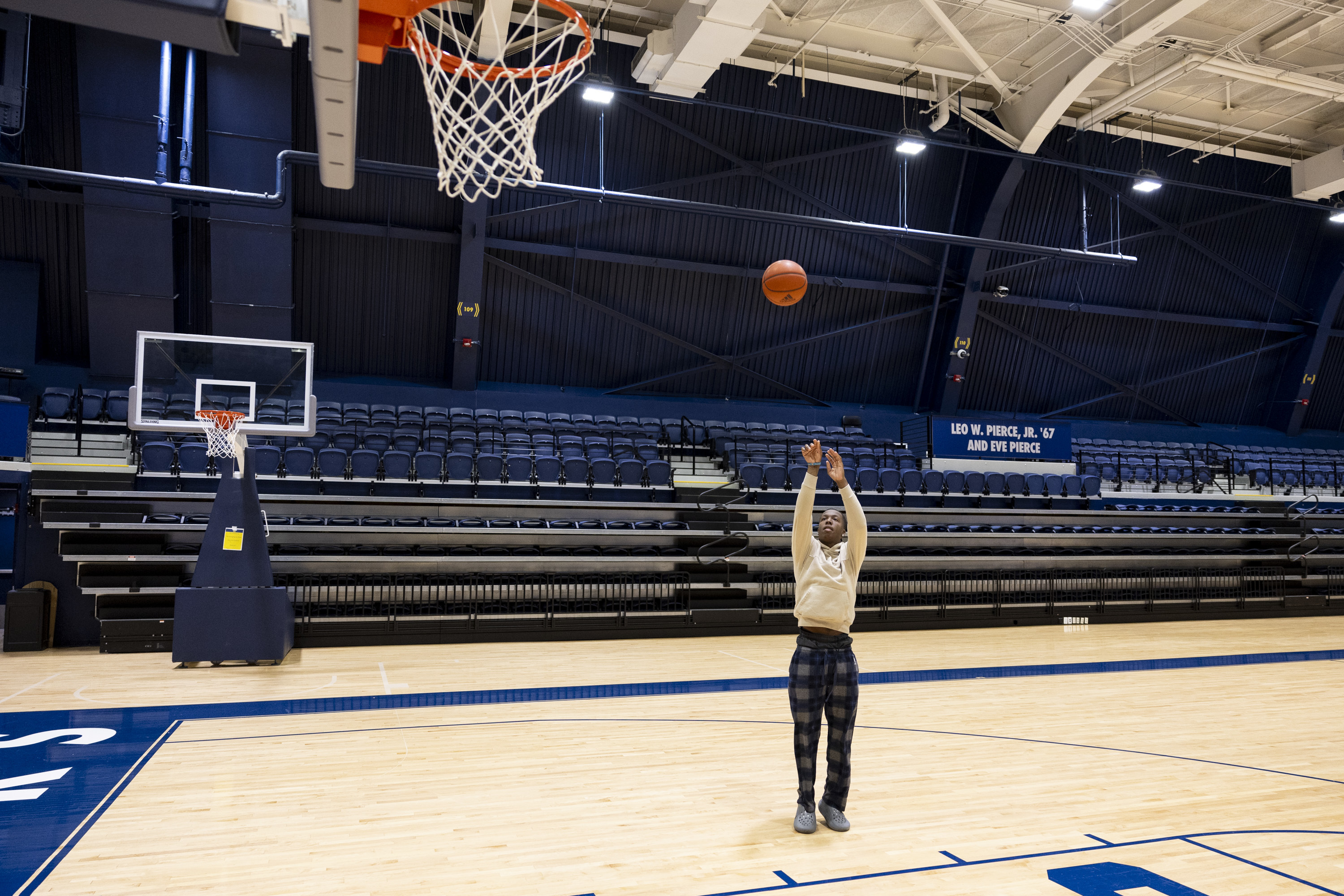
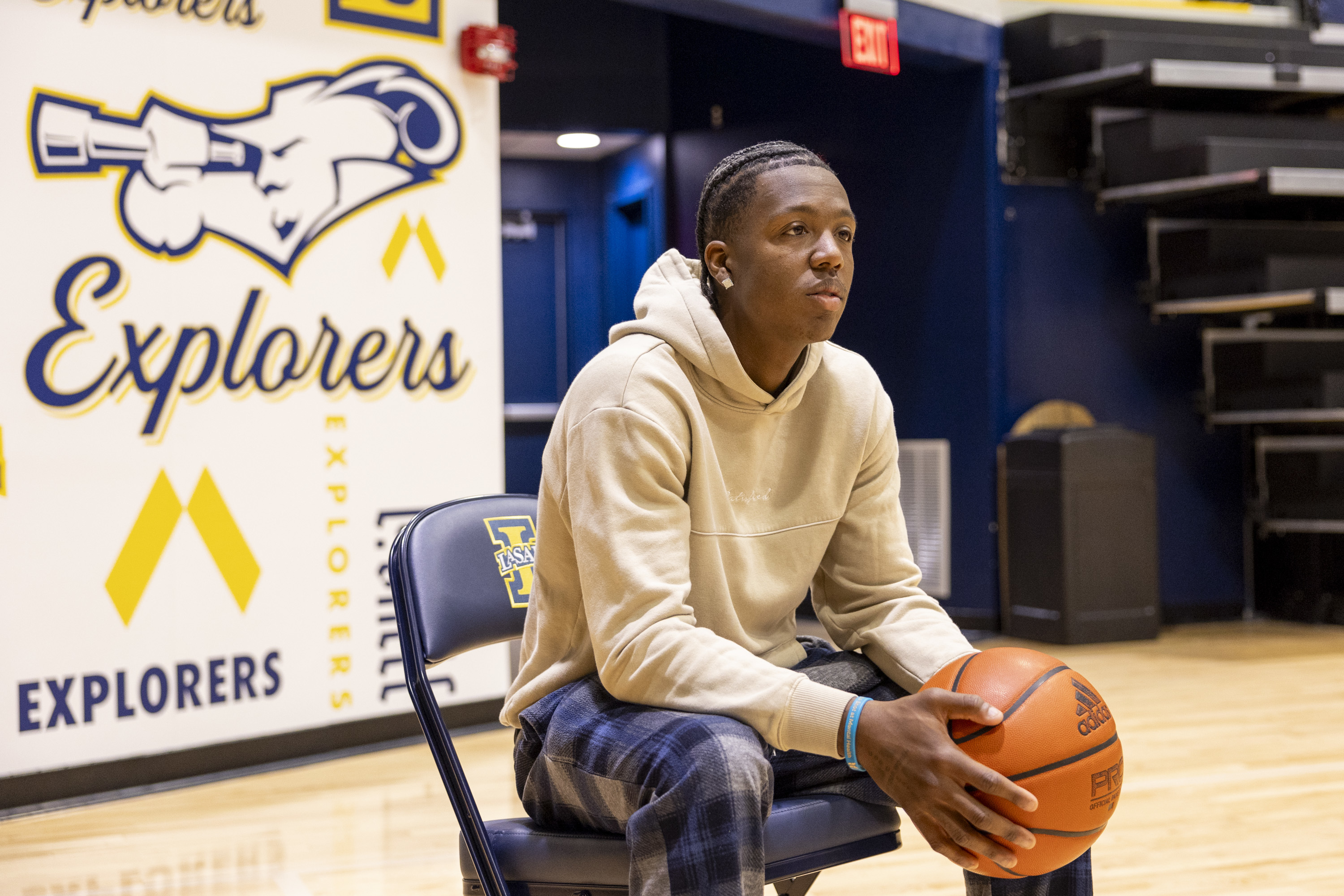
Truth Harris takes a few shots inside La Salle’s TruMark Financial Arena earlier this year. Harris joined the Explorers in the offseason, his fifth school in five years.
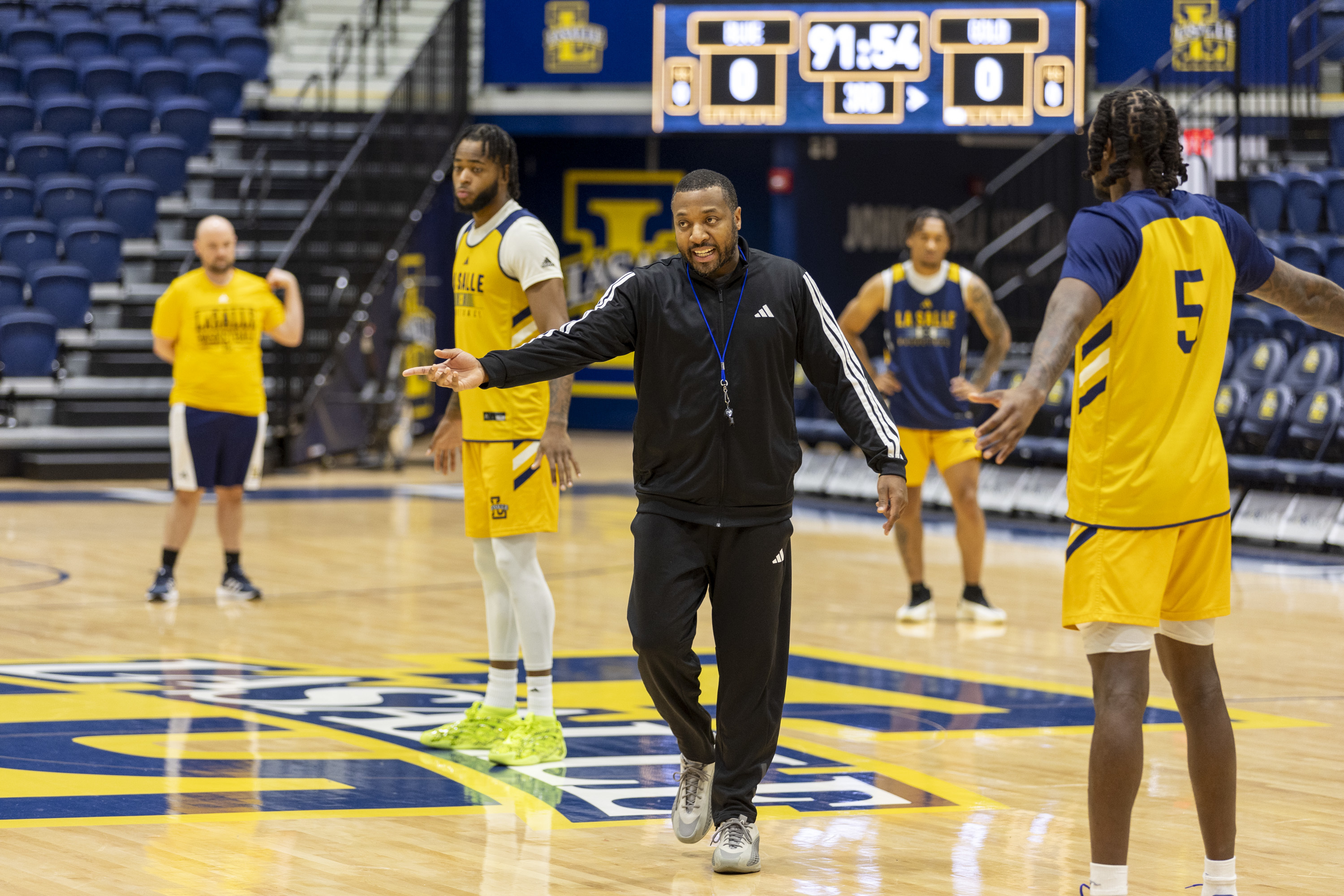
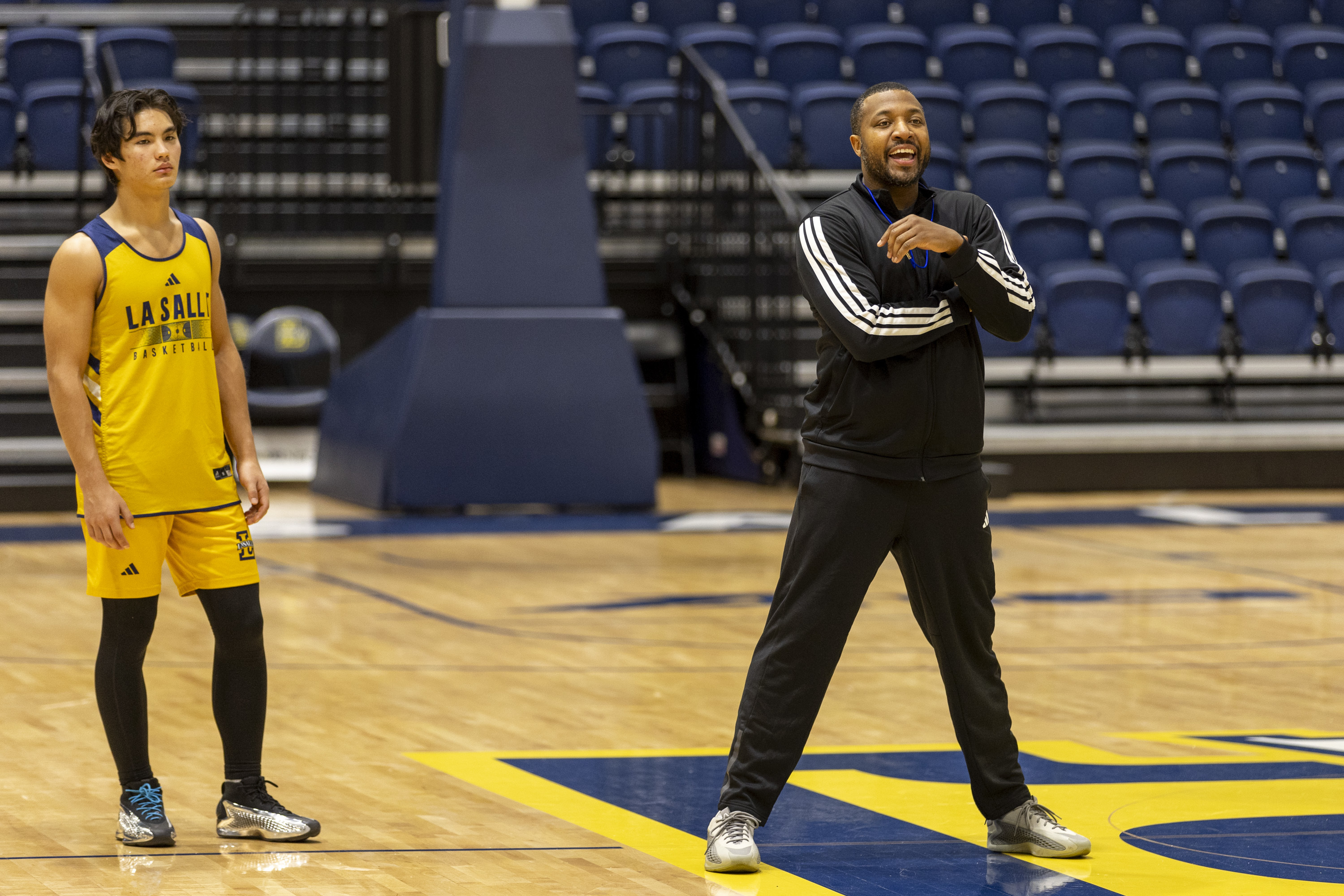
One of those players is Truth Harris, a graduate guard who followed new La Salle coach Darris Nichols after he succeeded Big 5 legend Fran Dunphy in March.
For Harris, 23, his fresh start with the Explorers was his third Division I program and his fifth school since 2020.
After his start at East Tennessee State, Harris, a Mt. Vernon, N.Y., native, who led Mount Vernon High School to a state title in 2017, spent two years at junior colleges, Pensacola State and Indian Hills Community College, where he starred. It afforded Harris a spot with Nichols at Radford ahead of the 2023 season — and he has been alongside him ever since.
While Harris sees these moves as opportunities, there are some within college sports who view them as exploitation and a lack of control by governing bodies.
Harris, who noted that his move to La Salle was paired with a five-figure sum through NIL opportunities, is why many students like him see the portal as a better way to navigate a college career.
“It was always going to get to this eventually,” Harris said in a sit-down with The Inquirer this summer. “I feel like students do deserve the recognition, do deserve the money. As student-athletes, we do go through a lot. We push our limits. We have to get paid for that. So, yeah, I think [the new reality of college sports is] right where it should be.”
This season’s top earners likely would agree. The highest paid hooper, BYU guard AJ Dybantsa, is earning $4.4 million this year, according to On3’s NIL valuations. The top 10 earners in men’s college basketball, according to that list, stand to make over $1 million this season.
It’s a far cry from the days in which the guarantee of a college scholarship was the allure.
These days, that comes standard.
Student-athletes are guided by the promise of a payday, with the masses who continue to jump into the transfer portal serving as proof.
BYU forward AJ Dybantsa (3) is the highest earner in college basketball, with a valuation of $4.4 million this season.
‘It’s not that hard, really’
Instructions on how to enter the NCAA’s transfer portal are available on the NCAA’s website. Once a player decides to go, though, there’s a bit of unknown. But if you’re a proven talent, it’s pretty straightforward, Harris says.
“When you enter the transfer portal, you don’t know what’s going to happen,” he said. “If we are saying if there’s stress [involved], I would say that’s the bad stress? But at the same time, when you start hearing from schools and hearing those schools out, it does ease you down a bit more.
“The hardest decision is picking the right school, picking the right option for you. And that all goes into [questions like], ‘Is the team good? What’s the coaching like? What’s their history, their culture?’ It’s about making sure they want you for the right things and you’ll be a good fit there. But once you do it once, it’s not that hard, really.”
Perhaps what causes little concern for student-athletes freely moving from school to school is that many are moving with general studies majors, or, in Harris’ case, chasing a master’s degree. He’s working on a master’s in communications, a degree he noted as “a well-known major that a lot of schools carry.”
La Salle’s Truth Harris is working on his master’s in communications, a popular degree he says has made it easier for him to change schools as much as he has.
In Step 1 of the NCAA’s guide to transferring schools, a line reads: “Your new school should help you satisfy both your academic and athletic goals.” However, graduation rates for athletes reflect the lack of emphasis on academics.
“I think we’ve opened up two different cans of worms. When we opened up the transfer portal and NIL at the same time, it became chaotic,” said Nichols, who added that fluctuating graduation rates and the impact it has on schools being treated like a revolving door isn’t being talked about enough.
“I think that if we’re about student-athletes graduating, we should be focused on retention and doing what’s best for both parties. Everybody’s talking about the money situation, but, to me, let’s clean up the situation of these student-athletes transferring so much but making sure they still graduate.”
However, according to the NCAA Division I Academic Progress Rates, a metric that is supposed to hold institutions accountable for the academic performance of student-athletes, graduation rates for men’s basketball players hovered around 83% as of the 2025 season — though that did have a 4% decline since last year.
La Salle men’s basketball coach Darris Nichols says graduation rates aren’t being talked about enough in the era of the transfer portal and NIL.
“I think that there are just some challenges people don’t talk about,” Nichols said. “If you’re a player that’s transferring every year, are all your credits rolling over, so you’re actually eligible? Something as simple as uniforms, think about it: you bring in nine new players every year, you’ve got to get nine new uniforms. And for people who say, ‘Well, why don’t you just not put their names on the back,’ every one of them comes in different sizes, and [a player] can be number 0 to 99.
“So it’s not just about the cost of NIL for potential players, it’s about operating costs, budgets, revenue. Everybody’s talking about NIL, but there are the little things that go into all this change.”
Still, to Nichols, a former Division I star at West Virginia whose playing days preceded NIL, players should be compensated. That’s not the issue. The issue is the time coaches spend trying to field winning teams every season in what’s essentially a free-agent market.
“You’re constantly trying to get kids to buy in,” he said. “When I was playing, it was a buy-in for four years. And now it’s buy-in for a year. Look, we’re not in a position to try to hold anybody back. If you play here, you do well, and you want to go elsewhere, I get it. But as a staff, we do our utmost to just have honest conversations with [our players] about the new landscape of athletics and not try to hide behind it.”
Darris Nichols (right) says open communication about expectations is all a program can do when it comes to the the transfer portal process.
It’s impossible to hide when the data is so stark in that most schools, especially mid-majors, will see significant movement across their programs each year, especially in revenue-generating sports like football and basketball.
Across the NCAA’s 364 Division I programs, 1,156 undergraduate transfer portal entrants found new homes in men’s basketball alongside 384 graduate entrants this past offseason. In women’s basketball, 720 undergrads found new homes alongside 344 graduate students.
On the men’s side alone, that averages out to four players a coach would need to replace on their roster — solely from transfers — before entering the 2025-26 season.
Men’s basketball coaches needed to replace an average of four players after transfer portal movement last season.
For players like Harris, who stands to graduate from La Salle after his five-year journey, he’s happy to have benefited from this new reality.
“It’s just a better feeling,” Harris said. “You’re more relaxed. You can do more things for yourself without having to ask your mother and ask your parents for money all the time. I feel like it’s a relief off my parents to know they don’t worry about me [financially]. They’re not worried if I’m good or not because they know I am.
“So if you’re asking me? Yeah, I think it’s a reality that’s right where it should be.”
Pizzerias crave visibility, but there’s no sign pointing to Apizzeria 888 by Sebastian. It’s a true hole in the wall you’ll likely blow right past while trying to keep up with traffic whizzing along Old York Road in Elkins Park.
Sebastian doesn’t care.
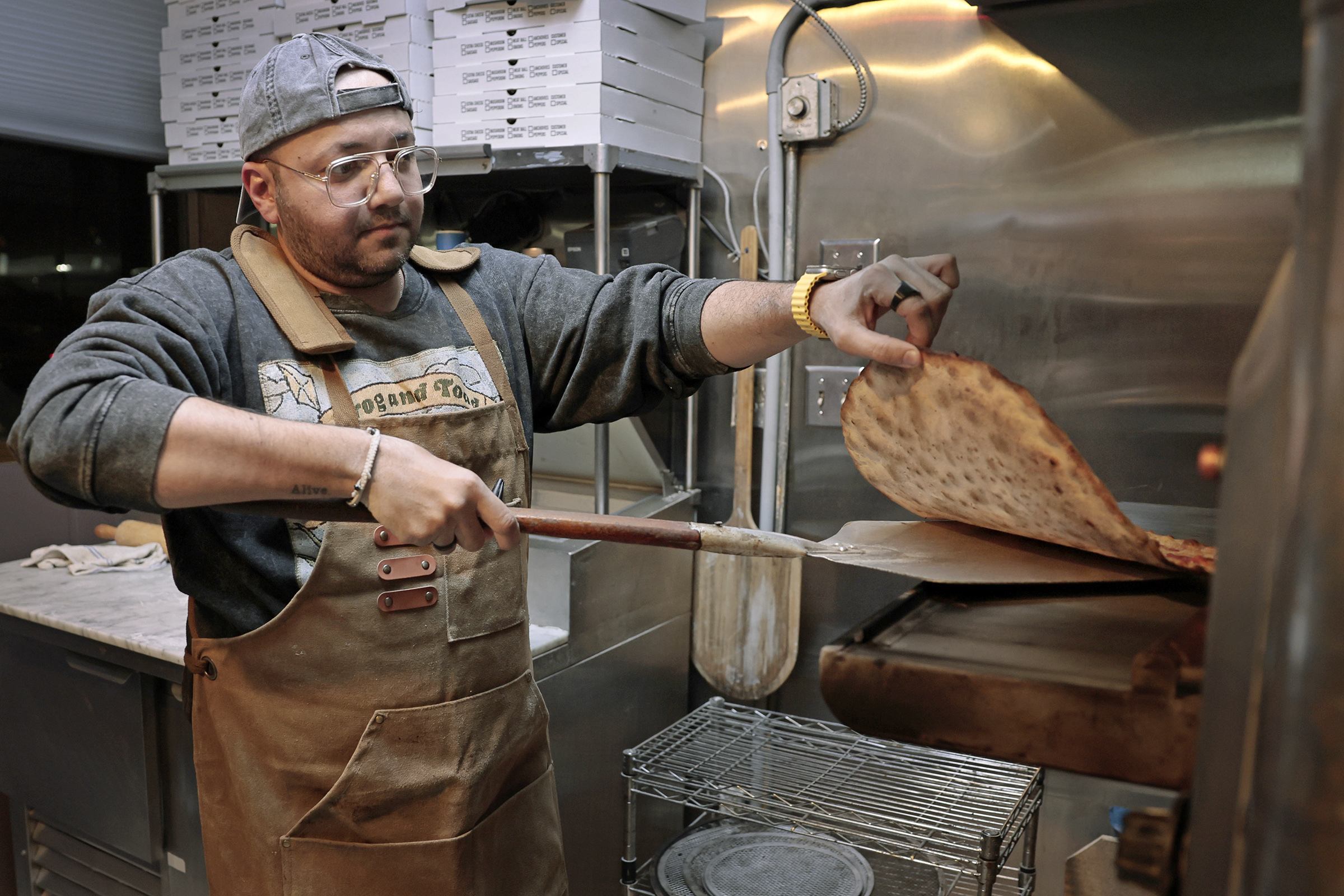
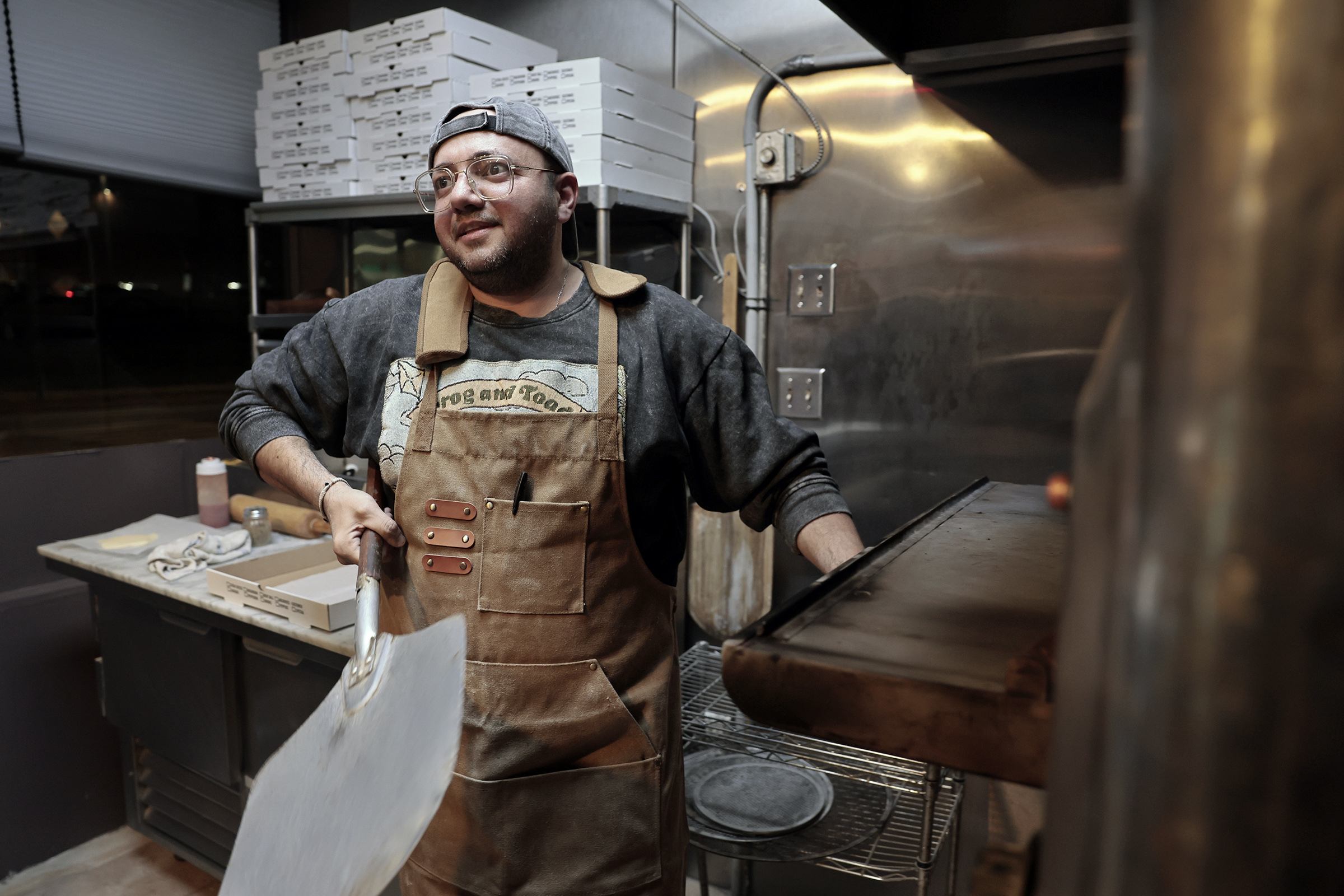
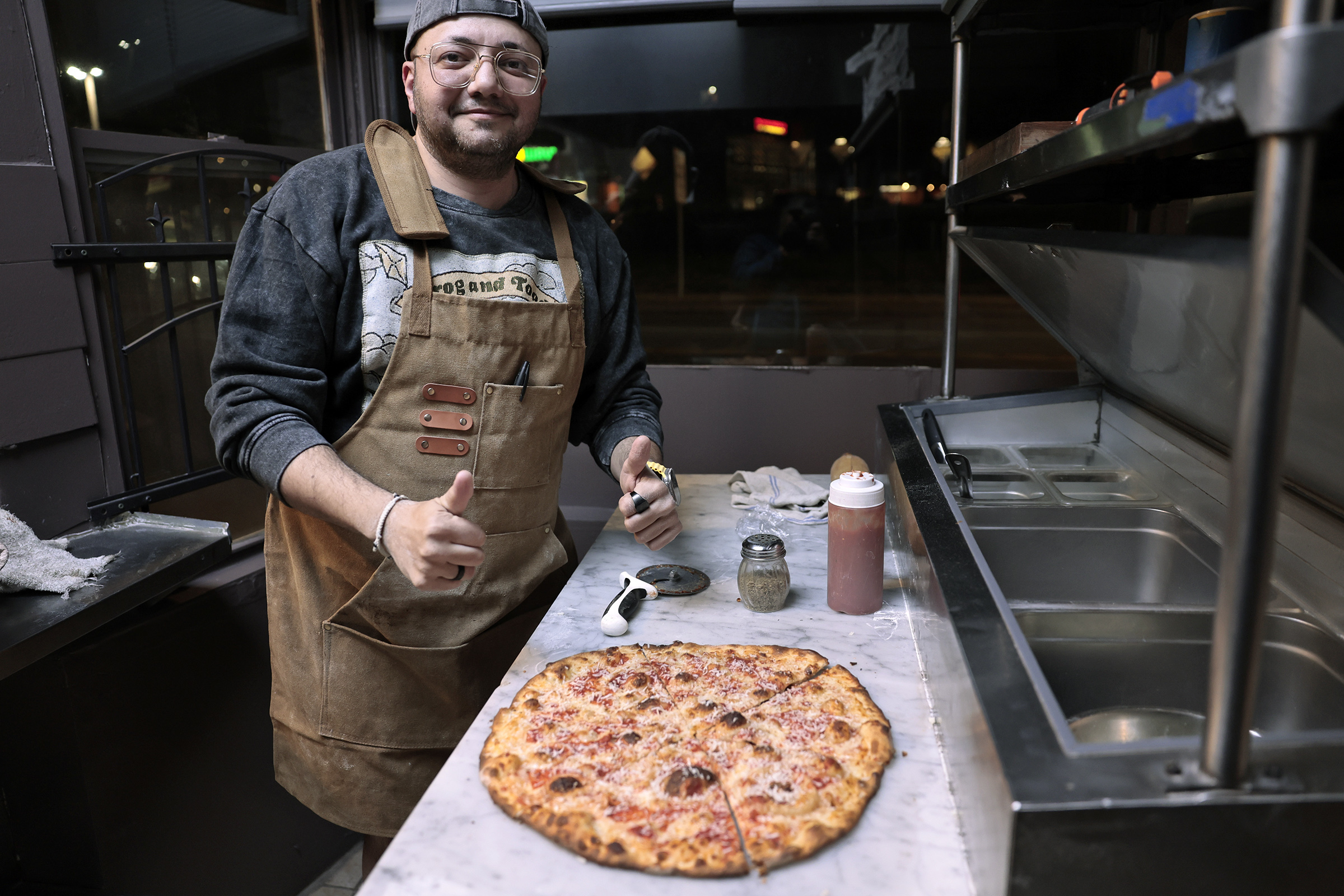
Right now, Sebastian Besiso is working for himself and by himself: 40 pies a night, walk-in or call-in, pickup only, limited menu, and no third-party delivery after he got frustrated with UberEats’ fees one night and smashed the order tablet to bits.
Sebastian Besiso checks the undercarriage of a pizza at Apizzeria 888 by Sebastian.
Besiso has an endgame — and Apizzeria is more of a lab than a pizzeria. He views it as a test ground for something bigger — what he cryptically calls part of a “social media interactive platform that will drive people directly to a restaurant.” It won’t be a delivery service, he said, but will offer the technology to give pizzerias better control over their business.
That would also mean moving beyond Apizzeria’s cramped takeout setting. “I want a real dine-in experience where people can come, sit down, enjoy themselves, eat Roman and Neapolitan pizza, and drink halal beer,” he said. “This current setup is not sustainable long-term.”
“I’m not saying I’m better,” says Sebastian Besiso. “I’m saying this is my style.”
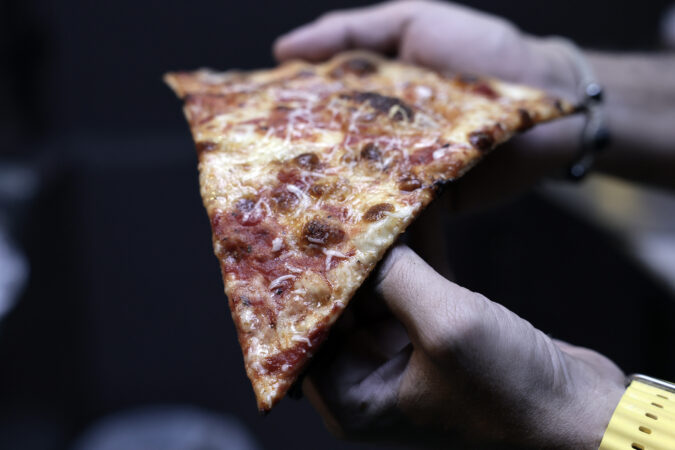
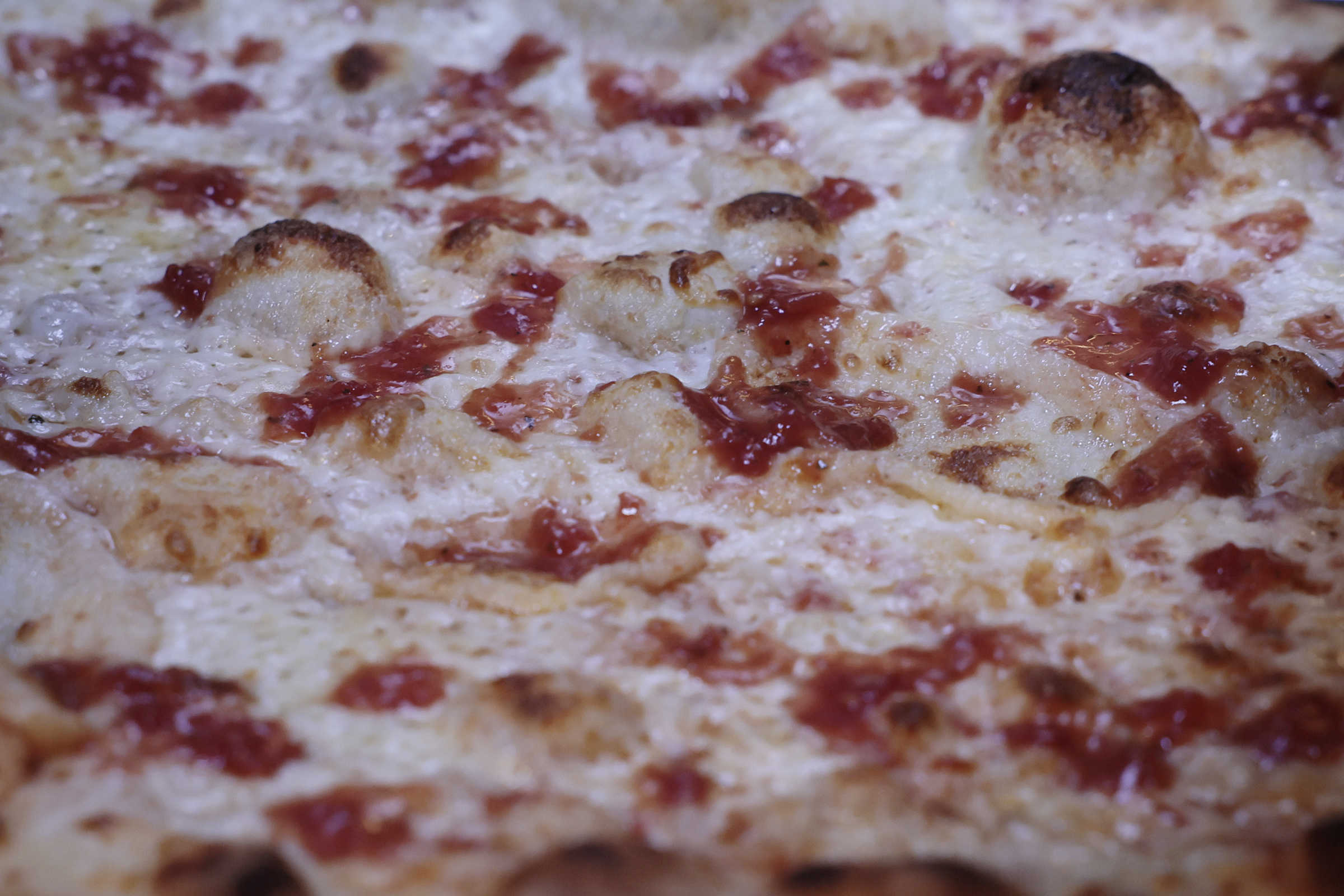
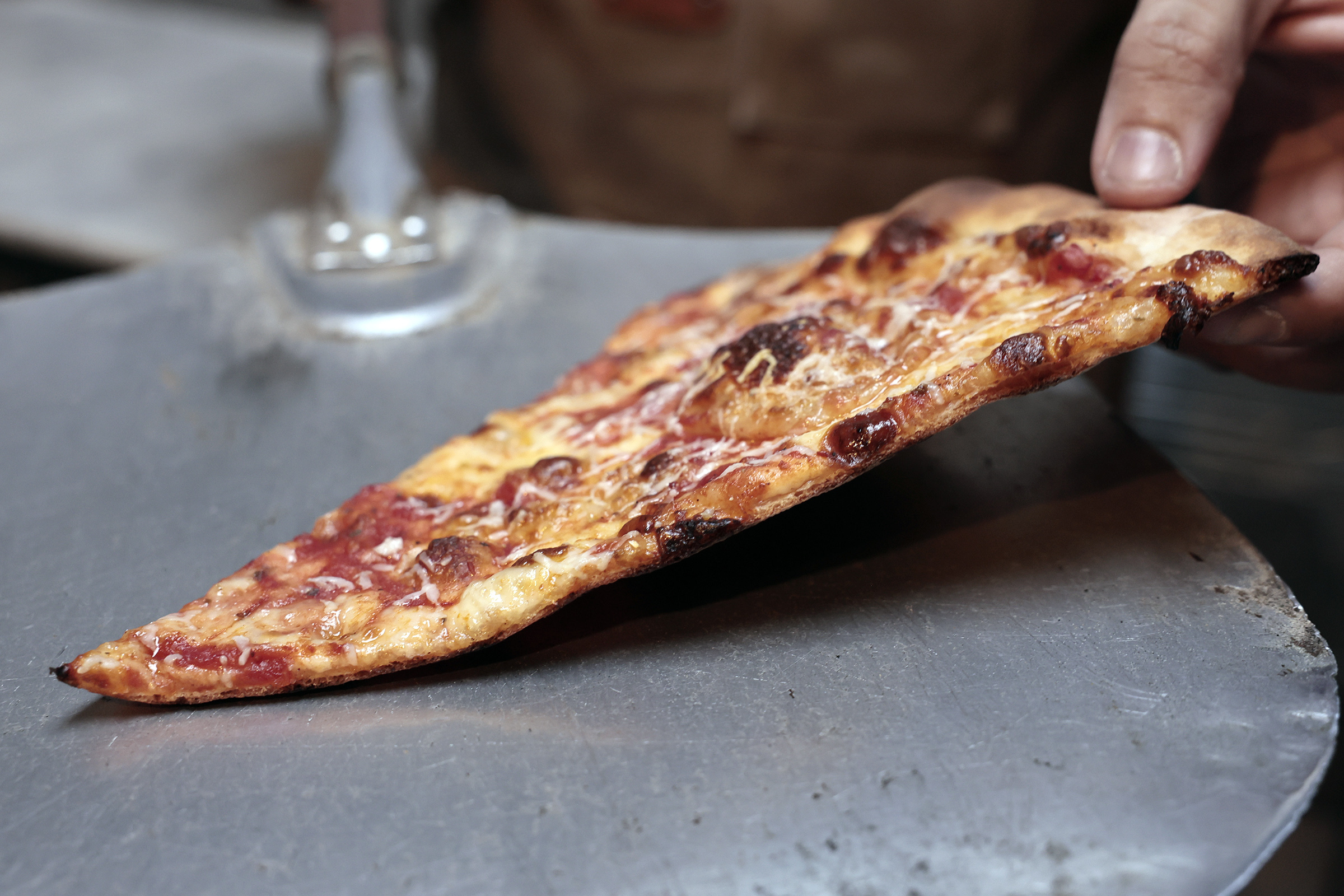
Besiso is the first to say that you may not like his pizza, especially if you prefer more conventional New York or Neapolitan styles, as many of his Elkins Park neighbors seem to. His “Roma” has two kinds of aged cheese, a smear of a slightly sweet tomato basil sauce, and an almost impossibly thin crust that shatters around the edges as you bite in. There is no flop whatsoever. It has the crunchy, cheese-on-the-bottom qualities of Chicago tavern-style, though Besiso slices his pies into conventional eighths, not party squares. Toppings include beef pepperoni and sausage crumbles.
His pizzas are well-done. “People around here will say, ‘You burned my pizza,’” he said. “I tell them, ‘Just take a bite.’”
A pizza just out of the oven at Apizzeria 888 by Sebastian.
His customers — and I am one — take a bite and love it. I’m obsessed.
“I’m not saying I’m better,” Besiso said last week, rolling out a 7-ounce dough ball into a 14-inch round — about half the weight of what’s used in a conventional New York-style pizza of the same size. “I’m saying this is my style.”
That restraint can confuse customers. “They look at a $25 price for a 14-inch pizza and feel cheated,” Besiso said. “They judge by quantity, not quality.”
An experimental pizza crust made by Sebastian Besiso of Apizzeria 888 by Sebastian.
I asked Gregorio Fierro, a local consultant well versed in pizza styles and parlors around the world, to tag along on a visit. “You can easily finish a 14-inch pie and not feel weighed down,” he said, impressed. “It’s not one of those heavy pizzas where you feel stuffed.”
Besiso, 42, started in the pizza business 20 years ago before he went to Drexel for chemical engineering. While building his career, he worked at the Pizza Gourmet, a parlor in Northeast Philadelphia, before buying Brandywine Pizza in Spring Garden with his brother. In 2020, he took over his current location, then called New Venice Pizza, across from Elkins Park Square. During the pandemic, he opened the shop for overnight deliveries. In his idle moments, he began tinkering with hydration, fermentation, yeast, and oven temperature and fell down the pizzaiolo rabbit hole.
Note the thinness of Sebastian Besiso’s Roma pizza at Apizzeria 888 by Sebastian.
After working overseas on an engineering job, he came back and last month rebranded the shop; “888” is a lucky number.
Besiso keeps everything close to the vest: He says he “ages” his dough at least two weeks and uses just a speck of yeast and much lower hydration than other shops. The Roma’s base is a low-moisture mozzarella blend. (“Let’s leave it at that,” he said.) A grated cheese goes on top. “People assume it’s Parmigiano Reggiano, but it’s not,” he said. (Fierro suspects it’s Pecorino Romano.)
Sebastian Besiso pauses at his Apizzeria 888 by Sebastian in Elkins Park.
Besiso’s real talent is his mastery of his 60-year-old Blodgett deck oven. He pulls out each pizza near the end, lets it rest, and then slides it back for the final few seconds. Even that tiny step makes the pizza crunchier. When the pie is done, he sets it on a rack — not a pan — for cutting to preserve even more snap.
Besiso’s cardboard pizza box also plays a role. He hand-punctures each with rows of small holes for ventilation. “Steam is not your friend,” Besiso said. “You close the box, drive 10 or 15 minutes, and the steam ruins everything.”
If you’re not local, the smart move is to call in your order, park in the lot around back, get paper plates, snag a Mexican Coke or a Fanta from the fridge, and enjoy the pizza on the hood of your car. You can take home the pizza and pop it into a hot oven for two minutes, if you must.
Right now, Besiso is developing his own panuozzo — a flat, pizzalike bread — for a line of sandwiches. If you like those, you like them, he said. “And if you don’t, you don’t.”
Apizzeria 888 by Sebastian, 8021 Old York Rd., Elkins Park, 215-635-1200. Hours: 5 to 8 p.m. Tuesday to Thursday, 4:30 to 8:30 p.m. Friday and Saturday.
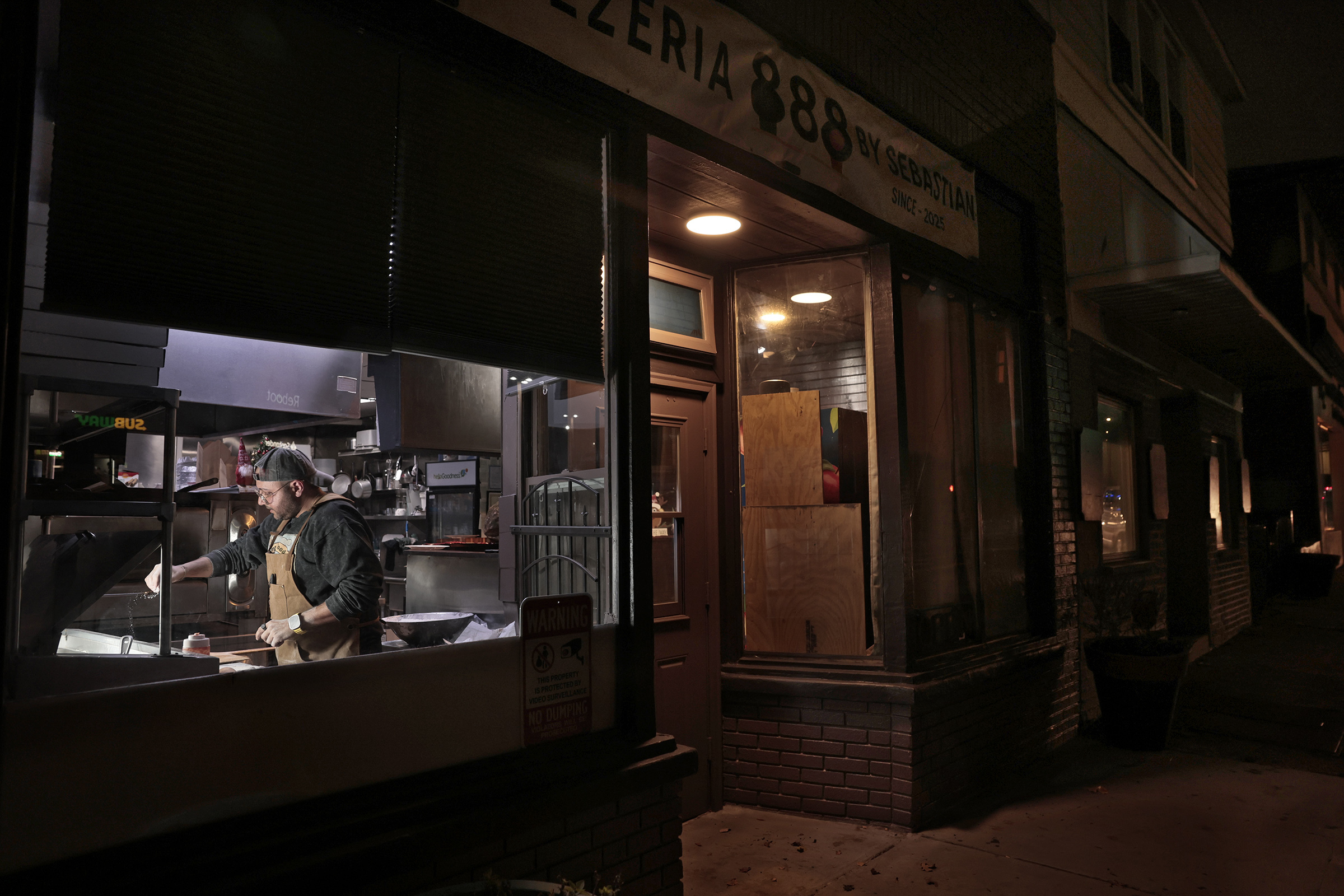
Sebastian Besiso is seen through the front window at Apizzeria 888 by Sebastian.
Imagine walking out of a Walmart, Target, or Costco. As you push your large shopping cart to your car, you ask yourself: Did I really need all that stuff?
The answer is you probably didn’t.
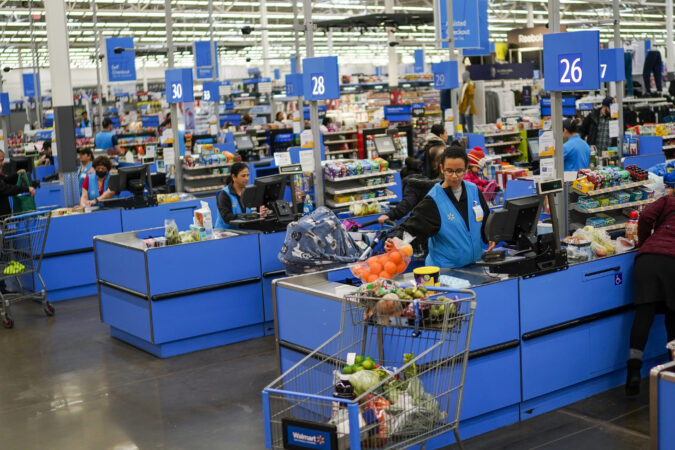
In a recent study, my coauthors, Lina Wang and Sungho Park, and I found that the presence of supercenters — large retailers that sell groceries alongside general merchandise — results in a significant uptick in consumer waste due to overpurchasing.
These supercenters often sit on lots in excess of 150,000 square feet. But figuring out how all that real estate affects people’s shopping habits — if it does at all — is tricky. That’s because a lot of factors influence how much people buy on a single shopping trip.
To answer this question, we looked at the impact of the spread of Walmart supercenters across the U.S. over a decade, using a technique called difference-in-differences — an analytical method in which we compared consumer waste trends in counties that saw supercenter launches with “matched” counties that did not. This matching ensured that counties were otherwise closely comparable on socioeconomic factors such as housing, income, and education.
Our analysis showed that the launch of a supercenter results in an increase in consumer waste of up to 7%. Furthermore, this increase in consumer waste is larger for new supercenter openings compared with conversions, when existing regular stores are expanded into large-format ones.
Why it matters
For decades, neighborhood stores across the U.S. were edged out by large-format retailers: department stores, supercenters, and shopping malls. Although there is evidence that many of these big-name retailers are beginning to look toward smaller stores, the shopping landscape remains dotted by supercenters.
And these large stores stimulate mass consumption through gradual shifts in consumer behaviors. For example, in their attempt to generate more sales, large-format retailers often underprice smaller neighborhood stores.
Take, for example, Walmart’s “everyday low price” strategy, which is key to its business model. This pricing strategy offers shoppers a largely consistent year-round low price rather than relying on occasional sales and discounts.
Further contributing to overpurchasing is the supercenters’ typical location, which tends to be away from residential areas. Naturally, in their effort to avoid multiple trips, consumers tend to maximize the utility of each visit by making their basket sizes larger.
Unfortunately, this overpurchasing often leads to waste as more goods reach expiration date or sit unused in people’s homes.
While this may be a profitable strategy for retailers, it’s bad for society and the environment and creates billions of dollars in waste. To put this into context, the United States generates close to 300 million tons of consumer waste every year, and then spends billions of dollars managing this waste.
What still isn’t known
Now that we have measured the “supercenter effect,” we are keen to look at potential solutions to this problem. Some existing solutions are based on implementing policies that encourage behavioral shifts in consumers. For example, many cities have adopted a pay-as-you-throw policy that charges people based on the volume of waste generated.
Other solutions are more structural, such as bringing back neighborhood stores and developing stronger circular economy channels. For example, neighborhood stores can play an important role in mitigating the supercenter effect and could allow for smaller, more frequent shopping trips and significantly less waste.
In many cities, initiatives promoting localvendors and stores are gaining momentum. Such solutions would not only encourage sustainable consumption but also have benefits for local economic growth by promoting small businesses that have historically accounted for 62% of net new job creation.
A second solution entails leveraging the “reuse economy,” which can provide a back-end channel for circulating surplus and used goods. While both offline and online reuse channels exist – through the likes of thrift stores, food banks, and Facebook Marketplace, for example — they currently remain vastly underused.
Identifying and aggressively implementing such solutions might turn out to be both economically meaningful and environmentally beneficial. But more work needs to be done to figure out which solutions are more effective, and why.
Suvrat Dhanorkar is an associate professor at the Georgia Institute of Technology. This article is republished from The Conversation. Read the original article at theconversation.com/us.
Restaurant gift cards begin as a thoughtful gesture — a birthday envelope, a holiday token, a “you deserve a night out.” So often, however, they migrate to a junk drawer or coat pocket, resurfacing in a moment of hopeful nostalgia:
“Hey, remember this place?”
But that cool restaurant has become a vape store, a Pilates studio, or a bubble-tea shop with a plastic vine selfie wall accented by the phrase “Let’s Make Pour Decisions.” written in neon.
That $75 that you thought would buy a roasted half chicken and a glass of natural wine from a “carefully curated” list has become a relic of a business that thrived briefly and then disappeared.
If you’re receiving a restaurant gift card this holiday season, there’s one important thing to bear in mind:
Use it. Fast. Not “soon.” Not “when it feels right.” Not after you’ve coordinated three calendars and a celestial alignment. Treat it like arugula, not heirloom jewelry. And if you’re giving one, attach an affectionate nudge: Go immediately.
Gift card horror stories
One-off, independent restaurants — the mainstay of Philadelphia’s mighty restaurant scene — depend on gift card sales. Ben Fileccia, senior vice president with the Pennsylvania Restaurant & Lodging Association, calls restaurant gift cards “one of the best ways to support the local businesses that bring our communities together.” He considers them a “direct investment in the neighborhood restaurants that show up for our schools, charities, and local events. Most restaurants honor every card they sell, and gift cards continue to be a reliable, meaningful way to support the hospitality businesses you love.”
But temper that with the idea that restaurants come and go.
Some restaurants wind down operations and stop selling gift cards months before the shutdown, publicly advising customers to use them promptly. One case in point is Laurel in South Philadelphia this year, which enjoyed a six-month countdown. Just last week, Rocco’s at the Brick shut down without warning during a dispute with the landlord; the owner graciously is refunding outstanding gift cards.
Others are not so ethical. On Christmas Eve 1994, a popular Center City bistro called Odeon was selling gift certificates — they were paper back then. Odeon never reopened after New Year’s and the gift certificates became bookmarks. The rumor was that the reservationist sold them, not knowing that the restaurant was closing.
Buying from a restaurant chain can be safer. But just two months ago, Iron Hill Brewery & Restaurant — a pillar of the region for three decades — shuttered three locations and, two weeks later, closed the remaining 16 and then filed for bankruptcy protection. If you have an Iron Hill gift card, you’re at the very back of the line.
J. Alexander’s, a contemporary steakhouse chain, shut down its King of Prussia location without notice last year. Gift cards can be honored at the closest remaining locations in Clifton, N.J., or Annapolis, Md. Grand Lux Cafe’s Cherry Hill location closed in 2020, directing customers to its King of Prussia location, which closed a year later. If you still have a Grand Lux Cafe card, plan a day trip to Paramus, N.J., or Garden City, N.Y. (Cheesecake Factory owns Grand Lux but does not accept its cards.)
Bertucci’s is slowly, quietly exiting: The suburban locations in Bryn Mawr, Langhorne, Marlton, Mount Laurel, and beyond went dark, leaving only Springfield, Delaware County, and Newark, Del. Houlihan’s vanished from Philadelphia and its suburbs altogether, and Ruby Tuesday has done the same slow fade, retreating from malls and roadside plazas that once seemed permanent.
The numbers
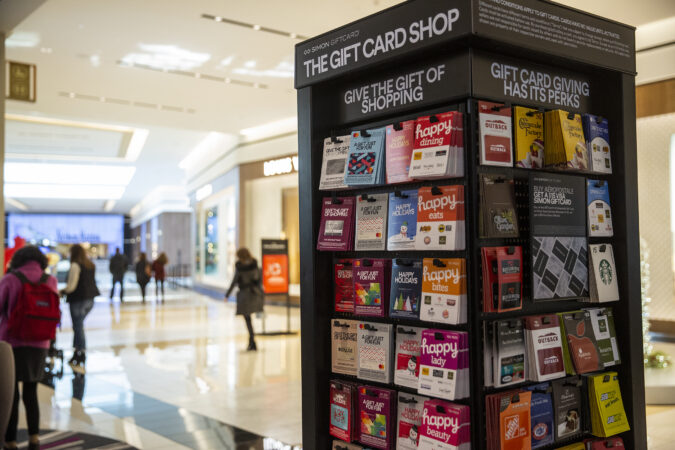
Total gift card spending is expected to reach $29.1 billion, up from $28.6 billion in 2024, according to the National Retail Federation. Consumers plan to purchase between three to four gift cards and expect to spend an average of $171.32 per person. Restaurants remain the most popular gift card type (27%), followed by bank-issued cards (25%), department stores (25%), and coffee shops (20%).
As you might imagine, restaurants do not mind selling cards. By industry estimates, 5% to 15% of restaurant card value is never used — a concept known as “breakage.”
In Pennsylvania, the law prohibits gift cards from expiring in less than two years and bans dormancy fees; after five years without redemption the value is presumed abandoned and may be sent to the state. In New Jersey, the law requires that gift card value remain fully available for at least 24 months and restricts inactivity fees during that period.
What else to do
Universal gift cards, like those issued by Visa and Mastercard, are the safest bet if you want to give something other than cold, hard cash. Although there’s usually an upfront fee with their purchase, they travel with the recipient, not the business. They survive concept changes, closures, disputes, and chef departures. Perhaps give the recipient one of these gift cards with a list of suggested restaurants. (For inspiration, I might suggest including a copy of The Inquirer’s 76 Magazine, our guide to the restaurants that are defining dining in the region, available through The Inquirer’s online store.)
Or consider a donation in your friend’s name to a Philadelphia hunger-relief nonprofit, such as Share Food Program, Sunday Love Project, and People’s Kitchen, which work magic turning even modest gifts into many meals.
Of course, you could skip giving a gift card altogether. Instead, pick a date, make a reservation, and treat the recipient to a meal — and to your company.