Blog

  • Immigration advocates say Philly courthouse has become a ‘hunting ground’ for ICE. They want agents barred from the building.

    Immigration advocates say Philly courthouse has become a ‘hunting ground’ for ICE. They want agents barred from the building.

    Activists rallied outside the Philadelphia Criminal Justice Center on Thursday to press their assertion that ICE has been allowed to turn the courthouse into “a hunting ground” for immigrants.

    The noon demonstration crystalized months of contention between activists and lawyers who say the courthouse must be a place to seek and render justice ― not to target immigrants ― and federal authorities who insist that making arrests there is legal, safe, and sane.

    No ICE Philly, the rally organizer, says agents have been enabled to essentially hang out at the Center City courthouse, waiting in the lobby or scouring the hallways, then making arrests on the sidewalks outside, a pattern they say has been repeated dozens of times since President Donald Trump took office in January.

    “ICE is kidnapping immigrants who are obeying the law and coming to court,” said Ashen Harper, a college student who helped lead the demonstration, which targeted Sheriff Rochelle Bilal. “She is capitulating and cooperating with ICE.”

    Many people who go to the courthouse, the group noted, are not criminal defendants ― they are witnesses, crime victims, family members, people dealing with alleged offenses like shoplifting or trespassing, and others who are already in diversionary programs.

    No ICE Philly, whose last demonstration saw four people arrested, says immigration agents must be barred from the property.

    Organizers said ICE has arrested about 90 people outside the courthouse since January, a dramatic increase over the previous year. And they pledged to return on Dec. 4 ― lugging a podium for Bilal so that, organizers said, she can explain changes she intends to make, including barring ICE.

    The sheriff did not immediately reply to a request for comment Thursday.

    Members of No ICE Philly rally outside the Criminal Justice Center on Thursday, calling on the sheriff to cut off Immigration and Customs Enforcement access to the building.

    “We want to put the sheriff on notice that we’re watching,” said Aniqa Raihan, a No ICE Philly organizer. “We want to raise awareness of the fact … that ICE is using the courthouse as a hunting ground.”

    As word of plans for the demonstration spread, Bilal issued a statement aimed at “addressing public concerns” around ICE activity.

    “Let me be very clear: the Philadelphia Sheriff’s Office does not partner with ICE,” the sheriff said. “Our deputies do not assist ICE, share information, or participate in immigration enforcement.”

    Deputies verify the credentials of ICE agents entering the courthouse ― and those agents are not permitted to make arrests in courtrooms or anywhere else inside, she said.

    Raihan and other advocates say that is no protection. ICE agents linger in the lobby, they said, then follow their target outside and quickly make the arrest.

    In April, The Inquirer reported that a Philadelphia police officer escorted a Dominican national out of the courthouse and into the custody of federal authorities, shortly after a judge dismissed all criminal charges against the man.

    A police department spokesperson said at the time that the Spanish-speaking officer offered to walk with the man to help translate, but did not detain him. The Defender Association of Philadelphia and others questioned how the incident squared with the city’s sanctuary policies.

    U.S. Immigration and Customs Enforcement officials in Philadelphia did not reply to a request for comment.

    On Thursday, about 40 demonstrators gathered outside the courthouse, chanting and singing under the watchful eye of city police officers and sheriff’s deputies. No ICE agents were visible. Protesters carried signs to indicate that they, too, were watching, raising colorful cardboard eyeballs, eyeglasses, and magnifiers.

    Lenore Ramos, the community defense organizer with the Juntos advocacy group, called on the sheriff and city government officials to protect immigrants at the courthouse. Proclaiming Philadelphia a welcoming city, she said, is not just a slogan ― it’s a promise, one that local government must fulfill.

    “The city is not standing behind our immigrant communities,” Ramos said. “It is walking all over them.”

    In an interview earlier this week, Whitney Viets, an immigration counsel at the Defender Association, said ICE agents are at the courthouse almost every day, and arrests occur there almost daily.

    The government does not publicly release data detailing where most immigration arrests occur, but Viets estimated that dozens of arrests have taken place at the courthouse since the start of the year. Masked plainclothes agents are seen outside the building, in the lobby, in courtrooms, and in hallways, she said.

    “Agents are effectively doing enforcement in the courthouse, through identification,” she said.

    She explained that agents may identify a person they are seeking in or near a courtroom, then either follow them outside or alert other agents who are already waiting on the sidewalk.

    It is unclear where ICE is obtaining information on who will be at the courthouse on any particular day, although some details about ongoing criminal cases are available in public records. One result of ICE enforcement, she said, is people are afraid to come to court.

    “This is about whether our justice system operates effectively,” Viets said. “The actions of ICE have gotten brazen. … What we need at this time is public engagement against this activity.”

    No ICE Philly decried “kidnappings” by the agency and demanded the sheriff “protect everyone inside and outside the courthouse,” including “immigrants targeted by ICE as well as citizens observing and documenting ICE arrests.”

    The Philadelphia Sheriff’s Office is in charge of courthouse security. However, Bilal said in her statement, her office has no authority to intervene in lawful activities that are conducted off the property.

    “Inside the courthouse, everyone’s rights and safety are protected equally under the law,” she said. “We are law enforcement professionals who follow the law.”
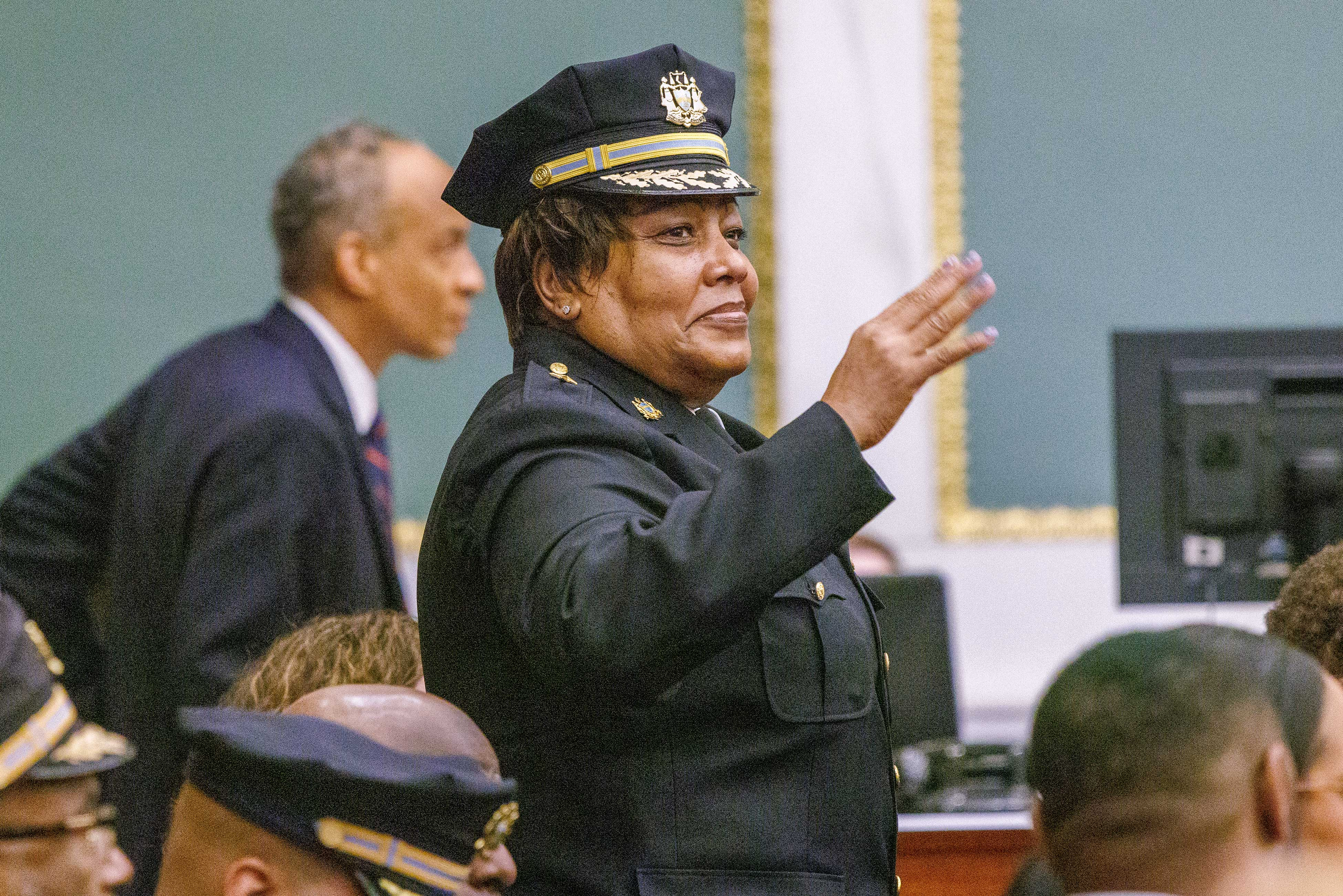
    Philadelphia Sheriff Rochelle Bilal stands to be recognized at City Hall in March.

    In Philadelphia and places around the country, courthouses have become disputed locales as the Trump administration pursues ever-more-aggressive arrest and deportation policies.

    Under President Joe Biden, limits were set on what ICE could do at courthouses. Agents were permitted to take action at or near a courthouse only if it involved a threat to national security, an imminent risk of death or violence, the pursuit of someone who threatened the public safety, or a risk of destruction of evidence.

    Even then, advocacy groups accused ICE of violating the policy by arresting people who were only short distances from courthouses.

    The Biden restrictions on ICE vanished the day after Trump took office.

    The new guidance said agents could conduct enforcement actions in or near courthouses ― period. The only conditions were that agents must have credible information that their target would be present at a specific location and that the local jurisdiction had not passed laws barring such enforcement.

    The guidance said that, to the extent practicable, ICE action should take place in nonpublic areas of the courthouse and be done in collaboration with court security staff. Officers should generally avoid making arrests in or near family or small-claims courts.

    The Department of Homeland Security said that the Biden administration had “thwarted law enforcement” from doing its job, that arresting immigrants in courthouses is safer for agents and the public because those being sought have passed through metal detectors and security checkpoints.

    “The ability of law enforcement to make arrests of criminal illegal aliens in courthouses is common sense,” Assistant Secretary Tricia McLaughlin said earlier this year. “It conserves valuable law enforcement resources because they already know where a target will be.”

    The issue cuts deep in Philadelphia, which has stood as a strong sanctuary city and welcomed immigrants who were sent here by the busload by Texas Gov. Greg Abbott in 2022 and early 2023.

    Philadelphia city officials have said repeatedly that they do not cooperate with ICE, and that the sanctuary city policies created under former Mayor Jim Kenney remain in place under Mayor Cherelle L. Parker.

    Protesters Elias Siegelman, right, with No Ice Philly, who also works with the groups Indivisible, Jewish Voice for Peace, and Progressive Victory, outside the ICE office, in Philadelphia on Oct. 30.

    Nationally, 10 months into the Trump administration, some Democratic jurisdictions are acting to tighten ICE access at courthouses.

    In Connecticut this month, state lawmakers passed a bill to bar most civil immigration arrests at courthouses, unless federal authorities have obtained a signed judicial warrant in advance.

    The Senate bill, already approved by the House, also bans law enforcement officers from wearing face coverings in court, Connecticut Public Radio reported. Democratic Gov. Ned Lamont is expected to sign the measure.

    Last month in Chicago, which has faced weeks of controversial immigration enforcement, the top Cook County judge barred ICE from arresting people at courthouses. That came as federal agents stationed themselves outside courthouses, drawing crowds of protesters, CBS News reported.

    On Monday, a federal judge dismissed a Trump administration challenge to a New York law that barred the immigration arrests of people going into and out of courthouses. New York passed the Protect Our Courts Act in 2020, during Trump’s first term, a law the administration said had imposed unconstitutional restrictions on enforcement, the Hill reported.

    The Thursday rally marked the third recent protest by No ICE Philly, which seeks to stop agency activity in the city. The organization’s Halloween Eve demonstration outside the ICE office erupted into physical confrontations with police, with several people pushed to the ground and four arrested.

    The arrests came after some demonstrators attempted to stop ICE vehicles from leaving the facility at Eighth and Cherry Streets.

    No ICE Philly organizers said Thursday that they will continue to scrutinize ICE activity at the courthouse.

    “There are people watching. We have eyes on this,” Raihan said, adding that ICE is “allowed to hang in the lobby, sometimes in the courtrooms.”

    “Somehow they seem to know when somebody vulnerable is in the courthouse. … We’re concerned with how they’re finding out that information.”


  • Hal Sirowitz, acclaimed performance poet, longtime teacher, and passionate Parkinson’s disease advocate, has died at 76

    Hal Sirowitz, acclaimed performance poet, longtime teacher, and passionate Parkinson’s disease advocate, has died at 76

    Hal Sirowitz, 76, of Philadelphia, internationally acclaimed performance poet, former poet laureate of Queens, N.Y., author, mentor, retired special education elementary school teacher, and passionate Parkinson’s disease advocate, died Friday, Oct. 17, of complications from Parkinson’s at KeystoneCare Hospice in Wyndmoor.

    Born in Manhattan to an expressive and overprotective mother, Mr. Sirowitz moved to Queens after college and, motivated by his early work with an inspirational young student, spent 23 years, until his retirement in 2003, as a special education elementary school teacher in New York.

    “He saw the impact he had on that student and realized the impact he could have,” said his wife, Minter Krotzer.

    He was a good listener and a lifelong reader and writer, and, in 1979, at 30, he started reciting his own writing in poetry events at New York cafes and theaters. He found that poignant poems, dark yet amusing, about his larger-than-life mother, Estelle, resonated with people.

    “Everyone either has a mother or is a mother, and they identify right away,” he told Newsday in 1998. By 1993, he was a favorite on the local poetry circuit and traveling to regional and national competitions.

    On Mother’s Day in 1996, his first book, Mother Said, was published to great acclaim. He went on to write four more books and to serve as poet laureate of Queens from 2001 to 2004.

    Until recently, when Parkinson’s made it impossible, Mr. Sirowitz performed his poems in his signature deadpan delivery, with perfect pauses and pacing, and his engaging New York accent. He spoke at colleges and conferences, bookstores and libraries, museums and workshops.

    He guested on national radio and TV shows, and read during visits to Israel, Finland, Iceland, and elsewhere around the world. Many of his poems, such as “Chopped Off Arm” and “Crumbs,” are about the angst and guilt he felt as a boy under the thumb of his always-worried mother. Later, he wrote about Parkinson’s, too.

    In “Crumbs,” he said: “Don’t eat any more food in your room,/Mother said. You’ll get more bugs./They depend on people like you./ Otherwise, they would starve./But who do you want to make happy,/your mother or a bunch of ants?/What have they done for you?/Nothing. They have no feelings./They’ll eat your candy. Yet/you treat them better than you treat me./You keep feeding them./But you never offer me anything.”

    He and his poems were featured in The Inquirer, the New York Times, Newsday, and other publications. Mother Said was celebrated in the United States and became a bestseller in Norway. He followed it up with My Therapist Said in 1998, Before, During, and After in 2003, Father Said in 2004, and Stray Cat Blues in 2012.

    “There must be a need for people to read funny sad poems about parents,” he told the Schuylkill Valley Journal. He told the New York Times in 1996: “I feel almost like I’m a conduit for my mother. I’m giving her her voice.”

    His poems inspired music composers and filmmakers, and were read in public by other literary notables. They appeared in anthologies, magazines, and journals, and were translated into 13 languages.

    He earned fellowships from the National Endowment for the Arts and the New York Foundation for the Arts, and he won the 2013 Nebraska Book Award for poetry. Colleagues called him “legendary,” an “icon,” and the “Maestro from Flushing.”

    Mr. Sirowitz and his wife, Minter Krotzer, married in 2002.

    One colleague said in a tribute: “Hal was a true inspiration. I relished his humor and perseverance.” Another said: “I often felt his poems were one-minute telescopes of therapy sessions.”

    He told the Schuylkill Valley Journal: “To me, one purpose of being a writer is to show others that it’s good to express yourself. You create your own personal history by the poems and stories you write.”

    Mr. Sirowitz was diagnosed with Parkinson’s in 1997 and, with his wife, became a vocal advocate and activist for others dealing with the disease. He spoke at medical centers and to support groups about having Parkinson’s. His wife talked of being his caregiver.

    In 2015, she wrote in The Inquirer: “Through poetry he had been able to forge a way through the illness and make art from the experience. … Keeping on with the writing of poetry is a way of saying ‘so there’ to the Parkinson’s. ‘I’m still at it.’”

    Mr. Sirowitz told the Schuylkill Valley Journal: “My life has been a struggle against limitations, like the Parkinson’s. But it also provided me definitions. I know who I am.”

    Harold Sirowitz was born March 6, 1949. He grew up between two sisters, Lauren and Iris, on Long Island, N.Y., and confronted a stutter and other speech issues when he was young.

    He was a soccer star in high school and earned a bachelor’s degree in English literature at New York University in 1972 and a master’s degree in education at Hofstra University.

    He met fellow writer Minter Krotzer at a book party in 2000, and they married in 2002. They lived in Brooklyn before moving to West Mount Airy in 2007, and she was his longtime editor, collaborator, and caregiver.

    “He had this childlike wonder about things,” his wife said. “He had a real sweetness and a connection with people.”

    Mr. Sirowitz was a runner and a hiker, and he quit his beloved New York sports teams to follow the 76ers, Eagles, Phillies, and Flyers. He especially enjoyed reading and spent one summer digesting the entire works of William Shakespeare.

    “He was a fighter, and people called him the ‘ultimate mensch,’” his wife said. “He said he had no regrets and did what he set out to do in life. It was amazing to witness someone so heroic.”

    In addition to his wife and sister Lauren, Mr. Sirowitz is survived by other relatives. His sister Iris died earlier.

    A private service was held in October. A public celebration of his life is to be held later.

    Donations in his name may be made to the Parkinson Council, 520 Carpenter Lane-COMM, Philadelphia, Pa. 19119; and KeystoneCare Hospice, 8765 Stenton Ave., Wyndmoor, Pa. 19038.

  • Bryn Mawr birth center Lifecycle Wellness to close in early 2026

    Bryn Mawr birth center Lifecycle Wellness to close in early 2026

    Lifecycle Wellness, a birth center in Bryn Mawr that offered an alternative to hospital delivery for Philadelphia-area parents, is shutting down operations amid growing financial pressure, the nonprofit announced Thursday.

    The nonprofit, which provides “homelike” births for low-risk pregnancies at its birth center and at Bryn Mawr Hospital, will stop delivering babies on Feb. 15. Patients who are due on Feb. 1 or later will need to transition to a different provider.

    In an open letter posted on its website Thursday, Lifecycle leaders said the organization was strained by rising operations and medical malpractice costs that outpaced insurance reimbursement rates — industrywide challenges that have plagued small and large health organizations alike.

    “From the beginning, Lifecycle Wellness has been dedicated to providing evidence-based, family-centered care that empowers clients to make informed choices and experience birth in a supportive, homelike environment,” Jessi Schwarz, executive and clinical director, and Lauren Harrington, board president, wrote. But, they added, “growing challenges have made it increasingly difficult for small, independent, and non-profit maternal health providers to exist.”

    Lifecycle reported a profit of $135,303 last year, down from $221,578 in 2023, according to its most recent tax filings.

    The organization provided prenatal and birthing services to about 600 patients a year, according to its 2024 tax filings. It employed 73 people that year.

    But in their letter announcing the closure, Schwarz and Harrington said that “shifts in public health and rising rates of medical complications have reduced the number of families eligible for this model of care.”

    Medical malpractice strain

    The number of malpractice cases rose in Philadelphia after a 2023 rule change allowed patients to sue outside the county in which they received medical treatment.

    Medical malpractice lawsuits are common in obstetrics, and Philadelphia’s court is known for verdicts with high awards.

    In 2023, a Philadelphia jury awarded a record-setting $180 million to the family of a child who was born with severe brain injuries at the Hospital of the University of Pennsylvania.

    The Birth Center is currently facing seven lawsuits in Philadelphia.

    The industry’s financial headwinds can be harder for independent, specialized healthcare organizations to face.

    Last year, Rothman Orthopaedic Institute ended a decades-long run as the official team physicians for the Philadelphia Eagles, citing the risk of medical malpractice liability. A year earlier, a Philadelphia jury awarded $43.5 million to former Eagles safety Chris Maragos, who sued Rothman over the treatment he received for a career-ending knee injury.

    Birth resources outside Philadelphia

    Lifecycle said it would continue to work with families who are expected to give birth by the end of January.

    The organization will work with families due after Feb. 1 to identify a new provider and transition their care.

    Lifecycle plans to continue offering limited prenatal, postnatal, and gynecological care through the end of March. The organization will also phase out its mental health and lactation services in February and March.

    “Access to respectful, equitable, community-based care is shrinking for many, particularly for marginalized communities who need it most,” Schwarz said in a statement to The Inquirer. “Our situation reflects a broader reality that the health, safety, and well-being of pregnant people and families is not prioritized within our current payment structures.”

    They did not offer specifics about where existing patients may be able to transfer their care.

    Birth centers are designed as alternatives to hospitals, offering a more natural, “homelike” setting. They have limited pain medications, and patients are typically not connected to fetal monitoring devices, allowing them to move more freely.

    This type of care is only an option for low-risk pregnancies, as birth centers are not licensed to perform c-section operations, and will need to transfer patients to a hospital if there is a serious complication during birth.

    “I felt very much in the arms of a beloved community of people who were really on your side,” said Monica Moran, who delivered her children with the support of Lifecycle midwives in 2007 and 2009.

    Moran, who lives in Havertown, has continued to go to Lifecycle for routine gynecological services and isn’t sure where she will go instead.

    She said she worries for families who were counting on Lifecycle’s providers for a nonhospital delivery.

    Nearby hospitals with labor and delivery services include Bryn Mawr Hospital and Lankenau Medical Center, both of which are owned by Main Line Health.

    The system is “well-positioned and prepared to manage increased patient volume while maintaining our high standards of care,” a spokesperson said in a statement.

    It has already seen an influx of patients since Crozer Health closed earlier this year. Crozer delivered 960 babies in 2024, according to health department records.

  • People who are self-employed could become exempt from paying a Philly business tax | City Council roundup

    People who are self-employed could become exempt from paying a Philly business tax | City Council roundup

    Philadelphia-based independent contractors and others who are self-employed could soon become exempt from paying certain business taxes as part of a measure aimed at easing tax burdens on small businesses.

    City Councilmember Mike Driscoll, a Democrat who represents parts of Northeast Philadelphia, introduced legislation Thursday to carve out entrepreneurs, sole proprietorships, and businesses that have only one employee from having to pay the city’s business income and receipts tax, commonly known as BIRT.

    Also on Thursday, members floated legislation to address the rising cost of water bills and introduced a bill to make it easier for restaurants to secure outdoor dining permits.

    What was the meeting’s highlight?

    Relief for the small(est) businesses: The bill is likely to find support in Council, where lawmakers have been searching for ways to provide relief to small businesses after earlier this year eliminating a popular tax break that allowed companies to exclude their first $100,000 in income from business taxes in Philadelphia.

    That exemption effectively meant that thousands of small businesses did not have to pay the tax. However, Mayor Cherelle L. Parker’s administration in June successfully moved to eliminate the exemption, saying the city was likely to lose a court battle over the matter.

    The change came after a medical device manufacturer sued the city, saying the exemption violated state law, which includes a “uniformity” clause that prohibits municipalities from creating different classes of taxpayers.

    Now, thousands of businesses newly have to pay the BIRT beginning with 2025 tax bills that are due in April. If Driscoll’s measure is adopted, it would begin in the 2026 tax year, meaning that eligible business owners would see the exemption when paying taxes due in April 2027.

    He said the legislation addresses concerns from small businesses that the impending tax bills will be financially unsustainable for them.

    “A $50,000 business should not face a $3,200 tax hike,” Driscoll said. “That is not policy. That is displacement.”

    Driscoll said that the city’s law department approved his legislation and that he is confident it does not violate the uniformity clause.

    What else happened this week?

    Making water more affordable: Council will consider a package of legislation to address rising water bills. Councilmember Jamie Gauthier of West Philadelphia introduced three measures:

    • A bill that expands eligibility for payment assistance programs to people who earn up to 300% of the federal poverty level. (This year, the FPL is $32,150 for a family of four.) There is currently a tiered assistance structure for people who earn up to 250%.
    • A bill requiring that the city reduce a resident’s water bill if it rose because of a water meter failure that lasted more than a year.
    • A resolution to hold hearings on whether lawmakers can expand assistance programs to renters. The Philadelphia Water Department does not allow bills to be in renters’ names.

    A spokesperson for Gauthier said the package of legislation has 10 cosponsors — a majority of Council — making it likely to pass.

    Parker opposes incineration ban: A Council committee on Monday advanced a bill to ban the city from incinerating trash, over the objections of Parker’s administration.

    Currently, the city sends about two-thirds of the trash it collects to landfills and one-third to a waste-to-energy incinerator in Chester operated by Reworld, formerly known as Covanta.

    Both of those contracts expire June 30, and Gauthier wants to prohibit the Parker administration from signing a new deal.

    Chester resident Zulene Mayfield, left, Philadelphia Councilmember Jamie Gauthier, right, and Chester Mayor Stefan Roots meet to discuss Gauthier’s “Stop Trashing Our Air Act,” which would ban the city from incinerating waste, during a visit with lawmakers and staff in Chester, Pa., on Friday, Nov. 7, 2025.

    On Monday, Chester officials pleaded with Philly to end its relationship with the facility, saying it contributes to high rates of illness.

    Reworld defended its record, saying it exceeds government regulations.

    Carlton Williams, who leads the Philadelphia Office of Clean and Green Initiatives, asked lawmakers to hold off approving a ban on incineration to allow the city time to study the issue.

    But the committee approved the measure, sending it to the full Council for a vote as early as Dec. 4.

    Dining out: Council is taking another crack at streamlining the city’s drawn-out permitting process for outdoor dining.

    The outdoor dining area at Booker’s Restaurant and Bar at 5021 Baltimore Ave. in 2021.

    Councilmember Rue Landau, who represents the city at-large, said it can take more than a year and a half for restaurants to get licensed if they are not in areas around Center City and a handful of commercial corridors in other neighbors.

    Beyond those locations, restaurants must get their district Council person to sponsor zoning legislation, which can take months.

    Landau introduced legislation Thursday to expand the “by-right” areas where sidewalk cafes can exist without special zoning. Where the areas are expanded to will be up to district Council members.

    Quote of the week

    Danny Garcia trains for an upcoming fight in August 2024.

    All in the family: Council members on Thursday honored boxer Danny Garcia, a North Philly native and an illustrious fighter who is retiring from the sport. He appeared in Council chambers to thank members and tell the city how much he loves it back.

    Staff writers Jake Blumgart and Beatrice Forman contributed to this article.

  • World Cafe Live’s liquor license has lapsed, forcing Free at Noon shows to move

    World Cafe Live’s liquor license has lapsed, forcing Free at Noon shows to move

    There’s more drama happening at the World Cafe Live.

    The University City music venue has been racked by labor strife since staff members walked off the job in June to protest what they said were unfair working conditions under the longstanding club’s new leadership under CEO Joseph Callahan.

    The concert schedule has grown sparse at both the WCL’s intimate upstairs Lounge and larger downstairs Music Hall.

    The one reliable highlight has been the Friday Free at Noon series presented by WXPN-FM (88.5), the University of Pennsylvania radio station that’s also located at 3025 Walnut St. but is an entirely separate business.

    Now, you can’t even get a drink at World Cafe Live. At least, not an alcoholic one.

    According to public records obtained by The Inquirer, the venue’s liquor license lapsed at the end of last month.

    Word of that lapse this week coincided with XPN moving the Free at Noon series — at least temporarily — out of West Philly to the Main Line in Montgomery County.

    Friday’s Free at Noon with Philly songwriter, guitarist, and protest singer Ron Gallo will be staged at Ardmore Music Hall. And next week’s Black Friday FAN with another local band — rock and roller Nik Greeley & the Operators — will also be held at AMH, which has periodically hosted the lunchtime concerts in recent years.

    Reached for comment about the temporary move, WXPN general manager Roger LaMay did not say whether the decision to move the FAN series — which celebrated its 20th anniversary earlier this year — to Ardmore was specifically based on the lapsed liquor license.

    Multiple attempts to reach World Cafe Live management for comment on the status of the liquor license and the Free at Noon shows were met with no response.

    As of Halloween, the Pennsylvania Liquor Control Broad’s site has listed the entry for Real Entertainment Philadelphia, Inc. as “EXPIRED.”

    Union rep Kerrick Edwards shows a support sticker outside the World Cafe Live building on Thursday, July, 2025.

    The company’s license still bears the name of Hal Real, who founded WCL in 2004 and later converted it into a nonprofit before stepping down in the spring. He was replaced by Callahan, the Philly native technologist and entrepreneur who was responsible for bringing the Portal to Center City last year.

    When he took over from Real in May, Callahan said that the venue had accumulated $6 million in debt and was losing up to $70,000 a month. He told The Inquirer in June he was dedicated to putting the venue on sound financial footing and vowed to utilize virtual reality technology “to bring the world to World Cafe Live, virtually and digitally.”

    On Wednesday, a spokesperson for the Pennsylvania LCB confirmed that the license is expired and said “its renewal is pending the receipt of information from the licensee, the licensee does not have operating authority at this time.”

    Since the WCL’s license expired, alcohol sales reportedly continued at some shows, such as the Josh Ritter Free at Noon performance in the Music Hall on Nov. 14, according to patrons.

    But at Wednesday night’s show in the Lounge with Montclair, N.J., bandleader Lily Vakali and Philly guitarist Mighty Joe Castro, all beer taps were turned off. No booze was served, a World Cafe Live staffer said, adding that the venue expects to have a BYO policy for the next few weeks until the license is renewed.

    Joseph Callahan of World Cafe Live at World Cafe Live, 3025 Walnut St., on June 18, 2025.

    This weekend, the WCL has a busy schedule. Contemporary Christian singer Terrian was scheduled for Thursday night in the Music Hall, Philly Irish music singer John Byrne Band is set to play in the Lounge on Friday, and salsero Alex Moreno Singer will sing in the Lounge on Saturday.

    However, Thursday’s show in the Lounge with Kaleb Cohen has been postponed and rescheduled for April 9 next year.

    At a Town Hall meeting in July, then-World Cafe Live president Gar Giles — who has since left the company — publicly recognized Philly unions Unite Here Local 274 and IATSE Local 8 to represent World Cafe Live workers.

    Since then, “World Cafe Live has refused to come to the bargaining table,” said Mat Wranovics of Unite Here, which represents food service and front-of-house workers at the venue. “Despite the announcements and promises they’ve made, not one of the workers they’ve fired has been given their job back.”

    In September, Callahan stepped aside as CEO and president, though insiders say he remains atop the World Cafe Live board and in charge of the venue. Callahan has been replaced J. Sean Diaz, a Penn grad who is a former DJ as well as a music producer and entertainment lawyer.

    “Whatever financial concerns that this place has had, I’m very positive that we are going to connect with all of the resources, all of the partnerships, all of the organizations that we need to be successful,” Diaz told the Daily Pennsylvanian in September. “I’m here to be that agent of change.”

    At time of publication, neither Callahan nor Diaz had responded to requests for comment for this story.

  • Head of Delco nonprofit traded cash for sexual favors from women in addiction, DA says

    Head of Delco nonprofit traded cash for sexual favors from women in addiction, DA says

    After losing his son to a heroin overdose in 2017, Lawrence Arata devoted his life to helping people in addiction, founded an Upper Darby nonprofit to further that mission, and even ran a failed congressional campaign in which the opioid crisis was his tent-pole cause.

    But behind the scenes, prosecutors in Delaware County said Wednesday, Arata twisted that mission, trading cash, gift cards, and other services from his nonprofit, the Opioid Crisis Action Network, for sexual favors from women who were desperate for help.

    One woman told investigators that she saw the relationship as transactional: “He had what I needed, and I had what he needed,” she said, according to court filings.

    Arata, 65, has been charged with trafficking in individuals and patronizing prostitutes, as well as witness intimidation for trying to coerce some of the women he victimized to recant their statements to police, court records show.

    Arata, of Villas, Cape May County, was freed after posting 10% of $500,000 bail.

    His attorney, Ronald Greenblatt, said Arata had done nothing wrong.

    “The evidence that will come out in court will show his innocence,” he said. “Mr. Arata is a pillar of the community who turned the personal tragedy of losing his son to a drug overdose into a career of helping people.”

    Delaware County District Attorney Jack Stollsteimer, in announcing the charges, said Arata “cynically and cruelly” misused opioid settlement funds to “satisfy his sexual desires.”

    “I want to thank the courageous women in recovery who fell victim to Mr. Arata, as well as those working to help others find their way into recovery, for having the courage to come forward and trust law enforcement to stop this predator,” Stollsteimer said. “We heard you and we support you.”

    Stollsteimer said he believes other people may have been victimized by Arata and urged them to contact his office.

    Investigators learned of Arata’s alleged crimes in August, when a former program director at his nonprofit gave a statement to Upper Darby police, according to the affidavit of probable cause for his arrest.

    The woman said Arata behaved inappropriately with his clients, kissed, them, touched them, and asked them to stay in hotel rooms with him. Some of the clients left the program because his behavior made them uncomfortable, she said, and she resigned from her position because of similar concerns.

    Detectives later interviewed one of the women Arata had initiated a relationship with. She said that during one encounter in 2024, Arata approached her after a group meeting and said she “looked like she could keep a secret.”

    At the time, the woman said, the weather had started to turn cold and, in need of a coat, she agreed to perform oral sex on Arata inside his car in exchange for gift cards. The woman told police she could not refuse, because she needed the benefits offered by OCAN to survive.

    The woman said she saw Arata again in March, when he was doing outreach on 69th Street in Upper Darby. Hungry and in need of resources, she told police, she approached Arata and again performed oral sex on him inside his car.

    Another woman, who lives in Atlantic City, said she and Arata had a yearslong sexual relationship. Arata met the woman while she was living in a recovery house in Chester, and she told him about her years of addiction and the time she spent as a sex worker in order to survive.

    Arata began trading gift cards and cash for sex with the woman, she told police. Later, when she returned to Atlantic City, she said, Arata continued their relationship.

    The woman said she needed the cash and gift cards to survive, and saw the arrangement as mutually beneficial. Earlier this month, Arata texted her from an unfamiliar phone number, saying police had confiscated his cell phone and urging her not to speak with investigators.

    But Arata didn’t just assault women in recovery, police said. A therapist who worked for his organization said Arata repeatedly told her she was beautiful, asked her to visit his hotel room in Chester, and once kissed her against her will.

    Later, after police had begun to investigate Arata, he pulled the woman aside, accused her of making “false allegations” against him, and demanded she retract her statement, authorities said.

    Other employees of OCAN said they had raised concerns to Arata about his methods, saying the repeated use of gift cards as an incentive to clients felt tantamount to a bribe, the affidavit said. He ignored or dismissed those concerns.

    Arata told The Inquirer in 2017 that the death of his son, Brendan, inspired him to raise awareness on the lack of resources for people in active addiction.

    “Getting very busy on this issue was a way for me to deal with my grief,” Arata said. “This is not a partisan issue. This disease has killed Republicans and Democrats.”

    Arata ran unsuccessfully for Pennsylvania’s Fifth Congressional District seat in 2018 as a Democrat, receiving just 925 votes.

  • Lower Merion bans gas-powered leaf blowers, but not without pushback

    Lower Merion bans gas-powered leaf blowers, but not without pushback

    Gas-powered leaf blowers will be banned in Lower Merion starting in 2029.

    The Montgomery County township on Wednesday became the first in Pennsylvania to ban gas-powered leaf blowers, commissioners said, taking a phased approach that will begin with a seasonal prohibition and transition to an all-out ban over the next four years.

    “Together, we will bring us a step closer to providing our residents the right to clean air, pure water, and to the preservation of the natural, scenic, historic, and aesthetic values of the environment as guaranteed by the Pennsylvania Constitution,” Commissioner Gilda Kramer said, addressing a packed house of attendees at the board meeting.

    The commissioners passed the ordinance 10-4.

    Starting on June 1, 2026, gas-powered leaf blowers will be banned seasonally during the summer (June 1-Oct. 1) and winter (Jan. 1-April 1). The use of portable generators to power electric leaf blowers or charge their batteries will also be banned.

    Starting on Jan. 1, 2028, the use of gas-powered leaf blowers will be permitted only during the fall. They will be banned from Jan. 1 to Oct. 1.

    On Jan. 1, 2029, a full-fledged ban will take effect.

    Residents will still be able to use gas-powered leaf blowers during snowfall and within 24 hours after snow has ceased to fall.

    Similar bans have taken effect in Montclair, N.J.; Montgomery County, Md.; Burlington, Vt.; and Evanston, Ill. The City of Philadelphia and Swarthmore tried for similar bans, but those ordinances did not pass.

    Dozens of residents testified in favor of the ban, citing the noise pollution, environmental impacts, and health consequences associated with the use of gas-powered leaf blowers. One third grader presented a petition with 141 signatures collected at Penn Valley Elementary School.

    While the majority of commissioners characterized the ordinance as a step in the right direction — one that prioritizes safety and environmental health — others dissented, warning that the electric leaf blower technology is not currently strong enough to supplant gas-powered blowers and that the costs of the transition are still unknown.

    “The ordinance that we’re considering tonight is based on an aspiration that the technology is going to be there,” Commissioner Joshua Grimes said. “Right now, staff has told us it is not there. Staff has not told us when it will be there, and no one knows when it’s gonna be there.”

    An amendment to implement a seasonal ban only, not a full ban, failed. The amendment was brought by Commissioner Daniel Bernheim.

    Board President Todd Sinai said that while electric leaf blower technology is not yet fully advanced, the ordinance should be seen as Lower Merion setting ambitious, and important, goals for the future.

    “Some town has to go first. Some town has to be the one that is the starting point for all the other municipalities to coalesce around,” Sinai said. “… If we have to backfill things because we’ve discovered things that are friction points, we will fix them, but at least let’s set an objective and try to accomplish it.”

    Commissioners Bernheim, Grimes, Louis Rossman, and Scott Zelov voted against the ordinance.

    This suburban content is produced with support from the Leslie Miller and Richard Worley Foundation and The Lenfest Institute for Journalism. Editorial content is created independently of the project donors. Gifts to support The Inquirer’s high-impact journalism can be made at inquirer.com/donate. A list of Lenfest Institute donors can be found at lenfestinstitute.org/supporters.

  • The CROWN Act gets closer to protecting Pennsylvanians from being fired for wearing Afros, braids, or locs

    The CROWN Act gets closer to protecting Pennsylvanians from being fired for wearing Afros, braids, or locs

    After being stuck in committee for four years, the Pennsylvania Senate passed the CROWN Act Wednesday with a vote of 44-3.

    Passage of the act — an acronym for Create a Respectful and Open World for Natural Hair — means employers and school officials can’t bar people from jobs or schools for wearing their hair as it grows out naturally or choosing styles — box braids, twists, locs, or cornrows — that protect it.

    The law applies to all Pennsylvanians, but especially impacts Black people. Black men who opt to wear locs or braids at work and school instead of close cropped Afros are often forced to cut them off.

    In 2018, Buena Vista Regional High School wrestler Andrew Johnson cut his locks after a referee told him he could not compete in a South Jersey wrestling match with them.

    But Black women, who, are often compelled and required to straighten their naturally curly coils in professional and school settings are the most will benefit the most from the new legislation.

    “This law takes discrimination head on,” said Sen. Vincent Hughes (D-Pa.). “Natural hair is beautiful. This law protects Pennsylvanians by abolishing any notion that natural hairstyles are not appropriate in professional, educational, or public settings.”

    Black women use scorching hot metal combs, flat irons, or blow dryers to press their manes into smooth styles. The hair remains straight until it gets wet and then it curls back up.

    Political strategist and advocate Adjoa B. Asamoah (right) participates on a panel with the Oscar-winning Hair Love filmmakers at the National Museum of Women and the Arts in Washington, DC Feb. 23, 2020.

    Some use relaxers. Stylists apply chemicals to the scalp to straighten the hair at the root, causing painful burns. This is a more permanent method, but the chemicals must be reapplied every few weeks when natural hair grows out.

    In recent years, there has been growing concerns that frequent applications of chemical straighteners increase the risk of cancers of the reproductive system.

    “That’s just too high of a price for conformity,” said Adjoa B. Asamoah, a Washington, D.C.-based Temple graduate and architect of the CROWN Act.

    Asamoah worked with attorneys to draft legislation, and champions the bill in legislative houses around the country.

    “I shouldn’t have to increase my likelihood of developing cancer to be upwardly mobile. That can’t be the cost,” she said.

    Fed up with hair discrimination, Asamoah began working with lawyers on the CROWN Act in 2018.

    California, New York, and New Jersey were the first states to pass the CROWN Act the following year. The U.S. House of Representatives passed the CROWN Act in 2020, but it got stalled in the Senate.

    Pennsylvania is the 28th state to pass anti-hair discrimination laws joining New York, New Jersey, Delaware, and Maryland. Both Pittsburgh and Philadelphia enacted ordinances banning hair discrimination in 2020, but the Pennsylvania ruling protects people throughout the state.

    Gov. Josh Shapiro is expected to sign the bill into law in the coming months.

    The Pennsylvania bill amended the Human Relations Act, clarifying the term of race to include traits such as hair texture and protective hairstyles. The House passed the CROWN Act in 2023 but was later assigned to a Senate committee where it lay buried.

    It passed the State House again in March, with a vote of 194-8, signaling strong bipartisan support. This time House Speaker Joanna McClinton (D., Phila.) a prime sponsor of the bill, refused to leave its fate up to chance. She worked with Republican Senate president pro tempore Kim Ward to move the bill to the Senate as part of the state’s budget negotiations.

    “I told her the CROWN Act was an important piece of legislation for people in all the communities that we serve,” said McClinton, who wears her hair in natural protective styles. “I’m excited about what the future holds for women in the Commonwealth of Pennsylvania who won’t have to face another barrier to succeeding in the work place.

    Former first Lady Michelle Obama recently reignited the discussion of Black women’s natural hair during interviews about her book The Look.

    Obama didn’t wear braids during Barack Obama’s presidential term because she feared they would be a distraction, she recently told Sherri Shepherd on her daytime talk show.

    However, upon returning to the White House in 2022 to unveil her official portrait, she wore braids gathered into a bun at the nape of her neck.

    “I wanted to make a statement, ‘Y’all get out of our heads,’” Obama said. “I don’t want any man in any HR department making decisions about what is appropriate, how we look, [to be able to determine] our ability to wear wigs, locs, braids and extensions … Don’t hire or fire somebody based on something you know nothing about.”

    Her comments drew ire of Republicans including Megyn Kelly who countered, saying the drama was all in Obama’s head.

    That kind of disconnect, Asamoah said, is why the CROWN Act is needed.

    “People have been discriminating against Black people’s hair for decades, and yes, it’s still happening,” Asamoah said.

    “The important thing is that Black women can no longer be fired, passed over for a promotion, or have a job offer rescinded if we wear our hair in locks, braids, or twists … If someone tells you need to straighten your hair at your job, that’s now a violation.”

  • Trump accuses Democratic vets in Congress of sedition ‘punishable by death,’ including two lawmakers from Pa.

    Trump accuses Democratic vets in Congress of sedition ‘punishable by death,’ including two lawmakers from Pa.

    U.S. Rep. Chrissy Houlahan was in her Washington office when she saw attacks directed at her and other military veteran members of Congress from President Donald Trump, days after they urged members of the military and intelligence community to “refuse illegal orders.”

    Trump called the Democrats “traitors” in a Thursday post on Truth Social and, in a second post, accused them of sedition that he said is “punishable by DEATH.”

    Houlahan, a Chester County Democrat and an Air Force veteran, was one of six Democratic members of Congress who released a video Tuesday contending that Trump’s administration is “pitting” service members and intelligence professionals against American citizens and urging them not to “give up the ship.”

    All six lawmakers are either veterans or members of the intelligence community.

    “The idea that the most powerful man on the planet, who wields the power of the United States military and should be emblematic of all the things we value in this republic, would call for the death and murder of six duly elected members of the House of Representatives and the Senate — I’m speechless and I’m devastated,” Houlahan told The Inquirer on Thursday afternoon.

    Houlahan said she had anticipated there might be a response from the president after Stephen Miller, Trump’s deputy chief of staff and homeland security adviser, spent much of Wednesday railing against the lawmakers in the video. But Trump’s comments went beyond anything Houlahan imagined even from a president known for extreme and sometimes violent rhetoric.

    “I’ve been struggling with the right words for this,” she said. “‘I weep for our nation’ would be an understatement.”

    U.S. Rep. Chris Deluzio, a Navy veteran who was also featured in the video, called Thursday “a dark day in America” in an interview with The Inquirer.

    “It tells me who he is and it tells me exactly why we should be talking about the rule of law and the Constitution,” said Deluzio, an Allegheny County Democrat.

    In the video that set Trump off, the lawmakers, finishing one another’s sentences, reminded service members of their oath to the Constitution and instructed them to refuse to follow any order that would violate it.

    “Right now, the threats to our Constitution aren’t just coming from abroad,” Deluzio says in the video.

    “But from right here at home,” adds U.S. Rep. Jason Crow (D., Colo.) a former paratrooper and Army Ranger.

    The video was shared by U.S. Sen. Elissa Slotkin (D., Mich.), a former CIA officer, and also included U.S. Sen. Mark Kelly (D., Ariz.), a former Navy captain, and U.S. Rep. Maggie Goodlander (D., N.H.) a former intelligence officer.

    Houlahan said she considered the video “innocuous.”

    “It literally talked about the fact that you should follow only lawful orders, an obvious reminder that those of us who served have grown up on,” she said.

    On Thursday morning, Trump shared a Washington Examiner article about the video with the headline “Dem veterans in Congress urge service members to refuse unspecified unlawful orders,” saying their message “is really bad, and Dangerous to our Country.”

    “Their words cannot be allowed to stand. SEDITIOUS BEHAVIOR FROM TRAITORS!!! LOCK THEM UP???” the president wrote on Truth Social, his social media platform.

    About an hour later, Trump added in his second post: “SEDITIOUS BEHAVIOR, punishable by DEATH!”

    Sedition and treason cases in modern U.S. history are very rare.

    Democratic condemnations of Trump’s comments poured in from across the country Thursday. Republicans were more muted. House Speaker Mike Johnson (R., La.) defended Trump’s claim that the Democrats had engaged in “sedition,” describing the video as “wildly inappropriate.”

    “It is very dangerous. You have leading members of Congress telling troops to disobey orders,” he told CNN.

    Sen. Dave McCormick, a Pennsylvania Republican and U.S. Army veteran, who has called out political violence in the past, both after Charlie Kirk’s killing and an arson at Gov. Josh Shapiro’s residence, defended the president’s verbal attacks on the lawmakers. “Not a single unlawful order is cited in this video — because there aren’t any,” he said in a statement.

    “The video is inappropriate and unwarranted, and I didn’t hear any of these calls to defy orders when Democrats were using lawfare against President Trump,” he added, “Giving outlandish pardons, or intimidating tech companies to stop free speech.”

    About an hour later McCormick’s spokesperson sent a second comment from him, adding: “President Trump can speak for himself, but as I’ve said repeatedly, there is no place in either party for violent rhetoric and everyone needs to dial it down a notch.”

    One of the few Republicans to offer any criticism of the president was U.S. Rep. Brian Fitzpatrick, a former FBI agent, who said in a statement that in the FBI he saw “how inflamed rhetoric can stoke tensions and lead to unintended violence.”

    Fitzpatrick, a moderate from Bucks County who has butted heads with Trump in the past, did not name him in the statement but said the “exchange” was “part of a deeper issue of corrosive divisiveness that helps no one and puts our entire nation at risk. Such unnecessary incidents and incendiary rhetoric heighten volatility, erode public trust, and have no place in a constitutional republic, least of all in our great nation.”

    Houlahan and Deluzio respond

    Houlahan served three years on active duty as an Air Force engineer and an additional 13 years as a reserve, and reached the rank of captain. She has been outspoken against the Trump administration on military issues, particularly surrounding women serving in combat roles.

    The lawmakers did not refer to any specific orders from the president in their video, but they had numerous concerns in mind.

    Houlahan said it was sparked, in part, by military troops being deployed to U.S. cities and lethal strikes against suspected drug boats in the Caribbean.

    Trump has suggested that American cities should be “training grounds” for the military, and targeted Los Angeles, Chicago, Washington, and Portland for National Guard deployments. His administration’s boat strikes, which have led to protests in Philadelphia, have come under scrutiny by experts who say they are illegal, per the New York Times, which found Trump’s claims justifying the attacks to be questionable.

    “What we were speaking to is the future, those who are currently serving, and making sure they remember who they serve and what they serve,” Houlahan said.

    She said the lawmakers felt “a responsibility to … make sure people understood there are people in Congress who have your back.”

    Deluzio pointed to reporting about concerns from military personnel who were deployed to U.S. cities. PBS reported this week that people in uniform have been seeking outside legal advice about some of the missions the Trump administration has assigned them.

    “This is a guy who’s been documented in a meeting with the secretary of defense talking about shooting unarmed civilians in the legs,” Deluzio said, citing an account from former Defense Secretary Mark Esper.

    Deluzio said he learned about the oath the first day of boot camp and trained sailors on it when he gained rank.

    “This is something that is fundamental to how our military works and the respect we show our service members,” he said.

    Deluzio served six years in the Navy including three deployments. He cofounded the Democratic Veterans Caucus in June, which was formed in opposition to the Trump administration.

    He said he has heard from people on both sides of the aisle and encouraged Republican colleagues to speak out publicly against the president’s remarks.

    “Republican officials should be stepping up loudly and clearly and saying the calling of death by hanging to members of Congress is out of bounds,” he said.

    James Markley, a spokesperson for the Pennsylvania Republican Party, declined to comment on Trump’s remarks and said in a text that “the woke left continues to attempt to rip apart the fibers of our communities and our country.”

    “Our party will continue focusing on making our country safer, prosperous and more affordable,” he added.

    A spokesperson for Pennsylvania Treasurer Stacy Garrity, an Army veteran who is running for governor next year with the state GOP’s endorsement, did not respond to a request for comment.

    Sen. John Fetterman, a Pennsylvania Democrat who has made a name for himself working across the aisle, said in a post on X that threatening members of Congress is “deeply wrong” without exception, regardless of political party.

    “I strongly reject this dangerous rhetoric,” he said.

    Gov. Josh Shapiro also quickly denounced Trump for calling for violence against Houlahan and Deluzio, describing them in a post on X as “two outstanding members of Congress from Pennsylvania who have fought for our country.”

    “There should be no place for this violent rhetoric from our political leaders, and it shouldn’t be hard to say that,” said Shapiro, who has consistently spoken out against the threat of political violence since a politically motivated arsonist firebombed the governor’s mansion while he and his family slept inside in April.

    Trump’s attack on Houlahan and other Democratic veterans marks the second time in two months Democratic lawmakers who served in the armed forces have been the subject of attacks from across the aisle.

    U.S. Rep. Scott Perry, a Trump ally who represents parts of central Pennsylvania, told a conservative radio station in October that Democrats in Congress “hate the military,” based on their voting records.

    Deluzio and Houlahan, both members of the House Armed Services Committee, also banded together then to push back on Perry’s comments, calling them “garbage.”

  • Drew Allar says his season-ending injury and the firing of James Franklin ‘still doesn’t feel real’

    Drew Allar says his season-ending injury and the firing of James Franklin ‘still doesn’t feel real’

    STATE COLLEGE, Pa. — Drew Allar said Thursday that he underwent successful surgery to repair his fractured left ankle. He said his rehab is “off to a really good start.”

    The 6-foot-5 quarterback finished his Penn State career with the program’s highest completion percentage. He led the Nittany Lions to the brink of a national title game berth last season, a performance many draft experts tabbed worthy of making him a first-round pick had he declared for the 2025 NFL Draft.

    But Allar felt he had unfinished business in Happy Valley. After a heartbreaking end to a successful junior campaign, one that ended with Allar tossing a game-sealing interception to seal Penn State’s 27-24 loss to Notre Dame in the College Football Playoff semifinals, he returned to State College for his senior campaign.

    His season did not go as planned. After a sporadic first five games, Allar suffered a season-ending ankle fracture in Penn State’s Oct. 11 loss to Northwestern, a result immediately followed by James Franklin’s firing.

    Penn State quarterback Drew Allar (15) throws a pass against Northwestern on Oct. 11.

    In 24 hours, not only did Allar’s college career end, but the head coach who recruited him and grew close to him over the last four years lost his job.

    “That was one of the worst weekends of my life,” Allar said. “I just stuck to my circle between my teammates here at Penn State and my family back home. … It still doesn’t feel real to some extent.”

    Allar took accountability for Penn State’s 3-3 start. He said the team wouldn’t have lost three games in a row if he had made more plays, specifically citing the game-sealing interception he threw in the Nittany Lions’ 30-24 loss to Oregon.

    The Ohio native, who has stayed with the team throughout his rehab process, has been present at practice and traveled with the Nittany Lions to road games against Iowa, No. 1 Ohio State, and Michigan State.

    Interim head coach Terry Smith said Allar is “in every meeting” and has served as a tremendous help to Ethan Grunkemeyer, Penn State’s redshirt freshman QB who replaced Allar under center. And while Allar’s presence has aided teammates and coaches, he said being around his teammates has helped him the most.

    “Selfishly, I felt like I needed to be around the team for my own sake,” Allar said. “I didn’t want to leave the guys or the coaches because I knew what kind of situation we were in … And for me personally as a captain, I felt like it was an obligation for me to be there for the guys.”

    Penn State quarterback Drew Allar (15) with his former coach James Franklin after losing to Oregon on Sept. 27.

    While Allar has remained around the program, his former head coach has moved on. Franklin was introduced as the head coach at Virginia Tech on Wednesday.

    Allar said he has talked to Franklin “about every other day” since his injury and congratulated him on his new gig. The duo earned consecutive 10-win seasons in Happy Valley, the kind of success that Allar believes awaits his former head coach with the Hokies.

    “[Franklin is] going to do a great job at Virginia Tech. It is a great spot for him,” Allar said. “I’m very excited to see what he does. I’m very happy for him and his family. They’ve done a great amount for me and my teammates.”

    Allar has played more than four games in each of his four collegiate seasons, which means he is out of college eligibility. With the Reese’s Senior Bowl scheduled for Jan. 31 and the NFL Combine beginning on Feb. 27, Allar’s next steps are near.

    But during Thursday’s media session, he did not directly answer questions regarding his participation in any of the major pre-draft evaluation events.

    “I’m not really going to get into all the timeline stuff,” Allar said. “There are a lot of things that have to go in a certain way.”