While countries around the world strive to protect their citizens from climate change, the U.S. government is attacking its citizens through climate regulations. Repealing the Environmental Protection Agency’s 2009 “endangerment finding” hits Americans where it hurts: their health.
This all started last year, when the Trump administration convened a group of five “climate contrarians” who have profited from their fringe views denying climate change and called it a “Climate Working Group.” The group quickly threw together a report full of cherry-picked data and other bad science. It was soon disbanded in the face of widespread scientific criticism, but the damage was done. The EPA — or a gutted version of it — used this sham Climate Working Group’s conclusions to propose a repeal of the 2009 endangerment finding, the foundation of our ability to regulate the polluting emissions that cause climate change and endanger human health.
Instead, it wants environmental regulation to be based solely on costs to businesses — effectively valuing human health at $0 in its scientific models.
This battle of reports and regulations might seem abstract, but it threatens real people. In the nearly two decades since the endangerment finding was issued, the impacts of climate change on health have only become clearer. Air pollution and extreme weather cause hundreds of thousands of premature deaths in the U.S. every year, impacting everyone from newborns to working-age people to older adults — and it’s only getting worse.
Doctors understand this reality beyond the science. Pretending health has no economic value passes the cost of climate change and air pollution onto people who are sick.
In this 2023 file photo, buildings in downtown Erie, normally visible from West Grandview Boulevard, are shrouded in a smoky haze caused by smoke from Canadian wildfires.
These are our patients — the truck driver in Cleveland having an asthma attack because of smoke from the Canadian wildfires, the gig worker who wiped out on her e-bike in a torrential storm, the day laborer who gets kidney failure working day after day in extreme heat — and they are sacrificing their health to pay their rent and feed their families. It’s no surprise that 120 leading patient care organizations (including Doctors for America) signed a letter urging the EPA to save the endangerment finding.
None of this seems to matter to the Trump administration.
A geyser of runoff rain water spouts from the sidewalk along 12th Street outside Reading Terminal Market as storms with damaging winds and significant flash flooding, as well as localized rainfall in amounts as high as seven inches, impacted the Philadelphia region last July.
The EPA officially repealed the endangerment finding Thursday. As doctors, we can’t believe we’re having this conversation again. The evidence is clear: Climate change is making us sicker and sicker, but we can limit that harm with better policy and regulations. This government is trading our health for the interests of big business.
We’re tired and angry, but we’re also scared. We’re doctors, but we’re also people.
We’ve been the new mom afraid to bring her newborn home from the NICU under skies turned orange by wildfire smoke. We’ve sat in our driveways during a flash flood warning, wondering if it’s worth risking our safety to get to work on time. We stay up at night worrying about an America where a livable environment is a luxury.
The America we want puts its citizens over politics. It cares more about people than dollars. Repeal of the endangerment finding has made that America a pipe dream. Only real science, a government that protects its people, and strong climate regulations can get us there.
Madhury “Didi” Ray is a public health physician, a Drexel Med alum, and a Copello Fellow in Health Advocacy with Doctors for America. Olivia Rizzo is a pulmonologist from northeast Ohio and the cochair of the Public Health Taskforce for Doctors for America.
WASHINGTON — The Trump administration is suing Harvard University, saying it has refused to provide admissions records that the Justice Department demanded to ensure the Ivy League school stopped using affirmative action in admissions.
In a lawsuit filed Friday in federal court in Massachusetts, the Justice Department said Harvard has “thwarted” efforts to investigate potential discrimination. It accused Harvard of refusing to comply with a federal investigation and asked a judge to order the university to turn over the records.
Harmeet Dhillon, who leads the department’s Civil Rights Division, said Harvard’s refusal is a red flag. “If Harvard has stopped discriminating, it should happily share the data necessary to prove it,” Dhillon said in a statement.
A statement from Harvard said the university has been responding to the government’s requests. It said Harvard is in compliance with the Supreme Court decision barring affirmative action in admissions.
“The University will continue to defend itself against these retaliatory actions which have been initiated simply because Harvard refused to surrender its independence or relinquish its constitutional rights in response to unlawful government overreach,” the university said.
The suit is the latest salvo in President Donald Trump’s standoff with Harvard, which has faced billions of dollars in funding cuts and other sanctions after it rejected a list of demands from the administration last year.
Trump officials have said they’re taking action against Harvard over allegations of anti-Jewish bias on campus. Harvard officials say they’re facing unconstitutional retaliation for refusing to adopt the administration’s ideological views. The administration is appealing a judge’s orders that sided with Harvard in two lawsuits.
The Justice Department opened a compliance review into Harvard’s admissions practices last April on the same day the White House issued a series of sweeping demands aligned with Trump’s priorities. The agency told Harvard to hand over five years of admissions data for undergraduate applicants along with Harvard’s medical and law schools.
It asked for a trove of data including applicants’ grades, test scores, essays, extracurricular activities and admissions outcomes, along with their race and ethnicity. It asked for the data by April 25, 2025. The lawsuit said Harvard has not provided that data.
Justice Department officials said they need the data to determine whether Harvard has continued considering applicants’ race in admissions decisions. The Supreme Court barred affirmative action in admissions in 2023 after lawsuits challenged it at Harvard and the University of North Carolina.
Trump officials have accused colleges of continuing the practice, which the administration says discriminates against white and Asian American students.
The White House is separately pressing universities across the U.S. to providing similar data to determine whether they have continued to factor race into admissions decisions. The Education Department plans to collect more detailed admissions data from colleges after Trump signed an action suggesting schools were ignoring the Supreme Court decision.
Trump’s dispute with Harvard had appeared to be winding down last summer after the president repeatedly said they were finalizing a deal to restore Harvard’s federal funding. The deal never materialized, and Trump rekindled the conflict this month when he said Harvard must pay $1 billion as part of any deal, double what he previously demanded.
U.S. Immigration and Customs Enforcement expects to spend $38.3 billion on its plan to acquire warehouses across the country and retrofit them into immigrant detention centers that can hold tens of thousands of immigrants, according to documents the agency provided to New Hampshire’s governor and published on the state’s website Thursday.
ICE plans to buy and convert 16 buildings across the countryto serve as regional processing centers, each holding 1,000 to 1,500 immigrant detainees at a time, according to one of the documents, an overview of the detention plan. Another eight large-scale detention centers will hold 7,000 to 10,000 detainees at a time, and serve as “the primary locations” for international removals.
Detainees would spend an average of three to seven days at the processing sites before being transported to the larger facilities, where they would be held about 60 days before being deported, according to the document. The additional detention space is necessary, the document states, due to ICE’s hiring of more agents and an expected surge in arrests.
The documents offer the most complete picture to date of the Trump administration’s plan to overhaul immigrant detention using buildings that were originally designed for industrial purposes — an expansive effort aimed at boosting ICE’s ability to arrest more immigrants and deport them faster. Rather than movingpeople around the country to any detention center with available beds, the new system of warehouses is designed to funnel theminto a series of large-scale holding centers where they will await deportation, ICE documents show.
They also demonstrate the scale and resources the Trump administration has devoted to building a mass deportation network. The plan’s $38 billion budget is more than the total annual spending for 22 states, according to state budget data.
The Washington Post first reported on an earlier, draft solicitation document in December. Warehouses in Berks and Schuylkill Counties would be converted into detention centers as part of the plan.
ICE has offered little information about the effort, prompting concern from state and local officials who have cited several logistical and humanitarian concerns of building large-scale detention centers in their regions.
New Hampshire Gov. Kelly Ayotte said in a news release that the Department of Homeland Security shared the documents for the first time with her office on Thursday. Her statement appeared to contradict a claim made by Todd M. Lyons, ICE’s acting director, who testified at a Senate hearing earlier that day that DHS officials had previously spoken to the governor about the project and provided “an economic impact summary” to her.
A spokeswoman for DHS did not immediately respond to an email seeking comment. The ICE document says all new facilities will need to comply with federal detention standards and provide for the “safe and humane civil detention of aliens.”
In recent weeks, ICE has spent more than $690 million acquiring at least eight industrial buildings in Maryland, Arizona, Georgia, Texas, Pennsylvania, and Michigan, according to real estate deeds and internal ICE records reviewed by the Post. The agency has confirmed its interest in at least four additional buildings in Georgia, New Hampshire, New York, and New Jersey, according to statements made by local officials in those places.
The government plans to hire contractors to carry out extensive renovations, turning vacant shells into holding facilities featuring lobbies, recreational space, dormitories, courtroom spaces, and cafeterias. At a building ICE plans to acquire in Merrimack, N.H., the agency expects to spend $158 million retrofitting the facility, according to an ICE economic impact assessment Ayotte posted to her website.
It’s not clear which companies will be hired to renovate and operate the new facilities. George Zoley, the founder and executive chairman of ICE detention contractor Geo Group, said on a quarterly earnings call with Wall Street analysts Thursday that his company wants to be supportive of the new initiative, but cautioned thatrenovating warehouses would be “more complicated than you may think.”
Geo Group once converted a warehouse into a holding center for 500 people about 30 years ago — nothing like the enormous size of the facilities being proposed now, Zoley said. “The operational implications of how you manage such a facility, particularly a large-scale facility, is going to be concerning,” Zoley said.
The Post previously reported that some warehouses are expected to accept detainees as soon as April. ICE appears to have given multiple deadlines for when it expects the centers to be operational, according to the overview document. The agency will “fully implement a new detention model” by Sept. 30 and will “activate” all facilities by Nov. 30.
Manchester Ink Link, a local news outlet, reported earlier on some of the details in the Manchester documents.
Details of the expensive warehouse renovation effort have come to light as Democratic lawmakers in Washington have blocked bills to fund DHS in an attempt to force lawmakers to include new restrictions on federal immigration agents. Though the federal government was hurtling toward a partialshutdown beginning this weekend, the closures would not impact ICE’s funding because Republicans sent the agency tens of billions of dollars last year — including a historic $45 billion for immigrant detention.
In several of the towns targeted for the project, local officials have said their water and sewer infrastructure would not be sufficient for a new facility holding thousands of people. For example, in Social Circle, Ga., a town with a population of 5,000, the town is permitted to pump up to 1 million gallons of water per day, and for much of the year, its peak usage is already above 800,000 gallons, according to data the city’s manager shared with the Post.
In the project overview document, ICE says it reviewed the water supply at all of the proposed buildings, and found that “the capacities currently at the sites are sufficient to support the new facilities.” However, at the larger sites, the document said, “additional infrastructure” would be needed to support wastewater systems, and “numerous solutions” will be implemented. The document did not providing any more details.
Federally owned real estate is often exempt from local permitting and zoning rules, but elected officials in some of the locations have pressed DHS to adhere to these requirementsanyway. Thedetention plan overview states that the departmentwill comply with the National Environmental Policy Act, federal law that requires environmental review of federal real estate projects before they can be built.
DHS is pitching the New Hampshire project as “a major economic investment” that will help create 1,252 jobs during renovations and 265 jobs each year of operation, according to the economic impact document. The departmentsaid it expects to spend $146 million on the first three years of the facility’s operation.
The analysis for New Hampshire contained what appeared to be a copy-and-paste error in describing “ripple effects to the Oklahoma economy.” ICE’s plans to buy a warehouse in Oklahoma City were scrapped last month, after the building’s owner decided not to sell.
At least two other proposed deals — in Kansas City, Mo., and in Virginia — have also fallen through.
These cancellations have revealed how the agency has pursued the projects. The owner of the Kansas City warehouse, a firm called Platform Ventures, said Thursday that it had begun negotiating a deal to sell its warehouse after being approached by a “third-party private enterprise” that it did not name.
Platform Ventures said it learned DHS was the buyer only once the deal got closer. When the public also learned about the buyer, the city council quickly passed a five-year ban on all new nonmunicipal detention facilities. The company said Thursday that it exited negotiations because it said “the terms no longer met our fiduciary requirements for a timely closing.”
The federal government also plans to take ownership of 10 existing detention centers where ICE currently operates in buildings owned by private contractors or local governments, the overview document said, without providing more detail.
These facilities, combined with the new warehouses, would accommodate a total of 92,600 detainees at a time, the documents said.
The Abington School District has placed Abington Senior High School Principal Alice Swift on administrative leave amid an investigation into social media posts.
“I am writing to inform you that, effective Feb. 12, 2026, Dr. Alice Swift has been placed on administrative leave,” Superintendent Jeffrey Fecher wrote in a message to parents Thursday. “The district received allegations of inappropriate social media posts and is investigating the matter.”
It was not immediately clear what Swift had posted on social media that led to the district’s action. Attempts to reach Swift for comment Friday were unsuccessful.
Fecher declined to comment further Friday, calling the issue a personnel matter. He said support was in place at the high school to ensure stability for students.
Swift, a 1983 Abington graduate and former teacher and administrator in Maryland schools, became principal of Abington Senior High School in 2024.
Fecher said the district “will share additional updates regarding Dr. Swift’s return as more information becomes available.”
The daughter of a Northeast Philadelphia man who prosecutors say ran a human-trafficking ring for years that trapped vulnerable women, supplied them with drugs, then forced them to have sex with men across the region pleaded guilty Friday to helping manage the finances of the criminal organization.
Natoria Jones, 30, pleaded guilty to promoting prostitution after prosecutors with the Pennsylvania Attorney General’s Office said she helped her father, Terrance Jones, manage the payments of his sex-trafficking scheme for at least three weeks in 2023.
In exchange for Jones’ plea, Senior Deputy Attorney General Zachary Wynkoop withdrew felony charges of conspiracy, participating in a corrupt organization, and promoting unlawful activities.
Wynkoop asked Common Pleas Court Judge Zachary Shaffer to defer Jones’ sentencing until after the June trial of her father, Terrance Jones — the alleged ringleader of the criminal enterprise — and three of his associates.
The plea marks the latest development in the sweeping indictment brought by the attorney general’s office in 2024 in which officials charged Terrance Jones, 54, and several of his associates with operating a human-trafficking ring across the region for more than a decade.
For 12 years, Terrance Jones, of Lawndale, marketed what he called “GFE” or “the Girlfriend Experience” online and recruited women in their 20s — many battling addiction and struggling to find stable housing or income, authorities said.
When women contacted the operation, prosecutors said, Terrance Jones would impersonate a woman, raising the pitch of his voice and introducing himself as “Julie” or “Julia” to build trust. He promised to send a driver to pick them up for “dates” where they could earn more than $250 and obtain drugs, officials said. He used the women to lure other victims who were addicted to drugs into the scheme, telling one confidant that he “could ‘wash em up’ and make money with them,” according to the affidavit of probable cause for Jones’ arrest.
“He made these women feel worthless. He controlled them, manipulated them, and, in a way, programmed them to feel like this was their only option,” then-Attorney General Michelle Henry said in announcing the charges.
Prosecutors and Pennsylvania State Police began investigating in 2021 after a woman who they said had been trafficked by Terrance Jones reported the abuse.
After meeting with the woman, officials conducted wiretaps, acted as undercover sex workers and buyers, and tracked down his clients, the affidavit said. Across the three-year investigation, officials said they found that the operation crossed through the Philadelphia suburbs and into New Jersey, and that over just 10 days in 2023, Terrance Jones arranged 78 “dates” — and pocketed most of the funds.
He was charged with trafficking individuals, involuntary servitude, running a corrupt organization, conspiracy, and related crimes. He remains in custody, held on $2 million bail.
Three of Terrance Jones’ business partners — Thomas Reilly, Joseph Franklin, and Raheem Smith — are charged with running a corrupt organization, conspiracy, and related crimes, and are scheduled to go to trial with him in June.
Another associate, James Rudolph, a driver who officials said transported women to their “dates,” pleaded guilty to conspiracy to promote a house of prostitution last year. He’s scheduled to be sentenced later this month.
In a rare move, prosecutors as part of the indictment also criminally charged 16 men who paid Terrance Jones for sex with the women. While the charges against some of the men have been dismissed, at least nine have pleaded guilty to promoting or patronizing prostitution and are scheduled to be sentenced next month.
Among Terrance Jones’ business partners, was also his daughter, Natoria, who handled some of the financials and payments between the women and customers. Her attorney Jonathan D. Consadene declined to comment Friday.
Senior Deputy Attorney General Erik Olsen said several factors influenced the plea agreement.
“There’s some mitigation as to how she got pulled into this,” Olsen said, adding that more details would emerge at trial in June.
We knew that Roger Goodell was serious about pushing the NFL internationally, but we didn’t know he was this serious.
The NFL is considering beginning the 2026 season on a Wednesday night, bucking a two-decade trend of holding the annual NFL Kickoff game on a Thursday night.
After winning the Super Bowl, the Seattle Seahawks would traditionally host the kickoff game Thursday. But the NFL has also announced that its first game in Melbourne, Australia — featuring the San Francisco 49ers and Los Angeles Rams — will take place in Week 1, and sources confirm the report from Puck’s John Ourand that the NFL is considering having it be the first game of the season.
The league could also decide to hold the traditional Seahawks-hosted kickoff game Wednesday and the Australia game Thursday. Either way, we’re looking at the 2026 season beginning on a Wednesday night for just the second time in nearly eight decades.
The last time the NFL kicked the season off on a Wednesday was 2012, when the league shifted its schedule to avoid going up against President Barack Obama’s speech during the final night of the Democratic National Convention. Prior to that, the NFL hadn’t opened the season on a Wednesday since 1948.
So why doesn’t the NFL just schedule its new Australian game on Friday, as they’ve done the past two years with their Brazil games? Because under the Sports Broadcasting Act of 1961, the NFL is prohibited from scheduling games on Friday nights from mid-September to mid-December to protect high school and college sports.
With some help from the calendar, the NFL was able to squeeze in a Week 1 Friday night game the past two seasons. This year they league isn’t so lucky, with kickoff Thursday falling on Sept. 10.
Whether it happens Wednesday or Thursday, the Seattle Seahawks will begin to defend their Super Bowl championship title at home to start the season, likely against the Chicago Bears.
Two big question marks remain: The first is where will the Australia game air? The NFL is negotiating broadcast rights with streaming companies, and the favorite has to be YouTube, which streamed last year’s Kansas City Chiefs vs. Los Angeles Chargers matchup from Brazil.
There’s also Netflix, which is entering the final year of streaming NFL Christmas day games and looks for big events to stream on its platform. The league’s first-ever game in Australia airing in primetime in the U.S. would certainly quality.
But Peacock could also be a possibility. NBC’s subscription streaming service had the rights to the NFL’s first Brazilian game, and last year it had the rights to a Week 17 Saturday night game between the Green Bay Packers and Baltimore Ravens.
Another unanswered question is when the game will air in the United States. Airing the game in prime time on the East Coast means dealing with a 16-hour time difference. An 8 p.m. kickoff time in Philadelphia on a Wednesday would mean the game was starting at noon Thursday in Melbourne.
Eagles likely to play in an international game?
The Eagles played in São Paulo, Brazil in Week 1 of the 2024 season.
The expansion into Australia is one of a record nine NFL games being held outside the United States this season.
Here’s a quick recap of what we know:
Melbourne, Australia: 49ers at Rams
Rio de Janeiro, Brazil: TBA at Dallas Cowboys
Paris, France: TBA at New Orleans Saints
Munich, Germany: TBA at TBA
Mexico City, Mexico: TBA at 49ers
Madrid, Spain: TBA at TBA
London, England (Tottenham Hotspur Stadium): TBA at TBA
London, England (Tottenham Hotspur Stadium): TBA at TBA
The Eagles have a ninth home game in 2026 thanks to the NFL’s 17-week season, and season-ticket holders have been notified that all will be played at the Linc. But the Birds remain in the mix to play an international game as an away team.
First, there’s Rio de Janeiro, where the Eagles could face the Cowboys. The Birds have marketing rights in Brazil and played there two seasons ago, but the NFL generally avoids scheduling divisional matchups in international games (though it’s already bucking that trend with 49ers-Rams in Australia, plus the Chiefs have played the Chargers, an AFC West foe, twice on foreign soil).
Still, this year’s Brazil game will take place on a Sunday afternoon — during daylight saving time, there is a one-hour difference between the East Coast and Rio de Janeiro. While the NFL likely won’t want to move such a marquee matchup into an international venue, Eagles-Cowboys at 4:25 p.m. on a Sunday does feel right.
Mexico City is also in play, because the Eagles face the 49ers on the road next season. So is London, because the Birds are scheduled to play a road game against the Jacksonville Jaguars and the home teams in the two remaining games have yet to be announced. But it doesn’t seem likely the NFL would want to waste the ratings potential of the Eagles on a game with a 9:30 a.m. Philly kickoff.
The NFL also hasn’t announced which teams will host games at Allianz Arena in Munich, Germany, and Bernabéu in Madrid, Spain.
Quick hits
Two puppies go at it during Puppy Bowl XXII Sunday.
The Super Bowl averaged 124.9 million viewers Sunday, down from last year but still good enough for the second-highest audience in the game’s history. But we should be talking about this year’s Puppy Bowl, which featured three Pennsylvania pups and drew 15.3 million viewers on Animal Planet and across Warner Bros. Discovery properties earlier in the day, the show’s biggest audience since 2018.
Just a point of annoyance: Yeah, Nick Castellanos confirmed the beer-in-the-dugout story. But the real credit goes to @MattGelb, who had it & went to Castellanos & his agent for comment. Only then did Castellanos put it out there. Good reporting forced his hand.#Phillies
Kudos to the Baltimore Banner, the successful digital news start up down in Charm City, which announced plans to expand its sports coverage to Washington after the Washington Post eliminated its entire sports desk. Banner editor in chief Audrey Cooper said the outlet plans to start by hiring beat reporters to cover the Washington Nationals and Washington Commanders, calling it “part of our unwavering commitment to serve Maryland with honest, independent journalism.”
Sports podcaster Josh Shapiro, who also happens to be the governor of Pennsylvania, got former Sixers general manager Billy King discussing a wild, four-team trade that nearly sent Allen Iverson to the Detroit Pistons ahead of the 2000-01 season. Of course, Iverson went on to be named NBA MVP that season and led that iconic Sixers team to the NBA Finals. They haven’t been back since.
I asked Billy King to give us a glimpse into the front office during one of the defining moments for the @sixers franchise — when Allen Iverson almost left Philadelphia. Check out the full conversation on my YouTube: https://t.co/8OT8LIicgKpic.twitter.com/O6w4T8esBU
Tower Health had an operating loss of $16 million in the first six month of fiscal 2026, according to its report to bondholders Friday. In the same period a year ago, the Berks County nonprofit’s loss was $16.1 million.
Here are some details:
Revenue: Revenue from patient care rose less than 1% to $889.3 million, while total revenue climbed 4.3% to $1.03 billion, thanks to a 34% increase in other revenue.
Cash reserves: Tower reported $244 million in cash reserves on Dec. 31. That translates into enough money to keep operating for 44 days without any new revenue. Both of those figures were at their highest levels since 2022.
The quarterly low was in March 2024, when Tower reported $153 million in cash. That amounted to 30 days of cash on hand. Financially strong systems often have 200 days in reserve.
The Justice Department’s efforts to prosecute President Donald Trump’s critics entered a new phase this week, when federal prosecutors failedto indict six Democratic lawmakers who recorded a video reminding military service members of their duty to refuse illegal orders.
Department lawyers, under pressure from the president, previously targeted several of Trump’s most outspoken foes, including former FBI director James B. Comey and New York Attorney General Letitia James. Both faced since-dismissed charges last year over alleged conduct unrelated to their politicalviews.
But the case federal prosecutors put before a grand jury Tuesday — seeking to charge Sens. Mark Kelly (D., Ariz.), Elissa Slotkin (D., Mich.) and four others over their90-secondvideo message — marked the first time the department has directly soughtto classify critical speech from prominent Trump detractors as a crime.
The other lawmakers who participated in the video included Reps. Jason Crow, a former Army ranger from Colorado, and Maggie Goodlander, a Navy veteran from New Hampshire, as well as Chrissy Houlahan, a former Air Force officer, and Chris Deluzio, a former Navy officer, both from Pennsylvania.
Grand jurors roundly rejected the effort, the Washington Post reported. But legal observers and the lawmakers at the center of the probe have argued in the days since that the panel’s decision is almost beside the point.
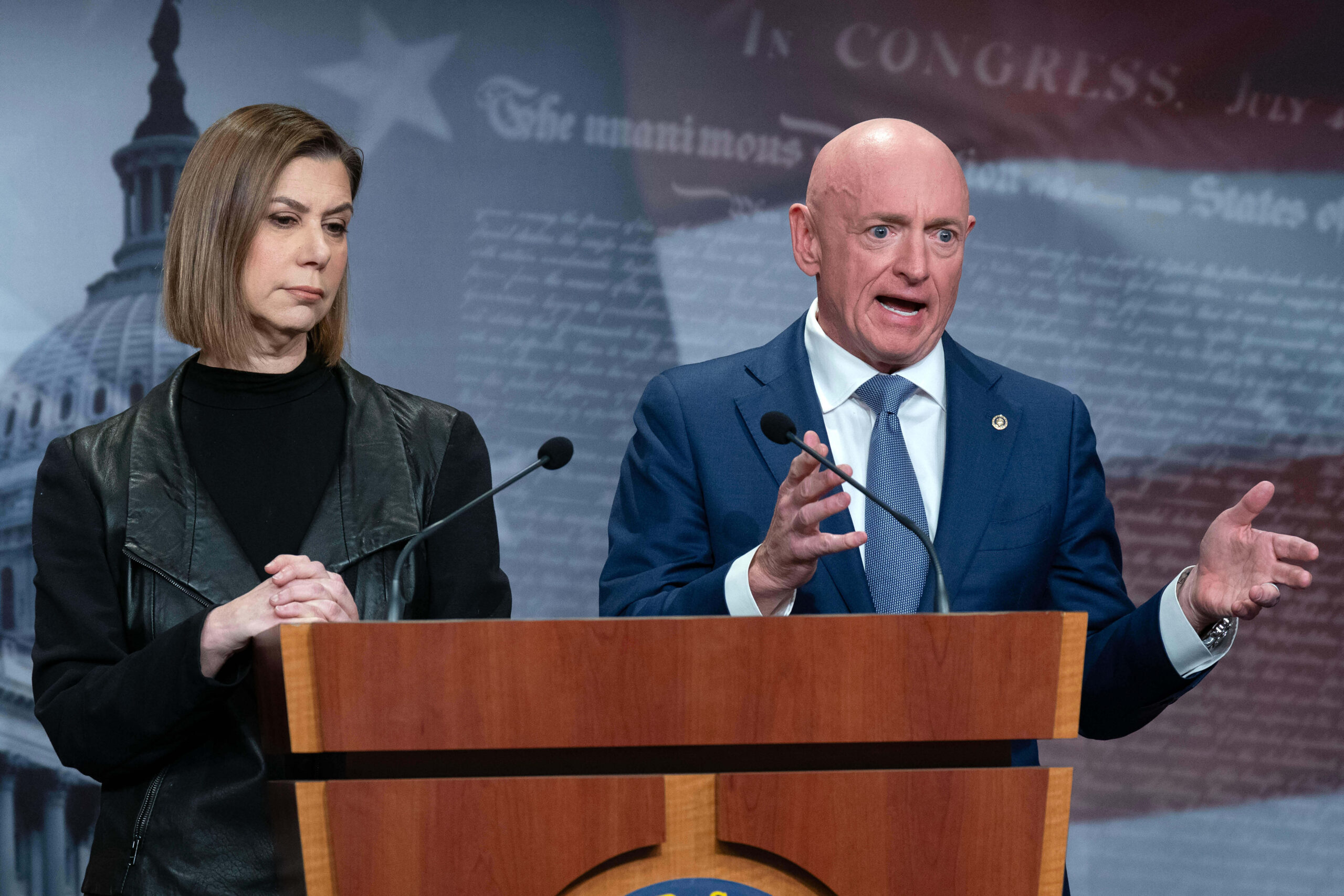
Rep. Elissa Slotkin (D., Mich.) and Sen. Mark Kelly (D., Ariz.) speak during a news conference Wednesday on Capitol Hill.
“This is not a good news story,” Kelly, a retired Navy captain and astronaut, told reporters during a news conference this week. “This is a story about how Donald Trump and his cronies are trying to break our system to silence anyone who lawfully speaks out against them.”
The attempt to charge the lawmakers represents an evolution of the campaign that began last year with cases against James and Comey, said Brendan Nyhan, a professor of government at Dartmouth College.
“Prosecuting people for speech criticizing the president is in some ways even more dangerous,” Nyhan said, “especially given these are legislators acting in their public role and especially given that they were calling for the military and national security state to follow the law.”
Still, some Trump allies in Congress, including House Speaker Mike Johnson (R., La.), defended the administration’s efforts. He told reporters that Slotkin, Kelly, and the others “probably should be indicted.”
“Any time you’re obstructing law enforcement and getting in the way of these sensitive operations, it’s a very serious thing, and it probably is a crime,” he said.
The Justice Department’s criminal investigation intothe lawmakers began after the video organized by Slotkin, a former CIA analyst, was posted online in November. In it, she and the others, all of whom served in the military or with intelligence agencies, reminded service members of their duty, spelled out in the Uniform Code of Military Justice, to resist unlawful directives.
“This administration is pitting our uniformed military and intelligence community professionals against American citizens,” the lawmakers said. “Our laws are clear. You can refuse illegal orders.”
The video did not single out any specificTrump administrationpolicies. But Slotkin and Kelly, both of whom serve on the Senate Armed Services Committee, have sharply criticized the president for military strikes he authorized on alleged drug trafficking boats in the Caribbean Sea and Pacific Ocean and his decision to deploy the National Guard to cities run by Democratic officials.
Their video drew an immediate reaction from Trump, who demanded on social media that the lawmakers face prosecution for sedition and suggested they should even, perhaps, be punished with execution.
“SEDITIOUS BEHAVIOR, punishable by DEATH!” Trump wrote in one social media post soon after the video was posted. He said in another: “IT WAS SEDITION AT THE HIGHEST LEVEL, AND SEDITION IS A MAJOR CRIME.”
Rep. Chrissy Houlahan, a former Air Force officer and a Democrat who represents Chester County, was one of six lawmakers targeted over a 90-second video message.
The messages echoed another Trump post from last year in which he, in a missive addressed to “Pam,”an apparent reference to Attorney General Pam Bondi, insisted the Justice Department move swiftly to prosecute Comey, James, and others.
“We can’t delay any longer, it’s killing our reputation and credibility,” he wrote then, adding, “JUSTICE MUST BE SERVED, NOW!!!”
Within months,James was indicted on counts of mortgage fraud, while Comey was charged with lying to Congress. Both denied the accusations and their cases were later dismissed by a federal judge over technicalissues with the appointment of the prosecutor who had charged them.
Slotkin, Kelly, and the other lawmakers have maintained they did nothing wrong — even as top administration officials have accused them of using the video to encourage service members to take actions tantamount to mutiny.
Earlier this month, four of the lawmakers in the video disclosed that they had been approached by FBI agents and declined to give voluntary interviews to prosecutors.
“It was clearly, when our lawyers sat down with them, just about checking a box and doing what the president wanted them to do,” Slotkin said Wednesday. “Their heart wasn’t even in it.”
It is not clear whether the FBI took other steps to investigate. But on Tuesday, prosecutors under the supervision of D.C.’s U.S. Attorney Jeanine Pirro, a former Fox News host and staunch Trump ally, presented a case against the lawmakers to the grand jury.
Two political appointees led that presentation, according to two people familiar with the matter who spoke on the condition of anonymity to describe sealed court proceedings.
The prosecutors — Steven Vandervelden, a former colleague of Pirro’s in the district attorney’s office in Westchester, New York, and Carlton Davis, a former staffer for House Oversight Committee Chairman Rep. James Comer (R., Ky.) — sought to charge the lawmakers with a felony crime that makes it illegal to “interfere with, impair, or influence the loyalty, morale, or discipline of the military or naval forces of the United States,” the people said.
But when it came time to vote, none of the grand jurors agreed there was sufficient probable cause to charge any of the lawmakers with a crime, one of the people familiar said.
Spokespeople for the Justice Department and for Pirro have declined to comment on the matter in the days since. Amid that silence,the effort has drawn an impassioned response from Capitol Hill.
“The fact that they failed to incarcerate a United States senator should not obviate our outrage,” Sen. Brian Schatz (D., Hawaii) said during a heated session Wednesday in which Democratic senators implored their Republican colleagues to openly condemn the Justice Department’s actions. Senate Democrats held a special caucus meeting Thursday morning to further discuss the situation.
“They tried to incarcerate two of us,” Schatz said. “I am not entirely sure the United States Senate can survive this if we do not have Republicans standing up.”
Sen. Thom Tillis (North Carolina) has emerged as one of the few Republicans to publicly rebuke the department. He described the failed attempt to prosecute as exactly the type of weaponization of the justice system that the Trump administration has said it is fighting against.
“Political lawfare is not normal, not acceptable, and needs to stop,” Tillis wrote in a post to X.
At their news conference Wednesday,Kelly told reporters that he and Slotkin learned about the attempt to indict them Tuesday through media reports.
“If things had gone a different way, we’d be preparing for arrest,” Slotkin said.
Since then, lawyers for several of the targeted lawmakers have sent letters to Pirro and Bondi seeking assurances that the investigation is over and that prosecutors will not seek to indict them again. They’ve also instructed the department to retain all records of the investigation threatening potential legal action for violating the lawmakers’ free-speech rights.
In a separate suit filed by Kelly, a federal judge Thursday halted Defense Department efforts to formally censure the senator over his video remarks, saying the effort to do so “trampled on Senator Kelly’s First Amendment freedoms and threatened the constitutional liberties of millions of military retirees.”
“The intimidation was the point — to get other people beyond us to think twice about speaking out,” Slotkin said Wednesday. “But the real question is if the president can do this to us — sitting senators — who else can he do it to?”
The Trump administration spent more than $40 million last year to send hundreds of migrants to at least two-dozen countries that are not their own, a tactic Senate Democrats described in a report Friday as a costly strategy aimed at sowing fear and intimidation in the president’s mass deportation campaign.
The 30-page analysis from the minority members of the Senate Foreign Relations Committee accuses the administration of entering into opaque financial agreements with foreign governments — including some with poor records on corruption and human rights — to rapidly expand a program for “third country” removals that once had been reserved for exceptional circumstances.
Its authors contend that the State Department has failed to conduct sufficient oversight to ensure that payments to those countries are not being misspent and that migrants transferred to their custody are not being abused or mistreated.
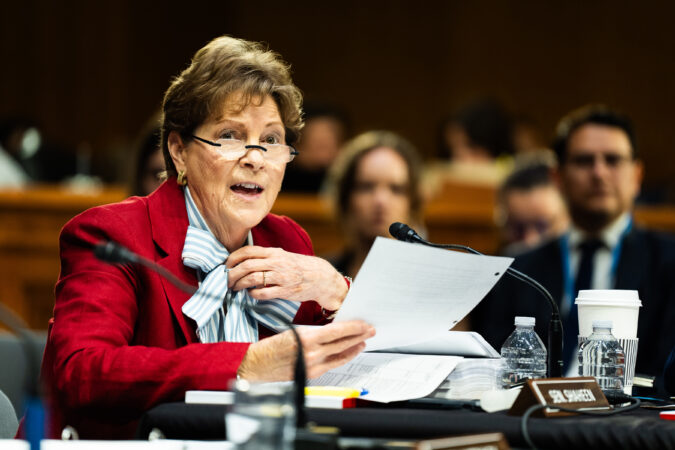
The administration “has expanded and institutionalized a system in which the United States urges or coerces countries to accept migrants who are not their citizens, often through arrangements that are costly, inefficient and poorly monitored,” Sen. Jeanne Shaheen of New Hampshire, the top Democrat on the committee, wrote in a letter to colleagues. “Deporting migrants to countries they have no connection to … has become a routine instrument of diplomacy.”
Administration officials have said they have no choice but to partner with foreign governments that are willing to accept undocumented immigrants whose native nations are not willing to take them back. In most cases, the migrants have criminal records, authorities said, though public records have shown that some have not been convicted of crimes in the United States.
The report from Senate Democrats, which provides the most comprehensive look at the administration’s third-country removal program, found that the U.S. government has sent migrants to two-dozen third countries. The analysis focused primarily on five nations — El Salvador, Equatorial Guinea, Rwanda, Eswatini, and Palau — with which the Trump administration has entered into direct financial payments totaling $32 million, a committee member involved in the report said. The person spoke on the condition of anonymity to discuss the analysis ahead of its release.
Under those agreements, U.S. authorities sent about 250 Venezuelan migrants to a maximum-security prison in El Salvador last spring, while 29 migrants have been deported to Equatorial Guinea, 15 to Eswatini, and seven to Rwanda, the report said. None has been sent to Palau.
The report also estimated that the administration has spent more than $7 million in costs related to deportation flights to 10 of the third countries.
“Millions of taxpayer dollars are being spent without meaningful oversight or accountability,” Shaheen wrote in her letter. “And speed and deterrence are being prioritized over due process and respect for human rights.”
Tommy Pigott, a State Department spokesman, said the report shows the “unprecedented” work the administration has undertaken in its first year to enforce immigration laws.
“Astonishingly, some in Congress still want to go back to a time just 14 months ago when cartels had free rein to poison Americans and our border was open,” Pigott said in a statement. “Make no mistake, President Trump has brought Biden’s era of mass illegal immigration to an end, and we are all safer for it.”
The third-country strategy has provoked public blowback and legal challenges that have slowed the administration’s efforts and, in some instances, forced it to change course.
Last spring, President Donald Trump invoked the Alien Enemies Act, a rarely used law targeting enemy combatants, which provided the administration’s legal rationale to send the Venezuelan migrants to El Salvador. Administration officials accused many of being members of the Tren de Aragua transnational gang, though some of their families and attorneys disputed that contention.
The men were later transferred from El Salvador to Venezuela under a prisoner swap. On Thursday, a federal judge in Washington ruled thatthe administration must bring some of the Venezuelan deportees back to the United States as they pursue legal challenges to their removals.
“It is worth emphasizing that this situation would never have arisen had the Government simply afforded Plaintiffs their constitutional rights before initially deporting them,” Chief U.S. District Judge James E. Boasberg wrote in his ruling.
The analysis from the Senate Foreign Relations Committee minority was put together over a period of more than eight months, based on conversations with foreign government and U.S. government officials, attorneys for deportees and immigrant rights organizations, according to the committee staffer.
The staffer said the goal of the report is to highlight the costs of the administration’s approach at a time when Democrats are concerned that the U.S. government is “entering a new phase” of speeding up the number of third-country agreements, along with the pace of deportations.
The report faults the administration for pursuing its deportation policies at the expense of other U.S. interests, including promoting human rights and punishing corrupt foreign regimes.
The authors said the Trump administration’s payment of $7.5 million to Equatorial Guinea to accept immigrants was more than the amount of foreign assistance the United States provided to that country in the previous eight years. They cited a 2025 State Department report on human trafficking that cited U.S. concerns about “corruption and official complicity in trafficking crimes” in that country.
The report also said the Trump administration was moving hastily to carry out third-country removals without trying to negotiate with the home countries of some deportees. In one case, a man initially deported to Eswatini was later sent to his home nation of Jamaica, where government officials said they had never told the United States that they were unwilling to accept him.
“As a result, the Trump Administration has, in some cases, paid twice for migrants’ travel — once to remove them to a third country and then again to fly them to their home country,” the report says.
As such, Philly is also a pretzel town, Jim Mueller says. While he was growing up in Northeast Philadelphia in the late 1990s, soft-pretzel bakeries dotted neighborhoods across the city. He and his family bought pretzels from the now-closed Ben Franklin Pretzels on Kensington Avenue near Ontario as well as Federal Pretzel Baking Co. at Seventh and Federal.
Jim Mueller with pretzels at Pretzel Day Pretzels.
Five years ago, Mueller was working as a UX designer and was craving a fix. “It kind of hit me that there were no pretzels to be gotten that weren’t straight from the [Philly] Pretzel Factory,” Mueller said of the ubiquitous Bensalem-based franchise. “I wanted to make them the way I remembered them tasting: buttery, rich, and flavorful.”
Mueller began studying recipes, and he and his wife, Annie, started a side project called Pretzel Day Pretzels. They began doing pop-ups and deliveries.
Jim Mueller pulls pretzels with long hots and provolone from the oven at Pretzel Day Pretzels.
On Saturday, Pretzel Day Pretzels went the brick-and-mortar route at Fifth and Dickinson Streets in South Philadelphia, opening at the former Milk & Sugar space with a simple setup: takeout only and morning-to-early-afternoon hours.
Mueller rolls and bakes standard-issue soft pretzels, but his specialties are stuffed pretzels and German varieties that you don’t really see around here, particularly Swabian pretzels.
Jim Mueller stuffs pretzels with long hots and provolone at Pretzel Day Pretzels.Pretzels are tossed with cinnamon sugar at Pretzel Day Pretzels.
“It’s a little different from a Bavarian,” Mueller said. “Bavarians are what most people are familiar with — thick all around. Swabians have a big belly and skinny arms, and the arms get a little crunch to them. You can split the belly and stuff them. You can do more with them than a regular pretzel, and it opens up a lot of possibilities to experiment.”
Stuffing is where Pretzel Day Pretzels leans hardest into variety. The most popular option is the long hot-provolone pretzel, with other offerings including chili pretzels, pizza pretzels, bialys, cinnamon-sugar pretzels, and, on some days, pretzel dogs and Bavarian cheese logs. The lineup will shift slightly week to week, Mueller said, “but we’ll always have the core stuff.”
Merch on display at Pretzel Day Pretzels.
Saturday’s opening was low-key, with small giveaways such as heart-shaped pretzels and tote bags. The shop will offer coloring pages for kids that can be redeemed for a free pretzel.
“I just want it to be a pretzel shop for everyone,” Mueller said. “I don’t want it to feel high-end or bougie — just a neighborhood pretzel shop.”
As he sees it, Pretzel Day is meant to feel less like a concept and more like a missing piece put back into place.
“You always hear that Philadelphia’s a pretzel town,” he said. “But then you think — where are all the pretzel shops? I never thought I’d open one when I started doing this, but here we are.”
Pretzel Day Pretzels, 1501 S. Fifth St., instagram.com/pretzeldaypretzels. Hours: 8 a.m. to 3 p.m. Wednesday through Saturday, and 8 a.m. to 1 p.m. Sunday.
Pretzels from the oven at Pretzel Day Pretzels on Feb. 12, 2026.