Blog

  • Billions of gallons of raw sewage from Philly are released into the Delaware annually

    Billions of gallons of raw sewage from Philly are released into the Delaware annually

    Philadelphia discharges 12.7 billion gallons of raw, diluted sewage into the Delaware River’s watershed each year, with Camden County adding to the mix, according to a new report.

    That’s a problem, say the report’s authors at the nonprofit advocacy group PennEnvironment. Philadelphia and Camden border the river, and significant recreational potential is blocked for part of the year because of pollution from both, the authors say.

    A waterway can remain unsafe for recreation for up to 72 hours after an overflow. That suggests local waterways could be unsafe for recreation up to 195 days per year, or more than half the year.

    Five decades after the Clean Water Act mandated that waterways be made safe for swimming and fishing, combined sewer overflows (CSOs) continue to pollute during wet weather when untreated sewage and runoff surge into nearby creeks and rivers, creating the potential to sicken recreational users.

    David Masur, executive director of PennEnvironment, said the group included Camden County in its most recent report “to get a more holistic view.” PennEnvironment’s first report on CSOs in 2023 focused only on Philly.

    The pollution “affects the waterway, the environment, and public health,” Masur said. “The river is the border between the two states, and people on both sides use it a lot.”

    PennEnvironment acknowledges that both Philly and Camden County have programs to reduce overflows and is calling on federal officials for increased funding to put proper infrastructure into place.

    Philadelphia Council member Jamie Gauthier (center) spoke Monday about PennEnvironment’s report on pollution from combined sewer overflows. To her left is Margaret Meigs, president, Friends of the Schuylkill Navy. And to her right is Tim Dillingham, senior adviser, American Littoral Society, and Hanna Felber, clean water associate at PennEnvironment Research & Policy Center.

    Frequent overflows, high volume in Philly

    Roughly 60% of Philadelphia is served by a combined sewer system, which has 164 outfalls — really large metal or concrete openings — that discharge pollution into waterways. A CSO system uses a single pipe to collect and transport sewage from homes and businesses as well as stormwater runoff from streets and sidewalks.

    During dry weather, the system can handle the volume before safely releasing it back into the rivers. But during heavy rainfall, the system discharges untreated, though highly diluted, sewage mixed with stormwater directly into waterways.

    Despite the Philadelphia Water Department’s ongoing Green City, Clean Waters project — a 25-year plan focusing on green infrastructure to reduce overflows — the frequency and volume remain alarmingly high, the report states.

    Overall, CSOs dumped an average of 12.7 billion gallons of raw sewage mixed with polluted stormwater per year into local waterways from 2016 to 2024, the authors of the report stated. They included an online map to show the location of the outfalls and annual overflow.

    Half the sewage came from just 10 CSOs.

    window.addEventListener(“message”,function(a){if(void 0!==a.data[“datawrapper-height”]){var e=document.querySelectorAll(“iframe”);for(var t in a.data[“datawrapper-height”])for(var r,i=0;r=e[i];i++)if(r.contentWindow===a.source){var d=a.data[“datawrapper-height”][t]+”px”;r.style.height=d}}});

    Still, the numbers are a slight improvement over the 15 billion gallons a year released into local rivers, as PennEnvironment reported in 2023.

    Philadelphia gets its drinking water from the rivers, but the CSOs are downstream of the city’s treatment plants on the Delaware and the Schuylkill.

    The report used publicly available data to show that five of six waterways in Philly produced at least one overflow 65 times or more per year on average between 2016 and 2024. Those were the Delaware River, the Schuylkill, and Cobbs, Frankford and Tacony Creeks.

    In better news: The average volume of overflow per inch of precipitation declined by about 16% from previous periods, but progress is slow and threatened by increased rainfall and rising sea levels due to climate change, the authors say.

    PWD could not be reached for comment.

    window.addEventListener(“message”,function(a){if(void 0!==a.data[“datawrapper-height”]){var e=document.querySelectorAll(“iframe”);for(var t in a.data[“datawrapper-height”])for(var r,i=0;r=e[i];i++)if(r.contentWindow===a.source){var d=a.data[“datawrapper-height”][t]+”px”;r.style.height=d}}});

    Camden County

    The report also found persistent overflows in Camden County. The cities of Camden and Gloucester, along with the Camden County Municipal Utilities Authority (CCMUA), operate combined sewer systems that frequently overflow into the Delaware River and its tributaries, including the Cooper River and Newton Creek.

    The report found that systems on the Camden County side of the river overflowed into local waterways an average of 76 days per year from 2016 to 2024.

    window.addEventListener(“message”,function(a){if(void 0!==a.data[“datawrapper-height”]){var e=document.querySelectorAll(“iframe”);for(var t in a.data[“datawrapper-height”])for(var r,i=0;r=e[i];i++)if(r.contentWindow===a.source){var d=a.data[“datawrapper-height”][t]+”px”;r.style.height=d}}});

    The highest-frequency outfall for the Cooper River released sewage for an average of 118 days annually during that period.

    The Delaware River received sewage overflows for an average of 94 days annually from its highest-frequency outfall.

    The authors said gaps in data leave them unable to show the total volume of diluted sewage released from Camden. But they said that the amount of “solids/floatables” collected at each outfall is an indicator a waterway is polluted.

    Dan Keashen, a spokesperson for Camden County, said officials have been making strides.

    He said that crews recently cleaned 30 miles of pipe and that a $26 million project is underway to physically separate the combined sewer service area of Pennsauken that flows into Camden. Officials are also studying how to better achieve compliance for the largest outfall in the system, a project estimated to cost $40 million to $150 million when complete.

    What can be done?

    The report concludes that current plans by Philadelphia and Camden County are insufficient to achieve the goal of a clean Delaware River watershed.

    The report was written by John Rumpler, clean water director for Environment America, PennEnvironment’s parent organization, and Elizabeth Ridlington, associate director of the Frontier Group, a nonprofit research group that is part of the Public Interest Network, an environmental advocacy organization.

    The authors call for officials to accelerate action to end all sewer overflows, set a hard deadline, and find new ways to pay for necessary infrastructure upgrades.

    Philadelphia Councilmember Jamie Gauthier, chair of the committee on the environment, called overflows “a public health crisis” and urged PWD’s new commissioner, Benjamin Jewell, to act. She said elected officials in Harrisburg and Washington also need to step up.

    PWD is separately under pressure by a new Environmental Protection Agency regulation that seeks to improve the amount of dissolved oxygen in the Delaware by ordering a large-scale reduction of ammonia at the city’s three water pollution control plants. PWD estimates that the price for compliance is $3.6 billion and would cost households an additional $265 annually on their water bills.

    The authors of the PennEnvironment report concede the CSO task is daunting. But they say Portland and Boston faced similar situations, invested in infrastructure, and managed to make CSO overflows infrequent. Washington, D.C., they said, is on track to reduce sewage overflows by 96% in 2030.

    Hanna Felber, a PennEnvironment advocate, said that PWD needs to use creative funding, such as floating longer-term bonds to finance projects, and that its engineers need to find more creative solutions, such as installing larger stormwater tunnels that flow separately from sewage.

    “Unfortunately, our new report on sewage pollution in Philadelphia shows that on far too many days each year, the Philadelphia Water Department’s pipes and sewer systems dump huge volumes of raw sewage into our beautiful waters, harming our environment and depriving the public of a safe place to fish, boat, and float,” Felber said.

  • A storm looms in what’s going to be another rough week for Jersey beaches

    A storm looms in what’s going to be another rough week for Jersey beaches

    New Jersey’s beaches, still recovering from major sand losses from an offshore hurricane and a nor’easter, evidently are in for another assault this week as October is about to make a dramatic exit.

    Gale-force gusts off the ocean could develop as early as Tuesday afternoon at the Shore, said Eric Hoeflich, a meteorologist at the National Weather Service office in Mount Holly, with brisk onshore winds persisting “maybe into Friday.”

    A potent storm is forecast to affect the entire region Wednesday night into Thursday, with heavy rains in the immediate Philadelphia area, where drought conditions have been intensifying.

    Also on Thursday, what is likely to become catastrophic Hurricane Melissa will be passing offshore, churning up the waves crashing on East Coast beaches.

    “The coast once again is going to take a pretty good battering,” said Dave Dombek, senior meteorologist with AccuWeather Inc.

    On the plus side, Hoeflich said, for the Shore, this week’s storm “doesn’t look as bad” as the beach-erasing nor’easter earlier this month. The path should be more inland, and the lunar influence on the tides would be less. Only minor flooding is expected, he said, subject to change.

    However, not only would the track mean region-wide heavy rain, but it would also increase the potential for severe thunderstorms Thursday. A front is due to chase the rains Friday, but it may generate gusts to 50 mph, the weather service says. Power outages are possible both days.

    The timetable for the winds and the storm in the Philly region

    The National Weather Service has posted a gale warning for Tuesday into Wednesday morning for the waters along the immediate coast for winds from the east that could gust past 50 mph.

    That would be more the result of high pressure to the north of the region. Winds circulate clockwise around centers of highs; thus, areas to the south of the center experience winds from the east.

    The breezes will be getting a second wind as a storm develops in the Southeast and tracks north. Meanwhile, a weakened Hurricane Melissa will be churning the ocean as it passes well off the U.S. coast on Thursday.

    The Philly region could use the rain

    The interagency U.S. drought monitor has the majority of the region in its “moderate drought” category.

    Rain for the last 30 days has been about a third of normal in the city and the neighboring Pennsylvania counties.

    South Jersey has fared only slightly better, but precipitation is well less than half of normal.

    What is the forecast for the trick-or-treaters?

    It is all but certain that Friday will be a dry day, with temperatures in the low and mid-50s. Wind gusts are forecast to die down sometime after 5 p.m., but hold onto those brooms, just in case.

  • A former Philly probation officer and an ex-cop ran an illegal gambling operation together, feds say

    A former Philly probation officer and an ex-cop ran an illegal gambling operation together, feds say

    A former Philadelphia probation officer and a former city police officer have been charged with illegally connecting bettors to an overseas sports gambling website that allowed them to place hundreds of thousands of dollars in bets over nearly a decade, according to federal authorities.

    Joseph Moore and James P. DeAngelo Jr. each face one count of conducting an illegal gambling business, court records show. Moore, the former probation officer, pleaded guilty in federal court Monday.

    DeAngelo, the former police officer, is scheduled to appear in court later this week and has been charged by information, which typically indicates that a defendant intends to plead guilty.

    Prosecutors said in charging documents that Moore ran the scheme from 2017 to 2025 — operating “block pools” based on NFL or NCAA basketball games, or helping bettors place ordinary wagers on different sporting events. He would sometimes send mass emails to hundreds of bettors advertising pools he was running, the documents said, with entry fees of a few hundred dollars and payouts in the thousands for winners.

    Moore often collected 10% of the winners’ earnings as a “tip,” prosecutors said, and he sometimes allowed bettors to place wagers on credit even if they had incurred multiple losses.

    He conducted some of his business from his probation office, the documents said, and saved records from the operation on his work computer. At one point, prosecutors said, he recruited another probation officer to help collect and transfer money from bettors using peer-to-peer apps such as Venmo and Cash App.

    DeAngelo, meanwhile, helped maintain the operation’s access to the overseas gambling site, prosecutors said, and he sometimes accepted wagers from individual bettors.

    Prosecutors did not specify whether the investigation led either man to lose his job. But in charging documents, prosecutors said Moore ran the operation until February 2025, and Martin O’Rourke, a spokesperson for the First Judicial District, said Monday that Moore resigned from the probation department that month.

    A police spokesperson did not immediately respond to a request for comment Monday, and DeAngelo did not have an attorney listed in court records.

    The case was unsealed Monday, just days after federal prosecutors in New York unveiled two sweeping indictments charging several NBA figures with participating in illegal gambling schemes, one of which involved a player allegedly providing inside information to bettors about specific games.

    The fallout from that scandal has come quickly, with some commentators questioning whether sports leagues have grown too close to the betting industry, and Congress requesting a briefing from the NBA’s commissioner, Adam Silver.

  • For Eagles, the bye week ‘sets you up for some things for the rest of the season,’ Nick Sirianni says

    For Eagles, the bye week ‘sets you up for some things for the rest of the season,’ Nick Sirianni says

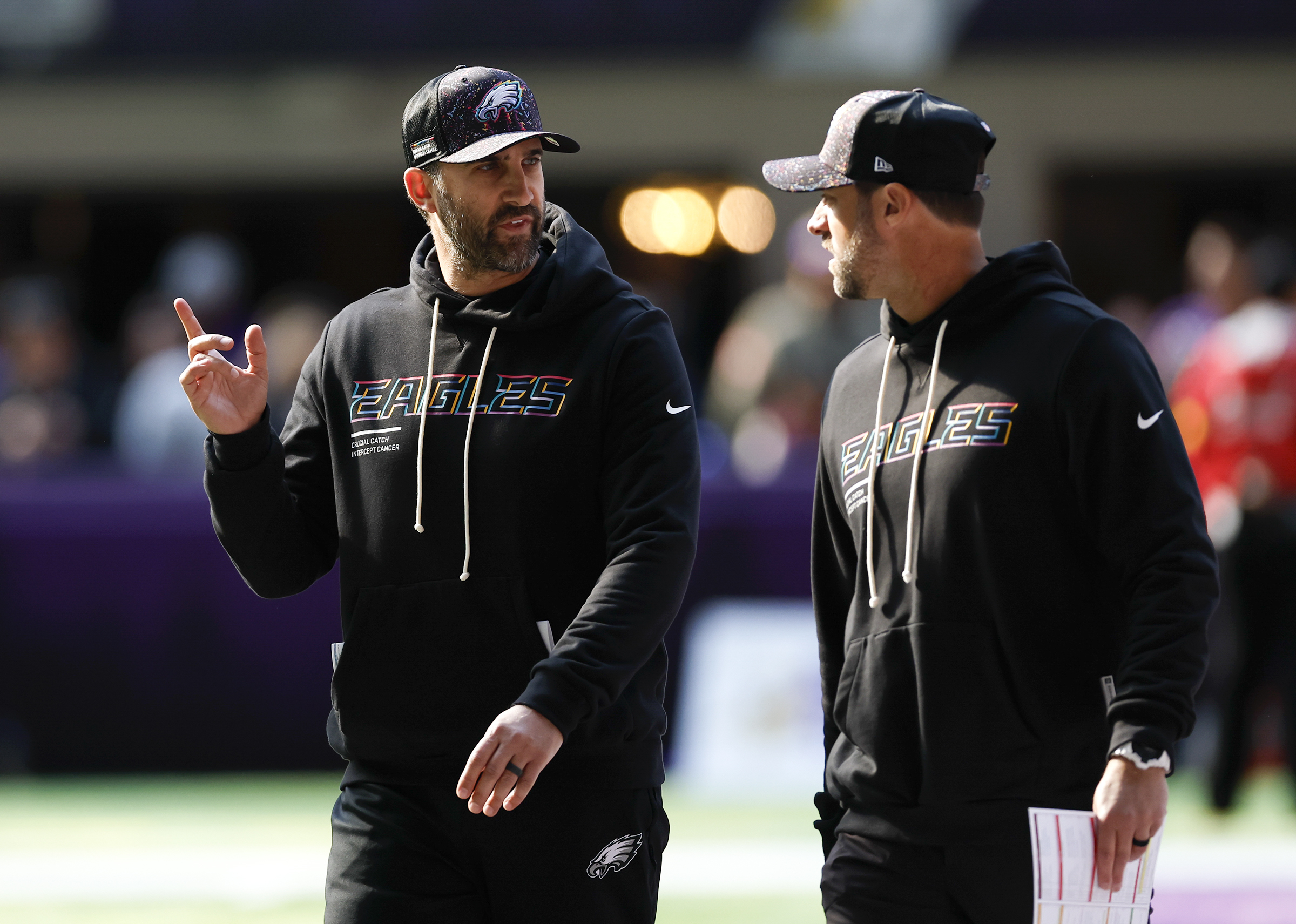
    Bye weeks have come in all shapes and sizes during Nick Sirianni’s five seasons leading the Eagles.

    In 2021, the Eagles waited until December and Week 14 for their week off. In 2022, the bye came in Week 7. In 2023, it was Week 10. And in 2024, the Eagles had the first bye of the season in Week 5 on the heels of their long travel to Brazil for Week 1.

    Is Week 9, basically the midway point of a 17-game regular season, the perfect time?

    “I don’t think you can ever really say, ‘Hey, this is the perfect time for a bye,’” Sirianni said Monday, a day after his Eagles beat the New York Giants, 38-20, to hit the bye week with a 6-2 record. “Last year, in 2024, Week 4 was our perfect time for the bye. Our mindset will be, this year, this is the perfect time for a bye. And when we play a Friday afternoon game coming up [Nov. 28 vs. Chicago], that will be the perfect time for a Friday afternoon game.

    “You handle every situation and control what you can control.”

    The constant through four bye weeks under Sirianni has been winning after the lull. The Eagles are 4-0 after the bye during Sirianni’s tenure. Last week in Minnesota, they improved to 10-3 over the last five seasons in games that come at least 10 days after their previous contests (including playoff games).

    Extending that 4-0 streak and improving upon that 10-3 extended rest record will be a difficult task for the Eagles, who come off the bye for a Week 10 Monday night game at Green Bay, which leads the NFC with a .786 winning percentage. After that is a home game on a shorter week against the 5-2 Detroit Lions.

    The bye comes just two weeks after the Eagles had a productive mini-bye following their Week 6 loss to the Giants. It was a second consecutive defeat and one that dropped the Eagles to 4-2. But the Eagles have emerged from that week with consecutive victories and won a lopsided affair Sunday. Is the state of the union different now compared to how Sirianni felt two Fridays ago? If it is, Sirianni wouldn’t say so.

    “We don’t live week-to-week with results,” he said. “Obviously, we’re paid to win football games and find ways to get better, but we don’t live week-to-week. You work like crazy to get better, you work like crazy to win each football game, but then win, lose, or draw, you’re on to the next and you’re doing the same thing all over again.”

    The message for the coaching staff this week, Sirianni said, is to be “completely locked in and focused on finding ways to get better, identifying issues, identifying strengths, and this is a really important week.

    “We’ve benefited from this week in the past, whether that be going into the playoffs or whether it’s in the regular season,” he said. “It’s that same motivation and that same hunger to do everything that we can do to help improve the football team.”

    For the players, the message is to get some rest, heal up, but remain mentally focused on what’s ahead.

    “This bye week sets you up for some things for the rest of the season,” Sirianni said.

    It certainly did last year, when the Eagles hit the bye with a 2-2 record, made some tweaks, and won 10 consecutive games after the break.

    Patullo’s growth

    Maybe the bye week is coming at a bad time. Who wouldn’t want to keep it rolling after the offense put together arguably its best four-quarter performance under new coordinator Kevin Patullo?

    The Eagles put together a complete effort Sunday and finally found success running the football and passing it during the same game. They schemed up the pin-and-pull blocking game and showed their under-center versatility.

    It has been a bumpy first eight games for Patullo after taking the reins from Kellen Moore. But Sunday — which followed a strong showing with the aerial attack last week — showed the Eagles might be on a better path.

    Coach Nick Sirianni believes offensive coordinator Kevin Patullo is getting better each week.

    “I think he’s done a good job of continuing to get better, just like our players,” Sirianni said of Patullo. “Every team is a new team, so there’s a growth period whether there’s a first-time play caller or not. There’s a growth period within each year for the players, for the coaches, everything. That’s what the first weeks of the season are for, is to find ways to win, find ways to get better, and really be in that continual growth mindset all the way through so you’re playing your best football in November, December, January hopefully.”

    Trade deadline looming

    The trade deadline will have passed the next time the Eagles take the field for a practice. The deadline is Nov. 4 at 4 p.m., and the Eagles aren’t due back at the NovaCare Complex until after that.

    It could be an active deadline period for the Eagles, who have a few positions of need to address. Does not having a game to prepare for ahead of the deadline make life easier for Sirianni when it comes to working closely with Howie Roseman on improvements? The coach said it’s no different.

    “We find time to do the things that are necessary to help the team win, help the team get better,” Sirianni said.

  • Flyers GM Danny Brière provides injury updates on Rasmus Ristolainen and Oliver Bonk

    Flyers GM Danny Brière provides injury updates on Rasmus Ristolainen and Oliver Bonk

    After an off-day on Sunday, the Flyers hit the ice Monday for practice in Voorhees, and there was a big piece missing.

    Defenseman Travis Sanheim did not skate, and when asked if it was a maintenance day, coach Rick Tocchet said, “Kind of, yeah.”

    “Just dealing with a little tweak here and there,” he added. “It’s better [for] us to just keep him off the ice. He’s played a lot of minutes.”

    In his ninth NHL season, Sanheim ranks second among all NHL skaters in ice time, averaging 26 minutes, 28 seconds. He only trails Quinn Hughes of the Vancouver Canucks.

    The blueliner, who does not skate on the power play, does play against the opposition’s top line and kills penalties.

    “Just whatever’s asked of me, whenever they need me to go out there,” Sanheim said on Oct. 19. “I’ve got the lungs to do it. I recover pretty good. So just whatever they kind of ask [of me].”

    Flyers defenseman Travis Sanheim, who ranks second in the NHL in ice time, has one goal and four points this season.

    Ristolainen update

    Rasmus Ristolainen is inching closer to a return.

    “In Risto’s case, everything’s coming along nicely,” Flyers general manager Danny Brière said on Monday of the defenseman, who has been skating on his own. “Pretty soon, we’re hoping he starts practicing with the team.

    “I don’t know how far away that is, but he’s progressing well, and everything’s going well. We’re hoping next month, in about a four-to-six-week range, hopefully he’s back with the team.”

    Ristolainen has not played this season after undergoing surgery on a right triceps tendon rupture on March 26. In 2024, Ristolainen underwent two surgeries, including a repair to a ruptured triceps tendon. According to Brière in April 2025, the injury was similar, although he wouldn’t confirm if he tore the tendon again.

    Before the start of training camp, the GM announced Ristolainen was expected to miss the first six to eight weeks of the season. It sounds like he is on track.

    The Finnish defenseman played in 63 games last season, with four goals, 15 points, and the first positive plus-minus of his career (plus-3) while averaging more than 20 minutes. One of the Flyers’ top blueliners, Ristolainen, who also played on the power play this season, last played on March 11.

    Bonk update

    It’s been weeks since prospect Oliver Bonk has been spotted on the ice. The 20-year-old, who just turned pro, is dealing with an upper-body injury that kept him from participating in the rookie series against the New York Rangers in early September and training camp.

    Flyers defenseman Oliver Bonk will make his professional hockey debut this season.

    “Things are not moving … as quickly as we expected,” Brière said on Sept. 16, adding that he underwent medical imaging that morning despite skating with the rookies in a noncontact jersey.

    Unlike Ristolainen, his timeline is still to be determined. But the hope is for the highly touted blueliner to get back to action soon.

    “As far as Oliver, we didn’t know how serious it was at first. We’ve kept him out of rookie camp, and it lingered. We kept him out of main camp, thinking that it would get better, and it’s been a slow process with his upper-body injury,” Brière said on Monday.

    “But it’s going well now. We’re just hoping that there’s no setbacks. We’re trying to give him the time and proper space between skates for him to feel good enough to come back and play. It’s a little tougher on a timeline with him. We’re kind of waiting on the progression and making sure there’s no setback on him.”

  • Shapiro’s view that America is ready for a Jewish president hasn’t changed, Times says

    Shapiro’s view that America is ready for a Jewish president hasn’t changed, Times says

    Gov. Josh Shapiro told the New York Times in an article appearing Monday his opinion that a Jewish person could become president has not changed since he first voiced it a year ago.

    The article referenced a statement Shapiro made to the Times last year that “speaking broadly, absolutely” America could elect a Jewish president in his lifetime.

    The Monday article stated: “This month he said his view was unchanged.”

    Shapiro has never publicly confirmed he’s interested in running for president, though speculation has long followed him.

    While he has been largely untested on the national stage, Shapiro is often listed among the Democrats likely to make a run for the presidency in 2028.

    Despite that, the April arson attack, denounced by many as antisemitic, at the governor’s mansion against Shapiro and his family on Passover as they slept shook some people’s “confidence in the idea that the country was ready for leaders like Mr. Shapiro,” the Times wrote.

    In fact, Shapiro told the Times, he spoke with his family about whether holding elected office was worth the risk of political violence, which Americans believe is on the rise, according to a survey released last week by the Pew Research Center.

    Shapiro concluded: “If I leave because violence pushed us out or scared us, then those who want to perpetuate political violence win.

    “I’ve got to stay. I’ve got to show that we’re not afraid.”

    Taking that stand, however, is not getting easier.

    “It’s gotten hotter and hotter and more and more dangerous,” Michigan Gov. Gretchen Whitmer, herself the target of a kidnapping plot, told the Times.

    Cody Balmer, 38, the man accused of setting the governor’s mansion ablaze, pleaded guilty on Oct. 14 to attempted murder and related crimes. Sentenced to 25 to 50 years in prison, Balmer said he intended to attack Shapiro with a hammer that night.

    Photos released by the Pennsylvania State Police and seen on YouTube showed a soot-covered chandelier, singed walls, a blackened carpet, melted tables, burned furniture, and a damaged grand piano.

    Since the attack, Shapiro has spoken with other elected leaders and those considering running for office, offering personal guidance to those victimized by political violence, and he talked with Gov. Tim Walz of Minnesota after the former state House speaker, Melissa Hortman, and her husband were assassinated, the Times wrote.

    “Knowing that as you’re doing that work that I consider to be noble, that it comes with a risk to you and your family,” he told the Times, “that’s a tension that is a challenge to work through.”

    “It is one of the reasons why I’m so motivated to speak out against political violence,” Shapiro added. To “try and take the temperature down so that good people want to serve.”

    Regarding potential bias against religion, the governor told the Times that Americans “respect faith, even if they don’t practice it, and want to have a deep relationship with the people who represent them.”

    Being open about his Judaism has allowed him “to be able to have a deeper relationship with the people of Pennsylvania, allowed them to share their stories,” Shapiro told the Times, adding: “We’re doing that in this ultimate swing state.”

    Shapiro will release a memoir next year detailing his career and personal life, including the firebombing of the governor’s mansion and his place on the short list to be Kamala Harris’ vice presidential candidate.

    Considered a viable Democratic presence, Shapiro on Saturday stumped for New Jersey gubernatorial candidate U.S. Rep. Mikie Sherrill in the Garden State at a senior center auditorium and an African Methodist Episcopal church, targeting two groups seen as necessary for Sherrill to beat Republican Jack Ciattarelli.

    Staff writers Julia Terruso and Gillian McGoldrick contributed to this article.

  • Temple tight end Peter Clarke’s size is creating an advantage in the passing game: ‘He’s hard to bring down’

    Temple tight end Peter Clarke’s size is creating an advantage in the passing game: ‘He’s hard to bring down’

    On the first offensive possession of the season, Temple faced second and 9 from Massachusetts’ 21-yard line, and offensive coordinator Tyler Walker buzzed down a play call to quarterback Evan Simon.

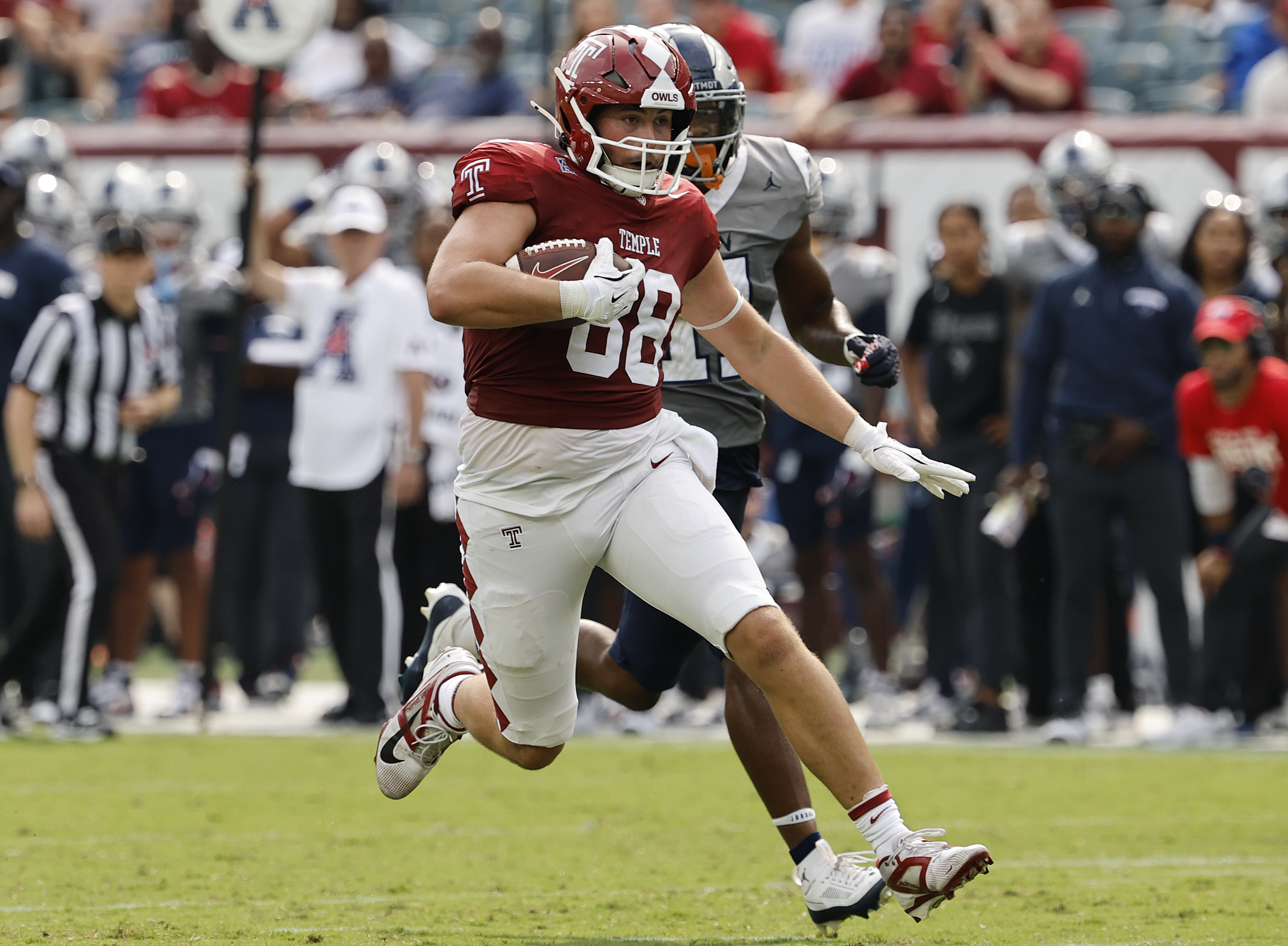
    The play, called “Buckeye,” sent tight end Peter Clarke down the seam on a double move matched up with a UMass safety. The ball from Simon, which he says was “really overthrown,” somehow found the outstretched right hand of Clarke, the 6-foot-6, 265-pound tight end.

    “You look at his height and weight, and [he’s] just a big target who really makes my job easier,” Simon said by telephone recently. “The missed throws, or whatever you want [to call them], inaccurate throws, they have a little more leeway with [his size].”

    Walker heavily featured his tight ends as Montana State’s offensive coordinator, and he brought the same mindset to the Owls. He recalls meeting Clarke, describing him as “big, athletic, can run and catch the ball well.”

    Clarke, a native of South London, went through the NFL Academy, a platform that helps international athletes learn football. He told Walker that he watched YouTube videos to learn the basics of football, drills, and highlights.

    “He’s got great ball skills, he’s super intelligent,” Walker said. “When he told me that he learned [football] through YouTube, I was surprised, because he’s got football feel that you see from kids who’ve been playing the game their whole life.”

    Philly emulates his home

    Clarke has put up career numbers through eight games in his junior season with 23 catches, 378 yards, and four touchdowns. He entered the season with just five catches and three touchdowns.

    Football began as a hobby for him in England, where he played five-on-five games in middle school before enrolling in the NFL Academy at 16. He equates the NFL Academy to IMG Academy in Bradenton, Fla., with the way it “emulates a college football sort of atmosphere in terms of the intensity and the weight room, the attention to detail in the meetings, the time schedule of early mornings, late afternoons, and really playing on a bigger stage than just an average high school.”

    Temple tight end Peter Clarke runs with the football against Howard on Sept. 6.

    “The NFL Academy did a great job of preparing me just for the transition of how much time, effort and intensity you put into this thing,” Clarke said. “And then once I got here, I had great leaders in my room, people like [former Temple tight end David Martin-Robinson], who’s on the Titans now, to really show me what college football was about and how to live this life.”

    When it came to choosing his future college home, Clarke said the decision was simple.

    “I wanted to go to a school that emulated something of my home environment, London, in a big city, 10 million people. I come from a very, like, inner-city part of London,” Clarke said. “So I wanted to go to a school that was in a city and Temple being in the heart of North Philly, when I came on my visit, it felt like home.”

    Top-rated tight end

    Among the tight ends across 136 teams in the Football Bowl Subdivision, Clarke is rated No. 1, according to Pro Football Focus, with a 91.8 grade, more than four points higher than the next player.

    His value on the field has been apparent this season. Clarke averages the most yards per catch (16.4) on the team among players with five or more receptions. But his preparation is what separates him, tight ends coach Chris Zarkoskie said.

    “Since I got here, he’s been a kid who has a good skill set and can do a lot of different things, and a young man who works really hard and is ready when his opportunity comes, which is the thing I’m most proud of for him,” Zarkoskie said. “He takes pride in the whole body of work that it takes to be a tight end. And I think that he’s continuing to grow and evolve as a blocker, in-line and out in space.”

    Temple’s tight end corps has representation from three international players: Clarke, Ryder Kusch (Canada), and Daniel Evert (Germany). David Wise is from South Philly and Jake Woods is from California. Zarkoskie said getting to coach this diverse group “is the coolest part of the game that we coach.”

    Temple tight end Peter Clarke enters before a game against Miami at Lincoln Financial Field on Sept. 23, 2023.

    Clarke arrived at North Broad weighing 225 pounds and has filled out his frame. He said he relishes most in proving that he is more than a run blocker by doing “freakish stuff” in the passing game. Walker and Simon agree, and both detailed Clarke’s best play this season as a pass catcher.

    “If I had to pick one from this year so far, I think it would be against UTSA in the second half,” Simon said. “Our first drive in the third quarter, we refer to it as ‘the spark,’ and we went down, scored, and his catch over the middle with a linebacker right on him and safety over top that could have really taken his head off. He stuck in there, caught the ball.”

    Added Walker: “Evan put the ball in a window the size of a computer screen, and you saw Peter’s big mittens just coming out of the air and catching the ball above his head. And then on top of that, being able to get the yards after the catch and add on another 15 yards, his pure size, his pure mass. He’s hard to bring down. He’s a little more fluid than people would think, just based off his size.”

    Clarke added to his highlight reel with a career-long 50-yard reception during a 38-37 overtime win over Tulsa on Saturday. With one more win, Temple (5-3) will be bowl eligible for the first time since 2019. And you can bet Clarke will be in the middle of it all.

  • Locked out for life: Pa.’s housing crisis is fueled by 1988 law

    Locked out for life: Pa.’s housing crisis is fueled by 1988 law

    Pennsylvania has an opportunity to lead the nation in righting a long-standing wrong in our housing laws.

    A group of legislators has introduced the PA Fair Future Act — landmark legislation that would end the state’s enforcement of one of the most damaging and overlooked barriers to housing: the Thurmond Amendment.

    Enacted in 1988 during the height of the war on drugs, the Thurmond Amendment allows landlords and property sellers to deny housing solely on the basis of a drug distribution conviction — regardless of how long ago it occurred, the person’s current circumstances, or how much they’ve rebuilt their lives.

    Imagine making a mistake as a teenager or young adult — getting caught up in drugs, serving your sentence, and spending years working hard to turn your life around.

    Despite holding a steady job, maintaining good credit, and having a clean rental history, you still find yourself legally locked out of housing because of a decades-old conviction.

    Some landlords won’t return your calls. Others reject your application outright, no questions asked.

    That’s the reality for thousands of Pennsylvanians.

    Take the case of Jonathon Jacobs, who was convicted of marijuana distribution when he was 19. For years, Jacobs faced rejection in the housing market or was forced to pay exorbitant security deposits because of his record.

    His punishment didn’t end with his sentence — it extended into every aspect of his life, including his ability to provide stable housing for his family.

    Ironically, had Jacobs been convicted of a violent crime, he would not be facing this same legal barrier.

    In 2016, the Department of Housing and Urban Development (HUD) issued guidance urging housing providers to consider criminal records in context — taking into account factors like rental, credit, and employment history.

    But the Thurmond Amendment creates an explicit carveout: Anyone with a drug distribution conviction is excluded from these protections. It’s a loophole that leaves people like Jacobs permanently locked out of fair housing opportunities.

    The law’s impact in Pennsylvania is staggering.

    Since 1988, over 80,000 Pennsylvanians have been convicted of drug distribution offenses — many for small amounts. In fact, the most frequently charged amount is less than 1 gram, barely more than a sugar packet.

    In 2022, the U.S. House voted to help roll back the war on drugs that as proportionately targeted people of color.

    Had many of these cases occurred in today’s legal and political environment, they likely would have been charged as simple possession, and those convicted would have retained their housing rights.

    These aren’t major traffickers being excluded from housing; they’re mostly people punished for low-level mistakes, often made in their youth, that carry lifetime consequences.

    And the consequences aren’t felt equally.

    Black Pennsylvanians are five times more likely than white residents to receive a distribution conviction.

    By denying housing based on old records, the Thurmond Amendment reinforces systemic racial disparities and perpetuates cycles of poverty, incarceration, and family instability — all without contributing to public safety.

    Thankfully, there’s a path forward.

    While federal efforts to repeal the Thurmond Amendment continue, as our governor is fond of saying, “We’re getting stuff done here in Pennsylvania.”

    State Rep. Josh Siegel has introduced legislation in Harrisburg to repeal the amendment’s effect at the state level, restoring fair housing protections to those with drug distribution convictions.

    House Bill 1492 passed committee on Monday, Sept. 29 and is expected to come to the House floor in the coming weeks.

    This is an opportunity for Pennsylvania to lead. It’s a chance to affirm that people should be judged not by their past, but by whom they are today.

    Stable housing isn’t just a second chance; it’s the first step toward a better life. Let’s make it accessible to everyone.

    Anjelica D. Sanders is a policy advisor and community reporter focused on public health and policy. Yusuf Dahl is CEO of The Century Promise and founder of the Real Estate Lab in Allentown, Pa.

  • Chester County prosecutors still trying to determine motive, identify suspects in Lincoln University shooting

    Chester County prosecutors still trying to determine motive, identify suspects in Lincoln University shooting

    A Wilmington man brought his mother’s gun to Lincoln University’s campus Saturday, prosecutors said, and was still holding the loaded weapon when a deadly shooting tore through the school’s homecoming celebration.

    Zecqueous Morgan-Thompson, 21, has not been charged in connection with the shooting, only with possessing the weapon without a concealed-carry permit. But investigators said they were still working Monday to determine whether his firearm was used in the incident at the historically Black university, which left one person dead and six others wounded.

    Morgan-Thompson remained in custody Monday in lieu of $25,000 bail.

    Chester County District Attorney Chris de Barrena-Sarobe said his office is trying to determine if more than one shooter was involved. Morgan-Thompson was arrested on the campus in the aftermath of the gunfire, holding a loaded Glock 28 .380-caliber handgun, according to the affidavit of probable cause for his arrest.

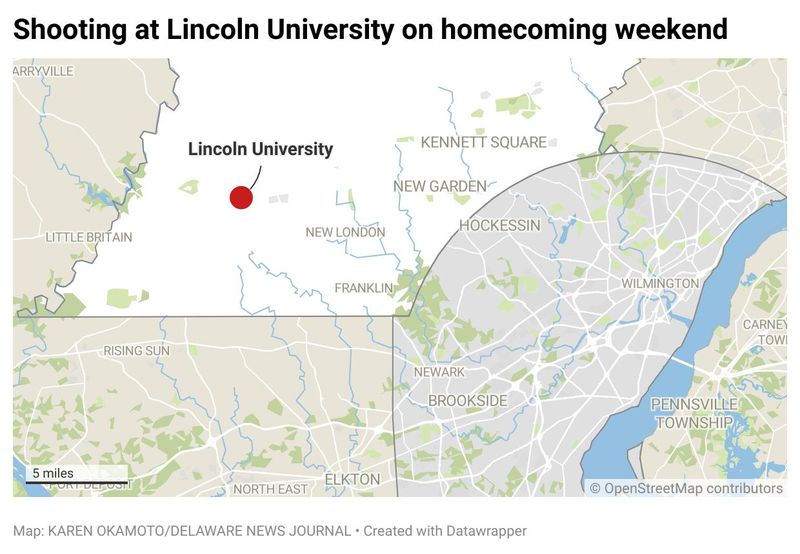
    The shots rang out about 9:30 p.m. Saturday on the campus in Lower Oxford Township. De Barrena-Sarobe has said he does not believe the shooting was a coordinated attack targeting the school, but instead took place as the crowd swelled on the campus.

    The motive for the shooting remained under investigation.

    Gunfire rang out just before 9:30 p.m. Oct. 25 at Lincoln University in the parking lot of the International Cultural Center in Lower Oxford Township in Chester County, Pennsylvania. The university is about 15 miles from Hockessin.

    Jujuan Jeffers, 20, of Wilmington, died after being shot in the head. It was unclear if Jeffers had any affiliation with Lincoln — investigators have said the victims included one alumnus and one current student.

    Jeffers’ brother declined to speak with a reporter when contacted Monday.

    The student who was hurt was recovering well, but obviously shaken, according to Chester County Commissioner Josh Maxwell, who is an adjunct professor at the school. Her injuries, he said, were not life-threatening.

    Lincoln University canceled classes Monday in light of the shooting.

    “Gun violence happens far too often in our country, and we are heartbroken that Lincoln University and its students are among the latest victims of such senseless violence,” the school said in a statement.

    The rural campus was quiet Monday afternoon as students gathered for a vigil that gave members of the university community a chance to grieve and heal.

    The service was not open to the media, and gates at various entrances to Lincoln’s campus were locked.

    Geslande Sanne, a Lincoln University junior from Oregon, was in her dorm Monday morning, still coming to terms with the chaotic scene she experienced Saturday night.

    “A lot of us on campus are processing it in our own different ways,” said Sanne, a political science and French major. “We are all reaching out to each other. Our professors are talking to each other and to us. Some students went home to be with their families. Some people are just resting.”

    She said she intended to attend the university’s community healing session on campus at noon and later go to the hospital to visit her friend, who was the only Lincoln student shot during the incident.

    Sanne recalled that she and a group of friends were on the outskirts of the crowd when they heard gunshots.

    “Everybody started running and we started running, too,” she said. “We were confused. Did something really happen? After a few minutes, the music stopped, and we knew something really happened.”

    She and her friends made a plan to get back to their dorms so they would be safe, but then decided to seek shelter inside the International Cultural Center building, not far from where the shooting took place.

    After people started banging on the windows, she said, Sanne and her friends left there and walked carefully back to their dorms.

    It all happened in about 20 minutes, she estimated.

    Sanne said she chose to attend Lincoln because she wanted to go to an HBCU and was impressed by all its prominent graduates. She said she has received much encouragement and many opportunities at the school.

    “It’s really inspired me,” she said, “that I can be a part of something positive despite everything going on in the country.”

    She said she has always felt safe on Lincoln’s rural campus, safer than she does anywhere else. And Saturday night’s shooting hasn’t changed that.

    “It wasn’t Lincoln’s fault,” said Sanne, who wants to be an international lawyer. “We do the best we can with the resources we have. It shouldn’t be an excuse to leave or disinvest in Lincoln. It’s a reason to pour in more resources and support these schools even more.”

    Staff writer Jesse Bunch contributed to this article.

  • Expect the Eagles to make a trade before the deadline — just not A.J. Brown — and what else they’re saying

    Expect the Eagles to make a trade before the deadline — just not A.J. Brown — and what else they’re saying

    The Eagles avenged their Week 6 loss to the New York Giants with a dominant 38-20 win at Lincoln Financial Field. However, much of the dialogue following the game still focused on the drama surrounding star receiver A.J. Brown, who didn’t even play on Sunday. There was also talk about Jalen Hurts’ performance — and his return to the MVP conversation — and the questionable officiating in the Birds’ Week 8 win.

    Here’s a look at what they’re saying about the Eagles as they enter the bye week with a 6-2 record …

    A.J. Brown trade talk

    Brown sat out of Sunday’s game due to a hamstring injury. Despite his absence, the Eagles offense dominated, finishing the game with a season-high 427 total yards. DeVonta Smith remained the centerpiece of the Birds’ passing game, recording six receptions (on nine targets) for 84 yards.

    Everything came together for the Eagles, including the team’s previously spotty running game. The Birds recorded 276 yards on the ground, with Saquon Barkley eclipsing 100 rushing yards for the first time this season.

    With all the drama surrounding Brown’s latest social media posts and the team’s success without him on the field, there’s already even more discussion centered on whether the team should trade the receiver.

    “The only thing that gets or punctures momentum and a loaded roster is drama,” Colin Cowherd said on The Colin Cowherd Podcast. “And I’m watching them today and I’m like oh [expletive]. They almost have 300 yards rushing. Some of this is tied to A.J. Brown’s absence. They’re just free to do what they want to do. … I just don’t think this team needs A.J. Brown.”

    However, on Sunday, ESPN’s Adam Schefter reported that the Eagles would not trade the three-time Pro Bowler ahead of the Nov. 4 trade deadline. He reinforced that notion Monday.

    “They’re not going to trade A.J. Brown,” Schefter said on ESPN’s Get Up. “Here’s the deal. They’re trying to repeat as a Super Bowl champion. They’re in the business of acquiring talent, not giving it away. And whatever they can get back for A.J. Brown, they can get back in February or March before the draft. They’re going to want him here to help the stretch run after the big win here, he’s not going to get traded.”

    But he does believe the team will eventually make some moves moving forward.

    “The Eagles don’t play again until two weeks from today in Green Bay,” Schefter said. “… If the Eagles don’t make a move to better their roster between now and then, I’d be surprised. That’s what they do. They’re always active. They’re always aggressive and they’re going to be that way again. I’ll be surprised if in the next two weeks, the Eagles haven’t pulled off at least one trade.”

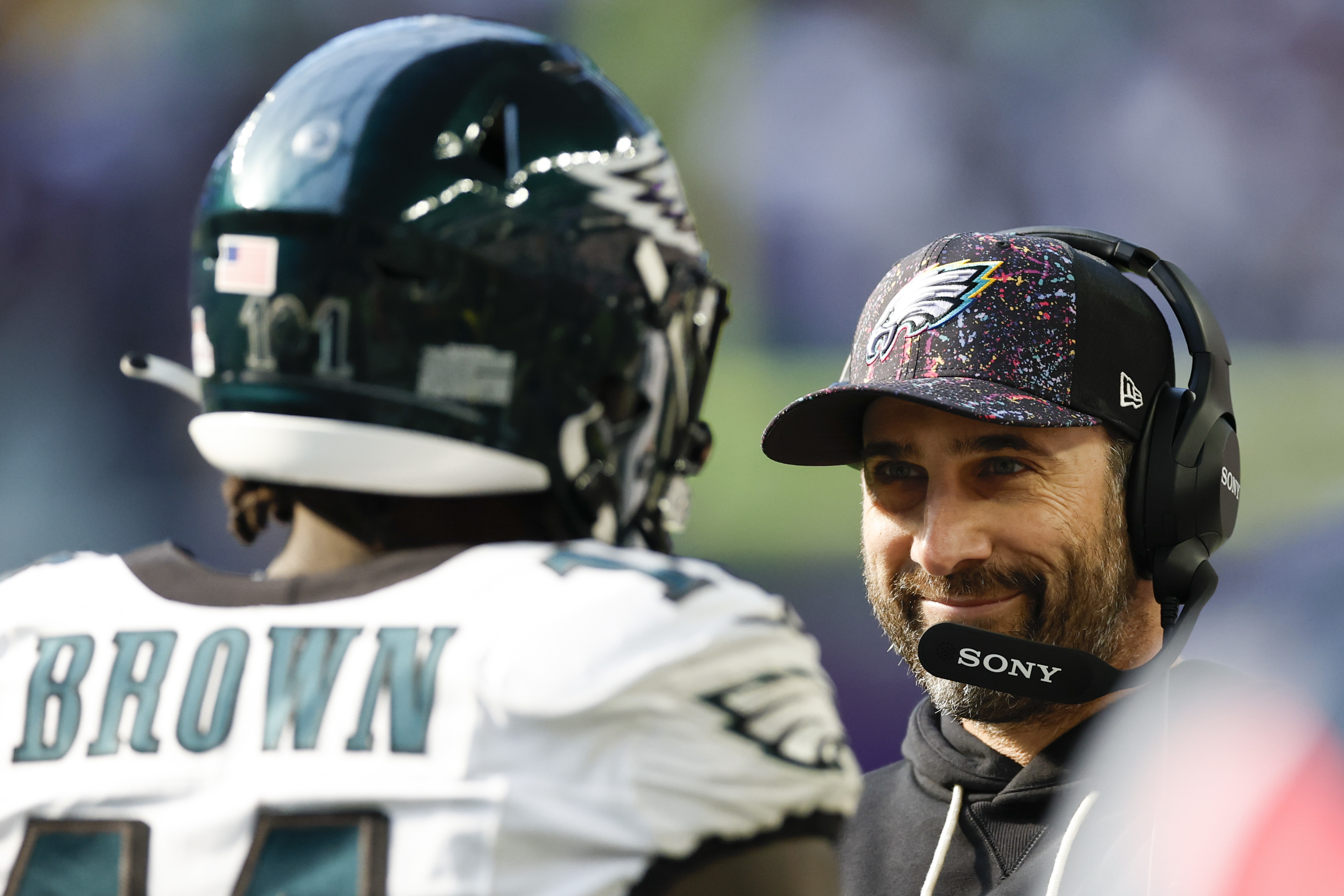
    Eagles wide receiver A.J. Brown, who had a big game in Week 7 against the Vikings, didn’t play in Sunday’s game against the Giants due to a hamstring injury.

    Hall of Fame advice for Brown

    Former New York Jets coach Rex Ryan asked Hall of Fame quarterback Peyton Manning about the Brown situation on ESPN’s Sunday NFL Countdown. Manning did his best to offer advice to the team.

    “I hate what’s going on there in Philly, it’s not fun to watch,” Manning said. “People always ask, ‘Hey, why did Marvin Harrison never complain about not getting the ball?’ Because I always threw him the ball.

    “I hated the fact that A.J. Brown doesn’t seem happy and they’re winning football games. I would tell A.J. the grass isn’t always greener on the other side. There’s certain teams that if he wanted to go play for right now, I can promise you he would not be happy there. The Eagles are 5-2, they won the Super Bowl last year, there’s big games for him coming. … He’s not going to have 10 catches for 160 every single week, but if he just stays in there, I can promise you good things are coming.”

    Controversial officiating

    There were a few questionable calls in Sunday’s game, including a potential Tush Push fumble. Hurts was stripped of the ball while running the Eagles’ signature sneak play, but the officials ruled that the quarterback’s forward progress had been stopped. The play couldn’t be reviewed and the Eagles kept the ball. Here’s a look at what happened.

    The Eagles scored two plays later. Former Eagles defensive end Chris Long discussed the ruling on the Green Light podcast.

    “I thought the Giants got robbed on the Tush Push,” Long said. “Certainly, the game plays out a little bit differently in sequence if that changes. But, the whistle was the whistle. And that’s the problem. I see so many Tush Pushes where the forward progress is three, four, five seconds. I understand the case that Giants fans would make that Thibodeaux pulled that ball out. And I think he did. I think he did. Didn’t go their way.”

    Hurts back in the MVP discussion?

    Hurts still found plenty of success through the air — completing 15 of 20 passes for 179 yards and four touchdowns — despite Brown being sidelined. The quarterback now has 15 passing touchdowns, five rushing touchdowns, and just one interception through eight games.

    Over his last two games, Hurts has thrown seven touchdown passes — and just nine incompletions. Numbers like those are enough for former Eagles linebacker Emmanuel Acho to put Hurts in the running for MVP.

    “Jalen Hurts has to be in the MVP conversation,” Acho said on the Speakeasy talk show. “I’m watching the game today and I’m thinking to myself, wait a second. In the midst of all the wide receiver distractions — and sometimes disregard the distractions — in the midst of the absence of A.J. Brown, you go out there and you get four touchdowns vs. a New York Giants team that’s incredibly hungry.

    “You ain’t got A.J. Brown. So, you go out there and you do it with [Smith], Jahan Dotson, and Dallas Goedert. You’re finally starting to get active. The week before you go out there and you get three touchdowns with no interceptions. Now, all of a sudden Jalen Hurts has 15 passing touchdowns — these are not Tush Push touchdowns, people, 15 passing touchdowns — and five rushing touchdowns to just one interception. These are MVP-type numbers.”