Tower Health had an operating loss of $16 million in the first six month of fiscal 2026, according to its report to bondholders Friday. In the same period a year ago, the Berks County nonprofit’s loss was $16.1 million.
Here are some details:
Revenue: Revenue from patient care rose less than 1% to $889.3 million, while total revenue climbed 4.3% to $1.03 billion, thanks to a 34% increase in other revenue.
Cash reserves: Tower reported $244 million in cash reserves on Dec. 31. That translates into enough money to keep operating for 44 days without any new revenue. Both of those figures were at their highest levels since 2022.
The quarterly low was in March 2024, when Tower reported $153 million in cash. That amounted to 30 days of cash on hand. Financially strong systems often have 200 days in reserve.
The Justice Department’s efforts to prosecute President Donald Trump’s critics entered a new phase this week, when federal prosecutors failedto indict six Democratic lawmakers who recorded a video reminding military service members of their duty to refuse illegal orders.
Department lawyers, under pressure from the president, previously targeted several of Trump’s most outspoken foes, including former FBI director James B. Comey and New York Attorney General Letitia James. Both faced since-dismissed charges last year over alleged conduct unrelated to their politicalviews.
But the case federal prosecutors put before a grand jury Tuesday — seeking to charge Sens. Mark Kelly (D., Ariz.), Elissa Slotkin (D., Mich.) and four others over their90-secondvideo message — marked the first time the department has directly soughtto classify critical speech from prominent Trump detractors as a crime.
The other lawmakers who participated in the video included Reps. Jason Crow, a former Army ranger from Colorado, and Maggie Goodlander, a Navy veteran from New Hampshire, as well as Chrissy Houlahan, a former Air Force officer, and Chris Deluzio, a former Navy officer, both from Pennsylvania.
Grand jurors roundly rejected the effort, the Washington Post reported. But legal observers and the lawmakers at the center of the probe have argued in the days since that the panel’s decision is almost beside the point.
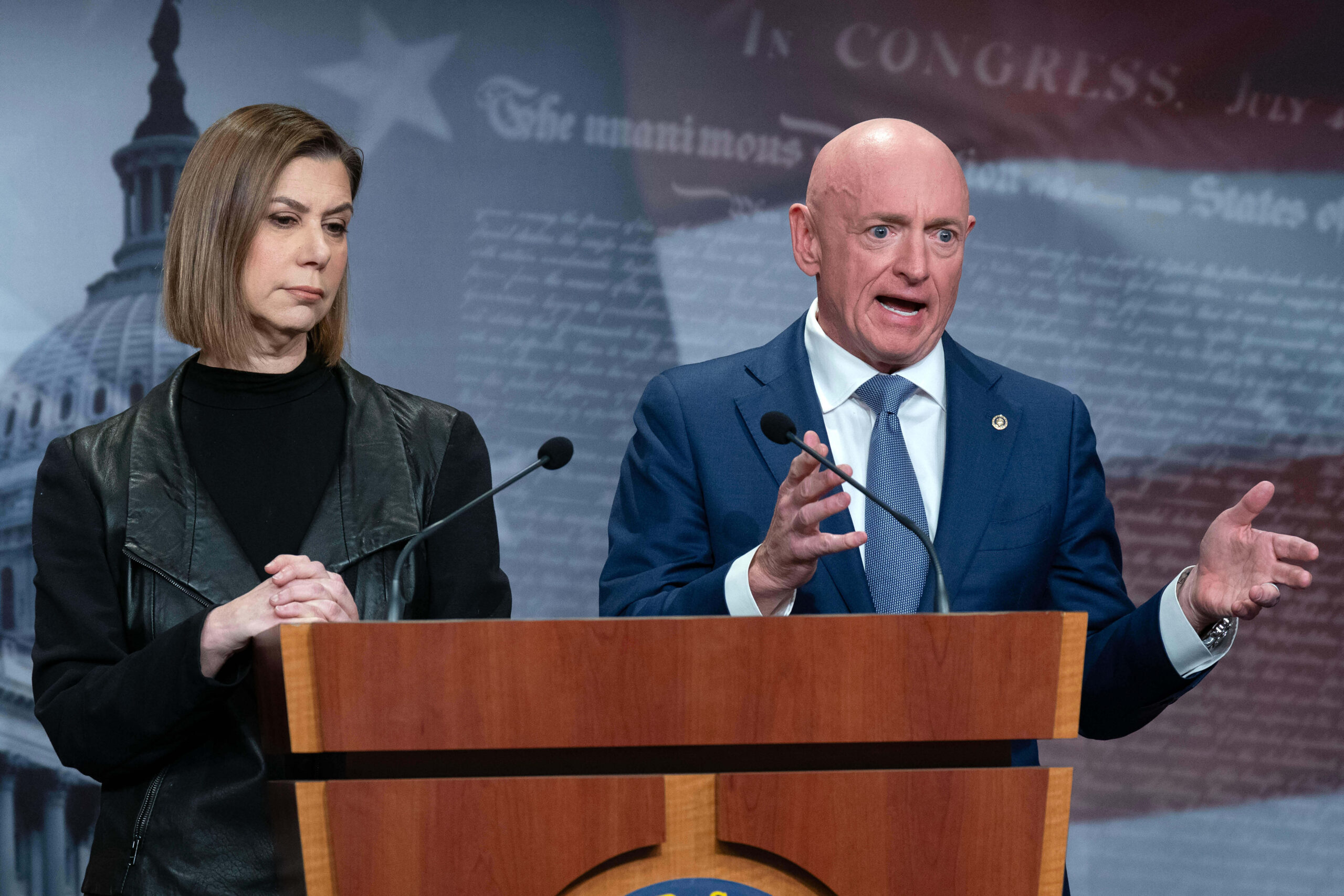
Rep. Elissa Slotkin (D., Mich.) and Sen. Mark Kelly (D., Ariz.) speak during a news conference Wednesday on Capitol Hill.
“This is not a good news story,” Kelly, a retired Navy captain and astronaut, told reporters during a news conference this week. “This is a story about how Donald Trump and his cronies are trying to break our system to silence anyone who lawfully speaks out against them.”
The attempt to charge the lawmakers represents an evolution of the campaign that began last year with cases against James and Comey, said Brendan Nyhan, a professor of government at Dartmouth College.
“Prosecuting people for speech criticizing the president is in some ways even more dangerous,” Nyhan said, “especially given these are legislators acting in their public role and especially given that they were calling for the military and national security state to follow the law.”
Still, some Trump allies in Congress, including House Speaker Mike Johnson (R., La.), defended the administration’s efforts. He told reporters that Slotkin, Kelly, and the others “probably should be indicted.”
“Any time you’re obstructing law enforcement and getting in the way of these sensitive operations, it’s a very serious thing, and it probably is a crime,” he said.
The Justice Department’s criminal investigation intothe lawmakers began after the video organized by Slotkin, a former CIA analyst, was posted online in November. In it, she and the others, all of whom served in the military or with intelligence agencies, reminded service members of their duty, spelled out in the Uniform Code of Military Justice, to resist unlawful directives.
“This administration is pitting our uniformed military and intelligence community professionals against American citizens,” the lawmakers said. “Our laws are clear. You can refuse illegal orders.”
The video did not single out any specificTrump administrationpolicies. But Slotkin and Kelly, both of whom serve on the Senate Armed Services Committee, have sharply criticized the president for military strikes he authorized on alleged drug trafficking boats in the Caribbean Sea and Pacific Ocean and his decision to deploy the National Guard to cities run by Democratic officials.
Their video drew an immediate reaction from Trump, who demanded on social media that the lawmakers face prosecution for sedition and suggested they should even, perhaps, be punished with execution.
“SEDITIOUS BEHAVIOR, punishable by DEATH!” Trump wrote in one social media post soon after the video was posted. He said in another: “IT WAS SEDITION AT THE HIGHEST LEVEL, AND SEDITION IS A MAJOR CRIME.”
Rep. Chrissy Houlahan, a former Air Force officer and a Democrat who represents Chester County, was one of six lawmakers targeted over a 90-second video message.
The messages echoed another Trump post from last year in which he, in a missive addressed to “Pam,”an apparent reference to Attorney General Pam Bondi, insisted the Justice Department move swiftly to prosecute Comey, James, and others.
“We can’t delay any longer, it’s killing our reputation and credibility,” he wrote then, adding, “JUSTICE MUST BE SERVED, NOW!!!”
Within months,James was indicted on counts of mortgage fraud, while Comey was charged with lying to Congress. Both denied the accusations and their cases were later dismissed by a federal judge over technicalissues with the appointment of the prosecutor who had charged them.
Slotkin, Kelly, and the other lawmakers have maintained they did nothing wrong — even as top administration officials have accused them of using the video to encourage service members to take actions tantamount to mutiny.
Earlier this month, four of the lawmakers in the video disclosed that they had been approached by FBI agents and declined to give voluntary interviews to prosecutors.
“It was clearly, when our lawyers sat down with them, just about checking a box and doing what the president wanted them to do,” Slotkin said Wednesday. “Their heart wasn’t even in it.”
It is not clear whether the FBI took other steps to investigate. But on Tuesday, prosecutors under the supervision of D.C.’s U.S. Attorney Jeanine Pirro, a former Fox News host and staunch Trump ally, presented a case against the lawmakers to the grand jury.
Two political appointees led that presentation, according to two people familiar with the matter who spoke on the condition of anonymity to describe sealed court proceedings.
The prosecutors — Steven Vandervelden, a former colleague of Pirro’s in the district attorney’s office in Westchester, New York, and Carlton Davis, a former staffer for House Oversight Committee Chairman Rep. James Comer (R., Ky.) — sought to charge the lawmakers with a felony crime that makes it illegal to “interfere with, impair, or influence the loyalty, morale, or discipline of the military or naval forces of the United States,” the people said.
But when it came time to vote, none of the grand jurors agreed there was sufficient probable cause to charge any of the lawmakers with a crime, one of the people familiar said.
Spokespeople for the Justice Department and for Pirro have declined to comment on the matter in the days since. Amid that silence,the effort has drawn an impassioned response from Capitol Hill.
“The fact that they failed to incarcerate a United States senator should not obviate our outrage,” Sen. Brian Schatz (D., Hawaii) said during a heated session Wednesday in which Democratic senators implored their Republican colleagues to openly condemn the Justice Department’s actions. Senate Democrats held a special caucus meeting Thursday morning to further discuss the situation.
“They tried to incarcerate two of us,” Schatz said. “I am not entirely sure the United States Senate can survive this if we do not have Republicans standing up.”
Sen. Thom Tillis (North Carolina) has emerged as one of the few Republicans to publicly rebuke the department. He described the failed attempt to prosecute as exactly the type of weaponization of the justice system that the Trump administration has said it is fighting against.
“Political lawfare is not normal, not acceptable, and needs to stop,” Tillis wrote in a post to X.
At their news conference Wednesday,Kelly told reporters that he and Slotkin learned about the attempt to indict them Tuesday through media reports.
“If things had gone a different way, we’d be preparing for arrest,” Slotkin said.
Since then, lawyers for several of the targeted lawmakers have sent letters to Pirro and Bondi seeking assurances that the investigation is over and that prosecutors will not seek to indict them again. They’ve also instructed the department to retain all records of the investigation threatening potential legal action for violating the lawmakers’ free-speech rights.
In a separate suit filed by Kelly, a federal judge Thursday halted Defense Department efforts to formally censure the senator over his video remarks, saying the effort to do so “trampled on Senator Kelly’s First Amendment freedoms and threatened the constitutional liberties of millions of military retirees.”
“The intimidation was the point — to get other people beyond us to think twice about speaking out,” Slotkin said Wednesday. “But the real question is if the president can do this to us — sitting senators — who else can he do it to?”
The Trump administration spent more than $40 million last year to send hundreds of migrants to at least two-dozen countries that are not their own, a tactic Senate Democrats described in a report Friday as a costly strategy aimed at sowing fear and intimidation in the president’s mass deportation campaign.
The 30-page analysis from the minority members of the Senate Foreign Relations Committee accuses the administration of entering into opaque financial agreements with foreign governments — including some with poor records on corruption and human rights — to rapidly expand a program for “third country” removals that once had been reserved for exceptional circumstances.
Its authors contend that the State Department has failed to conduct sufficient oversight to ensure that payments to those countries are not being misspent and that migrants transferred to their custody are not being abused or mistreated.
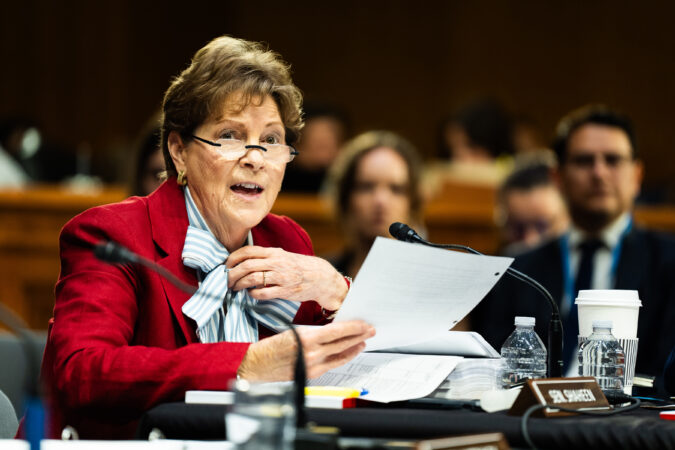
The administration “has expanded and institutionalized a system in which the United States urges or coerces countries to accept migrants who are not their citizens, often through arrangements that are costly, inefficient and poorly monitored,” Sen. Jeanne Shaheen of New Hampshire, the top Democrat on the committee, wrote in a letter to colleagues. “Deporting migrants to countries they have no connection to … has become a routine instrument of diplomacy.”
Administration officials have said they have no choice but to partner with foreign governments that are willing to accept undocumented immigrants whose native nations are not willing to take them back. In most cases, the migrants have criminal records, authorities said, though public records have shown that some have not been convicted of crimes in the United States.
The report from Senate Democrats, which provides the most comprehensive look at the administration’s third-country removal program, found that the U.S. government has sent migrants to two-dozen third countries. The analysis focused primarily on five nations — El Salvador, Equatorial Guinea, Rwanda, Eswatini, and Palau — with which the Trump administration has entered into direct financial payments totaling $32 million, a committee member involved in the report said. The person spoke on the condition of anonymity to discuss the analysis ahead of its release.
Under those agreements, U.S. authorities sent about 250 Venezuelan migrants to a maximum-security prison in El Salvador last spring, while 29 migrants have been deported to Equatorial Guinea, 15 to Eswatini, and seven to Rwanda, the report said. None has been sent to Palau.
The report also estimated that the administration has spent more than $7 million in costs related to deportation flights to 10 of the third countries.
“Millions of taxpayer dollars are being spent without meaningful oversight or accountability,” Shaheen wrote in her letter. “And speed and deterrence are being prioritized over due process and respect for human rights.”
Tommy Pigott, a State Department spokesman, said the report shows the “unprecedented” work the administration has undertaken in its first year to enforce immigration laws.
“Astonishingly, some in Congress still want to go back to a time just 14 months ago when cartels had free rein to poison Americans and our border was open,” Pigott said in a statement. “Make no mistake, President Trump has brought Biden’s era of mass illegal immigration to an end, and we are all safer for it.”
The third-country strategy has provoked public blowback and legal challenges that have slowed the administration’s efforts and, in some instances, forced it to change course.
Last spring, President Donald Trump invoked the Alien Enemies Act, a rarely used law targeting enemy combatants, which provided the administration’s legal rationale to send the Venezuelan migrants to El Salvador. Administration officials accused many of being members of the Tren de Aragua transnational gang, though some of their families and attorneys disputed that contention.
The men were later transferred from El Salvador to Venezuela under a prisoner swap. On Thursday, a federal judge in Washington ruled thatthe administration must bring some of the Venezuelan deportees back to the United States as they pursue legal challenges to their removals.
“It is worth emphasizing that this situation would never have arisen had the Government simply afforded Plaintiffs their constitutional rights before initially deporting them,” Chief U.S. District Judge James E. Boasberg wrote in his ruling.
The analysis from the Senate Foreign Relations Committee minority was put together over a period of more than eight months, based on conversations with foreign government and U.S. government officials, attorneys for deportees and immigrant rights organizations, according to the committee staffer.
The staffer said the goal of the report is to highlight the costs of the administration’s approach at a time when Democrats are concerned that the U.S. government is “entering a new phase” of speeding up the number of third-country agreements, along with the pace of deportations.
The report faults the administration for pursuing its deportation policies at the expense of other U.S. interests, including promoting human rights and punishing corrupt foreign regimes.
The authors said the Trump administration’s payment of $7.5 million to Equatorial Guinea to accept immigrants was more than the amount of foreign assistance the United States provided to that country in the previous eight years. They cited a 2025 State Department report on human trafficking that cited U.S. concerns about “corruption and official complicity in trafficking crimes” in that country.
The report also said the Trump administration was moving hastily to carry out third-country removals without trying to negotiate with the home countries of some deportees. In one case, a man initially deported to Eswatini was later sent to his home nation of Jamaica, where government officials said they had never told the United States that they were unwilling to accept him.
“As a result, the Trump Administration has, in some cases, paid twice for migrants’ travel — once to remove them to a third country and then again to fly them to their home country,” the report says.
As such, Philly is also a pretzel town, Jim Mueller says. While he was growing up in Northeast Philadelphia in the late 1990s, soft-pretzel bakeries dotted neighborhoods across the city. He and his family bought pretzels from the now-closed Ben Franklin Pretzels on Kensington Avenue near Ontario as well as Federal Pretzel Baking Co. at Seventh and Federal.
Jim Mueller with pretzels at Pretzel Day Pretzels.
Five years ago, Mueller was working as a UX designer and was craving a fix. “It kind of hit me that there were no pretzels to be gotten that weren’t straight from the [Philly] Pretzel Factory,” Mueller said of the ubiquitous Bensalem-based franchise. “I wanted to make them the way I remembered them tasting: buttery, rich, and flavorful.”
Mueller began studying recipes, and he and his wife, Annie, started a side project called Pretzel Day Pretzels. They began doing pop-ups and deliveries.
Jim Mueller pulls pretzels with long hots and provolone from the oven at Pretzel Day Pretzels.
On Saturday, Pretzel Day Pretzels went the brick-and-mortar route at Fifth and Dickinson Streets in South Philadelphia, opening at the former Milk & Sugar space with a simple setup: takeout only and morning-to-early-afternoon hours.
Mueller rolls and bakes standard-issue soft pretzels, but his specialties are stuffed pretzels and German varieties that you don’t really see around here, particularly Swabian pretzels.
Jim Mueller stuffs pretzels with long hots and provolone at Pretzel Day Pretzels.Pretzels are tossed with cinnamon sugar at Pretzel Day Pretzels.
“It’s a little different from a Bavarian,” Mueller said. “Bavarians are what most people are familiar with — thick all around. Swabians have a big belly and skinny arms, and the arms get a little crunch to them. You can split the belly and stuff them. You can do more with them than a regular pretzel, and it opens up a lot of possibilities to experiment.”
Stuffing is where Pretzel Day Pretzels leans hardest into variety. The most popular option is the long hot-provolone pretzel, with other offerings including chili pretzels, pizza pretzels, bialys, cinnamon-sugar pretzels, and, on some days, pretzel dogs and Bavarian cheese logs. The lineup will shift slightly week to week, Mueller said, “but we’ll always have the core stuff.”
Merch on display at Pretzel Day Pretzels.
Saturday’s opening was low-key, with small giveaways such as heart-shaped pretzels and tote bags. The shop will offer coloring pages for kids that can be redeemed for a free pretzel.
“I just want it to be a pretzel shop for everyone,” Mueller said. “I don’t want it to feel high-end or bougie — just a neighborhood pretzel shop.”
As he sees it, Pretzel Day is meant to feel less like a concept and more like a missing piece put back into place.
“You always hear that Philadelphia’s a pretzel town,” he said. “But then you think — where are all the pretzel shops? I never thought I’d open one when I started doing this, but here we are.”
Pretzel Day Pretzels, 1501 S. Fifth St., instagram.com/pretzeldaypretzels. Hours: 8 a.m. to 3 p.m. Wednesday through Saturday, and 8 a.m. to 1 p.m. Sunday.
Pretzels from the oven at Pretzel Day Pretzels on Feb. 12, 2026.
The Flyers are bringing Scranton to Philadelphia, with the NHL’s first theme night celebrating The Office.
On March 14 against the Columbus Blue Jackets, the Flyers will pay tribute to one of NBC’s most iconic TV shows to celebrate the network’s 100th anniversary.
The night will include clips from the show on the videoboard, specialty food and beverage offerings, Gritty tie-ins, and (probably) a giveaway or special ticket package of some kind to be announced at a later time.
The Flyers will be hosting a special “The Office” theme night to celebrate the hit NBC show.
“The Philadelphia Flyers are honored to partner with Peacock to celebrate The Office, an iconic piece of NBC’s legacy 100 years in the making,” said Flyers chief revenue and business officer Todd Glickman in a statement. “It’s happening! Everybody stay calm!”
While The Office has been off the air since May 2013, when it ended its nine-season run, it remains popular. NBC launched a spinoff called The Paper, which premiered on Peacock in the fall and stars Domhnall Gleeson and Oscar Nuñez, who reprises his role of Oscar Martinez from the original series. The Paper, which follows a small Midwestern newspaper, is expected to return for a second season in the fall.
Other forthcoming theme nights include Fourth Wing Night, PGA Championship Night, and Margaritaville Night. The Flyers will also host Philadelphia’s last remaining Dollar Dog Night on March 24.
WASHINGTON — A shutdown for the Department of Homeland Security appeared certain Thursday as lawmakers in the House and Senate were set to leave Washington for a 10-day break and negotiations with the White House over Democrats’ demands for new restrictions had stalled.
Democrats and the White House have traded offers in recent days as the Democrats have said they want curbs on President Donald Trump’s broad campaign of immigration enforcement. They have demanded better identification for U.S. Immigration and Customs Enforcement and other federal law enforcement officers, a new code of conduct for those agencies and more use of judicial warrants, among other requests.
The White House sent its latest proposal late Wednesday, but Trump told reporters on Thursday that some of the Democratic demands would be “very, very hard to approve.”
Democrats said the White House offer, which was not made public, did not include sufficient curbs on ICE after two protesters were fatally shot last month. The offer was “not serious,” Senate Democratic Leader Chuck Schumer of New York said Thursday, after the Senate rejected a bill to fund the department.
Americans want accountability and “an end to the chaos,” Schumer said. “The White House and congressional Republicans must listen and deliver.”
Lawmakers in both chambers were on notice to return to Washington if the two sides struck a deal to end the expected shutdown. Sen. Patty Murray, the top Democrat on the Senate Appropriations Committee, told reporters that Democrats would send the White House a counterproposal over the weekend.
Impact of a shutdown
Senate Majority Leader John Thune, R-S.D., said after the vote that a shutdown appeared likely and “the people who are not going to be getting paychecks” will pay the price.
The impact of a DHS shutdown is likely to be minimal at first. It would not likely block any of the immigration enforcement operations, as Trump’s tax and spending cut bill passed last year gave ICE about $75 billion to expand detention capacity and bolster enforcement operations.
But the other agencies in the department — including the Transportation Security Administration, the Federal Emergency Management Agency, the Secret Service and the Coast Guard — could take a bigger hit over time.
Gregg Phillips, an associate administrator at FEMA, said at a hearing this week that its disaster relief fund has sufficient balances to continue emergency response activities during a shutdown, but would become seriously strained in the event of a catastrophic disaster.
Phillips said that while the agency continues to respond to threats like flooding and winter storms, long-term planning and coordination with state and local partners will be “irrevocably impacted.”
Trump defends officer masking
Trump, who has remained largely silent during the bipartisan talks, noted Thursday that a recent court ruling rejected a ban on masks for federal law enforcement officers.
“We have to protect our law enforcement,” Trump told reporters.
Democrats made the demands for new restrictions on ICE and other federal law enforcement after ICU nurse Alex Pretti was shot and killed by a U.S. Border Patrol officer in Minneapolis on Jan. 24. Renee Good was shot by ICE agents on Jan. 7.
Trump agreed to a Democratic request that the Homeland Security bill be separated from a larger spending measure that became law last week. That package extended Homeland Security funding at current levels only through Friday.
Schumer and House Democratic leader Hakeem Jeffries of New York have said they want immigration officers to remove their masks, to show identification and to better coordinate with local authorities. They have also demanded a stricter use-of-force policy for the federal officers, legal safeguards at detention centers and a prohibition on tracking protesters with body-worn cameras.
Democrats also say Congress should end indiscriminate arrests and require that before a person can be detained, authorities have verified that the person is not a U.S. citizen.
Thune suggested there were potential areas of compromise, including on masks. There could be contingencies “that these folks aren’t being doxed,” Thune said. “I think they could find a landing place.”
But Republicans have been largely opposed to most of the items on the Democrats’ list, including a prohibition on masks.
Sen. Eric Schmitt, R-Mo., said Republicans who have pushed for stronger immigration enforcement would benefit politically from the Democratic demands.
“So if they want to have that debate, we’ll have that debate all they want,” said Schmitt.
Judicial warrants a sticking point
Thune, who has urged Democrats and the White House to work together, indicated that another sticking point is judicial warrants.
“The issue of warrants is going to be very hard for the White House or for Republicans,” Thune said of the White House’s most recent offer. “But I think there are a lot of other areas where there has been give, and progress.”
Schumer and Jeffries have said DHS officers should not be able to enter private property without a judicial warrant and that warrant procedures and standards should be improved. They have said they want an end to “roving patrols” of agents who are targeting people in the streets and in their homes.
Most immigration arrests are carried out under administrative warrants. Those are internal documents issued by immigration authorities that authorize the arrest of a specific person but do not permit officers to forcibly enter private homes or other nonpublic spaces without consent. Traditionally, only warrants signed by judges carry that authority.
But an internal ICE memo obtained by The Associated Press last month authorizes ICE officers to use force to enter a residence based solely on a more narrow administrative warrant to arrest someone with a final order of removal, a move that advocates say collides with Fourth Amendment protections.
Far from agreement
Thune, R-S.D., said were “concessions” in the White House offer. He would not say what those concessions were, though, and he acknowledged the sides were “a long ways toward a solution.”
Schumer said it was not enough that the administration had announced an end to the immigration crackdown in Minnesota that led to thousands of arrests and the fatal shootings of two protesters.
“We need legislation to rein in ICE and end the violence,” Schumer said, or the actions of the administration “could be reversed tomorrow on a whim.”
Simmering partisan tensions played out on the Senate floor immediately after the vote, as Alabama Sen. Katie Britt, the chairwoman of the Senate Appropriations subcommittee that oversees Homeland Security funding, tried to pass a two-week extension of Homeland Security funding and Democrats objected.
Britt said Democrats were “posturing” and that federal employees would suffer for it. “I’m over it!” she yelled.
Connecticut Sen. Chris Murphy, the top Democrat on the Homeland spending subcommittee, responded that Democrats “want to fund the Department of Homeland Security, but only a department that is obeying the law.”
“This is an exceptional moment in this country’s history,” Murphy said.
WASHINGTON — A key measure of inflation fell to nearly a five-year low last month as apartment rental price growth slowed and gas prices fell, offering some relief to Americans grappling with the sharp cost increases of the past five years.
Inflation dropped to 2.4% in January compared with a year earlier, down from 2.7% in December and not too far from the Federal Reserve’s 2% target. Core prices, which exclude the volatile food and energy categories, rose just 2.5% in January from a year ago, down from 2.6% the previous month and the smallest increase since March 2021.
Friday’s report suggests inflation is cooling, but the cost of food, gas, and apartment rents have soared after the pandemic, with consumer prices still about 25% higher than they were five years ago. The increase in such a broad range of costs has kept “affordability,” a topic that helped shape the most recent U.S. presidential election, front and center as a dominant political issue.
And on a monthly basis, consumer prices rose 0.2% in January from December, while core prices rose 0.3%. Core inflation was held down by a sharp drop in the price of used cars, which fell 1.8% just in January from December.
“Inflation continues to decelerate and is not threatening to move back up, and that will enable more rate cuts by the Fed,” said Luke Tilley, chief economist at Wilmington Trust.
There were signs in the report that retailers are passing on more of the costs of President Donald Trump’s tariffs to consumers for goods such as furniture, appliances, and clothes. But those increases were offset by falling prices elsewhere. In other areas, Trump has delayed, scrapped, or provided exemptions to his duties.
Furniture prices jumped 0.7% in January from the previous month and are up 4% from a year ago. Appliances rose 1.3% in January though are only slightly more expensive than a year earlier. Clothing price rose 0.3% in January from December and have increased 1.7% in the past year.
Some services prices also rose: Airline fares soared 6.5% just in January, after a 3.8% jump in November, though they rose only 2.2% from a year earlier. Music streaming subscriptions increased 4.5% in January and are 7.8% higher than a year ago.
Yet those increases were largely offset by price declines, or much slower price growth, in other areas, including many that make up a greater share of Americans’ spending.
The cost of used cars, for example, plunged 1.8% in January, the biggest decline in two years. Gas prices fell 3.2% last month, the third drop in the past four months, and are down 7.5% from a year earlier. Grocery prices rose just 0.2% in January, after a big 0.6% rise in December, and are up 2.1% from a year ago. Hotel prices ticked down 0.1% in January and have fallen 2% from last year.
Rental prices and the cost of owning a home, which make up a third of the inflation index, both rose just 0.2% in December, while rents increased only 2.8% from a year earlier. That is much lower than during the pandemic: Rents rose by more than 8% in 2022.
The tariffs have increased some costs and many economists forecast companies will pass through more of those increases to consumers in the coming months. A study released Thursday by the Federal Reserve Bank of New York found that U.S. companies and consumers are paying nearly 90% of the tariffs’ costs, echoing similar findings in studies by Harvard and other economists.
Yet the increases haven’t been as broad-based as many economists feared.
Tilley said that the higher tariffs have pulled some consumer spending away from other services, which has forced companies to keep those prices a bit lower as a result.
“We don’t think consumers are in a place to take on price increases across the board, so you’re not seeing those price increses,” he said. Hiring was particularly weak last year, slowing wage growth, and many Americans remain gloomy about the economy.
Some economists note that the rental figures were distorted by October’s six-week government shutdown, which interrupted the Labor Department’s gathering of the data. The government plugged in estimated figures for October which economists say have artificially lowered some of the housing costs.
Companies are still grappling with the higher costs from Trump’s duties, though some have benefited from tariffs being delayed or scrapped.
Arin Schultz, chief growth officer at Naturepedic, which makes organic mattresses in Cleveland, breathed a sigh of relief when Trump postponed import duties on upholstered furniture until 2027. They would have substantially pushed up the cost of the headboards the company imports.
Schultz welcomed the decision to lower tariffs on imports from India to 18%, from 50%. Naturepedic sources a lot of the cotton fabrics and bedding that it sells from India. When that reduction kicks in, he said, the company could even cut some prices.
Still, Naturepedic’s costs jumped because of duties on imports from Vietnam and Malaysia, where it sources its organic latex, which can’t be grown in the United States. Naturepedic makes its mattresses in the United States at a factory in Cleveland and employs about 200 workers.
“We’re paying more now for that,” he said, and the company raised its prices about 7% last year as a result. “Tariffs are awful. We are less profitable now as a company because of tariffs.”
If inflation gets closer to the Federal Reserve’s target of 2%, it could allow the central bank to cut its key short-term interest rate further this year, as Trump has repeatedly demanded. High borrowing costs for things like mortgages and auto loans have also contributed to a perception that many big-ticket items remain out of reach for many Americans.
Inflation surged to 9.1% in 2022 as consumer spending soared as supply chains snarled after the pandemic. It began to fall in 2023 but leveled off around 3% in mid-2024 and remained elevated last year.
At the same time, measures of wage growth have declined as hiring has cratered. With companies reluctant to add jobs, workers don’t have as much leverage to demand raises.
The Franklin Institute has welcomed its newest exhibit with the world premiere of “Universal Theme Parks: The Exhibition.”
The 18,000-square-foot exhibit — which opened Saturday — takes visitors behind the scenes of the country’s billion-dollar theme-park industry through an expansive collection of costumes, immersive photo opportunities, and park props.
The exhibit has eight galleries, 20 interactive components, and 100 theme park-related artifacts ranging from actor show props to model roller coasters.
Young Lachlan McMahon poses for a photo at the Franklin Institute’s newest exhibit, “Universal Theme Parks: The Exhibition,” on Thursday.
At an early showcase Thursday, those behind the exhibit touted it as a “first-of-its-kind look” that would “[immerse] guests in the creative process that brings Universal’s most iconic experiences to life.”
“At the institute, I think we are really a leader in bringing exhibitions that educate, but they do it while entertaining,” said Larry Dubinski, president and CEO of the Franklin Institute.
“We wanted to create an exhibit in which we could teach some interesting things about engineering, design, jobs that are in a booming business, like theme parks, and [inspire] that curiosity and creativity.”
Kyra Zamborsky (left) and Jade Beasley at the Franklin Institute’s new exhibit that pays homage to Universal’s theme parks, in Philadelphia, on Feb. 12, 2026.
Among the goals of the exhibit was to package science and technology learning in an accessible way.
“History and science and technology — these things need to be wrapped in a layer of immersion that gets today’s kids excited,” said Dan Picard, owner and chief creative officer of creative design firm MDSX. “Because they don’t want to walk through a place that’s boring. … If you do not have a vibe, you’re not going to sell tickets, you’re not going to connect with kids, and you’re not going to have a shot to create that spark that makes them curious about these topics.”
Created in partnership between the Franklin Institute and Comcast NBCUniversal, the exhibit opens with a video featuring legendary filmmaker Steven Spielberg that uses archival footage to take visitors through the history of Universal’s theme parks.
From there, visitors will find a collection of galleries showcasing all aspects of the theme-park universe. There is a station on the science of roller-coasters, including models of real-life coasters, as well as costumes worn by park workers.
Among the most popular stops on Thursday was a station that allowed users to program the movements of an animatronic figure from DreamWorks Animation’s How to Train Your Dragon. (The exhibit features other Universal attractions, including Jaws, The Wizarding World of Harry Potter, and Jurassic World.)
Sprinkled throughout the exhibit are video interviews with those who make Universal’s theme parks tick — from costume designers to storyboard artists and creative directors.
“There’s so many opportunities for interactivity and creative storytelling,” said Abby Bysshe, chief experience and strategy officer at the Franklin Institute, of the draw to creating a theme park-related exhibit. “It was about kind of curating all these parts and pieces, and talking with their team members and finding ways to really highlight what makes Universal theme parks so special.”
At the new exhibit at the Franklin Institute that pays homage to Universal’s theme parks, in Philadelphia on Feb. 12, 2026.
“At the end of the day, our mission is to inspire and educate,” said Dubinski. “And here, people are going to be inspired, they’ll be educated — and they’ll have a great time as they go through.”
“Universal Theme Parks: The Exhibition,” runs through Sept. 7, 9:30 a.m. to 5 p.m. daily. Daytime tickets range from $41 for children to $47 for adults and include admission to the Franklin Institute.
Evening tickets, available from Thursday through Saturday, are $25 and limited to the Universal exhibit. Tickets at fi.edu, (215) 448-1200.
In the 1980s, baseball scout John Young noticed a declining share of Black or Latino draft prospects in his hometown of Los Angeles. With funding from Major League Baseball, he started a youth program dubbed “Reviving Baseball in Inner Cities” (RBI) to address the disparity in 1989.
RBI has since spread across the country, including Philadelphia, as baseball’s preeminent youth outreach program. The Phillies say their RBI program serves more than 6,000 children in the city and the surrounding region by providing organized baseball and softball leagues, free equipment, and game tickets to youth participants.
But contrary to RBI’s founding mission, Philadelphia’s program mostly serves the city’s predominantly white, middle-class neighborhoods in the Northeast.
“The programs we have in North Philadelphia are programs that save at-risk kids,” said Dave Fisher, who runs Tioga United Baseball. “The programs that they have in the Northeast are programs to evaluate and elevate the talent of their kids.”
Neither the Phillies nor Major League Baseball returned requests for comment.
The distribution of RBI teams reflects Philadelphia’s unequal youth sports landscape, confirmed by a recent city-funded study that found neighborhoods with more white residents had more fields, amenities in better shape, and more youth sports programs compared to other areas. In Northeast Philadelphia, there is simply more baseball: The Philadelphia Parks & Recreation Baseball league reflects a similar disparity of Northeast teams as the Phillies’ RBI leagues.
Several North Philadelphia coaches are part of Phillies RBI and say they have benefited from the league’s free equipment and clinics. But they say the program is a better fit for well-established teams that already have foundational needs met. Teams working against the tide of economic inequality, lower parental involvement, and children not being exposed to baseball early cannot recruit enough to play in the RBI league.
“You’ll find more parents who are financially able and culturally able to give baseball to their children at such a younger age of 6, 7, or 8,” said Fisher, who participates in RBI. “Kids at that age are groomed through baseball to be able to have batting coaches, pitching coaches, hitting coaches, fielding coaches.”
Phillies RBI offers noncompetitive leagues that introduce children ages 5 to 12 to baseball and softball as well as competitive leagues for children 13 and older. The program’s website says teams “must be located in an area that serves children who are unable to afford to play in an organized baseball league without assistance.”
David Lisby, who coaches the North Philly Camelots in Strawberry Mansion, was part of Phillies RBI but withdrew after six years because of a lack of players on his team. This past season, he was able to recruit only 15 children from three age brackets to make a single team.
Children ages 7 to 12 played in the inaugural season of the Catto Youth Baseball League, an offshoot of Phillies RBI.
“With the Phillies RBI program, I wasn’t seeing them coming down to really get the kids involved,” Lisby said.
Amos Huron, the executive director of the Anderson Monarchs in South Philadelphia — which does not participate in Phillies RBI — said the RBI program is more focused on areas where baseball is already played rather than introducing the sport to new players.
“There’s such wide swaths of the city where kids are never getting exposed to the game, and there’s only one entity in the city that has the baseball credibility and financial capacity to create a system that spreads across the city, and I think it’s a shame that they are not doing that,” he said.
Running a community baseball or softball program in Philadelphia is a grind. Coaches — many of whom are volunteers — maintain their own fields, recruit players, and take care of all the logistics in running a nonprofit on top of their on-field duties.
They say the Phillies could help with that.
“I did a lot of stuff on my own, a lot of stuff. Field stuff, cutting trees down,” said Tyrone Young, who founded and leads the Heritage Baseball League in North Philadelphia. “Anybody that didn’t have the drive that I have will probably get frustrated and give up if they didn’t have more support. More support can help.”
Young, who endorses the Phillies RBI program, also said it could sponsor more events and clinics to teach children baseball in North Philadelphia.
Phillies RBI offers noncompetitive leagues that introduce children ages 5 to 12 to baseball and softball as well as competitive leagues for those 13 and older.
Josh Throckmorton, a coach with Give and Go Athletics in Brewerytown and director of program development with the Philadelphia Youth Sports Collaborative, said coaches at smaller programs could benefit from off-field support, such as help with securing insurance and background checks.
“I think administrative support would be huge,” he said. “I think providing some training to help coaches for these really small programs market their programs and manage registration, I think that could be huge.”
This year, a small group of teams in North and West Philadelphia, organized by Germantown’s Urban Youth Kings and Queens and supported by the Phillies, formed a separate RBI group aimed at children ages 7 to 12. The subleague benefited programs like Throckmorton’s, which withdrew from the larger RBI league after finding its first-time players mismatched against other teams, he said.
The four teams in the league played eight games in the spring and some of the teams continued practicing into the summer. This spring, league organizers are seeking to double the number of teams and serve an additional 100 or more children between the ages of 6 and 9.
“We’ve already gotten outreach from families asking us when baseball season is going to start again,” Throckmorton said. “It did exactly what we were hoping for.”
Playing Fields, Not Killing Fields is an Inquirer collaboration with Temple’s Claire Smith Center for Sports Media and the Logan Center for Urban Investigative Reporting, to produce a series examining the current state of Philadelphia’s youth recreation infrastructure and programs. The project will explore the challenges and solutions to sports serving as a viable response to gun violence and an engine to revitalize city neighborhoods.
In over three decades years of coaching basketball at Plymouth Whitemarsh High School, Jim Donofrio had to convince one player to take a day off.
That’s Mani Sajid, now a 6-foot-4 senior shooting guard.
His resumé can attest to it. He has led the Colonials to an 19-5 record and the top seed in the District 1 Class 6A tournament. Plymouth Whitemarsh will host the winner of Friday’s game between Downingtown West and Central Bucks East on Tuesday.
Sajid also became Plymouth Whitemarsh’s all-time leading scorer, finishing with 1,686 points in the regular season, and is committed to play at Towson, where he will enroll early.
Donofrio said the coaches there will be lucky if they can get Sajid out of the gym.
“His natural work ethic is as high as any kid I’ve coached in 35 years,” Donofrio said. “His work ethic and drive is at that special level.”
Congratulations to @Manibuckets5 on becoming the all time leading scorer in PW Boys Basketball history tonight! 1649 and counting
Sajid recognizes that becoming the program’s all-time scoring leader is a great achievement, but he also wants to experience postseason success. The Colonials reached the district final last season, where they fell to Conestoga in overtime.
“I did have a chance for the scoring record, but that wasn’t my main goal,” Sajid said. “That just came as we played. [We are] just trying to win everything. Districts and state titles are our main goal as a team and the main goal for me.”
Plymouth Whitemarsh’s postseason did not start off as anticipated. The Colonials were upset, 45-43, by rival Upper Dublin in the semifinals of the Suburban One League tournament. But the Colonials were still the top-seeded team in the District 1 Class 6A bracket when it was revealed last Sunday.
The right ingredients
Chuck Moore Jr., an assistant with Plymouth Whitemarsh, has known Sajid since he was a middle schooler. Moore was a 1,500-point scorer at Plymouth Whitemarsh and graduated with Sajid’s father, Ayyaz, in 1997.
Moore, who runs an AAU program with his younger brother, Penn assistant Ronald Moore, would see Sajid’s father at tournaments and showcases. Every time the old classmates met, Ayyaz would try to convince Moore to train his son. Moore finally agreed the third time Ayyaz asked and arranged a session with Sajid at the Plymouth Whitemarsh gym.
“Right away, you could see the skill set,” Moore said. “He was already a long, lanky kid with long arms.”
He developed quickly in a year. By the time Sajid finished his eighth grade season and was entering high school, Moore knew his spot on PW’s scoring leaderboard was in jeopardy.
“I said, ‘Yeah, he’s going to be the all-time leading scorer one day,’” Moore said. “I could see it in him at that early age.”
Mani Sajid helped Plymouth Whitemarsh earn the No. 1 seed in the District 1 6A playoffs.
Donofrio confirmed that his assistant called Sajid’s ascent to the top.
“Chuck Moore, he predicted it when [Sajid] was a freshman,” Donofrio said. “He goes, ‘That’s the all-time leading scorer.’ I remember him saying it. Mani had the right stuff. He had the right ingredients.”
No time off
Those ingredients — a long, lanky frame and a natural shooting ability — do not guarantee success. They need to be combined with a solid work ethic. Sajid’s coaches say that the senior has that in abundance.
When Donofrio told Sajid to take a day off during the offseason, he ignored his coach’s order.
“I had to call his dad up a couple of summers ago and say, ‘He has to take a day off,” Donofrio said. “I said, ‘Please, take Sunday.’ It was in the summertime. And then I find out, not only did he not take Sunday off, he worked out twice that day.”
Sajid likes being in the gym as much as possible, which should benefit him as he transitions to Towson.
“It’s hard to get me out of the gym, man,” Sajid said. “I’m a guy that likes to go seven days a week, especially in the offseason. There really are no off days.”
Plymouth Whitemarsh assistant coach Chuck Moore Jr., said “right away” Mani Sajid had a strong skill set.
After last season’s run to the district final, Donofrio challenged Sajid to share the ball with his teammates more effectively.
“You’re going to score 26 points the hard way or the easy way,” Donofrio said. “If you get rid of the ball, you’re still scoring 26 points, only we’re going to win a lot more.”
It took Sajid some time to accept that piece of coaching, but once he did, he began to develop his skills as a passer.
“I think I just grew up more as a player, grew up more as a person,” Sajid said. “Just being able to trust those guys. I know that they always have my back, and I always have their backs. I trust them a lot.”
Transition to Towson
After emerging as a contributing piece for the Colonials as a sophomore, Sajid started to draw some attention from colleges. He fielded offers from Albany, St. Joseph’s, Temple, La Salle, East Carolina, Bryant, Penn State, and Towson before committing in July to play for the Tigers.
Sajid said he chose Towson for its coaching staff.
“They’ve just been really consistent,” he said. “They’ve been a great coaching staff. They hit me up often and always check up on me, and that’s what I like.”
Sajid, a three-star recruit, is the highest-ranked player of three signees in the Tigers’ class of 2026. Towson’s 2026 class also includes Neumann Goretti guard Stephon Ashley-Wright, the younger brother of BYU guard Robert Wright III.
Sajid hopes to see minutes early at Towson, which competes in the Coastal Athletic Association.
“That is my goal, to step on there freshman year and play,” Sajid said. “But I’ve got to work for that spot.”
Donofrio believes the most crucial part of Sajid’s college development is adding weight. He weighs about 170 pounds and will need to put on muscle to keep up with college players, especially on defense.
“He’s going to have to want to get more physical,” Donofrio said. “That’s his next challenge for this summer, into the fall. And he loves the weight room now, and he loves strength training and agility, conditioning. Hopefully he still loves Franzone’s pizza, because he should eat a lot of that to get about 8 to 10 more pounds on him.”
Mani Sajid looks to earn a district and state crown for Plymouth Whitemarsh.
His coach isn’t worried, though. Donofrio said Sajid could be a major talent at the next level.
“It would not surprise me at all if, by the end of his first college season, a lot of coaches are punching themselves in the head,” Donofrio said. “I’ve coached a lot of talented guys, and, trust me, the ceiling on him has got a ways to go.”